❌

Reading view

The quest to keep organs alive outside the body

This week, I covered a fascinating effort to preserve organs outside the body. There’s a huge shortage of donor organs, and one of the main reasons is time—they survive only a matter of hours outside the body, even when they’re kept on ice.

Doctors dream of organ banks—stores of human organs that can be preserved for days, weeks, months, or even longer. That would allow them to run tests on organs, find the best matches for them, and transport the organs to those recipients.

In new research, one team has been able to supercool the kidneys of pigs—animals whose organs are of a similar size to human ones—and preserve them for days. The kidneys survived being stored at −4 °C (25 °F) and eventually reimplanted back into pigs. And that’s just the latest development in a field that is positively buzzing.

It has proved super difficult to freeze organs. Once ice forms in them, they’re done. The ice crystals create all kinds of damage and render the organs unusable. That hasn’t stopped many researchers from trying.

Some have focused on cryopreservation—rapid extreme cooling that essentially leaves cells in a glasslike state. This process is now routine for eggs, sperm, and embryos, which are cooled to −196 °C in less than two seconds and can be used even after decades in storage.

No one has managed to cryopreserve and thaw human organs for transplantation. But plenty of human bodies and brains have been stored at ultra-low temperatures in the hope that they might one day be rewarmed and brought back to life. (You can read more about why some people opt for cryonics here.)

In March, I wrote about Stephen L. Coles, a gerontologist who had opted to cryopreserve his own brain. After the scientist died in 2014, his body was taken to Alcor, a cryonics facility in Arizona. A team at the facility removed Coles’s head, perfused his brain with cryoprotective chemicals (which work like antifreeze), removed the brain from the skull, and cooled it to −146 °C.

When Coles’s friend Greg Fahy, a cryobiologist, studied pieces of his brain years later, he found that the brain cells, which had shrunk, “bounced back” once they were rewarmed. But that doesn’t mean the cells are alive, or that it might one day be possible to reanimate the brain. As Matthew Powell Palm of Texas A&M told me at the time: “There are so many ways those neurons could be toast.”

Powell Palm is working on other ways to preserve organs. It was he, along with his colleagues, who managed to store supercooled pig kidneys and successfully transplant them, in a study described as “a landmark achievement.” Those organs did better than kidneys stored on ice, he says.

His approach didn’t require cryoprotectants. But other teams are exploring potential chemical cocktails that might allow them to store organs at lower temperatures, potentially for longer periods of time. (More on this in The Checkup soon!)

Another way to prolong the lifespan of an organ is to use a machine that perfuses it with nutrients, mimicking what happens inside the body. Machine perfusion devices have become more commonly used over the last decade or so and are typically used to maintain livers and kidneys for up to about 24 hours.

Researchers are now adapting this protocol for a growing list of organs, even eyeballs—a recent feat that might enable whole-eye transplants. In March, I went to visit scientists in Valencia who had developed a perfusion system for uteruses. They had used their device—which they nicknamed “Mother”—to keep a human uterus alive for a day.

It’s an exciting time for organ preservation. Keep an eye out for more coverage from MIT Technology Review in the coming weeks.

This article first appeared in The Checkup, MIT Technology Review’s weekly biotech newsletter. To receive it in your inbox every Thursday, and read articles like this first, sign up here.

  •  

The Morning Show Season 5 Will End the Apple TV Drama

The Morning Show Season 5 will officially conclude one of the longest-running and most recognizable dramas on Apple TV when it premieres in 2027.

Apple confirmed that the fifth season will be the last, allowing Jennifer Aniston, Reese Witherspoon and the creative team to complete the stories of Alex Levy, Bradley Jackson and the troubled journalists surrounding their fictional television network.

Aniston and Witherspoon will return as stars and executive producers. Both indicated that the ending was planned while the season was being developed, giving the writers an opportunity to create a deliberate conclusion rather than leaving the characters suspended after an unexpected cancellation.

Apple has not announced a specific premiere date or episode schedule. The company has released first-look images featuring Aniston and Witherspoon together, confirming that production on the final chapter is moving forward for a 2027 arrival.

The Morning Show Season 5 - Two women sit across from each other on blue chairs, engaged in conversation on The Morning Show set. A bouquet of flowers rests on the glass table between them, and a large screen is visible in the background, capturing the lively atmosphere of Apple TV's acclaimed series.
Image Credit: Apple Inc.

The Morning Show Season 5 Brings a Planned Ending

The Morning Show Season 5 was originally announced in September 2025, shortly before the fourth season premiered. At the time, Apple presented the renewal as another chapter for an established global hit without indicating that it would end the series.

The decision to identify it as the final season changes the expectations surrounding every storyline. Rather than creating another crisis that could lead into a sixth season, the writers can determine where the central characters belong after years of professional upheaval, corporate conflict and personal compromise.

Showrunner Charlotte Stoudt suggested that the final episodes will examine what the journalists ultimately choose for themselves. That direction fits a series in which success has rarely provided its characters with stability or satisfaction.

Alex and Bradley began the drama from sharply different positions. Alex was an established television personality attempting to protect her career during a public scandal, while Bradley entered the network as an unpredictable outsider. Their relationship developed through rivalry, loyalty, separation and repeated confrontations with the institutions employing them.

The final season can now treat those ambitions as completed journeys rather than temporary stages. Alex must decide what remains worth defending after years of negotiating with executives, billionaires and political interests. Bradley must determine whether pursuing the story at any personal cost remains sustainable.

Season four moved the drama into a media environment shaped by deepfakes, conspiracy theories, corporate influence and uncertainty over what audiences can trust. Its story continued examining how journalism operates when the network reporting the news is also affected by commercial priorities and internal power struggles.

Apple has not disclosed the central subject of Season 5. The first-look images concentrate on Aniston and Witherspoon, placing their complicated partnership back at the center after a fourth season that separated the characters through an international crisis.

A Flagship Series That Grew With Apple TV

The Morning Show debuted on November 1, 2019, the same day Apple launched its streaming service.

Its position in the original lineup made the series more than another drama acquisition. Apple needed recognizable performers and an ambitious production capable of signaling that the new platform intended to compete for major television audiences and awards.

Aniston and Witherspoon provided immediate visibility, while the newsroom setting allowed the series to respond to current debates involving workplace misconduct, corporate accountability, political polarization and the influence of television journalism.

The first season began after allegations against morning-show anchor Mitch Kessler, played by Steve Carell, forced the network to restructure its leading program. Alex attempted to retain control while Bradley was selected as an unconventional replacement capable of changing the tone of the broadcast.

Later seasons expanded far beyond the original scandal. The drama incorporated the COVID-19 pandemic, a technology billionaire attempting to acquire the network, the merger of UBA and NBN, artificial intelligence, misinformation and international political pressure.

The willingness to move quickly into recognizable real-world subjects became part of the identity of The Morning Show. Its fictional network frequently operated only a short distance from controversies affecting actual media companies, public figures and technology platforms.

The approach sometimes pushed the series toward heightened melodrama, but that excess also distinguished it from a conventional workplace production. Executive decisions, personal betrayals and breaking-news events could carry the intensity of a political thriller.

Billy Crudup became one of its most acclaimed performers as Cory Ellison, the charismatic executive whose enthusiasm for disruption regularly concealed more complicated motives. Crudup won two Emmy Awards for the role and will return for the final season.

Apple executives have described the production as a defining part of the streaming service. Ending it after five seasons closes a direct connection to the original Apple TV launch lineup while allowing the platform to preserve the series as a completed story.

A man in a tan suit and a woman in a black blazer walk side by side in a hallway, looking ahead with serious expressions. This could be a scene from The Morning Show Season 4 on Apple TV+, with others visible in the background.
Image Credit: Apple Inc.

The Final Cast Adds More High-Profile Names

The final season will bring back Aniston, Witherspoon, Crudup, Mark Duplass, Nicole Beharie, Nestor Carbonell, Karen Pittman and Jon Hamm.

Hamm joined the series as Paul Marks, a technology billionaire whose business ambitions and relationship with Alex reshaped the third season. His continued presence indicates that the consequences of his involvement with the network have not been fully resolved.

Several new performers will enter the drama for its last run. Apple has assembled additions including Jeff Daniels, Reneé Rapp, Jesse Williams, Sean Hayes and Lizzy Caplan, although complete character details remain limited.

Daniels brings a particularly appropriate history to the production after starring as news anchor Will McAvoy in The Newsroom. His presence creates an immediate association with another television drama concerned with journalism, newsroom ethics and the conflict between ratings and public responsibility.

Rapp returns to a major television role after building her music career and appearing in projects including The Sex Lives of College Girls and Mean Girls. Williams previously spent more than a decade on Grey’s Anatomy, while Hayes is best known for Will & Grace and has expanded into dramatic work.

Caplan has moved between comedy, drama and thrillers through projects including Masters of Sex, Fleishman Is in Trouble and Fatal Attraction. The scale of the additions suggests that the final season will introduce another major institutional or professional conflict rather than concentrating exclusively on farewell scenes.

Stoudt remains showrunner and executive producer. Mimi Leder continues as director and executive producer, while Media Res, Echo Films and Hello Sunshine remain behind the production.

Aniston described the opportunity to finish the story knowingly as a way to honor the characters with intention. Witherspoon emphasized that the series was never only about the personalities appearing on television, but also about the role of journalism and the people responsible for protecting the press.

That theme gives the final season a defined destination. The Morning Show began by asking whether a television institution could survive the misconduct it had protected. Its last episodes can decide whether the journalists inside that institution changed it, escaped it or became part of the machinery they once believed they could challenge.

The post The Morning Show Season 5 Will End the Apple TV Drama appeared first on AppleMagazine.

  •  

ChatGPT Health Expands Apple Health Access

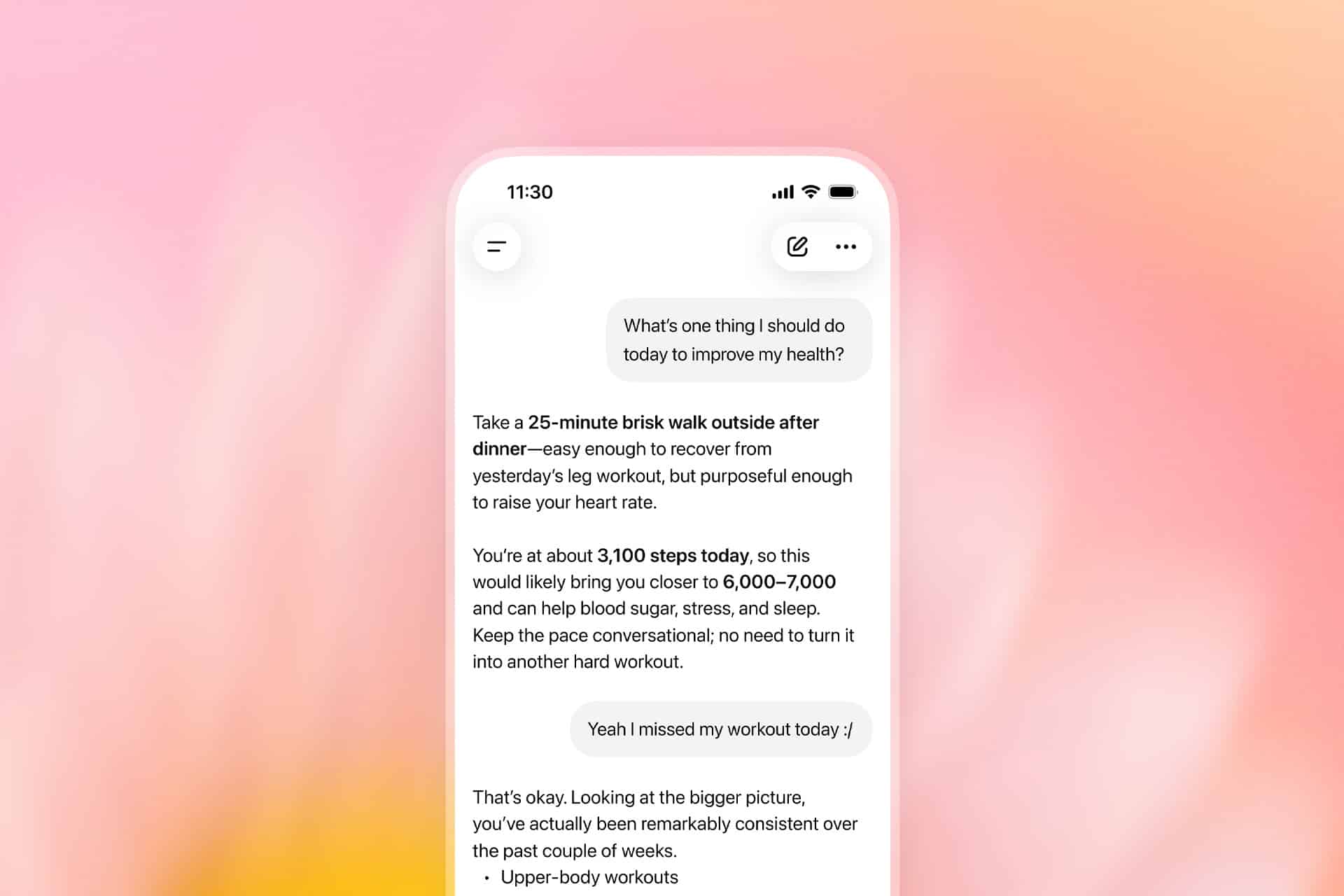
ChatGPT Health is returning with substantially wider access, giving more iPhone users the option to connect information from Apple Health directly to the AI assistant.

The expansion follows a limited test introduced in January. OpenAI is now gradually making the dedicated Health experience available to eligible ChatGPT Free, Go, Plus and Pro users in the United States who are at least 18 years old.

Despite the close Apple connection, this is not a feature created by Apple or built directly into the Health app. OpenAI operates the service through ChatGPT, while Apple Health serves as one of the sources users can voluntarily connect.

Once permission is granted, ChatGPT can examine selected health and fitness information stored on iPhone, including activity, sleep, workouts and other measurements collected by compatible apps and devices. Users can then ask questions about changes over time without manually exporting records or uploading screenshots during every conversation.

A smartphone screen displays a chat conversation about health, mentioning a 25-minute brisk walk and daily step goals, seamlessly integrated with Apple Health, against a softly blurred pink and yellow background.
Image Credit: OpenAI

ChatGPT Health Reaches More iPhone Users

ChatGPT Health originally appeared as a limited early-access experience for a small group of testers. The expanded rollout replaces that narrow availability with support for eligible adult users across the United States, although OpenAI says access may take several weeks to reach every account.

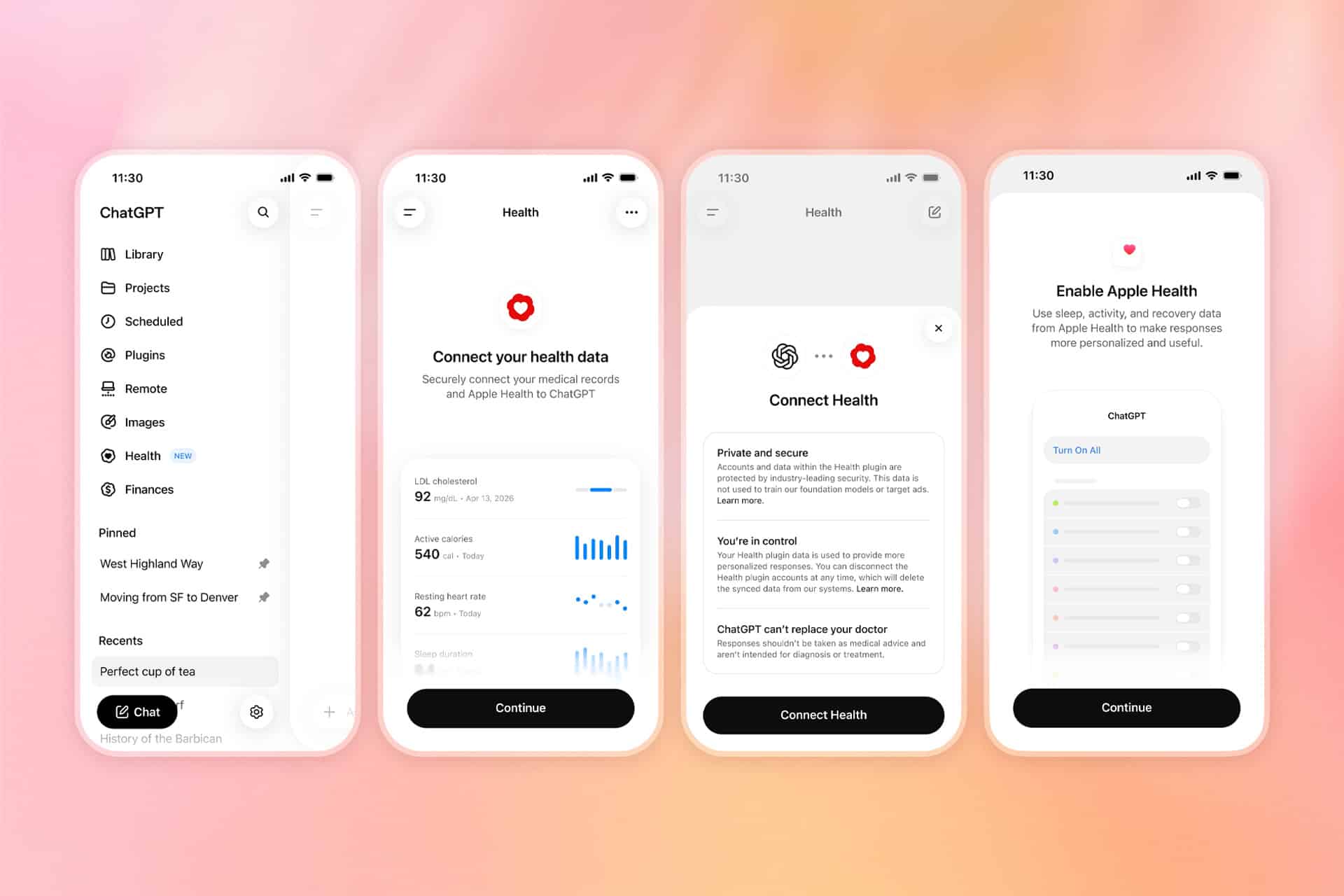
The feature works on the ChatGPT website and iOS app, but connecting Apple Health requires an iPhone. Users also need a recent version of the ChatGPT app before the Health option appears in the sidebar or More menu.

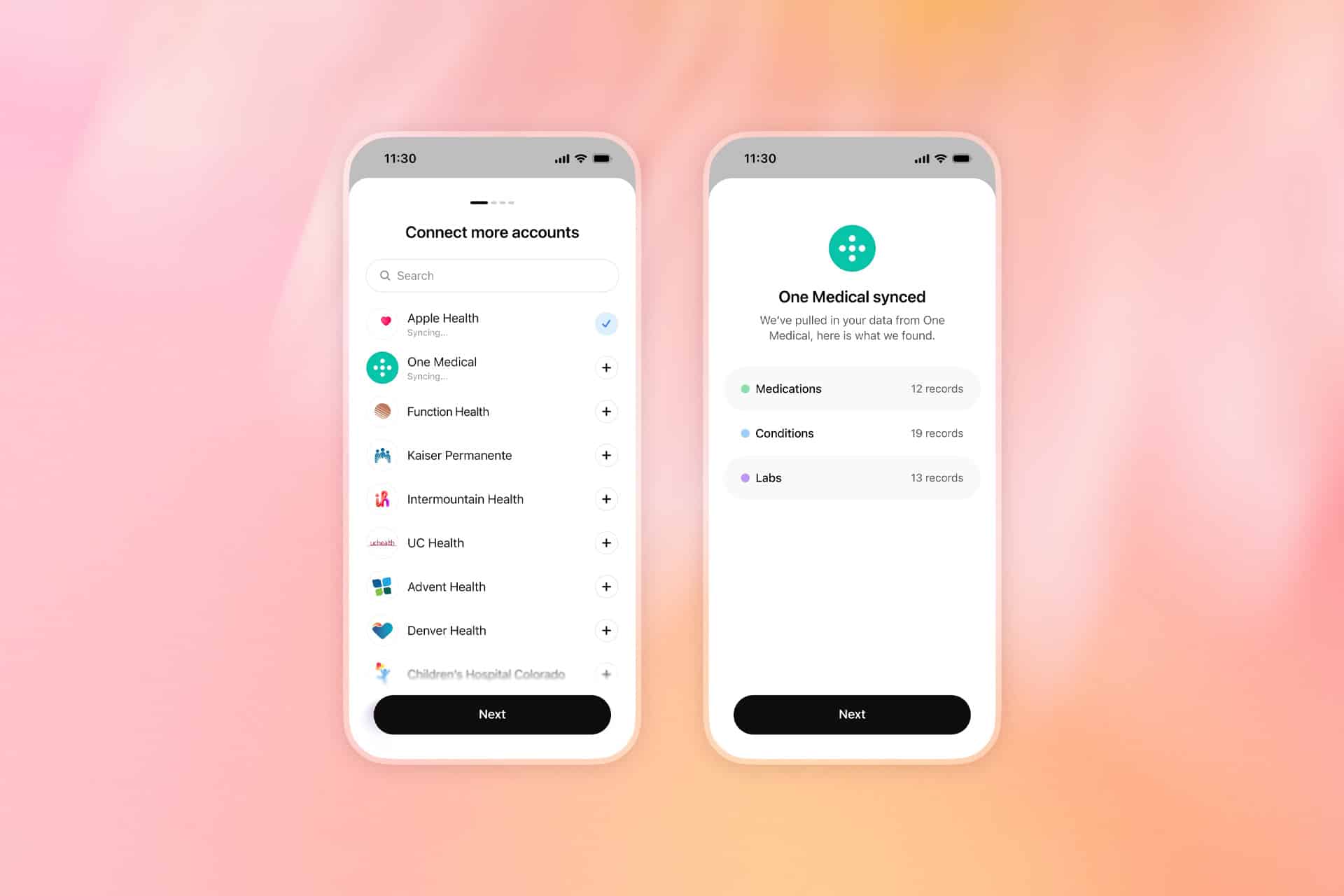
Apple Health is only one part of the system. ChatGPT can also connect to supported medical-record portals, One Medical and Function Health. Bringing those sources together allows the assistant to answer questions using a broader personal context than activity data alone.

A user could ask how sleep duration has changed across several weeks, whether workout frequency declined after a schedule change or how recent laboratory results compare with earlier tests. ChatGPT can also help organize questions before a medical appointment or summarize changes found across connected records.

Information from third-party fitness services can reach ChatGPT through Apple Health when those apps already share their data with the iPhone database. That may include measurements from platforms such as Garmin, Oura, Whoop, Strava and MyFitnessPal, depending on which categories each service makes available.

Not every proprietary score transfers. An app may calculate its own readiness, recovery or sleep score without writing that exact result into Apple Health. ChatGPT can only use the information made available through the connected source and approved by the user.

After synchronization, health information can inform responses throughout ChatGPT rather than remaining limited to conversations opened from the Health tab. The assistant normally asks for permission before using connected information, and users can also add “@Health” to a prompt when they specifically want a response based on their records.

Four smartphone screens show the process of connecting health data to a Health app, displaying menus, health data graphs, privacy info, and Apple Health permissions. Background is a soft pink and orange gradient.
Image Credit: OpenAI

Apple Health Data Gains a Conversational Layer

The appeal of the integration comes from turning a large collection of measurements into questions expressed in ordinary language.

Apple Health can already organize trends, highlights, medications, laboratory results and activity records. ChatGPT adds a conversational layer capable of comparing those categories or explaining them in a more personalized format.

Someone preparing for an annual physical could ask for a summary of meaningful changes since the previous appointment. A runner might request a comparison between training volume, sleep and resting heart rate. Another user could ask which information deserves discussion with a clinician after receiving new laboratory results.

That does not make ChatGPT a doctor. OpenAI says the feature is intended to support medical care rather than diagnose conditions or recommend treatment. Urgent symptoms and emergencies still require professional assistance.

The distinction is especially important because health data can appear more conclusive than it is. A change in heart rate, sleep or activity may have several explanations that cannot be determined from an iPhone record alone. Wearables can identify patterns, but they do not automatically reveal the medical cause behind them.

ChatGPT may help users notice relationships and prepare better questions. It should not be treated as the final authority on whether a symptom is harmless, whether medication should change or whether professional care is unnecessary.

The service is also read-only. ChatGPT can examine approved Apple Health information but cannot alter the original records stored on iPhone. It cannot add a diagnosis, change a medication list or write new measurements back into the Health app.

Users retain control over which Apple Health categories are shared. Someone may allow access to steps, workouts and sleep while withholding reproductive health, medications or other sensitive information.

That selective approach may be more appropriate than approving every category simply because the option is available. A useful response does not always require a complete health history.

Two smartphone screens show a health app: the left screen lists health providers to connect, including Apple Health, while the right screen confirms "One Medical" synced, displaying counts of Medications, Conditions, and Labs. Both screens have a "Next" button.
Image Credit: OpenAI

Privacy Becomes the Central Decision

Connecting Apple Health to ChatGPT creates a different privacy relationship from using health features entirely within the Apple ecosystem.

Apple designs the Health app around on-device protections and user-controlled permissions. ChatGPT Health requires selected information to synchronize with OpenAI systems so the company can analyze it and generate personalized responses.

OpenAI says connected Apple Health data, medical records and conversations using that information are not used to train its foundation models or target advertising. The company also applies additional encryption and isolation protections to health information.

Users can disconnect Apple Health at any time. OpenAI says synchronized data from the disconnected source will be deleted from its systems within 30 days.

Previous conversations are handled separately. Information already included in ChatGPT conversation history remains until those chats are deleted, even after the Apple Health connection is removed.

Memory introduces another consideration. Conversations using Health can create memories when ChatGPT memory is enabled, although OpenAI says memories are not generated directly from synchronized health data. Temporary Chat or separate project memory can reduce how much personal context continues across future conversations.

The new Health experience should also not be confused with the existing ChatGPT integration inside Apple Intelligence. Siri and Writing Tools can use ChatGPT for certain requests without requiring the dedicated ChatGPT app or a connected account.

ChatGPT Health is a separate OpenAI service with its own account, permissions, privacy controls and health-data connections. Using ChatGPT through Siri does not automatically give OpenAI access to Apple Health.

That separation gives users a meaningful choice. They can continue keeping health information inside Apple apps, share only selected categories with ChatGPT or connect medical records for a more comprehensive view.

The expanded rollout makes one of the most personal databases on iPhone available to conversational AI. Its usefulness will depend not only on the quality of the answers, but also on whether users understand exactly which information they are sharing and where it goes after leaving the device.

The post ChatGPT Health Expands Apple Health Access appeared first on AppleMagazine.

  •  

WhatsApp Rolls Out Redesigned Message Bubbles for iOS

WhatsApp is rolling out a new design for message bubbles on iOS, reports WaBetaInfo. The platform's message bubbles are rounder than before with a softer shape – similar to iMessage – while shared media files appear without the original borders, giving them a cleaner look.

The message bubble update follows several Liquid Glass-based design changes that came to WhatsApp's chat interface on iPhone and iPad last month.
This article, "WhatsApp Rolls Out Redesigned Message Bubbles for iOS" first appeared on MacRumors.com

Discuss this article in our forums

  •  

Supercooled kidneys have been transplanted into pigs in a “landmark achievement”

When it comes to organ donation, time is everything. As soon as an organ has been carefully removed from a donor’s body, it starts to deteriorate. Surgeons have a matter of hours to get it into a recipient. Leave it too long and the organ will become unusable.

In most cases, organs will be kept on ice during that time, at around 4 °C (39 °F). They cannot be frozen—in previous attempts, ice has formed, causing all kinds of damage.

Matthew Powell Palm at Texas A&M University and his colleagues have an alternative solution—a device that allows organs to be cooled to -4 °C (25 °F) without forming any ice.

Now, in new research with pig organs, his team has shown that kidneys, at least, can be supercooled and preserved in the device for days. Once rewarmed, the organs have been successfully transplanted into animals, and they seem to do better than organs kept on ice.

The work represents “a landmark achievement,” says Kevin Myer, president and CEO of LifeGift, an organ procurement organization based in Texas, who was not involved in the research.

Cooling organs

Powell Palm hopes this approach could ultimately help ease the organ shortage crisis. Today, there are more than 104,000 people waiting for a kidney transplant in the US alone. It is estimated that 17 people die every day in the US while waiting for a transplant. That’s partly due to a lack of donated kidneys, but it’s also because many of those that are available never make it to a recipient. In some years, around one in three donated kidneys end up being discarded, often because they end up too degraded to use by the time they reach a recipient. Kidneys can be stored on ice for around 24 hours or placed in devices that aim to mimic the conditions of the body, also for up to around 24 hours. That’s not always long enough to find a suitable recipient and transport the organ, says Myer.

Scientists around the world have been working on ways to store organs for longer by cooling them to even chillier temperatures. Cooling an organ slows its metabolism—the colder you go, the greater the effect, and the longer you can store it.

We’ve long been able to successfully cryopreserve eggs, sperm, and embryos, but it’s much harder to freeze large organs. Teams have been exploring various temperatures and cryoprotectants (chemicals that essentially work like antifreeze), but so far no one has been able to freeze human organs for transplantation.  

As a thermodynamicist, Powell Palm explored another approach. By keeping an organ submerged at a constant pressure, it should be possible to prevent the formation of ice at temperatures a little below 0 °C, without the need for cryoprotectants (which might have side effects and would need to be approved before being used in human transplants). 

To test this theory, Powell Palm and his colleagues have created a device that does just that. The device itself is essentially a hermetically sealed chamber with a transparent lid. At its base is a device that monitors the organ’s temperature and checks for the formation of ice. Organs are submerged in a solution that is already commonly used to preserve them for transplant. “I always describe this as low-tech high science,” says Powell Palm. “A lot of work has gone into understanding the … kinetics at play in this system, but ultimately … it’s quite simple.”

Supercooled kidneys

To test their device, Powell Palm and his colleagues first removed single kidneys from pigs. The organs were flushed with the same commonly used solution to remove the blood, just as transplant organs are. The team then kept some kidneys on ice for either two hours or 24 hours, to mimic standard conditions used in human transplantation. They also put some of the removed kidneys in their device for 24, 48, or 72 hours.

The stored kidneys were then each transplanted back into the original donor pigs. Each pig’s second kidney was removed in the same procedure, leaving each animal with only the kidney that had been stored, and reimplanted.

Once the 24-hour supercooled kidneys were transplanted, they immediately began producing urine—a key indication that they were working. The team members also measured other markers of kidney function and found that the organs appeared to be working normally within about 10 days of being transplanted.

Kidney supercooled for 72 hours reperfuses homogeneously upon transplantation, and proceeds to recover baseline renal function over the 30 day survival period studied.
A kidney that was supercooled for 72 hours recovers once it is transplanted back into a pig.
COURTESY RONALD SELLERS, POWELL-PALM LAB, TEXAS A&M UNIVERSITY

That’s slower than kidneys stored on ice for two hours but much quicker than kidneys kept on ice for 24 hours, says Powell Palm.

The organs that were kept supercooled for 48 and 72 hours performed similarly, he says. “Even at three days—triple the clinical standard—we’re getting recovery that is faster than … [what has been] the gold standard for the last three decades,” he says. “So we’re really, really pumped about this.”

“It is impressive,” says Heidi Yeh, a transplant surgeon at Mass General Brigham for Children, who also researches organ preservation technologies. “Often kidneys that have been stored for 48 hours [in other studies] take a week or two before they start working again.”

Organs that grow

The supercooled organs seem to work well in the long term, too. Over a 30-day period, the pigs grew by around 30%—and the kidneys grew with them, almost doubling in size to compensate for both the pigs’ growth and the lack of a second kidney. The team monitored one of the pigs for 200 days before removing and analyzing its kidney. Even at that point the organ looked healthy, says Powell Palm. He and his colleagues presented the findings at the American Transplant Congress in Boston last month.

Earlier this year, researchers in Canada showed they could also cool pig kidneys to below-zero temperatures and transplant them into pigs. The team’s protocol included the use of a cryoprotectant, and organs were stored for up to 48 hours before being transplanted into pigs. Those organs survived for a week.

In supercooling organs for 72 hours and showing that they do well for 30 days or more, Powell Palm and his colleagues have broken new ground. “It’s the first time this has ever been reported in history,” he says.

Those extra hours could make all the difference, says Myer of LifeGift. The advance could give doctors more time to evaluate the kidneys, match them to the most suitable donors, and physically get the organs to their intended recipients in time. It could enable international donations and open up cheaper transport options, he adds. “Right now, with kidney transplantation the assumed limit is 18 to 24 hours,” he says. “If we can get up to 72 hours … that would change everything.”

Powell Palm and his colleagues think they may even be able to go beyond 72 hours. In preliminary studies, organs that had been stored for up to 120 hours appeared healthy, although those organs have not yet been transplanted.

And because the process doesn’t require any cryoprotective chemicals, the team members are hoping for an accelerated approval from the US Food and Drug Administration, which would allow them to test the device in human transplantations.

The storage device is simple and compact, so Powell Palm thinks it will be easy to transport. It hasn’t been tested for air travel yet, but it has been used to take supercooled kidneys across the US in the back of a Kia Sorento, he says: “From a stability perspective, we view this as an even higher bar.”

Powell Palm and his colleague Sebastian Giwa plan to launch a company dedicated to developing the technology, along with other protocols that “stop biological time,” in the coming months, he says.

  •  

Tesla swapped a solar owner’s lease contract for the Book of Enoch

A Tesla solar customer went to pull up their lease agreement in their Tesla account this month and found something other than a contract waiting for them: the Book of Enoch, an ancient apocalyptic text about fallen angels.

Not a scanned copy of their agreement. Not an error page. The full text of a roughly 2,000-year-old religious book, sitting exactly where their legally binding solar lease was supposed to be. Electrek confirmed it.

  •  

The power line that could reshape New York’s grid is hitting snags

On July 3, as a heat wave swept the region, New York State’s grid imported 52 gigawatt-hours of electricity from Canada—enough to meet about 9% of its total electricity demand that day.

Some of that power shuttled in on a 339-mile power line stretching from Quebec to Queens called the Champlain Hudson Power Express (CHPE). It opened in May and is officially the longest underground transmission line in North America.

An underground power line might not sound all that exciting, but this could be a big deal for the state’s grid planning, and for emissions. It could provide up to 20% of New York City’s electricity demand, largely with abundant hydropower from Quebec.

One wrinkle: The line has been down for most of this month, and some experts are concerned about how drought will affect the power supply feeding it. Let’s look at how the CHPE transmission line could help shape the future of our grid, and what barriers it needs to overcome to make a difference.

Planning for the CHPE (which is charmingly pronounced “chippy”) started 15 years ago, with the permitting process formally beginning in March 2010. The vision was to build infrastructure to better connect Quebec and southern New York.

Map showing the route of CHPE project over land and underwater,  south from Canada to NYC.
The Champlain Hudson Power Express stretches 339 miles from Quebec to Queens. It is officially the longest underground transmission line in North America.

Over 99% of Quebec’s electricity comes from renewable sources; most demand is met with hydropower, though the province’s wind capacity is growing quickly. New York has some hydropower of its own, as well as nuclear and wind, but the state still relies on fossil fuels for most of its energy generation.

Transmission Developers, a company owned by the alternative asset management firm Blackstone, and Hydro-Québec, the province’s manager of generation and transmission, partnered to build CHPE. Construction began in late 2022 and wrapped up earlier this year. The total cost for the privately funded project turned out to be  $6 billion.

The construction of this line was a feat. It’s made up of a bundle of two high-voltage direct-current power cables, each measuring roughly five inches across. Developers buried the bundle underground or underwater across the length of New York State. Much of the line was laid at the bottom of the Hudson River, requiring special boats that shot water jets deep into the sediment to create trenches for the cable.

Connecting grids together can help accelerate the transition away from fossil fuels. The ability to move electricity to where it’s needed could also help limit the amount of new capacity we need to build. Research has shown that interconnection can help cut emissions and lower system costs.

But CHPE is off to a slow start and has seen two outages so far. The first, on July 1, was reportedly caused by a trip at a converter on the Canadian side of the border. The second outage began on July 4, and the power line is still down as of the morning of July 22.

Some experts say this isn’t unusual for a new infrastructure project. Other power lines have seen similar startup challenges, and the equipment hasn’t really been fully tested until it’s in operation, Normand Mousseau, a physics professor at Université de Montréal, told the Gazette.

Officials traced the issue to a damaged section of cable on the US side of the border, and the company that manufactured the line sent experts to investigate the cause, according to reporting from RTO Insider, a trade publication. 

The damaged portion of the cable has been removed and replaced, says Lynn St-Laurent, a spokesperson for Hydro-Québec. “It is currently estimated that the remaining work, including necessary post-repair testing, will be completed by the weekend.”

Similar woes have afflicted the New England Clean Energy Connect line, which opened in January, stretching 145 miles from Quebec to Maine. That project has also seen outages, and very little additional energy has flowed into the Northeast.

The good news for New York is that the grid wasn’t relying on CHPE yet. “Our planning studies did not assume CHPE would be available this summer, and that was one reason the grid performed reliably during the heat wave earlier this month,” Kevin Lanahan, a spokesperson for the New York Independent System Operator, the state’s grid management company, said in a statement. “A core principle of reliability planning is not relying on any single project.” 

The idea is that eventually, states and regions will be able to rely—at least in part—on these projects, so there is pressure to get them working smoothly: Building massive transmission lines is a major long-term investment. In future years, as the equipment gets stress-tested and utilities begin to feel more confident in the projects’ reliability, they could play a bigger role on the grid.

One thing to keep an eye on moving forward is the condition of Quebec’s hydropower fleet: The region has seen intense drought for the past three years, eating into the water reserves used to generate electricity. That could mean there won’t always be abundant hydropower to ship across the border—even if the transmission lines are able to carry it. 

This article is from The Spark, MIT Technology Review’s weekly climate newsletter. To receive it in your inbox every Wednesday, sign up here. 

  •  

Shape-shifting mirrors on NASA’s new space telescope could unveil Jupiters like our own

When NASA’s Nancy Grace Roman Space Telescope launches, as early as the end of next month, it will attempt one of astronomy’s most precise disappearing acts to date. The telescope will carry the first space-bound “active” coronagraph, an instrument that effectively erases most of the light from a star during photography.

It will allow astronomers to take the first pictures of planets orbiting other stars that are similar to those in our solar system. Ultimately, it could pave the way for a future mission that could snap the first photos of Earth-like worlds.

“I hope it’s remembered for it being that critical stepping stone for … finding Earth 2.0,” says Brandon Creager, the instrument’s lead mechanical engineer at NASA’s Jet Propulsion Laboratory (JPL).

Named after Nancy Grace Roman, NASA’s first chief of astronomy, this new telescope will carry a roughly 300-megapixel wide-field camera that will enable it to capture images about 100 times larger than the Hubble Space Telescope’s widest exposures at a similar resolution.

These capabilities will help astronomers unpack the mysterious identities of dark matter and dark energy—and to detect around 100,000 new exoplanets, planets outside our solar system, whose presence can be inferred from the way they distort the starlight of more distant stars. Javier Viaña, a research scientist at Harvard who has had two projects selected for Roman’s highly competitive first year of observing, compares the leap to moving from “interviewing a handful of people” to “conducting a global census.”

Another camera will use the coronagraph, blocking out a star’s light as it observes one stellar system at a time. The instrument will allow astronomers an unprecedented look at the space around stars, enabling them to see smaller, dimmer, and more close-in exoplanets. “It’s giving us the ability to see planets that we haven’t been able to physically see before,” says Creager.

The anatomy of a vanishing trick

Coronagraphs in space aren’t new. But earlier incarnations, such as those currently aboard Hubble and the James Webb Space Telescope, use a stationary system to block a star’s blinding light. The approach does help, but it’s a bit like putting your thumb over a flashlight while searching a dark room for a firefly. Though the bulb vanishes, stray glare can still escape and overwhelm the light of the insect. Inside a telescope, that glare can come from light leaking around the edges of machinery or from minuscule imperfections in mirrors and coatings that can scatter starlight into speckles. All this can hide, or even impersonate, a planet.

Roman’s coronagraph, however, will attempt something completely unseen in space telescopes until this year: Before each observation, it will measure that leftover light and try to suppress it, a technique known as active wavefront control.

The telescope is able to do this because it contains two deformable mirrors. Each has a 48-by-48 checkerboard of actuators (tiny pistons) beneath a thin, deformable sheet of glass. Applying a small amount of voltage makes the actuators contract and tug their patches of mirror slightly backward, like thousands of microscopic fingers delicately sculpting a surface.

The effect is very subtle: Each patch of mirror can deform by up to 0.5 micrometers, or about one-fourth the size of an E. coli bacterium, and in increments as small as approximately 10 picometers. That’s about a tenth the diameter of a hydrogen atom, says Ilya Poberezhskiy, the instrument’s project systems engineer at JPL.

The actuators allow the mirrors to create an “active wavefront,” where each component is moved to the perfect position to cancel out incoming waves of unwanted light—a bit like a pair of noise-canceling headphones, but for light instead of sound. The “canceled-out” light creates a “doughnut-shaped region around the star where we suppress starlight and where we’re hoping to see exoplanets,” says Poberezhskiy.

Compared with current space-based coronagraphs, the system is expected to improve sensitivity to exoplanets against the glare of their host stars by a factor of up to 1,000, revealing planets that would have been far too faint to detect before.

Like Hubble and JWST, Roman also uses masks, patterned plates placed in the path of the light that are designed to block the photons that run into them. One tool in Roman’s mask arsenal is “silicon grass,” a thicket of microscopic spikes on some masks that can be used in certain configurations to absorb photons so they don’t bounce around the telescope and accidentally reach a detector.

Light entering the forest bounces deeper and deeper between the blades and gets trapped instead of reflecting back toward the camera. “Once the light gets into there, it never gets out,” Poberezhskiy says. The mirrors and masks form a succession of gates and hedges to guide as much of the preserved planetary light as possible toward the final detector.

Alien Jupiters

This elaborate setup could open a new chapter in the direct imaging of exoplanets. Nearly all exoplanets photographed so far are oversize youngsters that are nothing like the residents of our solar system: several times the mass of Jupiter, still glowing with the heat left over from their birth, and orbiting tens or hundreds of times farther from their star than the Earth is from the sun. This is because they are relatively easy to see. Their size, warmth, and distance from their parent star makes them shine brightly in infrared light, far away from the worst of the stellar glare.

Roman, however, could directly image a true Jupiter analogue—a planet similar to Jupiter in mass and circling a sunlike star a few times farther out than Earth is from our sun. Unlike the hot Jupiters we can see now, this one would be a much more mature gas giant like ours, primarily reflecting its parent star’s light after billions of years of cooling instead of heavily emitting its own.

Astronomers have been able to infer the existence of such planets from the gravitational wobble they impart to the star. Roman instead will collect starlight reflected from the planet itself. “We’re not looking at the star. We’re not looking at the effect of the planet on the star,” says Meredith MacGregor, a professor of astronomy at Johns Hopkins who has also secured an observing program. “We are actually looking at the planet, and that is super powerful.”

Once this instrument becomes available, it will become the scientists’ turn to do their jobs. “I’m honestly a little terrified about how we’re all going to deal with it, because I think it’s just so much data,” MacGregor says. “I think people will legitimately still be working on Roman data for decades.”

But don’t expect to see a 4K photo of an alien Jupiter in the coming months. Roman will not be able to resolve such a planet into a solid globe—at best, it will likely resemble a smattering of pixels. Still, that will be enough, MacGregor says, as Roman can then use the coronagraph to get information on the various wavelengths of light from the planet, which can tell astronomers about its atmospheric chemistry.

“You’re taking something that’s a point of light and turning it into an actual world,” she says, “because if you know that about its atmosphere, now you know something about the surface of the planet and the possibility of life being on that planet, right? So that’s a big step.”

During its first observations, scientists and engineers will see whether they can hold a star at the very center of the coronagraph’s masks, shape the mirrors, “dig” the dark doughnut (as Poberezhskiy describes it), and then maintain everything as the spacecraft moves through space and actively changes temperature.

The results will inform NASA’s proposed Habitable Worlds Observatory, the daydream of many an exoplanet astronomer, which will in theory be able to separate the light of an Earthlike planet from that of a sunlike star, over 10 billion times brighter.

Creager, who has worked on the instrument since 2018, is proud of the achievement: “Not too many people get to say, ‘I built something and it’s taking a picture of a planet that’s at a star that’s 50 light-years away or 100 light-years away.’” He imagines the moment he and his team will be able to look at the first image as it arrives: “Yes, we did that.” While the planet may show up only as a tiny dot, Roman’s achievement will be the darkness engineered around it.

  •  

Whisper and SpeechAnalyzer

Om Malik (2023):

One of the key advantages of MacWhisper, as it utilizes the Whisper technology, is its superior accuracy in transcriptions compared to other services I have used. I was an early adopter of Rev.com and eventually switched to Otter.ai, for which I paid approximately $100/year. However, I have since canceled my subscription.

[…]

After comparing the audio transcripts from MacWhisper and Otter, I found that while Otter’s formatting is superior, there is hardly any difference in the transcriptions. I started with the free model, which was sufficient for my needs, and eventually upgraded to the large models. Nowadays, I primarily use MacWhisper to transcribe my voice memos, which I then import into Lex.Page.

Bon Adamson:

Whisper, which is made by OpenAI, has the distinct advantage of allowing you to transcribe audio in almost any language you may ever need to. For the time being, Otter can only transcribe English. The benefits of better accuracy and accurate punctuation that the service already holds over Siri hold up across other languages as well. If you’re looking to transcribe non-English audio accurately, Whisper is definitely the best option available on Mac.

Dan Moren:

By taking advantage of OpenAI’s Whisper framework, Audio Hijack can now take any audio it’s recording and generate a text transcript. While this process was possible before—see Jason’s lengthy post about his workflow—it required a lot of fiddling and several different tools to accomplish; it’s certainly a lot easier to simply drop Audio Hijack’s block into your existing session. If you record multiple sources, it can even appropriately label each one—though if you record multiple people via one input, say the other end of a Zoom call, it can’t distinguish between the various participants.

Inscribe (2026, Hacker News):

Apple’s new SpeechAnalyzer is the most accurate on-device speech engine we tested. It beat every Whisper model we ship, including Whisper Small, on both the clean and the noisy half of LibriSpeech, while running roughly three times faster than Small. And the API it replaces, SFSpeechRecognizer, came last on clean speech: behind even Whisper Tiny, a 40MB model.

[…]

The new API cuts word error rate by 3.5 to 4x on the same audio: from 9.02% to 2.12% on clean speech, and from 16.25% to 4.56% on noisy speech. There is no accuracy trade-off to weigh; the new API wins everywhere we measured, and it produces punctuated, cased text where the legacy engine’s output is rougher.

[…]

All five engines ran comfortably faster than real time: between roughly 12x and 40x on the M2 Pro, meaning an hour of audio transcribes in about 1.5 to 5 minutes on-device. SpeechAnalyzer was about 3x faster than Whisper Small per second of audio while beating it on accuracy.

Yuki:

SpeechAnalyzer’s ReportingOption.fastResults reads like a knob you’d reach for when you want to trade power for latency. That framing is what cost me the afternoon.

[…]

If a recording matters — and in a notes app, a lost meeting is the worst thing that can happen to a user — then the container you write while recording has to be PCM in CAF. Not m4a, and not AAC-in-CAF either.

[…]

AVAudioEngine’s inputNode silently ignores your device selection

[…]

I wanted summarization to run on-device. Everything else in Nib’s transcription path does, the audio never leaves the machine, and it would have been a much cleaner story to tell.

But 4,096 tokens for the Foundation Models isn’t enough.

Previously:

  •  

Sunsetting Google Earth for Mac

The Google Earth Team:

We’re continuing to make Google Earth on web and mobile (Android | iOS) the best place for people to get helpful geospatial insights. While you can continue using the legacy Google Earth Pro desktop app, it will no longer be available for new downloads beginning on June 25, 2027. We encourage using web and mobile for the best Google Earth experience.

Via Nick Heer:

This is a two-factor loss: the MacOS app is Intel-based and, thus, will no longer be supported by the system come next year.

[…]

On the Google Earth community thread, you will find comments from people with all sorts of interesting use cases for the desktop app.

Rui Carmo:

This is going to be the end of an era for me. One of the first things I did with the early versions of Google Earth was wire it up to Vodafone’s mobile network data, producing some genuinely unique–for the time, at least–visualisations of network usage over time.

Previously:

  •  

The EnshAIttification of Day One

Aleem Shaun:

I’ve used Day One for more than a decade. It was an excellent journalling app. Private, minimal, easy to use, with excellent features such as geolocation, weather, ‘On this Day’, and book printing. Features that got out of the way and either worked quietly in the background or appeared only when you summoned them. That’s changed.

Now there are new subscription tiers. Previously, the tiers were Free and Premium. Simple. Premium included sync and a few other things that I can’t remember, but it was compelling enough that I’ve been a Premium subscriber from the beginning. Now, without consultation, I’m Silver (not Premium), and there’s a new, more expensive AI-driven tier, Gold. I don’t object solely on that basis. You would think I could just choose to remain on ‘Silver’ and all would be well. But no. Even with these features turned off in settings, I’m visually prompted in the app to upgrade to Gold and use the Daily Chat (with AI), which I’ve turned off and can only use if I upgrade. And yet, there it is, taunting me.

Via Eric Schwarz:

Even Apple is guilty of doing this in the Settings app and the former iWork apps.

Previously:

  •  

Licensing a Mac App With RevenueCat

Jared Sorge:

I know there are options out there like Paddle, FastSpring, and Lemon Squeezy that have worked for many apps like mine over the years. But I also wanted something simple for my users. Not to mention Apple Pay was a must-have.

I believe all the services he mentions do support Apple Pay.

  • RevenueCat serves as the source of truth for whether or not a customer is licensed.

  • I create RevenueCat customer IDs from local iCloud identifiers (more specifically, calling userRecordID() on my CKContainer in CloudKit).

  • When the user makes a purchase, they earn an entitlement that I look for in Arborist to grant them a license.

He doesn’t need to run his own server, and the purchases are automatically tied to the user’s iCloud account, so there are no e-mails or serial numbers to deal with. On the other hand, well, it’s all dependent on the Apple Account.

The app, which helps manage Git worktrees, is shipping now.

Previously:

  •  

Git Tower 17

Bruno Brito (release notes):

In Tower 15, we introduced the “Fully Merged” badge and Automatic Branch Management to help you keep your repository tidy. With Tower 17, we’re taking the detection behind that badge to a whole new level. […] Tower now matches your local branches against merged pull requests from your hosting service, such as GitHub or GitLab.

[…]

Trust is everything when deleting branches — so we redesigned the “Fully Merged” hint view to show you exactly which checks matched.

[…]

One that is particularly noteworthy is that updating submodules is now significantly faster! Tower gathers each submodule's Git data concurrently instead of one at a time—something you will especially notice in repositories with many submodules.

I’m sad that they got rid of the yellow icon.

Previously:

  •  

San Francisco Demands Removal of Nudify Apps

Matt Burgess (MacRumors, ArsTechnica):

On Thursday, San Francisco city attorney David Chiu sent legal notices to Apple and Google demanding that they remove from their app stores 13 face-swapping apps, which allow users to create AI-generated nonconsensual nude images. The letters say the Silicon Valley giants should stop “aiding and abetting” the sale of explicit deepfake images and “sever” business relationships with the app developers.

[…]

Researchers have repeatedly found and reported apps in Apple’s App Store and Google’s Play Store that allow people to generate sexual images using AI—including some apps being rated as suitable for use by children. While new laws and bans aim to tackle the scourge of explicit deepfakes online, technology and social media companies consistently direct millions of people toward the harmful tech.

Both Apple and Google have developer policies that prohibit pornography, abuse, and harassment on their platforms.

Burgess gives the impression, which is my base assumption, that these 13 apps were clear about what they do, so App Review has no excuse for missing them. But I’m sure it’s keeping us all safe in other regards.

Meanwhile, in a preprint research paper published in May, researchers from Cornell University and Georgetown University identified 420 apps offering general face-swapping capabilities on Google’s and Apple’s app stores. They tested 155 to see if they could be used to create face swaps with nude images; in 70 percent of cases, it was possible, with the apps not including safety measures to prevent this.

Previously:

Update (2026-07-21): Danny Bradbury:

Chiu isn’t arguing that hosting an app automatically makes a platform liable for what it does. Platform operators already won that battle with Section 230 of the Communications Decency Act. That 30-year-old law says websites generally aren’t responsible for content posted by users, allowing platforms to host user-generated content without getting sued every time someone defames someone in a comment thread.

Courts have often extended those protections to cover app stores too. Apple and Google are treated as distributors of whatever a third-party developer uploads, rather than publishers.

Chiu is attempting to sidestep that argument by focusing on the companies’ payment systems, noting that Apple and Google collect a cut of every in-app purchase. According to the Tech Transparency Project (TTP), that means they profit from apps that generate revenue by creating non-consensual intimate imagery.

  •  

SpamSieve 3.3.1

SpamSieve 3.3.1 is an update of my Mac e-mail spam filter that improves the filtering accuracy and includes various optimizations, fixes, and updates for macOS 27. Some interesting engineering issues were:

  • I’m still supporting macOS 10.13, but the app can now build with the macOS 12 deployment target in preparation for Xcode 27. The way Swift handles calling deprecated APIs remains annoying. You need workarounds like protocols to suppress a warning in a particular region of code. Often, I am updating to a newer API, but I want to continue using the old one on earlier versions of macOS. Right now I am heavily testing on macOS 26, so I would like to only deploy the new code there. Sometimes the initial versions of APIs are buggy, and I don’t want to have to retest every feature on every version. But Swift doesn’t like me to gate the calls to macOS 26 and later if the new API was actually introduced in, say, macOS 11.

  • The most risky update was probably switching to the Swift API for Scanner. This is tricky because the current scan position changes from being based on UTF-16 indexes to String.Index. And in some cases my code was intentionally scanning into the middle of a combining character. I was really glad to have extensive tests here.

  • Recent versions of Tahoe introduced a Core Data bug that broke save recovery (when invalid Unicode can’t be written to the database and we have to fix it up first). When the error comes in, SpamSieve looks under the NSDetailedErrorsKey key, but the value of this key is "NSDetailedErrorsKey" while the actual error info is under the key "NSDetailedErrors".

  • Database corruption combined with a Core Data bug and two Swift behaviors were causing crashes. The root problem, I think, is that in this situation Core Data neglects to set the error pointer for -[NSManagedObjectContext countForFetchRequest:error:]. Normally, Swift would detect this and throw a generic nilError. However, this method signals errors by returning NSNotFound instead of nil. It’s annotated as swift_error(nonnull_error), which I think means that Swift doesn’t even look at the return value, only the (unset) error. So my code was receiving NSNotFound on the non-error path, treating it as a real count, and doing some math with it, which (by default in Swift) leads to a crash if there’s overflow. Now my code checks for NSNotFound and uses Int.addingReportingOverflow().

  • I reimplemented Core Data batch fetching because of two problems with the fetchBatchSize option. First, it logs spurious errors when fetching from multiple stores at once. Second, it leads to high memory use. It will load objects in batches, but it never releases the earlier batches. You can manually refault objects that you no longer need, but it will still hold onto the full object shells, which can add up. My implementation only holds onto IDs, and it can fetch the IDs using a different context than the objects to push more work to background threads.

  • I’m now using String.makeContiguousUTF8() in various places to avoid slow iteration of bridged strings.

  • There was a regression where some menu code could crash on macOS 10.13. -[NSMenu setItemArray:] is only available on macOS 10.14 and later, whereas the getter is always available. With old Objective-C, the two methods could be annotated with separate availabilities. The Objective-C property syntax doesn’t allow this, so there’s no way for the compiler to flag calls where the setter is missing.

  • The AppleScript support works much better with large data sets. The key, I think, is to never return an array to Cocoa for a scripting property/element. First, if you give it a lazy array it will sometimes try to access all the elements even if it only needs a few. And, second, AppleScript will run out of memory if the array is too large. By using indexed accessors, you can maintain laziness and only convert one object to a descriptor at a time. By caching a batch-fetching collection, you can limit the number of fetches and respond quickly when AppleScript requests individual objects.

Previously:

  •  

Flickr 5.0

Phil Gyford:

Flickr recently updated their iOS/iPadOS app to version 5 (App Store link) and, while it’s not radically new, for a service whose changes have been incremental over recent years it contains a lot of differences. However I’ve yet to find any official changelog or update information.

[…]

When displaying multiple grouped photos from a person you’re following, it is no longer possible to view all the subsequent ones, other than the three or four initially displayed.

In the list of your Followers’ photos, their name now appears under their photos, so you must scroll down beyond the photos to see who took them.

[…]

When zooming into a photo the app no longer loads a higher resolution version, so now the zoomed-in version will be very pixellated.

He has a long list of missing features that may or may not be coming back. And there’s what seems like a major change: tags can no longer use capital letters.

The main changes I noticed were:

  • In the Home/Discover view, when there’s a large group of new photos, you can only go into the group and view them individually, swiping to see each one. There’s no longer a way to see the whole group at once and scroll through it. (And tapping on the group icon or number of photos doesn’t do anything.)

  • Double-tapping to favorite doesn’t work in some situations.

  • The interface is more busy, showing more interaction chrome like other social media sites, rather than focusing on the photos.

  • Swiping/navigation seems more clear than before, though without the old app side-by-side I can’t be exactly sure what’s changed.

Update (2026-07-16): Wesley Moore:

The Android version has been updated too:

“Flickr is back and better than ever — rebuilt from the ground up with a fresh new look and feel.”

I would guess it’s been built with cross-platform technology as it looks the same and came out the same time as iOS. The performance is terrible on Android. Scrolling my Photostream is juddery on my Pixel 9a (120 Hz display). It’s worse on my Android tablet.

Scrolling between photos swipes the whole UI (not just the photo), there’s also a flash of white loading the new photo. Needs some serious iteration.

See also: Reddit.

Update (2026-07-27): A. Lee Bennett Jr.:

Hooray! #Flickr restored a thumbnail view of all items from a specific post.

It turns out that Flickr 5.0.3 reverts back to the 4.x codebase.

Flickr (Reddit):

We know the new app hasn’t met the bar you expect from Flickr. Since launch, we’ve heard your feedback about bugs, missing features, and rough edges, and we want to acknowledge that directly. Here is where we currently stand:

iOS: We’re in the process of rolling back the iOS app to the previous version while we address these issues. You should see this reflected in the App Store shortly.

Android: The Android app will remain on the updated version. Due to technical limitations and the risks involved in reverting, a rollback isn’t possible on this platform. Instead, expect frequent updates as we fix bugs and restore preexisting features.

Across both platforms, this app refresh represents a significant, long-term investment in the Flickr app. The app was long overdue for an update and getting it right matters to us. Thank you for your patience, and for continuing to share what’s missing and not working. It’s shaping exactly what we address next.

  •  

ChatGPT Work and ChatGPT Classic

John Gruber, earlier this week:

When ChatGPT is attached to an open document in another app, it’s not a snapshot at the moment of attachment, like what you’d get by copying and pasting the whole thing into the chat, or by dragging the current version of the file into the chat. It’s a live ongoing attachment, so as the attached document/note changes, ChatGPT sees the changes. It’s such a great feature, and I don’t think it exists on any platform but the Mac. And it couldn’t exist on iOS, by design, doesn’t allow for inter-application communication.

I worry for ChatGPT’s future, though.

Juli Clover:

OpenAI today announced ChatGPT Work, a ChatGPT agent with built-in Codex that can complete tasks across web, mobile, and desktop using information from your apps. ChatGPT Work can execute multi-step tasks, using scheduling to work independently. Like Claude Cowork, ChatGPT can use your computer to do tasks in the background across apps.

[…]

With OpenAI merging Codex and ChatGPT, there is a new ChatGPT desktop app that’s available across Mac and Windows. Users who have the Codex app installed can update it to turn it into the new ChatGPT desktop app. The existing ChatGPT desktop app is being renamed ChatGPT Classic.

Zac Hall:

You can watch today’s livestream announcement video below[…]

[…]

It’s possible to have ChatGPT Classic, ChatGPT, and Codex installed, but the way forward seems to be just running the new ChatGPT desktop app. Codex users can still use the Codex app icon, but the app will be called ChatGPT.

The ChatGPT Classic app looks more native Mac-like, so that might be an issue for users.

Steve Troughton-Smith:

LOL @ OpenAI replacing the native AppKit ChatGPT app with the Electron Codex app after @gruber’s recent posts on the topic 😂

(It’s almost like Apple doesn’t have clear messaging on the right way to build native desktop apps anymore, and, if Apple doesn’t know, why on earth would third-party developers make that investment)

Federico Viticci:

The rollout of the unified ChatGPT for Mac app really isn’t going well on X/Reddit 🥶

They kinda fumbled it and I think Anthropic did a slightly better job on first try. Even OpenAI’s existing iOS app makes more sense than their new Mac layout right now.

The difference between “normal” chatbot chats, Work/Cowork harnesses with connectors, and Code/Codex local threads and filesystem access is the new UX hell for these companies.

Steve Troughton-Smith:

The chat experience is ChatGPT. Now it’s squirreled away in a sub section of a sub pane inside a vastly more-complex app. It’s hard to imagine anybody who actually wants to use ChatGPT wants to use it this way, Electron or not. And as a Codex user, I resent having my Codex deleted and renamed ‘ChatGPT’ instead. I don’t want my ‘chats’ anywhere near my ‘work’. This feels like a stupid move that will decimate casual ChatGPT desktop usage

John Gruber (Mastodon):

Looks like I picked the wrong week to quit sniffing glue.

See also: Dithering.

Previously:

Update (2026-07-13): Tony Arnold:

Oh yeah, the new ChatGPT app is as bad as first impressions made it out to be. It’s not just a slow, RAM hungry shell of a thing, but the design and UX are a poorly thought out kitchen sink approach.

Codex has never been great, but this is a confusing mess.

Benedict Evans:

Wow, what a total mess. What is the difference between a project, a task and a chat? Why did chats get a crappy floating window but tasks and projects don’t? Why does choosing ‘plugins’ get me ‘templates’? Am I not allowed to finish ‘setup’ if I don’t use Slack or Google Drive? Why…

Via John Gruber (Mastodon):

OpenAI’s internal org chart is a complete disorganized mess. This new app perfectly reflects that.

The old ChatGPT app was focused. That’s the app that still ships for mobile (which includes iPad, which tells you whether OpenAI thinks iPad is a real computer or a big iPhone), and is, for some Mac users, left installed on their systems as “ChatGPT Classic”. The new app is an incredibly confusing sloppy mess. At a glance it looks like a polished app. But the UI is just slop. It has the veneer of a polished app without actually being organized or structured or labeled in ways that add clarity and coherence.

John Gruber:

So I don’t see “the prompt in the app to download the new ChatGPT desktop app”. If I download the new app manually, I get a disk image. After mounting the disk image, the instructions say to double-click the “ChatGPT” app on the disk image — not to drag it to the Applications folder. If I do that while the old ChatGPT app is still running, it bounces back and forth a few times but nothing new gets installed and nothing old gets removed or renamed. I’m just left with the classic ChatGPT app, still named “ChatGPT”.

If I run the installer on the disk image when the old ChatGPT app is not running, the old app gets replaced by the new one in my Applications folder, and the old app is moved to the Trash. There is no app named “ChatGPT Classic”.

I mean, their Help document does say “the new app may install alongside your current app”, and “if both remained installed”, so they seem just as confused as I am.

Update (2026-07-14): Adam Engst:

And as much as I’ve been focusing more of my attention on Anthropic’s Claude because of concerns I have about OpenAI and its management, ChatGPT has more active users (~1.1 billion) than Google’s Gemini (~900 million), and many more than Claude (~245 million, in part because it’s more focused on enterprise uses).

As such, it’s worth noting three recent changes with ChatGPT: a massively confusing app replacement, the end of the ChatGPT Atlas Web browser, and improvements to ChatGPT Voice.

Update (2026-07-17): M.G. Siegler:

Let’s give OpenAI some credit, once they realize they made a mistake, they act quickly to correct it. Today’s case in point: with an update, ChatGPT now features ChatGPT once again. No, that’s not a joke, and yes, it does speak to a very obvious self-own.

John Gruber:

How in the world did they ship this without sync?

[…]

Bringing back “chat” to ChatGPT is literally the least they needed to do. Hiding chat in an obscure corner of the interface from an app named “ChatGPT” would be like removing text editing from TextEdit.

  •  
❌