In his latest Power On newsletter, Bloomberg News’ Mark Gurman highlights two notable Apple developments: a new AI tool being tested in retail stores and previously undisclosed plans for the now-defunct Mac Pro.
AI Recording and Transcription for Genius Bar Appointments
Apple is piloting an AI-powered system called Live Notes at select retail stores. The tool allows Genius Bar employees to record conversations with customers using an iPad. AI then transcribes and summarizes the discussion, automatically adding it to the employee’s notes and the official repair session record.
Key details of the pilot include:
• Opt-in only — Both the employee and customer must agree before recording begins.
• Goal — Reduce manual note-taking so staff can focus more on customer service and problem-solving rather than typing during appointments.
• Integration — Transcripts feed directly into Apple’s internal Genius Bar system for better documentation and follow-up.
This initiative reflects Apple’s broader push to integrate AI across its ecosystem, including retail operations, to improve efficiency while maintaining a personal touch in customer interactions. Privacy safeguards via the opt-in requirement appear designed to address potential concerns.
Apple Once had Bigger Plans for the Mac Pro
Apple discontinued the Mac Pro earlier in 2026, but new reporting reveals the company once had far more ambitious plans for the high-end desktop. Gurman notes that Apple developed — but ultimately shelved — “M2 Extreme” and “M3 Extreme” chip variants specifically intended for the Mac Pro.
These ultra-powerful chips were part of an effort to deliver even greater performance for professional users who rely on the modular, expandable workstation. The decision not to release them contributed to the product’s eventual discontinuation, as Apple shifted focus amid changing market demands and the rise of more portable high-performance options like Mac Studio and MacBook Pro configurations.
The revelations underscore the evolving nature of Apple’s Mac lineup, where even flagship products like the Mac Pro face tough strategic trade-offs in an AI-driven computing era.
MacDailyNews Take: Not everything makes it to market. Conditions change. As always, retail and pro desktop innovations continue to shape the company’s customer and professional user experiences.
For the vast majority of professional users (video editors, photographers, 3D artists, developers, and those running AI/ML workloads) the Mac Studio is the superior choice overall. It delivers an excellent balance of performance, price, compact size, and modern features. The Mac Studio covers 90% (or more) of what the Mac Pro once offered, but at a fraction of the cost and with newer silicon, and the promise of regular updates. The discontinued Mac Pro was only preferable, or truly necessary, in the rare cases that demand heavy internal PCIe expansion that cannot be adequately handled externally via Thunderbolt; a very niche market. – MacDailyNews, March 27, 2026
Apple’s Mac Pro is a dead end. Mac Studio is the high-end Mac future now. Bring on the M5 Ultra Mac Studio and rename it “Mac Pro.” – MacDailyNews, November 17, 2025
Please help support MacDailyNews — and enjoy subscriber-only articles, comments, chat, and more — by subscribing to our Substack: macdailynews.substack.com. Thank you!
In Nasdaq trading today, shares of Apple Inc. (AAPL) rose $0.48 to $333.74 to hit a new all-time closing high. Apple’s all-time intraday high was also set today at $334.98.
Apple’s 52-week low stands at $201.50.
Today’s trading volume for AAPL shares was 63,196,563 versus Apple’s average trading volume of 54,686,906 shares.
Apple’s PE Ratio currently stands at 40.40.
Apple currently has a market value of $4.902 trillion, making it the world’s second-most valuable company.
The top five U.S. publicly-traded companies, based on market value:
MacDailyNews Take: To the moon, Alice. To the moon!
Please help support MacDailyNews — and enjoy subscriber-only articles, comments, chat, and more — by subscribing to our Substack: macdailynews.substack.com. Thank you!
In Nasdaq trading today, shares of Apple Inc. (AAPL) rose $5.76 to $333.26 to hit a new all-time closing high. Apple’s all-time intraday high was also set today at $334.68.
Apple’s 52-week low stands at $201.50.
Today’s trading volume for AAPL shares was 59,624,981 versus Apple’s average trading volume of 54,664,537 shares.
Apple’s PE Ratio currently stands at 40.40.
Apple currently has a market value of $4.895 trillion, making it the world’s second-most valuable company.
The top five U.S. publicly-traded companies, based on market value:
Please help support MacDailyNews — and enjoy subscriber-only articles, comments, chat, and more — by subscribing to our Substack: macdailynews.substack.com. Thank you!
In Nasdaq trading today, shares of Apple Inc. (AAPL) rose $12.64 to $327.50 to hit a new all-time closing high. Apple’s all-time intraday high was also set today at $328.72.
Apple’s 52-week low stands at $201.50.
Today’s trading volume for AAPL shares was 58,741,821 versus Apple’s average trading volume of 54,375,570 shares.
Apple’s PE Ratio currently stands at 39.70.
Apple currently has a market value of $4.810 trillion, making it the world’s second-most valuable company.
The top five U.S. publicly-traded companies, based on market value:
MacDailyNews Take: Gaudy (yet still woefully undervalued)! To the moon, Alice. To the moon!
Please help support MacDailyNews — and enjoy subscriber-only articles, comments, chat, and more — by subscribing to our Substack: macdailynews.substack.com. Thank you!
OpenAI, the company behind ChatGPT, the AI for newbies who don’t know better alternatives exist, is stepping into consumer hardware with its first device: a movable, screen-free smart speaker designed as an always-on AI companion for the home. According to a Bloomberg News report, the product — still in development — aims to control smart-home devices, play media, answer questions, handle messages, and leverage ChatGPT’s capabilities.
This sounds innovative on paper, especially with the promise of a more “humanlike” AI presence. But let’s be clear: Amazon, Google, and Apple pioneered this category years ago. OpenAI isn’t breaking new ground here — it’s trying to catch up to a market these giants have dominated for nearly a decade.
Apple’s HomePod mini
The Smart Speaker Revolution Started Long Before ChatGPT
Amazon lit the fuse in 2014 with the original Echo and Alexa. What began as a cylindrical speaker that could play music, set timers, and answer basic questions quickly evolved into a full ecosystem. Echo devices now control lights, thermostats, door locks, and more — exactly the smart-home hub role OpenAI envisions. Amazon iterated relentlessly with cheaper Dots, portable versions, and premium models, shipping hundreds of millions of units and embedding Alexa into countless third-party devices.
Google followed in 2016 with Google Home (later Nest Audio and similar), emphasizing superior search integration and natural language understanding powered by its vast data resources. These speakers became central to many households for information, entertainment, and automation. Apple entered the fray in 2018 with the HomePod, focusing on premium audio quality and tight integration with its ecosystem, later adding the more affordable HomePod mini.
By the time OpenAI is targeting a potential 2027 launch for its device, smart speakers will have been mainstream for over a dozen years. The core features OpenAI highlights — voice interaction, media playback, smart-home control, and AI assistance — are table stakes that consumers already expect.
What’s New (or Not So New) with OpenAI’s Approach?
The Bloomberg News description by Mark Gurman positions OpenAI’s speaker as a “new type of home computer for the AI era,” movable and screen-free for ambient use.
Earlier reports suggest possible camera integration for environmental awareness, object recognition, and even facial recognition for purchases — features that echo (pun intended) what existing devices already offer or are evolving toward. Many current smart speakers and displays already include cameras, microphones that listen continuously (with privacy toggles), and advanced AI for proactive suggestions.
OpenAI’s edge is presumably its cutting-edge language models, potentially enabling more conversational, context-aware interactions than today’s assistants. Yet even here, competitors aren’t standing still: Google has integrated Gemini, Amazon continues enhancing Alexa with generative AI, and Apple is finally significantly deepening Siri with on-device intelligence in its ecosystem.
Privacy Concerns Loom Large, Especially Versus Apple
One area where OpenAI’s entry raises fresh questions is privacy. An always-listening, camera-equipped AI companion that processes conversations, surroundings, and potentially personal interactions could amass intimate data about users’ daily lives. OpenAI has faced broader scrutiny over how it handles training data and user inputs with its models, and a device that lives in the home would amplify those risks — including potential data sharing, advertising uses, or breaches.
In contrast, Apple has long positioned itself as a privacy leader in the smart speaker space. HomePod devices prioritize on-device processing where possible, use randomized identifiers instead of linking data to user accounts, and offer straightforward controls to delete Siri history. Apple’s ecosystem design generally minimizes cloud transmission and avoids using customer data for ad targeting in the same way its competitors do. OpenAI, as a newer hardware player heavily reliant on cloud-based AI, will need to earn similar trust — something that could prove challenging given the always-on nature of the proposed companion.
Challenges Ahead for the Newcomer
OpenAI enters a crowded, mature market where hardware margins are thin, privacy concerns run high, and user loyalty to existing ecosystems (Amazon for shopping, Google for search, Apple for seamless device handoff) is strong. Building reliable hardware at scale, managing always-listening microphones and potential cameras responsibly, and competing on price (rumored $200–$300 range) won’t be trivial.
History shows that smart speakers succeeded because they solved simple, everyday problems affordably and reliably — not because they promised revolutionary AI companionship. OpenAI’s version may feel more “alive” thanks to advanced models, but it risks being perceived as a me-too product unless it delivers truly standout experiences that justify switching or adding yet another device to the home.
MacDailyNews Take: In the smart speaker space, OpenAI following well-trodden footsteps laid by Amazon, Google, and Apple. The real test will be whether ChatGPT can make the familiar feel fresh enough to stand out — while addressing privacy headwinds that Apple has long navigated more cautiously.
Our prediction is that it won’t.
OpenAI has always been skeevy, from eschewing its open source roots to Sam Altman to desperately overpaying for a washed Jony Ive. Just plain skeevy.
If ever a Skynet would arise, we expect it would spring from the diseased loins of OpenAI. – MacDailyNews, July 13, 2026
Please help support MacDailyNews — and enjoy subscriber-only articles, comments, chat, and more — by subscribing to our Substack: macdailynews.substack.com. Thank you!
In Nasdaq trading today, shares of Apple Inc. (AAPL) rose $1.99 to $317.31 to hit a new all-time closing high. Apple’s all-time intraday high was also set today at $323.45.
Apple’s 52-week low stands at $201.50.
Today’s trading volume for AAPL shares was 41,376,714 versus Apple’s average trading volume of 54,682,654 shares.
Apple’s PE Ratio currently stands at 38.42.
Apple currently has a market value of $4.660 trillion, making it the world’s second-most valuable company.
The top five U.S. publicly-traded companies, based on market value:
MacDailyNews Take: To the moon, Alice. To the moon!
Please help support MacDailyNews — and enjoy subscriber-only articles, comments, chat, and more — by subscribing to our Substack: macdailynews.substack.com. Thank you!
Audiofile Engineering’s Fidelia plays your music collection with bit-perfect accuracy and lets you shape the sound through Audio Units, equalization, and headphone virtualization. It’s not for everyone—but audiophiles will appreciate its depth.
Enables direct image editing in Pixelmator Pro for Apple Creator Studio subscribers. ($129.99 annual Apple Creator Studio subscription, various sizes, macOS 15.6+)
Brings new intelligence-based features to Final Cut Pro. ($299.99/$49.99/$49.99 new or $129.99 annually with Apple Creator Studio subscription, free update, various sizes, macOS 15.6+)
Nothing highlights the highs and lows of vinyl like a proper turn table such as the Fluance RT87. Maybe you’ve been using the same Audio Technica LP-60 or even Crossley or Victrola that proliferates the storefront of every record store you’ve ever been to. No shame, I’ve had each at some point.
But there’s something about a fully manual turntable from assembling and calibrating (and testing one’s patience) to cleaning a record every time you put a new one on. Convenient is not necessarily a word that I would use for this process. But it is a bit meditative. More importantly, the audio quality you get a step above with that analog warmth that the best turntables are known for, while not adding unnecessary distortion that may make your vinyl also sound a bit unintentionally lo-fi.
Of course, spending the $799.99 / £666.33 / AU$1,231.70 is not enough for that immersive listening experience. You should probably get a pair of the best stereo speakers you can afford. And if those speakers don’t have a built-in phono preamp, you’ll have to get one of those too. This turntable does not come with one.
Fluance RT87 Turntable review: price and release date
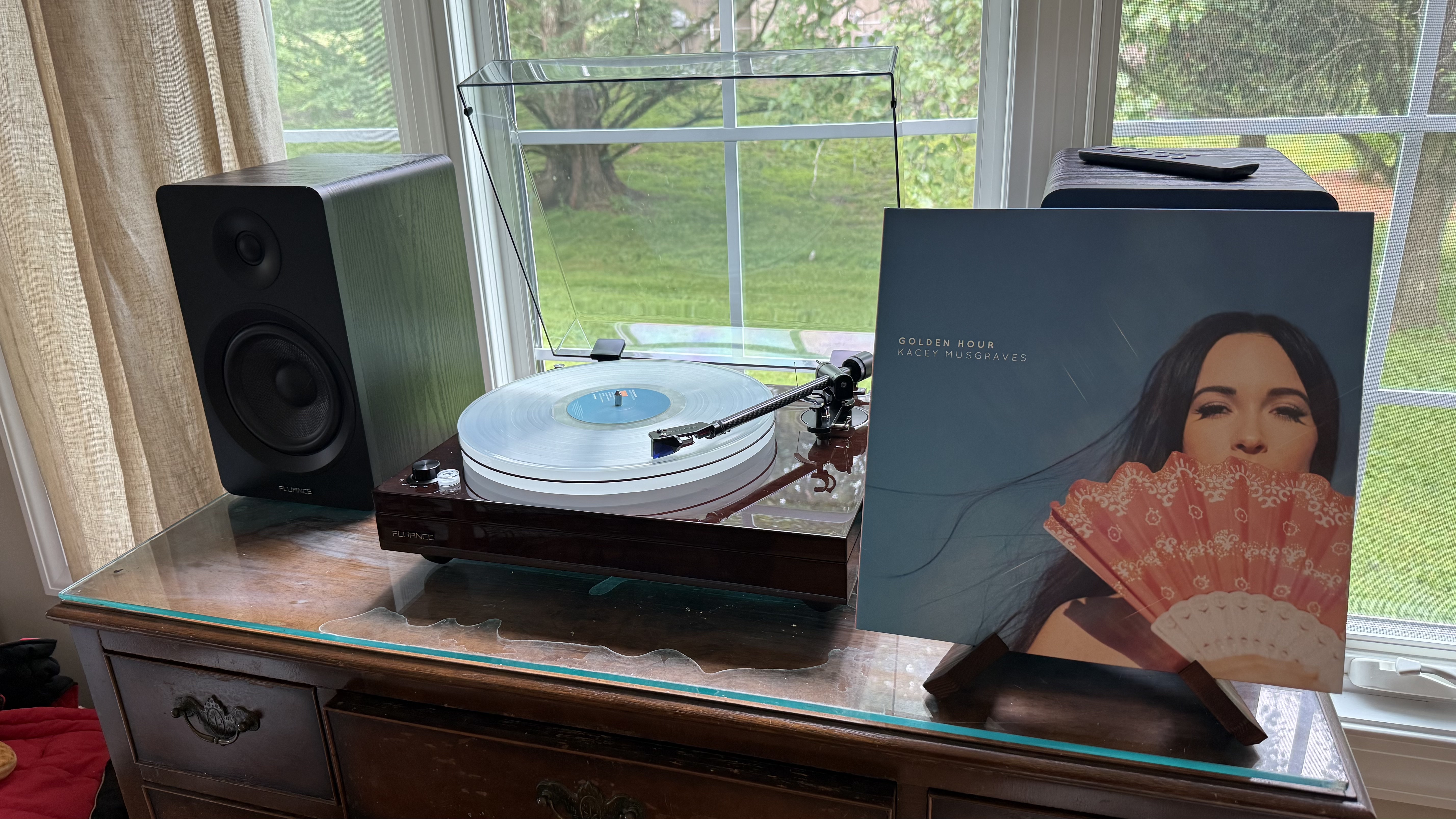
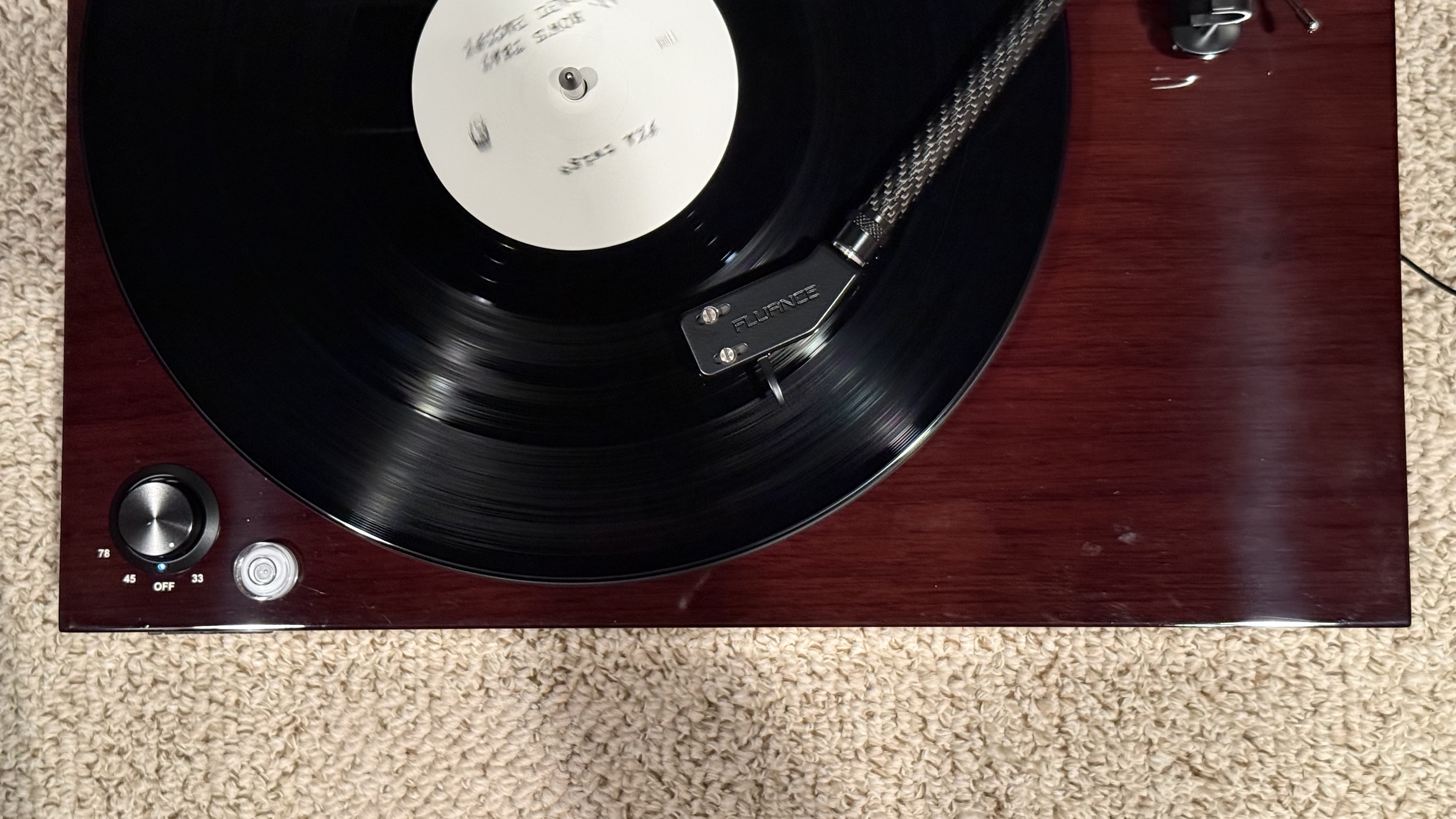
The Fluance RT87 is playing Kacey Musgraves. (Image credit: Future / James Holland)
How much does it cost? $799.99 (around £666 / AU$1,230)
When is it available? Available now (launched in June 2026)
Where can you get it? Available now in the US; UK and Australia coming soon
Newest among Fluance’s offerings with a mid-June 2026 release, the Fluance RT87 is available in the US and will (at the time of writing) be available in the UK,and Australia very soon. And whether you get it in Natural Walnut, Piano Black, or Piano White, the price goes for an only-cheap-to-audiophile price of $799.99 (around £666 / AU$1,230). And that price stays the same regardless of cartridge, of which you can choose from the Ortofon 2M Blue or Audio Technica AT-VM95ML.
Just be aware that the Fluance RT87 does not have a built-in phono preamp, so you’ll need to invest in one. Fluance does sell the PA10 Phono Preamp for $99.99 / £82.99 / AU$154 and can be bundled (though without a discount) on its site.
Fluance RT87 Turntable review: features
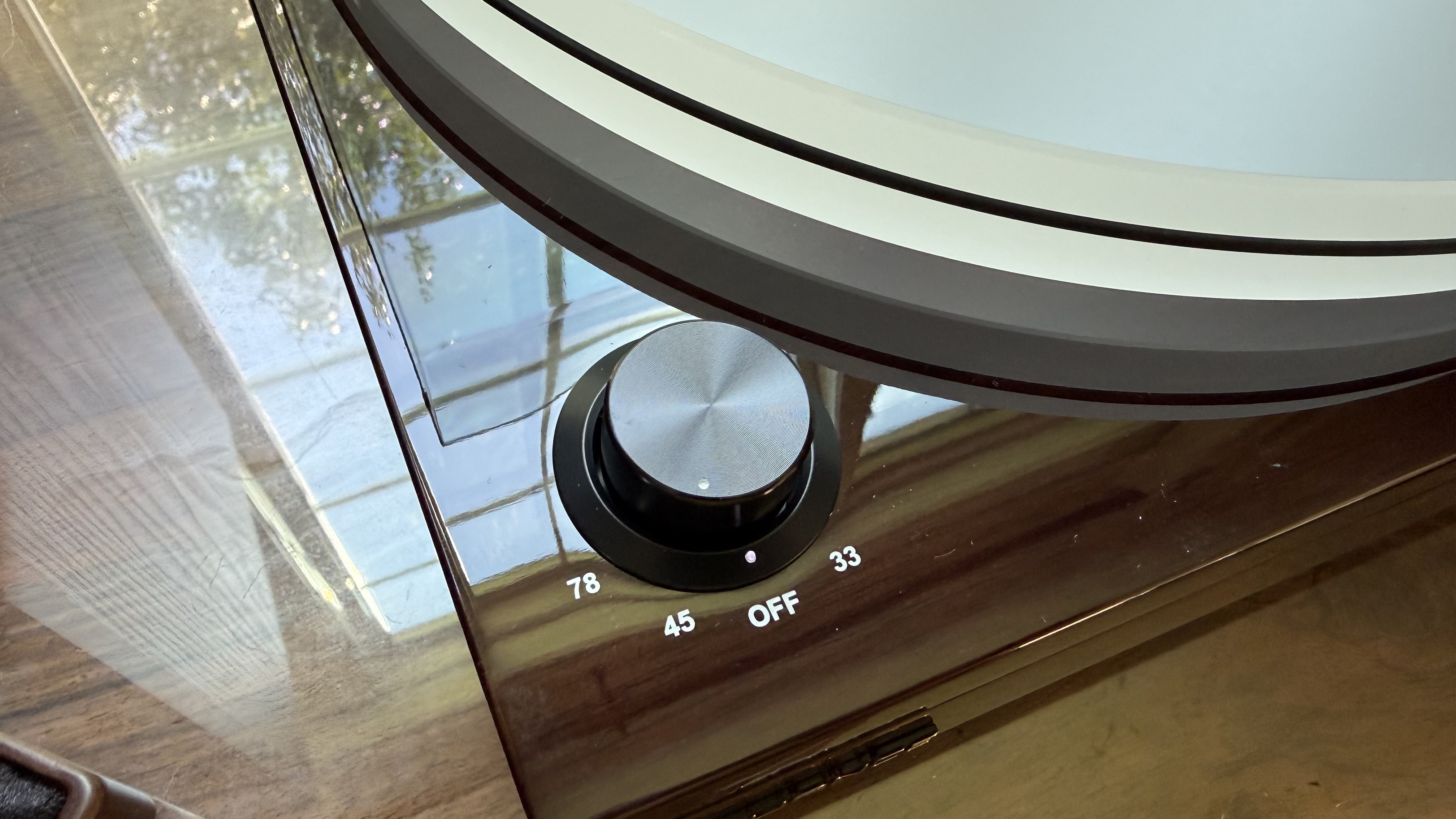
The Fluance RT87 has a speed selector, so no need to change the belt. (Image credit: Future / James Holland)
Very light on features and extra perks — the connoisseurs' choice
No phono preamp or 45 RPM adapter
Does come with a bubble level
If the Fluance RT87 is more for the audio purist and I think that’s who the brand is targeting, then it makes sense that this turntable is pretty light on convenience-focused features. There is no built-in phono preamp — something you can find on much cheaper decks like the Audio-Technica AT-LP70XBT. And, of course, you won’t find Bluetooth connectivity or any other unique types of connectivity.
I don’t say this as a bad thing, either. After all, the Fluance RT87 is meant for someone ready to enter more serious vinyl listening and all those extra accoutrements take away from what’s important and that’s its performance and everything involved in making sure that it performs properly.
While I’ll cover most of those choices for performance in the next couple sections, it’s worth noting that the Fluance RT87 comes with the option of either the Ortofon 2M Blue or Audio Technica AT-VM95ML cartridge, either of which cost over $150 as just as part ($166.99 and $179.00, respectively). The configuration reviewed here is the Ortofon 2M Blue.
While there are plenty of opinions out there on both cartridges and how they affect the sound and I won’t parse out that whole conversation — people’s opinions of cartridges are as varied as they are on any other piece of audio equipment — other than to say that either cartridge marks an entry point into serious audio quality from more budget cartridges… just like the Fluance RT87 itself.
It’s also worth mentioning that this turntable can play 78, 45, and 33 RPM, via a selector on the lower left corner of the turntable so no need to adjust the belt like some turntables. Unfortunately, it doesn’t come with a 45 RPM adapter. Additionally, it has an Auto-Stop toggle on the back.
Features score: 3 / 5
Fluance RT87 Turntable review: sound quality
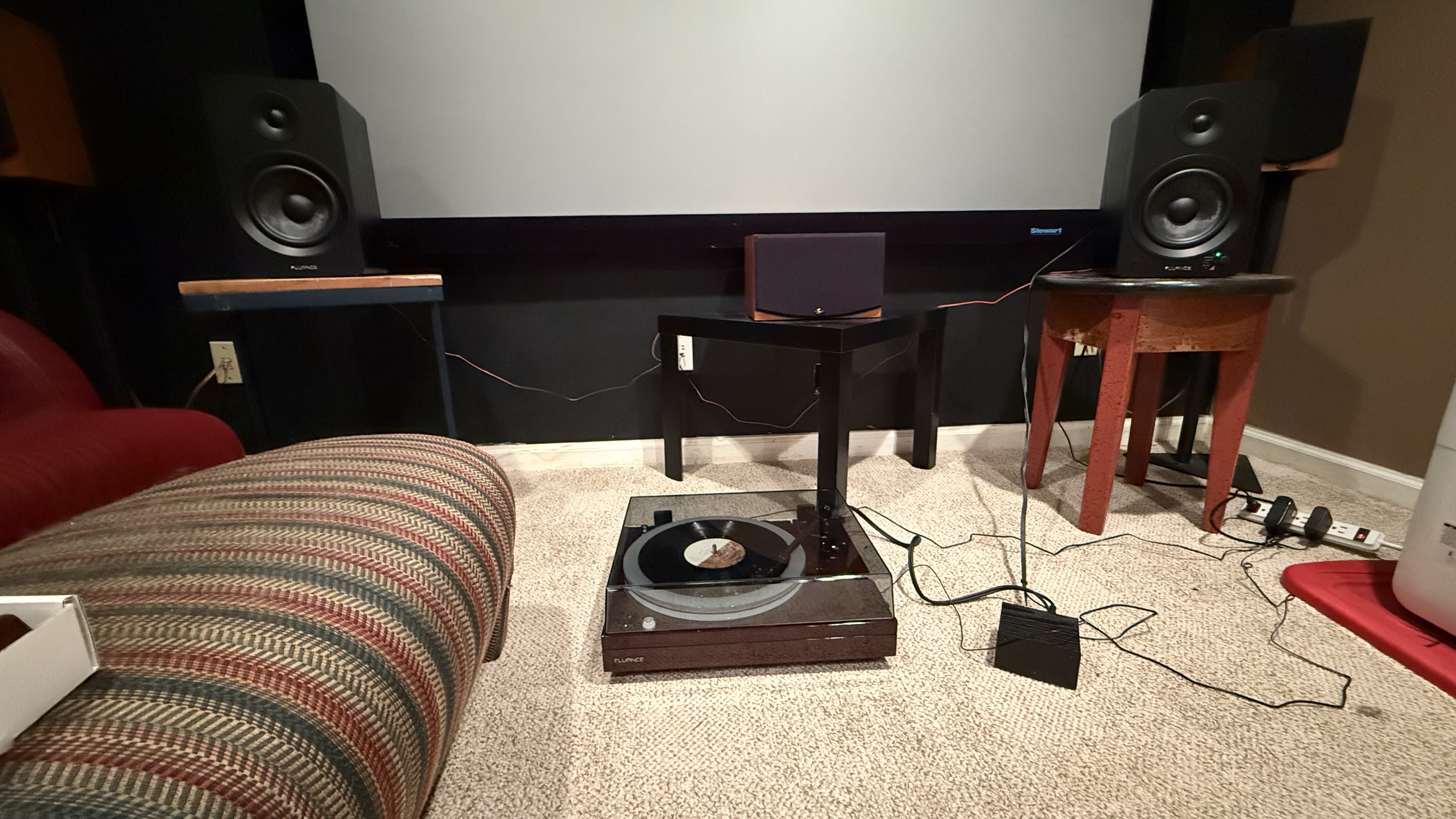
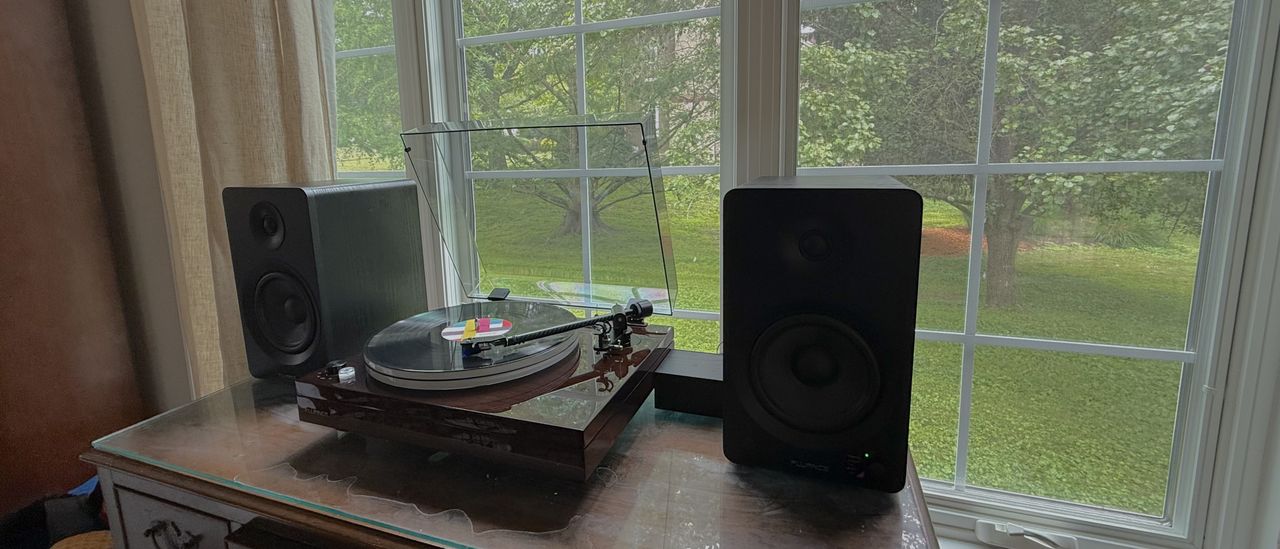
The Fluance RT87 being used in a somewhat treated room. (Image credit: Future / James Holland)
Has a sweet, slightly warm sound
Soundstage is immersive
No discernable inner groove distortion
I learned a lot about my records using the Fluance RT87 as my conduit. I learned that I didn’t like the way Fleetwood Mac’s Rumours is mixed. I learned that there’s way too much happening in Kamasi Washington’s Truth. Just to name a few.
You hear something that was there this whole time, but you noticed it on this last listen. And that’s not something that typically happens with entry-level gear. In short, I really enjoyed listening to the Fluance RT87. And while the turn table is a step or two up from entry-level gear (maybe beginner audiophile gear or first serious turntable level), the rest of the chain was more on the budget side — Fluance’s affordable PA10 phono amp and the company’s Ai41 speakers. Solid gear, but not transcendent.
One of the good things about using the Ai41 speakers is its Bluetooth connectivity. I could compare a record to a digital stream of the same music via HiFi through Deezer, which I did in a few cases. Rumours, for instance, got a play through vinyl as well as Kacey Musgrave’s Golden Hour. And the vinyl sounded just a little bit better. Maybe it’s the even-order harmonics. Maybe it’s using physical media over digital zeros and ones. To me, everything through the Fluance RT87 had this little bit of bloom to it. It just sounded a little bit sweeter.
Since I had done my best to properly set up my bookshelf speakers when I did my serious listening, I found the soundstage to be expansive and enveloping during listening sessions. I mentioned Kamasi Washington’s Truth, from his album Harmony of Difference before. When playing that song (really the whole record), not only could I hear his band to the outer reaches of where the speakers were projecting, but I could hear precise placement of various horn parts placed across the sound stage. In the same vein, Radiohead’s Pyramid Song sounded phenomenal on this setup.
As far as frequency response goes, I was pretty pleased. With the obvious caveat that the speakers are going to be the biggest bottleneck in a sound system (a bit of an oversimplification), I found the mid-range to be rich and full. Kacey Musgrave’s voice and guitar on Slow Burn, the opening track from Golden Hour, has weight to it. And the high-end has plenty of detail, while retaining some of the warmth of analog as it’s a tiny bit rolled off in a pleasing kind of way.
Now, the bass response is a bit tighter as opposed to big or woolly. It was still very present. Sure, it has a defined space on an older record like Rumours or Talking Heads’ Remain In The Light, but it’s easily placeable and doesn’t overpower the mix in something like FKA Twigs’ EP1.
Lastly, every record I played had a good amount of headroom so that the music came through clearly and without any real distortion (outside of those even order harmonics). And there wasn’t any discernable inner groove distortion either as the stylus would wind its way to the end of each side.
Sound quality: 5 / 5
Fluance RT87 Turntable review: design
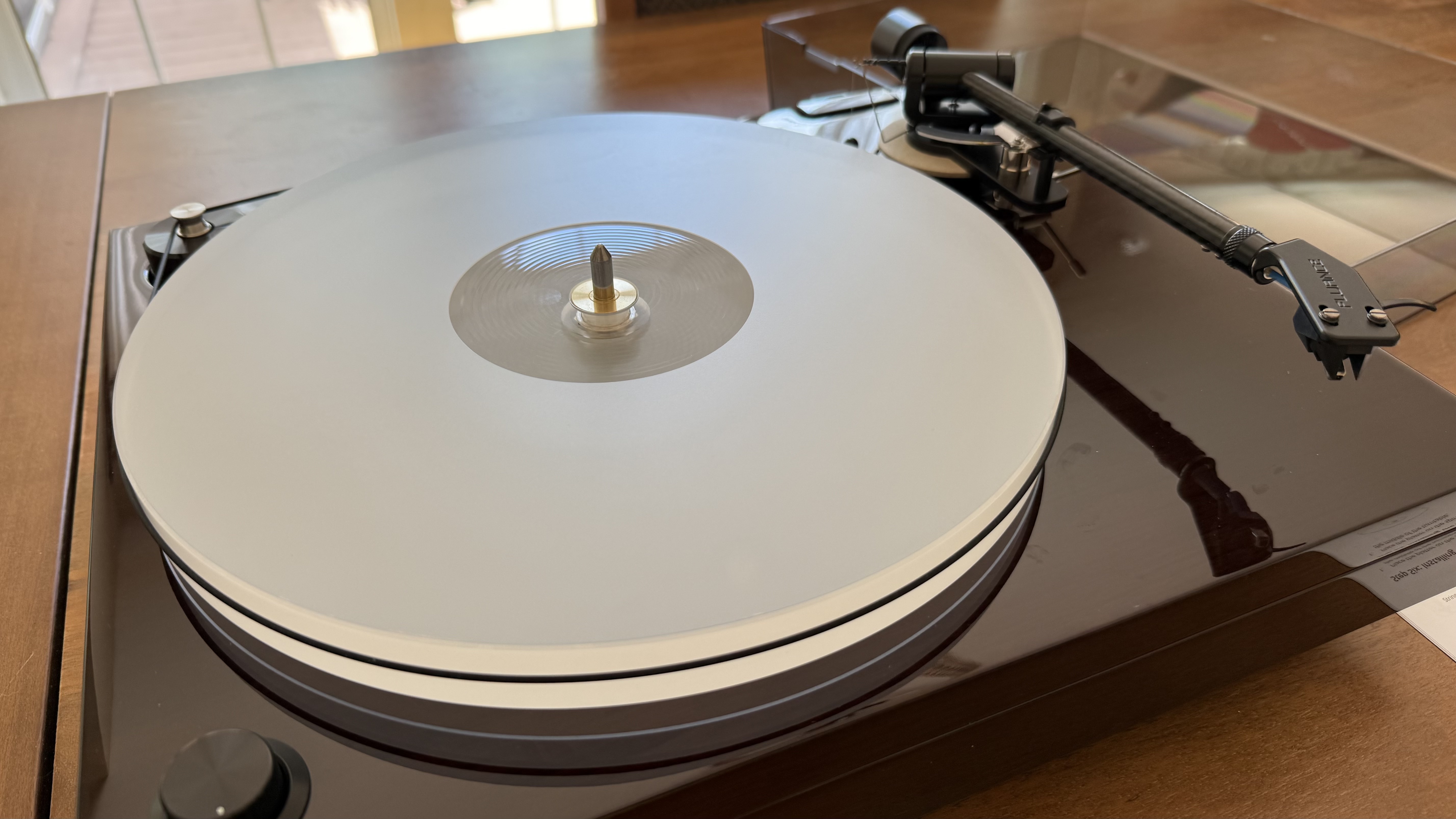
Fluance RT87's acrylic platter is hefty, weighing about four pounds. (Image credit: Future / James Holland)
Heavy-duty plinth and platter
Belt-driven
Removable cartridge
If you’re just getting into turntables, you might be wondering what puts the Fluance RT87 in a more expensive price bracket compared to a lot of the popular, feature-filled turntables out there, one of which you might be upgrading from.
Obviously the sound quality is a huge part of that, which we’ve already covered, but that sound quality is affected by the build of the Fluance RT87. Of course, it’s worth mentioning that it’s a classy-looking deck with a high-gloss finish, available in Natural Walnut (reviewed here), Piano White, and Piano Black. It is made from MDF, but that’s actually a positive, as it doesn’t create any resonance.
Getting back to that build, the plinth, aka the body or chassis of the turntable, is heavy — the whole thing weighs 21 lb (9.5 kg) — giving the turntable a durable feel. Also, the acrylic platter is hefty in and of itself at 4.1 lb (1.85 kg). Incidental bumping or closing of the dust cover, which is surprisingly easy to scratch, doesn’t skip or affect the sound. And unless your record is warped, it will rotate without any up or down motion.
This is a belt-driven turntable with an adjustable and rigid carbon fiber tonearm (you even get a little hex wrench to adjust it), complete with removable counterweight and tiny anti-skate weight, and replaceable cartridge. I’ve mentioned earlier the two types of cartridges to select from and the fact that the reviewed model here came with the Ortofon 2M Blue. It’s worth noting that this is a moving magnet cartridge with a nude elliptical stylus.
The feet, of which there are three, are adjustable to help level the Fluance RT87. They are basically large, mostly silicon silicon screws.
Control-wise, there’s just the speed selector on the front, left corner of the plinth and the auto-stop toggle on the back. The ports are about as Spartan — just stereo RCA inputs and a ground outlet.
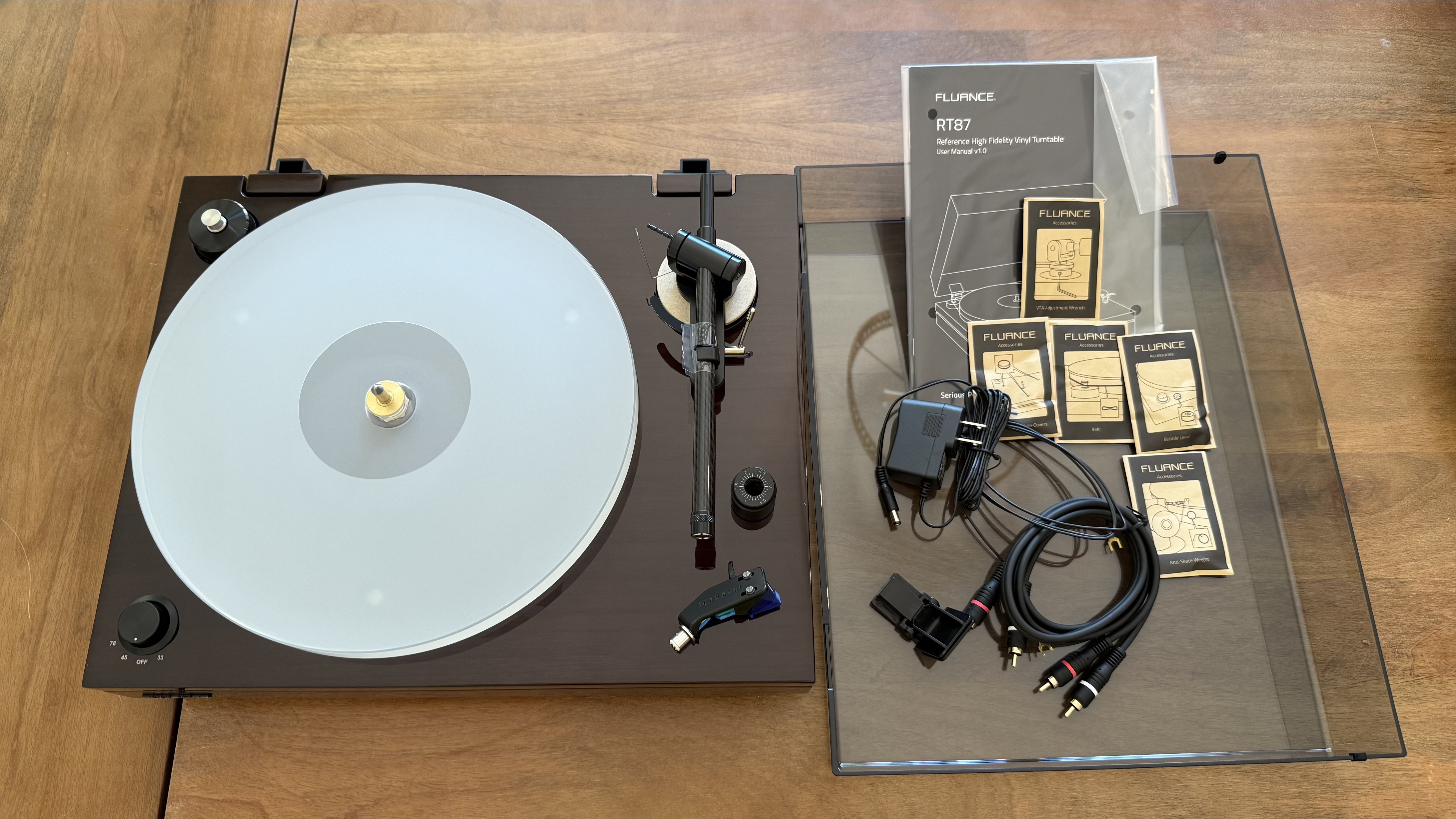
As far as extras go, the turntable comes with a RCA cable, ground cable, hex wrench for adjusting the tone arm, and bubble level, so you can adjust the turntable’s angle accordingly before you end up butchering any records. Brushes and any extras will require an individual purchase.
Design score: 4.5 / 5
Fluance RT87 Turntable review: ease of use and setup
Putting it together takes ten minutes
Not plug-and-play
Fine tuning takes even longer
There's a bit of assembly required with the Fluance RT87. (Image credit: Future / James Holland)
This should not be your first turntable. There’s ritual to setting up the Fluance RT87, as there is for a lot of turntables once you graduate beyond the three-to-four hundred dollar range. Because of that, it was equal parts frustrating and engaging. So, yes, there is some assembly required.
When first unboxing, I had to remove everything from its plastic wrapping and then spend probably five minutes just getting everything all together. I had to put the platter on the plinth, put the belt around the platter and then on the motor, put the Ortofon cartridge on one end of the tonearm followed by the counterweight on the other end, then on goes the anti-skate weight, and, lastly, I had to add the hinges to the dust cover and then attach it to the plinth.
But wait, we’re not ready to start playing any records. I had to turn the platter a few times with the belt on so that it’s evenly distributed. Since the platter doesn’t have a ridge or indentation for the belt, it has a habit of slipping off (and still does if I’m a bit clumsy removing a record after play) — something you don’t have to deal with on cheaper decks.
I also had to adjust the feet so that the turntable is completely level, making sure records lie flat during play. This takes a bit of time because you have to reach under and turn each foot clockwise to extend (counter-clockwise to shorten) until the bubble level shows its bubble directly in the center. This took me about ten minutes of adjusting initially, though to be fair, I was using a table that wasn’t very level. After moving the Fluance RT87 from the table I first had it set up on to a different, somewhat treated room where I had to put it on the floor, it required much less adjusting.
Adjusting the tonearm’s counterweight took quite a while as I had to be precise in getting it to balance flat instead of flying up and away from the turntable or digging into my records. While it’s par for the course, this probably also took me about ten minutes of adjusting, though that’s partially because I set it up according to the manual and found the tonearm to still not have enough weight from the counterweight.
Similarly, the anti-skate weight here is a bit finicky as well. It’s just a tiny ball on a thread thin enough to thread a needle with a loop on the other end to attach to the tonearm. The tonearm attachment is basically a lever with four notches on it to account for different anti-skate weight needs (for instance, the anti-skate should loop over a different rung when using the Ortofon cartridge versus the Audio-Technica one). Not only did it take some experimentation to find the right setting, but the loop kept slipping off its rung.
If you’re upgrading to your first big-boy or big-girl turntable and considering this one, just be ready to put in some time getting it right before actually using it. Also be aware that some of the required attention to detail during setup is not unique to this turntable, though anti-skate weights aren’t always a tiny ball on a tiny string.
Usability and setup score: 3.5 / 5
Fluance RT87 Turntable review: value
(Image credit: Future / James Holland)
Less features and automation than cheaper turntables
Better sound quality than those cheaper turntables
Some entry-to-premium decks may sound as good, but aren’t as sturdy
It’s interesting that the cheaper decks are the more convenient. It’s almost as if the more money you spend, the less features. Exhibit A, for instance, might be the FiiO TT13. This turntable costs a little over a quarter of the price of the Fluance RT87 ($249 / £239 / AU$249 if you need specifics), while adding in Bluetooth connectivity, a built-in phono amp, a fully automatic tonearm, and, frankly, due to its plug-n-play design requires none of the setup or fine tuning of the record player reviewed here. But I would hazard that the Fluance RT87 sounds quite a bit better since it has a bit more heft to its sound.
If you’ve been looking at upping your vinyl game, you might have already looked at the popular Rega Planar PL1, which at $595 / £299 / AU$645, is probably a more direct comparison. But, while the Rega also has a pretty spacious sound, it’s a bit more workmanlike in construction. It’s more utilitarian in looks and is much more light weight in construction. The Fluance RT87’s acrylic platter alone weighs about half of the Rega Planar PL1, making the Fluance more likely to absorb shocks and bumps without fuss.
Value score: 4 / 5
Should I buy the Fluance RT87 Turntable?
Attributes
Notes
Rating
Features
While it’s to be expected on more serious turntables, this one is very light on features, though at least one can change from 33 to 45 rpm without having to adjust the belt.
3/5
Sound quality
The Fluance RT87 sounds really good, able to reproduce that analog warmth with body and spaciousness.
5/5
Design
From the removable but capable Ortofon Blue 2M (or AT-VM95ML) cartridge to the heavy acrylic platter and more, this turn table was built for durability and for quality.
4.5/5
ease of use and setup
There’s a lot of fine tuning required to set the RT87 up properly. And it’s probably going to take a little while. This part may exercise your patience.
3.5/5
Value
The Fluance RT87 is not a cheap turntable, but as a turntable for those ready to get serious about their listening experience, it’s appropriately priced.
4/5
Average Rating
Excellent sound, heavy duty build — there’s a lot to love. Too bad it doesn’t have a built-in phono preamp.
4.5/5
Buy it if...
You want immersive, impressive audio With a good pair of speakers in tow, the Fluance RT87 will make your record collection come alive with audio that has heft as well as breadth. It just sounds good.
You’re ready for a serious turntable Yeah, you have to do a bunch of set up and it doesn’t have Bluetooth, but if you want a solid turntable for serious listening, the Fluance RT87 should be in consideration.
You’re worried about vibrations There’s the rubberized, adjustable feet, a substantial plinth, and a hefty platter. This turntable won’t skip or scratch from a bump (if you have it set up correctly).
Don't buy it if...
You prioritize value While I think the Fluance RT87 is worth its price tag, I’ll also admit that it’s pretty high. Most people wanting to get into vinyl or step up from their very first record player will probably not want to spend $800 on one.
You need a phono preamp The Fluance RT87 does not have a phono preamp. If you’re not prepared to pay for this additional piece, then you might want to look elsewhere.View Deal
Fluance RT87 Turntable review:: Also consider
Fluance RT81 If you’re reading this review and liking what you see except for the price tag, Fluance does have the RT81, which costs less than half the price. It still sounds good, though not as good (less detail, inconsistent speed), and is much more convenient to use. Read our full Fluance RT81 reviewView Deal
Rega Planar PL1 The Rega Planar PL1 is not nearly as heavy duty as the Fluance RT87. And it’s a bit more utilitarian looking. But it also sounds very good and is a couple hundred bucks cheaper. Read our full Rega Planar PL1 reviewView Deal
How I tested the Fluance RT87 Turntable
Used regularly for a few weeks
Played through Fluance P10 Phono Preamp and Fluance Ai41
Played at various speeds and different size records
I used the Fluance RT87 for a few weeks, listening to as wide a variety of music from Rock to Jazz to Americana that I could. In so doing, I used the different speeds as well as seeing how it did with different size records. I also used the record player in a couple different rooms and with a couple different speakers, the Fluance Ai41 mentioned above and the Klipsch The Nines II.
I’ve tested a lot of tech gear over the years from laptops to keyboards and speakers, and so have been able to use my expertise towards giving an honest and fair opinion, not to mention a critical eye, to any product I test.
O EX30 é o Volvo mais pequeno e mais acessível da gama, e um dos SUV elétricos compactos mais interessantes do mercado. Testámos a versão P5 Plus, com bateria de 55 kWh, e ficámos rendidos ao bom ambiente a bordo, e com a eficiência superior à anunciada. Mas não conseguimos ignorar algumas decisões de design que dão que pensar numa marca com o histórico de segurança da Volvo.
Prices are going up across almost all the Apple Music tiers
There are some bumps in Apple Music prices too
These are the first price hikes we've seen since October 2022
Apple Music is the latest subscription package to get a bump in price, leaving users with the choice between paying more or losing access to the streaming part of their library. The bundled Apple One package that includes Apple Music now costs more as well.
As reported by Music Business Worldwide (via Engadget), the reason cited by Apple is "rising licensing costs". It's the first price hike for this particular subscription we've seen since October 2022. The new monthly prices are below:
New Apple Music prices
US
UK
Australia
Individual
$11.99 (up $1)
£11.99 (up £1)
AU$14.99 (up AU$2)
Family
$19.99 (up $3)
£19.99 (up £3)
AU$23.99 (up AU$4)
Student
$6.99 (up $1)
£5.99 (unchanged)
AU$7.99 (up $1)
The Apple One price increases are less clear, as they're not as easily available on the Apple website. It appears the Apple One Family plan is now $27.95 per month (up $2) and the Apple One Premier plan is now $39.95 (also up $2), though the Apple One Individual plan has stayed at $19.95. Internationally, similar price rises are likely.
This comes at a time when everything tech-related is getting more expensive, from laptops to streaming services. Exploding AI resource demand has sent the price of memory and storage rocketing, and that continues to have a knock-on effect everywhere.
Apple is of course by no means the first company to put up its subscription prices, but it's a reminder of the pitfalls of the digital rental model. As soon as you stop paying, you lose access — so if you need a service, you have no choice but to accept the higher price.
The online reaction has mostly focused on this too: "It's not even about the cost sometimes," writes one Redditor. "It's about loss of control over your finances. Companies can jack up their prices whenever they want." Few commenters seem ready to quit Apple Music, though many are pointing out the billions that Apple has in the bank.
Apple Music doesn't have a free tier like Spotify does, but it beats every other music streaming service in the support it gives you for local files. If you have enough MP3s and ripped CDs, you can use it perfectly well without a subscription.
As we've written about recently, Apple is selling more and more of its software products through recurring payments rather than a flat one-off fee, and one of the reasons is that it's more profitable — and makes it more likely that users will continue to pay up.
Audio engineer Cameron Oatley is better-known as 'GoldenSound'
He's teamed up with Status to add a special tuning profile to its Pro X buds
The result is Pro X GoldenSound; the fruit of impressively extensive labor
Sometimes in this job (as TechRadar's Audio Editor), I just get sent a set of earbuds and a press release. Sometimes, I'm invited to an online briefing so that a marketing rep can explain key terminology before I start my review process.
Rarely am I invited to a lovely pub in London, lulled into a false sense of security with a drink and a comfy chair and then taken through a brief but intense Doctorate in audio engineering.
I jest, of course. But if you've ever come into contact with either Status Audio (see the Status Audio Between 3ANC or Status Audio Pro X for previous examples of greatness) or Cameron Oatley, aka GoldenSound, you'll know that things are about to get decidedly audiophile. And given that this is a collab between the two, it's doubly so.
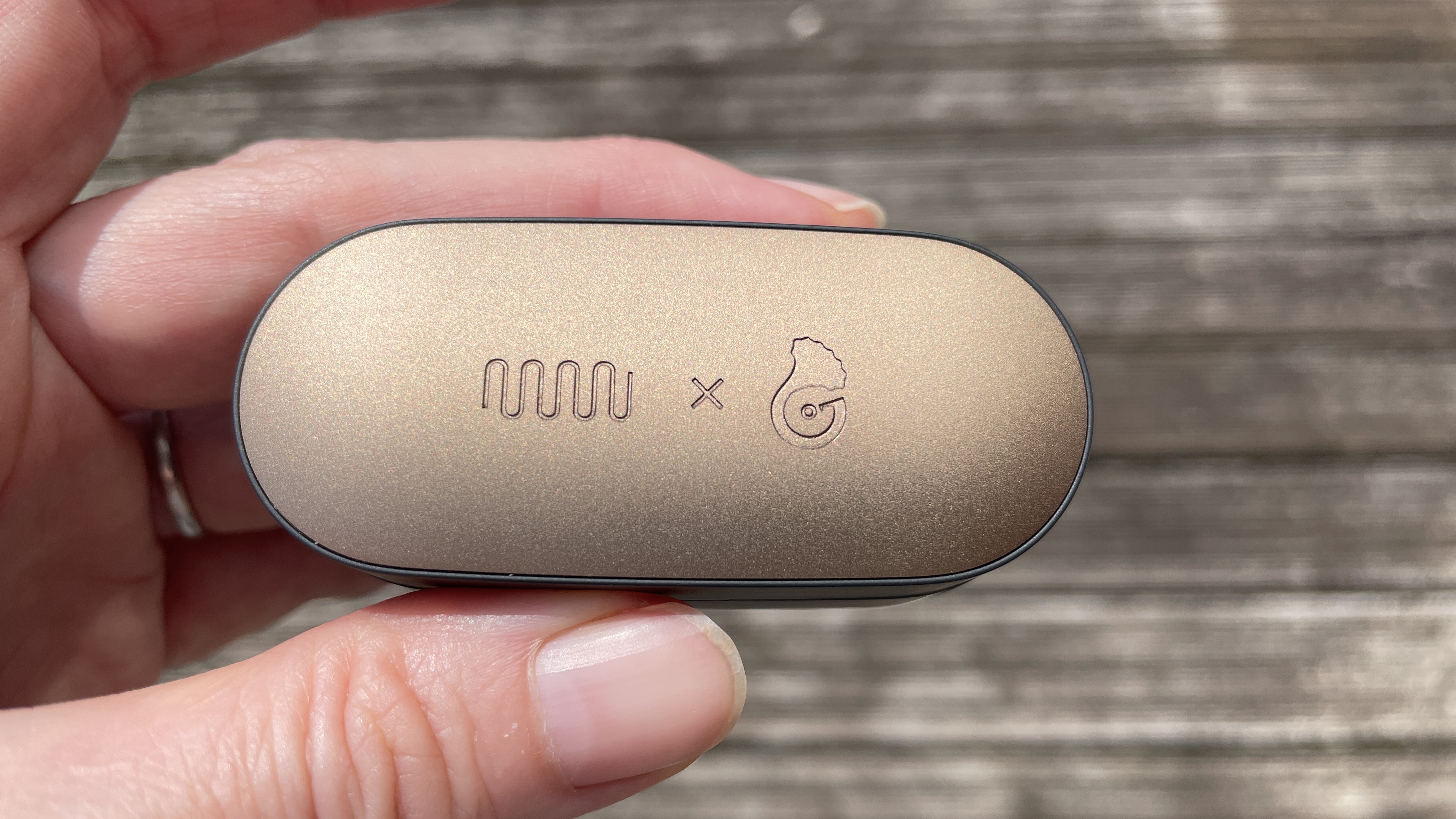
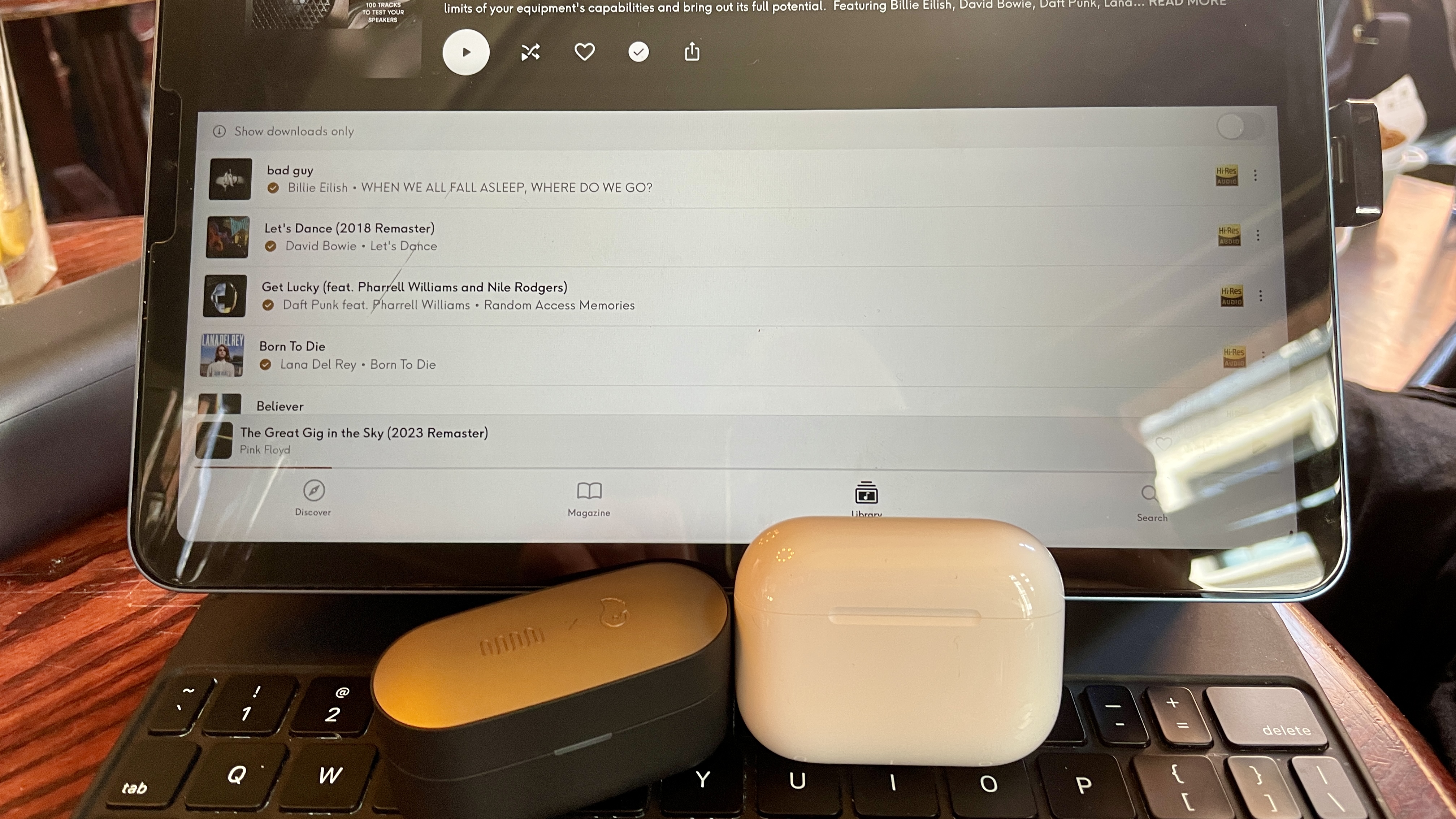
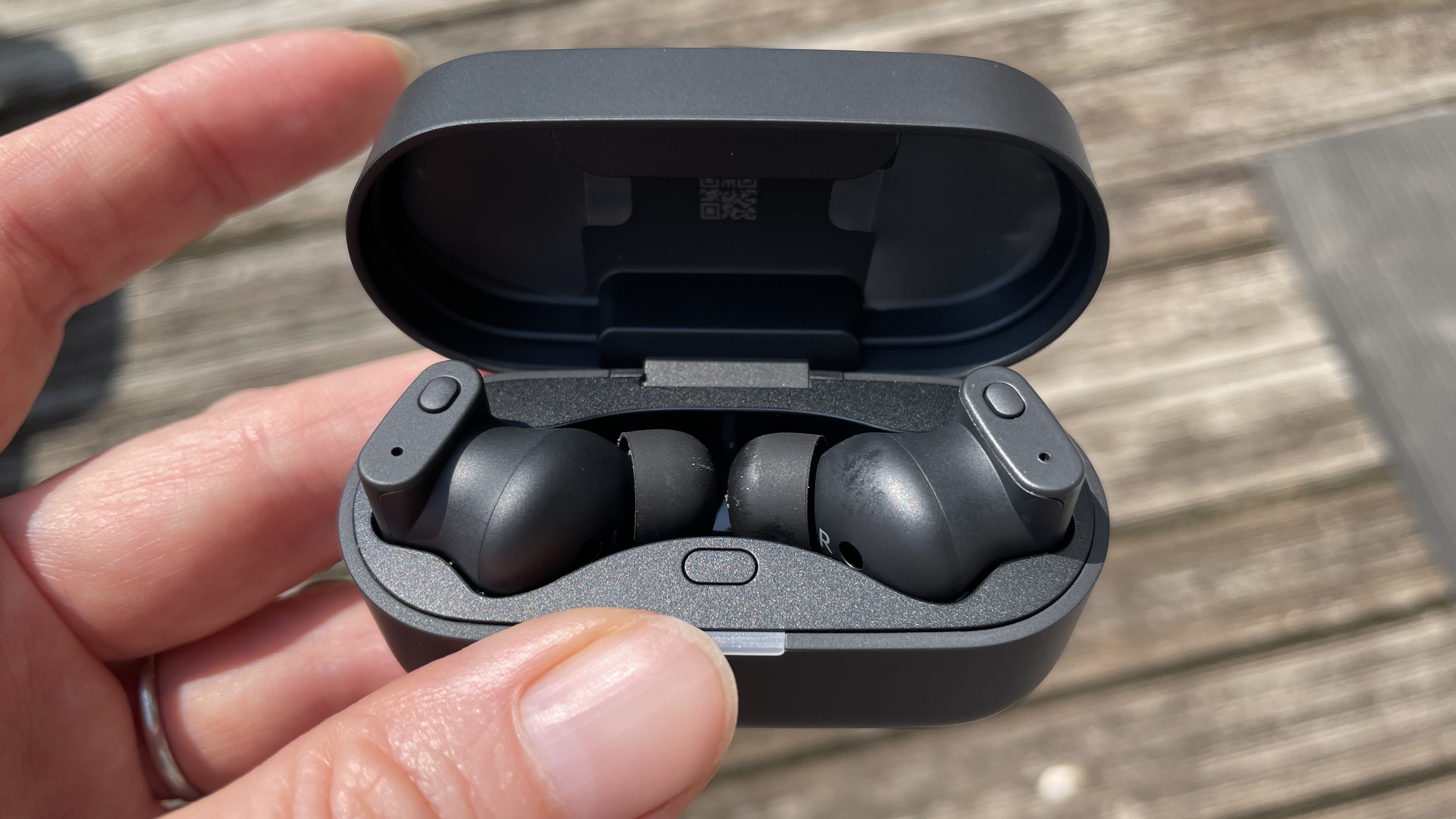
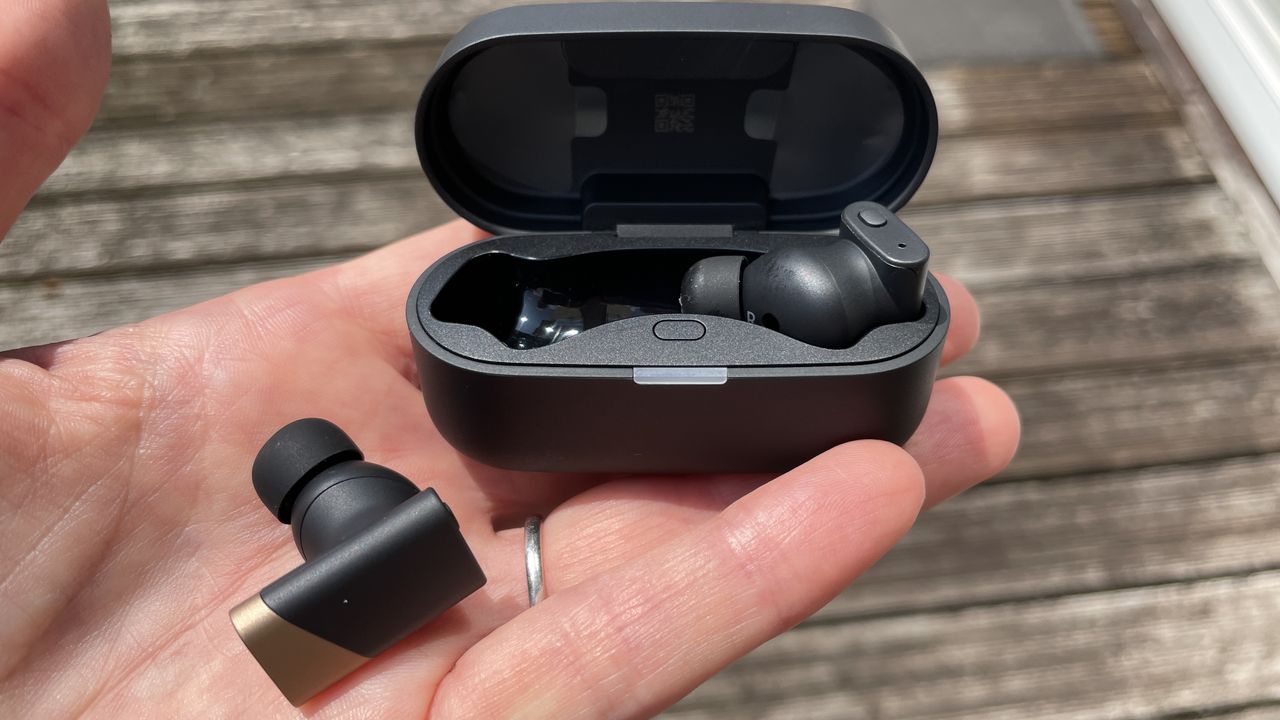
What you're looking at is the Status Pro X GoldenSound Edition. Yes, it's gold-tone on the top of the case and on the accents of the stems — but that's not all. Inbuilt here (and definitely not available in the non-GoldenSound variant) is a special new piece of software that Oatley thinks is the "most accurate tuning that a TWS product has ever had" and a "faithful recreation of real-world sound".
And this version will be $279 when it hits shelves in August (so $30 more than the current price of the Pro X, at $249) or around £209 / AU$400, give or take.
(Image credit: Future)
Status Audio Pro X GoldenSound: are listeners up for a Harmon Curve rewrite?
In terms of hardware, you're looking at everything built into the Status Audio Pro X, so two balanced armatures and a dynamic driver — something Status has been working with for some time and with no dearth of success.
But this time around, Oatley describes his granular approach to tuning thus: "What you measure is the IEM plus the impact of the rig" ie. your inner ear — albeit a metal tube to represent it with a mic at the end, for the purposes of his testing.
Oatley explains that the Harman Curve is often implemented incorrectly by audio engineers, because when it was developed in 2012 (and subsequently published in 2013, quickly becoming a trusted reference), true wireless earbuds hadn't yet been invented.
Because of this, the Harman Curve uses the pinna, or outer ear, as the reference point — ie. part of the "rig". But when developing in-ear products, from a purely sonic perspective (not including the creation of ANC antiphases) you can ignore the outer ear because the product starts within your ear canal. I know! Contrary to what we were taught as kids, the answer to 'My, what big ears you have!' isn't actually 'All the better to hear you with'…
(Image credit: Future)
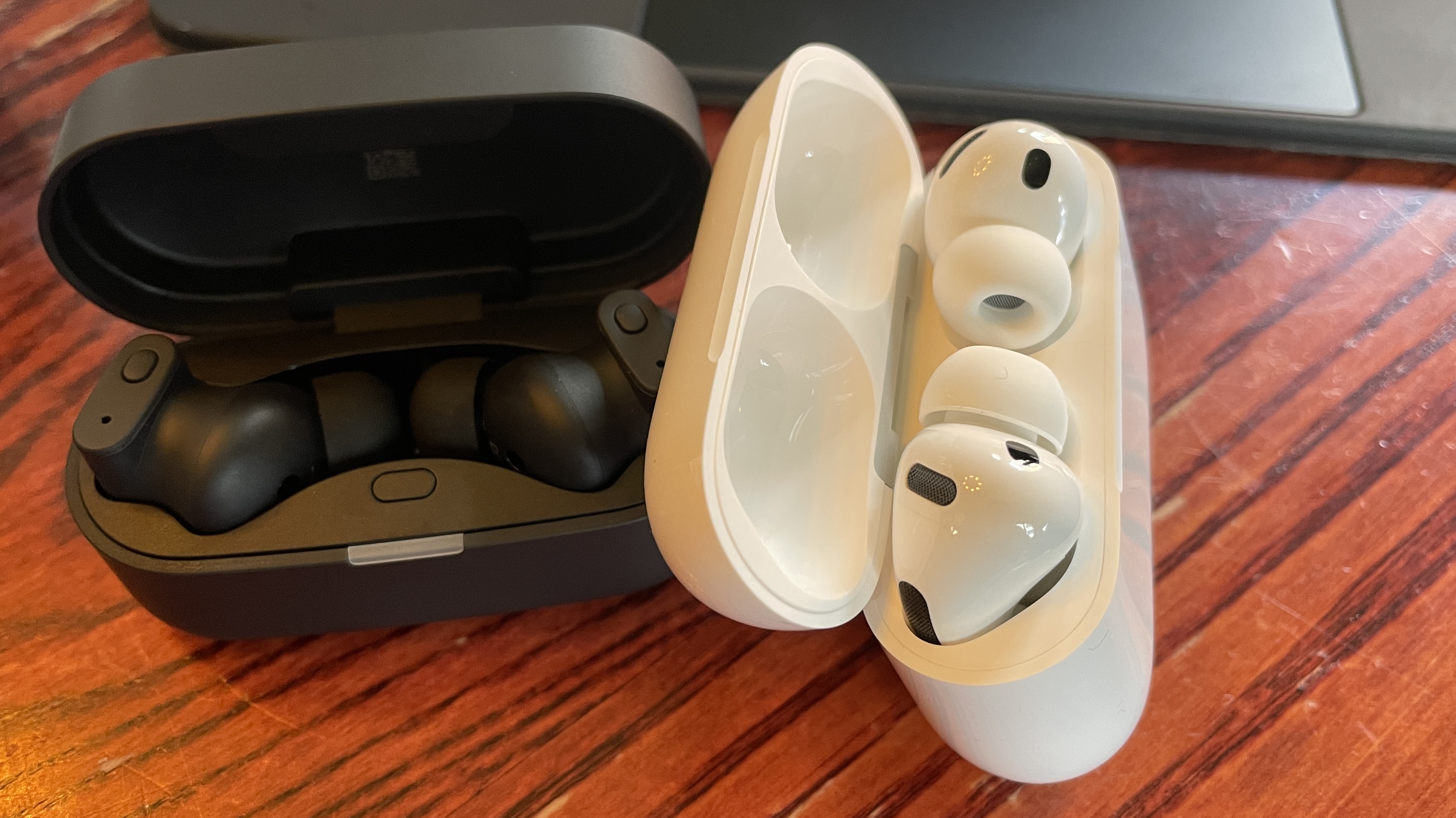
How does all of this stack up against AirPods Pro 3?
I ask Oatley what he's most proud of with this project and he's surprisingly open: "Look, for ANC I think AirPods will always be tough to beat. But a lot of work has been done to make these sound better. These are for the user who wants the best possible sound in a true wireless design. I hope I've achieved that".
He then points me to a graph that's like the Harman Curve, but different. It's what he was able to achieve with the GoldenSound Edition. He's particularly proud of the graceful line between 80Hz and 100Hz, juicy bass frequencies he feels are more accurately relayed in the Pro X GoldenSound Edition. And I have to agree: in this area, these earbuds glitter like gold.
Let's get to the meat of the thing: listening. Both Status and GoldenSound actively encourage me to do this, and even set me up with a Qobuz screen, an LDAC source device and some AirPods Pro 3 for comparison. Oatley adds, "something tuned perfectly on a low codec is still better than something tuned badly on a higher codec", and while we all know you won't get LDAC out of AirPods, it's a very valid point.
Billie Eilish's Bad Guy is expansive and clean, with a snappy, impactful low end. Dire Straits' Money for Nothing is as brooding, snaking and exciting at the outset as you'd ever want it to be. ACDC's Back in Black? A head-nodding and beautifully regimented, cohesive mix.
What's gone are the… I hesitate to call them 'parlor tricks', but that typical V-shaped augmented treble one so often hears in designs of this type feels eased. And know this: the sound is altogether more open as a result.
(Image credit: Future)
It's not all glowing praise: during my limited time for an initial listen, you understand, I found Apple AirPods Pro 3's audio just marginally more woolly overall in direct comparison. That said, AirPods Pro 3 do have a slightly more soaring treble from the box. As such, some tracks sound more fun, forthright and zealous using the Apple product. It's the age old debate, isn't it: integrated hi-fi sound or fun, V-shaped in-ear mix?
I know my ear is keenly tuned to treble sounds (I've done the tests) but some listeners will love what's been achieved here. I spy an industry disruptor and no mistake. It's nothing if not interesting — and I'd say the industry standard was due a shake up.
I often find listeners might think they enjoy a certain tuning (typically, wearers might augment bass frequencies straight away) when in fact, if we play with their EQ settings, they actually prefer something quite different.
Here, Oatley hasn't given users the option to tweak his proprietary GoldenSound profile within the EQ settings, although you can select from 'Status Signature', 'Status Audiophile', 'Knowles Preferred' or 'Vocal Enhance' presets, or create your own using an 8-band tab set at neutral from the Status Hub app. Sadly, there's no similar visual for the presets so you really need to trust GoldenSound has done it right here. And given the extensive amount of work that's gone into them, I think your trust is well-placed.
This is not to be considered a full review, you understand. For that, I need more time. But what I can tell you right now is that the process won't be a hardship.
Três alunas da Faculdade de Medicina da Universidade de Lisboa usaram a experiência no curso de IA na Medicina para desenvolver uma aplicação que permite localizar stocks de medicamentos e fazer a reserva.
Today, Apple released an update to its Creator Studio subscription with new features across many of the suite’s apps.
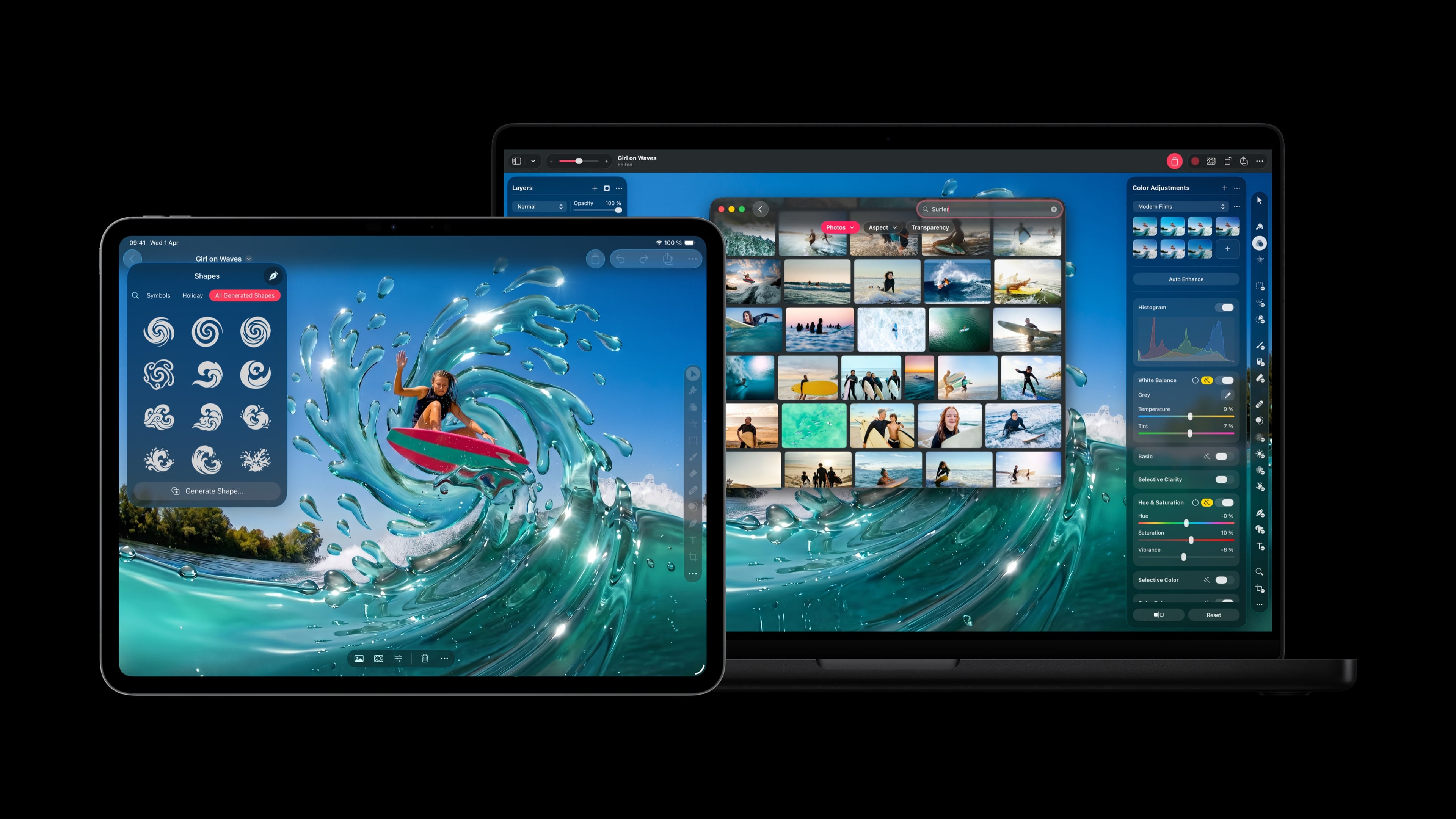
Pixelmator Pro now integrates more deeply with Creator Studio’s other apps. While working in Keynote, Pages, and Numbers, you can open an image directly in Pixelmator Pro, edit it, and save the changes back to the source app’s document. On the Mac, Final Cut Pro can now send individual frames to Pixelmator Pro, making thumbnail creation simpler.
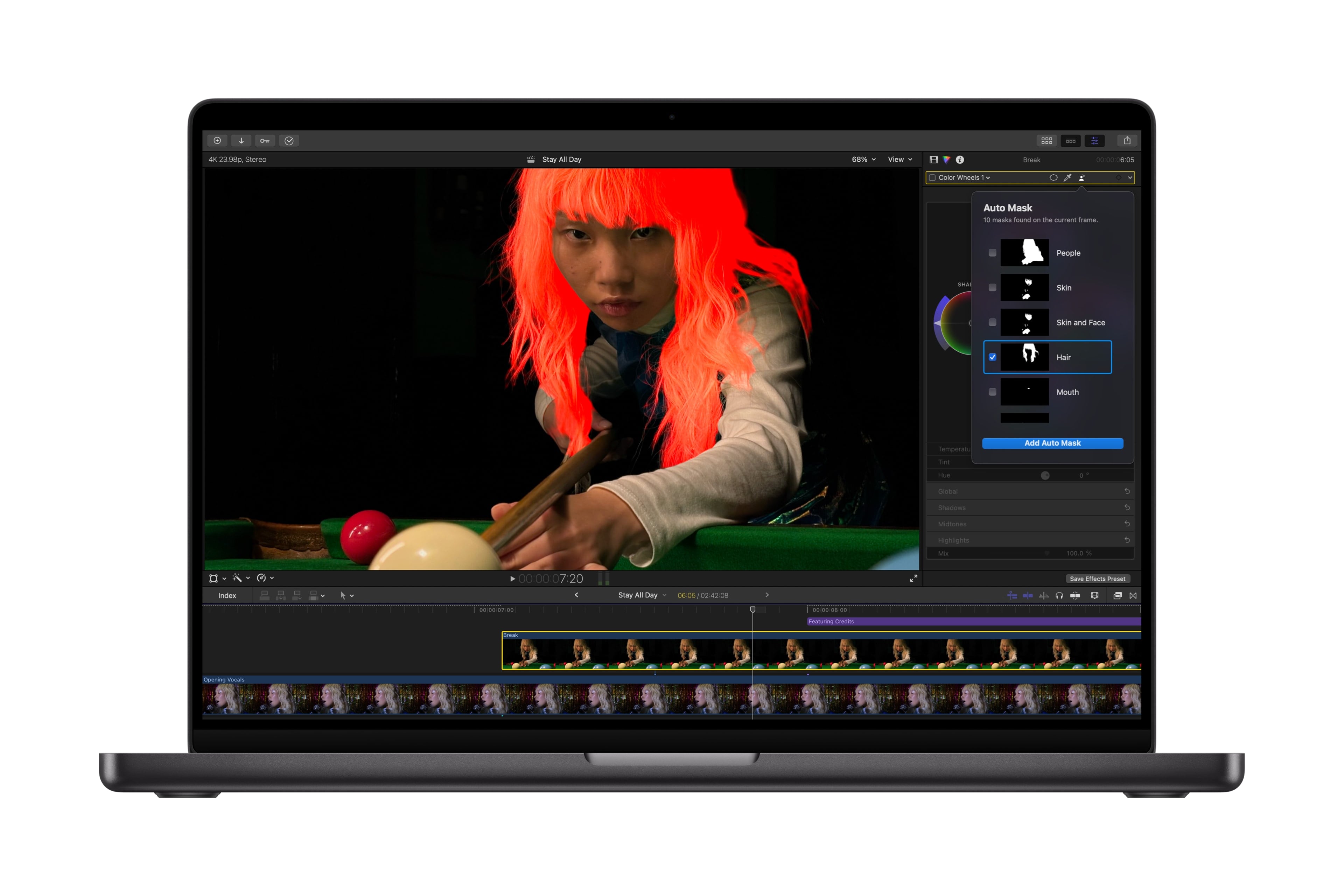
Final Cut Pro is also adding a set of Creator Themes with multiple aspect ratios, dynamic titles, and customizable backgrounds. Plus, users now have more control over the design of captions generated on-device using AI. On the Mac, Auto Mask lets you isolate certain parts of footage for editing, and Match Color reproduces colors more accurately.
Source: Apple.
For Logic Pro users, today’s update includes improvements to Chord ID, a new Producer Project from Khris Riddick-Tynes, a new sound pack, and an expansion of Beat Breaker.
Final Cut Camera for the iPhone and iPad has been updated with support for Clean HDMI Out, more flexible ProRes support, and disabling of digital zoom. Motion now supports vector graphics, and Compressor gains Vision Pro features, while Freeform gains shape creation, opening images in Pixelmator Pro, a Dark Mode, folders, and drawing on the Mac. Plus, Pages, Keynote, and Numbers each added a handful of new features.
Creator Studio debuted just six months ago, so it’s good to see it already being updated with meaningful features. Creator Studio costs $12.99/month or $129/year. More information is available in Apple’s press release here.

 Login


 or dislike
 this post below!