Slashdot reader BrianFagioli writes:
Shutterstock has unveiled what it calls a "human-led, AI-powered" creative platform that combines its massive library of [human] contributor-created content with AI image and video generation, AI editing, conversational search, prompt enhancement, and automated model selection tools. The company says the goal is to help creators move from idea to finished work faster [in a single application] while maintaining commercial licensing protections and contributor royalty payments... While Shutterstock repeatedly emphasizes human creativity, much of the platform's future appears centered on AI-generated and AI-modified content.
An article at Nerds.xyz suggests Shutterstock's AI tools let users "transform existing content into something new," while noting Shutterstock's repeated references to human creativity "almost feel defensive."
But it points out other companies including Adobe and Canva "and countless startups are all racing to integrate AI into creative workflows."
Agora você pode organizar o feed do Instagram da forma que quiser! A Meta começou a liberar a função de reordenar a grade do perfil, permitindo mudar a posição dos posts sem precisar apagar ou republicar conteúdos. Neste vídeo, veja o passo a passo para usar o novo recurso e descubra o que fazer caso a opção ainda não tenha aparecido no seu aplicativo.
"Battery breakthroughs will lessen AI's demand on the electricity grid," argues The Washington Post's editoral board, arguing that GM's latest moves "offer a fresh reminder that resource constraints can be solved by innovation."
Or As Fortune put it, "America's electric grid is buckling under extreme weather, aging infrastructure, and an AI build-out that is quietly rewriting U.S. power demand — and General Motors wants to turn that crisis into a business." They describe GM's plan as offering itself "as a distributed utility in disguise... stitching together hundreds of thousands of battery-powered cars, new grid-scale storage, and a unified charging platform into what amounts to a virtual fleet of power plants."
The bet puts GM on a collision course with Ford's newly branded Ford Energy unit as both Detroit rivals race to repurpose underused EV capacity for a more urgent problem: keeping the lights on in the AI era. GM's case rests on three planks. The first is its existing fleet. GM says more than 250,000 of its EVs on U.S. roads can already charge bidirectionally — pulling electricity from the grid and sending it back. "Every evening, a quiet transformation occurs across the American landscape," GM Energy vice president Wade Sheffer writes in an open letter to utilities and regulators, describing the EVs sitting in driveways as "a massive opportunity to aggregate energy storage capacity."
A firmware update is rolling out to customers with GM Energy's vehicle-to-home hardware, converting those systems into full vehicle-to-grid assets with no new hardware and turning home backup systems into grid resources when utilities need them. GM is piloting the idea in Michigan with DTE Energy at 30 employee homes, and has sketched a 2030 vision with Pacific Gas & Electric in which more than 52,000 GM EVs help balance the grid out of a projected 130,000 vehicles in the area.
GM is also "seeking partnerships with utility companies nationwide to assist in offering such vehicle-to-grid services for customers," reports CNBC, noting it's one of two moves "meant to address concerns about rising energy costs amid an artificial intelligence boom."
Forbes reports that GM's second goal "is to leapfrog the dominant battery cell tech used for energy storage packs right now" — right past the LFP (lithium-iron phosphate) stage, "which is dominated by China."
Sodium batteries are cheaper to use than LFP because they don't need an additional cooling system. They also have a 20-year usable life and are made from materials that can be sourced from within the U.S., the company said at a briefing in San Francisco on Tuesday.
"Sodium-ion actually is the better chemistry for that application. And when I say sodium-ion is better, I mean GM's version of sodium-ion," Kurt Kelty, GM's battery chief and a long-time Tesla battery executive, told Forbes. He said GM is seeing great results from its prototypes, even at scorching temperatures of 55 Celsius (131 Fahrenheit).
"Sodium-ion-powered energy storage systems have the potential to operate without active cooling and with much less system complexity," Kurt Kelty, GM's vice president of battery and sustainability, said Tuesday in a blog post. "In large energy storage systems, that matters." Not having to cool the battery cells could lead to lower upfront costs as well as operating costs, the automaker said.
TechCrunch reports on GM's big new partnership with energy-storage startup Peak Energy to develop GM's sodium-ion battery chemistry for grid-scale deployments:
GM wouldn't share with TechCrunch how much money it is investing in this energy-storage effort. But we do know the company has committed $900 million to commercialize new battery chemistries, an investment that includes a new battery-development center. .. The first GM cells are expected to enter trial production at the company's Battery Cell Development Center in 2028.
"Our next-generation sodium-ion cell development will drive energy density higher," promises GM's blog post, arguing they're extending the company's battery expertise and technical infrastructure "into the electrical grid itself. If we get this right, we will not just build better batteries. We will help create a more resilient, more affordable and more flexible energy future... Every improvement we make strengthens the development stack that supports both EVs and energy storage."
"The message: GM isn't just selling cars into a stressed grid; it's supplying the batteries to stabilize it," argues Fortune.
And GM also announced they're augmenting their apps with an "Energy Pass" offering "seamless access to Tesla Supercharger, IONNA, Electrify America, and soon, ChargePoint and EVgo networks." Their goal is to simplify the charging experience with an app "that covers nearly 70% of all DC fast chargers in the United States, plus many Level 2 chargers, all through one app."
A newly discovered genetic clock acts as the body’s developmental timekeeper, coordinating the bursts of gene activity needed for growth. Scientists found that when this clock breaks down, development comes to a halt. Think about a train sitting at a station. Passengers have boarded, conductors are checking tickets, and everything is ready to go. But [...]
This month saw the release of Vim Classic 8.3, the first stable version of a new long-term support fork of Vim maintained without generative AI tools. Linuxiac reports:
The release is based on Vim 8.2.0148 and includes selected bug fixes and patches backported from later upstream Vim releases. Vim Classic was first announced by [SourceHut's CEO/founder] Drew DeVault in March 2026 after he objected to LLM-assisted development in Vim and Neovim. In his announcement, DeVault said he no longer wanted to use software developed with LLM assistance and introduced Vim Classic as a fork for users who want to continue using Vim without that involvement... Vim Classic follows Vim's charityware model and continues to direct users toward Bram Moolenaar's long-running support for children in Uganda. The release is distributed as a signed source tarball from SourceHut, while future important announcements are expected through the project's mailing list.
"Vim is important to me..." DeVault wrote in March. (DeVault even tattooed "hjkl" on his right arm.) "[A]lmost every word I have ever committed to posterity, through this blog, in my code, all of the docs I've written, emails I've sent, and more, almost all of it has passed through Vim."
But DeVault wrote that he also cares about AI's impact on air pollution, fresh water supplies, global supply chains, and the working conditions of miners in African companies:
And at a moment when the climate demands immediate action to reduce our footprint on this planet, the AI boom is driving data centers to consume a full 1.5% of the world's total energy production in order to eliminate jobs and replace them with a robot that lies... All this to enrich the few, centralize power, reduce competition, and underwrite an enormous bubble that, once it bursts, will ruin the lives of millions of the world's poor and marginalized classes.
I don't think it's cute that someone vibe coded "battleship" in VimScript. I think it's more important that we stop collectively pretending that we don't understand how awful all of this is. I don't want to use software which has slop in it. I do what I can to avoid it, and sadly even Vim now comes under scrutiny in that effort as both Vim and NeoVim are relying on LLMs to develop the software... To keep my conscience clear, and continue to enjoy the relationship I have with this amazing piece of software, I have forked Vim...
Since forking from this base, I have backported a handful of patches, most of which address CVEs discovered after this release, but others which address minor bug fixes. I also penned a handful of original patches which bring the codebase from this time up to snuff for building it on newer toolchains...
I invite you to use Vim Classic, if you feel the same way as me, and to maintain it with me, contributing the patches you need to support your own use cases.
More than 1,500 user-contributed packages in the Arch Linux User Repository "AUR" were infected with malware, reports Phoronix:
The last message in the thread over this security incident is noting that Arch Linux developers have deleted all the malicious commits they are aware of. Cited was this list that puts the number of malware-affected packages at 1,579...
Even at 1,579 packages listed, that final updated noted, it's a "list containing many (but not all) of the affected packages".
Thanks to long-time Slashdot reader couchslug for sharing the report.
O modelo mais rápido e potente da história da Mercedes-AMG é totalmente elétrico. Recorre pela primeira vez a motores de fluxo axial diretamente inspirados na Fórmula 1, carrega 460 km de autonomia em apenas 10 minutos e já pode ser encomendado em Portugal, a partir de 160.500 euros.
"A coalition of state attorneys general has opened an investigation into OpenAI," reports the Wall Street Journal, citing "people familiar with the matter."
OpenAI was served Friday with a subpoena seeking documents related to a broad range of its activities and impact on users, including advertising, user engagement and retention, handling of consumer data and health data, activities related to minors and seniors, deep learning models, model sycophancy and company policies, some of the people said. The subpoena, viewed by The Wall Street Journal, was sent by New York's attorney general....
Earlier this month, Florida became the first state to file a lawsuit against OpenAI and its chief executive, Sam Altman. The lawsuit claims OpenAI and Altman knowingly released an unsafe product and ignored warnings that it could harm users. Florida's Attorney General, James Uthmeier, opened a criminal investigation into OpenAI in April over the role its chatbot played in a mass shooting that killed two people at Florida State University last year. The suspect allegedly turned to ChatGPT as a confidant and sounding board to plan the attack, and the chatbot dispensed advice for his questions...
State attorneys general have been scrutinizing OpenAI's competitors in the AI industry as well. In December, a coalition of 42 state attorneys general led by Pennsylvania's Dave Sunday sent a letter to companies including OpenAI, Meta, Anthropic, Google and xAI. In the letter, the Attorneys General demanded safeguards to protect vulnerable users from harmful interactions with chatbots, warning that "developers may be held accountable for the outputs of their GenAI products" for "encouraging an individual to commit a criminal act."
"We take the concerns raised by state attorneys general seriously," OpenAI told the Journal in a statement, "and intend to engage constructively with their offices."
The article also acknowledges that The Wall Street Journal's parent company "has a content-licensing partnership with OpenAI."
It's the 10-year anniversary of Britain's "Brexit" vote withdrawing from the European Union.
But a new UK poll "shows that a new Brexit referendum would reverse the vote that led to Britain's departure," reports Bloomberg:
Fifty-two percent of Britons think the UK should rejoin the EU, according to an Ipsos survey of 1,137 British adults conducted between May 14 and May 20. That's the inverse of the mood in June 2016 when a comparable share of the electorate backed Brexit...
Younger voters overwhelmingly favor reversing Brexit, whereas half of those ages 55 and above oppose returning to the bloc.
"The number of people who say Brexit is going worse than they had predicted has almost doubled in the past five years," reports The Independent, " from 27% in 2021 to 48% today — more than those saying it was going as well as or better than expected."
[T]here is more backing for a second referendum, with 48 per cent now saying they would support one, against 27 per cent who would oppose it. Even a fifth of Reform UK voters and a quarter of those who voted Leave in 2016 would back a second vote, the study found.
Tufts University discussed the last 10 years with the European Studies chair at their international relations graduate school:
Q: Have their fears of negative financial effects been realized?
A: The figures are quite revealing: The British GDP has been reduced by 6-8%, business investment has been reduced by 12%, and trade volume has been reduced by 15%, compared to what it could have been if the U.K. had remained in the EU...
Q: What do you think happens next?
A: The United Kingdom made a choice and they might have the opportunity, at some point, to revise this choice. I hope that when they have to decide again, they will be much more informed.
For centuries, the Arctic has remained one of the most dangerous places on Earth to explore. Beneath what looks like solid snow can lie hidden pools of icy water capable of swallowing people, vehicles, and scientific equipment without warning.
These risks make collecting data from polar regions slow, expensive, and often dangerous. Now, a small four-legged robot promises to change this.
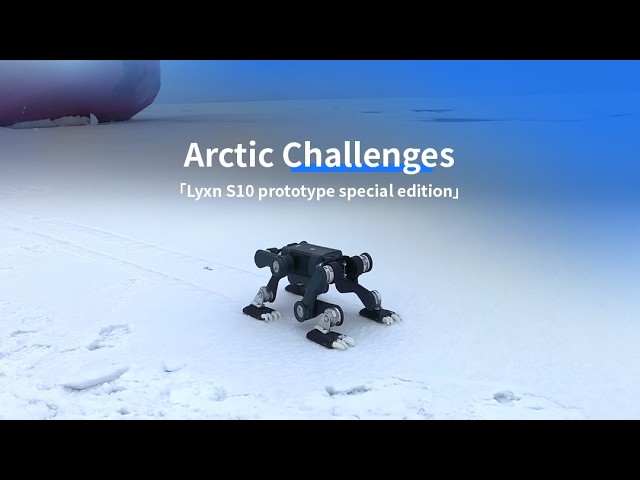
A modified version of Lynx S10, an autonomous robot developed by China-based DEEP Robotics, has become the first quadruped platform to walk on Arctic Ocean ice floes. It successfully demonstrates that autonomous machines may one day perform some of the most hazardous fieldwork in places where human access is limited.
“The Lynx S10 enables autonomous path planning and intelligent obstacle avoidance,” the DEEP Robotics team notes.
The achievement is significant not because a robot survived the cold, but because it showed that compact autonomous systems can navigate unpredictable ice, snow, and water-filled terrain that even experienced researchers approach with extreme caution.
A compact but highly capable machine
The Arctic expedition was designed as a real-world stress test for the Lynx S10, a compact quadruped robot that weighs less than 20 kilograms even with its battery installed.
Unlike larger robotic platforms that require extensive transport and setup, the machine can be carried and deployed by a single person. “Its compact body allows single-person portability and rapid deployment, enhancing operational mobility,” the DEEP Robotics team claims.
Despite its small size, it is equipped with sixteen precision joints that allow it to bend, twist, and maneuver through spaces that would be inaccessible to bulkier robots.
The standard version of the robot is already highly capable. According to its creators, “Equipped with a next-generation AI motion control and gait algorithm, the Lynx S10 performs a variety of extreme maneuvers.”
For instance, it can travel at speeds of up to 8 m/s on flat ground, climb over obstacles as tall as 50 centimeters, and switch between wheeled and legged movement depending on the terrain.
When necessary, it can even rise into a bipedal stance to gain additional height and visibility.
To operate independently, the robot relies on an advanced perception system.
Four ultra-wide-angle cameras equipped with high-dynamic-range lenses continuously monitor its surroundings, while front and rear LiDAR sensors generate detailed three-dimensional maps. This allows the machine to identify obstacles, plan routes, and navigate without constant human control.
Its rugged design also enables operation in harsh environments. The standard platform is rated IP66 against dust and water intrusion, functions in temperatures from minus 20 to 55 degrees Celsius, carries payloads exceeding 8 kilograms, and can automatically locate and travel to a charging station when battery levels become low.
However, Arctic ice presented challenges that went far beyond the robot’s original design specifications.
Teaching a robot to walk on floating Arctic ice
Engineers therefore modified the platform before deployment. The standard wheels were replaced with large biomimetic paws inspired by the broad feet of polar bears. These custom feet spread the robot’s weight across a larger surface area, helping prevent it from sinking into soft snow.
Anti-slip textures improved grip on slick surfaces, while integrated crampons provided extra traction on hard ice. The robot’s sealing was also upgraded from IP66 to IP67 for greater protection against water intrusion.
Researchers introduced another unusual modification for environments where ice and water mixed together. By increasing the effective surface area of the limbs, the robot’s legs could function almost like paddles, allowing it to move through slushy conditions that would challenge conventional wheeled systems.
The Arctic tests quickly revealed why such adaptations were necessary. In several locations, snow concealed dangerous meltwater pools beneath the surface. The robot encountered terrain that appeared stable but actually floated above hidden pockets of water.
Thanks to its redesigned feet and traction system, it maintained stability while traversing these deceptive surfaces. In one instance, it successfully glided across an area that looked like solid ice but concealed water underneath.
Later tests pushed the machine into regions where ice and water were intermixed, and the modified limbs enabled it to continue moving through the difficult terrain.
More importantly, this was not a finished commercial product being showcased under controlled conditions. The Arctic vehicle was still an alpha-stage prototype.
The machine matters beyond the Arctic
The broader significance of the project extends well beyond a single expedition. Environmental researchers and emergency responders often need to operate in locations that are dangerous, remote, or impossible for humans to access safely.
Lynx S10 “confidently handles challenging environments such as dusty sites, heavy rain, and humid/foggy conditions,” the researchers at DEEP Robotics added.
This lightweight autonomous robot is capable of crossing unstable ice and moving through mixed ice-water environments. Therefore, it could help collect environmental data, monitor climate-related changes, and support search-and-rescue operations without exposing people to the same risks.
Researchers are now using the performance data gathered during the mission to further improve the design. Hopefully, future versions will be even more capable of handling unpredictable natural environments.
Lately, Nick Dixon has been suffering from ‘Long 90s’: the ailment whereby one feels a sudden and almost unbearable desire to return to the 1990s. It can strike at any time and particularly affects men over 40.
It's the U.S. law that allows wiretaps without a warrant for surveilling foreign targets. And the U.S. Congress just let it lapse. Sort of. NPR reports:
Each year, the provision is used by American intelligence agencies to collect the electronic communications of hundreds of thousands of foreigners located outside of the United States. The government says that more than 60% of the president's daily intelligence briefing relies on information collected under the authority. The tool officially lapsed at the end of the day on Friday. What happens now?
Intelligence collection under FISA's Section 702 is authorized annually by a federal court — and the law allows for that collection to continue for the duration of the court's authorization, even if the law lapses before the court's next approval. That means companies — electronic communications service providers, in this context — will still be legally required to turn over material to intelligence agencies.
Still, some lawmakers worry that the companies compelled to turn over communications may attempt to challenge the law in court, possibly leading to an indeterminately long window during which they stop providing intel. Advocates on all sides of the surveillance fight believe those challenges are ultimately likely to fail, but those closely linked to the intelligence community emphasize that even a small pause comes with risks ahead of major events like America's 250th celebration and the World Cup.
EEG studies suggest caffeine can reduce deep, restorative sleep even when sleep duration appears normal. Its effects vary by individual, and relying on caffeine for energy may come at the cost of nighttime recovery. Evening coffee has long been debated. Some people can drink it and fall asleep with no trouble, while others struggle to [...]
Pesquisadores que investigam os mistérios dos neutrinos revelaram o primeiro resultado de uma nova instalação subterrânea na China. O projeto alcançou as medições mais precisas já feitas de certos aspectos das partículas fantasmagóricas.
Leia mais (06/13/2026 - 12h00)
I turned off Siri on the Mac years ago and never looked back. Similarly, I found Apple Intelligence so fruitless I never engage with it. But the new Siri AI coming to macOS 27 Golden Gate has at least got me slightly rethinking things.
I'm still early in testing Siri AI, as I've only had access to it in the macOS 27 developer beta for little more than 24 hours. It's also in an early preview state on the dev beta, so there should be lots of runway for improvements before it releases later this year. I don't even know if it's done indexing my files and folders on our review unit M5 MacBook Air and M5 Max MacBook Pro. Unlike on the iOS 27 dev …
Artificial Intelligence is beginning to improve itself. In today's video I have a summary of recent events. Are we ready for the intelligence explosion? I think not.

 Login