❌

Reading view

Novel particle beam could challenge Einstein’s Theory of Gravity

Researchers at ETH Zurich and the Paul Scherrer Institute in Villigen, Switzerland, have produced a high-intensity beam of muonium atoms in a cold state, an experimental advance that could enable a direct test of whether gravity acts differently on second-generation matter. The peer-reviewed study in Nature Physics describes a new method for generating muonium in superfluid helium. The resulting atoms travel at similar speeds and almost parallel to one another, properties required for a future interferometer that would measure the tiny influence of gravity on muonium.

The study did not conduct that gravitational measurement or find evidence that gravity departs from its expected behavior for ordinary matter; it instead developed the beam source needed for the proposed test. The experiment is designed to examine the universality of free fall and the equivalence of gravitational and inertial mass, a cornerstone of Albert Einstein’s theory of gravitation. In ordinary matter, bodies fall at the same rate at a given point within a gravitational field, while the equivalence principle links gravitational mass with inertial mass.

According to the research team, this principle has so far been demonstrated only with ordinary matter or first-generation antimatter. Muonium is a neutral atom formed from a positively charged antimuon and a negatively charged electron, making it a second-generation probe. A gravity experiment with this exotic atom would test whether the equivalence continues to hold for particles outside the first generation.

Muonium has two characteristics that make it useful for this test: it is neutral, and it belongs to a heavier and less familiar generation of particles. A neutral object allows gravitational behavior to be studied without the weak gravitational signal being masked by stray electromagnetic fields, which can dominate the behavior of charged particles. At the same time, muonium is exceptionally difficult to produce and control.

Its constituent muon decays after only about 2.2 microseconds. Earlier sources generated muonium atoms that flew off in many directions at different speeds and were therefore unsuitable for the precision required in a gravity experiment. The researchers addressed this problem by creating a cold, intense and well-directed beam.

The antimuons were directed into a thin layer of superfluid helium that had been cooled close to absolute zero, at minus 273 degrees Celsius. Superfluid helium is a quantum fluid in which individual helium atoms lose their identity and in which impurities are not tolerated. Lead author Jesse Zhang said the researchers used the superfluid as an “atomic cannon,” exploiting the conversion of chemical potential into kinetic energy to propel the newly formed muonium atoms out of the liquid.

When an antimuon encounters a free electron in the superfluid helium, it forms a neutral muonium atom with positive chemical potential. The atom is forced out of the liquid, and as it reaches the surface, that chemical potential is converted into kinetic energy. The resulting boost sends the muonium vertically out of the helium.

Importantly, the atoms must move through the quantum liquid at a suitable speed without collisions, because excessive scattering would prevent them from reaching the surface within their very short lifetime. The high-intensity antimuon beam from PSI allows many muonium atoms to be generated for the planned experiments. Anna Soter, a professor of physics at ETH Zurich and member of the research team, said the cold state is what makes the proposed gravity experiment possible.

In this context, “cold” does not mean that the atoms are motionless; it means that they propagate at similar speeds and nearly parallel to one another. This improved control over direction and velocity is important because the planned instrument will use the wave properties of the atoms to create an interference pattern. A very small shift in that pattern caused by Earth’s gravitational pull would provide a measure of gravity’s effect on muonium.

The study establishes the upstream beam capability rather than reporting the result of that comparison. The next stage of the program is the development of a muonium interferometer. According to the researchers, they hoped to test the method for the first time with the atomic beam in the year of the announcement and, if that worked as expected, to carry out the actual gravity experiment two or three years later.

Those are planned milestones rather than completed measurements. If the interference pattern of muonium shifts differently from the pattern expected for ordinary matter, Soter said the result would be surprising and could, among other theoretical possibilities, point toward the existence of a fifth force. No fifth force has been proven, and the present work provides no evidence for one.

The team’s primary aim is to measure whether the equivalence between gravitational and inertial mass applies to a second-generation particle. Physics recognizes four fundamental interactions: gravity, electromagnetism, the strong interaction and the weak interaction. A fifth force has been proposed repeatedly, but it has never been established.

Soter emphasized that the researchers are open-minded about what the measurement may show while keeping the immediate objective focused on the first such test. The new beam is therefore an enabling experimental result, not a demonstration that Einstein’s theory has been challenged or overturned. Beyond the planned gravity measurement, the high-intensity muonium beam is expected to enable more precise laser-spectroscopy experiments.

These could allow muonium to be measured more accurately than in previous work and provide information about the muon’s mass and fundamental physical constants, which are stated goals of the research group. The same experimental source can thus serve two purposes: supplying a cold, directed beam for a gravitational comparison and providing a larger, better-controlled population of muonium for detailed spectroscopic study. The reported advance addresses a major technical obstacle while leaving the central scientific question unresolved.

A successful gravitational test will still require an interferometer capable of resolving a minuscule shift in an interference pattern while dealing with muonium’s short lifetime, beam quality and other sources of uncertainty. The study’s demonstrated result is the generation of a high-intensity, superthermal muonium beam in superfluid helium, with atoms emerging in the cold state needed for future work. Whether muonium falls exactly as expected for ordinary matter remains to be measured.

The beam nevertheless supplies the experimental foundation for testing gravitational universality in a second-generation particle, a comparison that had not previously been carried out with muonium.

Subject of Research: A cold muonium beam developed for future tests of gravitational universality and laser spectroscopy

Article Title: Novel particle beam could challenge Einstein’s Theory of Gravity

Article References: Novel particle beam could challenge Einstein’s Theory of Gravity. Original publication (Bibliographic details unavailable.)

Image Credits: AI Generated

DOI: Not provided

Keywords: muonium, muon beam, gravity, gravitational universality, equivalence principle, interferometry, superfluid helium, laser spectroscopy, ETH Zurich, Paul Scherrer Institute, Novel, particle

  •  

AI designs functional enzyme components that could help expand drug discovery

New active ingredients for drugs to treat infections, cancer or other serious diseases are often based on substances originally discovered in microorganisms, plants or other living organisms. Producing or improving such active ingredients in a targeted manner using microorganisms is often challenging because the underlying biological processes are extremely complex.

  •  

Random Ohio Town Turns Into Scene From ‘Silent Hill’ After Massive Chemical Leak

The Northern suburbs of Toledo, Ohio turned into a real life Don DeLillo novel overnight, after an explosion at a chemical facility sent plumes of industrial compounds billowing into the sky.

According to the local station WTOL11, the blast happened at a chemical distribution site in Ohio’s Lucas County on Tuesday night, prompting an immediate evacuation order for anybody living within one mile of the disaster zone. Those within three miles were given an order to shelter in place.

In a press conference on Wednesday, city emergency officials explained that the leaking chemical exhaust is glycidyl methacrylate, an industrial manufacturing chemical broadly suspected to be carcinogenic to humans.

Maps show numerous residential neighborhoods in the immediate vicinity, the closest being a trailer park just 0.25 miles as the crow flies from the site of the chemical explosion. The nearby Ottawa river, a tributary of Lake Erie, is situated under a half mile to the South.

Complicating matters for first responders and any broader evacuation order is the onset of a fog alert, which combined with the hazmat emergency has turned Toledo into America’s apocalypse zone du jour.

Images circulated by WTOL11 on Facebook show the cataclysmic scenes unfolding across the city, with commenters expressing confusion over whether the clouds of haze were caused by the airborne chemical leak, the fog, or a noxious mix of both.

“I can’t see out my window,” one Toledo resident wrote. “Should I and my dog leave?”

More on disasters: Giant Oil Tanker Runs Aground in Marine Nature Preserve, Spills Nonstop for Weeks

The post Random Ohio Town Turns Into Scene From ‘Silent Hill’ After Massive Chemical Leak appeared first on Futurism.

  •  

Mirror-image molecules are difficult to separate from their counterparts, but a new catalytic method might be the answer

Just like gloves, molecules can have left- and right-handed—or mirror-image—forms. Because the left- and right-handed molecules are still very similar, scientists have had trouble separating them from each other. But a team of researchers in Japan might have found a solution. In their new study, published in Science Advances, the team successfully separated an equal mixture of mirror-image molecules created by replacing hydrogen with deuterium in one form.

  •  

New catalyst could make clean hydrogen production last much longer

Scientists have developed a new material that helps a costly catalyst survive for thousands of hours while producing hydrogen from water. The advance could address one of the problems holding back a promising method of making low-emission hydrogen. Researchers at Tohoku University designed a structure that keeps tiny particles of iridium firmly in place and […]

The post New catalyst could make clean hydrogen production last much longer appeared first on Knowridge Science Report.

  •  

New hydrogen technology could capture up to 99% of carbon dioxide emissions

A new study suggests that hydrogen could be produced from natural gas while capturing most of the carbon dioxide generated during the process. In detailed computer models, some designs captured between 90% and 99% of those emissions. Researchers at the University of Manchester assessed a technology called chemical looping reforming. Their work, published in Carbon […]

The post New hydrogen technology could capture up to 99% of carbon dioxide emissions appeared first on Knowridge Science Report.

  •  

How Did Life Arise? Three Turning Points in Early Evolution

Where did it start? How did it grow complex? Why did it get big? Three moments in Earth’s early history when evolution suddenly, inexplicably turned up the dial.
  •  

Computation sorts thousands of 2D crystals for topology and twisting


In 2004, physicists isolated graphene, a sheet of carbon just one atom thick. It launched the study of two-dimensional (2D) materials: crystals a few atoms thick in which electrons are confined to a plane and can behave quite differently from those in ordinary solids. The family of known and predicted 2D crystals has since grown to thousands of members. Two recent studies show how computation can search that family for the most promising ones, the first for unusual electronic “topology”, the second for crystals well suited to twisting.

A hidden property of electrons

Electrons in a crystal can only have energies within allowed ranges called bands, separated by forbidden gaps. If a gap separates the filled electrons from the empty states, the material is an insulator. In a semimetal, filled and empty bands just touch, so a few electrons can move freely.

Two insulators can still differ at a deeper level, described by topology: a property of the whole set of electron states that cannot change smoothly, only by closing the gap or breaking a protecting symmetry. A doughnut and a coffee mug are topologically alike because each has one hole, and neither can become a sphere without tearing.

The idea took off with the quantum spin Hall effect. Proposed for graphene in 2005, it proved unobservable there because the effect is far too weak. A 2006 proposal for thin layers of mercury telluride was confirmed in 2007. In such a topological insulator the interior blocks current, yet the edges conduct, with electrons of opposite spin travelling in opposite directions, which protects them against many kinds of imperfection.

Symmetry-based methods known as topological quantum chemistry in 2017 made it possible to decide whether a computed electronic structure is topological. Applied to three-dimensional crystals, they pointed to thousands of candidates. Flat crystals lagged behind, with only about 400 known topological or related monolayers.

The first study, “Two-dimensional Topological Quantum Chemistry and Catalog of Topological Materials” 1, adapts these methods to 2D crystals and applies them to 8,872 entries in two computational databases. It finds 4,073 with nontrivial topology or a related property called obstruction, including 905 topological insulators, 2,129 topological semimetals and 1,003 obstructed atomic insulators, plus 36 close variants. In an obstructed insulator the electrons are centred on empty positions between the atoms rather than on the atoms themselves. The bulk looks ordinary, but cutting the crystal along certain lines produces edge states, and small flakes can carry fractions of an electron’s charge at their corners. The study also calculates edge states for selected materials. Its catalogue includes over 100 monolayers already made in laboratories, but most entries are computer predictions whose properties remain to be tested.

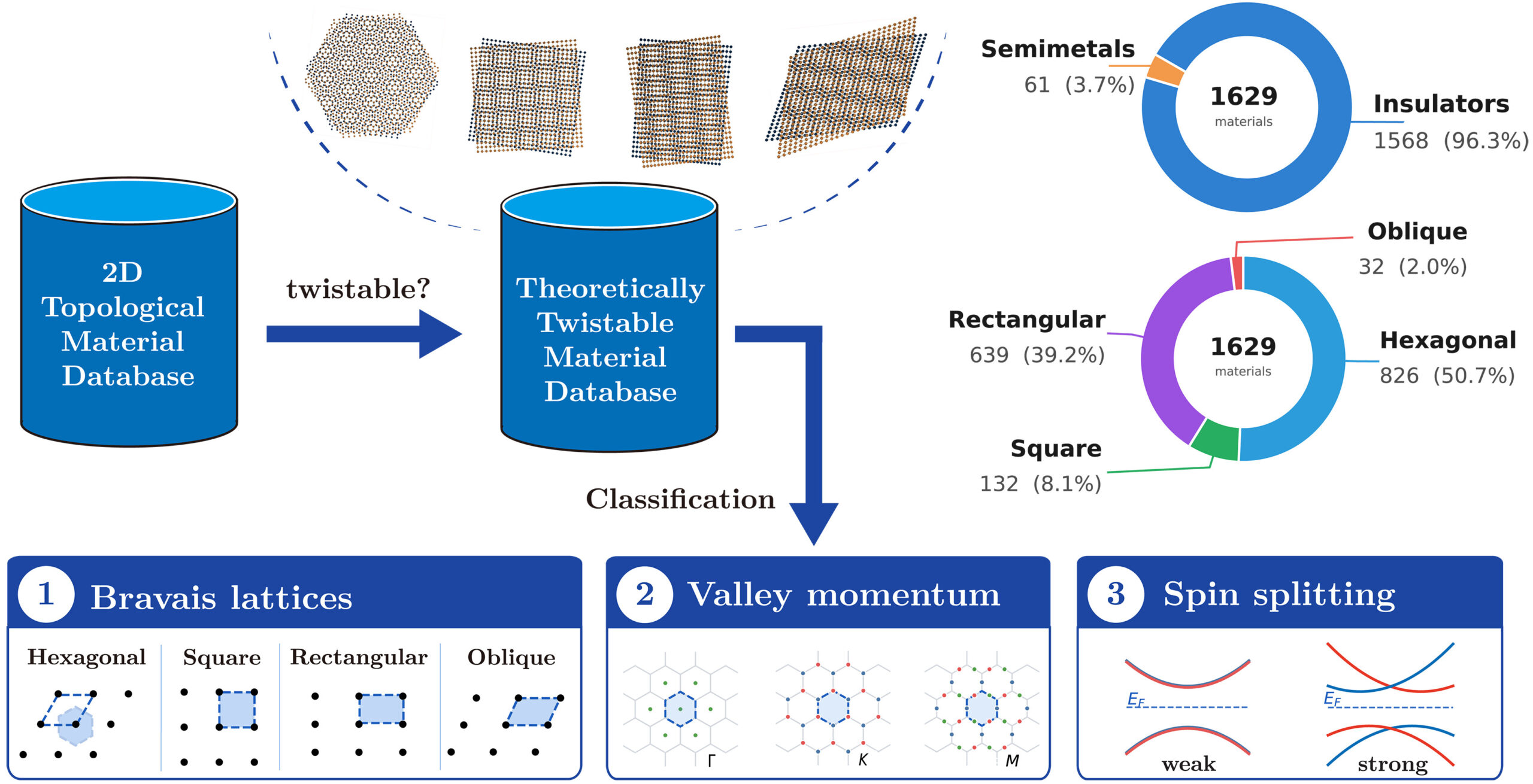
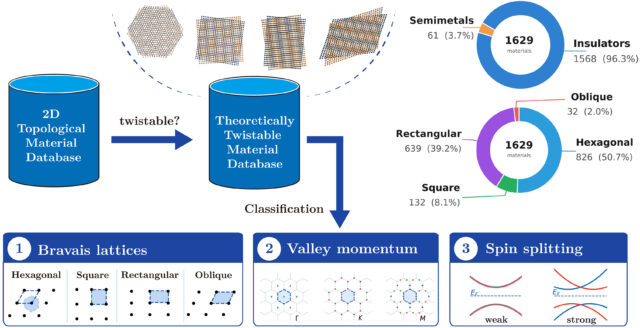
Workflow of the database construction. Starting from a 2D topological material database, a filtering score is applied to construct a database of theoretically twistable materials, which includes both semimetals and insulators. The candidate materials in this database are further classified according to their Bravais lattices, valley splitting, and spin splitting. Source: Y. Jiang et al. (2026) Science doi:10.1126/science.adu1550

Twisting layers

Stack two atomic sheets and rotate one slightly, and the mismatch creates a large interference pattern, called a moiré pattern, much like two overlapping window screens. Electrons feel this longer repeating pattern, and under the right conditions their bands become nearly flat. Electrons in a flat band have little energy of motion, so their mutual repulsion dominates and strongly correlated behaviour can emerge.

In 2011, calculations predicted that two graphene sheets twisted by about 1.1 degrees, a “magic angle”, would have such flat bands. In 2018, experiments at that angle revealed insulating states caused by electron repulsion, and superconductivity. Twisted layers of other materials, such as MoTe2 and WSe2, have since shown many correlated phases, though the mechanisms are still debated.

Most work has focused on these few materials, because most crystals have electronic structures too complicated to predict once twisted. The second study, “2D theoretically twistable material database” 2, therefore defines a material as theoretically twistable if its low-energy electrons admit a simple description. In a metal, the relevant electrons must sit at isolated points, as in graphene. In an insulator, the top of the filled band or the bottom of the empty band must stand clear of other bands. Insulators must also have gaps between 0.2 and 3 electronvolts, because larger gaps make electrical contacts difficult. The search was limited to crystals with at most 12 atoms in the repeating cell and four chemical elements.

Starting from the first study’s database, it identifies 61 semimetals and 1,568 insulators. It ranks them with a score and sorts them by lattice shape (about half are hexagonal), by where in momentum space the relevant electrons sit, and by the strength of spin-orbit coupling, the link between an electron’s spin and its motion. These choices shape the moiré pattern, which can resemble honeycomb, kagome or square lattices. Square-lattice moiré systems have been proposed but not yet realized, and could help simulate models relevant to cuprate superconductors.

Calculations on twisted bilayers of SnSe2, SnS2, ZrS2, HfS2 and Sc2CCl2 at a twist of about 7 degrees show isolated flat bands, as the database predicts. Experiments connect the theory to the laboratory. Bulk crystals of SnSe2, SnS2, HfS2, GaTe and ZrNCl were grown. Single layers of several candidates, including SnSe2, HfSe2, ZrS2 and WS2, were peeled off with a gold-assisted technique that yields larger, cleaner flakes. A dual-gated two-layer SnSe2 device was built for electrical measurements, and a twisted two-layer HfS2 device was used for scanning tunnelling measurements near absolute zero.

The direction is clear. Instead of discovering materials by trial and error, it is becoming possible to search systematically for crystals with chosen properties, then test them layer by layer.


Author: César Tomé López is a science writer and the editor of Mapping Ignorance

Disclaimer: Parts of this article may have been copied verbatim or almost verbatim from the referenced research paper/s.

References

  1. U. Petralanda, Y. Jiang, H. Pi, M. G. Vergniory, B. A. Bernevig, N. Regnault, and L. Elcoro (2026) Two-dimensional topological quantum chemistry and catalog of topological materials Science doi: 10.1126/science.adu2107 ↩
  2. Y. Jiang, U. Petralanda, H. Pi, G. Skorupskii, Q. Xu, D. Calugaru, H. Hu, J. Xie, R. A. Mustaf, P. Hohn, V. Haase, A. Ouahchi, S. Samal, J. Zhu, D. Yang, Z. Geng, G. Avedissian, Y. Wang, M. G. Vergniory, M. Claassen, et al. (2026) 2D theoretically twistable material database Science doi:10.1126/science.adu1550 ↩

The post Computation sorts thousands of 2D crystals for topology and twisting appeared first on Mapping Ignorance.

  •  

Supramolecular polymers can dramatically enhance brain cell activity

Scientists have developed remarkably long, precisely patterned molecular threads that could open new possibilities for designing advanced materials. The scientists also discovered these threads — called supramolecular polymers — can dramatically enhance brain cell activity. 1

Built from self-assembling molecules, the longest threads reach dimensions greater than the diameter of a cell. By molecular standards, they are giant — roughly 100 times more massive than even very large conventional polymers and the largest known proteins in biology. Yet despite their enormous size, scientists can precisely control their lengths and organize them into chemically distinct segments with defined dimensions carrying opposite electrical charges.

That precision also produced an unexpected biological effect. In cell culture studies, the structures enhanced the growth and organization of neurons and increased synapse formation.

Supramolecular
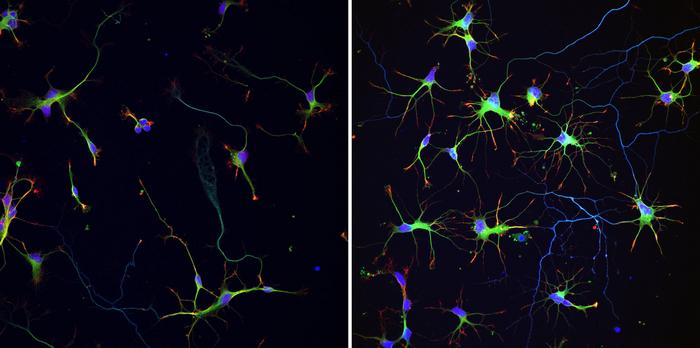
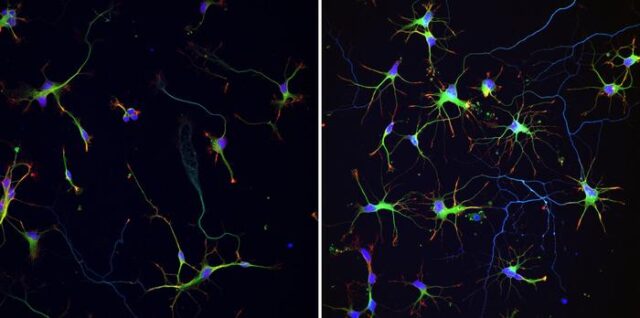
A side-by-side image showing untreated (left) vs. treated mouse cortical neurons. Mouse cortical neurons grown in the presence of charge-segmented supramolecular polymers (right) exhibit extensive neurite outgrowth. Source: Madison Strong (Stupp Laboratory) / Center for Regenerative Nanomedicine, Northwestern University

The findings introduce a new way to use self-assembly to build highly controlled supramolecular materials with precise physical arrangement of chemical structures. Ultimately, the work could inform materials’ design for a range of applications, including biomaterials for regenerative medicine.

“These structures represent a breakthrough in materials design, and we already discovered one useful application: their superbioactivity toward neurons, which will bring new opportunities in regenerative medicine,” said Northwestern’s Samuel I. Stupp, who led the study. “Typically, when we design a regenerative material, we add biological signals, designed to activate cell receptors. Here, the material itself becomes highly bioactive simply through the precise organization of electrical charges and its dynamic behavior. That introduces a very different way of thinking about how materials can communicate with cells.”

Bringing precision to self-assembly

The new study builds on Stupp’s long history working with supramolecular materials, dynamic structures that form when molecules spontaneously organize through weak, reversible interactions. While conventional polymers, like plastics, hold together using strong, permanent chemical bonds, supramolecular polymers are dynamic, allowing their components to move and reconfigure, which generates life-like properties in synthetic systems. Supramolecular polymers exist in all living organisms, where they perform essential functions and hold promise for future soft matter technologies.

That flexible, dynamic nature can be useful for interacting with living cells in biomedical applications, but it also makes the structures difficult to control. Scientists can design the individual molecular building blocks but then struggle to control how long the resulting structures grow and how they organize their chemical components.

Stupp’s team overcame that limitation by using novel designs of molecules and carefully controlling their assembly process. With this strategy, the researchers could dictate the threads’ lengths and keep them uniform. Once the growth stopped, the structures maintained their precise lengths rather than fusing together or rearranging.

“We let these filaments sit in a test tube for months, and they surprisingly didn’t change,” Stupp said. “They remained the same length and retained their segmented structures.”

Grow, stop, grow again

Stupp and his team traced that unusual ability to a previously unknown process his laboratory calls “self-capping supramolecular polymerization.” As a thread grows, flexible portions at the ends remain highly dynamic and, at proper temperatures, allow new molecules to join in a synchronized manner. Once the available building blocks are consumed, those flexible portions fold over and protect the ends. This effectively shuts down further growth by preventing threads from fusing together or undergoing “Ostwald Ripening,” a process in which smaller structures disappear while larger ones grow.

“To make them longer and longer, we just kept adding new molecules,” Stupp said. “The new molecules stick with strong noncovalent bonds to the growing thread and elongate the assembly, which led to a breakthrough in terms of size control.

“The collective molar mass of their noncovalently bonded monomers reaches billions of daltons, and thus they are ‘giga-assemblies.’ These are the largest supramolecular polymers ever made with this degree of precision. Once the monomer is fully consumed, they finish growing and their dimensions remain stable.”

Approximately the size of one proton or neutron, a dalton is a tiny unit that scientists use to measure the mass of molecules and atoms. More than a billion daltons is enormous by molecular standards. For comparison, the largest common polymers of plastics have molar masses in the range of 10 million daltons, and the largest proteins in nature reach approximately 3 to 5 million daltons.

Researchers can later restart growth by supplying more building blocks. By adding different types of molecules in sequence, the researchers can create precisely defined segments with different chemical properties. In the study, Stupp and his team created threads with positively and negatively charged segments. Because opposites attract, the researchers expected the threads to clump together. Instead, they remained stable in water because the “capping” mechanism prevented the assemblies from fusing together.

Small anchor, big difference

To explore how the pattern of electrical charges might interact with living cells, Stupp and his team turned to neurons, which carry a strong negative charge. The team exposed several threads with different designs to cellular cultures containing cortical neurons.

“The first thing we did was make a structure with only positively charged segments, and it basically killed the neurons,” Stupp said. “Then, we tried a structure with only negatively charged segments, and nothing happened because the neurons repelled the materials.”

When Stupp’s team used supramolecular assemblies with randomly mixed positive and negative charges, the neurons didn’t respond in a notable way. But then the team designed a thread with the breakthrough polymerization strategy comprising a small positively charged segment sandwiched between two negatively charged segments of different lengths. Something interesting and unexpected occurred.

The small positive region anchored the thread to the negatively charged surface of a neuron. Repelled by the neuron’s negative charge, the thread’s negative segments remained highly mobile and in constant motion since they could not escape.

“When we used only positively charged segments, they suffocated the neuron and killed it,” Stupp said. “But with only one positively charged segment surrounded by negative ones, it couldn’t do that anymore. And the negative segments, which ordinarily couldn’t get near the neuron, were forced to stay near it because they were anchored.”

Neurons grow and spring to life

Neurons treated with the precisely segmented threads grew longer neurites — the long projections neurons use to communicate with other cells. The treated neurons also formed more elaborate branches, gaining the ability to connect with neighboring cells.

“The neurons matured to an amazing level,” Stupp said. “They grew long and highly branched neurites, which is how they can start making synaptic connections in the brain and in the spinal cord.”

After just seven days, treated neurons were much more active than untreated neurons. When stimulated, treated neurons produced a calcium response — a sign of neuronal activity. Their overall calcium activity was four times greater. And, after 14 days, treated neurons formed more synapses than untreated neurons.

Stupp and his team saw another striking effect in cultures of human neural progenitor cells, which are immature cells that can develop into neurons. Although these cultures typically grow in flat layers, the cells instead organized into raised, three-dimensional clusters connected by axons. This organization resembled aspects of the brain’s white and gray matter, where somas are separated from axons.

No signals required

Perhaps most surprisingly, the molecular threads produced these effects without carrying biological signals specifically designed to encourage neurons to grow. Stupp posits the negatively charged segments recruit specific proteins already present around the cells that help neurons survive, grow and communicate. These proteins, called neurotrophic factors, have positively charged domains. Stupp’s team also found laminin — an important protein that holds tissues together and has positively charged domains — accumulating along the supramolecular threads near neurons.

Stupp hypothesizes that the interplay between attraction and repulsion causes the threads’ negative segments to rapidly move toward and away from the neurons in a “tapping” motion. Proteins recruited by the negative segments may be drawn toward receptors on the neurons, while electrostatic forces push the segments away. This repeated tapping, occurring on millisecond timescales, could help enhance biological signaling. A live cell movie included in the Science paper has captured this phenomenon.

Beyond neurons, Stupp says the new polymerization strategy could eventually enable scientists to build long molecular structures containing many carefully positioned chemical segments. That could open opportunities to create new materials and devices with features that extend over very long distances.

“We discovered something we had never seen before in chemistry or in biology,” Stupp said. “This work gives us a new level of control over supramolecular materials. In the future, we can imagine creating many segments with different properties. The unknown functions of these structures are likely to be as surprising as the superbioactivity observed on neurons. We’re just beginning to imagine the possibilities.”

References

  1. Michael D. Dore et al. (2026) Precise length and charge segmentation of billion-dalton supramolecular polymers Science doi: 10.1126/science.aeg5583 ↩

The post Supramolecular polymers can dramatically enhance brain cell activity appeared first on Mapping Ignorance.

  •  

Scientists Say: Pyrolysis

Pyrolysis (noun, “Py-RAW-leh-sis”)

Pyrolysis is a process though which heat breaks down large molecules into smaller ones. It is just one of the chemical reactions that occurs when something is burning.

Picture a campfire. The flame may look like a single chemical reaction. But in reality, it comes from multiple reactions that occur step by step.

The first step is pyrolysis. In this step, heat breaks open the fuel’s chemical bonds. In the case of a campfire, that fuel is wood. But pyrolysis doesn’t create the campfire’s flame. The next step — combustion — does that. Combustion occurs when the broken-open fuel molecules react with oxygen in the air.

Pyrolysis can occur without combustion. For example, if you seal wood in an oxygen-free container and heat it, the wood won’t ignite. Instead, pyrolysis will slowly transform it into charcoal. Pyrolysis typically does not break down fuel as completely as combustion does. That’s why charcoal can still burn to heat up a grill. In contrast, soot collected from a cold campfire typically cannot be burned.

Pyrolysis also plays a crucial role in cooking up a popular sweet treat: caramel.

To make caramel, a chef heats sugar and water on a stovetop into a syrup. As the syrup gets hotter and hotter, the sugar molecules begin to break open. This causes the clear syrup to turn yellow-gold and then a deep, caramel brown. That’s the chef’s cue to take the caramel off the heat. They may then add butter and cream to the hot, gurgling caramel. Much of the chemical transformation that turned syrup into caramel occurred through heat alone. Therefore, it is an example of pyrolysis.

In a sentence

Pyrolysis can produce biochar, a valuable, carbon-rich substance that farmers use to improve soil quality.

Check out the full list of Scientists Say.

  •  

Needles turn rain into electricity

For centuries, civilizations have harnessed energy from water. However, hydropower often requires large bodies of water to move heavy machinery, confining its use to rivers. But what if the electricity needed to light up your house could be generated from raindrops hitting its roof? 

To achieve this, scientists rely on electrical charges created when materials come into contact and then separate, a phenomenon called the triboelectric effect. As an example, rubbing a balloon against your hair gives them opposite charges, causing your hair to stand up and stick to the balloon. Scientists apply the same principle to make droplet-based triboelectric nanogenerators, or D-TENGS, where raindrops slide across negatively charged surfaces. As the droplets move, their positive charges gather near the surface, freeing up their negative charges. When the droplets reach a metal strip called an electrode, these negative charges flow into a circuit, generating electricity. However, water often remains on D-TENG electrode surfaces, blocking subsequent droplets and corroding the device.

Researchers at the China Three Gorges University and the Chinese Academy of Sciences approached this problem by modifying the shape of the electrodes used in D-TENGs. They proposed that a needle rather than a strip would help droplets detach quickly, allowing charge to flow into a device that uses inexpensive components. They called this design a needle electrode droplet-based triboelectric nanogenerator, or NED-TENG.

To build the NED-TENG, the researchers prepared a plastic film using a water-repellent polymer called polytetrafluoroethylene as the negatively charged surface. They inserted a copper wire through the center of the plastic film, protruding 3 millimeters (0.1 inches) from the front side to form the needle-shaped electrode exposed to raindrops. Meanwhile, they attached copper foil to the plastic film’s backside as a second electrode, completing the circuit. The team connected both electrodes to an instrument that measures electrical performance and mounted the components on an acrylic sheet, sealing it with waterproof tape.

To simulate raindrops, the team inclined the NED-TENG at 50° from a table and dispensed tap water drop by drop from 30 centimeters (12 inches) above its plastic film. Like conventional D-TENGs, the device generated electricity as droplets slid across the film and contacted the needle electrode. However, because the water touched only a small area of the needle, it easily slid off the NED-TENG, preventing the water from building up like in D-TENGs.

The researchers then evaluated and optimized the device using 2 metrics: the force driving charges through its circuit, or voltage, and how fast its charges transfer, or current. First, they compared the NED-TENG with a conventional D-TENG. The NED-TENG generated about 564 Volts (V) and 5 milliamperes (mA) of current, nearly twice the voltage and 3 times the current of the D-TENG, and enough to power small electronics like indicator lights.

Next, they varied the droplets’ release height to maximize electricity production. They found that increasing the release height from 10 to 30 centimeters (4 to 12 inches) increased both voltage and current, peaking at about 543 V and 4 mA. At greater heights, droplets splashed hard on impact, scattering the water and disrupting the charging process they observed in sliding droplets. 

Similarly, the researchers tested different device inclination angles, ranging from 10° to 70°. Their tests revealed that the device’s electrical performance increased at steeper angles and peaked at 50°, reaching 521 V and 3 mA. At steeper angles, droplets spent less time in contact with the surface, reducing electrical output. They explained that because triboelectric materials are highly sensitive, results can vary slightly between experiments, leading to individual peak values that are lower than the highest overall outputs. 

The researchers then explored how the technology might perform in a simulated rooftop installation. To reduce power fluctuations during real-world applications, they connected multiple NED-TENGs. They observed that 10 connected devices could fill a small energy-storage component within 2 minutes and power 200 LED lights.

Overall, the NED-TENGs shed water efficiently and generated more electricity than D-TENGs, while remaining simple to build. The team noted that future upscaled studies should examine how rooftop systems can direct rainwater onto the devices at optimal heights, and how droplets interact with their surfaces to improve long-term performance. With further development, these low-cost systems could turn rooftops into practical generators powered by everyday rainfall. 

The post Needles turn rain into electricity appeared first on Sciworthy.

  •  

Where did the galaxy get its carbon?

Carbon is the 4th most abundant element in the universe. It’s everywhere, from the air you breathe to the carbohydrates in your food to the petroleum in the Earth’s crust. Like most elements, carbon was not created by the Big Bang, but came from 2 different types of stars that fuse lighter elements together. 

Massive stars at least 8 times the Sun’s mass fuse 3 helium atoms into a carbon atom in their cores, through a mechanism called the triple-alpha process. They eventually expel this carbon into space, either through a stream of material called a stellar wind or at the end of their lives during a core-collapse supernova. 

Meanwhile, low-to-intermediate-sized stars between ½ and 8 times the Sun’s mass also induce the triple-alpha process. But unlike massive stars, they produce carbon not in their cores, but in a dense shell of helium that surrounds them during an advanced stage known as the asymptotic giant branch or AGB. AGB stars undergo cycles of swelling and contraction, during which they shed some of their material into space.

While scientists understand these processes, the contribution of each star type to the carbon supply in the universe remains uncertain. To address this, a team of scientists modeled how the chemical elements in the Milky Way Galaxy change over time with different contributions from the 2 carbon-creating processes. They then verified their findings by comparing them with the actual carbon concentration in the Milky Way.

To obtain the benchmark for the Milky Way Galaxy’s carbon content, the team turned to the catalog of stars observed by the Apache Point Observatory Galactic Evolution Experiment (APOGEE) survey. They selected 14,066 stars that were large and bright enough to yield reliable data but, unlike AGB and massive stars, were still at a stage of life when their newly produced carbon was still confined to their cores. The researchers used the carbon in the outer layers of these stars, known as subgiants, as a compositional record of the gas from which they formed, thereby estimating the Galaxy’s carbon content during their formation. 

The scientists started with a computer program developed by another team that models how the Milky Way’s chemistry changes over time. First, the team calculated the potential amount of carbon produced by different types of stars using estimates from earlier studies. Then, they incorporated these results into a model that accounts for how stars form, fuse elements, and release carbon into the Galaxy, using a simulation program called the Versatile Integrator for Chemical Evolution, or VICE. The researchers ran 14 versions of this model, each assuming a different contribution of carbon from AGB stars relative to massive stars.

In their computer model, the Milky Way Galaxy began as a set of 200 concentric rings, each containing its own population of stars, different speeds at which stars form, and varying amounts of gas available to form new stars. The team then stitched these rings together by having stars migrate between them. They allowed these model Galaxies to settle over 10 billion years, then picked a random sample of 14,066 simulated stars to compare their carbon content with carbon in the same number of observed subgiants from APOGEE.

The team’s model most closely reproduced the actual carbon content of the Milky Way’s subgiant stars when AGB stars contribute between 10% and 40% of the Galaxy’s carbon, with the strongest agreement occurring at 15% to 30%. Even though they found that massive stars are the dominant source of carbon, they also found that smaller AGB stars could produce carbon more efficiently than previously thought, though they take longer to become carbon sources than their larger counterparts.

The team concluded that their estimates of how much carbon comes from AGB and massive stars provide a benchmark for future studies, as the connection between the production of elements inside stars and the processes by which those same stars lose mass remains poorly understood. They suggested that future researchers analyze larger sample sizes, examine other galaxies, and use data from future surveys to better understand the chemical history of the universe.

The post Where did the galaxy get its carbon? appeared first on Sciworthy.

  •  

Is nuclear waste safe underground?

More than 90,000 tons of radioactive waste are stored on-site at nuclear power plants awaiting permanent disposal. Nuclear waste releases unstable forms of uranium and other elements, called radionuclides. Long-term exposure to radionuclides can cause cancer, so environmental safety regulations require that nuclear waste be made inaccessible for at least 1 million years. Thus, researchers are evaluating possible ways to store this waste permanently. 

One proposal is to store nuclear waste thousands of feet below ground in rock formations called deep geological repositories, or DGRs, to seal in radionuclides. Scientists can’t see into the future, so instead they look to the past to determine how well DRGs could work. A team of researchers from Canada recently analyzed uranium deposits that have existed for billions of years as an analog for how nuclear waste behaves deep underground.

Past researchers found that uranium deposits in ideal DGR conditions, with their protective casings intact, will stay contained for more than a billion years. However, these conditions require a stable geological environment. This team instead focused on uranium deposits in non-ideal conditions. They studied the Canadian Kiggavik uranium deposits, which occur in cracked bedrock approximately 500 meters (1,600 feet) below the surface. The team claimed these conditions are similar to DRGs with broken protective casings.

The team knew from previous work that most of the uranium minerals in the Kiggavik deposits are more than 274 million years old, but about 10% are less than 1 million years old. They found that these younger uranium minerals occurred alongside clay minerals surrounding the older uranium minerals and within open fractures. The researchers interpreted the older uranium as the source material of the younger uranium because of their proximity. They concluded that water must have infiltrated the deposits and interacted with older minerals, transporting uranium and forming new, younger minerals.

To determine the source of water infiltration, the researchers compared the chemistry of clay minerals formed alongside the younger uranium with modern snow in the Kiggavik region. They looked at the number of neutrons, or isotopes, in hydrogen atoms within the clay minerals, and found heavy values matching those of fresh water. These values indicated that snow or glacial meltwater was the source, rather than underlying bedrock or seawater. 

To determine when the water infiltrated over the last million years, the researchers used uranium-thorium dating to find when the radionuclides were mobilized. This dating method shows when uranium was removed from the original minerals by measuring how much its concentration was reduced by water infiltration. They found that the dates of these radionuclide mobilizations clustered into 5 separate water-infiltration events that occurred from 36 to 470 thousand years ago. 

Comparing these dates with existing climate records, the researchers found that the water infiltration events overlapped with periods when glaciers covered the ground surface. Normally, water can’t travel thousands of feet underground. But, like a hydraulic press, a glacier pushes water at its base downward. If the water encountered cracks in the ground, the pressure could inject it to the depth of the uranium deposit.

Next, the researchers wanted to measure how quickly radionuclides left the deposit. They measured the maximum distance between younger and older uranium minerals and used the age of the most recent water-infiltration event to estimate the fastest speed at which the radionuclides could have moved. They determined this maximum speed to be 0.0014 millimeters (0.000055 inches) per year. At that rate, they calculated it would take 360 million years for uranium radionuclides to travel 500 meters from a DGR at the same depth as the Kiggavik uranium deposits to the surface. This timescale far exceeds the necessary 1 million years for nuclear waste containment.

The team concluded that if glaciers were to return to Kiggavik, the uranium deposits wouldn’t experience substantial radionuclide movement, even in contact with glacial meltwater. Similarly, if a DGR has broken protective casings, radionuclides would be moving too slowly to reach the surface even if water leaked into it. They suggested their findings reduce constraints on viable DGR sites and could help ensure the long-term secure storage of nuclear waste.

The post Is nuclear waste safe underground? appeared first on Sciworthy.

  •  

Why Metal Ions Make Fluorescent Probes Glow or Go Dark: New Design Rules Emerge

Metal ions are everywhere in biology and the environment, and telling them apart quickly and cheaply has long been a challenge for chemists. A new open-access review published in Discover Chemistry by M. S. Ajay Kumar, Pradeep Bhaskar, and B. Anindita of Presidency University in Bengaluru takes a fresh look at one of the most versatile tools in the detection toolbox: organic fluorescent probes. Rather than simply cataloguing probes and their detection limits, the review argues that the real key to building better sensors lies in understanding why different metal ions produce fundamentally different fluorescence responses, from brilliant turn-on emission to complete quenching.

The stakes are high. Essential ions such as copper, zinc, and iron participate in enzymatic catalysis, cellular signaling, redox regulation, and gene expression, but when their balance is disrupted they can contribute to oxidative stress, metabolic disorders, and neurodegenerative diseases. Toxic heavy metals such as mercury and lead offer no biological benefit at all and are hazardous even at trace levels because of their persistence, bioaccumulation, and long biological half-lives. Conventional analytical techniques like atomic absorption spectroscopy and inductively coupled plasma mass spectrometry deliver excellent accuracy, but they demand expensive instruments, trained personnel, and complex sample preparation, making them poorly suited for real-time or on-site detection. Fluorescent probes, which convert metal-ligand interactions into measurable optical signals, promise something different: fast, simple, and biologically compatible sensing.

The central insight of the review is that probe performance depends not only on the fluorophore but on the compatibility between the target ion and the sensing mechanism. Paramagnetic ions such as Cu2+ and Fe3+ usually promote fluorescence quenching through non-radiative decay, intersystem crossing, and charge-transfer pathways. Diamagnetic Zn2+, by contrast, more readily supports turn-on emission through suppression of photoinduced electron transfer, known as PET, and chelation-induced rigidification of the molecular framework. Soft heavy metals such as Hg2+ and Pb2+ occupy a middle ground: they bind strongly to carefully selected donor atoms, yet their heavy-atom character can trigger spin-orbit coupling that quenches emission, so designers must balance strong binding against signal reliability.

The authors walk through the major photophysical mechanisms one by one. PET-based probes contain an electron-rich donor unit that quenches the excited fluorophore in the free state; when a metal ion coordinates to the donor, the electron-transfer pathway is blocked and fluorescence returns. This OFF-ON switching works beautifully for closed-shell d10 ions like Zn2+ but often fails for paramagnetic targets, where suppressing PET merely opens the door to stronger quenching routes such as ligand-to-metal charge transfer. Intramolecular charge transfer, or ICT, systems integrate the binding site directly into the conjugated framework, producing wavelength shifts that enable ratiometric sensing, a more reliable readout than simple intensity changes because it reduces dependence on probe concentration and excitation conditions. Twisted intramolecular charge transfer adds a conformational dimension: metal coordination can restrict torsional motion, suppressing non-emissive twisted states and boosting emission.

Chelation-enhanced fluorescence and its counterpart, chelation-enhanced quenching, are presented not as separate mechanisms but as opposite outcomes of the same coordination event. When metal binding locks a flexible ligand into a rigid, planar geometry, non-radiative decay is suppressed and brightness increases; when the bound ion instead introduces intersystem crossing or electron transfer, the same binding event extinguishes the signal. Excited-state intramolecular proton transfer, or ESIPT, offers another elegant route: photoexcitation drives a proton from a donor group to a nearby acceptor, generating a keto tautomer with a much larger Stokes shift. Metal ions can either disrupt the hydrogen bond required for this process or stabilize it, giving designers a tunable switch between enol and keto emission bands.

The review also highlights through-bond energy transfer, an emerging mechanism in which excitation energy moves along a covalently linked donor-acceptor backbone rather than through space as in FRET. Because TBET does not require strict spectral overlap or precise donor-acceptor distances, it can generate large pseudo-Stokes shifts and support ratiometric, multi-channel detection. A representative Hg2+-responsive cassette shows weak emission in the OFF state but strong acceptor fluorescence once metal binding enhances electronic communication between the chromophores. The authors caution, however, that TBET systems demand precise molecular architecture and often struggle with aggregation-induced quenching in water.

Computational chemistry receives a notably critical treatment. Density functional theory and time-dependent DFT are now standard in probe studies, but the authors argue their value is frequently squandered on decorative HOMO-LUMO diagrams. Used properly, ground-state DFT can confirm binding sites, coordination geometry, and structural rearrangements such as rigidification or ring opening, while TD-DFT can assign whether an observed transition is locally excited, charge-transfer, or ligand-to-metal in character. The review stresses that a smaller HOMO-LUMO gap alone proves nothing; orbital localization, charge-transfer direction, and experimental fluorescence output must all be correlated. Method choice matters too: hybrid functionals like B3LYP suit organic fluorophores, while effective core potential basis sets such as LANL2DZ are needed for heavy metals, and long-range corrected functionals like CAM-B3LYP or omega-B97XD better describe charge-transfer states.

Metal-by-metal, the review distills design lessons from dozens of representative probes. For Cu2+, quenching dominates because of its paramagnetic d9 configuration, with peptide-based probes reaching detection limits as low as 1.5 nanomolar, while rhodamine ring-opening and ratiometric platforms offer turn-on and quantitative alternatives. Iron sensing is even harder because Fe3+ is a hard, highly charged, paramagnetic d5 ion that promotes ligand-to-metal charge transfer, so most probes are turn-off or colorimetric. Zn2+ is the friendliest target: ratiometric and turn-on probes routinely achieve low-nanomolar detection in seconds, though discriminating Zn2+ from its fellow d10 ion Cd2+ remains the field’s stubborn challenge. For Hg2+ and Pb2+, the standout performers combine aggregation-induced emission, near-infrared output, and ratiometric readout, with some systems reporting detection limits down to the picomolar range in water, food, and living cells.

The application landscape is shifting rapidly from bench-top demonstrations to real-world deployment. Recent probes have been validated in tap water, groundwater, river water, milk, soil, fruit juice, and plant tissues, with recovery values typically between 90 and 102 percent. Smartphone-assisted detection, 3D-printed sensing devices, and paper test strips are turning molecular recognition into field-ready tools. In bioimaging, ratiometric probes have tracked intracellular Cu2+ in HeLa cells, an AIE probe with a 130-nanometer Stokes shift visualized Hg2+ in A549 cells and in the roots of rice plants, and a peptide-based self-assembling system detected Pb2+ in groundwater and living cells below 10 nanomolar. Nitrogen and sulfur co-doped carbon dots have even combined metal sensing with logic-gate behavior in a single platform.

Significant hurdles remain before fluorescent probes fulfill their promise. Absolute selectivity in complex matrices is still elusive, because borderline and soft ions such as Pb2+, Hg2+, and Cd2+ exhibit overlapping coordination behavior. Quantitative accuracy inside cells is compromised by probe distribution, intracellular heterogeneity, and interference from endogenous biomolecules like glutathione. Many probes lack reversibility, subcellular targeting, or the long-term stability needed for continuous monitoring. The review’s closing message is clear and likely to shape the next generation of research: successful probes must be mechanism-guided rather than structure-driven, matching the electronic personality of each metal ion with the right signal-transduction pathway, and validated not under ideal laboratory conditions but in the messy, competitive environments where metal ions actually matter.

Subject of Research: Organic fluorescent probes for detecting metal ions through mechanism-guided photophysical design and bioimaging

Article Title: Organic fluorescent metal ion probes for understanding design rules photophysical mechanisms and bioimaging applications

Article References: Ajay Kumar, M. S., Bhaskar, P., & Anindita, B. (2026). Organic fluorescent metal ion probes for understanding design rules photophysical mechanisms and bioimaging applications. Discover Chemistry, 3(1), Article 472. https://doi.org/10.1007/s44371-026-00857-5

Image Credits: AI Generated

DOI: 10.1007/s44371-026-00857-5

Keywords: fluorescent probes, metal ion sensing, photoinduced electron transfer, intramolecular charge transfer, ESIPT, chelation-enhanced fluorescence, aggregation-induced emission, DFT calculations, zinc detection, mercury detection, lead detection, bioimaging

  •  
❌