Keep your eyes peeled and your binoculars primed tonight, stargazers. The distant Halley’s Comet is reminding us of its far-off presence by pelting our planet with a barrage of meteors which will make the eastern welkin blush with a cosmic light show.
The meteor shower, known as the Orionids, is characterized by its fast-moving bright streaks and fireballs that can be seen for minutes at a time, with some trails staying visible even after the meteor has blinked out. And yes, you can see them with the naked eye.
Though it began at the start of October and is projected to last until November 7, the shower is expected to hit peak brightness this Wednesday night and early Thursday morning.
Its resplendence, however, will be challenged by a waxing gibbous Moon, which will be around 77 percent full tonight and as such fairly shiny in its own right, but will set early in the morning.
Halley’s Comet is a long period comet that takes 76 years to orbit the Sun and only makes an appearance in our skies roughly just as often. Last time it swung by was back in 1986, and it won’t return until 2061, but the Orionids, which are essentially the debris discarded by the comet as it nears our star, can be seen at other times because they linger around long after it has departed back into the void.
Our planet happens to pass through this debris field twice a year, producing a meteor shower. The Orionids falls in October, and the other meteor shower, known as the Eta Aquariid, occurs in May. The streaks of light in our sky are the comet’s ejected particles burning up as they tear through our atmosphere.
To watch the Orionids, NASA recommends viewing it after moonset and before dawn because of the bright gibbous Moon. That will probably be around 3:30 AM EST. You don’t need any special equipment, but you should get outside the city and go somewhere far from any sources of light pollution. Then cross your fingers and hope for clear weather.
The shower originates from a point near the star system Betelgeuse in the constellation Orion, but the shower is noticeable enough that you won’t have to do much more than look towards the southeast to spot it. If you’re lucky, you’ll see up to 20 streaks cross the sky each hour.
An international team of researchers, including members from the University of Michigan, has revealed surprising results that could rewrite our understanding of a key transition in the early universe.
An overlooked particle could have altered the early Universe in ways that helped produce the imbalance between matter and antimatter, a new theoretical study suggests.
In 1892, George Ellery Hale, a professor of astrophysics at the University of Chicago, convinced the university president to acquire two 40-inch telescope lens blanks. With funding from Charles Yerkes, a Chicago mass-transit tycoon looking to refurbish his image, Hale spearheaded the creation of an observatory to house the Great Refractor made with these blanks.Continue reading "Oct. 21, 1897: Yerkes Observatory is dedicated"
The movie Disclosure Day, directed by Spielberg, investigates a conspiracy about government suppression of alien evidence dating back to Roswell. This review questions current societal beliefs about extraterrestrials and Darwinian evolution. It exposes the deception, ultimately portraying alien visitation as a misunderstood age-old phenomenon rather than a new factual reality.
Uranus and Neptune are often described as near-twins, but a new study suggests their chemistry, and possibly their histories, may differ more than expected.
Astronomers using the James Webb Space Telescope (JWST) have found what may be one of the most distant supernovas ever observed. And in a stroke of cosmic luck, the team thinks they're seeing what the explosion looked like just days after it ignited.
The supernova, named AT 2026abck, dates to around 1.15 billion years after the Big Bang, when the universe was less than one-tenth of its current age and bursting with massive stars flickering into life. The massive exploding star violently released its light over 12.5 billion years ago, according to the researchers — so long ago that the distance between us has effectively ballooned sixfold due to the expansion of the universe.
The discovery was described in a paper that was uploaded to the preprint server arXiv Sept. 29 and has not yet been peer reviewed. According to the study authors, this ancient speck of light is stupendously bright.
"At its peak, the supernova is about 8 billion times the brightness of the sun … almost as bright as the whole Milky Way Galaxy," study co-author Xiaohui Fan, an observational cosmologist and professor of astronomy at the University of Arizona, told Live Science via email. "Over the course of the explosion, it radiates the energy that the sun will radiate over about 2 billion years."
A beacon from the beginning of space-time
The newly discovered supernova shines brilliantly at over 30,000 degrees Fahrenheit (16,000 degrees Celsius). Its incandescent shell of ejected material has billowed to a radius of approximately 46 astronomical units — about 46 times the distance between Earth and the sun, or about as far as Pluto swings at its farthest point from the sun.
The supernova's host galaxy, designated ID101411, holds about 6.3 billion solar masses and is "forming new stars more than ten times faster than our Milky Way," first author Mingyang Zhuang, an observational astrophysicist at the University of Illinois Urbana-Champaign, told Live Science via email.
As with other early galaxies, ID101411 is deficient in metals, meaning any elements heavier than hydrogen and helium, because not enough time had passed to create those heavier elements in the forges of massive stars and their apocalyptic explosions.
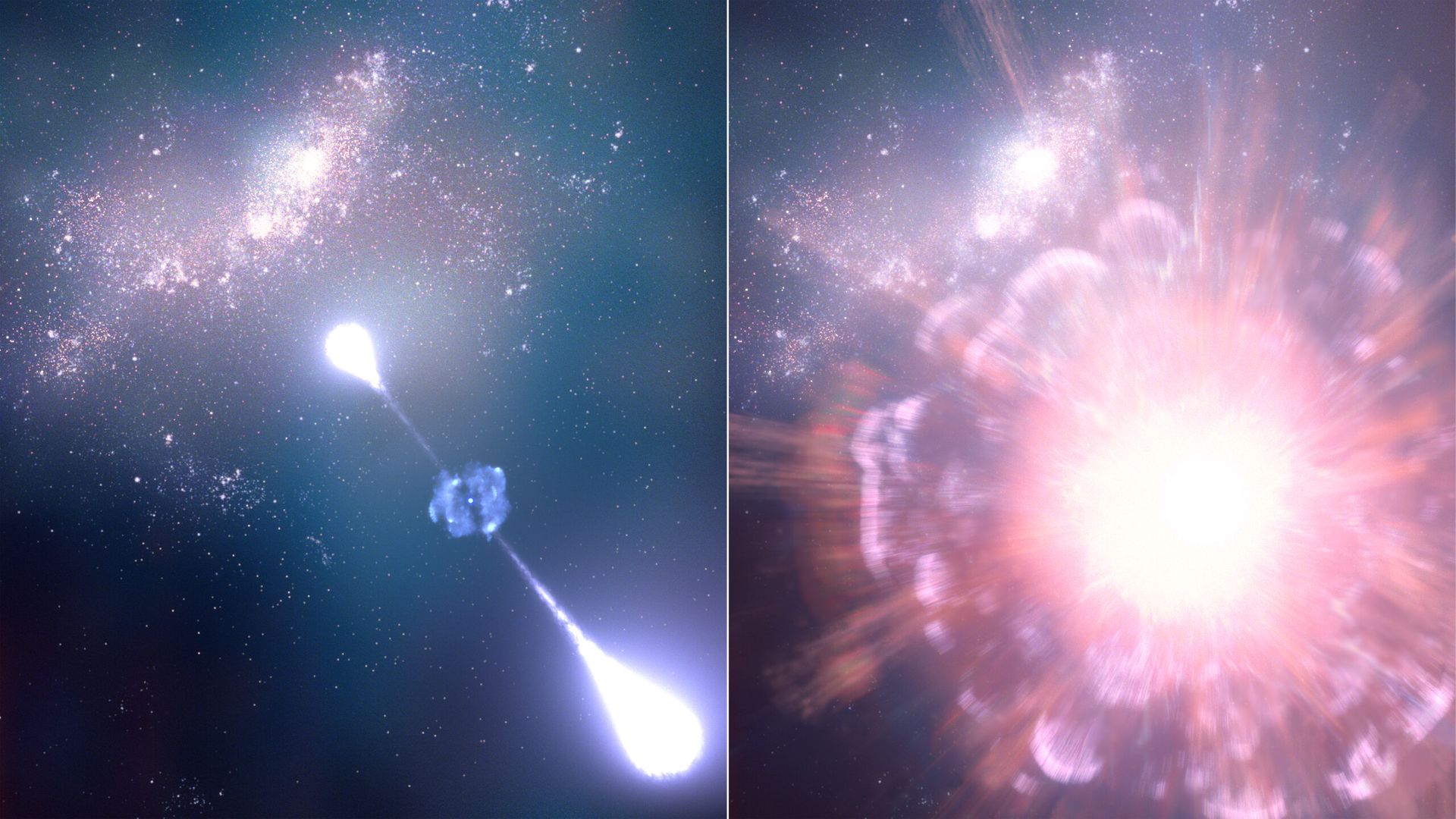
An illustration of a supernova erupting when the universe was just 730 million years old. (Image credit: NASA, ESA, CSA, STScI, L. Hustak (STScI))
The study authors estimate that they observed the supernova as it would have looked just four to 10 days after it exploded. Although this is relatively common, spotting one at such an incredible distance "is extremely rare," Zhuang emphasized. "You have to observe the exact same tiny patch of sky repeatedly with [JWST], and the explosion has to happen at the right moment. We were lucky."
There's another layer of luck that made the discovery even more remarkable: It was observed without the aid of a cosmological quirk called gravitational lensing — a phenomenon predicted by Einstein in which the gravity of a massive object in space bends and magnifies the light emitted by objects behind it.
"Most supernovas this far away were found with help from a massive foreground galaxy cluster acting as a natural magnifying glass," Zhuang explained. "It's the most distant one we've actually seen appear."
This supernova was discovered as part of the NEXUS Treasury program, in which JWST intermittently scours patches of the sky for ancient explosions. It had previously observed the explosion's host galaxy over the past few years and finally witnessed the supernova on Aug. 7 of this year.
An explosion in slow motion
Intriguingly, the star had not yet exploded in JWST's previous viewing, on May 28, 2026, meaning that 71 days passed on our Earthly clocks, even though only about 12 days passed in the supernova's own time frame.
This highlights a mind-bending cosmological effect: The universe's expansion doesn't just stretch space; it slows down time from our perspective.
"Because the universe has expanded since this light was emitted, everything about this explosion appears to us in slow motion, about six times slower than it actually happened," Zhuang said. "Changes that took one week at the supernova take about six weeks to unfold from our point of view."
Mysteries still remain about the nature of this ancient explosion that shone so brilliantly we can observe it across nearly the entire universe.
Rather than a conventional core collapse supernova — in which a star between approximately eight and 50 times the mass of the sun exhaust its nuclear fuel and suffers a rapid core collapse and subsequent explosion — the recently discovered supernova may be one of the universe's rarest, most powerful explosions, the study authors said. Known as a superluminous supernova, this type of explosion releases tens or hundreds of times more energy than conventional supernovas. Whether the explosion continues to heat up or starts to cool could reveal exactly what is happening in its environment and what caused it, the team said.
"Our interpretation is still preliminary," Zhuang concluded. "Follow-up observations will tell us more about exactly what kind of explosion this was."
How well do you know our home galaxy? Find out with our Milky Way quiz!
The spiral galaxy NGC 1827, as seen from the side by the Hubble Space Telescope. (Image credit: NASA, ESA, Michael Jones (California Institute of Technology); Image Processing: Gladys Kober (NASA/Catholic University of America))
If you were approaching the edge of a spiral galaxy, arriving from afar through the cosmos, it might look something like this.
What is it?
In this new snapshot by the Hubble Space Telescope's Advanced Camera for Surveys (ACS), we can see the edge of the spiral galaxy NGC 1827. Found about 37 million light-years from Earth, this galaxy sparkles in this side-on view.
Not all spiral galaxies are the same. This galaxy is what is known as an "intermediate" spiral, which means that its structure sits somewhere between that of a barred and unbarred spiral galaxy. Barred galaxies have a distinctive central, bar-shaped structure, while the unbarred variety lacks this bar and can look more like circular spirals.
NGC 1827's spiral shape isn't clear from the side, however. From this perspective, we see its twinkling edge, speckled with stars and woven together with brown ribbons of dust.
Why is it incredible?
Beneath the beauty of this spiral edge lies an expansive, cosmic landscape. Bright blue stars dot the spiral's side, with one particularly luminous star taking the spotlight with four diffraction spikes — created by light bending through the inner workings of Hubble's camera — emanating from its center.
This image was captured as part of a larger Hubble survey that's exploring 260 satellite galaxies, which are galaxies gravitationally bound to larger hosts. Hubble is specifically looking to survey satellite galaxies that lie near host galaxies similar to our own Milky Way.
So far, Hubble has spotted 111 such satellites and will continue to observe, hunting for the rest.
By studying satellite galaxies like this one, which also happens to be an especially low-mass galaxy, researchers could better understand the complicated dynamics both within the galaxies themselves and between them and their host galaxies.
BepiColombo, a joint mission of the European Space Agency and the Japan Aerospace Exploration Agency, launched Oct. 20, 2018. The spacecraft is actually two satellites in one, the Mercury Planetary Orbiter (MPO) and the Mercury Magnetospheric Orbiter (MMO), commissioned with investigating one of the least-visited planets in our solar system. To reach its final position,Continue reading "Oct. 20, 2018: BepiColombo launches"
On Sept. 30, NASA formally concluded OSIRIS-REx, the historic first U.S. mission to pluck a pristine piece of an asteroid and deliver it safely back to Earth.
The van-sized OSIRIS-REx spacecraft — whose name is short for Origins, Spectral Interpretation, Resource Identification, Security-Regolith Explorer — visited and sampled Bennu, an ancient space rock holding pristine remnants from the dawn of our solar system more than 4.5 billion years ago. Among those cosmic relics are raw organic building blocks, the kind that may have seeded life on Earth.
"I have known this day was coming for a long time, but it is still difficult to see it arrive," OSIRIS-REx Principal Investigator Dante Lauretta, who's based at the University of Arizona, said in a post on LinkedIn. "I feel enormous pride in what we accomplished together, and real sadness that this journey has come to an end."
For the mission team, the farewell capped a decade of high-stakes engineering, on-the-fly troubleshooting and nail-biting close calls that ultimately delivered to Earth the largest asteroid sample ever collected in space, one that held secrets from the early solar system.
Long before launch, the team faced obstacles that nearly thwarted the endeavor — chiefly, two rejections from NASA — before finally securing the green light for the $1 billion project under the New Frontiers Program in 2011.
When OSIRIS-REx launched on Sept. 8, 2016, on a two-year journey across the inner solar system, Bennu was little more than a point of light in telescopes. Scientists expected the asteroid’s surface to be a smooth, sandy sphere where OSIRIS-REx could seamlessly touch down. Much to their surprise, however, when the probe arrived at the asteroid in late 2018, it revealed Bennu to be a treacherous, loosely bound amalgamation of jagged boulders.
"Our expectations about the asteroid's surface were completely wrong," Lauretta said in an Oct. 7 statement from the University of Arizona. "There was no obvious place to collect a sample anywhere."
When OSIRIS-REx touched down on a small crater named Nightingale, Bennu offered so little structural resistance that scientists said its surface reacted more like fluid than a hard, rocky shell. The spacecraft's sampling head sank directly into the asteroid, stopping after burrowing 20 inches (51 centimeters) deep by firing its thrusters at the right time to pull away, with the precious sample in hand.
NASA's OSIRIS-REx spacecraft captured this series of images of asteroid Bennu on April 14, 2020, during the first rehearsal of the mission's sample collection event. The actual sample retrieval was extremely close to the way this looks. (Image credit: NASA/Goddard/University of Arizona)
Then came another nail-biting moment: The sample collector lid got jammed in a partially open position because so much material was scooped up, allowing fragments of the precious cargo to escape. In a race against time to prevent further loss, the mission team quickly stowed the sampler head directly inside the return capsule, securing the cosmic treasure for its journey back to Earth.
Even the final return to Earth, on Sept. 24, 2023, kept the team on edge: A parachute failed to deploy properly during reentry, forcing a tense but ultimately safe landing in the Utah desert.
"Successful exploration missions are not those that avoid surprises; they are those that are deliberately designed to adapt to them," Lauretta said in the statement, quoting a line from the mission's final report to NASA.
"That certainly describes OSIRIS-REx," he said. "Again and again, the mission presented us with circumstances we had not expected, and again and again, this team found a way forward."
The mission's triumphs began long before the samples reached Earth. For example, the probe set a Guinness World Record when it slid into orbit around the 1,610-foot-wide (490 meters) Bennu, which became the smallest object ever circled by a spacecraft.
The scientific payoff that followed included remote-sensing work that confirmed Bennu's surface is coated in carbon-bearing compounds. Those observations also revealed that Bennu was once part of a much larger, water-rich parent asteroid that shattered in a catastrophic collision in the main asteroid belt between Mars and Jupiter.
The returned sample — which weighs 4.29 ounces (121.6 grams) here on Earth, more than twice the mission's requirement — continues to thrill and occupy scientists.
A wave of research papers, now topping 200, continues to piece together the composition and history of the ancient space rock. Among other findings, Bennu's pristine material has revealed amino acids and sugars that, on Earth, are essential for life, alongside a history of exposure to liquid water that could have served as the "broth" for these compounds to interact.
More discoveries are likely to come. Most of the returned Bennu sample is being preserved for future generations of scientists, who will study it "with questions and instruments we cannot yet anticipate," Lauretta said in the statement.
Though its OSIRIS-REx chapter is closed, the spacecraft itself is far from retired. Renamed OSIRIS-APEX (OSIRIS-APophis EXplorer), the probe is using its remaining propellant to head toward Apophis, another near-Earth asteroid and a different type of space rock from Bennu. It is scheduled to arrive in 2029.
One of the best fall meteor showers peaks this week, when pieces of the famous Halley's Comet streak across Earth's atmosphere as fast-moving "shooting stars."
The Orionid meteor shower will peak overnight Wednesday (Oct. 21) through Thursday (Oct. 22), potentially producing around 20 meteors per hour under a dark sky, according to Time and Date. The Orionids are caused when Earth passes through the debris left by Halley's Comet, which last passed through the inner solar system in 1986 and will return in 2061.
Halley's Comet is presently beyond the orbit of Neptune, according to The Planets Today, but it doesn't need to be close to Earth to cause "shooting stars." Every time the comet travels through the inner solar system, heat from the sun causes it to shed dust and rocky particles along its orbital path. Earth's own orbit takes the comet through streams of that ancient debris several times a year, with the particles vaporizing as they slam into our planet's atmosphere.
The Orionids are particularly fast meteors, striking Earth's atmosphere at around 41 miles per second (66 kilometers per second). They can produce bright streaks, occasional fireballs (extremely bright, sometimes colorful meteors) and "persistent trains" — glowing trails that remain visible briefly after a meteor has disappeared. The best way to view them is with the naked eye, although a nice pair of stargazing binoculars or a small backyard telescope will help you enjoy more sights during peak skywatching season this fall.
Halley's Comet produces not one but two annual meteor showers. Its orbit comes close to Earth's at two different points, so our planet encounters the comet's debris twice each year — once during the Orionids in late October, and again during the Eta Aquariid meteor shower in early May.
There's a slight complication with the Orionids this year. A 71%-illuminated waxing gibbous moon will brighten much of the night, making it harder to spot meteors. However, the moon will set early Thursday morning, creating a valuable window of darkness before dawn. That's also when the constellation Orion will be high in the sky, making the predawn hours the best time to watch.
You can trace the paths of Orionid meteors back to their radiant: the famous red supergiant star system Betelgeuse in the constellation Orion. (That's why the shower is called the Orionids.) However, there's no need to look directly at Orion. Meteors seen farther from the radiant can produce longer streaks across the sky; each one comes from a tiny piece of Halley's Comet completing a journey that began many centuries ago.
The mission, which launched on Monday, is headed to Phobos, the larger of the two moons of Mars. It could carry back the first samples from the Martian system.
The moon is shrinking, and scientists are narrowing in on exactly how much our natural satellite has dwindled over the years.
The moon is thought to have formed from a violent collision between a massive object and our young Earth roughly 4.5 billion years ago, and its interior is still gradually cooling off from this ancient collision. As it cools, the moon contracts, leading to a long, slow shrinking process. Now, in a new study, scientists think that they have figured out how much smaller the moon is actually getting.
In this new study, scientists analyzing images snapped by the Lunar Reconnaissance Orbiter Camera (LROC) have spotted over 10,000 young faults, or cracks across the moon's surface. This helped them to figure out how much the moon has contracted over time, and they now estimate that the moon's radius has decreased by about 148 feet (45 meters) over the past 400 to 800 million years.
"The number of these young faults revealed in LROC images is much greater than I ever imagined," study lead Thomas Watters, a geologist and scientist emeritus at the Center for Earth and Planetary Studies at the Smithsonian's National Air and Space Museum, said in a statement. "As the interior of the moon continues to cool and contract, it is expected that the growth of existing faults and formation of new faults continues today."
Lobate scarps on the lunar surface, as seen by LROC. (Image credit: NASA/KARI/ASU/Intuitive Machines/Smithsonian )
With these LROC observations, researchers in this study saw a variety of different types of cracks and landforms across the lunar surface. This included lobate scarps, or long, curved structures that form when the moon's surface contracts, cracks and is pushed upwards; and small mare ridges, or narrow "wrinkles" in the lunar surface, across the dark plains on the moon.
Lobate scarps on the moon, as seen by LROC. (Image credit: NASA/KARI/ASU/Intuitive Machines/Smithsonian)
Tectonic activity on the moon looks a lot different than it does on Earth. On our own planet, there are about 15 major tectonic plates. On the moon, there are no tectonic plates at all. Instead, the moon has a single-plate body meaning its outer shell is a single piece only broken by faults or other such cracks created by the moon contracting. This means that instead of faults or cracks appearing at tectonic plate boundaries, they are instead scattered all over the moon.
A global map of lunar faults. Red lines indicate over 8,900 lobate scarps while blue lines show over 2,000 small mare ridges. (Image credit: NASA/ASU/Intuitive Machines/Smithsonian)
By mapping these thousands of different features, all created from the moon cooling and contracting over time, the researchers are piecing together lunar history. In addition to finding the extent to which the moon has shrunk over time, they also found that some areas of the moon are covered in many more faults than other areas, and the areas with fewer cracks and faults have thicker moon crust.
This led them to conclude that not only are these areas with thicker crust more stable, but they suggest that a great deal of the widespread cracks in the lunar surface were created later in the moon's history as, in its earlier years, its thick crust would have insulated the moon's warm interior and prevented cooling, contracting and cracking.
This work was described in a study published Oct. 14 in The Planetary Science Journal.
Using NASA’s SPHEREx spacecraft, astronomers have studied a host of "failed stars," also known as brown dwarfs.
These strange cosmic bodies straddle the line between planets and stars, possessing a mass between 13 and 80 times that of Jupiter (0.013 to 0.08 times the mass of the sun). They get the nickname failed stars because they form like stars from collapsing clouds of gas and dust but fail to gather enough mass to trigger the fusion of hydrogen to helium in their cores, the process that powers actual stars.
This formation process also means that brown dwarfs are cosmic loners, wandering the darkness of space alone, bereft of the light of a parent star. That description might sound like lyrics from a Type O Negative song ("Black No. 1," anybody?). And that's apt, according to the leader of the new study, which reveals that, chemically speaking, the atmospheres of these dark and cloudy worlds are not unlike those of our solar system's gas giant planets.
"They’re kind of goth," Zafar Rustamkulov, of the California Institute of Technology (Caltech), said in a statement. "Unlike exoplanets, free-floating brown dwarfs are completely independent celestial objects that will fade into eternity alone. We’re still learning how complex they are."
Rustamkulov added that, from Earth orbit, SPHEREx — short for Spectro-Photometer for the History of the Universe, Epoch of Reionization, and Ices Explorer — sees wavelengths of light that are nigh-impossible to see with telescopes on the ground because water in Earth’s atmosphere absorbs them. That is important for bringing brown dwarfs into the light.
"We are picking up light from the deep, red clouds of brown dwarfs all over the sky," he said.
A forest (of brown dwarfs)
Brown dwarfs have been somewhat mysterious since their discovery in the 1990s, due to the fact that the small amount of nuclear fusion that occurs within them causes them to emit no more than a faint glow. That means that our understanding of their makeup, their storms, and their evolution really only comes from theory.
To help lift this observational darkness, the team turned to data from SPHEREx. They studied 37 nearby brown dwarfs in a spectrum of light including 102 wavelengths, from the deepest red our eyes can see to the invisible infrared light. These local failed stars spanned the full temperature range for brown dwarfs — from 4,000 degrees Fahrenheit to minus 10 degrees Fahrenheit (2,200 to minus 20 degrees Celsius).
Considering that the temperature of the sun is about 10,000 degrees Fahrenheit (5,500 degrees Celsius), you could definitely say brown dwarfs run cold.
Brown dwarfs observed by SPHEREx. (Image credit: Zafar Rustamkulov/NASA/JPL-Caltech)
The spectra of brown dwarfs seen by SPHEREx allowed the team to determine that their atmospheres are chemically rich in water, carbon dioxide, carbon monoxide and methane.
"We’re seeing the signatures of these molecules and how they change from object to object across the entire temperature regime," said team member J. Davy Kirkpatrick, also of Caltech. "Our paper concentrated on just three dozen, but we have thousands more that we are in the process of analyzing.
"I really want to see what bounds the universe places on the variety of brown dwarfs."
All my colors
Brown dwarfs have been routinely observed by other telescopes, including NASA's James Webb Space Telescope and the agency's now-retired Spitzer Space Telescope, but the wide wavelength coverage of SPHEREx has made it particularly useful in observing these failed stars. That's good news for astronomers waiting for change in the atmospheres of brown dwarfs as they age and grow cold.
The researchers found that some brown dwarfs observed by SPHEREx are at a stage of extreme change in which their clouds are clearing, creating atmospheres rich in methane.
The team may have discovered significant new details about brown dwarfs, but they are still on the proverbial mystery street when it comes to these strange celestial objects,
"The state-of-the-art models are capturing the general chemical trend, but when it comes to these cloudy transitions, the models are struggling to match the data," said Rustamkulov. "No two brown dwarfs are alike. Even at the same temperature, their spectra look quite distinct."
NASA’s SPHEREx reveals molecules like methane (CH4), carbon dioxide (CO2), and carbon monoxide (CO) in brown dwarf atmospheres. The telescope’s view of three different brown dwarfs appears on the left. (Image credit: Zafar Rustamkulov/International Gemini Observatory/NOIRLab/NSF/AURA, M.H. Wong (UC Berkeley) et al. Acknowledgments: M. Zamani)
"This journey has turned many of us into accidental meteorologists. We know how hard it is to predict weather on our own planet, and we realize it's going to be just as challenging to explain the phenomena we see in these bizarre, cold objects," Kirkpatrick said. "The findings are a call to action to explore even more of these dark worlds."
As astronomers resond to that call to action, I will ponder how I could have worked Bauhaus' Goth classic "Bela Lugosi is Dead" into this article.
Ice floats by in West Antarctica as winter comes to an end in the Southern Hemisphere. (Image credit: contains modified Copernicus Sentinel data (2026), processed by ESA)
Antarctica is a magnificent sight, and that beauty is visible all the way from space.
What is it?
Orbiting planet Earth, the European Space Agency's (ESA) Copernicus Sentinel-3 mission captured a close-up of West Antarctica.
Winter is ending in the Southern Hemisphere, meaning this is the peak of icy weather and sea ice in the Arctic.
In this image snapped by Sentinel-3, you can see a massive swath of ice which includes Elephant Island on the left-hand side. An ice-covered island off the Antarctic coast, Elephant Island floats in the Southern Ocean. It got its name both from the island's shape, which some liken to that of an elephant's head, and the fact that the island is home to a community of elephant seals.
Why is it incredible?
While a seal-inhabited island on the left floats near the Antarctic coast, across the water is a vast, frozen landscape. In just this snapshot, you can see about between 746 and 1,056 miles (1,200 to 1,700 kilometers) of the icy continent.
This image was captured on Sept. 30, 2026. In the Southern Hemisphere, that was just past the end of winter. The absolute peak for sea ice in Antarctica fell just a couple weeks before, on Sept. 14, according to the National Snow and Ice Data Center, ESA reported.
So in this one snapshot, we can see a near-maximum for sea ice in the Antarctic, spanning hundreds of miles. In observing our own planet from space, we are able to peer across vast landscapes, capturing important observational data. This is especially critical for the Antarctic as, with the progression of climate change, this sea ice continues to dwindle, adding to sea level rise among other serious consequences across the planet.

 Login