Login
Meta ordered to pay $25 billion in case related to Cambridge Analytica scandal
21 October 2026 at 20:42
The payout is related to a recent trial involving the social media giant that revolved around its data privacy practices.

Hoping to quell criticism, Meta has dropped the word “train” from its “streamlined” commercial terms of service that kick in on October 30.
Last week, Meta faced backlash after legal experts warned that the tech giant’s sweeping new commercial terms of service seemed to give Meta permission to endlessly scrape websites linked on business pages. Talking to Nieman Lab, experts suggested that Meta could possibly use the policy to avoid millions in licensing fees from news organizations by requiring all business users to share a wealth of AI training data simply for running a business page.
A Meta spokesperson confirmed that Meta did not alert users to the changed language following backlash. This potentially only adds to confusion ahead of the policy rollout. In response to backlash, Meta's spokesperson provided a statement to Ars, acknowledging Nieman Lab's initial report but not its follow-up report reiterating experts' concerns:

© filo | DigitalVision Vectors
Meta removed training from the crawling clause in its upcoming Commercial Terms. The permission to crawl sites tied to business users is still in place.
The post Meta Drops Training From Its Crawl Clause And Keeps The Crawl appeared first on Search Engine Journal.

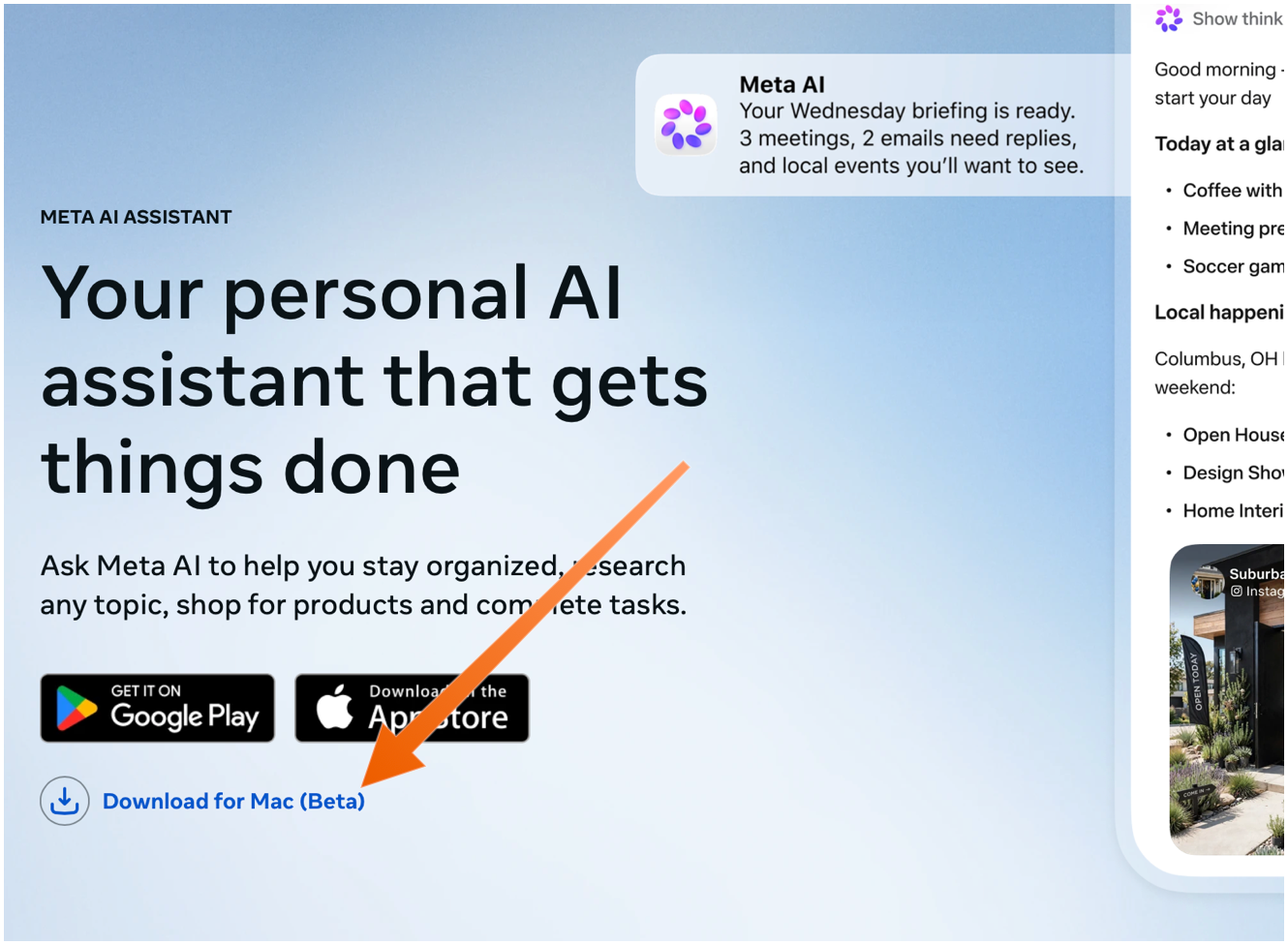
The new Meta AI desktop app is version 1.0 beta at launch and weighs just 16MB once installed.
Based on initial inspection, it runs natively on Apple silicon Macs with macOS 15 or later, using an AppKit and SwiftUI shell with WebKit for richer chat content. In other words, this is not an Electron app or a repackaged iPad release.
It includes Mac-specific hooks, making the desktop experience more robust than the Meta AI mobile app.
The Mac app brings a few new capabilities compared with Meta AI’s existing website and mobile app. For example, it enables users to share part of their screen so the assistant can “see” what they’re working on and provide more specific answers.
The app is primarily meant for businesses and content creators, and it integrates with Facebook and Instagram. It incorporates analytics tools so it can answer questions about performance, and connects with Google Workspace for document access. Google Workspace access requires a professional Facebook or Instagram account.
Passes the Settings window sniff test too — it actually has a Settings window.
[…]
The Mac app is not available in the App Store. You need to download it directly from Meta’s web page, using the “Download for Mac (Beta)” link. The ChatGPT and Claude Mac apps aren’t in the Mac App Store either — they do too many things outside the App Store’s mandatory sandbox (and probably use APIs require that special entitlements in the App Store too).
Meta’s new AI assistant app, Muse, is now available on Mac.
On the Mac, Muse can interact with your files, messages, calendar, notes, and mail, all within their native applications.
Jason Aten, a contributing editor at Inc Magazine, posted on Threads screenshots of an interaction he had with Muse in which the assistant asks him some questions about a conversation he was having in Messages.
The problem is that Aten says he didn’t give Muse access to his messages. When asked how it knew about the contents of his messages, Muse replied, “I saw the notification previews, not your message history. I haven’t been reading your texts.” Aten continued to push, asking how Muse was receiving message previews, it didn’t have a good answer.
The number one response I’ve gotten to my thoughts on Meta’s Muse personal assistant agent is some variation of “I will never trust Meta with my data.” But the number two response is arguably more interesting (and related): “Why didn’t Google build this?”
Mac security researcher Patrick Wardle says it’s trivial to turn Muse into “the ultimate backdoor.”
[…]
According to Ars Technica, Wardle found that a locally running application or terminal command could alter an undocumented Muse configuration setting that controls the server used for dictation transcription. By redirecting dictation traffic to an attacker-controlled server, an attacker could capture voice prompts and obtain the authentication token for the victim’s Muse account.
Four days later and Muse still holds the #1 spot in the U.S. iOS App Store.
See also: Joanna Stern.
Alexandr Wang (Watts Martin, John Gruber):
Here’s the best part: we have no idea what people will want. The world until now has been shaped by the small number of fanatics who have somehow found a way to make their wants real. But we’ve never seen humanity with every single person’s agency fully switched on. Eight billion people who just need to write their dream down in order to get started making it happen.
So we built Muse to help people build the world they want.
So uhhhhhh… Apparently meta’s muse “AI” is just straight up doxxing people to strangers on FB marketplace???
Via Mike Masnick:
Almost all of Meta’s PR about Muse was about how careful they had been to set it up not to do things like this, how they delayed the launch by months to carefully design it so it could be trusted. And then…
Previously:
New terms let Meta crawl sites tied to business users and use the content to train its products, widening rights ad buyers had already granted.
The post Meta’s New Terms Expand Crawling Rights Beyond Advertisers appeared first on Search Engine Journal.
Thanks to a little-known feature in Instagram, I try to travel back to 2012 – before everything on the internet was an ad
Get our breaking news email, free app or daily news podcast
I have a confession. I love my social media algorithm. It is a perfectly curated window into my insane and inquiring mind. It knows precisely which videos will tickle me and which memes will gently distract me from the slow collapse of humankind.
On Tuesday the Australian government announced “world-leading” reforms that would force social media platforms to allow users to opt-out of algorithms, dubbed “my feed, my way”. On the same day, I was delighted to be confronted with a video on Instagram of a woman accidentally spilling a bucket of eels on a Chinese train. Dozens of eels slithered among the passengers, who appeared not as surprised as I would have expected.
Continue reading...
© Illustration: Guardian Design
© Illustration: Guardian Design
© Illustration: Guardian Design
A ANACOM afirma que as plataformas da Meta foram responsáveis por mais de 50% das reclamações sobre serviços digitais recebidas durante o segundo trimestre do ano. Entre as plataformas que geram mais queixas em Portugal incluem-se ainda as da Google e a rede social X.
The post Queixas sobre serviços digitais aumentam 195%. Facebook e Instagram são as plataformas que geram mais reclamações appeared first on Tek Notícias.
Meta took days to remove ads containing AI-generated child sexual abuse material (CSAM) on Facebook and Instagram. Some ads featured photos of real kids, including a press photo of a young member of a European royal family and images swiped from a popular Instagram profile of a preteen girl deemed an influencer.
In an investigation published Tuesday, the Tech Transparency Project (TTP) reported that Meta failed to detect 332 ads containing CSAM this year. The “vast majority” of ads promoted AI apps made in China, while many ads promoted so-called “nudify” apps that make it easy for bad actors to use AI and digitally alter images of children.
TTP matched “multiple CSAM ads to photos of real children that appeared online.” These ads seem to violate federal child pornography laws, since the Justice Department has clarified that AI CSAM is just as harmful as CSAM. The young royal’s image was “animated into a video of her performing a graphic sex act,” TTP found. Other ads animated a photo of a 14-year-old Instagram influencer “showing off her new sports club uniform” into “a video of her performing oral sex.” A third “preteen” victim “posing in a pink athletic outfit with pigtails” in a series of stock photos was morphed into a video where she looks frightened as she’s molested by an adult male, TTP reported.
© Alex Wong / Staff | Getty Images News
Even if the legislation passes, tech companies may still find ways to frustrate its intent and keep Australians hooked on their feed
Social media could become a “choose your own adventure” between the doom-scrolling status quo, or just the feed of the friends you want to see, if the government’s planned digital duty of care legislation passes, and the tech companies don’t muck around on compliance.
But that’s a big if.
Continue reading...
© Photograph: Peter Cripps/Alamy
© Photograph: Peter Cripps/Alamy
© Photograph: Peter Cripps/Alamy
Instagram and Facebook’s parent company agreed to sweeping alterations and a payment of up to $18bn to settle a landmark trial
Meta’s agreement to change how teenagers use its social networks marks a major turning point for the US tech giant, setting a precedent that could significantly reshape how other social media operates in the coming years.
Meta agreed to substantial alterations to Instagram and Facebook on Wednesday as part of a settlement to end a landmark lawsuit. Dozens of US states had accused it of addicting and harming children with dangerous products. The company also agreed to pay up to a combined $18bn over a decade to several US states and territories involved in the suit.
Continue reading...
© Photograph: Matt Cardy/Getty Images
© Photograph: Matt Cardy/Getty Images
© Photograph: Matt Cardy/Getty Images
Also: OpenAI CEO Sam Altman expressed his surprising sympathy over the construction of datacenters across the country
Hello, and welcome to TechScape. I’m Blake Montgomery, US tech editor at the Guardian, writing to you from a sunny park in New York City, which was supposed to endure rain all weekend but in fact delivered the best weather of the year.
‘We are hitting a different chapter’: OpenAI leader warns of threat of ‘persistent’ AI cyber-attacks
OpenAI announces slowing pace of development after hack by rogue agent
OpenAI launches ChatGPT for Teens with stronger safeguards
‘Digging the grave of my profession’: the Hollywood creatives training AI to do their jobs
Will AI give you the job? Automated hiring tools spark discrimination and secrecy lawsuits
After more than 15 years of laptops in the classroom, do Australian schools need a rethink?
Did someone wearing Meta Glasses film you today? Are you sure?
Continue reading...
© Photograph: Vicki Behringer/Reuters
© Photograph: Vicki Behringer/Reuters
© Photograph: Vicki Behringer/Reuters
Read more of this story at Slashdot.
Ruling comes as part of second phase of landmark trial that found social media company enabled harm against users
A New Mexico court has ordered Meta, the parent company of Facebook, to pay $567m into a fund aimed at redressing adverse mental health impacts from the social media giant’s platforms.
The Thursday ruling comes as a part of the second phase of a landmark trial the social media giant lost in March. At the time, a jury found that the company knowingly harmed children’s mental health and concealed what it knew about child sexual exploitation on its platforms, and imposed the maximum penalty: a $375m fine.
Continue reading...
© Photograph: Jill Connelly/Getty Images
© Photograph: Jill Connelly/Getty Images
© Photograph: Jill Connelly/Getty Images