❌

Normal view

If you're looking, here's a "good deal" for NASA and the European Space Agency

7 October 2026 at 12:00

It's no surprise that NASA's new tack toward foreign partnerships—good deals only, please—is challenging preconceived notions of international cooperation in space.

Without a massive budget hike, the US space agency's emphasis on building a Moon Base and winning a competition for lunar real estate and resources with China will inevitably leave lesser priorities behind.

Gone is the Lunar Gateway, a space station that was to be assembled in orbit around the Moon. For the United States, Gateway was an unnecessary distraction and expense as NASA goes all-in on placing a surface station near the Moon's south pole.

Read full article

Comments

© AEI/MM/Exozet

Supernova, Kilonova, or Both? Another Look at SN 2025ulz

2 October 2026 at 17:00

AT 2025ulz within its host galaxy

A tentative gravitational wave signal sent astronomers searching for a possible electromagnetic counterpart. New radio observations weigh in on whether the candidate counterpart is a standard supernova or a sign of something rarer.

A Potential Neutron Star Merger

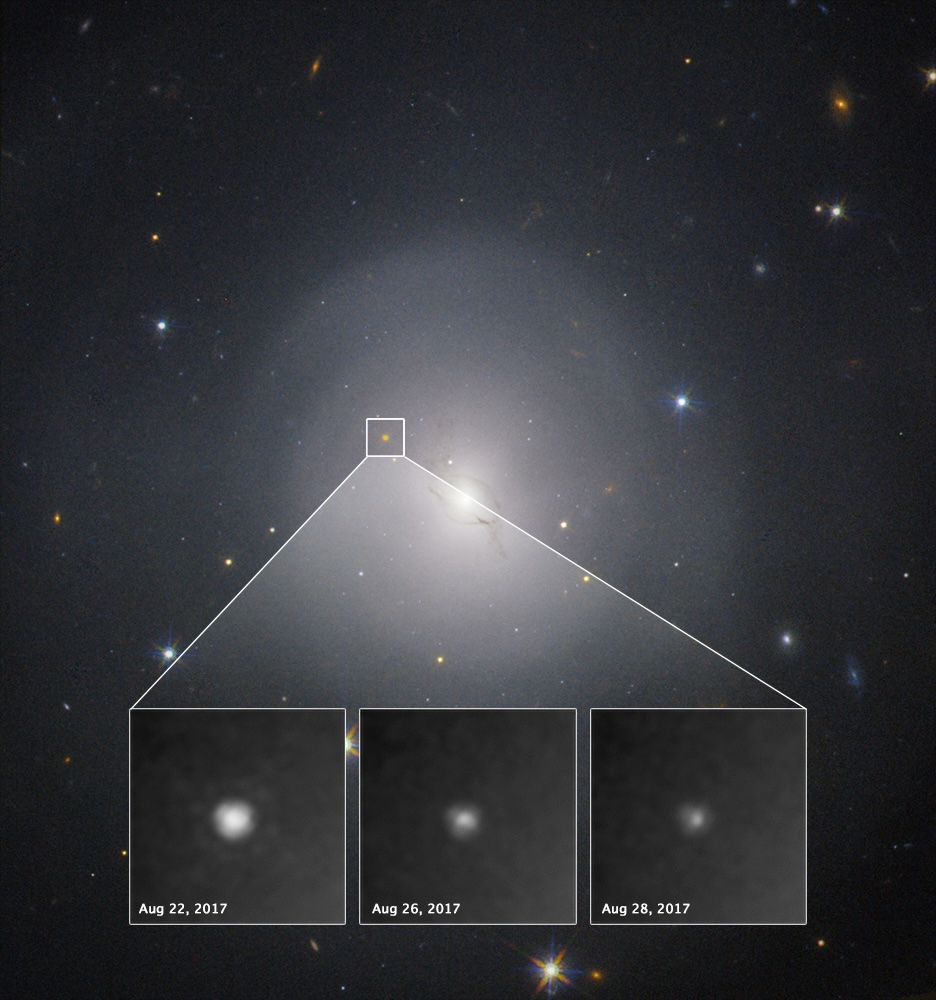
kilonova as seen by Hubble

These images from the Hubble Space Telescope show the fading light of the kilonova associated with the gravitational wave event GW170817. [NASA and ESA Acknowledgment: A. Levan (U. Warwick), N. Tanvir (U. Leicester), and A. Fruchter and O. Fox (STScI)]

In 2025, the LIGO-Virgo-KAGRA collaboration announced an interesting gravitational wave candidate, S250818k. Despite a 71% chance that the gravitational wave signal wasn’t astrophysical in origin, S250818k raised eyebrows as a potential kilonova: a compact-object collision involving at least one neutron star.

S250818k offered a rare opportunity to associate the light from a kilonova with a gravitational wave detection, a feat achieved only once so far, in 2017. The intrigue surrounding S250818k was heightened even further by the possibility that the collision involved at least one sub-solar-mass neutron star. Such a lightweight neutron star would fall below the lower mass limit set by stellar evolution models, requiring a different formation pathway.

S250818k’s kilonova potential rose and fell once researchers spotted an electromagnetic transient in its source region. Early optical observations revealed a kilonova-like color and rapid fading, while later observations showed brightening similar to a supernova interacting with circumstellar gas. This led the event to be classified as supernova SN 2025ulz — and therefore unlikely to be the source of the gravitational wave signal.

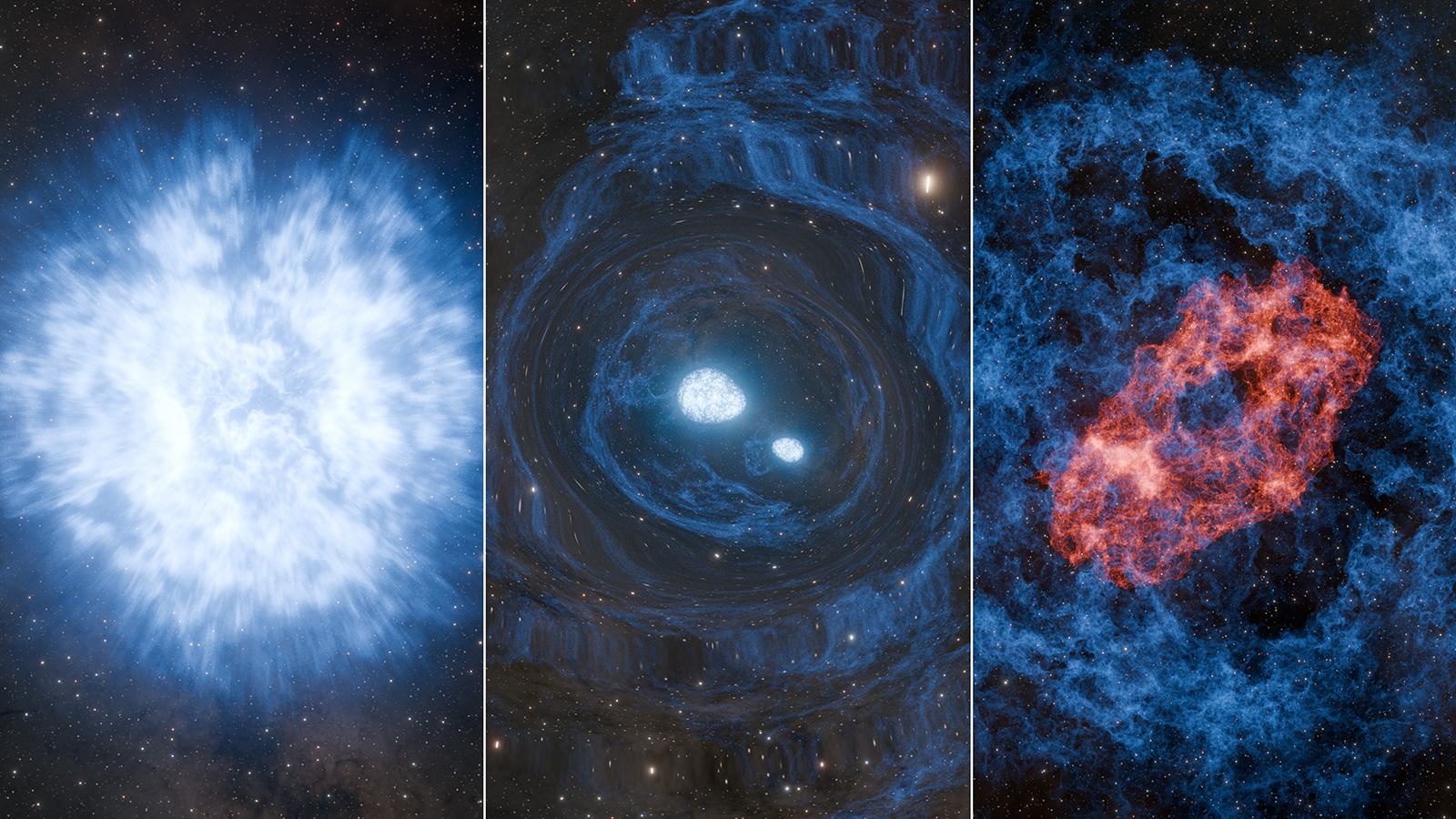
illustration of a kilonova in a supernova

Illustration of a kilonova that occurs in the wake of a supernova. First, a massive star collapses. Then, neutron stars form in the aftermath. Finally, the neutron stars collide, producing a kilonova whose signal might be hidden by the supernova. [Caltech/K. Miller and R. Hurt (IPAC)]

A Kilonova in a Supernova?

Unlikely, but not impossible. Tanner O’Dwyer (Johns Hopkins University) and collaborators investigated the supernova for signs that it wasn’t a typical collapsing star. The team was motivated by theories suggesting that the collapse of a rapidly rotating massive star could produce both a kilonova and a supernova — potentially uniting gravitational wave signal S250818k and supernova SN 2025ulz.

In theory, the demise of a fast-spinning massive progenitor could produce one or more sub-solar-mass neutron stars. This could happen if 1) the collapsing stellar core splits into two neutron stars, or 2) in a twist on the star-formation process, neutron stars coalesce out of neutron-rich material in the disk surrounding the dying star. In either scenario, the neutron stars could merge shortly after the star’s collapse, generating kilonova emission that might be obscured by the expanding supernova.

Looking Deeply in the Radio

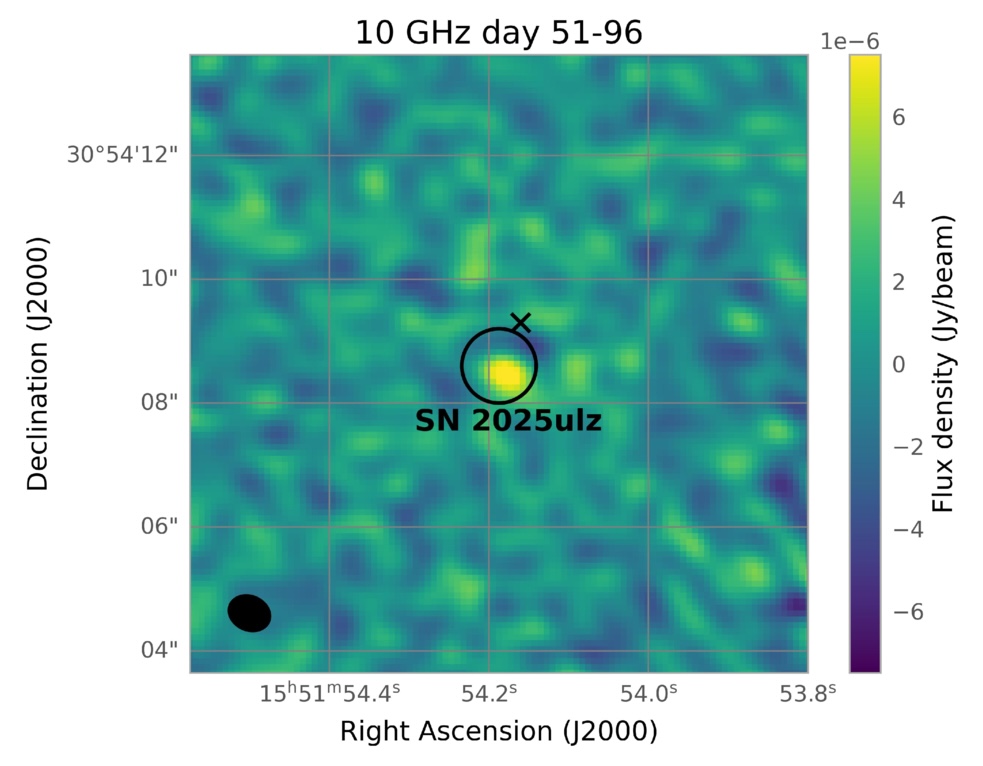
radio counterpart of SN 2025ulz

Very Large Array detection of a radio counterpart to SN 20215ulz. The circle shows the optical position of the supernova, and the “x” shows the optical position of the host galaxy. [Adapted from O’Dwyer et al. 2026]

Radio observations offer a way to distinguish between a typical supernova, which would have relatively slow-moving ejecta, and a collapsing rapidly rotating progenitor, which could produce a relativistic jet. Searching for a radio counterpart to the supernova in observations from the Very Large Array, the upgraded Giant Metrewave Radio Telescope, and MeerKAT, O’Dwyer and coauthors found a faint but significant radio source in stacked observations made 51–96 days after the gravitational wave trigger.

The team found that standard supernova ejecta and relativistic jet models can both plausibly fit the data. In the supernova scenario, the estimated expansion speed and progenitor mass-loss rate place the event well within the bounds of known stripped-envelope supernovae. Though the data were also compatible with an off-axis relativistic jet, the authors were unable to resolve degeneracies in the event’s properties, including the jet energy and the interstellar medium density.

Ultimately, the authors suggested that a supernova fits the data more naturally. While this radio investigation didn’t unambiguously link S250818k and SN 2025ulz via an exotic kilonova-plus-supernova mechanism, it’s clear that radio observations have an important role to play in examining future gravitational wave signals.

Citation

“Identification of a Radio Counterpart to SN 2025ulz in the S250818k Localization Area,” Tanner O’Dwyer et al 2026 ApJL 1009 L44. doi:10.3847/2041-8213/aea4a5

The post Supernova, Kilonova, or Both? Another Look at SN 2025ulz appeared first on AAS Nova.

August Ties for Hottest Month on Record

10 September 2026 at 03:00
Sweltering summer temperatures put last month on par with July 2023 for global warmth, scientists said. More records could be broken in the months ahead.

© Yonhap News Agency, via Reuters

A vendor cooled off with a frozen water bottle in a market in Seoul on Aug. 6.

How gravitational waves transformed our universe

10 August 2026 at 19:14

Some 1.3 billion years ago, when multicellular organisms were just emerging on Earth and life was still confined to the ocean, two behemoth black holes smashed together in a far-flung galaxy. The collision was so powerful that it jolted the universe, creating a ripple in the fabric of space-time that traveled across the cosmos atContinue reading "How gravitational waves transformed our universe"

The post How gravitational waves transformed our universe appeared first on Astronomy Magazine.

Trump Administration Is Undoing Plans to Boost Workplace Heat Protections

1 August 2026 at 20:58
The Biden administration took steps to shield workers from extreme temperatures. The Trump administration is taking a gentler approach with employers.

© Allison Joyce/Agence France-Presse — Getty Images

A delivery in Wilmington, N.C., this month. Heat is linked to hundreds of workplace deaths each year, but labor groups say the true toll is unknown because heat-related illnesses are not properly tracked or reported.

Monthly Roundup: The Fourth Catalog of Gravitational Wave Events from LIGO, Virgo, and KAGRA

29 July 2026 at 17:00

Illustration of gravitational waves emanating from a pair of black holes approaching a merger

A recent Focus Issue of the Astrophysical Journal Letters describes the fourth version of the catalog of gravitational wave events (GWTC-4.0) from the Laser Interferometer Gravitational Wave Observatory (LIGO), the Virgo interferometer, and the Kamioka Gravitational Wave Detector (KAGRA).

This catalog contains transient gravitational wave events recorded through January 2024, during the observatories’ fourth observing run, which concluded in November 2025. GWTC-4.0 displays the results of significant improvements to our suite of gravitational wave detectors, including higher-powered lasers and reduced quantum noise. A fifth catalog of gravitational wave events was released in Spring 2026, with the accompanying scientific articles being submitted to the Astrophysical Journal and the Astrophysical Journal Letters.

This Monthly Roundup consists of short descriptions of each of the currently published research articles in the LIGO–Virgo–KAGRA Gravitational Wave Transient Catalog (GWTC): Release 4 Focus Issue. Each snippet links to the corresponding research article, and the Focus Issue landing page is linked at the bottom of this post. Be sure to revisit the landing page to catch new articles as they’re published!

Introducing GWTC-4.0

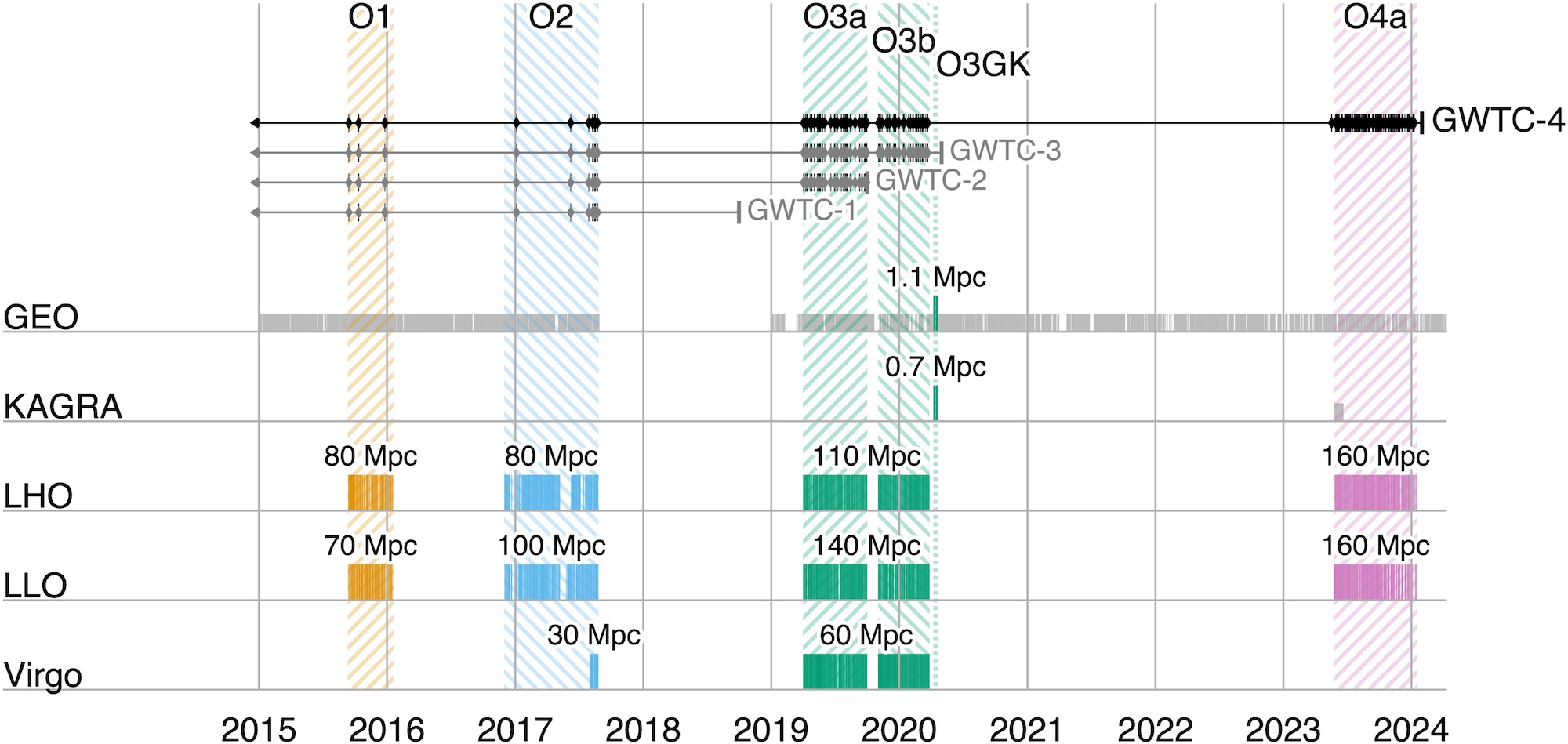
timeline of gravitational wave observatories' observing runs

A timeline showing observing runs between 2015 and 2024. Click to enlarge. [LVK Collaboration 2025]

First up, the collaboration orients the reader to many important aspects of the catalog and the articles contained in the Focus Issue. This article describes how four detectors, each with two arms 3–4 kilometers long, monitor gravitational waves from Hanford, Washington; Livingston, Louisiana; Santo Stefano a Macerata, Italy; and Hida, Japan. These detectors work in concert, ready to receive signals from the universe during coordinated observing runs separated by periods of downtime for construction and commissioning. During these pauses, a smaller instrument, the German–British GEO600 gravitational wave detector, has kept an ear out for signals and will continue to do so until the end of 2026.

After these detectors record subtle spacetime squiggles from compact objects colliding millions to billions of light-years away, the collaboration converts the raw signals into the data contained in catalogs like GWTC-4.0. This process involves modeling the gravitational wave signals, filtering them to identify candidate transients, and pinpointing the most significant events.

After collecting and cleaning the signals, the collaboration undertakes a critical step: making their data accessible to researchers and the public. The data are available through the Gravitational Wave Open Science Center, and the Focus Issue article on open data describes how to navigate the online portal, how the datasets archived online are structured, and how the data were calibrated.

Science Results

This fourth version of the gravitational wave transient catalog greatly expands the sample of gravitational wave transients recorded by detectors across the globe. Including events from previous catalogs, GWTC-4.0 brings us to 218 events for which the probability of the source being astrophysical in nature is more than 50% and for which there is little chance of the signal being an instrumental artifact. This represents a more than 100% increase in the number of recorded gravitational wave events fulfilling this criterion, broadening our understanding of colliding compact object pairs. This release also includes some superlative signals, such as the most massive black hole binary with a low false-alarm rate and the highest signal-to-noise ratio for a gravitational wave event thus far.

Detected in November 2023 by both LIGO Hanford and LIGO Livingston, GW231123 is in many ways an exceptional gravitational wave transient. The total mass of the merging components appears to be between 190 and 265 solar masses, and the false-alarm rate for this signal is less than one per year. This makes it the most massive merger event with such a low false-alarm probability. The two components also appear to have high spins, which complicates the interpretation of the signal with existing models. A binary black hole merger in which one or more components lies within the pair-instability mass gap is the likeliest explanation for this signal, but the authors also present alternative scenarios, such as a core-collapse supernova or a gravitationally lensed gravitational wave signal.

GW230814 gravitational wave signal

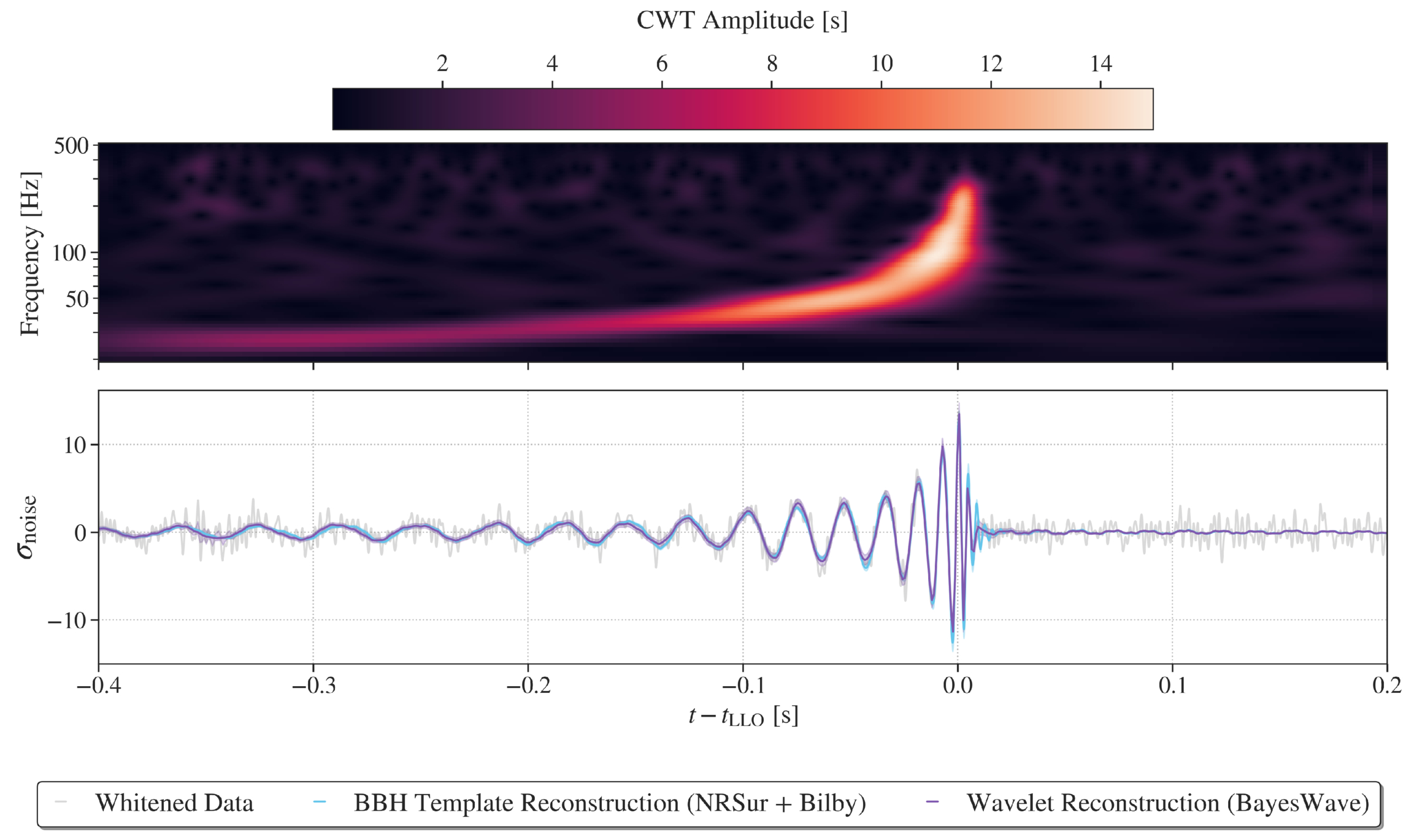
Representations of the GW230814 gravitational wave signal. Click to enlarge. [LVK Collaboration 2026]

GW230814, which was detected only by LIGO Livingston, is the loudest signal in the catalog. This signal is consistent with the collision of two black holes, each of roughly 30 solar masses. During the analysis of this signal, the team discovered potential deviations from the predictions of general relativity in the ringdown phase, when the remnant black hole settles into its final shape. Without a detection from another facility to corroborate this finding, it’s difficult to pinpoint the cause of the deviation, but the team could not rule out statistical noise fluctuations as the source.
Plot of the differential merger rate

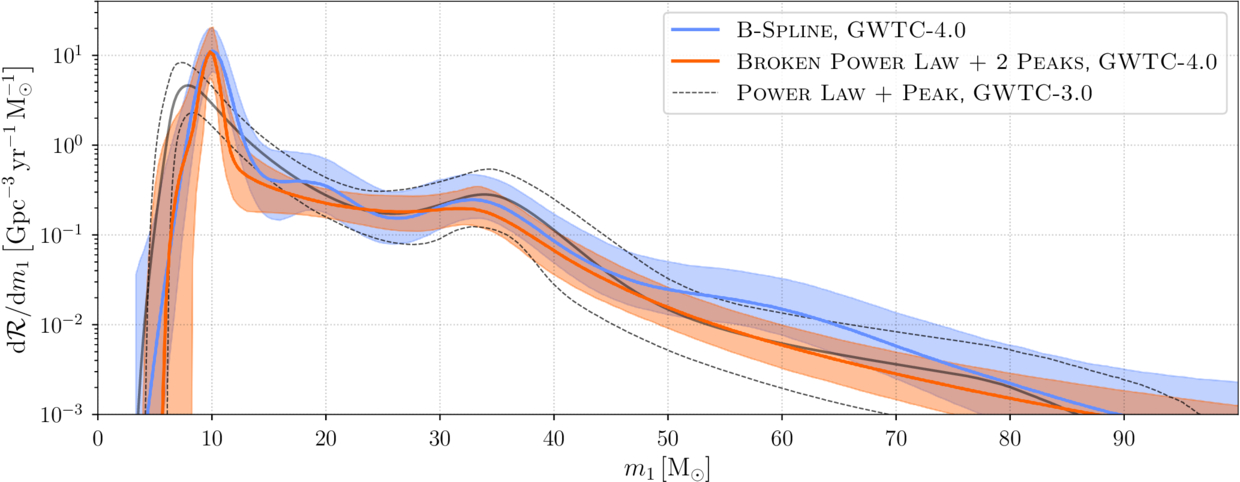
Plot of the differential merger rate as a function of the mass of the more massive of the two merger components. This shows overdensities at 10, 35, and possibly 20 solar masses. Click to enlarge. [LVK Collaboration 2026]

Surveying merging black holes and neutron stars on the population level, the team analyzed 158 gravitational wave signals from the current catalog. This analysis supported findings from previous transient catalogs, including multiple overdensities in the distribution of merging black hole masses, broadly distributed neutron star masses, and an increase in the merger rate with redshift. The new data strengthened certain previously identified trends, such as an increase in the width of the effective spin distribution with redshift, and weakened others.

The full list of articles in the GWTC-4.0 Focus Issue can be found here.

Citation

“GWTC-4.0: An Introduction to Version 4.0 of the Gravitational-Wave Transient Catalog,” A. G. Abac et al 2025 ApJL 995 L18. doi:10.3847/2041-8213/ae0c06

“GWTC-4.0: Methods for Identifying and Characterizing Gravitational-Wave Transients,” A. G. Abac et al 2026 ApJL 1004 L21. doi:10.3847/2041-8213/ae447b

“Open Data from LIGO, Virgo, and KAGRA Through the First Part of the Fourth Observing Run,” A. G. Abac et al 2026 ApJ 1004 232. doi:10.3847/1538-4357/ae211e

“GWTC-4.0: Updating the Gravitational-Wave Transient Catalog with Observations from the First Part of the Fourth LIGO–Virgo–KAGRA Observing Run,” A. G. Abac et al 2026 ApJL 1004 L22. doi:10.3847/2041-8213/ae2c74

“GW231123: A Binary Black Hole Merger with Total Mass 190–265 M⊙,” A. G. Abac et al 2025 ApJL993 L25. doi:10.3847/2041-8213/ae0c9c

“GW230814: Investigation of a Loud Gravitational-Wave Signal Observed with a Single Detector,” A. G. Abac et al 2026 ApJL 1004 L23. doi:10.3847/2041-8213/ae2ad3

“GWTC-4.0: Population Properties of Merging Compact Binaries,” A. G. Abac et al 2026 ApJL 1005 L51. doi:10.3847/2041-8213/ae771e

The post Monthly Roundup: The Fourth Catalog of Gravitational Wave Events from LIGO, Virgo, and KAGRA appeared first on AAS Nova.

New Research Reveals How Traveling Brain Waves Allow Us to Predict, Reconstruct, and Perceive the World

21 July 2026 at 17:00

Scientists from the Salk Institute have determined that brain waves in the visual cortex serve as a computational engine, allowing the brain to construct internal representations of the external world that enhance prediction, reconstruction, and perception capabilities.

While the scientists behind the new study focused their work on the visual cortex, they suspect that similar brain waves washing over other areas of the brain’s surface likely serve a similar role for other sensory systems.

Unraveling the Role of Traveling Brain Waves in the Visual Cortex

The human brain uses electricity to communicate between synapses. Research has shown that this electrical activity can travel in waves across the brain’s surface. Called neural traveling waves, the phenomenon’s role in brain function and consciousness is not completely understood.

Previous studies have established that traveling brain waves play a significant role in behavior and attention. In 2020, Salk neuroscientist John Reynolds, PhD, successfully identified traveling brain waves in the visual systems of animals during a wakeful state.

According to a statement from Reynolds, the senior and co-corresponding author on the new paper, and colleagues, the 2020 research effort also found a direct correlation between traveling brain waves in the visual cortex and an animal’s ability to perceive objects directly in front of them. The authors suggest this discovery explained the “classic conundrum” of searching for something like a pair of keys or a phone that was right in front of you the whole time.

Although the connection between traveling brain waves and an awake animal’s ability to perceive objects seemed solid, Reynolds said he was left wondering why. 

Process is Analogous to LLM’s Like ChatGPT

In their newly proposed theory, Reynolds and colleagues suggest that traveling brain waves are not simply “electrical noise” resulting from the brain’s normal relaying of signals. Instead, the Salk Institute team proposes that the neural connections responsible for the generation of traveling brain waves change their physiological structure, or “synaptic weights,” to more accurately reflect the outside world.

“Each sight, smell, sound, and action of an animal alters the connections that generate these waves, building the neural circuitry that the brain uses to construct an internal representation of the external world,” the team’s statement explains.

In the visual cortex, the part of the brain responsible for receiving and processing visual information, the team proposed that traveling brain waves perform four distinct functions. These include modulating visual perception from moment to moment and turning recent visual sensory inputs into “internal representations” of objects, people, and surroundings.

The team proposes that traveling brain waves also help humans generate short-term predictions about their surroundings, and “store and replay patterns that represent memories of events unfolding in time.” Reynolds said the process laid out by his team is analogous to how ChatGPT and other LLMs translate and interpret data.

“They learn statistical structure from language and use that knowledge to generate meaningful and appropriately structured text that reflects the patterns of language,” the researcher explained. “The brain may be doing something functionally similar—a biological generative model built from the ground up by experience.”

“One Step Closer” to Understanding How Our Brains Compute the World

When detailing the potential impact of their proposed role for traveling brain waves in the visual cortex, the team highlights the contrast between a rich and complex world and its general predictability.

“Objects around you exist in 3D space, you see the world in retinal images that change with your eye and body movements, and the laws of physics and physiology overlay this all,” they explain.

Reynold’s team says that traveling brain waves are merely the brain’s way of internalizing these predictable “regularities” and encoding them in its synapse network. If correct, they said that this encoding would allow the brain to “infer the likely causes of sensory input and construct an internal model of the world.”

“This framing brings us one step closer to understanding how our brains compute the busy, messy world around us, turning a complicated sensory onslaught into behaviors and experiences,” they conclude.

The study “Neural traveling waves in cortex: network mechanisms and potential roles in neural computation” was published in Neuron.

Christopher Plain is a Science Fiction and Fantasy novelist and has spent the last six years as Associate News Editor and Head Science Writer at The Debrief. Follow and connect with him on X, learn about his books at plainfiction.com, or email him at christopher@thedebrief.org

❌