Les tunnels de lave font partie des formations géologiques communes à Mars et à la Terre. Déjà envisagées comme potentiels habitats pour de futurs explorateurs de la Planète rouge, ces tunnels pourraient également être des environnements privilégiés pour rechercher de potentielles traces de vie...
Japan launched a $578 million mission Monday on a five-year expedition to land on the largest moon of Mars and retrieve samples for return to Earth, a daring international project that could yield new insights into the formation of the Solar System.
The robotic Martian Moons eXploration mission, known as MMX, lifted off at 3:41 pm EDT Monday (4:41 am Japan Standard Time Tuesday) from Tanegashima Space Center in southern Japan.
The MMX spacecraft rode into orbit atop a 207-foot-tall (63-meter) H3 rocket, Japan's flagship launch vehicle. The rocket assigned to MMX debuted a new souped-up configuration with four strap-on solid rocket boosters, full-throttle main engines, and an extended payload shroud to accommodate the demands of Japan's heaviest and most ambitious interplanetary mission to date.
Rocket launches this week On Monday, Oct. 19, the Japan Aerospace Exploration Agency (JAXA) successfully launched its Martian Moons eXploration (MMX) mission aboard an H3-24L rocket from Tanegashima Space Center in southern Japan at 3:41 p.m. EDT. MMX will study the martian moons Phobos and Deimos and is designed to return a sample from PhobosContinue reading "Japan sends MMX toward the martian moons"
Planetary researchers at the University of Sydney have proposed a new way to classify the soils of Mars, along with a new word for them: areth (the name comes from Ares, the Greek name for Mars).
Japan will launch an epic mission to Mars today (Oct. 19), and you can watch the action live.
The Martian Moons eXploration (MMX) mission is scheduled to lift off atop an H3 rocket from Japan's Tanegashima Space Center today at 3:41 p.m. EDT (1941 GMT; 4:41 a.m. on Oct. 20 local Japan time).
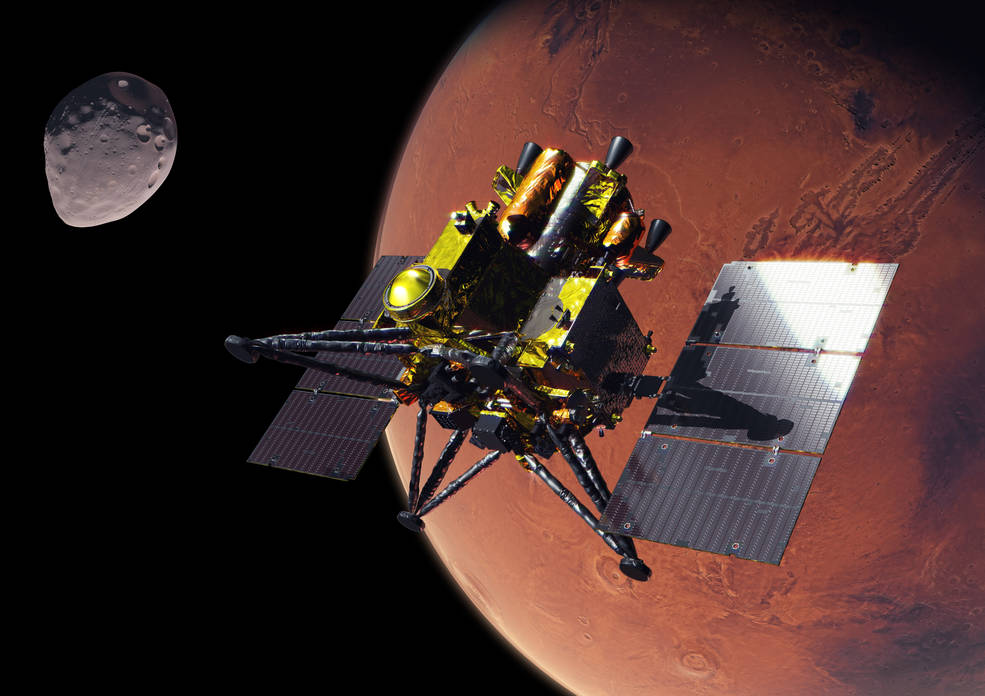
An artist’s concept of JAXA’s MMX spacecraft during its Mars orbit insertion. The Martian moon Phobos, which MMX will explore and sample, is in the background. (Image credit: JAXA)
As its full name suggests, MMX will focus on Mars' two moons, Phobos and Deimos. They're both tiny compared to Earth's own moon; Phobos is just 14 miles (22 kilometers) wide, and Deimos is even smaller, with a diameter of about 8 miles (13 km).
They're also quite mysterious. While astronomers have a pretty clear understanding of our own moon's birth — it coalesced from material blasted into space when a Mars-sized planet slammed into Earth long ago — there's no consensus about Phobos and Deimos' origin story.
The duo "may be the remains of a massive impact on Mars that sent material into orbit around the planet, or they could be ancient asteroids that were captured by Mars' gravity billions of years ago," Tom Statler, MMX program executive and program scientist at NASA Headquarters, said in an Oct. 15 statement. (NASA is a partner on the mission, providing a scientific instrument, a technology demonstration, communication support and funding for American scientists on the MMX team.)
"Having the answer will help illuminate that early era when Earth and the other inner planets may have been acquiring much of their water and organic compounds," Statler added.
MMX will help provide that answer, if all goes according to plan.
The spacecraft will arrive in the Mars system in August 2027, then slip into orbit around Phobos a month later. It will study that moon and Deimos from a distance for about 18 months, then deploy the French-German Idefix rover onto Phobos' surface in early 2029.
The 55-pound (25 kilograms) Idefix "has two main tasks: providing information to prepare for the landing of the main spacecraft to collect samples, and analyzing the composition and texture of Phobos' surface," European Space Agency officials wrote in an MMX mission description.
"The gravity on Phobos is so low that Idefix will only weigh the equivalent of 15 grams [0.5 ounces] on its surface!" they added.
The MMX mothership's Phobos landing will occur in 2030. The spacecraft will grab at least 10 grams (0.4 ounces) of samples from the moon, then head back toward Earth with this extraterrestrial bounty. MMX's return capsule will land here in 2031, after which scientists around the world will scrutinize the Phobos sample for clues about the history and evolution of Mars and our solar system more broadly.
Engineers conduct a thermal vacuum test with JAXA's MMX Mars moon sample-return spacecraft. JAXA posted this image on X on May 15, 2025. (Image credit: JAXA)
MMX was originally supposed to launch in 2024, but issues with the H3 rocket prevented it from doing so. Mars and Earth align properly for interplanetary launches just once every 26 months, so MMX had to wait a while for its next chance.
Japan already has an impressive sample-return track record. The country's Hayabusa mission brought home pieces of the asteroid Itokawa in 2010, for example, and Hayabusa2 did the same with material from the space rock Ryugu a decade later.
His early Mars expedition called for 70 people, orbital assembly and winged landers. The design reveals how much depended on a planet nobody had visited.
On October 11, 2026, NASA’s Perseverance rover reached 45.22 km (28.1 miles), edging past the 45.16 km (28.06 miles) logged by NASA’s Opportunity rover, which explored Mars from 2004 to 2018.
Japan launches a ground-breaking mission to the Mars moon Phobos today, and you can watch live.
The JAXA (Japan Aerospace Exploration Agency) MMX (Martian Moons eXploration) mission aims to collect samples from Phobos, the larger of Mars’ two moons, and deliver it back to Earth for analysis. If successful, the samples could help solve long-standing mysteries about Mars’ moons, including their origin.
In 1877, US astronomer Asaph Hall discovered Phobos and its smaller sibling, Deimos. The moons have arguably the most bad-ass names in our solar system: Phobos comes from the ancient Greek word φόβος (phobos), meaning “fear,” and Deimos originates with the ancient Greek word Δεῖμος, which translates to “dread.”
Despite increased attention on Mars in recent decades, astronomers don’t know exactly how the celestial bodies formed. Theories include asteroids or debris leftovers from way back when the solar system formed about 4.5 billion years ago.
“The samples from MMX will bring forth paradigm-shifting science on the Mars system for generations to come, especially as NASA prepares to send the first humans to Mars,” said Nicky Fox, associate administrator and Science Mission Directorate at NASA, said in a statement. While a JAXA mission, NASA worked with the agency to provide instruments and technologies to assist.
The MMX spacecraft launches on top of an H3 rocket at Japan’s Tanegashima Space Center today at 3:41 p.m. EDT (4:41 a.m. Japan Standard Time on October 20). You can watch it live on JAXA’s YouTube page. The mission will get to Phobos in August 2027 and spend at least 16 months surveying the surface before collecting samples. The samples will not return to Earth until at least 2031.
NASA’s Perseverance Mars rover has officially traveled 28.10 miles—farther across another planet’s surface than any other vehicle in history. Not only that, but the six-wheeled science lab accomplished this impressive feat almost entirely autonomously and in barely a third the time it took the previous recordholder.
“The original mission called for no more than 12.4 miles of driving. We’ve blown well past that,” Steven Lee, Perseverance and Curiosity project manager at NASA’s Jet Propulsion Laboratory, said in a statement.
Perseverance began operations on Mars on February 18, 2021, after landing in an ancient river delta selected for potential past microbial life called Jezero Crater. Since then, the rover has slowly but steadily made its way across the region, while conducting multiple sediment drilling surveys. These samples are then chemically analyzed using onboard laboratory equipment before the results are sent back to mission specialists at NASA.
Perseverance surpassed the previous travel record of 28.06 miles set by NASA’s Opportunity rover, before its communications with NASA ended on June 10, 2018. However, it took Opportunity nearly 15 years to accrue its distance while Perseverance exceeded the same mileage in less than six years, and on the 2,006th Martian day (sol) of its mission. Perseverance is currently traveling towards an area named Idubi through an expanse nicknamed “Lac de Charmes.” The region near Jezero Crater’s western rim hosts what may be the oldest landscape ever investigated in the solar system. Mars does not feature tectonic plates like Earth, which means its terrain is never eroded and subsumed into the planet’s substrates.
Mission engineers have not spent the last six years remotely steering Perseverance, either. The rover arrived on Mars equipped with a self-piloting system called AutoNav, which constructs 3D maps of the immediate surroundings to flag any potential hazards. AutoNav then charts a route between specific waypoints chosen by NASA specialists back home. Perseverance has completed 90 percent of its total excursion with AutoNav. Opportunity and its sibling rover, Spirit, only relied on a first version of the piloting system about five percent of the time.
Perseverance has a long road ahead of it, if all goes according to plan. In October, NASA approved the first mission extension that will continue the rover’s operations through about the end of 2028.
“With all mobility systems fully operational and favorable extended-ground-life test results, we expect Perseverance to keep adding to this record for many years to come,” added Lee.
Since the 1976 Viking missions, when NASA first successfully placed uncrewed landers on Mars, scientists who study life in the universe, known as astrobiologists, have been gathering evidence to determine whether microorganisms ever lived on the red planet. It has been a challenging determination to make. Until a Mars sample return mission occurs, all necessary analyses must take place on Mars, using instruments designed as much to withstand the stresses of space travel as to collect data, which limits how thoroughly scientists can study Martian rocks. As a result, the search for evidence of microbial life on Mars is inherently incremental.
Recently, scientists added another piece of exciting, yet inconclusive, evidence to their search. In the summer of 2024, the Mars 2020 Perseverance Rover science team was searching for signs of ancient microbial life in a 3,700-million-year-old lake bed on Mars, known as Jezero Crater. In the process, they detected complex, carbon-containing organic molecules in mudstones within a river channel that once brought water to the now-dry lake bed.
Widely dispersed organic molecules associated with minerals that can support microbial life are exactly what astrobiologists would expect to see if microorganisms once lived in Jezero Crater. However, organic molecules can also form through geological processes, like when gases and minerals react at high temperatures and pressures at deep-sea vents on Earth. Therefore, astrobiologists must carefully assess organic molecules to determine their origin.
In July of 2026, more than 60 Perseverance science team members took a first step towards determining whether ancient microorganisms could have made the organic molecules found in Jezero Crater. They compared the organic molecule detections in Martian mudstones to similar detections of organic molecules in samples of known origin, including fossilized Earth life, meteorites, and minerals.
NASA scientists detected the organic molecules in Jezero Crater with a rover instrument called Scanning Habitable Environments with Raman and Luminescence for Organics and Chemicals (SHERLOC). SHERLOC uses a 248.6 nanometer (nm) wavelength laser to excite molecules in unknown materials. When molecules are excited, they absorb and scatter the laser light, causing characteristic shifts in the wavelength of the scattered light.
Instruments like this, known as Raman spectrometers, detect the shifted light and display the detections as lines called spectra, which scientists use to identify the unknown molecules. The Raman spectra from the 4 mudstones in Jezero crater showed shifts of about 1600 nm, which is characteristic of complex carbon molecules. These shifts appear as bands in the spectra that are often called G-bands.
Raman spectrometers are common laboratory instruments, but most use lasers with wavelengths of 485 nm or higher, so the spectra they produce can be slightly different from SHERLOC spectra even when the laser excites the same kind of molecule. To get around this issue, the scientists compared the Mars spectra with spectra of complex carbon molecules from fossilized Earth microorganisms, coal, graphite, meteorites, and synthetic samples collected by Raman instruments using the same wavelength laser that SHERLOC uses. They found that the spectra collected on Mars overlap with at least one example from every sample type except graphite.
These results don’t rule out the possibility that organic molecules in Jezero Crater were produced by ancient microbial life, but they can’t tell us exactly how they formed either. That determination will have to wait until the samples are brought to Earth so they can be studied with laboratory instruments.
The Perseverance team has made a small but critical contribution towards determining whether microbial life ever inhabited our closest planetary neighbor, Mars. Their efforts exemplify how the science of astrobiology and the search for possible extraterrestrial life slowly and carefully move forward. If we keep at it, humans may one day have a definitive answer to one of our most consequential questions: Are we alone?
Astronomers and astrobiologists use a wide range of tools in their search for extraterrestrial life. Probes, satellites, and rovers take photographs and collect data on the geology and chemistry of planets and moons in the solar system. Radio telescopes sweep the sky, looking for signals from intelligent civilizations. And telescopes like the JWST can observe the atmospheres of distant exoplanets, potentially finding ones similar to Earth’s.
A limitation of these methods is that they assume life on other worlds is fundamentally similar to life on Earth, requiring the same balance of molecules in the atmosphere, producing the same chemicals for their metabolic processes, or developing technologies analogous to those humans make. While researchers use these assumptions as baseline markers to look for, assuming such similarities might lead them astray. Scientists looking for life using too narrow a set of parameters might miss life unlike Earthlings. Or they might mistake coincidentally similar geological, chemical, or astronomical processes for having been made by living things.
So, to complement techniques that assume alien life resembles life on Earth, scientists also consider approaches that detect signs of life while making as few assumptions as possible about what it could look like, known as agnostic biosignatures. One of these life signs with few assumptions is complexity. Though it can be difficult to quantify precisely, living things tend to create more complex systems than nonliving things. A team of researchers recently tested whether living and nonliving worlds could be distinguished solely by examining the complexity of the light-reflection patterns from their surfaces.
For this, the team treated Earth and Mars, similar planets but one with life and one without, as stand-ins for exoplanets around other stars. They collected data on the light reflected off both planets’ surfaces from a space station monitoring Earth, known as the Deep Space Climate Observatory or DSCOVR, and an orbiter around Mars observing its atmosphere, known as the Hope Probe.
The team identified 3 nearly identical wavelengths of light that these machines observe from their respective planets. From the machine databases, they collected measurements of how much light each planet reflected, called its reflectance, at these 3 wavelengths over 486 local days. By using only individual wavelengths of light rather than full photographs, the team claimed that, if their test worked, researchers could apply it to distant exoplanets that cannot be photographed in detail.
Without looking for any particular chemical or signal, the team compared these measured reflectances using a series of statistical tests to determine the variation and randomness in their reflected light, which they considered representative of the complexity of the planets’ surfaces. The researchers found that of the 27 complexity metrics they tested, Earth scored higher than Mars on 25, Mars scored higher than Earth on 1, and the planets scored the same on 1. So, even though both planets have rocky surfaces with atmospheres, weather, and cyclical changes, the one with life is measurably more intricate and dynamic, and the researchers found this difference detectable even with a small stream of light at great distances.
The researchers claimed their test demonstrated that complexity could be a valid agnostic biosignature, with caveats. One is that Earth is quite distinct from Mars, in that it has oceans and a relatively thick atmosphere. This means that processes like making and dispersing clouds and the sharp contrast between land and water could add complexity to Earth’s measurements without direct ties to living things.
They suggested 2 possible explanations for how these complicating factors relate to life on Earth. Either life allows Earth to have these factors, or Earth is inherently complex regardless of life, and therefore it can’t be used to assess how life leads to measurable complexity. To say which is the case, one would have to replicate this test with a lifeless copy of Earth. However, the team argued that Earth’s biosphere is unlikely to be wholly unrelated to its water cycle.
To bolster the validity of their methods, the team plans to expand their sample of planets to include Venus, Saturn’s moon Titan, and simulated exoplanets with modeled biochemistry and atmospheres. If the model holds up, their methodology could represent a new category of mission to find alien life, with long searches for variations in reflected light uncovering properties of distant worlds that would otherwise go unnoticed.
An artist’s concept of JAXA’s (Japan Aerospace Exploration Agency) Martian Moons eXploration (MMX) spacecraft at Mars.
Credit: JAXA
Media are invited to join NASA for a media teleconference at 4 p.m. EDT, Thursday, Oct. 15, to preview the agency’s contributions to JAXA’s (Japan Aerospace Exploration Agency) Martian Moons eXploration (MMX) mission. The mission is scheduled to launch from JAXA’s Tanegashima Space Center in Japan on Monday, Oct. 19 EDT (Tuesday, Oct. 20 JST).
Audio of the media teleconference will stream on the agency’s website at:
Participants in the briefing, who will provide an overview of the mission and NASA’s contributions, include:
Lindsay Hays, acting director, Planetary Science Division, NASA Headquarters in Washington
Tom Statler, MMX program executive and scientist, Planetary Science Division, NASA Headquarters
David Lawrence, MEGANE (Mars-moon Exploration with Gamma-rays and Neutrons) principal investigator, Johns Hopkins Applied Physics Laboratory
Kris Zacny, vice president, Blue Origin’s Honeybee Robotics
Media interested in participating by phone must RSVP no later than two hours prior to the start of the teleconference to Molly Wasser at molly.l.wasser@nasa.gov. A copy of NASA’s media accreditation policy is online.
The MMX spacecraft will arrive at Mars in August 2027 to begin its survey of the Red Planet’s two moons, Phobos and Deimos. After surveying Phobos in detail, the spacecraft will collect a sample of the moon’s surface no earlier than December 2028 and deliver it to Earth in 2031. NASA’s contributions to the mission include the MEGANE gamma-ray and neutron spectrometer, the spacecraft’s surface sampler mechanism, and communications and navigation support from the agency’s Deep Space Network, as well as funding United States scientists participating on the MMX science team.
The MEGANE instrument was developed by Johns Hopkins Applied Physics Laboratory. Honeybee Robotics, a Blue Origin company, developed the spacecraft’s pneumatic sampler mechanism. NASA’s contributions to the MMX mission were funded by the agency’s Discovery Program, which provides frequent flight opportunities for high-value, focused planetary science investigations. The Discovery Program is managed by NASA’s Marshall Space Flight Center in Huntsville, Alabama, for the agency’s Science Mission Directorate in Washington.
For more information about the MMX mission, visit:
A 1,000-mile-long (1,600 kilometers) Martian cloud that emerges and then quickly disappears from the Red Planet's sky nearly every day is even weirder than scientists realized. New simulations suggest that the eerie apparition can only be explained using "exotic physics" that have been theorized but never seen on Earth or anywhere else in the solar system.
The mysterious floating mass, dubbed the Arsia Mons Elongated Cloud (AMEC), frequently emerges above Arsia Mons, a 12-mile-tall (20 km) extinct volcano located in the Tharsis region, just south of the Red Planet's equator. The water vapor cloud was first spotted in 2018 by the European Space Agency's Mars Express orbiter and has since appeared nearly every morning throughout Mars' spring and summer, when increased solar radiation triggers strong surface winds. But it lasts only a few hours each day, before fully evaporating.
The AMEC can stretch up to 1,100 miles (1,800 km) long, around one-twelfth of Mars' circumference. For context, that is roughly twice the length of the U.K. or the distance between New York City and Miami.
Although the Red Planet is no stranger to giant dust clouds and occasional "iridescent streaks" of carbon dioxide, it is almost completely devoid of atmospheric water vapor. That makes it extremely rare for puffy, Earth-like clouds to form there, let alone ones so vast. As a result, scientists have struggled to explain this whacky weather.
But in a new study published Wednesday (Oct. 7) in the journal Nature Geoscience, researchers used Mars Express data to create new simulations in an effort to finally explain the AMEC. Initially, the team struggled to recreate the puzzling phenomenon. But when they abandoned traditional meteorological principles in favor of a more out-of-the-box explanation, they were eventually successful.
The AMEC forms when summer winds push water vapor up and over the 12-mile-high slopes of Arsia Mons. But it only lasts for a couple of hours at a time. (Image credit: ESA/DLR/FU Berlin)
"To create the AMEC in our modelling, we found that we needed to include some exotic physics … physics that, while included in textbooks, is treated as theoretical and usually thought not to happen in nature," study first author Jorge Hernández-Bernal, a planetary scientist at the University of the Basque Country in Spain who was affiliated with Sorbonne University in Paris at the time of the study, said in a statement. "Once we included this physics in our simulations, the AMEC emerged just as we hoped."
"Wholly unexpected"
The AMEC is an orographic cloud, meaning it forms as strong winds push water vapor up and over a raised structure, such as a mountain. Similar clouds also exist on Earth, including the "Levanter" cloud, which occasionally forms above the Rock of Gibraltar in southern Europe. However, the Martian equivalent cannot be explained by the same processes that occur on our planet.
On Earth, clouds form via a process called heterogeneous nucleation, in which moist air cools and condenses into ice crystals that form around tiny atmospheric particles, such as dust, salt, pollen or soot. But while Mars has plenty of atmospheric dust, that's not what's happening there.
"For the AMEC, it seems that cloud formation takes place without needing any of this 'stuff' [in the air]," said Hernández-Bernal, who has been studying the AMEC for the past six years. "Water vapour turns directly into icy cloud particles without any middle step. It's akin to droplets of condensation appearing in the middle of a room, rather than on a window."
The researchers call this "homogeneous nucleation" and say it has never been seen before in a planetary atmosphere. "It's wholly unexpected," Hernández-Bernal added.
Arsia Mons is the second-tallest volcano on Mars behind Olympus Mons, but is twice as tall as Mount Everest. This image, captured by NASA's Odyssey orbiter, helps give a scale of how huge the Martian mountain really is. (Image credit: NASA/JPL-Caltech/ASU)
Other scientists previously predicted that homogeneous nucleation could occur in Earth's upper atmosphere or in the skies above Venus. However, this has been deemed highly unlikely because it requires humidity levels roughly 100,000 times greater than those on our planet's surface.
Given that modern-day Mars is almost completely devoid of water, it may seem unlikely that its humidity levels could reach such lofty heights. However, the Mars Express data tells a different story.
As wind rises up the slopes of Arsia Mons, which is more than twice as tall as Mount Everest, it creates a powerful wave that shoots air into the upper atmosphere at tremendous speed. The researchers calculated that the temperature of this air can drop by up to 54 degrees Fahrenheit (30 degrees Celsius) in just 10 minutes. This not only makes it easy to freeze but also greatly increases the humidity within the wave, allowing homogeneous nucleation to take place, the simulations show.
So where does all this water come from? Some of it is already in the atmosphere, but some likely originates at the summit of Arsia Mons, which is covered with a thick layer of frost, the researchers suggested.
"A big success"
The new simulations mark a big step forward in our understanding of the AMEC and wider Martian meteorology.
"We don't have nearly as much information about Mars' atmosphere as we do about Earth's, so reproducing the AMEC to this degree is a big success for the model," Hernández-Bernal said.
Mars Express has been closely monitoring the AMEC since 2018. These photos show the cloud appearing over consecutive days in July 2020. (Image credit: ESA/GCP/UPV/EHU Bilbao)
The findings would not have been possible without the Mars Express orbiter, which used three instruments — the Visual Monitoring Camera, the High Resolution Stereo Camera and the OMEGA instrument — to map out how the AMEC takes shape and evolves every day. It is also one of the only Mars spacecraft that can see Arsia Mons in daylight.
"Mars Express discovered the AMEC, has followed up and monitored it for years, and is now helping reveal the secrets of its formation," Colin Wilson, the project scientist for Mars Express, who was not involved in the new study, said in the statement.
The discovery is also a reminder that, despite sharing the same basic principles, weather systems do not behave the same on other worlds as they do on Earth, which could have big implications for solar system exploration and the hunt for extraterrestrial life on distant exoplanets.
"While clouds on Earth and Mars seem to be governed by the same 'rules', understanding this exotic Martian cloud required exotic physics — and this may be true elsewhere in the cosmos," Wilson said.
La Planète rouge porte-t-elle bien son nom ? Une région martienne photographiée par Mars Express dévoile un paysage étonnant près du pôle Sud martien, où les falaises et les étendues glacées se parent de surprenantes teintes roses et violettes. Mais d’où vient cette étrange palette de couleurs ?
University of Bern simulations and ESA Hera observations point to one non-destructive asteroid impact as the source of Deimos’ southern depression and dusty surface.
Astronauts could travel back to Earth from Mars using rocket fuel converted directly from the carbon dioxide in the Red Planet's atmosphere, using a technique known as electrochemical reduction, a recent study reports.
It's an old method involving electrolysis, which is the application of an electrical current to drive a chemical reaction, but the new trick produces methane pure enough to be used as liquid propellant. (A number of rocket engines these days burn liquid oxygen and liquid methane — including the Raptors that power Starship, the rocket SpaceX is developing to help humanity get to Mars.)
"The work we're doing is basically taking CO2 and using electricity to convert it into carbon-containing fuels and chemicals," said Carter Racine in a statement. Racine is a Ph.D. student in mechanical engineering at Texas A&M University and a member of the study team, which was led by University of Mississippi chemical engineer Ahmed Badreldin.
"You can't bring up everything you need [on Mars] from Earth, because every additional kilogram adds enormous cost and complexity to launch and escape Earth's gravity," added Badreldin. "So the question becomes, How do we make the fuels and chemicals needed for space exploration from the resources already available at the destination?"
One answer is electrochemical reduction, which takes place in an electrolyzer, with electrons flowing from the negatively charged anode to the positively charged cathode. Water at the anode is oxidized, meaning it loses an electron, which is transferred to the carbon dioxide at the cathode, where one of its atoms gains an electron and becomes what chemists refer to as "reduced" (meaning its oxidation state is lowered). It can then react with the hydrogen and oxygen atoms that have split from the oxidized water molecules.
The anode contains a catalyst, and the choice of material for the catalyst dictates what carbon-based compounds are produced when the reduced carbon reacts with the hydrogen and oxygen. For example, a gold catalyst leads to the production of carbon monoxide (CO), while copper produces more complex compounds including alcohols, ethanol and methane (CH4).
What makes the work of Badreldin's team stand apart from previous experiments is that they have developed a nanometer-scale copper catalyst doped in nitrogen that is able to produce nearly pure methane.
Electrochemical reduction of carbon dioxide has been used to produce methane before, in applications on Earth. The problem is, those methods have produced a lot of byproducts alongside methane. On Earth we have complex equipment that separates the methane from the other unwanted compounds, but astronauts are not going to be able to take such unwieldy devices to Mars when every kilogram counts. That's a problem, because for methane to be used as a liquid propellant in rocket fuel it needs to be pure.
NASA wants to send astronauts to Mars in the late 2030s or early 2040s. (Image credit: NASA)
However, the specific copper catalyst used by Badreldin's team is able to preferentially produce methane over other compounds, thereby creating it pure without having to refine it. And there's plenty of carbon dioxide available on Mars to use: While Mars' atmosphere is thin, it is nonetheless composed of 96% carbon dioxide.
Even if astronauts never go to Mars, the usefulness of this technique on Earth is clear. Rather than drilling for this natural gas, we can create methane from the carbon dioxide already in our atmosphere.
"We want to do that because right now many of these carbon-based products ultimately come from virgin fossil resources," said Racine. "If we can make them using captured CO2 and renewable electricity, it could reduce reliance on virgin fossil carbon and help close the carbon cycle."
Consequently, electrochemical reduction has also been suggested for use on Earth as a carbon sequestration technique, drawing carbon dioxide out of our atmosphere where it acts as an unwanted greenhouse gas.
The problem with that is, converting carbon dioxide into methane to be burned as a fuel simply releases that carbon dioxide straight back into the atmosphere in a net-zero cycle. Ideally, we want to lock that carbon dioxide away from the atmosphere for a long period of time, but Badreldin doesn't think the technology is ready yet.
"What we are ultimately interested in is seeing whether we can move beyond simply recycling CO2 and toward pathways that are net-negative," he said. "That means using CO2 as a carbon source while converting it into products where the carbon is stored or used long enough that it is not immediately released back into the atmosphere."
It should be noted that the best way to alleviate climate change is to cease burning all fossil fuels, including methane. However, using methane created from electrochemical carbon dioxide reduction in a net-zero process rather than drilling for it could help during the transition from fossil fuels to renewable resources.
The study reporting this research was published in April in the journal ACS Catalysis.
A broad pit that looks almost like a "footprint" on Mars is unlike anything researchers have ever seen on the Red Planet. (Image credit: NASA/JPL-Caltech/MSSS)
Is that a footprint on Mars? Sorry to burst your bubble, but no. However, scientists have found a strange feature unlike anything they've seen before on the Red Planet's surface.
What is it?
While NASA's Perseverance rover is the newest addition to the agency's robotic Red Planet fleet, its cousin Curiosity is still going strong and finding strange and unusual things on Mars 14 years after landing.
In new observations captured on Mars' Mount Sharp, the Curiosity team has identified "features unlike quite anything we have seen in the past," Michelle Minitti, deputy principal investigator for Curiosity's Mars Hand Lens Imager (MAHLI), said in a statement.
These mysterious features are a bunch of broad, shallow pits scattered across the Martian bedrock.
Why is it incredible?
While little pits and divots are common to find on the Martian surface, these wide, shallow pits that researchers saw with Curiosity are quite different from surface features that have been seen before.
"The pits of this week were much broader and shallower than past features and were not accompanied by obvious objects that were once in the pits," Minitti said.
The team collected as much data as they could on the strange pits using Curiosity's various instruments, including MAHLI, the Mastcam camera, ChemCam (the Chemistry and Camera complex) and APX (Alpha Particle X-Ray Spectrometer).
They have so far found interesting layers in the pit material that seems chemically different from the main bedrock.
But we will have to wait and see what else researchers might be able to learn about these odd pits. How did they form? How long have they existed? What can they tell us about the history of Mars?
In theory, developing a spacecraft that will fly to Mars, insert itself into orbit around the red planet, and relay transmissions back and forth to large satellite dishes on Earth is a relatively straightforward proposition.
NASA's procurement of a "Mars Telecommunications Network" spacecraft, however, has turned out to be one of the most engrossing dramas of the year for the US space agency.
The agency finally reached a decision earlier this month, selecting Blue Origin to develop, launch, and operate a $700 million spacecraft at Mars. However, the main competitor for the award, Rocket Lab, was not happy—at all. On Friday, the company filed a protest of NASA's decision with the US Government Accountability Office.

 Login