Few sights thrill backyard observers as much as the Orion Nebula (M42). The brightest stellar nursery visible from mid-northern latitudes resolves into a complex web of luminous gas and dusty tendrils even through modest telescopes. And at its core, you’ll see the brilliant young stars of the Trapezium Cluster that provide the energy to setContinue reading "JWST tours Orion’s hidden stellar nursery"
Using NASA’s SPHEREx spacecraft, astronomers have studied a host of "failed stars," also known as brown dwarfs.
These strange cosmic bodies straddle the line between planets and stars, possessing a mass between 13 and 80 times that of Jupiter (0.013 to 0.08 times the mass of the sun). They get the nickname failed stars because they form like stars from collapsing clouds of gas and dust but fail to gather enough mass to trigger the fusion of hydrogen to helium in their cores, the process that powers actual stars.
This formation process also means that brown dwarfs are cosmic loners, wandering the darkness of space alone, bereft of the light of a parent star. That description might sound like lyrics from a Type O Negative song ("Black No. 1," anybody?). And that's apt, according to the leader of the new study, which reveals that, chemically speaking, the atmospheres of these dark and cloudy worlds are not unlike those of our solar system's gas giant planets.
"They’re kind of goth," Zafar Rustamkulov, of the California Institute of Technology (Caltech), said in a statement. "Unlike exoplanets, free-floating brown dwarfs are completely independent celestial objects that will fade into eternity alone. We’re still learning how complex they are."
Rustamkulov added that, from Earth orbit, SPHEREx — short for Spectro-Photometer for the History of the Universe, Epoch of Reionization, and Ices Explorer — sees wavelengths of light that are nigh-impossible to see with telescopes on the ground because water in Earth’s atmosphere absorbs them. That is important for bringing brown dwarfs into the light.
"We are picking up light from the deep, red clouds of brown dwarfs all over the sky," he said.
A forest (of brown dwarfs)
Brown dwarfs have been somewhat mysterious since their discovery in the 1990s, due to the fact that the small amount of nuclear fusion that occurs within them causes them to emit no more than a faint glow. That means that our understanding of their makeup, their storms, and their evolution really only comes from theory.
To help lift this observational darkness, the team turned to data from SPHEREx. They studied 37 nearby brown dwarfs in a spectrum of light including 102 wavelengths, from the deepest red our eyes can see to the invisible infrared light. These local failed stars spanned the full temperature range for brown dwarfs — from 4,000 degrees Fahrenheit to minus 10 degrees Fahrenheit (2,200 to minus 20 degrees Celsius).
Considering that the temperature of the sun is about 10,000 degrees Fahrenheit (5,500 degrees Celsius), you could definitely say brown dwarfs run cold.
Brown dwarfs observed by SPHEREx. (Image credit: Zafar Rustamkulov/NASA/JPL-Caltech)
The spectra of brown dwarfs seen by SPHEREx allowed the team to determine that their atmospheres are chemically rich in water, carbon dioxide, carbon monoxide and methane.
"We’re seeing the signatures of these molecules and how they change from object to object across the entire temperature regime," said team member J. Davy Kirkpatrick, also of Caltech. "Our paper concentrated on just three dozen, but we have thousands more that we are in the process of analyzing.
"I really want to see what bounds the universe places on the variety of brown dwarfs."
All my colors
Brown dwarfs have been routinely observed by other telescopes, including NASA's James Webb Space Telescope and the agency's now-retired Spitzer Space Telescope, but the wide wavelength coverage of SPHEREx has made it particularly useful in observing these failed stars. That's good news for astronomers waiting for change in the atmospheres of brown dwarfs as they age and grow cold.
The researchers found that some brown dwarfs observed by SPHEREx are at a stage of extreme change in which their clouds are clearing, creating atmospheres rich in methane.
The team may have discovered significant new details about brown dwarfs, but they are still on the proverbial mystery street when it comes to these strange celestial objects,
"The state-of-the-art models are capturing the general chemical trend, but when it comes to these cloudy transitions, the models are struggling to match the data," said Rustamkulov. "No two brown dwarfs are alike. Even at the same temperature, their spectra look quite distinct."
NASA’s SPHEREx reveals molecules like methane (CH4), carbon dioxide (CO2), and carbon monoxide (CO) in brown dwarf atmospheres. The telescope’s view of three different brown dwarfs appears on the left. (Image credit: Zafar Rustamkulov/International Gemini Observatory/NOIRLab/NSF/AURA, M.H. Wong (UC Berkeley) et al. Acknowledgments: M. Zamani)
"This journey has turned many of us into accidental meteorologists. We know how hard it is to predict weather on our own planet, and we realize it's going to be just as challenging to explain the phenomena we see in these bizarre, cold objects," Kirkpatrick said. "The findings are a call to action to explore even more of these dark worlds."
As astronomers resond to that call to action, I will ponder how I could have worked Bauhaus' Goth classic "Bela Lugosi is Dead" into this article.
Roughly one-third of stars in the Milky Way are in binary or multiple systems, but only ~1–10% of stars in globular clusters have a companion. Did globular clusters start with fewer binaries than the solar neighborhood, or have they since been wiped out?
Survival of the Tightest
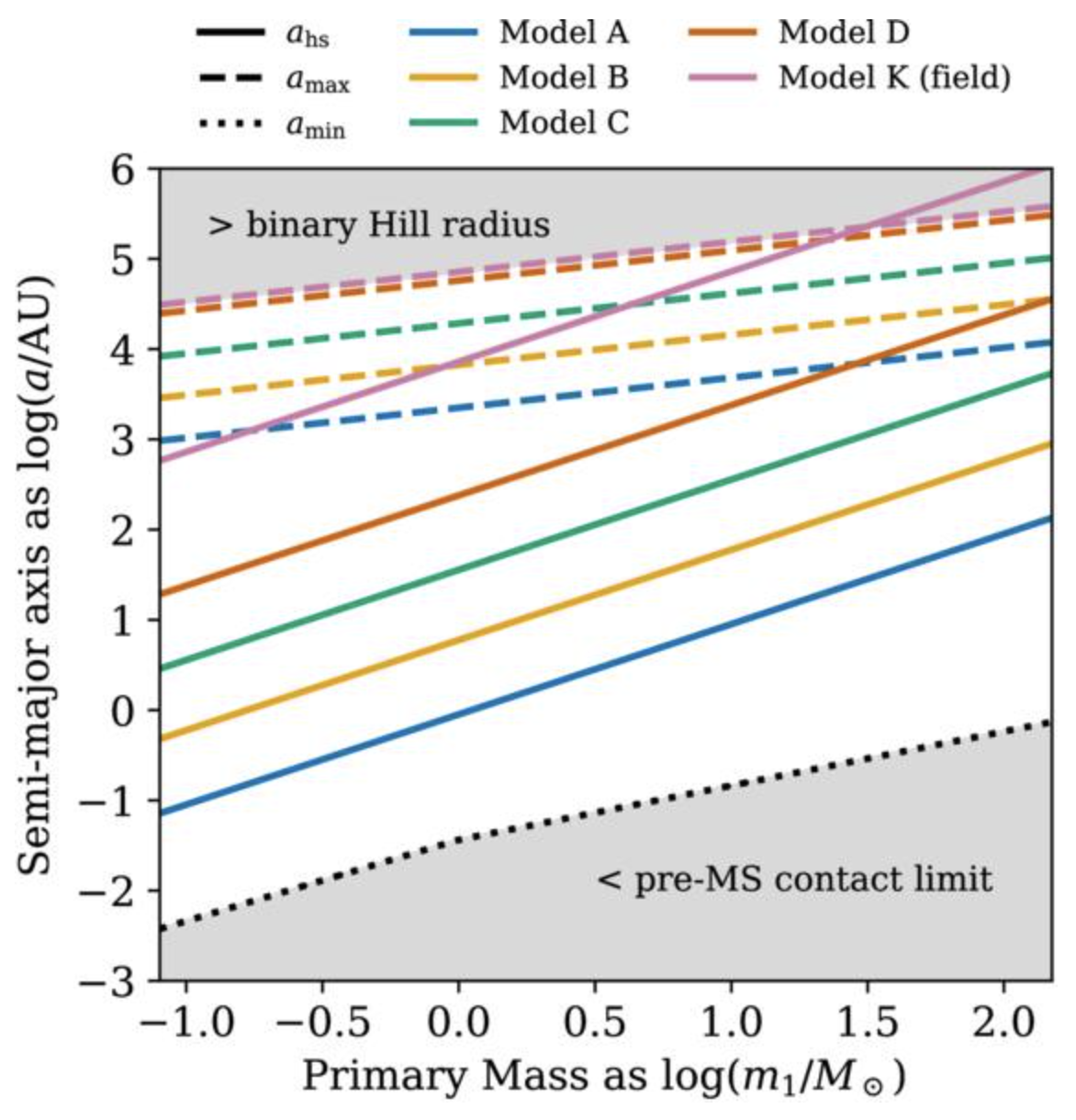
Map of the semi-major axis–primary mass parameter space for binary systems. Solid lines show the boundary between hard (below the line) and soft (above the line) binaries for a variety of models. Models A–K span a variety of cluster masses and virial radii (a proxy for cluster density). [O’Connor et al. 2026]
Globular clusters (GCs) are dense, ancient, gravitationally bound groups of stars. A team led by Christopher O’Connor at Northwestern University explored whether the lack of binary systems could be the result of some process unique to GCs. First, the team developed an analytical formalism to understand how binaries in a GC evolve depending on the binary stars’ masses, distance from each other, and interactions with other stars in the cluster.
It turns out that the fate of a binary system depends on whether it is dynamically “hard” or “soft.” Hard binaries are generally tightly bound, and they tend to get “harder” from stellar flybys, which are common in a crowded cluster environment. Soft binaries are the opposite — they have much shorter lifetimes since encounters with other stars tend to loosen them. The team found that, assuming GCs have the same initial distribution of binaries as the solar neighborhood, the dissolution of soft binaries is sufficient to explain the present-day scarcity of binaries in GCs.
Burning Away the Binaries
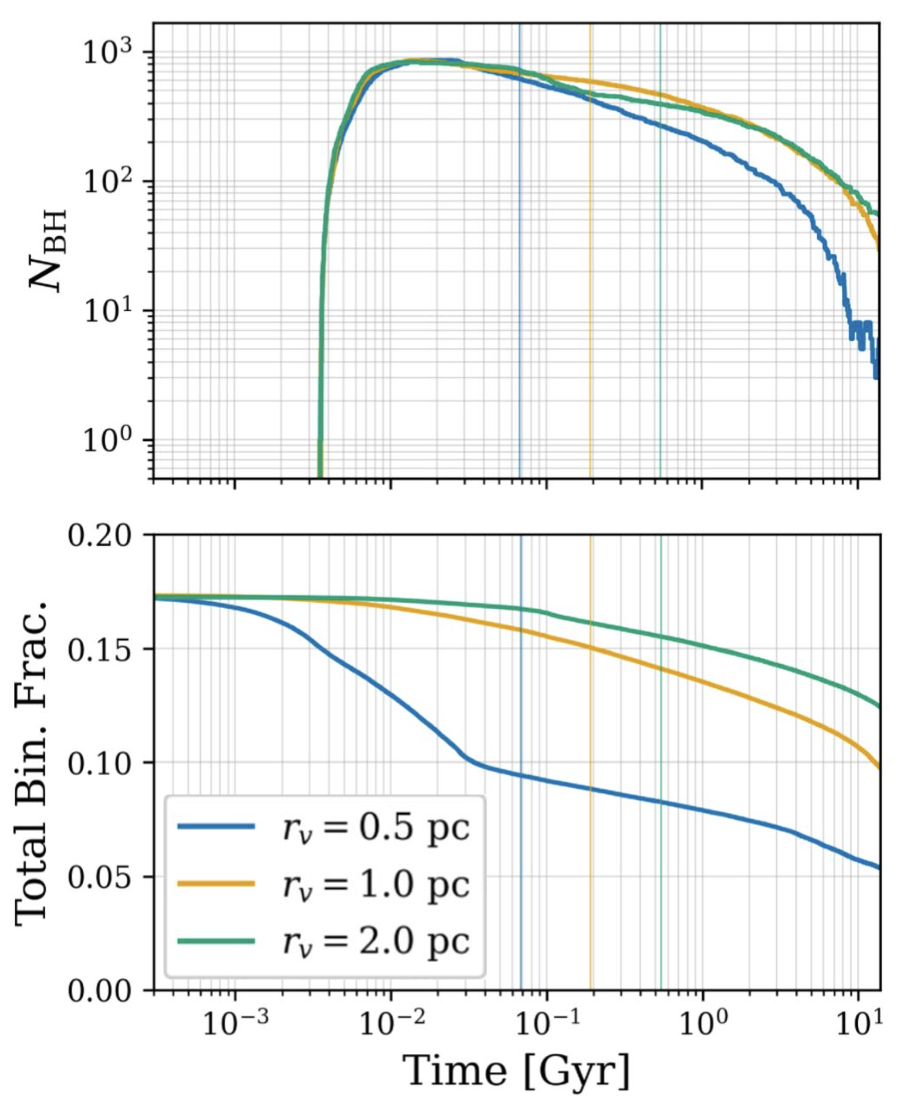
What actually tears the soft binaries apart? The answer is a process called “black hole burning.” As some of the most massive objects in a globular cluster, black holes in binary systems can transfer energy when they interact with passing stars. This influx of energy can excite soft binaries to the point of dissolution, the study shows.
Black hole burning can also prevent core collapse in GCs. Left to itself, a cluster’s core gradually loses energy to its outskirts, causing the core to grow hotter and denser with stars. This leads to more dynamical interactions between stars that can then get flung from the core or enter new tight binaries. Black hole burning pumps energy back into the core and prevents this from happening.
Putting the Theory to the Test
The total number of black holes in a cluster (top) and the binary fraction (bottom) as a function of time for three different cluster models. In the densest cluster (blue), binary dissolution starts early on, mainly driven by stellar collisions. For the other two models, binary dissolution mainly occurs after the number of black holes reaches its peak and black hole burning commences. [Adapted from O’Connor et al. 2026]
To validate their analytical results, the team performed N-body simulations of GC dynamics with the Cluster Monte Carlo code. They found that, in moderate-to-low-density clusters, the decline of binary systems is powered mainly by black hole burning. In more compact clusters, however, stellar collisions also play an important role in the dissolution of binary systems, and at earlier times than the onset of black hole burning.
In general, the final binary fractions of the simulated clusters agree with those predicted by the team’s analytical formalism. This further supports the theory that there is a universal initial binary distribution between galactic GCs and our solar neighborhood. Constraining this distribution is pivotal for refining dynamical models of GCs.
In short, GCs and the solar neighborhood likely started with the same amount of binary systems, and interstellar dynamics handled the rest.
Citation
“A Common Origin for Binary Fractions in the Field and in Dense Clusters,” Christopher E. O’Connor et al 2026 ApJ 1009 L80. doi:10.3847/1538-4357/aea078
By observing subtle variations in the timing of stellar pulsation modes, researchers may have made the first detection of a planet in the habitable zone of a massive A-type star.
Listening for Planets in Stellar Heartbeats
To date, some 6,000 exoplanets have been detected across a vast array of surveys and instruments. The majority of these have been detected around main-sequence F, G, and K stars — but not because these are the only places exoplanets can exist. Rather, this is a result of selection bias: these stars tend to be both bright and luminously stable enough for astronomers to deploy the radial velocity or transit methods.
Periodic modulations in the time of observed stellar pulsations can indicate the presence of an orbiting companion. In this case, timing variations are displayed for the two most prominent pulsation modes f1 and f2 for the variable star HD 156295. The sinusoidal pattern indicates they may be caused by an orbiting companion with a mass of about 6.3 Jupiter masses at a distance of 3.9 au, in this star’s habitable zone. [Adapted from Wilson et al. 2026]
A-type stars, by contrast, are challenging for exoplanet detections. These more massive stars tend to exhibit fewer and broader spectral lines than their F, G, or K counterparts, rendering radial velocity techniques largely ineffective. Many A-type stars also pulsate in brightness, making it hard to identify planetary transits within their erratic light curves.
Luckily, one transit astronomer’s trash data can be a pulsation timer’s treasure. For some A-type stars called δ Scuti stars, the pulsation is regular enough to be used like a cosmic clock. Subtle variations in a star’s position due to the tug of an orbiting companion can then disrupt the timing of its otherwise steady pulsation, allowing one to once again find planets via its light curve — including massive ones on intermediate-period orbits that are the most difficult to detect around massive stars using traditional methods.
A Massive Planet in the Habitable Zone of a Hot Star?
In a new study led by Logan Wilson (Center for Astrophysics | Harvard & Smithsonian), researchers analyzed 16,440 highly pulsating δ Scuti stars observed at a high cadence by the Transiting Exoplanet Survey Satellite (TESS) in order to look for the distinctive, periodic timing modulations associated with an orbiting companion. This sample was then whittled down to nine candidate systems they believe may contain substellar companions — likely either brown dwarfs or massive planets.
The properties of the nine candidate objects identified in this study and their host stars are shown here, along with the properties of other exoplanet systems. Through stellar pulsation timing, the researchers were able to identify substellar candidates around hot A-type stars in intermediate-period orbits, a region of parameter space that has been difficult to probe with other methods. [Wilson et al. 2026]
One particularly striking candidate was found when analyzing the star HD 156295. Based on their timing data, Wilson and collaborators deduce the star may have a 6.3 Jupiter-mass planetary companion orbiting every 2,200 days. That puts the companion’s distance from its host at about 3.9 au, right at the far edge of HD 156295’s habitable zone. If this planet turns out to be real, HD 156295 would be the hottest star known to host an exoplanet in its habitable zone. This detection also suggests a high occurrence rate of massive planets on intermediate orbits relative to expectations for other main-sequence stars, supporting theories that A-type stars may form companions like these more efficiently.
The other eight candidates are more consistent with brown dwarfs. Six of these candidates show somewhat uncommon masses and orbital separations that place them in a region of parameter space known as the “brown dwarf desert.” Some observations suggest this desert is less severe around hotter stars — a conclusion that this study supports.
All of these findings are still quite tentative, however; the researchers estimate that the probability for the planetary signal being real is just over 50%, and the parameters given for each candidate are still subject to large uncertainties. With new data arriving all the time, it may not take long before we have a clearer picture of these unique substellar companions.
Citation
“A Search for Substellar Companions around A-type Stars: Pulsation Timing Detection of Eight Brown Dwarf Candidates and a Possible Habitable-zone Planet,” Logan G. Wilson et al 2026 ApJ1009 78. doi:10.3847/1538-4357/ae93a0
Carbon is the 4th most abundant element in the universe. It’s everywhere, from the air you breathe to the carbohydrates in your food to the petroleum in the Earth’s crust. Like most elements, carbon was not created by the Big Bang, but came from 2 different types of stars that fuse lighter elements together.
Massive stars at least 8 times the Sun’s mass fuse 3 helium atoms into a carbon atom in their cores, through a mechanism called the triple-alpha process. They eventually expel this carbon into space, either through a stream of material called astellar wind or at the end of their lives during a core-collapse supernova.
Meanwhile, low-to-intermediate-sized stars between ½ and 8 times the Sun’s mass also induce the triple-alpha process. But unlike massive stars, they produce carbon not in their cores, but in a dense shell of helium that surrounds them during an advanced stage known as the asymptotic giant branch or AGB. AGB stars undergo cycles of swelling and contraction, during which they shed some of their material into space.
While scientists understand these processes, the contribution of each star type to the carbon supply in the universe remains uncertain. To address this, a team of scientists modeled how the chemical elements in the Milky Way Galaxy change over time with different contributions from the 2 carbon-creating processes. They then verified their findings by comparing them with the actual carbon concentration in the Milky Way.
To obtain the benchmark for the Milky Way Galaxy’s carbon content, the team turned to the catalog of stars observed by the Apache Point Observatory Galactic Evolution Experiment (APOGEE) survey. They selected 14,066 stars that were large and bright enough to yield reliable data but, unlike AGB and massive stars, were still at a stage of life when their newly produced carbon was still confined to their cores. The researchers used the carbon in the outer layers of these stars, known as subgiants, as a compositional record of the gas from which they formed, thereby estimating the Galaxy’s carbon content during their formation.
The scientists started with a computer program developed by another team that models how the Milky Way’s chemistry changes over time. First, the team calculated the potential amount of carbon produced by different types of stars using estimates from earlier studies. Then, they incorporated these results into a model that accounts for how stars form, fuse elements, and release carbon into the Galaxy, using a simulation program called the Versatile Integrator for Chemical Evolution, or VICE. The researchers ran 14 versions of this model, each assuming a different contribution of carbon from AGB stars relative to massive stars.
In their computer model, the Milky Way Galaxy began as a set of 200 concentric rings, each containing its own population of stars, different speeds at which stars form, and varying amounts of gas available to form new stars. The team then stitched these rings together by having stars migrate between them. They allowed these model Galaxies to settle over 10 billion years, then picked a random sample of 14,066 simulated stars to compare their carbon content with carbon in the same number of observed subgiants from APOGEE.
The team’s model most closely reproduced the actual carbon content of the Milky Way’s subgiant stars when AGB stars contribute between 10% and 40% of the Galaxy’s carbon, with the strongest agreement occurring at 15% to 30%. Even though they found that massive stars are the dominant source of carbon, they also found that smaller AGB stars could produce carbon more efficiently than previously thought, though they take longer to become carbon sources than their larger counterparts.
The team concluded that their estimates of how much carbon comes from AGB and massive stars provide a benchmark for future studies, as the connection between the production of elements inside stars and the processes by which those same stars lose mass remains poorly understood. They suggested that future researchers analyze larger sample sizes, examine other galaxies, and use data from future surveys to better understand the chemical history of the universe.
When stars the size of our sun die, they leave behind powerful stellar remnants called white dwarfs — and these white dwarfs can transform into even more extreme objects called neutron stars, composed of the densest material in the universe. However, scientists have found that conditions must be "just right" for the major makeover to occur. You can think of it like a cosmic "Goldilocks" situation.
As it turns out, the white dwarf has to be feeding on a companion star like some kind of cosmic vampire.
Neutron stars and white dwarfs are both born when stars run out of the fuel supplies needed for nuclear fusion happening in their cores, but the difference between the two lies with their masses.
Stars with masses similar to that of the sun end their lives when they run out of hydrogen in their cores. This halts the nuclear fusion process — which involves converting that hydrogen to helium — leading to the stars collapsing and shedding their outer layers to become a white dwarf with around the mass of the sun crammed into the width of Earth.
When stars with masses around eight times that of the sun collapse after running out of hydrogen in their cores, they generate enough pressure and heat in these cores to fuse the produced helium into even heavier elements. This process only ends when the star attains a core of iron. The final collapse results in a supernova explosion and creates a neutron star with a mass between one and two times that of the sun. That's the usual way neutron stars form.
However, what if there's a bridge between the white dwarf scenario and neutron star scenario? Scientists have long suspected there is indeed a pathway for a white dwarf to become a neutron star. This new work maps out that pathway, calling it accretion-induced collapse (AIC).
"In AIC, the progenitor is already a stellar remnant, and the trigger is not its own evolution but material handed to it by a companion," team leader Laurenz Thümmler of ETH Zurich told Space.com.
The researcher added that an AIC begins with a stellar remnant in the form of a white dwarf, while the traditional route to birthing a neutron star begins with a massive "living" star. Yet, in the AIC, the collapse of an overfeeding white dwarf continues in a broadly similar way to the collapse of a massive star that creates a neutron star.
As Thümmler explains, in both cases, the neutron star creation process involves the massive star's core imploding and zippy particles called "neutrinos" carrying away energy from the event. However, an important difference is in the "standard" massive star collapse scenario, the subsequent core-collapse supernova and neutron star birth happens inside a thick envelope of material that has been ejected during the massive star's death throes. In AICs, however, this thick envelope of matter is absent.
"AIC is expected to be faint and fast, and why so little matter is ejected compared with an ordinary supernova. Not all white dwarfs could undergo an AIC, and that is the essential point."
Though AICs have been theorized about for years, Thümmler and team wanted to know what characteristics a white dwarf would need in order to undergo this transformation. They set about investigating this using 3-dimesional simulations.
It's what is inside that counts
Most white dwarfs consist of carbon and oxygen. However, some stars collapse to form a white dwarf composed of oxygen, neon and magnesium. That only happens for a narrow range of stellar masses, meaning this composition represents a minority population of white dwarfs.
When carbon and oxygen white dwarfs overfeed on stellar material from a companion or donor star, they eventually reach the so-called Chandrasekhar limit, usually around 1.4 stellar masses. Above this limit, they can go supernova. They don't become neutron stars as a result of these "Type 1a" supernovas, however, but are rather completely destroyed. Oxygen, neon and magnesium white dwarfs can avoid that destruction thanks to their high densities.
"They are typically born more massive and denser than carbon-oxygen white dwarfs and therefore require less additional mass to approach the Chandrasekhar limit," Thümmler said.
However, Thümmler and colleagues discovered this isn't the only condition needed to provoke an AIC. The white dwarf can't be too greedy either.
An illustration shows a "vampire" neutron star feeding on a close companion star. (Image credit: Robert Lea (created with Canva))
The team found that the accretion rate, or rate at which material from the donor star falls onto the white dwarf, has to fall within a fairly narrow window to allow an AIC to occur.
"If it is too low, nova eruptions can expel much of the accumulated material again; if it is too high, winds, envelope expansion, or binary interaction can prevent the white dwarf from reaching the conditions required for collapse," Thümmler said. "The accretion has to be fast enough, and steady enough, to get it there without triggering explosive burning along the way.
"When those conditions hold, electrons are captured onto neon and magnesium nuclei. This removes the pressure supporting the star, and the collapse follows."
All this means that AICs are expected to be rare events, although the rate at which they occur remains highly uncertain.
An illustration of a highly magnetic neutron star. (Image credit: ESO/L. Calçada)
The team also found the environment around AICs is somewhat surprising.
"We expected the most neutron-rich material, which produces the heaviest elements, to emerge along the rotation axis, since that is where the magnetically driven outflow is strongest," Thümmler said. "It does not."
Instead, the team's models revealed neutron-rich material emerging at the mid-latitudes of white dwarfs as they transform into neutron stars. This is region where the outflows of matter driven by intense magnetic fields collide with winds heated by energy-carrying neutrinos.
Thümmler explained that this is significant because it means that these events would appear different based upon the angle at which they are observed.
How to spot white dwarf transformations
Laurenz said these AICs could be identified by Vera C. Rubin Observatory and other telescopes as a bright ultraviolet and optical event lasting two to three days, potentially accompanied by X-ray emissions and longer-lasting radio emissions.
However, the neutron stars created by such events may be difficult to distinguish from stellar remnants birthed in the traditional way.
"They are expected to populate the lower end of the neutron-star mass distribution because the collapsing white dwarf has a mass close to the Chandrasekhar limit and ejects relatively little material," Thümmler said. "However, ordinary stellar-collapse channels, particularly those involving low-mass progenitors, can also produce neutron stars with masses of approximately 1.1 to 1.4 solar masses, so a low mass alone would not uniquely indicate an AIC origin."
The Vera C. Rubin observatory gazes out at the Milky Way (Image credit: RubinObs/NOIRLab/SLAC/NSF/DOE/AURA/B. Quint)
The team isn't done investigating AICs, with Thümmler explaining there are two main approaches to take next.
"The first is to make the predicted light curves more reliable by following both the radioactive heating and energy injection in substantially greater detail," Thümmler said. "This requires distinguishing energy carried bygamma rays, which can escape relatively early from the low-mass ejecta, from that deposited more efficiently by charged particles, while also modelling how the neutron star wind heats and accelerates the heavy-element-rich material."
The team's simulations can then be used to follow the expansion of the ejecta from the AIC and calculate how the observed light curve and spectra depend on viewing angle.
"This work is currently underway," Thümmler said. "The second direction is to test the robustness of the explosion geometry, since our present models begin with a relatively simple magnetic-field configuration and more complex or tilted fields may produce different angular ejecta patterns."
The team's research is available to view as a pre-print on the paper repository site arXiv.
Using the ALMA (Atacama Large Millimeter/submillimeter Array) radio telescope, astronomers have watched as two stars come together to form a massive stellar binary. The observations revealed that these stars didn't form from the same collapsing cloud of gas and dust, as most binary stars are assumed to form, but instead came together later in their infancy.
Here on Earth, we are slightly prejudiced by our single sun to view stars as somewhat solitary bodies. However, around half of sun-sized stars in the Milky Way have a companion star. This percentage of stellar partnership rises to around 90% of massive stars. Eventually, these massive stars go supernova and shape their cosmic surroundings. Thus, understanding these binary systems is vital to our understanding of stars and of galaxies in general.
The team behind this research initially observed the still-growing massive stars, or protostars, in the binary system IRAS 07299−1651, located around 5,300 light-years away in 2019. At first, the researchers didn't see anything that suggested these stars didn't form from the same disk-shaped cloud of gas and dust that later fragmented. However, one thing really stood out: the disks of material surrounding and feeding these protostars are oddly misaligned.
Over the course of eight years, the team mapped subtle shifts in the position of the stars using ALMA in addition to the Very Large Array (VLA), as well as infrared images from the James Webb Space Telescope (JWST) and the Very Large Telescope (VLT).
"For the first time, we were able to watch two massive stars move around one another while they were still being born," team leader Yichen Zhang of Shanghai Jiao Tong University, China, said in a statement.
The team was able to reconstruct the full 3-dimensional structure of IRAS 07299−1651 for the first time, obtaining details about how the stars orbit each other, the way their disks are aligned, and the angle at which they blast jets into space.
"Each telescope revealed a different piece of the puzzle," team member Rubén Fedriani, of the Instituto de Astrofísica de Andalucía (IAA) in Granada, Spain, said. "The combination of radio and infrared observations provides the most exquisite detail on the formation of this massive protobinary system."
Unexpected chaos
The team's observations took them by surprise. They were expecting these stars to orbit each other in neat, near-circular orbits. Instead, the orbits were found to be highly flattened or "eccentric," almost parabolic.
If the stars had formed from the same disk of material, then even after it fragmented, the individual disks surrounding the stars would be aligned. However, that wasn't the case; the disks are tilted at a sharp angle to each other and to the orbits of the stars.
"It felt like solving a three-dimensional puzzle," team member Yao Wang of Shanghai Jiao Tong University said. "Each new observation added another piece, and eventually the orbit, disks, and jets all came together into a single, coherent picture."
An artist’s impression of the formation of a close massive binary system, showing misaligned disks around two young stars. (Image credit: Y. Zhang)
The chaotic structure of IRAS 07299−1651, as observed by the team, is difficult to explain if the two stars emerged from the same disk of material.
Instead, the researchers theorize that the two stars were born in individual clouds of gas and dust, before a chance encounter brought the two infant stars and their respective natal cocoons together.
Tracing back the orbits of the stars, the researchers found that this encounter likely occurred around 60 years ago. Considering stars live for billions of years, that is an instant on a cosmic timescale. The disk-shaped pockets of material around the stars have thus far survived the encounter, retaining their well-defined structures.
"This study demonstrates that the early lives of stars can be quite chaotic, with a chance encounter leading to this gravitational dance and stellar coupling," team member Jonathan C. Tan of the University of Technology and the University of Virginia said.
A binary star system, is IRAS 07299−1651 destined to settle to form such a system? (Image credit: NASA)
What the team can't yet establish is whether these stars are destined to stick together or if they will eventually move apart. Indeed, this fate may not have been sealed yet; interactions with the surrounding gas could determine what shape this system takes in the future.
The team hopes that further observations of IRAS 07299−1651 will help to better understand what the future holds for these stars.
In the meantime, the long-term monitoring approach adopted by the researchers could provide scientists with a powerful new way of investigating other young massive binary systems. This could reveal how common encounters like this are and if more binary systems are composed of stars brought together by chance encounters.
The team's research was published on Tuesday (Sept. 8) in the journal Nature Astronomy.
After five years in development, Free Stars: Children of Infinity—the official sequel to The Ur-Quan Masters by the old game's original creators—has released a free public demo. It's a "combat demo" in the style of UQM’s melee mode, where players can assemble a fleet from the game's roster of nearly 40 ships, then match those ships up in head-to-head arcade SpaceWar-style action. The demo can be found on Steam and GOG, and it's available for Windows, Mac, and Linux. (Console versions are coming, but they're not yet out.)
Pew pew!
Credit:
Pistol Shrimp Games
I have to present this news with a big disclaimer, though, because I've been part of the Children of Infinity writing team since 2021, working as a volunteer with the Pistol Shrimp Games crew and contributing NPC dialogue and some story bits. As a huge fan of the original games, it's been a dream opportunity. (Because I've been volunteering my time, I'm not financially involved and receive no compensation if you download the demo or, when it's eventually released, buy the full game.)
What's in the demo
Children of Infinity is a space adventure RPG, just like The Ur-Quan Masters (and its direct spiritual predecessors, Starflightand Starflight 2). What's been released today is just one part of the game—the arcade-style "melee" portion, which lets players jump into one-versus-one combat against another player or against a computer-controlled opponent. Each of the ships you can pick has its own maneuvering characteristics, weapons, and special abilities.
Beyond the solar system, the line between planet and star can get blurry. Astronomers call objects that fall between the size ranges of planets and stars substellar objects. One type of substellar object, called a brown dwarf, forms from collapsing gas clouds like a star, but is not quite massive enough to fuse hydrogen in its core. Some can briefly fuse a heavier form of hydrogen, known as deuterium, in their cores, though never enough to produce starlight. Others are small and cold enough to develop complex atmospheres.
Recently, astronomers discovered a new type of substellar object in a star-forming region of the Milky Way Galaxy called IC 348. Using observational data from the JWST’s Near InfraRed Spectrograph (JWST NIRSpec), they found objects 0.2% to 1.2% the mass of the Sun that float freely like stars but have carbon-containing molecules called hydrocarbons in their atmospheres. Because these objects are smaller than known brown dwarfs and have evidence of hydrocarbons, scientists refer to them as H-type objects.
To investigate what H-type objects are and where they fit within the spectrum of substellar objects, researchers Richard J. Parker and Catarina Alves de Oliveira analyzed survey data on stars and substellar objects in IC 348, then conducted follow-up simulations to uncover how H-type objects formed. The main question they asked was whether H-type objects form from collapsing gas clouds, like brown dwarfs and stars, or develop around host stars before being ejected and drifting freely through space, like planets.
First, they reviewed the observational records of IC 348 obtained with the JWST NIRSpec and the near-IR spectrograph SpeX at the NASA Infrared Telescope Facility. IC 348 has 495 stars and brown dwarfs combined, as well as 9 H-type objects. Estimates for the age of this star-forming region range from either 1 to 3 million years or 5 to 6 million years, depending on how different teams calculated it. From there, Parker and Alves de Oliveira compared where the stars, brown dwarfs, and H-type objects were located within the cluster. They found no unique spatial distribution among the 3 types of objects.
Then, the team simulated the evolution of IC 348 over 10 million years to determine which initial conditions would result in a spatial distribution closest to the survey data. They simulated an initial giant gas cloud and used a mathematical function to distribute its mass among the 495 constituent objects. The researchers then placed a Jupiter-sized planet around each simulated star that was approximately the Sun’s mass to determine whether they could grow and escape their home star and become H-type objects. They also repeated the simulations by placing the Jupiter-sized planets at distances from the Sun similar to those of Earth, Jupiter, and Neptune, and varied the sizes and star densities of the simulated IC 348 regions.
They found that if Jupiter-sized planets orbited their stars at roughly Jupiter’s distance from the Sun, then 5 to 15 of them could escape their stars in a region like IC 348, which would roughly match the number of known H-type objects. However, the escaped planets were distinctly more spread-out than the observed H-type objects, which share a similar spatial distribution with the cluster’s stars and brown dwarfs. Since the simulations did not match the observed distribution, the researchers suggested that these H-type objects are likely a new sub-category of very small brown dwarfs rather than escaped planets.
Although this study favors a brown dwarf origin for H-type objects, the exact details of how they formed remain up for debate. Astronomers still have multiple competing theories about how ordinary brown dwarfs form. Perhaps they are ejected from their gas cloud before fully forming, have their outer layers stripped by radiation from a nearby massive star, or simply form like stars on a slightly smaller scale. Regardless, future researchers will continue to explore this murky area of substellar astronomy.
A neutron star is what remains after the core of a massive star collapses. It is not a small ordinary star. It is the crushed core of a dead one, compressed until protons and electrons are forced together and most of the material becomes neutrons. The result is one of the strangest objects in the […]
Scientists are closer than ever before to understanding how stars forge the elements that comprise our planet, bodies and pretty much everything else around us — and they're gaining a clearer picture of where star explosions fit into the story.
New research reported in two different papers looks at how stars forge elements as they explode and how these supernova explosions spread those elements — and other elements stars have forged during their lifetimes — throughout the cosmos.
Astronomers have been studying the bright supernova deaths of massive stars for centuries, but they still don't quite understand how these explosions proceed.
The first paper looked at one way to investigate supernovas. It uses a radioactive element produced by these explosions called titanium-44, which lingers long after supernovas fade. Researchers have now collected experimental evidence that determines how much titanium-44 is created in a supernova, finding that these cosmic explosions produce 35% more of this element than expected.
With this knowledge in hand, scientists can now develop robust computer models of supernovas and compare these models with astronomical observations. This could bring them much closer to understanding how these explosions progress.
"It's exciting to see just how far the field has come," Christopher Cousins, a postdoctoral researcher in the University of Surrey's Nuclear Physics Group, said in a statement. "A measurement like this would have been considered out of reach only a couple of decades ago, but it now gives us new insight into one of the biggest unanswered questions in astrophysics."
An illustration shows a "vampire" neutron star feeding on a close companion star. (Image credit: Robert Lea (created with Canva))
The second paper honed in on a particular brand of stellar explosion called a Type I supernova. These occur when a dense stellar remnant called a neutron star drags material from a companion stellar body. The intense gravitational influence of the neutron star — a stellar corpse that has one to two times the mass of the sun crammed into a body about 12 miles (20 kilometers) wide — means that, when this stolen stellar matter hits their surfaces, a thermonuclear explosion is triggered.
These blasts forge heavy elements and release incredible amounts of energy, some in the form of X-ray bursts.
The authors of this paper, hailing from the Facility for Rare Isotope Beams (FRIB) in Michigan, studied the nuclear reaction that triggers X-ray bursts in greater detail than has been possible before.
This revealed the long-debated role of the so-called nickel-copper cycle, the temporary trapping of nuclear material during supernovas. Scientists previously didn't know if material was trapped in the nickel-copper cycle during X-ray bursts.
This research reveals that this does happen, but only in small proportions. It gives scientists a clearer picture of how Type I supernovas proceed.
An illustration shows a supernova explosion bombarding Earth. (Image credit: Super-Kamiokande Collaboration)
"Despite decades of research, we still don't fully understand the nuclear reactions that power some of the universe's most spectacular stellar explosions," said Gavin Lotay of the University of Surrey.
"These two studies give us a much clearer picture of how these explosions happen, allowing us to compare our models more closely with astronomical observations and bringing us closer to understanding how the chemical elements are created and spread throughout the universe," he added.
While previous investigations of planet formation across the universe’s history suggest that planets trickled into the picture, a recent study has found that primordial planetesimals could have formed much earlier from the insides of the first stars in the universe.
First Stars, First Planets?
When the first stars flickered on, the universe was filled with pristine gas, containing only hydrogen, helium, and a little lithium. This gas, though great at making massive stars known as Population III (Pop III) stars, was not yet enriched with the heavy elements necessary for planet formation and, of course, life. Past studies have suggested that planet formation in the universe was gradual, taking several billion years to peak after billions of stars created and spilled the needed metals into the universe. However, local pockets of enriched gas from Pop III stars could have created the right conditions for planet formation earlier in the universe’s history.
Pop III stars burned bright and fast, exploding violently in pair-instability supernovae that completely shredded the progenitor, ejecting over 100 solar masses of metals into their previously pristine surroundings. Cosmological simulations suggest that oxygen from these supernovae could have produced significant water fractions within the dense cores of the supernova remnant. This may have set the stage for planet formation in water-rich disks around subsequent generations of stars as early as 150–200 million years after the Big Bang — does numerical modeling support this planet formation hypothesis?
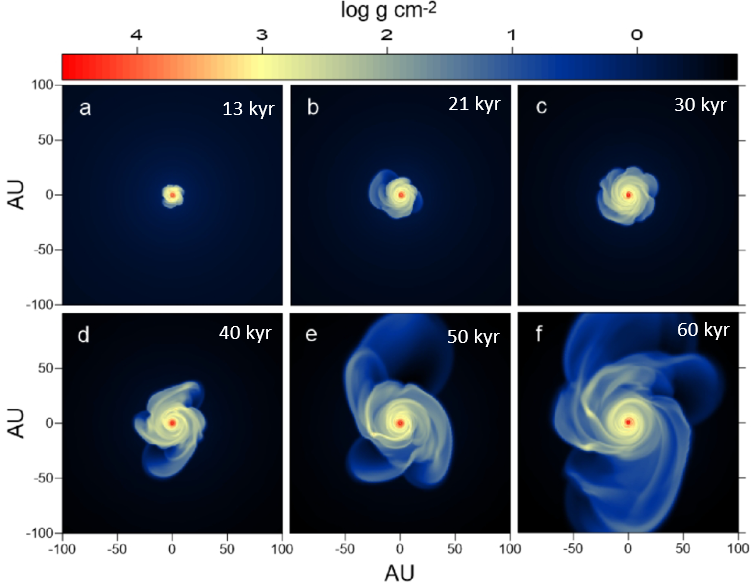
Simulation snapshots showing the formation and evolution of the protoplanetary disk for 13, 21, 30, 40, 50, and 60 thousands of years after protostellar birth. Click to enlarge. [Modified from Vorobyov et al 2026]
Primordial Planetesimals in Simulated Water-Rich Disks
To test if these water-rich dense cores within Pop III supernova remnants could form planetesimals, the building blocks of terrestrial planets, Eduard I. Vorobyov (University of Innsbruck; Southern Federal University) and collaborators performed numerical simulations tracing the collapse of one such gas core into a protoplanetary disk around a protostar. The simulations begin from the gravitational collapse of a 1-solar-mass gas cloud core, with a protostar emerging 24 thousand years after the initial cloud collapse. As the protostar’s gravity pulled in material from its surroundings, a rotating disk formed around the growing star.
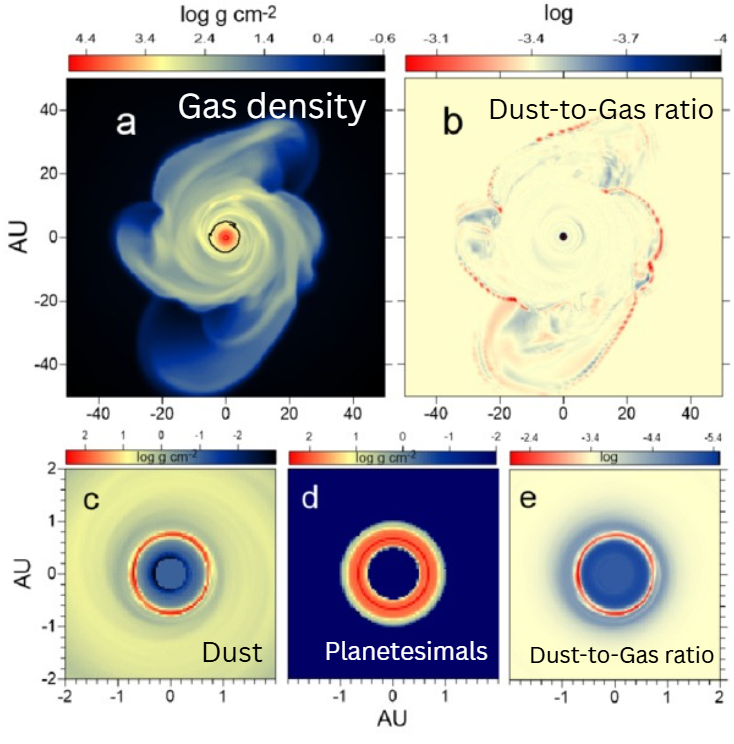
Simulation snapshot 40 thousand years after the formation of the protostar showing the gas, dust, and planetesimal surface densities and the dust-to-gas ratio. Click to enlarge. [Modified from Vorobyov et al 2026]
Tracking the gas and dust evolution in the disk, the authors found that several Earth masses of planetesimals formed within 0.5–1.0 au of the 0.4-solar-mass protostar. While the simulations did not trace the disk all the way to planet formation (this requires complex multi-body modeling and lots of computing power), enough planetesimals formed to create a Mars- or Earth-mass planet in the future. Luckily, unlike their live-fast and die-young predecessors, low-mass stars born from Pop III supernova remnants would still be burning hydrogen in their cores today, and ancient metal-poor stars in the Milky Way’s halo may be home to the universe’s first planets that could be detected in future exoplanet surveys. This study showed, for the first time, that water-rich protoplanetary disks with planetesimals could pop up billions of years earlier than previously thought, changing our understanding of planet formation in the universe.
Citation
“Planet Formation at Cosmic Dawn: Planetesimals in H2O-rich Disks around Low-mass Stars,” Eduard I. Vorobyov et al 2026 ApJL1007 L51. doi:10.3847/2041-8213/ae907c
Searching for Another Earth with the Nancy Grace Roman Space Telescope
In NASA’s mission fact sheet, Roman’s planners pose several questions. These include:
How common are solar systems like our own?
What kinds of planets exist in the cold, outer regions of planetary systems?
What determines the habitability of Earth-like worlds?
Although scientists have used several methods to detect exoplanets, including Earth-like planets, Roman will employ three. These include the transit method, microlensing, and direct imaging. NASA said the combination of approaches will allow mission scientists to conduct a “sweeping search expected to uncover around 100,000 new exoplanets — a staggering leap compared to the nearly 6,200 currently known.”
“It is hoped that Roman will discover thousands of new exoplanets and significantly expand our knowledge of the diversity of planetary systems in our Galaxy,” explained Associate Professor Edita Stonkutė, an astrophysicist at Vilnius University unconnected to the Roman team, in a statement emailed to The Debrief.
Microlensing Can Reveal Earthlike Planets Orbiting Sunlike Stars
Most exoplanets have been detected by the dimming of their host star when they transit between it and Earth, giving the transit method its name. Roman plans to use that same method for most of its larger planetary detections. However, among the expected tens of thousands of transit-method detections, mission planners expect a small but sizeable percentage to come from microlensing.
NASA said the “light-bending” microlensing phenomenon occurs when two distant stars “align closely from our vantage point.” Due to the strength of the nearer star’s gravity, the light from the more distant one is “warped” around the nearer one, essentially focusing it very briefly for a distant observer.
“If the alignment is especially close, the nearer star acts like a cosmic lens, focusing and magnifying light from the background star.” Professor Stonkutė explained. “By analysing these changes, astronomers can determine that the planet exists and estimate its mass and orbital characteristics.”
Critically, Professor Stonkutė also noted that microlensing can occur with objects other than stars, including exoplanets.
“This is Precisely Where Roman Has the Edge”
Using its Wide-Field Array, Roman will monitor hundreds of millions of stars. NASA said the observatory will monitor these target stars for “tiny surges in starlight” that typically signal a microlensing event.
Although the transit method is employed to detect larger exoplanets, NASA noted that microlensing “specializes in finding planets like those in our solar system.” The space agency added that this includes “worlds as lightweight as Mars in their star’s habitable zone or farther out.”
A star’s habitable zone is typically defined as the orbital plane where an exoplanet could sustain liquid water on its surface, a key ingredient for life as we know it.
Professor Stonkutė described microlensing as “particularly valuable” since it can detect planets that are difficult to spot with other planet-hunting methods. The professor said this includes “small Earth-like planets located far from their star.” The Roman team hopes to find “more than 1,000 microlensing planets.”
The professor warned that “most microlensing events cannot be predicted in advance.” As a result, telescopes need to actively scan large areas of the sky to increase the chances of a microlensing detection
“This is precisely where Roman has the edge over other telescopes that have searched for exoplanets using different methods,” the professor added.
A “Stepping Stone” Toward NASA’s Habitable Worlds Observatory Concept
While Roman is tasked with directly imaging exoplanets, finding another Earth around a Sun-like star will still require an indirect detection, most likely from a microlensing event. However, the Roman team notes that their observatory “will provide a crucial stepping stone for NASA’s Habitable Worlds Observatory concept.”
According to the space agency, that “flagship” telescope, still awaiting final approval, “would be designed to photograph Earth-like planets for the first time ever.”
Roman may also be able to scan the atmospheres of planets detected with the transit method. The space agency said Roman “would also look for signs of life called biosignatures by measuring atmospheric gases like oxygen and ozone that could signal the presence of living things.”
Christopher Plain is a Science Fiction and Fantasy novelist and has spent the last six years as Associate News Editor and Head Science Writer at The Debrief. Follow and connect with him on X, learn about his books at plainfiction.com, or email him at christopher@thedebrief.org.
Empty space is not completely empty in the equations of quantum physics. Under an ordinary magnetic field, that distinction is impossible to notice. Near a magnetar—a neutron star with a magnetic field trillions of times stronger than Earth’s—space itself can alter the way light travels. NASA’s Imaging X-ray Polarimetry Explorer (IXPE) has measured unusually strong […]
Which naked-eye star is richest in metals and what is the estimated mass of the metal contained therein? ThomasMineral, Virginia In astronomer-speak, metals refer to elements heavier than helium. The first stars that lit up the universe were very metal-poor, since hydrogen and helium were just about the only materials around after the Big Bang. TheseContinue reading "Which naked-eye star is richest in metals?"
Stars do not actually switch their lights on and off when they twinkle. The flicker happens between the star and your eyes, as its light passes through Earth’s moving atmosphere. Planets are affected by the same air, but they usually look steadier because their light arrives from a small disk rather than a single point. […]
A pioneer mission in astrometry – the measurement of the position, distance, motion, brightness, and color of stars – the European Space Agency’s (ESA) High Precision Parallax Collecting Satellite, or Hipparcos, launched on Aug. 8, 1989. There were immediately problems when a rocket-engine failure kept Hipparcos from reaching its planned orbit. However, the satellite wasContinue reading "Aug. 8, 1989: The Hipparcos satellite launches"
Astronomers have captured the death of a massive star from its first faint flash of X-rays, revealing an unusual explosion that may bridge the gap between ordinary supernovas and more extreme, gamma-ray-burst-producing stellar explosions
The event began in March 2026, when China's Einstein Probe spacecraft detected a brief X-ray flash from a galaxy about 500 million light-years away. Follow-up observations identified the source, initially designated EP260321a and later named supernova SN 2026gzf, as a broad-lined Type Ic supernova.
Such explosions occur when massive stars that have lost their outer layers of hydrogen and helium collapse. They are often associated with narrow, powerful jets traveling near the speed of light and, in some cases, brilliant gamma-ray bursts. But SN 2026gzf produced neither.
An image of a galaxy 500 million light-years away captured by the Dark Energy Camera (DECam), mounted on the NSF Víctor M. Blanco 4-meter Telescope in Chile taken on March 9, 2026 (left); and an image of the galaxy now containing supernova SN 2026gzf taken by the same camera on April 3, 2026. (Image credit: CTIO/NOIRLab/DOE/NSF/AURA Image Processing: D. de Martin & M. Zamani (NSF NOIRLab))
Instead, the initial X-ray signal appears to have been a "shock breakout" — the moment the blast wave generated by a collapsing star reaches its surface and releases its first burst of radiation. The flash was the faintest shock breakout yet linked to a broad-lined Type Ic supernova, according to the research team.
Because shock breakouts generally last only seconds to hours, astronomers rarely detect them. In this case, rapid observations by a network of space- and ground-based telescopes, including a number of NSF NOIRLab observatories, allowed researchers to follow the supernova across multiple wavelengths throughout its early life.
"Our observations allowed us to study the physics of three pieces of this explosion: the X-ray shock breakout, the accompanying supernova, and the interaction of the supernova with material previously cast out by the dying star," Jillian Rastinejad, who led one study on the event, said in a statement. "With this information we were able to map out the structure of the material surrounding the star and understand the star's violent lifestyle before it collapsed."
A close up of the area of space that contains the the galaxy home to supernova SN 2026gz, taken by the LSST Camera at the Vera C. Rubin Observatory. (Image credit: CTIO/NOIRLab/DOE/NSF/AURA Image Processing: D. de Martin & M. Zamani (NSF NOIRLab))
The observations suggest that the progenitor was a Wolf-Rayet star born with about 20 times the mass of the sun. Before exploding, it had shed its hydrogen and helium, leaving behind a core composed largely of carbon and oxygen.
Researchers also found evidence of multiple shells of material surrounding the star. Those shells were likely expelled during turbulent bouts of mass loss shortly before the explosion, giving astronomers an unusually detailed view of the star's final stages.
The discovery suggests that energetic, broad-lined Type Ic supernovas do not always produce gamma-ray bursts or relativistic jets. Instead, massive stars may reach similar-looking explosions through a wider variety of pathways than astronomers previously recognized.
"Going forward, I'm excited to observe more shock breakout events in similar detail to test if all stripped stars have a similar 'lifestyle' prior to collapse and what, if any, differences we see," said Gokul Srinivasaragavan, a member of Rastinejad's team.
Star formation in the nearby Andromeda Galaxy (M31) has been slowing down over the last 500 million years, according to a new study using Hubble Space Telescope data. The study was published July 27, 2026, in The Astrophysical Journal. Lead author Tobin Wainer, an astronomer at the University of Washington, and his team used dataContinue reading "Andromeda’s star formation is slowing down"

 Login