❌

Normal view

Windows 98 SE users get a Thunderbolt 4 driver, thanks to AI assistance

20 October 2026 at 12:30

Windows 98 SE devotees can now enjoy (experimental) support for USB4 and Thunderbolt 3/4. Developer and maker Yeo Kheng Meng, who also enjoys retrocomputing, recently released the vibe-coded xHCI98 v3.0.0.0, enabling the practical use of generic USB 3.x, USB4, and Thunderbolt 3/4 host controllers on systems running Windows 98 SE, ME, 2000, XP, Vista, and 7. An extensive blog post by the dev provides further reading about the driver, compatibility, its creation, and usage.

Demo video “shows many different USB devices being hotplugged to a modern 2020 ThinkPad P14s Gen 1 with only xHCI controller.”

Some of you will be wondering why a project to bring USB4 (Thunderbolt 3 and 4) to PCs running Windows 98 SE exists. Retro computing fan Meng explains on his GitHub that this project should appeal directly to users of PCs from the mid-2010s that have xHCI-only (USB 3.x) chipsets and no legacy EHCI controller. However, older OSes don’t have xHCI drivers, and that’s where xHCI98 steps in. “Without xHCI support, even keyboards, mice, and flash drives need the BIOS's legacy support, cannot be hotplugged, and devices such as Ethernet and audio do not work at all,” explains Meng, revealing his motivation. “This project fills that gap.”

Impressively, xHCI98 drives a lot more than USB storage. It replaces Windows’ own USB port and hub drivers to facilitate the connection and use of USB 1.1 and 2.0 and SuperSpeed (USB 3.x) devices and hubs, UAS (USB Attached SCSI) storage through a second driver (xhciuas.sys), and Thunderbolt 3 and USB4 docks and NVMe enclosures through a third driver (xhcicm.sys).

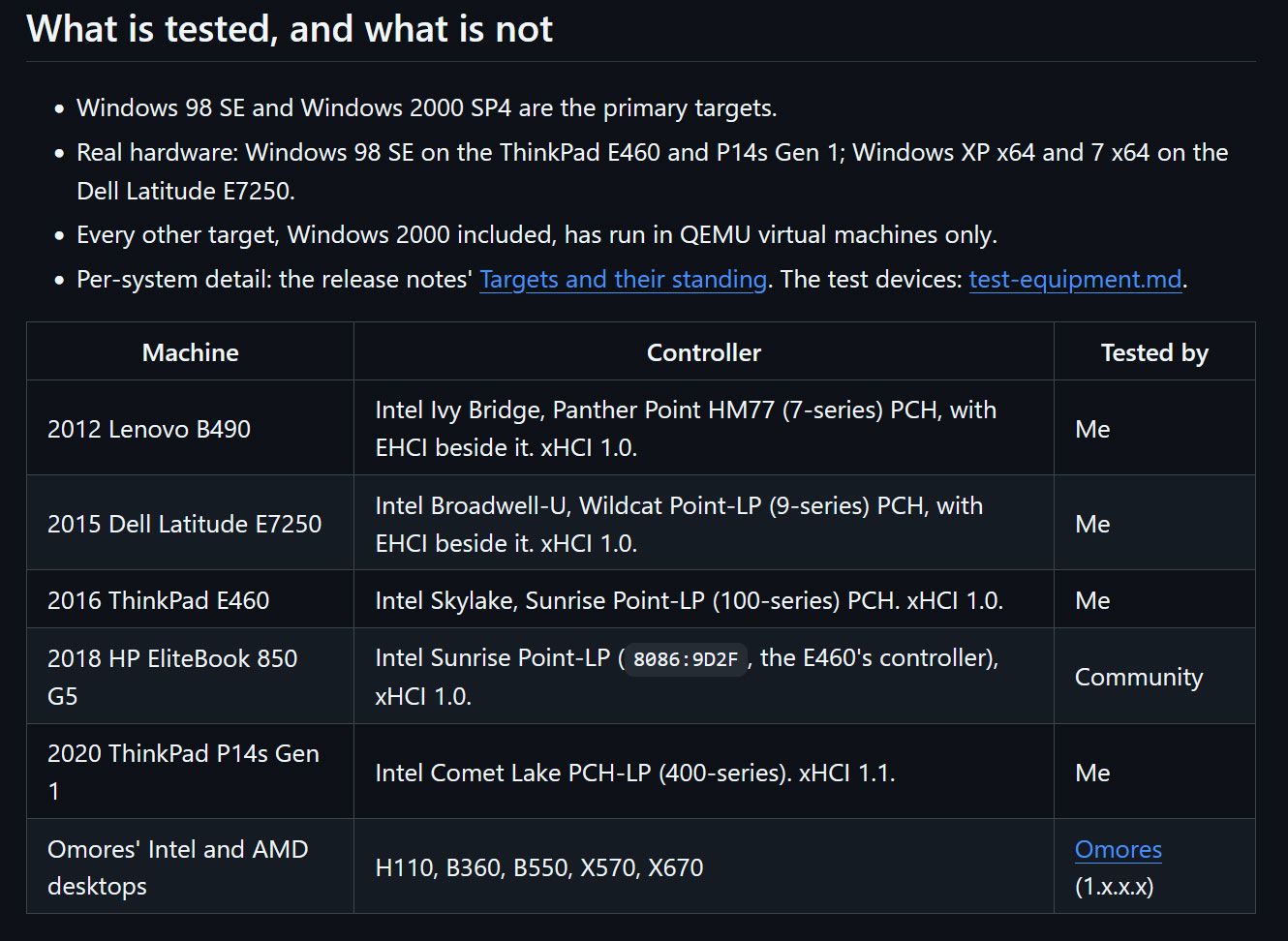
Meng has developed and tested xHCI98 mostly on Intel hardware, as that is what he owns. Candidly, he admits “this is a solo human's project with AI assistance, so bugs are not unexpected,” even if you do have the same hardware as the dev - a 2020 ThinkPad P14s Gen 1 (Comet Lake xHCI, no EHCI). It stands up pretty well during the plug/unplug video demo above, though the test rig used is not quite the USB cart of death.

Windows 98 users get Thunderbolt 4 driver

(Image credit: Yeo Kheng Meng)

As a solo developer, Meng isn't shy to admit he leaned heavily on AI assistance to prepare the xHCI98 release. His vibe coding adventure was supported by Claude Fable 5.1 for planning, Claude Opus 5.5 for coding, and Codex GPT 6 Astra as an adversarial reviewer.

In addition to a few bug warnings, there are some other things to know about using this driver with the various older versions of Windows it supports, standby and hibernation, and more. The dev helpfully sketches out a process for checking your hardware, outlines various install methods, discusses updating, and talks about tuning the driver for those who will be jumping in at the deep end with this project.

MacVoices #26273: Live! – Remembering Steve Jobs, John Ternus and Design, Choosing iPhone Duo

By: Chuck
7 October 2026 at 22:50
After Day 1, the panel compares Amazon Prime Day deals and strategies for separating real bargains from inflated discounts. On a more serious note, they reflect on the 15th anniversary of Steve Jobs’ death. John Ternus’ increased focus on design and what it could mean for Apple’s future, and the the iPhone Duo’s replaceable display layer and other improvements designed to address traditional foldable-phone weaknesses wrap up the session. 

💾

Peças dos iPhones 18 Pro e dos novos Macs Studio e mini chegam ao Self Service Repair

20 October 2026 at 17:41

A Apple atualizou o programa Self Service Repair para incluir componentes dos recém-lançados iPhones 18 Pro e 18 Pro Max, Mac Studio (M5 Max e M5 Ultra) e Mac mini (M6 e M5 Pro).

Lançado em 2022 e disponível em mercados selecionados, o Self Service Repair permite que consumidores adquiram peças genuínas de dispositivos da Maçã e as ferramentas adequadas para realizar manutenções por conta própria, além de oferecer manuais de reparo.

No caso dos iPhones supracitados, agora é possível comprar itens como vidro traseiro, bateria, alto-falante inferior, alto-falante superior, câmera traseira, câmera frontal, tela, carcaça, placa lógica, microfone principal, bandeja do cartão, Taptic Engine e outros componentes.

No caso da nova geração do Mac Studio, é possível comprar peças como portas Thunderbolt e USB-C, ventoinhas, alto-falante, módulo de SSD, placa lógica e fonte de energia.

Como assinalado pelo 9to5Mac, o Mac mini tem uma lista mais enxuta de peças disponíveis do que os demais, mas ainda é possível encontrar componentes como ventoinhas, alto-falantes, placas lógicas e fontes de energia.

Ao que tudo indica, os preços dessas peças ficaram, em grande parte, inalterados em relação aos das gerações anteriores. Um módulo de câmera para os iPhones, por exemplo, segue saindo por US$250 — valor que cai para US$189,24 caso você devolva o original.

Já é possível adquirir essas peças nas lojas do Self Service Repair nos Estados Unidos, no Canadá e na Europa.

iPhone 18 Pro Max

iPhone 18 Pro Max

Cores: bordô, glacial, prateado e preto
Armazenamento: 256GB, 512GB, 1TB ou 2TB
R$ 12.999,00
iPhone 18 Pro

iPhone 18 Pro

Cores: bordô, glacial, prateado e preto
Armazenamento: 256GB, 512GB, 1TB ou 2TB
R$ 11.126,19
R$ 11.999,00
Mac Studio

Mac Studio

Chip: M4 Max ou M3 Ultra
Memória: 36GB, 48GB, 64GB, 96GB, 128GB, 256GB ou 512GB
Armazenamento: 512GB, 1TB, 2TB, 4TB, 8TB ou 16TB
R$ 25.999,00
Mac mini

Mac mini

Chip: M4 ou M4 Pro
Memória: 16GB, 24GB, 32GB, 48GB ou 64GB
Armazenamento: 256GB, 512GB, 1TB, 2TB, 4TB ou 8TB
Conectividade: Ethernet ou Gigabit Ethernet 10
R$ 16.999,00

NOTA DE TRANSPARÊNCIA: O MacMagazine recebe uma pequena comissão sobre vendas concluídas por meio de links deste post, mas você, como consumidor, não paga nada a mais pelos produtos/serviços ao usar os nossos links de afiliado.

WhatCable Reports on USB-C Cable Power and Speed

20 August 2026 at 23:24
USB-C cables look alike but vary wildly in capability. WhatCable, a free utility for Apple silicon Macs, shows you exactly what each cable supports for charging, data transfer, and display. The paid WhatCable Pro adds persistent cable naming and additional diagnostic options.

macOS Hidden Treasures: Quick Look

MacVoices #26166: NAB – OWC Brings Thunderbolt 5 Speed and DIY Storage

By: Chuck
3 June 2026 at 19:40
At NAB 2026, Larry O’Connor of Other World Computing discusses the new Express 4M2 Ultra, a Thunderbolt 5-certified, four-blade M.2 DIY storage solution built for speed, quiet operation, and thermal control. The conversation also covers OWC’s dual 10G dock, StudioStack, Helios 5S PCIe chassis, and the company’s focus on reliable, accessible technology for creators, prosumers, […]

💾

❌