Login

'They're kind of goth': NASA spacecraft gives mysterious brown dwarfs a close-up
Using NASA’s SPHEREx spacecraft, astronomers have studied a host of "failed stars," also known as brown dwarfs.
These strange cosmic bodies straddle the line between planets and stars, possessing a mass between 13 and 80 times that of Jupiter (0.013 to 0.08 times the mass of the sun). They get the nickname failed stars because they form like stars from collapsing clouds of gas and dust but fail to gather enough mass to trigger the fusion of hydrogen to helium in their cores, the process that powers actual stars.
This formation process also means that brown dwarfs are cosmic loners, wandering the darkness of space alone, bereft of the light of a parent star. That description might sound like lyrics from a Type O Negative song ("Black No. 1," anybody?). And that's apt, according to the leader of the new study, which reveals that, chemically speaking, the atmospheres of these dark and cloudy worlds are not unlike those of our solar system's gas giant planets.
"They’re kind of goth," Zafar Rustamkulov, of the California Institute of Technology (Caltech), said in a statement. "Unlike exoplanets, free-floating brown dwarfs are completely independent celestial objects that will fade into eternity alone. We’re still learning how complex they are."
Rustamkulov added that, from Earth orbit, SPHEREx — short for Spectro-Photometer for the History of the Universe, Epoch of Reionization, and Ices Explorer — sees wavelengths of light that are nigh-impossible to see with telescopes on the ground because water in Earth’s atmosphere absorbs them. That is important for bringing brown dwarfs into the light.
"We are picking up light from the deep, red clouds of brown dwarfs all over the sky," he said.
A forest (of brown dwarfs)
Brown dwarfs have been somewhat mysterious since their discovery in the 1990s, due to the fact that the small amount of nuclear fusion that occurs within them causes them to emit no more than a faint glow. That means that our understanding of their makeup, their storms, and their evolution really only comes from theory.
To help lift this observational darkness, the team turned to data from SPHEREx. They studied 37 nearby brown dwarfs in a spectrum of light including 102 wavelengths, from the deepest red our eyes can see to the invisible infrared light. These local failed stars spanned the full temperature range for brown dwarfs — from 4,000 degrees Fahrenheit to minus 10 degrees Fahrenheit (2,200 to minus 20 degrees Celsius).
Considering that the temperature of the sun is about 10,000 degrees Fahrenheit (5,500 degrees Celsius), you could definitely say brown dwarfs run cold.
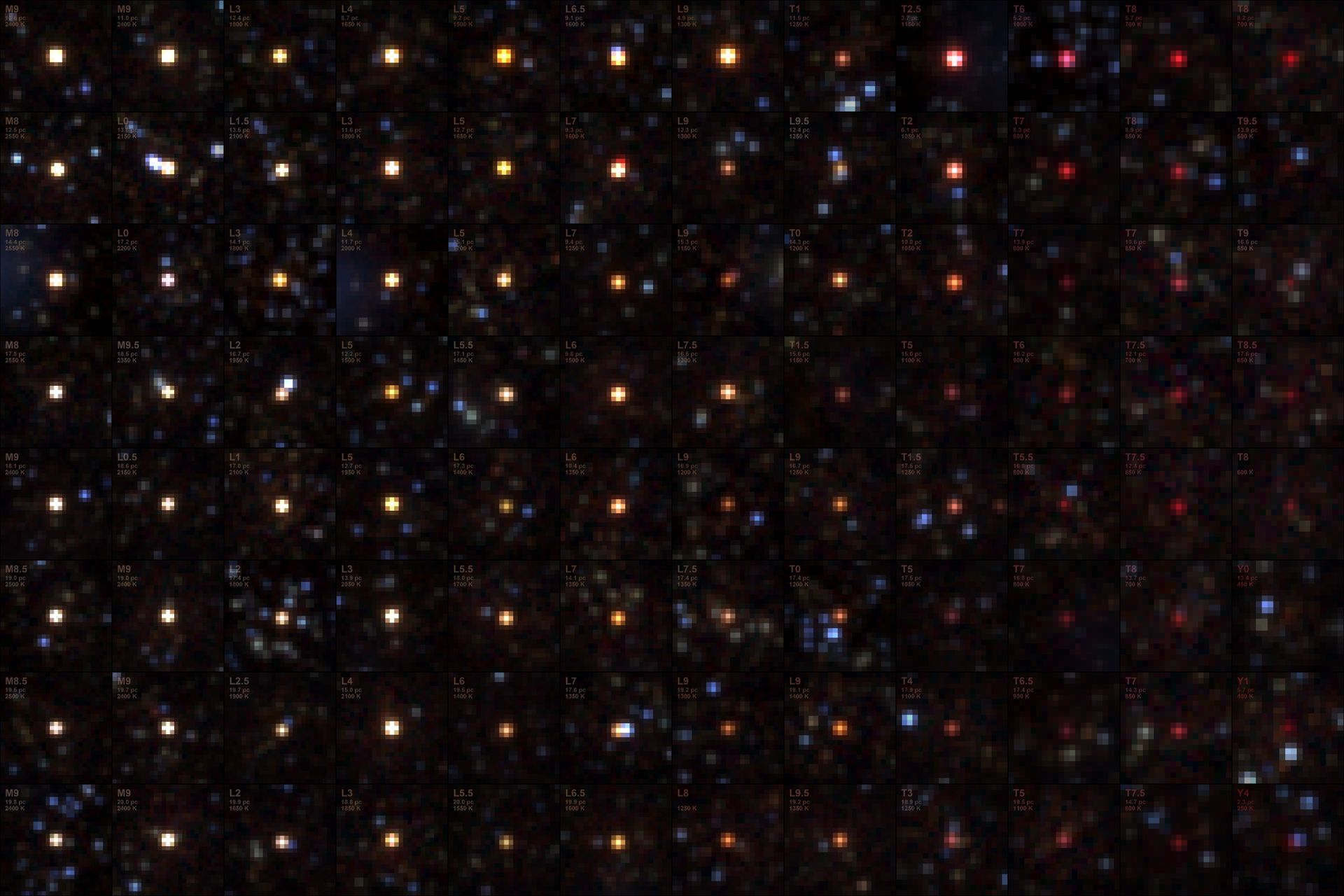
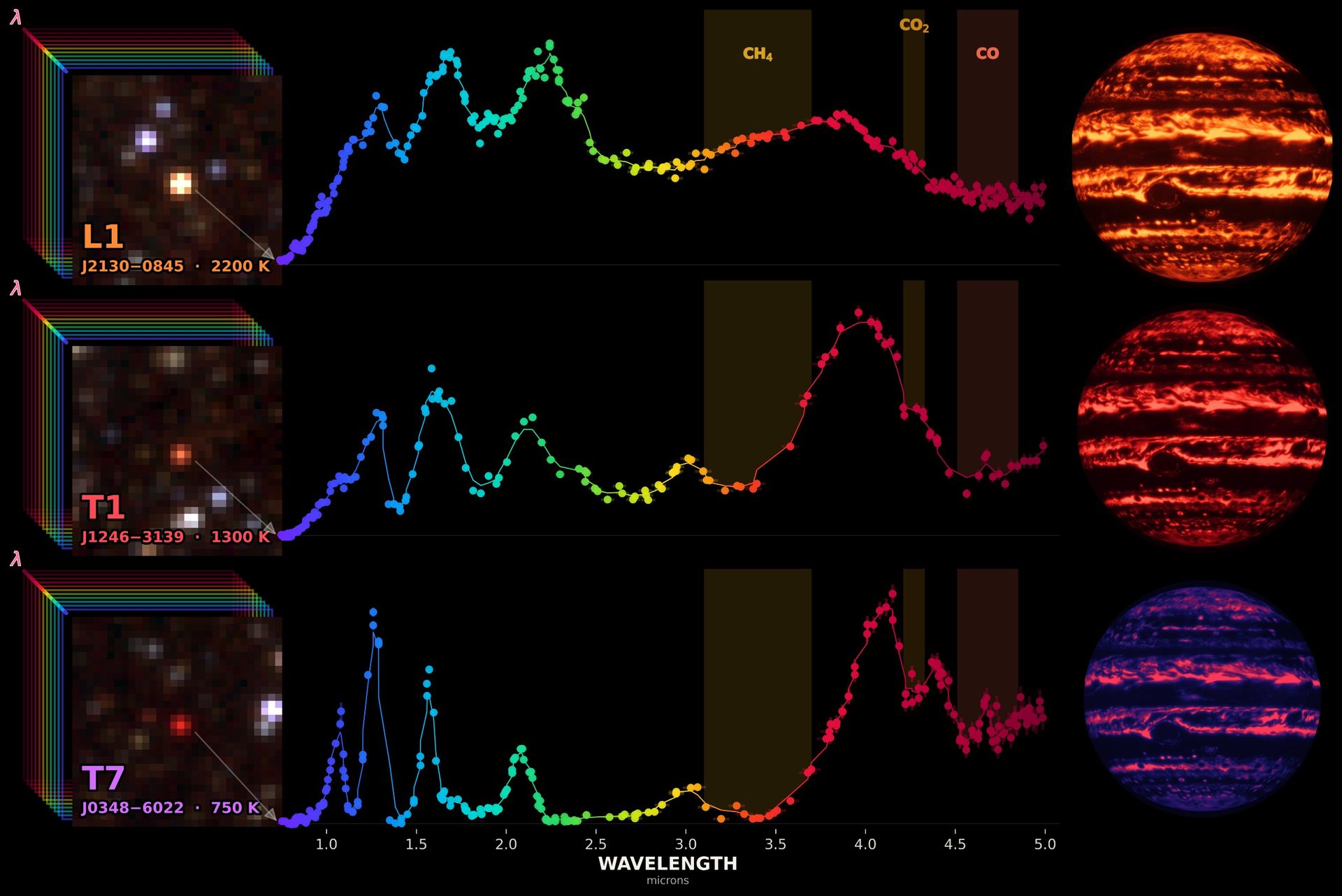
The spectra of brown dwarfs seen by SPHEREx allowed the team to determine that their atmospheres are chemically rich in water, carbon dioxide, carbon monoxide and methane.
"We’re seeing the signatures of these molecules and how they change from object to object across the entire temperature regime," said team member J. Davy Kirkpatrick, also of Caltech. "Our paper concentrated on just three dozen, but we have thousands more that we are in the process of analyzing.
"I really want to see what bounds the universe places on the variety of brown dwarfs."
All my colors
Brown dwarfs have been routinely observed by other telescopes, including NASA's James Webb Space Telescope and the agency's now-retired Spitzer Space Telescope, but the wide wavelength coverage of SPHEREx has made it particularly useful in observing these failed stars. That's good news for astronomers waiting for change in the atmospheres of brown dwarfs as they age and grow cold.
The researchers found that some brown dwarfs observed by SPHEREx are at a stage of extreme change in which their clouds are clearing, creating atmospheres rich in methane.
The team may have discovered significant new details about brown dwarfs, but they are still on the proverbial mystery street when it comes to these strange celestial objects,
"The state-of-the-art models are capturing the general chemical trend, but when it comes to these cloudy transitions, the models are struggling to match the data," said Rustamkulov. "No two brown dwarfs are alike. Even at the same temperature, their spectra look quite distinct."
"This journey has turned many of us into accidental meteorologists. We know how hard it is to predict weather on our own planet, and we realize it's going to be just as challenging to explain the phenomena we see in these bizarre, cold objects," Kirkpatrick said. "The findings are a call to action to explore even more of these dark worlds."
As astronomers resond to that call to action, I will ponder how I could have worked Bauhaus' Goth classic "Bela Lugosi is Dead" into this article.
The team's research was published on Sept. 28 in The Astrophysical Journal.