❌

Reading view

How humans domesticated the bacterium behind Botox treatments

Clostridium botulinum bacteria produce a potent neurotoxin called botulinum toxin, which causes the serious illness botulism. The toxin attacks the nervous system, leaving the body unable to control its muscles and making every breath a struggle. Without immediate treatment, botulism can be fatal. Humans, however, have managed to domesticate this dangerous bacterium to do their bidding. Over more than 90 years, biologists have been able to turn a wild microbe into an efficient factory for medical, military and cosmetic products like Botox.

  •  

Ancient fish bones reveal how Arctic cod species survived the last ice age

The glacial Arctic Ocean was not a barren ice desert but a breeding ground for the evolution of cold adaptation in marine fish. This is the main conclusion of a new scientific publication from Stockholm University that examines small fish bones found in deep-sea sediments during an expedition aboard the Swedish icebreaker Oden.

  •  

Review of Spielberg’s Disclosure Day | What is the Real Message?

The movie Disclosure Day, directed by Spielberg, investigates a conspiracy about government suppression of alien evidence dating back to Roswell. This review questions current societal beliefs about extraterrestrials and Darwinian evolution. It exposes the deception, ultimately portraying alien visitation as a misunderstood age-old phenomenon rather than a new factual reality.

  •  

Early Cambrian Fossil Rewrites Starfish Family Tree

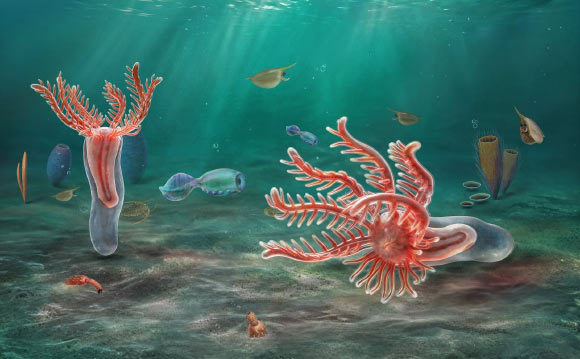
An artist’s impression of Yujingia glutenotunica. Image credit: He et al., doi: 10.1016/j.cub.2026.08.053.

A 518-million-year-old ambulacrarian fossil from China suggests that the common ancestor of starfish and their relatives was not a burrowing worm; it was probably a tentacled animal that fed from the water around it.

The post Early Cambrian Fossil Rewrites Starfish Family Tree appeared first on Sci.News: Breaking Science News.

  •  

Not All Black Holes Who Wander Are Lost

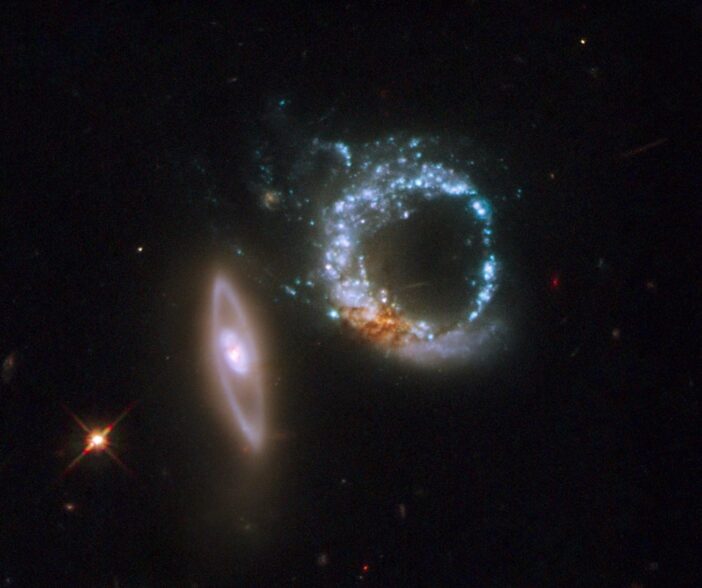
interacting galaxies Arp 147

Editor’s Note: Astrobites is a graduate-student-run organization that digests astrophysical literature for undergraduate students. As part of the partnership between the AAS and astrobites, we occasionally repost astrobites content here at AAS Nova. We hope you enjoy this post from astrobites; the original can be viewed at astrobites.org.

Title: Tracing Black Hole and Galaxy Growth Across Environments Since Cosmic Noon
Authors: Emma Jane Weller et al.
First Author’s Institution: Yale University
Status: Published in ApJ

They say you can’t choose your hometown, but it still ends up shaping who you become. Turns out the same is true for black holes. The galaxy a black hole grows up in will have a major impact on how it will live out the rest of its life. Similarly, the black hole can leave a lasting impression on its galaxy!

Astronomers have long known that a galaxy’s stellar mass (the combined mass of all its stars) tracks pretty tightly with the mass of the black hole sitting at its centre: bigger galaxy, bigger black hole. This is one pillar of the idea that galaxies and their central black holes coevolve; that is, their life stories are tangled up with one another from early on. But ever since JWST started spotting suspiciously large black holes in the early universe, astronomers have been debating whether this relationship holds steady across cosmic time, or whether the rules were different when the universe and everything in it was younger.

Not Everyone Stays in the Town Centre

Most previous studies of the relationship between black holes and their galaxies have focused only on the central black hole: the biggest, most famous resident of a galaxy, sitting right downtown at its centre. That’s a reasonable place to start, since the central black hole is usually the most massive one around and tends to dominate the story. But this article’s authors wanted to know what happens to everyone else in town, too!

That includes satellite black holes, which are the central black holes of smaller “satellite” galaxies that orbit a bigger “primary” galaxy, a bit like a small town around a big city. It also includes a stranger, more recently discovered population: wandering black holes. These are the black hole equivalent of someone whose hometown got swallowed up by an expanding metropolis, and who never quite settled into their new surroundings.

Here’s how it happens: when a small satellite galaxy merges with a larger one, the satellite gets torn apart by tidal forces and its gas and stars are stripped away. However, its central black hole is often left behind, drifting through the new, much bigger galaxy on a wide orbit. The process that would normally drag a black hole down to the centre of a galaxy, called dynamical friction, is painfully slow, so wanderers can spend billions of years roaming the outskirts.

Two Cities, Two Sets of Rules

To study how these different black hole “life paths” shape, and are shaped by, their host galaxies, the authors turned to two cosmological simulations, ASTRID and TNG300, which handle black hole physics quite differently.

In TNG300, black holes are assumed to start fairly massive and are snapped straight to the centre of their host galaxy at every timestep. This makes mergers happen quickly and often, but it also means there’s no such thing as a wandering black hole in TNG300.

ASTRID, on the other hand, seeds smaller black holes and lets them move more realistically through their galaxy using a subgrid dynamical friction model. This is what allows wandering black holes, with their slow, aimless orbits, to exist and be studied in the first place.

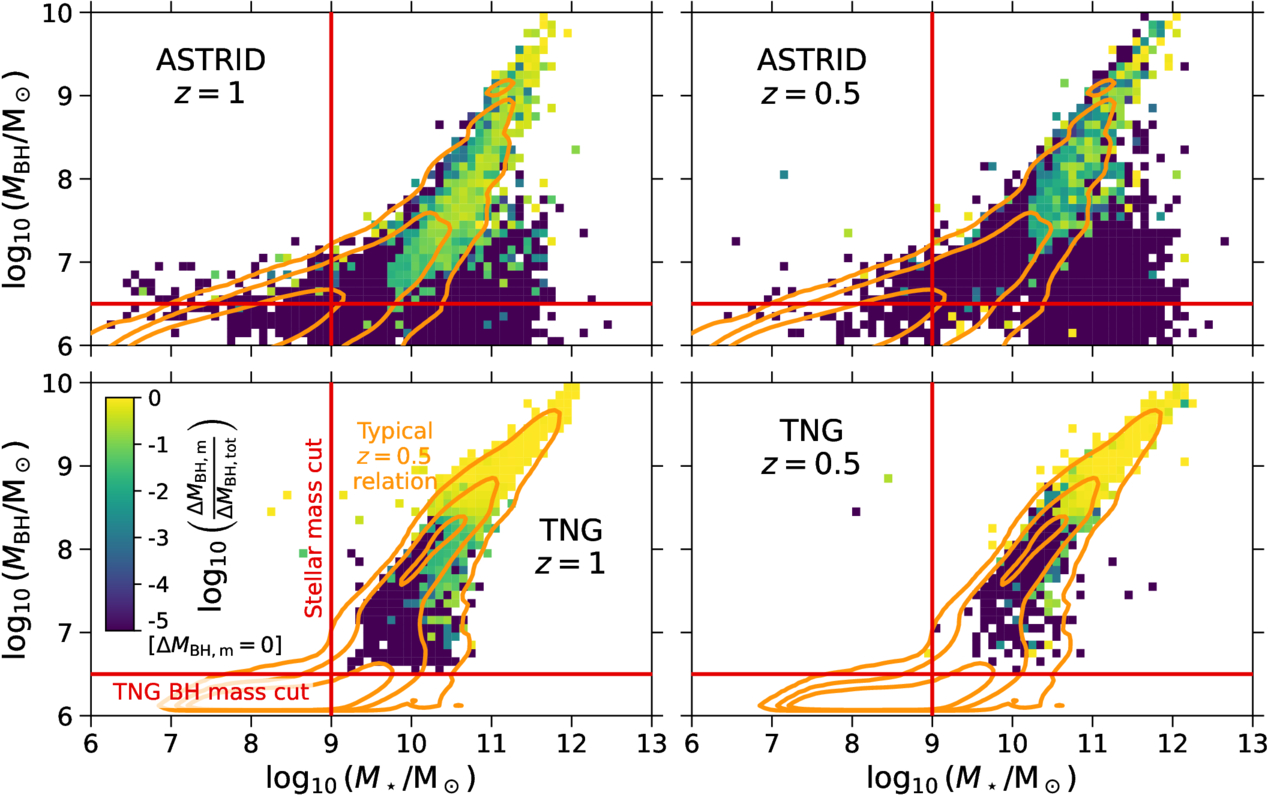
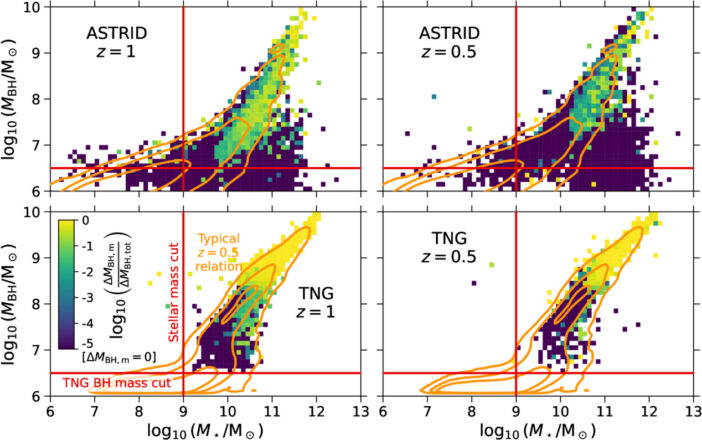
Figure 1 reveals a lot at once. First, ASTRID (the simulation that allows wandering black holes and tidally stripped satellites) has whole new neighbourhoods on the map that simply don’t exist in TNG300. Those populations clearly aren’t following the same tidy, linear coevolution that central black holes enjoy with their galaxies. Second, the most massive black holes tend to be the most yellow, meaning mergers did the heavy lifting for their growth. This is especially pronounced in TNG300, where roughly 80–90% of the growth of the most massive black holes comes from mergers. Meanwhile, the wanderers and stripped satellites sit at the deep-purple end: these black holes have barely merged with anyone at all.
relation between black hole mass and host galaxy stellar mass

Figure 1: How black hole mass relates to host galaxy stellar mass, shown at two snapshots in cosmic history, 8 and 5 billion years ago, for both simulations (ASTRID: top row; TNG300: bottom row). Colour shows what fraction of each black hole’s growth since the last snapshot came from mergers, from purple (grown almost entirely by slowly swallowing gas) to yellow (grown mostly by swallowing other black holes). [Weller et al. 2026]

Four Kinds of Black Hole Life Stories

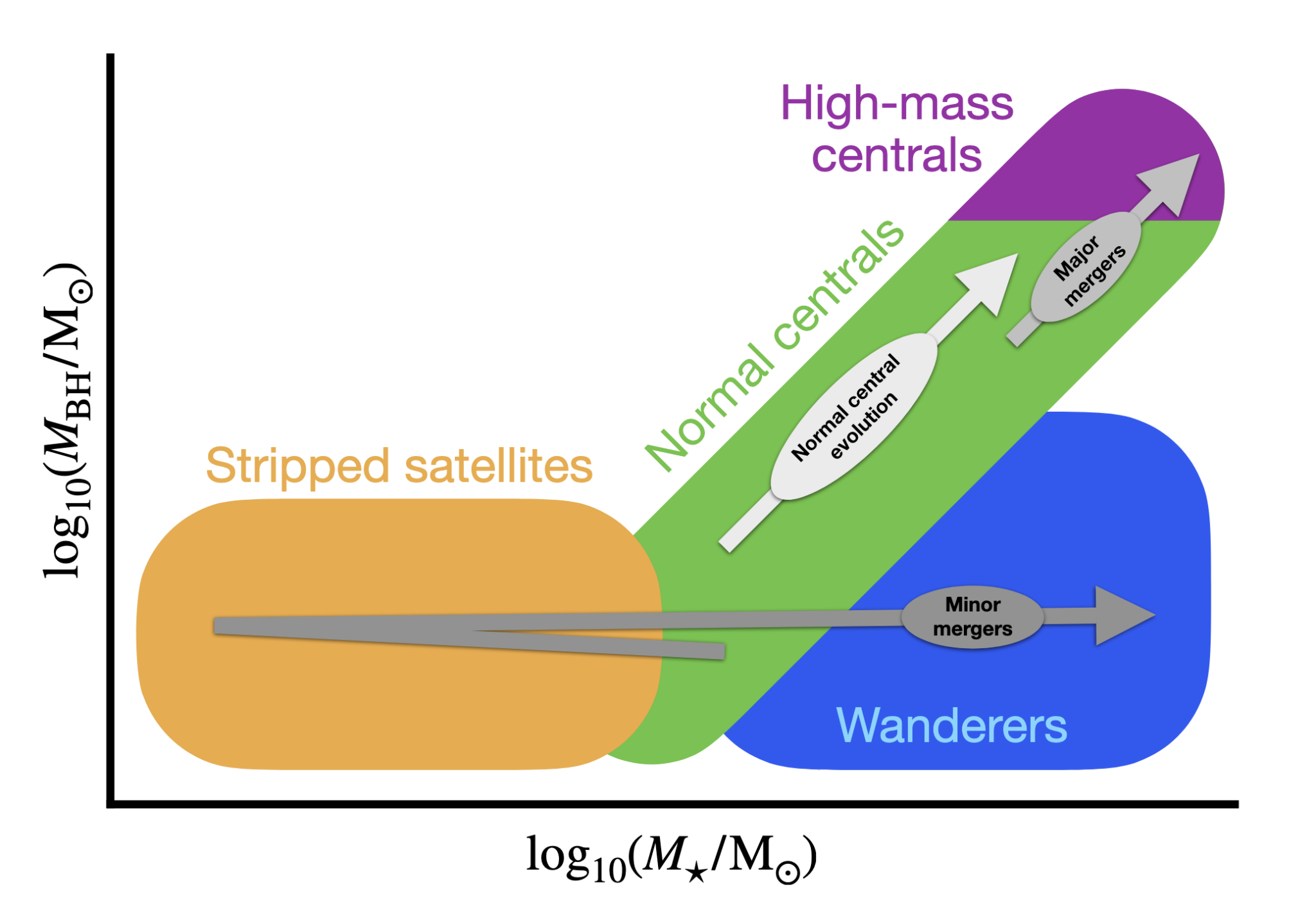
Pulling all of this together, the authors sketch out a kind of “neighborhood map” of black hole fates, sorted by where a black hole ends up on the mass-relation plot and how it got there (see Figure 2).
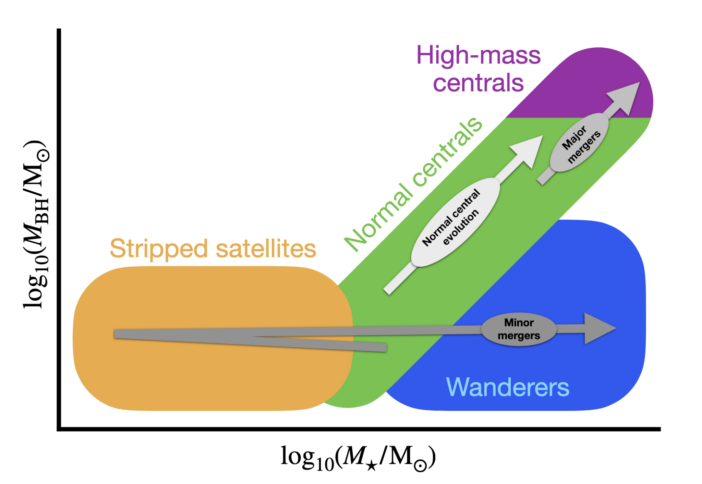
diagram showing the distinct populations revealed by the black hole mass–stellar mass relation

Figure 2: The distinct black hole populations revealed by the black hole mass–stellar mass relation, and the evolutionary path that lands each population in its corner of the map. [Weller et al. 2026]

  • Normal centrals are the homebodies. They sit at the centre of primary or satellite galaxies and grow up steadily alongside their hometown, climbing the mass relation together through a healthy mix of accretion and the occasional merger. Their galaxies keep forming stars the whole time in a functional, unremarkable, thoroughly nice place to live.
  • High-mass centrals are the ones who “made it.” These are central black holes in big primary galaxies, and their growth comes overwhelmingly from mergers with other black holes. Once they get big enough, they start throwing their weight around: their jets blast gas out of the galaxy, shutting down both star formation and their own further growth.
  • Stripped satellites are the annexed suburbs. They start out on the normal mass relation, but a merger with a bigger galaxy tears away their gas and stars, shrinking their stellar mass while their black hole is left comparatively overweight for its new, smaller home. With their gas reserves gone, star formation grinds to a halt, and their black holes, starved of fuel, barely grow either.
  • Wanderers are the ones who moved to the big city and never quite settled in. They start out on the normal relation inside a satellite galaxy, but when that galaxy merges into something much bigger, they’re left drifting through unfamiliar, low-density territory. With little gas around to feed on and almost no chance of merging with anyone else, their growth basically stalls.

This four-way map is a genuinely useful new way to read the black hole–galaxy relation: a black hole’s exact position on the plot isn’t just a number, it’s a fossil record of everywhere it’s ever “lived.”

There’s plenty more in the article we haven’t covered here, including how quenching plays out over time, how these results stack up against the local universe, and a closer look at how star formation rates and black hole accretion rates track each other across all four populations. If any of this piqued your interest, the full article is well worth a read.

Original astrobite edited by Ryan White and Chloe Klare.

About the author, Jayde Willingham:

I am a first-year PhD student at Swinburne University of Technology studying the early universe and how the first galaxies came to be. My work combines observations and theoretical modelling to explore how galaxies form, evolve, and shape the universe we see today. When I’m not at my desk or doing SciComm, I’m probably reading a good book with a hot beverage under a cozy blanket.

The post Not All Black Holes Who Wander Are Lost appeared first on AAS Nova.

  •  

94 Year-Old Electronics Billionaire Accused of Hiring Goons to Infest Chicago With Huge Rat Swarm

A 94-year-old electronics mogul is in hot water with Chicago authorities, who claim that his hare-brained plan to feed hungry squirrels is instead sustaining a massive plague of rats.

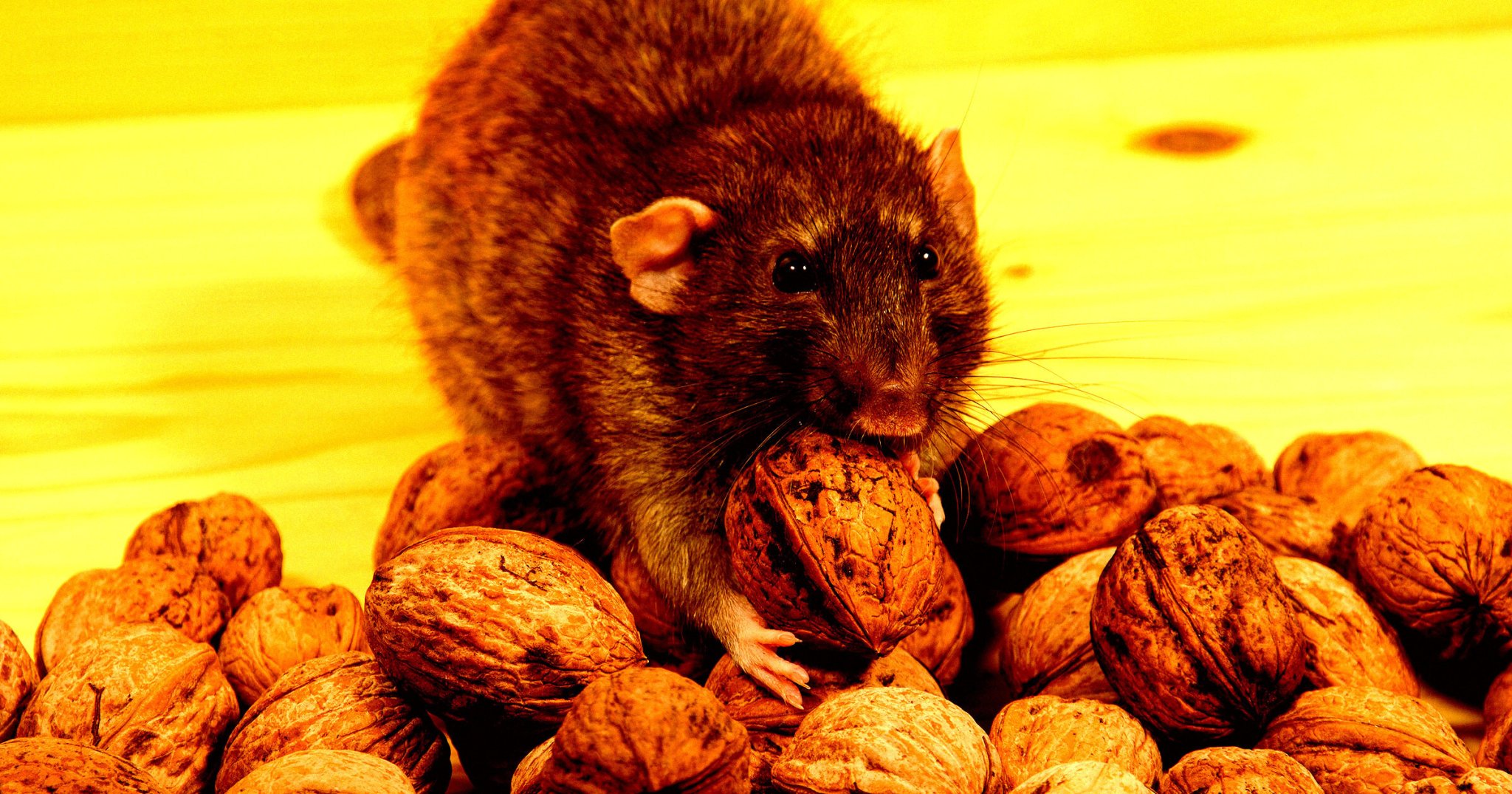
As previous owner of the billion-dollar electrical manufacturing company Tripp Lite, businessman Barre Seid has been putting his largess to use by paying a small army of workers to sprinkle an assortment of tree nuts across Chicago-area parks, Fortune reports.

As local resident Caroline Novak told Chicago WGN, it’s “like a luxury mélange of really nice nuts: I’m talking Brazil nuts and walnuts… these are not acorns.”

Though Seid’s target audience seems to be local squirrels, residents and city officials note that rats have quickly grown to depend on the regular feedings. As Novak’s husband told WGN, he counted over 40 rats digging holes near nut piles during a recent walk through Lincoln Park.

The bizarre operation has evidently been underway for years at this point, earning the billionaire heaps of civil violations carrying relatively small fines. Wealthy as he is, Seid has reportedly had no problem paying those fees and carrying on — the law forbids rich and poor alike to sleep under bridges, as the old saying goes.

“When you’re a billionaire and you have a weird hobby and someone tries to stop you, you have complete impunity,” Novak told Block Club Chicago in a separate interview. “You just triple down because why not? You’ll pay $40,000 in fines. You don’t care.”

Now in 2026, authorities in Chicago are reaching their breaking point. Alderman Timmy Knudsen — whose jurisdiction covers the area of Lincoln Park Seid’s workers are active in — is now pushing the Chicago Park District to sue Seid in order to stop the nuttiness once and for all.

“For years, a billionaire family has carried out a paid operation to feed local wildlife, disrupting our rat abatement efforts and causing an infestation that has made parts of the park unusable for other residents,” Knudsen’s office told Fortune in a statement. “We’re hopeful that raising awareness and drawing attention to the issue will ultimately lead to better behavior and a safer park for our community.”

More on tech billionaires: Billionaires Pouring Money Into Ads About How AI Data Centers Are Actually Good

The post 94 Year-Old Electronics Billionaire Accused of Hiring Goons to Infest Chicago With Huge Rat Swarm appeared first on Futurism.

  •  

Mysterious hole in Neanderthal shoulder blade may have been a 'kill shot' from a wooden spear, according to archaeologists

A Neanderthal who was buried 75,000 years ago in Shanidar Cave in Iraq died from a wooden spear straight through the chest, archaeologists have revealed.

While it's impossible to know exactly what happened, the violence may have been a targeted hit.

"The position of the wound and the force required to push it right through the Neanderthal's body bear the hallmarks of an intended kill shot directed towards the heart," study first author Emma Pomeroy, a paleoanthropologist at the University of Cambridge, said in a statement.

In a study published Thursday (Oct. 15) in the journal Scientific Reports, Pomeroy and co-authors analyzed the bones of Shanidar A, a Neanderthal who died violently at about age 45 and was then buried in Shanidar Cave.

The archaeological site at Shanidar is famous for its evidence of purposeful burial, which experts once thought was only done by modern humans. Although the Neanderthal "flower burial" at Shanidar has since been debunked, the cave holds other evidence of repeated Neanderthal burials, which shows that these extinct humans placed specific meaning on that location, the authors wrote in the study.

The skeleton of Shanidar A was incomplete when it was discovered in 2019, consisting of a mostly complete right hand, three ribs, six teeth and a left scapula or shoulder blade, which meant they could not figure out the sex of the Neanderthal.

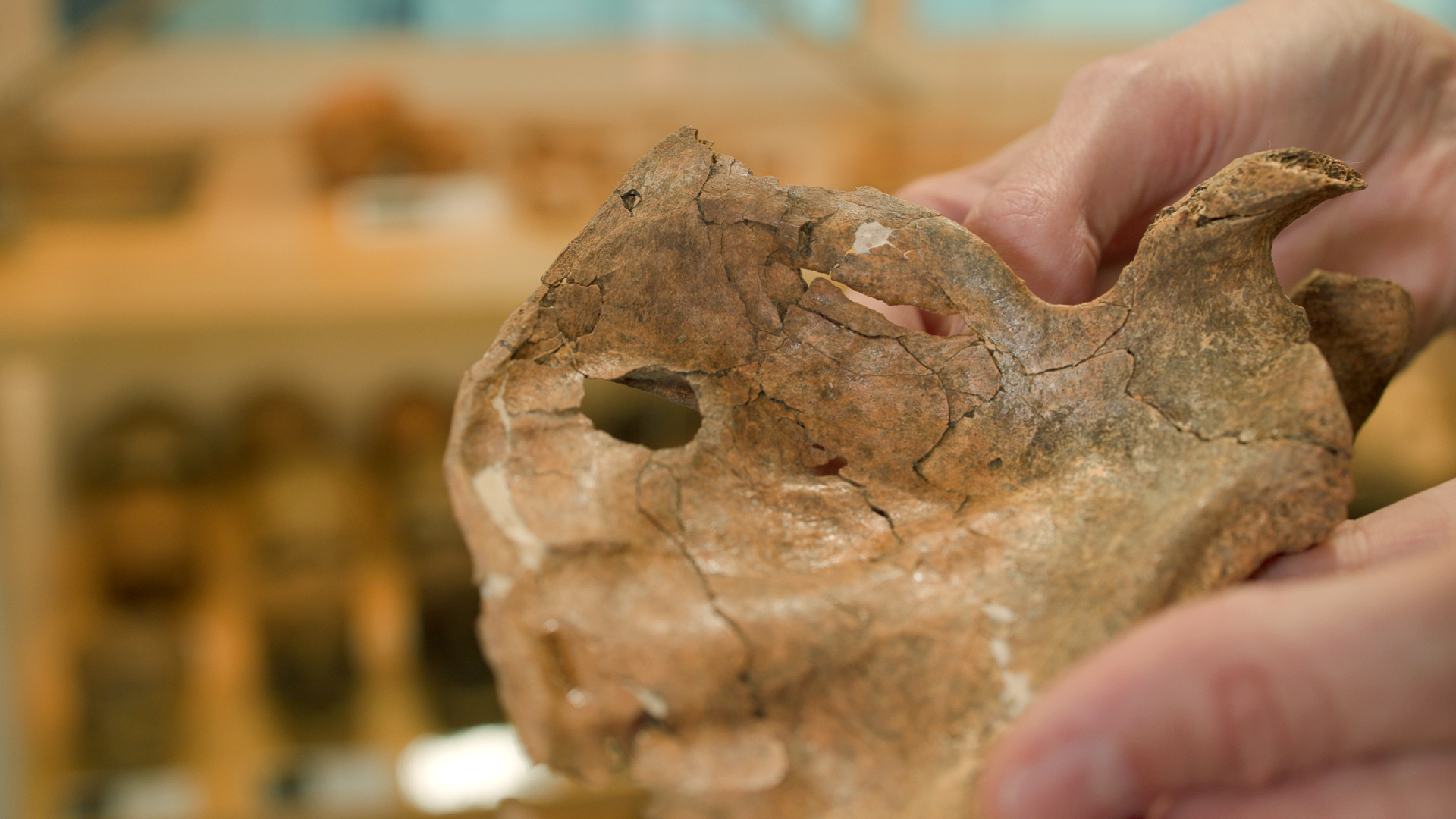
Near the edge of the shoulder blade, archaeologists noticed a round hole about 0.6 inches (1.5 centimeters) in diameter and a round piece of bone that had been punched out of the shoulder blade. The researchers ruled out post-mortem damage to the bone, including animal gnawing and insect burrowing.

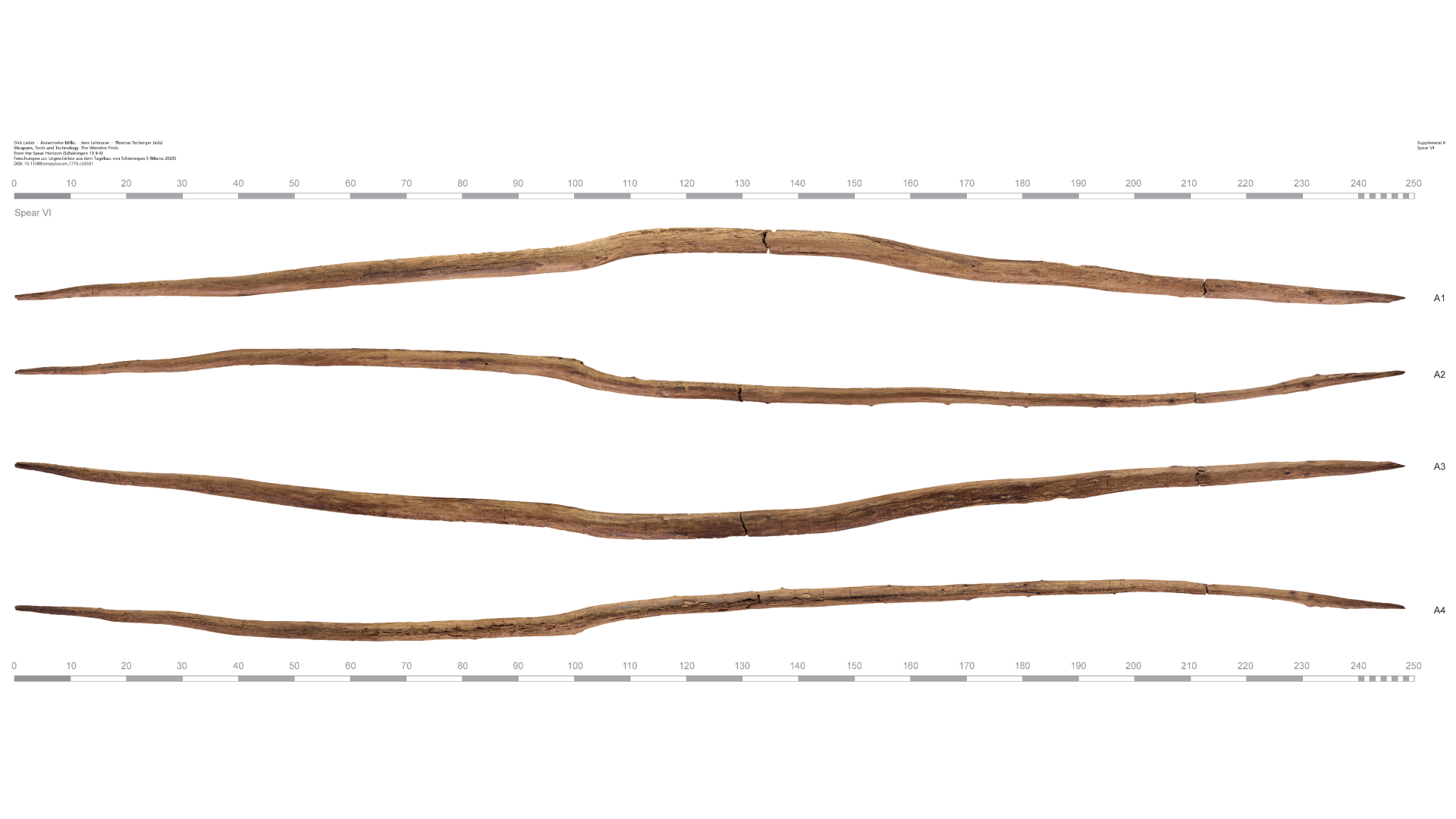
a series of four images of a wooden spear against a white background

An example of a Paleolithic thrusting spear found in Germany. This may have been the kind of weapon that killed the Shanidar A Neanderthal. (Image credit: Dirk Leder et al. (eds), Weapons, Tools and Technology (2026))

"The perforation is best explained as resulting from perimortem [around the time of death] penetrating trauma, such as that caused by a projectile or a thrusting implement such as a spear," the researchers wrote in the study. Specifically, the Neanderthal was killed by a spear that entered their chest from the front at a high velocity and pierced their shoulder blade.

The shape of the wound in the shoulder blade appears to match experimental evidence of injuries made by wooden spears rather than stone-tipped weapons, the researchers wrote in the study. Neanderthals would have used wooden spears for both thrusting and throwing. But it is unclear if this individual died because of a violent interaction with another Neanderthal or by accident, such as a hunting incident.

"All we can ever know about the end of this Neanderthal's life is that it was violent, and came at the end of a wooden spear," study co-author Graeme Barker, an archaeologist at the University of Cambridge, said in the statement.

"Care and support from other Neanderthals"

Even though this Neanderthal had an untimely demise, evidence on the teeth suggested that the individual was cared for during life.

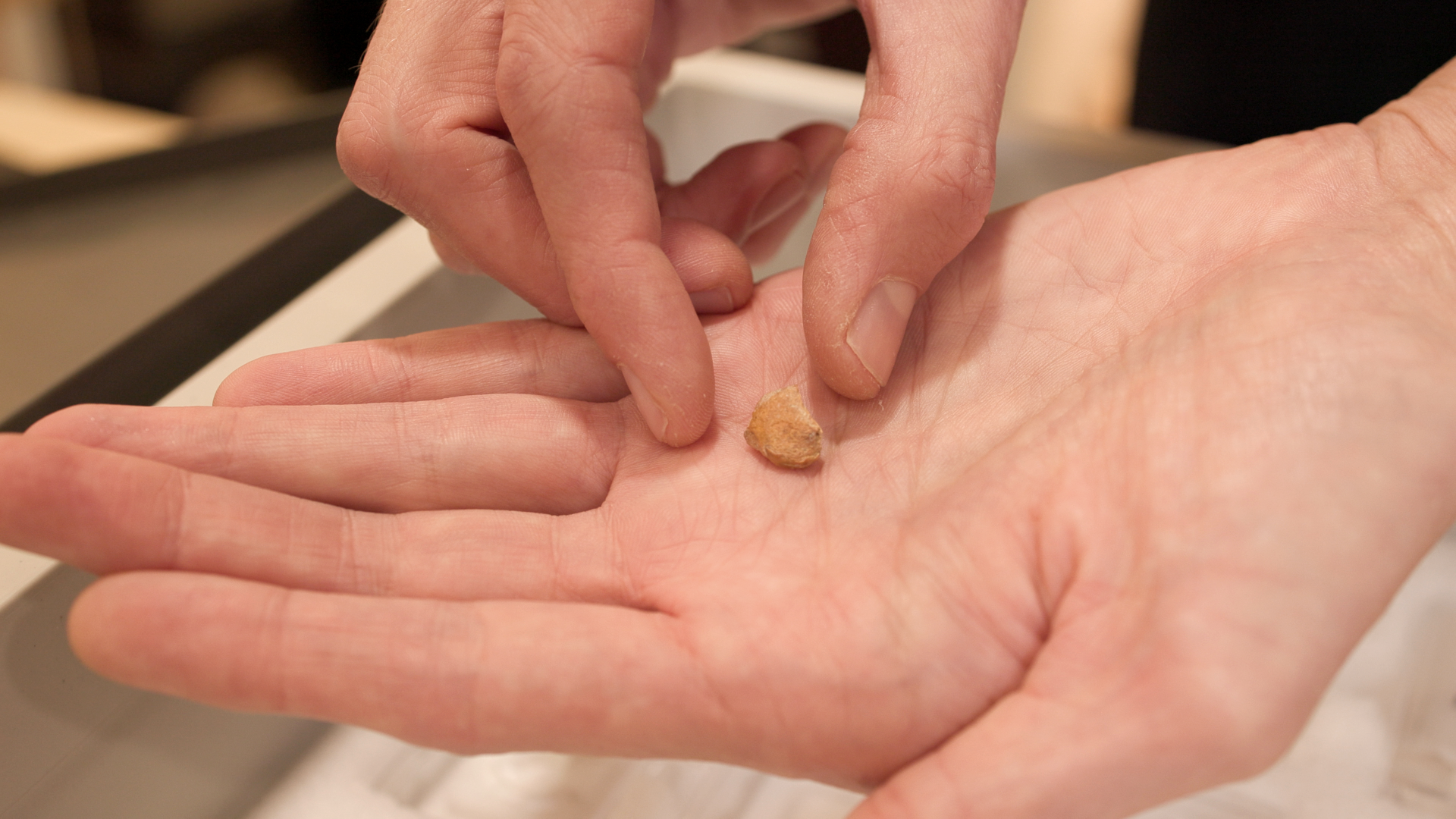
The six teeth from Shanidar A were heavily worn-down in an unusual manner, the researchers wrote. One of them — a front tooth with a large quantity of tartar on it — had been split in half during the Neanderthal's life, and the individual continued to use the damaged tooth for a considerable amount of time. The collection of teeth suggests the Neanderthal sustained a major trauma to the face that fractured the lower front tooth and may have caused additional injuries to the jaw.

a person with light skin holds half a Neanderthal tooth in their open palm

The Neanderthal's lower front tooth was fractured during life. (Image credit: University of Cambridge)

"There’s no doubt that Shanidar A would have had difficulty communicating and been in absolute agony for a long period of time," Pomeroy said in the statement. "Surviving a blow that splits a tooth in this fashion, then continuing to live and eat for a period of at least a year and maybe more, would have required care and support from other Neanderthals."

Rebecca Wragg Sykes, an archaeologist and author of "Kindred: Neanderthal Life, Love, Death and Art" (Bloomsbury, 2020) who was not involved in the study, told Live Science in an email that the apparently fatal chest injury is an important addition to our understanding of Neanderthals. While it is plausible the Neanderthal was stabbed by a wooden spear, Wragg Sykes said, "it would be interesting to also compare whether a wild goat horn, the most intensely hunted species at Shanidar, might have been responsible."

Shanidar A is not the first mortally wounded Neanderthal to be found at the site. In 2009, researchers analyzed the skeleton of Shanidar 3, an older adult male who died 50,000 years ago, and found a deep slice in one of his ribs. The researchers suggested that the Neanderthal may have been killed by a stone-tipped spear possibly thrown by a modern human. Although modern humans first reached Europe around 54,000 years ago, experts aren't sure exactly how they interacted with Neanderthals.

Pomeroy told Live Science in an email that the discovery at Shanidar of two stabbed Neanderthals 25,000 years apart is interesting but possibly just a coincidence.

"We know from the archaeology that Neanderthals were repeatedly coming back to Shanidar and using it for short periods at a time, both around 75,000 years ago and around 45-50,000 years ago, as well as leaving their dead there," Pomeroy said.

The traumatic injuries, purposeful burial and indirect evidence of wooden spears all show that 75,000 years ago, Neanderthal life — and death — were complex, the researchers wrote in the study.

How much do you know about our closest relatives? Find out with our Neanderthal quiz.

  •  
  •  

New Species of Predatory Dinosaur Identified in UK

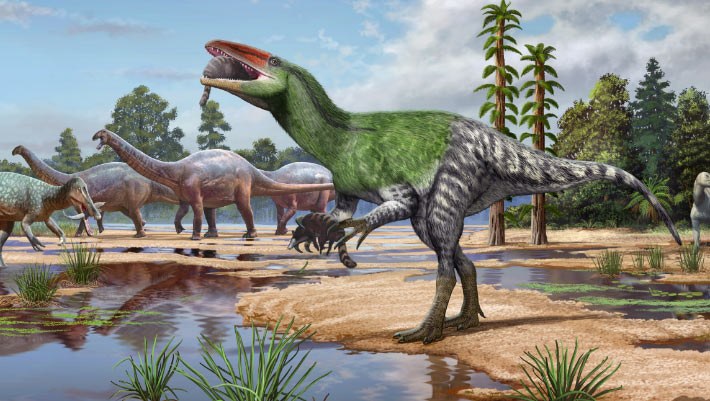
Artists’ rendition of Invictibellatrix amberina with contemporary fauna in the lower part of the Wessex Formation. Image credit: Sergey Krasovskiy / Pedro Salas.

A fossilized braincase that sat in in the collection of the Natural History Museum in London for a century has been identified as Europe’s first megaraptoran dinosaur, a lineage once thought to have flourished mainly in the southern hemisphere.

The post New Species of Predatory Dinosaur Identified in UK appeared first on Sci.News: Breaking Science News.

  •  

A Pulsar in a Rare Triple System

triple-star system containing the pulsar PSR J0435+3233

Follow-up observations show that a recently discovered pulsar has two stellar companions, making it one of just a handful of millisecond pulsars known to be in triple-star systems.

An Unusual New Pulsar

Earlier this year, researchers reported the discovery of a pulsar with the Five-hundred-meter Aperture Spherical radio Telescope (FAST). The newfound pulsar, PSR J0435+3233, is a millisecond pulsar, rotating once every 3.2 milliseconds. What’s unique about this pulsar is how quickly it’s spinning down: its spin rate is decreasing roughly 100 times faster than other millisecond pulsars in our galaxy, suggesting an unusually strong magnetic field and the possibility of an exotic formation pathway.

The FAST observations also showed that the pulsar is not alone: it appears to be on an 8-day orbit with a white dwarf. Now, follow-up observations have revealed the pulsar’s membership in an intriguing stellar system.

From Radio to Gamma Rays

Zonglin Yang (National Astronomical Observatories, Chinese Academy of Sciences) and coauthors followed up on the discovery of PSR J0435+3233 using multiwavelength data from FAST, multiple optical and infrared observatories, and the Fermi Gamma-Ray Space Telescope.

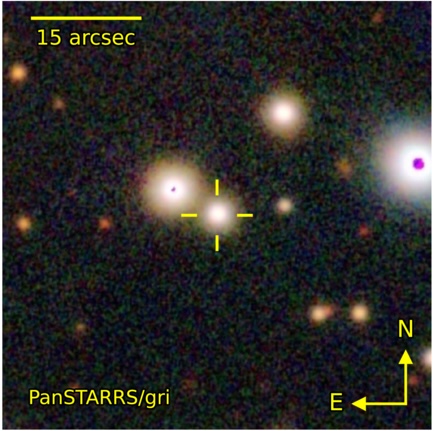
optical image of the subgiant companion to PSR J0435+3233

Visible-light image from PanSTARRS of the outer subgiant companion. [Adapted from Yang et al. 2026]

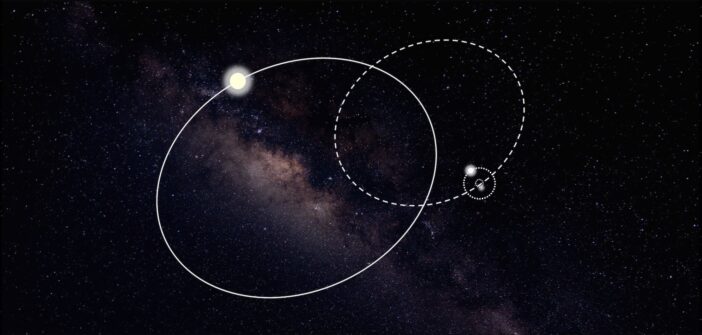
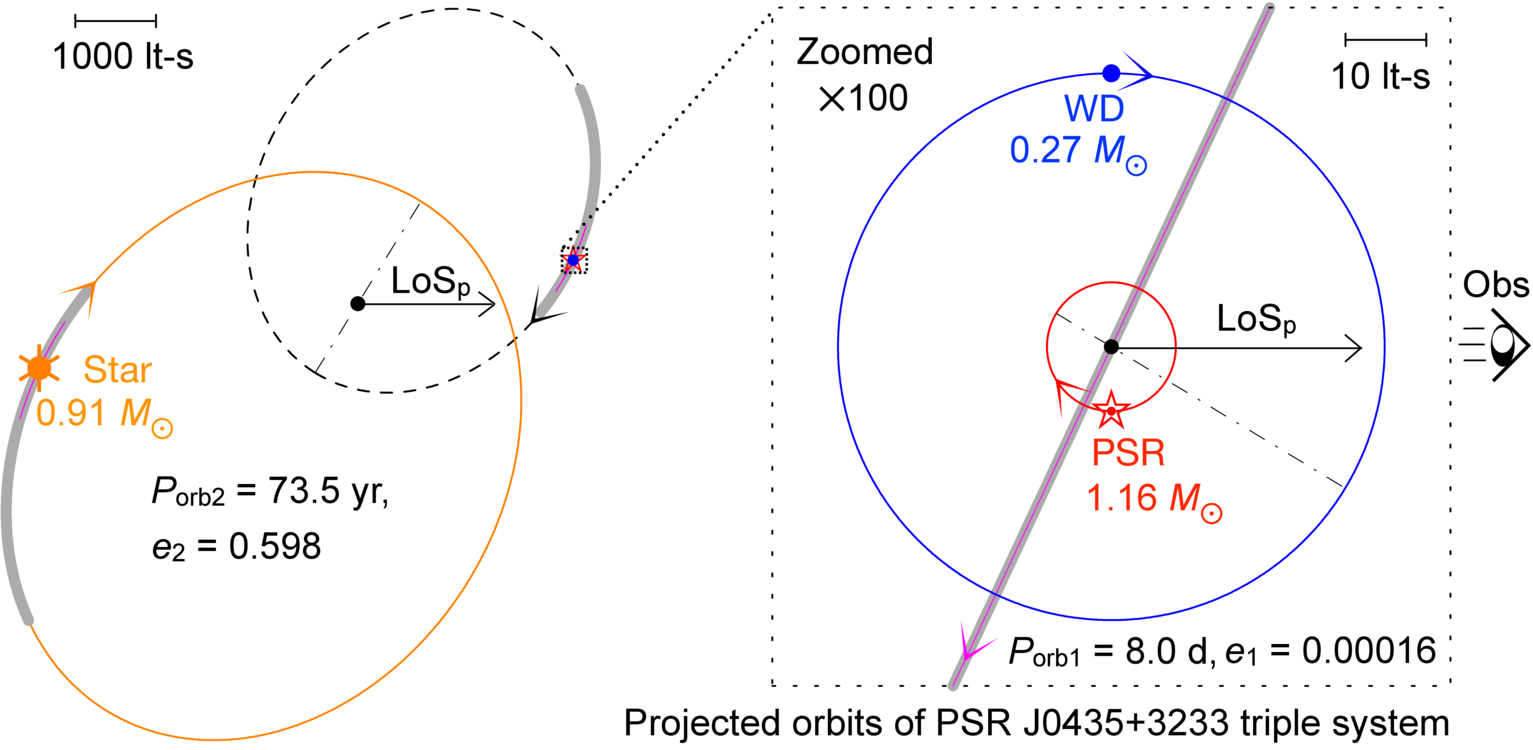
With this broad dataset, the team confirmed the identity of the pulsar’s white-dwarf companion, detected gamma-ray emission from the pulsar, and identified a second previously unknown companion, a subgiant star roughly as massive as the Sun. These three stars are arranged in a hierarchical triple: the pulsar and white dwarf orbit one another tightly, and the subgiant is a more distant companion, orbiting in decades rather than days. Current observations show that the orbits of the inner binary and the outer star are tilted relative to one another, either nearly perpendicularly or at about 54 degrees. While a triple system of three closely intertwined stars invites chaos, this configuration is stable long term.

Insights into Stellar Evolution

While it’s common to find millisecond pulsars in binary systems — in fact, many millisecond pulsars are thought to spin up to their incredible speeds via accretion from a stellar companion — it’s rare to discover them in triple systems. Because this system is isolated out in the field rather than crowded together with other stars in a dense cluster, Yang and collaborators suspect that the three stars have been together since birth, as opposed to being assembled dynamically later on.

projected orbits of PSR J0435+3233 and its two stellar companions

Projected orbits of the three stars in the system. Click to enlarge. [Yang et al. 2026]

The most massive star in the trio would have hurried through its main-sequence lifetime in less than 10 million years, culminating in a supernova. The remaining two members of the system would have had to withstand this explosion, which the team found is possible but not especially likely; the likelihood of the system coming unglued due to a star going supernova depends on how much of a “kick” the explosion gives the newborn pulsar, and even in a zero-kick scenario, the likelihood of the system remaining bound is only 35%. The future evolution of the system will be less dramatic. The outer star will eventually evolve into a white dwarf, undergoing a gentle transition that poses no threat to the stability of the system.

Triple-star systems are common among massive stars, but how this configuration affects stellar evolution is still being explored. This discovery offers a valuable opportunity to study dynamics and stellar evolution in a rare triple system.

Citation

“The PSR J0435+3233 Triple System,” Z. L. Yang et al 2026 ApJL 1010 L9. doi:10.3847/2041-8213/aeaa29

The post A Pulsar in a Rare Triple System appeared first on AAS Nova.

  •  

The Solar System Has a New Life Expectancy, and It’s a Billion Times Shorter

Image of a solar flare.

Isaac Newton suspected that the gravitational dance between the Sun and Jupiter would eventually destabilize the solar system, but modern computational research has shown that its long-term stability is, statistically, pretty secure. However, new simulations with more realistic solar mass-loss conditions make a strong case for the disassembly of the outer solar system — and on timescales much shorter than previously thought.

Kick It Up a Notch

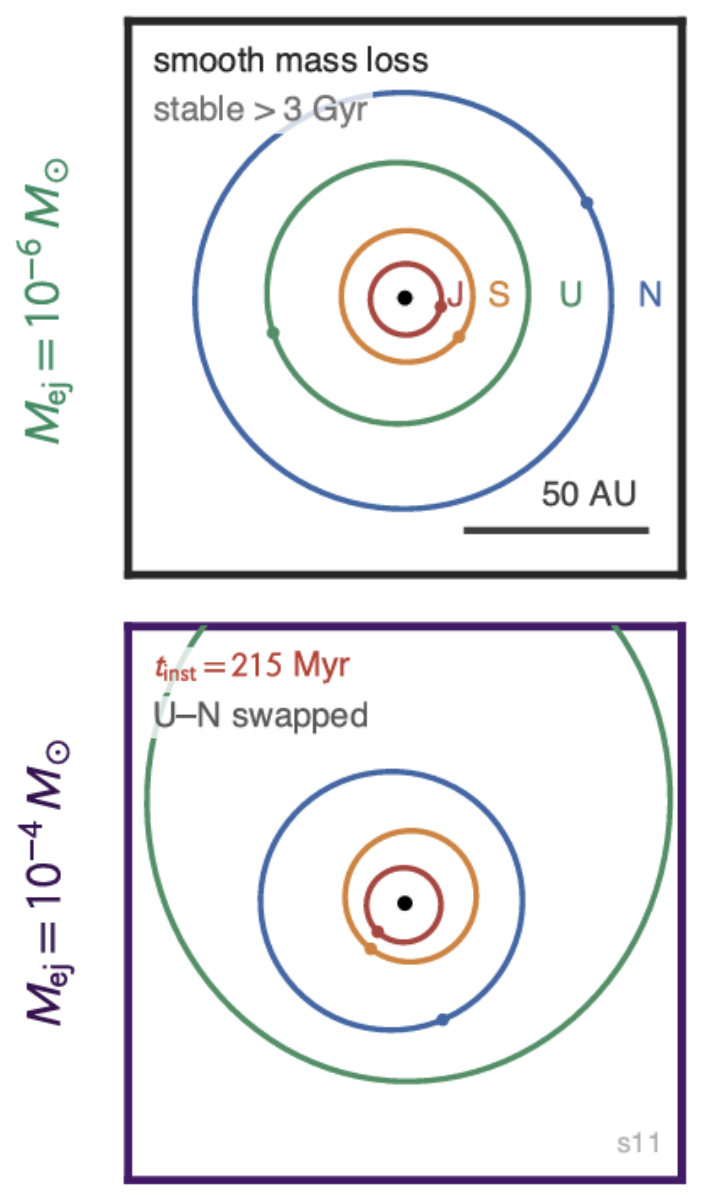
A plot showing final orbits of the outer planets for two simulations.

Final outer planet orbital configurations for two simulations — one stable and one unstable. t=0 at the onset of white dwarf formation. Click to enlarge. [Adapted from Batygin et al. 2026]

Several studies have investigated what will happen to the orbits of planets in our solar system as the Sun sheds its mass during its transition to a white dwarf. These studies have found that while the semimajor axes of the planets will expand by approximately a factor of 2, their orbits remain stable on timescales longer than the age of the universe (approximately 1018 years). This expanded orbital architecture will make the solar system more prone to jostles from stellar flybys, but even accounting for this, the giant planets’ orbits wouldn’t disassemble for another 30–100 billion years.

However, all of these studies modeled solar mass loss as a smooth function, so the dismantling of the solar system was left up to external forcings. In reality, stars on the red giant branch undergo mass ejections that are random in time and direction, corresponding to velocity “kicks” that can alter the dynamics of the planets. 

A team led by Konstantin Batygin at the California Institute of Technology conducted numerical experiments to analyze the orbital dynamics of the outer solar system under different solar mass-loss conditions. First, they tested the classic case of smooth mass loss and validated previous findings that, despite planetary orbits doubling in size, the dynamics are pretty tame. This holds true even when mass is ejected anisotropically: if the timing is smooth, the asymmetries cancel out.

Outer Solar System, Your Days Are Numbered

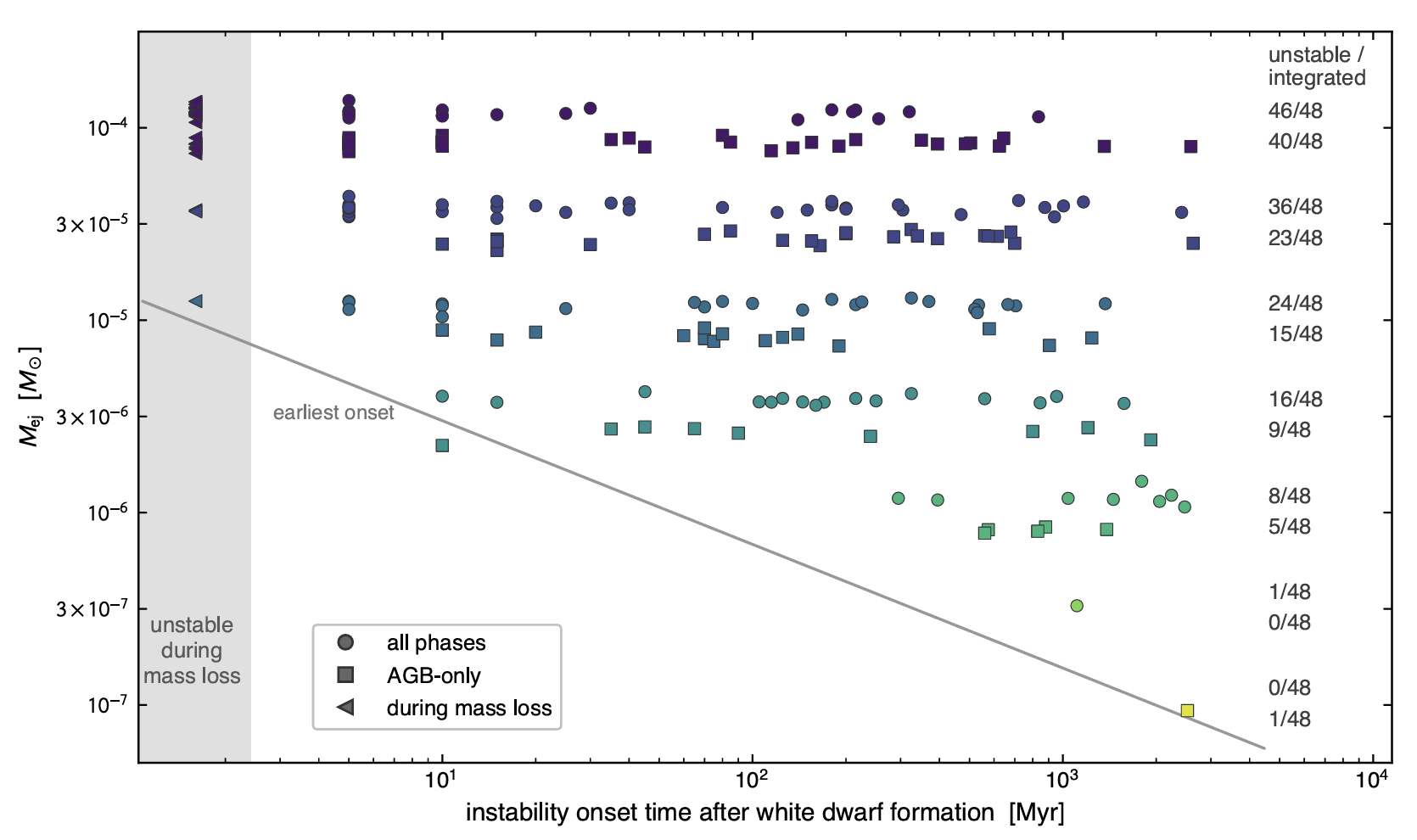
Next, they simulated stochastic kicks and found that the behavior of the outer planets was largely tied to the ejection mass of each kick. For very small ejection masses (≤ 10-7 M☉), dynamics mimic the smooth mass-loss case. For intermediate values (10-7 to 10-6 M☉), there’s a roughly 20% chance Jupiter–Saturn and Uranus–Neptune enter mean-motion resonances: an orbital configuration where planets’ periods are a ratio of small integers. These resonant configurations don’t protect the giant planets, however: resonant simulations disassemble slightly more often than nonresonant simulations. For larger ejection masses (≥ 10-5 M☉), the outer solar system disassembles on the timescale of billions of years. 

Plot showing the instability onset times as a function of ejection mass for all simulations.

Instability onset time — or how long after white dwarf formation the outer solar system disassembles — as a function of ejection mass. The larger the ejection mass, the greater the chance of instability. Click to enlarge. [Batygin et al. 2026]

Which ejection masses are the most accurate for our Sun? Well, unfortunately for our beloved outer planets, ejection models and observed kick amplitudes suggest a future ejection mass of 10-4 M☉. With kicks like these, not only is there a considerable chance of orbit destabilization, but it could happen before the white dwarf even forms. About 40% of simulations lead to disruption or violent scattering while the Sun is in its red giant phase, and roughly 90% break down within 3 billion years. 

This new discovery reduces the life expectancy of the solar system from one billion billion years to a meager one billion years after white dwarf formation. 

Citation

“Terminal Instability of the Solar System Triggered by Stochastic Solar Mass Loss,” Konstantin Batygin et al 2026 ApJL 1009 L22. doi:10.3847/2041-8213/aea290

The post The Solar System Has a New Life Expectancy, and It’s a Billion Times Shorter appeared first on AAS Nova.

  •  
❌