Entre monitor de humor, testes de bem-estar e uma companheira de IA sempre disponível para conversar, a Liven quer ser o seu companheiro digital de autodescoberta.
Após as muitas novidades do evento especial de mais cedo, a Apple anunciou no comunicado de imprensa sobre os iPhones 18 Pro que está estendendo o período de acesso gratuito à conexão via satélite para aparelhos mais antigos.
Segundo a empresa, donos de iPhones das linhas 14, 15 e 16 poderão acessar os recursos por mais um ano — algo disponível para quem já ativou o serviço em um país suportado.
O serviço de comunicação via satélite oferecido pela Apple, vale recordar, é apresentado como um teste gratuito — o que significa que a empresa pretende cobrar por ele futuramente.
Não se sabe, no entanto, o quão distante estaria essa cobrança, visto que a empresa vem adiando o período de teste gratuito para os aparelhos compatíveis desde o seu lançamento, em 2022.
Isso significa que a linha iPhone 14 já teve o prazo de gratuidade (que originalmente havia sido prometido para apenas dois anos) para o serviço por três vezes desde o ano supracitado.
Apesar de a conectividade via satélite ainda não estar disponível por aqui, não deixa de ser uma boa notícia, não é mesmo?
Astronomers have combined 2,884 Type Ia supernovae -- which are used to measure cosmic distances -- with cosmic microwave background and galaxy-mapping data, deepening cracks in the standard ‘cosmological constant’ model.
Polestar has confirmed a new concept car, the Formula 2030, and it’s the clearest look yet at where the Swedish EV brand’s design is headed.
The concept previews styling that will show up on the next Polestar 2, due in 2027, and the Polestar 7 compact SUV coming in 2028. It’s also the design centerpiece of a broader strategy the company is pitching to investors around one goal: getting to profit.
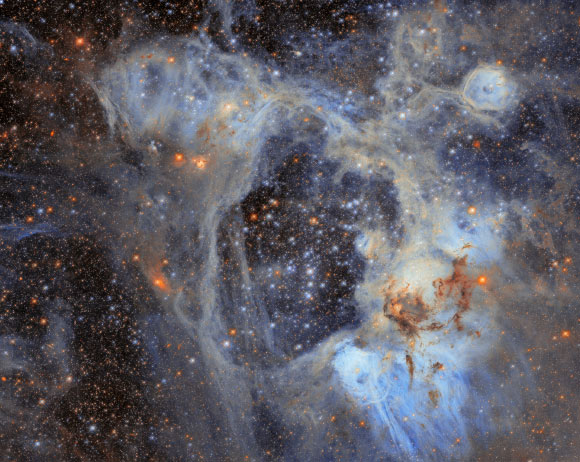
A new images from the NASA/ESA Hubble Space Telescope reveals LHA 120-N44, a striking nebula located roughly 160,000 light-years away in the Large Magellanic Cloud, a satellite galaxy of the Milky Way.
Astronomers monitoring an unusual young neutron star report a stellar surprise after years of apparent silence, as the space object has displayed sudden changes in its rotation, including one large event they characterize as a “glitch” that could point to evidence of exotic matter.
The discovery involves a 41,000-year-old pulsar known as PSR J1637−4642, which completes each of its rotations approximately every 154 milliseconds. Glitches like the one recently observed by astronomers are common for young pulsars like this, although this one had shown no similar behavior for close to a decade after its initial discovery.
The new observations have prompted questions over why PSR J1637−4642 has suddenly begun to display such activity.
When a Pulsar’s Spin Speeds Up
Pulsars are a variety of neutron stars characterized by their rapid rotation, which releases beams of electromagnetic radiation that can sweep past Earth at frequent intervals. Because of this, it allows astronomers to track their rotation with extreme precision.
Every so often, the regularity of their activity can become interrupted if a pulsar begins spinning more quickly, and scientists currently don’t fully understand what drives these “glitches.” One possible reason they occur involves interactions between the neutron star’s solid exterior and the exotic superfluid material they are believed to contain.
Based on this interpretation of pulsars, the differences in rotation that occur between the crust and their superfluid centers may give rise to the accumulation of angular momentum, which is suddenly transferred to the crust. This may create the energy required to speed up their observable rotation.
More Than a Decade of Observations
The research, led by Zhaoyi Wang of Xiamen University, looked at more than fifteen years of observations collected using Australia’s Murriyang radio telescope at Parkes. Based on their analysis, three rotational glitches were detected, beginning with a particularly powerful event that occurred in 2018.
At that time, the frequency of the pulsar’s rotation abruptly increased by around 17.54 microhertz—a fractional change of roughly 2.7 parts per million. The two other, much smaller glitches followed at around three years and 2.7 years later.
“PSR J1637−4642 adds to the growing class of young pulsars that exhibit large glitches after extended intervals of apparent quiescence,” the researchers write in a recent study detailing their findings.
During observations of PSR J1637−4642, astronomers found that its most significant glitch didn’t end immediately, and instead underwent a gradual period where it relaxed over more than 100 days of monitoring.
“Our results demonstrate that even ‘quiet’ pulsars can harbor significant glitch activity,” the researchers conclude.
Ultimately, the several years of silence exhibited by this pulsar before its sudden, massive glitch may represent the culmination of a period during which stresses accumulated over time, building up to an unusual detection by astronomers that offers new insights into this peculiar class of stars.
The team’s findings were reported in a recent study, “Discovery of Three Glitches in the previously quiet pulsar PSR J1637−4642,” which was uploaded to the arXiv preprint server and has been accepted for publication in the Astrophysical Journal Letters.
Micah Hanks is the Editor-in-Chief and Co-Founder of The Debrief. A longtime reporter on science, defense, and technology with a focus on space and astronomy, he can be reached atmicah@thedebrief.org. Follow him on X @MicahHanks, and at micahhanks.com.
PG&E just expanded its Vehicle-to-Everything (V2X) program, adding EVs from Tesla, Kia, Volvo, Polestar, and Nissan and opening up as much as $17,000 in incentives to turn a car into home backup power.
The California utility brought in Bidirectional Energy and PowerFlex as approved partners, and drivers now have until June 30, 2027 to enroll.
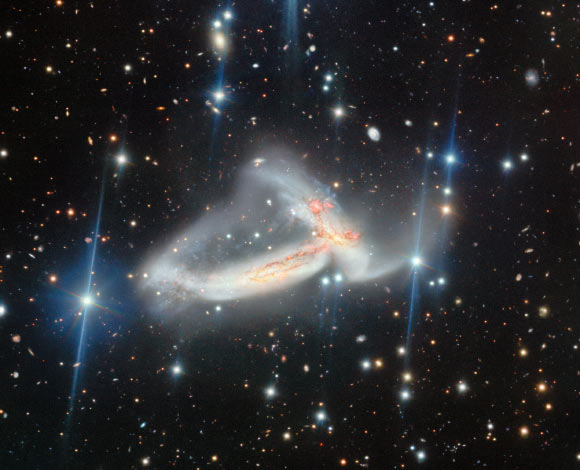
A new image from the Gemini North telescope on Maunakea in Hawai’i offers the sharpest look yet at a striking pair of interacting spiral galaxies, cataloged as NGC 7253.
Polestar launched the Polestar 4 SUV today, a new body style of its compact executive electric SUV that starts at €57,900 and delivers up to 630 km of WLTP range.
The bigger news for anyone who followed the original car: unlike the Polestar 4 coupé, the SUV has an actual rear window.
Recorrendo a uma tecnologia de IA patenteada que adapta o som à sua localização, hora do dia e frequência cardíaca, a Endel é usada por milhões de pessoas em todo o mundo para melhorar o sono, a concentração e o bem-estar.
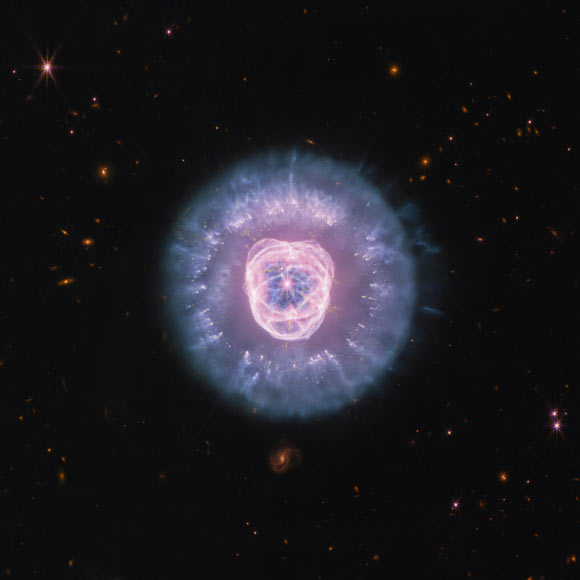
New infrared observations of the Eskimo Nebula, a bipolar double-shell planetary nebula in the constellation of Gemini, reveal clumps of dust, ionized gas and expanding shells surrounding a central star.
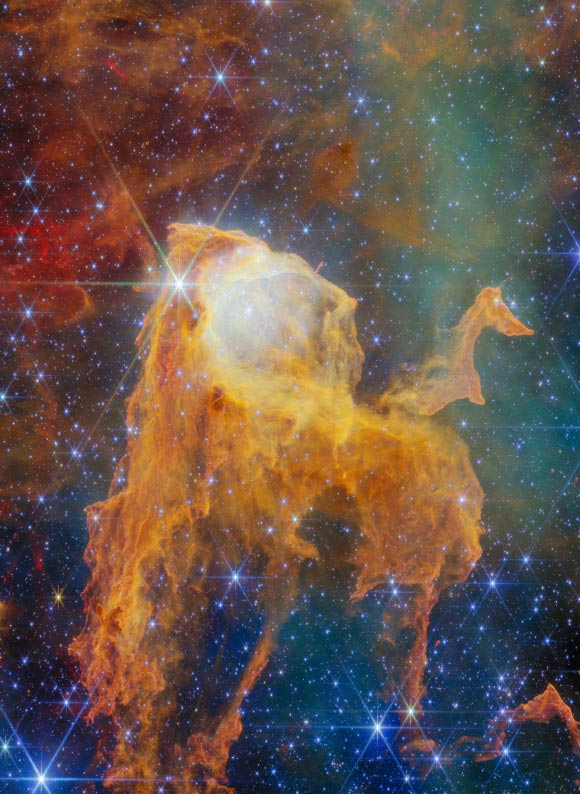
A stunning new image from the NASA/ESA/CSA James Webb Space Telescope reveals a comet-shaped cloud in the Carina Nebula hiding a cluster of about 70 young stars, including a rare giant of O-type nearly 19 times as massive as the Sun.
An unusual dead star displaying one of the strongest magnetic fields astronomers have ever seen may offer the clearest evidence yet that regions of space appearing to be void of matter are anything but empty.
An international team of astronomers has revealed that the magnetar 1E 1547-5408 displays behavior consistent with vacuum birefringence, a phenomenon first predicted almost a century ago, but never directly observed—until now.
The findings, detailed in a new study published in the journal Nature, were the product of more than 140 hours of observations in 2025 using NASA’s Imaging X-ray Polarimetry Explorer (IXPE), the Neutron Star Interior Composition Explorer (NICER), and Australia’s Murriyang radio telescope.
Artist’s concept of NASA’s Imaging X-ray Polarimetry Explorer (IXPE), one of the platforms that made the recent magnetar discoveries possible (Image Credit: NASA)
Spying on the Universe’s Most Extreme Objects
Ranking among the most extreme objects known to astronomers, magnetars are a variety of neutron stars that display unusually strong magnetic fields.
These extreme celestial objects pack more mass than our Sun into a region of space spanning only a few miles; yet they also manage to generate magnetic fields that are sometimes as much as trillions of times that of our planet.
For the recent study, scientists focused on 1E 1547-5408, a magnetar that spins once every two seconds. This magnetar is atypical since it also emits both intense X-rays and bright radio waves. Measuring the polarization of light it produces, researchers were able to discern that X-ray polarization was almost three times stronger than expected, based on current models that characterize the star’s surface, as well as the geometry of its magnetic field.
An Unusual Signal Emerges
The observed characteristics were unexpected, and to explain this, the researchers looked to the concept of vacuum birefringence, a phenomenon originally predicted in 1936. This predicts that magnetic fields possessing enough power could potentially alter the vacuum of space.
According to quantum theory, the vacuum of space isn’t truly empty—it is filled with fleeting “virtual” particles, and when subjected to the influence of such a strong magnetic field, the quantum vacuum is predicted to behave like an extremely large optical filter, whereby light that passes through it is subtly changed, with its polarization increasing.
Based on computer simulations, the researchers found that the proposed vacuum birefringence phenomenon produced results that appeared to be consistent with both the X-ray and radio observations.
Hoa Dinh Thi, a researcher at Rice University and the recent study’s co-lead author, said the team’s model “suggests that reproducing the observed X-ray polarization signatures, while also satisfying the constraints set by radio observations, requires the presence of vacuum birefringence in the neutron star’s environment.”
“This finding exemplifies how neutron stars enable us to test fundamental physics in environments not replicable in labs on Earth,” Thi added.
Although the team says further observations will be required to confirm their findings, their current results offer the strongest evidence to date for one of the longest-standing predictions in quantum physics.
If confirmed through future observations of magnetars, such findings could reveal the presence of other exotic phenomena that may provide astronomers with a unique opportunity to explore the fundamental nature of space itself—and potentially even more surprises in regions of the cosmos that were long assumed to be “empty.”
Micah Hanks is the Editor-in-Chief and Co-Founder of The Debrief. A longtime reporter on science, defense, and technology with a focus on space and astronomy, he can be reached atmicah@thedebrief.org. Follow him on X @MicahHanks, and at micahhanks.com.
Desenvolvida por um programador independente, a Helys usa uma fórmula científica que considera o seu tipo de pele, localização, hora do dia, condições meteorológicas e índice UV para calcular, em tempo real, quanto tempo de exposição solar é seguro e suficiente. Disponível gratuitamente apenas para iOS.
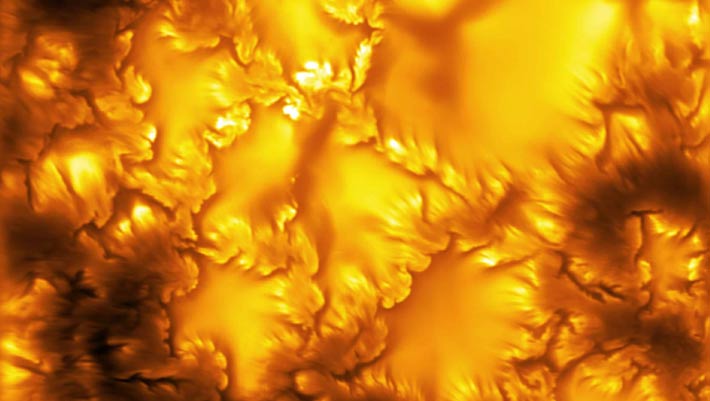
Astronomers using the 4-m Daniel K. Inouye Solar Telescope in Hawaii have detected tiny plasma vortices on the Sun’s surface (photosphere) for the first time, revealing a long-suspected process that could transport energy into the million-degree corona.
Pluto’s tenuous atmosphere appears to have begun contracting after years of holding steady, according to a new study published in the Planetary Science Journal.
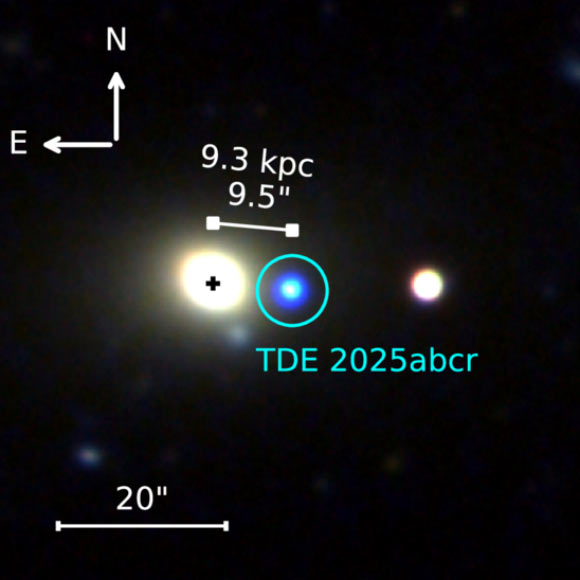
Astronomers have discovered a dormant supermassive black hole 30,000 light-years from the center of WISEA J014656.04-152214.7 -- a massive galaxy located about 750 million light-years away in the constellation of Cetus -- after it briefly lit up by tearing apart a star.

 Login