Charlotte Henry and Chuck Joiner catch up after a brief break to discuss the first looks at Silo Season 4, Neuromancer, and the return of Ted Lasso. The issue of adaptation versus original storytelling, speculation on Apple TV strategy are debated from the new leadership perspective. The hosts also share their expectations for upcoming releases. […]
A resource for checking Mac external-display support, Comcast’s move away from NBCUniversal, Peacock’s streaming and sports strategy, and whether broadband offers a stronger business model than media all started off this MacVoices Live! conversation. Chuck Joiner, David Ginsburg, Brian Flanigan-Arthurs, Ben Roethig, Eric Bolden, Marty Jencius, Jeff Gamet, Norbert Frassa, Jim Rea, and Web Bixby examine Apple Invites and question why so many Apple features launch with fanfare but receive little sustained development.
Charlotte Henry and Chuck Joiner examine Apple TV’s strategy through the expansion of Monarch: Legacy of Monsters, the theatrical release of Tenzing, and Eddie Cue’s Cannes Lions recognition. They compare Apple’s stated quality-over-quantity approach with Netflix’s engagement-first model, then consider F1 sequel plans and speculate on what smart glasses could mean for the streaming service from […]
Charlotte Henry and Chuck Joiner explore how Apple TV connects sports, entertainment, and corporate strategy, from World Cup coverage and the After the Whistle podcast to Slow Horses and global storytelling. They debate Tim Cook’s visible Hollywood presence, his role in the service’s growth, and how future leadership could shape Apple’s streaming ambitions.
The MacVoices Live! panel examines backlash around Apple rumor reporting, especially Vision Pro speculation and the impact of click-driven headlines on developers and readers. Chuck Joiner, David Ginsburg, Marty Jencius, Eric Bolden, Brian Flanigan-Arthurs, Jeff Gamet and Mark Fuccio then turn to Bartender’s return after past trust concerns, alternatives for menu bar management, and whether […]
Charlotte Henry and Chuck Joiner discuss Apple TV’s sports and awards momentum, from Lionel Messi’s expanding U.S. profile and Friday Night Baseball visibility to major BAFTA and Tony recognition. They also examine how awards influence viewer choices, upcoming Apple TV projects with John Travolta and James Marsden, and frustrations with subtitle handling in multilingual shows.
The MacVoices Live! panel discuss privacy, AI, and digital trust, comparing Meta’s Instagram encryption rollback with Apple’s RCS encryption in Messages. Chuck Joiner, David Ginsburg, Eric Bolden, Brian Flanigan-Arthurs, Marty Jencius, and Jeff Gamet also examine an AI lawsuit involving a chatbot posing as a doctor, plus AI customer service, Apple Wallet, and user trust in technology.
The MacVoices Live! panel examine Apple’s quarterly earnings, the continuing importance of Services revenue, and what John Ternus’ presence on Apple’s earnings call may indicate about Apple’s future leadership transition. Chuck Joiner, David Ginsburg, Eric Bolden, Brian Flanigan-Arthurs, Marty Jencius, and Jeff Gamet discuss the Apple Vision Pro and the newest wave of “Vision Pro is doomed” commentary. They argue that Vision Pro should be viewed as an early-stage platform product that still needs more time, more content, more developer support, and a larger installed base before its long-term value can be fairly judged.
The fully-integrated LEMS (Lunar Environment Monitoring Station) ready for environmental testing. A small suitcase-size instrument suite built at NASA Goddard, LEMS is designed to carry out continuous, long-term monitoring of the seismic environment at the Moon, including surface motion caused by moonquakes and meteorite impacts in the lunar south polar region.
NASA Goddard/Mike Guinto
NASA has declared “wrenches down” on the first completed payload designed for Artemis astronauts to deploy on the Moon’s surface. Engineers working on NASA’s Lunar Environment Monitoring Station, or LEMS, have completed hardware development and testing and the payload is ready for its permanent home near the lunar South Pole. With the hardware complete, LEMS is ready to support one of the Artemis program’s core goals: enabling sustained lunar science and exploration.
The LEMS instrument package contains two highly sensitive seismometers that will monitor ground vibrations from moonquakes and meteorite impacts, providing scientists with insights into the Moon’s interior and the seismic hazards astronauts might encounter at the surface. Its modular design allows the system to be adapted or expanded to host new instruments in the future, creating a reusable platform that can evolve as scientific priorities grow.
The payload will remain in a clean room at NASA’s Goddard Space Flight Center in Greenbelt, Maryland, where it was built, until it is assigned to an Artemis mission for deployment to the lunar surface.
“The completion of the LEMS scientific instrument is a major step in a new era of lunar surface science. Innovative science experiments will uncover, measure, and reveal the Moon’s secrets while astronauts open new frontiers for discovery,” said Joel Kearns, deputy associate administrator for exploration, Science Mission Directorate, NASA Headquarters in Washington. “And, behind the scenes, countless teams across NASA and our partners are pushing the boundaries of what surface instruments can do, building the tools that will make future exploration possible and safer.”
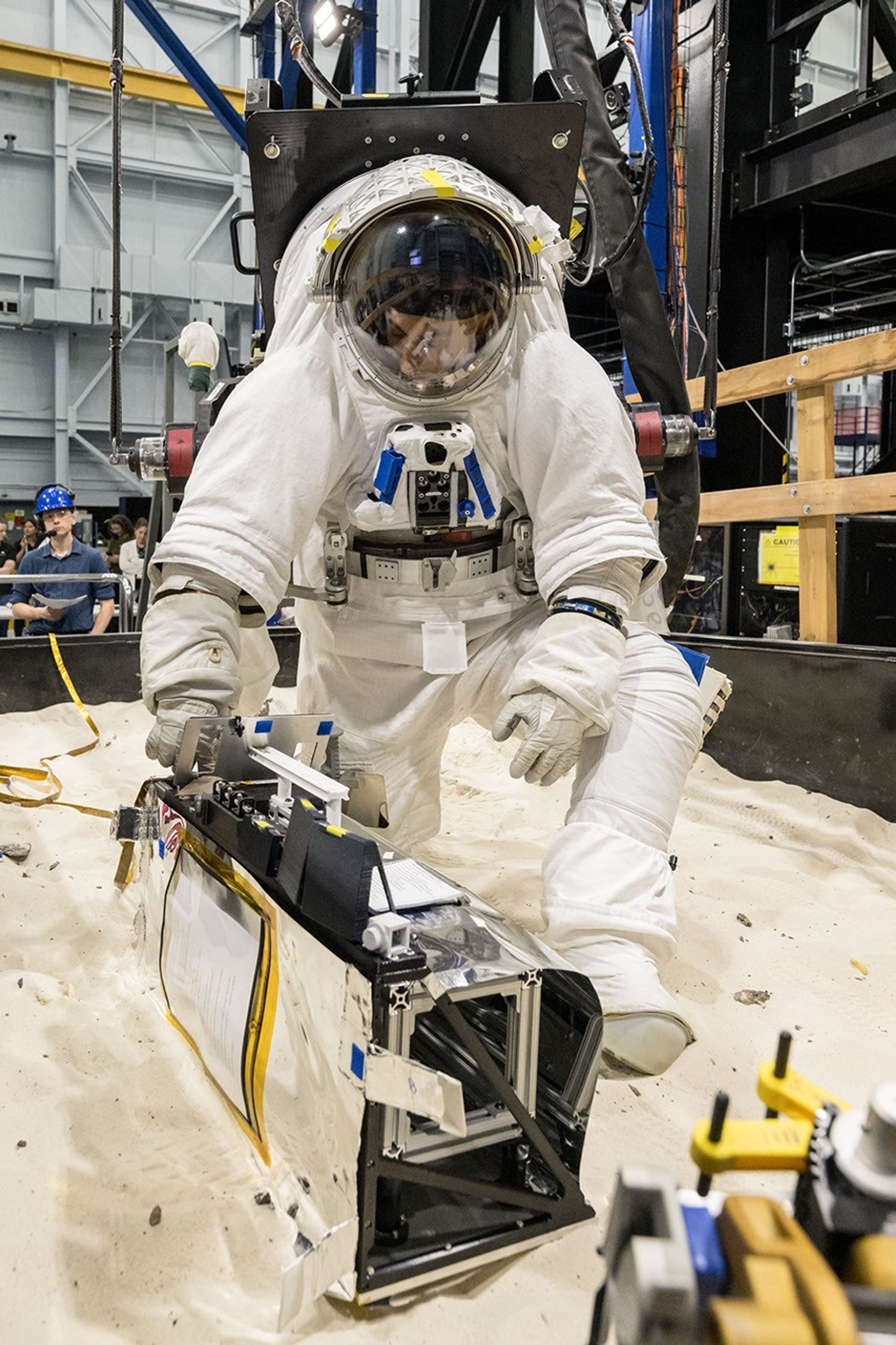
A scientist wearing NASA’s xEMU prototype space suit is testing the handling of a mockup version of NASA’s Lunar Environment Monitoring Station, or LEMS. The testing took place at the Active Response Gravity Offload System, a simulated reduced gravity environment at NASA’s Johnson Space Center in Houston.
NASA Johnson
The LEMS payload builds on a legacy of lunar seismic tracking. Apollo astronauts deployed a network of seismometers on the Moon’s nearside equatorial region between 1969 and 1972. Those instruments operated until 1977, recording about 13,000 moonquakes and other ground vibrations that helped scientists begin to understand the composition of the Moon’s interior. For decades, researchers have hoped to spread more seismometers, updated with new technologies, across the lunar surface.
Now, LEMS will carry the first seismometers to be deployed by future astronauts to listen for faint ground vibrations, collecting new clues to the Moon’s internal structure and ongoing seismic activity. The sensors will be the most compact, sensitive, and energy-efficient seismometers ever built for planetary exploration.
LEMS itself is about the size of a small suitcase, weighing 11 pounds in the Moon’s low-gravity environment. It will carry not just these seismic sensors, but everything it needs to function independently of humans after deployment. LEMS is built to manage its own power production via a lightweight, flexible solar array that conforms to the shape of the LEMS unit. It also will manage its operational activities to ensure continuous data collection based on a preset plan, and monthly data transmission to Earth. The payload will do all this while maintaining a stable internal temperature throughout the massive day-to-night temperature swings of the South Pole region.
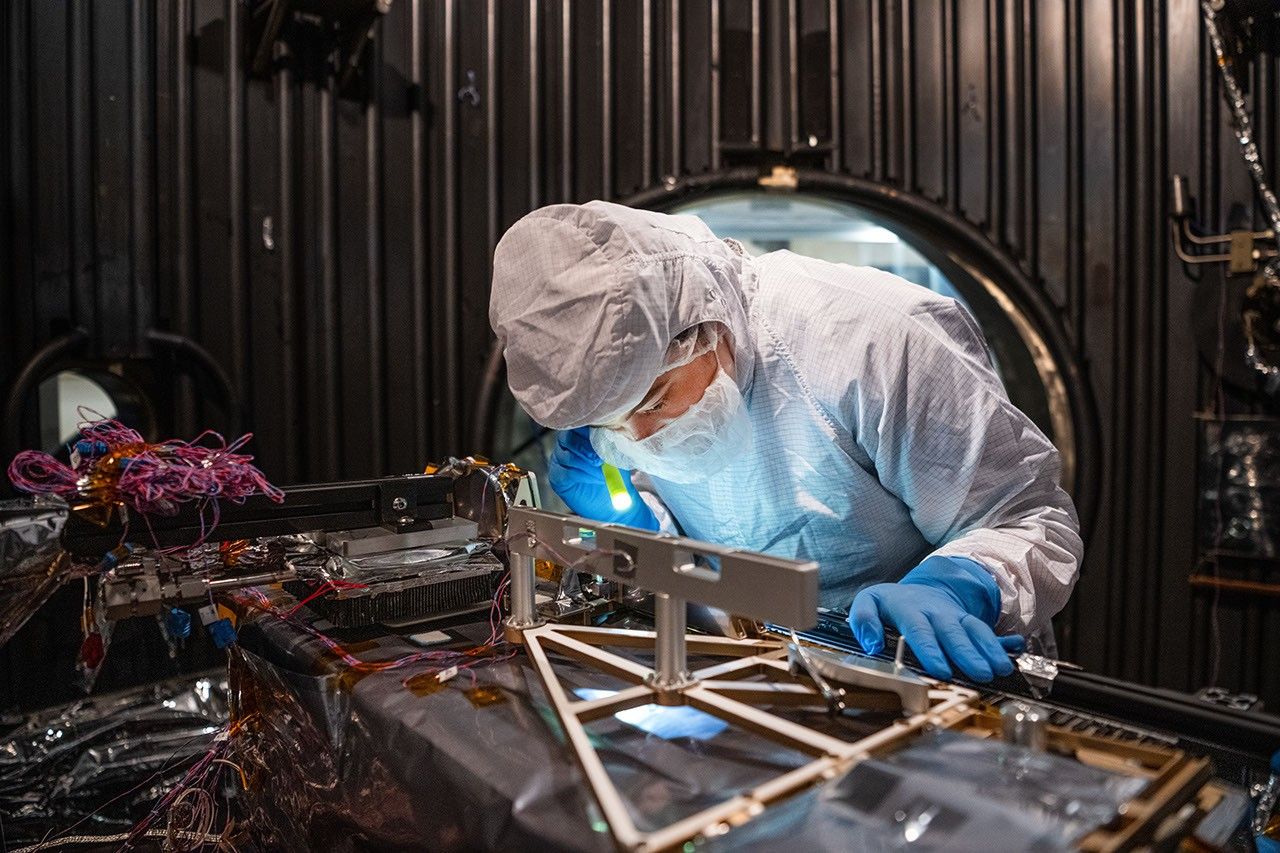
Mechanical Engineer Brie Ludwig inspects the Lunar Environment Monitoring Station (LEMS) in preparation for testing in a thermal vacuum chamber at Goddard Space Flight Center in Greenbelt, Maryland, on March 31, 2026. LEMS is a compact, autonomous, and self-sustaining seismometer suite designed to carry out continuous, long-term monitoring of the lunar seismic environment at the South Polar region.
NASA/Denny Henry
“When we conceived of LEMS, we weren’t just thinking about the next mission, we were thinking about the next generation of lunar exploration,” said Mehdi Benna, a University of Maryland Baltimore County scientist who leads LEMS from NASA Goddard. “Our vision was to create a scientific buoy for the Moon. Like an ocean buoy on Earth, LEMS is designed to be easy to build, adaptable to different scientific objectives, and capable of operating independently for years.”
Before any surface science could happen, Benna and his team had to ensure that LEMS could survive the trip to the Moon and the harsh environment of its surface. Over the past five months, LEMS and its components have been subjected to a demanding series of environmental and operational tests. Engineers verified LEMS can endure the violent shaking of launch, the journey to the lunar surface, and the Moon’s temperature and radiation environment. The team also showed that the instrument package’s mechanical and electrical design is safe for astronaut handling.
The LEMS payload was built to operate through the lunar night, which lasts two Earth weeks, without external power assistance or a heat source. Past lunar surface instruments relied on radioisotope heaters for warmth and power. But LEMS instead will withstand temperatures that dip to minus 400 degrees Fahrenheit in some areas by using advanced insulation materials, low-thermal-conductivity cables that minimize heat loss, and a thermal regulator that conducts heat away during the day to prevent overheating and helps retain heat at night.
These innovations reduce mass and power needs, setting the stage for lighter, energy-efficient instruments that can operate continuously at future Artemis landing sites and the NASA-led Moon Base.
The LEMS payload is led by University of Maryland Baltimore County and University of Maryland College Park. Technical implementation is led by NASA Goddard. The University of Arizona, in partnership with Silicon Audio, Inc., supplied LEMS’ two state-of-the-art seismometers. Morehead State University in Kentucky provided LEMS’ telecommunication system and will operate the instrument on the surface. Washington University in St. Louis will manage the instrument’s data processing and dissemination to the larger scientific community.
Researchers found that dexamethasone eye drops may reduce the risk that retinopathy of prematurity advances to the treatment stage. For babies born extremely early, abnormal blood vessel growth in the retina can threaten their sight before they leave the hospital. Researchers in Sweden have now completed the world’s first randomized clinical trial testing whether cortisone [...]
Bonfire series planned for Apple is no longer proceeding at the streaming service, ending the latest attempt to transform Tom Wolfe’s The Bonfire of the Vanities into an episodic television drama.
The project had assembled a notable creative team. David E. Kelley was attached to write and executive produce, while The Batman director Matt Reeves was expected to direct the eight-episode adaptation and serve as an executive producer through his 6th & Idaho Productions company.
Warner Bros. Television was producing the series, with Sarah Geismer representing 6th & Idaho and Matthew Tinker participating through David E. Kelley Productions.
According to industry reports, Apple and the creative team were not aligned on the direction of the adaptation. Kelley was also reportedly dissatisfied with how the development process had been handled. The exact source of the disagreement has not been disclosed.
Apple has not announced the project as a formal cancellation, and it never received a public premiere date or cast. Its departure from Apple instead ends one stage of development while leaving Warner Bros. Television with the possibility of taking the adaptation elsewhere.
Tom Wolfe’s | Image Source: Google
Apple Ends the Project After Four Months
News of the Bonfire series first emerged in April 2026. Kelley was expected to write the adaptation after working with Apple on Presumed Innocent and Margo’s Got Money Troubles, while Reeves would direct after completing his existing film commitments.
The partnership appeared well suited to a complicated literary adaptation. Kelley has extensive experience turning novels into television dramas, including Big Little Lies, The Lincoln Lawyer, Nine Perfect Strangers, Presumed Innocent, and Wolfe’s A Man in Full.
Reeves brought a different set of strengths. His work on The Batman, Dawn of the Planet of the Apes, War for the Planet of the Apes, and Cloverfield demonstrated his ability to handle large casts, morally compromised characters, and cities presented as active elements of the story.
The arrangement also connected Warner Bros. Television with Apple’s preference for recognizable creators and established literary properties. Wolfe’s novel offered a prestigious title, a large ensemble, and a view of New York society that could support a limited-series structure.
The development reportedly lasted only a few months before the creative relationship broke down. No actors had been announced, and there was no indication that cameras were close to rolling.
The absence of production activity makes the development easier to stop than a commissioned series with actors, sets, and crews already under contract. It also means Apple can leave the project without abandoning completed episodes or disrupting a release calendar.
Development Never Reached Production
A television project entering development is not the same as a series receiving a complete production order. Writers can prepare scripts, directors can become attached, and studios can negotiate with a streaming service before a final budget or filming commitment is approved.
The Bonfire of the Vanities was widely discussed as an eight-episode Apple adaptation, but Apple never unveiled it through its official press service. The project did not appear with a cast, production date, first-look image, or planned release window.
That distinction makes “stalled” more accurate than suggesting that Apple canceled a finished series. The adaptation remains intellectual property controlled through its rights and production arrangements, but the version developed for Apple has stopped advancing.
Creative alignment can cover several areas, including tone, period setting, episode structure, budget, casting, and how closely a project follows its source. None of those issues has been identified publicly as the specific cause of the disagreement.
The source material presents difficult choices. Wolfe wrote the novel as a detailed portrait of 1980s New York, with Wall Street, tabloid journalism, city politics, race, class, and personal ambition colliding around a single incident.
An adaptation could preserve that period or move the story into a contemporary financial and media environment. Keeping the 1980s setting would retain the social ecosystem Wolfe observed, while modernization would require substantial changes to technology, journalism, policing, politics, and the financial industry.
Reports of creative differences do not establish which approach Apple, Kelley, Reeves, or Warner Bros. preferred. Until one of the parties discusses the project, the disagreement remains undefined.
Image Credit: AppleMagazine
A Difficult Novel to Translate
Published in 1987 after being serialized in Rolling Stone, The Bonfire of the Vanities follows Sherman McCoy, a wealthy bond trader who considers himself a “Master of the Universe.”
McCoy’s protected life begins collapsing after he and his mistress take a wrong turn into the Bronx. Their encounter with two young Black men ends in a hit-and-run, creating an opportunity for journalists, attorneys, politicians, activists, and social climbers to exploit the case.
The novel spreads its attention across several communities and institutions. Its satire depends on the reader observing how each group manipulates the incident while claiming moral authority. That scope gives television more room than a feature film, but it also requires precise control of perspective and tone.
Brian De Palma directed the previous film adaptation, released by Warner Bros. in 1990. Tom Hanks played Sherman McCoy alongside Melanie Griffith, Bruce Willis, Morgan Freeman, Kim Cattrall, and F. Murray Abraham.
Despite the cast and an estimated production budget of approximately $47 million, the film earned about $15.6 million domestically. Critics objected to its casting, tonal decisions, and changes to Wolfe’s characters.
The difficult production later became the subject of Julie Salamon’s The Devil’s Candy, a detailed account of how an expensive adaptation made by accomplished filmmakers deteriorated through compromises and conflicting decisions.
The film’s reputation has followed every subsequent effort to revisit Wolfe’s novel. A television version has frequently been proposed as a better format because it can preserve more characters, institutional detail, and social context.
Amazon began developing an eight-episode adaptation in 2016 with Chuck Lorre and Warner Bros. Television. That version was intended to update the story while approaching it through themes of race, class, politics, and media. It never entered production.
Apple’s attempt therefore becomes another chapter in a long development history rather than the first revival since De Palma’s film.
The Kelley Relationship May Continue
The collapse of this project does not necessarily end David E. Kelley’s relationship with Apple. His adaptation of Presumed Innocent became a major drama for the service, while Margo’s Got Money Troubles expanded his work with the company into comedy-drama.
Large producers and streaming services regularly continue working together after deciding against an individual project. Each adaptation has its own creative, financial, and scheduling demands.
The reported dissatisfaction does introduce uncertainty around whether Kelley would remain involved if Warner Bros. Television places the series with another distributor. Reeves’ position is similarly unknown, particularly because directing all eight episodes would require a substantial scheduling commitment.
Apple can continue expanding its collection of literary adaptations without Bonfire. Its existing slate includes projects derived from novels, nonfiction books, short stories, podcasts, and magazine reporting, often with established filmmakers receiving considerable creative control.
The decision also illustrates how selective Apple can be before production. Projects in development may attract prominent writers and directors without ever becoming Apple Originals available to subscribers.
Warner Bros. Television remains attached as the studio behind the adaptation, giving it a potential route to another streaming service or network. No new buyer, revised creative team, or timetable has been reported for The Bonfire of the Vanities.

 Login