❌

Reading view

Trump Vows to Reverse EU Fines Against Apple and Other Tech Companies, Threatens Tariffs

U.S. President Donald Trump today said on Truth Social that his administration plans to launch an investigation into fines the European Union has levied against tech companies like Apple, Google, and Meta for violating antitrust and Digital Markets Act rules.


Trump called the European Union's conduct "illegal and highly unethical," vowing to get the penalties reversed and planning to institute a "substantial tariff."
The European Union is at it again and, as usual, taking direct aim at GREAT American Companies! After having fined Apple, for no reason at all, 15 Billion Dollars, Meta, 3 Billion Dollars, Amazon 2.5 Billion Dollars, and many others, we have just been informed that Google, a truly advanced and amazing group, has been fined yet another 1 Billion Dollars, without explanation. This brings the Google total to over 18 Billion Dollars! This illegal and highly discriminatory practice started at these high levels during the first year of the Sleepy Joe Biden Administration, but it's not going to continue during the Trump Administration. The United States of America is not a "PIGGYBANK" for Europe, nor will we allow it to be! Please let this TRUTH serve to represent that we will immediately initiate a 301 Investigation into the practice of "ROBBING" American Companies and, in turn, the American Taxpayer. The European Union will pay a very big price for this illegal and highly unethical conduct, which I have consistently warned them about. The penalties will be entirely reversed and, we anticipate, a substantial TARIFF to be placed on them at the earliest possible moment.

Apple was fined $570 million in 2025, ‌Meta‌ was fined $840 million in 2024 and $200 million in 2025, and Google was fined $1 billion this week after a $4.5 billion Android fine was upheld earlier this month.

Trump previously threatened European tariffs if the EU did not stop targeting U.S. companies, and the Office of the United States Trade Representative has also threatened to implement fees and restrictions on European services and companies.

Trump has focused heavily on tariffs during his second term, affecting U.S. companies and consumers. A 10 percent blanket tariff Trump enacted earlier this year expired today. The Trump administration implemented new tariffs to replace them, accusing 60 countries of failing to "impose and effectively enforce a prohibition on the importation of goods produced with forced labor." The tariffs will affect goods from the UK, China, and the European Union, among others.
This article, "Trump Vows to Reverse EU Fines Against Apple and Other Tech Companies, Threatens Tariffs" first appeared on MacRumors.com

Discuss this article in our forums
  •  

AI firms want more data centers; Trump's EPA may give neighbors less say

The Trump administration is quietly considering a rule change that could make it easier for polluters to build facilities—including certain gas plants and diesel generators that power data centers—with little to no notice to the public.

On Wednesday, the Environmental Protection Agency held a public hearing on a proposed rule change that would hand the power to states to decide how the public participates in the permitting process for certain new sources of air pollution. The proposed rollback comes as data centers face greater pushbackacross the US, with many communities using the permitting process to try to slow down development. Any changes could have major consequences for how ordinary people are given notice about new or expanded polluting facilities coming into their neighborhoods.

“As someone actively working in communities with data centers, I know this to be fundamentally true: People want to have a say,” Vanessa Lynch, a Pennsylvania organizer with Moms Clean Air Force, said at the EPA hearing.

Read full article

Comments

© Getty Images

  •  

Trump says nearly 200 firms have signed pledge to protect Americans from costs arising from datacenters

‘Ratepayer Protection Pledge’ president has touted is non-binding as people continue to struggle with rising bills

Donald Trump has announced that about 200 entities have signed on to his non-binding “Ratepayer Protection Pledge”, expanding a voluntary commitment which claims to ensure US consumers will not bear the cost of the AI datacenter build-out.

Trump delivered remarks on Thursday at the Environmental Protection Agency (EPA) headquarters, alongside Lee Zeldin, the agency’s administrator, and Chris Wright, the energy secretary. Other attenders included governors who signed on to the pledge, including Brian Kemp of Georgia, Mike DeWine of Ohio, Spencer Cox of Utah and Jeff Landry of Louisiana.

Continue reading...

© Photograph: Bloomberg/Getty Images

© Photograph: Bloomberg/Getty Images

© Photograph: Bloomberg/Getty Images

  •  

Nuclear Energy Revival Puts Westinghouse in Prime Position

The company, which filed for bankruptcy protection in 2017, stands to benefit from growing support for nuclear power and President Trump’s deal with Saudi Arabia.

© Mike Stewart/Associated Press

Cooling towers at the nuclear reactor facility at the Alvin W. Vogtle Electric Generating Plant in Waynesboro, Ga.
  •  

White House report says Trump can usher in a "new golden age" of science

On Tuesday, the White House Office of Science and Technology Policy (OSTP) released a report entitled "Science: A New Golden Age," in which it lays out how it has viewed science, found it lacking, and believes the Trump administration is in the perfect position to fix things. It's a bit unexpected coming from an administration that has been proposing crippling funding cuts to research and trying to enable political appointees to terminate grants awarded based on scientific merit.

The report presents itself as the spiritual successor of "Science, the Endless Frontier," a policy document that laid out the case for government-funded science in the wake of World War II. The New Golden Age (SNGA) says that, while the concepts promoted by the original remain vital, the circumstances have changed such that we need major revisions to how the government is implementing things.

The result is an odd mix. It completely ignores or glosses over many things that the administration is doing to harm scientific progress. In some cases, it identifies issues that have already been discussed as problems within the scientific community, but misrepresents them. Elsewhere, it's a mixture of political grievances, ideas without a solid intellectual foundation, and an injection of Silicon Valley's perspective on innovation (Michael Kratsios, the director of the OSTP, formerly worked with Peter Thiel). As a result, it's unlikely to have anything like the impact of "Science, the Endless Frontier."

Read full article

Comments

© Bloomberg

  •  

Saudi Arabia and US strike deal for kingdom to enrich uranium

Donald Trump approves agreement to help country make fuel for civilian nuclear programme

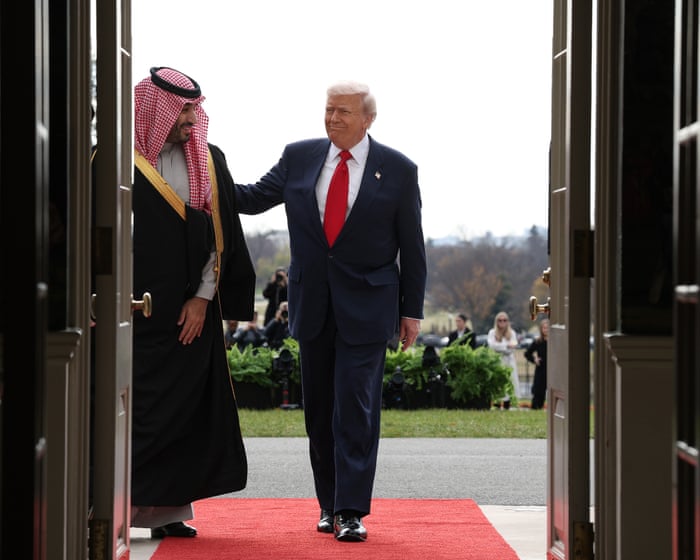
Donald Trump signed a nuclear agreement with Saudi Arabia on Wednesday that could enable the kingdom to enrich its own uranium for nuclear reactions.

The US energy secretary, Chris Wright, and his Saudi counterpart, Prince Abdulaziz bin Salman, signed “a peaceful nuclear cooperation agreement” and “an accompanying bilateral safeguards agreement,” according to a statement from the US Department of Energy.

Continue reading...

© Photograph: Win McNamee/Getty Images

© Photograph: Win McNamee/Getty Images

© Photograph: Win McNamee/Getty Images

  •  

Cameron Hamilton Poised to Lead FEMA Once More

Cameron Hamilton defended the agency last year when President Trump talked about eliminating it. Emergency managers hope for more stability if he’s confirmed as administrator.

© Andrew Harnik/Getty Images

Just over a year after being fired, Cameron Hamilton is on the brink of assuming the helm of FEMA once again.
  •  

The U.S. Is Pulling Back on Energy Efficiency

The Trump administration is undoing fuel-saving efforts even as war in Iran, data centers and heat waves are pushing up gasoline and electricity costs.

© Michael Hickey/Getty Images

A dishwasher at a General Electric plant in Louisville, Ky. The Energy Department has moved to repeal 17 standards for dishwashers, washing machines, kitchen appliances and more.
  •  

Trump Attacks National Academies Over Climate Chapter in Judges’ Manual

The president joined Republican officials who slammed the National Academies of Sciences for a chapter about climate science in an educational guide for judges.
  •  

US launches 10th round of strikes as Iran says it is in ‘full-scale war’

Diplomats say de-escalation talks continue as Trump vows retaliation over US soldier deaths

The US military said it has launched its 10th consecutive round of strikes on Iran to force the reopening of the strait of Hormuz.

Earlier on Monday, Iran’s president said the country is in a “full-scale war” after the US expanded its aerial campaign and Tehran struck Washington’s Gulf allies, even as diplomats said talks to de-escalate were continuing.

Continue reading...

© Photograph: US Central Command (CENTCOM)/AFP/Getty Images

© Photograph: US Central Command (CENTCOM)/AFP/Getty Images

© Photograph: US Central Command (CENTCOM)/AFP/Getty Images

  •  

Trump Attacks National Academies Over Climate Chapter in Judges’ Manual

The president joined Republican officials who slammed the National Academies of Sciences for a chapter about climate science in an educational guide for judges.

© David Coleman/Alamy

The National Academies of Sciences building in Washington, D.C.
  •  

Truth Social Parent to Sell Faster Access to Trump’s Posts

The product, Truth API, could give Wall Street trading firms an edge in seeing President Trump’s posts on the social media platform he partly owns.

© Allison Robbert/Associated Press

A Truth Social booth at the Great American State Fair on the National Mall in Washington this month.
  •  

Trump admin secures record $265 billion TSMC investment in U.S. semiconductor manufacturing, adding 4 new facilities for total of 12

TSMC

In a major boost to American domestic manufacturing, the Trump Administration today announced that Taiwan Semiconductor Manufacturing Company (TSMC) is committing an additional $100 billion in investments for advanced semiconductor facilities in the United States. This brings TSMC’s total planned investment to $265 billion — one of the largest foreign direct investments in American history.

The announcement, made jointly by the White House and the Department of Commerce, highlights the success of strategic trade and investment partnerships, particularly the historic U.S.-Taiwan deal signed in January 2026. As a direct result, TSMC will build four additional advanced semiconductor manufacturing and packaging facilities, bringing its U.S. footprint to 12 leading-edge facilities, primarily in Arizona.

Building on Momentum

This latest expansion builds on previous commitments. TSMC’s original plans started at around $65 billion, which were later increased. The new infusion underscores sustained momentum under the current administration’s focus on reshoring critical supply chains.

In a statement, U.S. Commerce Secretary Howard Lutnick emphasized the job-creating impact, “President Trump’s leadership is driving companies to invest in American manufacturing. TSMC’s announcement of an additional $100 billion investment following our historic deal on trade and investment with Taiwan will create tens of thousands of American jobs and bring advanced semiconductor manufacturing back to America.”

TSMC Chairman and CEO Dr. C.C. Wei echoed the sentiment, crediting collaboration with the administration and strong U.S. customer demand, “We appreciate the strong collaboration and support of the Trump Administration, Secretary Lutnick and our leading U.S. customers… This is to support the strong multi-year demand from our leading U.S. customers, and we believe this investment will further foster the development of the U.S. semiconductor ecosystem, strengthen the supply chain, and support significant job creation in the United States.”

Economic and Strategic Impact

The investments are expected to generate significant construction and high-tech jobs, along with billions in indirect economic output. Beyond direct facilities, the broader U.S.-Taiwan trade and investment framework is catalyzing an additional $500 billion in Taiwanese investments — $250 billion in direct semiconductor and related enterprises, plus another $250 billion to strengthen the full supply chain in the U.S.

This move addresses long-standing concerns about reliance on overseas production for advanced chips, especially those critical for AI, defense, automotive, and consumer electronics. By expanding domestic capacity with a world-leading foundry like TSMC, the U.S. strengthens its position in the global semiconductor race while creating high-paying opportunities for American workers.

The Trump Administration’s approach, which combines diplomatic deals, incentives for onshoring, and a focus on national security, continues to yield concrete results in rebuilding America’s industrial base.
‎
MacDailyNews Take: With 12 state-of-the-art facilities on track, America is poised to capture a much larger share of advanced chip production. This not only bolsters economic competitiveness, but also enhances supply chain resilience against geopolitical risks.


‎
Please help support MacDailyNews — and enjoy subscriber-only articles, comments, chat, and more — by subscribing to our Substack: macdailynews.substack.com. Thank you!

Support MacDailyNews at no extra cost to you by using this link to shop at Amazon.

The post Trump admin secures record $265 billion TSMC investment in U.S. semiconductor manufacturing, adding 4 new facilities for total of 12 appeared first on MacDailyNews.

  •  

Trump made $1.4bn from crypto in one year. Is Justin Sun the man who helped him do it?

The entrepreneur is known in Washington as the financial power behind the president’s crypto fortune. How did Sun’s business love-in with the Trump family spiral into dueling lawsuits?

The most infamous financial scandal in US presidential history – the 1920s Teapot Dome affair – involved then president Warren G Harding’s interior secretary, Albert Fall, taking roughly $400,000 in bribes. Adjusted for inflation, that’s about $6m today. Last year, Donald Trump made at least $2.2bn; his single year of income is on the order of 200 to 300 times larger than the bribe that defined “presidential corruption” in the American imagination for a century.

It’s taken for granted that Trump flogs items like Bibles and gold sneakers as a way to wring more money from his loyal base. But of the president’s $2.2bn, at least $1.4bn came from his crypto businesses. That’s an extraordinary achievement, even for an unscrupulous sitting president. How exactly did he do it without any prior background in crypto?

Continue reading...

© Photograph: Bloomberg/Getty Images

© Photograph: Bloomberg/Getty Images

© Photograph: Bloomberg/Getty Images

  •  
❌