Tshopo province in the Democratic Republic of the Congo granted 31 community forest land titles to farmers in May, bringing a total of more than a million hectares of forest in Tshopo under the legal stewardship of local Indigenous peoples. Bantu and Indigenous Mbuti communities have lived in the province for generations, but without official title or control of their own lands and under the ever-present threat of extractive and development projects without their consent. Community Forestry Lands (CFLCs) include community environmental management plans. They also offer legal tenure that’s meant to ensure any development on those forest lands requires the free and informed consent of the communities holding the tenure rights. According to the deforestation-tracking platform Global Forest Watch, Tshopo province lost roughly 46% of its total tree cover between 2002 and 2025, largely driven by timber harvesting, charcoal production and mining. These activities degrade the ecosystem and destabilize the livelihoods and food systems of indigenous peoples. “[E]xtreme poverty is gaining ground among indigenous peoples and local communities, for whom the forest is more of a habitat than a source of vital goods and services,” Alphonse Maindo, director of the environmental NGO Tropenbos DRC that helped the communities obtain CFLCs, told Mongabay’s Didier Makal. The recently granted community forest concessions in Tshopo, when added to other such community management areas, means nearly 6.3 million hectares (15.5 million acres) of secured land in the DRC. That’s an area roughly the size of Togo. Some local residents are planning to start beekeeping and cocoa…This article was originally published on Mongabay
Of the roughly $700 million in total funding, $425 million would be used to upgrade and extend the life of 13 coal plants that otherwise might have closed in the coming years.
A new Magecart campaign is using Stripe's API infrastructure to host the credit card-stealing payload and the data exfiltrated from checkout pages. [...]
The country on Thursday released a national artificial intelligence strategy that focuses on building its sovereign capability and protecting consumers.
Microsoft has announced Coreutils, a new Windows 11 feature that allows developers to run many popular Linux command line utilities natively on Windows from a single binary.
Revealed at this week’s Build 2026 developer conference in Seattle, Coreutils is about reducing what Microsoft terms the “cognitive load” faced by developers when moving between Windows and other platforms.
Currently, accessing the Linux command line utilities that are considered essential in many CI/CD development environments on Windows requires a kludge that involves either opening an emulation such as Git Bash, or a virtualized Windows Linux Subsystem (WSL) terminal.
Both are time-consuming and inefficient. As Microsoft’s announcement puts it: “Developers constantly move between platforms, but familiar commands don’t work consistently, forcing workarounds, lost speed and context switching.”
Coreutils removes the need for this back and forth, allowing developers to run most Linux commands straight from the Windows CMD command prompt, PowerShell, or Windows Terminal.
“Whether you’re moving between Linux, macOS, WSL, containers or cloud environments, the commands and workflows you’ve built over years just work in your Windows environment,” Microsoft said.
Most utilities, but not all
Installed as a single executable (via WinGet: install Microsoft.Coreutils), Coreutils for Windows itself is a Rust rewrite of the GNU uutils/coreutils project that provides commands that are universal across Linux distros.
Fundamental to making Coreutils efficient to manage is the fact that individual Linux commands run from a multi-call executable which maps via NTFS hardlinks pointing to each command. The advantage of this approach is that there’s only one binary to install, one binary to sign, and one binary to patch or update.
However, some Coreutils commands clash with existing CMD or Powershell commands, or are otherwise not possible to execute; Microsoft provides a compatibility table listing conflicts. This means that some commands are not available, specifically: dir, expand, kill, more, timeout, and whoami.
There are also some commands omitted from Coreutils because a command relies on a POSIX Unix/Linux feature that Windows doesn’t implement in a compatible way; some examples are chmod, chown, id, stty, and chroot.
In other cases, the command will execute in one context, CMD, but not in PowerShell. Microsoft explained the complex order of precedence: “Whether the Coreutils version runs depends on the shell, the PATH order, and (for PowerShell) the alias table.”
A new Keck Observatory study indicates that giant planets can spin faster than more massive brown dwarfs, revealing important clues about how planetary systems form and evolve. Astronomers have long suspected that a planet’s mass may be linked to how quickly it spins. In our solar system, Jupiter and Saturn rotate especially fast, each completing [...]
The window to claim a 30% tax credit on your solar panel project is closing July 4th, which means you’ve got just one month left to safe harbor your project and preserve your eligibility – keep reading to find out how.
NASA’s Roman Telescope could reveal 100,000 hidden worlds and rewrite what we know about planets across the Milky Way. NASA’s Nancy Grace Roman Space Telescope is expected to dramatically expand humanity’s catalog of worlds beyond our solar system. Known as exoplanets, these distant planets number nearly 6,300 discoveries so far through NASA missions and other [...]
Neolithic people, not glaciers, moved the Altar Stone -- the six-ton central sandstone megalith at Stonehenge -- from northeast Scotland to Salisbury Plain, according to a new study led by archaeologists from Curtin University and Sheffield Hallam University.
A star caught feeding on its companion has finally revealed the source of some of the galaxy’s most mysterious repeating signals. An international research team led by scientists at the University of Sydney has uncovered the strongest evidence yet explaining the origin of a puzzling type of cosmic signal. Their work has also revealed a [...]
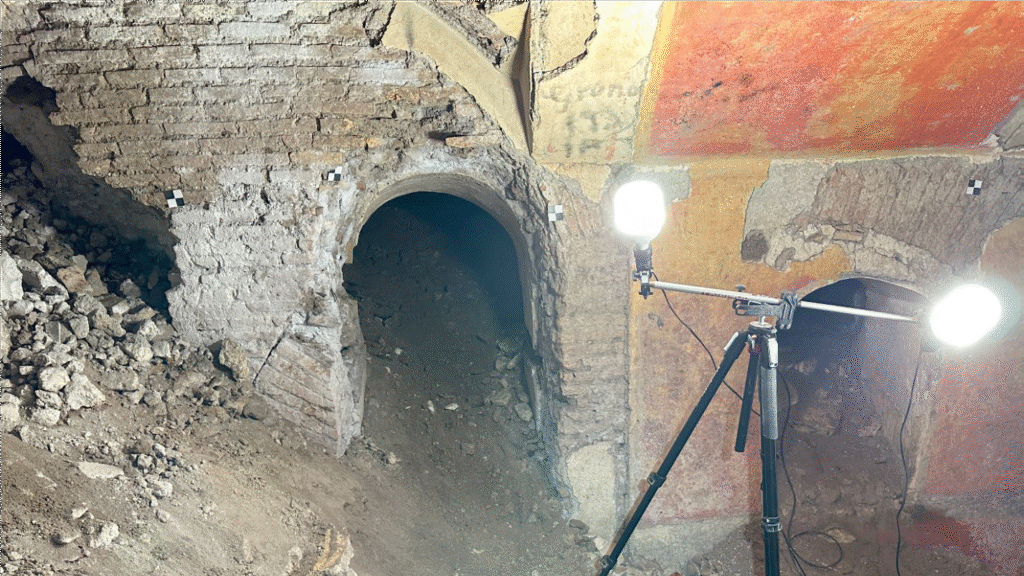
After being notified by mischievous high school students, archaeologists uncovered a large and luxurious second-century Roman house near the Colosseum.
A deep partial lunar eclipse on August 27-28, 2026, will be visible in North America and will be the best lunar eclipse anywhere on Earth until New Year's Eve 2028.

 Login