Researchers at ETH Zurich and the Paul Scherrer Institute in Villigen, Switzerland, have produced a high-intensity beam of muonium atoms in a cold state, an experimental advance that could enable a direct test of whether gravity acts differently on second-generation matter. The peer-reviewed study in Nature Physics describes a new method for generating muonium in superfluid helium. The resulting atoms travel at similar speeds and almost parallel to one another, properties required for a future interferometer that would measure the tiny influence of gravity on muonium.
The study did not conduct that gravitational measurement or find evidence that gravity departs from its expected behavior for ordinary matter; it instead developed the beam source needed for the proposed test. The experiment is designed to examine the universality of free fall and the equivalence of gravitational and inertial mass, a cornerstone of Albert Einstein’s theory of gravitation. In ordinary matter, bodies fall at the same rate at a given point within a gravitational field, while the equivalence principle links gravitational mass with inertial mass.
According to the research team, this principle has so far been demonstrated only with ordinary matter or first-generation antimatter. Muonium is a neutral atom formed from a positively charged antimuon and a negatively charged electron, making it a second-generation probe. A gravity experiment with this exotic atom would test whether the equivalence continues to hold for particles outside the first generation.
Muonium has two characteristics that make it useful for this test: it is neutral, and it belongs to a heavier and less familiar generation of particles. A neutral object allows gravitational behavior to be studied without the weak gravitational signal being masked by stray electromagnetic fields, which can dominate the behavior of charged particles. At the same time, muonium is exceptionally difficult to produce and control.
Its constituent muon decays after only about 2.2 microseconds. Earlier sources generated muonium atoms that flew off in many directions at different speeds and were therefore unsuitable for the precision required in a gravity experiment. The researchers addressed this problem by creating a cold, intense and well-directed beam.
The antimuons were directed into a thin layer of superfluid helium that had been cooled close to absolute zero, at minus 273 degrees Celsius. Superfluid helium is a quantum fluid in which individual helium atoms lose their identity and in which impurities are not tolerated. Lead author Jesse Zhang said the researchers used the superfluid as an “atomic cannon,” exploiting the conversion of chemical potential into kinetic energy to propel the newly formed muonium atoms out of the liquid.
When an antimuon encounters a free electron in the superfluid helium, it forms a neutral muonium atom with positive chemical potential. The atom is forced out of the liquid, and as it reaches the surface, that chemical potential is converted into kinetic energy. The resulting boost sends the muonium vertically out of the helium.
Importantly, the atoms must move through the quantum liquid at a suitable speed without collisions, because excessive scattering would prevent them from reaching the surface within their very short lifetime. The high-intensity antimuon beam from PSI allows many muonium atoms to be generated for the planned experiments. Anna Soter, a professor of physics at ETH Zurich and member of the research team, said the cold state is what makes the proposed gravity experiment possible.
In this context, “cold” does not mean that the atoms are motionless; it means that they propagate at similar speeds and nearly parallel to one another. This improved control over direction and velocity is important because the planned instrument will use the wave properties of the atoms to create an interference pattern. A very small shift in that pattern caused by Earth’s gravitational pull would provide a measure of gravity’s effect on muonium.
The study establishes the upstream beam capability rather than reporting the result of that comparison. The next stage of the program is the development of a muonium interferometer. According to the researchers, they hoped to test the method for the first time with the atomic beam in the year of the announcement and, if that worked as expected, to carry out the actual gravity experiment two or three years later.
Those are planned milestones rather than completed measurements. If the interference pattern of muonium shifts differently from the pattern expected for ordinary matter, Soter said the result would be surprising and could, among other theoretical possibilities, point toward the existence of a fifth force. No fifth force has been proven, and the present work provides no evidence for one.
The team’s primary aim is to measure whether the equivalence between gravitational and inertial mass applies to a second-generation particle. Physics recognizes four fundamental interactions: gravity, electromagnetism, the strong interaction and the weak interaction. A fifth force has been proposed repeatedly, but it has never been established.
Soter emphasized that the researchers are open-minded about what the measurement may show while keeping the immediate objective focused on the first such test. The new beam is therefore an enabling experimental result, not a demonstration that Einstein’s theory has been challenged or overturned. Beyond the planned gravity measurement, the high-intensity muonium beam is expected to enable more precise laser-spectroscopy experiments.
These could allow muonium to be measured more accurately than in previous work and provide information about the muon’s mass and fundamental physical constants, which are stated goals of the research group. The same experimental source can thus serve two purposes: supplying a cold, directed beam for a gravitational comparison and providing a larger, better-controlled population of muonium for detailed spectroscopic study. The reported advance addresses a major technical obstacle while leaving the central scientific question unresolved.
A successful gravitational test will still require an interferometer capable of resolving a minuscule shift in an interference pattern while dealing with muonium’s short lifetime, beam quality and other sources of uncertainty. The study’s demonstrated result is the generation of a high-intensity, superthermal muonium beam in superfluid helium, with atoms emerging in the cold state needed for future work. Whether muonium falls exactly as expected for ordinary matter remains to be measured.
The beam nevertheless supplies the experimental foundation for testing gravitational universality in a second-generation particle, a comparison that had not previously been carried out with muonium.
Subject of Research: A cold muonium beam developed for future tests of gravitational universality and laser spectroscopy
Article Title: Novel particle beam could challenge Einstein’s Theory of Gravity
Article References: Novel particle beam could challenge Einstein’s Theory of Gravity. Original publication (Bibliographic details unavailable.)
Image Credits: AI Generated
DOI: Not provided
Keywords: muonium, muon beam, gravity, gravitational universality, equivalence principle, interferometry, superfluid helium, laser spectroscopy, ETH Zurich, Paul Scherrer Institute, Novel, particle
In a study published in Advanced Optical Materials, researchers at Vilnius University (VU) demonstrated perovskite-based laser structures that maintained stable performance over more than 400 million pulses. Their findings address one of the major challenges limiting the practical use of perovskites: their instability. These semiconductor materials could play an important role in next-generation optical technologies, but their tendency to degrade has long posed a challenge for researchers worldwide.
In a study published in Advanced Optical Materials, researchers at Vilnius University (VU) demonstrated perovskite-based laser structures that maintained stable performance over more than 400 million pulses. Their findings address one of the major challenges limiting the practical use of perovskites: their instability. These semiconductor materials could play an important role in next-generation optical technologies, but their tendency to degrade has long posed a challenge for researchers worldwide.
Despite being known for more mundane uses such as sticking notes to refrigerators or keeping bags shut, magnetization is one of the most fundamental and useful properties of a material. Indeed, it forms the physical basis for storing most of our digital information, encoding the bits used in hard drives, computer memories and credit cards.
An overlooked particle could have altered the early Universe in ways that helped produce the imbalance between matter and antimatter, a new theoretical study suggests.
Dark Matter season 2 episode 9, titled “How to Build the Box,” is listed for October 23, 2026 on Apple TV, according to Apple’s episode guide for the show. Apple says the 10-episode season runs with one new episode every Friday through October 30, 2026, which makes episode 9 the second to last chapter before […]
Meet Shareefa Energy, the partly taxpayer funded poet who kicked Reform's Rupert Matthews out of an anti-racism workshop allegedly because he was white. Though on this evidence, 'poet' is stretching it, says Steven Tucker.
This session starts out by reviewing the third-party smart home devices for HomeView, their pricing, capabilities, and how they compare with more established options. TextExpander’s new free tier sparks a discussion of its limitations, business strategy, and competition from TextBlaze, Typinator, and Apple’s built-in text replacement. snippet restrictions, practical applications, and whether the free offering is worthwhile are examined by the panel. They also explore Apple’s HomeView ecosystem, Matter and Thread compatibility, third-party smart home devices, and the importance of privacy.
In 2004, physicists isolated graphene, a sheet of carbon just one atom thick. It launched the study of two-dimensional (2D) materials: crystals a few atoms thick in which electrons are confined to a plane and can behave quite differently from those in ordinary solids. The family of known and predicted 2D crystals has since grown to thousands of members. Two recent studies show how computation can search that family for the most promising ones, the first for unusual electronic “topology”, the second for crystals well suited to twisting.
A hidden property of electrons
Electrons in a crystal can only have energies within allowed ranges called bands, separated by forbidden gaps. If a gap separates the filled electrons from the empty states, the material is an insulator. In a semimetal, filled and empty bands just touch, so a few electrons can move freely.
Two insulators can still differ at a deeper level, described by topology: a property of the whole set of electron states that cannot change smoothly, only by closing the gap or breaking a protecting symmetry. A doughnut and a coffee mug are topologically alike because each has one hole, and neither can become a sphere without tearing.
The idea took off with the quantum spin Hall effect. Proposed for graphene in 2005, it proved unobservable there because the effect is far too weak. A 2006 proposal for thin layers of mercury telluride was confirmed in 2007. In such a topological insulator the interior blocks current, yet the edges conduct, with electrons of opposite spin travelling in opposite directions, which protects them against many kinds of imperfection.
Symmetry-based methods known as topological quantum chemistry in 2017 made it possible to decide whether a computed electronic structure is topological. Applied to three-dimensional crystals, they pointed to thousands of candidates. Flat crystals lagged behind, with only about 400 known topological or related monolayers.
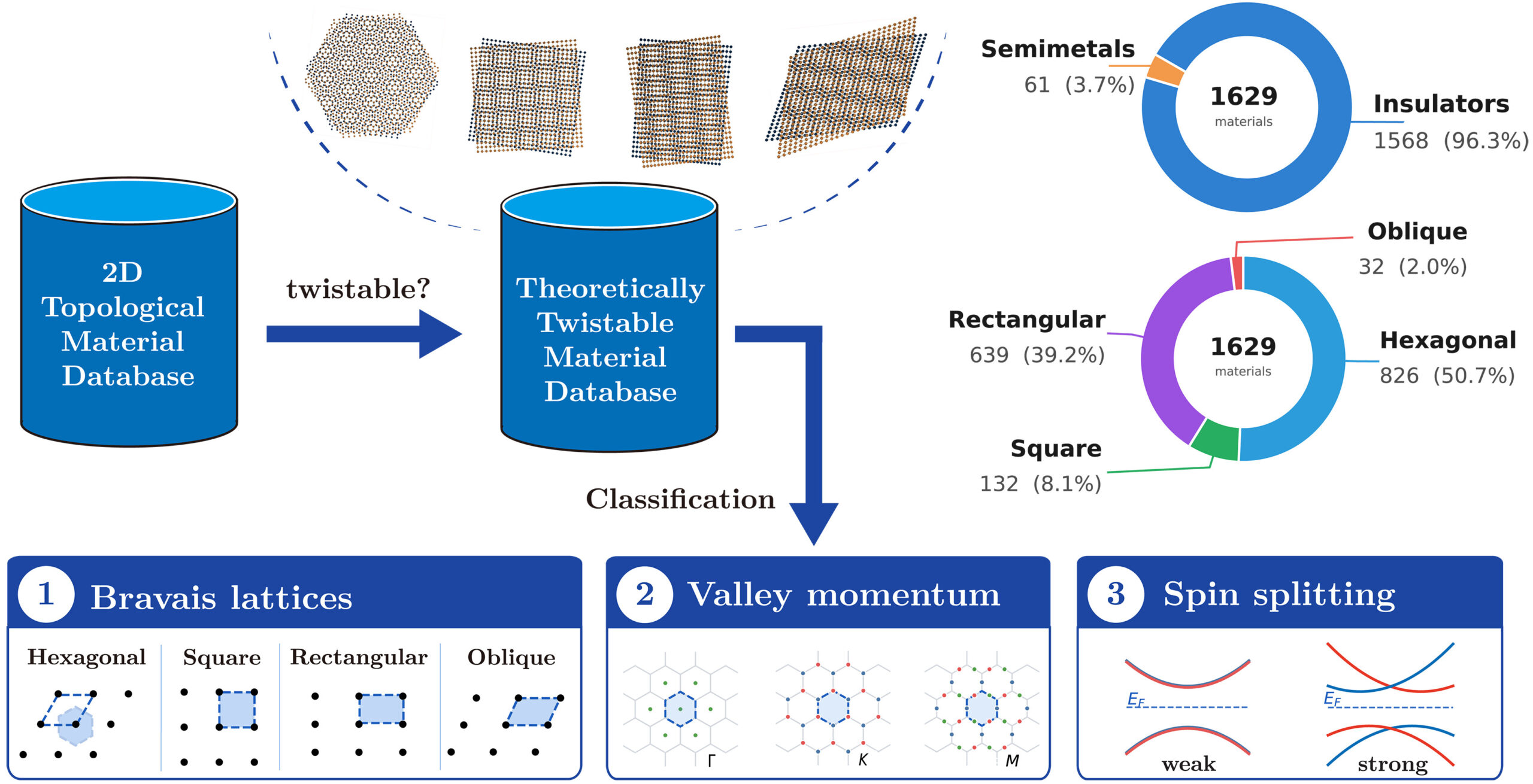
The first study, “Two-dimensional Topological Quantum Chemistry and Catalog of Topological Materials” 1, adapts these methods to 2D crystals and applies them to 8,872 entries in two computational databases. It finds 4,073 with nontrivial topology or a related property called obstruction, including 905 topological insulators, 2,129 topological semimetals and 1,003 obstructed atomic insulators, plus 36 close variants. In an obstructed insulator the electrons are centred on empty positions between the atoms rather than on the atoms themselves. The bulk looks ordinary, but cutting the crystal along certain lines produces edge states, and small flakes can carry fractions of an electron’s charge at their corners. The study also calculates edge states for selected materials. Its catalogue includes over 100 monolayers already made in laboratories, but most entries are computer predictions whose properties remain to be tested.
Workflow of the database construction. Starting from a 2D topological material database, a filtering score is applied to construct a database of theoretically twistable materials, which includes both semimetals and insulators. The candidate materials in this database are further classified according to their Bravais lattices, valley splitting, and spin splitting. Source: Y. Jiang et al. (2026) Science doi:10.1126/science.adu1550
Twisting layers
Stack two atomic sheets and rotate one slightly, and the mismatch creates a large interference pattern, called a moiré pattern, much like two overlapping window screens. Electrons feel this longer repeating pattern, and under the right conditions their bands become nearly flat. Electrons in a flat band have little energy of motion, so their mutual repulsion dominates and strongly correlated behaviour can emerge.
In 2011, calculations predicted that two graphene sheets twisted by about 1.1 degrees, a “magic angle”, would have such flat bands. In 2018, experiments at that angle revealed insulating states caused by electron repulsion, and superconductivity. Twisted layers of other materials, such as MoTe2 and WSe2, have since shown many correlated phases, though the mechanisms are still debated.
Most work has focused on these few materials, because most crystals have electronic structures too complicated to predict once twisted. The second study, “2D theoretically twistable material database” 2, therefore defines a material as theoretically twistable if its low-energy electrons admit a simple description. In a metal, the relevant electrons must sit at isolated points, as in graphene. In an insulator, the top of the filled band or the bottom of the empty band must stand clear of other bands. Insulators must also have gaps between 0.2 and 3 electronvolts, because larger gaps make electrical contacts difficult. The search was limited to crystals with at most 12 atoms in the repeating cell and four chemical elements.
Starting from the first study’s database, it identifies 61 semimetals and 1,568 insulators. It ranks them with a score and sorts them by lattice shape (about half are hexagonal), by where in momentum space the relevant electrons sit, and by the strength of spin-orbit coupling, the link between an electron’s spin and its motion. These choices shape the moiré pattern, which can resemble honeycomb, kagome or square lattices. Square-lattice moiré systems have been proposed but not yet realized, and could help simulate models relevant to cuprate superconductors.
Calculations on twisted bilayers of SnSe2, SnS2, ZrS2, HfS2 and Sc2CCl2 at a twist of about 7 degrees show isolated flat bands, as the database predicts. Experiments connect the theory to the laboratory. Bulk crystals of SnSe2, SnS2, HfS2, GaTe and ZrNCl were grown. Single layers of several candidates, including SnSe2, HfSe2, ZrS2 and WS2, were peeled off with a gold-assisted technique that yields larger, cleaner flakes. A dual-gated two-layer SnSe2 device was built for electrical measurements, and a twisted two-layer HfS2 device was used for scanning tunnelling measurements near absolute zero.
The direction is clear. Instead of discovering materials by trial and error, it is becoming possible to search systematically for crystals with chosen properties, then test them layer by layer.
Author: César Tomé López is a science writer and the editor of Mapping Ignorance
Disclaimer: Parts of this article may have been copied verbatim or almost verbatim from the referenced research paper/s.
References
U. Petralanda, Y. Jiang, H. Pi, M. G. Vergniory, B. A. Bernevig, N. Regnault, and L. Elcoro (2026) Two-dimensional topological quantum chemistry and catalog of topological materials Science doi: 10.1126/science.adu2107↩
Y. Jiang, U. Petralanda, H. Pi, G. Skorupskii, Q. Xu, D. Calugaru, H. Hu, J. Xie, R. A. Mustaf, P. Hohn, V. Haase, A. Ouahchi, S. Samal, J. Zhu, D. Yang, Z. Geng, G. Avedissian, Y. Wang, M. G. Vergniory, M. Claassen, et al. (2026) 2D theoretically twistable material database Science doi:10.1126/science.adu1550↩
Apple’s new HomeView takes center stage (no pun intended) as the panel examines its design, features, pricing, and potential role in the smart home. From tabletop and wall-mounted models to HomeKit integration, FaceTime, calendars, and home automation, the discussion explores practical uses and limitations. Panelists who have already ordered HomeView share their buying decisions, while […]
In 1911, Heike Kamerlingh Onnes cooled mercury to a few degrees above absolute zero and watched its electrical resistance vanish. Lead soon joined the list of superconductors, losing its resistance below about 7.2 kelvin. A full explanation arrived in 1957: electrons bind into Cooper pairs that move together as one collective state below a critical temperature. Breaking a pair costs a minimum amount of energy, called the energy gap, so inside the gap a superconductor offers no states for single electrons.
Yu–Shiba–Rusinov states
Magnetism is an old enemy of this order. Magnetic impurities were known to suppress superconductivity, and in the 1960s Yu, Shiba and Rusinov showed theoretically that a magnetic atom disturbs the pairs around it and traps a localized state with an energy inside the gap. These Yu–Shiba–Rusinov (YSR) states were first seen atom by atom in 1997, using a scanning tunneling microscope (STM): a needle-sharp metal tip that measures the tiny current of electrons tunneling across a vacuum gap to a surface.
A different story concerns two superconductors joined by a very weak link. In 1962, Brian Josephson predicted that Cooper pairs can tunnel through such a link with no voltage at all, an effect confirmed in 1963. When a voltage is applied, another process takes over: multiple Andreev reflection. An electron whose energy lies inside the gap cannot enter a superconductor alone. Instead it is sent back as a hole, the absence of an electron, while a Cooper pair slips in, as Andreev described in 1964. Between two superconductors under a voltage V, a particle can bounce back and forth, gaining energy eV with each crossing, until it can finally escape above the gap. When n crossings are needed, the conductance shows a peak at a voltage equal to the sum of the two gaps divided by n. This pattern, explained in the early 1980s, is called subharmonic gap structure. For lead on lead the sum is 2.7 millivolts, so peaks are expected near 2.7, 1.35 and 0.9 millivolts.
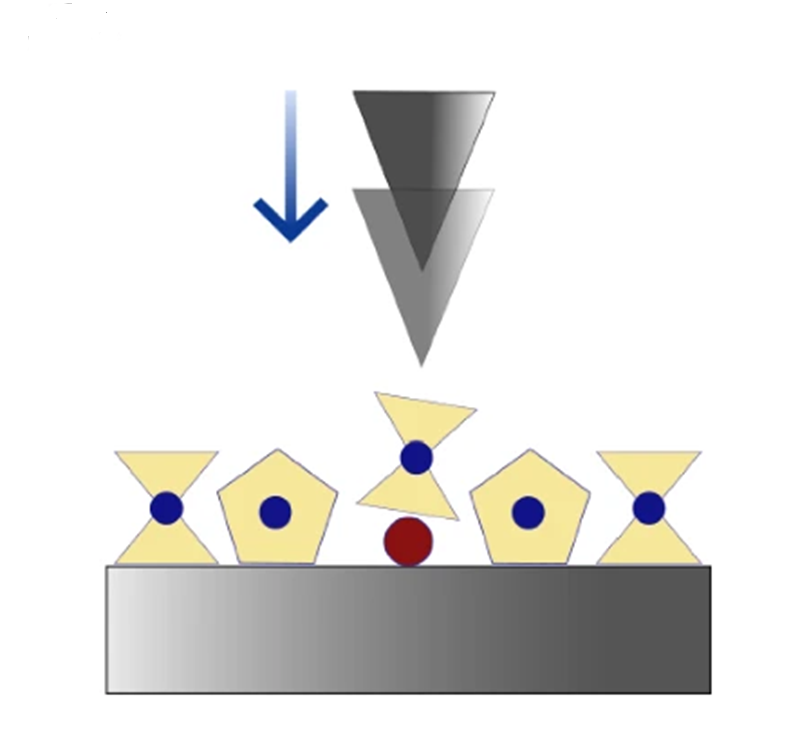
A schematic of the scanning tunneling microscope junction. A lead-coated tip is approached to a nickelocene molecule (yellow) above a subsurface iron atom (red) on Pb(111). Source: C. Mier et al (2026) Nat. Commun. doi: 10.1038/s41467-026-76478-4CC BY-NC-ND 4.0
Impurity states and Andreev reflections have usually been treated as separate subjects. A recent experiment 1 places them in the same device. A nickelocene molecule, a nickel atom sandwiched between two five-carbon rings, sits on a lead surface above a single iron atom trapped between the molecule and the lead. On its own, the molecule carries a spin that appears as characteristic steps in the measured spectra. Above the iron, those steps vanish and YSR states appear instead. Density-functional calculations explain why: the magnetic moments of molecule and iron point in opposite directions and almost cancel, leaving a leftover spin of one half on the iron. That spin couples to the lead and produces a single pair of YSR states.
The second superconductor is a lead-coated STM tip, lowered toward the molecule at 2.4 kelvin. Far away, electrons tunnel through a wide vacuum barrier and the tip merely reads out the YSR states, which appear as lopsided peaks near the edge of the gap. As the tip approaches, the junction becomes more transparent, meaning electrons cross it more easily, and the setup becomes a weak link between two superconductors. At moderate conductance, new peaks appear at half the sum of the gaps, the signature of second-order Andreev reflection. At the highest conductances, a sharp peak develops at zero voltage: the Josephson contribution. Thermal fluctuations of the superconducting phase broaden this peak, as is typical of STM junctions.
These stages do not simply stack. As the tip approaches, the YSR peak moves to lower energy and mingles with the Andreev peaks. The interpretation is that the bound state becomes a stopping point along the Andreev path. Peaks then appear at the tip’s gap plus the bound-state energy, divided by n, rather than at the ordinary positions. This is called YSR-assisted multiple Andreev reflection.
Odd and even orders
A simple argument explains why odd and even orders differ. Each reflection carries the particle to the opposite electrode, and only the lead surface contains the magnetic atom; the tip has none. After an odd number of crossings the particle ends on the surface, where it can land in the bound state. The peak shifts and acquires the lopsided shape typical of tunneling into a single level. After an even number it ends in the tip, among ordinary states, and those peaks stay closer to their usual positions, although the second-order peak still turns lopsided at higher conductance as a YSR-assisted component splits off. Simulations reproduce this pattern. In the measurements, thermal broadening blurs finer details such as the third-order peak, and small features near zero voltage seem to reflect a mixture of both processes.
Reproducing the evolution of the spectra required two changes together: higher transparency and a stronger exchange coupling between the iron spin and the lead. Raising transparency alone gives a growth of the key peak that the measurements do not show. A likely reason is that the approaching tip slightly squeezes the molecule and strengthens the coupling, though this is an inference. The model treats the spin as classical and its two parameters as effective ones, so it is a phenomenological decomposition rather than a unique microscopic extraction. It also cannot capture the zero-voltage peak.
Even so, the result shows that YSR states and Andreev reflections are two limits of one problem, tuned continuously within a single molecular junction. Under suitable conditions, such spin-active links might also host a Josephson diode, in which supercurrent flows more easily in one direction, or a π-junction, in which the two superconductors prefer opposite phases. These remain possibilities, not demonstrated effects.
Author: César Tomé López is a science writer and the editor of Mapping Ignorance
Disclaimer: Parts of this article may have been copied verbatim or almost verbatim from the referenced research paper/s.
References
C. Mier, A. Fetida, R. Robles, P. Boronat, D. Jyoti, N. Lorente, L. Limot, and D. -J. Choi (2026) Yu-Shiba-Rusinov-assisted Andreev transport in a molecular junction between superconductors Nat. Commun. doi: 10.1038/s41467-026-76478-4↩
A new phase of solid superionic ice has been created for the first time in the laboratory. By heating a tiny sample of ultrapure water while compressing it to extreme pressures, physicists at the French Alternative Energies and Atomic Energy Commission (CEA) succeeded in forming an ice phase that features a hexagonal close-packed (hcp) structure and liquid-like hydrogen diffusing through a solid lattice of oxygen atoms. This demonstration could help us better understand the structure of ice giant planets such as Uranus and Neptune, which may harbour this form of ice deep within their interiors.
Unlike water’s familiar liquid, vapour and ice phases, superionic ice can only exist when water is subjected to tens or even hundreds of GPa of pressure at temperatures above 1000-2000 K. Under these conditions, theory predicts that hydrogen ions (protons) diffuse so readily through empty sites in water’s oxygen lattice that the material’s ionic conductivity may exceed 100 Siemens per centimetre, making it almost as conductive as metals. The melting temperature of this form of ice is also extremely high, reaching several thousand kelvin as new ice structures develop that feature a close-packed oxygen lattice.
Diamond anvil cells and X-ray diffraction spectra
To create super-high pressures in the laboratory, researchers typically use diamond anvil cells, which are tiny cavities in which samples are tightly compressed between the tips of two opposing diamond surfaces. In the new work, a CEA team led by physicists Alexis Forestier and Gunnar Weck added two high-thermal-conductivity cup-shaped discs made of boron-doped diamond to the diamond anvil surfaces. This set-up enabled them to apply pressure while heating their 12 micron-sized sample uniformly with lasers, thereby avoiding the large temperature gradients that complicate measurements in conventional diamond anvil cells.
Forestier, Weck and colleagues heated their sample of ultrapure water from 300 to 2630 K while applying pressures between 80 and 229 GPa. Thanks to the Extremely Brilliant Source’s sub-micron beam – part of the ID27 beamline at the European Synchrotron Research Facility in Grenoble – they were able to obtain high-quality X-ray diffraction spectra despite the small size of their sample. According to the CEA researchers, these spectra clearly showed a new hexagonal close-packed (hcp) phase of superionic ice emerging alongside a previously observed face-centred cubic (fcc) phase across a pressure range of 130-200 GPa and temperatures above 1800 K.
A link to Uranus and Neptune
The discovery brings the total number of superionic phases of water to three, with the other being the body-centred cubic phase first observed in 2016. But that’s not all. Forestier, Weck and colleagues say that their results, which they report in Physical Review Letters, could also help explain the magnetic fields of Uranus and Neptune.
Unlike the Earth’s magnetic field, these fields are skewed and off-centre with respect to the planets’ axis of rotation. These properties have led scientists to hypothesize that instead of being generated by the motion of molten iron in the planet’s core (as on Earth), the magnetic fields of Uranus and Neptune could arise from conductive superionic warm dense ice (composed of water, ammonia and methane) in the planets’ outer third.
“The experimental observation of this new hcp superionic phase now provides a rationale for incorporating its mechanical properties and ionic conductivity into these models of planetary interiors,” Forestier says. “Indeed, this phase can coexist with the fcc superionic phase and become more stable at higher pressures (above 150–200 GPa), and so probably exist deeper within the inner shell of these ice giants.”
The researchers’ next step will be to precisely define regions of the phase diagram where pressure and temperature are stable; map out the transition lines between the different phases (molecular and superionic); and understand how the new hcp phase behaves as it melts. This will help confirm whether these phases are stable and present within Uranus and Neptune, Forestier tells Physics World.
“We also want to obtain more direct experimental signatures of superionic behaviour, beyond the thermal expansion we observed,” Weck adds. “Brillouin spectroscopy measurements, for example, could reveal anomalies in the speed of sound, strengthening the evidence for proton diffusion.”
In the 1980s, scientists measured quantized jumps in the energy of ions for the first time. In the 2000s, it was photons’ turn. Now, thanks to a tour de force of device engineering and nanofabrication, researchers at Stanford University in the US are reporting that phonons – mechanical vibrations like those that carry sound – also display this quantum behaviour.
“We could see it by eye [in the data], which was very satisfying,” team leader Amir Safavi-Naeini tells Physics World. “I’ve been fascinated with the interface between the quantum world and the classical world and trying to move that interface closer to daily experience…and now we have mechanical objects.”
Laying the groundwork
The Stanford team’s recipe for observing quantum jumps in phonons begins with thin films of lithium niobate (LiNbO3). Although bulk samples of this material had been available since the 1950s, the commercialization of thin-film LiNbO3 a decade ago was a game changer for Safavi-Naeini and his colleagues once they worked out how to process the material.
Because LiNbO3 is piezoelectric, placing it under stress – from a vibration, say – produces a voltage. This voltage allows vibrational quanta to couple to superconducting qubits, after which the qubit states can be “read out” to determine whether a phonon was present or not.
The problem was that initially, the phonons had lifetimes of only 800 nanoseconds – well short of the millisecond the team needed to observe them falling from an excited state to the ground state. Extending these phonon coherence times “took a lot of work by a number of graduate students in my group,” Safavi-Naeini says.
After probing various sources of dissipation, including material properties that cause quantum excitations to lose coherence, the researchers realized that surface defects were key offenders. They therefore switched from polymer processing, which left a residue, to shadow masks that superimpose one chip over the other and evaporate metal through it. “There were probably three generations of students that worked on getting that four to five orders of magnitude increase in the performance of the devices,” Safavi-Naeini says.
The voltage profile of the nanomechanical resonator in motion. In the crystal used for the mechanical resonator, mechanical motion and electrical potentials are inherently coupled, so the motion profile has an accompanying electric potential profile. (Courtesy: Erik Szakiel)
Once they’d extended their phonon lifetimes, the researchers had to find a way of combining their “very clean, long-lived” mechanical and superconducting systems without destroying either. For this, Safavi-Naeini credits past and present students Takuma Makihara and Erik Szakiel, who spent most of their PhDs tackling issues with the mechanical oscillators before finding a way to couple them to the superconducting systems. “That was the last piece,” Safavi-Naeini recalls. “Once we had that, we could do these experiments.”
Spot the missing phonon
Because the superconducting qubits detect whether an even or odd number of phonons is present in the LiNbO3 (which at very low energies amounts to determining whether a phonon is there at all), they are effectively performing a parity measurement. That could make the Stanford team’s system useful for quantum error correction, where the goal is to find out whether an error has crept in without actually measuring the quantum states, since doing so would destroy their useful quantum characteristics.
One of the most common sources of error in superconducting qubits is the loss of an excitation, such as when a phonon decays. However, if data is encoded into phonons in pairs and the system detects an odd number of them, this loss becomes apparent without measuring all the states. This so-called “binomial” code has already been implemented for microwave photons, and Safavi-Naeini explains that it works best for long-lived particles – a further benefit of the team’s long-lived phonons.
Protein and gravity measurements
The Stanford researchers are now collaborating with Michael Roukes and colleagues at the California Institute of Technology (Caltech) to explore possible applications in high-precision measurements of single protein masses. They are also interested in fundamental science questions such as whether it’s possible to generate entanglement between mechanical systems through gravitational fields.
However, Safavi-Naeini cautions that their phonon lifetimes would need to be much longer – a factor of 10 for error correction and mass spectrometry, and for gravity perhaps as much as six orders of magnitude, with further modifications to the experimental set-up also required – before they can achieve these goals. “The hope is that by figuring out the fundamental sources of loss in these materials we can build our way up to those experiments in the coming decade,” he says. “Every time you improve, you hit some new source of noise, you understand it, then you can deal with it, and then you go to the next one. It’s a fun physics problem.”
Researchers in the Netherlands have shown that they can turn off the dipole moment of molecules that are normally polar, drastically altering the molecules’ behaviour in low-energy collisions. The discovery – which was only possible after the team cleared a major experimental hurdle – has implications for ultracold chemistry and could also lead to a better understanding of polarity, with benefits for quantum simulation and computation.
Chemical reactions are full of complexity and chaos, making them hard to study at the atomic and molecular level. Before attempting to do so, scientists typically cool the reactants to just above absolute zero, which restricts their movement and vibrations. Despite these restrictions, however, interactions between ultracold molecules remain poorly understood, especially when the molecules have an electric dipole moment.
In 2023 experimental physicist Bas van de Meerakker and theorist colleagues at the Radboud University Nijmegen in the Netherlands shone a ray of light on this murky area by studying the collision cross-section (that is, the likelihood that collisions will take place) between molecules of ammonia (NH3) at low energies. Their simulations showed that this cross-section falls off sharply as the energy decreases. This contradicts the classical picture of polarity, which suggests that the cross-section should continuously increase.
A big turn off
The Radboud team explained this discrepancy by noting that in the classical picture, polar molecules such as ammonia have a permanently asymmetric charge distribution – a dipole moment – due to the arrangement of the bonds between their constituent atoms. The quantum mechanical picture, in contrast, depicts an isolated molecule in a specific quantum state as having a definite parity, or symmetry. Because of this symmetry, the molecule’s net dipole moment in the lab frame is exactly zero.
According to this quantum picture, collisions between polar molecules at high speeds (high energies) cause these opposite parity states to mix via interactions between the molecules’ electrostatic fields. In the process, they essentially “turn on” each other’s dipole moments, causing them to attract each other and increasing the collision cross-section. At low speeds, however, the molecules cannot get close enough to trigger this mutual mixing. As a result, their dipole moments effectively switch off, and their collision rates drop drastically.
On a collision course
The Radboud team’s next step was to prove experimentally that this is indeed what happens. However, colliding cold molecules generally requires using electric fields to merge two molecular beams. When molecules in the two beams have very similar dipole moments, this is very difficult, because using an electric field to steer one beam automatically affects the path of the other. The risk is that the beams never overlap at all.
To overcome this obstacle, van de Meerakker and colleagues combined a 2.6 m Stark decelerator, a curved hexapole guide and a merged quadrupole/hexapole trap into a device that can overlap the beams at just the right position, with minimal angle between them. In this way, they achieved sufficient overlap to observe low-energy collisions. They then experimentally verified the predicted energy-dependent changes in cross-section for NH3-NH3 collisions, while also showing that this dependence is different when they replace hydrogen atoms with deuterium (NH3-ND3 or ND3-ND3 collisions).
Under control
According to van de Meerakker, the fact that cross sections drop at low energies could make it hard to perform experiments that require scattering to take place in crossed or merged beams. On the other hand, experiments in which dipolar molecules are stored in traps could benefit, as lower inelastic cross-sections mean fewer molecules are lost from the trap.
As for future work, van de Meerakker says the team plans to add a controlled electric field to the beam overlap region. The mechanism they discovered is expected to respond extremely sensitively to this field, with even small electric fields changing cross sections by orders of magnitude and thereby providing a “knob” with which to control collision outcomes. “It was exactly this type of control that sparked our interest in cold and ultracold molecules two decades ago, and it is very exciting that this is now within reach in our scattering experiments,” van de Meerakker tells Physics World.
Tim Langen, a physicist at Austria’s Vienna University of Technology who was not involved in this research, describes it as important because it provides experimental evidence for a phenomenon that had mainly been discussed theoretically. In his view, the results support the idea that effective dipolar interactions become strongly suppressed at low collision energies. He also finds the experimental approach “impressive” as it enables measurements in a regime that was previously difficult to access. “Overall, I find the work convincing and expect it to be of broad interest to researchers working on cold and ultracold molecules,” Langen concludes.
In the mid-1970s a graduate student wrestling with a deceptively simple quantum problem uncovered one of the most haunting images in modern physics. The pattern seemed almost impossibly intricate: delicate wings assembled from infinitely nested bands and gaps, a self-similar pattern born from the motion of electrons in a crystal under a magnetic field. First published in 1976 (Phys. Rev. B14 2239), it came to be known as Hofstadter’s butterfly, after its discoverer Douglas Hofstadter.
Half a century later, the butterfly has not faded into scientific nostalgia. If anything, it has become even more important – reappearing in new materials, new experiments and in places no-one imagined when it was first plotted. Recent research by Kazuki Ikeda from the University of Massachusetts and Yaron Oz at Stony Brook University suggests that related patterns may even surface in the physics of black holes (J. High Energy Phys.2026 38).
Each new realization adds another chapter to a story that is not really about a single graph, or even a single discovery, but about the unity of patterns across the physical world. A structure first seen in a simple model has become a symbol of how richness can emerge from basic rules, how beauty can arise from constraint, and how the quantum world still harbours forms strange enough to surprise us.
How the butterfly got its wings
What makes Hofstadter’s butterfly so compelling is the remarkable story of its birth and, more importantly, how far it has travelled from its original birthplace. Like many scientific breakthroughs, its discovery was fairly obscure initially and owed a great deal to luck. In 1974 Hofstadter – son of the 1961 Nobel-prize-winning nuclear physicist Robert Hofstadter – had just dropped out of graduate school at Stanford University in the US and was “in despair” according to friend and physicist Francisco Claro.
Having just completed a PhD with the renowned solid-state physicist Gregory Wannier at the University of Oregon, Claro suggested that Hofstadter should approach Wannier as well. As it happened, Wannier had been struggling with a problem that had puzzled him for years: he could not obtain an analytical solution to Harper’s equation, which describes the motion of electrons on a 2D crystal lattice subjected to a perpendicular magnetic field.
Named after P G Harper, who was a graduate student of Rudolf Peierls at the University of Birmingham, UK, this classic “magnetic problem” displayed a mysterious sensitivity to whether the magnetic flux was a rational or irrational number. It was a feature that immediately captured Hofstadter’s imagination and, with the rational–irrational dichotomy echoing in his mind, Hofstadter began his PhD studies at Oregon by immersing himself in solving the problem.
But he soon found himself equally stuck. Frustrated by the analytical approaches often discussed at the time, he pursued a different path: numerical computation. Using a programmable Hewlett Packard desktop calculator that by today’s standards looks laughably primitive, he displayed the numerical solutions graphically as the energy of electrons versus magnetic flux Φ per unit cell of the lattice. At that moment, he became convinced that he had uncovered the true structure of the problem. “All at once my eyes were opened,” Hofstadter recalls.
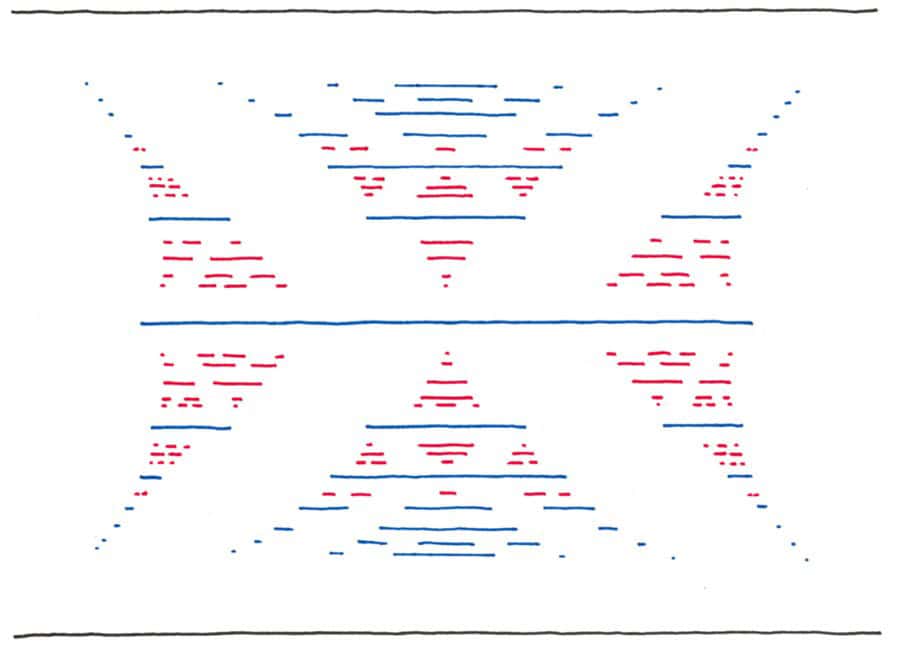
Beautiful beginning Hofstadter’s butterfly dates back to November 1974 when Douglas Hofstadter, who was then a PhD student at the University of Oregon, was trying to describe the motion of electrons in a 2D crystal lattice under an applied magnetic field. His work led him to produce a primitive, hand-drawn diagram – dubbed “Gplot” – that looked like a butterfly. The original diagram has been lost so Hofstadter created this reconstruction in 2016. (Courtesy: Indu Satija. Permission granted by Douglas Hofstadter)
What he found was a complex recursive shape (or fractal in today’s terminology) hidden within the energy spectrum of electrons in a magnetic field. Resembling a butterfly, Hofstadter brought his hand-plotted diagram, which he codenamed “Gplot”, to Wannier, who was not impressed. According to Hofstadter, Wannier dismissed the result as “numerology” and even threatened to withdraw the PhD student’s funding.
But after nearly a year, Wannier came to recognize the validity and significance of Hofstadter’s work, ultimately awarding Hofstadter his PhD and accepting the butterfly as a legitimate description of the energy spectrum of electrons moving on a 2D lattice in a magnetic field. Wannier even added to the butterfly’s story with a paper titled “A result not dependent on rationality for Bloch electrons in a magnetic field (Phys. Status Solidib88 757). This work, along with further studies with Claro, introduced a set of integers uniquely labelling every gap in the graph, providing a simplified description of the spectrum (Phys. Rev. B 19 6068).
Douglas Hofstadter: in his own words
Ruby celebration Douglas Hofstadter (right) pictured in 2016 with colleagues Indu Satija (centre) and Francisco Claro (left) all wearing T-shirts emblazoned with Hofstadter’s butterfly to celebrate its 40th anniversary. (Courtesy: Indu Satija)
Born in 1945, Douglas Hofstadter discovered his eponymous butterfly while a PhD student at the University of Oregon in 1975, using computational modelling to make his breakthrough (see main text). Four years later Hofstadter published his Pulitzer-prize-winning popular-science book Gödel, Escher, Bach, which tackles cognition, mathematics and symmetry.
Currently a professor of cognitive science and comparative literature at Indiana University in Bloomington, US, Hofstadter is still active as a researcher and wrote a follow-up book I Am a Strange Loop in 2007. On the golden jubilee of the now-famous butterfly named after him, Hofstadter provided the following comment to Physics World.
“This graph was first computed using a programmable desktop calculator and was first plotted by hand using coloured felt-tip pens. I was just extremely relieved that by showing that my ‘Gplot’ graph was made of distorted copies of itself, I would at last be able to get a PhD thesis. I had no idea that Gplot would go on to become well known as the Hofstadter butterfly, and that variations on the theme would proliferate like wildfire over the coming decades.”
“As the years have gone by,” he continues, “articles about Hofstadter’s butterfly have grown more and more numerous and harder and harder for me to follow. For better or for worse, these theories are all way beyond me, but remembering the first wingbeats of the butterfly’s flight cheers me up.”
Statements about states
Hofstadter’s butterfly is more than a beautiful graph. It is a map of what happens when quantum particles are caught between two competing kinds of order: the regular periodicity of a crystal lattice and the circular orbits of a magnetic field. When these two scales contend with one another, the energy spectrum does something extraordinary. Instead of varying smoothly, it fragments into a hierarchy of allowed and forbidden energies, referred to as bands and gaps, respectively.
Zoom in on one region and new structures emerge. Zoom in again and the pattern repeats, endlessly varied yet ruled by strict mathematical order. It is one of the rare instances in which fractal geometry appears not only in abstract mathematics or artistic imagination, but in the measurable behaviour of matter itself.
The deep connection between this theoretical pattern and real-world matter became clear through an exotic quantum phenomenon known as the integer quantum Hall effect. It was discovered experimentally by Klaus von Klitzing at the Max Planck Institute for Solid-State Physics in 1980 – a breakthrough that earned him the Nobel Prize in Physics five years later.
The classical Hall effect is what happens when a voltage is produced in a bulk conductor at right angles to an applied magnetic field. Similarly, the quantum Hall effect is the appearance of a voltage across opposite faces of a thin 2D semiconductor when a current is passed along the plane of the material and a magnetic field applied perpendicularly it. But there is one big difference in the quantum version.
If you slowly increase the power of the magnet, the transverse electrical conductance does not grow steadily. Instead, it jumps up sharply, with plateaus in between like steps on a staircase. In other words, it assumes quantized values given by integer multiples of the fundamental constant e2/h, where h is Planck’s constant and e is the charge on an electron.
In 1982 the British physicist David Thouless and his collaborators at the University of Washington, Seattle, made another remarkable discovery: the effect, they found, is topological. Topology is the study of the global properties of objects and topological invariants are those properties that do not change regardless of how much you try to deform a given object.
Thouless and colleagues found that the integers underlying the quantum Hall effect are topological invariants arising from the global topology of the electronic wave functions. This seminal work, which was published in 1982 (Phys. Rev. Lett.49 405), significantly contributed to Thouless earning the 2016 Nobel Prize in Physics, which he shared with Duncan Haldane and Michael Kosterlitz for their work on “topological phase transitions and topological phases of matter”.
1 Butterfly behaviour
(Courtesy: Indu Satija; CC BY 3.0 New J. Phys.18 103023; J. Stat. Phys. 156 417. Reused with permission from Springer Nature)
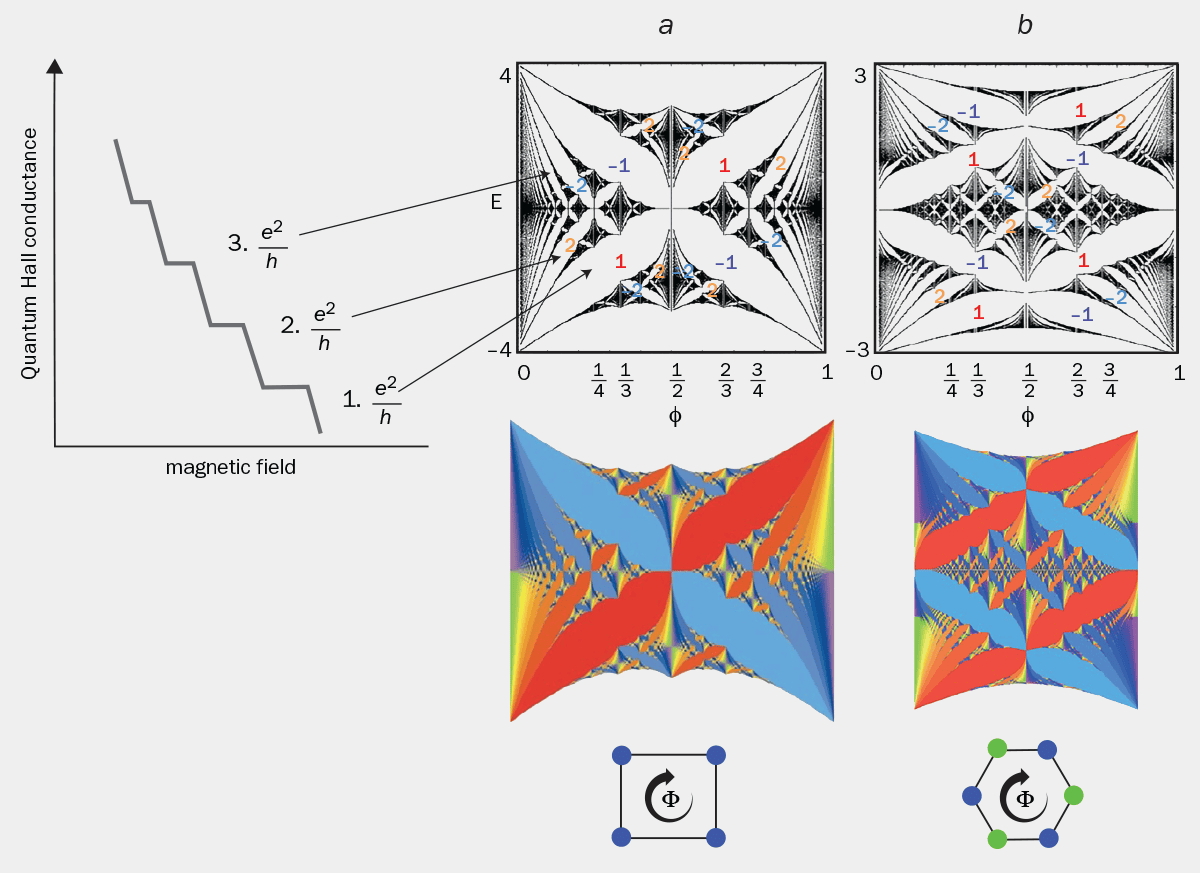
Hofstadter’s butterfly, in its original form, refers to the behaviour of electrons in 2D lattices subject to an applied magnetic field. (a and b) Shown here (top row) are graphs of the electrons’ energy (E) plotted against the magnetic flux (Φ) per unit cell for square and honeycomb lattices (bottom row). The relation between the quantum Hall effect (displayed in the staircase-like graph, left) and Hofstadter’s butterfly is shown via the arrows. The colours on the “butterfly graphs” (middle row) correspond to the quantum numbers of the Hall conductivity. Some of these integer labels are shown (colour coded) in the top row.
How all of this relates to Hofstadter’s butterfly is simple: the butterfly model describes all integer quantum Hall states, where the integers of Hall conductivity label the gaps in Hofstadter’s butterfly – the exact same integers that Wannier and Claro introduced in the butterfly spectrum (figure 1). In other words, the butterfly is not merely a chart of recursively split energy levels; it is also a coded map of topology in quantum matter under a magnetic field.
A pattern repeating across physics
That connection places it squarely within one of the central themes of modern condensed-matter physics, namely the realization that certain physical properties are protected not by local details, but by global features of the quantum state. But what is fascinating is that in the 50 years since Hofstadter’s butterfly was discovered, physicists have found that the same spectral architecture in it can also arise in a remarkable range of settings. It has appeared, for example, in other lattice geometries, in engineered semiconductor devices and in so-called moiré materials.
The butterfly’s migration into moiré systems has been especially fruitful. Such materials are created by stacking two atomically thin materials onto each other with a slight twist, creating a moiré pattern with different properties from the individual layers. Utilizing moiré materials, in research that began in 2013 led by Philip Kim of Columbia University (Nature497 598) and continues apace with a team led by Ali Yazdani of Princeton University (Nature639 60), the butterfly structure can now be tuned, probed and in some cases directly imaged on modern quantum platforms.
Over the last 50 years, the butterfly itself has also evolved into other forms. For instance, in some systems, the butterfly emerges without an external magnetic field. As a team of researchers led by Xu-Tao Wan from East China Normal University showed in 2025 (Phys. Rev. Lett.136 033401), the fractal pattern can be controlled by twist angle – that is, by geometry alone.
Each time physicists add a new layer of realism – spin, interactions, periodic driving or lattice complexity – the butterfly adapts, and re-emerges in new forms, so long as it is not overwhelmed by strong interactions, disorder or thermal effects
In other realistic systems, electron spin – the particle’s intrinsic magnetic orientation, absent from the original simplified model – becomes an essential part of the physics. Even when a magnetic field splits the system into spin-up and spin-down states via Zeeman splitting, the butterfly spectrum survives. More striking still, the butterfly can emerge independently for each spin state, as Xiaomeng Liu and Zhida Liu of Cornell University discovered in 2025 (Nature Phys.21 1873).
This persistence of the fractal structure, despite the added complexity introduced by spin, highlights the extraordinary robustness and universality of the underlying quantum phenomenon. More generally, what these new iterations of Hofstadter’s butterfly reveal is that what once looked like a specialized theoretical curiosity now seems more like a recurring motif in quantum matter.
Indeed, this is part of its enduring fascination: each time physicists add a new layer of realism – spin, interactions, periodic driving or lattice complexity – the butterfly adapts, and re-emerges in new forms, so long as it is not overwhelmed by strong interactions, disorder or thermal effects. This durability prompted a friend to once joke that whenever he undergoes an MRI scan, he cannot help wondering what kind of butterfly his body might be producing.
Beauty from simplicity
As my friend’s joke reveals, there is something unmistakably human about the butterfly’s appeal. Physicists are drawn to it not only for its usefulness, but for its beauty. It belongs to that rare class of scientific objects whose visual grace seems to gesture toward deeper truths. And yet its deepest charm may lie in the fact that its immense complexity grows from remarkable simplicity.
2 Baby butterflies
(Courtesy: Indu Satija)
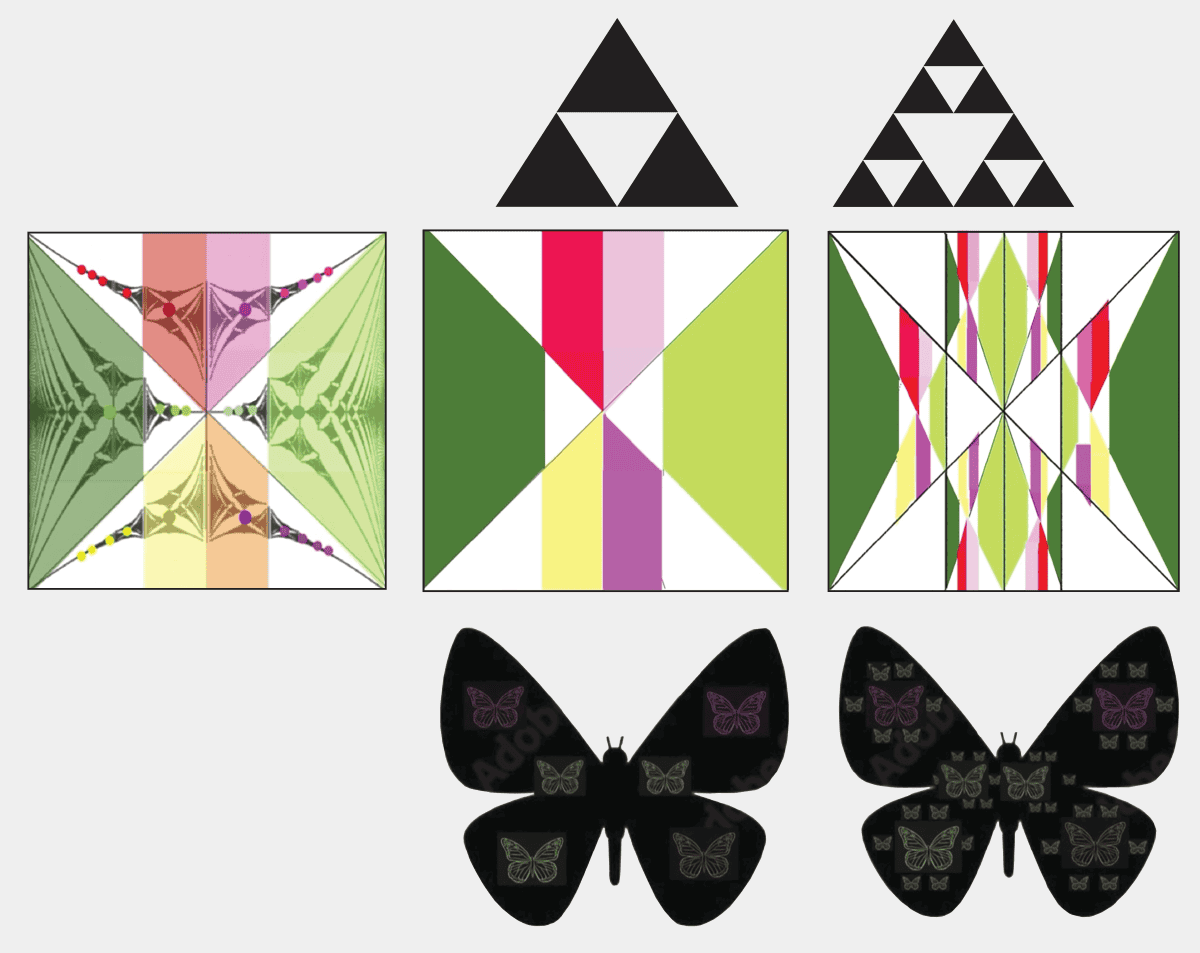
A simplified representation of Hofstadter’s butterfly, commonly known as the butterfly skeleton, interpreted as a 2D tessellation of trapezoids and triangles. It is shown in parallel with the “Sierpiński gasket” (top), which is made entirely from triangles. The iterative construction underlying this fractal consists of a parent butterfly generating six “baby” butterflies, represented by the six colour-coded trapezoids. Each baby butterfly is accompanied by a tail – an infinite chain of progressively smaller butterflies, indicated schematically by dots in the corresponding colour. The two butterflies at the bottom provide a schematic illustration of the hierarchical organization of the structure.
Beneath the intricate pattern are integers, recursion relations and number-theoretic structures that connect it to fairly simple geometric patterns, including the Farey tree, the tree of Pythagorean triplets and fractal packings such as the Apollonian gasket. In fact, this complicated quantum fractal admits a surprisingly simple geometric description: the butterfly landscape can be organized as a hierarchical lattice of trapezoids, bringing it into close parallel with geometric fractals such as the Sierpiński gasket (figure 2). It is extraordinary to think that this geometric harmony underlies such a complex and beautiful graph.
Fifty years on, Hofstadter’s butterfly remains exactly what great scientific ideas are supposed to be: elegant, prolific and unfinished. That interplay of beauty, mathematics and physical reality is what keeps the butterfly alive. Its evolution under interactions, spin effects and new forms of engineered geometry continues to reveal unexpected physics. And with each turn, the butterfly reminds us of something rare and precious in science: that the universe can hide immense complexity within simple forms, and that sometimes, if we are lucky, those forms are beautiful enough to be unforgettable.
Multiferroics are materials that simultaneously exhibit two or more ferroic orders—stable arrangements of physical properties that can be switched using an external stimulus. These materials could be highly advantageous for the development of various technologies, including non-volatile, low-power memory devices, spintronic devices, miniaturized electronics, neuromorphic hardware, sensors and magnetoelectric devices.
When a material heats up, its electrical resistance often rises. The harder question is what, exactly, is getting in the way. The electrons carrying the current may be scattered by vibrations of the material's atomic lattice, known as phonons. They may also collide with one another. Frustratingly, a conventional temperature test warms the electrons and the lattice together, so the effects arrive tangled in the same resistance measurement.
When a material heats up, its electrical resistance often rises. The harder question is what, exactly, is getting in the way. The electrons carrying the current may be scattered by vibrations of the material's atomic lattice, known as phonons. They may also collide with one another. Frustratingly, a conventional temperature test warms the electrons and the lattice together, so the effects arrive tangled in the same resistance measurement.
Soft materials such as colloidal suspensions, emulsions, foams and gels often display complex and unusual behaviors compared with ordinary solids or liquids. From a mechanical point of view, for instance, they can resist deformation like solids, but they can also start to flow like liquids when a sufficiently strong external drive is applied. This transition from solid-like to liquid-like behavior, known as "yielding," is central to the physics of soft amorphous materials and to many industrial and biological processes.
Soft materials such as colloidal suspensions, emulsions, foams and gels often display complex and unusual behaviors compared with ordinary solids or liquids. From a mechanical point of view, for instance, they can resist deformation like solids, but they can also start to flow like liquids when a sufficiently strong external drive is applied. This transition from solid-like to liquid-like behavior, known as "yielding," is central to the physics of soft amorphous materials and to many industrial and biological processes.

 Login