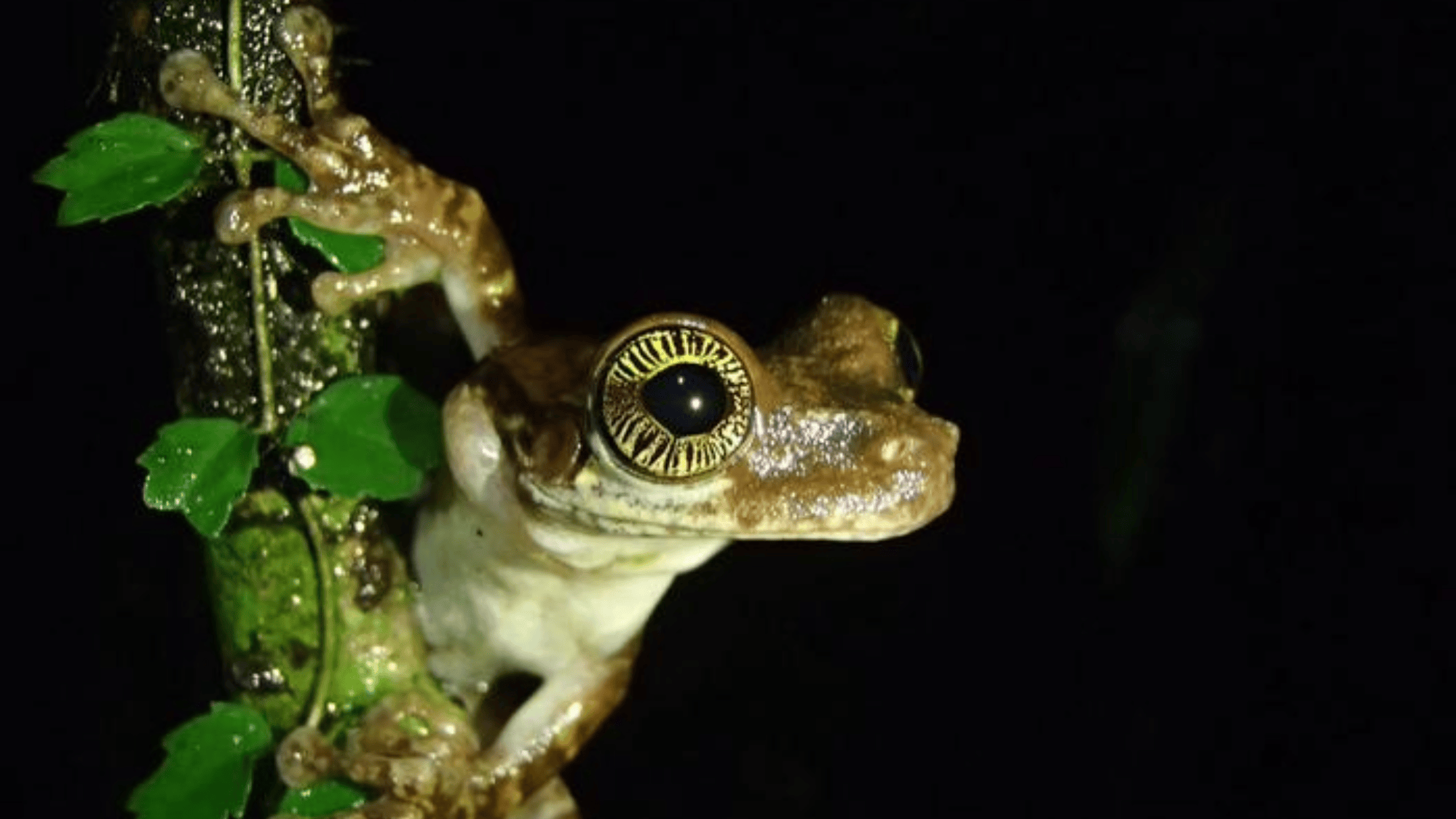
Our fingerprints, patterns on whale flukes, and fur patterns on cheetahs are examples of the natural ways we can tell one individual animal from another. For an Amazonian treefrog called the egg-eating spiny-backed frog (Osteocephalus oophagus), we need to look into their eyeballs. Fine black radial lines cross their golden irises, and form a pattern similar to our fingerprints. A study recently published in the journal Herpetozoa details the discovery.
The project began with study co-author Mélissa Peignier, a behavioral ecologist at the University of Bern in Switzerland, admiring frog eyes.
“At the time, I was doing my PhD, studying Allobates femoralis in the field in French Guiana,” Peignier said in a statement. “My first reaction was simply something along the lines of, ‘Wow, what beautiful eyes!’ That initial curiosity gradually turned into a genuine interest in the species, and I realised how little we actually know about them.”
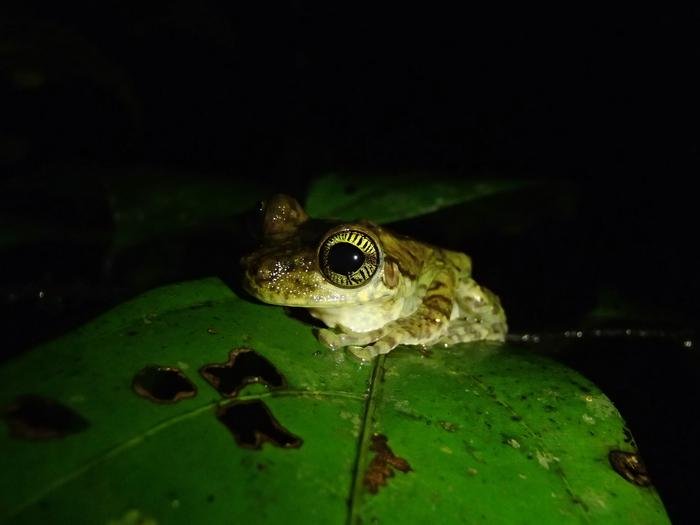
Osteocephalus oophagus in situ. Photographed in French Guiana (4°02’N, 52°41’W; ) between March and May 2021. Image: Mélissa Peignier et al., 2026.
There was also an ethical component. One of the standard ways to tell amphibians apart from one another is toe-clipping, where a section or all of a single toe is removed. This procedure can affect their survival, physiology, and behavior.
“Other studies have used toe-clipping, which involves removing some of the digits. Personally, I was uncomfortable with this approach, especially given that these are arboreal frogs that rely on their limbs to climb trees.”
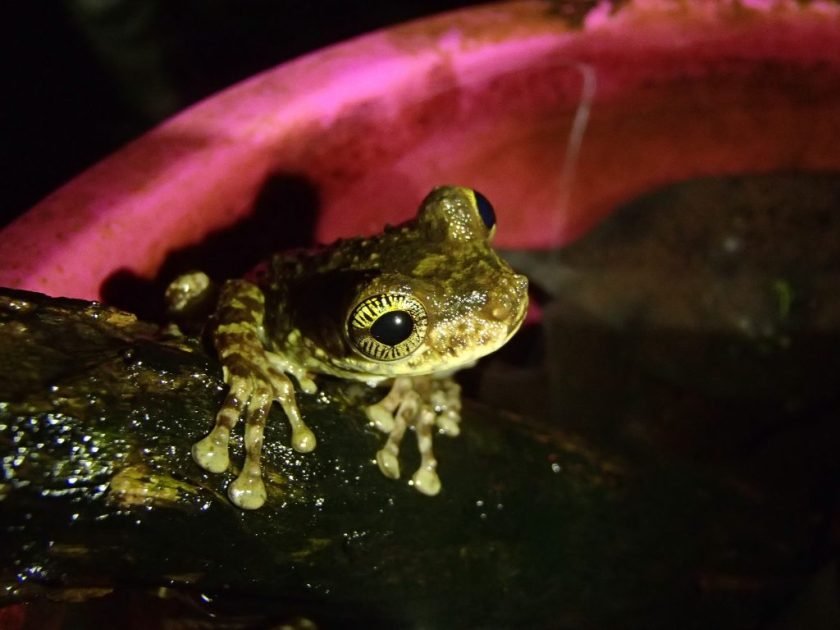
Osteocephalus oophagus in situ. Photographed in French Guiana (4°02’N, 52°41’W; ) between March and May 2021. Image: Mélissa Peignier et al., 2026.
Looking for other markings could offer a more humane solution and a way to observe the animals natural behavior unimpeded.
For this study, fieldwork took place over three rainy seasons (2021 to 2023) on a river island in the Nouragues Nature Reserve in French Guiana. They identified 103 individual frogs over the course of the study.
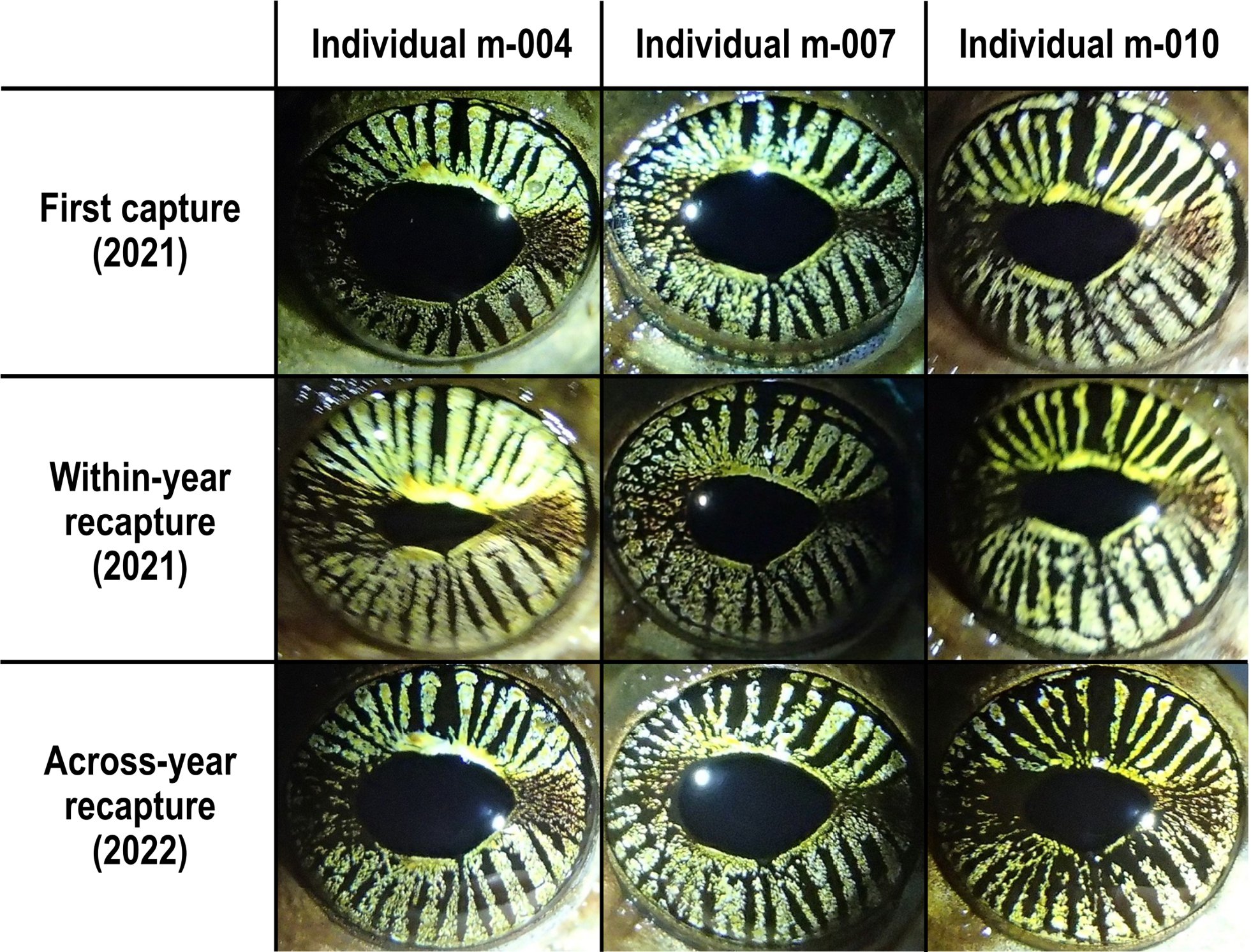
Example of the diversity of iris patterns from eight Osteocephalus oophagus individuals photographed in French Guiana (4°02’N, 52°41’W; Bongers et al. 2001) between March and May 2021, 2022, and 2023. Image: Mélissa Peignier et al., 2026.
During their later encounters, the team took pictures of each animal’s eyes without touching it and then compared the images with a reference library. This way, the recognised frogs were left undisturbed and their eyes appeared in their more natural state. The identifications were then independently verified using Wild-ID, a software package that analyzes photographic markings in animals.
They found highly distinctive iris patterns. Within one season, between 56 and 80 percent of the frogs were recaptured and reliably re-identified. According to the team, this indicates that the patterns on their eyes remain stable enough to monitor the frog in the short-term. Photographs could even be taken of frogs while in their mating embrace (called amplexus) without disrupting them. The team hopes that this method will spread.
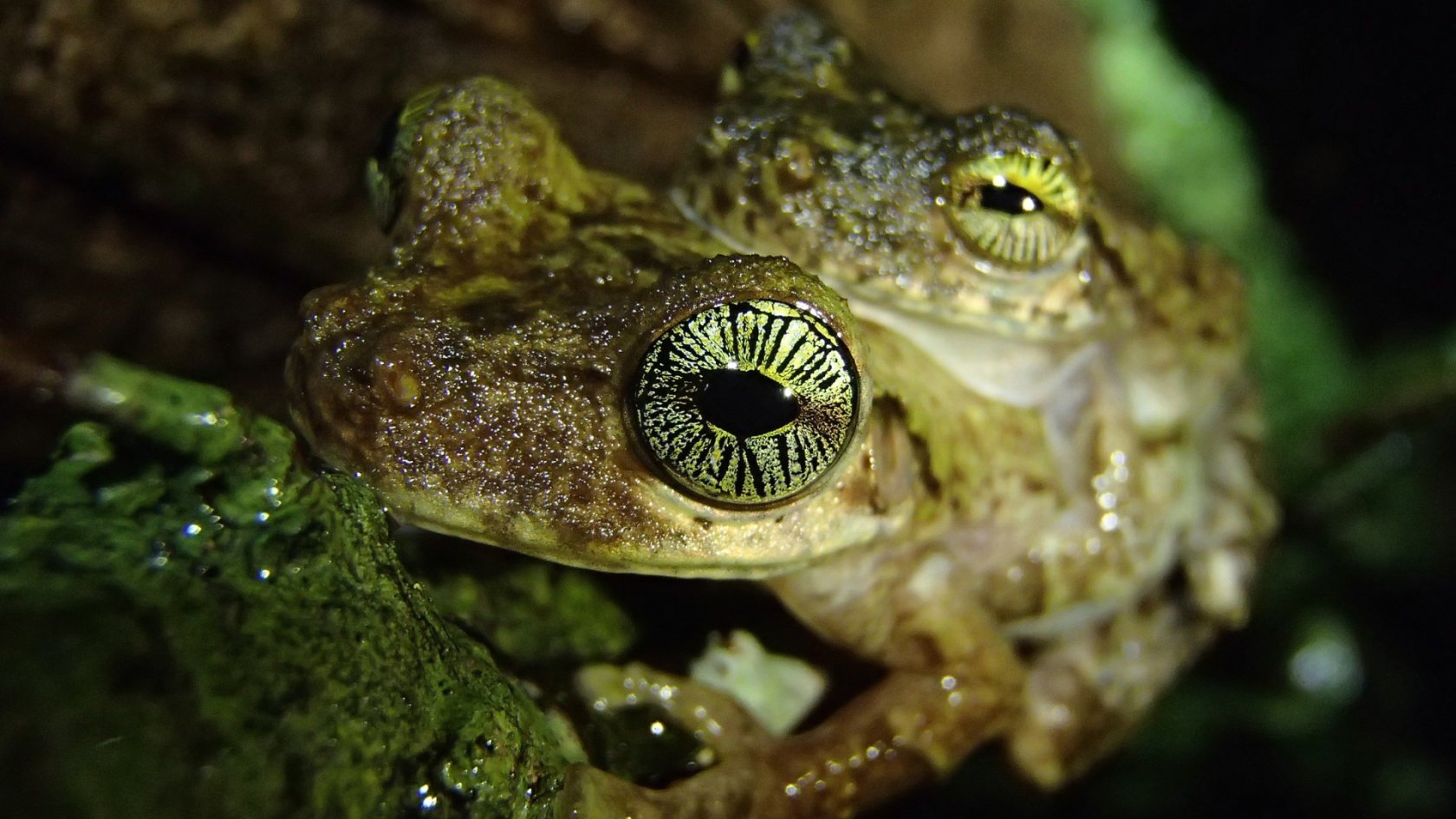
Osteocephalus oophagus in situ. Photographed in French Guiana (4°02’N, 52°41’W; ) between March and May 2021. These frogs are in amplexus, or their mating embrace. Image: Mélissa Peignier et al., 2026.
“In a world where biodiversity is declining at an alarming rate, it is essential that we minimise our impact on the animals we study,” added Peignier. “If we can reliably identify individuals using naturally occurring features, we may be able to reduce the need for more invasive marking techniques while still collecting the data needed to answer important scientific questions.”
While the reliability of the eye markings will vary between species, and should be done case by case, the team sees considerable promise for amphibians with complex irises. And working with them offers its own benefits.
“Honestly, the frogs themselves are incredibly beautiful and surprisingly chill, which makes working with them a real pleasure,” Peignier said.
Clostridium botulinum bacteria produce a potent neurotoxin called botulinum toxin, which causes the serious illness botulism. The toxin attacks the nervous system, leaving the body unable to control its muscles and making every breath a struggle. Without immediate treatment, botulism can be fatal. Humans, however, have managed to domesticate this dangerous bacterium to do their bidding. Over more than 90 years, biologists have been able to turn a wild microbe into an efficient factory for medical, military and cosmetic products like Botox.
Clostridium botulinum bacteria produce a potent neurotoxin called botulinum toxin, which causes the serious illness botulism. The toxin attacks the nervous system, leaving the body unable to control its muscles and making every breath a struggle. Without immediate treatment, botulism can be fatal. Humans, however, have managed to domesticate this dangerous bacterium to do their bidding. Over more than 90 years, biologists have been able to turn a wild microbe into an efficient factory for medical, military and cosmetic products like Botox.
The glacial Arctic Ocean was not a barren ice desert but a breeding ground for the evolution of cold adaptation in marine fish. This is the main conclusion of a new scientific publication from Stockholm University that examines small fish bones found in deep-sea sediments during an expedition aboard the Swedish icebreaker Oden.
The glacial Arctic Ocean was not a barren ice desert but a breeding ground for the evolution of cold adaptation in marine fish. This is the main conclusion of a new scientific publication from Stockholm University that examines small fish bones found in deep-sea sediments during an expedition aboard the Swedish icebreaker Oden.
Keeping to warm climates throughout their 250-million-year history may have helped crocodiles and their relatives survive the asteroid that killed the dinosaurs, finds a new study led by UCL (University College London) researchers.
The movie Disclosure Day, directed by Spielberg, investigates a conspiracy about government suppression of alien evidence dating back to Roswell. This review questions current societal beliefs about extraterrestrials and Darwinian evolution. It exposes the deception, ultimately portraying alien visitation as a misunderstood age-old phenomenon rather than a new factual reality.
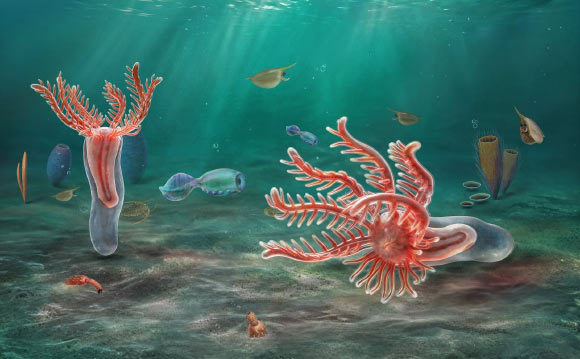
A 518-million-year-old ambulacrarian fossil from China suggests that the common ancestor of starfish and their relatives was not a burrowing worm; it was probably a tentacled animal that fed from the water around it.
Editor’s Note:Astrobites is a graduate-student-run organization that digests astrophysical literature for undergraduate students. As part of the partnership between the AAS and astrobites, we occasionally repost astrobites content here at AAS Nova. We hope you enjoy this post from astrobites; the original can be viewed at astrobites.org.
They say you can’t choose your hometown, but it still ends up shaping who you become. Turns out the same is true for black holes. The galaxy a black hole grows up in will have a major impact on how it will live out the rest of its life. Similarly, the black hole can leave a lasting impression on its galaxy!
Astronomers have long known that a galaxy’s stellar mass (the combined mass of all its stars) tracks pretty tightly with the mass of the black hole sitting at its centre: bigger galaxy, bigger black hole. This is one pillar of the idea that galaxies and their central black holes coevolve; that is, their life stories are tangled up with one another from early on. But ever since JWST started spotting suspiciously large black holes in the early universe, astronomers have been debating whether this relationship holds steady across cosmic time, or whether the rules were different when the universe and everything in it was younger.
Not Everyone Stays in the Town Centre
Most previous studies of the relationship between black holes and their galaxies have focused only on the central black hole: the biggest, most famous resident of a galaxy, sitting right downtown at its centre. That’s a reasonable place to start, since the central black hole is usually the most massive one around and tends to dominate the story. But this article’s authors wanted to know what happens to everyone else in town, too!
That includes satellite black holes, which are the central black holes of smaller “satellite” galaxies that orbit a bigger “primary” galaxy, a bit like a small town around a big city. It also includes a stranger, more recently discovered population: wandering black holes. These are the black hole equivalent of someone whose hometown got swallowed up by an expanding metropolis, and who never quite settled into their new surroundings.
Here’s how it happens: when a small satellite galaxy merges with a larger one, the satellite gets torn apart by tidal forces and its gas and stars are stripped away. However, its central black hole is often left behind, drifting through the new, much bigger galaxy on a wide orbit. The process that would normally drag a black hole down to the centre of a galaxy, called dynamical friction, is painfully slow, so wanderers can spend billions of years roaming the outskirts.
Two Cities, Two Sets of Rules
To study how these different black hole “life paths” shape, and are shaped by, their host galaxies, the authors turned to two cosmological simulations, ASTRID and TNG300, which handle black hole physics quite differently.
In TNG300, black holes are assumed to start fairly massive and are snapped straight to the centre of their host galaxy at every timestep. This makes mergers happen quickly and often, but it also means there’s no such thing as a wandering black hole in TNG300.
ASTRID, on the other hand, seeds smaller black holes and lets them move more realistically through their galaxy using a subgrid dynamical friction model. This is what allows wandering black holes, with their slow, aimless orbits, to exist and be studied in the first place.
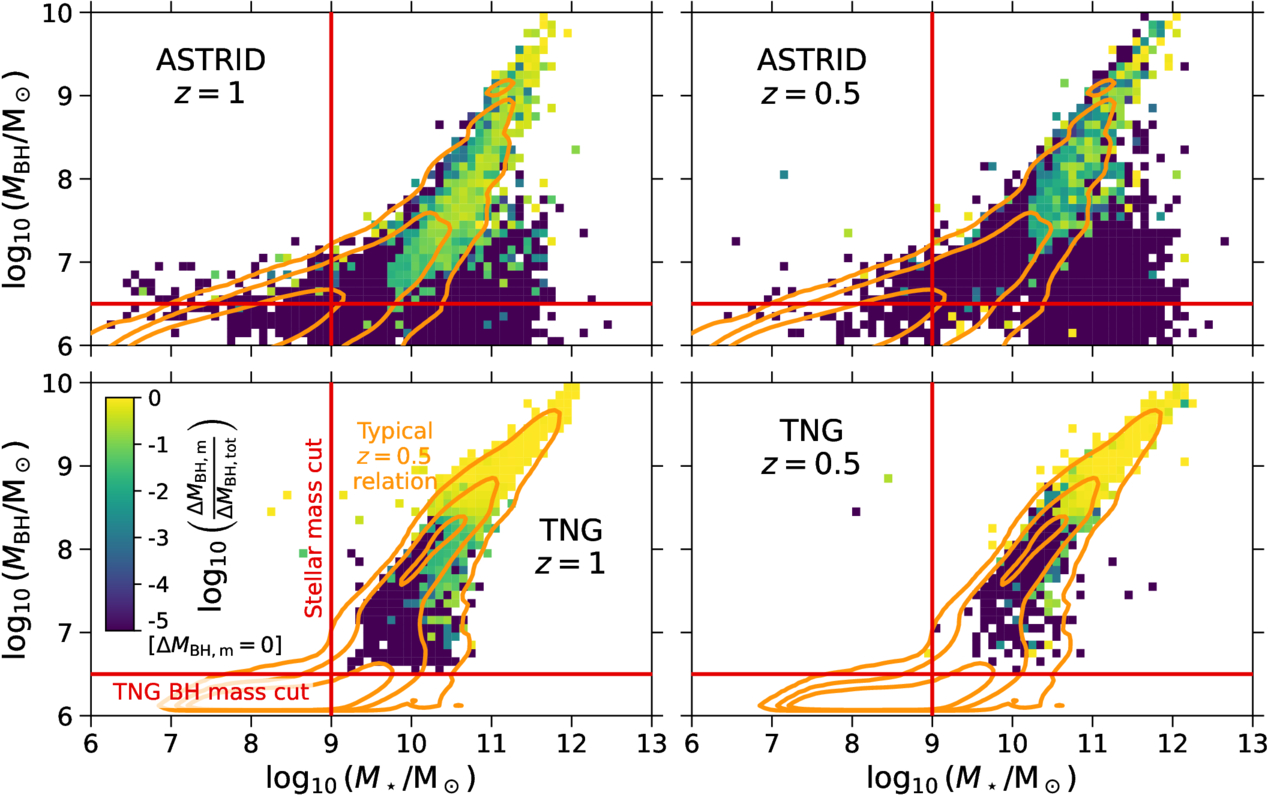
Figure 1 reveals a lot at once. First, ASTRID (the simulation that allows wandering black holes and tidally stripped satellites) has whole new neighbourhoods on the map that simply don’t exist in TNG300. Those populations clearly aren’t following the same tidy, linear coevolution that central black holes enjoy with their galaxies. Second, the most massive black holes tend to be the most yellow, meaning mergers did the heavy lifting for their growth. This is especially pronounced in TNG300, where roughly 80–90% of the growth of the most massive black holes comes from mergers. Meanwhile, the wanderers and stripped satellites sit at the deep-purple end: these black holes have barely merged with anyone at all.
Figure 1: How black hole mass relates to host galaxy stellar mass, shown at two snapshots in cosmic history, 8 and 5 billion years ago, for both simulations (ASTRID: top row; TNG300: bottom row). Colour shows what fraction of each black hole’s growth since the last snapshot came from mergers, from purple (grown almost entirely by slowly swallowing gas) to yellow (grown mostly by swallowing other black holes). [Weller et al. 2026]
Four Kinds of Black Hole Life Stories
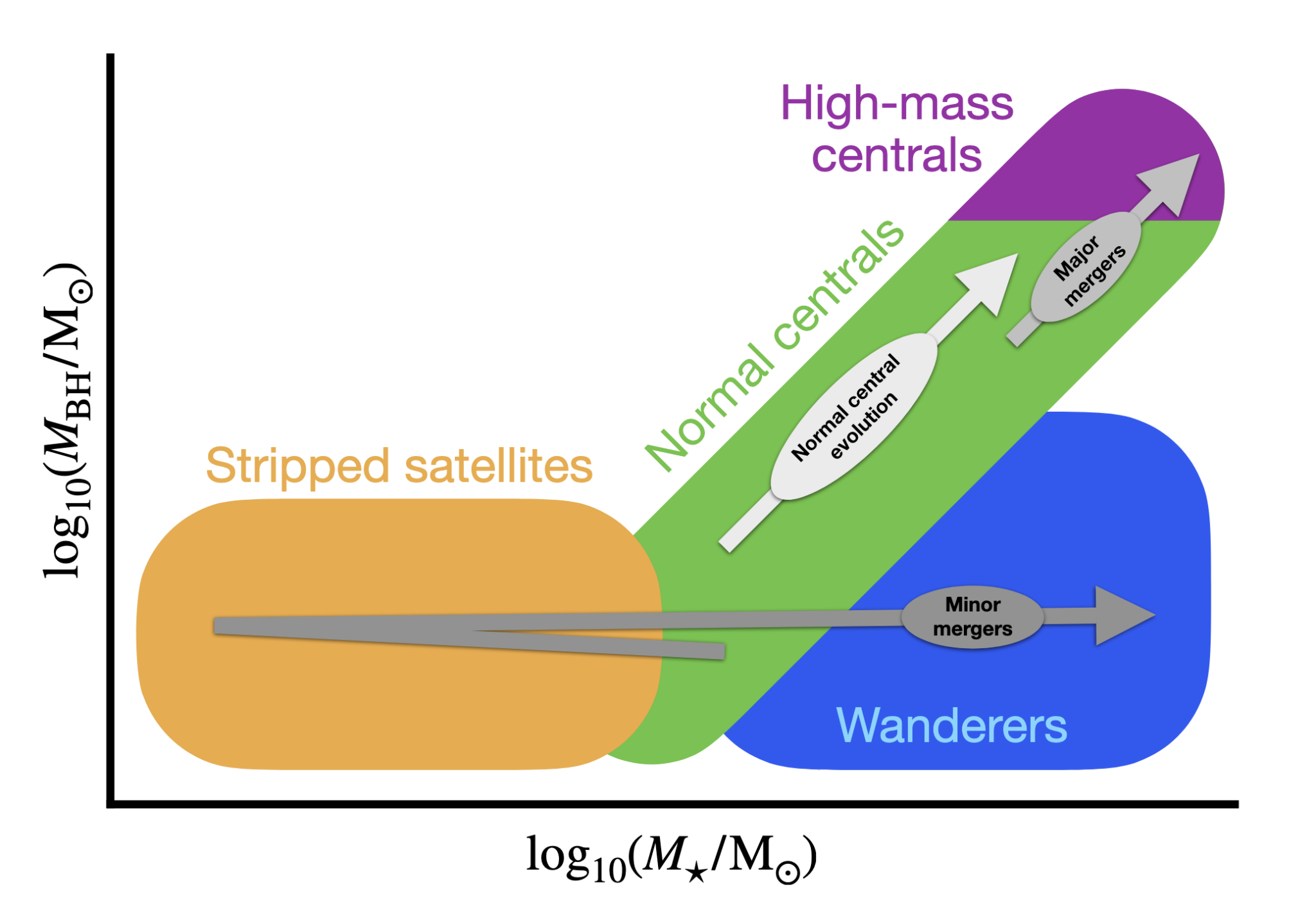
Pulling all of this together, the authors sketch out a kind of “neighborhood map” of black hole fates, sorted by where a black hole ends up on the mass-relation plot and how it got there (see Figure 2).
Figure 2: The distinct black hole populations revealed by the black hole mass–stellar mass relation, and the evolutionary path that lands each population in its corner of the map. [Weller et al. 2026]
Normal centrals are the homebodies. They sit at the centre of primary or satellite galaxies and grow up steadily alongside their hometown, climbing the mass relation together through a healthy mix of accretion and the occasional merger. Their galaxies keep forming stars the whole time in a functional, unremarkable, thoroughly nice place to live.
High-mass centrals are the ones who “made it.” These are central black holes in big primary galaxies, and their growth comes overwhelmingly from mergers with other black holes. Once they get big enough, they start throwing their weight around: their jets blast gas out of the galaxy, shutting down both star formation and their own further growth.
Stripped satellites are the annexed suburbs. They start out on the normal mass relation, but a merger with a bigger galaxy tears away their gas and stars, shrinking their stellar mass while their black hole is left comparatively overweight for its new, smaller home. With their gas reserves gone, star formation grinds to a halt, and their black holes, starved of fuel, barely grow either.
Wanderers are the ones who moved to the big city and never quite settled in. They start out on the normal relation inside a satellite galaxy, but when that galaxy merges into something much bigger, they’re left drifting through unfamiliar, low-density territory. With little gas around to feed on and almost no chance of merging with anyone else, their growth basically stalls.
This four-way map is a genuinely useful new way to read the black hole–galaxy relation: a black hole’s exact position on the plot isn’t just a number, it’s a fossil record of everywhere it’s ever “lived.”
There’s plenty more in the article we haven’t covered here, including how quenching plays out over time, how these results stack up against the local universe, and a closer look at how star formation rates and black hole accretion rates track each other across all four populations. If any of this piqued your interest, the full article is well worth a read.
Original astrobite edited by Ryan White and Chloe Klare.
About the author, Jayde Willingham:
I am a first-year PhD student at Swinburne University of Technology studying the early universe and how the first galaxies came to be. My work combines observations and theoretical modelling to explore how galaxies form, evolve, and shape the universe we see today. When I’m not at my desk or doing SciComm, I’m probably reading a good book with a hot beverage under a cozy blanket.
A 94-year-old electronics mogul is in hot water with Chicago authorities, who claim that his hare-brained plan to feed hungry squirrels is instead sustaining a massive plague of rats.
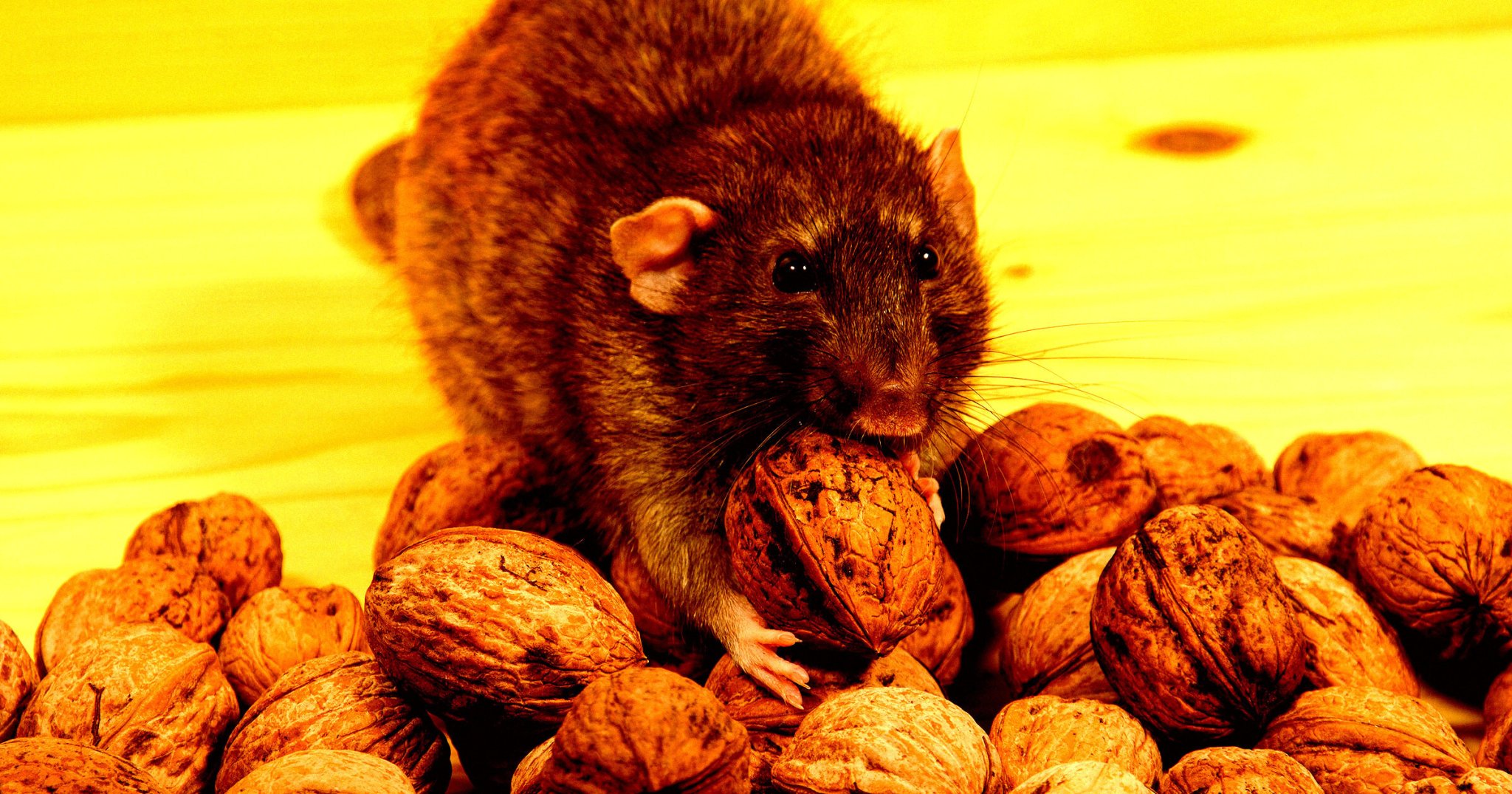
As previous owner of the billion-dollar electrical manufacturing company Tripp Lite, businessman Barre Seid has been putting his largess to use by paying a small army of workers to sprinkle an assortment of tree nuts across Chicago-area parks, Fortune reports.
As local resident Caroline Novak told Chicago WGN, it’s “like a luxury mélange of really nice nuts: I’m talking Brazil nuts and walnuts… these are not acorns.”
Though Seid’s target audience seems to be local squirrels, residents and city officials note that rats have quickly grown to depend on the regular feedings. As Novak’s husband told WGN, he counted over 40 rats digging holes near nut piles during a recent walk through Lincoln Park.
The bizarre operation has evidently been underway for years at this point, earning the billionaire heaps of civil violations carrying relatively small fines. Wealthy as he is, Seid has reportedly had no problem paying those fees and carrying on — the law forbids rich and poor alike to sleep under bridges, as the old saying goes.
“When you’re a billionaire and you have a weird hobby and someone tries to stop you, you have complete impunity,” Novak told Block Club Chicago in a separate interview. “You just triple down because why not? You’ll pay $40,000 in fines. You don’t care.”
Now in 2026, authorities in Chicago are reaching their breaking point. Alderman Timmy Knudsen — whose jurisdiction covers the area of Lincoln Park Seid’s workers are active in — is now pushing the Chicago Park District to sue Seid in order to stop the nuttiness once and for all.
“For years, a billionaire family has carried out a paid operation to feed local wildlife, disrupting our rat abatement efforts and causing an infestation that has made parts of the park unusable for other residents,” Knudsen’s office told Fortune in a statement. “We’re hopeful that raising awareness and drawing attention to the issue will ultimately lead to better behavior and a safer park for our community.”
A Neanderthal who was buried 75,000 years ago in Shanidar Cave in Iraq died from a wooden spear straight through the chest, archaeologists have revealed.
While it's impossible to know exactly what happened, the violence may have been a targeted hit.
"The position of the wound and the force required to push it right through the Neanderthal's body bear the hallmarks of an intended kill shot directed towards the heart," study first author Emma Pomeroy, a paleoanthropologist at the University of Cambridge, said in a statement.
In a study published Thursday (Oct. 15) in the journal Scientific Reports, Pomeroy and co-authors analyzed the bones of Shanidar A, a Neanderthal who died violently at about age 45 and was then buried in Shanidar Cave.
The archaeological site at Shanidar is famous for its evidence of purposeful burial, which experts once thought was only done by modern humans. Although the Neanderthal "flower burial" at Shanidar has since been debunked, the cave holds other evidence of repeated Neanderthal burials, which shows that these extinct humans placed specific meaning on that location, the authors wrote in the study.
The skeleton of Shanidar A was incomplete when it was discovered in 2019, consisting of a mostly complete right hand, three ribs, six teeth and a left scapula or shoulder blade, which meant they could not figure out the sex of the Neanderthal.
Near the edge of the shoulder blade, archaeologists noticed a round hole about 0.6 inches (1.5 centimeters) in diameter and a round piece of bone that had been punched out of the shoulder blade. The researchers ruled out post-mortem damage to the bone, including animal gnawing and insect burrowing.
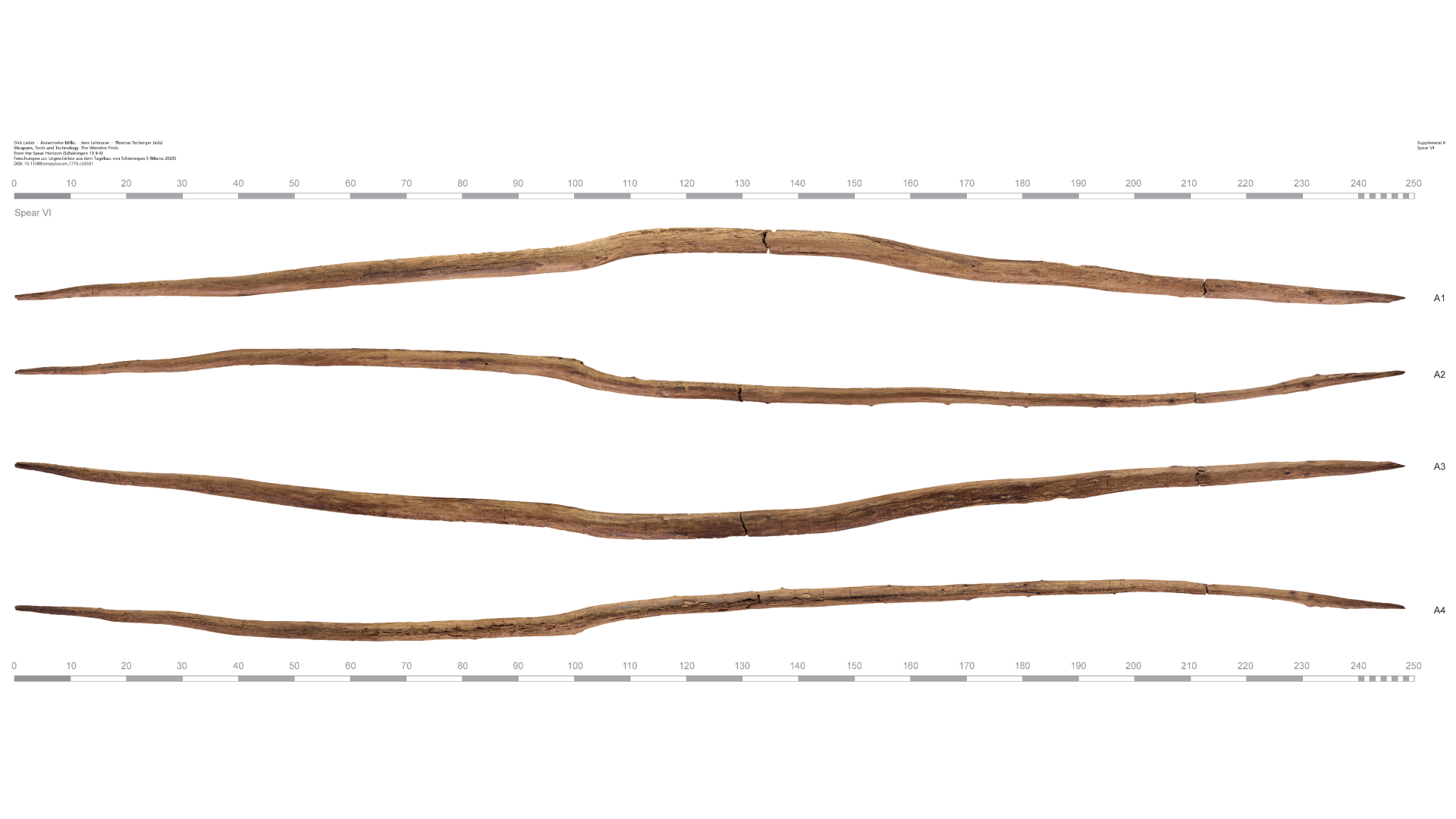
An example of a Paleolithic thrusting spear found in Germany. This may have been the kind of weapon that killed the Shanidar A Neanderthal. (Image credit: Dirk Leder et al. (eds), Weapons, Tools and Technology (2026))
"The perforation is best explained as resulting from perimortem [around the time of death] penetrating trauma, such as that caused by a projectile or a thrusting implement such as a spear," the researchers wrote in the study. Specifically, the Neanderthal was killed by a spear that entered their chest from the front at a high velocity and pierced their shoulder blade.
The shape of the wound in the shoulder blade appears to match experimental evidence of injuries made by wooden spears rather than stone-tipped weapons, the researchers wrote in the study. Neanderthals would have used wooden spears for both thrusting and throwing. But it is unclear if this individual died because of a violent interaction with another Neanderthal or by accident, such as a hunting incident.
"All we can ever know about the end of this Neanderthal's life is that it was violent, and came at the end of a wooden spear," study co-author Graeme Barker, an archaeologist at the University of Cambridge, said in the statement.
"Care and support from other Neanderthals"
Even though this Neanderthal had an untimely demise, evidence on the teeth suggested that the individual was cared for during life.
The six teeth from Shanidar A were heavily worn-down in an unusual manner, the researchers wrote. One of them — a front tooth with a large quantity of tartar on it — had been split in half during the Neanderthal's life, and the individual continued to use the damaged tooth for a considerable amount of time. The collection of teeth suggests the Neanderthal sustained a major trauma to the face that fractured the lower front tooth and may have caused additional injuries to the jaw.
The Neanderthal's lower front tooth was fractured during life. (Image credit: University of Cambridge)
"There’s no doubt that Shanidar A would have had difficulty communicating and been in absolute agony for a long period of time," Pomeroy said in the statement. "Surviving a blow that splits a tooth in this fashion, then continuing to live and eat for a period of at least a year and maybe more, would have required care and support from other Neanderthals."
Rebecca Wragg Sykes, an archaeologist and author of "Kindred: Neanderthal Life, Love, Death and Art" (Bloomsbury, 2020) who was not involved in the study, told Live Science in an email that the apparently fatal chest injury is an important addition to our understanding of Neanderthals. While it is plausible the Neanderthal was stabbed by a wooden spear, Wragg Sykes said, "it would be interesting to also compare whether a wild goat horn, the most intensely hunted species at Shanidar, might have been responsible."
Shanidar A is not the first mortally wounded Neanderthal to be found at the site. In 2009, researchers analyzed the skeleton of Shanidar 3, an older adult male who died 50,000 years ago, and found a deep slice in one of his ribs. The researchers suggested that the Neanderthal may have been killed by a stone-tipped spear possibly thrown by a modern human. Although modern humans first reached Europe around 54,000 years ago, experts aren't sure exactly how they interacted with Neanderthals.
Pomeroy told Live Science in an email that the discovery at Shanidar of two stabbed Neanderthals 25,000 years apart is interesting but possibly just a coincidence.
"We know from the archaeology that Neanderthals were repeatedly coming back to Shanidar and using it for short periods at a time, both around 75,000 years ago and around 45-50,000 years ago, as well as leaving their dead there," Pomeroy said.
The traumatic injuries, purposeful burial and indirect evidence of wooden spears all show that 75,000 years ago, Neanderthal life — and death — were complex, the researchers wrote in the study.
How much do you know about our closest relatives? Find out with our Neanderthal quiz.
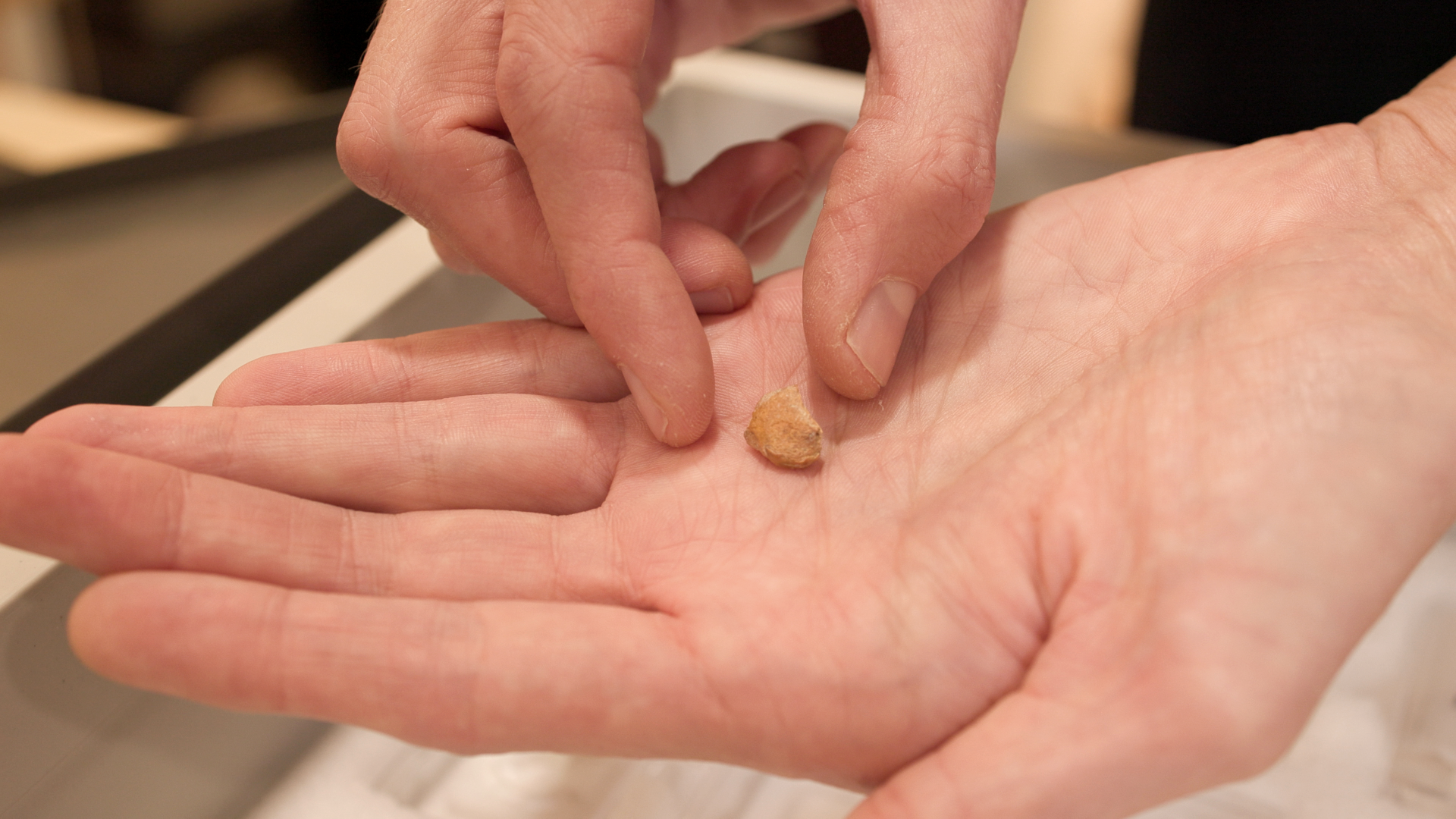
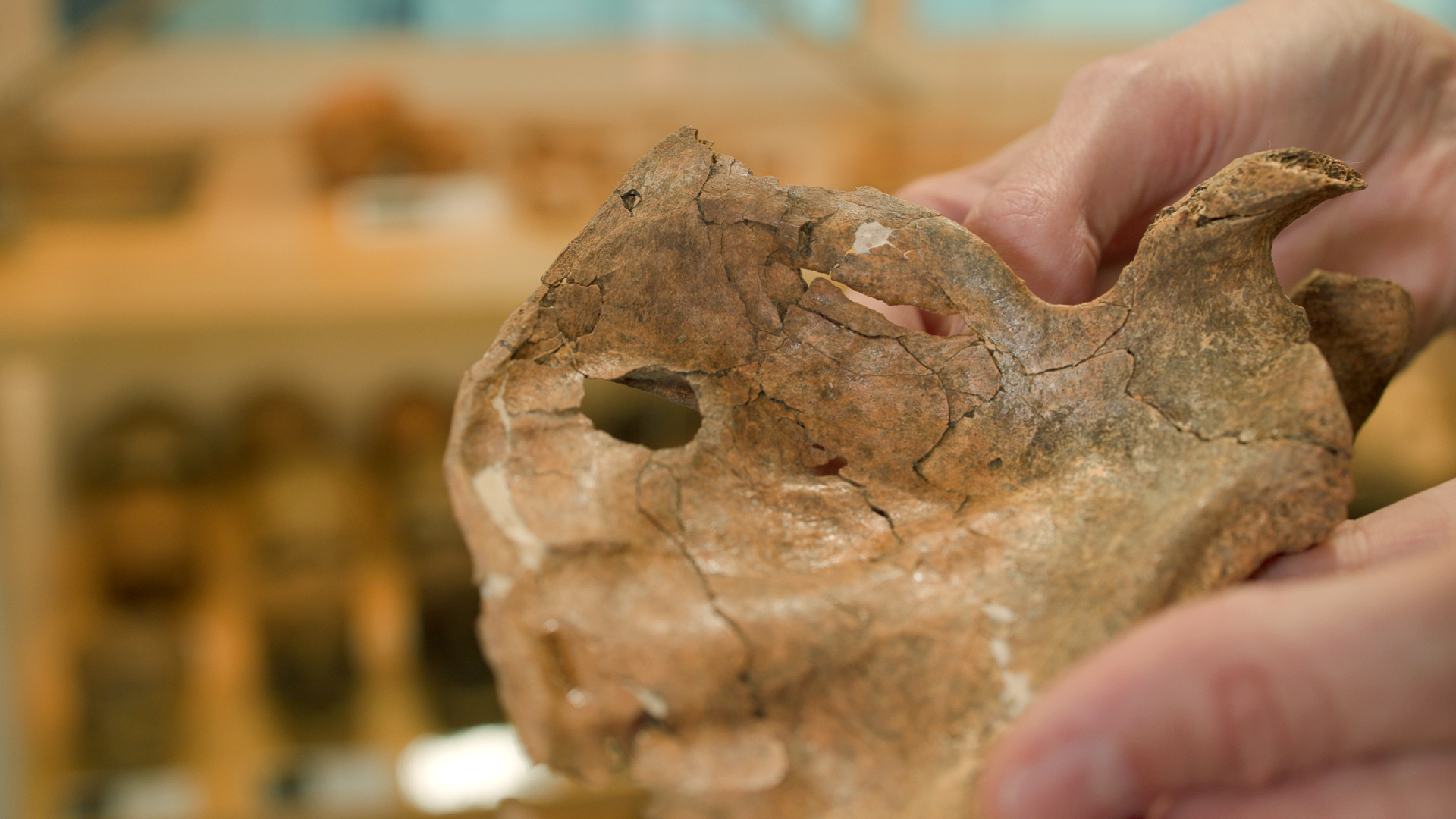
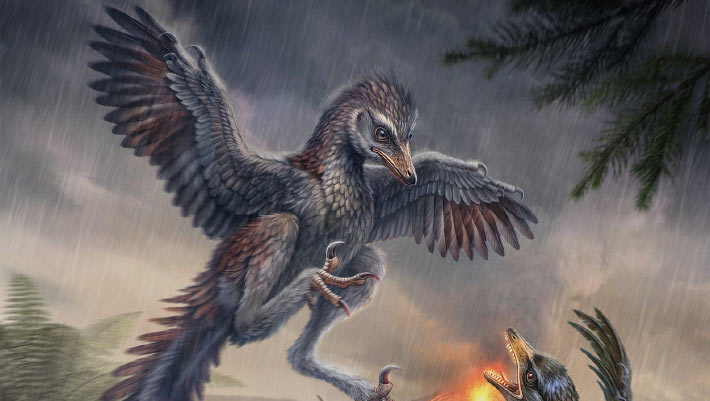
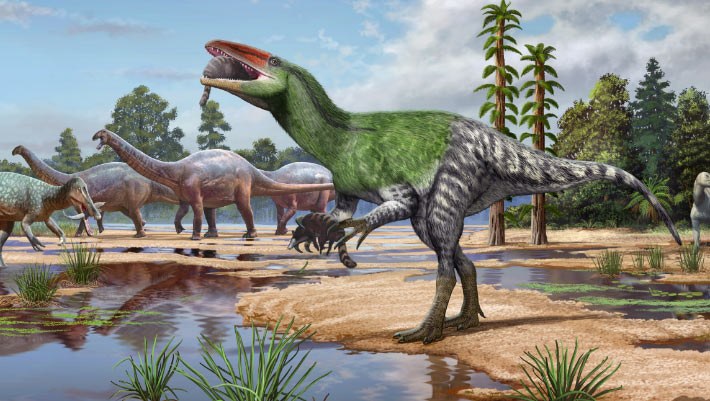
A fossilized braincase that sat in in the collection of the Natural History Museum in London for a century has been identified as Europe’s first megaraptoran dinosaur, a lineage once thought to have flourished mainly in the southern hemisphere.
Follow-up observations show that a recently discovered pulsar has two stellar companions, making it one of just a handful of millisecond pulsars known to be in triple-star systems.
An Unusual New Pulsar
Earlier this year, researchers reported the discovery of a pulsar with the Five-hundred-meter Aperture Spherical radio Telescope (FAST). The newfound pulsar, PSR J0435+3233, is a millisecond pulsar, rotating once every 3.2 milliseconds. What’s unique about this pulsar is how quickly it’s spinning down: its spin rate is decreasing roughly 100 times faster than other millisecond pulsars in our galaxy, suggesting an unusually strong magnetic field and the possibility of an exotic formation pathway.
The FAST observations also showed that the pulsar is not alone: it appears to be on an 8-day orbit with a white dwarf. Now, follow-up observations have revealed the pulsar’s membership in an intriguing stellar system.
From Radio to Gamma Rays
Zonglin Yang (National Astronomical Observatories, Chinese Academy of Sciences) and coauthors followed up on the discovery of PSR J0435+3233 using multiwavelength data from FAST, multiple optical and infrared observatories, and the Fermi Gamma-Ray Space Telescope.
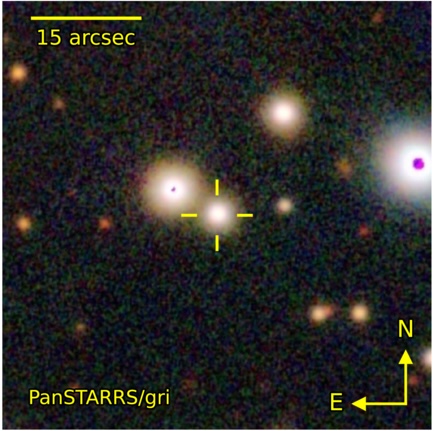
Visible-light image from PanSTARRS of the outer subgiant companion. [Adapted from Yang et al. 2026]
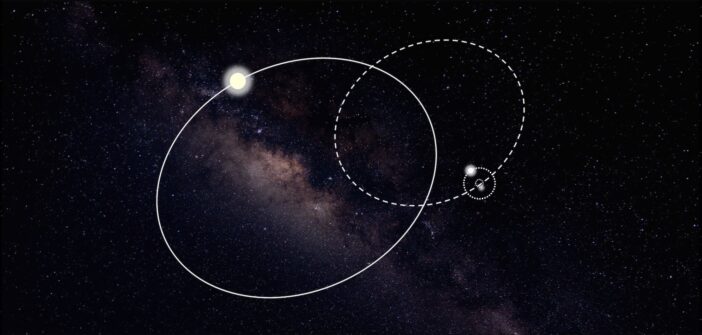
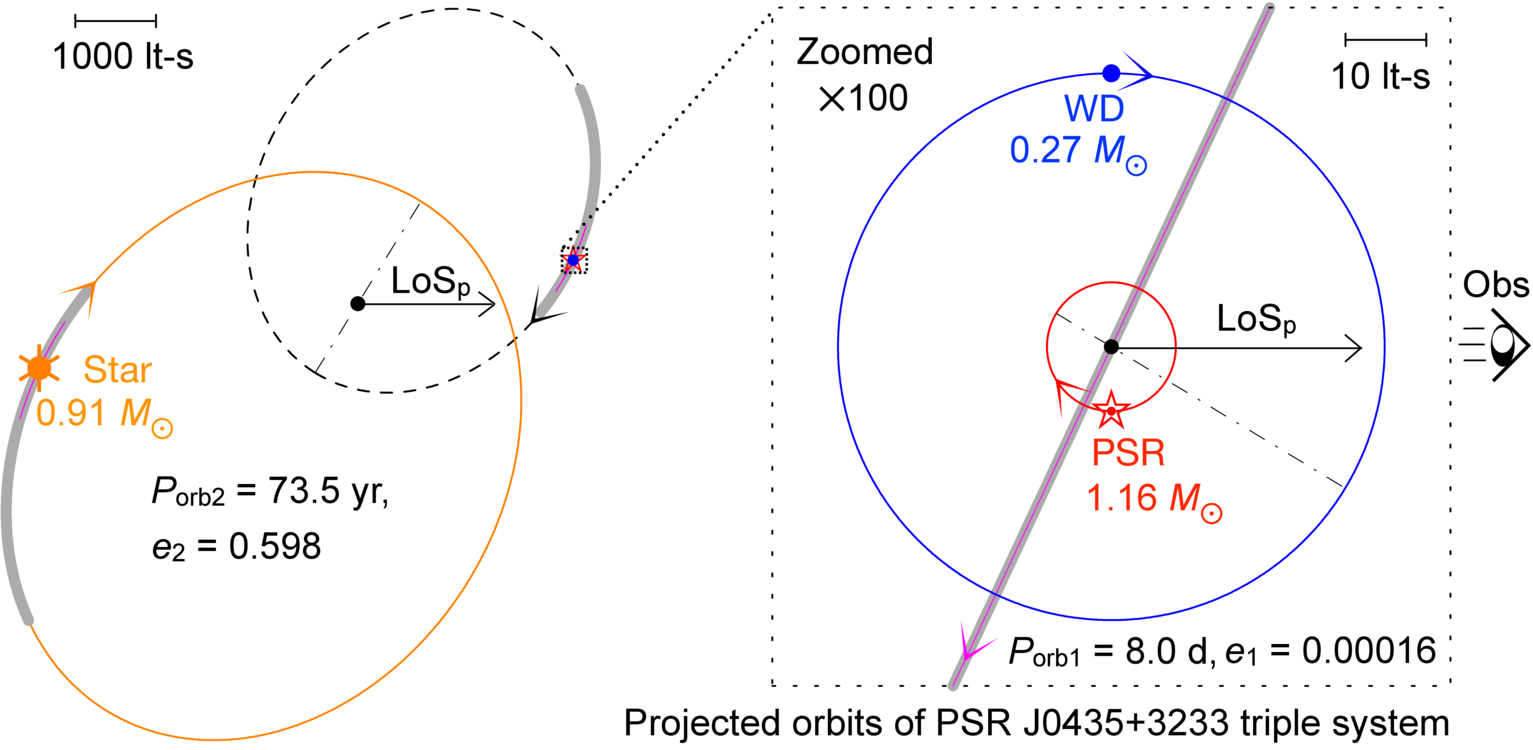
With this broad dataset, the team confirmed the identity of the pulsar’s white-dwarf companion, detected gamma-ray emission from the pulsar, and identified a second previously unknown companion, a subgiant star roughly as massive as the Sun. These three stars are arranged in a hierarchical triple: the pulsar and white dwarf orbit one another tightly, and the subgiant is a more distant companion, orbiting in decades rather than days. Current observations show that the orbits of the inner binary and the outer star are tilted relative to one another, either nearly perpendicularly or at about 54 degrees. While a triple system of three closely intertwined stars invites chaos, this configuration is stable long term.
Insights into Stellar Evolution
While it’s common to find millisecond pulsars in binary systems — in fact, many millisecond pulsars are thought to spin up to their incredible speeds via accretion from a stellar companion — it’s rare to discover them in triple systems. Because this system is isolated out in the field rather than crowded together with other stars in a dense cluster, Yang and collaborators suspect that the three stars have been together since birth, as opposed to being assembled dynamically later on.
Projected orbits of the three stars in the system. Click to enlarge. [Yang et al. 2026]
The most massive star in the trio would have hurried through its main-sequence lifetime in less than 10 million years, culminating in a supernova. The remaining two members of the system would have had to withstand this explosion, which the team found is possible but not especially likely; the likelihood of the system coming unglued due to a star going supernova depends on how much of a “kick” the explosion gives the newborn pulsar, and even in a zero-kick scenario, the likelihood of the system remaining bound is only 35%. The future evolution of the system will be less dramatic. The outer star will eventually evolve into a white dwarf, undergoing a gentle transition that poses no threat to the stability of the system.
Triple-star systems are common among massive stars, but how this configuration affects stellar evolution is still being explored. This discovery offers a valuable opportunity to study dynamics and stellar evolution in a rare triple system.
Isaac Newton suspected that the gravitational dance between the Sun and Jupiter would eventually destabilize the solar system, but modern computational research has shown that its long-term stability is, statistically, pretty secure. However, new simulations with more realistic solar mass-loss conditions make a strong case for the disassembly of the outer solar system — and on timescales much shorter than previously thought.
Kick It Up a Notch
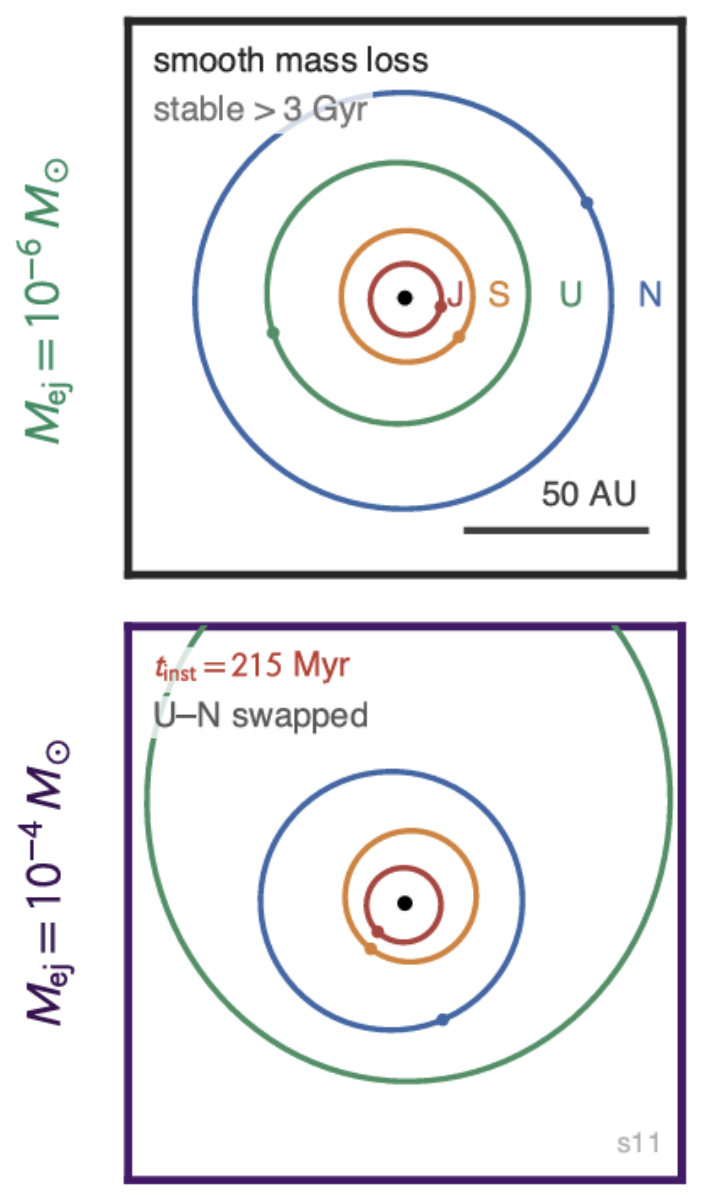
Final outer planet orbital configurations for two simulations — one stable and one unstable. t=0 at the onset of white dwarf formation. Click to enlarge. [Adapted from Batygin et al. 2026]
Several studies have investigated what will happen to the orbits of planets in our solar system as the Sun sheds its mass during its transition to a white dwarf. These studies have found that while the semimajor axes of the planets will expand by approximately a factor of 2, their orbits remain stable on timescales longer than the age of the universe (approximately 1018 years). This expanded orbital architecture will make the solar system more prone to jostles from stellar flybys, but even accounting for this, the giant planets’ orbits wouldn’t disassemble for another 30–100 billion years.
However, all of these studies modeled solar mass loss as a smooth function, so the dismantling of the solar system was left up to external forcings. In reality, stars on the red giant branch undergo mass ejections that are random in time and direction, corresponding to velocity “kicks” that can alter the dynamics of the planets.
A team led by Konstantin Batygin at the California Institute of Technology conducted numerical experiments to analyze the orbital dynamics of the outer solar system under different solar mass-loss conditions. First, they tested the classic case of smooth mass loss and validated previous findings that, despite planetary orbits doubling in size, the dynamics are pretty tame. This holds true even when mass is ejected anisotropically: if the timing is smooth, the asymmetries cancel out.
Outer Solar System, Your Days Are Numbered
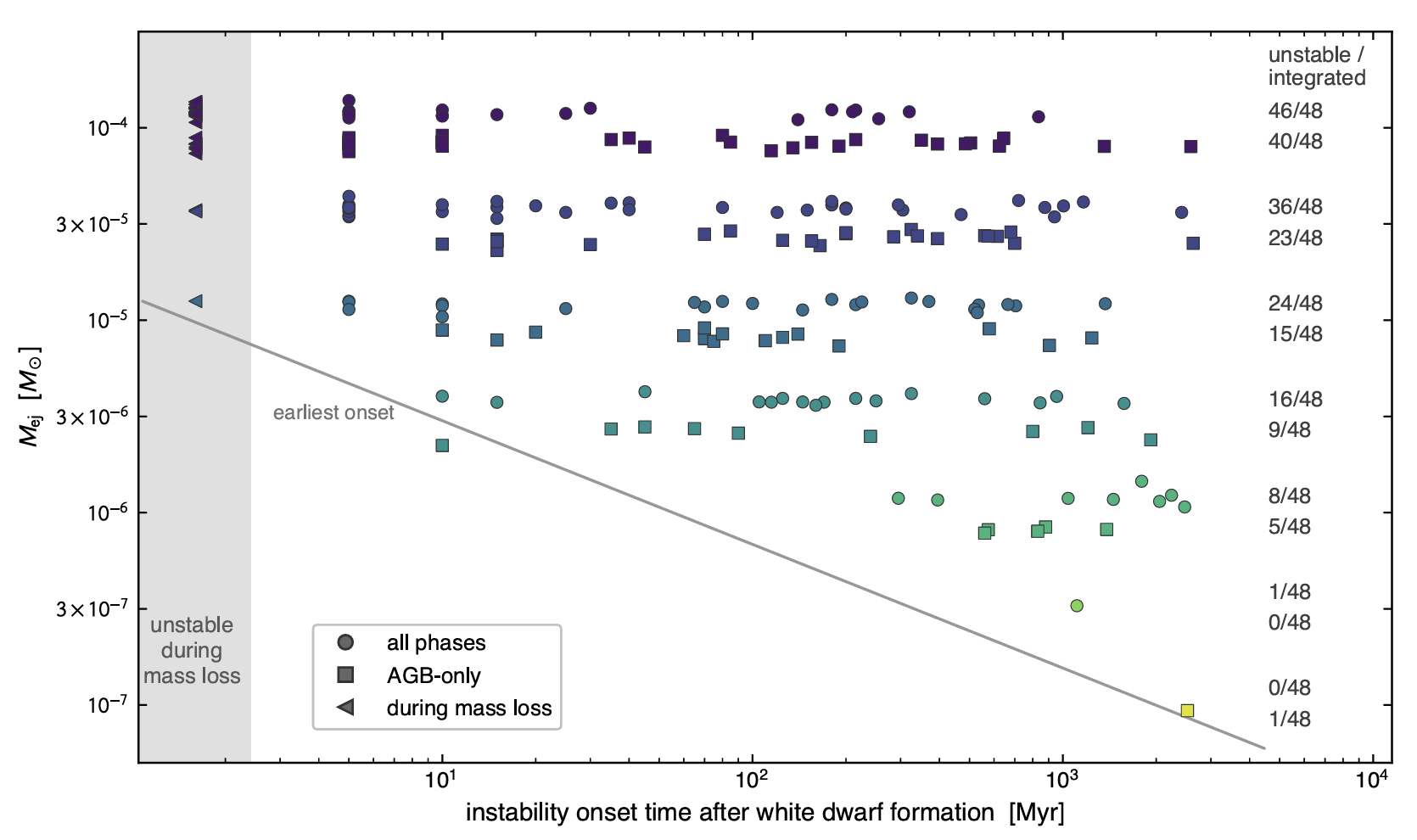
Next, they simulated stochastic kicks and found that the behavior of the outer planets was largely tied to the ejection mass of each kick. For very small ejection masses (≤ 10-7 M☉), dynamics mimic the smooth mass-loss case. For intermediate values (10-7 to 10-6 M☉), there’s a roughly 20% chance Jupiter–Saturn and Uranus–Neptune enter mean-motion resonances: an orbital configuration where planets’ periods are a ratio of small integers. These resonant configurations don’t protect the giant planets, however: resonant simulations disassemble slightly more often than nonresonant simulations. For larger ejection masses (≥ 10-5 M☉), the outer solar system disassembles on the timescale of billions of years.
Instability onset time — or how long after white dwarf formation the outer solar system disassembles — as a function of ejection mass. The larger the ejection mass, the greater the chance of instability. Click to enlarge. [Batygin et al. 2026]
Which ejection masses are the most accurate for our Sun? Well, unfortunately for our beloved outer planets, ejection models and observed kick amplitudes suggest a future ejection mass of 10-4 M☉. With kicks like these, not only is there a considerable chance of orbit destabilization, but it could happen before the white dwarf even forms. About 40% of simulations lead to disruption or violent scattering while the Sun is in its red giant phase, and roughly 90% break down within 3 billion years.
This new discovery reduces the life expectancy of the solar system from one billion billion years to a meager one billion years after white dwarf formation.
Citation
“Terminal Instability of the Solar System Triggered by Stochastic Solar Mass Loss,” Konstantin Batygin et al 2026 ApJL 1009L22. doi:10.3847/2041-8213/aea290
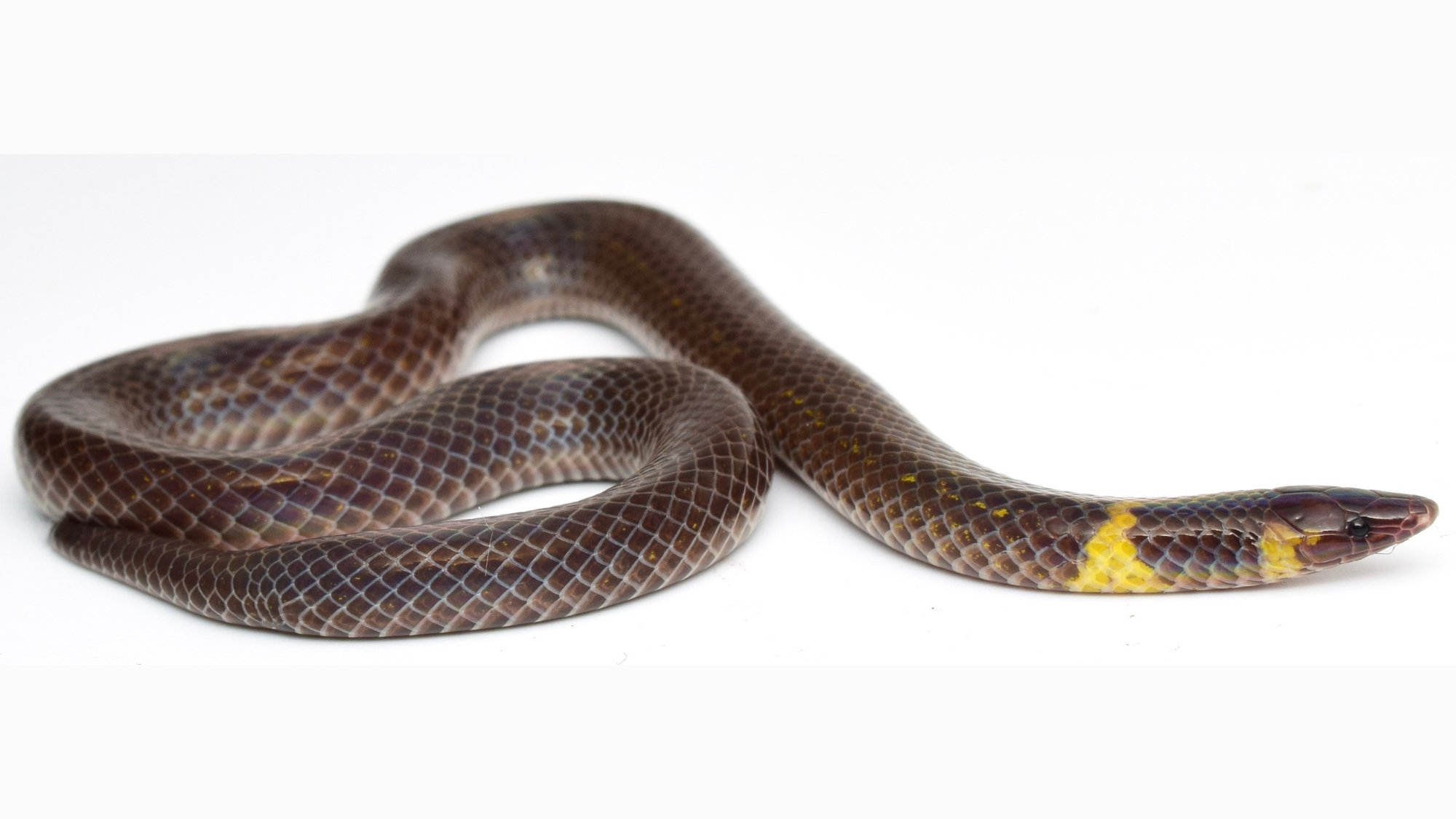
Snakes will bite, rattle their tails, and even spit venom to escape danger. But of all the world’s species, southeast Asia’s dwarf reed snake (Pseudorabdion longiceps) relies on an especially fascinating escape method. When threatened, the diminutive serpent rolls away like a speeding wheel.
An adult dwarf reed snake typically measures less than 12 inches long, but its unique locomotive maneuvers allow it to retreat as fast one foot per second—about four times faster than it travels by simply slithering on the ground. It’s not a flailing getaway, either. The snake also easily rolls along a straight path while somehow keeping its head both stable and facing forward.
Now, researchers finally have a better understanding of how the dwarf reed snake achieves such dizzying acrobatics. In a study published today in the journal Current Biology, a team at Japan’s Toho University detailed the specific physiology that enables its locomotion after filming the snakes with high-speed cameras. Essentially, the snake doesn’t rotate its entire body in a singular, forward motion—it whips one side of its body forward towards the ground while an arched portion swings down by its head in what the study’s authors call a “stroke.” The snake then alternates between its left and right side coming into contact with the ground for each successive stroke. Essentially, it’s like twirling a rope in a lateral circle while holding one end in your hand—except that end is the snake’s head.
The cumulative efforts bypass the traditional idea of a wheel requiring something like a central axle. Instead, this ingenious, highly controlled movement allows the animal to keep its head and sensory organs upright and facing ahead while traveling at such high speed. This is compounded by the dwarf reed snake directing regions of its body to engage in large, alternating rotations while stabilizing its head.
By gaining better insight into these biological mechanisms, researchers also highlight the difficulty in trying to predict an animal’s capabilities based solely on its physiology. A snake may have primarily evolved to slither—but that doesn’t mean it can’t get creative when necessary.
When zoology professor Daniel Baldassarre traveled to the remote Galápagos Islands of Wolf and Darwin with two other researchers, getting there proved quite a challenge. With no beaches to land a boat on, they had to approach the islands’ cliffs in a small dinghy and wait for a lull in the waves before jumping onto sharp, black lava rocks.
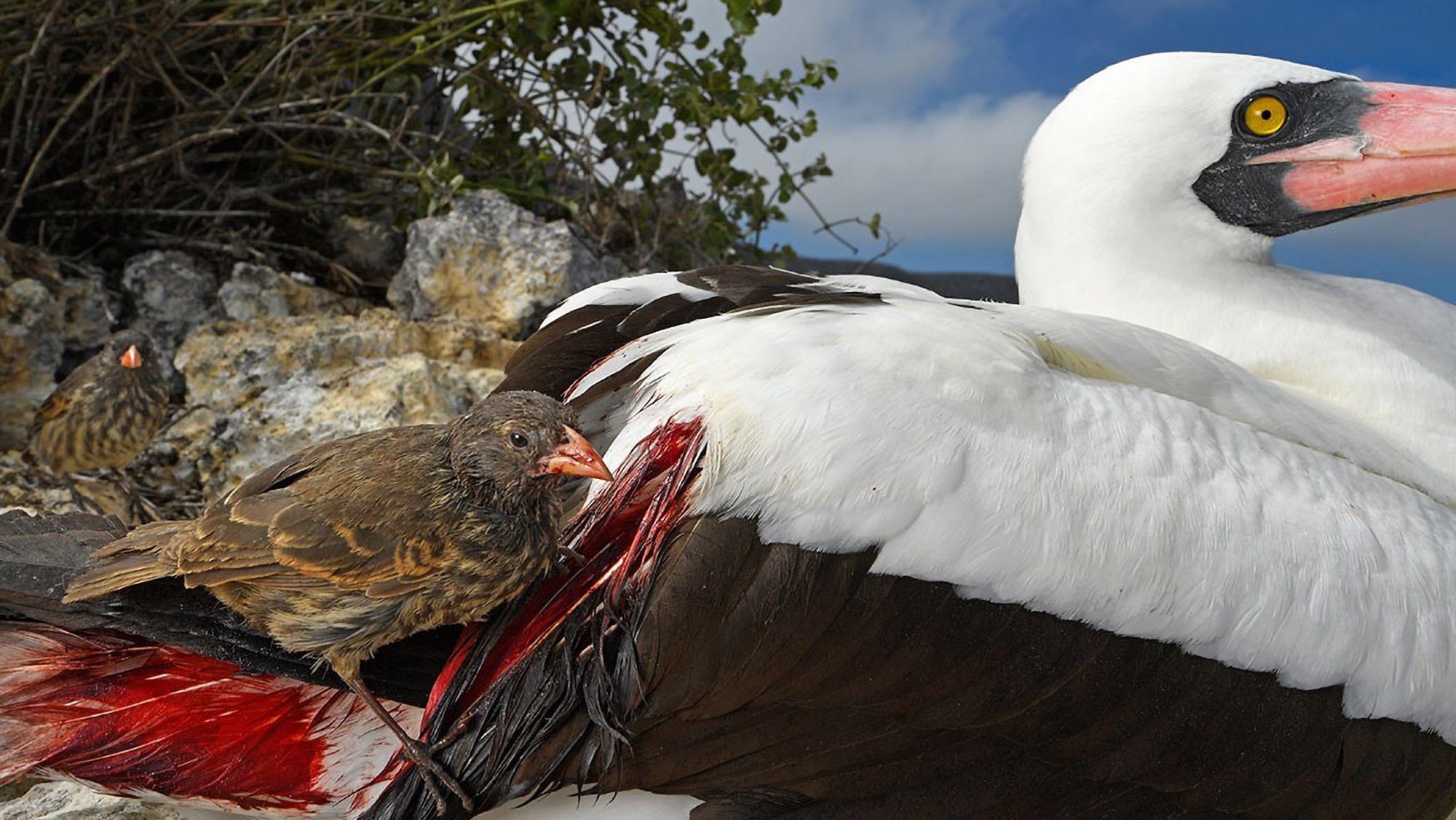
But their efforts paid off. On that trip, they saw a bird that very few people have ever set eyes on in the wild: the vampire ground finch. These finches are only found on Wolf and Darwin, and feed on the blood of much larger birds called Nazca boobies that also live on the islands.
Up close, Baldassarre and his colleagues noted the vampire finches’ blood-stained bills and their throats visibly engorged with blood. They also saw them in action.
“We observed scores of vampire finches clamouring all over the backs, tails, and wings of boobies, opening up substantial wounds with their sharp beaks, and drinking their fill of blood,” they wrote in an article for The Conversation.
Why only some birds drink blood
“Blood is a notoriously difficult food source to process and extract nutrients from, which probably partly explains why so few animals have evolved to feed on it,” Baldassarre tells Popular Science. He suspects that on these islands where freshwater is extremely rare, blood might serve as a water source for the finches.
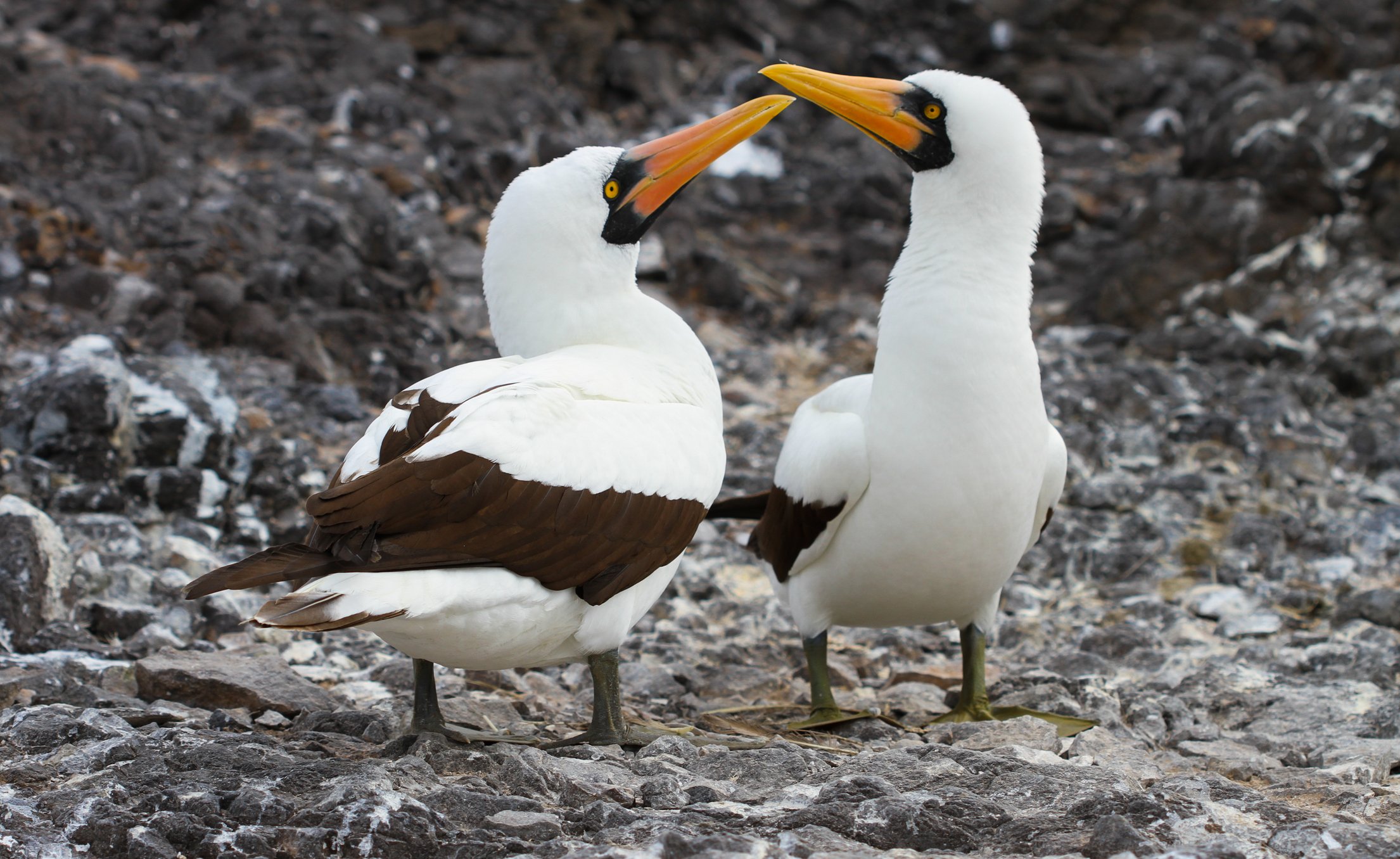
Two Nazca boobies perform their species’ mating call. Vampire ground finches feed on Nazca boobies on the remote Galápagos Islands of Wolf and Darwin. Image: Getty Images / inthedark72
It’s not the only component of the vampire finches’ diet, however. Based on unpublished data collected by Baldassarre and his colleagues, blood makes up about one-tenth of the vampire finches’ diet.
“These finches are quite opportunistic, so they will eat just about anything they can find,” Baldassarre says. “We observed them feeding on everything from seeds to insects to broken seabird eggs.”
One theory is that vampire finches rely more on blood feeding in periods of extreme drought, when other resources are scarce. But more research is needed to see if this idea holds up in practice.
How this strange behavior evolved
Vampire finches weren’t always vampires, scientists think. The relationship between vampire finches and boobies probably started off with the finches eating parasites found on the skin and feathers of the boobies. This would have been mutually beneficial because it provided a cleaning service for the boobies and food for the finches.
But at some point in evolutionary history, in the process of picking off parasites, the finches started to create lesions on the boobies’ skin, and eventually began feeding on their blood.
Over time, their bills became more scalpel-like, perfect for making skin incisions. Their digestive system also changed. When Baldassarre and his colleagues studied the microbes found in vampire finches’ guts, they found that their gut microbiome was very different from that of other, non-blood-consuming finches on the Galápagos Islands, something they attribute to their unique diet.
Until recently, vampire finches were considered a subspecies of the sharp-beaked ground finch (Geospiza difficilis).
“But they have now been designated as their own species [Geospiza septentrionalis] because of the differences they have evolved because of blood feeding,” Baldassarre notes.
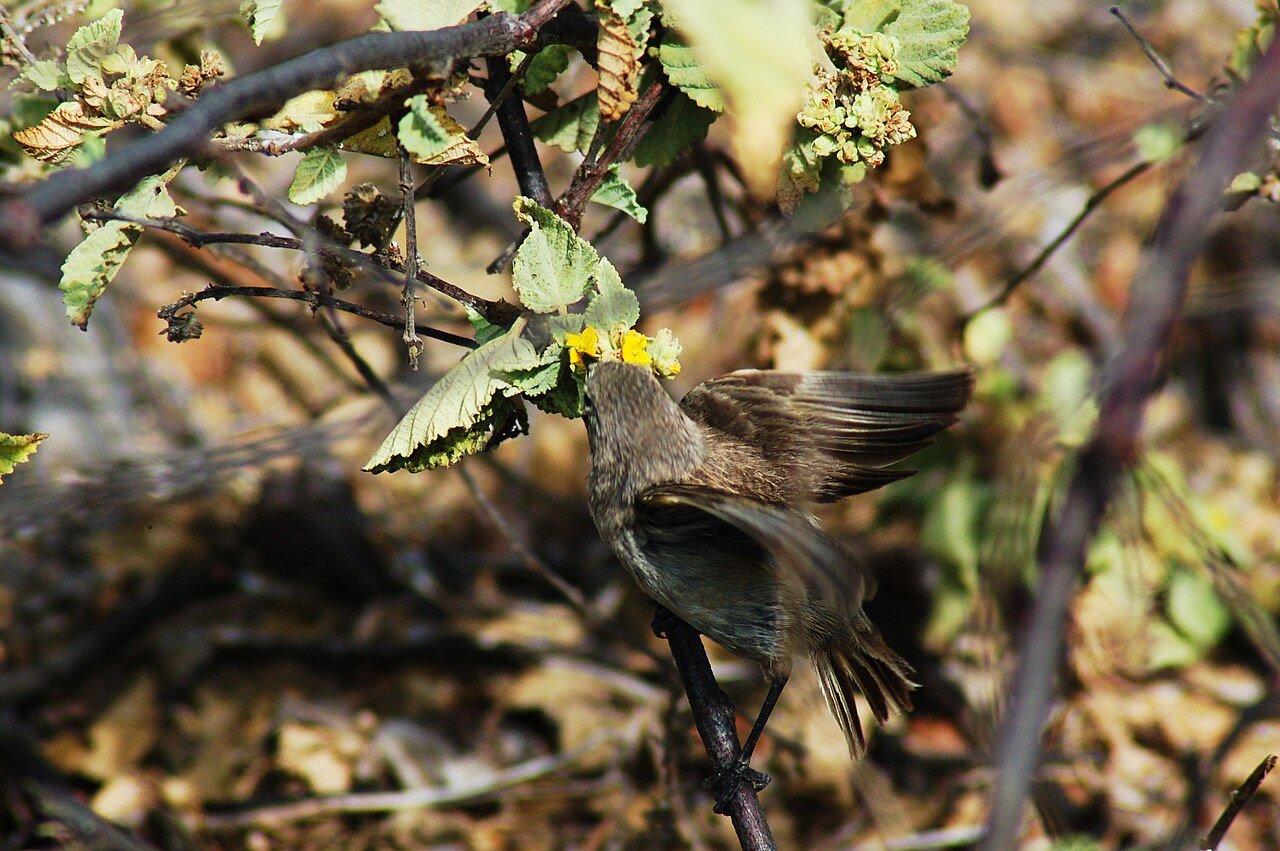
Vampire ground finches on Wolf island have been seen drinking nectar from Galápagos prickly pear flowers and other flowers. Image: Peter Wilton / CC BY 2.0
How the boobies cope
Baldassarre and his colleagues have seen vampire finches gang up on and kill nestling boobies,“but that was quite rare,” he points out.
“In most cases, the finches seem to inflict just enough damage to break the skin and extract some blood, but not too much to harm the boobies significantly.” This is similar to many parasite-host relationships, such as fleas, ticks, and mosquitoes on mammals. “You can kind of think of the vampire finches as giant mosquitoes,” Baldassarre says.
“For one, as in large animals being bitten by mosquitoes, often the damage is minimal and not noticeable, so it doesn’t elicit a strong reaction. Also, the boobies sometimes have a vested interest in staying put and guarding their spot in the colony, or perhaps nest or nestlings, so may not want to fly away. Finally, the finches seem to target hard-to-reach areas on the boobies like the base of tail feathers, so it’s likely difficult for the boobies to deter them.”
I, for one, was feeling very sorry for the boobies being constantly hounded by these small vampire birds. Until I learnt that Nazca boobies practice something called “obligate siblicide,” which essentially means that the first-hatched chick routinely attacks and kills its younger sibling. It’s a harsh, bird-eat-bird world in the Galápagos Islands.
In Ask Us Anything, Popular Science answers your most outlandish, mind-burning questions, from the everyday things you’ve always wondered to the bizarre things you never thought to ask. Have something you’ve always wanted to know? Ask us.
Many of the cutest animals on Earth have one appendage in common. Whether you’re thinking of an adorable raccoon, a kitten, or a puppy, it’s hard to imagine them without their fluffy tail. In fact, the overwhelming majority of animals have tails. Only a select few, like us humans, don’t have an external tail.
Sarah Durn: Think of some of the cutest animals you know, a puppy, a kitten, maybe a little red panda. Now, picture them without their tails.
It’s weird, right?
Tails are such a normal part of the animal world that we barely think about them, and they’re not just adorable accessories.
A kangaroo uses its big muscular tail to help it balance. Opossums can use their tails to grip branches. Fish use theirs to propel them through the water. And your dog can communicate an entire emotional journey with just a few well-timed wags.
Tails can help animals climb, swim, steer, balance, communicate, even swat away an annoying bug.
So what happened to ours? Because humans are part of a huge evolutionary family where tails are basically standard equipment.
We even briefly start developing a tail when we’re embryos. But look behind you now, and unless something has gone very unexpectedly, you probably don’t have one.
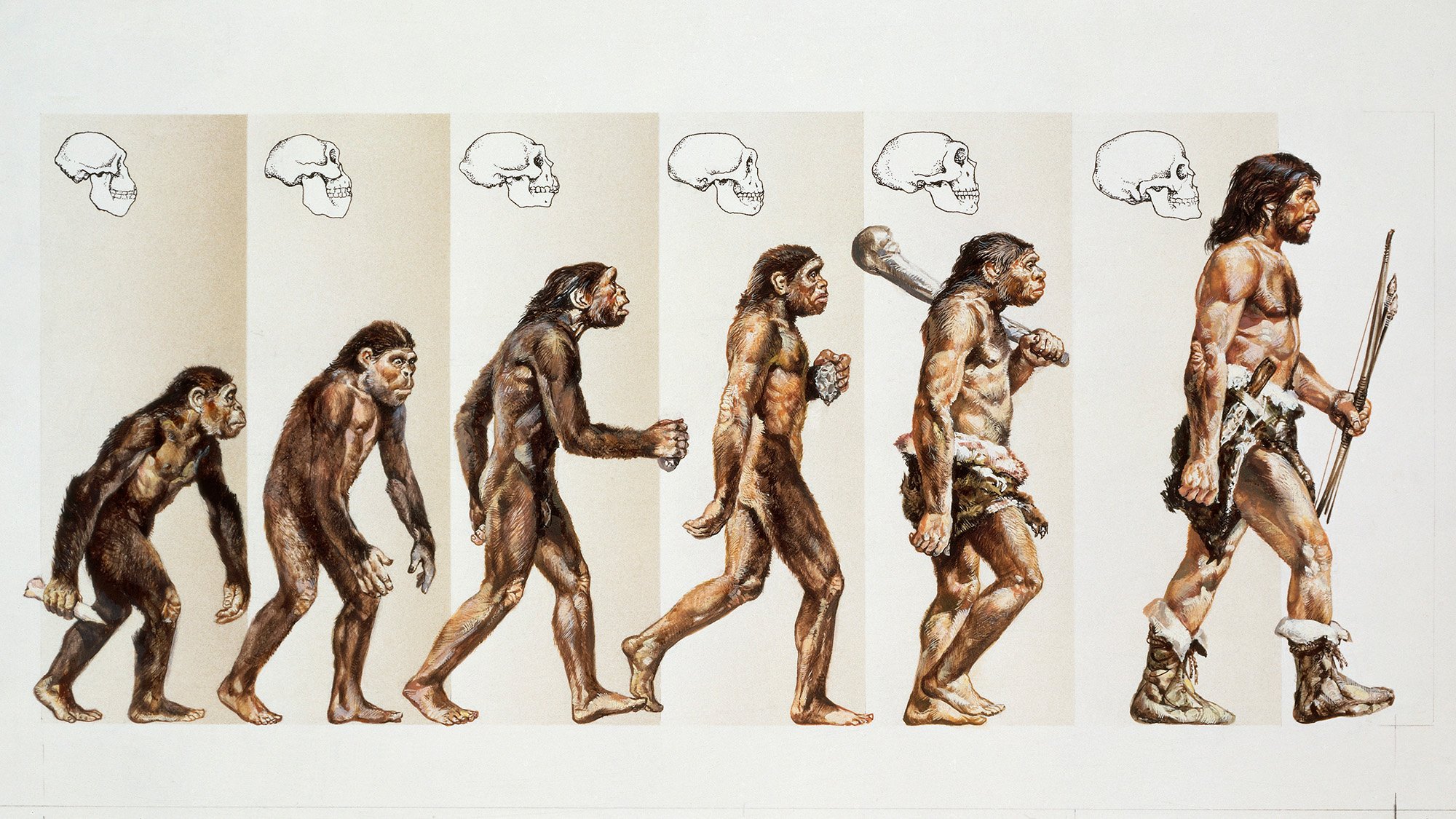
And neither do chimpanzees, gorillas, orangutans, or any of our other ape relatives. So somewhere deep in our evolutionary past, our ancestors lost their tails. But why? And what would life be like if we still had them?
No question is too simple or too out there. I’m Sarah Durn, an editor at Popular Science.
Annie Colbert: And hi, I’m Annie Colbert, editor-in-chief
SD: Here at PopSci, we’re always pondering quirky questions
AC: And this week we’re wondering: Why don’t humans have tails? Because tails are everywhere in the animal kingdom.
SD: And they’re incredibly useful. Beavers use their big flat tails to help maneuver through the water. Some monkeys can basically use their tails like an extra limb, wrapping them around branches as they climb. And rattlesnakes, of course, turn theirs into a built-in warning system
AC: So what happened to ours? Did we just lose them somewhere?
SD: Well, technically, humans never lost them.
AC: Okay.
SD: But that said, we have to go way back in our family tree, tens of millions of years back, to find out why our butts don’t have tails anymore.
AC: I’m guessing the answer isn’t because of pants?
SD: No, you are correct. This goes way beyond pants. We’re talking back to a time when our ancient ape ancestors were still hanging out in trees
AC: So when did tails disappear then? And more importantly, why would you want to give up a perfectly good tail?
SD: That’s the big question because for lots of animals, tails are incredibly useful for balance. But the way our ancient ape ancestors moved through the trees may have actually made a tail kind of pointless.
AC: So evolution really said, “We’re not using this anymore, so just get rid of it.”
SD: Yeah, pretty much. And later we’re going to get into what those ancient apes looked like and why their particular style of tree climbing may have made tails more trouble than they’re worth.
AC: And naturally, we also have to ask the important question: Would life actually be better if humans still had tails?
SD: I have some thoughts.
AC: Same. Many thoughts.
Now, before we swing into our evolutionary past, we want to know what questions are circling in your brain hole. If there’s something you’ve always wanted to know, submit your questions by clicking the “Ask Us” link at popsci.com/ask.
Again, that’s popsci.com/ask and click the “Ask Us” link
SD: We can’t wait to hear your questions
AC: We’ll be back right after this quick break to find out how humans ended up on team no tail.
SD: And stick around to the end because we’ll be joined by Science Friday host Flora Lichtman to discuss what makes a really good tail and whether she’d want one herself.
And we’re back. Okay, Annie, before this episode, how much time have you spent thinking about your tail?
AC: Absolutely none. I can confidently say I have never yearned for a tail.
SD: Yeah. No, I mean, neither have I, but I have spent a lot of time thinking about my tailbone.
AC: Uh-oh, where is this going?
SD: Yeah. Uh, a couple years ago, I was walking my Saint Bernard, Poochie, when he caught a whiff of something and took off. And me, trying to be a responsible dog walker, tried to hold onto the leash.
AC: Oh no.
SD: Yes, yes, yes. Safe to say Poochie, the Saint Bernard, won, and I fell straight onto my butt.
AC: Oh, Sarah. Ouch
SD: Yes, it was un-ideal. I ended up bruising my tailbone pretty bad.
AC: Mm.
SD: And unfortunately for me, this happened about a week before I left for a two-week long trip to Italy.
AC: Oof.
SD: Rome, Pompeii, the Colosseum, the Amalfi Coast, Puglia, all while carrying a little donut butt pillow everywhere I went.
AC: Oh my.
SD: Sometimes I even wore it as a hat.
AC: I mean, obviously.
SD: You know, sun protection is important.
AC: Crucial.
SD: Yeah, so I have actually spent a bit of time thinking about and cursing our teeny-tiny, mostly not there human tail because out we actually do have a tail. Kinda.
AC: Hmm. All right. Tell me more
SD: That tailbone I bruised, the coccyx, is at the bottom of your spine.
It’s basically what’s left of when our ancestors actually had a proper external tail.
AC: But humans had more of a tail at one point, right? Like fetuses have tails in the womb?
SD: Correct. When human embryos are developing, we actually form a little tail that extends beyond the rest of the body. But by around eight weeks, that external tail disappears.
AC: So I briefly had a tail?
SD: You did!
AC: Ugh, RIP. Gone too soon.
SD: We should all have a, like, little tail funeral upon our birth.
AC: Eh, that’s obviously the only normal response here.
SD: I mean, obviously.
Okay, but here’s the thing. Humans didn’t suddenly decide to ditch our tails. We inherited our tailless bodies from our ape ancestors.
So if we really want to figure out why humans don’t have tails today, we have to first figure out how our furry ancestors lost theirs. And for that, we have to go way back.
AC: How far back are we talking?
SD: Well, first let’s go back about five or six million years.
That’s roughly when scientists estimate the last common ancestor of humans, chimpanzees, and bonobos lived, and that doesn’t really help us with our tail mystery
AC: Because chimps and bonobos don’t have tails either.
SD: Exactly. And neither do gorillas, orangutans, or any other modern ape. So we have to keep going back.
AC: So rewind. Whoop, rewind.
SD: And eventually we get all the way back to around 25 to 30 million years ago. Megalodon is stalking the seas. Daeodon, aka “hell pigs,” were roaming North American forests. And keep in mind, we’re still tens of millions of years before the first saber-toothed cats and mammoths pop up.
And this is where things get interesting because around this time, our ape ancestors branched off from the ancestors of modern monkeys.
AC: And monkeys do have tails.
SD: Right. Most do.
So somewhere around this part of our family tree, around 25 to 30 million years ago, we finally crossed over to the tailless side from our tailed ancestors.
The frustrating thing is the fossil record doesn’t give us a perfect family album. We can’t point to one specific ancient ape and say, “There, that’s our ancestor, that’s the one that lost the tail.” But we can find clues, and one of the best clues comes from an ancient ape called Ekembo.
AC: Tell us your secret, ancient ape
SD: Yes! Tell them. So fossils from this genus have been found in Kenya and date back about 17 to 20 million years. And these animals would’ve looked pretty different from modern apes.
One species, Ekembo heseloni, probably had arms and legs that were roughly the same size. It climbed around on tree branches on all fours, and it had a long, flexible lower back, unlike modern apes. But there’s one thing we know it didn’t have.
AC: A tail?
SD: Exactly. And we can tell because of particular bone, the sacrum.
AC: And where is my sacrum?
SD: It’s right at the base of your lower spine, and it’s actually one of the places scientists can look to to figure out whether an animal could have supported a tail or not.
If you look at the sacrum of a cat or another tailed mammal, it leads into a whole bunch of tail vertebrae.
But in humans and apes, the sacrum just ends in a, you know, little point. And scientists see that little point in Ekembo heseloni. So even though this animal lived up to 20 million years ago, we know they didn’t have a tail.
AC: So by 20 million years ago, the tail was already gone.
SD: At least in Ekembo.
AC: Mm.
SD: And it’s not alone.
Another ancient ape called Nacholapithecus shows up in Kenya around 15 million years ago, and fossils of its sacrum show the same thing. It couldn’t have supported a tail either.
So we don’t know exactly which one of these ancient apes ultimately gave rise to later hominids, aka our ancestors, but we do know that tailless apes were already walking or climbing around millions and millions of years before humans existed.
AC: Okay, so we know the tail disappeared way back in our evolutionary history, but that still leaves the biggest question, which is why? Like, why would you give up a tail? They seem kind of awesome.
SD: And this is where we get into a little bit of scientific speculation because we don’t have one definitive answer.
One possibility is that it has to do with the way these early apes moved. Think about modern animals that really benefit from tails.
If you’re a cheetah sprinting and making incredibly fast turns, a tail can help you balance. Or if you’re a monkey moving quickly through the trees, a tail can be really useful. But these early apes weren’t moving like modern monkeys.
AC: So what were they doing?
SD: Well, millions of years ago, these apes probably had arms and legs that were about the same length, and scientists think they walked on all fours.
They were also climbing through trees looking for fruit. And if you’re trying to get some delicious fruit growing way out on the edge of a branch, you don’t necessarily want to go flying through the canopy.
You want to move slowly and carefully they could support their weight across multiple branches and deliberately work their way towards the good stuff.
AC: So less swinging dramatically through the jungle…
SD: …and more very cautious trip to the fruit bowl.
AC: Got it.
SD: And if you’re moving that slowly and deliberately, a tail might not give you much of an advantage. In fact, it could actually come with costs.
Your body has to spend energy growing this whole extra appendage, and then you’re dragging it around behind you where a predator could potentially grab it.
So as the University of Missouri anatomist Carol Ward told Popular Science, for these slow-moving, careful climbers, the tail just didn’t offer an advantage.
AC: So after all of this, the answer to why don’t humans have tails is basically because our ancestors stopped needing them.
SD: That’s one theory, but the important thing is that we didn’t lose our tails because humans started walking upright or because of something that happened recently in human evolution.
By the time anything resembling a human showed up, tails had already been absent from our branch of the family tree for millions and millions of years
AC: So I never really stood a chance.
SD: Nope. You were born into a long, proud lineage of tailless apes.
AC: Yet after this whole conversation, I’m starting to feel like we kinda got a bad deal.
SD: Yeah, well, before you get too jealous of Team Tail, there is someone I want us to talk to because last year Science Friday host Flora Lichtman went looking for an answer to a very important question. If you are gonna have a tail, what’s the best one to have?
AC: Ooh, yes. Let’s talk upgrades.
SD: Yes, let’s. We’ll talk with Flora about the science of tails, whether there really is a best tail for balance, and whether she’d actually want one herself. That’s after this quick break.
And we’re back with Flora Lichtman. Flora is a podcaster extraordinaire, an Emmy-nominated writer for Bill Nye’s Netflix show, Bill Nye Saves the World, and one of the hosts of Science Friday, a public radio program and podcast about science, nature, technology, and health.
Flora, thank you so much for making the time to come on Popular Science’s Ask Us Anything podcast.
Flora Lichtman: I am delighted to be here. Thank you for the invitation, and I love tails, so glad to talk about them.
SD: So yes, as you know, throughout this episode, we’ve been talking all about why humans don’t have tails when so many animals do, and last year you actually explored an important piece of this puzzle on a Science Friday episode called “In Search of the Best Tail for Balance,” which we’ll link in the show notes.
In the episode, you talked with roboticist Dr. Talia Moore and developmental biologist Dr. Ceri Weber about their work into figuring out what’s the best tail, and how a tail could actually help us build better robots.
So obviously I have to ask: Is there actually a best tail for balance?
FL: You know, of course, if you ask scientists, they’ll never give you a best because that’s their, their whole job is to find the nuance and the complicated elements of every story. But what I did learn from them is that there are ways to design tails so that they do their job better.
SD: Hmm.
FL: And the thing that I didn’t know about tails is that they’re an inertial appendage, which is not a term I’d heard.
But the way these researchers described it is that it’s like a tightrope walker’s stick.
SD: Hmm.
FL: That you use to sort of regain your balance. Like that, for animals with tails, that is a primary reason why they have a tail.
SD: Yeah.
FL: The difference, though, between a tightrope walker stick and a tail is that most tails aren’t rigid rods, right? Like, they’re curvy and they’re twisty.
So what these researchers did is this simulation to try to compare, you know, what tails work best as this inertial appendage, and they found that design matters, and, like, you can optimize basically the bones in the tail to make them work better. And they found, it turns out if you have, like, short bones, then long bones, then short bones, that gives you a very good tail.
And it turns out that a lot of mammals in the animal kingdom have tails just like this.
SD: Wow. Amazing. So after spending all of this time thinking about tails: Would you want one?
FL: You know, Sarah, I’ve been thinking about that. Here’s the problem. I already have such a problem finding pants that I like and that fit, so I feel like the tail is just not a challenge I need.
On the other hand, I’m also very clumsy, and I do feel like maybe a tail would’ve helped me in the past.
SD: Yes.
FL: …keep my balance.
SD: Yeah. Yeah, I mean, like theoretically, pants aside, if you did have a tail as a human, what would be different? What would be harder? What would be easier?
FL: I mean, besides my look, I think, the thing that would be easier is walking on a slippery, icy day in the Northeast.
SD: Mm-hmm.
FL: I think they do really help you regain balance. I like the idea of being able to swing from the trees.
SD: Yeah.
FL: I’m at the playground a lot with my kids. I feel like it would be a real flex to get on those monkey bars with a tail.
SD: Oh my God, you’d be the coolest mom.
FL: The something-ist mom for sure.
Would you want a tail?
SD: I think, yeah, I mean, I guess, like, I think I would. I think it’d be fun. I feel like it’s kinda like having wings, you know?
You’d be definitely, like, ostracized a little bit. Like, people would look at you funny, but you could do a lot of cool stuff. I don’t know. I look at squirrels, and they’re basically flying,
FL: That’s true.
SD: Okay, so you also encountered a lot of impressive tales, I’m sure, in your reporting. Do you have a favorite tale from the animal world?
FL: I’m really love seahorse tails.
SD: Oh, yeah.
FL: They’re so iconic and twisty and beautiful and they really need them because they’re these lightweight little animals that are, like, being, you know, battered by ocean waves, and they can use them to hang on.
But I was reading that not only that, which is like, that’s all cool, but actually, while most tails are cylindrical, the seahorse tail actually has a square profile, which I thought was cool, too.
So it’s… I don’t know. I’m into the seahorse tail.
SD: Yeah, no, excellent choice. Excellent, excellent choice. Flora, thank you so much for taking the time to talk tails with us. It was absolutely lovely.
FL: Delighted to be here. I would love to come back anytime.
SD: Oh, we’d love to have you.
AC: Okay, I started this episode having never really thought about having a tail, and now I definitely feel like maybe I’m missing out. Like, when I need help holding things, give me a tail.
SD: Same. Although after my tailbone incident, maybe I shouldn’t be trusted with an additional appendage.
AC: Yeah, that’s maybe for the best.
And that’s it for this episode. But don’t worry, we’ve got more episodes of Ask Us Anything live in our feed right now. Follow or subscribe to Ask Us Anything by Popular Science wherever you enjoy your podcasts.
And if you like our show, please leave a rating and a review
SD: If you could have any animal’s tail, which one would you want? Tell us in the comments.
AC: Yes, we want to know.
SD: We wanna know. Our producer is Alan Haburchak. This week’s episode was based on an article written for Popular Science by Sarah Kiley Watson, and a big thank you to Flora Lichtman for joining us.
AC: Thank you team, thank you tails, and thank you everyone for listening
SD: And one more time, if you want something you’ve always wondered about explained on a future episode, go to popsci.com/ask and click the “Ask Us” link. Until next time, be careful with your tailbone and keep the questions coming.
AC: Wait, if we had tails, what would chairs look like? And pants, and car seats.
SD: Planes? It’d be kind of cute to see all the tails lined up.
AC: I feel like we need tails. It’s time to change up humans.

 Login