A Huawei prepara um novo celular topo de linha com foco em fotografia. Segundo vazamentos, o Huawei Pura 90 Plus pode estrear com uma câmera principal de 50 MP e sensor de 1 polegada, característica até então reservada ao modelo Pro Max da linha. A novidade promete aproximar a qualidade das fotos de smartphones à de câmeras dedicadas.
O aparelho, identificado internamente pelo codinome Lucia, deve chegar como uma nova opção no catálogo da fabricante chinesa. A ideia não seria substituir os modelos atuais, mas ampliar a família Pura 90 poucos meses após seu lançamento.
O principal destaque do Pura 90 Plus deve ser o conjunto fotográfico. O celular é cotado para receber um sensor principal de 1 polegada com resolução de 50 MP, que permite captar mais luz do que sensores menores, especialmente em ambientes escuros.
A câmera também deve utilizar a tecnologia RYYB, já conhecida nos smartphones da Huawei. Ela substitui os filtros verdes tradicionais por amarelos, e aumenta a quantidade de luz captada pelo sensor e pode melhorar a qualidade das imagens noturnas.
O conjunto ainda deve incluir uma câmera teleobjetiva periscópica compacta, com suporte para fotografias macro. Dessa forma, o usuário poderá registrar objetos pequenos com maior aproximação, além de aproveitar o zoom óptico para fotografar assuntos distantes.
O que mais esperar do novo Huawei?
Além das câmeras, o Huawei Pura 90 Plus deve trazer uma tela plana de 6,8 polegadas, com resolução 1.5K e taxa de atualização de 120 Hz. O design deve manter o módulo fotográfico triangular característico da linha, posicionado no canto superior esquerdo da traseira de vidro.
O aparelho é esperado em quatro opções de cores: Preto Obsidiana, Branco Neve, Dourado Manhã e Roxo Pôr do Sol.
Já o processador ainda é uma incógnita. Rumores anteriores apontaram duas possibilidades, o Kirin 9030S e o Kirin 9035, mas ainda não há consenso entre os informantes sobre qual será utilizado.
A expectativa é que o novo modelo ofereça uma alternativa mais acessível para quem procura câmeras avançadas, sem precisar investir na versão Pro Max.
Por enquanto, não há informações sobre preço ou data de lançamento do Huawei Pura 90 Plus. Também não há confirmação sobre uma possível disponibilidade no mercado brasileiro.
Recentemente, a Huawei inaugurou uma nova loja em São Paulo, e ampliou sua presença física no Brasil. A unidade, que funciona no Shopping Center Norte, já funciona desde o começo de outubro.
Além de fechar a BioWare, a Electronic Arts anunciou 400 demissões nos demais estúdios subsidiários. Enquanto a desenvolvedora de Dragon Age e Mass Effect fechou as portas, a Ripple Effect (Skate) terá seu time reduzido e vários outros serão impactados.
Entre os afetados estão a Maxis (The Sims), EA Motive (Iron Man) e até mesmo a Respawn (Star Wars Jedi e APEX Legends). Não foi divulgado quantos desligamentos foram feitos em cada uma delas, nem se algum projeto foi cancelado no meio do procedimento.
Uma das grandes surpresas é a Respawn, que recebe um alto investimento da Electronic Arts e supostamente trabalha em Star Wars Battlefront 3. A única que parece não ter sofrido cortes é a DICE — responsável pela franquia Battlefield e que carrega o sucesso do sexto game, lançado em 2025.
Essa é a primeira rodada de demissões desde que a produtora foi adquirida pelo Fundo de Investimento Público da Arábia Saudita. A negociação de US$ 55 bilhões foi feita no início de 2026 e também envolve a Silver Lake e a Affinity Partners.
Os nomes que saíram na crise da EA
Entre os profissionais desligados, estão a diretora sênior da Maxis, Anna Huerta — uma das principais responsáveis por manter a franquia The Sims. Além dela, também foram registradas demissões de designers de gameplay, diretores criativos e cargos operacionais.
Como a Electronic Arts já afirmou no passado, a aquisição garantirá uma economia de US$ 700 milhões no balanço anual — o que se traduz nas demissões e cancelamento de projetos. Na prática, isso pode gerar novas ondas no futuro e coloca em risco diversos títulos em desenvolvimento.
A Xiaomi lançou um novo massageador inteligente para quem vive reclamando de dor nas costas ou sente desconforto após passar muito tempo sentado. O dispositivo da linha Mijia combina massagem mecânica com aquecimento e promete ajudar a relaxar a musculatura da região lombar e das costas.
O aparelho já está disponível na China por ¥ 599, cerca de R$ 450 em conversão aproximada, como parte de uma promoção de lançamento. O preço oficial é de ¥ 699, aproximadamente R$ 525.
O grande destaque é o sistema de massagem que percorre praticamente toda a extensão das costas, desde a região próxima aos ombros até a lombar. Além disso, o dispositivo pode ser controlado pelo celular e funciona sem precisar ficar conectado à tomada.
Como funciona o massageador da Xiaomi?
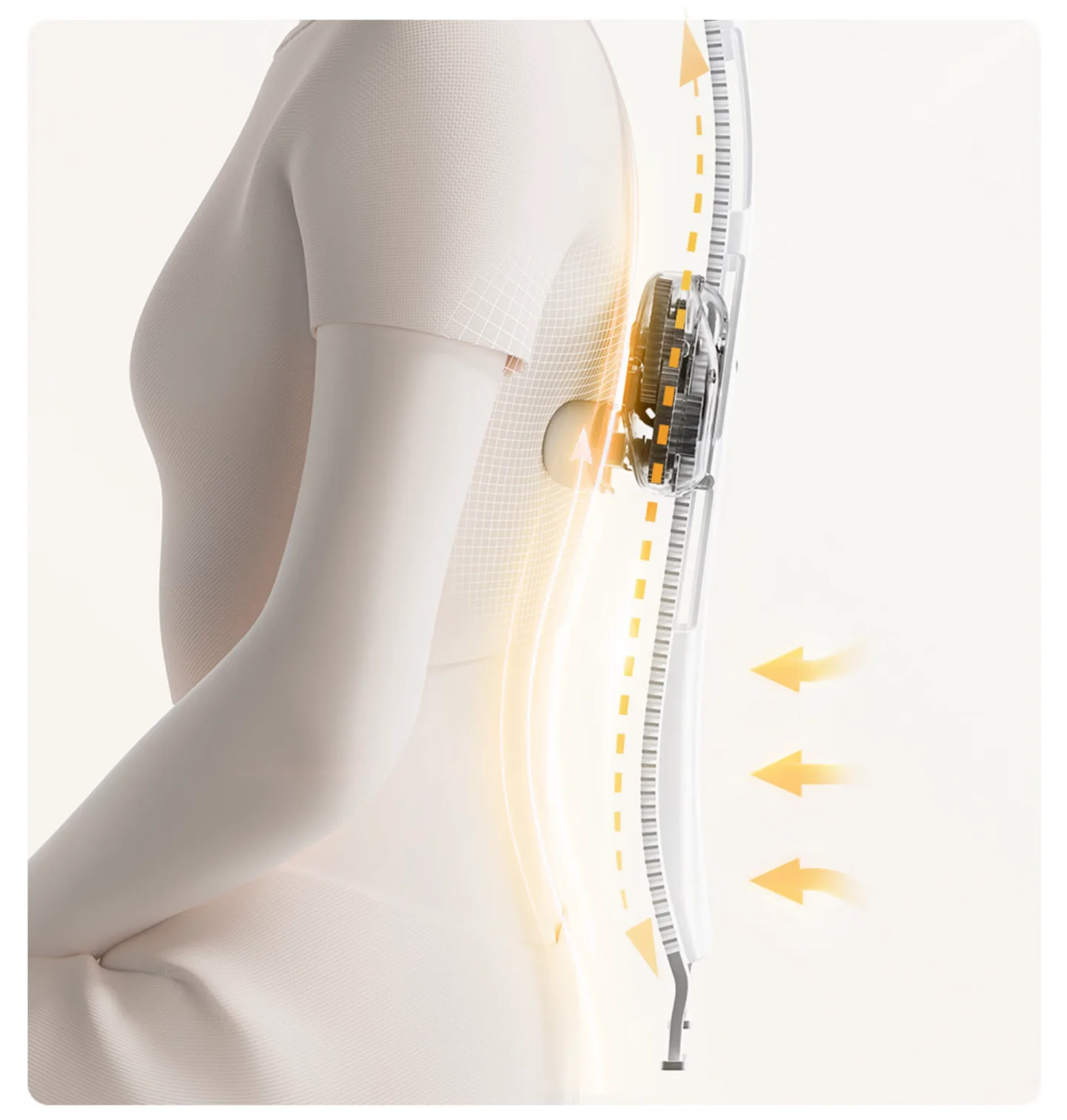
O novo Mijia utiliza um sistema de trilhos duplos flexíveis de 450 mm, que permite movimentar as cabeças massageadoras verticalmente. Assim, em vez de concentrar a massagem em um único ponto, o aparelho consegue alcançar diferentes regiões das costas.
Ao todo, são quatro cabeças de massagem, duas maiores e duas menores, que simulam a pressão dos dedos sobre a musculatura. O mecanismo também acompanha a curvatura natural das costas, com um arco de raio de 550 mm para melhorar o encaixe.
O dispositivo oferece sete modos de massagem pré-programados, que podem ser selecionados diretamente pelos botões físicos na lateral. Já pelo aplicativo Mijia, é possível configurar outros três modos personalizados.
O app também permite escolher uma região específica para receber a massagem. Nesse caso, as cabeças concentram seus movimentos em uma área menor, em vez de percorrer toda a extensão das costas.
Outro destaque é o sistema de aquecimento com grafeno. Ele possui uma área térmica de 10.000 mm² e pode funcionar junto com a massagem ou de forma independente, para quem prefere apenas o calor na região lombar.
Massageador também funciona como apoio lombar
Além da massagem, a Xiaomi pensou em outras formas de aproveitar o dispositivo. Quando está desligado, ele pode funcionar como uma almofada de apoio lombar, o que permite utilizá-lo em cadeiras de escritório, por exemplo.
O aparelho também pode ser posicionado sob as pernas para massagear a região das panturrilhas. Seu corpo tem 2,2 kg e espessura inferior a 75 mm, o que facilita o transporte entre diferentes ambientes.
Para funcionar sem fios, o massageador conta com uma bateria interna de 3.150 mAh, recarregável por uma porta USB-C. O kit inclui um cabo de 1,5 metro, mas a fabricante não informou a autonomia estimada por carga.
Por enquanto, o Xiaomi Mijia Smart Waist and Back Massager está disponível apenas no mercado chinês, e não há informações sobre um possível lançamento oficial no Brasil.
A Sony descontinuou oficialmente seu último player dedicado de Blu-ray no Japão. O modelo UBP-X700/K foi marcado como "descontinuado" no catálogo da fabricante, o que encerra a venda de novos reprodutores independentes da marca no país, após cerca de duas décadas de presença do formato no mercado.
A informação foi divulgada pelo site FlatpanelsHD e confirma um movimento que já era esperado. Em fevereiro deste ano, a Sony havia interrompido o envio de novos aparelhos às lojas japonesas. Desde então, as vendas dependiam apenas das unidades que ainda estavam em estoque.
Com a decisão, o PlayStation 5 passa a ser o único dispositivo restante da Sony capaz de reproduzir discos Blu-ray.
O fim dos players dedicados também levanta dúvidas sobre o futuro das mídias físicas nos consoles da Sony. A empresa já anunciou que encerrará a produção de discos físicos de jogos até janeiro de 2028, o que aumenta as especulações sobre a próxima geração do PlayStation.
Com isso, existe o receio de que o PlayStation 6 chegue ao mercado sem leitor óptico, o que impediria a reprodução de jogos e filmes em discos.
Por enquanto, porém, essa possibilidade é apenas uma especulação, já que a Sony não confirmou a ausência do componente em seu próximo console.
Outras fabricantes também abandonam o Blu-ray
A Sony não é a única empresa a deixar esse mercado. Em 2024, a LG encerrou a produção de reprodutores de Blu-ray, enquanto as japonesas Elecom e Buffalo interromperam a fabricação de drives ópticos do formato para computadores neste ano.
No caso da Buffalo, porém, a divisão americana informou que continuará a oferecer leitores de DVD e Blu-ray nos Estados Unidos, ao menos no futuro próximo.
Ainda existem alternativas de outras fabricantes, como a Panasonic, mas a saída da Sony tem um peso especial. Afinal, a companhia foi uma das principais responsáveis pela criação e popularização do formato.
O problema também chegou ao mercado de equipamentos de áudio de alta fidelidade. Algumas fabricantes precisaram cancelar a produção de determinados reprodutores Hi-Fi após a interrupção do fornecimento de componentes ópticos necessários para a leitura de discos SACD.
Streaming está substituindo as mídias físicas
Diferentemente das transições anteriores, como a substituição do VHS pelo DVD e, posteriormente, pelo Blu-ray, a mudança atual não acontece necessariamente por uma evolução na qualidade de imagem.
O Ultra HD Blu-ray não está perdendo espaço para um formato com resolução superior, mas principalmente para a conveniência dos serviços de streaming, que permitem acessar filmes e séries diretamente pela internet.
Essa mudança também traz uma preocupação para consumidores e profissionais que trabalham com preservação de dados: a perda da posse de mídias físicas, já que o consumo de conteúdo passa a depender cada vez mais de plataformas digitais.
Por outro lado, o interesse por formatos antigos ainda resiste em alguns segmentos. Dados apresentados sobre esse mercado apontam crescimento de 59% nas vendas de CDs e de 18% nas de discos de vinil, embora os percentuais não indiquem necessariamente uma recuperação do Blu-ray.
Assim, apesar de o formato continuar disponível por meio de outras fabricantes, a decisão da Sony reforça uma tendência que já se desenha há alguns anos: os discos ópticos perdem espaço no mercado e ficam cada vez mais restritos a um público de entusiastas e colecionadores.
Enquanto "aposenta" uma tecnologia antiga, a Sony ainda aposta no saudosismo para chamar atenção do público, e recentemente anunciou um novo Walkman por nada menos que R$ 30 mil.
A Microsoft revelou quanto os usuários terão de pagar para acessar o XBOX Cloud Gaming, fora dos planos disponíveis no Game Pass. A companhia chama de “preço de lançamento introdutório”, o que indica que pode haver mudanças futuras na forma como eles são aplicados.
De acordo com o anúncio oficial, quem não assina o serviço do XBOX terá de pagar os seguintes valores para acessar a nuvem em dispositivos móveis, browsers e em Smart TVs:
10 horas adicionais: US$ 4
25 horas adicionais: US$ 8
50 horas adicionais: US$ 12
Nossa equipe do Canaltech entrou em contato com a XBOX Brasil para esclarecer os valores praticados em nosso país, porém até o fechamento deste texto não recebemos retorno da divisão. Na conversão direta, sem aplicação de impostos, seria cobrado R$ 20,11, R$ 40,21 e R$ 60,32 respectivamente.
O pagamento permite jogar na nuvem sem a presença de propaganda, assim como um acesso mais veloz e uma qualidade alta de streaming. De acordo com a Microsoft, estes preços passarão a ser praticados a partir do mês de novembro de 2026.
Será possível adicionar mais tempo, mediante o pagamento das mesmas tarifas impostas para quem não assina o serviço. Na prática, não haverá qualquer desconto para quem já integrar a comunidade — algo que não é bem recebido pelos fãs.
A situação do XBOX no Brasil
Vale lembrar que, graças às leis nacionais, a limitação de tempo para o Cloud Gaming não pode ser aplicada para assinaturas já existentes do Game Pass. Ou seja, se você já paga pelo serviço, a Microsoft não pode alterar a entrega acordada.
Apenas novos assinantes e não pagantes pelo serviço que serão submetidos ao pagamento por hora. Quem se manteve fiel à assinatura continuará “intocável”, a menos que a companhia mude suas operações novamente (como do Live Gold para o XBOX Game Pass).
Neste aspecto, se você já paga pela plataforma, não precisará se preocupar com alterações súbitas. Isso, por enquanto, não é uma preocupação para a comunidade brasileira — do mesmo modo que usuários da Polônia, Alemanha e Austrália.
Isso tudo ocorreu logo após a estreia de uma tier gratuita para jogar na nuvem. Com a presença de propagandas, a companhia viu que havia uma vasta demanda e decidiu que mudaria a forma como aplica seus serviços para se adequar ao mercado.
Uma vulnerabilidade do Nintendo Switch 2 foi descoberta recentemente e já permite o desbloqueio do console híbrido para rodar jogos modificados e softwares de homebrew na plataforma. Na prática, você poderá baixar games e instalar aplicativos a partir do jailbreak.
De acordo com os testes, a falha ainda não pode ser amplamente acessada por depender de um jogo original de Switch para ser executada. Porém, essa é a primeira vez que o videogame lançado em 2025 é explorado deste modo e já rendeu resultados que a Big N “tremeria” só de imaginar.
O desenvolvedor que descobriu o jailbreak mostrou como Mario Kart World atua com a presença de modificações — com a inclusão de personagens adicionais à experiência, como é o caso da ilustre “idol” Hatsune Miku e do infame Peter Griffin, do desenho Uma Família da Pesada.
Ele revela que usou ferramentas de inteligência artificial para desbloquear o Nintendo Switch 2, por meio do OpenAI Codex. Para fazer o procedimento funcionar, ele teve de encontrar um título retrocompatível do primeiro console para explorar a vulnerabilidade.
Deste modo, ele estabeleceu a execução de um código por meio de um bug de integer overflow de 32-bit na manipulação de arrays do título, o que permitiu manipular as permissões do processo e interceptar as rotas de carregamento do sistema até alcançar a falha.
Como isso pode ser atingido com apenas um título, não deve demorar para a Big N removê-lo da eShop para corrigir os erros. Contudo, é esperado que sejam encontrados outros que repliquem a prática — algo que a companhia não tem controle, ao menos por enquanto.
Com o jailbreak, muito pode ser explorado no Nintendo Switch 2 a partir de agora. De melhorias no upscaling DLSS a adição de legendas e otimizações, o cenário pode favorecer ainda mais os games nativos e emulados na plataforma.
O grande dilema é como os softwares externos podem incomodar a companhia. No videogame, os games retrô são acessíveis apenas pela assinatura do Nintendo Switch Online e pelo Pacote de Expansão. Agora, isso se tornará mais acessível. Isso sem mencionar a proximidade ao lançamento de The Legend of Zelda: Ocarina of Time.
Além disso, pode atrapalhar as vendas de games antigos como Pokémon FireRed & LeafGreen, Super Mario Galaxy e outros relançados na eShop. A empresa japonesa não assistirá ao desbloqueio de braços cruzados, mas não se pronunciou sobre a vulnerabilidade e em como reverterá a situação.
Inclusive, o desbloqueio no primeiro Switch garantiu até que o videogame rodasse Final Fantasy VII Remake (oficialmente disponível apenas no console mais recente). A expectativa é que o mesmo ocorra no Switch 2 — com títulos que não estão liberados na plataforma. Eu ouvi GTA 6?
A Electronic Arts mudou de ideia e produz uma sequência para The Sims 4, conhecido atualmente como “Project Evergreen”. Porém, a produtora trata o título como um “The Sims 4 2.0” e não como um “The Sims 5” — o que pode soar confuso para os fãs.
De acordo com os rumores que circulam na Sims Community, a expectativa é que o desenvolvimento seja concluído até setembro de 2027, com previsão de lançamento para o final do mesmo ano. A prioridade é para a plataforma PC (com otimização para consoles portáteis).
A EA deseja abocanhar o mercado desses aparelhos, com foco no Steam Deck e ASUS ROG Ally. Contudo, não foram divulgados detalhes de como é esperada a performance nesses hardwares e se haverá mudanças expressivas do que é visto nos computadores.
Se a chegada do novo The Sims for, de fato, em 2027, possivelmente a Electronic Arts mostrará algo do projeto durante o The Game Awards ou em uma apresentação própria no início do ano que vem.
O próximo The Sims
Além de o mercado do título ter sido ameaçado por iniciativas como Paralives e inZOI, vale notar que o quarto game da franquia foi lançado há 12 anos. Desde então, ele se tornou gratuito e foram adicionadas diversas DLCs e pacotes ao jogo.
Inicialmente, a EA declarou que não produziria The Sims 5. Seu foco era desenvolver expansões para a experiência anterior enquanto o time explorava novos projetos — como o Project Lotus, que funcionaria como um novo “The Sims Mobile”.
Porém, a companhia mudou de ideia novamente e parece ter encaminhado a equipe para trabalhar na continuação do game mais recente. A própria Electronic Arts não confirmou esse vazamento, contudo, se a previsão estiver correta, não deve demorar para um anúncio chegar.
Cabe destacar que a comunidade reclama há muito tempo de The Sims 4 não ter sucessores, algo que deve ter sido ouvido com mais afinco após toda a movimentação ao redor de GTA 6 (que chega 13 anos após o lançamento de Grand Theft Auto V). Pela alta expectativa e número elevado de fãs, o projeto pode ter recebido tração.
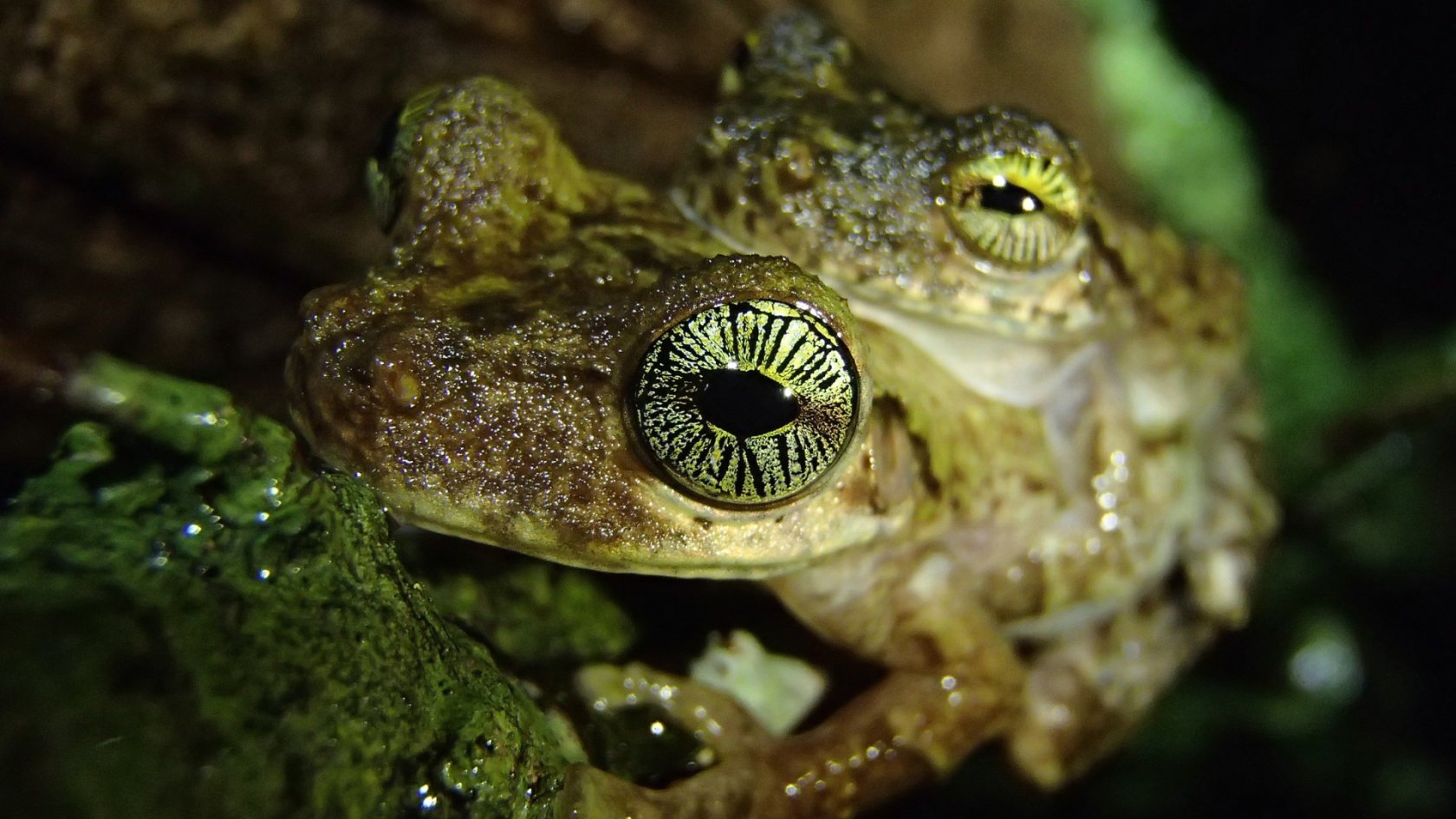
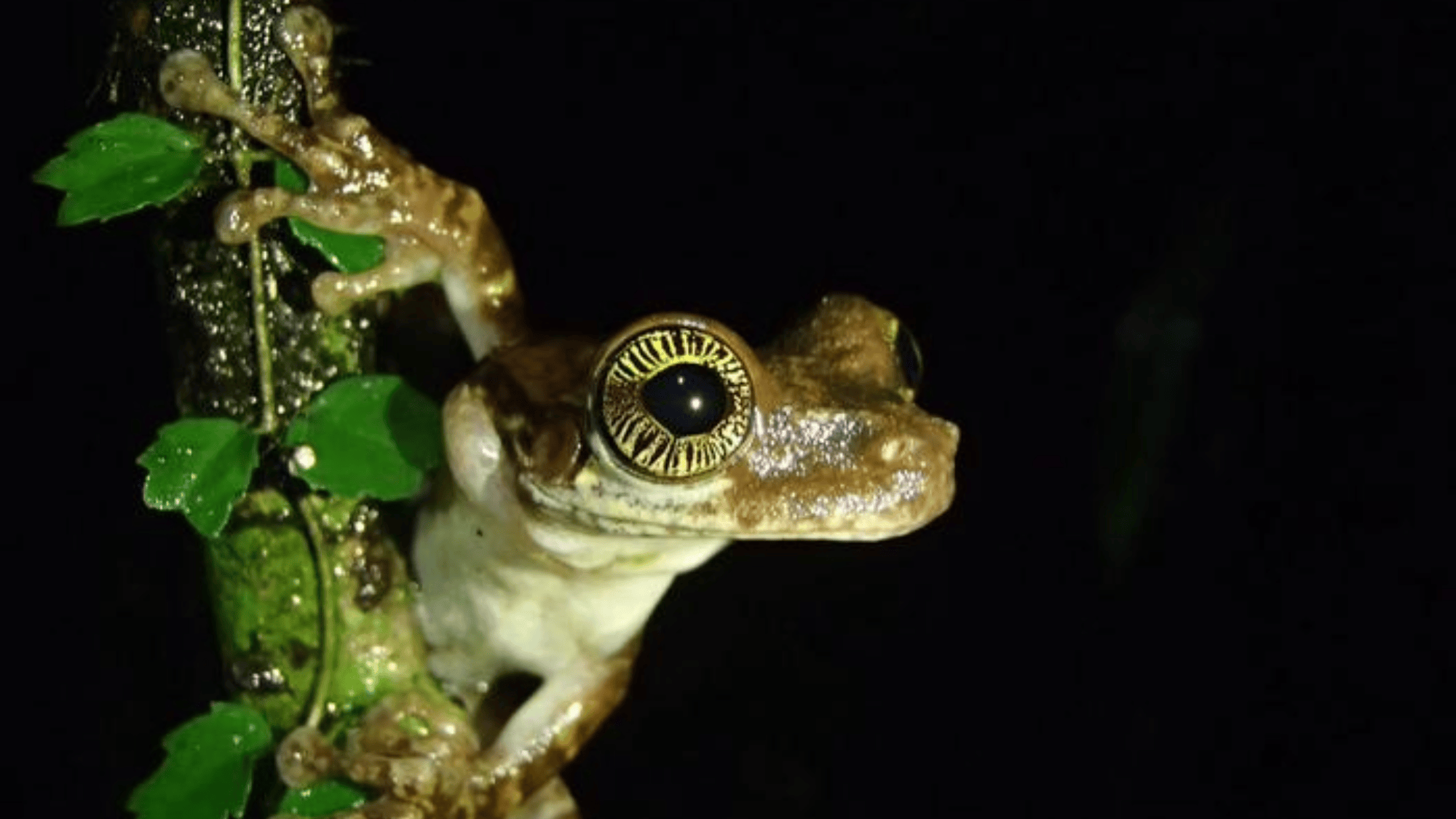
Our fingerprints, patterns on whale flukes, and fur patterns on cheetahs are examples of the natural ways we can tell one individual animal from another. For an Amazonian treefrog called the egg-eating spiny-backed frog (Osteocephalus oophagus), we need to look into their eyeballs. Fine black radial lines cross their golden irises, and form a pattern similar to our fingerprints. A study recently published in the journal Herpetozoa details the discovery.
The project began with study co-author Mélissa Peignier, a behavioral ecologist at the University of Bern in Switzerland, admiring frog eyes.
“At the time, I was doing my PhD, studying Allobates femoralis in the field in French Guiana,” Peignier said in a statement. “My first reaction was simply something along the lines of, ‘Wow, what beautiful eyes!’ That initial curiosity gradually turned into a genuine interest in the species, and I realised how little we actually know about them.”
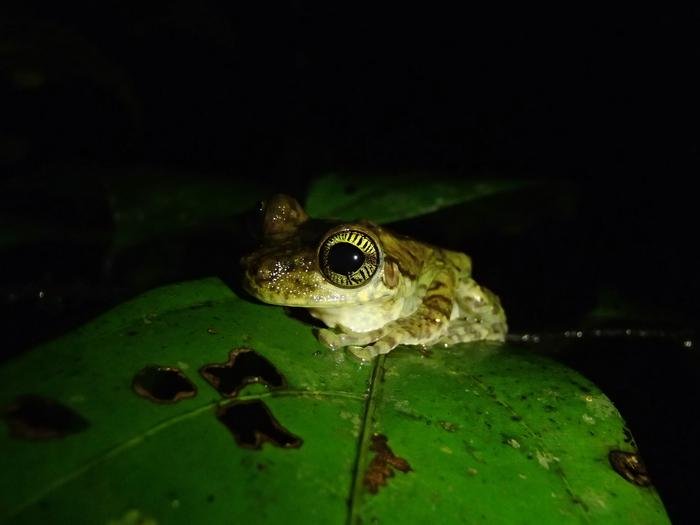
Osteocephalus oophagus in situ. Photographed in French Guiana (4°02’N, 52°41’W; ) between March and May 2021. Image: Mélissa Peignier et al., 2026.
There was also an ethical component. One of the standard ways to tell amphibians apart from one another is toe-clipping, where a section or all of a single toe is removed. This procedure can affect their survival, physiology, and behavior.
“Other studies have used toe-clipping, which involves removing some of the digits. Personally, I was uncomfortable with this approach, especially given that these are arboreal frogs that rely on their limbs to climb trees.”
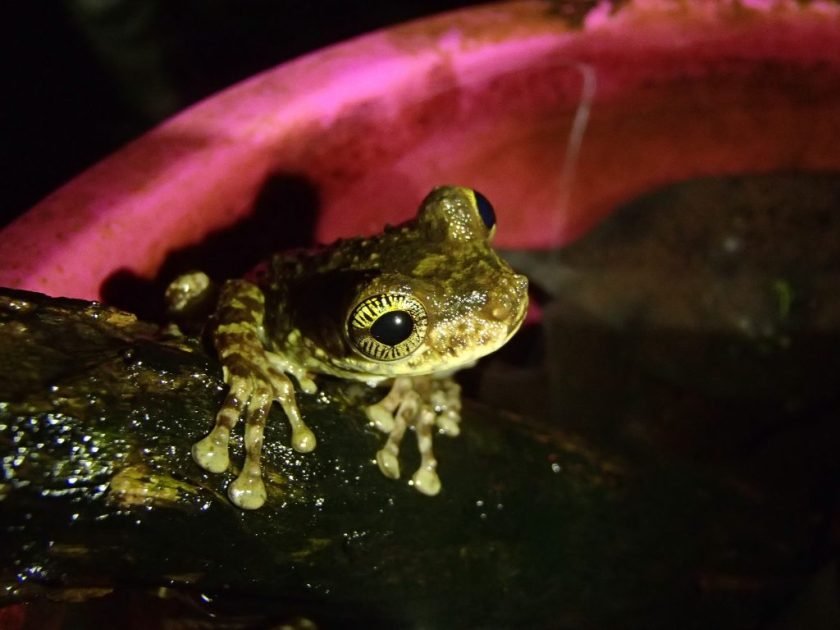
Osteocephalus oophagus in situ. Photographed in French Guiana (4°02’N, 52°41’W; ) between March and May 2021. Image: Mélissa Peignier et al., 2026.
Looking for other markings could offer a more humane solution and a way to observe the animals natural behavior unimpeded.
For this study, fieldwork took place over three rainy seasons (2021 to 2023) on a river island in the Nouragues Nature Reserve in French Guiana. They identified 103 individual frogs over the course of the study.
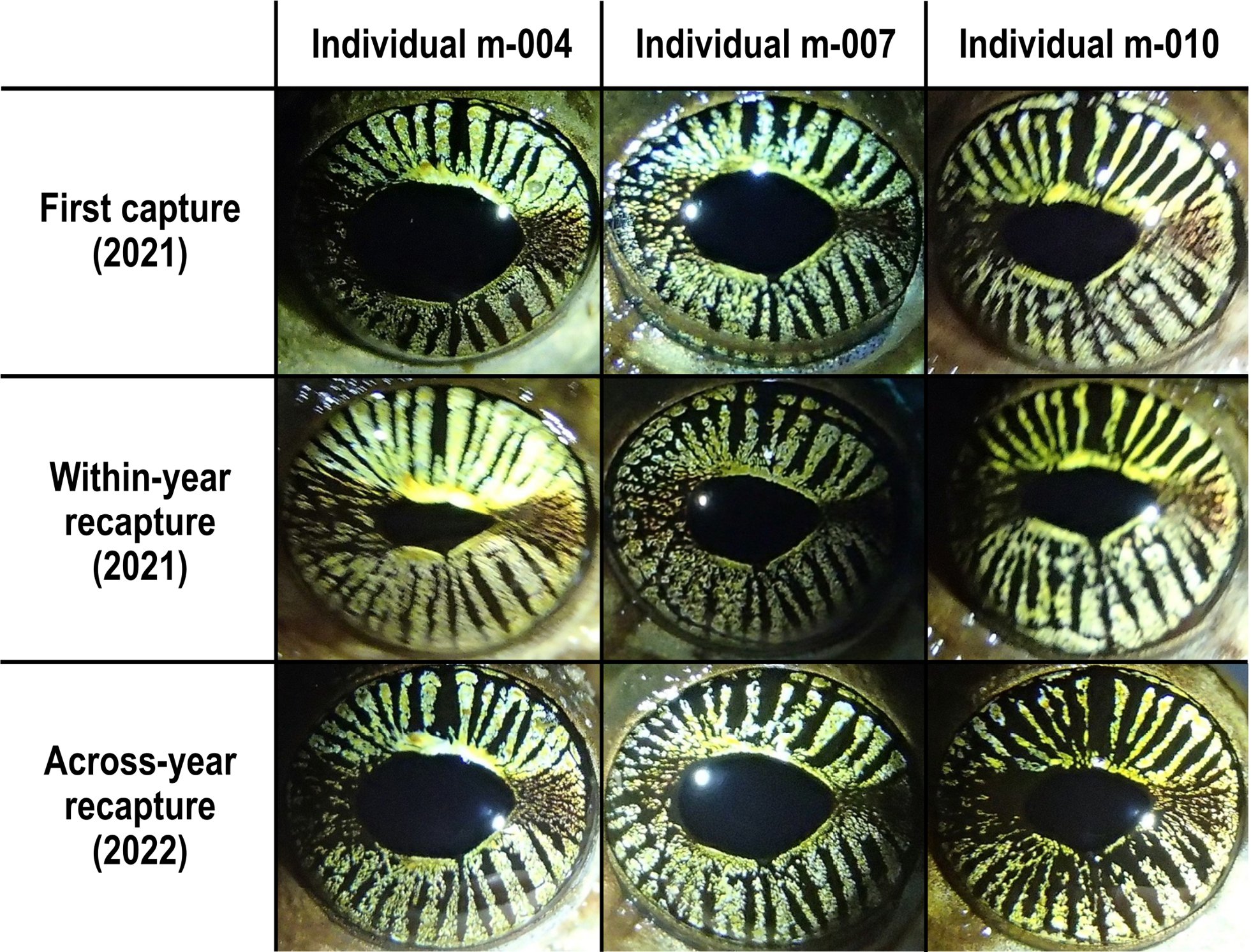
Example of the diversity of iris patterns from eight Osteocephalus oophagus individuals photographed in French Guiana (4°02’N, 52°41’W; Bongers et al. 2001) between March and May 2021, 2022, and 2023. Image: Mélissa Peignier et al., 2026.
During their later encounters, the team took pictures of each animal’s eyes without touching it and then compared the images with a reference library. This way, the recognised frogs were left undisturbed and their eyes appeared in their more natural state. The identifications were then independently verified using Wild-ID, a software package that analyzes photographic markings in animals.
They found highly distinctive iris patterns. Within one season, between 56 and 80 percent of the frogs were recaptured and reliably re-identified. According to the team, this indicates that the patterns on their eyes remain stable enough to monitor the frog in the short-term. Photographs could even be taken of frogs while in their mating embrace (called amplexus) without disrupting them. The team hopes that this method will spread.
Osteocephalus oophagus in situ. Photographed in French Guiana (4°02’N, 52°41’W; ) between March and May 2021. These frogs are in amplexus, or their mating embrace. Image: Mélissa Peignier et al., 2026.
“In a world where biodiversity is declining at an alarming rate, it is essential that we minimise our impact on the animals we study,” added Peignier. “If we can reliably identify individuals using naturally occurring features, we may be able to reduce the need for more invasive marking techniques while still collecting the data needed to answer important scientific questions.”
While the reliability of the eye markings will vary between species, and should be done case by case, the team sees considerable promise for amphibians with complex irises. And working with them offers its own benefits.
“Honestly, the frogs themselves are incredibly beautiful and surprisingly chill, which makes working with them a real pleasure,” Peignier said.
But what particular night above Saint-Rémy-de-Provence, France, did the troubled post-impressionist painter actually put on the canvas? A new analysis points to July 22, 1889. During the early morning hours at that time of year, a waning crescent moon, the planet Venus, and the Hyades star cluster in Taurus appeared close together—all of which are seen in the painting. A study published today in the journal Scientific Reports details the findings.
Like many of his paintings that year, “The Starry Night” was created in several sessions during the day, under different weather conditions. The village nestled below the hills was also based on other views, and could not be seen from his window. Although van Gogh reconstructed some of the features in the night sky as he saw them, he also altered the celestial shapes and added a sense of glow.
“Van Gogh assigned an emotional language to night and nature that took them far from their actual appearances,” the museum writes. “Dominated by vivid blues and yellows applied with gestural verve and immediacy, ‘The Starry Night’ also demonstrates how inseparable van Gogh’s vision was from the new procedures of painting he had devised, in which color and paint describe a world outside the artwork even as they telegraph their own status as, merely, color and paint.”
Historically, the painting has been dated based on a letter van Gogh wrote to his brother Theo around June 18, 1889. However, the waning gibbous moon from mid-June does not account for the slender crescent seen in the painting. By July 22, 1889, the Hyades star cluster rose in the eastern sky alongside Venus, and the moon’s shape looked closer to the crescent on the canvas. This new study uses observational geometry to find an answer.
“To an observational astronomer, the cluster of stars in ‘The Starry Night’ is the Hyades in Taurus,” said study co-author Elijah Jeong-hyun Kim. “But the moment I read the earlier studies explaining it as Aries, I heard the painting calling to me.” Kim is the CEO at South Korean robotic telescope company SLLAB and a PhD candidate at Kyung Hee University.
For this research, the team combined astronomical simulations and measurements of star positions, with historical weather records, and van Gogh’s own letters. They also used earlier sketches of the landscape to reconstruct the narrow field of view represented in “The Starry Night.”
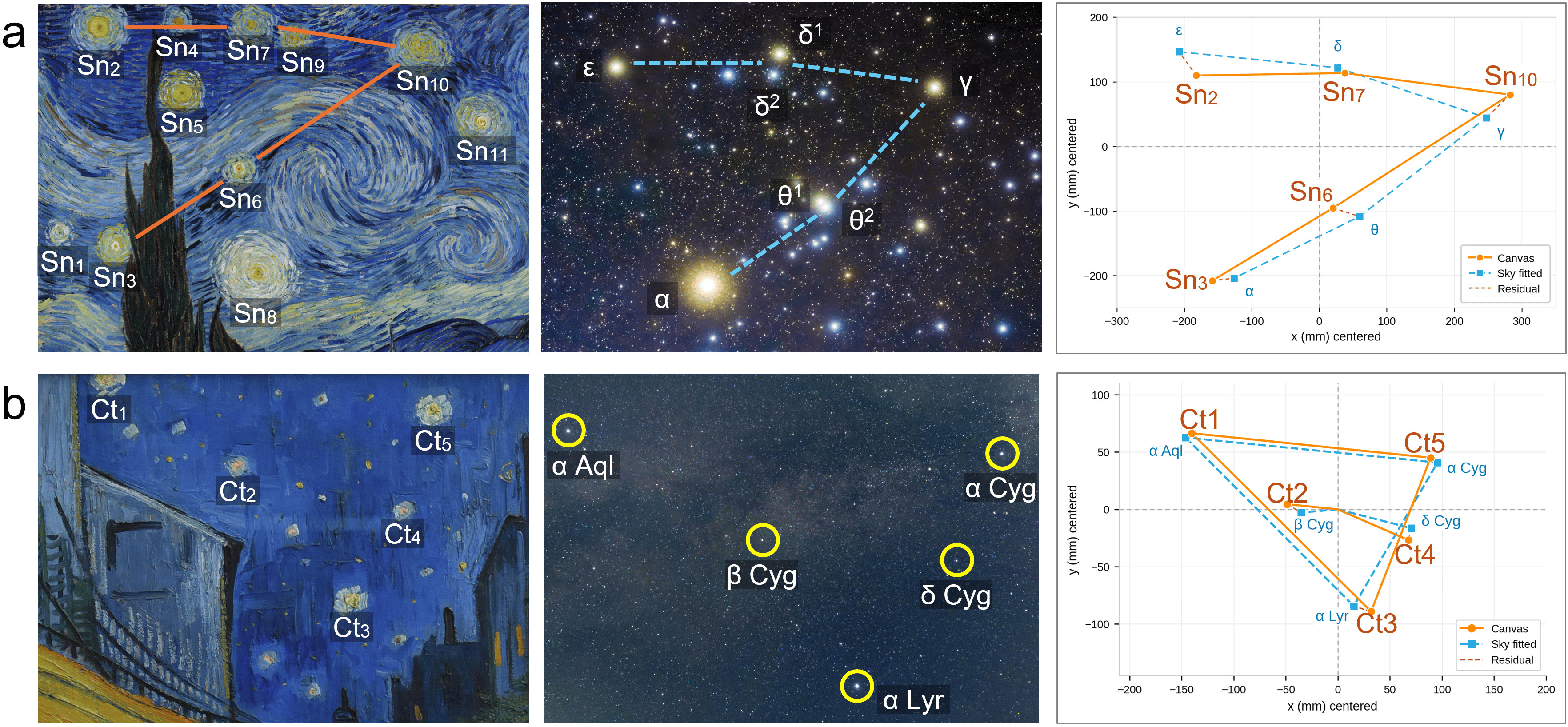
(A) The central cluster of stars in “The Starry Night” (1889), left, and the Hyades cluster in Taurus, center. At right, the five stars in the painting (orange) are overlaid on the real stars (blue) after matching for size, orientation and position; red dashed lines show the residual differences. (B) The stars in “Café Terrace at Night” (1888), left, and the stars around the Summer Triangle, center. The panel at right follows the same layout as in (A). Image: Kim et al., Scientific Reports (2026), Figs. 2, 4 and S1.
According to the team, the crescent moon, Venus, and the Hyades star cluster in the constellation Taurus would have been visible around dawn on July 22, 1889. This configuration generally corresponds to what is portrayed in the painting. Weather records suggest that the night sky around July 22 would have been clear enough for this astronomical arrangement to be visible. Additionally, the frequent mentions of cicadas in van Gogh’s letters suggest that the region was seeing a period of hot weather, which matches the recorded temperatures in July 1889 better than in June.
The team also verified that the painter’s field of view in another painting titled “Starry Night over the Rhône” (1888) with photographs taken on site was painted when the sky was in Aries. Using the same method, the team also believes that the stars in “Café Terrace at Night” (1888) may be the Summer Triangle.
“I hope this work prompts a renewed, multidisciplinary look at the sequence and working methods of the Saint-Rémy paintings, and at Van Gogh’s movements that summer,” Kim said. “Our conversation with Van Gogh’s other skies is still ongoing. We plan to tell those stories one by one.”
Dr. Nick Medford’s patient had plenty of reasons to be terrified of a simple blood test.
His body had shrunk down to a fraction of its size, or so he believed, and the physicians looming over him were enormous. Then there was the needle about to pierce his vein: to the patient’s eye, it was larger than his entire arm.
It might sound like something out of Alice in Wonderland. But this patient’s story belonged to a different genre entirely. Horror, namely. As far as the patient was concerned, there was no point in taking his blood. It was no longer human. Neither was he.
Medford’s patient was suffering from clinical lycanthropy, defined as the delusional belief that one is turning into a werewolf. And unlike the flesh-tearing beasts of folklore, who terrorize the unsuspecting by the light of the full moon, patients like Medford’s are often the ones haunted, trapped inside a body-horror nightmare.
According to Medford, his patient knew something was wrong, but was as confused about his condition as anyone. “Not only did he think he was a werewolf, but he would also talk about things like wanting to realign the cosmos and wanting to kill God,” says Medford, a neuropsychiatrist with the South London and Maudsley NHS Foundation Trust.
“And then you would say, ‘Do you believe in God? Are you religious?’ And he’d say, ‘No.’ His ideas didn’t really make sense even to him, which was a part of his distress.”
So, what causes this rare condition? And why does it take the form of one of Halloween’s classic monsters?
Rarer than movie werewolves
If you’ve never heard of clinical lycanthropy before, there’s a good reason: Hollywood’s werewolves easily outnumber the real-life cases of this condition. Only about 25 instances have been reported in the medical literature.
Because there are so few cases, Medford says it is difficult to identify a common cause or predictable disease course. However, he says that typically it is seen in patients already experiencing mental illness.
“In around 40 percent of published cases, it occurs in the context of schizophrenia,” Medford says. “There are also reports of it occurring in the context of bipolar disorder or psychotic depression. So, in the context of severe mental illness, basically.”
Experts debate whether German artist Lucas Cranach the Elder depicts a werewolf or a cannibal in this woodcut print from the 16th century. Image: Public Domain
Medford’s own patient had been diagnosed with Huntington’s disease, an inherited, fatal brain disease that causes psychiatric symptoms and uncontrolled body movements. The case, which Medford documented in a 2023 report, was the only published instance of clinical lycanthropy associated with Huntington’s. Although Medford says it is uncertain what then led his patient to believe he was a werewolf, he says the physical changes associated with Huntington’s may have fed this idea.
“There may be some change in the person’s body or in their perception or their experience of their body,” Medford says. “That might be, if you like, the seed from which this idea can develop.”
This seems possible in the case of Medford’s patient, who exhibited involuntary writhing movements and other strange physical sensations.
“He did not seem to be aware that he was having these abnormal movements, but he was aware of some weird sensations,” he says. “He described freezing sensations and electric-shock-like sensations. He had some sense that something strange was happening in his body.”
Why wolves?
But physical changes alone don’t explain why the patient imagined he was turning into a werewolf. Which raises the question: Why do these delusions so often focus on lupine metamorphoses?
They don’t always, Medford notes. There’s a broader term—therianthropy—for the delusion that one has turned into any animal. But most of these cases involve canines, he acknowledges.
“Most of them are wolves or dogs or something of that type,” he says. “And then there’s a whole range of other strange things. There’s a report of someone who thought they’d turned into a bee.” That would make for an underwhelming horror movie, to be sure.
So, is it a coincidence that many of these patients report delusions ripped straight from a creature feature?
Probably not. In their case report, Medford and his co-author, neuroscientist Natasha Sigala, note that “delusions are influenced by culture,” and few cultural images of human/animal shapeshifting are as deeply embedded as the werewolf.
“The werewolf folklore and werewolf mythology goes right back to antiquity,” Medford says. “And it’s kind of interesting that the werewolf or something like it seems to pop up in a lot of different cultures and different times and places.”
American actor Henry Hull poses for a publicity portrait for his 1935 film Werewolf of London. Image: Getty Images / Stringer / Archive Photos
Why is the werewolf legend so potent and enduring? Medford suspects it may tap into something primal.
“The werewolf symbolizes something about the human condition,” he says. “We live in civilized societies, and we adhere to social norms, but there’s a sort of animal part of us that perhaps chafes against that.”
That internal conflict may explain some of the patient’s other fixations. He described urges to strangle his wife and to defecate in a church. Medford notes that Huntington’s may also have impaired his sense of disgust, which can happen as the disease progresses.
Yet the patient also fought against his own impulses. At times, he lunged at staff, only to pull back and apologize.
“You could see the conflict in that moment,” Medford says. In that sense, the patient wasn’t so far from the werewolves of fiction. Like a movie werewolf beholding his mirror image in horror, he looked at his reflection and saw himself changing in ways he couldn’t control.
The werewolf fades
For Medford’s patient, that dreaded blood test ultimately was part of a turning point in his treatment. The bloodwork allowed Medford to keep the patient on clozapine, a potent antipsychotic. As Medford increased the dose, the patient’s delusional beliefs dwindled, and although the underlying Huntington’s disease remained, the werewolf soon was gone.
Medford hopes patients like his will be treated with compassion rather than sensationalism. “These cases, they’re rare, but when they do happen, they tend to arise in the context of serious psychiatric or neurological disturbance,” Medford says. “They are people meriting sympathy and treatment, rather than romancing about it.”
In Ask Us Anything, Popular Science answers your most outlandish, mind-burning questions, from the everyday things you’ve always wondered to the bizarre things you never thought to ask. Have something you’ve always wanted to know? Ask us.
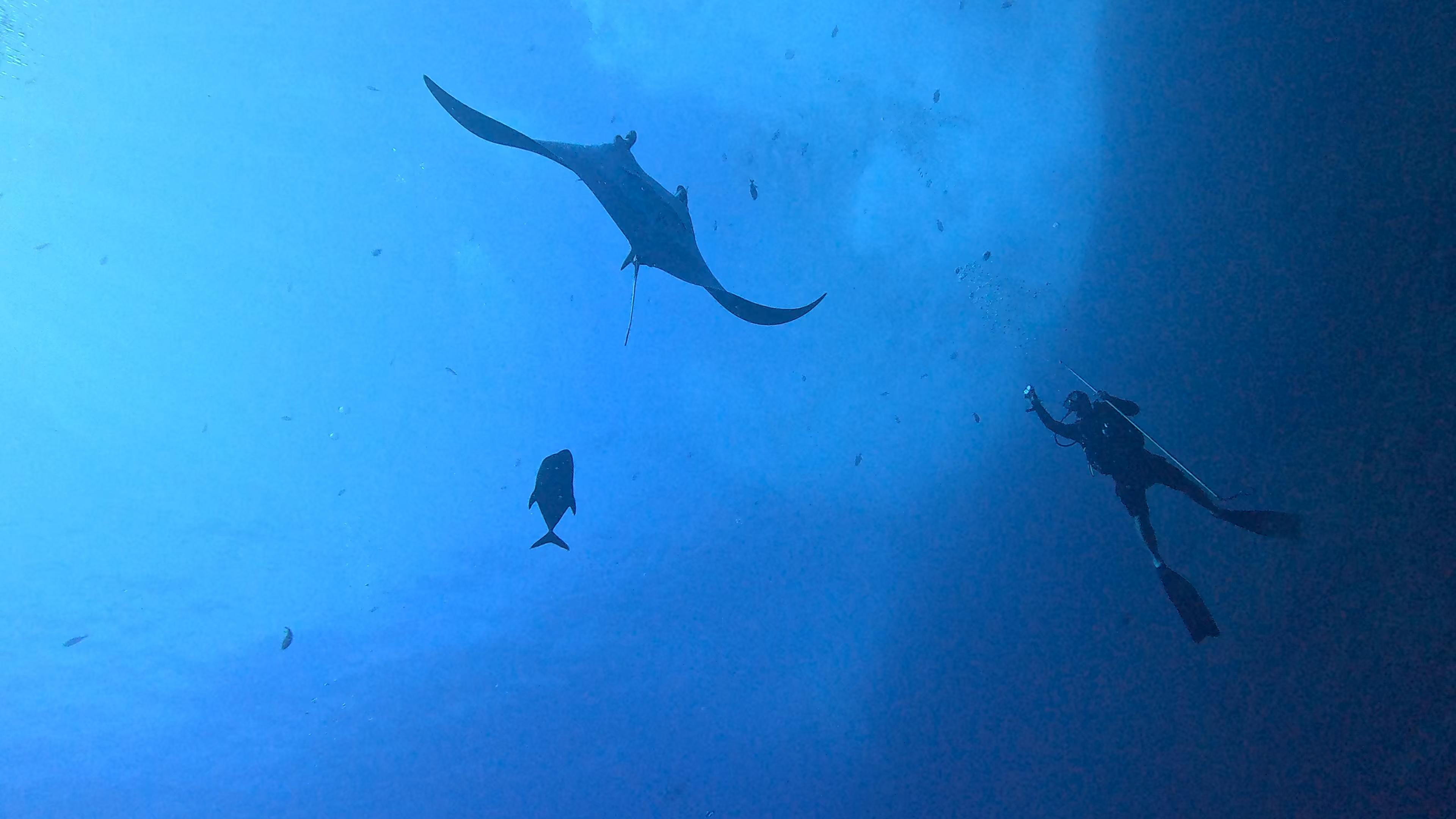
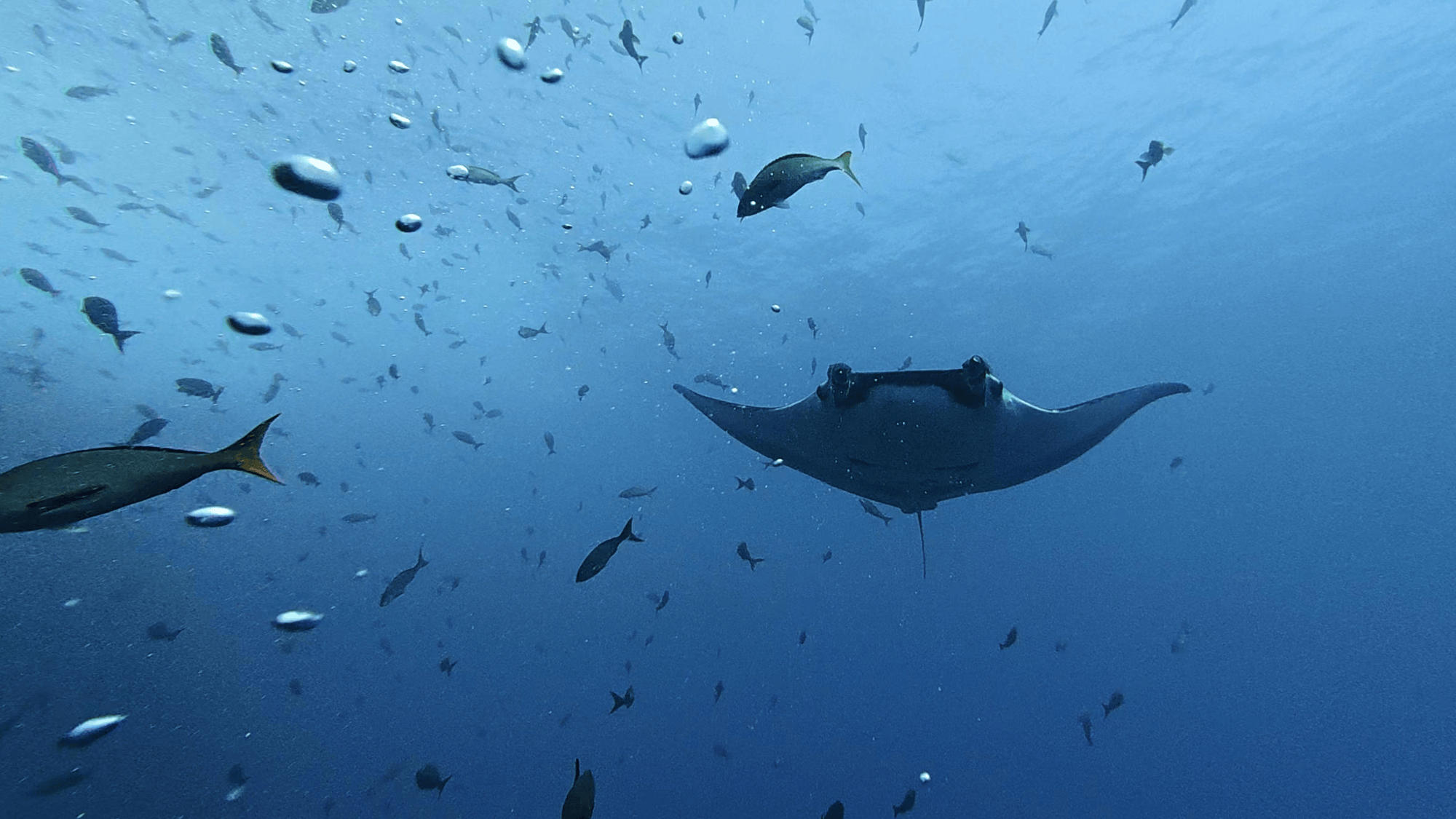
Before giant manta rays (Mobula birostris) can grow to up to 30 feet long and 4,409 pounds, they must start small like most living things. Giant manta ray babies (called pups) in Central America don’t have their size to protect them from orca whales (Orcinus orca) and the numerous sharks in the open ocean. Their solution—sticking to the coast, where there is plenty of food to help them grow and defend themselves. A new study published today in the journal Frontiers in Fish Science details the baby rays’ behavior.
“We show that manta rays’ lifestyle isn’t a one-size-fits-all behavior. Giant manta rays in Central America undergo a dramatic shift in space use as they mature,” Jeffry Madrigal-Mesén, a study co-author and project leader of Mantas Costa Rica, said in a statement. “Juveniles remained strictly within shallow nearshore waters that serve as coastal refuges, but most of the tracked adults executed long-distance transboundary migrations along the continental shelf break into Central America.”
Puntitos, one of the immature mantas the scientists followed. Image: Jeffry Madrigal.
Where the pups grow
In the study, the team used multiple methods to track and identify mantas at five locations between 2018 and 2025. Acoustic telemetry uses underwater sound pulses to monitor fish movements and allowed the team to track 59 individual rays. With satellite telemetry, transmitters track movement and behavior from a distance and helped the team track large-scale movements of 12 individuals. Lastly, photo identification helped to identify individual manta rays.
“If we hadn’t used all three technologies together, we simply wouldn’t have been able to piece this puzzle together,” explained Madrigal-Mesén. “Combining these tools turned fragmented data into a unified, undeniable story.”
The team ended up with a dataset of over 12,000 detections. The data showed that young mantas (those with a body about 10 feet or less) stick to shallow coastal refuges. In these more shallow spots, the pups have a safe place that doesn’t overlap with their predators’ hunting grounds. They have plenty of food and places to hide, and even get essential services like cleaning from reefs.
“Mature adults can rely on their massive body size and their ability to dive deep to evade threats. But juveniles don’t have that luxury,” said Madrigal-Mesén. “What is truly amazing is seeing how strictly young manta rays stick to coastal waters as long-term refuges. We see the same individuals more often than once a year. In fact, just recently, they were sighted again at the exact same tagging location. It is always a joy to see them again—they have truly become a part of the family.”
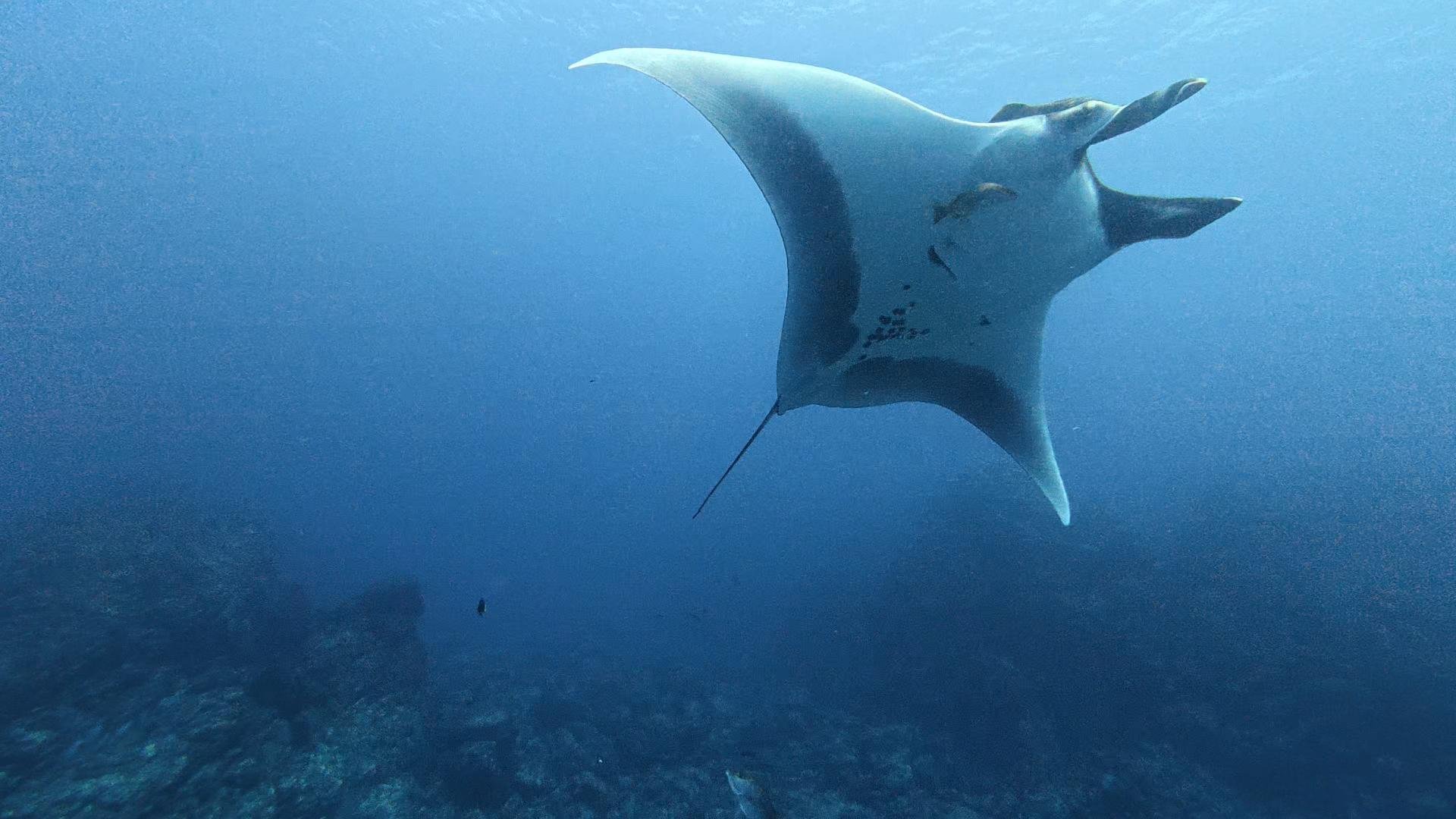
Manta ray in close proximity to a diver. Image: Jeffry Madrigal.
By comparison, nine mature mantas in the study went on expansive migrations along the continental shelf break. One manta ray nicknamed Mickey Mouse because of a spot pattern on his belly had movements that suggest the fish also continue to display loyalty to a particular site once they grow up. Unusually approachable for a manta, Mickey Mouse allowed the team tag him multiple times over several years, which provided a continuous dataset. In 2020, he logged 462 acoustic detections at a coastal hub called El Secreto. He returned to the same shelf in 2023, and stayed there for 38 days.
“Nearshore cleaning stations transcend basic hygienic function; they act as primary social hubs where courtship and reproductive interactions take place,” said Madrigal-Mesén. “Returning to a predictable coastal depot allows mature rays to prioritize social and cleaning needs before undertaking large-scale regional migrations.”
Traveling the manta swimway—safely
Once they leave coastal regions, adult manta rays face different dangers. Coastal areas are often legally protected marine reserves, but the open ocean is another story. They no longer have legal protection and are exposed to dangers from industrial fisheries and vessel strikes.
According to the team, this shows that marine protected areas alone are not enough to protect this highly mobile species as it swims across Central America. They say that multi-national “conservation swimways” that link the domestic juvenile coastal refuges with adult migratory corridors could help keep the endangered rays safe.
“This study opens a new chapter for manta ray research in Central America,” Madrigal-Mesén concluded. “We hope it sparks fresh enthusiasm and encourages future collaborators to join us in executing the new ideas and research projects we have planned for the conservation of this species.”
The California Department of Public Health (CDPH) reported 80 new West Nile virus (WNV) positive human cases reported in the state last week from the following counties: Fresno (2), Glenn (1), Los Angeles (59), Orange (11), Riverside (1), San Joaquin (1), Stanislaus (3), Tulare (1), and Yolo (1).
This brings the total human cases in California to 378 from 24 counties. This number accounts for 25.7 percent of the total WNV cases in the United States (1471).
23 WNV-related fatalities have been reported to CDPH this year from 9 jurisdictions: Butte (3), Glenn (2), Kings (1), Los Angeles (6), Orange (5), Sacramento (2), Stanislaus (1), Tuolumne (1), and Yolo (2).
Of the 378 case patients, 321 (85%) had neuroinvasive disease. The median age of case patients was 66 years and 254 (67%) of the case patients were male.
In Los Angeles County, the Department of Public Health has documented 249 West Nile virus (WNV) human infections and 12 deaths.
The 378 cases statewide this year is higher than 59 cases reported in 2025 and the 110 case 5 year average.
West Nile virus is the most common and serious vector-borne disease in California. There have been more than 8,000 human cases and over 400 deaths reported in California since 2003. The mosquitoes that spread WNV are found throughout the state.
Outbreak News Today is a reader-supported publication. To receive new posts and support my work, consider becoming a free or paid subscriber.
Tesla now says unsupervised “Full Self-Driving” in customer-owned cars will arrive in Q2 2027. It’s the latest date on a promise Elon Musk has been making to FSD buyers for the better part of a decade.
But there’s a catch. On Tesla’s Q3 2026 earnings call today, AI chief Ashok Elluswamy described it as owners adding their own vehicles to Tesla’s managed Robotaxi fleet, not owners getting a car that drives them anywhere they want to go.
AMD has published Linux kernel patches for an official Ryzen overclocking driver that allows users to adjust CPU power and current limits through a firmware interface exposed via sysfs. Phoronix reports: AMD engineer Shyam Sundar S K posted the patches for the AMD Overclocking "AOD" WMI driver as an interface to the platform firmware for managing overclocking and power/current limits of modern Ryzen CPUs.
The driver in its initial form allows setting via sysfs a number of CPU tunables including the Package Power Tracking (PPT), Thermal Design Current (TDC), and Electrical Design Current (EDC) limits along with reading their supported range. SMT toggling can also be done via the interface as an alternative to the likes of Linux's "nosmt" option in disabling SMT at the platform level rather than kernel disabling. The current memory clocks can also be read via this AOD driver.
The power tunables aren't applied in real-time but go into effect at next reboot. The firmware does support many more commands compared to the few initially wired up and hopefully in time more of these controls will be enabled with this driver.
Fãs de GTA 6 flagraram equipes de filmagem gravando comboios de carros esportivos exóticos e personalizados com marcas fictícias da franquia nas ruas de Miami. A aposta dos jogadores é que a Rockstar Games pode estar produzindo uma espécie de trailer live-action para o jogo que está a menos de um mês de distância.
A engrenagem de marketing da Rockstar parece estar rodando a todo vapor. Além dos veículos e de um possível trailer live-action, a produtora também contou com um dirigível de Vice City sobrevoando Miami, cartazes espalhados por toda a cidade e uma ação com o time de basquete Miami Heat.
Buried in a press release titled, “Even more colours and even greater convenience for the Cayenne Electric” was news that Porsche, for the first time, would be offering electrically wireless inductive charging on its impressively powerful Cayenne Electric SUV.
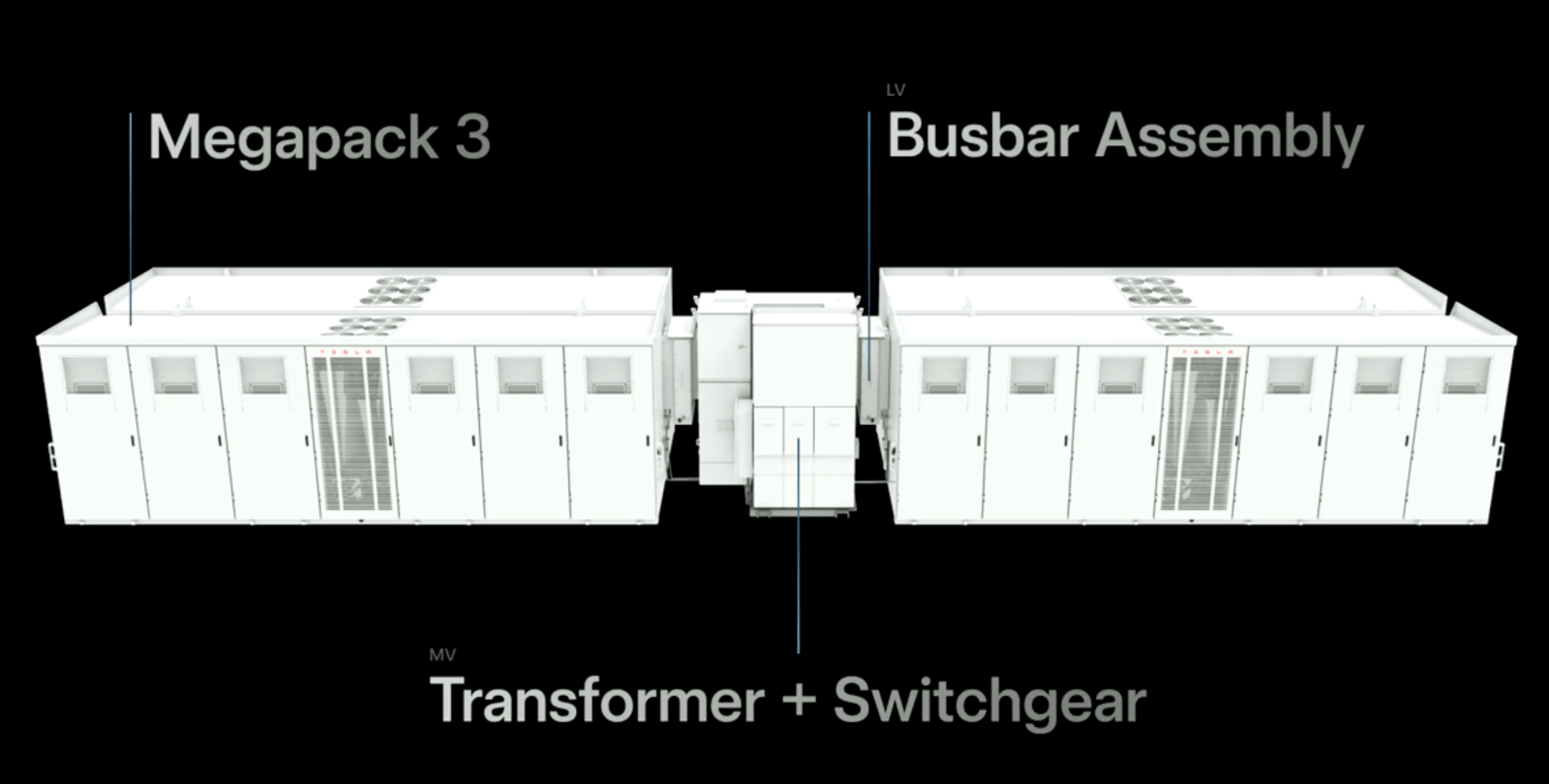
Tesla’s energy business deployed more batteries in Q3 2026 but brought in less money. Energy generation and storage revenue fell 16% year-over-year to $2.88 billion, even though storage deployments rose 10% to 13.7 GWh.
Tesla’s shareholder letter blames the drop “partially” on “tariff-related customer refunds.” It doesn’t say how much it refunded, to which customers, or why it was accounted for as reduced revenue.
There’s something really appealing about retro tech but it’s hard to put your finger on exactly what it is. Or maybe that’s it. You can press the chunky buttons, place a record on a turntable, hold your favorite media in your hands and feel the satisfying click of a flip phone snapping shut.
For others, the appeal might be the colorful designs that seemed to have so much more personality than the shiny black rectangles we all own now. Or maybe it's actually owning media rather than feeling like you’re constantly renting it. Whatever the reason, it’s clear plenty of people love retro tech.
However, it’s easy to romanticize a return to older tech, like the idea of listening to a Walkman on the train, taking blurry photos with an old camera or spending a lazy afternoon playing a Game Boy. But how much of the actual experience are you prepared to put up with?
Because using that Walkman also means carrying round tapes, replacing batteries and rewinding songs. The camera might need an obscure memory card and a cable you haven't seen since 2004. And your beautiful old flip phone probably isn't going to help when you're lost and need Google Maps.
I'm personally all for bringing a little retro tech back into our lives. I've got some myself. But there's a big difference between wanting the aesthetic and being willing to embrace the inconvenience.
Although, for some people, the inconvenience is also part of the experience. At a time when everything is quick, easy and frictionless it can be nice to feel like things are slower and require a little more effort.
So, before you start bidding on vintage gadgets on eBay, take our quiz to find out how much retro tech you can realistically handle. We'll test your patience, willingness to tinker and tolerance for doing things the old-fashioned way, then recommend some retro gadgets to match. Because I strongly suspect many of us might miss the way tech used to look and feel but we maybe don’t miss the way it used to work quite as much.
A CBC investigation found that more than 1.5 million Canadian Crime Stoppers tips spanning 25 years were exposed in a breach of the P3 Global Intel tip-management platform. About 850,000 records contained personally identifiable information, including addresses, phone numbers, emails, license plates and some banking details. Longtime Slashdot reader doconnor shares the report: The data was stolen last March by hacktivist collective Internet Yiff Machine. In a manifesto, the group said it wanted to disprove the claim by P3 Global Intel -- the company hired by Crime Stoppers to manage its tips -- that the platform was "anonymous" and "secure." A copy of the hacked data was made available to researchers and journalists, including CBC, by Distributed Denial of Secrets, a U.S. non-profit that archives and publishes hacked and leaked documents it deems to be in the public interest. The report found that more than 4,300 Crime Stoppers tipsters identified themselves by their full name, with hundreds of records containing staff warnings that individuals had "self-identified" or been "exposed," yet their information remained unredacted.
The leaked data included sensitive allegations involving murder, terrorism, drug trafficking and organized crime, with nearly 49,000 tips linked to cases cleared through arrests or criminal charges. Cybersecurity experts criticized the retention of decades-old records... "If a tip is closed, does that need to stay online?" asked cybersecurity expert Ben Coon. "The answer to that, to me, is no."
The RCMP was initially told Canadian data was unaffected, then assured that exposed Canadian records contained no personally identifiable information. This appears to contradict the CBC's findings. Furthermore, affected individuals have not been systematically notified because contacting them could further jeopardize their anonymity.
"For a system that has been designed to promise anonymity to the users, that has failed categorically," said Prof. Ali Dehghantanha, the Canada Research Chair in Cybersecurity and Threat Intelligence at the University of Guelph.
Just 9 months after raising an $180 million seed round, Flapping Airplanes has landed $1 billion Series A for its mission to build AI models "without ingesting half the internet."

 Login