❌

Normal view

Samsung and SK Hynix are upgrading Chinese factories to produce advanced RAM chips as AI data center competition ramps up

21 October 2026 at 12:49

The two biggest NAND flash memory manufacturers on the planet, Samsung Electronics and SK Hynix, are reportedly working to upgrade their Chinese factories to produce more advanced chips for use in AI data centers, Reuters reports. The move comes as the two companies continue to fight off competition from the fast-growing Chinese memory makers like CXMT. Fierce competition in the lucrative AI RAM market has already seen manufacturers slash consumer-focused production to allow them to increase production capacity for the more advanced — and money-spinning — components.

Citing four people familiar with the companies' plans, the report claims that Samsung Electronics aims to switch its Xian plant to the production of 286-layer flash chips by the end of the year. SK Hynix has its sights set a little lower, targeting chips with 240 or more layers at its Dalian facility. That factory was taken over back in 2021, but a timescale for the new upgrades isn't clear.

However, while Samsung Electronics and SK Hynix are well placed to deal with the growing threat from Chinese chipmakers, both are faced with additional complications in the form of U.S. regulations. Export controls on chipmaking equipment were applied in 2022, with the aim of slowing China's technological progress. Both companies, based in South Korea, must now get licenses in order to install U.S.-built hardware in Chinese factories. The report points to this as a reason for the recent growth of Chinese firms like Yangtze Memory Technologies Co. (YMTC). The company told investors at a recent IPO preparation meeting that it aims to become the world's largest NAND flash producer by the end of 2027.

While both Samsung Electronics and SK Hynix say that they are working in consultation with the U.S. authorities, there's little doubt that this extra step has hampered the companies' ability to upgrade their factories to better meet the new AI memory demand.

It's impossible to overstate just how key Samsung and SK Hynix are to NAND supply. Samsung's Xian factory produces around 40% of the company's global output. It currently produces chips that have around 200 layers, but Samsung's plans aim to boost that to 286 layers for V9 NAND chips. For its part, SK Hynix's Dalian plant currently produces chips with 192 layers, with the company's aim for 240-layer chips reportedly confirmed by three people familiar with the plans.

Meanwhile, CXMT, China's premier chipmaker, is looking to move beyond DRAM production. A report from September 2026 noted that it was eyeing production of 3D NAND memory for use in solid-state storage (SSD) products. The country's largest DRAM producer, CXMT, posted $22.41 billion in revenue and $11.57 billion in net profit in the first half of 2026 after years of losing money. But despite this purple patch, the company is still much smaller than the likes of Samsung, SK Hynix, and Micron.

Google Preferred Source

Micron's Taiwan union will launch a one-day strike this week, threatening memory production

Micron faces a one-day labor stoppage at its Taoyuan operations in Taiwan on October 22, Reuters reports. Micron's employees are striking for concrete terms for this year's bonus and a clearer mechanism for sharing the company's future profits. The strike's teeth come from the resultant financial impact on Micron's operations, as semiconductor fabs are supposed to operate around the clock. The scheduled protest comes amid strong demand for memory chips and will have a minor impact on Micron's memory output.

The Taoyuan union wants Micron to present a specific proposal for this year's additional employee bonus and establish a transparent formula for distributing a portion of future profits. Previous negotiations between the company and the union ended unsuccessfully in September, which prompted employees to approve industrial action in early October. Nonetheless, the union stresses that the October 22 strike is intended to pressure Micron into reaching an agreement rather than terminate negotiations. The union is prepared to conclude a deal if the company presents terms acceptable to employees across its Taiwanese operations.

The situation could become more serious if employees at Micron's Taichung operations, its largest manufacturing site in Taiwan, decide to join the action. A separate labor organization that represents workers at that facility is scheduled to meet with Micron for mediation on October 22, the same day as the Taoyuan protest. However, the Taichung union has not yet authorized a strike.

Micron's fabs in Taiwan produce commodity DDR5 and LPDDR as well as expensive high-bandwidth memory (HBM) for AI accelerators. Amid record demand for memory of all types, even a one-day suspension of operations would have a material impact on Micron's output and earnings.

Modern semiconductor fabs are supposed to work 24/7/365, as many processes cannot be halted. However, if management has sufficient time and personnel to prepare, a one-day warning strike does not necessarily mean a complete shutdown of Micron's Taoyuan manufacturing operations, not to mention permanent damage to wafers or equipment. The actual consequences of the strike will depend on employee participation, which manufacturing operations are affected, and Micron's contingency plans. While it is likely that the output will drop, the decline will likely be negligible.

Micron employs approximately 15,000 people in Taiwan. The workers point to compensation arrangements at Samsung Electronics and SK hynix as examples of how semiconductor manufacturers can distribute profits among employees as AI-driven demand generates unprecedented cash flows for memory firms.

Apple taps Perryman titanium and Qnity films for iPhone Duo and iPhone 18 Pro

20 October 2026 at 23:16

Apple on October 20, 2026 announced new and expanded American Manufacturing Program (AMP) partnerships with U.S. companies supplying materials and components for iPhone Duo and iPhone 18 Pro. Apple says it will commit up to $100 million over the next three years with Pennsylvania titanium producer Perryman Company, and is expanding its partnership with Delaware-based […]

The post Apple taps Perryman titanium and Qnity films for iPhone Duo and iPhone 18 Pro appeared first on The Mac Observer.

Meta drops the word "train" from its commercial TOS after AI backlash

20 October 2026 at 21:07

Hoping to quell criticism, Meta has dropped the word “train” from its “streamlined” commercial terms of service that kick in on October 30.

Last week, Meta faced backlash after legal experts warned that the tech giant’s sweeping new commercial terms of service seemed to give Meta permission to endlessly scrape websites linked on business pages. Talking to Nieman Lab, experts suggested that Meta could possibly use the policy to avoid millions in licensing fees from news organizations by requiring all business users to share a wealth of AI training data simply for running a business page.

A Meta spokesperson confirmed that Meta did not alert users to the changed language following backlash. This potentially only adds to confusion ahead of the policy rollout. In response to backlash, Meta's spokesperson provided a statement to Ars, acknowledging Nieman Lab's initial report but not its follow-up report reiterating experts' concerns:

Read full article

Comments

© filo | DigitalVision Vectors

Electronics hobbyist converts $120 DDR5 SODIMM kit into ‘$1000’ desktop kit to fight RAM crisis

20 October 2026 at 12:10

What if you could buy a cheap used DDR5 SODIMM (laptop memory) kit and transform it into a super-fast DDR5 desktop kit? That’s what electronics hobbyist Blighted Agent recently did when they succeeded in converting a SK hynix 2x 16GB DDR5-5600 SODIMM kit they got from Facebook Marketplace for $120 into a 2x 16GB DDR5-7800 desktop kit, claimed to be worth around $1,000. They also had to buy some blank DDR5 desktop memory PCBs from AliExpress for around $16 each, and a set of heatsinks for around $18.

In the above video, our hero says they bought the donor laptop 2x 16GB DDR5-5600 sticks for just $120, which is a bargain. With extra bits and pieces from AliExpress (desktop DDR5 PCBs, etc.), the total bill of materials came to $175. Blighted Agent comments that the SODIMMs used what he believed to be SK hynix A-die modules, which are the same as the ICs used in expensive desktop DDR5 modules like the G.Skill Trident Royal line.

The process began with taking the memory ICs from the donor modules using a hot air station. Then they were cleaned and had 0.45mm leaded solder balls added, using a DDR5 stencil, reballing jig, and hot air. Next, the blank desktop DDR5 PCBs were prepared. A little solder was added to the plethora of BGA connectors to be ready for the memory chips to connect to.

The old DDR5 ICs and the new desktop modules could now be mated, using flux, the preheater, hot air, and watching and prodding carefully with a dental pick. Blighted Agent’s experience lets him know when the BGA chips have successfully mated with the PCB. You can eyeball when they pop precisely into place due to surface tension, and offer up a modicum of resistance to pick prodding.

Finally, the enthusiast added the SPD chip and BIOS chip from the SODIMMs to the new desktop DIMMs. These new desktop DIMMs were quickly tested in a PC before they were finished off with carefully applied thermal pads and the fancy-looking heatsinks.

Blighted Agent felt lucky that there were no issues with the newly created desktop modules. There’s a lot of intricate things that can go wrong during such a process. The initial boot verification showed them recognized in his Asus ROG Maximus Z790 Apex Encore motherboard as two “SK hynix 16,384MB 5600MHz” modules, which was correct. Some tuning resulted in rock-steady performance at DDR5-7800 CL38 and 1.40V. This was verified by stress testing for 90 minutes, which the enthusiast reckons was ample for a gaming PC. It is very likely a better result than using those mechanical SODIMM-to-DIMM converters you can buy, which can be problematic.

Blighted Agent seems to specialize in BGA soldering work, and has also successfully upgraded several graphics cards with double the VRAM. Though videos like this are edited to be brief, and they make the process look easy, the TechTuber admits there is a lot that can go wrong during this kind of rework. Moreover, with RAM modules, they lack the testing equipment to locate an issue with any particular IC on the PCB. So, if this module didn’t work, they might have ended up in a world of pain, not knowing which memory chip had an issue due to either an internal fault or a BGA soldering glitch.

Electronics hobbyist converts a $120 DDR5 SODIMM kit into a $1000 desktop kit
Blighted Agent on YouTube
Electronics hobbyist converts a $120 DDR5 SODIMM kit into a $1000 desktop kit
Blighted Agent on YouTube
Electronics hobbyist converts a $120 DDR5 SODIMM kit into a $1000 desktop kit
Blighted Agent on YouTube

Looking around at used DDR5 SODIMMs, it looks like Blighted Agent was very lucky to get a used working 32GB kit for $120. I just checked eBay U.S., and the best deal there was $320. Meanwhile, the best price for a new 32GB DDR5-6000 kit seems to be $449 at the time of writing.

We reported on Russian enthusiast VIK-on succeeding in a similar project earlier this year, but all their costing was in Rubles, and they went the extra mile in flashing custom firmware so the remade modules would be auto-detected with 6400 MT/s XMP support on most motherboards. In late 2026, DDR5 RAM continues to be too expensive.

Instagram Charging for Links

13 October 2026 at 03:03

Meta:

If you subscribe to a Meta One plan, you can add links to a set number of posts and reels each month based on your plan:

  • Meta One Advanced plan: up to 4 posts and 4 reels with links per month
  • Meta One Expert plan: up to 8 posts and 8 reels with links per month
  • Meta One Max plan: up to 12 posts and 12 reels with links per month

Via Nick Heer:

Instagram has never supported links of any kind in individual posts, so that is a new feature with two links per month permitted for free, and more enabled by this pricey subscription — starting at $50 USD per month for four posts per month containing external links. But links in Reels have been commonplace for years. Meta is now gating that, too; and there is more.

[…]

Meta seems to have two objectives here: to take a cut from businesses that use Meta’s services as a referral source more generally, and — more specifically — to capture some of the money made by influencers.

Requiring login, removing RSS, discouraging links. Things are not looking good for the open Web.

Previously:

US military ends long-running program to spot nuclear missile launches

2 October 2026 at 18:32

In late 1970, a Titan IIIC rocket launched from Space Launch Complex 40 at what was then called Cape Canaveral Air Force Station. It carried a top-secret payload for the US military.

Much has changed in spaceflight since then. The Titan IIIC would bow out in 1982 after dozens of launches. Various Titans continued launching from Space Launch Complex 40 until 2005, at which point the US Air Force—in a competitive process hotly opposed by United Launch Alliance—turned the pad over to a small, largely unknown startup called SpaceX. And Cape Canaveral is now a "Space Force" station.

But those unspecified payloads? Until last month, some of them were still flying operationally.

Read full article

Comments

© ULA/Carleton Bailie

Memory executives expect RAM shortage to continue through 2028

1 October 2026 at 18:49

Micron and Samsung executives this week said the memory shortage will continue for at least the next couple of years.

Micron CEO Sanjay Mehrotra expects demand for the firm’s memory to exceed its available supply over that period, he told investors last night.

Micron no longer sells consumer RAM, and Mehrotra’s statements refer to Micron’s business-to-business sales of high-bandwidth memory (HBM) for AI and DRAM for servers. However, his comments also have implications for consumer devices. Manufacturing capacity is prioritizing memory for AI and servers, limiting the supply of memory manufactured for consumer devices.

Read full article

Comments

© Getty

Not Muse in the App Store

28 September 2026 at 19:52

Jeff Johnson:

The Muse from Meta app description says at the beginning, “Muse is your personal AI agent that gets things done, always working on what matters to you.” The Muse AI app description says at the beginning, “Muse is your professional AI agent that gets work done, always helping move important tasks forward.” Near the end, the Muse from Meta app description has the heading “SMART, BUT STILL LEARNING.” Near the end, the Muse AI app description has the heading “POWERFUL, BUT STILL LEARNING.”

In other words, Muse AI is a blatant copy of Muse from Meta, the latter of which is currently the #1 iOS App Store download in the United States. I don’t know where Muse AI ranks in the iOS App Store, but I do know that it’s currently the #20 Mac App Store download in the US.

And the real Muse app isn’t in the Mac App Store, so it has no competition.

By the way, I’d also like to draw your attention to the #11 Mac App Store download, as shown in my screenshot above: App for Instagram º. Yes, the app name includes the º character, a phenomenon I’ve written about before.

[…]

The top search result for “VLC” in the Mac App Store is Video Player for VLC, developed by muhammad faisal jabbar, not by VideoLAN. VLC for Mac is distributed outside the Mac App Store. You may notice a similarity between the icon of the official VLC app in the iOS App Store and the icon of Video Player for VLC.

Previously:

Update (2026-09-29): John Gruber:

“Muse AI” is now gone, but “App for Instagram °” and “Video Player for VLC” are both still there.

Jeff Johnson:

The Reddit commenter claims that the scams receiving public attention are “the tip of the iceberg from a limited, outsider perspective,” which is an accurate metaphor, yet the commenter and I have dramatically different interpretations of that metaphor. For the commenter, the iceberg represents the vast number of scams allegedly caught by Apple app review but not seen by the public; for me, the iceberg represents the vast number of scams not caught by Apple app review and not seen by the public either. To put the argument another way, the commenter appears to assume that the majority of scams in the App Store receive widespread public attention, in blog posts such as mine or in the news media, so the relatively small number of stories we hear is indicative of a relatively small number of scams in the App Store, whereas my own impression is that the vast majority of scams in the App Store do not receive widespread public attention. Scam hunting is not my job, merely an occasional hobby. It’s so easy for me to find scams, they practically fall into my lap whenever I look. I could spend all day every day finding and listing App Store scams, if I were sufficiently motivated (I’m not). You would think that someone working for Apple would be sufficiently motivated, by a paycheck, to spend all day every day finding and listing and most importantly removing App Store scams, but I’ve seen no evidence of it.

I think Johnson is right about the iceberg. Most of the scams that get publicity are at the top of the charts. One view is that all the scam apps that Apple misses end up being popular. What are the odds? The other is that we notice them because they’re popular and that there’s also a vast number of deceitful or dangerous apps lurking.

Dan Moren:

Speaking of App Store shortcomings, I really hate when I want to see how much an app costs and I get this impenetrable list of IAP options. It’s impossible to know without installing and opening the app what the payments options are. Be great if Apple helped make this clearer—which options are actually available? What are their various plans (monthly, weekly, etc.)?

Meta AI for Mac and Muse

28 September 2026 at 19:51

Zac Hall:

The new Meta AI desktop app is version 1.0 beta at launch and weighs just 16MB once installed.

Based on initial inspection, it runs natively on Apple silicon Macs with macOS 15 or later, using an AppKit and SwiftUI shell with WebKit for richer chat content. In other words, this is not an Electron app or a repackaged iPad release.

It includes Mac-specific hooks, making the desktop experience more robust than the Meta AI mobile app.

Karissa Bell:

The Mac app brings a few new capabilities compared with Meta AI’s existing website and mobile app. For example, it enables users to share part of their screen so the assistant can “see” what they’re working on and provide more specific answers.

Juli Clover:

The app is primarily meant for businesses and content creators, and it integrates with Facebook and Instagram. It incorporates analytics tools so it can answer questions about performance, and connects with Google Workspace for document access. Google Workspace access requires a professional Facebook or Instagram account.

John Gruber:

Passes the Settings window sniff test too — it actually has a Settings window.

[…]

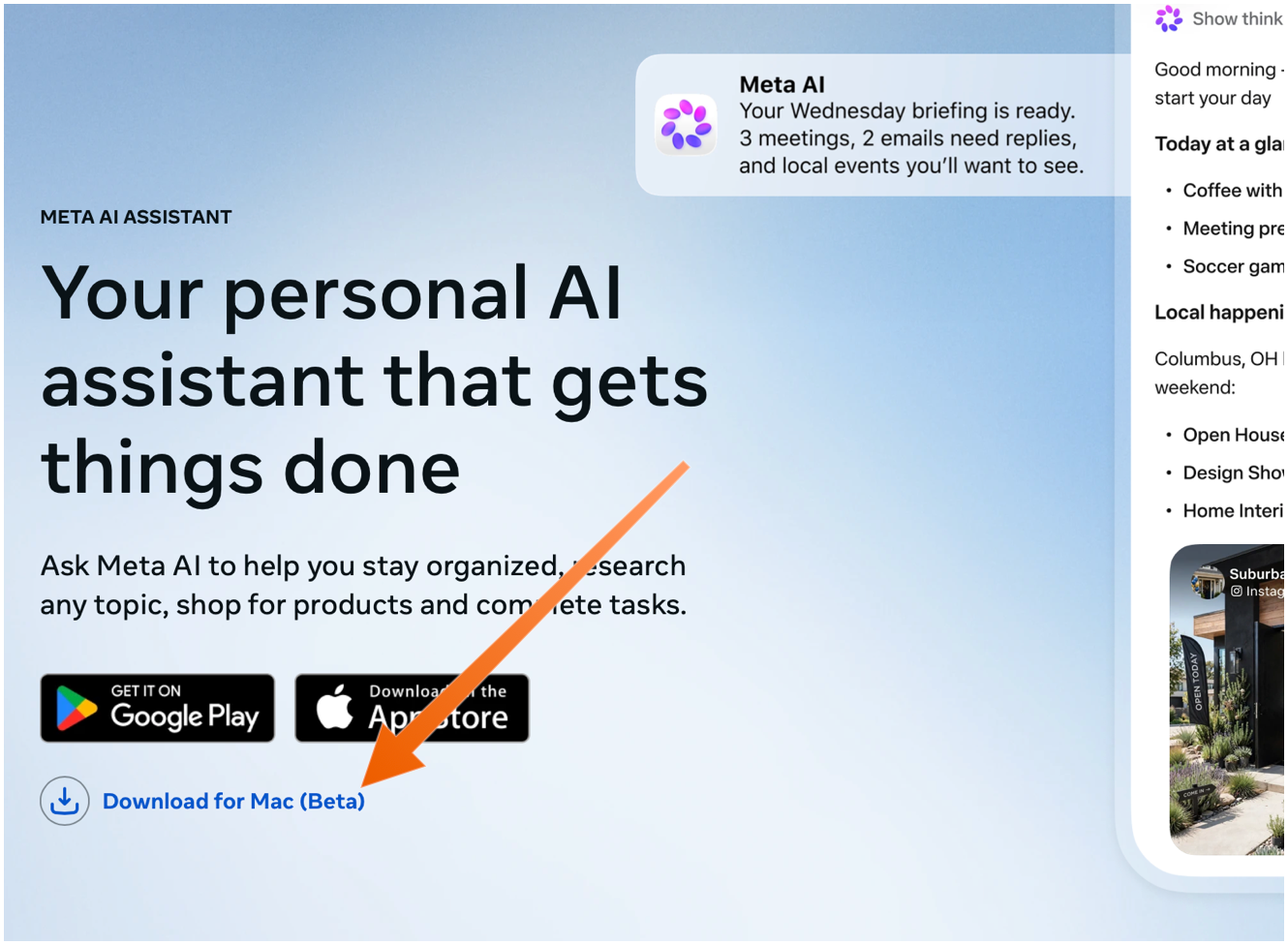
The Mac app is not available in the App Store. You need to download it directly from Meta’s web page, using the “Download for Mac (Beta)” link. The ChatGPT and Claude Mac apps aren’t in the Mac App Store either — they do too many things outside the App Store’s mandatory sandbox (and probably use APIs require that special entitlements in the App Store too).

Sarah Perez:

Meta’s new AI assistant app, Muse, is now available on Mac.

On the Mac, Muse can interact with your files, messages, calendar, notes, and mail, all within their native applications.

Terrence O’Brien:

Jason Aten, a contributing editor at Inc Magazine, posted on Threads screenshots of an interaction he had with Muse in which the assistant asks him some questions about a conversation he was having in Messages.

The problem is that Aten says he didn’t give Muse access to his messages. When asked how it knew about the contents of his messages, Muse replied, “I saw the notification previews, not your message history. I haven’t been reading your texts.” Aten continued to push, asking how Muse was receiving message previews, it didn’t have a good answer.

M.G. Siegler:

The number one response I’ve gotten to my thoughts on Meta’s Muse personal assistant agent is some variation of “I will never trust Meta with my data.” But the number two response is arguably more interesting (and related): “Why didn’t Google build this?”

Pieter Arntz:

Mac security researcher Patrick Wardle says it’s trivial to turn Muse into “the ultimate backdoor.”

[…]

According to Ars Technica, Wardle found that a locally running application or terminal command could alter an undocumented Muse configuration setting that controls the server used for dictation transcription. By redirecting dictation traffic to an attacker-controlled server, an attacker could capture voice prompts and obtain the authentication token for the victim’s Muse account.

John Gruber:

Four days later and Muse still holds the #1 spot in the U.S. iOS App Store.

See also: Joanna Stern.

Alexandr Wang (Watts Martin, John Gruber):

Here’s the best part: we have no idea what people will want. The world until now has been shaped by the small number of fanatics who have somehow found a way to make their wants real. But we’ve never seen humanity with every single person’s agency fully switched on. Eight billion people who just need to write their dream down in order to get started making it happen.

So we built Muse to help people build the world they want.

Damien P. Williams:

So uhhhhhh… Apparently meta’s muse “AI” is just straight up doxxing people to strangers on FB marketplace???

Via Mike Masnick:

Almost all of Meta’s PR about Muse was about how careful they had been to set it up not to do things like this, how they delayed the launch by months to carefully design it so it could be trusted. And then…

Previously:

Quais são as diferenças entre a Apple TV 4K de quarta geração e o modelo anterior?

20 October 2026 at 22:35

A Apple lançou na semana passada, após anos de espera, uma nova Apple TV 4K — mais precisamente, a quarta geração do produto.

Abaixo, vamos conferir como a nova Apple TV 4K se compara ao modelo anterior, de terceira geração, lançado em 2022.

Design

De relance, ambos os modelos têm virtualmente o mesmo visual, formato e cor. Para não dizer que absolutamente nada mudou, a luz indicadora de status branca está agora centralizada na parte frontal da nova Apple TV 4K.

Parte frontal da Apple TV 4K (4ª geração)
Divulgação/Apple

Na ponta do lápis, o modelo mais recente tem algumas ligeiras mudanças nas dimensões.

DimensõesApple TV 4K (quarta geração)Apple TV 4K (terceira geração)
Altura31mm31mm
Largura93,24mm93mm
Espessura93,24mm93mm
Peso217 gramasModelo Wi-Fi: 208 gramas
Modelo Wi-Fi + Ethernet: 214 gramas

Já o Siri Remote que acompanha ambos os modelos tem as mesmas dimensões (136mm de altura, 35mm de largura e 9,25mm de espessura), com exceção do peso: 69,6g na versão mais recente e 66g na anterior.

Especificações

Uma das principais mudanças é, naturalmente, um novo chip. A nova Apple TV 4K conta com o A19, o mesmo que estreou nos iPhones 17 no ano passado. A Apple TV 4K de terceira geração, por sua vez, trazia o chip A15 Bionic, lançado em 2021.

A Apple afirma que o novo chip “oferece desempenho de CPU 1Central processing unit, ou unidade central de processamento. até 50% mais rápido e de GPU 2Graphics processing unit, ou unidade de processamento gráfico. até 2x mais rápido”, o que resulta em “maior responsividade, navegação mais ágil e animações mais fluidas”. O A19 também inclui um novo decodificador AV1 dedicado, que possibilita “streaming de alta qualidade e maior eficiência, consumindo menos largura de banda”.

Divulgação/Apple

Em matéria de armazenamento, enquanto a Apple TV antiga possuía opções de 64GB (modelo Wi-Fi) e 128GB (modelo Wi-Fi + Ethernet), a nova Apple TV 4K vem apenas com 128GB — a versão de 64GB, portanto, saiu de cena.

Ademais, com relação à memória, a nova Apple TV 4K tem 8GB, ante os 4GB no modelo anterior.

Recursos

Entre os recursos, o destaque vai para a Siri AI, que permitirá funções como “compreensão de contexto pessoal, amplo conhecimento geral e a capacidade de realizar ainda mais ações em aplicativos em todo o sistema”.

Embora a Siri AI estreie na nova Apple TV 4K, ela também chegará aos modelos de segunda e terceira gerações. Ainda assim, é de se esperar que a assistente tenha uma resposta mais rápida no hardware mais recente com o chip A19.

Divulgação/Apple

Uma melhoria exclusiva da Apple TV 4K de quarta geração é a inclusão de um conjunto de três microfones com isolamento de voz integrado ao próprio aparelho, o que permite interações sem o uso das mãos, como chamar a assistente dizendo “Siri” ou “E aí, Siri”, sem a necessidade de ter o controle remoto por perto.

Além disso, se você tem vários HomePods em casa ou planeja investir bastante no ecossistema de casa inteligente da Apple, a Apple TV 4K de quarta geração traz um novo recurso de som surround.

Divulgação/Apple

Com o HomePod mini 2 ou o HomePod de segunda geração, a Apple TV 4K permitirá uma experiência de som surround com quatro alto-falantes. Segundo a Apple, “os quatro alto-falantes trabalham em conjunto com a Apple TV 4K para reconhecer de forma inteligente suas posições no ambiente, permitindo que o timing e os níveis de áudio sejam calibrados automaticamente para o espaço”.

Siri Remote

Embora o Siri Remote não tenha sofrido mudanças externas, como vimos acima, ele foi atualizado para funcionar com o recurso Buscar (Find My) com a Busca Precisa (Precision Finding).

Com isso, ao perder o Siri Remote, você poderá receber orientações passo a passo para chegar até ele. Ademais, graças a um novo alto-falante integrado, você pode até reproduzir um som no controle para ajudar a encontrá-lo.

Divulgação/Apple

Ainda que venha com a Apple TV 4K de quarta geração, o novo Siri Remote é compatível com modelos mais antigos da set-top box.

Conectividade

No que diz respeito à conectividade sem fio, a Apple TV 4K de quarta geração tem suporte a Wi-Fi 7 (uma evolução em relação ao Wi-Fi 6 do modelo anterior), Bluetooth 6 (ante o Bluetooth 5.0) e Thread (anteriormente limitado ao modelo de 128GB).

Acredita-se que essas atualizações decorram da inclusão do chip sem fio N1, da Apple, embora isso não tenha sido confirmado oficialmente.

Além disso, a porta Gigabit Ethernet agora vem de fábrica na Apple TV 4K de quarta geração. Anteriormente, a porta não estava presente no modelo básico de 64GB.

Preço

Talvez uma das diferenças mais pertinentes entre o novo modelo e seu antecessor seja o preço: no Brasil, a nova Apple TV 4K custa R$3.600 (US$300 nos Estados Unidos e 350€ em Portugal).

Trata-se de um aumento considerável ao levar em conta que o modelo anterior partia de R$2.500 no Brasil (US$200 nos EUA e 170€ em Portugal).

Já disponível em pré-venda (exceto no Brasil, pois ainda precisa ser homologada pela Anatel), a Apple TV 4K chegará às lojas em 13 de novembro.

Apple TV 4K (3ª geração)

Apple TV 4K (3ª geração)

Armazenamento: 64GB ou 128GB
Conectividade: Wi-Fi ou Wi-Fi + Ethernet
R$ 2.735,25

NOTA DE TRANSPARÊNCIA: O MacMagazine recebe uma pequena comissão sobre vendas concluídas por meio de links deste post, mas você, como consumidor, não paga nada a mais pelos produtos/serviços ao usar os nossos links de afiliado.

Notas de rodapé

  • 1
    Central processing unit, ou unidade central de processamento.
  • 2
    Graphics processing unit, ou unidade de processamento gráfico.

❌