NASA’s Freedom 250 F-5 team, including NASA Administrator Jared Isaacman, performs a flyover during the national anthem at an NFL game between the Cleveland Browns and the Carolina Panthers at Huntington Bank Field, Sept. 27, 2026, in Cleveland.
NASA/Jordan Cochran
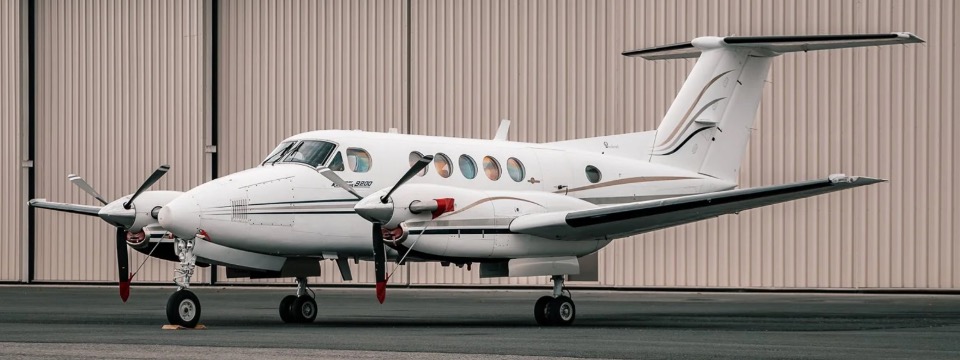
As part of the agency’s Inspiration Tour, NASA will conduct a flyover at the University of Alabama vs. Texas A&M football game in Tuscaloosa, Alabama, on Saturday, Oct. 24. NASA Administrator Jared Isaacman will pilot one of three F-5 fighter jets during the flyover, highlighting NASA’s contributions to aeronautics and the agency’s continued commitment to advancing aviation technologies.
Ahead of the game, members of the news media are invited to visit the NASA Experience Zone on Champions Lane, where Isaacman will participate in a media opportunity at 11 a.m. CDT. Media interested in attending should confirm their attendance by 12 p.m. Friday, Oct. 23, with Lance D. Davis at lance.d.davis@nasa.gov to receive additional details and instructions.
Supported by NASA’s Marshall Space Flight Center in Huntsville, Alabama, the NASA Experience Zone will be open to the public from 10:30 a.m. to 2:30 p.m. CDT, with no game ticket required. The experience will give visitors an opportunity to meet NASA team members and learn more about the people and technologies advancing the agency’s missions in aeronautics and space exploration.
Attendees can engage with NASA team members and explore exhibits highlighting the agency’s Artemis campaign and efforts to return astronauts to the Moon, including:
An inflatable SLS (Space Launch System) rocket.
Displays featuring the Starship and Blue Moon human landing systems.
Information about NASA internship opportunities.
Photo opportunities featuring NASA exhibits and displays.
With stops across the nation, NASA’s Inspiration Tour convenes academic, industry, and public sector stakeholders to connect the agency with the people, technologies, and organizations that drive American leadership in space.
The tour will culminate in MAX POWER, a public exposition of American air and space innovation, Saturday, Nov. 7, and Sunday, Nov. 8, on and near the agency’s Kennedy Space Center in Florida. Held in honor of America’s historic 250th anniversary, the multi-day, family-friendly event will showcase the next-generation aircraft, spacecraft, autonomous vehicles, and technologies that will help define the future of transportation in air and space.
For more information about MAX POWER and the agency’s missions, visit:
The start of the tween years, nine years old, is a sweet spot between curiosity and growing independence, making it a fun, though sometimes tricky, age to buy for.
Kids at this age are up for a challenge, whether that means trying a trickier craft set, playing a more complex game or stepping up their sporting interests. Pitch a gift right and you’ll not only get the whoop of joy when they first receive it, but something that will hold their interest and help them develop their skills, interests and hobbies over time.
SpaceX will soon notch a huge spaceflight milestone, if all goes according to plan.
The company will try to catch both stages of its Starship megarocket during the vehicle's next test flight, which is targeted for next month, founder and CEO Elon Musk announced during SpaceX's quarter 3 (Q3) earnings call today (Oct. 20).
If SpaceX succeeds, this "will be the first time that an orbital launch vehicle has been fully recovered," Musk said. "The only way that we can extend consciousness beyond Earth on a sustained basis is with a fully reusable orbital launch vehicle. So this is, I think, a profound technology milestone in the history of civilization and consciousness."
Artist's illustration of SpaceX catching the upper stage of its Starship megarocket, something the company expects to do on the vehicle's 15th test flight. (Image credit: SpaceX)
Starship is the biggest and most powerful rocket ever built, standing more than 400 feet (122 meters) tall when fully stacked.
As Musk noted, both of its stages — the Super Heavy booster and Ship spacecraft — are designed to be fully and rapidly reusable, a breakthrough that SpaceX thinks will make Mars settlement and other grand exploration feats economically feasible.
Starship's recovery strategy is different than that for SpaceX's Falcon 9 and Falcon Heavy rockets, which are partially reusable. (The latter two rockets have expendable upper stages). Falcon 9 and Falcon Heavy boosters come back to Earth on landing pads near the launch site or on ships at sea downrange. Super Heavy and Ship, however, will steer themselves directly back to their launch tower, which will capture each vehicle with its "chopstick" arms.
This will allow SpaceX to inspect, refurbish and refly Starship at an accelerated rate, which is a priority for the company: Musk has said he envisions launching Starship more than 10,000 times per year by 2030.
Starship has conducted 14 test flights to date, and SpaceX has pulled off chopstick catches with Super Heavy on three of them. The company has not yet tried to catch Ship, which is a more difficult proposition, as the upper stage travels higher, farther and faster than the booster does.
Still, Musk is confident that SpaceX will pull off a Ship catch on the first try. (He did not give a specific target date for Flight 15, saying only that it was expected next month.)
"I'd say it's more likely than not that this succeeds next flight," he said. "And if not, we have a steady stream of Starship flight attempts through the end of this year, and and then accelerating next year."
Success would mean back-to-back Starship flights with huge milestones. On Flight 14, which occurred on Sept. 28, Ship reached orbit for the first time ever. It also deployed 26 of SpaceX's Starlink Version 3 satellites — the first 26 members of a next-gen broadband constellation in low Earth orbit that will eventually consist of about 100,000 spacecraft.
The Starship Flight 15 preview was something of an aside during today's call. The event primarily served to announce SpaceX's financial performance during Q3, the three-month stretch that ended on Sept. 30.
And that performance was strong, company representatives said. SpaceX recorded revenues of $14.6 billion during Q3, an increase of 161% from the $5.6 billion earned during Q3 of 2025. The company had a net income of $4.4 billion during Q3, $5.5 billion better than the result from the same stretch last year, when SpaceX lost $1.1 billion.
Just $1.8 billion of 2026 Q3 revenue came from SpaceX's launch division. The vast majority was generated by two other segments — connectivity (services provided by its Starlink megaconstellation) and artificial intelligence (or, as the Trump administration has recently rebranded it, "superintelligence").
SpaceX thinks these latter two segments will continue to boom. That's why it's building the infrastructure to support thousands of Starship launches per year — to loft lots of Starlink satellites and AI data centers to Earth orbit. And the company believes that it's positioned to really start raking in the cash, starting as soon as next year.
"In a nutshell, what this implies for SpaceX annual recurring revenue by the end of '27 is somewhere between 500 billion [dollars] and a trillion," Musk said.
Editor’s Note: This article was originally published on Oct. 15, 2026, and has been updated to correct the location of the flights.
A NASA Dynamic Aviation A200 aircraft will conduct low-flying research flights over farmland near Amarillo, Texas, from Thursday, Oct. 22, through Monday, Nov. 9. These flights will measure gaseous and particulate emissions from animal feeding operations.
A photo of the Dynamic Aviation A200 aircraft, which will conduct low-flying research flights over farmland near Amarillo, Texas, to measure emissions in October and November 2026.
Dynamic Aviation
Agricultural emissions represent an important and understudied part of Earth’s land and atmosphere systems. The FarmFlux mission will deploy more than a dozen sensors to measure ozone, methane, ammonia, particulates, and other pollutants rising from crop lands and livestock farms and their interaction with the Earth’s atmosphere. The mission is jointly led by NASA’s Goddard Space Flight Center in Greenbelt, Maryland; Colorado State University; and Boston University.
Additional low-altitude research flights with a NASA P-3 Orion aircraft are scheduled for the March to July 2027 growing season in the Midwest and California’s Central Valley with a focus on cropland.
For more information about the FarmFlux mission, visit:
SpaceX just launched its mysterious "Starfall" return capsule for the second time ever.
Starfall was one of 32 payloads on the company's Bandwagon-5 rideshare mission, which launched atop a Falcon 9 rocket at 7:04 a.m. EDT (1104 GMT) today (Oct. 20) from Cape Canaveral Space Force Station in Florida.
SpaceX has been relatively quiet about Starfall, which debuted this past June on a Falcon 9 launch from the Cape.
The payloads of SpaceX's Bandwagon-5 rideshare mission, seen in a prelaunch photo. The company's Starfall capsule sits at the very top of the stack. (Image credit: SpaceX)
That June 23 flight was a dedicated demonstration mission for Starfall, designed to show that the capsule can fly in a controlled fashion and survive the harrowing downward trip through Earth's atmosphere.
And those will be Starfall's main jobs. The vehicle "will enable affordable, routine access to the microgravity environment for scientific research and in-space manufacturing," SpaceX in a June 23 X post, one of the few public statements the company has made about Starfall.
Indeed, most of the details that we have about the capsule come from an environmental assessment that was published by the U.S. Federal Aviation Administration in May.
According to that document, the disk-shaped Starfall is roughly 2.5 feet (0.75 meters) tall and 10.2 feet (3.1 m) wide. It weighs about 4,600 pounds (2,100 kilograms) and can bring 2,200 pounds (1,000 kg) of payload back down to Earth.
Artist's illustration of a SpaceX Starfall capsule reentering Earth's atmosphere. (Image credit: SpaceX)
Starfall wasn't the only return capsule that went up on Bandwagon-5. Among the other 31 payloads on the flight was W-Series 7, the latest orbital "mini-factory" built and operated by the California company Varda Space Industries.
The W-Series capsules are designed to both host the production of valuable goods such as pharmaceuticals and bring them safely down to Earth, Varda has said.
The other payloads on Bandwagon-5 are a mix of "cubesats and microsats," according to SpaceX's mission description. Among the latter is Pelican-12, a sharp-eyed Earth-observation satellite built by the San Francisco company Planet.
The 32 payloads were deployed over a two-hour span beginning about 57 minutes after launch. Starfall will be the last to separate, releasing from the Falcon 9's upper stage two hours and 48 minutes post-liftoff.
The Falcon 9's first stage, meanwhile, came back to Earth as planned on Bandwagon-5. It touched down about nine minutes after launch, coming down in the Atlantic Ocean atop the SpaceX drone ship "A Shortfall of Gravitas." It was the 19th mission for this particular booster, according to the company.
(Image credit: SpaceX)
Bandwagon is one of two SpaceX rideshare programs. The other, known as Transporter, has been busier, flying 18 missions to date.
Japan's groundbreaking mission to Mars is officially underway, headed to the Red Planet's mysterious moons Phobos and Deimos for a historic sample-return attempt.
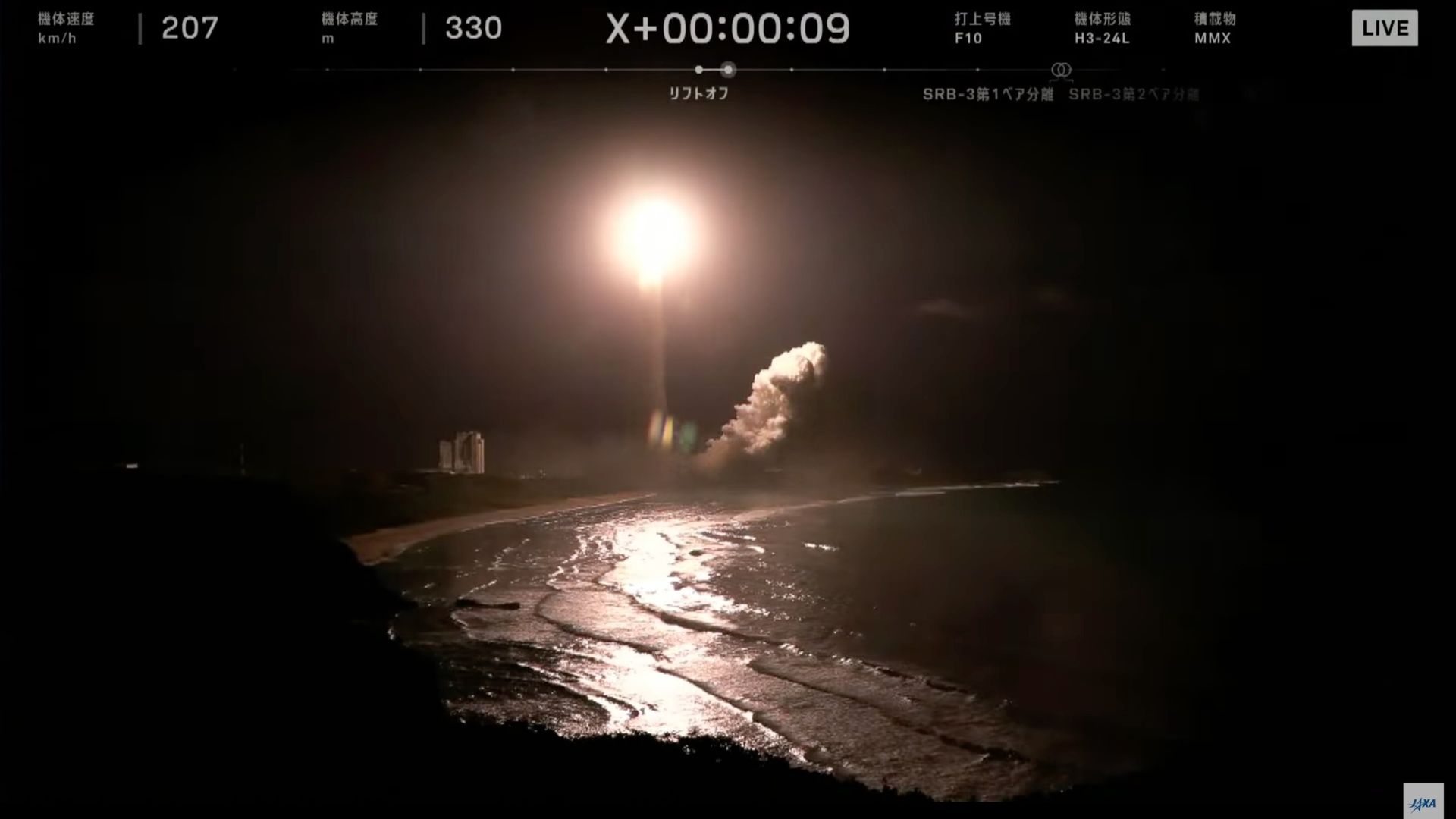
The Martian Moons eXploration (MMX) mission launched today (Oct. 19) from Tanegashima Space Center in Japan, riding an H3 rocket that lifted off from Pad-2 at Tanegashima's Yoshinobu Launch Complex at 3:41 p.m. EDT (1941 GMT; 4:41 a.m. local time in Japan on Oct. 20).
The JAXA (Japan Aerospace Exploration Agency)-led MMX mission is bound for Mars orbit, where it will study the planet's two moons, Phobos and Deimos. If everything goes according to plan, MMX will become the first spacecraft to land on and return samples from Phobos for study back on Earth, which scientists think could shed light on a decades-old mystery about the moons' origins and reveal clues about the formation of the early solar system.
a rocket launches into a night sky from a seaside pad (Image credit: JAXA)
It was the 10th liftoff of Japan's expendable, two-stage H3 rocket, which was jointly developed by JAXA and Mitsubishi Heavy Industries. After clearing its launch pad today, the 207-foot-tall (63 meters) launch vehicle flew a nominal trajectory through its ascent corridor over the Pacific Ocean, jettisoning its four solid boosters in pairs just before the flight clock reached two minutes. The rocket shed its payload fairings about one minute and 20 seconds later, exposing MMX to the vacuum of space for the first time.
H3's first stage, powered by two LE-9 rocket engines, channels a mixture of liquid hydrogen and liquid oxygen to produce a combined thrust of 331,000 pounds (1,471 kN), according to Mitsubishi Heavy Industries. As the mission clock approached T+5 minutes, H3 executed its main engine cutoff procedure and separated from the second stage, which ignited its engines for a 5.5-minute burn about 10 seconds later.
All continued to go to plan after that. The H3's upper stage ignited its engine for a second time for a trans-Mars injection burn about one hour and four minutes after liftoff, a maneuver that lasted roughly six minutes and 25 seconds and took MMX to a maximum velocity of about 24,145 mph (38,858 kph).
MMX was released from the rocket's upper stage right on schedule, about one minute after the completion of that burn and roughly 71 minutes after liftoff. The success elicited loud cheers in mission control, which viewers saw and heard on JAXA's launch webcast.
MMX is now under its own power, and on course for Mars. The interplanetary transit will last about 10 months, with the spacecraft scheduled to arrive at the Red Planet in August 2027. When it does, MMX's propulsion module will execute an orbital insertion burn to place itself in a quasi-satellite orbit (QSO) around Phobos, which places MMX within the space around the moon as both circle Mars.
MMX will spend about three years in the Martian system, devoting much of that time to studying the 14-mile-wide (22 km) Phobos with its science instruments. The spacecraft also carries the IDEFIX rover, a joint effort of the space agencies of France and Germany, which is scheduled to deploy to the surface of Phobos in late 2028 or early 2029.
After a mapping campaign to select suitable landing sites, MMX will perform two separate touchdowns on Phobos to collect and stow samples in the spacecraft's return capsule. Following its second landing and sample collection, MMX will briefly return to QSO with Phobos before transferring to a more elongated orbit around Mars that intersects with the planet's smaller moon, Deimos, which is just 8 miles (14 km) in diameter.
During the last several months of its time around Mars, MMX will perform a series of Deimos flybys before departing for Earth in November 2030. If all goes according to plan, the MMX sample-return capsule will land in Australia in 2031.
Scientists are counting on those samples, and other data collected during MMX's time around Mars, to answer a decades-old question surrounding the Martian moons' origins. Competing theories and conflicting evidence point to two possibilities for how Mars got its moons.
Their near-circular, equatorial orbits suggest a narrative similar to how Earth's moon is thought to have formed — as a result of a massive planetary impact between Mars and some other giant space rock, which broke off pieces of the planet that eventually coalesced to form the natural satellites that orbit there today.
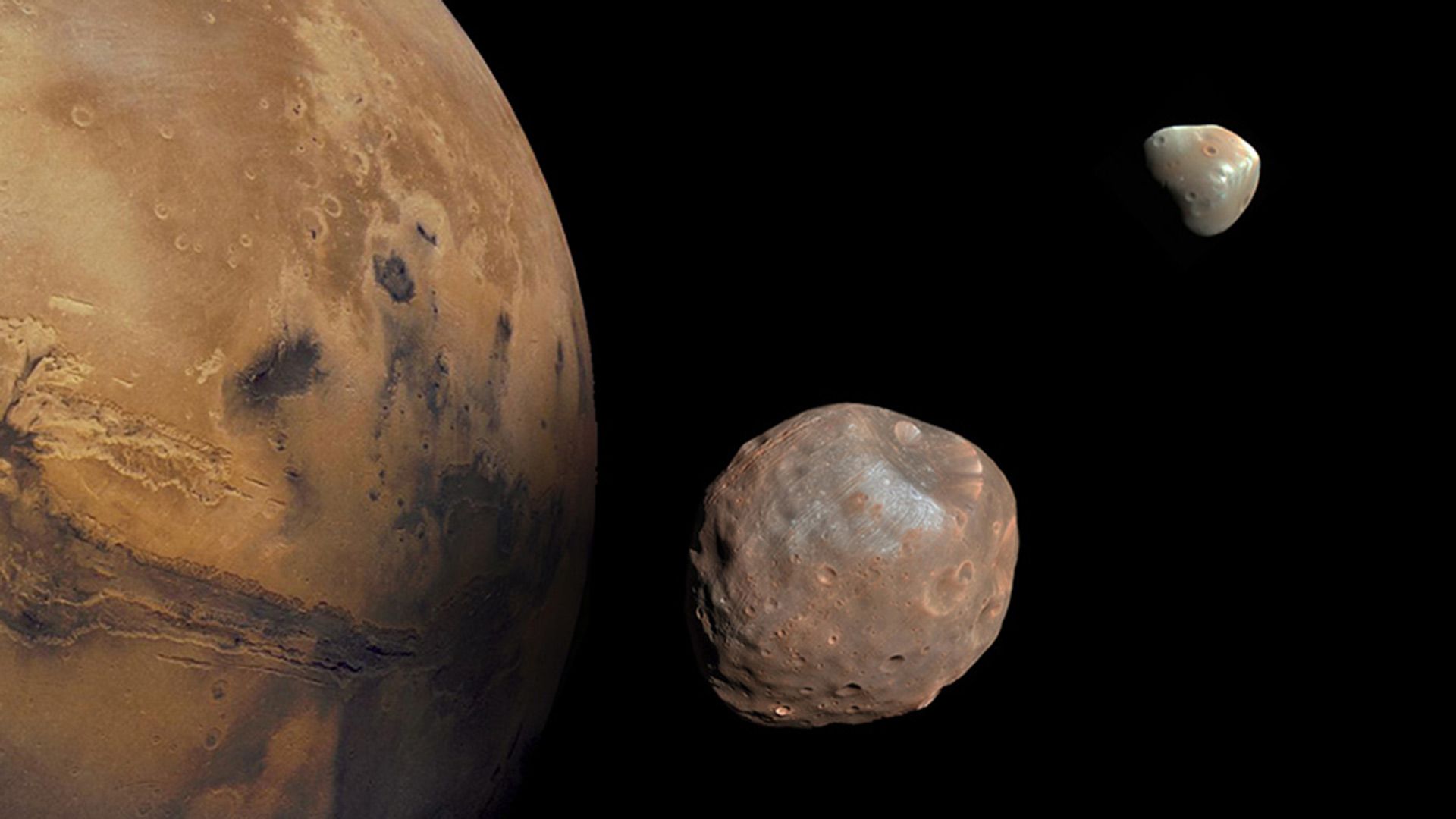
A composite image with Mars and its two moons, Phobos and Deimos. (Image credit: NASA/JPL/University of Arizona)
Neither Phobos nor Deimos is spherical, isntead; both are oblong and lumpy, like potatoes. That fact — along with their chemical composition, as far as we have been able to tell using telescopic spectroscopy — point to the possibility that Phobos and Deimos were asteroids from the early solar system that were captured by Mars' gravitational pull. Figuring out the moons' true origin story would provide key clues about Mars' geological past, the solar system's early history and the formation of the inner planets, mission team members have said.
Once the MMX samples are safely returned to Earth, scientists will study their composition and mineralogy, then compare such chemical fingerprints with those of Martian rocks and asteroid material. These analyses, combined with data collected by MMX during its mission, will help nail down the origin of Phobos — and by extension, Deimos. — by
While JAXA leads MMX, the mission is an international effort, with interagency partnerships between JAXA, NASA and the European Space Agency (ESA), as well as U.S. and European companies, which supplied a handful of the spacecraft's scientific hardware and communications equipment.
NASA's contributions to MMX include the Mars-moon Exploration with Gamma rays and Neutrons (MEGANE, pronounced "meh-gah-nay") device, which is a gamma-ray and neutron spectrometer built by the Johns Hopkins Applied Physics Laboratory (APL); a Honeybee Robotics-built pneumatic sampler; and communications support using the agency's Deep Space Network.
NASA has also invested approximately $87 million through the end of the mission, which includes funding for United States scientists and astromaterials experts on the MMX team. The agency is getting something concrete for such contributions: At least 15% of the planned 10-gram (0.35 ounces) returned Phobos sample will be reserved for NASA's study. Those materials will be transferred and maintained at the agency's Johnson Space Center in Houston for analysis and long-term preservation.
MMX is not the first Phobos sample-return project to take flight, by the way. That distinction goes to Russia's Phobos-Grunt ("Phobos-Soil") mission, which launched in November 2011 but failed to get out of Earth orbit due to a rocket glitch. The 14.5-ton spacecraft eventually crashed back to Earth over the Pacific Ocean in January 2012.
Editor's note: This story was updated at 5 p.m. ET on Oct. 19 with news of MMX's successful separation from the H3 rocket's upper stage.
Can AI-powered vibe coding challenge established software companies? Photocraft and other Adobe application clones spark a discussion of their capabilities, legal questions, and the possibility of creating customized software. A live download offers a closer look at the applications. The conversation also explores the Swift Angels developer meetup, LinkedIn’s growing importance for professional networking, and generational differences in technology.
PC; Origame Digital This odd but absorbing adventure sends you waddling across Antarctica in search of an eldritch entity – uncovering a world far stranger than it first appears
A Nazi kneels down on frozen snow, staring at an endless Antarctic horizon. Another holds a gun to his head, ready to end his own life. I direct a small waddling penguin up to them, trying to imagine what it could be thinking. Dismay, perhaps. Likely bewilderment. But then a faint smile seems to break out across its beaky face, as if amused by these silly humans and their misguided belief that they could ever best this howling, harsh landscape.
For most games, the idea of playing as a penguin observing Nazis losing the plot near the south pole would be weird enough. But Penguin Colony, developed by Origame Digital, pushes further. This is an audacious, frequently brilliant retelling of HP Lovecraft’s 1936 novella At the Mountains of Madness, in which eldritch horrors are just as common as Nazis. Further weirdness abounds: the many collectibles scattered about this place are not shiny gold objects à la Super Mario or Sonic. Rather, they are words. So tottering about as a semiaquatic bird, you have a unique mission: collect human language.
Margaret Hamilton, a profoundly influential computer scientist best known for leading the software engineering team at MIT’s Instrumentation Lab during NASA’s Apollo program, died on Sep. 30. She was 90.
A computing pioneer who authored over 130 publications, Hamilton helped to establish software engineering as a dedicated discipline.
[…]
Moments before the Eagle module was set to land on the lunar surface, the onboard computer raised the alarm. It had detected a 1202 error: The computer was overloaded due to a fault in a hardware switch, and it was possible the system would not be able to handle the complex landing procedure.
But Hamilton and her team had engineered priority-driven software, able to shut down unnecessary background tasks in order to prioritize mission-critical tasks. Houston trusted Hamilton’s software and allowed the mission to proceed, and two men walked on the moon for the first time.
The following is an excerpt from a textbook called Fluency With Information Technology: Skills, Concepts, & Capabilities, 7th Edition ISBN 0-13-444872-3
At the time of publishing, the Wikipedia page for Margaret Hamilton has an important quote about the origin of the term “software engineering”. I was moved by this and wanted to add it to my /quotes page, but needed to verify the source of the quote. I was bothered that the source came from an interview given for an out-of-print textbook that as far as I can tell is unavailable to legally obtain. The interview is also not published in later editions of the book.
Fortunately, I was able to find the complete interview and I am publishing that excerpt here under fair use doctrine for educational, archival, and personal informational purposes only.
You’ve probably heard the famous story of how Lorenz kept a continuous simulation running on his LGP-30 computer, and of that fateful 1961 day when he realized that even small differences in starting values could lead to very different outcomes—a sensitivity to initial conditions that is a hallmark of chaos theory, along with strange attractors. You might not have known that it was Hamilton who was responsible for programming the LGP-30.
Computers were still a novelty at the time, and neither Lorenz nor Hamilton had any programming knowledge; they taught themselves. Per a 2019 Quanta article, Lorenz was amused by her unusual methods: For instance, she once bypassed the “clunky debugging process” by rolling the paper tape down the hallway and editing the binary code by hand with a pencil. “I’d poke holes for ones, and I’d cover up with Scotch tape the others,” she recalled.
The type systems provided by mainstream languages have grown vastly more sophisticated, but how much value does that complexity actually provide programmers in practice? I would like to make the case that it is somewhat less than one might think. While at times convenient, invariants can be captured in the type system using a small set of simple tools applied in principled fashion, and while fancy type systems may be convenient, they have misled many programmers by obscuring what is possible to model without built-in type system support. This talk aims to provide a simple shift in perspective, plus a set of concrete design principles, to make modeling invariants in types feel accessible to the working programmer without fancy language support.

 Login