 Login
SpaceX Stock Jumps 19% in Record Nasdaq Debut as Value Passes $2 Trillion
13 June 2026 at 22:31
SpaceX’s $2 Trillion Nasdaq Debut SpaceX shares jumped 19% in their Nasdaq debut on Friday, lifting the company’s


O Trump Phone não é o que parece e uma nova desmontagem da iFixit confirma o que muitos suspeitavam. Afinal, o smartphone é quase idêntico ao HTC U24 Pro, lançado em 2024.
The post Que segredos esconde o Trump Phone? Desmontagem confirma que não é tão novo (ou americano) quanto parece appeared first on Tek Notícias.

I turned off Siri on the Mac years ago and never looked back. Similarly, I found Apple Intelligence so fruitless I never engage with it. But the new Siri AI coming to macOS 27 Golden Gate has at least got me slightly rethinking things.
I'm still early in testing Siri AI, as I've only had access to it in the macOS 27 developer beta for little more than 24 hours. It's also in an early preview state on the dev beta, so there should be lots of runway for improvements before it releases later this year. I don't even know if it's done indexing my files and folders on our review unit M5 MacBook Air and M5 Max MacBook Pro. Unlike on the iOS 27 dev …
The most popular camera in the world just got its first set of serious AI photo editing features, and I don't think any of us are ready.
As far as AI photo editing goes, the new features in iOS 27 are pretty tame compared to what you can do on, say, Google's Pixel phones. But for the iPhone, they represent a tipping point in what the native photos app allows you to do to your photos. I mean memories. I mean, I don't know anymore.
These new features are part of the iOS 27 developer beta right now, so bear in mind that Apple may continue making tweaks to them before they're released to the general public. There are three, or maybe two and a …
Dark matter remains one of the biggest mysteries in science. Scientists cannot see it directly, yet they believe it makes up most of the matter in the universe. Now, a new study suggests that dark matter may gather around supermassive black holes, forming large invisible clouds that influence their surroundings. Researchers from Virginia Tech have […]
The post Scientists use light echoes to hunt dark matter around giant black holes appeared first on Knowridge Science Report.
For all the noise that's been made about how generative AI is poised to revolutionize the filmmaking industry, there haven't really been any projects created with the technology that felt like the sort of entertainment people would pay to see. Most AI firms' video models are still only capable of churning out short bursts of visually inconsistent footage. And some of Hollywood's biggest AI partnerships have suddenly evaporated in ways that make it seem like studios might not be able to rely on the new technology coming out of Silicon Valley. For the most part, short-form video slop appears to be the only thing that major production houses ar …
Astronomers using NASA’s powerful James Webb Space Telescope may have solved one of the biggest mysteries of the early universe. A strange object known as a “little red dot” appears to be a rapidly growing supermassive black hole hidden inside a thick cloud of gas. Little red dots were first discovered by the James Webb […]
The post Mysterious “little red dot” may be a giant black hole wrapped in gas appeared first on Knowridge Science Report.
Extremely powerful large language models (LLMs) still operate as though they’re typing on a keyboard, processing workloads in a simple left-to-right fashion. But in locally-run, single-user scenarios, this sequential processing can leave graphics processing units (GPUs) and tensor processing units (TPUs) underutilized.
Google is betting that DiffusionGemma can get around this bottleneck. The new experimental open model generates text “exceptionally fast,” creating entire blocks of text simultaneously through diffusion techniques rather than through token-by-token processing. The company says this technique results in 4x faster inference compared to auto-regressive models that rely on sequential processing.
It can also save users money. Technology analyst Carmi Levy noted that existing pay-per-token monetization models “penalize the use of less than optimally efficient AI solutions.”
But DiffusionGemma “could herald a new generation of task-defined, efficient solutions that can enable expanded compute capacity without draining the operations budget,” he said.
Built on Google’s Gemma 4 family and its Gemini Diffusion research, DiffusionGemma is a 26B mixture-of-experts (MoE) model designed to maximize text output generation.
It essentially shifts how models use hardware, giving processors a larger hunk of work each cycle so it can draft full 256-token paragraphs in sequence. This allows the model to generate text up to 4x faster on GPUs, Google claims. It activates only 3.8B parameters during inference, and, when quantized, can fit within 18GB VRAM on high-end consumer GPUs like Nvidia RTX 5090.
“It upgrades your model inference from a single, sequential typewriter to a massive printing press that stamps the entire block of text simultaneously,” Google research scientists Brendan O’Donoghue and Sebastian Flennerhag wrote in a blog post.
AI image generators begin with pure, random ‘visual noise’ and iteratively refine that into a finalized picture (what’s known as ‘diffusion’); DiffusionGemma applies this same process to text. It does not generate tokens in order, but begins with a “canvas of random placeholder tokens” that it processes in multiple passes, identifying the context tokens it feels are most relevant and using those to refine the rest.
The model has the ability to self-correct, using confidence scoring to re-evaluate tokens in the next pass. “The model iteratively refines its own output, allowing it to evaluate the entire text block at once to fix mistakes in real-time,” O’Donoghue and Flennerhag explained.
DiffusionGemma also has bidirectional attention, they wrote. “Generating 256 tokens in parallel with each forward pass allows every token to attend to all others.” This can be particularly helpful in domains that are non-linear in nature, such as mathematical graphs, code infilling, and in-line editing, they said.
DiffusionGemma is optimized across Nvidia’s hardware stack, making it compatible with consumer setups as well as with high-performance enterprise systems like Hopper and Blackwell.
Because it is released under the Apache 2.0 license, developers can freely use, modify, distribute, and commercialize the software using their preferred tools. It can be run on GPUs or in the cloud through Google Cloud Model Garden or Nvidia NIM, and is available on Hugging Face, GitHub, and vLLM, with support for the open-source library llama.cpp coming soon.
The model is particularly useful in local workflows that are “speed critical,” such as generation of non-linear text structures, and unlocks what Google calls “new patterns of model behavior” like multimodal understanding and generating and rendering code in near real-time.
Levy explained, “DiffusionGemma is particularly well suited for interactive coding and editing where its efficiency allows rapid processing and iterations,” noting that its ability to fit within 18GB of VRAM and its deployability on commonly available local GPUs can potentially benefit customer service-related workloads that lean heavily on real-time interaction and local processing.
“DiffusionGemma also incorporates a thinking mode that is especially adept at problem solving,” he said. For instance, the model was fine-tuned to play Sudoku, a typically challenging task for autoregressive models because each token depends on future tokens. This “rather handily” illustrates the model’s capability to solve more complex problems, Levy noted.
Google freely admits that DiffusionGemma is geared to specific workflows, and there are “key trade-offs.”
The model is engineered for small batch size inferencing and low-latency, high-speed generation low-to-medium batch sizes on a “single capable accelerator.”
In high-QPS cloud serving environments, (where infrastructure is designed to handle tens or hundreds of thousands of requests per second with ultra-low latency), DiffusionGemma’s parallel coding “offers diminishing returns,” and can even result in higher serving costs, Google conceded. In addition, its overall output quality is lower than that of standard Gemma 4, which is built for apps demanding maximum quality.
However, Levy noted that while DiffusionGemma “can be less precise than other models in certain workloads,” subsequent refinement cycles could overcome this limitation.
While Google isn’t sharing runtime costs, it’s clear that this is an efficiency play, he added. “When deployed across the kinds of workloads that would optimally benefit from its architecture, DiffusionGemma seems to have the potential to reduce processing overhead and related costs,” he said.
This article originally appeared on InfoWorld.
Read more of this story at Slashdot.
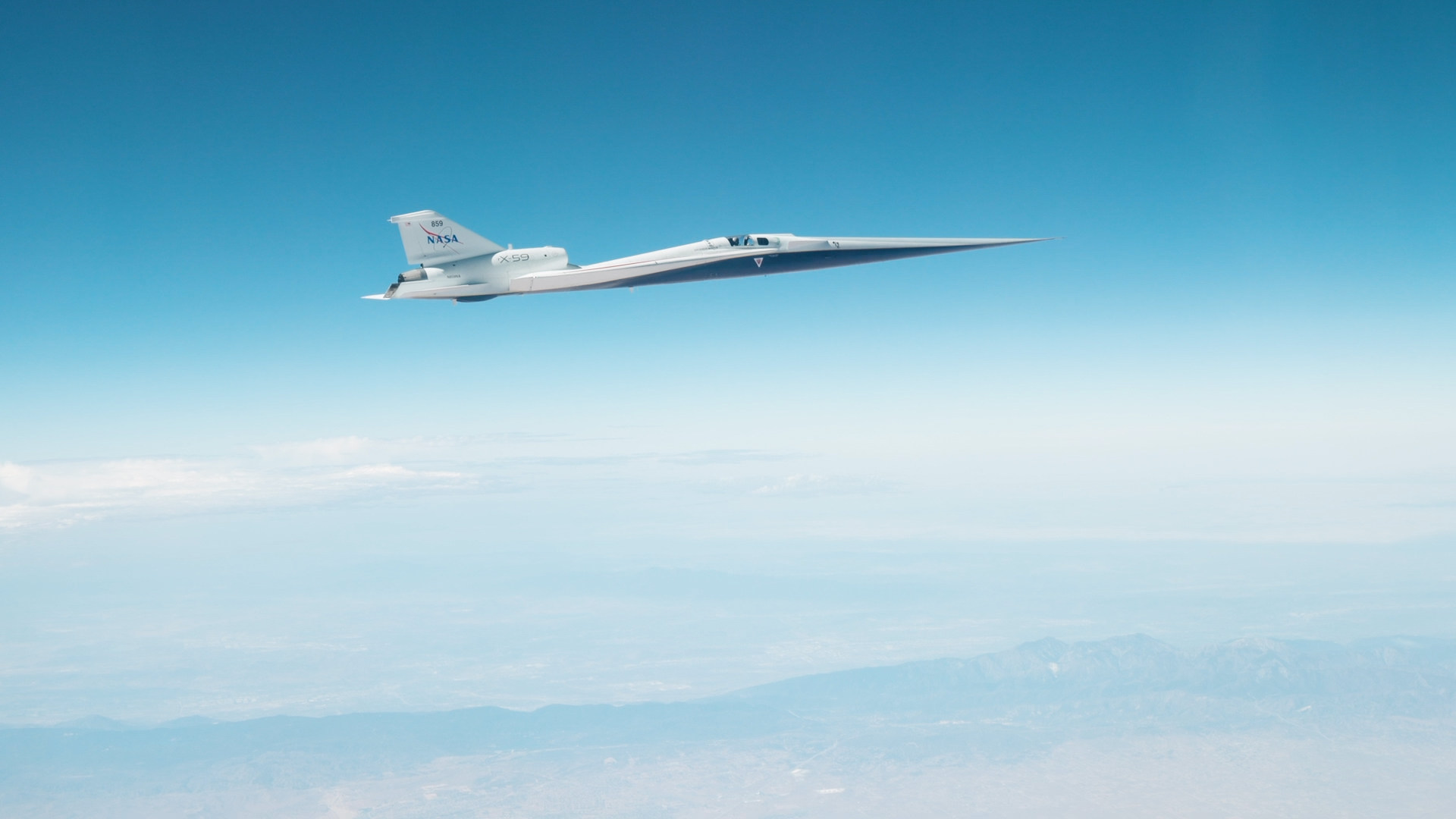
NASA’s X-59 experimental aircraft reached a major milestone Friday, June 12, flying Mach 1.4 (about 924 mph) and an altitude of 55,000 feet, the conditions required for the aircraft to make future flights critical to its mission.
The X-59 still has months of performance testing ahead, but after those are complete, NASA’s Quesst mission will fly the aircraft over several U.S. communities to collect data on public perception of the quiet sonic thump it will make at supersonic speeds. Those community overflights will include flights at Mach 1.4 and 55,000 feet.
The milestone comes just days after the X-59’s first supersonic flight. That flight showed the aircraft performed as expected at Mach 1.1, but Friday’s mission conditions flight was an even more critical step for NASA.
The aircraft’s team has steadily expanded the aircraft’s flight envelope by evaluating its performance at a variety of speeds and altitudes, and having its pilots take on a battery of maneuvers.

The X-59 was designed to fly supersonic without causing a loud sonic boom. However, for these early supersonic flights it has been accompanied by a NASA F-15 research aircraft, a traditional supersonic jet that causes booms obscuring any noise the X-59 makes. During upcoming flights, a shock-sensing probe mounted to the F-15 will gather measurements of the X-59’s shock wave signature, an early measure of its supersonic performance.
After the team conducts more tests at a variety of altitudes and conditions to complete envelope expansion, the X-59 will enter the acoustic validation phase of Quesst. During this phase, researchers will thoroughly measure the aircraft’s supersonic acoustic signature — the quiet thump it’s designed to make — to confirm it is performing as intended.
Each flight brings NASA one step closer to flying the X-59 over communities and gathering feedback that could help shape the future of commercial supersonic flight over land.

The post NASA’s X-59 Reaches Speed, Altitude for Future Quiet Supersonic Flights appeared first on NASA Science.
One of the world’s most active ransomware groups exploited a critical vulnerability in Oracle’s PeopleSoft software suite and used it to target about 100 customers and extort at least one of them to pay up in exchange for not leaking stolen data, researchers said.
The group, tracked as ShinyHunters, had been exploiting the PeopleSoft vulnerability for more than two weeks before Oracle flagged it. CVE-2026-35273, as the vulnerability is tracked, carries a severity rating of 9.8 out of 10, making the former zero-day one of the year’s most critical vulnerabilities to be exploited.
Google’s Mandiant security team said it’s an SSRF (server-side request forgery), a vulnerability that allows attackers to send requests from a susceptible server to systems used by the targeted organization. Oracle said the SSRF is remotely exploitable, and the company has issued a stopgap mitigation but has yet to fully patch the flaw. Google has confirmed that victims are receiving extortion demands.
© Mesut Dogan
