A meteorite discovered in Africa could be evidence of a lost protoplanet that once orbited our Sun, according to researchers at the University of Colorado at Boulder.
In a recent paper published in Earth and Planetary Science Letters, the team revealed evidence of an ancient protoplanet that may have been as large as Mars based on simulations of how the meteorite sample may have formed.
The four-and-a-half-billion-year-old world carried an unexpected geological makeup, which the researchers say casts doubt on common assumptions regarding planetary evolution.
Protoplanetary Demise
According to the UC Boulder team, the massive protoplanetary body collided with another object four and a half billion years ago, shattering it completely. This is the first definitive evidence of a lost protoplanet in our solar system, based on analysis of the angrite meteorite NWA 12774, a shard of that planetary embryo recovered from the Sahara Desert.
“It’s incredible to think there was once a world this large,” said lead author Aaron Bell, an assistant research professor in the Department of Earth Science at CU Boulder. “We only know it existed because a few fragments of it happened to land on Earth. These meteorites preserved evidence of a completely different pathway through which early planets developed.”
A Rare Meteorite Sample
Angrites, a rare type of volcanic rock, serve as a record of our solar system’s distant past. These rocks began forming only a few million years after the solar system’s birth, making them valuable evidence of this early era. However, they are extremely rare and difficult to find.
NWA 12774 is one of only 68 angrite samples identified among more than 80,000 meteorites cataloged by scientists. Given its rarity, the discovery could potentially reshape how researchers understand these ancient rocks.
Until now, scientists had assumed that angrites originated from relatively small asteroids less than 124 miles (200 kilometers) wide, based largely on their chemical composition. Large rocky planets such as Earth and Mars contain significant amounts of silicon dioxide, while angrites contain very little of the compound.
Unexpected Meteorite Discovery
Researchers began to reconsider those assumptions when they identified clinopyroxene in the meteorite sample. This mineral, commonly found in Earth’s crust and mantle, appeared unusually rich in aluminum, suggesting that it formed under significant pressure deep within a planetary body.
To investigate this unusual characteristic of NWA 12774, the University of Colorado Boulder team recreated the conditions under which the sample could have formed. Their analysis revealed that pressures of at least 17.5 kilobars were required to produce the aluminum-rich clinopyroxene found in the meteorite. For comparison, one kilobar is roughly equivalent to the pressure at the deepest part of Earth’s oceans, near the bottom of the Mariana Trench.
Rethinking Meteorite Origins
The researchers’ discovery proved that at least this particular angrite sample could not have formed inside a small meteorite, as a body with a radius of at least 621 miles would be required to generate the pressure needed to produce the crystals.
Additional evidence suggested the parent body may have been even larger. The crystals’ sharp edges and delicate internal structures indicate they likely formed at relatively shallow depths beneath the surface. Reconciling both the high-pressure conditions and the shallow formation depth suggests that the parent body may have ranged in size from the Moon to Mars.
“There are many meteorites sitting in drawers that haven’t been thoroughly studied, so there were likely more of these protoplanets we don’t know about,” Bell said.
Exactly what happened to this ancient world remains uncertain, but researchers believe it was likely destroyed in a massive collision early in the solar system’s history. Fragments of that lost protoplanet may have later contributed material to other bodies, potentially including Earth itself.
“The materials that formed the angrite parent body are fundamentally different from the ingredients of Earth and Mars,” Bell concluded. “It points to a distinct and separate evolutionary path in planetary formation in the early history of our solar system.”
Ryan Whalen covers science and technology for The Debrief. He holds an MA in History and a Master of Library and Information Science with a certificate in Data Science. He can be contacted at ryan@thedebrief.org, and follow him on Twitter @mdntwvlf.
Five leading scientists were ousted from the annual meeting of the American Diabetes Association (ADA) in New Orleans on Friday. Their crime: handing out copies of an editorial, published in the journal Diabetes Care on April 29, sharply criticizing the Trump administration's ongoing attacks on scientific research.
Those ousted were Steven Kahn, professor of medicine at the University of Washington and editor-in-chief of Diabetes Care, who co-authored the published editorial; former ADA President Desmond Schatz of the University of Florida, Gainesville; Aaron Kelly, pediatrics professor at the University of Minnesota; Justin Ryder of Northwestern University; and Irl Hirsch, also of the University of Washington. The five were handing out reprints of the editorial outside a room where NIH director Jay Bhattacharya had been scheduled to speak. Bhattacharya canceled and another NIH official spoke in his stead.
"They physically grabbed us, forced us out of the conference center, and now are telling us we can no longer attend this meeting," Kelly told MedPage Today, which first reported the incident. "They're taking our lanyards. It really has come to this in America. Censorship is real. America needs to stand up. Scientists, stand up. Physicians, stand up."
Researchers are replacing rigid silicon-based AI hardware with stretchable, neuromorphic electronics that mimic how the brain processes information, opening new possibilities for long-term human-machine integration. Modern artificial intelligence can outperform humans in tasks ranging from image recognition to medical data analysis, but there is one environment where today’s hardware still struggles: the human body. The [...]
Silphium was an extinct Libyan plant renowned for contraception, medicine, and trade. Its disappearance remains a historical mystery, and scientists continue searching for surviving descendants. Roman leader Julius Caesar is said to have kept a stock of it in the treasury. Ancient writer Pliny the Elder says Rome’s Emperor Nero owned the last stalk of [...]
Discovered in December 2024, the roughly 60-meter-wide asteroid 2024 YR4 was initially thought to have a slim chance of striking Earth in 2032. Further observations ruled out an Earth impact but left open the possibility of a Moon impact. New JWST observations show that 2024 YR4 will speed past both Earth and the Moon without a collision.
Another Update on 2024 YR4
In April 2025, we featured a Research Note that described March 2025 JWST observations of 2024 YR4 and characterized the asteroid’s size and albedo. At the close of that article, the authors suggested that further JWST observations in early 2026 could help to refine our understanding of the asteroid’s trajectory and determine whether it would strike the Moon.
On 18 and 26 February 2026, JWST carried out those critical observations. In this dataset, the asteroid is bright enough to be detected confidently, and the background is peppered with a sufficient number of reference stars — two factors necessary to determine the precise track of the asteroid as it zipped through space.
Trajectory Refinement
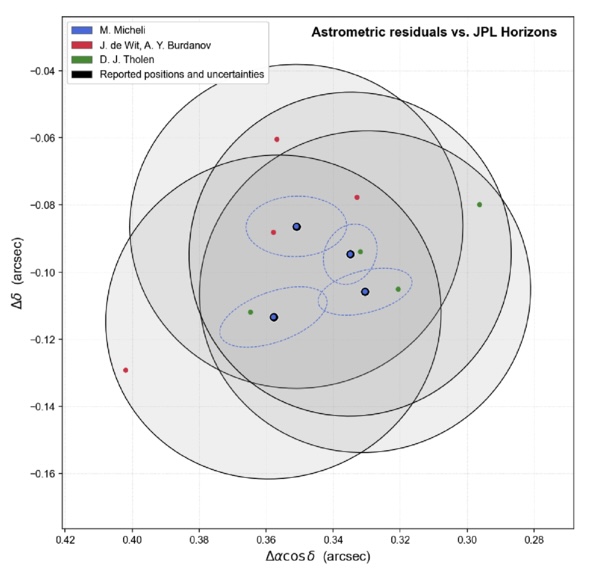
Difference between the position of 2024 YR4 determined in this work using three different reduction methods (red, blue, and green circles) and the position drawn from the existing orbit from the JPL Horizons database. The different analysis methods yielded consistent results. [Adapted from De Wit et al. 2026]
Julien de Wit (Massachusetts Institute of Technology) and collaborators analyzed the new JWST data and determined the asteroid’s position. The team used multiple methods to reduce the data and showed that their results were consistent regardless of the reduction method, ultimately yielding a measurement with an uncertainty of just 50 milliarcseconds. This is a huge improvement over the previous trajectory estimate, which had an uncertainty of 700 milliarcseconds.
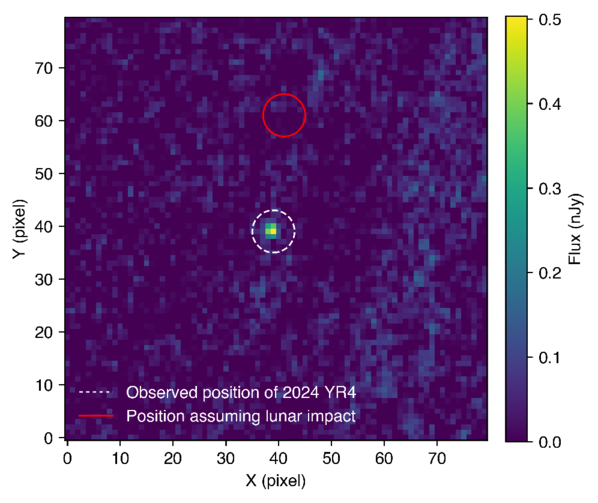
Combining the latest JWST observations with existing data stretching back to the asteroid’s discovery, de Wit and coauthors determined a new, highly precise orbit for the object — one that definitively shows that the asteroid will safely pass by the Moon at a distance of 22,900 ± 800 km in 2032. In addition to ruling out the upcoming lunar impact, the team also ruled out any collisions with Earth in the next 100 years. Phew!
Position of 2024 YR4 as seen by JWST in February 2026 (white dashed circle) compared to the asteroid’s location estimated from existing data (red circle). [De Wit et al. 2026]
High-Impact Science
This work highlights JWST’s potential as a tool for planetary defense. The February 2026 observations detailed here represent the faintest-ever detection of a near-Earth object, and JWST can detect objects far fainter than ground-based telescopes can. This ability allows JWST to observe potentially hazardous asteroids over a larger swath of their orbits, which translates to earlier trajectory estimation — JWST pinned down 2024 YR4’s orbit two years before the asteroid would have become bright enough for ground-based telescopes to do so.
JWST’s role may be even more important for smaller objects that rapidly become undetectable after discovery. De Wit’s team demonstrated this for a 10-meter-diameter 2024 YR4 clone on the same trajectory; for an object of this size, JWST would be able to rule out an Earth impact before the asteroid became undetectable, but ground-based telescopes could not. With surveys from facilities like Vera C. Rubin Observatory and Near-Earth Object Surveyor set to discover hundreds of thousands of new near-Earth objects, JWST’s role as a hazard assessor will likely be in high demand.
Citation
“JWST Observations of Asteroid 2024 YR4 Rule Out a 2032 Lunar Impact and Demonstrate a New Regime for Planetary Defense Follow-Up,” Julien de Wit et al 2026 ApJL1003 L21. doi:10.3847/2041-8213/ae6a95
The outer solar system is inhabited by swarms of small objects that are challenging to observe and characterize. When one of these objects travels in front of a star, from our perspective, the passage provides a brief chance to study these distant, icy denizens of our solar system. In a recent article, Estela Fernández-Valenzuela (University of Central Florida) and coauthors described how they predicted and observed stellar crossings by Weywot, the largest moon of the dwarf planet Quaoar, which lies roughly 44 au from the Sun. In the image above, the black dashed lines indicate the areas where Weywot was predicted to briefly blot out the light from a star, and the blue lines show the updated regions based on Hubble Space Telescope observations. In each panel, the green squares and red circles show where the occultation was and was not detected, respectively. There were five successful detections of Weywot’s passage across a star, allowing the team to constrain Weywot’s diameter to 116–172 km. The team also found that Weywot is much darker than the body it orbits, which has important implications for how the system formed. To learn more about the planning process for and results of these observations, be sure to check out the full research article linked below.
Citation
“Weywot, an Unusually Low-Albedo Satellite in the Trans-Neptunian Region,” Estela Fernández-Valenzuela et al 2026 ApJL1002 L37. doi:10.3847/2041-8213/ae6076
Motivated by a desire to support community members financially during the coronavirus pandemic, researchers employed 30 local citizen scientists in the Hubble Image Similarity Project. This project quantified the similarities between astronomical images, providing a way to test the results of image-search algorithms.
Say you have an image of a star-forming region, featuring eye-catching gas clouds, dense and dusty knots, and newborn stars. How would you go about finding other images that resemble yours?
You might start your search with an astronomical image database, using filters for object type or instrument to sift through thousands and thousands of options. But even filtering out everything but star-forming regions might yield vastly different results, given the widely varying shapes, colors, and sizes of these regions.
Or maybe you’ll feed your image into a neural network that has been trained to spot similar images. The results may seem promising, but how can you tell whether the algorithm has found the images that are the most similar? Would another algorithm do better?
The Hubble Image Similarity Project
Astronomical image collections rarely contain information about similarities between images in their metadata, and while neural networks appear to excel at gathering similar images, the results of these models are generally unverified. The Hubble Image Similarity Project, led by Richard White (Space Telescope Science Institute) and Josh Peek (Space Telescope Science Institute and Johns Hopkins University), addressed these issues with a team of citizen scientists who generated similarity information for astronomical images, providing a quantitative means to test the results of neural networks.
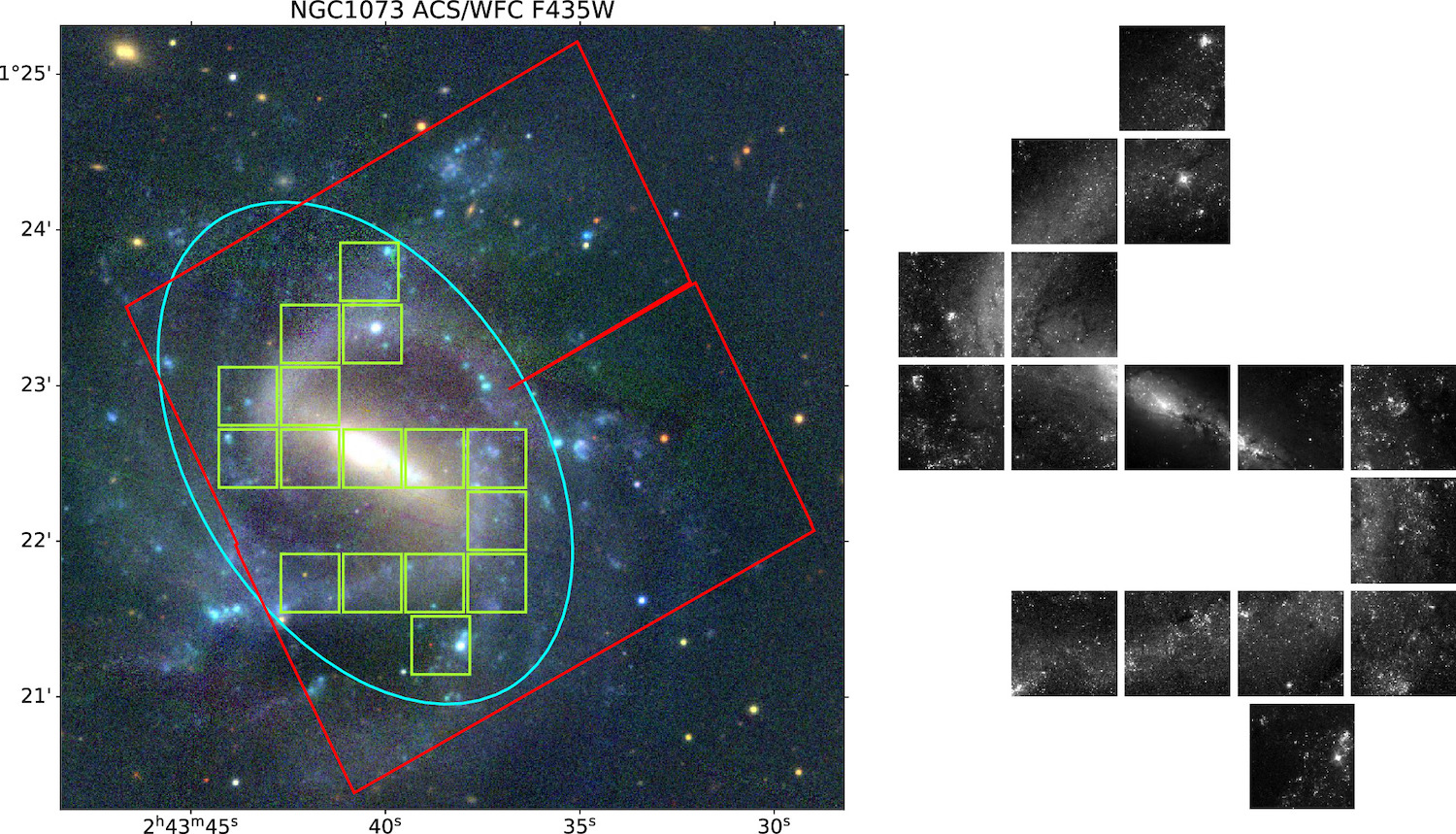
An example of individual test images (green squares) extracted from a Hubble Legacy Archive image (red square). Low-contrast areas have been excluded, leaving the galaxy’s spiral arms for analysis. Click to enlarge. [White & Peek 2025]
White and Peek began by amassing a sample of images from the Hubble Legacy Archive. This sample included many different object types, such as galaxies, planetary nebulae, star-forming regions, and star clusters. After trimming and binning the images, converting them to 8-bit grayscale, filtering out low-contrast images, and eliminating satellite trails, image artifacts, and repeated observations of the same patch of sky, 2,098 images of 666 objects remained.
Citizen Scientists, Assemble
White and Peek recruited 30 members of the community within walking distance of the Space Telescope Science Institute to identify similar astronomical images, and the reviewers were paid for their work. In the three phases of the project, reviewers considered test images one at a time and 1) selected all similar images from a set of 15 comparison images, 2) selected the most similar image from a narrowed-down set of 6 comparison images, and finally 3) selected the most similar image from a set of 3 comparison images.
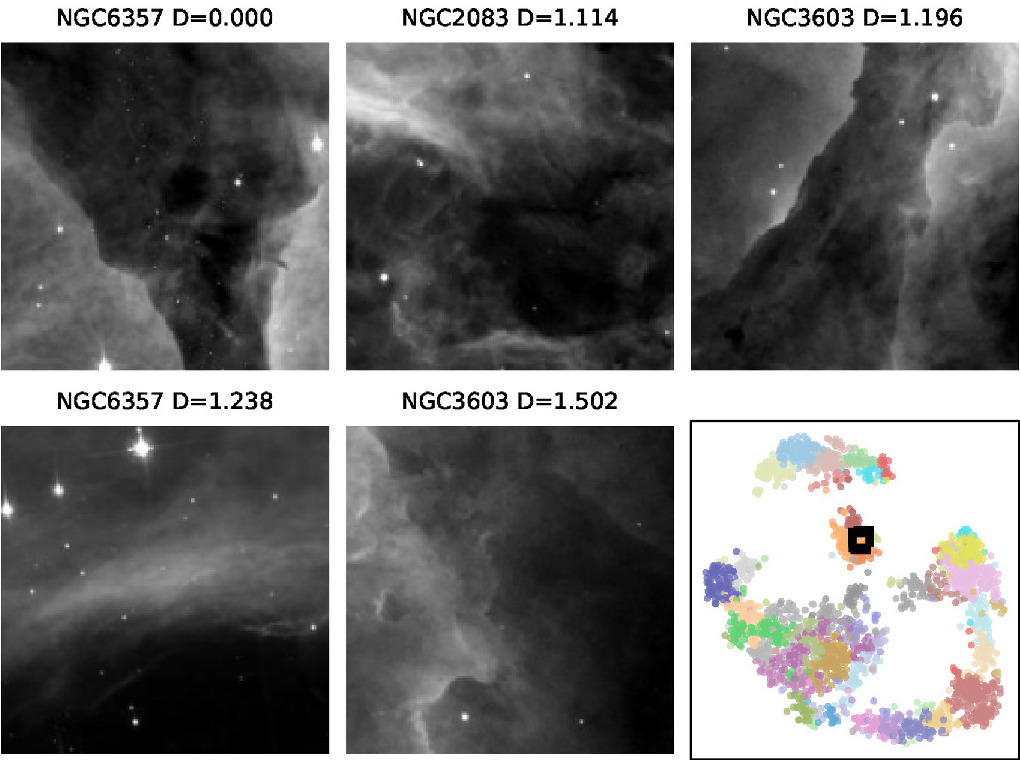
Examples of similar images according to the image similarity matrix. In the lower-right corner is a visualization of the similarity data. The semicircle of data points in the bottom half of this visualization represents galaxies, while star clusters occupy the small arc near the top and nebulae sit in the island in the center of the plot. Click to enlarge. [Adapted from White & Peek 2025]
The citizen science team ultimately compared 5.4 million pairs of images, and White and Peek used these comparisons to produce an image similarity matrix. The matrix describes the metaphorical “distance” between the images, with the most similar images being the smallest distance apart.
Similar images resemble one another in terms of structure, texture, and other factors that White and Peek say are “difficult even to describe in words” — for example, the diffuse glow of a galaxy interrupted by a bright star with diffraction spikes, or a nebula speckled with stars and dense dusty clumps. The similarity data from this study are available online and can be used to test the performance of image-search algorithms. In future work, the authors plan to carry out a similar project using images of the Martian landscape.
Citation
“The Hubble Image Similarity Project,” Richard L. White and J. E. G. Peek 2025 AJ169 306. doi:10.3847/1538-3881/adcb43
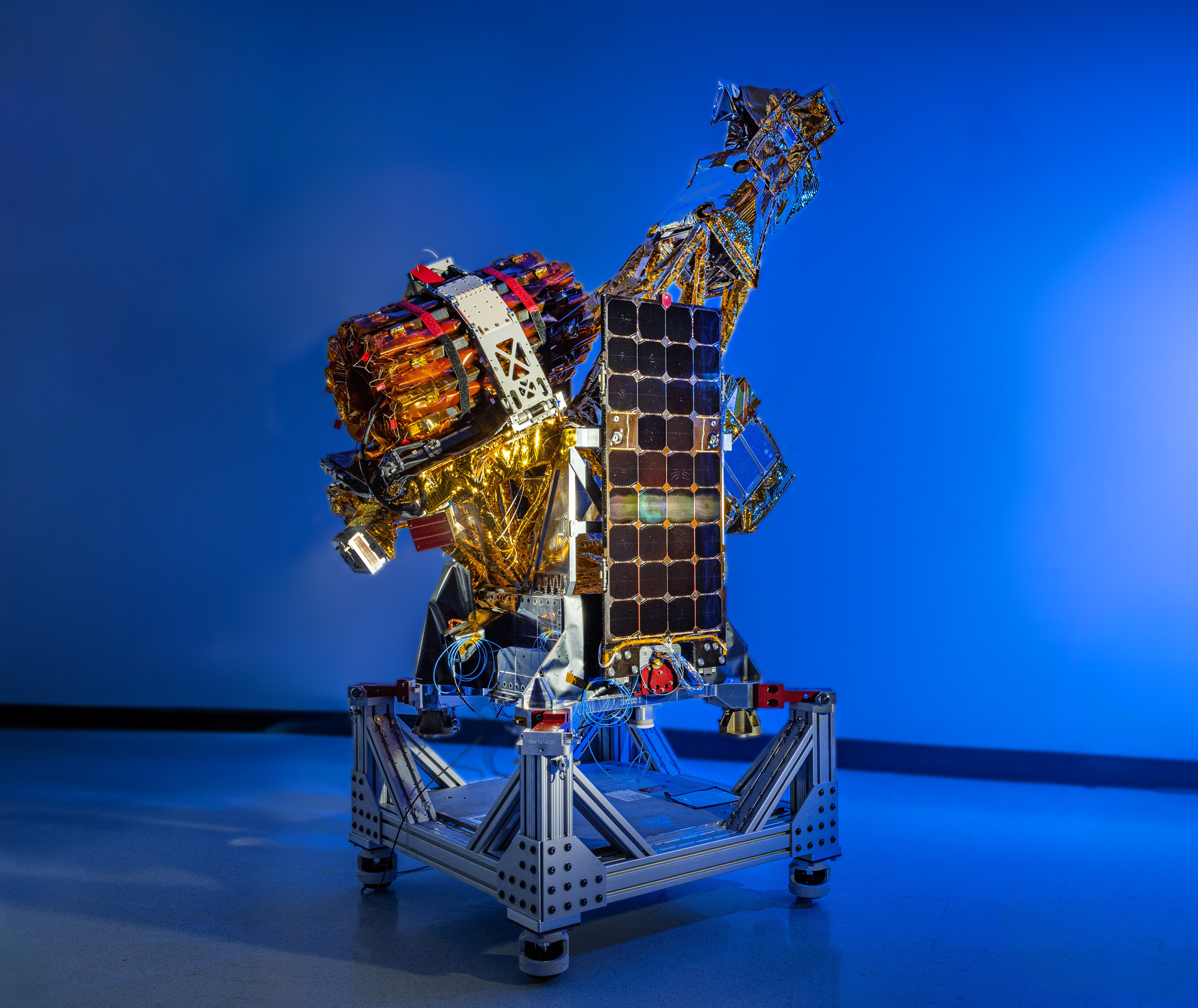
Two of the three SmallSats for NASA’s INCUS mission, including the one shown here, have completed assembly and testing in preparation for shipment to NASA’s Wallops Flight Facility in Virginia for a 2027 launch. From low Earth orbit the satellites will observe the dynamics of tropical convective storms.
Blue Canyon Technologies
Teams working on NASA’s INCUS (Investigation of Convective Updrafts) mission, the first space-based survey of the dynamics of tropical convective storms, have completed assembly and tested two of the mission’s small satellites, or SmallSats. Testing continues on the third SmallSat and is scheduled for completion no earlier than September in advance of a 2027 launch.
The three satellites will fly in tight coordination in low Earth orbit, with the first and second satellites separated by 30 seconds and the second and third satellite by 90 seconds.
Characterized by the sudden and intense lifting of large amounts of air and water, tropical convective storms provide more than half of the world’s precipitation, a crucial source of life-supporting fresh water. But they also produce severe weather, which can increase risks to life and property. The INCUS mission will help improve understanding of where, when, and why convective storms form.
Led by principal investigator Sue van den Heever of Colorado State University in Fort Collins, INCUS will use spaceborne radar instruments developed at NASA’s Jet Propulsion Laboratory in Southern California to observe the vertical motion of air and water, known as convective mass flux, as storms develop and evolve. The mission will also explore how environmental factors such as air temperature, humidity, pressure, wind speed, and wind direction correlate with that movement.
These insights will improve storm forecasting, potentially mitigating loss of life and property damage in affected communities, by helping decision-makers plan for and respond to severe weather events and manage freshwater supplies.
Teams at NASA JPL built each INCUS satellite’s radar, which were combined with a deployable mesh radar reflector made by Tendeg in Louisville, Colorado. The middle satellite also carries a microwave radiometer, also made at NASA JPL, that provides spatial context to the vertical precipitation profiles provided by the radars.
The three assemblies shipped in late 2025 and early 2026 to Blue Canyon Technologies in Lafayette, Colorado, where they were integrated with Blue Canyon’s spacecraft buses. The first two satellites, also called observatories, have successfully undergone vibration and thermal vacuum testing to ensure they will be able to withstand the jostling of launch and the extreme temperatures of space.
These two observatories also shipped to Tendeg, where teams successfully performed test deployments of the reflectors. Then they returned to Blue Canyon for additional testing. They’ll remain in storage before heading out next year to the launch site at NASA’s Wallops Flight Facility in Virginia.
Funded through the Earth Venture Mission-3 acquisition under NASA’s Earth System Science Pathfinder Program, INCUS is one of several missions fulfilling the clouds, convection, and precipitation requirements of NASA’s Earth System Observatory, a series of interconnected missions set to study our home planet’s dynamic natural systems and how they interact. The mission is also part of FALCON (Fleet for the Atmosphere Linking Commercial Observations with NASA), a fleet of atmosphere-observing satellites that will combine hardware contributions from NASA centers, universities, and commercial partners.
For more than a century, musicians have maintained that the way a pianist touches a key influences the sound that emerges. Many scientists, however, have argued that after the hammer strikes the string, the instrument itself determines the outcome, making the pianist’s touch irrelevant.
A research team led by Dr. Shinichi Furuya of the NeuroPiano Institute and Sony Computer Science Laboratories developed a custom sensor system called HackKey. This system can record the movement of all 88 piano keys at 1,000 frames per second, with a spatial precision of 0.01 millimeters. The team invited 20 internationally recognized pianists to play notes while intentionally aiming for contrasting timbres, such as bright versus dark and light versus heavy. Listeners were able to distinguish among the different timbres, even individuals with no experience playing the piano.
The Movements Behind the Sound
The researchers identified a series of micro-movements beneath each keystroke. These movements are so subtle that they are almost impossible to see, but precise enough for listeners to perceive differences in sound.
Small changes in how quickly a key accelerates, slight overlaps between notes, and variations in the speed of initial contact with the key all influenced how listeners described the resulting sound. When each of these factors was adjusted individually, the perceived timbre changed. Adjusting a single movement feature was enough to reliably change how listeners perceived timbre. The results show that touch has a direct effect on sound, independent of factors such as volume or tempo.
The study describes these micro-movements as a motor skill developed through years of advanced training. The researchers call the emerging science of mapping movement to musical experience “dynaformics.”
A Debate as Old as the Modern Piano
The debate over whether touch can alter piano timbre dates back to at least the early 1900s, when music educators began discussing what distinguishes one performer’s sound from another. The piano’s mechanical action appeared to support the skeptics, since the hammer, once released, moves independently before striking the string and is not directly contacted by the pianist’s finger.
As a result of this mechanical process, many acousticians concluded that any reported differences in tone were psychological, influenced by context, volume, or timing rather than by touch. Musicians maintained their position but did not have the scientific tools to prove it.
To settle this debate, Furuya’s team developed a custom biometric contact-sensing system called HackKey, capable of recording the movement of all 88 piano keys at 1,000 frames per second with sub-millimeter precision. The system captured in-depth piano movement data that previous technology could not. For the first time, researchers could observe the specific actions of elite pianists and relate those movements to listeners’ descriptions of sound.
What It Means Beyond the Concert Hall
Piano teachers have often used general phrases like “play warmer” or “use a softer touch” because the specific movements that create certain sound qualities were not well understood. This study now offers a guide to those movements.
Future training tools may allow students to see precisely what their fingers are doing when a note is played successfully or not. Instead of relying on a teacher’s metaphor, students could compare their own keystrokes to a standard and work to improve their technique. The researchers suggest that this approach could make expressive technique easier to teach and visualize, especially for students who find it difficult to translate verbal instructions into physical actions.
The research may also apply to rehabilitation, robotics, and human-computer interaction. Discovering that small differences in movement can shape auditory perception offers new insight into how the brain links movement and sensory experience. Some researchers are exploring whether systems based on expressive musical movement could help patients recover dexterity and coordination after injury.
Most scientific research on music has focused on elements that are easier to measure, like pitch, loudness, and rhythm. Timbre, or the quality or “color” of a sound that makes one instrument or voice different from another, has been harder to measure. This study offers a new way to understand the mechanics behind this concept. The findings suggest that some of the most expressive parts of music come from movements too small to see, developed through years of practice.
Austin Burgess is a writer and researcher with a background in sales, marketing, and data analytics. He holds an MBA, a Bachelor of Science in Business Administration, and a data analytics certification. His work focuses on breaking scientific developments, with an emphasis on emerging biology, cognitive neuroscience, and archaeological discoveries.
Ötzi the Iceman, Europe’s most famous mummy, is crawling with microbes, some long dead, some still eking out a living after thousands of years, and some very modern.
After he died in the Ötztal Alps, the Copper Age man now known as Ötzi lay alone and forgotten for 5,300 years, until a group of hikers stumbled on his freeze-dried remains in 1991. Since then, he’s received a lot of attention from scientists, who have sequenced his DNA, pored over his last meal and the remains of his gut microbes, and examined his clothes and his broken tools. Today, Ötzi lies in a high-tech resting place at the South Tyrol Museum of Archaeology in Italy, where, it turns out, his body is still home to a handful of cold-adapted yeast species that have probably been with him since just after he died.
Slightly morbid souvenirs from the Alps
Microbiologist Mohamed S. Sarhan (of the Institute of Mummy Studies at the private Eurac Research center) and his colleagues recently sampled material from Ötzi’s stomach and meltwater from inside his body, swabbed his skin, and even sampled airborne microbes from his frozen storage room and the lab outside it. They also took samples from a block of frozen alpine soil taken from next to Ötzi’s body back in 1991.
Scientists discovered a hidden gut-brain network that can change cravings when the body needs more protein. The body has a remarkable ability to recognize when it is missing important nutrients and adjust behavior accordingly. New research shows that the gut plays a much larger role in this process than previously understood, actively detecting protein shortages [...]
The giant planet’s bow shock isn’t just deflecting the solar wind, it’s acting as a powerful particle accelerator, firing electrons to relativistic energies of at least 1 MeV, according to a new analysis of data from NASA’s Juno spacecraft.
Just over a year ago, the Trump Administration issued an executive order meant to accelerate the development of nuclear power in the US. While an entire startup ecosystem has developed around the use of different—and typically smaller—reactor designs, only one of them has been fully licensed so far, and there are no plans to actually build any instances of that design.
The executive order directed the Department of Energy to have three different reactor designs reach criticality in a bit over a year. On Thursday, a startup called Antares announced that a test reactor it had placed at the Idaho National Laboratory had reached criticality, making it the first new design to cross this threshold. Criticality means that the nuclear reactions inside the hardware had become self sustaining; it does not mean the reactor had started to generate power.
Antares is one of a number of companies that is basing its design on a new fuel system called TRISO that takes some of the complexity and safety out of the reactor design and places them in the fuel design. The fuel design is based on tiny pellets with a uranium oxide core. The pellets are surrounded by several layers of carbon that can moderate the energy of both the neutrons and lighter nuclei that are released by fission reactions. All of that is encased in a hard ceramic shell that's designed to withstand the highest temperatures that can be produced by the encased uranium.
Os projetos foram aprovados no contexto de um aviso ligado aos Roteiros Tecnológicos Big Science, que corresponde a uma das medidas do programa “Acelerar a Economia”, reforçando a presença da indústria nacional em grandes projetos internacionais de Big Science, avança a ANI.
The search for a ninth planet in our solar system could reach a turning point as soon as this year, according to a planetary scientist involved in the hunt for a mysterious object believed to be lurking in the outer reaches of the Solar System.
For the past decade, astronomers around the world have been searching for evidence of another resident in our planetary neighborhood. As far back as 2016, there were already hints that something might be out there, given the odd orbits of distant objects like Sedna, discovered in 2003.
Now, two astronomers—California Institute of Technology (Caltech) researchers Konstantin Batygin, a professor of planetary science, and his colleague, Dr. Michael E. Brown—believe there is a high probability that the confirmation of a ninth planet in our solar system could be on the horizon.
Batygin and Brown’s findings suggest Planet Nine may have a mass roughly 5 to 10 times that of Earth and orbit, on average, about 20 times farther from the Sun than Neptune, which circles the Sun at an average distance of 2.8 billion miles. If it exists, the distant world would take between 10,000 and 20,000 years to complete a single orbit around the Sun.
“This would be a real ninth planet,” says Brown, the Richard and Barbara Rosenberg Professor of Planetary Astronomy, in a 2016 statement. “There have only been two true planets discovered since ancient times, and this would be a third. It’s a pretty substantial chunk of our solar system that’s still out there to be found, which is pretty exciting.”
Evidence for Planet Nine comes from a small group of distant Kuiper Belt objects whose highly elongated orbits appear clustered in the same direction and share similar orbital tilts relative to the plane of the known planets.
Researchers argue that this type of alignment is unlikely to occur by chance. Alternative explanations involving the Kuiper Belt itself have also been explored, but models suggest the belt would require far more mass than has been observed to produce the effect.
Brown’s excitement shines through: “It’s almost like having six hands on a clock all moving at different rates, and when you happen to look up, they’re all in exactly the same place,” he says, adding that the odds of having that happen are something close to one in 100.
Computer simulations suggest that a large, unseen planet in the outer Solar System could maintain these orbital alignments through its gravitational influence. The models also demonstrate how mean-motion resonances could keep the distant objects in stable orbits while preventing collisions with the proposed planet.
The hypothesis may also explain the unusual trajectories of objects such as Sedna and 2012 VP113, whose highly elongated orbits do not bring them close to Neptune.
Konstantin Batygin, astronomer and Professor of Planetary Sciences at Caltech.
Japanese Scientists Find More Evidence
In July, additional data relevant to the Planet Nine debate emerged with the discovery of a newly identified object nicknamed “Ammonite,” found by Japanese astronomers using the Subaru Telescope on Maunakea, Hawaii. The object is only the fourth known sednoid, joining a rare class of distant celestial bodies with unusual orbits beyond Pluto.
“The fact that Ammonite’s current orbit does not align with those of the other three sednoids lowers the likelihood of the Planet Nine hypothesis,” said Dr. Yukun Huang of the National Astronomical Observatory of Japan, who conducted simulations of Ammonite’s orbit in a July interview with The Debrief.
“It is possible that a planet once existed in the Solar System but was later ejected, causing the unusual orbits we see today,” says Huang.
How Planet Nine Could be Found This Year
Astronomy is often a science of probabilities and competing hypotheses, but Planet Nine presents a relatively rare case where new observations may soon provide a clear answer. The Vera C. Rubin Observatory in Chile recently began scientific operations and could provide the data needed to confirm—or rule out—the existence of Planet Nine.
Perched atop a mountain in Chile, the NSF–DOE Vera C. Rubin Observatory observes the night sky in extraordinary detail. Equipped with the largest digital camera ever built for astronomy, it will repeatedly survey the sky over ten years, producing an unprecedented time-lapse record of the Universe.
In a recent podcast interview, Batygin told The Debrief how his and Brown’s theory could soon be tested.
“The Planet Nine hypothesis is kind of readily refutable, right? I find that to be quite important,” says Batygin. “There’s a new telescope that came online called the Vera Rubin Observatory, and as it collects data this year, we will, I think, know one way or another whether Planet Nine is really out there or not.”
Batygin says Rubin’s greatest strengths are its survey efficiency and extensive sky coverage. By repeatedly imaging vast portions of the sky, Rubin is uniquely suited to detecting a faint, distant, and slowly moving object like Planet Nine.
“If Rubin detects an object at hundreds of astronomical units from the Sun, and its orbit is consistent with the predicted Planet Nine parameter space, that would essentially be it,” Batygin explained, in terms of what kind of observation would provide a definitive answer regarding Planet Nine’s existence.
“At that distance, anything visible to Rubin would have to be very large, so a direct detection would be the decisive confirmation,” he added, although suggesting that “whenever you find some interesting pattern in the data, the first thing you have to ask is, ‘will it hold up to additional scrutiny from [some] fresh kind of unbiased data?”
He points to this summer being a turning point in his research: “We will get that new batch of discoveries basically starting this summer, starting summer twenty twenty-six. It will be a direct test of all lines of evidence that we have for the existence of Planet Nine.”
“ You can imagine Vera Rubin comes online, looks at the sky for a few months, finds an object that it can see that is far away, that is hundreds of astronomical units away, meaning hundreds of times the distance between the Earth and the Sun, as far away from the Sun as the Earth,” adds Batygin. “That’s Planet Nine. Like, that’s direct confirmation, right? Then you close the book and move on to the more interesting question of like characterization.”
Batygin suggests it would solidify many of the lines of evidence for Planet Nine, even if his team does not discover the object itself. “Nevertheless, that would lend support to its existence because, if the solar system is structured in this way, then something must be sculpting that structure.”
Although he has devoted years to the Planet Nine hypothesis, Batygin says he remains open to the possibility that the planet does not exist and believes the data must ultimately determine the outcome.
“It would definitely suck,” Batygin told The Debrief of this possibility, though noting that scientists have to “go where the data takes you, right?”
Planet Nine and Nibiru, “The Destroyer” Sumerian Folklore
Over the decades, the Planet Nine hypothesis has inevitably drawn comparisons to “Nibiru,” a supposed hidden world popularized in modern pseudoscientific interpretations of ancient Mesopotamian texts.
The idea gained widespread attention through the writings of Zecharia Sitchin, who argued that ancient Sumerian records described a rogue planet that periodically enters the inner Solar System and causes catastrophic events on Earth. However, mainstream historians and archaeologists reject these interpretations, noting that ancient Mesopotamian flood traditions, including the story of Utnapishtim in the Epic of Gilgamesh, do not identify Nibiru as the cause of a global catastrophe.
When asked on the podcast whether Planet Nine could pose any threat to Earth, Batygin dismissed the idea.
“The important thing to understand about Planet Nine is that if you’re worried about Planet Nine’s gravity destroying things, I would encourage you to revisit the inverse square law of gravity, right?
He explains that gravity increases with mass and falls off as the distance between objects squared, and that Planet Nine is estimated to be five Earth masses, and at a distance of 500-600 astronomical units away. By comparison, Jupiter is 300 Earth masses and only around four astronomical units away.
“So if you’re worried about Planet Nine, you should really, really worry about Jupiter,” Batygin says. “I mean, this is one of the intriguing, frankly humbling things about learning celestial mechanics and understanding how the solar system works at a large scale,” Batygin added.
How Planet Nine Could Change Astronomy and CULTURE
The confirmation of Planet Nine would be one of the most significant astronomical discoveries of the century, reshaping our understanding of the Solar System and its formation. Textbooks, educational materials, and scientific models would need updating to account for a previously unknown major planet residing far beyond Pluto. More importantly, its discovery could reveal new insights into how planetary systems form and evolve.
Batygin also thinks the influence of such a discovery also might impact science in ways we haven’t yet considered.
“Until we really take a look, we don’t know what kind of awesome and exciting information we’ll discover. This has been true along the way in all planetary exploration. We have been surprised time and time again,” says Batygin.
Batygin also surmises that astronomers “will discover interesting constraints about the birth environment of the Sun itself by studying Planet Nine.”
An exciting future may indeed lie ahead if Planet Nine is soon discovered. Astronomers could eventually determine whether it is a gas giant, an icy world, or something entirely unexpected. Future observations may even reveal details about its atmosphere and composition.
When Voyager 1 and Voyager 2 returned the first close-up images of the outer planets, it marked one of humanity’s greatest scientific achievements. For the first time, people saw distant worlds in remarkable detail rather than as tiny points of light in the night sky.
Now, in 2026, humanity may once again stand on the brink of a major planetary discovery, thanks to the Vera C. Rubin Observatory.
Fundamentally, confirmation of a ninth planet would not only be a cosmic discovery: it would also offer a reflection of humanity, and a reminder of how much remains unknown, even within our own cosmic backyard.
Chrissy Newton is a PR professional and the founder of VOCAB Communications. She currently appears on The Discovery Channel and Max and hosts the Rebelliously Curious podcast, which can be found on YouTube and on all audio podcast streaming platforms. Follow her on X: @ChrissyNewton, Instagram: @BeingChrissyNewton, and chrissynewton.com. To contact Chrissy with a story, please email chrissy @ thedebrief.org.
On Thursday, President Donald Trump announced his administration's latest attempt to prop up the US coal industry during an incoherent press event that randomly oscillated between energy issues and Trump's fixation with building and renovating monuments in DC. The energy portion of the events was also frequently disconnected from reality.
"Today we're taking historic action to bring down the price of energy and the cost of living for all Americans with the power of clean, beautiful coal," said Trump, apparently unaware that coal is one of the most expensive means of generating electricity in the US.
With wind and solar power getting cheaper, coal has become the second-most expensive way of producing electricity, trailing only the cost of building a new nuclear plant. As a result, no new coal plants have been completed in over a decade, and coal has gone from powering over half the electrical grid to producing only about 15 percent of the nation's electricity. That's before the indirect costs of coal use are considered. It produces the most greenhouse gas emissions per unit of energy, releases dangerous particulates and chemicals into the atmosphere, and leaves behind ash that has high levels of toxic metals.
Welcome to Edition 8.44 of the Rocket Report! The news this week is decidedly weighted in favor of heavy-lift rockets, largely due to the fallout from last Thursday's explosion of Blue Origin's New Glenn on its launch pad in Florida. Blue Origin aims to resume launches at the badly damaged launch facility by the end of the year, but there's good reason to be skeptical of this timeline. With New Glenn grounded, will Blue Origin founder Jeff Bezos approach Elon Musk's SpaceX to launch his Blue Moon lander to the lunar south pole? It sure sounds like NASA is pushing for that.
As always, we welcome reader submissions. If you don't want to miss an issue, please subscribe using the box below (the form will not appear on AMP-enabled versions of the site). Each report will include information on small-, medium-, and heavy-lift rockets, as well as a quick look ahead at the next three launches on the calendar.
Spaceport development moves forward in Canada. There's been a lot of talk about the Canadian government's recent commitment to invest in a sovereign launch capability. There was the announcement last year of a federal budget of 182.6 million Canadian dollars ($131 million) over three years to establish a sovereign launch program. In March, the government said it would lease a dedicated launch pad at a commercially developed spaceport in Nova Scotia for national defense purposes, committing 200 million Canadian dollars ($144 million) to the deal. The agreement is a boon for Maritime Launch Services, which is developing Spaceport Nova Scotia after years of slow progress at the coastal site, SpaceQ reports.
Last week's explosion of a New Glenn rocket at Cape Canaveral, Florida, was clearly a setback for Blue Origin and NASA, but it was a learning experience for safety officials looking to open up the spaceport to hundreds more launches per year.
The launch base on Florida's Space Coast is gearing up for a flurry of new arrivals. SpaceX is building multiple launch pads for its super-heavy Starship rocket, which will operate within a few miles of launch pads operated by SpaceX rivals Blue Origin and United Launch Alliance. Two other companies, Stoke Space and Relativity Space, are also developing launch sites along a narrow stretch of coastline at Cape Canaveral Space Force Station.
All of them have, or will soon have, rockets burning methane or liquified natural gas, replacing legacy launch vehicles fueled by kerosene, liquid hydrogen, or solid propellants. There are good technical reasons for making the switch, but until last week, engineers had scant real-world data on the damage that millions of pounds of methane and liquid oxygen would cause if a fully loaded rocket exploded on the launch pad or soon after liftoff.

 Login