Using data from the James Webb Space Telescope (JWST), astronomers have unraveled some of the atmospheric secrets of a bizarre, blisteringly hot world that has the consistency of marshmallow.
The extrasolar planet, or exoplanet, under the watchful infrared eye of the JWST, is WASP-17b, located around 1,300 light-years away. The exoplanet has a mass around 0.8 times that of Jupiter, but it is around twice as wide as the solar system's largest planet, giving it a "super-puff" consistency comparable to the Earth-based treat. WASP-17 b is so close to its parent star that it completes an orbit in under four Earth days, with this proximity also making the temperature of this "hot Jupiter" skyrocket.
Given the extreme conditions of this exoplanet, it is little wonder that its atmosphere is pretty unusual too. Using a new technique called transmission strings, a team of scientists mapped the contours of the atmosphere of WASP-17b. They found that the atmosphere is shaped like a ring with prominent "gems" rising from it.
"Planets are temperamental, their atmospheres complex and chaotic," team member Hannah Wakeford of the University of Bristol said in a statement. "The fact that all of these numbers came together and showed us this very structured, dynamical picture of this giant world over 1,000 light-years away was just really exciting."
Astronomers like WASP-17b so much they put a ring on it
WASP-17b is so close to its parent star that it is tidally locked, meaning one side permanently faces the star; its dayside is constantly bombarded with stellar radiation. In contrast, the planet also has a cooler nightside, which faces out into space in perpetuity.
By creating incredibly comprehensive 3D views of this exoplanet's atmosphere, researchers found that WASP-17b's atmosphere has a chemical composition and temperature that shift between dayside and nightside according to theory and modelling.
This was possible because the transmission strings technique tracked WASP-17b as it crossed or transited in front of its star, capturing the composition of light around the edge of the planet's atmosphere, or limb, from different angles. This method trumps standard approaches because traditional modelling only maps light as an average across the entire limb.
"Rather than assuming your atmosphere is a circle with the same radius all the way around, our technique allows you to pull out different distances from the center to the edge of the planet," Lili Alderson, of Cornell University, said. "We're able to go around the edge.
"So, we've gone from a ring to understanding where on the ring the gemstones are, so to speak."
The modelling showed just such a "gem," that occurs where hot winds from the planet reach the equator and the nightside of WASP-17b, the atmosphere of the cooler side inflates.
An illustration of the atmosphere of WASP-17b with "gems" rising from it. (Image credit: Robert Lea)
"Theory predicts that the morning and the evening sides should have a strong temperature difference, and WASP-17b fits really nicely in that trend – pretty much bang-on what we thought it would be," Alderson said.
The successful application of the transmission strings method is an exciting step forward in the modelling of the atmospheres of the over 6,000 worlds in NASA's exoplanet catalog.
"This is proof of concept that planets are, in fact, 3D objects, and that, consistently, as they go around their star, what we predict should be happening is happening," Alderson concluded. "To move beyond computational exercises and see it for real is a different matter."
The team's research was published on Wednesday (Oct.14) in the journal Nature Astronomy.
In 3 million years or less, WASP-12b will tumble into its host star. It’s not surprising that the planet will meet its end this way, but it is surprising that it will happen so soon. New work tests a potential explanation for the planet’s rapid orbital decay.
Diagnosing a Doomed Planet
Roughly twice as wide as Jupiter and almost 50% more massive, exoplanet WASP-12b zips around its Sun-like stellar host every 1.09 days at a distance of just 0.023 au (3.4 million kilometers or 2.1 million miles). If placed in our solar system, WASP-12b would easily dethrone Mercury as the nearest planet to the Sun.
Observations show that WASP-12b’s already tiny orbit is shrinking, with each orbital period growing shorter at a rate of 29 milliseconds per year (Earth-year, that is). While we would expect the planet to slowly spiral inward due to tidal interactions with its star, it’s moving several orders of magnitude faster than predicted. The planet’s motion has so far defied all attempts to explain it, and now, a new research article by Caleb Lammers (Princeton University) and collaborators appears to topple yet another hypothesis for WASP-12b’s unexpectedly fast orbital decay.
A Tidy Tidal Explanation?
Previous work has proposed that WASP-12b’s rapidly shrinking orbit is due to obliquity tides, which could come into play if the planet had a nonzero obliquity, or axial tilt. Tidal dissipation generally works to keep close-in giant planets like WASP-12b from having a significant axial tilt. However, if you throw a second planet into the system, the companion can exert a torque that could force WASP-12b to remain tilted. This outside forcing, the hypothesis suggests, changes the orbital, spin, and tilt evolution of WASP-12b and ultimately pushes it toward its star far faster than expected without the tilt or the companion.
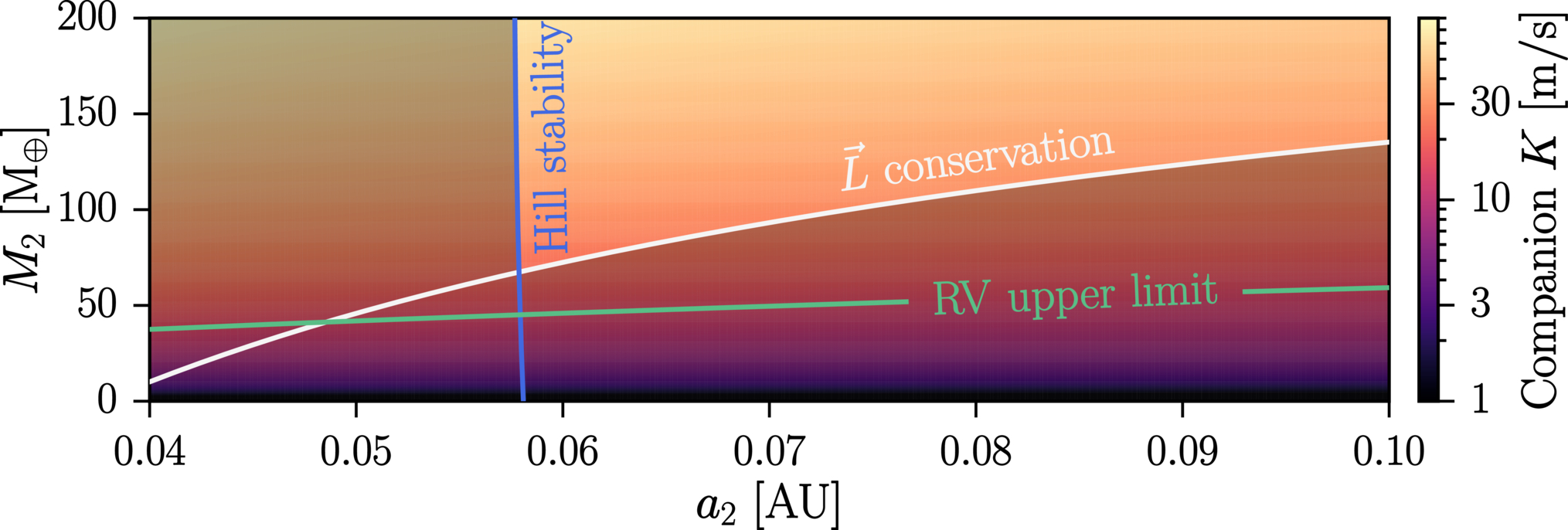
Constraints on the mass and orbital distance of the companion planet in the obliquity-tide scenario. The color shows the radial velocity signal associated with each combination of parameters. The green line shows the maximum radial velocity allowed by observations. Click to enlarge. [Lammers et al. 2026]
Lammers and coauthors examined this hypothesis by tracking how the angular momentum of a system containing both WASP-12b and a companion planet would evolve over time. As WASP-12b spirals inward, it loses angular momentum. For the planet’s lost angular momentum to be absorbed by the star and the companion planet — while maintaining a stable orbital configuration for both planets — the companion must orbit at least 0.06 au from the star and have a mass of at least 65 Earth masses.
The Mystery Persists
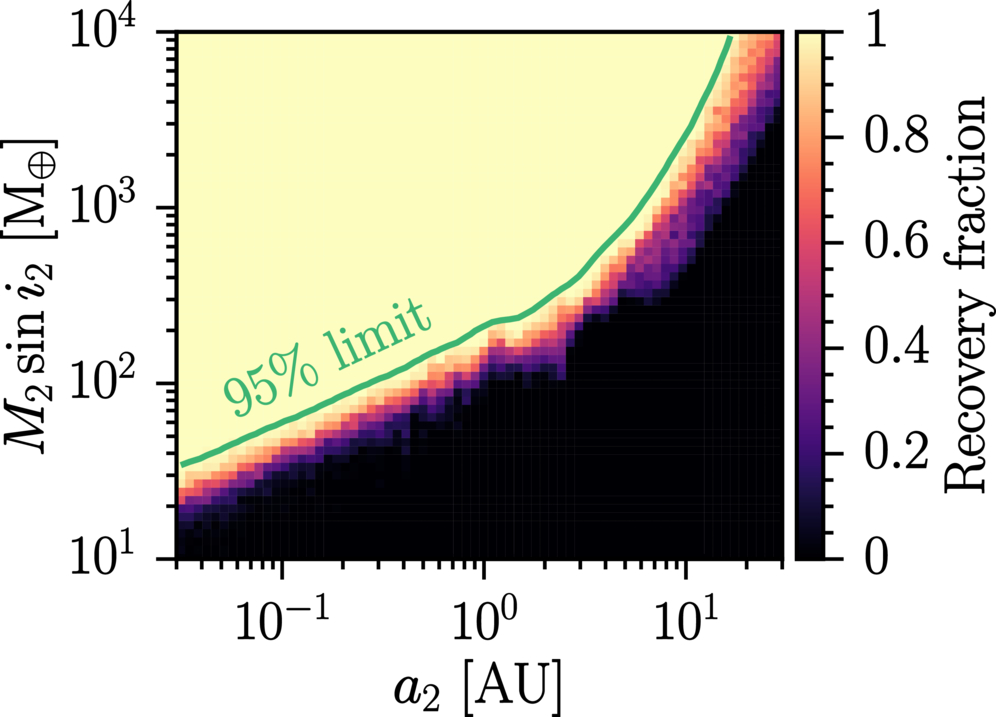
This companion mass and orbital distance are both larger than predicted by previous work, which had suggested that a 10–20-Earth-mass planet at 0.04 au would be sufficient to drive WASP-12b’s inward journey. Lammers and coauthors analyzed WASP-12’s radial velocity data for evidence of such a planet tugging on the star, but found none; only under extremely particular conditions could such a planet exist and not be detected in current data.
Radial velocity constraints on the properties of a hypothetical second planet in the WASP-12 system, obtained via injection-recovery tests. [Lammers et al. 2026]
Taking their calculations further, the team found it unlikely that this mechanism is at work in planetary systems in general, not just in the WASP-12 system. This leaves the mystery of WASP-12b’s rapid orbital decay wide open, and with only 3 million years to ponder it before the planet’s demise.
Citation
“The Mysterious Inspiral of WASP-12 b: Why Obliquity Tides Cannot Drive Orbital Decay,” Caleb Lammers et al 2026 ApJL1009 L43. doi:10.3847/2041-8213/aea405
By observing subtle variations in the timing of stellar pulsation modes, researchers may have made the first detection of a planet in the habitable zone of a massive A-type star.
Listening for Planets in Stellar Heartbeats
To date, some 6,000 exoplanets have been detected across a vast array of surveys and instruments. The majority of these have been detected around main-sequence F, G, and K stars — but not because these are the only places exoplanets can exist. Rather, this is a result of selection bias: these stars tend to be both bright and luminously stable enough for astronomers to deploy the radial velocity or transit methods.
Periodic modulations in the time of observed stellar pulsations can indicate the presence of an orbiting companion. In this case, timing variations are displayed for the two most prominent pulsation modes f1 and f2 for the variable star HD 156295. The sinusoidal pattern indicates they may be caused by an orbiting companion with a mass of about 6.3 Jupiter masses at a distance of 3.9 au, in this star’s habitable zone. [Adapted from Wilson et al. 2026]
A-type stars, by contrast, are challenging for exoplanet detections. These more massive stars tend to exhibit fewer and broader spectral lines than their F, G, or K counterparts, rendering radial velocity techniques largely ineffective. Many A-type stars also pulsate in brightness, making it hard to identify planetary transits within their erratic light curves.
Luckily, one transit astronomer’s trash data can be a pulsation timer’s treasure. For some A-type stars called δ Scuti stars, the pulsation is regular enough to be used like a cosmic clock. Subtle variations in a star’s position due to the tug of an orbiting companion can then disrupt the timing of its otherwise steady pulsation, allowing one to once again find planets via its light curve — including massive ones on intermediate-period orbits that are the most difficult to detect around massive stars using traditional methods.
A Massive Planet in the Habitable Zone of a Hot Star?
In a new study led by Logan Wilson (Center for Astrophysics | Harvard & Smithsonian), researchers analyzed 16,440 highly pulsating δ Scuti stars observed at a high cadence by the Transiting Exoplanet Survey Satellite (TESS) in order to look for the distinctive, periodic timing modulations associated with an orbiting companion. This sample was then whittled down to nine candidate systems they believe may contain substellar companions — likely either brown dwarfs or massive planets.
The properties of the nine candidate objects identified in this study and their host stars are shown here, along with the properties of other exoplanet systems. Through stellar pulsation timing, the researchers were able to identify substellar candidates around hot A-type stars in intermediate-period orbits, a region of parameter space that has been difficult to probe with other methods. [Wilson et al. 2026]
One particularly striking candidate was found when analyzing the star HD 156295. Based on their timing data, Wilson and collaborators deduce the star may have a 6.3 Jupiter-mass planetary companion orbiting every 2,200 days. That puts the companion’s distance from its host at about 3.9 au, right at the far edge of HD 156295’s habitable zone. If this planet turns out to be real, HD 156295 would be the hottest star known to host an exoplanet in its habitable zone. This detection also suggests a high occurrence rate of massive planets on intermediate orbits relative to expectations for other main-sequence stars, supporting theories that A-type stars may form companions like these more efficiently.
The other eight candidates are more consistent with brown dwarfs. Six of these candidates show somewhat uncommon masses and orbital separations that place them in a region of parameter space known as the “brown dwarf desert.” Some observations suggest this desert is less severe around hotter stars — a conclusion that this study supports.
All of these findings are still quite tentative, however; the researchers estimate that the probability for the planetary signal being real is just over 50%, and the parameters given for each candidate are still subject to large uncertainties. With new data arriving all the time, it may not take long before we have a clearer picture of these unique substellar companions.
Citation
“A Search for Substellar Companions around A-type Stars: Pulsation Timing Detection of Eight Brown Dwarf Candidates and a Possible Habitable-zone Planet,” Logan G. Wilson et al 2026 ApJ1009 78. doi:10.3847/1538-4357/ae93a0
While our solar system sports one Jupiter-like planet, exoplanet discoveries have revealed that giant planets come in a few different forms in systems with varying architectures. A recent study has explored how the mass–eccentricity relationship in warm Jupiters is shaped by dynamical interactions between planets.
Jupiter-like Planet Eccentricities
Exoplanet surveys have uncovered three different Jupiter-like planet populations across the galaxy: hot, warm, and cold Jupiters. Much like our own, cold Jupiters orbit on long periods, far away from their host stars. Conversely, hot Jupiters zip around their host stars on extremely short-period orbits. Somewhere in between, warm Jupiters orbit their host stars with periods from 10 to 365 days.
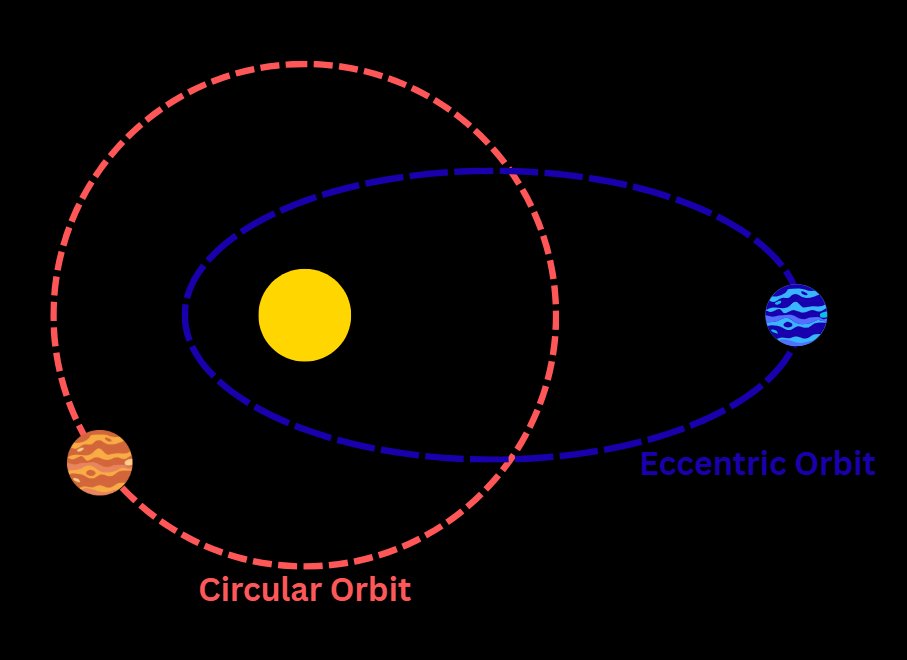
Diagram showing examples of a circular and an eccentric orbit. Click to enlarge. [AAS Nova/Lexi Gault]
These giant planets have proven to be deeply entwined with the makeup of their host systems, and their orbital properties have been used to test and trace planet formation pathways. For example, long-period cold Jupiters discovered in radial velocity surveys have exhibited a positive correlation between planetary mass and orbital eccentricity. This mass–eccentricity relationship, as previous studies have suggested, is likely the result of a process known as planet–planet scattering, in which dynamical interactions between planets in the same system cause significant and chaotic changes to their orbits.
Does this relationship extend to shorter-period giant planets as well? Hot Jupiters are heavily impacted by tidal interactions with their host stars, circularizing their orbits and erasing dynamical imprints on their eccentricities. Warm Jupiters, on the other hand, orbit far enough away for their eccentricities to preserve clues about their energetic histories. Recently, thanks to the Transiting Exoplanet Survey Satellite (TESS), astronomers have identified a positive correlation between planetary mass and eccentricity in a growing sample of warm Jupiters, but the exact driver of this trend has yet to be uncovered.
Planets Scattering Planets
To test if the positive mass–eccentricity correlation in warm Jupiters is consistent with planet–planet scattering, Jiayin Dong (University of Illinois at Urbana-Champaign) constructed a sample of 85 warm Jupiters from the NASA Exoplanet Archive. This carefully selected sample, dominated by discoveries from TESS and Kepler, included planets with masses between 0.3 and 15 Jupiter masses and orbital periods between 10 and 365 days. In conjunction with this sample, the authors built a planet–planet scattering framework to assess the range of properties anticipated for scattered warm Jupiter systems.
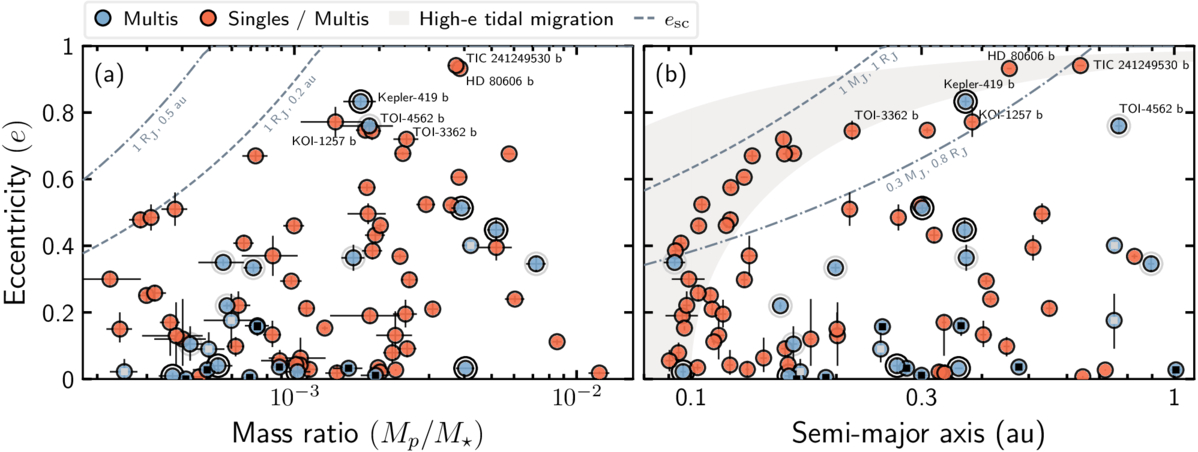
Warm Jupiter eccentricity versus planet–star mass ratio (left) and semimajor axis (right). Click to enlarge. [Dong et al 2026]
Comparing the observed trends in their sample with their theory-based expectations, Dong and team showed that planet–planet scattering naturally explains the mass–eccentricity relation of warm Jupiters. In their framework, warm Jupiters originate in compact, multiplanet systems, and as the systems evolve, gravitational interactions between planets excite orbital eccentricities and inclinations, leading to close encounters. These encounters can cause planets to collide or to be ejected from the system entirely.
The mass–eccentricity relation of warm Jupiters, the authors suggested, represents a transition from collision-dominated interactions among low-mass planets to ejection-dominated interactions among high-mass planets. For massive enough systems, scattering can excite eccentricities high enough to trigger the high-eccentricity migration responsible for moving hot Jupiters to their close-in orbits. Overall, this study suggests that warm Jupiters are not a distinct planet species, but instead may represent the shorter-period counterparts of cold Jupiters whose orbits are shaped by the same dynamical processes. Future observations expanding the sample of warm Jupiters and discoveries of additional planet companions will further uncover the links between hot, warm, and cold Jupiter systems.
Citation
“Planet–Planet Scattering Explains the Mass–Eccentricity Relation of Warm Jupiters,” Jiayin Dong et al 2026 ApJL 1007 L29. doi:10.3847/2041-8213/ae930e
A cosmic Quarter-Pounder is providing us with a near-perfect view of a distant gas giant’s earliest moments. Known as Gomez’s Hamburger (or GoHam for short), the massive protoplanetary disk surrounds a young star located in the Scorpius-Centaurus stellar region of our home galaxy about 453 light-years away from Earth. As researchers explained in a study recently published in The Astrophysical Journal, GoHam’s vantage from Earth is virtually unparalleled for anyone hoping to glimpse the subtle layers of dust and particles that will one day coalesce into a humongous gas giant.
Early observers first spotted GoHam in 1985, but initially pegged it for a planetary nebula as far as 6,500 light-years from Earth. Astronomers have since revised their assessments with data gathered by the Atacama Large Millimeter/submillimeter Array (ALMA) in northern Chile. As its full name implies, ALMA measures millimeter-and-smaller wavelengths, allowing scientists to map the miniscule dust grains and gaseous molecules that compose distant objects. GoHam is a particularly unique subject for ALMA, because its position makes it a new benchmark example for testing models of how planets evolve.
“GoHam gives us a rare and clear view of the vertical and radial structure of a very large, nearly edge‑on disk,” explained study co-author and University of Minnesota astronomer Charles Law.
Gomez’s Hamburger was first discovered in 1985, but originally misidentified as a planetary nebula. Credit: Law, et al. (2026)
According to Law, its mixture of cosmic winds, large formational asymmetries, massive disk size, as well as the potential for planetary formation makes GoHam a “perfect laboratory.” With ALMA, Law and his colleagues analyzed GoHam’s layers of carbon monoxide, and sulfur-bearing molecules. As predicted, the lightest gas is in the highest layer above the formation’s midplane, while the heavier sulfur components lay beneath it. Meanwhile, a thin but concentrated section of millimeter dust is visible in the midplane itself.
Comparisons to GoHam’s fast food namesake only go so far, however. Its dust clouds lean north–south, with one side containing brighter and wider emissions. This likely stems from a disturbance such as a cosmic vortex, which may capture additional material for planetary formation. Dim, thin carbon monoxide emissions along the disk’s northern section also suggest GoHam’s central star is blowing gases into deep space as what’s known as photoevaporative wind.
Astronomers also noted that GoHam is one of the largest protoplanetary disks ever observed. At nearly 93 billion miles wide and with an exponentially larger dust mass than the typical protoplanet disk, GoHam may ultimately host not just one gas giant, but an entire planetary system.
The NASA Exoplanet Exploration Program (ExEP) has a curated list of 164 nearest Sun-like stars that are easily visible from Earth. This list represents the first targets for a proposed large space telescope specially designed to find life in the universe, currently known as the Habitable Worlds Observatory (HWO).
After the HWO is completed, likely sometime in the 2040s, scientists will use the specialized telescope to directly image planets in those star systems. The telescope will search around Sun-like stars for planets in a region known as the habitable zone, where temperatures allow liquid water to exist. Scientists hope to find Earth-like planets with liquid water in the habitable zones of other stars.
While the 164 stars on ExEP’s list have qualities that make them good candidates for study, it remains unknown how many actually have terrestrial planets within their habitable zones. A team of scientists at Arizona State University used simulated data for ExEP’s 164 stars and their hypothetical planetary systems to assess which are most likely to have habitable worlds. Their results would help the HWO prioritize which star systems to observe.
The team started with a subset of 134 stars on ExEP’s list with no known exoplanets, giving researchers the freedom to simulate potential worlds around them. They used a software model called the DYNAmical Multi-planet Injection TEster (DYNAMITE) to predict the possibility that an unseen planet exists around each star by generating 100,000 simulated planetary systems around it. The simulations use mathematical formulas based on observations of real exoplanets to determine the sizes and orbital characteristics of hypothetical gas giants and rocky exoplanets. DYNAMITE then determines whether these planetary systems would be stable and include a terrestrial exoplanet in the star’s habitable zone.
The other 30 stars in the ExEP’s list have known exoplanets, but none of them are rocky planets in habitable zones. To predict whether these stars have unseen terrestrial planets in their habitable zones, the team used the same DYNAMITE process as before with the additional requirement that each star must have an exoplanet matching the one already found.
The space around a Sun-like star can be divided into three regions. The region closest to the star is too hot for liquid water to persist on an exoplanet’s surface, while the region farthest from the star is so cold that any water on an exoplanet would be frozen solid. Between these lies the habitable zone, where temperatures would allow liquid water to exist. However, it’s also possible that a combination of light and gravity could create habitable temperatures on large enough moons orbiting gas giants even beyond a star’s main habitable zone. Illustration by Andrew Bizal.
To increase the chances of finding a terrestrial planet in a habitable zone, the team also investigated potentially habitable moons orbiting gas giants in these systems. For each simulation that included a gas giant, the team inserted between 2 and 23 moons, with masses between 10% of Earth’s Moon and 50% of Earth. Then they simulated the surface temperatures of these moons based on how much starlight they receive and how strongly their host planet pulls on them. They deemed the moons potentially habitable if they were large enough to retain an atmosphere and had a temperature ideal for liquid water, even if they were not technically in their stars’ habitable zones.
For each star, the team calculated a metric based on the probabilities that the star had a terrestrial planet in its habitable zone, that the planet would remain in a stable habitable zone for at least 2 billion years, and that the star had a potentially habitable moon. They called this probability statistic a rankingmetric and used it to compare star systems.
Based on the ranking metric, the team found that the dimmer and cooler stars on their list generally had better chances of hosting a habitable-zone terrestrial planet than the brighter, hotter stars. They also found that stars without known exoplanets ranked more favorably. Around 70% of the stars with known exoplanets had less than a 1% probability of hosting a terrestrial planet in their respective habitable zones. Additionally, fewer than 0.1% of their simulated moons were habitable.
Overall, the researchers concluded that the HWO should prioritize observing cooler, Sun-like stars with no known exoplanets. They claimed that the exoplanets with known characteristics in their sample set were of sizes and in positions that made it unlikely for other exoplanets to be in their systems’ habitable zones. Even with expanded habitability criteria for moons, it would be very unlikely for HWO to find another Earth orbiting a gas-giant exoplanet. They ranked 47 stars in the highest-priority category (A Tier), 51 stars in the middle category (B Tier), and 66 stars in the lowest category (C Tier) to observe with HWO.
At the end of their study, the team remarked that the proposed HWO represents a potential next step in the search for other Earths, but scientists still need to identify the best targets for this future telescope. The HWO telescope should be able to image rocky exoplanets directly, so thorough research to prepare a list of high-priority targets will help avoid overlooking other Earths.
Astronomers and astrobiologists use a wide range of tools in their search for extraterrestrial life. Probes, satellites, and rovers take photographs and collect data on the geology and chemistry of planets and moons in the solar system. Radio telescopes sweep the sky, looking for signals from intelligent civilizations. And telescopes like the JWST can observe the atmospheres of distant exoplanets, potentially finding ones similar to Earth’s.
A limitation of these methods is that they assume life on other worlds is fundamentally similar to life on Earth, requiring the same balance of molecules in the atmosphere, producing the same chemicals for their metabolic processes, or developing technologies analogous to those humans make. While researchers use these assumptions as baseline markers to look for, assuming such similarities might lead them astray. Scientists looking for life using too narrow a set of parameters might miss life unlike Earthlings. Or they might mistake coincidentally similar geological, chemical, or astronomical processes for having been made by living things.
So, to complement techniques that assume alien life resembles life on Earth, scientists also consider approaches that detect signs of life while making as few assumptions as possible about what it could look like, known as agnostic biosignatures. One of these life signs with few assumptions is complexity. Though it can be difficult to quantify precisely, living things tend to create more complex systems than nonliving things. A team of researchers recently tested whether living and nonliving worlds could be distinguished solely by examining the complexity of the light-reflection patterns from their surfaces.
For this, the team treated Earth and Mars, similar planets but one with life and one without, as stand-ins for exoplanets around other stars. They collected data on the light reflected off both planets’ surfaces from a space station monitoring Earth, known as the Deep Space Climate Observatory or DSCOVR, and an orbiter around Mars observing its atmosphere, known as the Hope Probe.
The team identified 3 nearly identical wavelengths of light that these machines observe from their respective planets. From the machine databases, they collected measurements of how much light each planet reflected, called its reflectance, at these 3 wavelengths over 486 local days. By using only individual wavelengths of light rather than full photographs, the team claimed that, if their test worked, researchers could apply it to distant exoplanets that cannot be photographed in detail.
Without looking for any particular chemical or signal, the team compared these measured reflectances using a series of statistical tests to determine the variation and randomness in their reflected light, which they considered representative of the complexity of the planets’ surfaces. The researchers found that of the 27 complexity metrics they tested, Earth scored higher than Mars on 25, Mars scored higher than Earth on 1, and the planets scored the same on 1. So, even though both planets have rocky surfaces with atmospheres, weather, and cyclical changes, the one with life is measurably more intricate and dynamic, and the researchers found this difference detectable even with a small stream of light at great distances.
The researchers claimed their test demonstrated that complexity could be a valid agnostic biosignature, with caveats. One is that Earth is quite distinct from Mars, in that it has oceans and a relatively thick atmosphere. This means that processes like making and dispersing clouds and the sharp contrast between land and water could add complexity to Earth’s measurements without direct ties to living things.
They suggested 2 possible explanations for how these complicating factors relate to life on Earth. Either life allows Earth to have these factors, or Earth is inherently complex regardless of life, and therefore it can’t be used to assess how life leads to measurable complexity. To say which is the case, one would have to replicate this test with a lifeless copy of Earth. However, the team argued that Earth’s biosphere is unlikely to be wholly unrelated to its water cycle.
To bolster the validity of their methods, the team plans to expand their sample of planets to include Venus, Saturn’s moon Titan, and simulated exoplanets with modeled biochemistry and atmospheres. If the model holds up, their methodology could represent a new category of mission to find alien life, with long searches for variations in reflected light uncovering properties of distant worlds that would otherwise go unnoticed.
Astronomers have spotted a never-before-seen type of "phoenix planet" rising from the ashes of a dying alien sun. The discovery, which the scientists say was "completely unexpected," raises hopes that more of these reborn alien worlds could be lurking throughout the cosmos — and may offer a glimpse of our own solar system's fate.
The unnamed exoplanet was spotted circling the white dwarf HS 0209+0832, which is located roughly 270 light-years from Earth. White dwarfs are stellar remnants, sometimes dubbed "zombie stars," that form from the leftovers of massive red giants that run out of fuel before eventually collapsing into shriveled husks. HS 0209+0832 is a particularly young white dwarf, still burning at around 63,000 degrees Fahrenheit (35,000 degrees Celsius), which suggests it made this transition within the past few million years.
Scientists previously discovered some surprising heavy elements within the visible spectrum of HS 0209+0832, which was first captured by the Hubble Space Telescope in the late 1990s. These elements — which included aluminium, titanium and nickel — are not normally found inside white dwarfs, so their presence suggested that something unusual was going on. But until now, there was not enough data to figure out what.
In the new study, published Oct. 5 in the journal Nature Astronomy, researchers took a closer look at HS 0209+0832. Using some of Hubble's updated instruments and data from other observatories, the team captured a more detailed spectrum of the stellar zombie. This revealed a high concentration of additional heavy elements, including zinc and copper, as well as niobium, which has never been seen in a white dwarf before.
The researchers think these out-of-place elements were created during the death throes of the former red giant and later coalesced into a "second-generation" planet around the newly forged white dwarf. They suspect the atmosphere of this hypothetical planet is being stripped by the white dwarf's stellar winds, causing the rare elements to fall back onto the zombie star.
HS 0209+0832 was once a main-sequence star like the sun (top left) that ballooned into a red giant after it ran out of fuel (top right). Eventually, it collapsed into a white dwarf (bottom left), before an exoplanet emerged from the ashes of the red giant (bottom right). (Image credit: NASA, ESA, L. Hustak (STScI))
Follow-up observations then revealed a recurring dip in the brightness of HS 0209+0832, suggesting that an exoplanet was repeatedly passing in front of the undead star. Based on the alien world's orbit, which lasts approximately 4.4 Earth days, and the duration of its transits in front of the star, the team predicted that the planet is roughly the size of Jupiter. (Its close proximity to the white dwarf also supports the hypothesis that its atmosphere is being stripped away.)
"Second-generation planets are worlds that form out of the material a star casts off as it dies," study first author Jamie Williams, a doctoral candidate in astronomy and astrophysics at the University of Warwick in the U.K., said in a statement. "They're incredibly rare, and finding one around a white dwarf was completely unexpected. It's a bit like finding a planet that has risen from the ashes of the very star it once orbited."
"Completely unexpected"
This is not the first time astronomers have spotted an exoplanet around a white dwarf. For example, in 2019, some of the authors of the new study previously spotted an alien world surrounding the white dwarf WDJ0914+1914. However, in that case, they were confident that it was a first-generation world that somehow survived its star's fiery end.
But the heavy elements that seem to be falling onto HS 0209+0832 — and the relative lack of other elements common in first-generation planets, such as silicon and iron — suggest that's not what's happened for this recently detected world.
"This pattern of elements is a telltale sign of the 's-process,' a nuclear reaction that builds heavy elements inside dying stars during their bloated red giant phase," study co-author Nicholas Stone, an astronomer at the University of Wisconsin-Madison, said in the statement. "It's a chemical signature no ordinary, 'first-generation' planet should carry, which told us that this new planet was something different."
The elements in HS 0209+0832's visible spectra, strongly suggested that it was accreting material from a second-generation exoplanet. The transit data later confirmed this theory. (Image credit: Illustration: NASA, ESA, Leah Hustak (STScI))
Instead, the newly detected exoplanet likely formed directly from the material that was shed by the dying red giant after it expanded and before it collapsed in on itself.
Similar phoenix planets have been spotted alongside other stellar remnants, such as pulsars, which form when stars explode as supernovas. However, until now, such worlds have never been seen around a white dwarf.
Rising from the ashes
"What's remarkable about the planet around HS 0209+0832 is that this isn't a planet from somewhere else, or a survivor from the system's birth, it looks like it was built from the very material its own star cast off as it died," study co-author Boris Gänsicke, an astrophysicist at the University of Warwick who also helped to discover the exoplanet around WDJ0914+1914 in 2019, said in the statement. "In a sense, this system has given birth to a new world using the foundations of the old one."
HS 0209+0832 may have once harbored other exoplanets when it was a red giant. But if they existed, these alien worlds likely perished in flames as the dying star ballooned — similar to what experts think will happen to Earth when the sun runs out of fuel and transitions into a red giant in around 5 billion years.
HS 0209+0832's exoplanet likely has very little to no atmosphere left due to strong gusts of stellar wind stripping it away. (Image credit: Dr Snehalata Sahu/University of Warwick)
Once the sun has finished bulging, it will turn into a white dwarf too. The new discovery hints that our star could also host brand-new worlds after it has transformed, creating a sort of solar system 2.0.
"Finding this one example raises the question of how many more might be out there and might our own solar system host a second-generation planet formed from the ashes of our sun," Gänsicke said.
However, more work is required to figure out exactly how the newfound exoplanet formed and, as a result, how likely this scenario is. The researchers suspect that another object, such as a lost stellar sibling, may have been required to create the new world.
"Forming the protoplanetary disc in this situation is not easy and helps explain why these planets are so rare," Williams said. "To form a disc of material necessary to birth a planet, HS 0209+0832 likely required a companion star that pulled the ejected material back into orbit, rather than letting it escape."
NASA’s Pandora satellite has started science observations of at least 20 exoplanets, measuring their host stars so Webb’s atmospheric results can be read more reliably.
Editor’s Note:Astrobites is a graduate-student-run organization that digests astrophysical literature for undergraduate students. As part of the partnership between the AAS and astrobites, we occasionally repost astrobites content here at AAS Nova. We hope you enjoy this post from astrobites; the original can be viewed at astrobites.org.
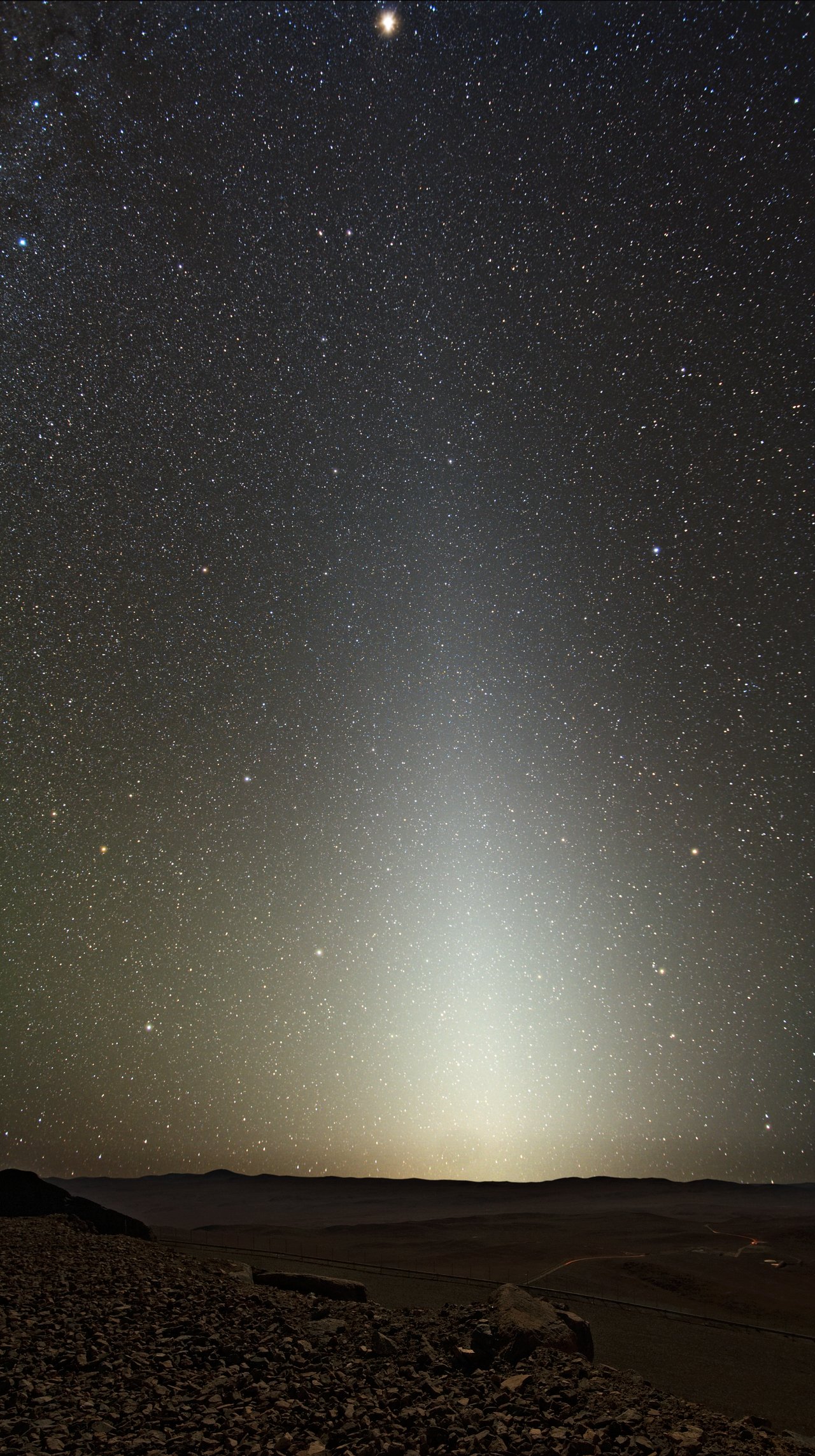
We have dust in our solar system — a huge cloud of it that permeates every corner. The dust itself is thought to be the product of many different processes including comet tails, collisions between asteroids, leftover debris from planetary formation, and gravitational collisions induced by planets. It’s small (on the order of 10–100 microns), made up of different silicates, and creates a noticeable triangle-shaped light that can be seen on the darkest nights (see Fig.1). This zodiacal dust is aptly named since the scattered light from the dust grains follows the line of the zodiac, or the ecliptic plane, across the sky. Its structure is quite complicated, with dust rings and trails and clumps near larger planetary bodies. For more information on the solar system’s zodiacal dust, you can read these bites here and here!
This zodiacal dust is not exclusive to the solar system. Other star systems, such as Tau Ceti and Vega, have been found to host similar clouds of interplanetary dust. This means planets imaged in these systems will also have emission from this dust mixed into the light that we observe from the planets. The Habitable Worlds Observatory (HWO) is a future space telescope mission under development by NASA. One of its primary science goals is to directly image 25 Earth-like planets in the habitable zones of nearby stars and look for signs of life (or biosignatures) in these planets’ atmospheres. Exozodiacal dust (aka exozodi) represents the biggest source of astrophysical noise that will need to be subtracted out from HWO observations of exoEarths. The authors of today’s article look at the potential impact of exozodi emission on the spectra of exoEarth atmospheres.
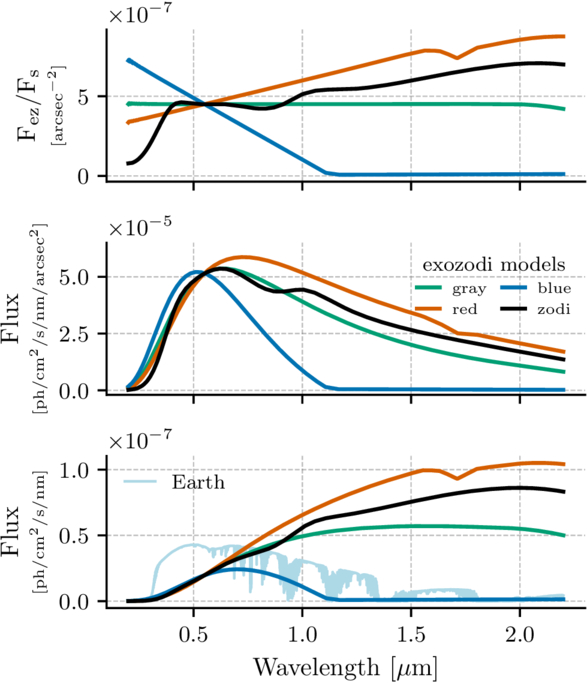
Figure 2: Different models of three “zodis” of dust observed at an inclination of 60 degrees plotted across HWO’s potential wavelength range. The gray scattering model is shown in green, the solar system’s model is shown in black, with the red and blue debris disk models shown in their respective colors. The top panel shows the flux contrast between the dust and the star. The middle panel shows the flux per area. The bottom panel shows the total flux captured with a 7.2-meter HWO with the thin blue line representing the spectrum of an Earth twin 10 parsecs (33 light-years) away for comparison. [Currie et al. 2026]
Show Me the Zodi
The authors first assume four different models of exozodi dust and how the dust’s emission changes with wavelength. The first model assumes a dust cloud that acts as a gray scatterer, meaning the particles scatter all wavelengths of light with no preference, and the second model’s dust acts just like the solar system’s does. However, it’s unknown whether the composition of exozodi will be the same as the solar system’s. Therefore, they adopt two more models of exozodi that act just like debris disks that have different compositions. One model is bluer in color because it is made up of smaller particles that preferentially scatter blue light, and the other model is redder in color because it is made up of bigger dust particles or different chemical compositions. Each of these models over HWO’s wavelength range can be seen in Figure 2. The authors then simulate a modern Earth atmosphere (both clear and 50% cloudy) as well as an Archean Earth atmosphere to understand how different exozodi models will affect observations of different exoplanet atmosphere conditions and compositions.
There’s Dust in My Spectra
In general, the effect that zodiacal dust has on the spectra of Earth-like planets can be broken down into two categories: its effect on the continuum and on the spectral features. The continuum is the object’s light emitted over all wavelengths and uninterrupted by spectral features. Spectral features are absorption and emission lines. These create either a dip or peak in the spectrum where atoms have either absorbed or emitted light at that particular wavelength. Lines at specific wavelengths tell us that a certain material is there, providing a list of possible chemicals that could be present in the planet’s atmosphere. For a brief summary of spectroscopy more generally, see here.
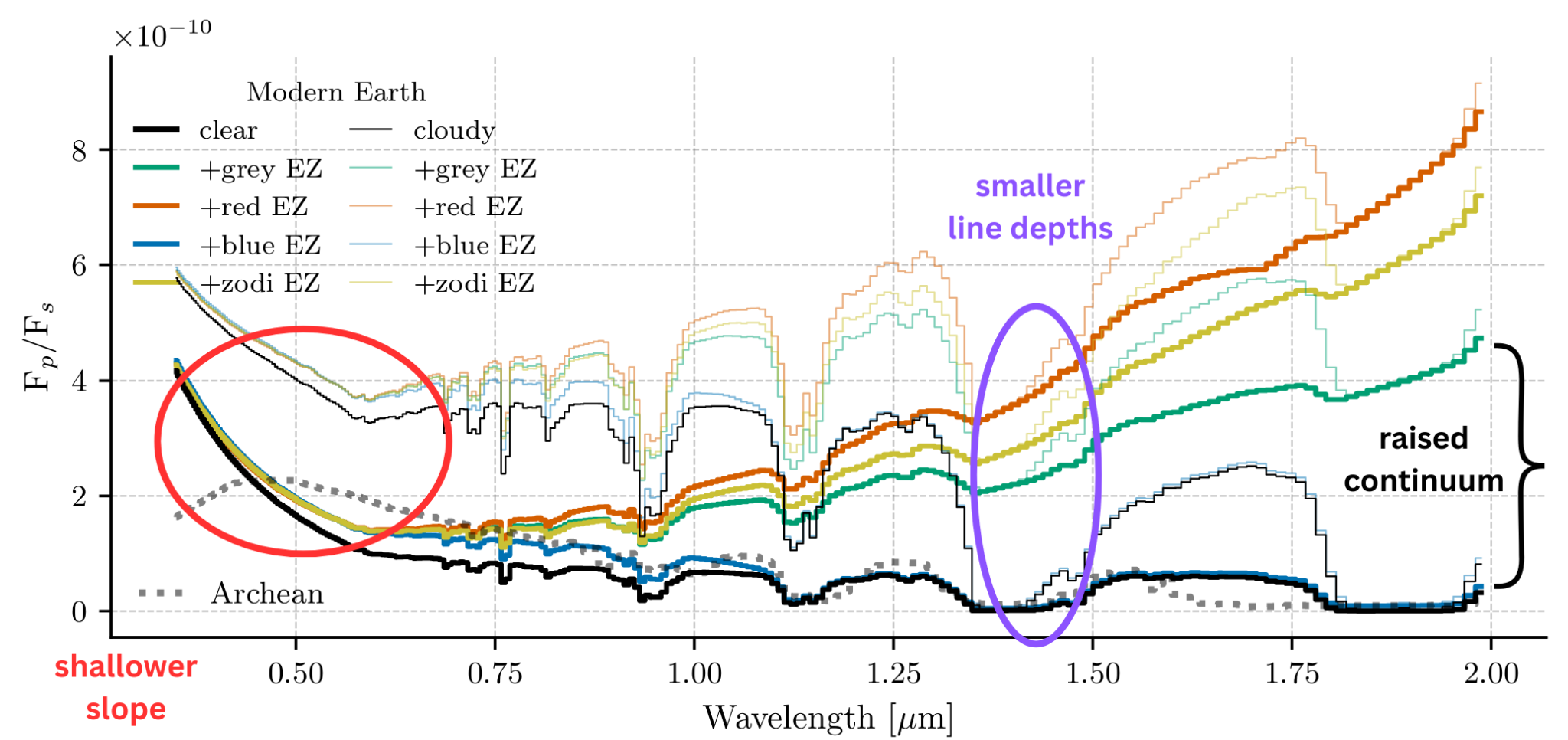
In the case of the continuum, exozodiacal emission raises the continuum, meaning the base flux of the planet is raised and absorption lines become more shallow. These effects can be seen in Figure 3, where the authors’ simulated spectra are plotted with and without zodiacal dust included. Not only is the continuum elevated for all models including zodiacal dust, notice how the dips become shallower at longer wavelengths. Because dust primarily radiates thermally, the red debris disk model nearly smooths out all dips beyond 1.25 microns! Molecules that absorb at these longer wavelengths, such as water or methane, may not be correctly identified with this type of exozodiacal emission.
Figure 3: Spectra of simulated modern-Earth atmospheres for clear (solid bright lines) and cloudy (solid dimmer lines) scenarios. The Archean Earth atmosphere is plotted in dotted gray. The redder exozodiacal spectrum has an elevated continuum and smoothed spectral features as opposed to the original, zodi-free spectrum plotted in black. [Currie et al. 2026, with annotations by Kaz Gary]
Additionally, the slope of the spectra between 0.25 and 0.75 microns (called the Rayleigh scattering slope) becomes shallower with zodiacal dust emission, which may bias our models toward lower-molecular-weight atmospheres. The slope at these wavelengths is dependent on the size distribution of molecules in the atmosphere, meaning it can tell us how much the average molecule in an atmosphere weighs.
From Figure 3, the effects of zodiacal dust are minimized with a bluer zodiacal dust model. This means systems with “bluer” zodiacal dust may be more optimal for HWO observations, as bluer dust does not scatter as much starlight as gray, solar system–like, or red dust. From their results, the authors recommend that the residual exozodi-to-planet flux ratio (in the V-band wavelengths) be kept to less than 10-2 in order to correctly understand the line depths (identify if a molecule is present or not) and 10-3 in order to accurately retrieve molecular abundances (understand how much of a molecule is present in the atmosphere). Dust is pesky enough here on Earth, but to find life on another planet like ours, we’ll dust have to deal with it.
Original astrobite edited by Anavi Uppal.
About the author, Kaz Gary:
I am a fourth-year PhD candidate at The Ohio State University with a passion for planets. My current work focuses on modeling exoplanet observations for the Habitable Worlds Observatory and understanding planetary atmospheres. Outside of research, I help develop planetarium shows and love all forms of science communication. In my free time, I enjoy playing tabletop RPGs, painting, watching terrible reality TV, and hanging out with my pet hedgehog.
A brand new observatory began its tenure on Aug. 30 — it's called the Nancy Grace Roman Space Telescope, and it's equipped with a high-tech tool that can directly photograph planets beyond our solar system.
The tool is called a coronagraph; in simple terms, a coronagraph is a device that can be affixed to a telescope and block out the light of a star the telescope is looking at to study features around that star. Without such a device, starlight can be so overpowering that it outshines details nearby. You can think of a coronagraph as a way to recreate a total solar eclipse, except instead of the moon blocking out the sun it's a humanmade mask of sorts that does that trick.
But while coronagraphs have been used many times before, the one that just launched toward the stars is unprecedented. "The Roman Space Telescope is carrying the most advanced coronagraph that humanity has ever put into space," Dominic Benford, the telescope's program scientist, told Space.com.
If you can remember the striking "Pale Blue Dot" image of Earth that NASA's Voyager 1 spacecraft captured while floating about 3.7 billion miles (6 billion kilometers) from the sun, this is the kind of thing scientists expect to see with Roman's coronagraph. A menagerie of Pale Brown Dots should soon make us feel the weight of our existence.
"I love the feeling of smallness that comes from understanding you're not alone in the universe," Vanessa Bailey, Roman's coronagraph instrument scientist, told Space.com.
Earth as a "pale blue dot" seen by Voyager 1 in 1990. (Image credit: NASA/JPL-Caltech)
How does it work?
Coronagraphs aren't really a new thing. Often, they're even used to study our own sun.
For example, NASA's PUNCH mission — which stands for Polarimeter to Unify the Corona and Heliosphere — launched in 2025 and consists of four spacecraft, one of which holds a coronagraph. This coronagraph blocks out the light of our sun in order to reveal the wispy tendrils of the sun's outer atmosphere, or corona.
"In fact, more than 100 years ago, astronomers used coronagraphs to create an artificial eclipse to study the sun's corona," Bailey said during a press briefing on Aug. 29, a day before Roman launched to space. "That's the reason for the name."
But when it comes to other stars, coronagraphs hold another purpose. They can block out a star's light in such a way that planets actually orbiting that star come into view.
"We can block that starlight until we have only a few parts per billion of the light of the star remaining," Benford said of Roman's coronagraph. As a result, he explained, "we can directly see the light bouncing off something like a Jupiter around another star, which we've never been able to do before."
NASA's Solar and Heliospheric Observatory, or SOHO, constantly observes the outer regions of the sun's corona using a coronagraph, which blocks the bright solar disk. (Image credit: ESA/NASA/SOHO)
This process will surely give us our Pale Brown Dots — but to take things a step further, scientists will also be able to dissect the light bouncing off the theoretical Jupiter to reveal what the atmosphere of the world is like, too.
To be clear, Roman isn't the only astronomy tool we have that utilizes a coronagraph while looking beyond our solar system. Even the James Webb Space Telescope and Hubble Space Telescope have their own, for that matter. However, Roman's is far more complex.
For one, the Roman's coronagraph doesn't exactly "block" out starlight like a standard coronagraph does. For the "moon" in its artificial eclipses, it uses a combination of patterned disks and special filters to create destructive interference with the light of a target star. Destructive interference means competing waves of light cancel one another out, leading to a zeroed amplitude. In effect, this blocks out the starlight as necessary and only allows light reflected off the planets of interest to pull through and reflect off the coronagraph's mirrors.
A diagram showing what the disk's pattern might look like. (Image credit: NASA's Goddard Space Flight Center)
The first active coronagraph
Which brings us to the next special part about Roman's coronagraph: It's the first "active" coronagraph to fly in space.
What this means is it can adjust those mirrors in real-time to make sure its exoplanet observations are as clear as possible. This is important because as light reflects off the coronagraph's mirrors, it can create small distortions that mess up the delicate destructive interference dance. You'd need to adjust to bring the balance back, and these adjustments are possible because Roman's coronagraph has hundreds of tiny pistons built into its mirrors. This makes them deformable so they can change shape to account for distortions.
If it all works out, this coronagraph should be capable of detecting exoplanets that are about 100 million times fainter than their stars.
"These deformable mirrors are a real engineering feat," Bailey said during the press briefing. "They can be commanded with the precision approaching the size of an atom, and this is what really allows us to make this transformative performance."
The Roman Space Telescope's coronagraph as scientists were working on it. (Image credit: NASA/JPL-Caltech)
As for what the specific hope is for Roman's coronagraph, Bailey explained there are a few nearby star systems the team is particularly interested in peering into because we have hints of Jupiter-like planets orbiting in those systems that still haven't been imaged. "Or," she said, "there may be really interesting remnants of dust and debris from the process of planet formation." Perhaps that dust could exist in the habitable zones of the stars Roman looks toward, and perhaps this could tell us more about the birth of planet Earth.
"That is interesting in its own regard but also interesting as a precursor to the Habitable Worlds Observatory," Bailey said, in reference to NASA's next great project that will be equipped with a more advanced version of Roman's coronagraph. "We can study how dusty these nearby systems are and understand whether any of them might have too much dust for us to be able to observe an Earth-like planet in the future."
An animation shows what Roman looks like deploying in space. (Image credit: NASA’s Goddard Space Flight Center Conceptual Image Lab)
While Roman will pretty much be focusing on Jupiter-like worlds because they're big enough to be detected with its current capabilities, HWO could certainly find another Earth someday.
From 6,000 exoplanets to 100,000
And before we wrap up, we must briefly mention this newly christened exoplanet hunter's partner tool, the majorly impressive Wide Field Instrument (WFI) that can survey huge swaths of sky in one go. It is because of the partnership between the WFI and its coronagraph that Roman will immensely expand our exoplanet gallery, says associate administrator for NASA's Science Mission Directorate Nicky Fox. The coronagraph won't be finding new exoplanets alone, but rather will be diving deeper into exoplanets the WFI finds first.
The Roman Space Telescope's WFI. (Image credit: NASA/Chris Gunn)
WFI will use two different techniques to contribute to our gallery. The first one is called the transit technique, and it's the same method big names like Kepler and TESS tapped into. It involves noticing dips in starlight that happen when a possible planet transits the face of a star from the telescope's vantage point. "If you see that happen multiple times," Fox said, "you can infer that it's a planet, and you can get the radius and the size of the planet from that observation."
The second technique has to do with gravitational lensing, which refers to how objects with mass in space (and therefore gravitational influence) can warp the very fabric of spacetime and alter the path of light traveling through the affected region. What comes to mind might be a mighty galaxy cluster twisting spacetime like a sheet of satin, but little things like stars and planets can do it, too. The so-called "microlensing" effect of smaller objects warping spacetime leads to the brightening of background objects.
Fox sums up WFI's two techniques in a nutshell: "If you see a little dip, that can suggest there's a transiting planet. You see a little brightening, that can suggest there's a microlensing planet."
For WFI, the microlensing technique will be sensitive to Earth-size planets in the habitable zones of their stars, while the transiting technique will be more sensitive to planets closer to their stars. And as Bailey reminds us, there are absolute heaps of planets to test Roman out on: "When you look up at the night sky, most of those stars have planets."
Right now, we only know of about 6,000 of those worlds. Fox believes this new space telescope could unveil 100,000 more.
Wouldn’t a free-floating planet eventually cross paths with a star or even a black hole and start revolving around it? YinToronto, Ontario Free-floating planets (FFPs) or rogue planets are bodies that move through space by themselves, not locked into an orbit around a star. While some may have begun as typical planets flung out ofContinue reading "Why aren’t free-floating planets captured when they fly past stars?"
Beyond the solar system, the line between planet and star can get blurry. Astronomers call objects that fall between the size ranges of planets and stars substellar objects. One type of substellar object, called a brown dwarf, forms from collapsing gas clouds like a star, but is not quite massive enough to fuse hydrogen in its core. Some can briefly fuse a heavier form of hydrogen, known as deuterium, in their cores, though never enough to produce starlight. Others are small and cold enough to develop complex atmospheres.
Recently, astronomers discovered a new type of substellar object in a star-forming region of the Milky Way Galaxy called IC 348. Using observational data from the JWST’s Near InfraRed Spectrograph (JWST NIRSpec), they found objects 0.2% to 1.2% the mass of the Sun that float freely like stars but have carbon-containing molecules called hydrocarbons in their atmospheres. Because these objects are smaller than known brown dwarfs and have evidence of hydrocarbons, scientists refer to them as H-type objects.
To investigate what H-type objects are and where they fit within the spectrum of substellar objects, researchers Richard J. Parker and Catarina Alves de Oliveira analyzed survey data on stars and substellar objects in IC 348, then conducted follow-up simulations to uncover how H-type objects formed. The main question they asked was whether H-type objects form from collapsing gas clouds, like brown dwarfs and stars, or develop around host stars before being ejected and drifting freely through space, like planets.
First, they reviewed the observational records of IC 348 obtained with the JWST NIRSpec and the near-IR spectrograph SpeX at the NASA Infrared Telescope Facility. IC 348 has 495 stars and brown dwarfs combined, as well as 9 H-type objects. Estimates for the age of this star-forming region range from either 1 to 3 million years or 5 to 6 million years, depending on how different teams calculated it. From there, Parker and Alves de Oliveira compared where the stars, brown dwarfs, and H-type objects were located within the cluster. They found no unique spatial distribution among the 3 types of objects.
Then, the team simulated the evolution of IC 348 over 10 million years to determine which initial conditions would result in a spatial distribution closest to the survey data. They simulated an initial giant gas cloud and used a mathematical function to distribute its mass among the 495 constituent objects. The researchers then placed a Jupiter-sized planet around each simulated star that was approximately the Sun’s mass to determine whether they could grow and escape their home star and become H-type objects. They also repeated the simulations by placing the Jupiter-sized planets at distances from the Sun similar to those of Earth, Jupiter, and Neptune, and varied the sizes and star densities of the simulated IC 348 regions.
They found that if Jupiter-sized planets orbited their stars at roughly Jupiter’s distance from the Sun, then 5 to 15 of them could escape their stars in a region like IC 348, which would roughly match the number of known H-type objects. However, the escaped planets were distinctly more spread-out than the observed H-type objects, which share a similar spatial distribution with the cluster’s stars and brown dwarfs. Since the simulations did not match the observed distribution, the researchers suggested that these H-type objects are likely a new sub-category of very small brown dwarfs rather than escaped planets.
Although this study favors a brown dwarf origin for H-type objects, the exact details of how they formed remain up for debate. Astronomers still have multiple competing theories about how ordinary brown dwarfs form. Perhaps they are ejected from their gas cloud before fully forming, have their outer layers stripped by radiation from a nearby massive star, or simply form like stars on a slightly smaller scale. Regardless, future researchers will continue to explore this murky area of substellar astronomy.
Searching for Another Earth with the Nancy Grace Roman Space Telescope
In NASA’s mission fact sheet, Roman’s planners pose several questions. These include:
How common are solar systems like our own?
What kinds of planets exist in the cold, outer regions of planetary systems?
What determines the habitability of Earth-like worlds?
Although scientists have used several methods to detect exoplanets, including Earth-like planets, Roman will employ three. These include the transit method, microlensing, and direct imaging. NASA said the combination of approaches will allow mission scientists to conduct a “sweeping search expected to uncover around 100,000 new exoplanets — a staggering leap compared to the nearly 6,200 currently known.”
“It is hoped that Roman will discover thousands of new exoplanets and significantly expand our knowledge of the diversity of planetary systems in our Galaxy,” explained Associate Professor Edita Stonkutė, an astrophysicist at Vilnius University unconnected to the Roman team, in a statement emailed to The Debrief.
Microlensing Can Reveal Earthlike Planets Orbiting Sunlike Stars
Most exoplanets have been detected by the dimming of their host star when they transit between it and Earth, giving the transit method its name. Roman plans to use that same method for most of its larger planetary detections. However, among the expected tens of thousands of transit-method detections, mission planners expect a small but sizeable percentage to come from microlensing.
NASA said the “light-bending” microlensing phenomenon occurs when two distant stars “align closely from our vantage point.” Due to the strength of the nearer star’s gravity, the light from the more distant one is “warped” around the nearer one, essentially focusing it very briefly for a distant observer.
“If the alignment is especially close, the nearer star acts like a cosmic lens, focusing and magnifying light from the background star.” Professor Stonkutė explained. “By analysing these changes, astronomers can determine that the planet exists and estimate its mass and orbital characteristics.”
Critically, Professor Stonkutė also noted that microlensing can occur with objects other than stars, including exoplanets.
“This is Precisely Where Roman Has the Edge”
Using its Wide-Field Array, Roman will monitor hundreds of millions of stars. NASA said the observatory will monitor these target stars for “tiny surges in starlight” that typically signal a microlensing event.
Although the transit method is employed to detect larger exoplanets, NASA noted that microlensing “specializes in finding planets like those in our solar system.” The space agency added that this includes “worlds as lightweight as Mars in their star’s habitable zone or farther out.”
A star’s habitable zone is typically defined as the orbital plane where an exoplanet could sustain liquid water on its surface, a key ingredient for life as we know it.
Professor Stonkutė described microlensing as “particularly valuable” since it can detect planets that are difficult to spot with other planet-hunting methods. The professor said this includes “small Earth-like planets located far from their star.” The Roman team hopes to find “more than 1,000 microlensing planets.”
The professor warned that “most microlensing events cannot be predicted in advance.” As a result, telescopes need to actively scan large areas of the sky to increase the chances of a microlensing detection
“This is precisely where Roman has the edge over other telescopes that have searched for exoplanets using different methods,” the professor added.
A “Stepping Stone” Toward NASA’s Habitable Worlds Observatory Concept
While Roman is tasked with directly imaging exoplanets, finding another Earth around a Sun-like star will still require an indirect detection, most likely from a microlensing event. However, the Roman team notes that their observatory “will provide a crucial stepping stone for NASA’s Habitable Worlds Observatory concept.”
According to the space agency, that “flagship” telescope, still awaiting final approval, “would be designed to photograph Earth-like planets for the first time ever.”
Roman may also be able to scan the atmospheres of planets detected with the transit method. The space agency said Roman “would also look for signs of life called biosignatures by measuring atmospheric gases like oxygen and ozone that could signal the presence of living things.”
Christopher Plain is a Science Fiction and Fantasy novelist and has spent the last six years as Associate News Editor and Head Science Writer at The Debrief. Follow and connect with him on X, learn about his books at plainfiction.com, or email him at christopher@thedebrief.org.
Artist’s concept of the Nancy Grace Roman Space Telescope (Credit: NASA).
Welcome to this special edition of The Intelligence Brief… This week, NASA is preparing to launch the Nancy Grace Roman Space Telescope, its next flagship space observatory and a mission poised to transform our understanding of distant worlds and some of the universe’s greatest mysteries. In our analysis, we’ll be looking at 1) how Roman’s powerful Wide Field and Coronagraph instruments will survey the cosmos on an unprecedented scale, 2) how the telescope could discover thousands of new exoplanets—including elusive rogue worlds—and directly image planets around other stars, 3) how Roman will survey more than a billion galaxies in search of new clues about dark matter and dark energy, and 4) why its combination of Hubble-like image quality and an enormously wider field of view could usher in a new era of astronomical discovery.
Quote of the Week
“We are poised at the brink of unfathomable scientific discovery.”
– Julie McEnery, Roman’s senior project scientist at NASA Goddard
If you enjoy the news and perspectives offered by The Debrief, make sure that you aren’t missing our stories by making us one of your “preferred sources” on Google News. You can simply follow this link to add The Debrief to your list of favorites, and you can read more about Google’s preferred sources in our article here.
Get all the latest stories from The Debrief, with more breaking stories at the end of this week’s newsletter.
NASA’s Nancy Grace Roman Space Telescope Prepares for Lift-Off
On Sunday morning, NASA will set a new milestone with the launch of the Nancy Grace Roman Space Telescope, setting the course for discoveries that may include new insights into some of the universe’s greatest mysteries.
As NASA’s next flagship space observatory, this powerful new telescope is designed to discover thousands of distant worlds while also probing the lingering mysteries of dark matter and dark energy. Named after Nancy Grace Roman, NASA’s first chief of astronomy and an early advocate for the efforts that led to the launch of the Hubble Space Telescope, the new space observatory bearing her name is poised to offer one of the most detailed views of our universe ever captured.
Scheduled to lift off aboard a SpaceX Falcon Heavy rocket on August 30, 2026, at 7:26 a.m. EDT, the Roman telescope’s mission is comparable in ambition to those of the Hubble and James Webb Space Telescopes, but also very different in many respects. Here’s a look at what to know about this historic mission, what it may help researchers uncover, and why it could set the pace for a range of important scientific advancements in the coming years.
Roman’s Historic Mission to Observe the Cosmos
At the heart of its mission, Roman will offer astronomers a remarkably wide view of the cosmos. Surveying immense portions of the sky, the powerful instruments on board the telescope will capture high-resolution imagery comparable to Hubble at certain optical and infrared wavelengths—imagery that could dramatically reshape scientists’ understanding of both planets and the universe they inhabit.
In terms of the technologies it will carry with it into space, Nancy Grace Roman Space Telescope will rely on two primary instruments: its Wide Field Instrument (WFI) and Coronagraph Instrument. The WFI is equipped with a 300-megapixel near-infrared camera enabling wide-area imaging and spectroscopy, allowing Roman to conduct large-scale surveys with great precision and sensitivity—all of which make it ideal for use in the hunt for dark energy, exoplanets, and other hard-to-spot cosmic phenomena.
Meanwhile, Roman’s Coronagraph Instrument is designed specifically for imaging and studying exoplanets. Equipped for both imaging and spectroscopy, the coronagraph will suppress the overwhelming glare of distant stars, potentially making much fainter planets orbiting nearby visible. According to NASA, Roman’s powerful Coronagraph will be the first instrument deployed on a space observatory to leverage “numerically optimized, precision-fabricated coronagraph masks.”
By suppressing the overwhelming glare of distant stars so that much fainter planets around them become visible, Roman’s Coronagraph could achieve as much as 100 times the performance of existing facilities, offering a promising chance that some of the faintest planets in the cosmos—some as much as a billion times fainter than their host stars—could become visible.
With a little luck, Roman could also break new ground with the first direct imagery of an exoplanet possessing rings. Going beyond its immediate discoveries, the coronagraph will also demonstrate technologies that could eventually be incorporated into future observatories, including NASA’s proposed Habitable Worlds Observatory.
A New Era of Planet Hunting
Presently, astronomers have confirmed roughly 6,000 planets beyond our Solar System. However, once Roman’s mission gets underway, that number could see a dramatic increase.
One of the ways it will achieve such landmark detections will be with the help of gravitational microlensing, which relies on detecting how the gravity of a foreground object can magnify light from a source much farther away. Using microlensing alone, there is a good chance Roman may discover several hundred—but more likely thousands—of planets, which may include worlds small enough that they have eluded previous detection using existing methods.
Along with the planets it discovers, astronomers anticipate that Roman will also find several new additions to the growing catalog of “rogue planets,” mysterious planetary bodies that wander through the cosmos without orbiting a star.
Additionally, NASA says that anywhere from 60,000 to 200,000 additional candidate planets could be revealed through transit observations, though only a fraction of these are expected to be confirmed through additional observations.
Mapping the Dark Universe
Arguably, one of the most significant components of Roman’s mission involves its study of the unseen side of the cosmos: the mysterious phenomena known as dark energy and dark matter.
In search of answers to such mysteries, Roman will soon begin scanning more than a billion galaxies as it maps the structure and evolution of the universe throughout cosmic history, providing data that will at the very least help researchers narrow down the most promising interpretations among a range of competing explanations for dark energy.
Simultaneously, the telescope will probe dark matter, the unseen material whose gravitational effects are currently needed to explain phenomena in our universe that include the motions of galaxies, as well as the evolution of some of the largest structures in the cosmos.
Hubble’s Vision, But at Far Greater Scale
In many ways, what Roman is expected to achieve will be comparable to its predecessor, the Hubble Space Telescope, although at a far greater scale.
At some wavelengths, Roman will be capable of producing images that approach the clarity of Hubble’s iconic views of our universe, all while capturing as much as 100 times more of the sky with each observation. By capturing more of the sky with each image it produces, Roman’s efforts to map the universe could occur at a remarkable pace—perhaps a thousand times faster than those of its predecessor.
A Historic Mission Lifts Off This Sunday
If all goes according to plan, Roman will be launched aboard a SpaceX Falcon Heavy rocket at 7:26 a.m. EDT this Sunday, Aug. 30. NASA will begin live coverage of Roman’s launch on Sunday at 6:20 a.m. Eastern Time, and you can follow the updates online with NASA’s free streaming platforms.
Once it lifts off, Roman will be carried 930,000 miles from Earth to the Sun-Earth Lagrange Point 2 region, which is the same location where the James Webb Space Telescope is currently operating. After it reaches orbit, for the next 90 days, Roman will undergo commissioning, after which science operations are expected to begin sometime in early 2027.
The observatory’s primary mission will last five years, although Roman could potentially remain operational for more than a decade, offering astronomers an unprecedented look at our universe and possibly a few answers to some of the most baffling questions about our universe.
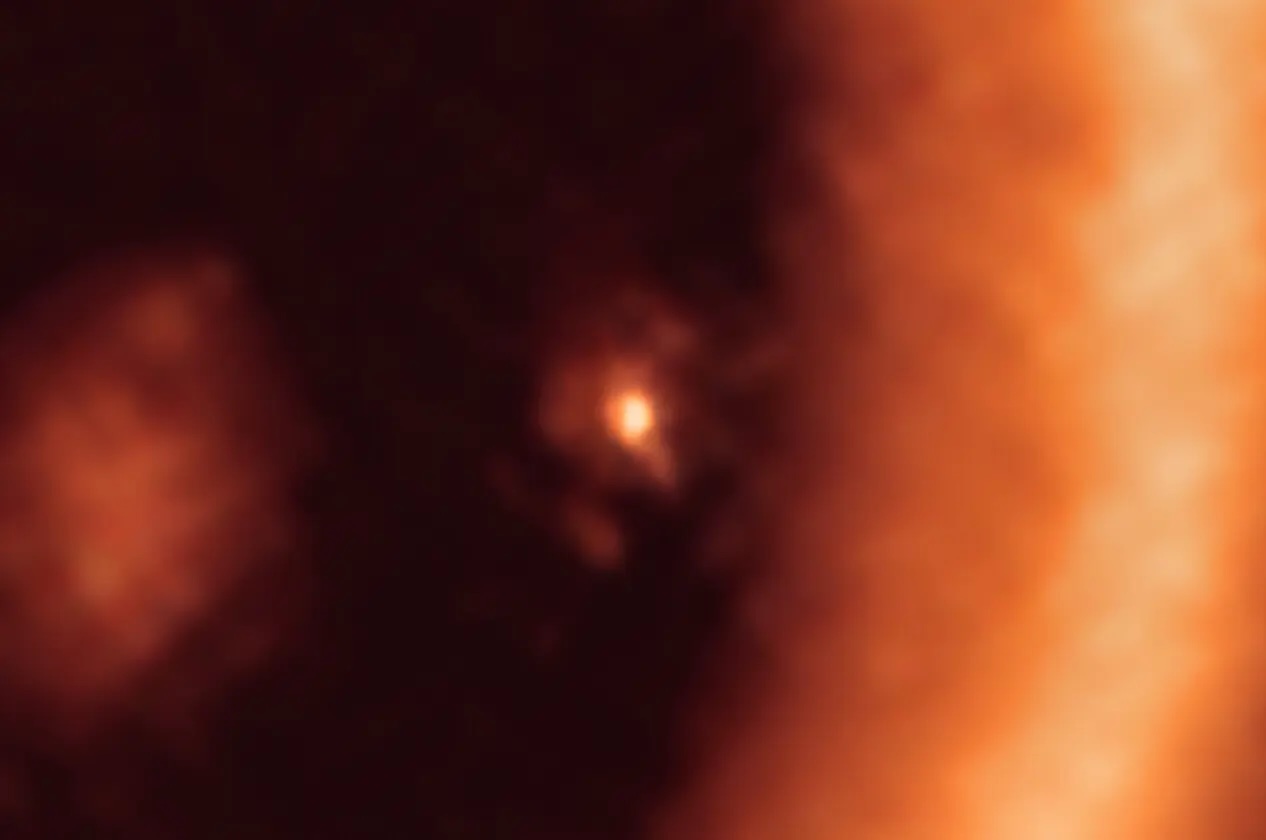
New research suggests that the circumplanetary disk surrounding the exoplanet PDS 70c contains a ring of dense dust, and the conditions within this ring may allow baby moons to form.
The young star PDS 70 has become famous for its protoplanetary disk and its two growing giant planets, PDS 70b and PDS 70c. At least one of these planets is surrounded by a disk of its own; in 2019, researchers using the Atacama Large Millimeter/submillimeter Array (ALMA) reported the first-ever observation of a circumplanetary disk around PDS 70c, and later observations with ALMA brought clearer views of this disk.
There’s still debate over the exact source of the emission detected by ALMA. Does this emission come from dust, and if so, how is the dust distributed? Is the disk optically thick or optically thin? Does the emission even come from dust, or could it instead be free–free emission from unbound electrons navigating a charged-particle maze?
Dust Diagnosis
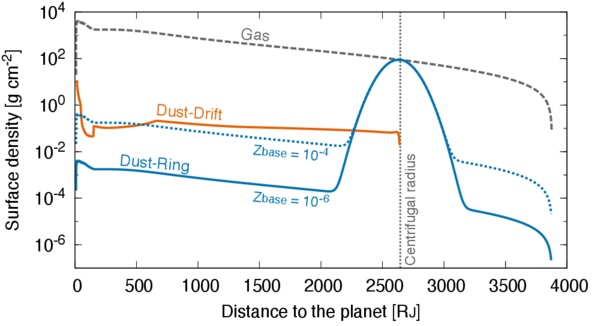
Yuhito Shibaike (Kagoshima University) and collaborators recently examined the hypothesis that the emission from PDS 70c’s circumplanetary disk arises from dust distributed in an optically thick ring. To test this hypothesis, the team explored two possible dust distributions, which they call “drift” and “ring.” In the drift model, dust grains within the circumplanetary disk migrate inward toward the planet, leaving much of the disk optically thin. Modeling suggests that this migration is typical in protoplanetary disks, and it might be common in circumplanetary disks as well.
Dust and gas surface density for the modeled disks in the drift (orange) and ring (blue) models. Click to enlarge. [Adapted from Shibaike et al. 2026]
In the ring model, the dust grains are concentrated within an optically thick ring at a certain distance from the planet. Simulations suggest that the formation of this type of dust ring is feasible, arising from a localized increase in gas density, outflows, or other causes.
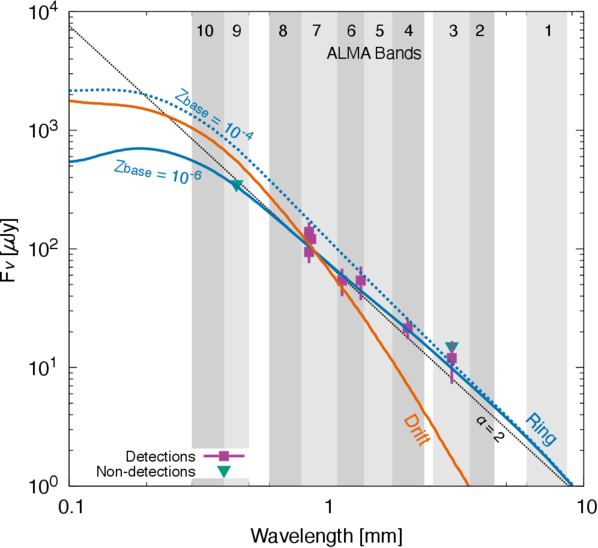
Shibaike and coauthors found that the ring model naturally reproduced the observed spectral energy distribution for a range of reasonable parameters. The drift model, on the other hand, required an unrealistically high dust-to-gas ratio for the material accreted onto the circumplanetary disk from the parent protoplanetary disk to reproduce the observed spectral index.
Future Prospects and Moon-Making Possibilities
Comparison of ALMA observations (colored symbols) and model predictions (colored lines) from the drift (orange) and ring (blue) models. Click to enlarge. [Adapted from Shibaike et al. 2026]
This work demonstrated the feasibility of the dust-ring model, but it didn’t rule out a contribution due to free–free emission from unbound electrons, which has also been proposed to explain the disk’s appearance. The team noted that distinguishing between thermal dust emission and free–free emission is challenging with existing data, as the two sources produce spectral energy distributions with similar shapes.
Luckily, this likely won’t remain a mystery forever: the next-generation Very Large Array, which is anticipated to begin full science operations in the mid-2030s, should be able to resolve the location of the dust within the circumplanetary disk and illuminate the source of emission.
Finally, if the dust surrounding PDS 70c is concentrated within a ring, what does that mean for the possibility of moons forming within the disk? Shibaike and collaborators found that the conditions within the ring likely satisfy the requirements of both the streaming instability and the gravitational instability, which are required for dust grains to clump together and form the rocky building blocks of baby moons. Perhaps the PDS 70 system will one day be the site of not only a circumplanetary disk, but an exomoon as well!
Citation
“Interpreting ALMA Multiwavelength Continuum Observations of PDS 70 c: An Optically Thick Dust Ring in the Circumplanetary Disk,” Yuhito Shibaike et al 2026 ApJL1006 L26. doi:10.3847/2041-8213/ae86f5
Ultra-hot Jupiter WASP-121b is once again puzzling astronomers. New JWST observations have revealed aspects of this superheated planet’s atmosphere that models cannot yet explain.
An Extreme Planet
Among the more than 6,000 known exoplanets, there are many types of worlds that aren’t represented in our solar system. The most exotic and unfamiliar planets might be the ultra-hot Jupiters: giant planets nestled so close to their host stars that they are tidally locked, with temperatures on their permanently starlit sides climbing to thousands of degrees.
WASP-121b, which circles its F-dwarf host star every 30.5 hours, is one of the best-studied ultra-hot Jupiters. Previous work has started to reveal the complexity of its atmosphere, and now, data from JWST have opened a new window onto WASP-121b’s behavior.
New View from JWST
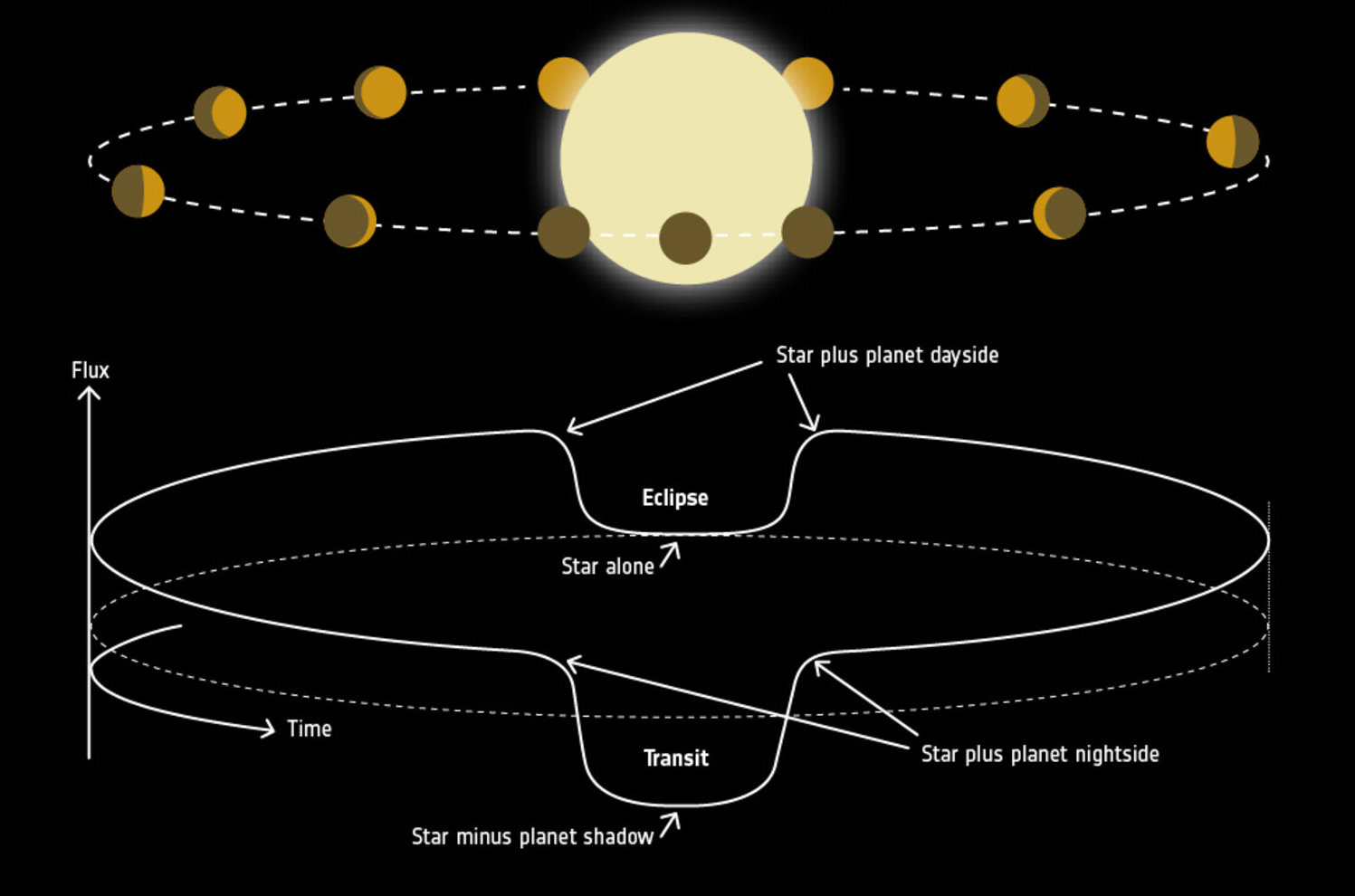
A representation of an exoplanet’s phase curve. Click to enlarge. [ESA]
To learn more about WASP-121b’s atmosphere, Robert C. Frazier (University of Michigan) and collaborators analyzed JWST Near Infrared Imager and Slitless Spectrograph (NIRISS) observations covering more than one full orbit of the planet. These observations allowed them to construct the system’s phase curve, which describes the total amount of emitted and reflected light from the planet and its host star over an entire orbit.
The team used two 3D general circulation models to predict the planet’s atmospheric structure and extract synthetic spectra and phase curves to compare against the JWST observations. Using nine model configurations in total, the team varied several inputs, including sources of atmospheric opacity, sources of atmospheric drag, and assumptions about whether clouds are able to form on the planet’s cooler nightside.
Left with a Mystery
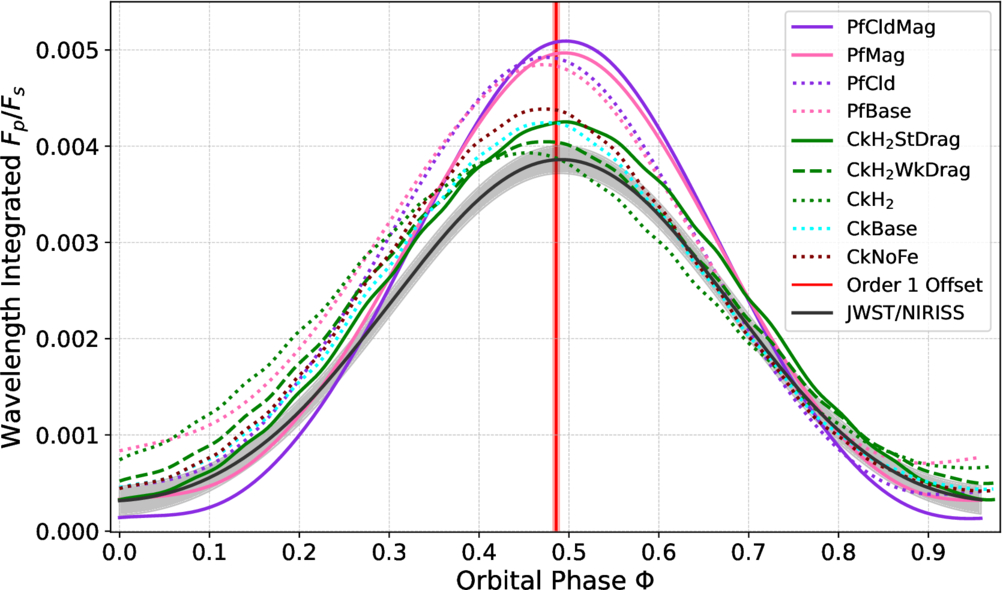
Frazier and collaborators found two aspects of WASP-121b’s phase curve that their models couldn’t explain: the planet emits less light overall than predicted, and the location of its phase-curve offset changes with wavelength.
Modeled phase curves, shown as the flux of the planet divided by the flux of the star, for WASP-121b (colored solid and dotted lines) compared to the best fit to the JWST observations (black line). Click to enlarge. [Frazier et al. 2026]
The models predict, on average, 12–15% more emission from the planet than observed. This discrepancy might be traced back to how the planet’s radius is determined, which is a simple-sounding task that can be deceptively difficult; WASP-121b isn’t perfectly spherical, and its emitting area changes with wavelength, making it challenging to normalize the planet’s radius for use in models.
The phase-curve offset is the difference between a planet’s sub-stellar point (where the star is directly overhead) and the brightest point in the planet’s atmosphere. In general, some degree of offset is expected because planetary winds tend to whisk heat away from the sub-stellar point, placing the brightest point somewhere to the east (usually). For WASP-121b, the offset is unexpectedly small — suggesting a source of drag in the atmosphere that prevents winds from transporting heat away from the sub-stellar point — and it’s larger at shorter wavelengths. This wavelength dependence isn’t predicted by any of the models, and it’s not clear what causes it.
These results demonstrate something remarkable: that our observations of a planet nearly 900 light-years away have become so precise that they’re pushing our already complex models to include more physics — an exceptionally exciting motivation for model improvement!
Citation
“The Days Drag On on WASP-121 b: Interpreting Its NIRISS Spectroscopic Phase Curve with General Circulation Models,” Robert C. Frazier et al 2026 ApJ1004 102. doi:10.3847/1538-4357/ae69ca

 Login