
❌

Normal view

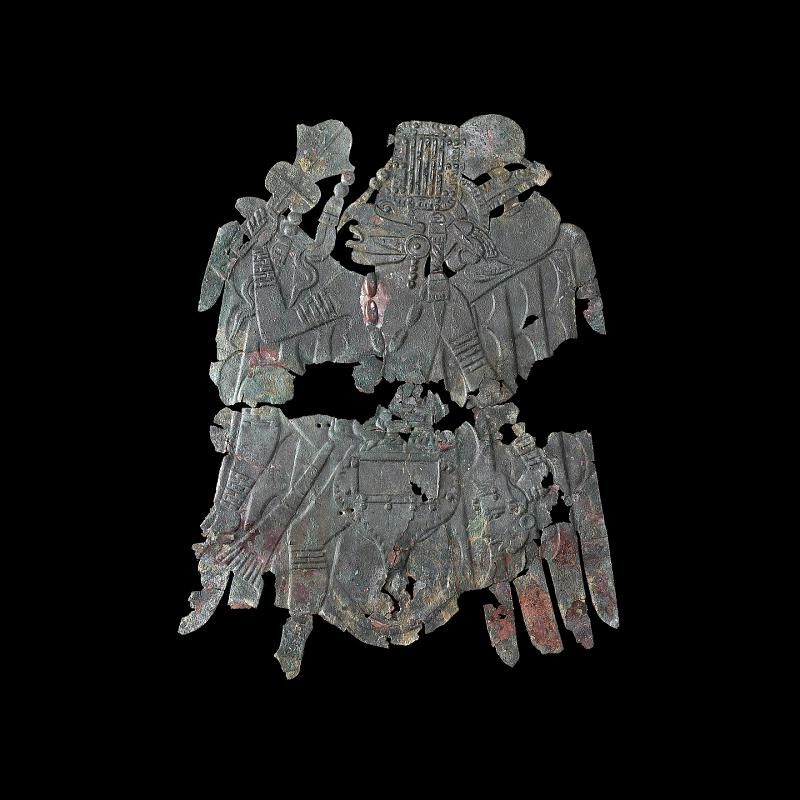
'Birdman' copper plate: A 700-year-old depiction of a Native American warrior that may be a woman holding a weapon and a severed head

a copper plate in the shape of a human wearing a bird costume against a black background

This hammered copper artifact depicts an Indigenous person wearing a bird costume and holding a severed head and a mace. (Image credit: Smithsonian National Museum of Natural History (CC0))
QUICK FACTS

Name: "Birdman" copper plate

What it is: A copper plate with a hammered decoration

Where it is from: Cahokia Mounds, Illinois

When it was made: 13th century

This copper plate was discovered in the late 19th century in a prehistoric Native American burial at the Etowah Indian Mounds archaeological site in Georgia, but it was likely made hundreds of miles away at Cahokia Mounds in Illinois. While the decorative plate showcases long-distance trade and a shared ritual culture among early Indigenous groups in the southeastern United States, the nature of the human figure depicted on the artifact has been debated for over a century.

The "Birdman" relic is one of two hammered copper plates that Smithsonian archaeologist John P. Rogan unearthed in the 1880s while digging in a burial mound at Etowah, a centuries-old village occupied by thousands of Native Americans from 1000 to 1550. Etowah was part of the "mound-building," or Mississippian, phase of Indigenous occupation; other famous sites include Moundville in Alabama and Cahokia in Illinois. These groups had extensive trade networks and shared a common artistic and ceremonial tradition known as the Southeastern Ceremonial Complex.

This copper artifact, known as Rogan Plate 1 or the "Birdman" plate, is in the collection of the Smithsonian National Museum of Natural History in Washington, D.C. The plate is roughly 11 inches (28 centimeters) tall and had been buried with a high-status person who likely died at Etowah in the mid-14th century. But experts believe the copper plate was an heirloom made decades earlier, at Cahokia, and traded south to Etowah.

A human figure dominates the copper plate with its elaborate bird costume. The person carries a severed head by the hair in their left hand, while their right hand holds a club or mace. The figure also wears a pleated skirt or loincloth that may have been made from human scalps. This bird-human figure is commonly depicted in the Southeastern Ceremonial Complex and has been called a dancing warrior, eagle warrior, eagle dancer, hawk dancer, falcon dancer and falcon warrior. But more often, the figure is called Birdman or Morning Star, a prehistoric Mississippian hero associated with agriculture and rebirth.

Archaeologists' interpretations of the Birdman plaque from Etowah have long assumed that the represented figure is a male warrior. In a 2004 study, for example, archaeologist Adam King wrote that "this plaque would have served as an emblem of office awarded to a chieftain, and would have accompanied him as a sign of his strength among the ancestral spirits."

But the sex of the skeleton in the Etowah burial is unclear, and there were high-status graves of both men and women at Etowah, archaeologist Billie Follensbee and art historian Katie Buford wrote in a 2017 study. Although experts previously assumed that both Rogan Plate 1 and Rogan Plate 2 represented male warriors, Follensbee and Buford found that the figures have slender bodies with prominent right breasts, suggesting the "Birdman" may have actually been female.

"A female bird-human warrior could have represented a gender variant individual in the form of the well-known Native American phenomenon of the 'manly-hearted woman,' a woman who has assumed the usually male role and the garb of a combat soldier," Follensbee and Buford wrote. In addition to the historic term "manly-hearted woman," third-gender or gender-variant individuals in Indigenous North America are often referred to as "two-spirit," a broad term Indigenous people coined in 1990 to describe people who take on gender-nonconforming roles.

The commemoration of a two-spirit individual on a copper artifact, as well as the use of the artifact as a high-status grave good, "not only demonstrates the Native American cultural acceptance of such gender variant roles but also further serves to celebrate the elite status and achievements of these 'manly-hearted women,'" Follensbee and Buford wrote.

For more stunning archaeological discoveries, check out our Astonishing Artifacts archives.

a ceramic urn with a person dressed like a jaguar surrounded by four human skulls

Jaguar Urn

a tall bronze shield with red roundel decorations against an orange background

Battersea Shield

a humanlike gold mask against an orange background

Java Mask

Can you put together last week's Astonishing Artifact?

Archaeologists discover the oldest dwelling in the Western Hemisphere at a 13,800-year-old site in Alaska

Archaeologists digging at a 13,800-year-old site in interior Alaska have unearthed thousands of artifacts and fossils, including what may be the bones of the earliest domesticated dogs in the Americas, the earliest needles and dwellings in the Western Hemisphere, and stone tools that reveal cultural connections across the Bering Land Bridge.

At a site called Shégˊ Xdaltthˊíˊ (which means "They Were There" in the Alaska Native Athabascan language), about 34 miles (55 kilometers) southeast of Fairbanks, archaeologists have excavated an encampment that some of the first people to settle in North America used off and on for a millennium.

Shégˊ Xdaltthˊíˊ is located in eastern Beringia, the geographical region that connected northeast Asia and northwest North America during the last ice age. The most recent archaeological and genetic studies suggest that the ancestors of today's Indigenous Americans entered the continent around 21,000 years ago. But since Beringian sites are often the remains of small seasonal hunting camps and are scattered across a large geographic area, much is still unknown about the earliest people who called the Western Hemisphere home.

"I expected we'd find hunting tools and knapping [stone tool making] debris surrounding a hearth or two, but I had no idea that we'd stumble into a base camp with tens of thousands of artifacts," study first author Kelly Graf, an archaeologist at the University of Kansas, told Live Science in an email. "It was a total surprise!"

In a study published Wednesday (Oct. 14) in the journal Science Advances, Graf and co-authors detailed their discoveries at Shégˊ Xdaltthˊíˊ, focusing on the earliest occupation, which occurred around 13,800 years ago, as evidence of people "settling in" to their new territory.

The researchers found a hearth, a small pit, and a dirt stain where a wooden post had once stood, likely the remains of a lean-to or early tent house. Additionally, the archaeologists unearthed stone tools, bone needles and a pendant made from an antler. Nearby, they found an earth oven, which was full of charcoal and animal bones and was likely used to slow-cook meat for a large family group.

"The complex feature at Shégˊ Xdaltthˊíˊ represents the earliest potential case of a habitation structure in North America," the researchers wrote in the study. "Early Alaskans knew their surroundings well."

Cross-cultural links

The archaeologists were also surprised by the stone tools recovered at Shégˊ Xdaltthˊíˊ because they are distinctively shaped and unique to central Alaska. Known as diamond-shaped hafted bifaces, the tools were crafted from rhyolite and basalt and are similar to those typically found much farther west in Beringia, in modern-day northern Siberia. Additionally, obsidian artifacts discovered at Shégˊ Xdaltthˊíˊ reveal that people brought the volcanic rock to the site from a geological source hundreds of miles to the northwest.

Bones from more than a dozen wolf-like animals suggest a further connection to Asia, according to the researchers. An analysis of the jaw of one of the animals showed that it was not from a dire wolf (Aenocyon dirus) or from a Pleistocene Beringian or gray wolf (Canis lupus sp.) but rather a population of wolf-like animals unique to central Alaska. Current genetic evidence suggests that early domesticated dogs in North America came from Siberian wolves. The timing and geographical location of Shégˊ Xdaltthˊíˊ provides circumstantial evidence that the people may have been dog owners.

"Like humans, potentially, the canids of Shégˊ Xdaltthˊíˊ and other early Alaskan sites were recent immigrants from Asian Beringia," the researchers wrote.

Although Shégˊ Xdaltthˊíˊ reveals a relationship with sites in Asia, there is also evidence of connections with early American sites south of the Canadian ice sheets, according to the study.

One clue to these connections is the presence of bone artifacts in a sewing kit. The archaeologists found eight bone needle fragments at Shégˊ Xdaltthˊíˊ. Previously, the only recovered eyed needles had come from Paleoindian sites in temperate North America. Therefore, the needles from Shégˊ Xdaltthˊíˊ are the oldest needles ever discovered in the Western Hemisphere, and they reveal connections with sites farther south, according to the study.

Another clue is the pendant, which was crafted from antler. The pendant had a hole drilled at one end and was fashioned into a point at the other end. This piece of ancient jewelry is similar to personal adornment items found farther south in North America.

"The co-occurrence of these cultural features at the single site of Shégˊ Xdaltthˊíˊ is truly notable," the researchers wrote, and they "highlight the strong cultural connection between early Beringians and Americans."

It is still unclear whether the people at Shégˊ Xdaltthˊíˊ were traveling to make these connections. "It would be hard to pin down whether or not they were moving back and forth during a lifetime, but at least we can say there is a connection," Graf said.

a person with light skin holds a broken animal bone in their hand

Archaeologists recovered bison bone and a hearth, among other things, at the Beringian site. (Image credit: Kelly Graf)

Further work in Beringia is needed

Future excavations in Beringia could help archaeologists learn more about the earliest people in the Americas, according to Graf. "Alaska is a big place and so remote, so there are really just a few small areas that have been intensively investigated," she said.

Spencer Pelton, an archaeologist at the University of Wyoming who was not involved in the research, wrote in an accompanying perspective published in the journal Science Advances that early Indigenous sites in Beringia are key to understanding the peopling of the Americas.

"Shégˊ Xdaltthˊíˊ is remarkable because it is the oldest site in the Americas containing a large and rich assemblage of features, artifacts, and faunal refuse indicative of prolonged residential occupation, providing an unprecedented glimpse into the lives of North America's first residents," Pelton wrote.

Graf is already planning future archaeological excavations in the area. "We're hoping to bring some younger Alaska Native folks out with us in the coming summers," she said, as incorporating local knowledge is important to the project. "Two of our co-authors are elders from Alaska Native corporations nearest to the site," she said. Elders named the Shégˊ Xdaltthˊíˊ site and have visited it to discuss where to excavate and what the archaeologists might find.

There is much left to learn about what was happening in Beringia 14,000 years ago, the researchers wrote, particularly since there are currently only two archaeological sites β€” including the 24,000-year-old Bluefish Caves site in the Yukon β€” that suggest humans were settling in Beringia considerably earlier.

How much do you know about the first people to reach the Americas? Find out with our First Americans quiz!

DNA from centuries-old skeletons buried in Montreal reveals no genetic mixing between Indigenous people and French colonists

14 October 2026 at 20:46

Ancient DNA from skeletons buried in a historic cemetery in Quebec is changing people's understanding of their Indigenous ancestry. Contrary to popular belief, there may be little truth to stories of intermarriage between Indigenous and French people during the early days of colonization, according to a new archaeology study published Oct. 5 in the journal PNAS.

"Family stories of an Indigenous ancestor are very common" in Quebec, study first author Diane Martin-Moya, a biological anthropologist at the University of Quebec in Trois-Rivières in Canada, told Live Science in an email, and "commercial genealogy and DNA tests have amplified this." But distant or claimed Indigenous identities can actually undermine the rights, resources and recognition of Indigenous nations, she said.

To learn more about the founders of Quebec, Martin-Moya and co-authors investigated Notre-Dame Cemetery, which was established in Montreal in 1683 and used for Catholic burials until 1796. Based on previous studies of the skeletons in the cemetery, experts disagreed on whether people of Indigenous, European, African or mixed ancestry were buried there. To settle the question, Martin-Moya and her colleagues sequenced DNA from 45 people buried in the cemetery and compared it with the genomes of people from Europe, West Africa and Indigenous groups in the Americas.

"The ancient DNA showed that all 45 individuals we analyzed had French European ancestry, with no sign of recent Indigenous or African admixture," Martin-Moya said of the research, which she conducted while at the University of Montreal.

These findings suggest that people descended from Indigenous and African populations may have been marginalized in early Montreal, challenging the popular narrative of cooperation and intermarriage, she said.

"Our sample is small and comes from a single cemetery, so this does not show that such unions never happened," Martin-Moya cautioned. "It is, however, consistent with genealogical and genetic studies suggesting that Indigenous ancestry among present-day French Canadians is very limited."

The apparent lack of genetic mixing among European, African and Indigenous populations in this cemetery group "provides a perspective on population relationships during the colonial period, one where perhaps nongenetic interactions were present but no biological relationships were found," Raquel Fleskes, a molecular anthropologist at Dartmouth College who was not involved in the research, told Live Science.

The DNA helped the researchers find several genetic lineages of people that spanned multiple generations. But the graves were scattered across multiple areas of the cemetery, suggesting that burials were not organized into family plots. This finding suggests that, in the 17th century, people in Montreal may have been burying their dead in a way that was not defined by strict biological kinship ties, Fleskes said.

One cemetery, many possibilities

Martin-Moya stressed that the results of the new study do not necessarily apply to all of colonial Montreal.

"Not identifying recent Indigenous or African admixture in this sample does not imply that Indigenous or African-descended people were absent from the city," Martin-Moya said.

In addition, "biological ancestry cannot by itself establish Indigenous belonging," as it "is rooted in kinship, community and relationships with land, not in blood or DNA," she added.

Changes in the use of the cemetery over time also may have influenced the findings, as reburials and later urban development disturbed or destroyed earlier graves.

"Those buried inside the church, mostly clergy and wealthier residents, were more likely to be exhumed and moved," Martin-Moya explained, while the city's poorer residents were buried outside the church and further buried beneath the expanding city. This means that the skeletons in the study may have been the remains of lower-class French colonists.

Archival records show that some Indigenous people were buried in Catholic cemeteries in Montreal as early as the 17th century, Martin-Moya said. "Over time, though, Indigenous communities were increasingly separated from the colonial town through land dispossession and the relocation of missions away from urban centers," she explained. "Their dead would most likely have been buried in those communities. Enslaved people, both Indigenous and African, were often buried on their enslaver's property or in cemeteries for the poor."

The results of the study don't mean that QuΓ©bΓ©cois have no Indigenous ancestors or that relations between French settlers and Indigenous peoples were only hostile, Martin-Moya said. Those relationships were complex and included alliances, trade, conflict and, sometimes, family ties.

"What our results suggest is that when such ancestry exists, it needs to be put in context," Martin-Moya said. "A single ancestor who lived more than 300 years ago does not say the same thing about a person today as being raised within an Indigenous family, community or nation."

How much do you know about the first people to reach the Americas? Find out with our First Americans quiz!

Ancient Indigenous people in New Mexico lived through extreme climate change 23,000 years ago, study suggests

14 October 2026 at 19:19

Some of the first people in North America lived through extreme climate change at the peak of the last ice age, a new study suggests.

Researchers studied ancient pollen locked in rocks at White Sands National Park in New Mexico, which houses an archaeological site thought to contain the oldest human footprints in the Americas. The researchers previously dated those footprints to around 21,000 to 23,000 years ago, though their age is the subject of some scientific debate because they are significantly older than other Indigenous sites in the Americas.

The new findings, published Wednesday (Oct. 14) in the journal Science Advances, suggest that humans kept using White Sands after temperatures warmed and thus saw the landscape undergo rapid changes during the coldest era of the last ice age, known as the Last Glacial Maximum (26,500 to 19,000 years ago).

"It's remarkable that early humans in the region were real-time witnesses to a rapidly changing environment discernible within a human lifetime β€” that is really food for thought," study co-author Kathleen Springer, a research geologist at the U.S. Geological Survey, said in a statement.

The White Sands footprints suggest that people from Asia reached the Americas via the region around the Bering Strait much earlier than scientists initially thought, challenging a long-held assumption that humans arrived on the continent around 13,000 years ago. While some scientists have disputed the methods used to date the footprints, evidence is building that they are around 23,000 years old.

White Sands contains footprints from various time periods, including footprints of a caregiver and a toddler who were there 10,000 years ago. Over thousands of years, people trudged across the New Mexico landscape alongside iconic ice age animals, including mammoths and giant ground sloths. The researchers have also discovered sled-like drag marks alongside ancient footprints at White Sands, providing evidence for a kind of travois β€” a wooden frame made from two poles bound together β€” that people likely would have used for transporting goods.

By looking at ancient pollen for the new study, researchers could deduce which plants grew across the millennia when humans lived in the area. The site's rock samples also contained waxes from plant leaves, membrane lipids from bacteria, and other organic molecules that helped the researchers better understand the environmental conditions of the time.

The analysis revealed that around 24,200 years ago, White Sands had a large lake and its surrounding mountains were coated in conifer trees (Pinus, Abies, and Picea). Then, over the next two millennia, temperatures rose, the lake began to shrink, and the conifer trees were replaced by oak trees (Quercus) and sagebrush, according to the statement.

"Throughout these periods of change, the people continued to visit and live in this area," study co-author Sally Reynolds, a paleoanthropologist at Bournemouth University in the U.K., said in the statement. "The sediments containing their footprints show us their environment changed significantly within individual human lifetimes."

The researchers speculated that people might have returned to White Sands at different times to benefit from the changing climate, with a shrinking lake potentially providing higher concentrations of animals and plants. However, while the footprints document that humans were present, they reveal little about their behavior.

"The footprints give us a snapshot of the people who lived there over 20,000 years ago," Reynolds said. "But they are not a continuous movie of their lives. They are individual frames β€” showing moments when humans, mud, water and chance came together."

Urn with jaguars and skulls: A 1,400-year-old burial container depicting a deceased ruler's arrival to the Maya underworld

a ceramic urn depicting a person wearing a jaguar costume surrounded by four human skulls

This burial urn depicts a person, accompanied by skulls, as they are received into the Maya underworld. (Image credit: The Walters Art Museum; (CC0 1.0 Universal))
QUICK FACTS

Name: Urn with jaguars and skulls

What it is: A ceramic burial urn

Where it is from: Guatemala

When it was made: Circa A.D. 600 to 900

This colorful ceramic urn depicts a person wearing a jaguar costume and surrounded by human skulls, about to be received into the Maya underworld. The urn once held the bones of an ancestor for their descendants to venerate.

The urn was anonymously gifted to The Walters Art Museum in Baltimore in 2008. According to the museum, the urn is about 17.5 inches (44.5 centimeters) tall and was likely produced in Guatemala by the K'iche' Maya people more than a millennium ago. Originally, the urn probably had an elaborate lid that was tied on with string through the loops near the lip of the vessel, but it is now missing.

The decoration on the urn is striking. A person wearing a jaguar costume splashed with blood β€” claws and teeth bared β€” looks out at the viewer from the center of the urn. This individual may be a deceased ruler who is entering the world of the dead, which is symbolized by two pairs of human skulls and the dark figures of two Maya gods of the underworld. Behind the underworld gods are raised spikes representing thorns of the tropical kapok tree (Ceiba pentandra).

The Maya believed that the kapok tree, which was also called the Maya "world tree" or the Yaxche, had roots in the aquatic underworld, so its depiction on this funerary urn may reflect how it is a conduit between realms, according to The Walters Art Museum. Jaguars also held important spiritual meaning to the Maya; they were thought to move fluidly between the three realms β€” sky, Earth and underworld. Therefore, the depiction of the deceased ruler wearing a jaguar costume to enter the underworld may have suggested that they could also mediate between the world of the living and the Maya gods.

This colorful and symbol-laden urn shows that death was not an ending for the Maya, according to The Walters Art Museum, and that the urn "serves as a graphic reminder of how the dissolution of the body could be a positive change, transforming a beloved ancestor into an honored spirit who would continue to guide the living for eternity."

For more stunning archaeological discoveries, check out our Astonishing Artifacts archives.

a humanlike gold mask against an orange background

Java Gold Mask

This brass head depicts an

Benin Bronze

an x-shaped folding wood chair frame against an orange background

GuldhΓΈj Chair

Can you put together last week's Astonishing Artifact?
500-year-old Inca mummies prove that European colonists brought devastating smallpox to the Americas

30 July 2026 at 19:00

Two Chilean mummies have provided scientists with the earliest known smallpox genomes found in the Americas, dating between 1492 and 1631.

The genomes are the first-ever DNA evidence that proves European colonization introduced smallpox to the Americas, according to a paper that published Thursday (July 30) in the journal Science.

Smallpox, an infection caused by the variola virus, was one of the deadliest diseases in the world until it was completely eradicated in 1980. While the disease has been found in 3,000-year-old Egyptian mummies, the first documented outbreak in the Americas was in 1518, during the Spanish conquest of the Caribbean. The virus then spread rapidly throughout Central and South America.

Experts have estimated that the disease caused the deaths of three to four million Indigenous people with no prior immunity to the disease. The combination of smallpox, violence, slavery and other diseases wiped out about 90% of the original inhabitants of the Americas by 1600.

While historians and scientists have long understood the toll of the disease, the story of smallpox's spread comes primarily from historical records, which were written by European colonizers and may not have fully captured transmission among Indigenous peoples. There's also a lot scientists don't know about the specific viral strains responsible for the pandemic because of the lack of ancient smallpox DNA evidence in the Americas.

In the new study, the researchers identified ancient smallpox virus DNA from the bones of two mummified Indigenous Inca individuals from northern Chile: an adult female and an adult male who lived between 1492 and 1631.

"None of us expected to find variola virus DNA from the sample that they collected, so it was completely a surprise," study co-author Shigeki Nakagome, a geneticist at Trinity College Dublin, told Live Science. The research team was not targeting ancient pathogens but rather looking to understand human population history in the region. "I don't think there was any historical record documenting smallpox in this particular community, so no one expected the smallpox evidence."

Analysis of the two ancient viral genomes showed them to be almost identical, suggesting the two individuals were likely infected during the same outbreak or by the same circulating strain.

A sandy beach by the water with mountains in the background.

A view of Camarones 9, the Inca period cemetery in northern Chile where the mummies were discovered. (Image credit: Bernardo Arriaza)

Comparing the genomes of ancient and modern variola viruses, the researchers found that the genome matched an extinct lineage that split from another European strain around 1296, but that predates modern strains. That means the variola virus found in the mummies is an evolutionary step between medieval European strains and modern strains, proving that Europeans brought smallpox to the Americas.

"We provide the first molecular evidence of smallpox introduction to the Americas through colonization," Nakagome said.

"This paper is really lovely because we know from the historical record that smallpox had a huge impact on Indigenous populations in the Americas," Anne Stone, an anthropologist at Arizona State University who was not involved in the study, told Live Science. "This paper gives us the first description of the pathogen during the colonial period," she said, adding that it corroborates the "historical record that a smallpox epidemic went through [the Americas]."

The genome also showed that, through a series of mutations, the genes that enable variola to infect species other than humans β€” genes present in related viruses that infect animals, like mpox or cowpox β€” were inactivated, Bruno Romero GonzΓ‘lez, a computational biologist at Trinity College Dublin and lead author of the study, told Live Science. Over time, this ancient variola strain became less able to infect animals. "Because of that, variola started to focus on targeting only humans," Romero GonzΓ‘lez said, ultimately adapting to become more successful in infecting people.

The researchers hope that more samples of ancient variola virus are found throughout the Americas, to complete the picture of smallpox's evolution and movement.

Studying ancient DNA can also give scientists insight into how modern day diseases might behave, Stone said. Understanding the evolution of this pathogen is particularly important because Mpox is in the same group and closely related, she said. Studies have suggested Mpox might behave similarly to the historical variola virus, in that it seems to mutate to adapt to human hosts. "It's always useful to study ancient pathogens," Stone said, "helping us learn how these pathogens adapt to us."

The study adds to growing evidence for smallpox on ancient Indigenous skeletons, including two 16th-century toddlers buried in Peru whose bones have lesions suggestive of smallpox infection.

How much do you know about the first people to reach the Americas? Find out with our First Americans quiz.

Lasers reveal hundreds of geoglyphs made by a mysterious civilization in the Amazon rainforest thousands of years ago

Using laser scanning technology to peer beneath the dense canopy of the Amazon rainforest, archaeologists have discovered hundreds of ancient earthworks that were made by a complex, enigmatic society over two millennia ago, a new study finds.

This ancient civilization, called the Aquiry, arose 2,500 years ago in Brazil. Based on the large number of earthworks, called geoglyphs, the Aquiry may have had 3 million people before the society collapsed, the researchers suggested in the study.

"The cultures and societies that composed the Aquiry shared a common worldview and constructed ceremonial centers in a variety of monumental geometric forms, characterized by deep ditches and high outer embankments, commonly known as Amazonian geoglyphs," Martti PΓ€rssinen, an archaeologist at the University of Helsinki, told Live Science in an email.

In the new study, published Wednesday (July 29) in the journal Nature, PΓ€rssinen and co-authors presented findings from their survey of nearly 1,740 square miles (4,500 square kilometers) of Amazonian rainforest, which revealed 396 new geoglyphs and allowed them to approximate the geographical extent of the Aquiry civilization.

PΓ€rssinen has been investigating geometric earthworks in Brazil's Acre state for more than two decades. In a 2021 study, he officially introduced the name Aquiry for the multicultural ancient civilization, named after the Acre River, which flows from Peru and Bolivia through the present-day states of Acre and Amazonas in Brazil. Aquiry means "river of caimans" in the language spoken by the Indigenous Arawakan people.

Because of the dense canopy of trees in the rainforest, archaeological investigation in the area has been limited. Most of the evidence for the Aquiry civilization comes from lidar and airborne laser scanning of monumental geoglyphs that were constructed between 600 B.C. and A.D. 850, according to the study. People lived in multifamily longhouses around the earthworks, and they farmed crops like maize and squash.

"According to native oral traditions, the Aquiry centers were built to foster relations among communities" and with significant otherworldly beings, PΓ€rssinen said. These centers also served as venues for gatherings and political decision-making, and they enabled chiefs to display their generosity, he added.

To date, archaeologists have identified around 1,700 known geoglyphs in the area. But the researchers think the total is significantly higher, with more than 20,000 Aquiry earthworks waiting to be found in places that haven't yet been surveyed. And based on an estimate of 300 people needed to build and maintain each geoglyph on average, the researchers estimated that the Aquiry civilization likely peaked at 1.25 million to 3 million people between A.D. 100 and 300.

Similar geoglyphs dating to between 200 B.C. and A.D. 500 have been found in Peru. Known as the Nazca Lines, these earthworks are shaped like animals, humans, plants and fantastical figures, in addition to having geometric motifs. The Nazca were an interconnected regional society of precolonial farmers who were able to survive in a forbidding geographic region, but they lived roughly 1,050 miles (1,700 kilometers) from the Aquiry.

"The Nazca geoglyphs represent a different phenomenon and were probably unrelated to the Aquiry civilization," PΓ€rssinen said. "Nevertheless, in both cases, the straight roads and lines, as well as the geometric forms and motifs, are best appreciated from the air."

The presence of thousands of geoglyphs in the southwest Amazon region is leading archaeologists to rethink assumptions about precolonial civilizations and urban development β€” but it's also bringing up questions about the fate of the Aquiry.

"We do not know why the geoglyphs were suddenly abandoned between A.D. 850 and 950," PΓ€rssinen said. "The available evidence points to a relatively rapid collapse" that may be related to the disappearance of other major precolonial powers, he said, "including the Classic Maya in Central America and the Tiwanaku and Wari civilizations in the Andes."

How much do you know about the first people to reach the Americas? Find out with our First Americans quiz!

Archaeologists find 2,800-year-old burial of person clutching sea turtle vessel in El Salvador

Archaeologists in El Salvador have uncovered the unusual burial of a face-down human skeleton that was interred along with a ceramic vessel shaped like a sea turtle nearly 3,000 years ago. The burial may be from a pre-Maya civilization that practiced human sacrifice.

According to a translated statement from El Salvador's Ministry of Culture, the burial was found July 2 in Antiguo CuscatlΓ‘n, a suburb of San Salvador, during excavation work directed by Carlos Flores Manzano, an archaeologist and doctoral student at Yale University.

Although the skeleton has not been radiocarbon-dated yet, it was discovered underneath a layer of volcanic ash from an eruption of the Plan de la Laguna volcanic crater thought to date to between 850 and 830 B.C., during the Middle Preclassic period (roughly 1000 to 400 B.C.) in Mesoamerica.

A person in a blue jacket holds a round ceramic vessel shaped like a sea turtle

A ceramic vessel shaped like a sea turtle was discovered in the grave. (Image credit: El Salvador Ministry of Culture)

During this period, societies in southeastern Mesoamerica were becoming more sedentary and developing more complex cultures, archaeologists have found. But in addition to the archaeological remains of crop cultivation and painted ceramics discovered over the years in Antiguo CuscatlΓ‘n, experts have pointed to some burials as evidence of human sacrifice β€” and the newly uncovered burial may be similar.

In the late 1970s, archaeologist William R. Fowler excavated at Chalchuapa, an ancient town east of Antiguo CuscatlΓ‘n with thousands of years' worth of history. While digging in an area known as Structure E3-7, Fowler found 33 human skeletons β€” mostly adult males β€” that he interpreted as sacrifices of war captives due to signs that their feet and arms were bound.

a bundle of white plaster is being hauled out of a deep ditch by means of yellow straps

The burial was encased in plaster to prevent damage during recovery. (Image credit: El Salvador Ministry of Culture)

According to the El Salvador Ministry of Culture's statement, the newly uncovered burial is likely not the only one in the area. Archaeologists may eventually find a burial mound with several dozen skeletons, similar to what Fowler uncovered at Chalchuapa. However, Fowler's interpretation of human sacrifice has been questioned in recent years, including by Flores Manzano in a 2020 study.

Instead of being linked to sacrifice, the unusual burial position might be related to an ancient understanding of the cosmos and underworld, Flores Manzano told Diario El Salvador. If that's the case, the sea turtle ceramic vessel found near the skeleton's hand may be associated with Orion's Belt, which features in later Maya astronomy as part of a sacred journey.

The fragile burial was encased in plaster before being removed for further study. Flores Manzano said the skeleton will now undergo chemical analysis so researchers can learn more about the individual's life, diet and possible cause of death. He expects the analyses to take about a year, after which the results will be announced to the public.

How much do you know about the first people to reach the Americas? Find out with our First Americans quiz!

Sacrificed Inca children died very differently than we thought, study finds

22 July 2026 at 18:05

Inca boys and girls chosen for human sacrifice trekked through Inca communities for thousands of miles on sacred pilgrimages before their ritual deaths, often near high peaks in the Andes Mountains, a new analysis of their mummies reveals.

The research also looks again at the manners of their deaths and found that none of three children in the Inca ritual, known as Capacocha, died in the ways that scientists previously thought.

"Capacocha was not limited to the final act of offering at the mountain," study first author VerΓ³nica Silva-Pinto, an archaeologist at Diego Portales University in Santiago, Chile, told Live Science in an email. "It was an extended ritual process that began months earlier and involved mobility, dietary changes, the participation of different communities, and the creation of sacred landscapes."

But some other experts, while welcoming the study, are cautious about some of its details.

The new study is based on new examinations of three Capacocha mummies from two sites: The "NiΓ±o de El Plomo" or El Plomo Boy, who was about 8 or 9 years old in the 15th century when he was sacrificed near the 17,700 foot (5,400 meter) summit of Cerro El Plomo, now in central Chile; and two girls, one about age 9 and the other about 18, who were sacrificed about 30 years earlier near the top of what's now Cerro Esmeralda in northern Chile's Atacama Desert.

A tall snowy mountain range looms over the landscape.

An aerial view of Cerro El Plomo in the Andes of Chile, where El Plomo Boy was sacrificed in about 1480. (Image credit: dreamextreme via Getty Images)

It was long thought that the El Plomo boy had died from hypothermia, or exposure to freezing temperatures, on the high peak, and that the Cerro Esmeralda girls were killed by strangulation. But the new study, published July 15 in the journal Science Advances, rejects those ideas.

Human sacrifice

Archaeologists found the El Plomo Boy in 1954 and the two Cerro Esmeralda girls in 1976. The new study applies modern archaeological techniques to them for the first time.

It "demonstrates that previously investigated contexts can continue to provide crucial information when revisited using new technologies, minimally invasive methods, and an ethical perspective," Silva-Pinto said.

Their examinations with CT scans and microscopy revealed that El Plomo Boy had been killed with blunt force trauma to the head β€” an injury that wasn't apparent to the initial investigators. The two Cerro Esmeralda girls, meanwhile, were previously thought to have been strangled because of marks on their necks. But the new study found that the marks were probably caused by their clothing after death, and that the hyoid bones of their throats were not fractured or displaced, which happens in most strangulations. The cause of the girls' deaths should now be considered "indeterminate," the researchers said.

A black and white image shows two people holding a small mummy.

A new study finds that El Plomo Boy β€” whose mummy is shown here being weighed β€” didn't die from exposure to the cold, but from blunt force trauma to the head. (Image credit: FPG via Getty Images)

Silva-Pinto said the forensic examination should be considered within the Andean worldview, which didn't see death as the end of existence.

"Death was not necessarily understood as an absolute end, but rather as a transformation or passage into the realm of divinities, ancestors, and sacred forces," she said. "The individuals who were offered acquired a new ritual status and could become mediators between communities, mountains, divinities, and the state."

Sacred pilgrimage

The researchers carried out chemical studies on tiny samples of hair from the mummies by looking at isotopes, or different versions of the same element that have varying numbers of neutrons in their nuclei. The isotopes from food and water people consume are incorporated into their hair, shedding light on where they've lived. The team also examined samples of fractured bones for radiocarbon dating.

The hair isotopes showed that the children had moved over long distances between "ecologically distinct regions." The researchers estimated that El Plomo Boy traveled between 1,615 and 1,740 miles (2,600 and 2,800 kilometers) over his last nine months, probably starting from the Inca capital Cuzco, at the heart of the Inca Empire. The Cerro Esmeralda girls probably traveled between 560 and 745 miles (900 and 1,200 km) in their final three months.

Silva-Pinto said the pilgrimages connected outlying regions with the high mountains and other sites where the ceremonies culminated. "Along the routes, local communities would have received the pilgrims and participated in ceremonies involving the sharing of food and beverages," she said. The routes thereby became sacred landscapes, and the central Inca state used this to consolidate its presence in incorporated territories, she said.

The radiocarbon dates for the mummies showed they were all sacrificed in the 15th century: the Cerro Esmeralda girls in about 1450 and El Plomo Boy in about 1480. "The chronology shows that these were not isolated events, but rather a practice carried out at different moments," Silva-Pinto said.

Bioarchaeologist Dagmara Socha from the University of Warsaw in Poland, who studies the Capacocha mummies but who was not involved in this particular examination, cautioned that the conclusions drawn from the isotope analysis might be flawed. "Isotopic analyses alone do not allow us to reconstruct the potential route taken during the journey," she told Live Science in an email. "In several cases, the observed isotopic changes were not statistically significant and may also reflect seasonal variation in diet."

The study is "interesting and potentially valuable, but some of the interpretations go beyond what can be reliably concluded from the available evidence," she told Live Science in an email.

Archaeologist Pablo Mignone of Argentina's Institute for Research in Social Sciences and Humanities, who was also not involved, said the paper's interpretive framing could be questioned. "The paper leans on a fairly centralized, top-down narrative: children brought to Cuzco and then dispatched as instruments of 'biopolitical conquest,'" he told Live Science in an email.

But earlier studies showed that Capacocha individuals sometimes started their trek in Inca regions, not only at the capital: '''Cuzco as the sole engine of conquest' is an interpretive choice that neither this study nor the broader body of comparative evidence on Capacocha unequivocally supports," Mignone said.

How much do you know about the first people to reach the Americas? Find out with our First Americans quiz!

Mummy mask with wig: A 1,000-year-old 'false head' found in Peru that was crafted with real human hair and toxic red cinnabar

QUICK FACTS

Name: Mummy mask with wig

What it is: A carved wooden mask

Where it is from: Peru

When it was made: Circa 1000 to 1450

This wooden mask, which is decorated with human hair and a textile headband, adorned an Andean mummy up to a millennium ago. Made by an artist of the Chancay people, the mask was also painted red with the mercury-containing pigment cinnabar.

The Chancay were a pre-Inca people who lived along the central coast of Peru in the Late Intermediate Period (1000 to 1450). A common tradition among the Chancay was the funerary bundle β€” the end result of wrapping their dead in layers of textiles, vegetal material and animal skin. The bundle was then buried in a pit along with grave goods such as tools, food and figurines. Because the bodies were usually wrapped in a fetal position, however, it was not always clear exactly where the head was located once the bundle was complete.

According to The Walters Art Museum in Baltimore, which has this mask in its collection, "false heads" made from textiles or wood were sometimes tied onto the Chancay funerary bundles to act as a focal point for venerating the ancestor.

The mask is roughly life-size, measuring 12 by 8 inches (30.5 by 20.3 centimeters). Chancay funeral masks were not meant to be realistic. Instead, they had simplified features, such as the diamond-shaped eyes; triangular nose; and tiny, U-shaped smile on this mask. The wig was almost certainly made from human hair, according to a microscopic analysis The Walters Art Museum undertook in 2017.

The Chancay artist who made the mask painted it red using cinnabar, a toxic substance that is the brick-red form of mercury sulfide. Cinnabar was frequently used in Andean funerary rituals, and the color was associated with purification and commemoration rituals. But the mask was likely not placed on the outside of the bundle burial, as a patterned impression has been left on the cinnabar of this mask, probably from being wrapped in even more textiles, according to The Walters Art Museum.

Although the Chancay culture is not as well known as the Inca, recent research into the ceramics the Chancay left behind and the tattoos on their mummified ancestors has revealed that they were a complex society with a high degree of artistic talent.

For more stunning archaeological discoveries, check out our Astonishing Artifacts archives.

Can you put together last week's Astonishing Artifact?

'One of the oldest gravestones of a free Black person in America' discovered in Boston

A team of conservationists has discovered and restored the tombstone of Sebastian, a formerly enslaved man who died free in 1729.

"That discovery is likely one of the oldest gravestones of a free Black person in America," Michelle Wu, the mayor of Boston, said in a July 4 speech. "It's been there all along. We just had to go look and share the story."

The stone marker is inscribed with Sebastian's chosen name, Boston, and features an image common in 17th- and early 18th-century tombstones in New England: the death's head. The symbol includes a stylized skull flanked by wings, which were possibly intended to symbolize spiritual resurrection.

On the tombstone, a simple, five-line inscription reads:

Original Inscription

HERE LYES Ye

BODY OF BOSTON

AGED 70 YEARS

DECD FEBY Ye 28

1728

Modern English

HERE LIES THE
BODY OF BOSTON
AGED 70 YEARS
DECEASED FEBRUARY THE 28
1728

In 18th-century American writing, the word "the" was often abbreviated with a Y-shaped letter form called a "thorn" representing the "th" sound. Tombstones also frequently abbreviated "deceased" and the month. Somewhat confusingly, before 1752, the American colonies regularly used the Julian calendar, as did Britain, in which the new year started on March 25. Boston's year of death is listed on the tombstone as 1728, but his February 28 death was actually in 1729 in our modern Gregorian calendar.

Kelly Thomas, the director of the Historic Burying Grounds Initiative for the Boston Parks and Recreation Department, told WBZ News Radio that she identified the gravestone during a restoration project at the Granary Burying Ground, the city's third-oldest cemetery. Established in 1660, the cemetery includes over 5,000 graves, including the final resting places of Declaration of Independence signers Samuel Adams and John Hancock; the U.S. Revolutionary War officer Paul Revere; and Crispus Attucks, a sailor of mixed African and Indigenous ancestry who is thought to be the first American killed in the Boston Massacre.

"I was reviewing the photos of headstones, and then I noticed that the stone only had one name," rather than a first and last name, Thomas told WBZ News Radio, suggesting that Boston was either enslaved or free when he died. Based on a search of historical records, Thomas determined that Boston's enslaved name was Sebastian and that he also went by Bastian.

A surprising amount of information was recorded about Boston and his wife, Jane Lake. In 1701, they had their daughter, also named Jane, baptized at First Church in Boston, where they regularly attended worship services. But while the two were married with children, they were also both enslaved and lived in different households, historian Gloria Whiting wrote in a 2016 study.

Boston was likely freed in the early 18th century, some time after the 1702 death of John Waite, who had held him in slavery. By 1708, a list of free Black people included the name Boston, and he had gained a reputation in the city as a hardworking handyman, according to Whiting's study. He had been freed for roughly 30 years when he died in 1729 and was well-known enough to have an obituary published for him in the New-England Weekly Journal, a rare occurrence for enslaved or freed Black people in colonial America.

Wu also said that, in recent weeks, archaeologists in Boston had discovered musket balls and gun flints from the infamous Battle of Bunker Hill that took place on June 17, 1775. The battle was fought by British Crown forces and New England troops in the first stage of the American Revolutionary War.

See if you know what these mysterious artifacts are with our archaeological fragments quiz!

'It's a huge deal': Archaeologists discover second cannonball from the Battle of the Alamo, and it was likely fired by Texans

Archaeologists have discovered an iron cannonball fired by Texans at the Battle of the Alamo in 1836. This is the second intact cannonball they have discovered from the famous conflict. The first one, a bronze cannonball, was found earlier this year and was likely fired by the Mexican army.

"It's a huge deal," Tiffany Lindley, director of archaeology at the Alamo, said in a video statement from Alamo Trust. "We all thought, 'There's no way we can top it,'" she said, referring to the bronze cannonball discovered March 5, just a day before the 190th anniversary of the conflict that killed Davy Crockett, "and then we found another one."

Both cannonballs were recovered from the northeast corner of the church at the Alamo, which was originally built in 1718 as a Spanish mission and fortress in what is now San Antonio. But the Alamo is better known as the location of an 1836 battle during the Texas Revolution, in which Anglo-American settlers and Hispanic Texans known as Tejanos seceded from the Republic of Mexico.

In a 13-day siege culminating in a deadly assault on March 6, 1836, Mexican troops, commanded by Gen. Antonio LΓ³pez de Santa Anna, surrounded the Alamo and killed the 180 Texan rebels defending the structure, including Davy Crockett. The cry "Remember the Alamo!" was used in later skirmishes in the Texas Revolution as soldiers fought Mexican troops for independence.

The newly excavated iron cannonball was found June 2, according to a statement from Alamo Trust.

Of the two cannonballs, "the newest one is slightly larger" and was likely fired from a cannon that shot 6-pound [2.7 kilogram] cannonballs, Kolby Lanham, a senior researcher and historian at the Alamo, said in the statement. "The likelihood is that the bronze one belonged to the Mexican Army and the iron one belonged to the Texans."

Over the years, archaeologists have found numerous pieces of ammunition and shrapnel at the Alamo, Lindley said, but these cannonballs are the first examples of solid shots β€” spherical projectiles fired from a gun or cannon β€” they have ever found.

"It's just a huge kind of once-in-a-lifetime deal," Lanham said. "But obviously, it's happened twice."

a light-skinned man measures a metal cannonball with calipers in a lab setting

The size and weight of the cannonball suggests it was fired by a cannon that shot 6-pound cannonballs. (Image credit: Alamo Trust)

The Mexican and Texan cannonballs were found near each other, so they are likely the historic remains of the two sides shooting at each other in the fateful siege nearly two centuries ago.

"Whenever they were dropped the very first time β€” possibly in 1836, probably β€” they haven't been touched since, and that's what makes them extra special," Lindley said. "I don't think you can undersell it."

The Alamo remains an active archaeological site, where experts have discovered artifacts that span its centuries of history, from Indigenous stone tools that predate the Spanish mission through the late 19th century, when the structure was converted into a general store and warehouse.

Can you identify these historical objects of war? Test your smarts with our weapons of the world quiz!

❌