❌

Reading view

What faces in paintings can tell us about how we perceive emotion
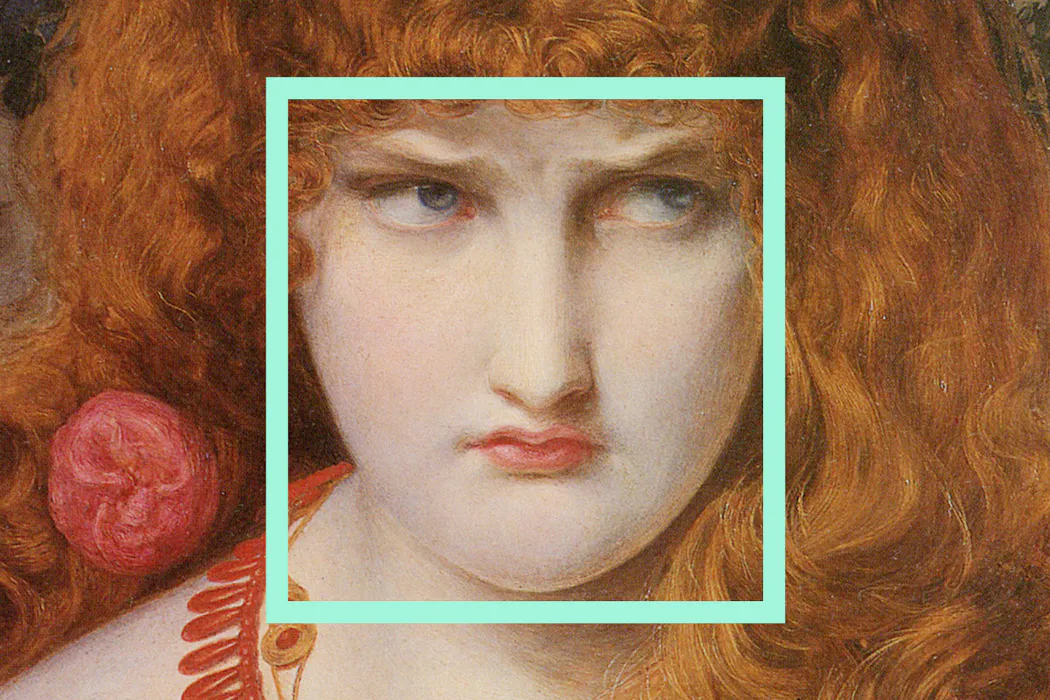
Helen of Troy by Anthony Frederick Augustus Sandys (1867) Wikimedia

Look closely at a face in a painting and you might think you know what emotion the person is experiencing. A smile suggests happiness. A furrowed brow might signal anger. Widened eyes could mean fear or surprise. But what happens when you ask lots of people the same question? Do they see the same emotion, or something more complicated?

In our recent research, we tested how consistently people interpret faces and their emotions depicted in paintings.

Emotions are central to how we experience and navigate the world around us. Because facial expressions are an important way emotions are communicated, psychologists have spent decades studying what faces can tell us about emotional states.

One of the main tools for studying emotions has been photographic databases like the classic Pictures of Facial Affect. In these images, actors pose using standardised combinations of facial movements to represent six basic, widely recognised emotions: happiness, sadness, anger, fear, disgust and surprise. These passport photo type images are incredibly valuable for studying how people recognise clear, prototypical emotion expressions. However, expressions do not always fit neatly into one of these six categories.

To understand the more nuanced ways people interpret facial expressions, researchers also need examples that go beyond clear-cut expressions. However, asking someone to pose with a convincing layered emotional expression for a photograph is not straightforward.

So researchers have found examples from films or everyday life, while also introducing additional emotion labels and other ways of measuring how a facial expression is understood, such as how positive or negative and how strongly that emotion is felt.

Mona Lisa
Is she smiling or not? Wikimedia

I work as part of an international team of psychologists that decided to look at how art could offer a fascinating option. Take, for instance, Leonardo da Vinci’s Mona Lisa. There has been over 500 years of debate over whether she is smiling or not. Research has found that perceptions of her gaze can change depending on how the painting is viewed, and that her eyes can appear to smile even when viewed on their own. It is a striking example of how much information can be packed into a single painted face.

The face in a painting is the result of deliberate artistic decisions, observation and traditions, while tapping into the ways our faces naturally move when we express emotion.

In our research, we selected 116 faces from European paintings dating from around 1400 to 1900. Before testing, we standardised the images by making sure that all faces were clearly visible and similar in how they were positioned. We then cropped the faces from the paintings, removing the wider scene and body language so that participants were judging the expressions themselves. We presented these isolated faces to 152 participants, who viewed them individually and selected which of the six basic emotions best described the expression.

Our findings revealed that agreement exists on a sliding scale. On one end of this spectrum, some faces produced a clear consensus: viewers consistently selected the exact same emotion. We classified 61 of the 116 faces in this way as showing a classic “basic emotion”.

But the other 55 faces produced consistent patterns of responses across two or three emotional categories.

Joan of Arc by Jules Bastien-Lepage French (1879)
Joan of Arc by Jules Bastien-Lepage French (1879) The Met

One painting that garnered such a response was Joan of Arc by Jules Bastien-Lepage (1879). The painting shows Joan in her family home in Domrémy, France at the moment she is told by the saints she must fight against the English in the Hundred Years War.

The full scene, along with our cultural knowledge of who she is and the heavy fate awaiting her, provides a vivid narrative context that helps us decode her psychological state. The chair beside her spinning wheel is upturned, telling us that she has been suddenly interrupted. When we look to the trees, we see the faint traces of the apparitions of the saints who have assigned her the terrifying burden of the role she must play in the defence of France.

But when the context was stripped away and participants viewed Joan’s isolated face, they didn’t agree on one single emotion. People most often saw fear, but many also saw sadness or surprise. For the participants, Joan’s expression did not convey a single, flat emotion but several plausible interpretations at once.

These complex, yet non-random patterns of response, to Joan’s face and the other 54 paintings, suggest that paintings offer interesting new avenues for the exploration of how people perceive emotion. Artworks then could offer researchers a wider range of facial expressions to investigate.

The Conversation

Zoe Thurtle does not work for, consult, own shares in or receive funding from any company or organisation that would benefit from this article, and has disclosed no relevant affiliations beyond their academic appointment.

  •  

New long-clawed British dinosaur is the first of its kind in Europe

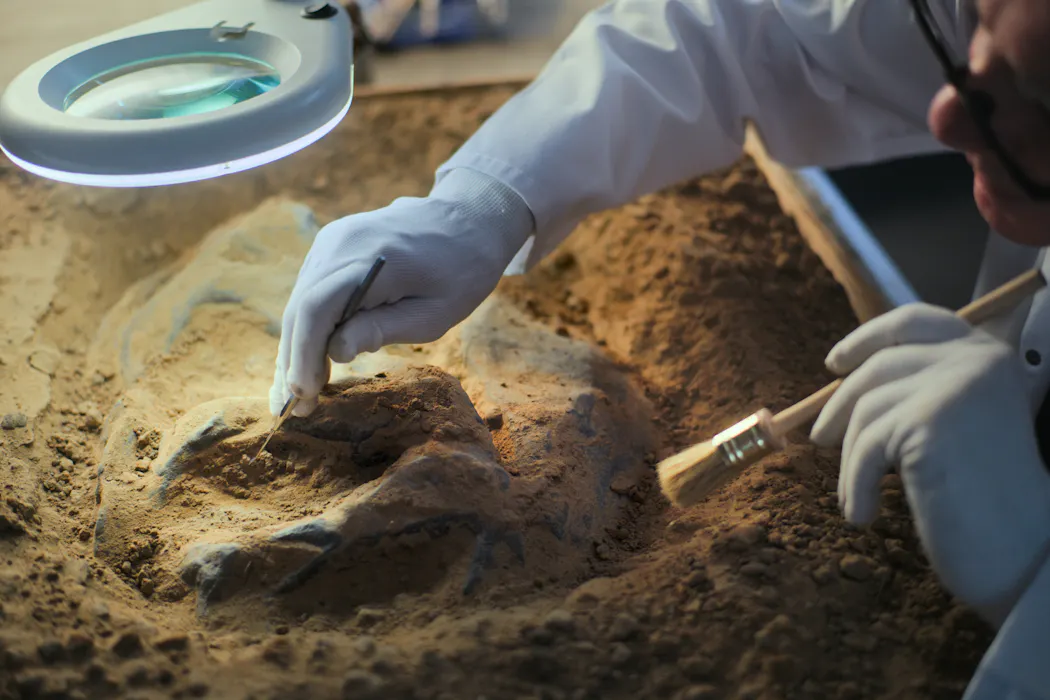
The fossilised skull of a new species of mysterious meat-eating dinosaur from the Isle of Wight has been rediscovered in the collections of the Natural History Museum after over 100 years in storage.

Over its nearly 150-year history, this London museum has become home to over 30 million specimens, making it fairly easy to forget about the odd fossil or rock here and there. This is almost definitely what happened to the only known fossil of the UK’s newest dinosaur, a two-legged meat-eating theropod (the dinosaur family including birds) which we have named Invictibellatrix amberina in a new study.

In 2020, Paul Barrett, one of the museum’s palaeontologists, looked through the fossil collections and came across a small chunk of bone which he recognised as an important part of the skull of a dinosaur: the braincase. After going through museum records, he realised the braincase was found on a beach near Sudmoor Point of on the Isle of Wight, an island off the south coast of England known for its world-famous dinosaur fossils. Knowing that it came from the Isle of Wight, Barrett enlisted one of us (Cassius Morrison), a PhD student specialising in dinosaur braincases at the time, to study the fossil in detail and try to figure out which dinosaur it belonged to.

This work showed that the roughly 120 million year old fossil was unlike anything found from the island before and belonged to new species of a mysterious family of carnivores called the Megaraptora.

Megaraptorans are known for their slender skulls, lightly-built skeletons and gigantic hand claws, with some of the larger species having claws over 1 foot long. These ferocious predators are known from across the globe, with most species known from South America, particularly Argentina. Our new British species, Invictibellatrix amberina, was on the smaller side for megaraptorans, about 5 metres from head-to-tail and weighed as much a large tiger, making it the smallest known megaraptoran.

To study the new species, we compared it directly with the skulls of other carnivores. This involved playing a scientific version of spot-the-difference, looking at the subtle differences between species to work out what we were dealing with. We also used computed tomography (CT) scanning, which combines X-rays and computer processing to create detailed images, to look inside the braincase of Invictibellatrix and study what we could of its brain. Putting all of these findings into a computer algorithm to determine where our species sits in the family tree helped us to avoid bias in our interpretations.

Our work suggests that the new species was probably part of the early days of megaraptoran evolution, representing what these animals looked like before they grew to gigantic sizes, similar to their relatives the tyrannosaurs.

Invictibellatrix and its place in the theropod family tree are particularly important, as we now have a better understanding of when and how megaraptorans spread across the world. Before the discovery of Invictibellatrix, megaraptorans were only known from species of the early Cretaceous period (130-120 million years ago) of Thailand and Japan, plus multiple larger species from the late Cretaceous period (85–66 million years ago) of Australia and Argentina.

Warrior of the amber

The great distances between these discoveries means that megaraptorans must have been even more common than their fossils suggest, since there is no way for large animals like these to swim across the oceans that separated these continents during the Cretaceous period.

As the first European megaraptoran, Invictibellatrix provides us with strong evidence that the group probably travelled to the southern continents from Asia, via Europe and Africa. Afterwards they probably spread out across South America and Australia sometime during, or perhaps even before, the early Cretaceous period. The fossil also implies that other megaraptorans may be waiting to be discovered in Africa and even Antarctica.

Invictibellatrix probably lived alongside other carnivores such as Neovenator (a relative of Allosaurus), Ceratosuchops (a relative of Spinosaurus) and Eotyrannus, which as the name implies, was an early relative to the Tyrannosaurus rex. These four dinosaurs were probably eating different animals to each other to survive. The spinosaur specialised in eating fish, with the others eating more land-based prey. Invictibellatrix probably fed on small dinosaurs, mammals, lizards and even crocodiles.

The story of megaraptorans seems to follow the pattern of most of nature’s successes. A small opportunist living in the shadows of much larger animals around the globe only to become the dominant force in a few select ecosystems up to the end of the age of dinosaurs.

It’s this story which gave Invictibellatrix amberina its name, honouring the role of megaraptorans as the apex predators in the late Cretaceous of South America. It translates to “unconquered [female] warrior of the amber”.

Invictibellatrix does not tell us everything. Scientists are still not sure when megaraptorans first evolved, but the fossil does give us some much-needed clues. There is so much left to be discovered about dinosaurs. Sometimes their secrets can be found simply hiding away in museum collections waiting for someone to come and take a closer look.

The Conversation

Cassius Morrison received funding from the Richard Owen Research Grant of the Palaeontographical Society for the study of the new megaraptoran braincase. He is currently a Royal Society Career Development Fellow at the University of Leeds ( funded by the Royal Society).

Charlie Scherer does not work for, consult, own shares in or receive funding from any company or organisation that would benefit from this article, and has disclosed no relevant affiliations beyond their academic appointment.

  •  

How did Mars get its moons? Japan’s MMX space mission aims to solve the puzzle

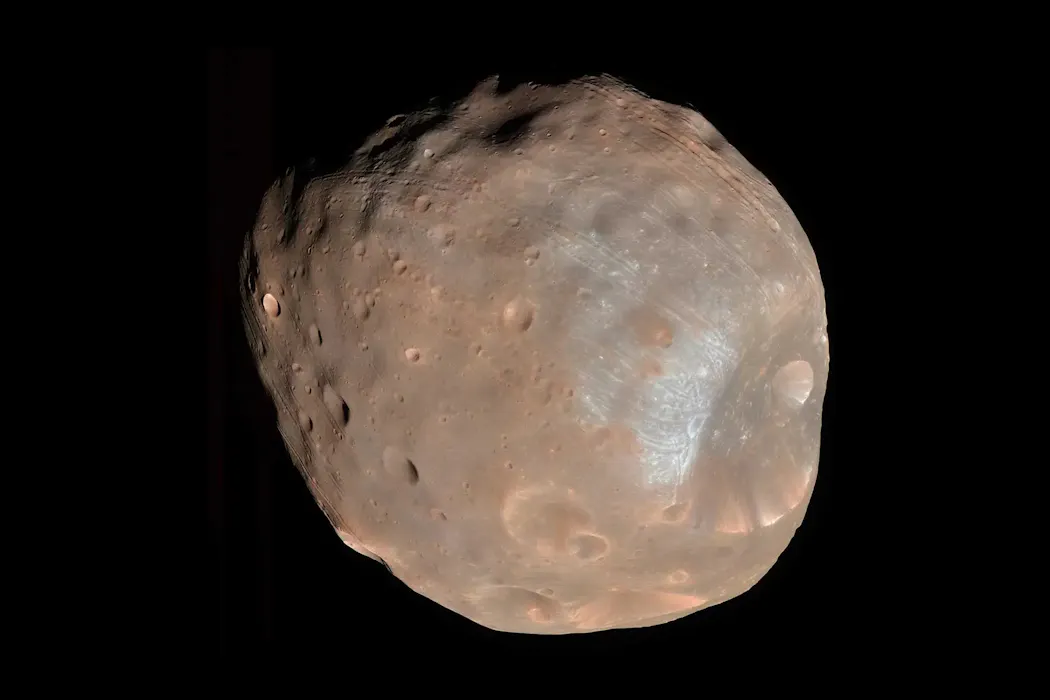
Phobos is dominated by Stickney crater, a 9km (5.6 mile) bowl visible on the right. NASA/JPL-Caltech/University of Arizona

The Earth got its Moon when a celestial object collided with our planet more than four billion years ago. This impact hurled molten rock into space, which eventually coalesced to form the satellite we can see every night from across our planet.

But what of our neighbour, Mars? The red planet has two small, irregularly shaped moons called Phobos and Deimos. There are several theories on how these natural satellites formed, but no clear front-runner. Soon, a Japanese-led space mission called Martian Moons Exploration (MMX) will begin its hunt for the answer.

On Monday October 19, MMX is due to lift off on an H3 rocket from Tanegashima Space Center in southern Japan. The mission will aim to land on Phobos and collect a sample of soil. The spacecraft will then send this precious payload to Earth, for study in laboratories.

Asaph Hall
American astronomer Asaph Hall discovered Phobos and Deimos in 1887. Naval History and Heritage Command

Of the two Martian moons, Phobos is the largest and orbits closer to the planet. It has a mean diameter of 22.2km and a mass of 10,637 million million kg. Deimos has a mean diameter of 12.5km and a mass of 1,480 million million kg.

The moons were discovered during a six-day window in 1877 by the American astronomer Asaph Hall, who was working at the US Naval Observatory in Washington DC.

Two main hypotheses dominate discussions of how Mars got these moons. The giant impact theory proposes that a celestial object a third of Mars’ size hit the planet early in its history, ejecting material into space.

The general mechanism is similar to how scientists think Earth’s natural satellite formed. But in the Martian impact theory, a single “giant” moon was created by the ejected material, along with a host of smaller satellites.

Over time, each one broke up and fell to Mars’ surface. Simulations by Pascal Rosenblatt, from the Laboratoire de Planétologie et Géodynamique (LPG) in Nantes, France, and his colleagues show that Phobos and Deimos would have been the sole moons to survive.

Gravitational capture

The other main idea is known as the captured asteroid theory, which goes back to the 1960s. This suggests that Phobos and Deimos were originally asteroids that wandered so close to Mars they were captured by the planet’s gravity.

According to this idea, the moons may have originated from within or just beyond the asteroid belt that lies between Mars and Jupiter. The moons might even have been what’s known as a binary – two asteroids that orbit each other.

The moons are characterised by their low density, which implies they have porous interiors.

Deimos
Deimos, the smaller of Mars’ moons, orbits further from the planet than Phobos. Nasa/JPL-Caltech/University of Arizona

The captured asteroid hypothesis, however, requires an extremely dense Martian atmosphere to explain how the asteroids were trapped by tidal forces. Mars today has a thin atmosphere mainly composed of carbon dioxide. Also, asteroids captured by planets tend to have highly eccentric orbits. The orbits of Phobos and Deimos around Mars are, by contrast, almost circular.

Scientists have also proposed other theories for the origins of these moons, but they command lower levels of support among the scientific community. One visualises the origin of these moons as debris from the destruction of a single “proto-moon”.

Another lesser known idea proposes that Mars undergoes billion-year cycles where rings of rocky material orbiting Mars coalesce over time into moons.

Once the moons are formed, they are eventually ripped apart by gravitational (tidal) forces to form new rings. Under this scenario, we just happen to live in an era where the debris is in the form of moons and not as rings.


Read more: Japan’s MMX mission aims to swipe soil samples from Mars’ moon Phobos


Solving the mystery

Amid this ongoing uncertainty surrounding the moons’ origins, MMX aims to collect more than 10g of material from Phobos – marking the world’s first sample return mission from the Moon.

If the samples contain a large amount of material from Mars itself, along with material from the asteroid that collided with the red planet, then it would favour the giant impact theory. If the composition of Phobos is similar to that of meteorites from known categories of asteroid, it would favour the asteroid capture theory.

MMX’s round trip to Mars will take five years in total. It will arrive at the red planet in late 2027, and return to Earth in 2031.

The spacecraft consists of three modules, one to get to Mars, one to land on Phobos and another to return the sample to Earth. There are 13 scientific instruments, including a gamma-ray and neutron spectrometer for measuring the chemical composition of Phobos, two cameras and a near-infrared instrument for characterising minerals. MMX will also deploy a 25kg rover called Idefix on Phobos’ surface.

For decades, the origin of Mars’s unusual moons has been subject to intense debate. Now, with the launch of this landmark space mission, scientists could be on the verge of a breakthrough.

The Conversation

Lana Williams does not work for, consult, own shares in or receive funding from any company or organisation that would benefit from this article, and has disclosed no relevant affiliations beyond their academic appointment.

  •  

Animal life may be far older than its most ancient fossils – here’s how we uncovered its hidden history

Frame Stock Footage/Shutterstock

The question of when animals first evolved is one that has confounded scientists since the time of Charles Darwin. Studying rocks in north Wales in the mid-19th century, Darwin found the sudden first appearance of animal shells and skeletons in layers dating back over 500 million years perplexing. He had predicted a long history of evolution, with animals slowly gaining complexity through time, rather than this apparent instantaneous appearance of complex animals.

The sudden appearance of complex animals has led scientists to argue that animals must have a “hidden history”, a period in Earth’s past prior to their fossil record where they existed but have left no trace of their presence in the rocks. Our new study may help scientists understand how long this hidden history may have lasted.

Palaeontologists have made significant progress since Darwin roamed north Wales. The oldest animal fossils are now recognised in rocks 574 million years old from the UK and Canada. Although these fossils do not have hard skeletons, they are nevertheless visible to the naked eye and relatively complex just like Darwin’s Welsh fossils. Scientists have pushed the date of the first animal fossils back in time, but researchers still haven’t resolved why these oldest remains of animal life are so complex.

Molecular clock studies aim to tackle this problem. A molecular clock works like the speed = distance/time equation. The genetic difference between two living species’ DNA provides the “distance”. If we can estimate the “speed” at which those differences accumulated, we can work backward to estimate the “time” at which their ancestors separated. Fossils provide important dated anchor points that help calibrate the “speed”.

In some instances, such as the divergence of humans and chimpanzees, (when they split from a common ancestor and became different species) molecular clocks can be incredibly effective at estimating the timing of evolutionary origins. However, in the case of animal evolution, molecular clocks give wildly different answers. Depending on how the clocks are calibrated, estimates for the first animals can be hundreds of millions of years apart. Some suggest animals evolved 800–700 million years ago, but others indicate that they evolved only around 600 million years ago. In short, scientists don’t know when animals first evolved.

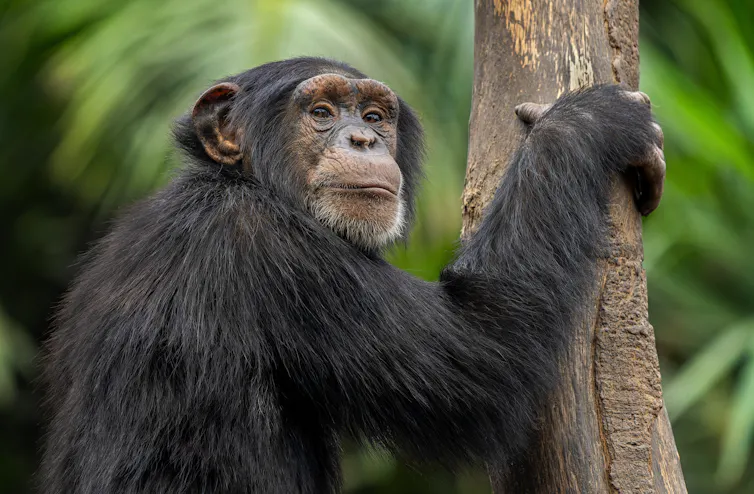
Chimpanzee looks over shoulder.
It was much easier to work out when chimpanzees and humans diverged than animal life from simpler organisms. jindrich_pavelka/Shutterstock

With colleagues, we set out to address this issue in our recent paper. Much of the disagreement between molecular clocks is due to the different fossil calibrations used in the models. For example, 590-million-year-old rocks in China, which have the conditions to preserve early animals as fossils, but don’t show any evidence of animal fossils, have been used to suggest animals hadn’t evolved by this time.

We show that approximately 550-million-year-old rocks from Mongolia also have these same fossilisation-promoting conditions but still do not preserve animals. The problem is that animals have been found all over the world in rocks 550 million years old. Animals existed elsewhere at the same time. Their local absence in Mongolia might be because they didn’t live in that place or were not preserved. An empty fossil deposit like the one in Mongolia can tell us that animals are absent from that deposit, but not necessarily that animals were absent from the entire planet.

Earth’s deep past

The same could be true for the 590-million-year-old rocks in China. Perhaps animals are not preserved in them because they simply didn’t live there or were rare at the time. This casts doubt on our ability to use the Chinese rocks to argue animals were yet to evolve 590 million years ago.

We argue that palaeontologists need to use several deposits of roughly the same age from around the world, with each demonstrating the right conditions for animal fossilisation but producing no fossils. Only then might we have more confidence in the result.

We suggest that there might be enough deposits meeting these criteria around 900 to 720 million years ago to justify calibrating the animal molecular clock in this interval. Even then, we think that we could only do so with around 70% confidence (and a 30% chance that our evidence of absence is wrong with animals already having evolved).

Using these older rocks suggests that animals originated between 850 and 715 million years ago. Intriguingly, this older age revitalises the idea that animal evolution coincided with snowball Earth, when ice may have covered much of the planet.

The timing of animal origins remains uncertain. But by learning how to read not only the fossils preserved in rocks, but also the fossils that are missing, we are beginning to bring the hidden early history of animal life into view.

The Conversation

Ross Anderson receives funding from the Royal Society.

Orin Lole Durbin does not work for, consult, own shares in or receive funding from any company or organisation that would benefit from this article, and has disclosed no relevant affiliations beyond their academic appointment.

  •  
❌