❌

Reading view

Novel particle beam could challenge Einstein’s Theory of Gravity

Researchers at ETH Zurich and the Paul Scherrer Institute in Villigen, Switzerland, have produced a high-intensity beam of muonium atoms in a cold state, an experimental advance that could enable a direct test of whether gravity acts differently on second-generation matter. The peer-reviewed study in Nature Physics describes a new method for generating muonium in superfluid helium. The resulting atoms travel at similar speeds and almost parallel to one another, properties required for a future interferometer that would measure the tiny influence of gravity on muonium.

The study did not conduct that gravitational measurement or find evidence that gravity departs from its expected behavior for ordinary matter; it instead developed the beam source needed for the proposed test. The experiment is designed to examine the universality of free fall and the equivalence of gravitational and inertial mass, a cornerstone of Albert Einstein’s theory of gravitation. In ordinary matter, bodies fall at the same rate at a given point within a gravitational field, while the equivalence principle links gravitational mass with inertial mass.

According to the research team, this principle has so far been demonstrated only with ordinary matter or first-generation antimatter. Muonium is a neutral atom formed from a positively charged antimuon and a negatively charged electron, making it a second-generation probe. A gravity experiment with this exotic atom would test whether the equivalence continues to hold for particles outside the first generation.

Muonium has two characteristics that make it useful for this test: it is neutral, and it belongs to a heavier and less familiar generation of particles. A neutral object allows gravitational behavior to be studied without the weak gravitational signal being masked by stray electromagnetic fields, which can dominate the behavior of charged particles. At the same time, muonium is exceptionally difficult to produce and control.

Its constituent muon decays after only about 2.2 microseconds. Earlier sources generated muonium atoms that flew off in many directions at different speeds and were therefore unsuitable for the precision required in a gravity experiment. The researchers addressed this problem by creating a cold, intense and well-directed beam.

The antimuons were directed into a thin layer of superfluid helium that had been cooled close to absolute zero, at minus 273 degrees Celsius. Superfluid helium is a quantum fluid in which individual helium atoms lose their identity and in which impurities are not tolerated. Lead author Jesse Zhang said the researchers used the superfluid as an “atomic cannon,” exploiting the conversion of chemical potential into kinetic energy to propel the newly formed muonium atoms out of the liquid.

When an antimuon encounters a free electron in the superfluid helium, it forms a neutral muonium atom with positive chemical potential. The atom is forced out of the liquid, and as it reaches the surface, that chemical potential is converted into kinetic energy. The resulting boost sends the muonium vertically out of the helium.

Importantly, the atoms must move through the quantum liquid at a suitable speed without collisions, because excessive scattering would prevent them from reaching the surface within their very short lifetime. The high-intensity antimuon beam from PSI allows many muonium atoms to be generated for the planned experiments. Anna Soter, a professor of physics at ETH Zurich and member of the research team, said the cold state is what makes the proposed gravity experiment possible.

In this context, “cold” does not mean that the atoms are motionless; it means that they propagate at similar speeds and nearly parallel to one another. This improved control over direction and velocity is important because the planned instrument will use the wave properties of the atoms to create an interference pattern. A very small shift in that pattern caused by Earth’s gravitational pull would provide a measure of gravity’s effect on muonium.

The study establishes the upstream beam capability rather than reporting the result of that comparison. The next stage of the program is the development of a muonium interferometer. According to the researchers, they hoped to test the method for the first time with the atomic beam in the year of the announcement and, if that worked as expected, to carry out the actual gravity experiment two or three years later.

Those are planned milestones rather than completed measurements. If the interference pattern of muonium shifts differently from the pattern expected for ordinary matter, Soter said the result would be surprising and could, among other theoretical possibilities, point toward the existence of a fifth force. No fifth force has been proven, and the present work provides no evidence for one.

The team’s primary aim is to measure whether the equivalence between gravitational and inertial mass applies to a second-generation particle. Physics recognizes four fundamental interactions: gravity, electromagnetism, the strong interaction and the weak interaction. A fifth force has been proposed repeatedly, but it has never been established.

Soter emphasized that the researchers are open-minded about what the measurement may show while keeping the immediate objective focused on the first such test. The new beam is therefore an enabling experimental result, not a demonstration that Einstein’s theory has been challenged or overturned. Beyond the planned gravity measurement, the high-intensity muonium beam is expected to enable more precise laser-spectroscopy experiments.

These could allow muonium to be measured more accurately than in previous work and provide information about the muon’s mass and fundamental physical constants, which are stated goals of the research group. The same experimental source can thus serve two purposes: supplying a cold, directed beam for a gravitational comparison and providing a larger, better-controlled population of muonium for detailed spectroscopic study. The reported advance addresses a major technical obstacle while leaving the central scientific question unresolved.

A successful gravitational test will still require an interferometer capable of resolving a minuscule shift in an interference pattern while dealing with muonium’s short lifetime, beam quality and other sources of uncertainty. The study’s demonstrated result is the generation of a high-intensity, superthermal muonium beam in superfluid helium, with atoms emerging in the cold state needed for future work. Whether muonium falls exactly as expected for ordinary matter remains to be measured.

The beam nevertheless supplies the experimental foundation for testing gravitational universality in a second-generation particle, a comparison that had not previously been carried out with muonium.

Subject of Research: A cold muonium beam developed for future tests of gravitational universality and laser spectroscopy

Article Title: Novel particle beam could challenge Einstein’s Theory of Gravity

Article References: Novel particle beam could challenge Einstein’s Theory of Gravity. Original publication (Bibliographic details unavailable.)

Image Credits: AI Generated

DOI: Not provided

Keywords: muonium, muon beam, gravity, gravitational universality, equivalence principle, interferometry, superfluid helium, laser spectroscopy, ETH Zurich, Paul Scherrer Institute, Novel, particle
  •  

SPHEREx: The Niftiest Space Telescope You May Not Have Heard Of

SPHEREx

Editor’s Note: Astrobites is a graduate-student-run organization that digests astrophysical literature for undergraduate students. As part of the partnership between the AAS and astrobites, we occasionally repost astrobites content here at AAS Nova. We hope you enjoy this post from astrobites; the original can be viewed at astrobites.org.

Title: The SPHEREx Satellite Mission
Authors: James J. Bock et al.
First Author’s Institution: California Institute of Technology; Jet Propulsion Laboratory
Status: Published in ApJ

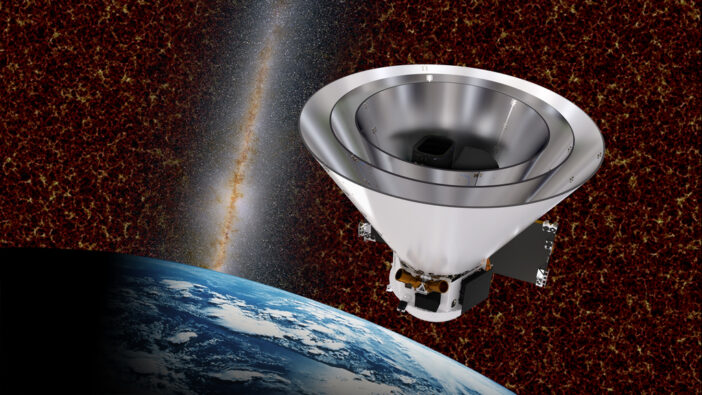
You know JWST. You’ve likely heard about the recently launched Nancy Grace Roman Space Telescope. But did you know that NASA launched a third space telescope focused on infrared astronomy just last year? That telescope, called SPHEREx (short for Spectro-Photometer for the History of the Universe, Epoch of Reionization, and Ices Explorer, but we’ll forgive the tortured acronym), is currently carrying out its ambitious mission to record an infrared spectrum for every point in the sky. Let’s break down SPHEREx’s three main science goals and then discuss how SPHEREx will accomplish its mission.

Goal #1: Stress-Testing Cosmic Inflation

According to our best current models of cosmology, the very early universe experienced a rapid burst of accelerating expansion called cosmic inflation. During inflation, small regions of the universe that by chance had slightly higher energy density than their neighbors (due to quantum fluctuations) expanded to huge scales. Because these regions were very gravitationally attractive, once inflation ended, they became the seeds where matter accumulated and eventually formed galaxies.

This means that the distribution of galaxies that we see today is a reflection of the properties of inflation (i.e., what the quantum fluctuations were like and how inflation supersized them). SPHEREx will assemble the largest atlas of galaxies ever, recording the three-dimensional positions of hundreds of millions of galaxies across the entire sky. To do this, SPHEREx must figure out how far away these galaxies are from Earth, using their redshifts. SPHEREx’s low-resolution infrared spectroscopy allows for moderately precise measurements of these redshifts. By performing statistical analyses of how galaxies are separated from each other, SPHEREx will test different theories of inflation, like whether inflation was driven by multiple fields.

Goal #2: Frozen Assets

Astronomers are racing to find evidence for life (or at least habitability) in the atmospheres of exoplanets through transmission spectroscopy. However, we don’t know for sure how molecules that could be used in biological processes (called biogenic molecules, these include water, carbon dioxide, carbon monoxide, and methanol) even end up on planets.

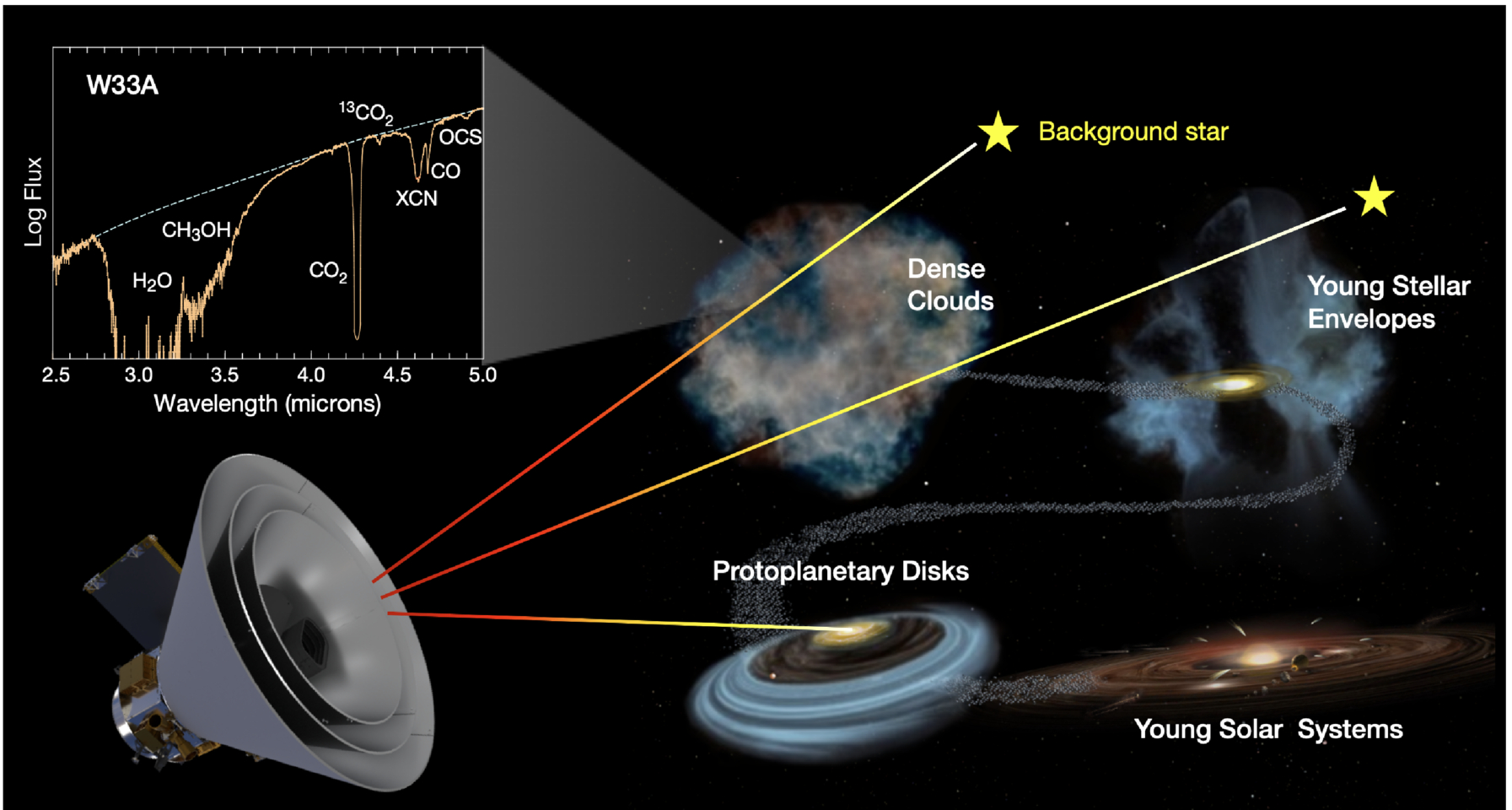
We think that a large fraction of these molecules are frozen onto dust grains throughout the interstellar medium. When a new star forms in the interstellar medium, this ice and dust would become part of the star’s protoplanetary disk. The ice species can help create planetesimals (which may grow into planets) or can later deliver biogenic molecules to planetary surfaces. Earth’s oceans likely came (at least in part) from collisions with icy asteroids. As Figure 1 shows, SPHEREx will measure the abundance of ice species in different environments that track the history of solar system formation, from dense clouds in the interstellar medium that may soon form stars to regions around newborn stars and evolving protoplanetary disks. In this way, SPHEREx will track how biogenic molecules from the interstellar medium can end up on planets.

cartoon showing the types of sources SPHEREx will target in its search for biogenic molecules

Figure 1: Examples of the sources SPHEREx will look at to search for biogenic ice species. In the top left, what the spectra of these sources will look like if those species are present: each type of ice leaves a distinct fingerprint in an infrared spectrum. [Bock et al. 2026]

Goal #3: Your Noise Is SPHEREx’s Signal

SPHEREx will measure an infrared spectrum for every point in the sky — even those that don’t contain galaxies or stars that we can resolve. These points are instead dominated by diffuse extragalactic background light. This light comes from many different sources, including stars, dust, and quasars, from the early universe to the present day, all added together incoherently. For most telescopes, the extragalactic background light is just a frustrating source of noise. For SPHEREx, it’s a treasure trove. We can compare the properties of the extragalactic background light that SPHEREx measures (its spectrum and how it fluctuates across the sky) to theoretical predictions and see if we seem to be missing anything. SPHEREx’s very broad infrared spectra — capturing redshifted light from the very early universe — and total sky coverage are crucial for this purpose. For instance, the SPHEREx team will try to isolate emission from the first stars and galaxies, which ionized most of the gas in the universe in the epoch of reionization. By understanding this and other contributions to the extragalactic background light, we can test hypotheses about how galaxies form and evolve.

Making It Happen

Beyond inflation, ices, and extragalactic background light, SPHEREx’s all-sky infrared spectra will be invaluable for countless other science cases, like studying asteroids, characterizing the atmospheres of stars that host exoplanets, and even understanding the upper atmosphere of Earth, through which SPHEREx orbits.

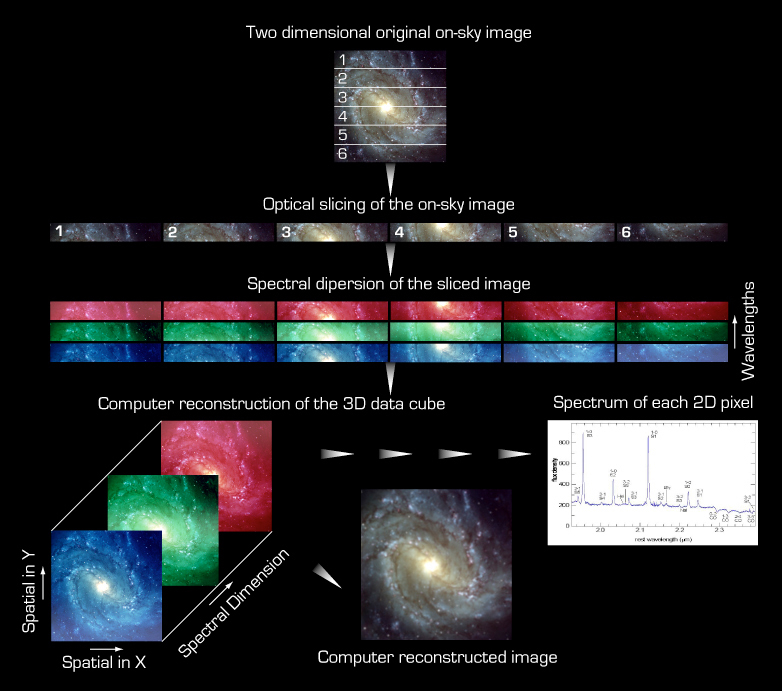
But how can SPHEREx even make a spectrum for every point in the sky? An image of some part of the sky is fundamentally two-dimensional, and measuring how the brightness of every point changes with wavelength adds a third dimension. Astronomers have come up with many ways to solve this problem. Integral field spectroscopy approaches typically involve splitting an image into small regions or strips, then using a dispersive element like a prism or grating to make a spectrum of each region, and finally putting these spectra side by side on a camera. Figure 2 shows an example of this strategy, as well as what the final three-dimensional “datacube” looks like after processing.

demonstration of integral field spectroscopy

Figure 2: A demonstration of the principle of integral field spectroscopy. [ESO; CC BY 4.0]

This approach is fairly complicated, relying on fancy optics, a prism or grating, and oftentimes optical fibers. From Figure 2, note that you could also make the final “datacube” product if you simply took many images with narrow filters that let through different wavelengths of light. This takes to an extreme the approach astronomers use for spectral energy distribution fitting. Of course, this would require an exorbitant number of filters. Here, the SPHEREx team had a stroke of genius: instead of having many different filters, what if you had a filter where the transmitted wavelength changes linearly across the filter? Each row would let through a different wavelength. To get a full spectrum for all points in an image, you could take many exposures, moving the telescope slightly between each exposure so points in the image fall on different rows each time.

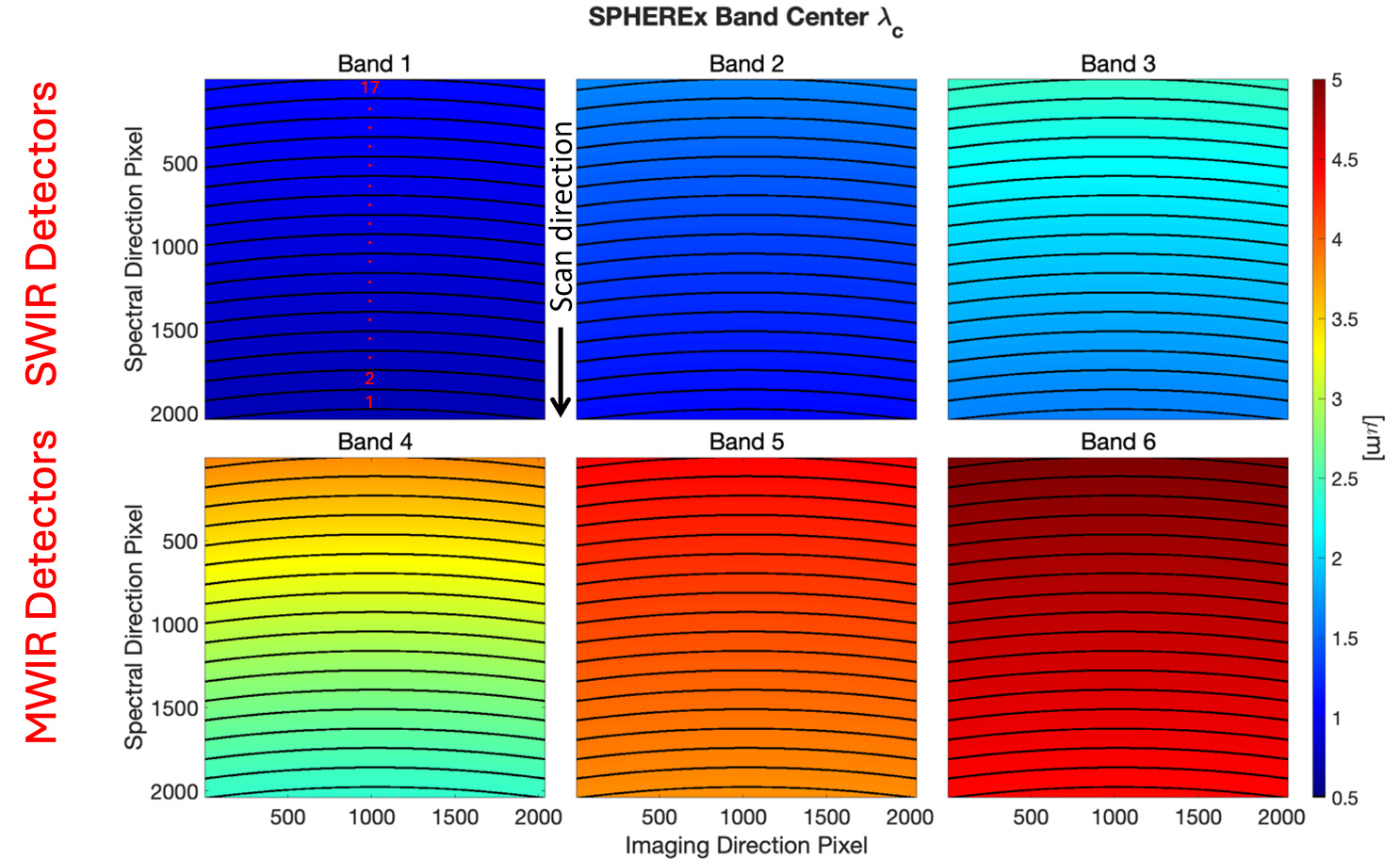
This is the SPHEREx survey strategy, with a few complications. First, before any filter, SPHEREx splits incoming light into two beams, with short-wave infrared light (SWIR, with 0.75 μm < λ < 2.42 μm) going in one direction and mid-wave infrared light (MWIR, 2.42 μm < λ < 5.00 μm) going in another. SPHEREx makes images with these two beams on different sets of detectors, so it can measure the brightness of an object at one SWIR wavelength and one MWIR wavelength simultaneously. The SPHEREx field of view covers 10.5° by 3.5°, with the SWIR and MWIR images each spread across three detectors. Every detector has a different linearly variable filter. To get a complete infrared spectrum of a given point in the sky, SPHEREx moves that point to 17 different positions on each detector. This requires 51 different telescope (17 × 3 detectors) pointings in all and yields 102 spectral values (51 × 2 for the SWIR and MWIR beams). Figure 3 shows the 17 bands on each of the six SPHEREx detectors, each corresponding to a different wavelength value.

plots showing the central wavelength of the spectral response of each pixel measured over the six detector arrays in the focal plane

Figure 3: The wavelength of light that each part of each SPHEREx detector is sensitive to. A point in the sky is imaged on one short-wave infrared detector (top row) and one mid-wave infrared detector (bottom row) simultaneously. SPHEREx measures each point in the sky at 102 different wavelengths by placing the point at 17 different positions on each of the detectors. [Adapted from Bock et al. 2026]

While it would take decades to collect spectra for every point on the sky with conventional methods for integral field spectroscopy, the SPHEREx team devised a nifty solution that will collect this dataset in a few years. Soon, SPHEREx will start answering questions about cosmic inflation, interstellar ices, and extragalactic background light, while its rich dataset will be relevant for decades to come. So tell all your friends about SPHEREx (even if you can’t remember what the acronym stands for)!

Original astrobite edited by Veronika Dornan.

About the author, Chris Layden:

Chris is a PhD candidate in astrophysics at the Massachusetts Institute of Technology. His primary research interest is developing instrumentation that enables high-speed astronomical observations. With such instruments, he studies the most rapidly varying phenomena in the sky, including millisecond pulsars, accreting black holes, and solar system objects whizzing past background stars. Outside of astronomy, Chris enjoys reading classic novels, playing ultimate frisbee, and hanging out with his wife and dog.

The post SPHEREx: The Niftiest Space Telescope You May Not Have Heard Of appeared first on AAS Nova.

  •  
❌