❌

Reading view

NASA to Conduct NCAA Flyover, Engage Fans at University of Alabama

Looking up, three white and black fighter jets fly in formation across a bright, blue sky.
NASA’s Freedom 250 F-5 team, including NASA Administrator Jared Isaacman, performs a flyover during the national anthem at an NFL game between the Cleveland Browns and the Carolina Panthers at Huntington Bank Field, Sept. 27, 2026, in Cleveland.
NASA/Jordan Cochran

As part of the agency’s Inspiration Tour, NASA will conduct a flyover at the University of Alabama vs. Texas A&M football game in Tuscaloosa, Alabama, on Saturday, Oct. 24. NASA Administrator Jared Isaacman will pilot one of three F-5 fighter jets during the flyover, highlighting NASA’s contributions to aeronautics and the agency’s continued commitment to advancing aviation technologies.

Ahead of the game, members of the news media are invited to visit the NASA Experience Zone on Champions Lane, where Isaacman will participate in a media opportunity at 11 a.m. CDT. Media interested in attending should confirm their attendance by 12 p.m. Friday, Oct. 23, with Lance D. Davis at lance.d.davis@nasa.gov to receive additional details and instructions.

Supported by NASA’s Marshall Space Flight Center in Huntsville, Alabama, the NASA Experience Zone will be open to the public from 10:30 a.m. to 2:30 p.m. CDT, with no game ticket required. The experience will give visitors an opportunity to meet NASA team members and learn more about the people and technologies advancing the agency’s missions in aeronautics and space exploration.

Attendees can engage with NASA team members and explore exhibits highlighting the agency’s Artemis campaign and efforts to return astronauts to the Moon, including:

  • An inflatable SLS (Space Launch System) rocket.
  • Displays featuring the Starship and Blue Moon human landing systems.
  • Information about NASA internship opportunities.
  • Photo opportunities featuring NASA exhibits and displays.

With stops across the nation, NASA’s  Inspiration Tour  convenes academic, industry, and public sector stakeholders to connect the agency with the people, technologies, and organizations that drive American leadership in space.

The tour will culminate in MAX POWER, a public exposition of American air and space innovation, Saturday, Nov. 7, and Sunday, Nov. 8, on and near the agency’s Kennedy Space Center in Florida. Held in honor of America’s historic 250th anniversary, the multi-day, family-friendly event will showcase the next-generation aircraft, spacecraft, autonomous vehicles, and technologies that will help define the future of transportation in air and space. 

 For more information about MAX POWER and the agency’s missions, visit:


https://www.nasa.gov/maxpower

-end-

Lance D. Davis 
Marshall Space Flight Center, Huntsville, Ala. 
256-640-9065 
lance.d.davis@nasa.gov  

Share

Details

Last Updated
Oct 21, 2026
Editor
Lee Mohon
Contact
  •  

NASA to Conduct Low-Altitude Flights Over Texas Farmland

Editor’s Note: This article was originally published on Oct. 15, 2026, and has been updated to correct the location of the flights.

A NASA Dynamic Aviation A200 aircraft will conduct low-flying research flights over farmland near Amarillo, Texas, from Thursday, Oct. 22, through Monday, Nov. 9. These flights will measure gaseous and particulate emissions from animal feeding operations.

A two engine aircraft sitting in front of a hangar.
A photo of the Dynamic Aviation A200 aircraft, which will conduct low-flying research flights over farmland near Amarillo, Texas, to measure emissions in October and November 2026.
Dynamic Aviation

Agricultural emissions represent an important and understudied part of Earth’s land and atmosphere systems. The FarmFlux mission will deploy more than a dozen sensors to measure ozone, methane, ammonia, particulates, and other pollutants rising from crop lands and livestock farms and their interaction with the Earth’s atmosphere. The mission is jointly led by NASA’s Goddard Space Flight Center in Greenbelt, Maryland; Colorado State University; and Boston University.

Additional low-altitude research flights with a NASA P-3 Orion aircraft are scheduled for the March to July 2027 growing season in the Midwest and California’s Central Valley with a focus on cropland.

For more information about the FarmFlux mission, visit:

https://science.nasa.gov/mission/evs-4/farm-flux/

By Sharon Teitelbaum

NASA’s Ames Research Center in California’s Silicon Valley

  •  

NASA’s SR-1 Freedom Advances with Progress on Nuclear Power Module

2 min read

Preparations for Next Moonwalk Simulations Underway (and Underwater)

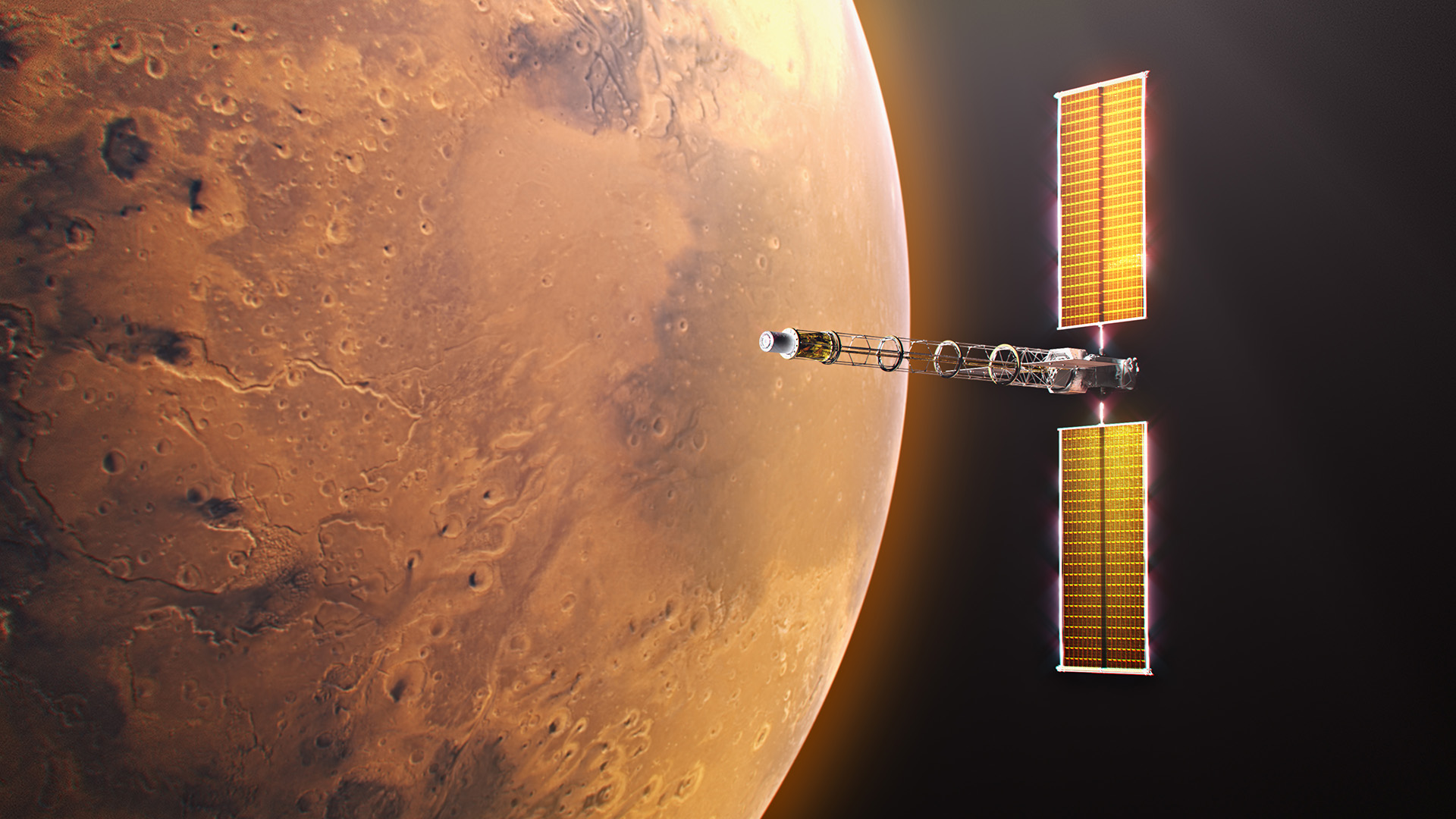
Digital illustration of the Space Reactor-1 (SR-1) Freedom spacecraft in orbit near Mars. The planet's red terrain fills the left half of the frame. On the right, the spacecraft is oriented horizontally, showcasing its central Power and Propulsion Element bus flanked by two tall, illuminated golden Roll-Out Solar Arrays. An elongated open-truss boom extends forward from the bus, ending at the cylindrical nuclear fission reactor and power conversion module.
Space Reactor-1 Freedom will be the first spacecraft ever to demonstrate fission power beyond Earth’s orbit, traveling to Mars to deliver a science payload called SkyFall.
NASA/Alberto Bertolin

Destined for Mars and beyond, NASA’s Space Reactor-1 (SR-1) Freedom will be humanity’s first fission-powered spacecraft to travel outside Earth’s orbit. Announced during NASA’s “Ignition” event, this mission will demonstrate nuclear electric propulsion in deep space, and progress is underway on its key element: the nuclear power module. To expedite development of the spacecraft, NASA and its partners have mutually agreed to key contract actions that will advance the SR‑1 Freedom mission. 

“These contract actions not only reduce technical risk and help us maintain momentum toward our 2028 launch, but they also strengthen collaboration across our partners,” said Steve Sinacore, SR-1 Freedom program director. “These actions keep SR‑1 Freedom on track and ensure we’re building the strongest possible foundation for NASA’s first fission‑powered voyage beyond Earth orbit while developing technology extensible to a vibrant space nuclear future.” 

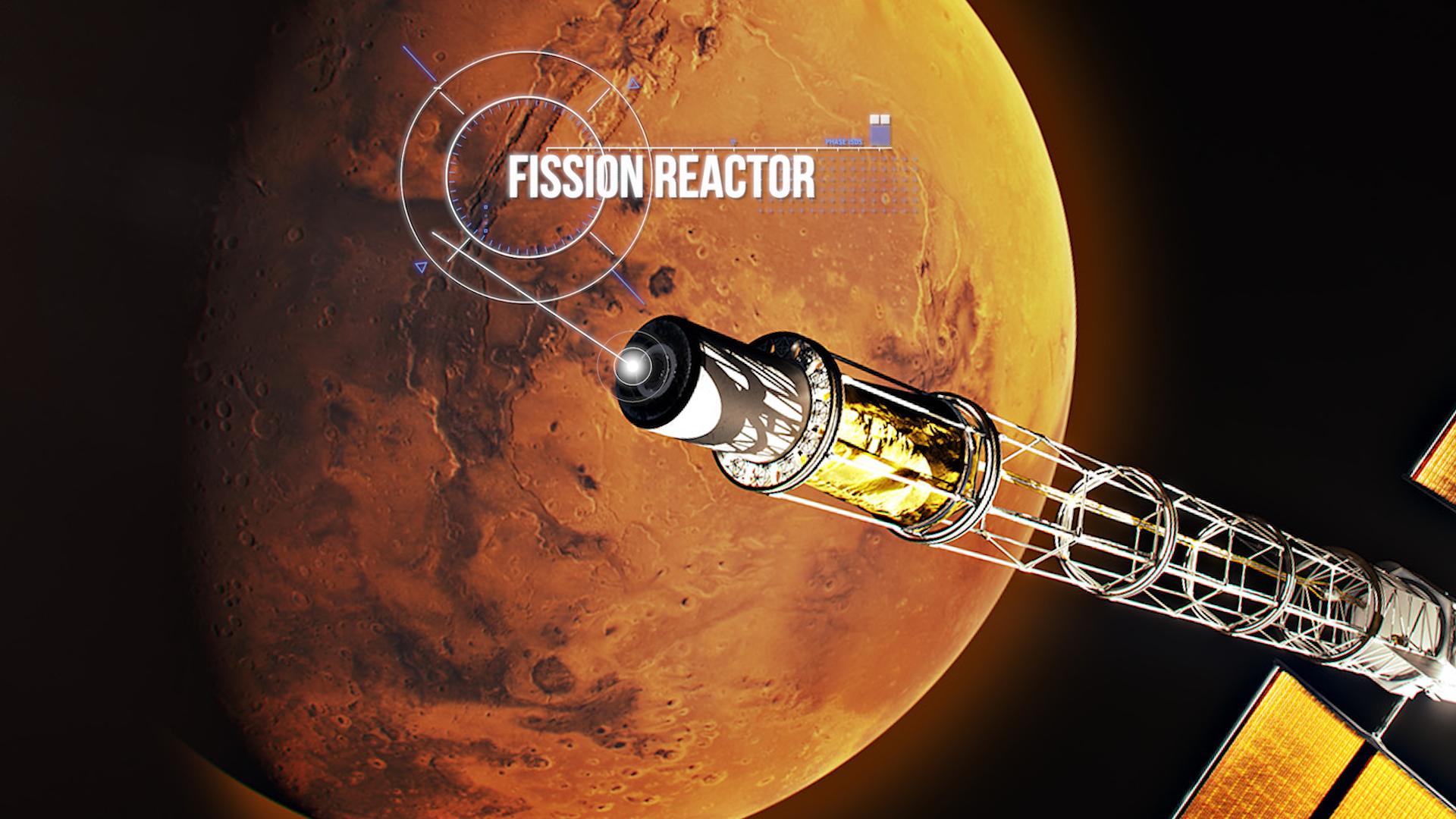
Digital illustration of the Space Reactor-1 Freedom (SR-1) spacecraft in deep space with the planet Mars filling the background. The spacecraft boom structure extends toward the planet, showing its power conversion assembly and solar panel, with a targeting graphic pointing to the fission reactor at its tip labeled 'FISSION REACTOR.'
Space Reactor-1 Freedom’s nuclear power module, located at the end of the spacecraft’s boom, consists of a reactor that generates heat through nuclear fission and a power conversion system that converts that heat into electricity to power systems and electric propulsion.
NASA/Alberto Bertolin

Sierra Lobo Inc. will provide the nuclear power module’s closed Brayton cycle power conversion system, which converts thermal energy from its fission reactor into electrical power needed for SR-1 Freedom’s nuclear electric propulsion demonstration. The work will be conducted under the Space Flight Systems Development and Operations Contract III, awarded in 2024, to support spaceflight hardware design, development, testing, and operations at NASA’s Glenn Research Center in Cleveland.

The power conversion system will be integrated with the fission reactor, which is being designed and developed by the Department of Energy (DOE)’s Idaho National Laboratory to complete the nuclear power module. NASA and DOE incorporate thorough safety standards throughout the design and development of the SR-1 Freedom spacecraft, including interagency safety reviews, continuous oversight by a NASA chief safety officer, regulatory compliance, and a rigorous safety design process focusing on hazards, failure tolerance, and nuclear safety. In addition, the nuclear reactor portion of SR-1 Freedom will remain inactive until the spacecraft leaves Earth orbit.

Launching in late 2028, SR‑1 Freedom will deliver the SkyFall science mission, a team of three Mars helicopters evolved from the Ingenuity design, to collect scientific data, demonstrate exploration zones, and identify potential water sources. The mission will pave the way for deep space exploration and next‑generation fission-powered systems designed to keep NASA’s Moon Base operating through periods of darkness and in locations where solar power alone is not sufficient.

For information about SR-1 Freedom, visit:

https://www.nasa.gov/mission/space-reactor-1-freedom/

  •  
❌