❌

Reading view

Samsung and SK Hynix are upgrading Chinese factories to produce advanced RAM chips as AI data center competition ramps up

The two biggest NAND flash memory manufacturers on the planet, Samsung Electronics and SK Hynix, are reportedly working to upgrade their Chinese factories to produce more advanced chips for use in AI data centers, Reuters reports. The move comes as the two companies continue to fight off competition from the fast-growing Chinese memory makers like CXMT. Fierce competition in the lucrative AI RAM market has already seen manufacturers slash consumer-focused production to allow them to increase production capacity for the more advanced β€” and money-spinning β€” components.

Citing four people familiar with the companies' plans, the report claims that Samsung Electronics aims to switch its Xian plant to the production of 286-layer flash chips by the end of the year. SK Hynix has its sights set a little lower, targeting chips with 240 or more layers at its Dalian facility. That factory was taken over back in 2021, but a timescale for the new upgrades isn't clear.

However, while Samsung Electronics and SK Hynix are well placed to deal with the growing threat from Chinese chipmakers, both are faced with additional complications in the form of U.S. regulations. Export controls on chipmaking equipment were applied in 2022, with the aim of slowing China's technological progress. Both companies, based in South Korea, must now get licenses in order to install U.S.-built hardware in Chinese factories. The report points to this as a reason for the recent growth of Chinese firms like Yangtze Memory Technologies Co. (YMTC). The company told investors at a recent IPO preparation meeting that it aims to become the world's largest NAND flash producer by the end of 2027.

While both Samsung Electronics and SK Hynix say that they are working in consultation with the U.S. authorities, there's little doubt that this extra step has hampered the companies' ability to upgrade their factories to better meet the new AI memory demand.

It's impossible to overstate just how key Samsung and SK Hynix are to NAND supply. Samsung's Xian factory produces around 40% of the company's global output. It currently produces chips that have around 200 layers, but Samsung's plans aim to boost that to 286 layers for V9 NAND chips. For its part, SK Hynix's Dalian plant currently produces chips with 192 layers, with the company's aim for 240-layer chips reportedly confirmed by three people familiar with the plans.

Meanwhile, CXMT, China's premier chipmaker, is looking to move beyond DRAM production. A report from September 2026 noted that it was eyeing production of 3D NAND memory for use in solid-state storage (SSD) products. The country's largest DRAM producer, CXMT, posted $22.41 billion in revenue and $11.57 billion in net profit in the first half of 2026 after years of losing money. But despite this purple patch, the company is still much smaller than the likes of Samsung, SK Hynix, and Micron.


Google Preferred Source

  •  

Micron's Taiwan union will launch a one-day strike this week, threatening memory production

Micron faces a one-day labor stoppage at its Taoyuan operations in Taiwan on October 22, Reuters reports. Micron's employees are striking for concrete terms for this year's bonus and a clearer mechanism for sharing the company's future profits. The strike's teeth come from the resultant financial impact on Micron's operations, as semiconductor fabs are supposed to operate around the clock. The scheduled protest comes amid strong demand for memory chips and will have a minor impact on Micron's memory output.

The Taoyuan union wants Micron to present a specific proposal for this year's additional employee bonus and establish a transparent formula for distributing a portion of future profits. Previous negotiations between the company and the union ended unsuccessfully in September, which prompted employees to approve industrial action in early October. Nonetheless, the union stresses that the October 22 strike is intended to pressure Micron into reaching an agreement rather than terminate negotiations. The union is prepared to conclude a deal if the company presents terms acceptable to employees across its Taiwanese operations.

The situation could become more serious if employees at Micron's Taichung operations, its largest manufacturing site in Taiwan, decide to join the action. A separate labor organization that represents workers at that facility is scheduled to meet with Micron for mediation on October 22, the same day as the Taoyuan protest. However, the Taichung union has not yet authorized a strike.

Micron's fabs in Taiwan produce commodity DDR5 and LPDDR as well as expensive high-bandwidth memory (HBM) for AI accelerators. Amid record demand for memory of all types, even a one-day suspension of operations would have a material impact on Micron's output and earnings.

Modern semiconductor fabs are supposed to work 24/7/365, as many processes cannot be halted. However, if management has sufficient time and personnel to prepare, a one-day warning strike does not necessarily mean a complete shutdown of Micron's Taoyuan manufacturing operations, not to mention permanent damage to wafers or equipment. The actual consequences of the strike will depend on employee participation, which manufacturing operations are affected, and Micron's contingency plans. While it is likely that the output will drop, the decline will likely be negligible.

Micron employs approximately 15,000 people in Taiwan. The workers point to compensation arrangements at Samsung Electronics and SK hynix as examples of how semiconductor manufacturers can distribute profits among employees as AI-driven demand generates unprecedented cash flows for memory firms.

  •  

Electronics hobbyist converts $120 DDR5 SODIMM kit into β€˜$1000’ desktop kit to fight RAM crisis

What if you could buy a cheap used DDR5 SODIMM (laptop memory) kit and transform it into a super-fast DDR5 desktop kit? That’s what electronics hobbyist Blighted Agent recently did when they succeeded in converting a SK hynix 2x 16GB DDR5-5600 SODIMM kit they got from Facebook Marketplace for $120 into a 2x 16GB DDR5-7800 desktop kit, claimed to be worth around $1,000. They also had to buy some blank DDR5 desktop memory PCBs from AliExpress for around $16 each, and a set of heatsinks for around $18.

In the above video, our hero says they bought the donor laptop 2x 16GB DDR5-5600 sticks for just $120, which is a bargain. With extra bits and pieces from AliExpress (desktop DDR5 PCBs, etc.), the total bill of materials came to $175. Blighted Agent comments that the SODIMMs used what he believed to be SK hynix A-die modules, which are the same as the ICs used in expensive desktop DDR5 modules like the G.Skill Trident Royal line.

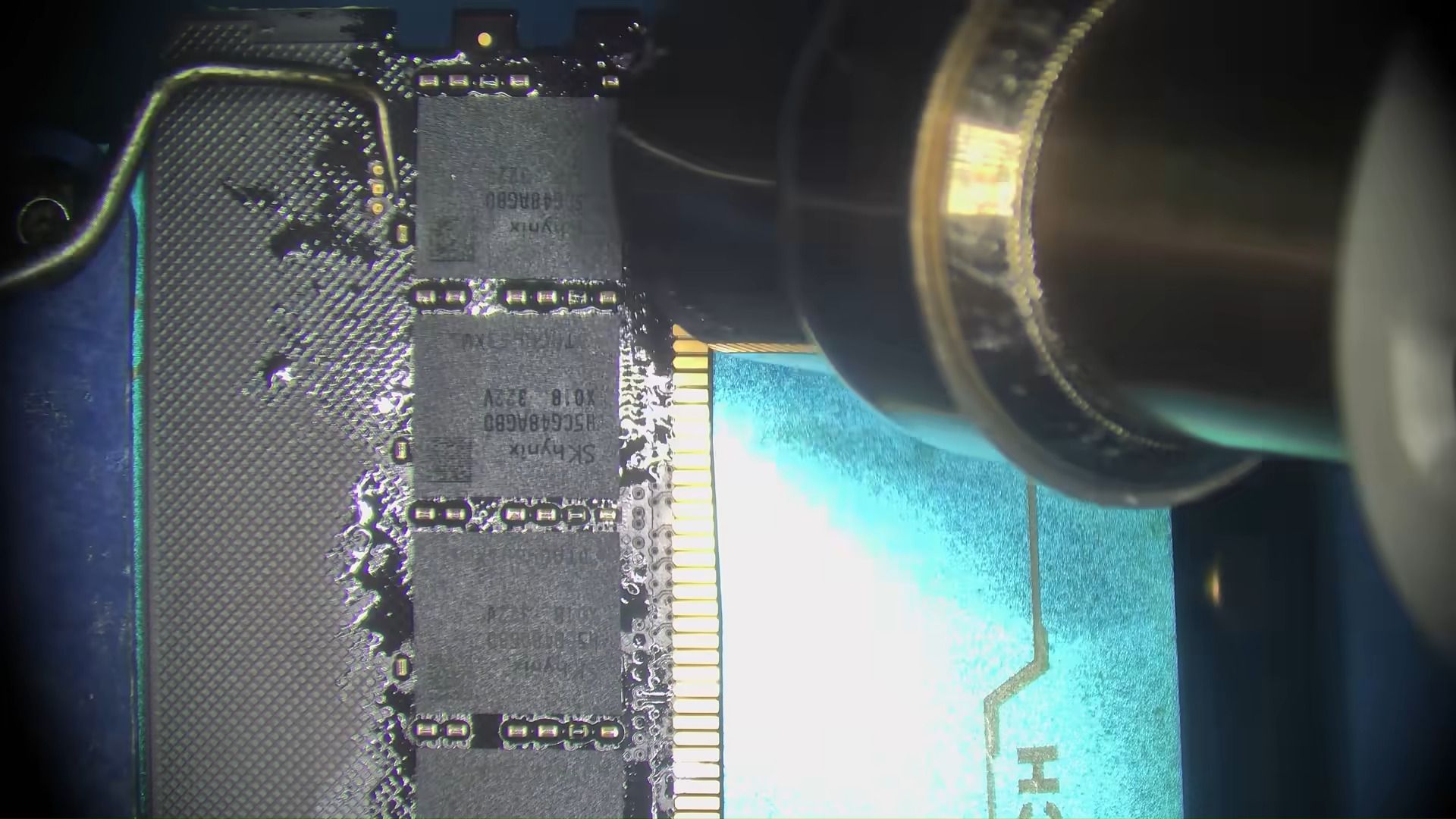
The process began with taking the memory ICs from the donor modules using a hot air station. Then they were cleaned and had 0.45mm leaded solder balls added, using a DDR5 stencil, reballing jig, and hot air. Next, the blank desktop DDR5 PCBs were prepared. A little solder was added to the plethora of BGA connectors to be ready for the memory chips to connect to.

The old DDR5 ICs and the new desktop modules could now be mated, using flux, the preheater, hot air, and watching and prodding carefully with a dental pick. Blighted Agent’s experience lets him know when the BGA chips have successfully mated with the PCB. You can eyeball when they pop precisely into place due to surface tension, and offer up a modicum of resistance to pick prodding.

Finally, the enthusiast added the SPD chip and BIOS chip from the SODIMMs to the new desktop DIMMs. These new desktop DIMMs were quickly tested in a PC before they were finished off with carefully applied thermal pads and the fancy-looking heatsinks.

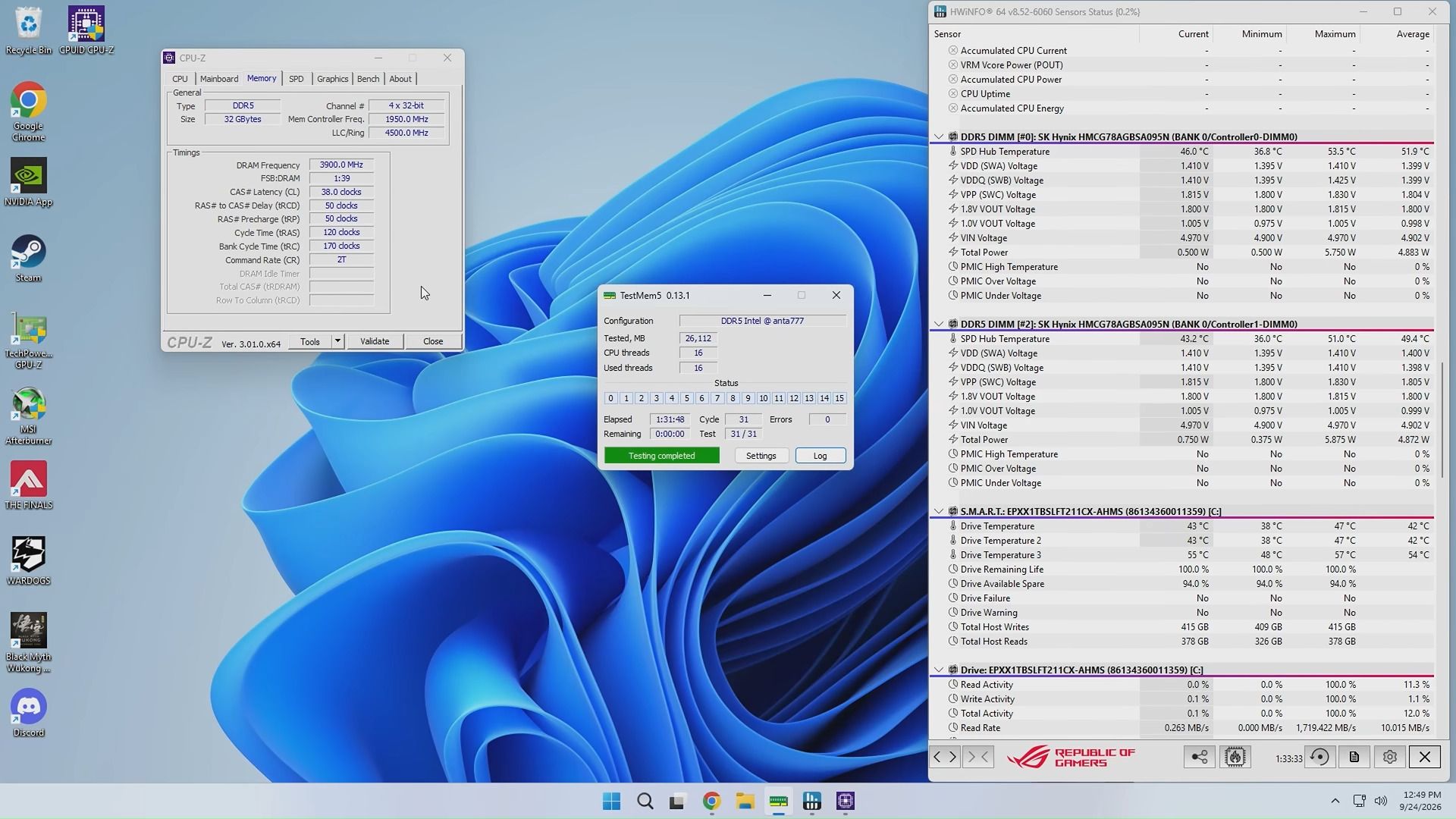
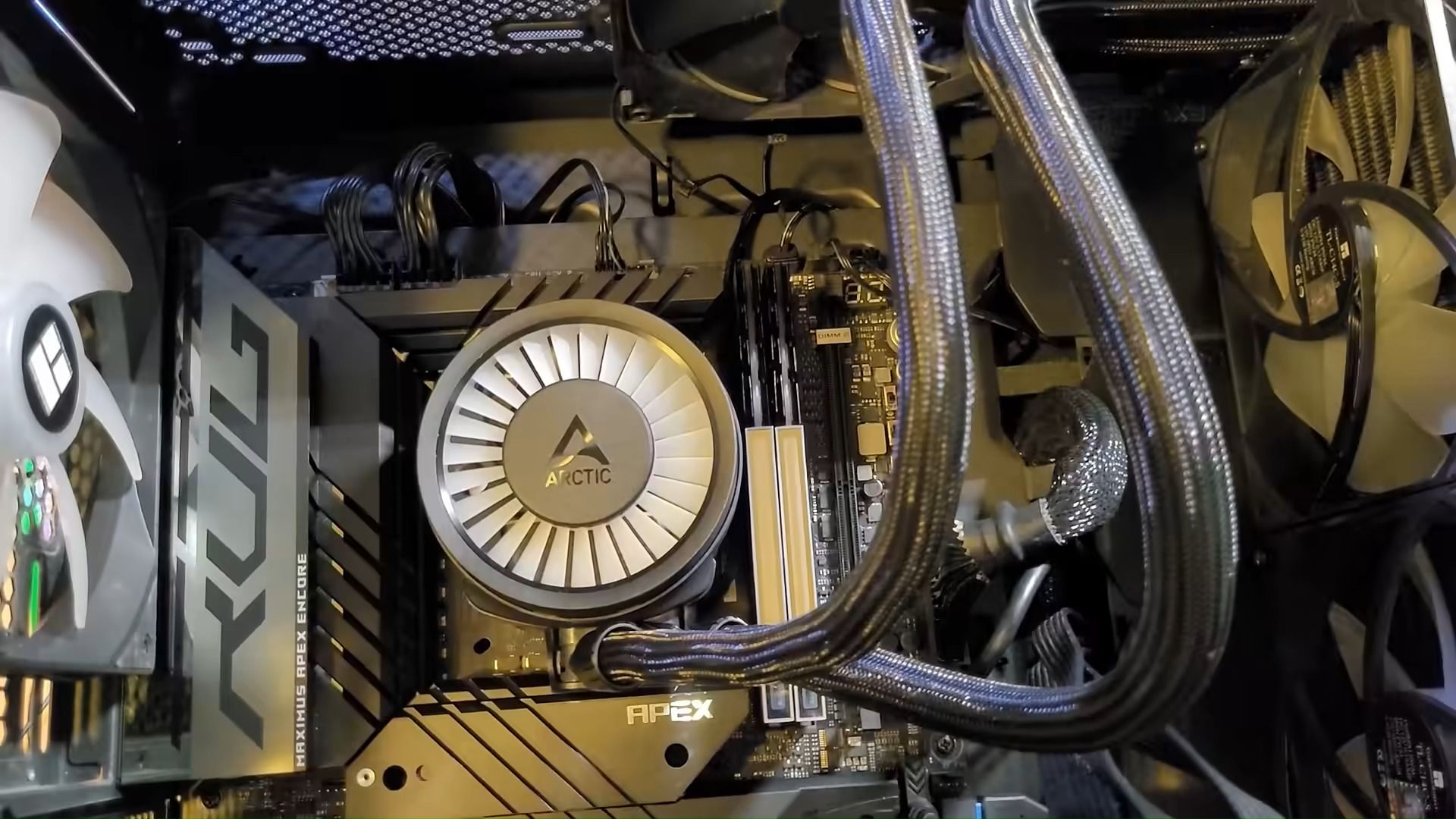
Blighted Agent felt lucky that there were no issues with the newly created desktop modules. There’s a lot of intricate things that can go wrong during such a process. The initial boot verification showed them recognized in his Asus ROG Maximus Z790 Apex Encore motherboard as two β€œSK hynix 16,384MB 5600MHz” modules, which was correct. Some tuning resulted in rock-steady performance at DDR5-7800 CL38 and 1.40V. This was verified by stress testing for 90 minutes, which the enthusiast reckons was ample for a gaming PC. It is very likely a better result than using those mechanical SODIMM-to-DIMM converters you can buy, which can be problematic.

Blighted Agent seems to specialize in BGA soldering work, and has also successfully upgraded several graphics cards with double the VRAM. Though videos like this are edited to be brief, and they make the process look easy, the TechTuber admits there is a lot that can go wrong during this kind of rework. Moreover, with RAM modules, they lack the testing equipment to locate an issue with any particular IC on the PCB. So, if this module didn’t work, they might have ended up in a world of pain, not knowing which memory chip had an issue due to either an internal fault or a BGA soldering glitch.

Electronics hobbyist converts a $120 DDR5 SODIMM kit into a $1000 desktop kit
Blighted Agent on YouTube
Electronics hobbyist converts a $120 DDR5 SODIMM kit into a $1000 desktop kit
Blighted Agent on YouTube
Electronics hobbyist converts a $120 DDR5 SODIMM kit into a $1000 desktop kit
Blighted Agent on YouTube

Looking around at used DDR5 SODIMMs, it looks like Blighted Agent was very lucky to get a used working 32GB kit for $120. I just checked eBay U.S., and the best deal there was $320. Meanwhile, the best price for a new 32GB DDR5-6000 kit seems to be $449 at the time of writing.

We reported on Russian enthusiast VIK-on succeeding in a similar project earlier this year, but all their costing was in Rubles, and they went the extra mile in flashing custom firmware so the remade modules would be auto-detected with 6400 MT/s XMP support on most motherboards. In late 2026, DDR5 RAM continues to be too expensive.

  •  
❌