❌

Reading view

Computation sorts thousands of 2D crystals for topology and twisting


In 2004, physicists isolated graphene, a sheet of carbon just one atom thick. It launched the study of two-dimensional (2D) materials: crystals a few atoms thick in which electrons are confined to a plane and can behave quite differently from those in ordinary solids. The family of known and predicted 2D crystals has since grown to thousands of members. Two recent studies show how computation can search that family for the most promising ones, the first for unusual electronic “topology”, the second for crystals well suited to twisting.

A hidden property of electrons

Electrons in a crystal can only have energies within allowed ranges called bands, separated by forbidden gaps. If a gap separates the filled electrons from the empty states, the material is an insulator. In a semimetal, filled and empty bands just touch, so a few electrons can move freely.

Two insulators can still differ at a deeper level, described by topology: a property of the whole set of electron states that cannot change smoothly, only by closing the gap or breaking a protecting symmetry. A doughnut and a coffee mug are topologically alike because each has one hole, and neither can become a sphere without tearing.

The idea took off with the quantum spin Hall effect. Proposed for graphene in 2005, it proved unobservable there because the effect is far too weak. A 2006 proposal for thin layers of mercury telluride was confirmed in 2007. In such a topological insulator the interior blocks current, yet the edges conduct, with electrons of opposite spin travelling in opposite directions, which protects them against many kinds of imperfection.

Symmetry-based methods known as topological quantum chemistry in 2017 made it possible to decide whether a computed electronic structure is topological. Applied to three-dimensional crystals, they pointed to thousands of candidates. Flat crystals lagged behind, with only about 400 known topological or related monolayers.

The first study, “Two-dimensional Topological Quantum Chemistry and Catalog of Topological Materials” 1, adapts these methods to 2D crystals and applies them to 8,872 entries in two computational databases. It finds 4,073 with nontrivial topology or a related property called obstruction, including 905 topological insulators, 2,129 topological semimetals and 1,003 obstructed atomic insulators, plus 36 close variants. In an obstructed insulator the electrons are centred on empty positions between the atoms rather than on the atoms themselves. The bulk looks ordinary, but cutting the crystal along certain lines produces edge states, and small flakes can carry fractions of an electron’s charge at their corners. The study also calculates edge states for selected materials. Its catalogue includes over 100 monolayers already made in laboratories, but most entries are computer predictions whose properties remain to be tested.
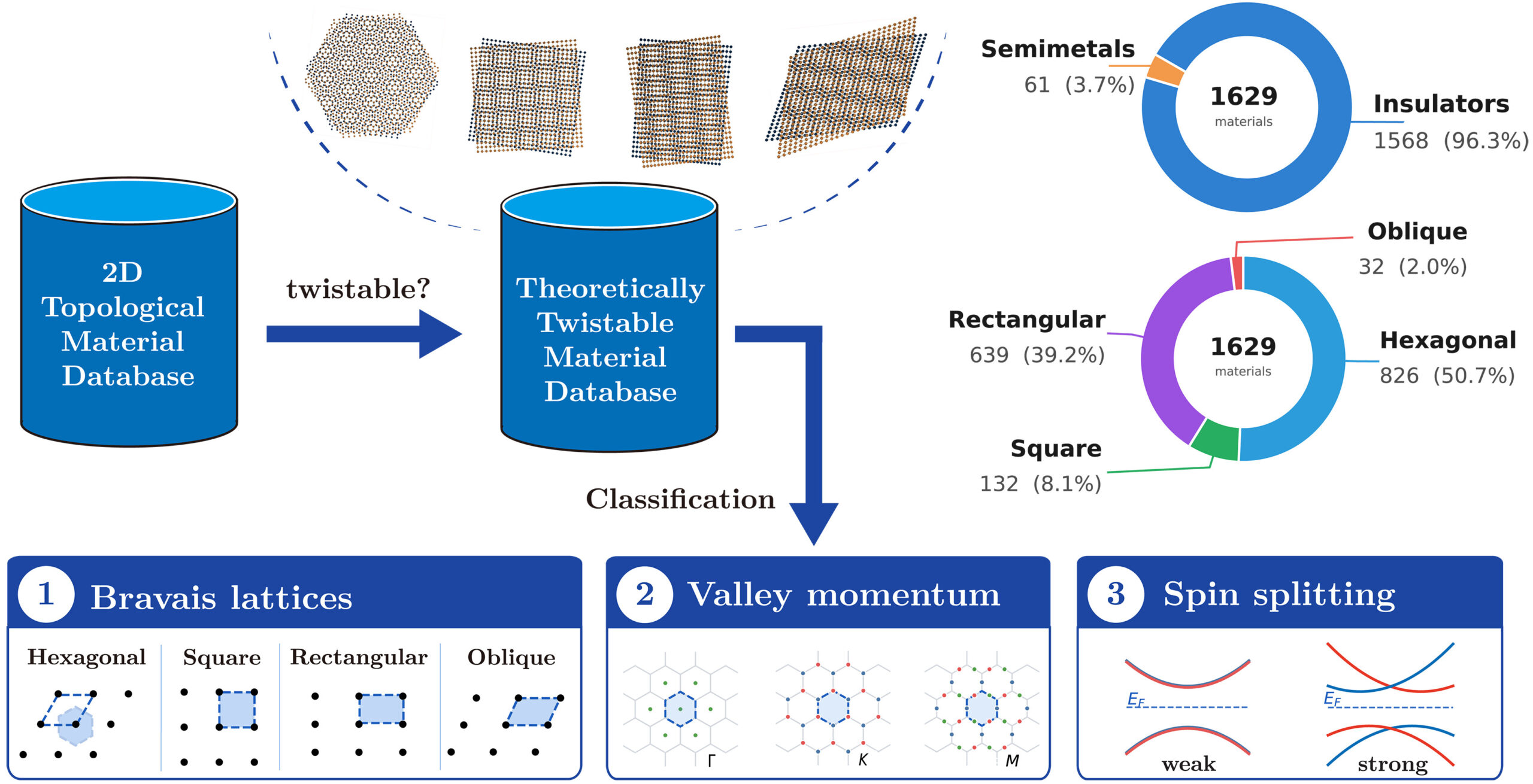
Workflow of the database construction. Starting from a 2D topological material database, a filtering score is applied to construct a database of theoretically twistable materials, which includes both semimetals and insulators. The candidate materials in this database are further classified according to their Bravais lattices, valley splitting, and spin splitting. Source: Y. Jiang et al. (2026) Science doi:10.1126/science.adu1550

Twisting layers

Stack two atomic sheets and rotate one slightly, and the mismatch creates a large interference pattern, called a moiré pattern, much like two overlapping window screens. Electrons feel this longer repeating pattern, and under the right conditions their bands become nearly flat. Electrons in a flat band have little energy of motion, so their mutual repulsion dominates and strongly correlated behaviour can emerge.

In 2011, calculations predicted that two graphene sheets twisted by about 1.1 degrees, a “magic angle”, would have such flat bands. In 2018, experiments at that angle revealed insulating states caused by electron repulsion, and superconductivity. Twisted layers of other materials, such as MoTe2 and WSe2, have since shown many correlated phases, though the mechanisms are still debated.

Most work has focused on these few materials, because most crystals have electronic structures too complicated to predict once twisted. The second study, “2D theoretically twistable material database” 2, therefore defines a material as theoretically twistable if its low-energy electrons admit a simple description. In a metal, the relevant electrons must sit at isolated points, as in graphene. In an insulator, the top of the filled band or the bottom of the empty band must stand clear of other bands. Insulators must also have gaps between 0.2 and 3 electronvolts, because larger gaps make electrical contacts difficult. The search was limited to crystals with at most 12 atoms in the repeating cell and four chemical elements.

Starting from the first study’s database, it identifies 61 semimetals and 1,568 insulators. It ranks them with a score and sorts them by lattice shape (about half are hexagonal), by where in momentum space the relevant electrons sit, and by the strength of spin-orbit coupling, the link between an electron’s spin and its motion. These choices shape the moiré pattern, which can resemble honeycomb, kagome or square lattices. Square-lattice moiré systems have been proposed but not yet realized, and could help simulate models relevant to cuprate superconductors.

Calculations on twisted bilayers of SnSe2, SnS2, ZrS2, HfS2 and Sc2CCl2 at a twist of about 7 degrees show isolated flat bands, as the database predicts. Experiments connect the theory to the laboratory. Bulk crystals of SnSe2, SnS2, HfS2, GaTe and ZrNCl were grown. Single layers of several candidates, including SnSe2, HfSe2, ZrS2 and WS2, were peeled off with a gold-assisted technique that yields larger, cleaner flakes. A dual-gated two-layer SnSe2 device was built for electrical measurements, and a twisted two-layer HfS2 device was used for scanning tunnelling measurements near absolute zero.

The direction is clear. Instead of discovering materials by trial and error, it is becoming possible to search systematically for crystals with chosen properties, then test them layer by layer.


Author: César Tomé López is a science writer and the editor of Mapping Ignorance

Disclaimer: Parts of this article may have been copied verbatim or almost verbatim from the referenced research paper/s.

References

  1. U. Petralanda, Y. Jiang, H. Pi, M. G. Vergniory, B. A. Bernevig, N. Regnault, and L. Elcoro (2026) Two-dimensional topological quantum chemistry and catalog of topological materials Science doi: 10.1126/science.adu2107 ↩
  2. Y. Jiang, U. Petralanda, H. Pi, G. Skorupskii, Q. Xu, D. Calugaru, H. Hu, J. Xie, R. A. Mustaf, P. Hohn, V. Haase, A. Ouahchi, S. Samal, J. Zhu, D. Yang, Z. Geng, G. Avedissian, Y. Wang, M. G. Vergniory, M. Claassen, et al. (2026) 2D theoretically twistable material database Science doi:10.1126/science.adu1550 ↩

The post Computation sorts thousands of 2D crystals for topology and twisting appeared first on Mapping Ignorance.

  •  

When dark matter comes in more than one wave


Galaxies rotate faster than the matter we can see should allow. Evidence for an unseen, gravitating substance began to build in the 1930s with Fritz Zwicky’s studies of galaxy clusters, and strengthened in the 1970s as Vera Rubin measured how stars orbit within spiral galaxies. Nearly a century later, dark matter is still known almost entirely through its gravity. It holds galaxies together and shaped the web of cosmic structure, yet its nature remains unknown.

Axions, plural

One candidate has an unusual origin. In the late 1970s, physicists proposed a new particle to solve a puzzle in the theory of the strong nuclear force. Frank Wilczek named it the axion, after a laundry detergent, because it promised to clean up the problem. By 1983 theorists had shown that axions about a millionth of an electronvolt in mass could make up cold dark matter, the slow-moving kind. Later, string theory, an attempt to unify gravity with quantum physics, suggested that nature may contain not one axion but many, with masses spread across a vast range. Some of these particles could be extraordinarily light: around 10⁻²² electronvolts, more than 10²⁷ times lighter than an electron.

Such lightness has a striking consequence. The quantum wavelength of a particle grows as its mass shrinks, and for these axions it stretches to astronomical size, comparable to the roughly half-kiloparsec cores of small dwarf galaxies, about 1,600 light-years. Dark matter would then behave less like a swarm of tiny grains and more like a vast wave, often called wave or fuzzy dark matter. Simulations from 2014 showed that every galaxy halo would have a dense central core with a flat density profile, surrounded by a shimmering pattern of interfering waves. The flat core contrasts with the steep central spike predicted by the simplest cold dark matter models. The same wave nature also prevents very small clumps from forming, which may help explain why fewer small satellite galaxies are seen around our Galaxy than those models predict.

There is, however, a serious difficulty. Light from distant quasars passes through clouds of hydrogen that imprint absorption lines on it, the Lyman-alpha forest, which records how matter was clumped on small scales in the early Universe. If a single ultralight species made up all dark matter, these data demand a considerably larger mass. One influential analysis set a lower limit of about 2×10⁻²⁰ electronvolts, some two hundred times heavier than the favoured value. Separately, deep surveys show no clear drop in the number of faint galaxies, which argues against single axions lighter than about 2.5×10⁻²² electronvolts. Both conclusions assume one kind of axion.

axions
The galaxy cluster called Abell 370 contains an astounding assortment of several hundred galaxies tied together by the mutual pull of gravity. Entangled among the galaxies are mysterious-looking arcs of blue light, the most stunning example is “the Dragon” (to the lower left of centre). Source: NASA, ESA, and J. Lotz and the HFF Team (STScI)  

A new analysis 1 asks what changes if dark matter is a mixture. On large scales, it finds, all species feel the same gravitational field, so they respond together and behave much like one effective axion. The mass of that stand-in depends on each species’ mass and on its share of the total dark matter, with lighter species weighing more heavily. The recipe was tested against a detailed calculation for two species, 30% at 10⁻²² electronvolts and 70% at five times that mass. It reproduced the overall suppression of structure well, missing only some fine oscillations, and the resulting difference in predicted mass fluctuations was below 0.1%. If this holds, a multi-axion universe could build large-scale structure much like a single-axion one, with the cut-off in faint galaxies set by the effective mass. The method extends to any number of species and could seed future simulations.

Inside galaxies the picture changes. On these smaller scales the species act independently, and each weaves its own interference pattern with its own grain size. Projected along the line of sight, these produce density fluctuations of only a few percent, yet they bend light enough to blur the lines of greatest magnification in a gravitational lens, called critical curves, into corrugated bands.

The Dragon test

The Dragon Arc offers a test. This is a spiral galaxy, seen when the Universe was half its present age, stretched and magnified by the galaxy cluster Abell 370. In 2025, observations with the James Webb Space Telescope revealed more than forty individual stars in it, each appearing as a brief flicker when magnified by intervening stars in the cluster. Their positions scatter broadly around the critical curve, and an earlier analysis found this matches wave interference. Cold dark matter clumps would instead confine them to a narrower band skewed in the opposite direction. Reading the scatter as a wavelength of about ten parsecs gives a lensing effective mass of roughly 2.4×10⁻²² electronvolts, assuming about 2.4×10¹⁴ solar masses lie inside the critical curve. This differs from the large-scale effective mass, because lensing depends on each species’ share of the projected density. It is not a detection of axions but a model-dependent interpretation. If the two species suggested by dwarf galaxies, about 1.9×10⁻²² and 2.3×10⁻²¹ electronvolts, made up the halo, the lighter would supply roughly 89% of the projected density near the arc.

The most distinctive prediction concerns position. Heavier axions are expected to gather near the centre of a halo and lighter ones to dominate farther out, so the lensing effective mass should change from place to place. A single species cannot do this. The Cosmic Horseshoe, a lensed galaxy where the telescope may find around sixty flickering stars per pointing, could test it by comparing two positions about five arcseconds apart. A mismatch would hint at several species.

This work shows how a mixture of ultralight particles could look like a single one across the cosmos while revealing its true complexity inside galaxies, perhaps reconciling cosmic constraints with galactic evidence. Proving it will require better simulations, more realistic models of multi-species haloes, and further lensing observations.


Author: César Tomé López is a science writer and the editor of Mapping Ignorance

Disclaimer: Parts of this article may have been copied verbatim or almost verbatim from the referenced research paper/s.

References

  1. J. Zhang, T. Broadhurst, J. Lim, P. Morilla, and S. K. Li (2026) Multi-copy axion transfer function and observational implications of effective de Broglie scales Astron. Astrophys. doi: 10.1051/0004-6361/202558735 ↩

The post When dark matter comes in more than one wave appeared first on Mapping Ignorance.

  •  

How a magnetic molecular junction shapes the current between two superconductors

In 1911, Heike Kamerlingh Onnes cooled mercury to a few degrees above absolute zero and watched its electrical resistance vanish. Lead soon joined the list of superconductors, losing its resistance below about 7.2 kelvin. A full explanation arrived in 1957: electrons bind into Cooper pairs that move together as one collective state below a critical temperature. Breaking a pair costs a minimum amount of energy, called the energy gap, so inside the gap a superconductor offers no states for single electrons.

Yu–Shiba–Rusinov states

Magnetism is an old enemy of this order. Magnetic impurities were known to suppress superconductivity, and in the 1960s Yu, Shiba and Rusinov showed theoretically that a magnetic atom disturbs the pairs around it and traps a localized state with an energy inside the gap. These Yu–Shiba–Rusinov (YSR) states were first seen atom by atom in 1997, using a scanning tunneling microscope (STM): a needle-sharp metal tip that measures the tiny current of electrons tunneling across a vacuum gap to a surface.

A different story concerns two superconductors joined by a very weak link. In 1962, Brian Josephson predicted that Cooper pairs can tunnel through such a link with no voltage at all, an effect confirmed in 1963. When a voltage is applied, another process takes over: multiple Andreev reflection. An electron whose energy lies inside the gap cannot enter a superconductor alone. Instead it is sent back as a hole, the absence of an electron, while a Cooper pair slips in, as Andreev described in 1964. Between two superconductors under a voltage V, a particle can bounce back and forth, gaining energy eV with each crossing, until it can finally escape above the gap. When n crossings are needed, the conductance shows a peak at a voltage equal to the sum of the two gaps divided by n. This pattern, explained in the early 1980s, is called subharmonic gap structure. For lead on lead the sum is 2.7 millivolts, so peaks are expected near 2.7, 1.35 and 0.9 millivolts.

Andreev
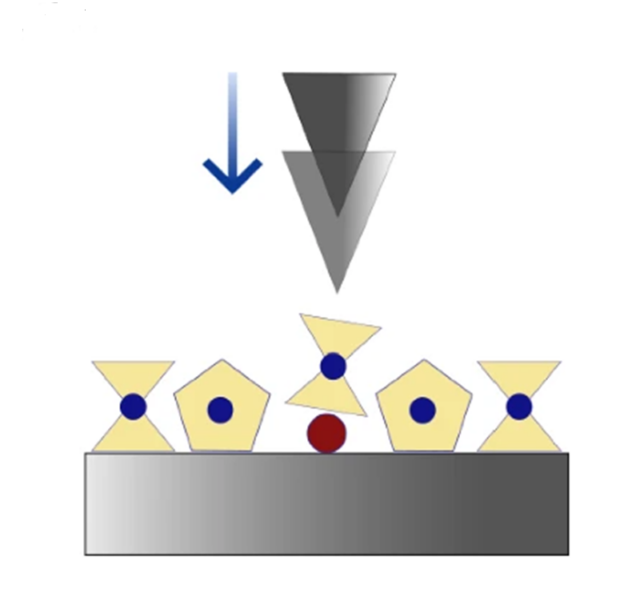
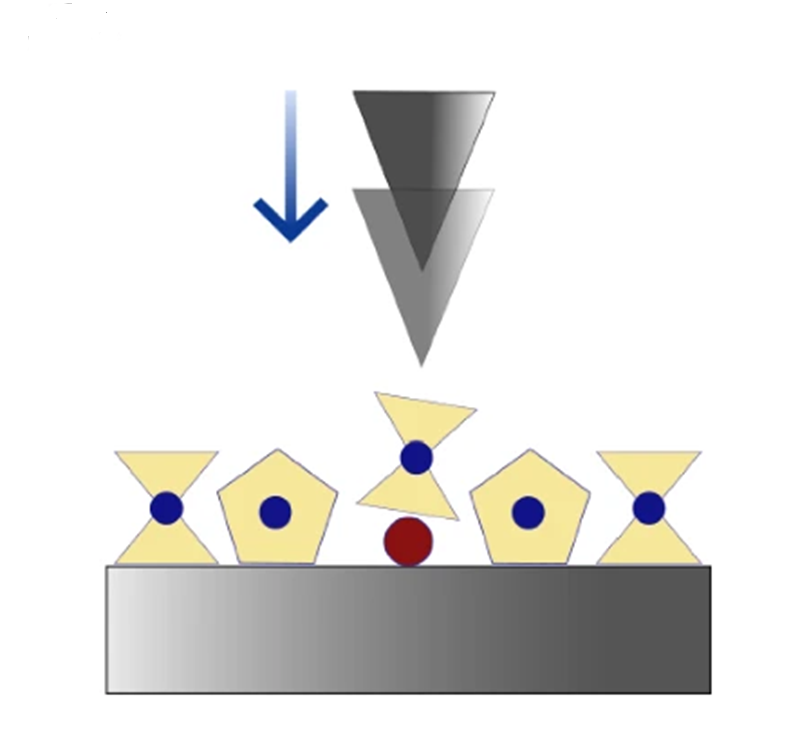
A schematic of the scanning tunneling microscope junction. A lead-coated tip is approached to a nickelocene molecule (yellow) above a subsurface iron atom (red) on Pb(111). Source: C. Mier et al (2026) Nat. Commun. doi: 10.1038/s41467-026-76478-4 CC BY-NC-ND 4.0

Impurity states and Andreev reflections have usually been treated as separate subjects. A recent experiment 1 places them in the same device. A nickelocene molecule, a nickel atom sandwiched between two five-carbon rings, sits on a lead surface above a single iron atom trapped between the molecule and the lead. On its own, the molecule carries a spin that appears as characteristic steps in the measured spectra. Above the iron, those steps vanish and YSR states appear instead. Density-functional calculations explain why: the magnetic moments of molecule and iron point in opposite directions and almost cancel, leaving a leftover spin of one half on the iron. That spin couples to the lead and produces a single pair of YSR states.

The second superconductor is a lead-coated STM tip, lowered toward the molecule at 2.4 kelvin. Far away, electrons tunnel through a wide vacuum barrier and the tip merely reads out the YSR states, which appear as lopsided peaks near the edge of the gap. As the tip approaches, the junction becomes more transparent, meaning electrons cross it more easily, and the setup becomes a weak link between two superconductors. At moderate conductance, new peaks appear at half the sum of the gaps, the signature of second-order Andreev reflection. At the highest conductances, a sharp peak develops at zero voltage: the Josephson contribution. Thermal fluctuations of the superconducting phase broaden this peak, as is typical of STM junctions.

These stages do not simply stack. As the tip approaches, the YSR peak moves to lower energy and mingles with the Andreev peaks. The interpretation is that the bound state becomes a stopping point along the Andreev path. Peaks then appear at the tip’s gap plus the bound-state energy, divided by n, rather than at the ordinary positions. This is called YSR-assisted multiple Andreev reflection.

Odd and even orders

A simple argument explains why odd and even orders differ. Each reflection carries the particle to the opposite electrode, and only the lead surface contains the magnetic atom; the tip has none. After an odd number of crossings the particle ends on the surface, where it can land in the bound state. The peak shifts and acquires the lopsided shape typical of tunneling into a single level. After an even number it ends in the tip, among ordinary states, and those peaks stay closer to their usual positions, although the second-order peak still turns lopsided at higher conductance as a YSR-assisted component splits off. Simulations reproduce this pattern. In the measurements, thermal broadening blurs finer details such as the third-order peak, and small features near zero voltage seem to reflect a mixture of both processes.

Reproducing the evolution of the spectra required two changes together: higher transparency and a stronger exchange coupling between the iron spin and the lead. Raising transparency alone gives a growth of the key peak that the measurements do not show. A likely reason is that the approaching tip slightly squeezes the molecule and strengthens the coupling, though this is an inference. The model treats the spin as classical and its two parameters as effective ones, so it is a phenomenological decomposition rather than a unique microscopic extraction. It also cannot capture the zero-voltage peak.

Even so, the result shows that YSR states and Andreev reflections are two limits of one problem, tuned continuously within a single molecular junction. Under suitable conditions, such spin-active links might also host a Josephson diode, in which supercurrent flows more easily in one direction, or a π-junction, in which the two superconductors prefer opposite phases. These remain possibilities, not demonstrated effects.

Author: César Tomé López is a science writer and the editor of Mapping Ignorance

Disclaimer: Parts of this article may have been copied verbatim or almost verbatim from the referenced research paper/s.

References

  1. C. Mier, A. Fetida, R. Robles, P. Boronat, D. Jyoti, N. Lorente, L. Limot, and D. -J. Choi (2026) Yu-Shiba-Rusinov-assisted Andreev transport in a molecular junction between superconductors Nat. Commun. doi: 10.1038/s41467-026-76478-4 ↩

The post How a magnetic molecular junction shapes the current between two superconductors appeared first on Mapping Ignorance.
  •  
❌