❌

Reading view

The Solar System Has a New Life Expectancy, and It’s a Billion Times Shorter
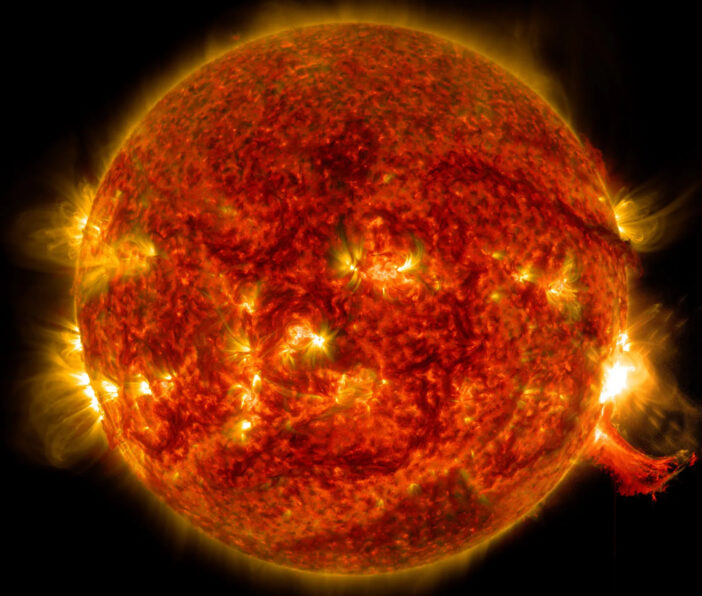
Image of a solar flare.

Isaac Newton suspected that the gravitational dance between the Sun and Jupiter would eventually destabilize the solar system, but modern computational research has shown that its long-term stability is, statistically, pretty secure. However, new simulations with more realistic solar mass-loss conditions make a strong case for the disassembly of the outer solar system — and on timescales much shorter than previously thought.

Kick It Up a Notch
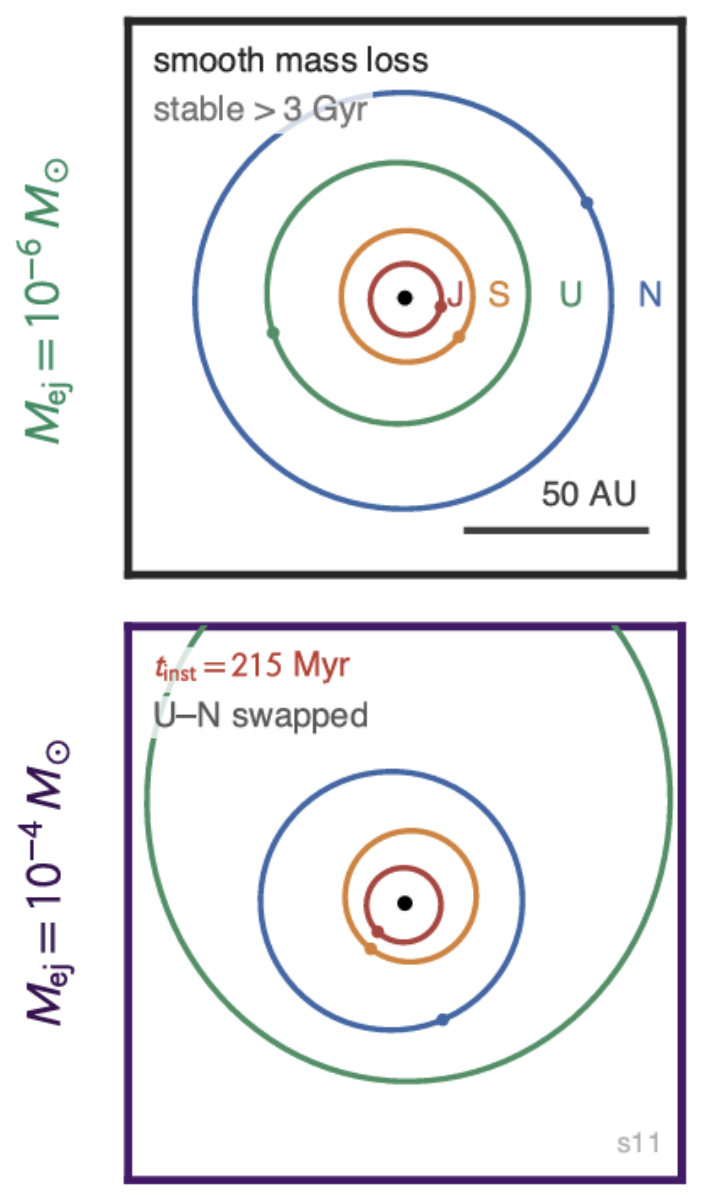
A plot showing final orbits of the outer planets for two simulations.

Final outer planet orbital configurations for two simulations — one stable and one unstable. t=0 at the onset of white dwarf formation. Click to enlarge. [Adapted from Batygin et al. 2026]

Several studies have investigated what will happen to the orbits of planets in our solar system as the Sun sheds its mass during its transition to a white dwarf. These studies have found that while the semimajor axes of the planets will expand by approximately a factor of 2, their orbits remain stable on timescales longer than the age of the universe (approximately 1018 years). This expanded orbital architecture will make the solar system more prone to jostles from stellar flybys, but even accounting for this, the giant planets’ orbits wouldn’t disassemble for another 30–100 billion years.

However, all of these studies modeled solar mass loss as a smooth function, so the dismantling of the solar system was left up to external forcings. In reality, stars on the red giant branch undergo mass ejections that are random in time and direction, corresponding to velocity “kicks” that can alter the dynamics of the planets. 

A team led by Konstantin Batygin at the California Institute of Technology conducted numerical experiments to analyze the orbital dynamics of the outer solar system under different solar mass-loss conditions. First, they tested the classic case of smooth mass loss and validated previous findings that, despite planetary orbits doubling in size, the dynamics are pretty tame. This holds true even when mass is ejected anisotropically: if the timing is smooth, the asymmetries cancel out.

Outer Solar System, Your Days Are Numbered

Next, they simulated stochastic kicks and found that the behavior of the outer planets was largely tied to the ejection mass of each kick. For very small ejection masses (≤ 10-7 M☉), dynamics mimic the smooth mass-loss case. For intermediate values (10-7 to 10-6 M☉), there’s a roughly 20% chance Jupiter–Saturn and Uranus–Neptune enter mean-motion resonances: an orbital configuration where planets’ periods are a ratio of small integers. These resonant configurations don’t protect the giant planets, however: resonant simulations disassemble slightly more often than nonresonant simulations. For larger ejection masses (≥ 10-5 M☉), the outer solar system disassembles on the timescale of billions of years. 
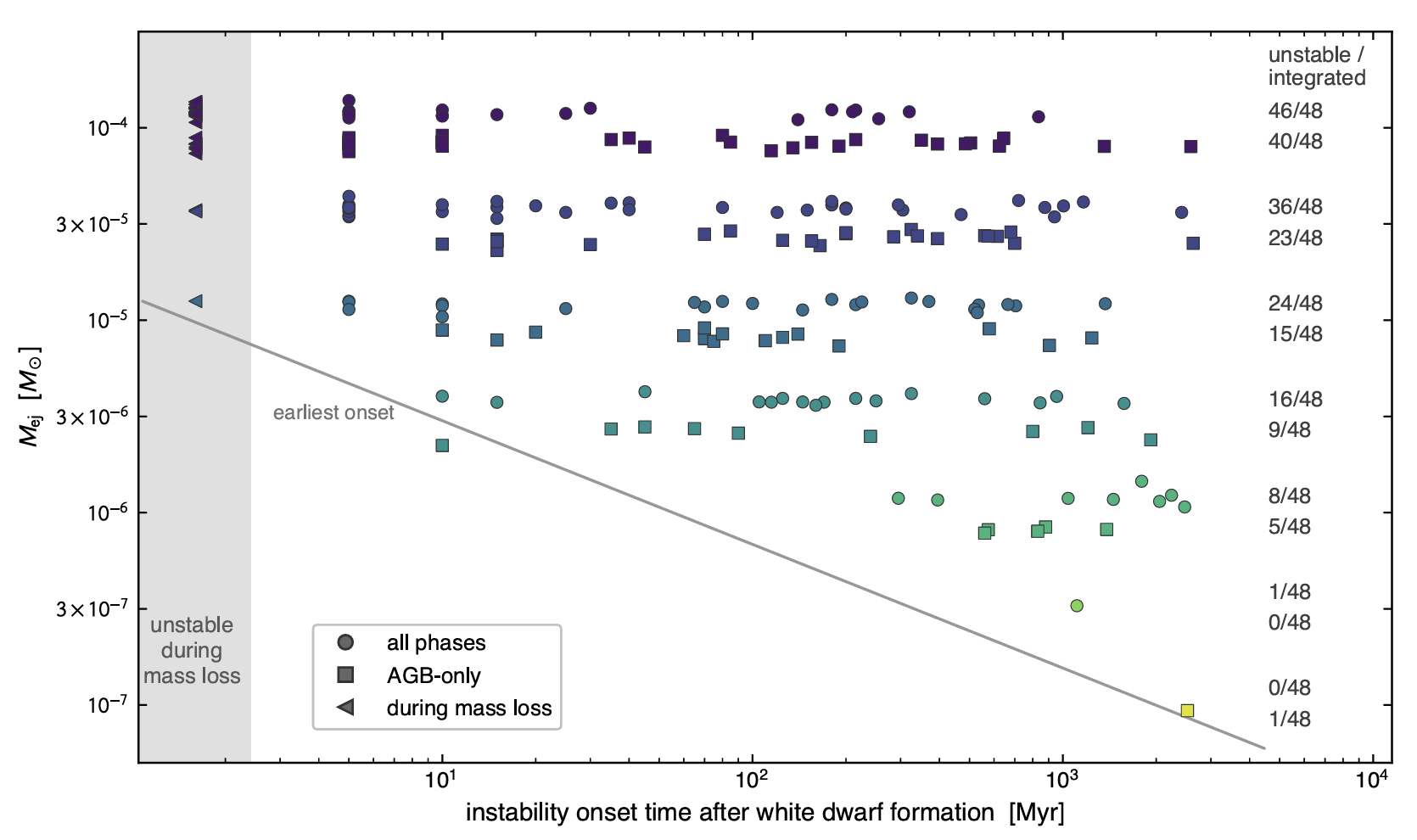
Plot showing the instability onset times as a function of ejection mass for all simulations.

Instability onset time — or how long after white dwarf formation the outer solar system disassembles — as a function of ejection mass. The larger the ejection mass, the greater the chance of instability. Click to enlarge. [Batygin et al. 2026]

Which ejection masses are the most accurate for our Sun? Well, unfortunately for our beloved outer planets, ejection models and observed kick amplitudes suggest a future ejection mass of 10-4 M☉. With kicks like these, not only is there a considerable chance of orbit destabilization, but it could happen before the white dwarf even forms. About 40% of simulations lead to disruption or violent scattering while the Sun is in its red giant phase, and roughly 90% break down within 3 billion years. 

This new discovery reduces the life expectancy of the solar system from one billion billion years to a meager one billion years after white dwarf formation. 

Citation

“Terminal Instability of the Solar System Triggered by Stochastic Solar Mass Loss,” Konstantin Batygin et al 2026 ApJL 1009 L22. doi:10.3847/2041-8213/aea290

The post The Solar System Has a New Life Expectancy, and It’s a Billion Times Shorter appeared first on AAS Nova.
  •  

Planets Scattering Planets in Warm Jupiter Systems

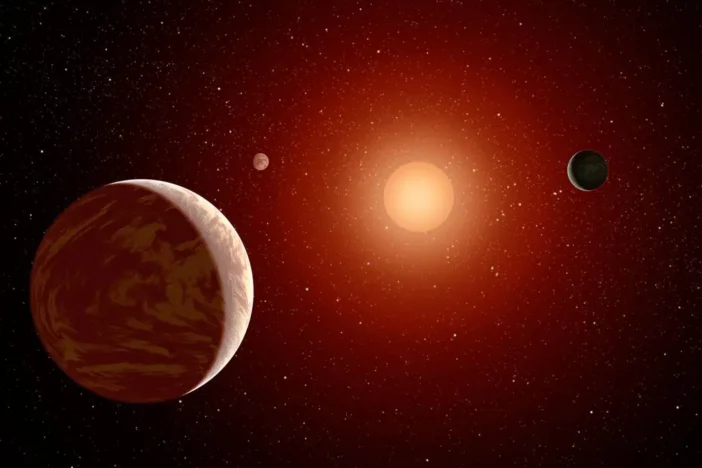
exoplanet system with three planets

While our solar system sports one Jupiter-like planet, exoplanet discoveries have revealed that giant planets come in a few different forms in systems with varying architectures. A recent study has explored how the mass–eccentricity relationship in warm Jupiters is shaped by dynamical interactions between planets.

Jupiter-like Planet Eccentricities

Exoplanet surveys have uncovered three different Jupiter-like planet populations across the galaxy: hot, warm, and cold Jupiters. Much like our own, cold Jupiters orbit on long periods, far away from their host stars. Conversely, hot Jupiters zip around their host stars on extremely short-period orbits. Somewhere in between, warm Jupiters orbit their host stars with periods from 10 to 365 days.

eccentric and circular orbits

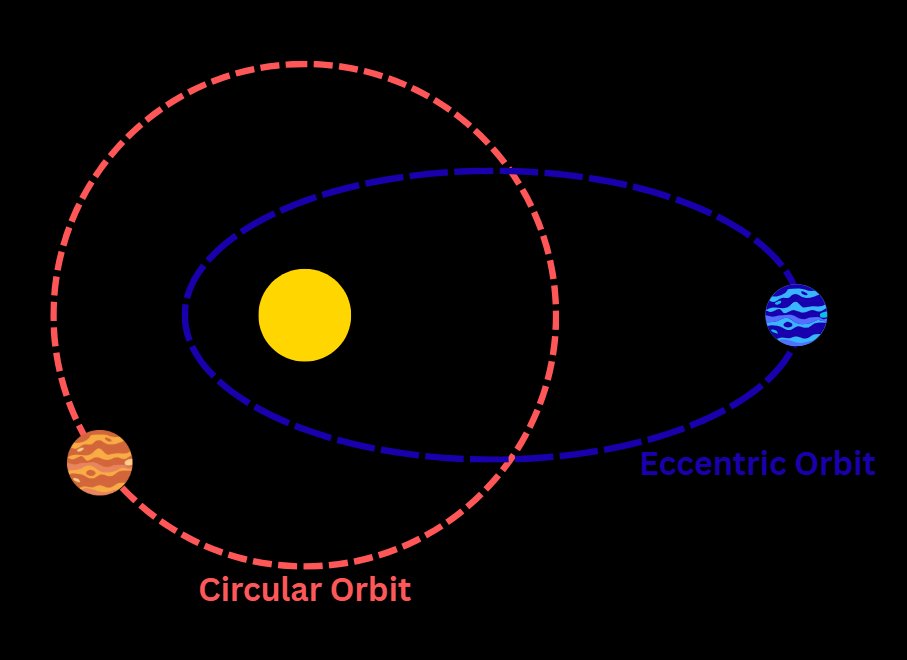
Diagram showing examples of a circular and an eccentric orbit. Click to enlarge. [AAS Nova/Lexi Gault]

These giant planets have proven to be deeply entwined with the makeup of their host systems, and their orbital properties have been used to test and trace planet formation pathways. For example, long-period cold Jupiters discovered in radial velocity surveys have exhibited a positive correlation between planetary mass and orbital eccentricity. This mass–eccentricity relationship, as previous studies have suggested, is likely the result of a process known as planet–planet scattering, in which dynamical interactions between planets in the same system cause significant and chaotic changes to their orbits.

Does this relationship extend to shorter-period giant planets as well? Hot Jupiters are heavily impacted by tidal interactions with their host stars, circularizing their orbits and erasing dynamical imprints on their eccentricities. Warm Jupiters, on the other hand, orbit far enough away for their eccentricities to preserve clues about their energetic histories. Recently, thanks to the Transiting Exoplanet Survey Satellite (TESS), astronomers have identified a positive correlation between planetary mass and eccentricity in a growing sample of warm Jupiters, but the exact driver of this trend has yet to be uncovered.

Planets Scattering Planets

To test if the positive mass–eccentricity correlation in warm Jupiters is consistent with planet–planet scattering, Jiayin Dong (University of Illinois at Urbana-Champaign) constructed a sample of 85 warm Jupiters from the NASA Exoplanet Archive. This carefully selected sample, dominated by discoveries from TESS and Kepler, included planets with masses between 0.3 and 15 Jupiter masses and orbital periods between 10 and 365 days. In conjunction with this sample, the authors built a planet–planet scattering framework to assess the range of properties anticipated for scattered warm Jupiter systems.

Eccentricity planet-star mass ratio and semimajor axis

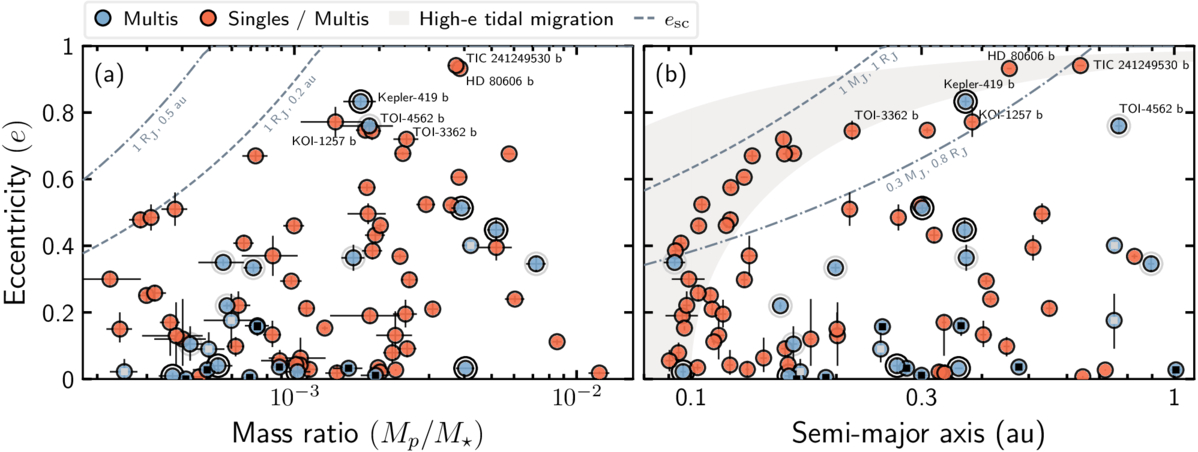
Warm Jupiter eccentricity versus planet–star mass ratio (left) and semimajor axis (right). Click to enlarge. [Dong et al 2026]

Comparing the observed trends in their sample with their theory-based expectations, Dong and team showed that planet–planet scattering naturally explains the mass–eccentricity relation of warm Jupiters. In their framework, warm Jupiters originate in compact, multiplanet systems, and as the systems evolve, gravitational interactions between planets excite orbital eccentricities and inclinations, leading to close encounters. These encounters can cause planets to collide or to be ejected from the system entirely.

The mass–eccentricity relation of warm Jupiters, the authors suggested, represents a transition from collision-dominated interactions among low-mass planets to ejection-dominated interactions among high-mass planets. For massive enough systems, scattering can excite eccentricities high enough to trigger the high-eccentricity migration responsible for moving hot Jupiters to their close-in orbits. Overall, this study suggests that warm Jupiters are not a distinct planet species, but instead may represent the shorter-period counterparts of cold Jupiters whose orbits are shaped by the same dynamical processes. Future observations expanding the sample of warm Jupiters and discoveries of additional planet companions will further uncover the links between hot, warm, and cold Jupiter systems.

Citation

“Planet–Planet Scattering Explains the Mass–Eccentricity Relation of Warm Jupiters,” Jiayin Dong et al 2026 ApJL 1007 L29. doi:10.3847/2041-8213/ae930e

The post Planets Scattering Planets in Warm Jupiter Systems appeared first on AAS Nova.

  •  
❌