❌

Reading view

Astronomers Get a Better Look at a Rare White Dwarf–Brown Dwarf Pair
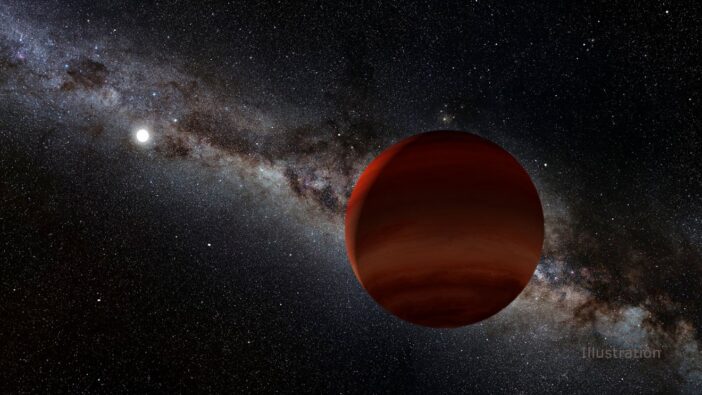
Illustration of a brown dwarf orbiting a white dwarf

Researchers have followed up on the discovery of a rare binary system containing a white dwarf and a brown dwarf. This unusual pairing offers valuable insights into the physics of atmospheres subjected to strong radiation.

Odd Couple

In 2025, researchers searching through observations from the Transiting Exoplanet Survey Satellite (TESS) spotted an eclipsing binary system in which a brown dwarf orbits the white dwarf J0404+1112 every 2.93 hours. Only about a dozen white dwarf–brown dwarf binaries have been confirmed so far, and each newfound system offers clues to how substellar or planetary companions survive a star’s transition from main-sequence star to swollen red giant to blazing white dwarf.

Because the two objects orbit one another so closely, this remarkable system also offers researchers an opportunity to study the dynamics and chemistry of an atmosphere blasted with high-energy radiation, with important implications for close-in brown dwarfs and giant planets.

Insights from New Observations
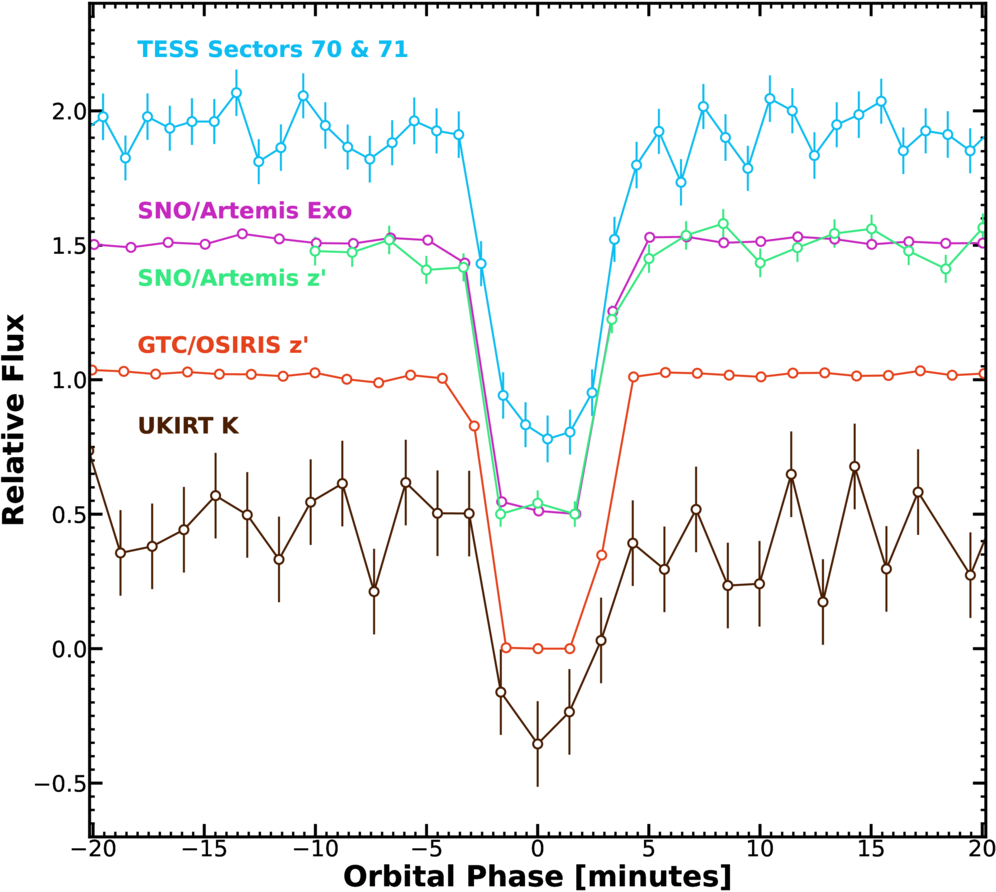
eclipse photometry of J0404+1112

Eclipse photometry of J0404+1112 from TESS, SPECULOOS, the Gran Telescopio Canarias, and the United Kingdom Infra-Red Telescope. [de Wit et al. 2026]

Based on early data from TESS and SPECULOOS, Julien de Wit (Massachusetts Institute of Technology) and collaborators posited that the J0404+1112 system contained an unusually puffy low-mass white dwarf and a 25-Jupiter-mass brown dwarf. However, the initial data couldn’t fully constrain the white dwarf’s properties, leaving degeneracies between its temperature, radius, and other factors.

Now, the team has obtained new photometry from the Gran Telescopio Canarias and the United Kingdom Infra-Red Telescope, plus spectroscopy from the Gran Telescopio Canarias, to get a better sense of the system. These observations allowed them to break the degeneracies in the white dwarf’s properties, showing it to be an 0.60-solar-mass white dwarf that has been cooling for more than 10 million years to a present-day temperature of 28,000K. The brown dwarf also appears to be more massive than initially thought, weighing in at roughly 40 Jupiter masses.
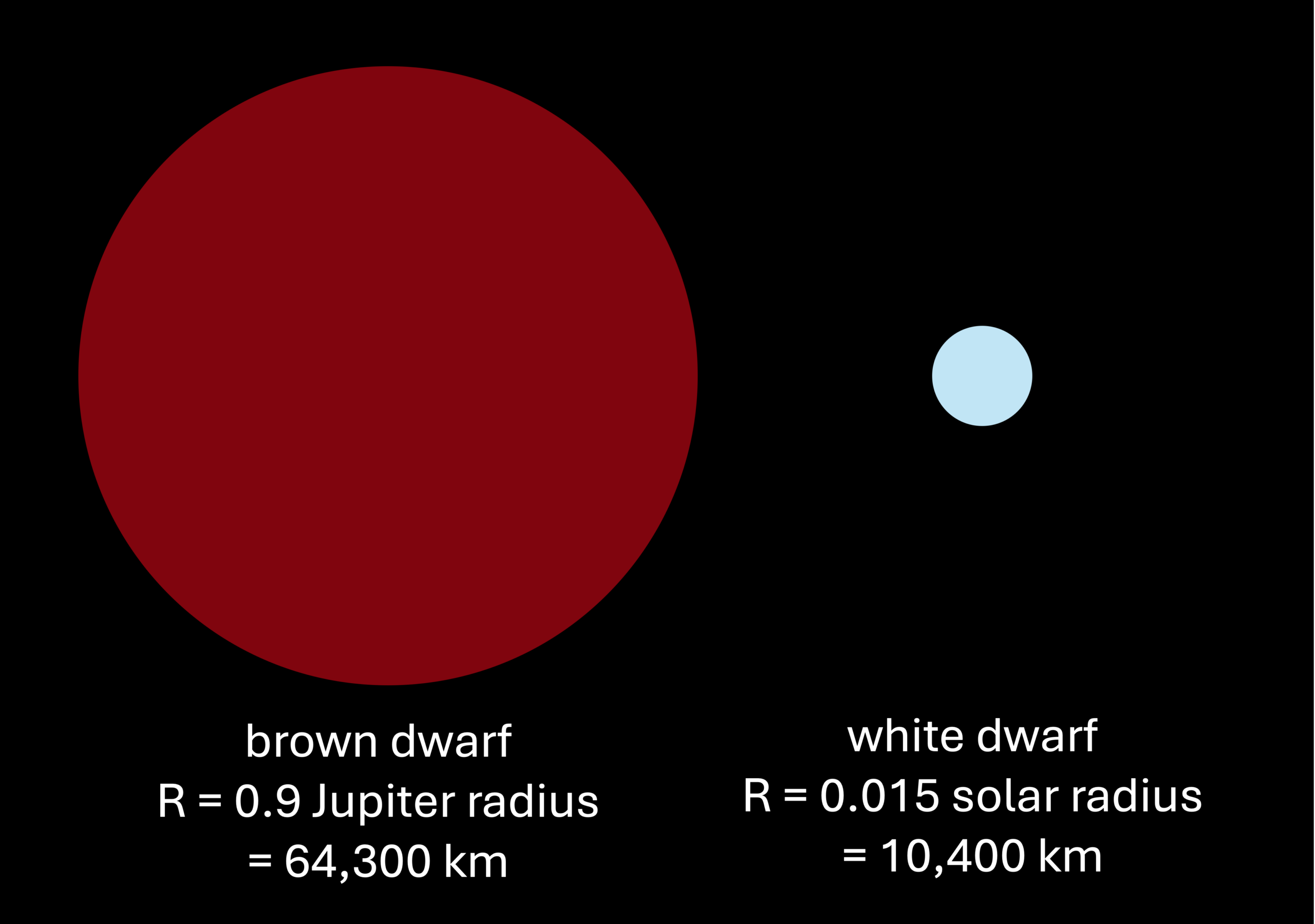
diagram illustrating the relative sizes of J0404+1112 and its companion brown dwarf

This diagram shows the relative sizes of the brown dwarf and the white dwarf. [AAS Nova/Kerry Hensley]

Like Night and Day

Because the system’s orbit is almost exactly edge on from our point of view, the white dwarf is completely eclipsed as the much larger brown dwarf passes in front of it. This allows the contributions from the two components to be separated, and for the emission from the brown dwarf’s nightside to be measured. The authors constrained the brown dwarf’s nightside temperature to roughly 1750K. Its dayside temperatures are likely to be significantly higher — potentially around 3750K at the point where the white dwarf is directly overhead — but more data are needed to constrain the dayside temperature of this world.
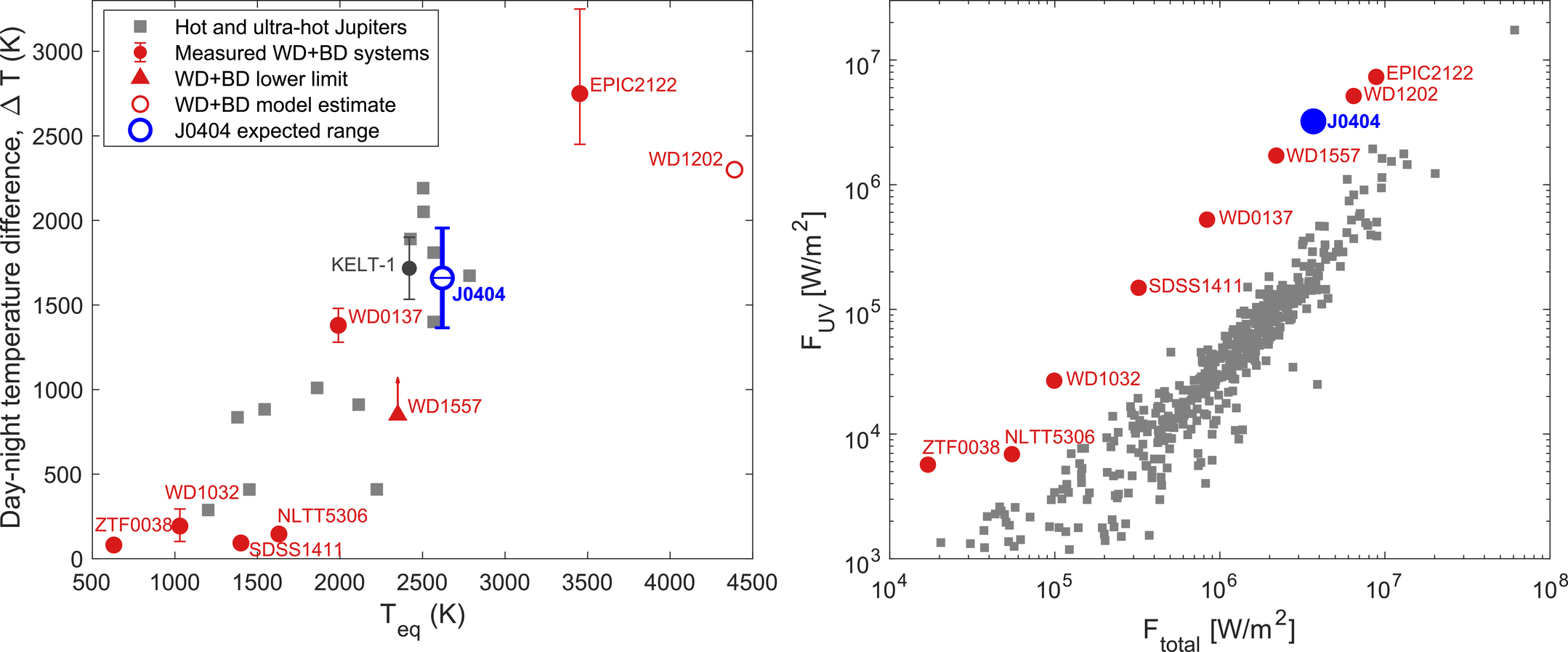
comparison of day–night temperature difference and irradiation flux of J0404+1112 compared to other systems

Day–night temperature difference (left) and irradiation flux (right) of the brown dwarf in this system compared to other white dwarf–brown dwarf systems and hot and ultra-hot Jupiters. Click to enlarge. [de Wit et al. 2026]

The estimated day–night temperature difference for this brown dwarf places it in the realm of hot and ultra-hot Jupiters. However, it’s subjected to more ultraviolet radiation than a typical hot or ultra-hot Jupiter orbiting a main-sequence star. This makes J0404+1112 a valuable system for disentangling the interconnected effects of temperature, radiation environment, atmospheric composition, and other factors on hot or ultra-hot Jupiters and other strongly irradiated brown dwarfs. We can certainly expect to learn more about this rare system as new data are collected!

Citation

“J0404+1112: A 3 hr Eclipsing White Dwarf–Brown Dwarf Probing Multiple Atmospheric Regimes,” J. de Wit et al 2026 ApJL 1009 L40. doi:10.3847/2041-8213/ae9a97

The post Astronomers Get a Better Look at a Rare White Dwarf–Brown Dwarf Pair appeared first on AAS Nova.
  •  

Stellar Pulsations Suggest Habitable-Zone Planet Around a Massive Star

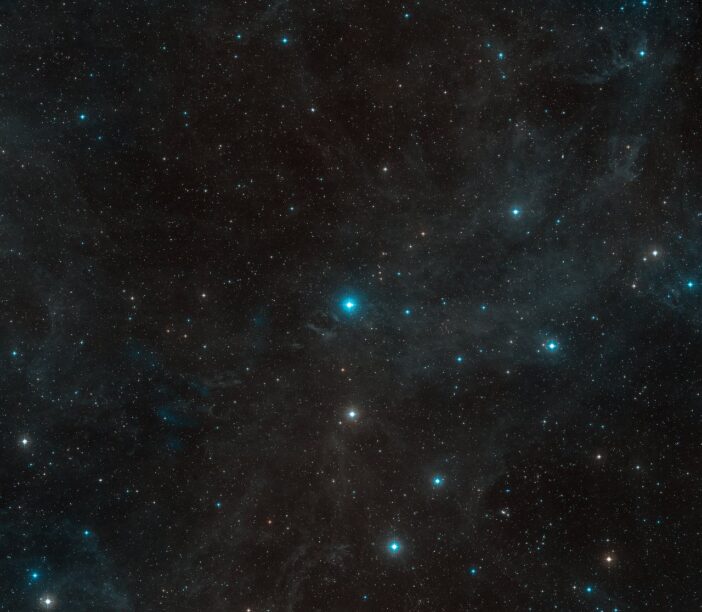
Stellar field observed by ESO.

By observing subtle variations in the timing of stellar pulsation modes, researchers may have made the first detection of a planet in the habitable zone of a massive A-type star.

Listening for Planets in Stellar Heartbeats

To date, some 6,000 exoplanets have been detected across a vast array of surveys and instruments. The majority of these have been detected around main-sequence F, G, and K stars — but not because these are the only places exoplanets can exist. Rather, this is a result of selection bias: these stars tend to be both bright and luminously stable enough for astronomers to deploy the radial velocity or transit methods.

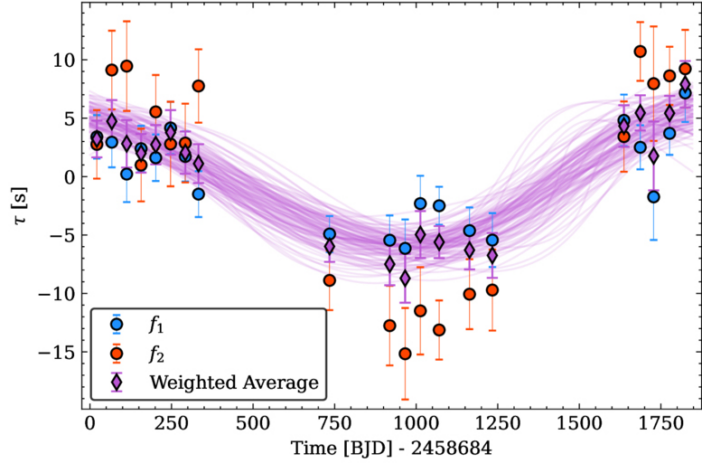
Sinusoidal graph showing planet-induced timing delays in stellar pulsation modes.

Periodic modulations in the time of observed stellar pulsations can indicate the presence of an orbiting companion. In this case, timing variations are displayed for the two most prominent pulsation modes f1 and f2 for the variable star HD 156295. The sinusoidal pattern indicates they may be caused by an orbiting companion with a mass of about 6.3 Jupiter masses at a distance of 3.9 au, in this star’s habitable zone. [Adapted from Wilson et al. 2026]

A-type stars, by contrast, are challenging for exoplanet detections. These more massive stars tend to exhibit fewer and broader spectral lines than their F, G, or K counterparts, rendering radial velocity techniques largely ineffective. Many A-type stars also pulsate in brightness, making it hard to identify planetary transits within their erratic light curves. 

Luckily, one transit astronomer’s trash data can be a pulsation timer’s treasure. For some A-type stars called δ Scuti stars, the pulsation is regular enough to be used like a cosmic clock. Subtle variations in a star’s position due to the tug of an orbiting companion can then disrupt the timing of its otherwise steady pulsation, allowing one to once again find planets via its light curve — including massive ones on intermediate-period orbits that are the most difficult to detect around massive stars using traditional methods.

A Massive Planet in the Habitable Zone of a Hot Star?

In a new study led by Logan Wilson (Center for Astrophysics | Harvard & Smithsonian), researchers analyzed 16,440 highly pulsating δ Scuti stars observed at a high cadence by the Transiting Exoplanet Survey Satellite (TESS) in order to look for the distinctive, periodic timing modulations associated with an orbiting companion. This sample was then whittled down to nine candidate systems they believe may contain substellar companions — likely either brown dwarfs or massive planets.

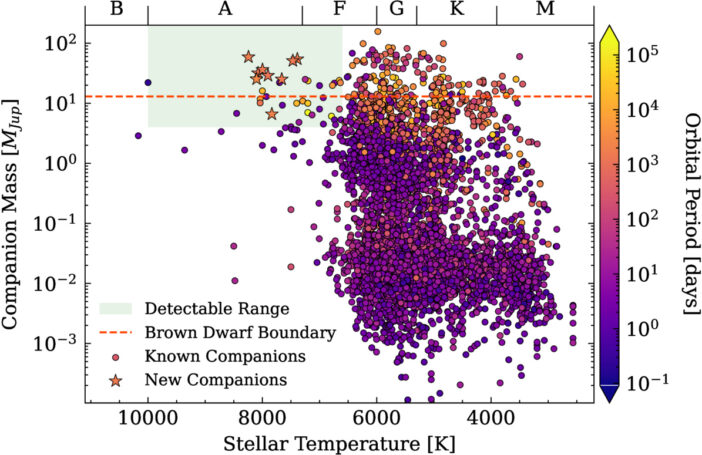
Scatterplot showing population of substellar companion objects found to date.

The properties of the nine candidate objects identified in this study and their host stars are shown here, along with the properties of other exoplanet systems. Through stellar pulsation timing, the researchers were able to identify substellar candidates around hot A-type stars in intermediate-period orbits, a region of parameter space that has been difficult to probe with other methods. [Wilson et al. 2026]

One particularly striking candidate was found when analyzing the star HD 156295. Based on their timing data, Wilson and collaborators deduce the star may have a 6.3 Jupiter-mass planetary companion orbiting every 2,200 days. That puts the companion’s distance from its host at about 3.9 au, right at the far edge of HD 156295’s habitable zone. If this planet turns out to be real, HD 156295 would be the hottest star known to host an exoplanet in its habitable zone. This detection also suggests a high occurrence rate of massive planets on intermediate orbits relative to expectations for other main-sequence stars, supporting theories that A-type stars may form companions like these more efficiently. 

The other eight candidates are more consistent with brown dwarfs. Six of these candidates show somewhat uncommon masses and orbital separations that place them in a region of parameter space known as the “brown dwarf desert.” Some observations suggest this desert is less severe around hotter stars — a conclusion that this study supports.

All of these findings are still quite tentative, however; the researchers estimate that the probability for the planetary signal being real is just over 50%, and the parameters given for each candidate are still subject to large uncertainties. With new data arriving all the time, it may not take long before we have a clearer picture of these unique substellar companions.

Citation

“A Search for Substellar Companions around A-type Stars: Pulsation Timing Detection of Eight Brown Dwarf Candidates and a Possible Habitable-zone Planet,” Logan G. Wilson et al 2026 ApJ 1009 78. doi:10.3847/1538-4357/ae93a0

The post Stellar Pulsations Suggest Habitable-Zone Planet Around a Massive Star appeared first on AAS Nova.

  •  
❌