❌

Reading view

Random Ohio Town Turns Into Scene From ‘Silent Hill’ After Massive Chemical Leak

The Northern suburbs of Toledo, Ohio turned into a real life Don DeLillo novel overnight, after an explosion at a chemical facility sent plumes of industrial compounds billowing into the sky.

According to the local station WTOL11, the blast happened at a chemical distribution site in Ohio’s Lucas County on Tuesday night, prompting an immediate evacuation order for anybody living within one mile of the disaster zone. Those within three miles were given an order to shelter in place.

In a press conference on Wednesday, city emergency officials explained that the leaking chemical exhaust is glycidyl methacrylate, an industrial manufacturing chemical broadly suspected to be carcinogenic to humans.

Maps show numerous residential neighborhoods in the immediate vicinity, the closest being a trailer park just 0.25 miles as the crow flies from the site of the chemical explosion. The nearby Ottawa river, a tributary of Lake Erie, is situated under a half mile to the South.

Complicating matters for first responders and any broader evacuation order is the onset of a fog alert, which combined with the hazmat emergency has turned Toledo into America’s apocalypse zone du jour.

Images circulated by WTOL11 on Facebook show the cataclysmic scenes unfolding across the city, with commenters expressing confusion over whether the clouds of haze were caused by the airborne chemical leak, the fog, or a noxious mix of both.

“I can’t see out my window,” one Toledo resident wrote. “Should I and my dog leave?”

More on disasters: Giant Oil Tanker Runs Aground in Marine Nature Preserve, Spills Nonstop for Weeks

The post Random Ohio Town Turns Into Scene From ‘Silent Hill’ After Massive Chemical Leak appeared first on Futurism.


  •  

Google’s DeepMind Quietly Hiring Nuclear Physicists

Top AI labs have been hiring subject matter experts across academic disciplines for years at this point — often turning them into glorified fact-checkers whose labor is used to train the AI models of tomorrow. Still, Google’s latest job listing is odd, even by those admittedly strange standards, and may reveal a lot about the future big tech has in mind for humanity.

As reported by the tech industry publication Data Center Dynamics, Google’s AI research lab, DeepMind is now hiring a team of “highly qualified physicists and nuclear engineers” for the role of “nuclear subject matter expert in the Chemical, Biological, Radiological, Nuclear, and high-yield Explosives team within the Responsible Development and Innovation team.”

According to the job listing, interested candidate should have a PhD in a field like plasma physics or nuclear engineering, or else “equivalent practical experience,” on top of experience collaborating with a US government lab and familiarity with policy related to “stockpile stewardship, nonproliferation, arms control, or threat reduction” — and that’s just at a minimum.

Ideally, Google says it would prefer its candidates to also have experience to have experience working with AI safety, as well as expertise in computational modeling, experience working at “major laser user facilities,” or the ability to design evaluations and mitigations that are “demonstrably unclassified and non-export controlled by developing dual use science proxies for weapons topics.”

The lucky candidates will be offered a salary in the ballpark of $174,000 to $252,000, with a 15 percent bonus on top.

The job won’t be easy, however. As the listing notes, the role involves evaluating safety risks of so-called “frontier AI models” in the “nuclear domain.” Specifically, this means “model assistance in fission, fusion, and thermonuclear weapons proliferation, radiation hydrodynamics, magnetohydrodynamics, etc. in a demonstrably unclassified and non-export controlled manner.”

Put together, it reads as if Google’s top AI research lab expects the company’s AI tools to start churning out actionable instructions for developing nuclear devices, and is now hiring nuclear physicists to help spearhead the defense efforts.

How serious the scenario is remains to be seen — but Google is clearly willing to put its money where its mouth is.

More on Google: The Tech Industry’s Aggressive Push to Integrate AI Into Schools Is Turning Into a Disaster

The post Google’s DeepMind Quietly Hiring Nuclear Physicists appeared first on Futurism.

  •  

Jungle Research Expedition Using Robot Dog Like a Pack Mule

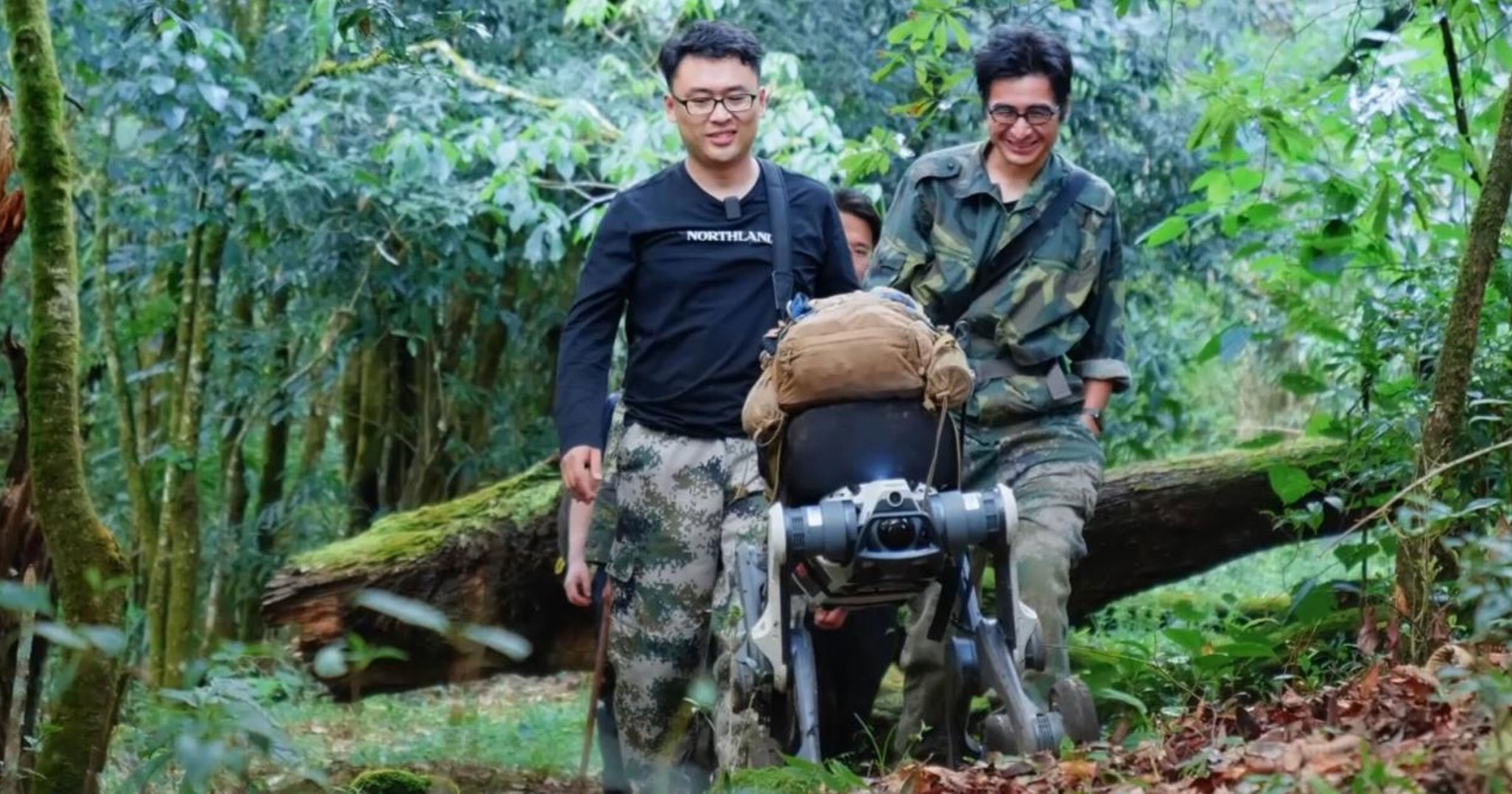
A biodiversity research team journeying into the incredibly diverse subtropical forests of China’s Ailaoshan Mountains took a strange companion with them: a robotic dog.

The robot, a Lynx M20S developed by DEEP Robotics, assisted the team on a trip organized by the China Association for Scientific Expedition, China’s state-run tabloid the Global Times reported. Photos of the expedition show the researchers using the robot like a pack mule to carry field and imaging supplies, though the unit reportedly also assisted with other tasks like route scouting, image recording, and data collection.

At one point, the robot was even used to capture footage of a rare parasitic plant known as Monotropa uniflora, as well as forest gibbons (though, to be fair, these are tasks a human scientist could surely perform just as well.)

Whether the expedition amounts to a practical deployment or a frivolous gimmick probably depends on how you view commercial robots as a whole. Though it can carry a load of about 220 pounds, the battery life on the Lynx M20S lasts just 2.5 to 3.5 hours, likely putting a decent burden on any researchers who have to lug replacement batteries up the Ailaoshan Mountain range or figure out a way to charge them in situ.

At the same time, it makes for a pretty effective product demo. The Ailaoshan Mountain range and its surrounding area are notoriously treacherous, with navigation of ravines and dense primeval forests complicated by extreme outbursts of precipitation. In 2021, a rapid change in weather on the range resulted in the deaths of four experienced geological researchers — an illustrative example of the kinds of conditions one can expect on the Ailaoshan Mountains.

As a device designed for challenging outdoor terrain, the Lynx M20S’s apparently successful participation in this trek seems to validate the company’s engineering efforts.

Elsewhere, DEEP robotics’ robo-hounds have reportedly assisted with underground tunnel excavation, patrolled urban streets during the 2026 FIFA World Cup, and helped firefighters extinguish blazes.

More on robots: Chinese Startup Shows Off Robot Horse You Can Actually Ride

The post Jungle Research Expedition Using Robot Dog Like a Pack Mule appeared first on Futurism.

  •  

You Know That Terrifying Global Warning Threshold They’ve Been Worried About for a Decade? Climate Change Is Speeding Up So Much That Now We’re Due to Cross It In Just Over a Year

In December 2015, 195 countries at the UN Climate Change Conference signed the Paris Agreement, a legally binding international treaty on climate change. The treaty’s overarching goal was to keep the “temperature increase to 1.5 degrees Celsius above pre-industrial levels.”

While unquestionably meant well, the agreement has quickly turned into little more than a footnote as global warming has stormed ahead. Scientists have long warned that we’re on a path to blaze past that foreboding threshold in a matter of years, possibly by 2030.

And now, according to the latest projections, that day is poised to come even sooner. In a new article in the journal Climate and Atmospheric Science, two researchers from the University of Kansas claim that a recent doubling in the rate of global warming means that we could blow past the Paris Agreement threshold as soon as 2028.

The researchers analyzed temperature records through last year and observed a “statistically significant doubling of the global warming rate” between 2011 and 2025, compared to the period between 1971 and 2025.

“Extrapolating this accelerated rate projects a crossing of the 1.5 degrees Celsius threshold by 2028, nearly a decade earlier than previous estimates,” they concluded. “These findings suggest a narrower window remains to limit warming to 1.5 degrees Celsius, underscoring the urgency for rapid and substantial reductions in greenhouse gas emissions.”

Realistically, it’s hard to imagine that we won’t fail to stop the warming in time.

“However, the inertia of existing political, economic, and technological systems3 limits the pace at which such actions can be implemented, narrowing the remaining window for achieving the 1.5 degrees Celsius target,” the researchers concluded in their paper.

The United States, long among the biggest carbon polluters on the planet, has not only officially withdrawn from the Paris Agreement twice during Donald Trump’s terms as president, but his administration has actively reversed environmental laws while giving the fossil fuel industry free rein through deregulation.

It’s a sad state of affairs that the UN Environment Program appears to be painfully aware of. In a new Emissions Gap Report, published today, the body found that “new climate pledges under the Paris Agreement have only slightly lowered global temperature rise over the course of this century.”

“Given the size of the cuts needed, the short time available to deliver them and a challenging political climate, a higher exceedance of 1.5°C will happen, very likely within the next decade,” the report reads.

Worse yet, we have the tools to make substantial cuts to greenhouse emissions — but we’re not using them due to a lack of incentives.

“The required low-carbon technologies to deliver big emission cuts are available,” the report concludes. “Wind and solar energy development is booming, lowering deployment costs.”

“This means the international community can accelerate climate action, should they choose to do so,” it continues. “However, delivering faster cuts requires would require navigating a challenging geopolitical environment, delivering a massive increase in support to developing countries, and redesigning the international financial architecture.”

More on climate change: Amid Terrifying Readings, Experts Fear El Niño Is About to Wreak Havoc

The post You Know That Terrifying Global Warning Threshold They’ve Been Worried About for a Decade? Climate Change Is Speeding Up So Much That Now We’re Due to Cross It In Just Over a Year appeared first on Futurism.

  •  

94 Year-Old Electronics Billionaire Accused of Hiring Goons to Infest Chicago With Huge Rat Swarm

A 94-year-old electronics mogul is in hot water with Chicago authorities, who claim that his hare-brained plan to feed hungry squirrels is instead sustaining a massive plague of rats.

As previous owner of the billion-dollar electrical manufacturing company Tripp Lite, businessman Barre Seid has been putting his largess to use by paying a small army of workers to sprinkle an assortment of tree nuts across Chicago-area parks, Fortune reports.

As local resident Caroline Novak told Chicago WGN, it’s “like a luxury mélange of really nice nuts: I’m talking Brazil nuts and walnuts… these are not acorns.”

Though Seid’s target audience seems to be local squirrels, residents and city officials note that rats have quickly grown to depend on the regular feedings. As Novak’s husband told WGN, he counted over 40 rats digging holes near nut piles during a recent walk through Lincoln Park.

The bizarre operation has evidently been underway for years at this point, earning the billionaire heaps of civil violations carrying relatively small fines. Wealthy as he is, Seid has reportedly had no problem paying those fees and carrying on — the law forbids rich and poor alike to sleep under bridges, as the old saying goes.

“When you’re a billionaire and you have a weird hobby and someone tries to stop you, you have complete impunity,” Novak told Block Club Chicago in a separate interview. “You just triple down because why not? You’ll pay $40,000 in fines. You don’t care.”

Now in 2026, authorities in Chicago are reaching their breaking point. Alderman Timmy Knudsen — whose jurisdiction covers the area of Lincoln Park Seid’s workers are active in — is now pushing the Chicago Park District to sue Seid in order to stop the nuttiness once and for all.

“For years, a billionaire family has carried out a paid operation to feed local wildlife, disrupting our rat abatement efforts and causing an infestation that has made parts of the park unusable for other residents,” Knudsen’s office told Fortune in a statement. “We’re hopeful that raising awareness and drawing attention to the issue will ultimately lead to better behavior and a safer park for our community.”

More on tech billionaires: Billionaires Pouring Money Into Ads About How AI Data Centers Are Actually Good

The post 94 Year-Old Electronics Billionaire Accused of Hiring Goons to Infest Chicago With Huge Rat Swarm appeared first on Futurism.

  •  
❌