❌

Reading view

Google’s DeepMind Quietly Hiring Nuclear Physicists

Top AI labs have been hiring subject matter experts across academic disciplines for years at this point — often turning them into glorified fact-checkers whose labor is used to train the AI models of tomorrow. Still, Google’s latest job listing is odd, even by those admittedly strange standards, and may reveal a lot about the future big tech has in mind for humanity.

As reported by the tech industry publication Data Center Dynamics, Google’s AI research lab, DeepMind is now hiring a team of “highly qualified physicists and nuclear engineers” for the role of “nuclear subject matter expert in the Chemical, Biological, Radiological, Nuclear, and high-yield Explosives team within the Responsible Development and Innovation team.”

According to the job listing, interested candidate should have a PhD in a field like plasma physics or nuclear engineering, or else “equivalent practical experience,” on top of experience collaborating with a US government lab and familiarity with policy related to “stockpile stewardship, nonproliferation, arms control, or threat reduction” — and that’s just at a minimum.

Ideally, Google says it would prefer its candidates to also have experience to have experience working with AI safety, as well as expertise in computational modeling, experience working at “major laser user facilities,” or the ability to design evaluations and mitigations that are “demonstrably unclassified and non-export controlled by developing dual use science proxies for weapons topics.”

The lucky candidates will be offered a salary in the ballpark of $174,000 to $252,000, with a 15 percent bonus on top.

The job won’t be easy, however. As the listing notes, the role involves evaluating safety risks of so-called “frontier AI models” in the “nuclear domain.” Specifically, this means “model assistance in fission, fusion, and thermonuclear weapons proliferation, radiation hydrodynamics, magnetohydrodynamics, etc. in a demonstrably unclassified and non-export controlled manner.”

Put together, it reads as if Google’s top AI research lab expects the company’s AI tools to start churning out actionable instructions for developing nuclear devices, and is now hiring nuclear physicists to help spearhead the defense efforts.

How serious the scenario is remains to be seen — but Google is clearly willing to put its money where its mouth is.

More on Google: The Tech Industry’s Aggressive Push to Integrate AI Into Schools Is Turning Into a Disaster

The post Google’s DeepMind Quietly Hiring Nuclear Physicists appeared first on Futurism.

  •  

Startup taps underwater volcano as energy source in "proof point" test

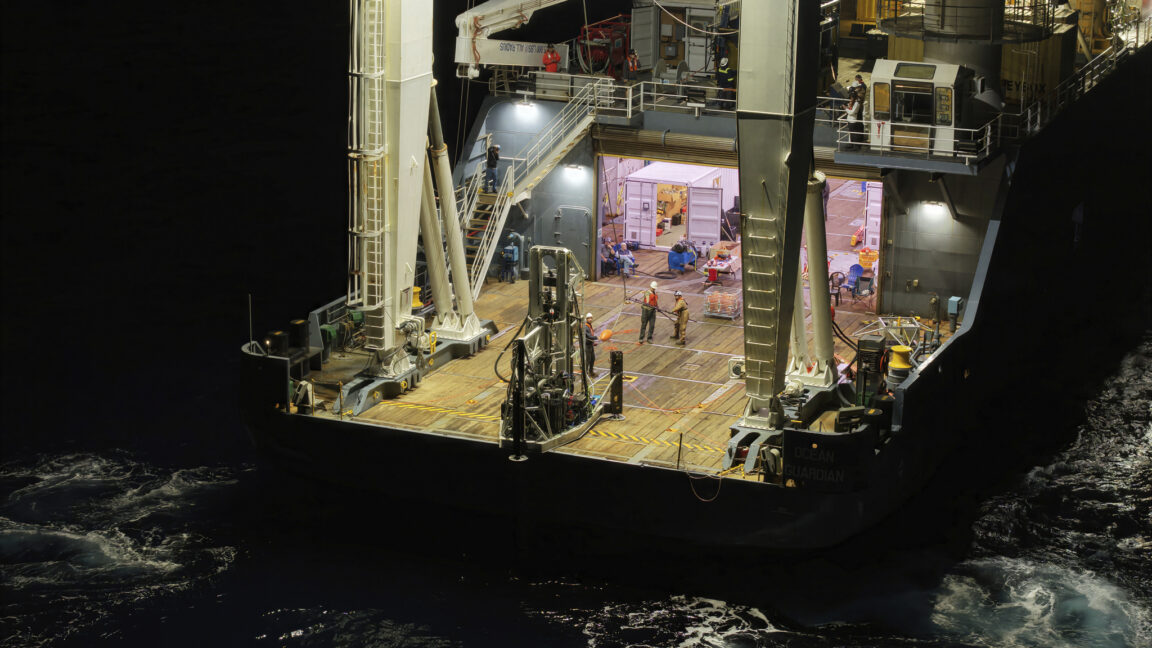
The world’s first demonstration of a subsea geothermal power plant has taken place near an active underwater volcano almost a mile below the ocean surface. It generated less than 10 seconds of net-positive electricity but showed the technical feasibility of tapping another form of renewable energy underwater.

The three-week test deployment of the 3-ton prototype power plant took place at the Axial Seamount in the northeast Pacific Ocean in September. Endurance Energy, the Seattle-based startup behind the effort, aims to eventually commercialize subsea geothermal power for Pacific island nations and other customers looking for alternatives to importing expensive fossil fuels.

“The deep ocean gives us unlimited cold seawater for cooling, and its weight keeps the system and the well pressurized, so our plants can be compact,” said Andrew Redd, founder and CEO of Endurance Energy, in an email to Ars.

Read full article

Comments

© Endurance Energy

  •  

You Know That Terrifying Global Warning Threshold They’ve Been Worried About for a Decade? Climate Change Is Speeding Up So Much That Now We’re Due to Cross It In Just Over a Year

In December 2015, 195 countries at the UN Climate Change Conference signed the Paris Agreement, a legally binding international treaty on climate change. The treaty’s overarching goal was to keep the “temperature increase to 1.5 degrees Celsius above pre-industrial levels.”

While unquestionably meant well, the agreement has quickly turned into little more than a footnote as global warming has stormed ahead. Scientists have long warned that we’re on a path to blaze past that foreboding threshold in a matter of years, possibly by 2030.

And now, according to the latest projections, that day is poised to come even sooner. In a new article in the journal Climate and Atmospheric Science, two researchers from the University of Kansas claim that a recent doubling in the rate of global warming means that we could blow past the Paris Agreement threshold as soon as 2028.

The researchers analyzed temperature records through last year and observed a “statistically significant doubling of the global warming rate” between 2011 and 2025, compared to the period between 1971 and 2025.

“Extrapolating this accelerated rate projects a crossing of the 1.5 degrees Celsius threshold by 2028, nearly a decade earlier than previous estimates,” they concluded. “These findings suggest a narrower window remains to limit warming to 1.5 degrees Celsius, underscoring the urgency for rapid and substantial reductions in greenhouse gas emissions.”

Realistically, it’s hard to imagine that we won’t fail to stop the warming in time.

“However, the inertia of existing political, economic, and technological systems3 limits the pace at which such actions can be implemented, narrowing the remaining window for achieving the 1.5 degrees Celsius target,” the researchers concluded in their paper.

The United States, long among the biggest carbon polluters on the planet, has not only officially withdrawn from the Paris Agreement twice during Donald Trump’s terms as president, but his administration has actively reversed environmental laws while giving the fossil fuel industry free rein through deregulation.

It’s a sad state of affairs that the UN Environment Program appears to be painfully aware of. In a new Emissions Gap Report, published today, the body found that “new climate pledges under the Paris Agreement have only slightly lowered global temperature rise over the course of this century.”

“Given the size of the cuts needed, the short time available to deliver them and a challenging political climate, a higher exceedance of 1.5°C will happen, very likely within the next decade,” the report reads.

Worse yet, we have the tools to make substantial cuts to greenhouse emissions — but we’re not using them due to a lack of incentives.

“The required low-carbon technologies to deliver big emission cuts are available,” the report concludes. “Wind and solar energy development is booming, lowering deployment costs.”

“This means the international community can accelerate climate action, should they choose to do so,” it continues. “However, delivering faster cuts requires would require navigating a challenging geopolitical environment, delivering a massive increase in support to developing countries, and redesigning the international financial architecture.”

More on climate change: Amid Terrifying Readings, Experts Fear El Niño Is About to Wreak Havoc

The post You Know That Terrifying Global Warning Threshold They’ve Been Worried About for a Decade? Climate Change Is Speeding Up So Much That Now We’re Due to Cross It In Just Over a Year appeared first on Futurism.

  •  

California Wildfires Damage Homes, Exmoor Dark Skies Festival Marks a Decade — Today’s Environmental Briefing for Sat, Oct 17 2026

Firefighters work in a smoky, burned forest beside a road.

Environmental change is being measured in forests cleared, crops stressed and species pushed from their habitats. But the response is also being shaped by decisions about money, land and technology, and by people trying to protect both livelihoods and the places they depend on.

Brazil’s latest figures offer one of the clearest signs of progress: forest clearing in the Amazon fell to 3,335 square kilometers in the year ending July 31, 2026, 42% below the previous year and the lowest level since records began in 1988. The Cerrado also saw a decline. The drop comes ahead of a presidential run-off in which the rainforest’s future is a key issue. Whether the reduction lasts remains uncertain.

Elsewhere, the costs of adapting to environmental pressures are immediate. Drought has left England’s pumpkins smaller than usual, with growers warning the crop could be the worst on record. In Southern California, wildfires have damaged or destroyed six homes, while a firefighter suffered heat exhaustion. And in the UK, proposals to cut hundreds of millions of pounds from the heat pump grant scheme could affect support for households switching from gas, oil or LPG boilers.

These stories sit alongside questions about what governments choose to prioritize. US voters in battleground states want candidates to discuss climate change, but candidates have largely stayed quiet. In Britain, Chancellor John Healey has made a growth case for Heathrow’s proposed third runway, while the prime minister has not backed the project. The government is studying consultation responses. The choices are practical as well as political: how to cut emissions, where to direct public funds and whose concerns shape decisions.

On the ground, communities are building their own responses. In Sergipe, women shellfish gatherers are resisting mangrove degradation and fighting for access to the areas where they work. In coastal Indonesia, Wisye Sahambangung leads a women’s group restoring mangroves and creating economic opportunities. Their work connects habitat protection with income and access to natural resources.

Other reports show how easily conservation efforts can create new pressures. Researchers found fewer wild pollinators in areas with higher concentrations of honeybees, which were observed bumping into or chasing other pollinators from flowers. The finding complicates the idea that more beekeeping automatically helps pollinators. In western states, efforts to reduce wolf numbers raise questions about the animals’ social lives and their role in nature. Meanwhile, countries are falling short of pledged funding and ocean-protection goals ahead of the UN biodiversity conference, COP17.

Technology and spectacle bring their own questions. Starlink’s reported restrictions in Ukraine have prompted US senators to seek an investigation into who imposed them, while the service remains important to Ukraine’s wartime operations. At a different scale, Belfast Harbour is to test zero-emission transport and energy systems with £15m in funding.

The Exmoor Dark Skies Festival, with about 80 events planned, offers another way people encounter the natural world: through walks, astronomy sessions and moonlit swims. The weeks ahead will show whether policy commitments match the scale of environmental pressures, and whether local efforts can endure with the resources and access they need.

The post California Wildfires Damage Homes, Exmoor Dark Skies Festival Marks a Decade — Today’s Environmental Briefing for Sat, Oct 17 2026 first appeared on EnviroLink Network.

  •  
❌