❌

Reading view

Uranium from World War II reveals how close the Nazis were to an atomic bomb

The Nazis were far from completing a working reactor for their atomic bomb program, despite claims by the project's leader that it was almost ready, a new study finds.

The German physicist Werner Heisenberg wrote in 1947 that the reactor for the "Nazi bomb" project β€ͺβ€” which culminated in Germany's B8 nuclear reactor β€ͺβ€” was almost finished at the end of World War II.

Heisenberg, who led the reactor's development, claimed the reactor was "just insufficient" to create a self-sustaining fission reaction and that it lacked only a "relatively small amount of uranium" to work.

If it had worked, the B8 reactor would have confirmed that a fission chain reaction was possible, marking a key step toward the German development of an atomic bomb. It could have also spurred the development of specialized fission reactors used to create weapons-grade plutonium from uranium. Instead, the atomic bomb was developed first by the United States and was used to force the surrender of Japan in August 1945. (Germany had already surrendered in May 1945.)

The new study, published Sept. 29 in the journal PNAS Nexus, used historical documents and forensic investigations of two of the project's surviving uranium cubes to refute Heisenberg's claim. The new research indicates that the German B8 reactor had less than half the amount of "heavy water" and about half the amount of uranium it would have needed for a continuous chain reaction.

"My results argue that Heisenberg was off by roughly a factor of two," said first author Patrick Park, a doctoral student at Princeton University who co-wrote the study while at Columbia University.

Park said Heisenberg's mistake was understandable: His calculations were only approximate, and the project was relocated to a rock cellar in the town of Haigerloch, Germany, after Berlin was bombed.

My results argue that Heisenberg was off by roughly a factor of two.

Patrick Park, doctoral student at Princeton University

"People were dying or starving and so these reactor calculations were not his first priority," while many details of neutron physics were unknown at that time, Park told Live Science in an email. "Given these circumstances, I think he did the best he could."

Heavy water

To answer the question of how far the reactor for the Nazi bomb project got, the scientists began by tracing archival records of hundreds of uranium cubes that had been used by German scientists. The B8 reactor consisted of five concentric circles of uranium cubes suspended on chains within the heavy water tank. The German scientists planned to place a radium-beryllium neutron source into the reactor's core to kick-start the chain reaction with a flood of neutrons that would split the uranium nuclei and release more neutrons, furthering the chain reaction.

Heavy water is a form of water that contains the neutron-heavy hydrogen isotope deuterium. Like the mainly-graphite blocks and rods used in many reactors, it can be used to "moderate" or slow down fast neutrons created in a fission reaction so they trigger fission β€” and more neutrons β€” in nearby uranium atoms. The Germans also used small amounts of graphite in their reactor, but as a coating to reflect neutrons back into the chamber.
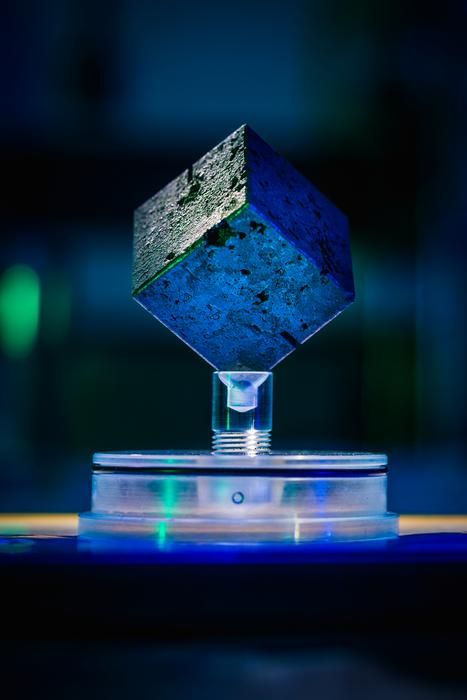
Uranium cube on a stand

A cube of natural uranium from the German atomic bomb project. (Image credit: John T. Consoli, University of Maryland College Park, MD.)

By combining the records of the cubes, heavy water and graphite used by the German scientists with measurements of the two surviving cubes, the study authors created a mathematical model of the reactor that agreed closely with historical measurements. This enabled them to establish that the heavy water reactor was far from achieving a stable reaction. The findings also helped them examine the suggestion that the Germans should have instead built a graphite-based reactor like the nuclear pile developed at the University of Chicago to build the American bomb.

But the study authors determined that a graphite-moderated reactor was unfeasible in wartime Germany because the local supply of coal available to create graphite contained high levels of neutron-absorbing boron, making it useless.

Instead, the heavy water used in the B8 reactor was produced at a single factory in Norway, which was occupied by Germany from April 1940 until May 1945. However, the reactor contained only about 370 gallons (1,400 liters) of heavy water, instead of the more than 780 gallons (roughly 3,000 liters) it would have needed, the researchers determined.

Heavy water makes up a tiny fraction of a percent of ordinary water, and extracting it by electrolysis in the Norwegian factory took extraordinary effort. The factory was producing as much heavy water as it could, but the B8 reactor would have needed more than twice the amount it produced during the entire war, the researchers wrote.

Another finding is that the B8 reactor had about half the amount of uranium it would have needed to sustain a fission chain reaction. The reactor contained a total of 664 cubes, each weighing about 5.11 pounds (2.32 kilograms), for a total of 3,390 pounds (1,540 kilograms) of uranium. Similar cubes were distributed among other experimental groups, giving a total inventory in wartime Germany of about 1,100 cubes of uranium.

But the researchers determined that the B8 reactor would have needed at least 1,200 cubes to work. Germany, therefore, was not about to develop a reactor for an atomic bomb in 1945. Contrary to Heisenberg's claims, the heavy-water reactor was not nearly ready, and a working graphite reactor was impossible.

"We conclude Germany could not have built heavy water nor graphite reactors during World War II," the researchers wrote.

Mark Walker, a historian at Union College in Schenectady, New York, who wasn't involved in the study, said the findings explain Germany's decision to develop a heavy-water reactor, since a graphite reactor was not feasible and they didn't know at the time how much heavy water would be needed.

Walker is the author of "Hitler's Atomic Bomb: History, Legend, and the Twin Legacies of Auschwitz and Hiroshima" (Cambridge University Press, 2024) and a noted expert on Germany's wartime nuclear efforts. He agreed that Germany could not have made a graphite reactor during World War II.

"This paper argues that if the Germans had done something they did not do, then this would have failed," he told Live Science in an email. "While this is counterfactual history, it is an interesting engineering analysis."
  •  

Lightest known pair of neutron stars proves Einstein right yet again

Astronomers have discovered the lightest known pair of neutron stars β€” two ultradense stellar remnants that circle each other every 2 hours, 22 minutes, veering toward an inevitable collision about 82 million years from now. By timing radio pulses from one of the stars, the researchers detected three subtle effects predicted by Albert Einstein's general theory of relativity and found that the theory describes the pair's motion to within about 1% β€” proving the visionary physicist right yet again.

The researchers published their findings Sept. 15 in the journal Physical Review Letters.

Neutron stars are the collapsed cores of massive stars that exploded as supernovas. Each packs more mass than the sun into a ball roughly 12 miles (20 kilometers) in diameter. Some, called pulsars, spin rapidly and sweep beams of radio waves across the sky like cosmic lighthouses. Their rotation is so steady that their pulses work as extraordinarily precise clocks.

Very few pulsars orbit another neutron star. "There are only 30 such double neutron star systems, and the relativistic effects are very strong if they are in compact orbits," study co-author JinLin Han, an astronomer at the National Astronomical Observatories of the Chinese Academy of Sciences, told Live Science via email.

The first such pair, discovered in 1974 and known as the Hulse-Taylor binary, provided the first evidence for gravitational waves β€” ripples in space-time predicted by Einstein. Such waves carry energy away from an orbiting pair, so its orbit should gradually shrink, and the Hulse-Taylor orbit shrank at just the rate Einstein's theory predicted.

Later, the "double pulsar," which completes an orbit every 2.45 hours, matched the predicted rate to within about 0.01%. Eventually, this shrinking forces such pairs to merge, unleashing gravitational waves like those the Laser Interferometer Gravitational-Wave Observatory and Virgo interferometer picked up in 2017.

A newly discovered pair

The new system, designated PSR J1856-0039, lies roughly 4,200 to 6,500 light-years from Earth. In 2020, it turned up in a survey of the Milky Way's disk by China's Five-hundred-meter Aperture Spherical Radio Telescope (FAST), the world's largest single-dish radio telescope.

"We have discovered about 900 pulsars," Han said of his team's work. "After a few follow-up observations, this one is very extraordinary."

The pulsar spins about 43 times per second, and the two stars are separated by roughly twice the distance between Earth and the moon. But the "most attractive feature" is the short orbital period of about 2.36 hours, Han said. "This is the second-shortest one, and it must show stronger relativistic effects than the famous double pulsar and the Hulse-Taylor system."

The team observed the pair with FAST 17 times between 2020 and 2025, sometimes long enough to cover a whole orbit. The researchers measured the arrival times of the system's pulses and then fit that data to orbital models that accounted for relativistic effects, like subtle changes to the pulse arrival times at different parts of the stars' orbits.

"With so many measurements by FAST, which would be hard to match in accuracy with other telescopes, we got not only the basic parameters of the pulsar and its orbit but also three relativistic effects," Han said.

First, the orbit is shrinking as the stars radiate gravitational waves, drawing them about 9 feet (2.7 meters) closer each year. Second, the oval orbit turns slowly, by 17.6 degrees per year β€” some 150,000 times faster than the relativistic drift of Mercury's orbit. Third, because both gravity and speed slow time, the pulsar's clock runs at a varying pace along the oval orbit, shifting its pulses by up to about half a millisecond.

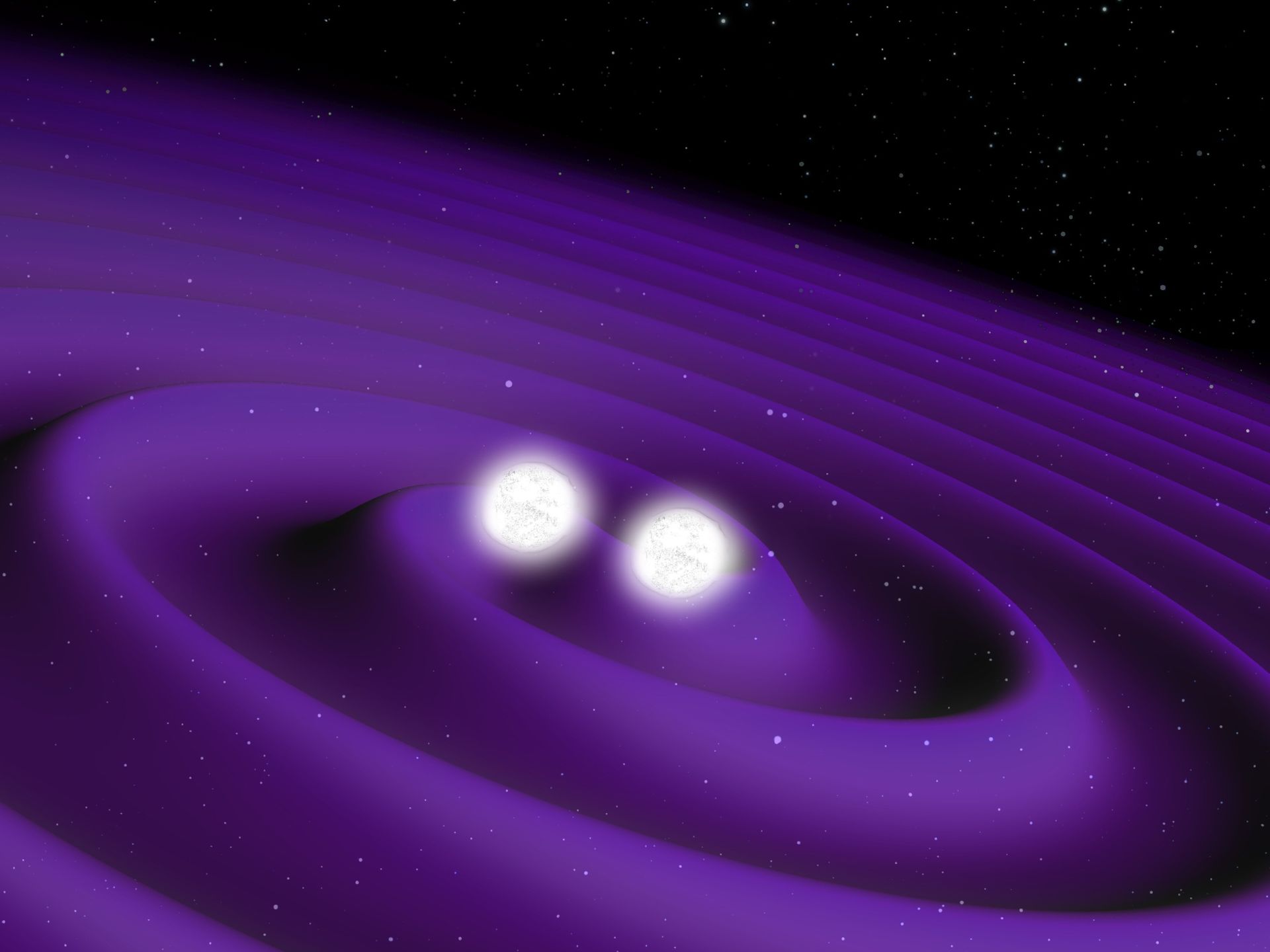
Two white stars circle each other, with purple swirls on them

An illustration of two neutron stars generating gravitational waves (purple) as they spiral toward each other in a tightening binary orbit. The rate of this orbital shrinkage offers a natural test of Einstein's theory or relativity. (Image credit: ESA)

"From these measurements, we determined the pulsar mass and the companion mass," Han explained. "The total mass is the lowest among all known double neutron star systems." The pulsar weighs about 1.3 times as much as the sun, and its companion is just 1.19 solar masses β€” one of the lowest-mass neutron stars known. Simulations suggest that supernovas can't forge neutron stars much lighter than that.

The stars will merge in about 82 million years. That merger will probably leave behind a heavier neutron star of about 2.26 solar masses, though the remnant could instead collapse into a black hole, the researchers estimate.

Another win for Einstein

Any two of the three effects are enough to calculate both stars' masses. The third then serves as an independent check, because if general relativity is correct, all three must point to the same masses β€” and they do.

"We found that general relativity is needed to explain the data, and the consistency is about 1%," Han said. The double pulsar test is more precise, but it drew on 16 years of data, compared with about five for the new pair. "Unfortunately, we could not beat this description of gravity," Han added, referring to physicists' hope of finding cracks in Einstein's theory that might reveal new physics.

Next, the team hopes to detect "frame dragging," an effect in which a spinning mass twists space-time around it, making nearby orbits wobble. "In the future, we will monitor this pulsar, probably over decades, to detect the frame dragging induced by the neutron star's spin," Han said.

Measuring the effect would reveal the pulsar's moment of inertia, which depends on how its mass is spread out inside. That would provide "a novel constraint" on how matter behaves at the crushing densities in neutron star cores, Han said β€” one of the biggest open questions in physics.

See how much you know about black holes with our black hole quiz!

  •  

Physicists froze a 'necklace' of atoms β€” and witnessed a quantum phenomenon predicted 100 years ago

"Necklaces" of ultracold atoms have provided new evidence to support a nearly 100-year-old quantum theory.

In 1931, physicists were trying to use quantum mechanics to explain why some materials are magnetic. Then, a young physicist named Hans Bethe looked at a single row of electrons. Each electron's spin can point up or down. Bethe worked out the math for how such a row behaves and found that if a few spins in the row flip, they can stick together and travel down the row as a single unit.

Decades later, physicists found that Bethe's method also works for larger particles moving along a line, such as atoms. If those particles attract each other, the math predicts they will bind into clusters called Bethe strings.

Now, physicists have found evidence of these clusters in a line of ultracold atoms. The findings were published Aug. 29 in the journal Nature Communications.

The discovery may not create new gadgets, but it addresses a fundamental mystery in physics. Everything around us, from magnets to phone chips, consists of countless interacting particles. This makes their behavior difficult to predict. Ultracold atoms serve as a clear and adjustable way to study these complex systems.

A "necklace" of atoms

Researchers have spotted small Bethe strings before, in magnetic crystals and superconducting quantum circuits β€ͺβ€” but those experiments captured strings one at a time.

Theory predicts that crowds of strings, in many sizes, can change how an entire system behaves, and studying that idea requires making many strings at once. That has been hard to do with atoms. Atoms that attract each other usually collapse into a clump. But this time, the team appears to have made many strings of different sizes at once, including some with more than six atoms.

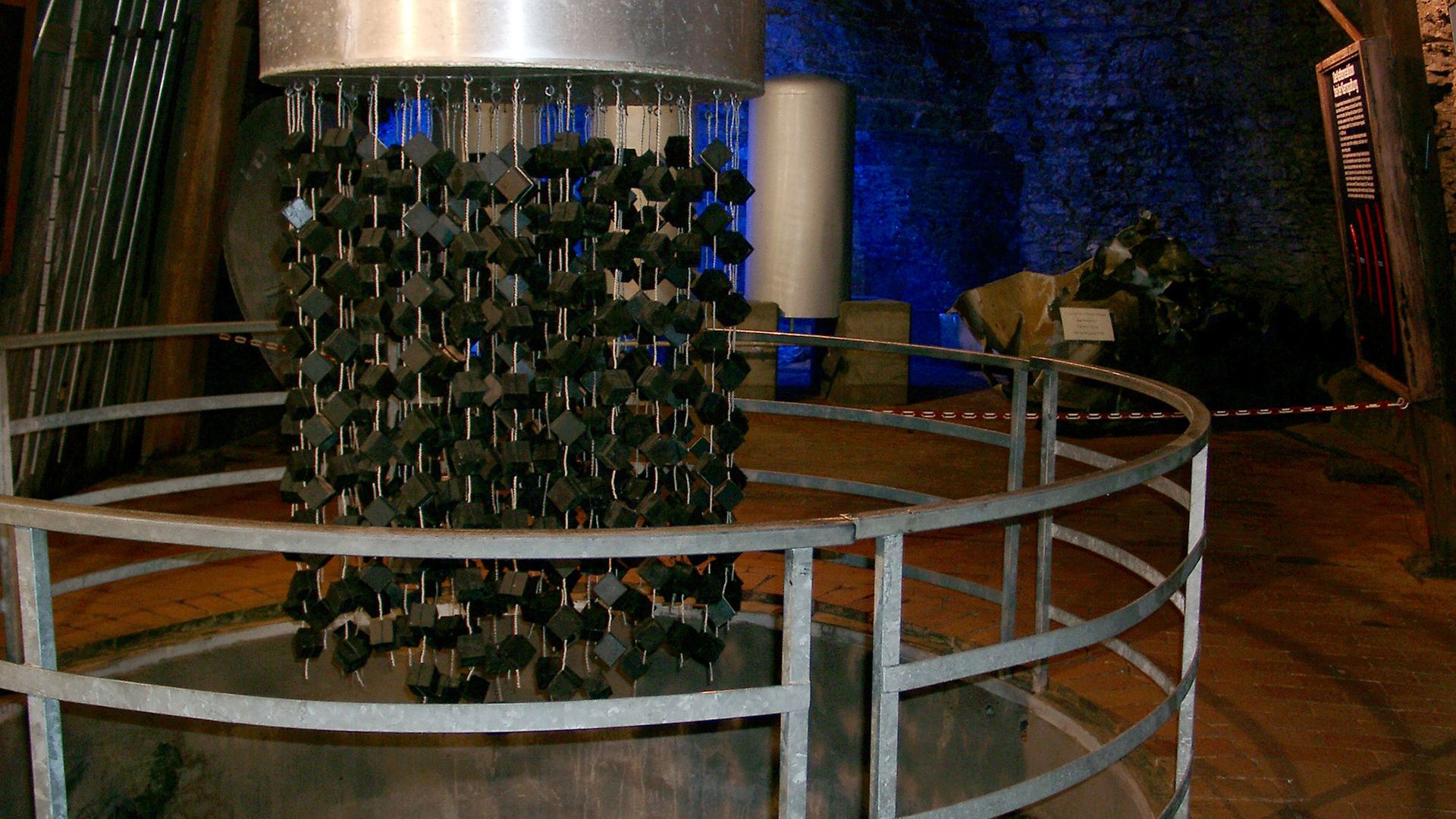
Three 3D maps showing different colored peaks against a black background

To make the "necklace" the researchers had to create a Bose-Einstein condensate, a special phase of matter. (Image credit: blackdovfx via Getty Images)

It's tricky to get atoms to attract each other. In three dimensions, a gas made of attracting atoms tends to collapse as the atoms clump together and form molecules. That process releases energy that kicks atoms out of the experiment, so the gas quickly collapses and disappears. But when they're in a single line, the atoms behave differently.

"They are really a bit like pearls on a string, right? Like on a necklace, they cannot go past," study co-author Hanns-Christoph NΓ€gerl, an experimental physicist at the University of Innsbruck, told Live Science. "In 3D, everything would collapse. But in 1D, it does not collapse."

To build their "necklaces," the team started with tens of thousands of cesium atoms cooled into a Bose-Einstein condensate β€ͺβ€” a state of matter in which atoms chilled to near absolute zero share a single quantum state. Laser beams then divided the condensate into thousands of thin tubes, each of which held up to a few dozen atoms in a line.

At first, the atoms repelled each other. The researchers used a magnetic field to gradually turn that repulsion down to zero, and then turned it into attraction.

The team couldn't see the strings directly. Instead, they let the atoms go and measured how fast the cloud spread. When the atoms could expand only along their tubes, any strings stayed intact. When the atoms were freed in all three dimensions, the strings broke apart and released their binding energy as motion. The researchers found that the 3D clouds spread with about three times as much energy as the one-dimensional ones did.

From that difference, the team estimated how tightly the atoms had been bound. The answer pointed to strings of at least six atoms. The measurements also closely matched predictions from a theory called generalized hydrodynamics, which describes a gas like this one as a fluid made of many kinds of particles, including strings of different sizes. It also tracks how each kind flows over time rather than following every atom.

NΓ€gerl was careful not to call this proof. "That some theory fits to your data is not a proof that something exists," he said; it's just more evidence to support it.

A short-lived state

The strings likely don't survive long. Up close, the atoms still feel the three-dimensional world, and the strings eventually decay into ordinary cesium molecules. In the coldest runs, the team lost about 40% of the atoms.

"Transiently you create these Bethe string states," NΓ€gerl said. "But I don't think they are long-lived."

He has an idea for future experiments. Physicists recently learned to shield ultracold molecules with microwaves, which keeps the molecules from colliding at close range. Strings made from shielded molecules might last long enough to be studied directly. But NΓ€gerl stressed that the idea is untested. "I've had nobody do a theory check on my claims now, but I think intuitively this should work," he said.

Another option is quantum gas microscopy, which images atoms one at a time and could offer more direct evidence of individual strings.

For NΓ€gerl, Bethe strings are one step in understanding how quantum systems with many particles behave and settle down over time. His long-term goal is an experiment in which physicists control both how every particle moves and how its spin flips, letting them assemble model materials piece by piece, "like a LEGO type," he said. His team has begun the next step: using lasers to control the spins of the atoms in its one-dimensional gas. He described Bethe strings as "a little diversion." But because the strings form whenever the atoms attract, they can't be ignored.

  •  
❌