Login

Sliding down surfaces can make rainwater corrosive
Raindrops may be doing untold damage to cars, bridges, monuments and other outdoor structures. Not all rain, new data show. Just droplets that have first picked up an electric charge. One way they can get that charge: sliding off other surfaces, such as leaves, glass or buildings.
Rain droplets can then transfer their charge to materials that have the right electrical properties. That includes metals. This eventually corrodes, or eats away, at the metals. And even metals treated with protective coatings can corrode, the new data show.
Researchers shared these findings in the September 10 Nature.
Scientists knew water droplets could wear down structures by pounding on them. Rains can also contain small amounts of corrosive compounds, such as acids. But it wasn’t clear whether electrified drops would cause damage, says physicist Zhongyuan Ni. He works at the Max Planck Institute for Polymer Research. It’s in Mainz, Germany.
In early experiments, Ni found no damage to a copper surface after it was pelted with hundreds of water droplets. But one day, he says, “I just let the experiment [keep] running.” He kind of forgot about it as he went “to drink coffee or something.” When he came back, the copper looked different. A co-worker suggested it might have been damaged in some way.
This spurred Ni’s team to investigate further.
Drip, drip, drip
His team continuously released drops of water onto Teflon-coated copper. Copper is more resistant to corrosion than many other metals. And Teflon is an especially strong, protective coating. If the drops started eating into this protected surface, they reasoned, charged raindrops could probably do it to other metals, too.
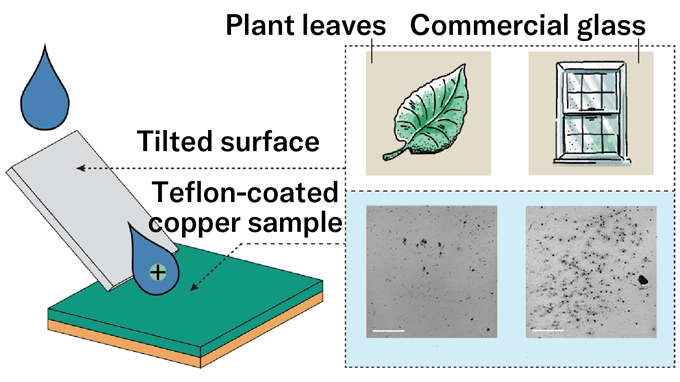
The researchers gave some drops an electric charge. They did this by having the water slide along leaves or construction materials. The team also tipped uncharged water drops directly onto the Teflon-coated copper.
When viewed under a microscope, all copper surfaces hit with electrically charged drops appeared damaged. The charged water had eaten through the Teflon and begun corroding the copper below. Uncharged water droplets triggered no such damage.
Similar effects appeared on samples of copper and gold covered in polystyrene glass — another protective coating. Clearly, charged water could wear through more than Teflon.
It’s electric
As water droplets slide down common surfaces — such as leaves and glass — they can pick up an electric charge. In a test setup (left), when thousands of these drops landed on Teflon-coated copper, they caused damage that could be seen under a microscope (bottom row; scale bar represents 100 micrometers).
The new findings could pave the way for better anticorrosion coatings, says Stefan Weber. A physicist at the University of Stuttgart in Germany, he did not take part in the study.
Water drops can become charged in clouds or by sliding along your windshield. But they should not scare you, Ni says. Their effects are small. Still, they could add up when cars, ships, monuments and machinery are exposed to the elements for years.
Small charges shouldn’t be ignored, Ni says. Even if they’re tiny, “sometimes they will play an important role.”
Do you have a science question? We can help!
Submit your question here, and we might answer it an upcoming issue of Science News Explores