Risks of Parkinson's Disease May Increase With Prolonged Exposure to Road Traffic Noise
Read more of this story at Slashdot.
“Solar towers” that convert sunlight into heat could play a useful role in the renewable energy transition, but high installation costs and complex requirements limit their attractiveness to commercial operators. A team of researchers from Germany’s Karlsruher Institut für Technologie (KIT) and the German Aerospace Center (DLR) is now taking steps to change that. By creating a freely accessible database of information about how these plants work, they aim to accelerate research on solar thermal energy and drive improvements that could allow the technology to be more widely deployed in the future.
Unlike photovoltaic panels, concentrating solar power (CSP) plants do not convert sunlight directly into electricity. Instead, they generate heat by using an array of movable mirrors called heliostats to funnel sunlight onto a receiver located at the top of a tower. This heat can be used to drive a turbine to produce electricity immediately, but it can also be stored and used to generate electricity at night or on cloudy days. Depending on the plant’s location and setup, the heat could even be used directly for industrial applications and district heating.
The problem, explains study leader Kaleb Phipps, is that operating solar power tower plants safely and efficiently is a complex and expensive task. “CSP technologies have the potential to help the transition to a renewable energy system,” says Phipps, a research fellow at KIT’s Scientific Computing Center. “However, they are still not financially viable and there are operating challenges associated with them.”
Before researchers can develop and reliably test new, improved processes, Phipps explains that they need access to real-world operational CSP data. “We believe that modern data-driven machine learning methods like ours can help solve a lot of these problems,” he says.
To construct their database, which is known as PAINT, researchers collected data from the CSP tower near Jülich, Germany. These data include the exact positions of the tower’s 2014 mirrors, their dimensions, how they are warped and the way they rotate and tilt. The team also obtained fine-grained weather data for the entire 2021-2024 period under study, plus a further 218 000 images to help determine whether the mirrors were efficiently directing sunlight precisely to the top of the tower.
All in all, the PAINT database contains 849 gigabytes of operational data organized using the SpatioTemporal Asset Catalog (STAC) standard. To make these data FAIR (findable, accessible, interoperable and reusable), the researchers developed software to simplify access to the database and then published the data in a way that is freely available to all users.
Their goal, they say, is for other researchers to use this FAIR database to develop “digital twins”, or virtual replicas, of real-world CSP plants. When combined with machine-learning models, such twins can be used to answer questions such as whether the mirrors are aligned for maximal light absorption (one of the most important parameters for efficient operation) in near real time.
“The fact that we are receiving many positive responses regarding the data and that people seem to appreciate it is our biggest success,” Phipps says. Such responses are especially gratifying, he adds, because constructing databases like PAINT can be an arduous task.
“The main difficulties were about collecting the data, cleaning and unifying it into standard formats and parsing and organising all the metadata, which was originally complete chaos,” Phipps recalls. “We therefore put a lot of time and effort into creating standardized and automated workflows so that the process is as transparent as possible and can be reused for future data.”
The team also faced challenges when trying to convince peers that this work counted as “research”, he adds. “The fact that the data itself didn’t directly result in a new algorithm or method meant that lots of people didn’t believe we would be able to publish the results or achieve anything with them,” says Phipps. “Luckily, we were able to prove the doubters wrong.”
While the PAINT database currently contains data from only one CSP, the KIT researchers, who report their work in Nature Energy, are hoping to expand it. “We really need contributions from other CSP power plants around the world to transform the database into a truly international and diverse source for researchers,” Phipps says. “As data from different facilities is added in the future, it will be possible to develop a common standard for open operational data in solar tower research. This would speed up the development and promote a widespread adoption of this technology.”
The post Solar tower power plants get a data boost appeared first on Physics World.

“Strange” metals owe at least some of their peculiar properties to the quantum entanglement of their electrons. This finding comes from physicists at the Vienna University of Technology in Austria, who used a concept from quantum information science to guide their experiments. A similar approach, they say, could also yield a better understanding of certain high-temperature superconductors and other correlated quantum materials.
Electrons travel relatively unimpeded through most metals, but in the 1980s, scientists identified puzzling exceptions in certain cuprate high-temperature superconductors. Further examples of this “strange” metal behaviour subsequently turned up in other classes of materials, including heavy-fermion materials, pnictides and organic compounds. This resistive behaviour cannot be explained by theories that treat electrons as independent, non-interacting particles, nor by theories that include interactions while treating electrons as quasiparticles. And although multiple recent theoretical works suggested a possible role for entanglement, experimental evidence was lacking.
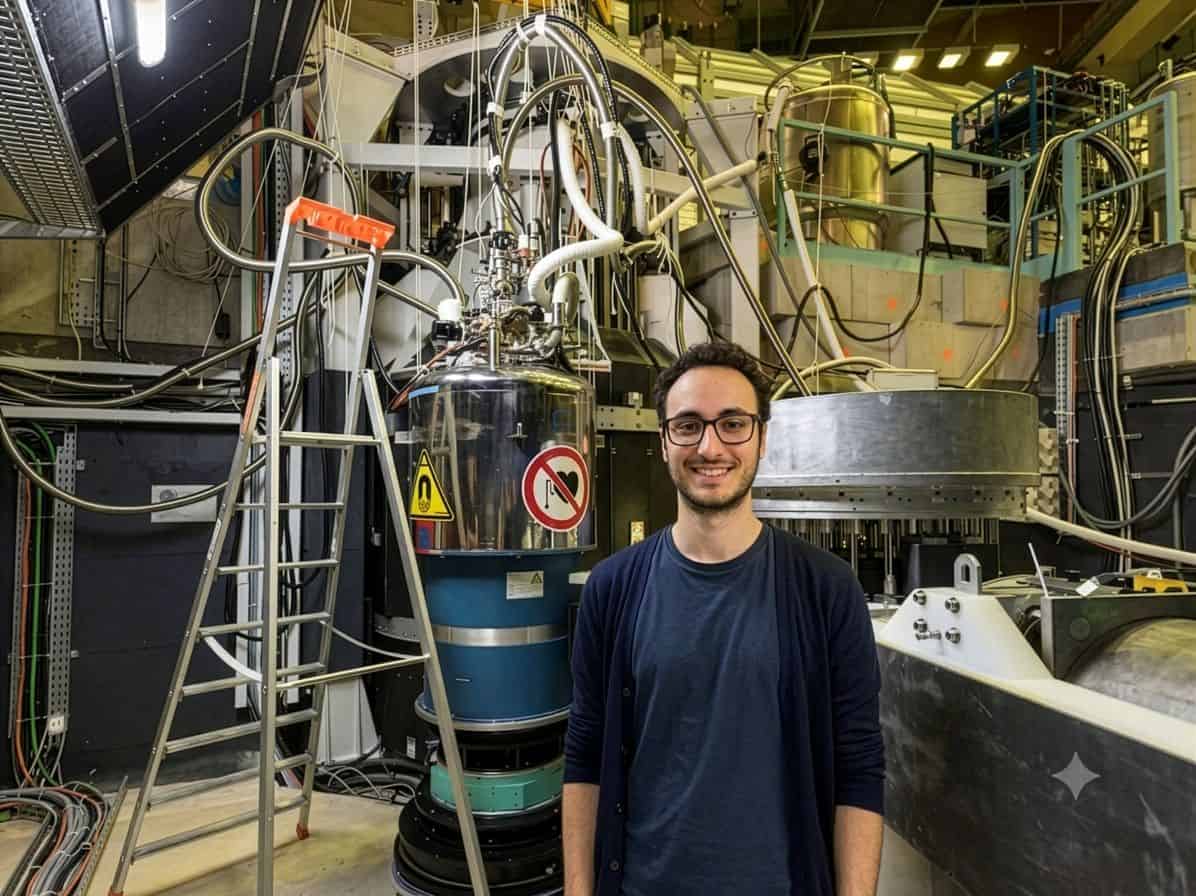
To investigate further, a team led by solid-state physicist Silke Bühler-Paschen used facilities at the Institut Laue-Langevin (ILL) in Grenoble, France to perform inelastic neutron scattering measurements on a heavy-fermion metal with the chemical formula Ce3Pd20Si6. According to team member Federico Mazza, who conducted this part of the study, the scattered neutrons would normally each transfer their energy to individual particles.
However, when the researchers analysed their data using a concept called quantum Fisher information – roughly, a measure of how sensitively a quantum state depends on a given parameter – they found that they could not explain what they were seeing in terms of particles behaving independently. Instead, the data indicated that groups of at least nine quantum-entangled entities were acting collectively. Mazza says this provides direct evidence of highly multipartite quantum entanglement in the material – and, in turn, a new way of understanding why strange metals are so strange.
The strange metal state is of great interest because physicists consider it the “parent” state of high-temperature superconductivity, though it also occurs across other materials platforms. “We had suspected that some of the intriguing properties of this state might be related to entanglement but were not able to pin it down until now,” Bühler-Paschen explains. “The results are a great success for us. They confirm that our unusual approach of using methods from quantum information science for solid-state physics studies of novel materials can reveal fundamentally new insight.”

The experiments, which are detailed in Nature Physics, were not without challenges. For starters, the researchers needed to identify an ideal material to study the effect they were looking for and then grow it as a large, high-quality single crystal. Once they secured inelastic neutron scattering beamtime at the ILL’s powerful high-resolution triple-axis spectrometer – a difficult feat in itself – Bühler-Paschen notes that they had to obtain and analyse the data at the highest standards and support it with simulations. “Last but not least, [we had to] communicate with our peers that multipartite entanglement contains valuable information beyond correlation functions and scaling analyses,” Bühler-Paschen recalls.
Rather than being a “detail” of one particular material, Bühler-Paschen says the team’s result suggests that enhanced multipartite entanglement might be an integral part of the strange metal state. Verifying this, however, will require studies on other strange metals across materials classes, she says.
“Looking further ahead, we can envision that this aspect of strange metals finds application in quantum devices,” she tells Physics World. “It could also help us better understand high-temperature superconductors and other materials in which electrons are so strongly correlated that they lose their (quasi)particle nature.”
The post Quantum entanglement explains why strange metals are so strange appeared first on Physics World.
An exceptionally loud gravitational wave signal has offered an unprecedented glimpse into the region of space near a black hole’s event horizon – the “surface of no return” beyond which nothing, not even light, can escape the pull of gravity. Denoted GW250114, the signal originated from the merger of two black holes, and its unusual strength and clarity meant that astrophysicists could extract information from it that was previously only accessible via theoretical modelling.
Physicists describe a black hole’s event horizon in terms of two parameters: the black hole’s rotation frequency ΩH and its surface gravity κ. When an object falls into a black hole, it appears to orbit at ΩH because of a phenomenon known as frame dragging in which the black hole literally drags nearby spacetime along with it as it rotates. This means that objects near a black hole’s edge are constantly in motion relative to observers on Earth.
Regions of space near an event horizon can be described very well theoretically, but observational data has been hard to come by – at least until recently. “Gravitational waves are changing that,” says Sizheng Ma, a postdoctoral researcher at Canada’s Perimeter Institute who led the new study alongside astrophysicist Ling Sun and PhD student Neil Lu from the ARC Centre of Excellence for Gravitational Wave Discovery (OzGrav) and the Australian National University.
Gravitational waves are ripples in spacetime produced whenever dense astronomical objects such as black holes and neutron stars collide. With facilities such as the Laser Interferometer Gravitational-Wave Observatory (LIGO), Virgo and KAGRA (Kamioka Gravitational Wave Detector) now routinely recording these ripples, Ma says, “something that once sounded almost like science fiction – learning about black-hole horizons through observations – is now becoming a real scientific programme”.
In earlier theoretical work, Ma and colleagues in Japan, China and the US predicted that if Einstein’s general theory of relativity is correct, the gravitational waves produced when two black holes merge should carry information about the near-horizon region during the final stage of the merger. This information takes the form of a gravitational-wave component known as a direct wave that oscillates around a value that is twice that of ΩH. “The big question was whether such a signal could actually be seen in real gravitational-wave data,” Ma says.

The main challenge, he explains, is that gravitational-wave data are hard to interpret. “Interesting features can appear for many reasons, so we had to be very cautious,” he says. “We needed to separate this possible direct-wave signature from the much stronger and better-known ‘ringdown’ signal of the final black hole, and then check whether the remaining pattern behaved as the theory predicted.”
When the LIGO-Virgo-KAGRA network detected GW250114 last year, the astrophysicists realized they were in luck. With a network signal-to-noise ratio of approximately 80, this event was around three times louder than LIGO’s first gravitational-wave signal in 2016, and it gave the team a rare opportunity to test their prediction against data. “Our new analyses have allowed us to decrypt the signal and measure ΩH and κ for the first time,” Ma says.
Even with an unusually clear signal, Ma acknowledges that the work required “careful modelling and many double-checks to make sure we were not overinterpreting a feature in the noise”. But if the team’s interpretation holds up, Ma tells Physics World that their method could become a new way of studying black holes. Gravitational-wave observations have already enabled scientists to study how black holes orbit, merge and settle down, Ma notes. The present work extends this by offering access to the near-event-horizon region during the merger’s final stage.
“That gives us a new observational handle on some of the most extreme predictions of Einstein’s theory, allowing us to perform sharper tests of this theory and better understand how black holes form and relax after a merger,” he says. “It also allows us to explore whether the near-horizon region behaves exactly as Einstein predicted.”
The researchers’ next step will be to improve their direct-wave model so that it describes realistic black hole mergers in greater detail. “On the observational side, we want to apply the analysis to more gravitational-wave events,” Ma says. “The result detailed in this study comes from one exceptionally loud and clean event, so the most convincing confirmation would be to see the same kind of near-horizon signature in other black-hole mergers.”
The good news is that as gravitational-wave detectors continue to improve, the researchers hope to collect more such high-quality events. “These will allow us to test whether this pattern appears consistently in the way general relativity predicts and eventually turn this first result into a more systematic way of studying the regions near black hole horizons,” Ma says.
The research is published in Nature.
The post Super-loud gravitational waves offer a new way to study black hole event horizons appeared first on Physics World.
A compact optical technology that has already proved its worth in Earth-bound applications could be on its way to space after researchers at the University of California San Diego, US showed that it can map the Sun’s magnetic field just as well as traditional instruments. By making polarization gratings from specially engineered metasurfaces rather than a complex assembly of optics, the researchers say that future solar-observing missions could benefit from reduced complexity and cost as well as size.
“Our work makes use of recent advancements in nanoscale optical technologies to help improve the hardware for making astronomical observations of the Sun,” says study leader Noah Rubin of UC San Diego’s Jacobs School of Engineering. “We believe this is one of the first times that metasurface optics – which have been a subject of intense interest in both academic research and industry for about a decade – have been used to improve scientific instrumentation of any kind outside of a lab/academic proof-of-concept.”
Although light emitted by the Sun is generally unpolarized – that is, the light waves do not vibrate along a particular axis – strong magnetic fields that develop near sunspots can polarize this light via the quantum mechanical Zeeman effect. These magnetic fields are closely associated with space weather events such as solar storms that can damage electronic infrastructure both on Earth and in orbit. Studying the Sun’s magnetic activity by monitoring areas of polarized light is thus an important step towards detecting or predicting such storms in time to take protective action.
Usually, measuring the polarization state of light means analysing different polarization directions using a device such as a waveplate that mechanically rotates between exposures. Rubin compares this process to taking several photographs through polarized sunglasses held at different angles, then combining them to obtain a fuller picture of what’s going on.

While this technique works, and instruments that use it have already been sent into space, the image analysis process is very time-consuming. It also requires an external power source, and the need to mechanically rotate the waveplate introduces extra complexity and cost, says Rubin.
“In space-based applications, a satellite itself can be moving while this component reorients, causing a highly undesirable blurring effect,” he explains. “As a result, designers of these systems often invest considerable resources into mechanical remediation and engineering to correct the motion of the telescope on the satellite, and this frequently ends up being substantially more expensive than the telescope optics themselves.”
In the new study, which is detailed in Science Advances, Rubin and colleagues solved this problem by creating a polarization-sensitive metasurface that splits light into its different polarization components. A camera-like system containing this metasurface polarization grating can then form multiple images of a scene in parallel. Rubin explains that each image in this scene is analysed with respect to a different polarization state, meaning that the system can measure the polarization of light simultaneously and passively in a single camera frame.
Rubin notes that this technique of condensing an instrument that would ordinarily involve a complex assembly of optics into a single, flat surface has previously made its way into applications as diverse as facial recognition in mobile phones and the preparation of complex photon states in quantum optics experiments. “In this work, we show that these advantages translate to polarization imaging in astronomy,” he tells Physics World.
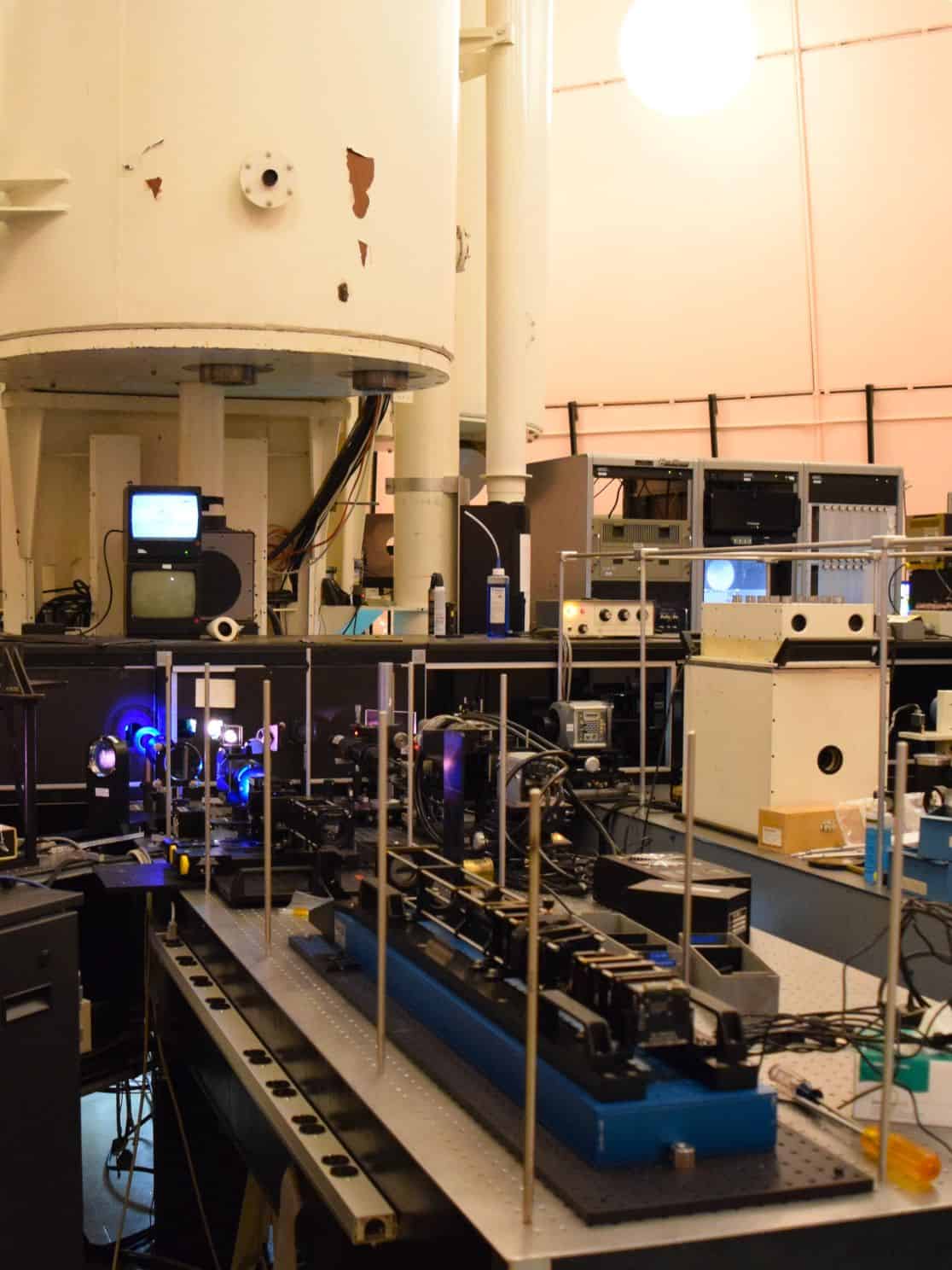
Working with industrial partners at BAE Systems Space & Mission Systems in Colorado, US (formerly known as Ball Aerospace, which Rubin describes as “well-known for its involvement in the development of the James Webb Space Telescope, Hubble and countless other NASA missions”), the team designed a specialized telescope built around such a metasurface polarization grating. They also deployed their instrument on the Dunn Solar Telescope in New Mexico, US, and showed that they could quantitatively map the magnetic fields in sunspots by capturing simultaneous polarization images of these spots.
The researchers report that their results were comparable to those obtained by the state-of-the-art NASA Solar Dynamics Observatory mission in-orbit, highlighting what Rubin calls “the significant advantages that these metasurface components can offer when designed in conjunction with more traditional optical systems”. The UC San Diego team is now exploring ways of integrating its technology into future NASA solar-observing space missions.
The post Metasurface grating gives solar telescopes a boost appeared first on Physics World.
Specially engineered materials known as metamaterials can boost heat transfer over nanoscale distances compared with conventional materials, thanks to the coupling of quasiparticles known as surface phonon polaritons. This new result, from researchers at Carnegie Mellon University, Stanford University and Purdue University, all in the US, could help improve technologies such as on-chip cooling and thermophotovoltaic systems.
The maximum radiative heat transfer between two macroscopic-sized objects at different temperatures can be estimated by assuming that the objects are “black bodies”. These are ideal entities that absorb all the radiation falling on them and emit thermal radiation according to Planck’s law. This approximation breaks down, however, when the objects are placed within a few hundred nanometres of each other. In this case, they begin to exchange heat much more strongly thanks to a phenomenon known as near-field enhancement, which can exceed the far-field black body limit by several orders of magnitude. This effect is already put to good use in technologies such as heat extraction and thermophotovoltaic systems.
Until now, near-field enhancement had only been observed and studied in naturally occurring materials, such as polar dielectrics, doped semiconductors and metals, explain the study leaders, mechanical engineer Sheng Shen at Carnegie Mellon and electrical engineer Shanhui Fan from Stanford. Although theoretical studies have predicted that metamaterials could surpass the performance limits of naturally occurring materials, there had not previously been any experimental demonstration of metamaterial-enhanced near-field radiative heat transfer. Identifying such metamaterials would be of great use as it would allow the effect to be exploited more widely.
Shen, Fan and colleagues observed enhanced near-field radiative heat transfer in a nanodevice platform comprising metamaterials based on arrays of gold split-ring resonators patterned on silicon nitride membranes. The researchers positioned the metamaterials so that they faced each other across a nanoscale gap, observing that heat transfer between them increased by as much as four times compared with similar setups using ordinary materials.
As well as confirming that radiative heat transfer is enhanced over short distances for these metamaterials, the results suggest that the interaction between metamaterials and surface phonon polaritons is responsible for the increase. These quasiparticles are produced by phonons, which are vibrations of the crystalline lattice, as they interact with oscillating electromagnetic fields at the material surface – in this case, those at the surface of the gold metamaterial structures. This coupling allows heat to tunnel across the gap between them and the silicon nitride membranes more efficiently – something that increases the energy flow between the two, explains Shen.
According to the researchers, the effect could help enhance and manipulate heat exchange at the nanoscale and could find applications in next-generation cooling for high-performance microelectronics, thermophotovoltaic systems for waste-heat harvesting and high-sensitivity infrared detection.
There are still a number of challenges to overcome before such applications see the light of day, however. On the theoretical side, notes Fan, the complex interactions between the metamaterial units and their supporting substrate make numerical calculations and analyses exceptionally difficult. “To address this difficulty, we have developed a numerical tool based on fluctuational electrodynamics to design the structures, alongside a coupled-mode theory model to fully elucidate the underlying physics,” he says.
Experimentally, measuring nanowatt-level radiative heat exchange across a sub-micron gap also demands extreme precision. The researchers tackled this challenge by designing an on-chip device using a “suspended thermal bridge” method that transforms the minute heat exchange into a measurable temperature rise. Indeed, they succeeded in detecting heat flow of less than 1 nW in these nanodevices.
They report their work in Nature.
The post Metamaterial boosts heat transfer on the nanoscale appeared first on Physics World.