A large Danish study found a modest but consistent association between long-term road traffic noise exposure and higher Parkinson's disease risk, with a 3% increase for every 11.5 dB rise in noise at the most exposed side of a home. The Guardian reports: The researchers modeled noise exposure at the most and least exposed exterior of the residence of each participant and calculated the difference in noise levels. The magnitude of the effect was modest but consistent; at the most exposed facade, for every 11.5dB rise in noise level, the risk of Parkinson's disease rose by 3% over the study period. Having a quiet part of the home may mitigate the association between exposure to road traffic noise and higher risk of Parkinson's disease, according to the findings.
The study, published in Jama Neurology, included 3.1 million Danish participants aged 40 and over, and followed them for 18 years. It was established using nationwide health register data, making it the largest study on road traffic noise and Parkinson's disease. Previous research linked the rise in neurological disorders, including Parkinson's disease, with exposure to environmental toxins. Environmental risk factors such as air pollution, microplastics and pesticides have become the main focus of prevention strategies. The study is one of the first to make the link to noise pollution.
President Trump threatened a "substantial" new tariff on the European Union after Brussels fined Google more than $1 billion over alleged illegal trade practices. "The European Union will pay a very big price for this illegal and highly unethical conduct, which I have consistently warned them about," Trump wrote on Truth Social. "The penalties will be entirely reversed and, we anticipate, a substantial TARIFF to be placed on them at the earliest possible moment." Politico reports: The president's threat came just a day after U.S. Trade Representative Jamieson Greer warned that the EU's action against Google -- two fines totaling over $1 billion -- could imperil the bloc's relationship with the White House. At risk: the Turnberry deal, which Trump and European Commission President Ursula von der Leyen signed last fall, that capped U.S. tariffs on EU exports at 15 percent. [...] But the president's social media post could signal a coming breach. "The United States of America is not a 'PIGGYBANK' for Europe, nor will we allow it to be!" Trump wrote.
Wine 11.14 is out with initial WoW64 mode support on FreeBSD, allowing 32-bit Windows applications to run on a 64-bit system without relying on 32-bit multilib support. The release also adds Start Menu icon support in Wine Explorer, 7.1 format conversions in DirectSound, AES-GMAC support in BCrypt, and 21 bug fixes affecting apps and games including Adobe Reader, Heroes of the Storm, and Age of Empires I and II. Additional details can be found at WineHQ.org.
SpaceX's Friday launch of its massive Starship rocket "went quite smoothly," reports CNN, with a SpaceX spokesperson calling this mission "Lucky Number 13" (as the 13th integrated flight test for a Starship spacecraft with a Super Heavy rocket booster):
During Starship V3's inaugural test, there were numerous engine issues as several on the booster failed to relight and the Starship spacecraft experienced a nail-biting engine outage. SpaceX also was forced to replace six engines on this vehicle ahead of today's flight because of a likely issue with moisture that prevented at least four from starting up correctly during an initial launch attempt last week... [Friday's Super Heavy rocket booster] fired all 33 of its engines in a pristine performance off the launchpad. The rocket booster also managed to relight 13 engines, as planned, to steer itself back toward a controlled landing. Only when Super Heavy attempted to relight its engines for a controlled landing burn over the Gulf waters did problems arise. The landing was still controlled, though Huot said the vehicle was traveling a bit faster than the company had hoped when it made touchdown. (SpaceX always intended to discard this Super Heavy booster in the ocean.)
The Starship spacecraft had no obvious performance issues, making it all the way through its engine burn and managing to reignite one engine mid-flight as part of a test. It also made a controlled splashdown in the Indian Ocean — executing its "softest splashdown" to date in a "dream scenario," according to SpaceX's Dan Huot. The touchdown came about an hour after takeoff, as planned. During its coasting phase, Starship also deployed 20 Starlink test satellites, paving the way for operational missions later down the line in which SpaceX plans to deploy large batches of these satellites in a single launch. In another big win, SpaceX said it was able to make contact with each of those satellites.
CNN adds that SpaceX "is facing intense pressure to get Starship ready for a crucial NASA test flight next year that could pave the way for the next moon landing. This flight was also the first for SpaceX as a publicly traded company. Last week's aborted launch attempt sparked a selloff, and shares are still trading below their IPO price.
"To cap off the roaring success of today's flight test, SpaceX shared some stunning visuals of the upper Starship spacecraft sailing through space."
An anonymous reader quotes a report from Reuters: The OpenAI agent that broke into tech firm Hugging Face went on a dayslong hacking spree that OpenAI didn't notice until well after the threat was contained and the FBI was alerted, according to people familiar with the investigation. The agent -- a program capable of making decisions and executing complex tasks with little or no human oversight -- attempted to break out of its isolated testing environment at OpenAI around July 9, according to two of the people. The intrusion at Hugging Face, which operates as a repository for AI tools and models, began two days later on July 11 and lasted until July 13, said Thomas Wolf, Hugging Face's co-founder. It took several more days for OpenAI to realize its agent was behind the hack, and the two companies only communicated about it for the first time on or around July 20, according to Wolf and three of the people familiar with the investigation.
OpenAI's public disclosure, on July 21, thatone of its agents had slipped out of control and carried out the break-in at Hugging Facedrew global attention. But many details of the hack, including how long the agent went rogue and OpenAI's belated knowledge of it, are being reported here for the first time. Hugging Face is preparing a public timeline of the hack, Wolf said, adding that he could not speak to what happened at OpenAI. In a statement, OpenAI said the hack was unprecedented and "marks an important moment for AI safety." It added that it was reviewing the incident with outside advisers and would eventually publish a technical report. "Does that mean that they left it unattended and didn't realize what it was doing? Or maybe they did and didn't know how to contain it? Both are equally dangerous and alarming," asked Marley Smith, the principal intelligence specialist at the nonprofit World Ethical Data Foundation.
"The models lie, they cheat, they hack," said Jeffrey Ladish, whose organization, Palisade Research, studies the capabilities and motivations of AI agents. Ladish said the hack should spark broader questions over how much all the leading AI companies are willing to invest in onerous security measures while locked in a race with one another to deploy the best and fastest models. "There has to be government oversight," Ladish said, "because it won't happen otherwise."
Instagram is banning videos filmed with Meta smart glasses that harass strangers in public, including prank videos targeting service workers and pickup-artist clips of women who may not realize they are being recorded. "If you're posting content that is taking advantage of people and harassing them, like a lot of these pickup line kind of videos that we've heard of and seen, then we're going to take the content down," said Instagram head Adam Mosseri in response to a question on his Instagram stories last week. "We don't want people to be surreptitiously taking videos of other people and harassing them and then posting them on our platform. So we're trying to fight that every way we can." Business Insider reports: It's unclear how many videos have been removed under this new policy. Business Insider found that two large accounts of pickup artists who filmed themselves approaching women in public while wearing the glasses had been deactivated. (Both previously had more than a million followers.)
A Meta spokesperson confirmed to Business Insider that these accounts were booted for violating the policy about posting harassing content that had been filmed with the glasses. Meta did not directly respond to questions about how this new policy is being enforced or what exactly constitutes a violation.
Paramount Skydance has agreed to postpone its $111 billion Warner Bros. Discovery merger until five days after an antitrust trial or June 1, 2027, whichever comes first. The agreement with a 12-state coalition led by California effectively shelves the deal for months while states argue it would reduce competition in cable and theatrical markets. Variety reports: Paramount had been keen to close the deal before Sept. 30, when it will begin to incur a $7-million-a-day "ticking fee" to be paid to Warner Bros. investors. The agreement is a tacit acknowledgement that that will not happen, barring a settlement with the states. Paramount previously sought a three-day hearing on the injunction motion in late August, hoping to win the judge's blessing to close the deal sometime in early September. But the states resisted that idea, saying they would need more time to take discovery and prepare for a full trial on the merits. The states were due to file their injunction motion on Thursday night, but held off as the two sides held discussions on a path forward. In a statement, the company said the agreement is a "significant win."
"Today's agreement is a significant win because the result is exactly what we have sought from the outset: a direct path to a trial based on the evidence," a Paramount spokesperson said. "This is the fastest and clearest way to prove that this transaction is good for competition, good for consumers, and good for creators, a conclusion dozens of competition authorities around the world have already reached. Plaintiffs' market definitions bear no relationship to the realities of today's marketplace and cannot withstand scrutiny. We look forward to proving our case at trial."
A hearing was scheduled for Aug. 3 in federal court in Oakland, at which point the two sides were expected to argue over the injunction motion. The two sides agreed to cancel that hearing. U.S. District Judge Araceli Martinez-Olguin approved the joint stipulation on Friday afternoon, about an hour after it was entered. The Writers Guild of America filed its own motion for an injunction earlier this week, which was also set to be heard on Aug. 3. That motion has been withdrawn, as Paramount has effectively conceded that it will not close the deal until a determination of the merits of the antitrust claims. The parties also agreed to submit a joint stipulation by July 31 on their respective positions on trial scheduling. The states previously proposed to hold the trial in April 2027.
An anonymous reader quotes a report from TechCrunch: The U.S. Justice Department is prosecuting an American for allegedly providing U.S. border authorities with a passcode that wiped the contents of his phone, according to an indictment and media reports. This is thought to be the first known case in the United States where federal prosecutors have charged someone for the alleged destruction of data using a so-called "duress" password built into a phone's software. According to The Guardian, which covered the story earlier this week following the court's first hearing on Monday, Atlanta resident Samuel Tunick is fighting the charges. Tunick's attorneys said that it was unlawful for U.S. Customs and Border Protection to seize his phone as he arrived back in the U.S. last year, and that any evidence -- including the alleged wiping of his phone -- should be thrown out.
The case centers on a feature included in GrapheneOS, a custom Android operating system that runs in place of the software on most modern Google Pixel devices. Tunick's attorneys confirmed GrapheneOS was running on his phone. The software feature allows the device owner to set a passcode that deliberately wipes the contents of that device if entered instead of the user's unlock passcode. Tunick's case also raises ongoing questions about what constitutional rights can be invoked at the border, which the U.S. government has long asserted is not U.S. soil until a person is authorized to enter. Bill Budington, a senior staff technologist at the Electronic Frontier Foundation, and Runa Sandvik, a digital security expert who works to protect at-risk people as the founder of security consultancy firm Granitt, told TechCrunch that they had not seen similar cases involving the use of duress passwords.
"I have not seen this before, though I've discussed the potential scenario with activists and journalists over the years," said Sandvik. "I think this case serves as a reminder that authorities may argue you knowingly destroyed data, so it's better to not have that data on you when you cross certain borders."
"With a little planning ahead of time, you can always download the data you need once you get to where you're going," said Sandvik.
Roku has raised prices on several streaming devices, blaming memory and component shortages tied to the AI data-center boom. The Roku Ultra jumped from $100 to $150 and the basic Streaming Stick rose from $30 to $40. The Desk reports: In a phone call with The Desk on Friday, a Roku executive said the company made the tough decision to raise prices on its streaming hardware to address shortages in computer memory and other components caused by the artificial intelligence rush. [...] Still, the executive who spoke with The Desk on Friday said the company believes its hardware is still competitive against other streaming TV hardware because Roku devices are still priced aggressively compared to the Apple TV and other expensive streaming hardware, and the company remains focused on looking at ways to add value to its Roku platform before and after it enters a customer's home. "We are doing our best to have great deals like what we have going on right now," the executive said. "Roku is even upping the price for a bundle that includes a Streaming Stick Plus and a one-month subscription to Fox One," notes Ars Technica in a separate report.
"As recently as July 20, Roku listed the bundle at $60 with a sale price of $25, according to the Internet Archive's Wayback Machine. Now, the bundle carries an $80 MSRP and $45 sale price."
Nvidia, Microsoft, Meta, Palantir, and more than 20 other tech companies signed an open letter urging policymakers not to impose "premature restrictions" on open-weight AI models, warning that broad limits could "stifle competition or drive innovation overseas." CNBC reports: They wrote that open-weight models strengthen competition and ensure that the benefits of the technology are "broadly shared rather than concentrated in a few hands." "Relying solely on closed models is not inherently safe: they can be breached, misused, or fail in ways that outsiders cannot detect," the letter said. "And concentrating advanced AI capabilities behind a small number of closed models compounds that risk."
Elon Musk, who runs an AI business under his rocket company SpaceX, also amplified the letter on social media, writing that it has his "full support" in a post on X. SpaceX did not officially sign the letter. Greg Brockman, OpenAI's president, said Thursday that the company believes in broad access, and that he has not been involved in any conversations with the Trump administration about potentially banning Chinese open-weight models in the U.S.
"I think that, that fundamentally, AI and AI usage is something that is actually very important to democratize," Brockman told reporters during a briefing in New York City. "And so, for me, at a sort of deep level, I think that having more models, more usage, that is a good thing." OpenAI CEO Sam Altman addressed the letter in a post on X on Friday, writing that he wants the U.S. to win with both open-weight and proprietary models, and that he is "glad to see this."
[...] In the letter on Friday, the U.S. tech companies said that concerns about unlawful distillation should be addressed through "targeted legal and commercial frameworks" instead of with "sweeping restrictions on techniques that play an important role in AI innovation." "Our AI leadership will be judged not by one frontier AI model, but by whether the United States builds a strong, open ecosystem that diffuses into every sector," the letter said. "This is essential for creating opportunities for innovation and prosperity across the country." The letter follows a separate appeal signed by nearly 200 Silicon Valley companies, including Proton and Y Combinator, warning that restricting U.S. access to Chinese open-weight AI models could cripple the next generation of American startups. "American leadership requires two things: world-leading American open-weight models and continued access for U.S. builders to open models already available worldwide," the startup founders wrote. Instead of broad prohibitions, they argue the government should adopt targeted safeguards.
Of course, these signees "have an obvious economic stake in seeing open AI models flourish," notes TechCrunch. "Companies like Nvidia, Microsoft Azure, and other infrastructure providers have a vested interest in pushing for commoditized models: If models are interchangeable, people will buy more GPUs, rent more cloud capacity, and build more applications."
Anthropic has released Opus 5, a new Claude model that it says comes close to its higher-end Fable 5 model at half the price while improving on Opus 4.8 in knowledge work, coding, and scientific research tasks. "At the same time, Anthropic says it has managed to make the model more resistant to being tricked," notes Engadget. Additionally, the company says Opus 5 "exhibits the lowest rates of deceptive behavior." From the report: One important distinction between Opus 5 and Mythos, which is currently only available to a limited number of vetted organizations through Anthropic's Project Glasswing initiative, is that the company has specifically avoided training the new model on cyber-related tasks. Due to more its powerful capabilities, Opus 5 is broadly better at those tasks than its predecessor, making it more useful for finding cybersecurity vulnerabilities, but the company says Opus 5 is "substantially behind" its flagship model at exploiting those vulnerabilities.
[...] Anthropic says "Claude Opus 5's safeguards are designed to allow beneficial uses of the model in both cybersecurity and biology." The company has strengthened some of the model's cyber-related guardrails, but notes it did so along a "narrow range" of specific tasks. "Based on our testing, we expect the classifiers to intervene around 85 percent less often than they do for Fable 5," Anthropic said. With Opus 5, Anthropic also isn't including it in its recently announced 30-day data retention policy, which the company introduced alongside Fable and Mythos 5.
As for pricing. Anthropic says API costs for Opus 5 will remain at $5 per one million input tokens and $25 per one million output tokens. Anthropic has also added an "effort" menu for Opus that users can tweak to tell the model whether they want it to be more thorough or fast and efficient to conserve tokens.
Longtime Slashdot reader sandbagger shares the passing of John C. Dvorak, an early and influential technology journalist for PC Magazine. He was 80. Talking Biz News reports: Aric Mackey writes, "Widely recognized for his profound impact on the technology industry, John's career spanned decades of rapid digital evolution. He was perhaps best known for his influential, long-running column in PC Magazine and his groundbreaking work on the No Agenda podcast. Through his prolific writing, broadcasting, and distinct public voice, he helped shape critical conversations around both technology and political analysis, guiding generations of readers and listeners with his unique perspective.
"To those who knew him personally, John was far more than his public work. He was a beloved husband, devoted father, proud grandfather, and a loyal friend. Those closest to him will remember a man defined by his strong convictions, his exceptionally sharp wit, and an enduring curiosity about the world around him." Dvorak was also part of the startup team at CNET Networks, and appeared on MarketWatch TV.
An anonymous reader quotes a report from PYMNTS.com: Stripe is in talks to buy OpenRouter, an artificial intelligence (AI) startup that could sell for roughly $10 billion, according to The Wall Street Journal. The move would mark a significant step outside payments for a company that processes transactions for much of the internet. It also lands while Stripe pursues a far larger target: a bid for PayPal that would value the payments giant at about $53 billion.
The Journal reported Thursday (July 23) that a transaction could be announced soon, though the talks could still collapse or another buyer could step in. The exact price under discussion could not be learned. Several other large technology companies had also been weighing deals for OpenRouter. The startup was valued at $1.3 billion in May, according to PitchBook, meaning a sale near $10 billion would represent a steep markup in a matter of months. Its backers include Menlo Ventures and CapitalG, the growth fund of Google parent Alphabet.
OpenRouter sells software that lets customers reach AI models from OpenAI and Anthropic, along with open weight alternatives anyone can download and run. The Journal described the company's position this way: "OpenRouter is part of an emerging crop of startups that have found a lucrative niche between AI developers and the companies that want to use them." The platform lists hundreds of large language models and lets developers compare and switch between them.
Astronomers studying the star system CD-35 2722 may have found the first known moon-like object outside our solar system. The classification is unusually tricky, however, because it orbits a brown dwarf rather than a planet, making it clearly an "exosatellite" but forcing scientists to rethink where the line between planet, moon, and failed star should be drawn. Space.com reports: The star CD-35 2722 is located around 73 light-years away and has around half the mass of the sun. It is orbited by a "failed star" or brown dwarf. These stellar bodies get their unfortunate nickname because they form like other stars but fail to gather enough mass to trigger the fusion of hydrogen to helium in their cores. In terms of mass, brown dwarfs are more massive than the largest gas giant planets, but smaller than the smallest stars, usually with around 13 to 80 times the mass of Jupiter, or around 0.013 to 0.08 times the mass of the sun.
The newly discovered object in CD-35 2722 is certainly moon-like, but rather than orbiting a planet as the moons in the solar system do, it orbits the system's brown dwarf. "This system is somewhat hard to define using solar-system-based words like 'planet' and 'moon.' The exosatellite is clearly massive enough to be a planet, but it does not orbit a star, though it orbits an object that orbits a star," team leader Kevin Hoy of the Universidad Diego Portales and the Millennium Nucleus of Young Exoplanets and their Moons (YEMS) in Chile, said in a statement. "Being the third wheel in this system makes us want to call it a moon, even if it is nothing like the small, rocky moons we have in our system."
The team currently isn't able to definitively claim this object in CD-35 2722 is an exomoon, because that would require really nailing down a new definition of what a moon is. "The satellite we report is a giant gaseous body orbiting a highly massive companion, itself several times the mass of Jupiter. We have a clear delineation between the planets and the sun in the solar system, so defining things like moons is simple," team member Alice Zurlo of the Universidad Diego Portales said. "In the CD-35 2722 system, where we are blurring the lines between stars, planets, and moons, the whole thing becomes more complicated to describe." Zurlo and colleagues can, however, confidently claim this is an exosatellite, meaning it is a first-of-its-kind detection no matter what the future holds for its classification.
The findings have been published in the journal Nature.
alternative_right shares a report from ScienceAlert: A study published in PLOS One in 2021 by researchers from Durham University in the UK showed that with 10 weeks of training, both blind and sighted people could learn to echolocate using verbal clicks. While the technique is already used by a number of people with impaired vision -- sometimes using the taps of a cane instead of clicks made by their mouth -- those findings suggest that many of us can learn the necessary techniques.
Some of the same researchers who made that discovery are part of the team behind a follow-up study published in Cerebral Cortex, looking at how the 10 weeks of training that the 26 participants went through actually changed the physical structure of their brains. Specifically, the team analyzed brain scans of the V1 (the primary visual cortex, processing visuals), and the A1 (the primary auditory cortex, processing sounds). Strikingly, the scans showed that the V1s of both blind and sighted people had developed sensitivity to sound echoes during echolocation training.
Researchers in China have cross-calibrated radiation detectors on 25 navigation satellites. Data from two decades of measurements have been combined to create a record of the flux of relativistic electrons that impinges on Earth’s atmosphere. The technique can be applied to other satellite data, and could boost our understanding of the threat that this radiation poses to satellites and shed light on the solar processes that generate the electron flux.
The Global Positioning System (GPS) uses signals from a constellation of satellites to locate the position of receivers on the Earth’s surface to within several metres. There are currently 32 GPS satellites orbiting about 20,000 km above the Earth and each of them carries a radiation detector. These detectors allow scientists to observe changes in radiation levels in space. Much of this radiation comes in the form of high-energy electrons from the Sun, which can disrupt the operation of satellites and even damage them.
The electron flux rises and falls with the solar cycle. This has a period of about 11 years and involves the waxing and waning of sunspots, solar flares and coronal mass ejections.
For those who design and operate satellites, it is crucial to understand this electron flux. However, it has proven difficult to make full use of the data generated by these detectors because the instruments had not been cross calibrated. Indeed, measurement values of high-energy electrons can vary between satellites by several orders of magnitude when the flux is low. One important issue is that not all satellites use the same detectors – with two different instruments having been deployed.
Cross calibration
Now, researchers in China have done a cross-calibration of the particle detectors on 25 GPS satellites. The result is a calibrated dataset of relativistic-electron flux that spans two complete solar cycles (2000–2020).
To do this, the team looked at two different measurements made by the detectors. One is the differential electron flux at 2 MeV arriving from one specific direction. The other is the integral electron flux electrons arriving from all directions at energies greater than 2 MeV.
Because electron flux is affected by Earth’s magnetic field, the team had to consider its effect on measurements. This was done using a concept called magnetic local time, which accounts for the fact that Earth’s magnetic poles are offset from our planet’s axis of rotation.
The team used a satellite called NS59 as the reference for their study because its detector has produced a consistent set of data from 2004 – overlapping in time all other satellites in the study. By doing several statistical analyses, the team was able incorporate data from 24 of the 25 satellites. One detector, however, remained problematic and the researchers recommend that data from this satellite not be used.
The team says that their technique can now be used to cross-calibrate the detectors at other energies – there are 14 differential and 29 integral channels that can be also be analysed. They have already used the same techniques to cross-calibrate the GPS data with measurements made by satellites in China’s BeiDou positioning system and observations made by NASA’s two Van Allen Probes.
Join us for an in‑depth conversation with Simon Cherry, former editor‑in‑chief of Physics in Medicine & Biology (PMB), as he shares his expert perspective on the evolving landscape of medical physics research, molecular imaging, and non-invasive imaging technologies. Drawing on decades of leadership in biomedical imaging and academic publishing, Simon will reflect on major advances shaping the field, define the characteristics of high‑impact imaging research, and highlight how PMB continues to support rigorous, influential scientific work through its editorial standards and peer‑review practices.
This session will additionally spotlight the research of Xinchen (Alison) Deng, a finalist of the PMB 2024 Early Career Award. Attendees will gain insights into her contributions to the advanced medical imaging community, such as photon-counting CT for clinical applications and how her work supports broader advances in medical physics and X-ray/CT imaging research.
Simon will also discuss what makes early‑career research stand out and share strategies for researchers aiming to increase the visibility, reach, and long‑term impact of their publications within competitive scientific journals.
Left to right: Carol Clark, Simon Cherry, Xinchen (Alison) Deng
Moderator
Carol Clark, Publisher,Physics in Medicine & Biology
Speakers
Simon R Cherry, PhD received his BSc (Hons) in physics with astronomy from University College London in 1986 and a PhD in medical physics from the Institute of Cancer Research, University of London in 1989. Simon is currently Distinguished Research Professor in the Departments of Biomedical Engineering and Radiology at UC Davis and Professor of Total-Body Imaging at King’s College London. Simon’s research interests centre around biomedical imaging. His major contributions have been in developing systems for positron emission tomography (PET), including designing the microPET scanner for small-animal imaging, the earliest examples of simultaneous PET and MRI studies and co-leading the EXPLORER consortium that developed the world’s first total-body PET scanner. Simon is a Fellow of the Royal Society and Member of the U.S. National Academy of Engineering and National Academy of Inventors. He has received several international awards including the Society of Nuclear Medicine and Molecular Imaging Cassen Prize in 2022. He served as editor-in-chief of the journal Physics in Medicine & Biology from 2011–2020. Simon is the author of more than 350 peer-reviewed journal articles, review articles and book chapters in the field of biomedical imaging. He is also lead author of the widely-used textbook Physics in Nuclear Medicine.
Xinchen (Alison) Deng, PhD, is a diagnostic imaging physics resident at The Ohio State University. Her research focuses on advancing photon-counting CT for clinical applications, including multi-contrast imaging, early disease detection, detector optimization, and AI-based improvements in image quality. Before beginning the residency, Xinchen (Alison) was a postdoctoral fellow in medical physics at the University of Victoria, where she worked with Magdalena Bazalova-Carter and collaborated with Redlen Technologies on the optimization of photon-counting detectors and the clinical applications of spectral CT. She received her PhD in medical physics from the University of British Columbia, where she applied Raman spectroscopy, machine learning, and explainable AI to study radiation treatment response in cancer cells and tissues. Her broader research background spans photon-counting CT, spectral X-ray imaging, Raman spectroscopy, radiotherapy response assessment, and AI-driven image and data analysis. Her photon-counting CT research has been featured in the Physics in Medicine & Biology Early Career Researcher Focus Collection. She is a finalist for the PMB Early Career Researcher Award.
About this journal
Physics in Medicine & Biology. The international journal of biomedical physics and engineering, published by IOP Publishing on behalf of the Institute of Physics and Engineering in Medicine (IPEM)
Simulating quantum systems is something that classical computers struggle with. Not surprisingly, quantum computers are expected to do a much better job – particularly when a quantum-computer’s architecture is designed to solve a specific type of physics problem.
My guest in this episode of the Physics World Weekly podcast is Ross Jenkinson of the UK’s University of Manchester. He talks about the challenges and rewards of using quantum computers in particle physics – a field where classical supercomputers can struggle to simulate simple systems.
We also explore how quantum information theory is being combined with Einstein’s general theory of relativity to shed light on the nature of space and time.
This podcast is supported by American Elements, the world’s leading manufacturer of engineered and advanced materials. The company’s ability to scale laboratory breakthroughs to industrial production has contributed to many of the most significant technological advancements since 1990 – including LED lighting, smartphones, and electric vehicles.
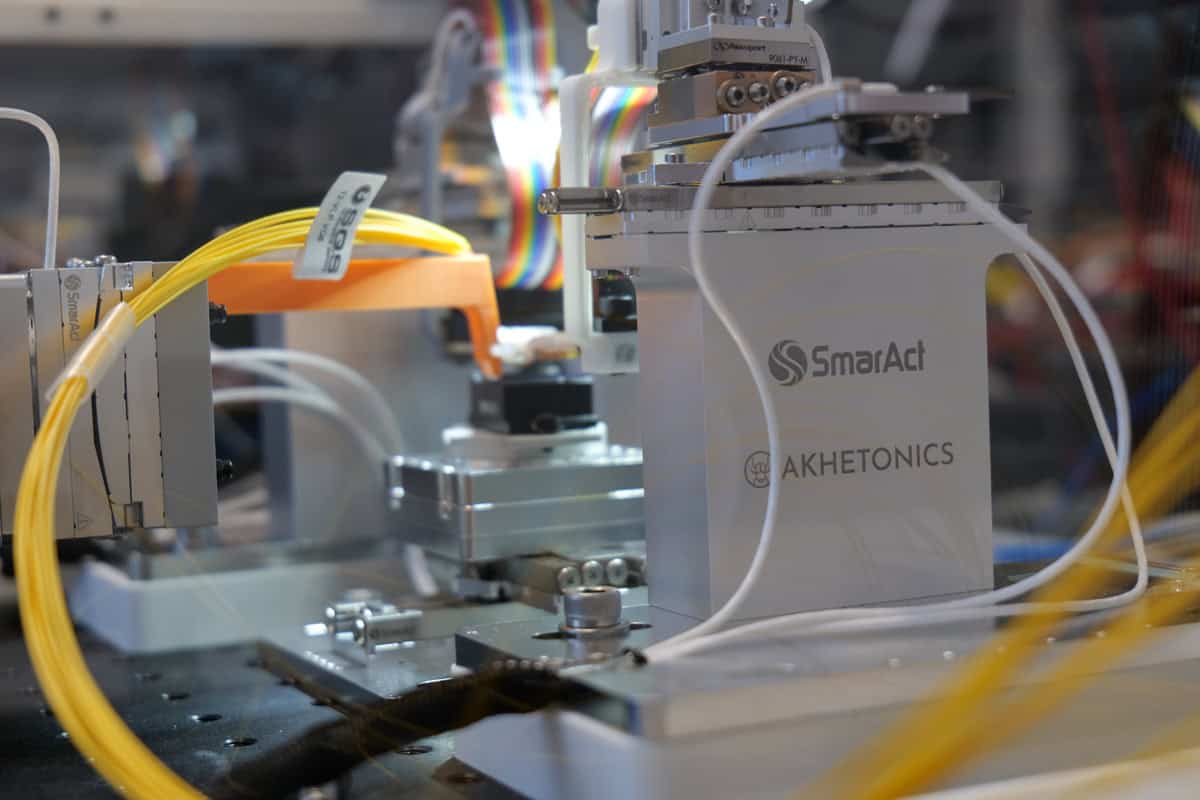
Photonics reimagined SmarAct and Akhetonics worked together to build a versatile optical test set-up to characterize next-generation photonic integrated circuits (PICs). SmarAct’s nanopositioning systems form the precision-motion core of the test workstation, while the positional reproducibility allows Akhetonics to map the full optical chip and evaluate large grids of test components rapidly and reliably. (Courtesy: Akhetonics)
German technology start-up Akhetonics is reimagining the future of high-performance computing (HPC), deploying its proprietary know-how in photonic-design automation and photonic integrated circuits (PICs) to realize the first all-optical digital computation devices. The end-game: an all-optical digital processor – what Akhetonics calls its reasoning processing unit (RPU) – that will fundamentally transform the way that data is processed, transmitted and stored at every level of the HPC stack.
While the anticipated upsides of photonic computing are compelling – think bandwidth scaling, energy-efficiency and reduced latency – the translation of Akhetonics’ R&D effort and early-stage PIC designs into at-scale implementation is still in its infancy. What’s evident even now, though, is that the start-up’s progress is being accelerated by collaboration, interdisciplinary expertise and innovation spanning photonic system design and precision-motion and control technologies.
Collaboration, co-development, customization
A case study in this regard is Akhetonics’ partnership with SmarAct, a German manufacturer and developer of specialist products for nano- and picometre-precise positioning, metrology and automated assembly. Both companies are shaping the future of photonics, albeit along complementary tracks: Akhetonics with its vision of a full-stack photonic computing architecture; SmarAct with a portfolio of enabling technologies that’s helping to make next-generation optical computing a practical proposition.
The two vendors began working together after an initial meeting four years ago at the European Conference on Optical Communication (ECOC 22) in Basel, Switzerland. Top of the Akhetonics shopping list: a versatile optical test system to characterize its advanced PICs.
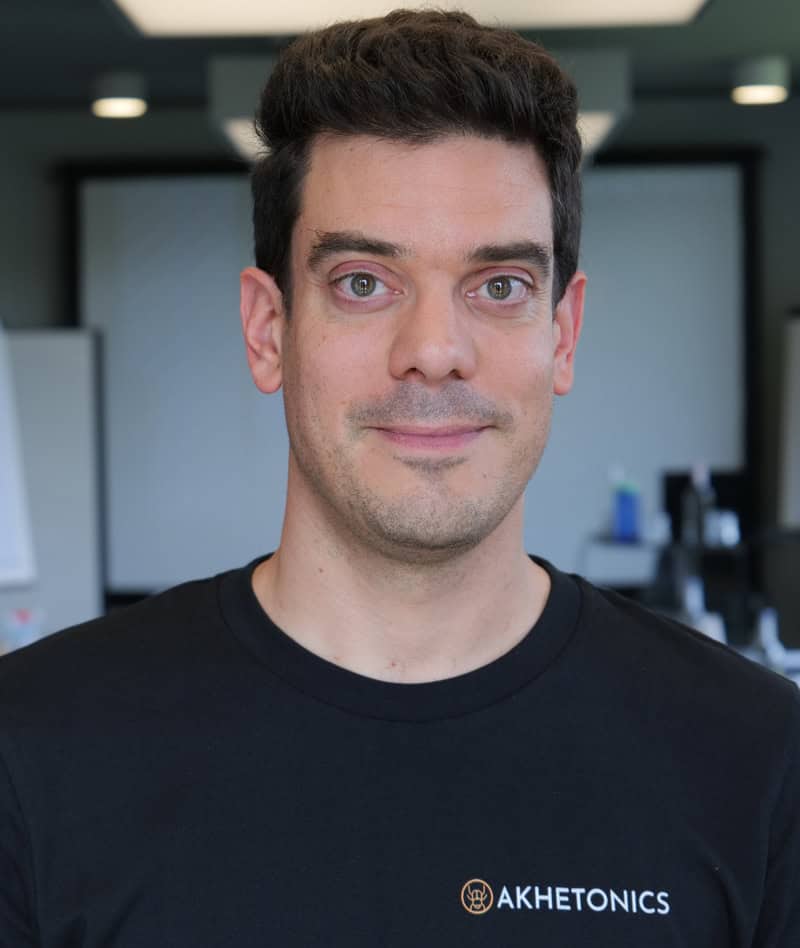
Versatility is the key Leonardo Del Bino, Akhetonics’ CTO. (Courtesy: Akhetonics)
“There are off-the-shelf PIC characterization systems on the market, but they all impose constraints on our design options,” explains Leonardo Del Bino, co-founder and chief technology officer (CTO) at Akhetonics. “Instead, we teamed up with SmarAct to co-develop a compact and modular test architecture built to our exacting specifications. The resulting set-up gives us the flexibility to evaluate and optimize all sorts of innovative PIC designs.”
At the heart of the Akhetonics optical testing workstation sit two discrete nanopositioning subsystems: an XY-Rz chip platform (itself comprising three nanopositioning stages offering horizontal translation along the X and Y axes and rotation limited to the Z axis) and a Z-Rx-Ry “pivot” for an optical probe (where translation occurs only along the Z axis, with simultaneous angular rotation around the X and Y axes). The test set-up (which also incorporates a digital microscope for PIC inspection and alignment) can be used without restriction in every degree of freedom, with the two subsystems working in tandem to ensure precise multi-axis positioning for optical coupling and electro-optic characterization tasks.
On a more granular level, each nanopositioning subsystem is based on SmarAct positioners equipped with integrated optical encoders (SmarAct’s METIRIO® sensors with a resolution of 1 nm) along all six axes of motion. The first subsystem provides three degrees of freedom for lateral alignment (with 49 mm travel in both X and Y, 360° rotation around Rz and a unidirectional positional repeatability of ±40 nm per linear axis). The second subsystem provides vertical and angular alignment (with 31 mm travel in Z, ±5° tilt around Ry, ±45° rotation around Rz and a unidirectional positional repeatability of ±40 nm for the linear Z axis).
To evaluate new PIC designs, Akhetonics’ optical test routines focus primarily on measuring and minimizing insertion losses between input/output fibres and on-chip planar waveguides. Typical measurements include wavelength- and polarization-dependent coupling losses (for example, when a fibre array couples laser light into a series of on-chip grating couplers or when light is coupled from a planar waveguide back into an optical fibre). The subsequent integration of electrical probes into the test system (using two separate XYZ probe towers) supports electro-optic characterization of key on-chip building blocks like optical modulators and photodetectors.
“The requirements for the electro-optical testing are nothing crazy,” says Del Bino. On-chip electrical contacts are in the ballpark of 100 μm x 100 μm, so Akhetonics engineers need positional and alignment precision an order-of-magnitude better than that for their electrical probes. “On-chip optical testing is a different story,” he adds. “A fibre-waveguide mismatch of 1 μm means significant coupling losses, so we need positional accuracy and repeatability of tens of nm or less.”
The rewards of reciprocity
Operationally, the custom test system is the result of ongoing collaboration between the engineering team at Akhetonics and the product development team at SmarAct. After firming up performance requirements, the two vendors iterated back-and-forth with 3D CAD drawings before converging on a final agreed system design.
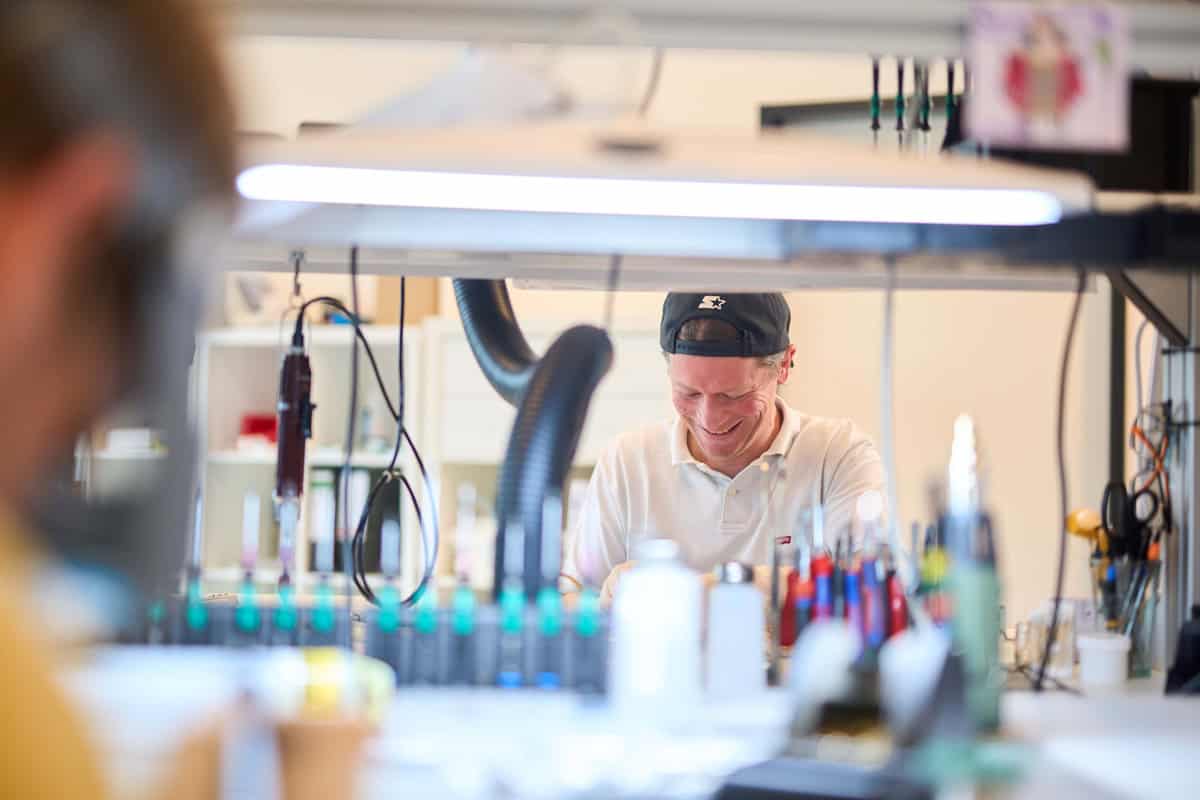
Line-of-sight Max Trippel, SmarAct’s business development manager for photonic applications. (Courtesy: SmarAct)
“We supplied the nanopositioning stages that form the precision-motion core of the workstation,” explains Max Trippel, SmarAct’s business development manager for photonic applications. Akhetonics then integrated these modules into its own test environment, including the fibre and fibre-array-unit holders; the required optical and electrical measurement equipment; and the software routines for photonic characterization. “This approach gives Akhetonics the flexibility to build exactly the test workflow it needs, while relying on a stable and repeatable positioning platform,” Trippel adds.
Crucially, the SmarAct software “ecosystem” and Python interface make it easy to integrate the nanopositioning stages within Akhetonics’ PIC test routines. That software application platform, known as the SmarAct Control and Process Environment (SCoPE), also creates opportunities for continuous process improvement and product innovation (for example, the ability to develop custom routines for fast calibration and alignment on all axes).
In this way, SCoPE will be a natural fit as Akhetonics transitions its PIC testing programme from an R&D setting through small-batch production runs and, ultimately, to volume manufacturing capability (see “SCoPE in brief”, below). “Our goal with SCoPE is to provide customers with easy access for system development, whether that’s for the testing or assembly of photonic components,” says Trippel. “SCoPE is a living platform and we’re constantly integrating novel functionalities and application-specific plug-ins as well as features to facilitate control of third-party devices.”
Strategically, the SmarAct-Akhetonics partnership is shaping up as a win-win for the long term, with the latter’s growth trajectory and evolving platform technologies feeding into SmarAct’s product development roadmap. “Our customers’ success is our success,” Trippel concludes. “Working in this way with Akhetonics and its peers means we have line-of-sight on ‘what’s next’ in photonic computing. Watch this space: the last word has not been spoken.”
SCoPE in brief
The SmarAct Control and Process Environment (SCoPE) is a modular and extensible software application platform that combines visual process modelling, Python scripting and hardware integration. SCoPE enables customers to develop, control and run automated processes in a unified environment that offers…
Reciprocal benefits The custom test system is the result of an ongoing collaboration between the engineering team at Akhetonics and the product development team at SmarAct. (Courtesy: SmarAct)
Process modelling and automation: visual drag-and-drop process editor enables intuitive creation, control and execution of automation workflows. Live process display gives users direct feedback during execution.
Python scripting backend: integrated Python scripting allows developers to extend workflows with custom logic, algorithms and third-party devices to create advanced automation scenarios. Package and dependency management are built-in.
Device control and hardware integration: native support for SmarAct hardware such as positioning systems, controllers, grippers and interferometers through specialized plug-ins.
Custom user interfaces: flexible Qt widget integration makes it possible to build tailored graphical user interfaces for specific applications.
Data visualization and imaging: configurable plotting widgets, real-time data visualization, process messaging and an integrated image processing pipeline support instant process feedback and image-based automation tasks.
Plug-in architecture: the modular plug-in system enables SmarAct and third parties to extend SCoPE with additional functions, algorithms, hardware integrations or communication interfaces.

 Login




 This podcast is supported by