Login

How to Heal People with Science Fiction
A new healthpunk movement aims to teach physicians to use their imaginations
The post How to Heal People with Science Fiction appeared first on Nautilus.


A new healthpunk movement aims to teach physicians to use their imaginations
The post How to Heal People with Science Fiction appeared first on Nautilus.

Researchers at the National University of Singapore have developed a quantum random number generator chip that can verify the integrity of its own hardware while producing random numbers, addressing a long-standing security challenge in digital encryption systems.
Random numbers are critical for encryption keys, secure transactions, digital signatures, and other cybersecurity applications. Existing random number generators, including quantum versions, rely on users trusting that their hardware components continue to operate as intended. If a component degrades or is tampered with, the output could become predictable without being detected.
The new chip is designed to eliminate that risk by continuously checking whether its measurement hardware is behaving as expected during operation.
The research team, led by Associate Professor Charles Lim from the National University of Singapore’s Department of Electrical and Computer Engineering, says the approach could strengthen security in sectors ranging from finance and healthcare to artificial intelligence and connected devices.
Most quantum random number generators operate using what researchers call a trusted-device model. Under this approach, components such as lasers, modulators, and detectors are assumed to match their specifications throughout their lifetime.
The new chip instead uses a measurement-device-independent protocol. This means users only need to trust the quantum light signals entering the system rather than the detector responsible for measuring them.
During operation, the chip generates known quantum light states and compares detector responses against predictions from quantum theory. If the results match expectations, the system converts the data into certified random numbers. If not, the process stops automatically.
“The measurement unit in quantum random number generators has traditionally been very difficult to characterize, making its real-world reliability hard to guarantee. Our solution removes the need to trust that this unit is operating as specified during use,” said Associate Professor Charles Lim.
The device integrates both the signal encoder and optical detector on a single silicon chip manufactured using an eight-inch wafer process commonly used in semiconductor production. Unlike some quantum technologies, it operates at room temperature and does not require cryogenic cooling.
Researchers also addressed a challenge involving silicon-based light modulators. Adjusting the phase of light can unintentionally change its brightness, potentially affecting security. The team developed a control method that compensates for this effect and maintains stable optical signals.
The chip’s detector achieved a total efficiency of 69.1 percent, exceeding the protocol’s minimum requirement of 67 percent. Tests also showed that the system generated more certified random bits than it consumed as an input seed, confirming that it produces fresh randomness.
Researchers describe the device as the most secure quantum random number generator chip demonstrated so far. Its security analysis assumes a worst-case scenario in which an attacker may possess quantum correlations with the detector itself.
That level of security comes with a trade-off. The current experimental system produces 64 bits per second, significantly slower than conventional quantum random number generators that can exceed 100 gigabits per second.
The team believes performance can improve substantially through better detector technology. Laboratory photodiodes developed by the researchers have already reached 92.4 percent efficiency, and simulations suggest future versions of the chip could achieve data rates of 68 megabits per second.
“This chip paves the way towards integrating practical self-testing quantum random number generators into compact, secure systems,” added Assoc Prof Lim.
The study was published in the journal PRX Quantum.
Dermatologists and skincare aficionados are excited for the U.S. to finally get a new, more protective sunscreen filter after more than 20 years of regulatory roadblocks. Here’s how bemotrizinol works

China has successfully tested a huge airborne electromagnetic detection system that could locate hidden nuclear submarines operating deep beneath the ocean surface.
The technology, called Airborne Transient Electromagnetic (Atem) detection, is reportedly made up of a helicopter towing a giant array of coils. The coils emit strong electromagnetic signals into the ground or water.
It is mainly intended to map underground and underwater structures for civilian applications, such as mineral exploration, groundwater mapping, and geological surveys. Previous studies, however, suggest the same approach could have great military potential.
Led by Fu Jingcheng, PhD, an associate professor at Beihang University and the Chinese Academy of Sciences’ Institute of Geology and Geophysics, the research team carried out a seven-minute helicopter test. During the trial, onboard sensors confirmed that the coil array could maintain the near-level stability required for precision detection.
The South China Morning Post (SCMP) pointed out that the detection system is a towering structure that consists of three giant dodecagonal (12-sided) coils. Each of them measures roughly 82 feet (25 meters) across. These coils serve as the transmitter, compensation unit, and receiver.
They are suspended under a helicopter using a network of cables. The technology sends a powerful pulse of electricity through the transmitter coil. This generates a brief electromagnetic field.
Once the pulse ends, conductive materials below the surface produce secondary electromagnetic signals that are captured by the receiver coil. By analyzing how these signals decay, scientists can identify buried or submerged objects and also estimate their depth and composition.
However, maintaining stability during flight is one of the greatest limitations of airborne electromagnetic systems. Large suspended coil arrays can tilt and swing due to wind, helicopter rotor wash, and aircraft maneuvers. These movements can affect the accuracy of the collected data. Even moderate helicopter acceleration caused the massive structure to pitch by more than 20 degrees.
To overcome these issues, Jingcheng and his team developed a computer model that calculated the ideal cable lengths and tensions throughout the system. They then identified a flight configuration that kept the coils level during surveys.
What’s more, the researchers also attached a flexible aerodynamic film to the rear portion of the main transmitter coil. This film works as a passive stabilizer. It can suppress violent oscillations by exerting a restoring force.
A seven-minute flight confirmed the design’s ability to maintain the near-level orientation required for precision measurements. The trial also showed that rapid acceleration and sharp turns can cause the suspended load to swing violently, placing heavy strain on the cable.
The researchers noted that the detection system performs best when flown slowly and smoothly. Pilots should reduce speed before a turn, make the turn gradually, and only speed up afterward.
A 2012 study by researchers from Chang’an University and Shandong University proposed combining Atem systems with synthetic aperture imaging techniques to detect submerged submarines. Simulation experiments reportedly succeeded in identifying a scaled submarine model submerged in salt water.
The study has been published in the journal Acta Aeronautica et Astronautica Sinica on April 25.

1 min read
Home
Characteristics
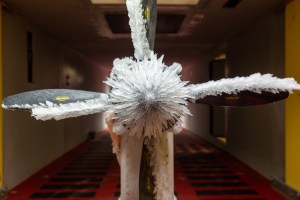
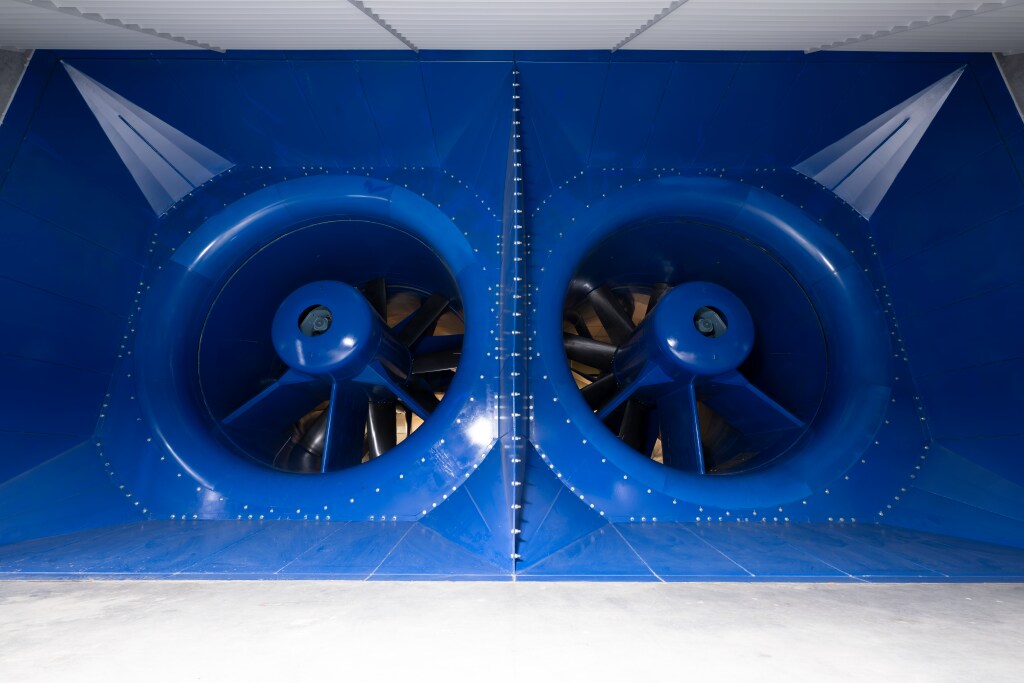
The Flight Dynamics Research Facility (FDRF) is a large, subsonic wind tunnel with a vertical test section for conducting flight dynamics research for stability, controllability, free-fall and aircraft spin, and spin recovery testing of atmospheric vehicles.
Flight Dynamics Flight Research
Aerosciences Evaluation and Test Capabilities




Anthropic has opened the doors to its most advanced AI system yet, but not without placing guardrails around its most sensitive capabilities.
The company on Tuesday unveiled Claude Fable 5, the first publicly accessible version of its Mythos-class AI model. Anthropic says the model outperforms every generally available system it has released to date, delivering major gains in software development, analytical work, visual understanding, and scientific reasoning.
The launch marks a significant shift for the AI firm. Until now, Mythos-level capabilities remained restricted to a small group of trusted organizations because of concerns that the technology could aid cyberattacks and other harmful activities. Fable 5 changes that equation by bringing those capabilities to a broader audience while routing certain high-risk requests through a less permissive model.
Anthropic said Fable 5 includes a new layer of AI-powered classifiers designed to detect potentially dangerous prompts and jailbreak attempts. The company stress-tested those safeguards before releasing the model to the public.
If users submit requests involving cybersecurity, biology, chemistry, or model distillation, the system automatically redirects those interactions to Claude Opus 4.8 instead of Fable 5. Users receive a notification whenever that fallback occurs, allowing them to understand why the switch happened.
Introducing Claude Fable 5: a Mythos-class model that we’ve made safe for general use.
— Claude (@claudeai) June 9, 2026
Its capabilities exceed those of any model we’ve ever made generally available. pic.twitter.com/2AvmEjHIX8
The company acknowledged that the safeguards may occasionally block harmless requests. However, Anthropic said early testing showed that fewer than 5% of sessions triggered a fallback response. “We’ve deliberately tuned the safeguards to be cautious,” the company said, adding that it plans to refine the system over time to reduce unnecessary interventions.
Anthropic argues that Fable 5 delivers its biggest advantages when tackling lengthy and complex assignments. The company says the model can stay focused across extended workflows while maintaining consistency over large amounts of context.
During early evaluations, payments company Stripe reported that the model completed a large-scale migration across a 50-million-line Ruby codebase in roughly one day. According to Anthropic, the same task would have otherwise occupied an engineering team for more than two months.
The company also highlighted gains in financial analysis. On Hebbia’s finance benchmark, Fable 5 posted the strongest results among leading models. Trading firm IMC found that the system performed well across factual analysis, reasoning tasks, root-cause investigations, and expected-value calculations.
Fable 5 also advanced Anthropic’s vision capabilities. The model can extract detailed information from scientific figures and reconstruct web applications from screenshots. In another demonstration, it completed Pokémon FireRed using a minimal vision-only setup after earlier Claude models struggled with the challenge.
Alongside Fable 5, Anthropic introduced Claude Mythos 5, a version of the same underlying model with fewer restrictions in select areas. Anthropic says the model offers the strongest cybersecurity capabilities it has developed so far.
Access to Mythos 5 remains limited. The company is deploying it through Project Glasswing while expanding availability to approved cyber defenders and organizations responsible for critical infrastructure. Anthropic said it intends to broaden access further through a trusted program in the future.
Fable 5 is available through Anthropic’s Claude API and consumption-based Enterprise offerings. Through June 22, Pro, Max, Team, and seat-based Enterprise subscribers can access the model at no additional cost. After that date, Anthropic plans to move users to a credit-based system before eventually restoring broader subscription access.
As competition intensifies across the AI industry, Anthropic is betting that powerful models do not have to arrive without safeguards. With Fable 5, the company is testing whether frontier capabilities and tighter controls can coexist in the hands of everyday users.


These top-rated dehumidifiers remove excess moisture and reduce musty odors.

© Dustin Fenstermacher
Paramount Skydance is accusing Netflix of maintaining a campaign against its proposed acquisition of Warner Bros. Discovery (WBD).
In a June 5 letter (PDF) addressed to Jared A. Hughes, acting section chief of the Media, Entertainment, and Communications Section of the US Department of Justice's (DOJ's) Antitrust Division, and A. Maya Kahn, a trial attorney for the Antitrust Division, and first reported on by Politico today, Paramount chief legal officer Makan Delrahim accused Netflix of trying to influence stakeholders about the merger. The letter reads:
Indeed, Netflix’s panic-level response and scorched-earth campaign to try and poison regulators and other stakeholders against the Transaction shows just how seriously Netflix takes Paramount as a scaled competitor.
The letter from Delrahim, a former assistant attorney general for the Antitrust Division, is a response to a letter that The International Brotherhood of Teamsters sent to the DOJ in March. The teamsters' letter argued that Paramount and WBD's merger would threaten film and TV workers. The union, which has 1.3 million members, asked the DOJ to block the merger "unless substantial and enforceable safeguards are put in place to increase domestic production and protect jobs," per an announcement from the group.


© Mike Cohen/Getty Images for The New York Times
And the best ways to prevent it
The post Here’s Why Our Walking Gets Slower as We Age appeared first on Nautilus.