❌

Reading view

CHEOPS vai ter mais tempo para explorar outros mundos. Portugal mantém papel central na missão europeia

A missão CHEOPS vai continuar a funcionar como uma espécie de laboratório orbital, ajudando a responder a algumas das perguntas mais antigas da humanidade: como se formam os planetas e quantos deles podem ser semelhantes à Terra.

The post CHEOPS vai ter mais tempo para explorar outros mundos. Portugal mantém papel central na missão europeia appeared first on Tek Notícias.

  •  

Il 12 agosto un'eclissi solare totale attraverserà il Nord Atlantico e la S…

Il 12 agosto un'eclissi solare totale attraverserà il Nord Atlantico e la Spagna, offrendo l'osservazione della corona solare durante una fase di buio di circa due minuti. In Italia l'evento sarà visibile solo in forma parziale, con il massimo oscuramento (oltre il 90%) concentrato tra la Sardegna e le regioni del Nord-Ovest proprio al momento del tramonto. La brevità dell'allineamento e la posizione bassa del Sole richiederanno orizzonti sgombri ad ovest, fornendo un importante banco di prova scientifico per i team dell'INAF impegnati nella penisola iberica.
  •  

Europe increases size and cost of IRIS² constellation

IRIS2

The European Commission has reached an agreement with an industrial consortium to proceed with a secure connectivity constellation, increasing the number of satellites as well as its cost.

The post Europe increases size and cost of IRIS² constellation appeared first on SpaceNews.

  •  

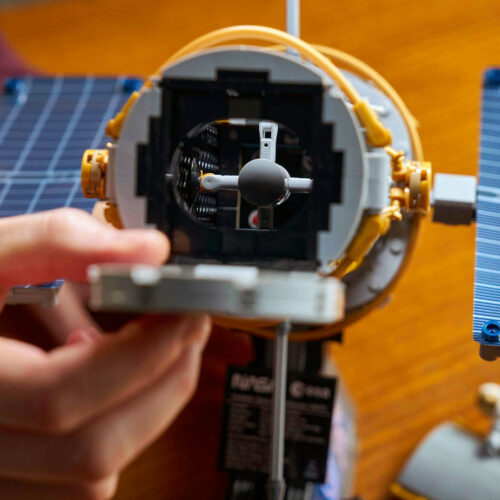
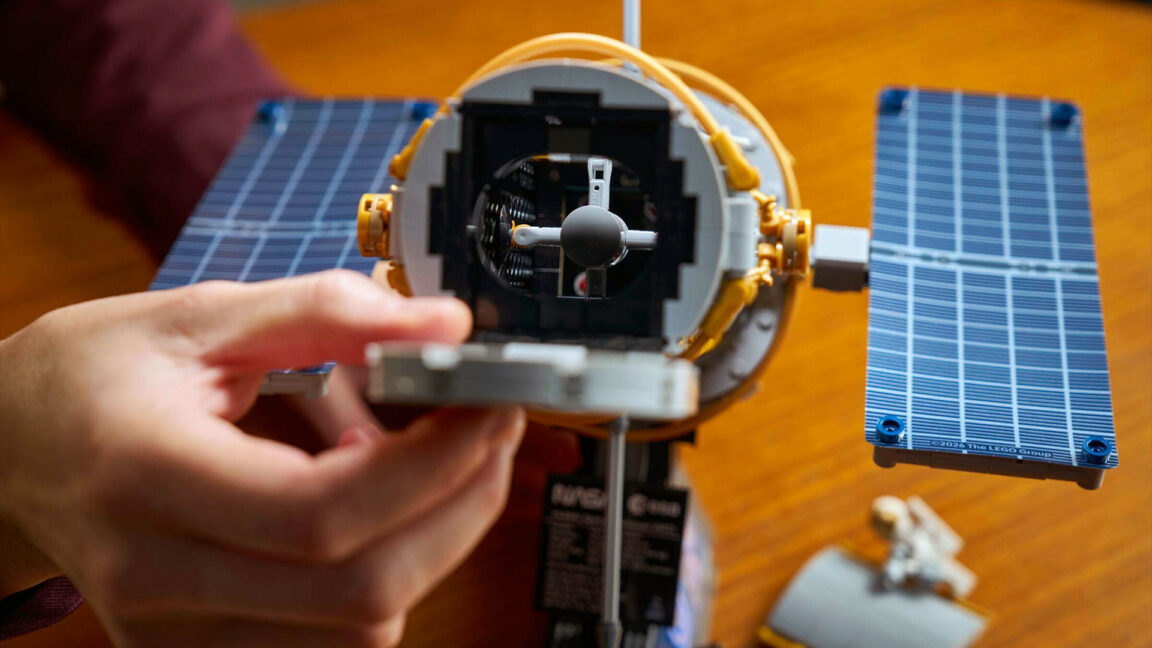
Lego deploys Hubble Space Telescope as detailed desktop model

For 35 years, the Hubble Space Telescope has looked out into the Universe. Now, Lego is inviting builders to look inward with its latest model of the orbiting observatory.

The new Lego Icons Hubble Space Telescope (set no. 11382) was released on August 1 for $140 at the toy company's stores and its online shop. The 1,252-piece kit builds a 15-inch-long (38-cm) desktop model that is about twice as large as the previously released Lego Hubble models.

The Icons Hubble is the first to be sized in comparison to a Lego minifigure, such that the included astronaut provides a sense of scale for the telescope.

Read full article

Comments

© LEGO

  •  

Hubble Spots Spiral Galaxy Warped by Cosmic Forces

This Hubble image shows NGC 4654, an intermediate spiral galaxy some 55 million light-years away in the constellation of Virgo. Image credit: NASA / ESA / Hubble / D. Thilker / J. Lee / PHANGS-HST Team.

A stunning new image captured by the NASA/ESA Hubble Space Telescope shows the lopsided intermediate spiral galaxy NGC 4654, whose unusual shape was sculpted by both a close encounter with another galaxy and a headlong plunge through the hot gas of the Virgo Cluster.

The post Hubble Spots Spiral Galaxy Warped by Cosmic Forces appeared first on Sci.News: Breaking Science News.

  •  

It Appears the Reports of Venus’s Death Were Greatly Exaggerated—New Models Suggest the Planet is Still Geologically Active

New computer models of Venus’s surface features, including ridges likely caused by volcanic activity, have determined that the second rock from the Sun remains geologically active to this day.

The ETH Zurich research team behind the new Venusian models, which suggest that Venus may still have active volcanoes, said their findings could help planned NASA and ESA missions select the most promising targets. The new models could also help in the search for rocky planets outside of our Solar System, including those that may support life.

Venus Previously Considered Geologically Dormant for Over 100 Million Years

Venus has long fascinated planetary scientists due to its similarities. For example, the planet’s mass and circumference make it roughly 95% the same size as Earth overall. However, although Venus’ elliptical orbit brings it closer to Earth than any other planet in the Solar System, its extreme surface temperatures and toxic atmosphere make it inhospitable to life as we know it.

Ground and space observations have detected rift valleys on Venus’s surface, which the research team notes indicate tectonic activity. Some can measure up to 10,000 kilometers and resemble the longest ridges on Earth. Although the timing of Venus’ rift formations remains uncertain, the team said most scientists have typically considered the planet to be geologically dormant. Some estimates have put their formation more than 100 million years ago.

Curious if data captured by space and ground-based observatories could provide enough information to answer the timing question, a research team from ETH led by Taras Gerya, a Professor of Geodynamics at the Department of Earth and Planetary Sciences, decided to plug that data into computer models. According to their results, the reports of Venus’ demise may have been greatly exaggerated. 

Models Reveal Planet Likely Supports Active Volcanoes

Working under Professor Gerya’s supervision, Master’s candidate and lead author of the paper detailing the team’s work, Xi Yang, and colleagues employed computer models to simulate the planet’s rifts in high-resolution and 3D. The team said these models allowed them to “accurately replicate these rift structures” in a level of detail never achieved. The data also allowed them to perform simulations to best determine how they originally formed.

Critically, the team notes that earlier attempts to model Venus’ tectonic history and potential ongoing activity had been mostly two-dimensional. Yang’s team also said those earlier models had relied on “simplified material assumptions” that his team was able to expand upon.

After completion, the models yielded several compelling results. First, they indicated that the broad ridges geologists call ‘rift flanks’ form along the edges of rift valleys at a time when the rifts are still “geologically young.” Specifically, the team’s models suggested that these flanks formed when Venus was still either actively moving or had only recently stopped moving.

A closer look at the simulations also suggested that these geological rifts open over a much shorter time scale than previously assumed, with an estimated rate between 3 and 10 centimeters per year. The models also indicated that rift flanks tend to flatten very quickly once the movement ends.

“The older the rift system, the less steep and narrow its flanks,” they explained.

A comparison to erosion patterns on Earth also supported a more recent time frame for the rift flank formations spotted on the Venusian surface from the Magellan probe during its 1990s mission. The team said that these formations and their models suggest that “Venus remains an active planet with a more dynamic interior than had been previously believed.”

“Venus remains geologically “alive” and even hosts active volcanoes,” they explained.

Planned NASA & ESA Missions Could Confirm Models

When discussing the implications of their work, Professor Gerya said the findings “help us to better assess the tectonic activity on Venus.” The team noted that their models could also guide future missions by pinpointing potentially active regions worthy of closer examination.

The ETH team said their study also has planetary formation implications, particularly for rocky planets like Venus and Earth. Such data could prove valuable in the search for rocky exoplanets, including the type that may host life.

Moving forward, the study authors noted that NASA and the European Space Agency (ESA) are actively preparing “multiple missions” to explore Venus in further detail. ETH geophysics professors Paul Tackley and Gerya, and their team of collaborators, are already participating in ESA’s EnVision mission.

The work includes developing instruments for the orbiter to analyze the surface in greater detail. Scheduled for launch in the early 2030s, the team said that EnVision will explore the planet more thoroughly than previous efforts “from its core to its upper atmosphere.”

The study “Recent active rifting on Venus revealed by wide rift flank uplifts” was published in Nature Geoscience.

Christopher Plain is a Science Fiction and Fantasy novelist and has spent the last six years as Associate News Editor and Head Science Writer at The Debrief. Follow and connect with him on X, learn about his books at plainfiction.com, or email him at christopher@thedebrief.org.

  •  

Uma foi de passagem, a outra já lá estava e duas sondas acabaram a fotografar o mesmo lugar de Marte

A mesma paisagem marciana pode parecer diferente consoante a câmara, a distância e o ângulo de observação. Uma rara experiência envolvendo duas sondas permitiu a comparação e pode ajudar a garantir que uma delas está pronta para a longa viagem que tem pela frente.

The post Uma foi de passagem, a outra já lá estava e duas sondas acabaram a fotografar o mesmo lugar de Marte appeared first on Tek Notícias.

  •  

Space Weather May Warp Martian Weather during Dust Storms, Planetary Scientists Suggest

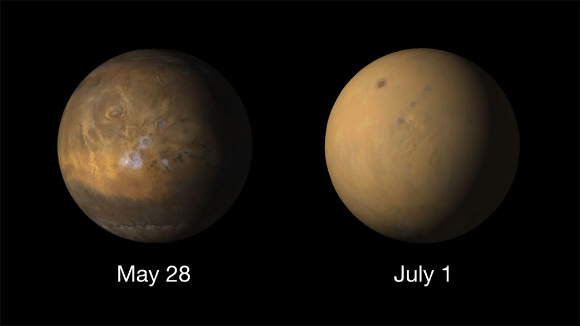
These images from Mars Color Imager (MARCI) aboard NASA’s Mars Reconnaissance Orbiter (MRO) show Mars before (left) and during (right) the June 2018 dust storm. Image credit: NASA / JPL-Caltech / University of Arizona.

Planetary researchers have found the first evidence that bursts of energetic particles from the Sun could warm the lower atmosphere of Mars during massive dust storms, hinting at an unexpected link between space weather and Martian climate.

The post Space Weather May Warp Martian Weather during Dust Storms, Planetary Scientists Suggest appeared first on Sci.News: Breaking Science News.

  •  

Our Milky Way Galaxy Likely Underwent Disk Flip after Ancient Galactic Collision: Study

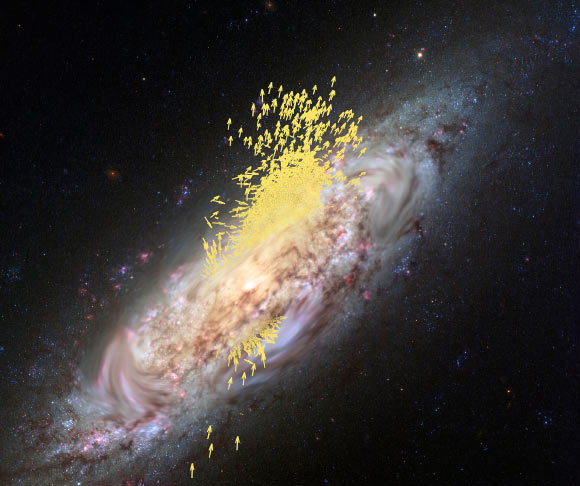
Using supercomputer simulations of galaxies like the Milky Way, Batrakov et al. found that galaxies with slowly rotating stellar haloes are more likely to have experienced a major ‘disk flip,’ where our Galaxy’s disk changed its orientation by more than 90 degrees. Image credit: Batrakov et al.

A head-on collision with another galaxy billions of years ago may have dramatically reoriented the Milky Way’s disk, according to new supercomputer simulations that reveal how violent mergers can leave spiral galaxies looking surprisingly normal today.

The post Our Milky Way Galaxy Likely Underwent Disk Flip after Ancient Galactic Collision: Study appeared first on Sci.News: Breaking Science News.

  •  

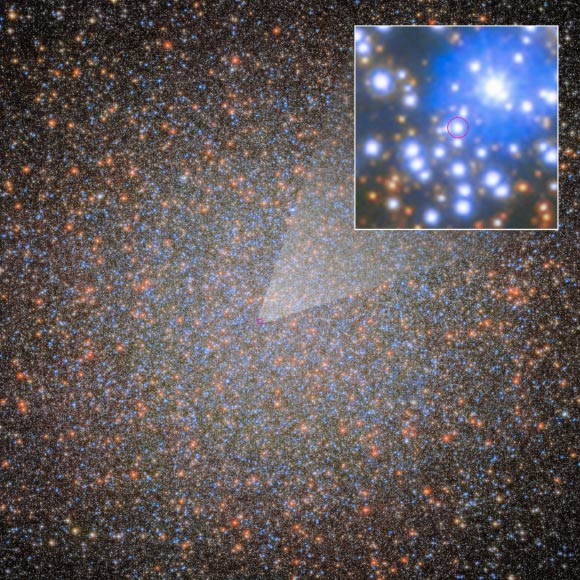
Astronomers Find Omega Centauri’s First Stellar-Mass Black Hole

Whitaker et al. found Omega Centauri’s first stellar-mass black hole, which has a visible star companion that is shown in greater detail. Image credit: ESA / NASA / Maximilian Häberle, MPIA / Joseph DePasquale, STScI.

After decades of searching, astronomers have pinpointed the first of an estimated 10,000 stellar-mass black holes thought to lurk in Omega Centauri, the most massive stellar system in the Milky Way found so far, with a stellar mass of 3.6 million solar masses.

The post Astronomers Find Omega Centauri’s First Stellar-Mass Black Hole appeared first on Sci.News: Breaking Science News.

  •  

Satélite Sentinel-1A diz adeus depois de mais de uma década a vigiar a Terra. Legado continua em órbita

Ao longo da missão, o Sentinel-1A registou milhões de imagens usadas para monitorizar cheias, incêndios, gelo marinho, culturas agrícolas, infraestruturas, tráfego marítimo e operações de resposta a catástrofes.

The post Satélite Sentinel-1A diz adeus depois de mais de uma década a vigiar a Terra. Legado continua em órbita appeared first on Tek Notícias.

  •  

Ingram Micro avança para a versão 2.0 da empresa com aposta reforçada em Portugal

A reorganização da operação da Ingram Micro em Portugal já está em marcha e Jaime Soler descreve as mudanças como uma evolução que traz benefícios aos clientes no mercado português.

The post Ingram Micro avança para a versão 2.0 da empresa com aposta reforçada em Portugal appeared first on Tek Notícias.

  •  

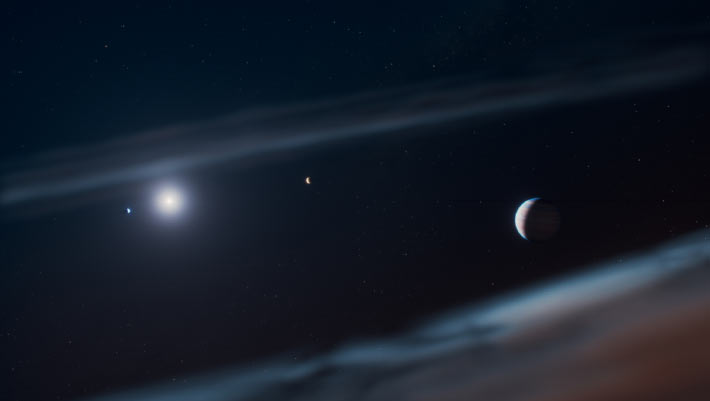
Astronomers Discover and Directly Image Third Planet in Beta Pictoris System

This artist’s concept shows the Beta Pictoris system with the discovered giant exoplanet Beta Pictoris d at the right. Image credit: NASA / ESA / CSA / STScI / Ralf Crawford, STScI.

Named Beta Pictoris d, the newly-discovered world is 100 times fainter than Beta Pictoris b -- the first planet discovered around the A5-type star Beta Pictoris -- and is among the lightest exoplanets ever to be imaged from the ground.

The post Astronomers Discover and Directly Image Third Planet in Beta Pictoris System appeared first on Sci.News: Breaking Science News.

  •  

Conferência internacional reúne astronautas e especialistas para debater o futuro espacial dos Açores

Entre os dias 22 e 25 de julho, a ilha de Santa Maria acolhe a conferência Atlantic Space Hub: Designing the Future of Space, com quatro dias de reflexão e debates sobre o papel dos Açores como centro atlântico para a exploração e investigação espacial.

The post Conferência internacional reúne astronautas e especialistas para debater o futuro espacial dos Açores appeared first on Tek Notícias.

  •  

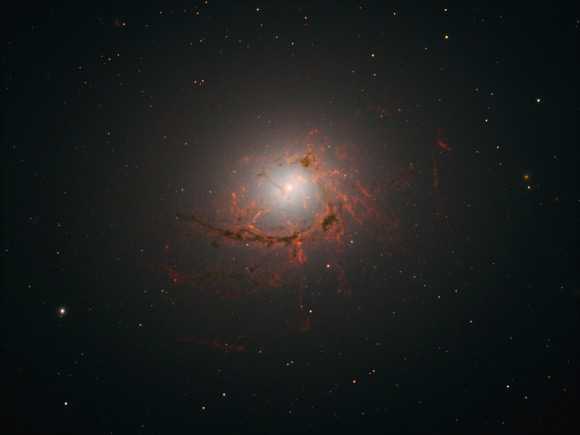
Webb Catches Supermassive Black Hole Feeding from Cosmic Gas Streams

This Hubble image shows the elliptical galaxy NGC 4696. Image credit: NASA / ESA / Hubble / A. Fabian.

New images of the giant elliptical galaxy NGC 4696 from the NASA/ESA/CSA James Webb Space Telescope reveal gas filaments funneling material into a spinning disk around a supermassive black hole 800 light-years across.

The post Webb Catches Supermassive Black Hole Feeding from Cosmic Gas Streams appeared first on Sci.News: Breaking Science News.

  •  

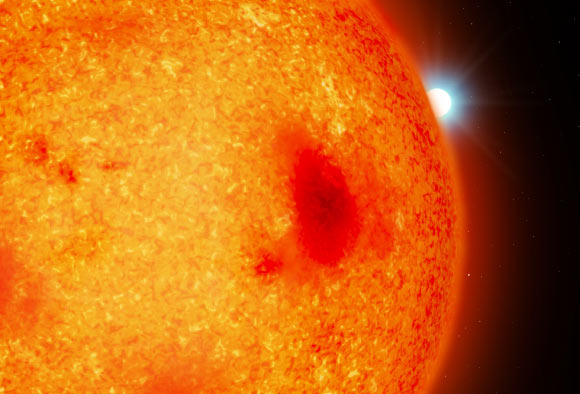
Astronomers Discover Four New White Dwarfs in Solar Neighborhood

An artist’s impression of a red dwarf with a white dwarf binary companion peeking out from behind. Image credit: Mark A. Garlick / University of Warwick.

Using near-UV spectroscopic data from the Space Telescope Imaging Spectrograph (STIS) on the NASA/ESA Hubble Space Telescope, astronomers discovered four white dwarfs orbiting nearby red dwarf stars.

The post Astronomers Discover Four New White Dwarfs in Solar Neighborhood appeared first on Sci.News: Breaking Science News.

  •  

Euclid Discovers Earliest Quasars Ever Seen

This collage shows 15 of the 31 newly discovered quasars by ESA’s Euclid space telescope. EUCL J172902.75+641018.1 and EUCL J125308.55+705432.3 are visible on the first row, the first and second from the left, respectively. Image credit: ESA / Euclid / Euclid Consortium / NASA / Euclid Science Ground Segment / Antoine Basset, CNES.

Astronomers using ESA’s Euclid space telescope have discovered 31 ancient quasars from a time when the Universe was just 670 to 800 million years old. One of these objects, dubbed EUCL J172902.75+641018.1, sets the new record for the most distant quasar ever reported.

The post Euclid Discovers Earliest Quasars Ever Seen appeared first on Sci.News: Breaking Science News.

  •  

ESA’s Euclid Telescope Just Spotted Two Record-Breaking Ancient Giants Among the Most Remote Objects in the Cosmos

The European Space Agency’s (ESA) Euclid Space Telescope has just revealed new evidence for the existence of more than two-and-a-half dozen objects that are among the oldest and most remote in the universe.

These 31 massive objects, known as quasars, rank among the oldest objects astronomers have ever seen, including two that are believed to originate from a period in the universe when our cosmos was only 5% of its current age.

The discoveries, revealed in a new study appearing in the journal Astronomy & Astrophysics, provide a remarkable look at the earliest generations of galaxies, as well as a rare look at the dynamics of the ancient black holes that once powered them.

Quasar Questions

As some of the brightest objects anywhere in our universe, quasars are remote objects resembling stars in appearance that emit unprecedented amounts of energy. They are the result of creation processes that involve enormous quantities of gas and dust, which spiral into supermassive black holes.

During the gravity-driven inward acceleration process, immense friction causes temperatures that can reach millions of degrees, which generates large amounts of energy. The resulting celestial features produce enough light to outshine entire galaxies.

Despite their brightness, the 31 newest additions to our growing collection of known quasars were difficult for astronomers to spot, given their extreme distances from Earth. The light that documents their ancient presence in the universe has traveled more than 13 billion years to make its way here, causing it to be extremely faint, and thereby very difficult to distinguish from surrounding stars whose light normally outshines them with ease.

Rotating Quasars from the Early Universe

A dozen of the newly discovered collection of quasars date to within the first 770 million years our universe existed. Add to that the fact that two of the ancient objects are believed to have formed just 670 million years after the Big Bang—at such ages, these quasars are among the oldest astronomers have ever observed.

The weight of the discoveries goes beyond just record-breaking astronomical observations, since the data they provide could help astrophysicists unravel some of the most enduring mysteries of cosmology. For instance, these quasars could help to reveal answers to questions about how supermassive black holes grew so quickly while the universe was still in its infancy.

Additionally, studying these energetic ancient giants could help to provide new insights into the formation of the earliest galaxies and the evolution of the universe while it was still in its relative infancy.

Answering Questions About the Cosmos

The recent research, led by the ESA and with contributions from its partners at NASA, has helped to place the Euclid mission in an ideal place to carry out its mission of mapping billions of galaxies. Doing so may help scientists uncover clues about the questions surrounding mysterious dark energy, which is widely believed to be the force behind the accelerating expansion of the cosmos.

Additionally, the Euclid mission’s findings could be pivotal in helping shape the future work of NASA’s Nancy Grace Roman Space Telescope, which will continue the quest to unravel the nature of dark energy and help astronomers understand the nature of the universe at large scales. Additional details about the recent quasar discoveries by Euclid can be found at the ESA’s website and on NASA’s FAQ page.

The new findings were detailed in a recent study, “Euclid: Discovery of 31 new quasars at 6.6 < z < 7.8” published in Astronomy and Astrophysics. 

Micah Hanks is the Editor-in-Chief and Co-Founder of The Debrief. A longtime reporter on science, defense, and technology with a focus on space and astronomy, he can be reached at micah@thedebrief.org. Follow him on X @MicahHanks, and at micahhanks.com.

  •  

Deep Inside the Earth’s Molten Core, a Sudden ‘Reversal’ Now Has Scientists Searching for Answers

The molten iron core deep within our planet could be much more dynamic and complicated than previously known, as revealed in new studies that point to a current of liquid metal under the Pacific Ocean that reversed directions unexpectedly more than a decade ago.

The new findings provide additional insights into a sort of hidden “engine” driving the planet’s protective magnetic field, as detailed in new reporting featured in the Journal of Studies of Earth’s Deep Interior.

According to the research, long-held assumptions about large-scale flows occurring in Earth’s outer core are now being challenged, pushing back on previous notions that they evolve only gradually over time. Now, researchers say a broad region of molten iron beneath the equatorial Pacific abruptly shifted from a weak westward flow to a strong eastward current sometime around 2010.

Earth’s Magnetic Field

Since our planet’s magnetic field is produced by the movement of superheated, electrically conductive liquid iron that is close to 2,200 kilometers (1,370 miles) below the surface, sometimes even the most nuanced changes within these deep currents can fundamentally alter the magnetic field that shields the planet from harmful charged particles emitted by the Sun.

Discovering this unexpected reversal required scientists to combine close to three decades of ground-based magnetic observations with satellite data collected from 1997 until 2025. The European Space Agency’s (ESA) Swarm Mission provided measurements, which, combined with previous observations made possible through German CHAMP and Danish Ørsted satellites, helped researchers behind the new work to construct a precise model of the changing flow patterns occurring at the boundary between Earth’s core and mantle.

“The large-scale flow reversal beneath the Pacific raises new questions about the behavior of Earth’s deep interior,” said lead author Frederik Dahl Madsen of the University of Edinburgh’s School of Geosciences.

“Scientists now want to understand whether the reversal represents a short-lived fluctuation, part of a repeating oscillation, or a new stable equilibrium for core circulation,” Madsen said.

A Weakening Current

Among their findings, the team also said they uncovered evidence that the strong eastward current appears to have weakened since 2020, raising the possibility that the reversal could represent part of a longer natural cycle.

According to Madsen, the shift coincided with changes inferred within Earth’s solid inner core, which suggests previously unrecognized links between the planet’s deepest layers.

“The rise of the strong eastward flow in the Pacific is contemporary with a change in behaviour in the inner core, as inferred from geodesy and seismology, and we hypothesize that these changes in the deep interior are associated with the changes in flow beneath the Pacific,” Madsen said.

While such processes occur thousands of kilometers beneath our planet’s surface and pose no direct dangers, they nonetheless have a vital part in sustaining Earth’s magnetic field.

Although invisible, the magnetic shielding capability it provides protects our atmosphere from solar radiation, while supporting the technologies many of us rely on daily for navigation, space weather monitoring and forecasting, and a range of other things.

ESA scientists say that in the long term, satellite missions like its Swarm mission provide a detailed picture of what’s happening in Earth’s hidden interior. That data is also revealing how the planet’s molten core may be considerably more variable and complex than once thought.

Going forward, Madsen says he and his colleagues will continue to look at how the molten flow deep within the earth is changing over time.

“Continued monitoring will be essential to determine how the flow evolves over the coming years,” Madsen said of the team’s ongoing work.

The team’s recent study, “Principal component analysis of the 2010 reversal of core-surface flow beneath the Pacific Ocean,” was published in the Journal of Studies of Earth’s Deep Interior.

Micah Hanks is the Editor-in-Chief and Co-Founder of The Debrief. A longtime reporter on science, defense, and technology with a focus on space and astronomy, he can be reached at micah@thedebrief.org. Follow him on X @MicahHanks, and at micahhanks.com.

  •  
❌