In an internal memo seen by WIRED, Bosworth promised employees more stability, better communication, and the return of workplace perks as the company seeks to improve morale.
Your public Facebook posts could help inform AI-generated results in Meta's new AI Mode. When you search on Facebook, the "AI Mode" option will appear alongside the usual search modes like "People" and "Marketplace." It's one of several new AI features Meta is rolling out starting today, including photo presets that swap sports jerseys onto fans and suggestions for collage templates.
Instead of "just links," it gives users AI-generated results that pull from publicly-posted content across Meta's platforms, like the AI search feature in its new Reddit-like Forum app. Users can also ask Meta's AI follow-up questions in response to the search …
With support from Markwayne Mullin and Robert F. Kennedy Jr., the kratom industry is pursuing a potentially lucrative policy. Mr. Mullin owns equity in a company that could benefit.
Google is removing Chrome's last remaining workarounds for Manifest V2 extensions, effectively ending support for legacy ad blockers such as the original uBlock Origin. 9to5Google reports: CyberNews points out a Chromium commit that removes support for the "kExtensionManifestV2Disabled" flag, which is referred to as "dead code" seeing as Chrome no longer supports Manifest V2 extensions. This removal acts as the final stop for many Manifest V2-based ad blocker extensions that were still in use today -- the flag was effectively a loophole to continue using these extensions.
A Googler on the commit explains: "MV2 extensions are no longer allowed in any supported version of Chrome, and we are removing support for them and the associated functionality. We won't be able to provide / maintain this functionality indefinitely due to the complexity and tech debt, as well as the security risks it entails (we've actually found a number of bugs that are specific to MV2 lately). Of course, other browsers can continue supporting these if they so desire."
This will also impact other Chromium-based browsers, though the comment notes that "other browsers can continue supporting these if they so desire." Neowin points out that Microsoft Edge and Opera are likely to follow suit. Chrome 150, set to be released later this month, will remove this flag, while other leftover bits of Manifest V2 will be removed in the v151 release.
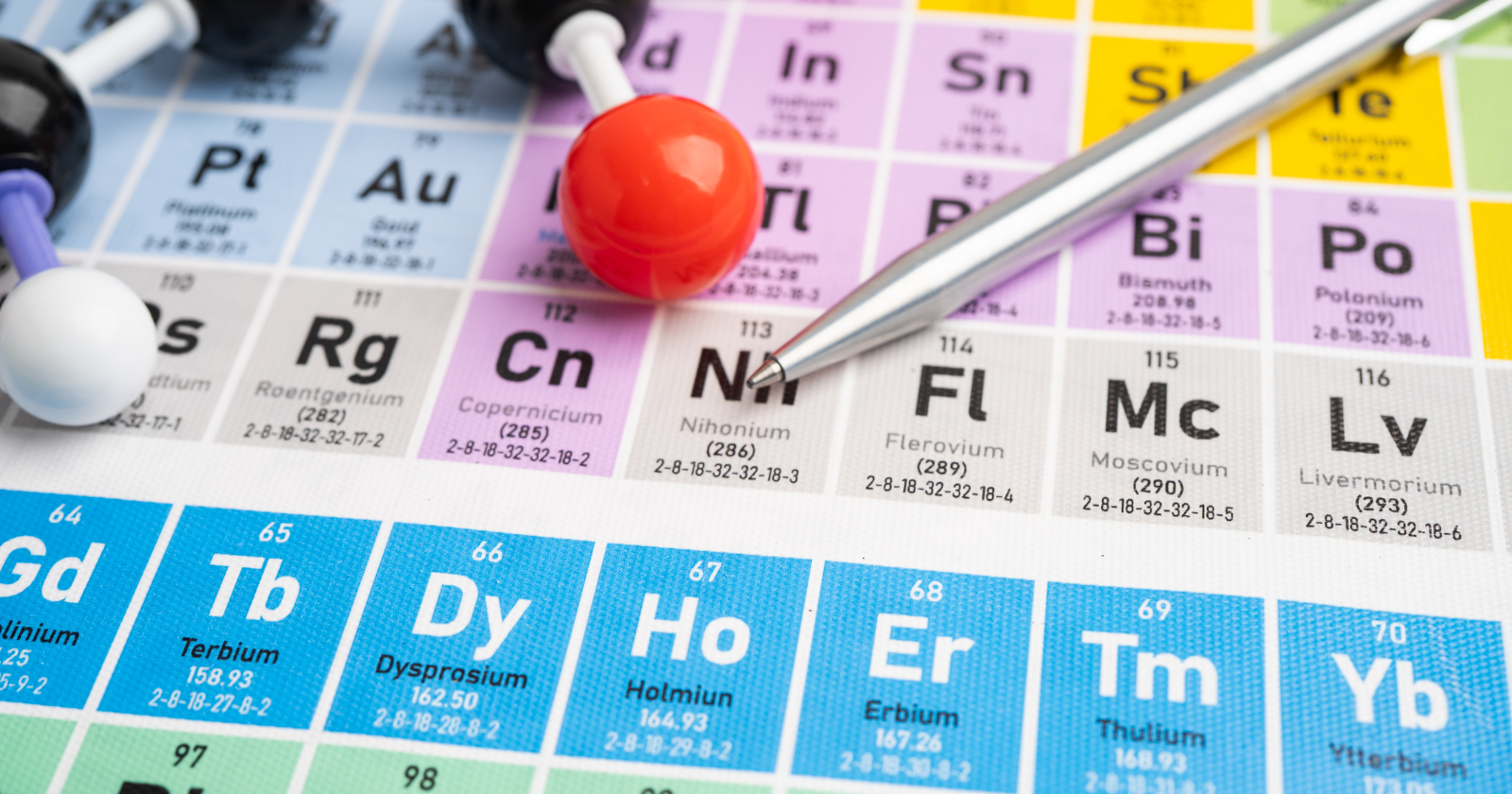
In March 1869, Dmitri Mendeleev presented to the Russian Chemical Society a way of laying out around sixty elements then known. He ordered them by atomic weight and broke the line into rows so that elements with similar chemical behaviour fell into the same columns. Where the pattern called for an element that no one had found, he did not close the line up. He left the space empty and described what should eventually fill it.
The arrangement is now so familiar that the gaps are easy to overlook. They are the part worth dwelling on. Other people had already noticed that the elements repeat their properties at regular intervals. What Mendeleev did with the repetition was different in degree: he trusted the pattern enough to bet against the existing inventory, and to say, in print, that the inventory was incomplete in specific places by specific amounts.
What the table was built on
The organising idea was periodicity. Run through the elements in order of increasing atomic weight and their properties do not change steadily; they cycle. A reactive light metal is followed some steps later by another reactive light metal, a pungent gas by another pungent gas. Mendeleev arranged the rows so that these recurrences stacked into vertical groups, lithium above sodium above potassium, and so on.
Atomic weight was the only quantity he had to order by. He did not know what caused the periodicity, because the structure of the atom was still decades away. He was working from measured weights and observed chemistry, and arranging both until the columns made chemical sense. In a few cases the weights and the chemistry disagreed, and he chose the chemistry, placing an element where its behaviour fit even when its measured weight argued for somewhere else.
The gaps and the predictions
For three of the empty spaces, Mendeleev went further than leaving a blank. He gave the missing elements provisional names built from the Sanskrit prefix eka, meaning one, so that eka-aluminium meant the element one place below aluminium. For each he estimated an atomic weight, a density, and a set of chemical properties, reading them off the neighbours that surrounded the hole.
The estimates were close enough to be checked. Eka-aluminium arrived in 1875, when the French chemist Paul-Émile Lecoq de Boisbaudran isolated a new metal he called gallium; its density, once measured carefully, matched Mendeleev’s figure. Eka-boron arrived in 1879 as scandium, identified by Lars Fredrik Nilson in Sweden. Eka-silicon arrived in 1886 as germanium, found by Clemens Winkler in Germany, and its properties tracked the prediction closely enough that the agreement is still the standard example taught from the episode.
Three confirmed predictions within seventeen years did more for the table than any argument could. A scheme that merely tidied the known elements would have been one convenience among several. A scheme that named absent elements and described them before anyone had seen them was harder to dismiss.
He was not the only one, and that matters
Mendeleev did not invent the idea that the elements form a periodic series. Alexandre-Émile Béguyer de Chancourtois had plotted them on a spiral in 1862. John Newlands, in London, had published his “law of octaves” in the mid-1860s, noting that every eighth element resembled the first, and had been mocked for it. The German chemist Lothar Meyer was developing his own table at almost the same time as Mendeleev and arguably had the periodicity of physical properties drawn more cleanly.
What separated Mendeleev’s version was not priority but nerve. Newlands had let the known elements set the length of his pattern. Mendeleev let the pattern set the length, and treated mismatches as evidence that an element was missing or that a measured weight was wrong, rather than as evidence against the scheme. The historian Eric Scerri, who has written the standard modern account of the table’s development, has argued that this willingness to subordinate the data to the system, and then to stake testable predictions on it, is the better explanation for why Mendeleev’s name attached to the result.
Where the 1869 table was wrong
The story is usually told as a clean run of successful forecasts. It was not clean. Mendeleev predicted elements that were never found, including light elements he expected to sit before hydrogen, tied later to his mistaken belief in a luminiferous ether. Several of his other interpolations did not pan out as described.
Two larger problems sat outside the 1869 table entirely. The noble gases, argon and its relatives, were discovered in the 1890s and formed a whole column that the original scheme had not anticipated; Mendeleev was at first reluctant to accept them. And the ordering principle itself was incomplete. A handful of pairs, tellurium and iodine among them, sat in the right chemical place but the wrong weight order. The reason became clear only in 1913, after Mendeleev’s death, when Henry Moseley showed that the elements are properly ordered not by weight but by nuclear charge, the atomic number. The table Mendeleev built by chemical intuition turned out to be tracking a physical quantity he had no way to measure.
That is the honest shape of it. The gaps were the achievement, and the parts he filled wrongly belong in the same account as the parts he filled before anyone else could.
The part worth keeping
The detail in the headline is fair: by 1869 the chemistry of the elements had become ordered enough that a missing piece could be described before it was found. That is a particular kind of confidence, and it is rarer than the finished table makes it look. It requires a pattern reliable enough to extrapolate from, and someone prepared to be checked against an empty square.
Mendeleev was prepared to be checked, and within his lifetime three of the squares filled in close to where he had said they would. The ones that did not fill in, and the deeper rule that only emerged after he was gone, are part of why the table is interesting rather than merely useful. It was right enough to predict, and wrong in ways that pointed at the physics underneath.
CyberGhost VPN, la única VPN del mercado con garantía de devolución de 45 días, ha vuelto a bajar su plan de 2 años + 2 meses a 1,59 USD/mes, un 88% de descuento sobre el precio mensual. Servidores en 100 países con redes de 10 Gbps, 7 dispositivos simultáneos, WireGuard y política de no registros certificada. El precio más bajo en la historia del servicio.
An anonymous reader quotes a report from Ars Technica: A decade ago, AMD added a protection to its high-end CPUs to protect them against cold boot attacks and other types of physical exploits that siphon sensitive data out of the connected memory chips. Short for Transparent Secure Memory Encryption, TSME encrypts the entire contents stored in memory, making the data useless to physical attackers. Over time, AMD added TSME to lower-end processors, including the consumer version of its Ryzen chips, a CPU that costs less than the Pro version. Over the years, users of these lower-end chips have gotten used to the added security. Recently and without warning or notice, this lower-end line of AMD chips suddenly dropped the protection, and did so in a way that was impossible to detect on Windows machines and required a fair amount of technical work when using Linux.
AMD has yet to say why TSME worked on these CPUs, or even to confirm the change. AMD declined to answer questions sent by email other than to say TSME "is a security feature only applied to PRO CPUs as part of AMD PRO Technologies." The statement is the first known time the chipmaker has explicitly made this restriction public. [...] There's no indication that AMD ever advertised or marketed TSME as being available in consumer CPUs. AMD has long said that a related memory protection, Secure Memory Encryption (SME), is available only in the Pro and Epyc CPU tiers. SME is OS-managed. It uses a single key and allows the OS to selectively encrypt individual memory pages. TSME is firmware-managed. It encrypts all RAM with no OS involvement. When active, it provides protection against physical attacks, including cold boot exploits, DRAM interface snooping, and memory module removal. It activates silently when enabled in the BIOS, making it the more practically useful of the two protections. Ben Kilpatrick, a self-described "privacy-conscious Linux hobbyist," discovered that TSME had stopped working on his consumer Ryzen processor despite remaining enabled in the BIOS. He spent months investigating, persuaded MSI engineers to test multiple CPUs, motherboards, and firmware versions, and filed a public AMD bug report that traced the change to newer AGESA firmware apparently disabling TSME on consumer chips while retaining it on Pro and EPYC models.
"AMD engineers' comments, such as those mentioned above, and the years of TSME working just fine in the lower-cost tier processors, have understandably conditioned Kilpatrick and other users to reasonably regard it as an expected part of the chip package," reports Ars Technica. "AMD quietly removing it and providing no acknowledgment or explanation strikes these users as something of a betrayal."
Joe Fitzgerald, an expert in silicon-level security, said in an interview: "They could have not realized they did it leading to their cagey responses, or they could have done it intentionally and tried to get away with it, leading to the same cagey responses. But I really feel like an explanation should be in order, even if it was 'TSME was never supposed to be supported. We did ship some firmwares that erroneously enabled it, but you shouldn't use them since we can't guarantee it'll work properly.'"
Ela parece apenas uma bola de futebol, mas por trás de cada chute existe uma combinação de materiais, engenharia e tecnologia desenvolvida para atender aos maiores torneios do planeta.
Neste vídeo, o Manual do Mundo abre a bola oficial da Copa para descobrir como ela é construída, quais são suas camadas e o que faz ela se comportar de forma tão diferente dentro de campo.
E claro: antes de cortar, a gente tentou acertar um alvo com ela. O resultado foi melhor para algumas coisas do que para o futebol.
#futebol #copa #bola #tecnologia #gol
Seja membro deste canal e ganhe benefícios:
https://youtube.com/channel/UCKHhA5hN2UohhFDfNXB_cvQ/join
► Inscreva-se: https://youtube.com/user/iberethenorio?sub_confirmation=1
► Canal de cortes: https://youtube.com/channel/UCzBTlYfHYMwVEru4hmLM8hg
Uruguay land in Miami as favorites, yet Saudi Arabia floored Argentina at the last World Cup. Here is how to stream the Group H opener live and free, anywhere.
 Login










 Researchers may have stumbled on a completely unknown pathway.