Neolithic people, not glaciers, moved the Altar Stone -- the six-ton central sandstone megalith at Stonehenge -- from northeast Scotland to Salisbury Plain, according to a new study led by archaeologists from Curtin University and Sheffield Hallam University.
Apple’s latest Safari privacy campaign is more than pre-WWDC marketing. It is an early signal of how the company plans to frame artificial intelligence (AI): as something that only works if users trust the platform behind it.
The week before WWDC is often significant, as Apple tends to make announcements it simply can’t fit into the keynote itself. This year’s first pre-show reveal is a new campaign focused on privacy that shows how much more private Safari is than rival browsers; there’s even a highly entertaining video that makes the point.
Privacy on Safari
Apple has been building privacy protections into Safari for years. The browser protects you from malicious scripts that might attempt to access passwords or credit card information. Safari also tells you what data an extension wants to access and can restrict access to match your settings. It blocks third-party cookies by default, detects and removes trackers, and has measures in place to prevent data companies from identifying — and following — you through device characteristics.
That’s even before Apple’s powerful Private Browsing mode, which includes meaningful protections. The company has put together a page packed with resources to explain the privacy protections it has in place across its platforms.
Privacy is critical to Apple — not only because the company regards it as a human right, but because it correctly recognizes that to make new generations of sensor-laden technologies it must ensure privacy is protected. Without privacy and trust, people won’t use the technology.
Trust is the product, not you
The truth is that people are becoming increasingly concerned about how the digital devices we depend on for convenience are now being used for different kinds of surveillance, and we need to be convinced that our personal data is protected. We do not want every aspect of our life to become fodder to feed a digital dystopia, even as we still want the positive solutions technology promises.
Think about the Apple Watch. Consider the data it gathers: distance walked, calories burned, and more — it’s a rich trove of personally identifiable data that no one really wants to share with others without consent. Apple Watch is not the only Apple device that is gathering information, even your web browser captures a great deal of it. Hence, the focus on Safari in Apple’s new campaign.
Privacy will become an even greater concern as AI spreads. Data brokering services already make extensive use of AI to analyze and identify patterns in the online data they harvest. AI deployed without strong privacy protections poses serious risks to the way we live, while the consolidation of AI ownership in the hands of a few companies risks creating dangerous imbalances of power. That’s the context in which private data needs to be protected, making privacy an essential component of a positive tech-augmented future.
Why the AI era raises the stakes
Apple’s focus on privacy is far from new; it has been consistent in this work for many years. Competitors often accuse Apple of hypocrisy, but the company has been arguing for privacy’s importance for more than a decade. Others have adopted some of the same principles, though not all of them — and while Apple may sometimes use privacy as a moat for its own products and services, that does not diminish its value.
It’s with all this in mind that I consider Apple’s latest privacy ad campaign and its rollout just before WWDC, where it is expected to introduce new AI services. That Apple’s new privacy campaign seems not to have made the final cut for the show tells me the company has much more to discuss on the topic, particularly around Apple Intelligence.
What Safari’s signals suggest
When Apple introduces its new AI features at WWDC it will do so while celebrating the privacy built into them. The current privacy ad campaign will be part of an overall push as the company explains that its ecosystem can run third-party AI services while also offering its own bespoke Apple Intelligence AI to do really useful things in complete privacy.
This isn’t just a competitive moat, it’s a realistic assessment in practice. It shows that Apple understands that in the age of AI, privacy matters more than ever. As AI becomes central to everyday digital experiences, privacy is no longer optional — and Apple is prepared to make the case to support it.
SoftBank Group’s mobile payment subsidiary PayPay inked a deal to acquire a 70% stake in T&D Financial Life Insurance Company for JPY134 billion ($840 million), part of an aim to broaden its range of financial services.
When launched in 2018 PayPay focused on providing contactless mobile payments but has since widened this to include credit cards and other banking services. It had a base of more than 74 million users as of May 2026.
Announcing the deal, PayPay said the move to buy the life insurance company from T&D Holdings was part of an ambition to “provide comprehensive financial services tailored to each stage of users’ lives”.
The company intends to grow T&D Financial Life’s business through use of its existing platforms and by creating “new customer experiences in the digital life insurance domain”.
In a linked deal, asset management company One Investment Management intends to buy a stake of almost 15% in the insurance company from T&D Holdings. The current owner will retain the other 15%, though a call option on this is being inserted into the acquisition agreement.
The deal is subject to regulatory approval.
Alongside the proposed acquisition, PayPay agreed a “comprehensive business alliance” agreement 3with T&D Holdings, largely concerning the latter’s insurance brand Taiyo Life.
The pair will “explore the development and provision of services designed to enhance customer convenience and help address social issues, while also drawing on AI, digital technologies, and other capabilities of SoftBank Corp”.
The pact is set to include: offering T&D Holdings’ Taiyo Life insurance products on the PayPay app; exploring call centre enhancement and operational efficiency for Taiyo Life; and jointly exploring a “smart senior city concept”.
T-Mobile US officially opened a global capability centre (GCC) in Hyderabad, India, with plans to hire around 1,000 staff by 2027, its first such facility outside of its home market.
The Indian government stated T-Mobile, through its TMUS Global Solutions Technology subsidiary, opened a site spanning 250,000 square feet in the city, which is situated in the state of Telangana.
It will operate as a strategic innovation hub within its global network, focusing on software engineering, DevOps, product development, cloud technologies, AI, data analytics, cybersecurity and next-generation digital solutions.
Posting on X, minister for IT Sridhar Duddilla said T-Mobile’s GCC represented another significant milestone in Telangana’s growth as a technology and innovation destination.
“The decision by T-Mobile to expand its presence here reflects the confidence that global companies have in Telangana’s talent, business-friendly environment, and strong digital infrastructure.”
Chandra Gupta, VP IT operations at TMUS Global Solutions, added the company decided to locate the facility in Hyderabad as it offers “a combination of technology talent and an established innovation ecosystem aligned with the company’s long-term goals”.
The Economic Times of India reported the company has already onboarded more than 500 people at the facility,
According to Reuters, India’s GCCs have evolved from low-cost outsourcing hubs to offices for global companies, supporting parent companies in several functions.
Google has released new tools that allow developers to run agentic AI workflows locally using Gemma 4 12B, a 12-billion-parameter model from Google DeepMind.
In a blog post, the company said the model, combined with the Google AI Edge stack, can be used to build and test applications on everyday machines. The model-runtime combination supports capabilities such as autonomous data processing, visual insight generation, webpage creation, and tool use.
The release includes Google AI Edge Gallery for macOS, where developers can use Gemma 4 12B to generate and run scripts for tasks such as data analysis. Google also said its Eloquent voice dictation and editing app now runs fully on-device on macOS, with support for local transcription and voice-driven text editing.
Google has also expanded LiteRT-LM, its lightweight command-line tool for running language models locally, with a new serve command. The company said this allows the CLI to act as a local LLM server and lets developers connect Gemma 4 12B to standard tools, SDKs, and frameworks through a local endpoint.
“Your data stays on your device while maintaining reliable responsiveness, utility, and cost efficiency,” the company said in the blog post.
The announcement comes as enterprises are looking beyond large, general-purpose models for some AI workloads. Gartner predicted that by 2027, organizations will use small, task-specific AI models at least three times more than general-purpose large language models, citing demand for more contextualized and cost-effective AI systems.
Challenges to overcome
But running agents on employee devices brings a number of problems. Companies must work within the limits of endpoint hardware, which can restrict the size of models that run effectively and the number of model instances that can operate at one time.
“While the AI can now fit on a laptop, enterprise IT infrastructure is largely unprepared to manage it,” said Rishi Padhi, principal analyst at Gartner. “Even highly optimized models like the Gemma 4 12B require around 16GB of unified memory or VRAM to run alongside standard applications. Many standard-issue enterprise laptops lack the memory bandwidth and NPUs/GPUs required for fluid, multi-turn agentic execution.”
Anand Joshi, AI analyst at TechInsights, said local deployment also changes the nature of the workloads. On a PC, search may mean finding information across internal folders and files. In a data center, the same function could involve searching the internet or querying a large database such as SQL.
“The framework for local deployment of agentic AI is different from that of a data center,” Joshi said. “The models are smaller; you can run only one instance of a large model at a time. You are limited by memory, CPU, and so on.”
Security and governance are also likely to become bigger concerns as AI agents move closer to enterprise endpoints. Agentic AI is designed to take actions, creating new security risks when local models are given access to employee files or allowed to interact directly with applications and scripts.
“Sandboxing these agents without breaking their utility is still a major operational challenge,” Padhi added. “And all this while enterprises need to audit AI usage for compliance and security. When inference happens entirely offline, capturing logs, tracking model drift, and ensuring employees are using the approved, compliant ways for a model becomes incredibly difficult.”
The cost tradeoff
Running AI agents locally could reduce some cloud inference costs, but the savings may be offset in the near term by higher spending on endpoint hardware and management.
“First and foremost, it is an OpEx-to-CapEx shift, as it shifts that financial burden by forcing accelerated hardware refresh cycles for premium PCs or edge devices,” Padhi said. “It would require buying expensive, high-memory laptops for employees at a time when memflation in the hardware industry is already driving up end-user average selling prices for laptops.”
Many enterprises refreshed PCs in 2025 to support Windows 11, but at that point, most AI inference still ran in the cloud, and the case for on-device AI remained unclear, Padhi said.
Enterprises may therefore move cautiously, buying AI-capable PCs only where local inference has a clear business case.
Over time, however, on-device AI could make enterprise AI spending more predictable by reducing exposure to variable cloud inference bills. The tradeoff is that companies may face a higher baseline cost for equipping and managing employees’ devices.
Complementing cloud AI
For enterprises, local AI is unlikely to replace cloud-based AI outright. Analysts said local AI is more likely to be used for workloads that benefit from endpoint processing, especially when applications must operate offline or when privacy and response times are critical.
“For local agentic AI to proliferate, the use cases on edge will have to complement data center/cloud use cases,” Joshi said. “I don’t expect local agentic AI to replace cloud AI, but it has potential to take a slice away from the cloud, and models like Gemma are significant steps towards enabling that.”
The market, Joshi added, is still determining where local AI fits best. “I estimate that use cases that require privacy or have strict latency needs will move to local node first, with further migration of others in the next 2-3 years,” he said.
Padhi said model placement will depend on the privacy requirements of a workload, the computing power it needs, and where the relevant data resides. Tasks such as code generation or analysis of local files could increasingly run on employee devices, while enterprise-wide RAG systems and more complex AI workflows are likely to remain cloud-based.
While searching for new Higgs bosons the CMS experiment at the Large Hadron Collider (LHC) may have just found a surprise. They have observed an excess of events that look to be a new particle, and are reporting high statistical evidence for their claim. The only question is what exactly is this new particle?
The search was initially designed to look for new, heavier, versions of the Higgs boson decaying to a top quark and an anti-top quark. Its well known that the Higgs boson of the Standard Model, discovered jointly by ATLAS and CMS in 2012, underlies the mechanism which gives all fundamental particles their masses. The Higgs boson itself interacts with particles in proportion to their mass, preferring heavier particles over lighter ones. It therefore interacts the most strongly with the heaviest known fundamental particle, the top quark, which has a mass of ~173 GeV. The Higgs boson itself only has a bass of 125 GeV, meaning conservation of energy dictates it can’t decay into a top quark-antiquark pair.
However many theories of physics beyond the the Standard Model predict additional Higgs bosons, heavier cousins of the current one. If these new heavy Higgs bosons had a mass larger than 350 GeV, they would likely decay to a top quark-antiquark pair quite often. CMS therefore was analyzed its data searching for this signature, hoping to find signs of a new Higgs boson. To do so, they had scrutinize very carefully the known production of top quark-antiquark pairs, which are produced copiously at the LHC from other processes. If a new particle was being produced and decaying to top quarks, the mass of the new particle would give the top quarks a characteristic energy. One key sign of a new particle would therefore be an excess of top quark-antiquark events at a particular energy, corresponding to the mass of the new particle.
When CMS scrutinized their data looking for such an excess they found one. But curiously right ~350 GeV, the minimum energy required to produce the top quark-antiquark pair. It would be quite the coincidence for a new particle to show up right at this minimum threshold, which made CMS consider alternative possibilities.
A comparison of the observed CMS data and their estimate of backgrounds as a function of the invariant mass of the top quark antiquark system. CMS observes an excess of events at ~350 GeV, which is well fit with a toponium model (red line).
One unorthodox explanation that seems to fit the bill is ‘toponium’, a short lived bound state of the top quark-antiquark pair is being formed. Toponium would be the heaviest version of ‘quarkonia’ we have seen, bound states of quark antiquark pairs that form bound states similar to atoms. We have observed and measured quarkonia states of the other quarks for decades, however it was long thought that the top quark, whose large mass causes it to decay in just 10^(-25) seconds, would decay too quickly to create observable bound state effects at a hadron collider. Toponium production would happen most often if the top quarks were produced just at the energy threshold, such that they don’t any extra energy. These low energy top quarks would spend more time close to each other than normal, rather than immediately flying away, so they could have time to briefly form a toponium state before decaying. However, once small hints of intriguing excesses started appearing in LHC analyses, updated calculations in the last few years suggested that perhaps such an effect could be observable.
These calculations are approximate, and more work is still being done to refine them. But the preliminary predictions they give for the properties of toponium seem to match well with what CMS is seeing, both in terms of the rate of toponium production and the quantum properties of the toponium state (spin and parity).
Still CMS is being cautious before claiming a discovery of toponium. They claim observation of an ‘excess at the top quark pair production threshold’ which is consistent with toponium. However given the limited present data and incomplete theoretical models of toponium, they cannot rule out that the excess they are seeing is coming from a new Higgs-like particle.
CMS measurement tries to disentangle the quantum properties of the observed excess. The x-axis shows the estimated rate of production a ‘pseudoscalar’ particle producing the excess. The y-axis shows a similar estimate for a ‘scalar’ particle. The allowed region for the scalar still includes zero, while the zero pseudoscalar hypothesis is clearly excluded at larger than 5 standard deviations.
Further work will be needed to develop improved theoretical models of toponium, and detailed studies from CMS assessing the properties of their observed excess. The excess will also need confirmation from CMS’s rival LHC experiment, ATLAS, to ensure it has not merely made a mistake in its analysis.
However, the smart money would say this very likely looks like toponium. Which, while not signaling the long sought overthrow of the standard model, would be an unexpected and cool surprise from the LHC. Understanding the properties of this previously-thought-impossible quasiparticle will spawn much fruitful research in the years to come. Physicists love a surprise!
Discloure: The author is a member of the CMS collaboration but did not directly work on this analysis
Erratum 4/15/2025 : The article was updated to clarify that in the theory literature prior to the LHC toponium was thought possible to form, just that it was thought to be too small an effect to be observable. The article previously incorrectly stated it had been previously thought impossible to form
This is the second part of our coverage of the P5 report and its implications for particle physics. To read the first part, click here
One of the thorniest questions in particle physics is ‘What comes after the LHC?’. This was one of the areas people were most uncertain what the P5 report would say. Globally, the field is trying to decide what to do once the LHC winds down in ~2040 While the LHC is scheduled to get an upgrade in the latter half of the decade and run until the end of the 2030’s, the field must start planning now for what comes next. For better or worse, big smash-y things seem to capture a lot of public interest, so the debate over what large collider project to build has gotten heated. Even Elon Musk is tweeting (X-ing?) memes about it.
Famously, the US’s last large accelerator project, the Superconducting Super Collider (SSC), was cancelled in the ’90s partway through its construction. The LHC’s construction itself often faced perilous funding situations, and required a CERN to make the unprecedented move of taking a loan to pay for its construction. So no one takes for granted that future large collider projects will ultimately come to fruition.
Desert or Discovery?
When debating what comes next, dashed hopes of LHC discoveries are top of mind. The LHC experiments were primarily designed to search for the Higgs boson, which they successfully found in 2012. However, many had predicted (perhaps over-confidently) it would also discover a slew of other particles, like those from supersymmetry or those heralding extra-dimensions of spacetime. These predictions stemmed from a favored principle of nature called ‘naturalness’ which argued additional particles nearby in energy to the Higgs were needed to keep its mass at a reasonable value. While there is still much LHC data to analyze, many searches for these particles have been performed so far and no signs of these particles have been seen.
These null results led to some soul-searching within particle physics. The motivations behind the ‘naturalness’ principle that said the Higgs had to be accompanied by other particles has been questioned within the field, and in New York Times op-eds.
No one questions that deep mysteries like the origins of dark matter, matter anti-matter asymmetry, and neutrino masses, remain. But with the Higgs filling in the last piece of the Standard Model, some worry that answers to these questions in the form of new particles may only exist at energy scales entirely out of the reach of human technology. If true, future colliders would have no hope of
A diagram of the particles of the Standard Model laid out as a function of energy. The LHC and other experiments have probed up to around 10^3 GeV, and found all the particles of the Standard Model. Some worry new particles may only exist at the extremely high energies of the Planck or GUT energy scales. This would imply a large large ‘desert’ in energy, many orders of magnitude in which no new particles exist. Figure adapted from here
The situation being faced now is qualitatively different than the pre-LHC era. Prior to the LHC turning on, ‘no lose theorems’, based on the mathematical consistency of the Standard Model, meant that it had to discover the Higgs or some other new particle like it. This made the justification for its construction as bullet-proof as one can get in science; a guaranteed Nobel prize discovery. But now with the last piece of the Standard Model filled in, there are no more free wins; guarantees of the Standard Model’s breakdown don’t occur until energy scales we would need solar-system sized colliders to probe. Now, like all other fields of science, we cannot predict what discoveries we may find with future collider experiments.
Still, optimists hope, and have their reasons to believe, that nature may not be so unkind as to hide its secrets behind walls so far outside our ability to climb. There are compelling models of dark matter that live just outside the energy reach of the LHC, and predict rates too low for direct detection experiments, but would be definitely discovered or ruled out by high energy colliders. The nature of the ‘phase transition’ that occurred in the very early universe, which may explain the prevalence of matter over anti-matter, can also be answered. There are also a slew ofexperimental ‘hints‘, all of which have significant question marks, but could point to new particles within the reach of a future collider.
Many also just advocate for building a future machine to study nature itself, with less emphasis on discovering new particles. They argue that even if we only further confirm the Standard Model, it is a worthwhile endeavor. Though we calculate Standard Model predictions for high energies, unless they are tested in a future collider we will not ‘know’ how if nature actually works like this until we test it in those regimes. They argue this is a fundamental part of the scientific process, and should not be abandoned so easily. Chief among the untested predictions are those surrounding the Higgs boson. The Higgs is a central somewhat mysterious piece of the Standard Model but is difficult to measure precisely in the noisy environment of the LHC. Future colliders would allow us to study it with much better precision, and verify whether it behaves as the Standard Model predicts or not.
Projects
These theoretical debates directly inform what colliders are being proposed and what their scientific case is.
Many are advocating for a “Higgs factory”, a collider of based on clean electron-positron collisions that could be used to study the Higgs in much more detail than the messy proton collisions of the LHC. Such a machine would be sensitive to subtle deviations of Higgs behavior from Standard Model predictions. Such deviations could come from the quantum effects of heavy, yet-undiscovered particles interacting with the Higgs. However, to determine what particles are causing those deviations, its likely one would need a new ‘discovery’ machine which has high enough energy to produce them.
Among the Higgs factory options are the International Linear Collider, a proposed 20km linear machine which would be hosted in Japan. ILC designs have been ‘ready to go’ for the last 10 years but the Japanese government has repeated waffled on whether to approve the project. Sitting in limbo for this long has led to many being pessimistic about the projects future, but certainly many in the global community would be ecstatic to work on such a machine if it was approved.
Designs for the ILC have been ready for nearly a decade, but its unclear if it will receive the greenlight from the Japanese government. Image source
Alternatively, some in the US have proposed building a linear collider based on a ‘cool copper’ cavities (C3) rather than the standard super conducting ones. These copper cavities can achieve more acceleration per meter than the standard super conducting ones, meaning a linear Higgs factory could be constructed with a reduced 8km footprint. A more compact design can significantly cut down on infrastructure costs that governments usually don’t like to use their science funding on. Advocates had proposed it as a cost-effective Higgs factory option, whose small footprint means it could potentially hosted in the US.
The Future-Circular-Collider (FCC), CERN’s successor to the LHC, would kill both birds with one extremely long stone. Similar to the progression from LEP to the LHC, this new proposed 90km collider would run as Higgs factory using electron-positron collisions starting in 2045 before eventually switching to a ~90 TeV proton-proton collider starting in ~2075.
Designs for the massive 90km FCC ring surrounding Geneva
Such a machine would undoubtably answer many of the important questions in particle physics, however many have concerns about the huge infrastructure costs needed to dig such a massive tunnel and the extremely long timescale before direct discoveries could be made. Most of the current field would not be around 50 years from now to see what such a machine finds. The Future-Circular-Collider (FCC), CERN’s successor to the LHC, would kill both birds with one extremely long stone. Similar to the progression from LEP to the LHC, this new proposed 90km collider would run as Higgs factory using electron-positron collisions starting in 2045 before eventually switching to a ~90 TeV proton-proton collider starting in ~2075. Such a machine would undoubtably answer many of the important questions in particle physics, however many have concerns about the extremely long timescale before direct discoveries could be made. Most of the current field would not be around 50 years from now to see what such a machine finds. The FCC is also facing competition as Chinese physicists have proposed a very similar design (CEPC) which could potentially start construction much earlier.
During the snowmass process many in the US starting pushing for an ambitious alternative. They advocated a new type of machine that collides muons, the heavier cousin of electrons. A muon collider could reach the high energies of a discovery machine while also maintaining a clean environment that Higgs measurements can be performed in. However, muons are unstable, and collecting enough of them into formation to form a beam before they decay is a difficult task which has not been done before. The group of dedicated enthusiasts designed t-shirts and Twitter memes to capture the excitement of the community. While everyone agrees such a machine would be amazing, the key technologies necessary for such a collider are less developed than those of electron-positron and proton colliders. However, if the necessary technological hurdles could be overcome, such a machine could turn on decades before the planned proton-proton run of the FCC. It can also presents a much more compact design, at only 10km circumfrence, roughly three times smaller than the LHC. Advocates are particularly excited that this would allow it to be built within the site of Fermilab, the US’s flagship particle physics lab, which would represent a return to collider prominence for the US.
A proposed design for a muon collider. It relies on ambitious new technologies, but could potentially deliver similar physics to the FCC decades sooner and with a ten times smaller footprint. Source
Deliberation & Decision
This plethora of collider options, each coming with a very different vision of the field in 25 years time led to many contentious debates in the community. The extremely long timescales of these projects led to discussions of human lifespans, mortality and legacy being much more being much more prominent than usual scientific discourse.
Ultimately the P5 recommendation walked a fine line through these issues. Their most definitive decision was to recommend against a Higgs factor being hosted in the US, a significant blow to C3 advocates. The panel did recommend US support for any international Higgs factories which come to fruition, at a level ‘commensurate’ with US support for the LHC. What exactly ‘comensurate’ means in this context I’m sure will be debated in the coming years.
However, the big story to many was the panel’s endorsement of the muon collider’s vision. While recognizing the scientific hurdles that would need to be overcome, they called the possibility of muon collider hosted in the US a scientific ‘muon shot‘, that would reap huge gains. They therefore recommended funding for R&D towards they key technological hurdles that need to be addressed.
Because the situation is unclear on both the muon front and international Higgs factory plans, they recommended a follow up panel to convene later this decade when key aspects have clarified. While nothing was decided, many in the muon collider community took the report as a huge positive sign. While just a few years ago many dismissed talk of such a collider as fantastical, now a real path towards its construction has been laid down.
Hitoshi Murayama, chair of the P5 committee, cuts into a ‘Shoot for the Muon’ cake next to a smiling Lia Merminga, the director of Fermilab. Source
While the P5 report is only one step along the path to a future collider, it was an important one. Eyes will now turn towards reports from the different collider advocates. CERN’s FCC ‘feasibility study’, updates around the CEPC and, the International Muon Collider Collaboration detailed design report are all expected in the next few years. These reports will set up the showdown later this decade where concrete funding decisions will be made.
For those interested the full report as well as executive summaries of different areas can be found on the P5 website. Members of the US particle physics community are also encouraged to sign the petition endorsing the recommendations here.
Particle physics is the epitome of ‘big science’. To answer our most fundamental questions out about physics requires world class experiments that push the limits of whats technologically possible. Such incredible sophisticated experiments, like those at the LHC, require bigfacilities to make them possible, bigcollaborations to run them, big project planning to make dreams of new facilities a reality, and committees with big acronyms to decide what to build.
Enter the Particle Physics Project Prioritization Panel (aka P5) which is tasked with assessing the landscape of future projects and laying out a roadmap for the future of the field in the US. And because these large projects are inevitably an international endeavor, the report they released last week has a large impact on the global direction of the field. The report lays out a vision for the next decade of neutrino physics, cosmology, dark matter searches and future colliders.
P5 follows the community-wide brainstorming effort known as the Snowmass Process in which researchers from all areas of particle physics laid out a vision for the future. The Snowmass process led to a particle physics ‘wish list’, consisting of all the projects and research particle physicists would be excited to work on. The P5 process is the hard part, when this incredibly exciting and diverse research program has to be made to fit within realistic budget scenarios. Advocates for different projects and research areas had to make a case of what science their project could achieve and a detailed estimate of the costs. The panel then takes in all this input and makes a set of recommendations of how the budget should be allocated, what should projects be realized and what hopes are dashed. Though the panel only produces a set of recommendations, they are used quite extensively by the Department of Energy which actually allocates funding. If your favorite project is not endorsed by the report, its very unlikely to be funded.
The P5 report also created an awesome graphic that contains symbolism for the different aspects of the plan. The left side depicts oscillating neutrinos and the shape of the Higgs potential. The right side depicts dark matter and the large scale structure of the universe. The central ball of light is supposed to represent discoveries of the unknown. Source
Particle physics is an incredibly diverse field, covering sub-atomic to cosmic scales, so recommendations are divided up into several different areas. In this post I’ll cover the panel’s recommendations for neutrino physics and the cosmic frontier. Future colliders, perhaps the spiciest topic, will be covered in a follow up post.
The Future of Neutrino Physics
For those in the neutrino physics community all eyes were on the panels recommendations regarding the Deep Underground Neutrino Experiment (DUNE). DUNE is the US’s flagship particle physics experiment for the coming decade and aims to be the definitive worldwide neutrino experiment in the years to come. A high powered beam of neutrinos will be produced at Fermilab and sent 800 miles through the earth’s crust towards several large detectors placed in a mine in South Dakota. Its a much bigger project than previous neutrino experiments, unifying essentially the entire US community into a single collaboration.
DUNE is setup to produce world leading measurements of neutrino oscillations, the property by which neutrinos produced in one ‘flavor state’, (eg an electron-neutrino) gradually changes its state with sinusoidal probability (eg into a muon neutrino) as it propagates through space. This oscillation is made possible by a simple quantum mechanical weirdness: neutrino’s flavor state, whether it couples to electrons muons or taus, is not the same as its mass state. Neutrinos of a definite mass are therefore a mixture of the different flavors and visa versa.
Detailed measurements of this oscillation are the best way we know to determine several key neutrino properties. DUNE aims to finally pin down two crucial neutrino properties: their ‘mass ordering’, which will solidify how the different neutrino flavors and measured mass differences all fit together, and their ‘CP-violation’ which specifies whether neutrinos and their anti-matter counterparts behave the same or not. DUNE’s main competitor is the Hyper-Kamiokande experiment in Japan, another next-generation neutrino experiment with similar goals.
A depiction of the DUNE experiment. A high intensity proton beam at Fermilab is used to create a concentrated beam of neutrinos which are then sent through 800 miles of the Earth’s crust towards detectors placed deep underground South Dakota. Source
Construction of the DUNE experiment has been ongoing for several years and unfortunately has not been going quite as well as hoped. It has faced significant schedule delays and cost overruns. DUNE is now not expected to start taking data until 2031, significantly behind Hyper-Kamiokande’s projected 2027 start. These delays may lead to Hyper-K making these definitive neutrino measurements years before DUNE, which would be a significant blow to the experiment’s impact. This left many DUNE collaborators worried about its broad support from the community.
It came as a relief then when P5 report re-affirmed the strong science case for DUNE, calling it the “ultimate long baseline” neutrino experiment. The report strongly endorsed the completion of the first phase of DUNE. However, it recommended a pared-down version of its upgrade, advocating for an earlier beam upgrade in lieu of additional detectors. This re-imagined upgrade will still achieve the core physics goals of the original proposal with a significant cost savings. With this report, and news that the beleaguered underground cavern construction in South Dakota is now 90% complete, was certainly welcome holiday news to the neutrino community. This is also sets up a decade-long race between DUNE and Hyper-K to be the first to measure these key neutrino properties.
Cosmic Implications
While we normally think of particle physics as focused on the behavior of sub-atomic particles, its really about the study of fundamental forces and laws, no matter the method. This means that telescopes to study the oldest light in the universe, the Cosmic Microwave Background (CMB), fall into the same budget category as giant accelerators studying sub-atomic particles. Though the experiments in these two areas look very different, the questions they seek to answer are cross-cutting. Understanding how particles interact at very high energies helps us understand the earliest moments of the universe, when such particles were all interacting in a hot dense plasma. Likewise, by studying the these early moments of the universe and its large-scale evolution can tell us about what kinds of particles and forces are influencing its dynamics. When asking fundamental questions about the universe, one needs both the sharpest microscopes and the grandest panoramas possible.
The most prominent example of this blending of the smallest and largest scales in particle physics is dark matter. Some of our best evidence for dark matter comes analyzing the cosmic microwave background to determine how the primordial plasma behaved. These studies showed that some type of ‘cold’, matter that doesn’t interact with light, aka dark matter, was necessary to form the first clumps that eventually seeded the formation of galaxies. Without it, the universe would be much more soup-y and structureless than what we see to today.
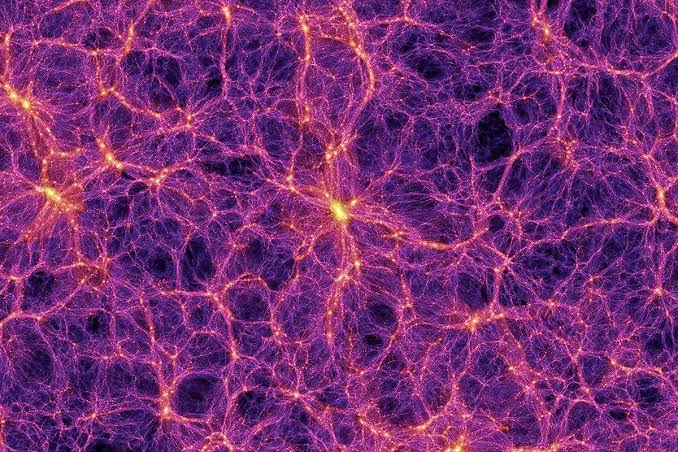
The “cosmic web” galaxy clusters from the Millenium simulation. Measuring and understanding this web can tell us a lot about the fundamental constituents of the universe. Source
To determine what dark matter is then requires an attack from two fronts: design experiments here on earth attempting directly detect it, and further study its cosmic implications to look for more clues as to its properties.
The panel recommended next generation telescopes to study the CMB as a top priority. The so called ‘Stage 4’ CMB experiment would deploy telescopes in both the south pole and Chile’s Atacama desert to better characterize sources of atmospheric noise. The CMB has been studied extensively before, but the increased precision of CMS-S4 could shed light on mysteries like dark energy, dark matter, inflation, and the recent Hubble Tension. Given the past fruitfulness of these efforts, I think few doubted the science case for such a next generation experiment.
A mockup of one of the CMS-S4 telescopes which will be based in the Chilean desert. Note the person for scale on the right (source)
The P5 report recommended a suite of new dark matter experiments in the next decade, including the ‘ultimate’ liquid Xenon based dark matter search. Such an experiment would follow in the footsteps of massive noble gas experiments like LZ and XENONnT which have been hunting for a favored type of dark matter called WIMP’s for the last few decades. These experiments essentially build giant vats of liquid Xenon, carefully shield from any sources of external radiation, and look for signs of dark matter particles bumping into any of the Xenon atoms. The larger the vat of Xenon, the higher chance a dark matter particle will bump into something. Current generation experiments have ~7 tons of Xenon, and the next generation experiment would be even larger. The next generation aims to reach the so called ‘neutrino floor’, the point as which the experiments would be sensitive enough to observe astrophysical neutrinos bumping into the Xenon. Such neutrino interactions would look extremely similar to those of dark matter, and thus represent an unavoidable background which would signal the ultimate sensitivity of this type of experiment. WIMP’s could still be hiding in a basement below this neutrino floor, but finding them would be exceedingly difficult.
A photo of the current XENONnT experiment. This pristine cavity is then filled with liquid Xenon and closely monitored for signs of dark matter particles bumping into one of the Xenon atoms. Credit: XENON Collaboration
WIMP’s are not the only dark matter candidates in town, and recent years have also seen an explosion of interest in the broad range of dark matter possibilities, with axions being a prominent example. Other kinds of dark matter could have very different properties than WIMPs and have had much fewer dedicated experiments to search for them. There is ‘low hanging fruit’ to pluck in the way of relatively cheap experiments which can achieve world-leading sensitivity. Previously, these ‘table top’ sized experiments had a notoriously difficult time obtaining funding, as they were often crowded out of the budgets by the massive flagship projects. However, small experiments can be crucial to ensuring our best chance of dark matter discovery, as they fill in the blinds pots missed by the big projects.
The panel therefore recommended creating a new pool of funding set aside for these smaller scale projects. Allowing these smaller scale projects to flourish is important for the vibrancy and scientific diversity of the field, as the centralization of ‘big science’ projects can sometimes lead to unhealthy side effects. This specific recommendation also mirrors a broader trend of the report: to attempt to rebalance the budget portfolio to be spread more evenly and less dominated by the large projects.
A pie chart comparing the budget porfolio in 2023 (left) versus the projected budget in 2033 (right). Currently most of the budget is being taken up by the accelerator upgrades and cavern construction of DUNE, with some amount for the LHC upgrades. But by 2033 the panel recommends a much more equitable balance between different research area.
What Didn’t Make It
Any report like this comes with some tough choices. Budget realities mean not all projects can be funded. Besides the pairing down of some of DUNE’s upgrades, one of the biggest areas that was recommended against were ‘accessory experiments at the LHC’. In particular, MATHUSULA and the Forward Physics Facility were two experiments that proposed to build additional detectors near already existing LHC collision points to look for particles that may be missed by the current experiments. By building new detectors hundreds of meters away from the collision point, shielded by concrete and the earth, they can obtained unique sensitivity to ‘long lived’ particles capable of traversing such distances. These experiments would follow in the footsteps of the current FASER experiment, which is already producing impressive results.
While FASER found success as a relatively ‘cheap’ experiment, reusing detector components from and situating itself in a beam tunnel, these new proposals were asking for quite a bit more. The scale of these detectors would have required new caverns to be built, significantly increasing the cost. Given the cost and specialized purpose of these detectors, the panel recommended against their construction. These collaborations may now try to find ways to pare down their proposal so they can apply to the new small project portfolio.
Another major decision by the panel was to recommend against hosting a new Higgs factor collider in the US. But that will discussed more in a future post.
Conclusions
The P5 panel was faced with a difficult task, the total cost of all projects they were presented with was three times the budget. But they were able to craft a plan that continues the work of the previous decade, addresses current shortcomings and lays out an inspiring vision for the future. So far the community seems to be strongly rallying behind it. At time of writing, over 2700 community members from undergraduates to senior researchers have signed a petition endorsing the panels recommendations. This strong show of support will be key for turning these recommendations into actual funding, and hopefully lobbying congress to even increase funding so that more of this vision can be realized.
For those interested the full report as well as executive summaries of different areas can be found on the P5 website. Members of the US particle physics community are also encouraged to sign the petition endorsing the recommendations here.
And stayed tuned for part 2 of our coverage which will discuss the implications of the report on future colliders!
When students first learn quantum field theory, the mathematical language the underpins the behavior of elementary particles, they start with the simplest possible interaction you can write down : a particle with no spin and no charge scattering off another copy of itself. One then eventually moves on to the more complicated interactions that describe the behavior of fundamental particles of the Standard Model. They may quickly forget this simplified interaction as a unrealistic toy example, greatly simplified compared to the complexity the real world. Though most interactions that underpin particle physics are indeed quite a bit more complicated, nature does hold a special place for simplicity. This barebones interaction is predicted to occur in exactly one scenario : a Higgs boson scattering off itself. And one of the next big targets for particle physics is to try and observe it.
A Feynman diagram of the simplest possible interaction in quantum field theory, a spin-zero particle interacting with itself.
The Higgs is the only particle without spin in the Standard Model, and the only one that doesn’t carry any type of charge. So even though particles such as gluons can interact with other gluons, its never two of the same kind of gluons (the two interacting gluons will always carry different color charges). The Higgs is the only one that can have this ‘simplest’ form of self-interaction. Prominent theorist Nima Arkani-Hamed has said that the thought of observing this “simplest possible interaction in nature gives [him] goosebumps“.
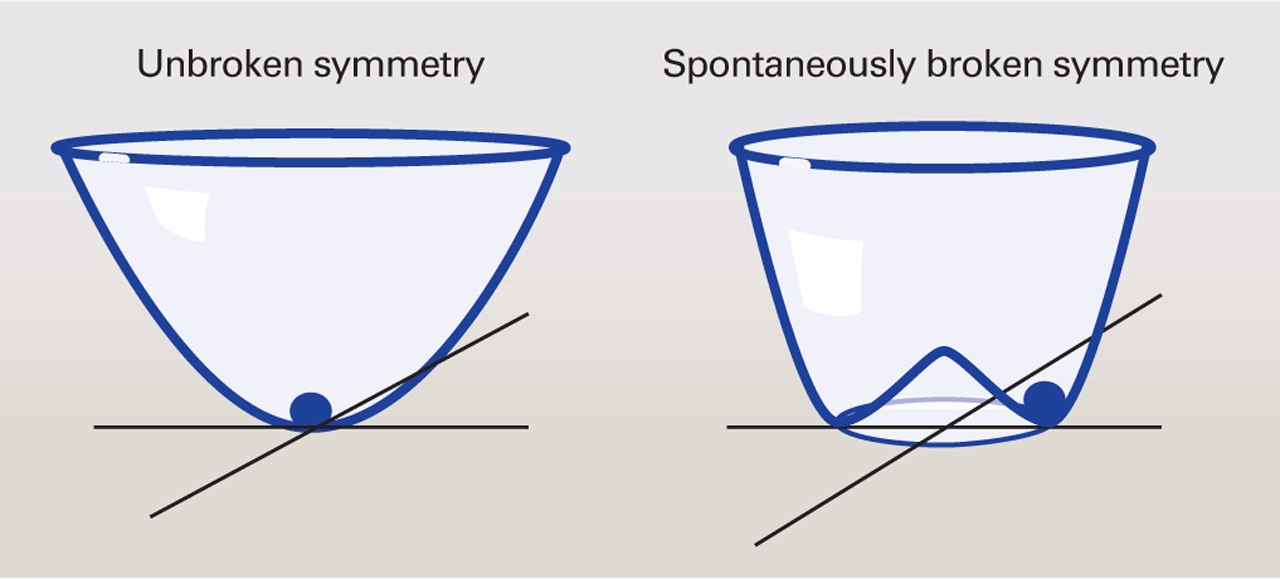
But more than being interesting for its simplicity, this self-interaction of the Higgs underlies a crucial piece of the Standard Model: the story of how particles got their mass. The Standard Model tells us that the reason all fundamental particles have mass is their interaction with the Higgs field. Every particle’s mass is proportional to the strength of the Higgs field. The fact that particles have any mass at all is tied to the fact that the lowest energy state of the Higgs field is at a non-zero value. According to the Standard Model, early in the universe’s history when the temperature were much higher, the Higgs potential had a different shape, with its lowest energy state at field value of zero. At this point all the particles we know about were massless. As the universe cooled the shape of the Higgs potential morphed into a ‘wine bottle’ shape, and the Higgs field moved into the new minimum at non-zero value where it sits today. The symmetry of the initial state, in which the Higgs was at the center of its potential, was ‘spontaneously broken’ as its new minimum, at a location away from the center, breaks the rotation symmetry of the potential. Spontaneous symmetry breaking is a very deep theoretical idea that shows up not just in particle physics but in exotic phases of matter as well (eg superconductors).
A diagram showing the ‘unbroken’ Higgs potential in the very early universe (left) and the ‘wine bottle’ shape it has today (right). When the Higgs at the center of its potential it has a rotational symmetry, there are no preferred directions. But once it finds it new minimum that symmetry is broken. The Higgs now sits at a particular field value away from the center and a preferred direction exists in the system.
This fantastical story of how particle’s gained their masses, one of the crown jewels of the Standard Model, has not yet been confirmed experimentally. So far we have studied the Higgs’s interactions with other particles, and started to confirm the story that it couples to particles in proportion to their mass. But to confirm this story of symmetry breaking we will to need to study the shape of the Higgs’s potential, which we can probe only through its self-interactions. Many theories of physics beyond the Standard Model, particularly those that attempt explain how the universe ended up with so much matter and very little anti-matter, predict modifications to the shape of this potential, further strengthening the importance of this measurement.
Unfortunately observing the Higgs interacting with itself and thus measuring the shape of its potential will be no easy feat. The key way to observe the Higgs’s self-interaction is to look for a single Higgs boson splitting into two. Unfortunately in the Standard Model additional processes that can produce two Higgs bosons quantum mechanically interfere with the Higgs self interaction process which produces two Higgs bosons, leading to a reduced production rate. It is expected that a Higgs boson scattering off itself occurs around 1000 times less often than the already rare processes which produce a single Higgs boson. A few years ago it was projected that by the end of the LHC’s run (with 20 times more data collected than is available today), we may barely be able to observe the Higgs’s self-interaction by combining data from both the major experiments at the LHC (ATLAS and CMS).
Fortunately, thanks to sophisticated new data analysis techniques, LHC experimentalists are currently significantly outpacing the projected sensitivity. In particular, powerful new machine learning methods have allowed physicists to cut away background events mimicking the di-Higgs signal much more than was previously thought possible. Because each of the two Higgs bosons can decay in a variety of ways, the best sensitivity will be obtained by combining multiple different ‘channels’ targeting different decay modes. It is therefore going to take a village of experimentalists each working hard to improve the sensitivity in various different channels to produce the final measurement. However with the current data set, the sensitivity is still a factor of a few away from the Standard Model prediction. Any signs of this process are only expected to come after the LHC gets an upgrade to its collision rate a few years from now.
Current experimental limits on the simultaneous production of two Higgs bosons, a process sensitive to the Higgs’s self-interaction, from ATLAS (left) and CMS (right). The predicted rate from the Standard Model is shown in red in each plot while the current sensitivity is shown with the black lines. This process is searched for in a variety of different decay modes of the Higgs (various rows on each plot). The combined sensitivity across all decay modes for each experiment allows them currently to rule out the production of two Higgs bosons at 3-4 times the rate predicted by the Standard Model. With more data collected both experiments will gain sensitivity to the range predicted by the Standard Model.
While experimentalists will work as hard as they can to study this process at the LHC, to perform a precision measurement of it, and really confirm the ‘wine bottle’ shape of the potential, its likely a new collider will be needed. Studying this process in detail is one of the main motivations to build a new high energy collider, with the current leading candidates being an even bigger proton-proton collider to succeed the LHC or a new type of high energy muon collider.
A depiction of our current uncertainty on the shape of the Higgs potential (center), our expected uncertainty at the end of the LHC (top right) and the projected uncertainty a new muon collider could achieve (bottom right). The Standard Model expectation is the tan line and the brown band shows the experimental uncertainty. Adapted from Nathaniel Craig’s talkhere
The quest to study nature’s simplest interaction will likely span several decades. But this long journey gives particle physicists a roadmap for the future, and a treasure worth traveling great lengths for.
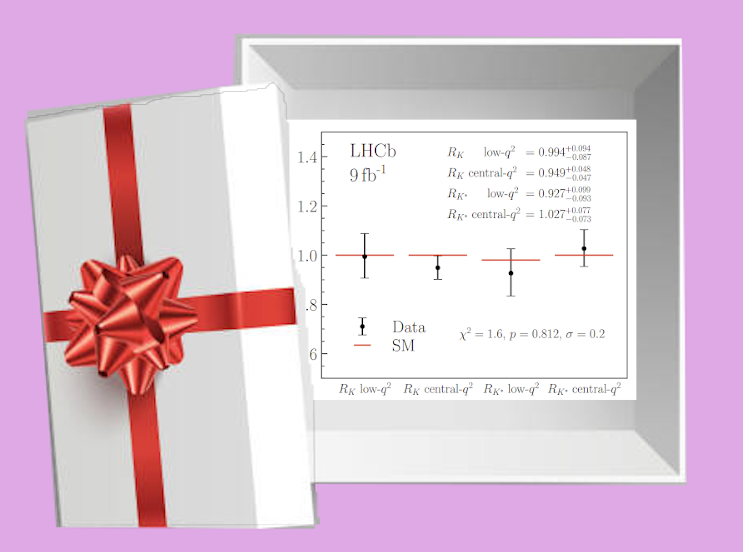
Just before the 2022 holiday season LHCb announced it was giving the particle physics community a highly anticipated holiday present : an updated measurement of the lepton flavor universality ratio R(K). Unfortunately when the wrapping paper was removed and the measurement revealed, the entire particle physics community let out a collective groan. It was not shiny new-physics-toy we had all hoped for, but another pair of standard-model-socks.
A disappointing present from LHCb, their recent measurement of R(K) (black points and error bars) showed very good agreement with the standard model prediction (red line).
The particle physics community is by now very used to standard-model-socks, receiving hundreds of pairs each year from various experiments all over the world. But this time there had be reasons to hope for more. Previous measurements of R(K) from LHCb had been showing evidence of a violation one of the standard model’s predictions (lepton flavor universality), making this triumph of the standard model sting much worse than most.
R(K) is the ratio of how often a B-meson (a bound state of a b-quark) decays into final states with a kaon (a bound state of an s-quark) plus two electrons vs final states with a kaon plus two muons. In the standard model there is a (somewhat mysterious) principle called lepton flavor universality which means that muons are just heavier versions of electrons. This principle implies B-mesons decays should produce electrons and muons equally and R(K) should be one.
But previous measurements from LHCb had found R(K) to be less than one, with around 3σ of statistical evidence. Other LHCb measurements of B-mesons decays had also been showing similar hints of lepton flavor universality violation. This consistent pattern of deviations had not yet reached the significance required to claim a discovery. But it had led a good amount of physicists to become #cautiouslyexcited that there may be a new particle around, possibly interacting preferentially with muons and b-quarks, that was causing the deviation. Several hundred papers were written outlining possibilities of what particles could cause these deviations, checking whether their existence was constrained by other measurements, and suggesting additional measurements and experiments that could rule out or discover the various possibilities.
Feynman diagrams showing the decay of a b quark into a strange quark and two leptons in the Standard Model (top). Two scenarios of new particles which could alter how often such an interaction occurs are shown in the bottom row: a new gauge boson (bottom left) and a leptoquark (bottom right).
This had all led to a considerable amount of anticipation for these updated results from LHCb. They were slated to be their final word on the anomaly using their full dataset collected during LHC’s 2nd running period of 2016-2018. Unfortunately what LHCb had discovered in this latest analysis was that they had made a mistake in their previous measurements.
There were additional backgrounds in their electron signal region which had not been previously accounted for. These backgrounds came from decays of B-mesons into pions or kaons which can be mistakenly identified as electrons. Backgrounds from mis-identification are always difficult to model with simulation, and because they are also coming from decays of B-mesons they produce similar peaks in their data as the sought after signal. Both these factors combined to make it hard to spot they were missing. Without accounting for these backgrounds it made it seem like there was more electron signal being produced than expected, leading to R(K) being below one. In this latest measurement LHCb found a way to estimate these backgrounds using other parts of their data. Once they were accounted for, the measurements of R(K) no longer showed any deviations, all agreed with one within uncertainties.
Plots showing two of the signal regions of for the electron channel measurements. The previously unaccounted for backgrounds are shown in lime green and the measured signal contribution is shown in red. These backgrounds have a peak overlapping with that of the signal, making it hard to spot that they were missing.
It is important to mention here that data analysis in particle physics is hard. As we attempt to test the limits of the standard model we are often stretching the limits of our experimental capabilities and mistakes do happen. It is commendable that the LHCb collaboration was able to find this issue and correct the record for the rest of the community. Still, some may be a tad frustrated that the checks which were used to find these missing backgrounds were not done earlier given the high profile nature of these measurements (their previous result claimed ‘evidence’ of new physics and was published in Nature).
Though the R(K) anomaly has faded away, the related set of anomalies that were thought to be part of a coherent picture (including another leptonic branching ratio R(D) and an angular analysis of the same B meson decay in to muons) still remain for now. Though most of these additional anomalies involve significantly larger uncertainties on the Standard Model predictions than R(K) did, and are therefore less ‘clean’ indications of new physics.
Besides these ‘flavor anomalies’ other hints of new physics remain, including measurements of the muon’s magnetic moment, the measured mass of the W boson and others. Though certainly none of these are slam dunk, as they each causes for skepticism.
So as we begin 2023, with a great deal of fresh LHC data expected to be delivered, particle physicists once again begin our seemingly Sisyphean task : to find evidence physics beyond the standard model. We know its out there, but nature is under no obligation to make it easy for us.
Paper: Test of lepton universality in b→sℓ+ℓ− decays (arXiv link)
Deep underground, on the border between Switzerland and France, the Large Hadron Collider (LHC) is starting back up again after a 4 year hiatus. Today, July 5th, the LHC had its first full energy collisions since 2018. Whenever the LHC is running is exciting enough on its own, but this new run of data taking will also feature several upgrades to the LHC itself as well as the several different experiments that make use of its collisions. The physics world will be watching to see if the data from this new run confirms any of the interesting anomalies seen in previous datasets or reveals any other unexpected discoveries.
New and Improved
During the multi-year shutdown the LHC itself has been upgraded. Noticably the energy of the colliding beams has been increased, from 13 TeV to 13.6 TeV. Besides breaking its own record for the highest energy collisions every produced, this 5% increase to the LHC’s energy will give a boost to searches looking for very rare high energy phenomena. The rate of collisions the LHC produces is also expected to be roughly 50% higher previous maximum achieved in previous runs. At the end of this three year run it is expected that the experiments will have collected twice as much data as the previous two runs combined.
The experiments have also been busy upgrading their detectors to take full advantage of this new round of collisions.
The ALICE experiment had the most substantial upgrade. It features a new silicon inner tracker, an upgraded time projection chamber, a new forward muon detector, a new triggering system and an improved data processing system. These upgrades will help in its study of exotic phase of matter called the quark gluon plasma, a hot dense soup of nuclear material present in the early universe.
A diagram showing the various upgrades to the ALICE detector (source)
ATLAS and CMS, the two ‘general purpose’ experiments at the LHC, had a few upgrades as well. ATLAS replaced their ‘small wheel’ detector used to measure the momentum of muons. CMS replaced the inner most part its inner tracker, and installed a new GEM detector to measure muons close to the beamline. Both experiments also upgraded their software and data collection systems (triggers) in order to be more sensitive to the signatures of potential exotic particles that may have been missed in previous runs.
The new ATLAS ‘small wheel’ being lowered into place. (source)
The LHCb experiment, which specializes in studying the properties of the bottom quark, also had major upgrades during the shutdown. LHCb installed a new Vertex Locator closer to the beam line and upgraded their tracking and particle identification system. It also fully revamped its trigger system to run entirely on GPU’s. These upgrades should allow them to collect 5 times the amount of data over the next two runs as they did over the first two.
One of the main goals in particle physics now is direct experimental evidence of a phenomena unexplained by the Standard Model. While very successful in many respects, the Standard Model leaves several mysteries unexplained such as the nature of dark matter, the imbalance of matter over anti-matter, and the origin of neutrino’s mass. All of these are questions many hope that the LHC can help answer.
Much of the excitement for Run-3 of the LHC will be on whether the additional data can confirm some of the deviations from the Standard Model which have been seen in previous runs.
One very hot topic in particle physics right now are a series of ‘flavor anomalies‘ seen by the LHCb experiment in previous LHC runs. These anomalies are deviations from the Standard Model predictions of how often certain rare decays of the b quarks should occur. With their dataset so far, LHCb has not yet had enough data to pass the high statistical threshold required in particle physics to claim a discovery. But if these anomalies are real, Run-3 should provide enough data to claim a discovery.
A summary of the various measurements making up the ‘flavor anomalies’. The blue lines and error bars indicate the measurements and their uncertainties. The yellow line and error bars indicates the standard model predictions and their uncertainties. Source
There are also a decent number ‘excesses’, potential signals of new particles being produced in LHC collisions, that have been seen by the ATLAS and CMS collaborations. The statistical significance of these excesses are all still quite low, and many such excesses have gone away with more data. But if one or more of these excesses was confirmed in the Run-3 dataset it would be a massive discovery.
While all of these anomalies are gamble, this new dataset will also certainly be used to measure various known entities with better precision, improving our understanding of nature no matter what. Our understanding of the Higgs boson, the top quark, rare decays of the bottom quark, rare standard model processes, the dynamics of the quark gluon plasma and many other areas will no doubt improve from this additional data.
In addition to these ‘known’ anomalies and measurements, whenever an experiment starts up again there is also the possibility of something entirely unexpected showing up. Perhaps one of the upgrades performed will allow the detection of something entirely new, unseen in previous runs. Perhaps FASER will see signals of long-lived particles missed by the other experiments. Or perhaps the data from the main experiments will be analyzed in a new way, revealing evidence of a new particle which had been missed up until now.
No matter what happens, the world of particle physics is a more exciting place when the LHC is running. So lets all cheers to that!
Apple’s MacBook Neo appears to be a triumph of strategic disruption that has already cast shock waves across the industry — and that energy is still playing out.
Approximately 55,000 MacBook Neo computers have been sold every day since it was introduced in March, according to IDC data (as first noted by TechCrunch). In fact, it looks as if Apple sold 1.1 million of these Macs in the first 20 days of sale, the analysts said.
There’s no real reason to imagine that level of demand has declined very much.
IDC’s March data may not capture the larger extent of the demand, as IDC analyst Navkendar Singh pointed out that MacBook Neo shipments “began to spike from early April”, which suggests demand has accelerated since then.
MacBook Neo demand exceeded expectations across multiple nations, including in India, where the company shifted 18,000 of them in the opening weeks.
Doing the business
Apple has also instructed processor maker TSMC to manufacture additional A18 processors specifically for its affordable laptop, while earlier speculation has claimed the company has been using ongoing memory price increases as a strategic competitive tool. (The Neo starts at $599, with a pricier model set at $699.)
By expanding the potential customer base for Macs with a lower cost Neo, Apple is aiming a claim at the biggest-selling part of the PC market. And it is doing so even as rapidly increasing component prices force others to choose between higher product prices and profitability, or much-reduced margins in to compete at the same price. levels
That’s a losing battle; competitors for the most part can’t hope to match Apple’s bargaining position when it comes to the cost of components like memory because they don’t have the same scale. That means that even when component costs increase for everybody, Apple pays less, because it orders more.
That scale means that for many component suppliers, it’s Apple’s business that keeps the meat on the table while other customers merely contribute the gravy. So, suppliers are happy to make deals with Apple to secure that main course — to continue the analogy — but are less likely to match those deals for dessert. As such, Apple is expected to be the only laptop vendor to see growth this year.
Apple’s great game
IDC’s figures confirm Apple’s strategy is working, with strong demand for the Neo, and, indeed, all Apple’s new laptops. At the same time, the researcher predicts overall global PC shipments will decline 11.3% this year, with a painful 20% sales drop envisioned for Q4.
“We’re not seeing any relief to the memory shortage situation before the end of 2027, which means prices will continue to rise and PC manufacturers will struggle to maintain full product portfolios for the foreseeable future,” Jean Philippe Bouchard, vice president of devices and consumers at IDC said in a statement.
“The introduction of the MacBook Neo is putting real pressure on the entire PC ecosystem,” added Jitesh Ubrani, research manager for IDC’s Consumer Devices Trackers.
Competitors are already responding with new devices equipped with ARM-based processors and aggressive promotional pricing. But none truly match what Apple has with MacBook Neo, and all must reach profitable scale to compete long-term.
None have yet done so.
The strategy makes sense
“The MacBook Neo launch stands out as one of Apple’s most strategically important recent Mac releases,” Counterpoint analyst David Naranjo said.
Both these parts of the market give Apple’s competitors their lunch. “The competitive pressure from the Neo is providing a partial offset to broader price increases, keeping some low-cost notebook options alive,” Ubrani said. “But the overall trajectory for average selling prices (ASPs) is firmly upward. IDC forecasts ASP growth of 17% in 2026, and even as memory capacity expands over the next two years, pricing is unlikely to return to 2025 levels.”
Apple’s control over its processors, along with its strategic approach to component purchasing, means it should be able to maintain its existing Mac price points for a while. “Apple’s vertical integration (own silicon, own OS) gives it more levers than competitors reliant on third-party chips and Microsoft licensing,” Hexnode CEO Apu Pavithran told me recently.
So, while PC makers either exit the market or raise prices in pursuit of profits, MacBook Neo will continue racing off the shelves, particularly to large enterprise and education customers.
The endgame?
The Neo is more than a lower-cost Apple notebook. It’s a hugely disruptive product that is already driving noteworthy change across the PC industry; it’s forcing competitors to make difficult choices between cost and price — even as they grapple with the existential challenges of memory shortages, component price hikes, and raw materials costs.
That’s not bad for a product that costs your local school just $499.
Just a reminder: the original $399 iPod cost only slightly less when it was first introduced, before subsequently disrupting the music industry.
The Federal Communications Commission (FCC) opened its first spectrum auction in four years, putting 200 licences on the block for bidding by AT&T, T-Mobile US, Verizon and possibly SpaceX.
Auction 113, formally known as the AWS-3 auction, includes licences covering frequencies in the 1695–1710 MHz, 1755–1780 MHz and 2155–2180 MHz bands.
Those frequencies were originally auctioned to Dish Network, which is now part of EchoStar, in 2014 but never made it into service after a series of defaults and bid withdrawals left them sitting unused in the FCC’s inventory for over a decade.
In 2015, Dish Network affiliates Northstar Wireless and SNR Wireless surrendered a number of spectrum licences worth $3.5 billion after a dispute with the FCC over discounts.
Last week the FCC and EchoStar reached an agreement which included the latter dropping a lawsuit it filed in a US Court of Appeals over the defaults by Northstar and SNR.
Proceeds from the auction which started yesterday (2 June) will fund the FCC’s secure and trusted communications networks reimbursement program, commonly known as “rip and replace”. It seeks to remove equipment by Huawei and ZTE from US communications networks.
The licences cover territory home to more than 100 million people across 48 states, and two US territories. The auction makes over 1.4 billion MHz-POPs available.
FCC chair Brendan Carr did not hold back in marking the occasion.
“Finally! The FCC is back in the game,” he stated while calling spectrum auctions “the lifeblood of licensed wireless service”.
Carr noted getting this auction moving was the first item the FCC voted on at his first meeting as chair.
“More spectrum means more building, lower prices and stronger competition,” he added.
The auction fits into the FCC’s broader Build America Agenda, which is targeting the delivery of 800 megahertz of spectrum by 2034 under the framework set out in President Donald Trump’s Working Families Tax Cut Act, the legislation which also restored the FCC’s auction authority.
Researchers at the University of Toronto showed how hackers could use artificial intelligence to create a program that could target any known flaw in the world’s computers.
One way archaeologists learn how ancient people, including Neanderthals, did things is to attempt to do those things themselves, a process called experimental archaeology. Normally, that involves making stone tools, butchering deer, or distilling birch tar. But in a new study, it meant doing very destructive things to teeth from one of the world’s most carefully protected animals.
That's because the archeologists suspected that Neanderthals once used rhino teeth as tools. By using the teeth to make stone tools, the researchers demonstrated that Neanderthals probably did the same thing, adding to what we know about the wide range of items in their toolkits.
We need to hit some rhino teeth with rocks for science
Some Neanderthal archaeological sites in Europe and Asia seem to have many more rhinoceros teeth lying around than you’d expect. We know Neanderthals hunted a now-extinct species of rhinoceros in Europe and eastern Asia, but the people who had inhabited these sites looked like they had been collecting rhino teeth for some reason.
Chemical traces preserved in ancient rocks indicate that marine environments were deteriorating long before the catastrophe that wiped out vast numbers of species at the end of the Triassic period, around 201 million years ago.

 Login