❌

Reading view

Apple iPhone Duo review: this is the foldable Apple fans have been waiting for

Apple iPhone Duo: Two-minute review

In the early days of the iPhone, seeing one in the wild, usually in a brave early adopter's hands, was like spotting a unicorn. The excitement was palpable. Over the years, though, as every smartphone has become a glass and metal slab, making it difficult to tell one iPhone release from another, the excitement has diminished. Where I used to keep my 'regular' iPhone review units out of sight, I now casually carry them around in a case, and no one is any the wiser.

That, though, is not the case with the iPhone Duo. In my effort to spend as much time using the new folding iPhone as possible, I carried it everywhere, including to a wedding party for my friend's son. My iPhone Duo test unit was somewhat disguised by being clad in a Taupe Folio with a Kickstand case, but as I held it aloft to photograph the newlyweds, the bride's eyes grew wide.

"Is that...?!"

My eyes darted from her to the phone in my hand, and I considered stuffing it back in my pocket, but I was intrigued by her reaction. I hadn't seen this level of interest and excitement in years.

I nodded wordlessly; the newlyweds started peppering me with questions, and as I folded and unfolded it, and they glimpsed the inner display, the bride's jaw dropped. She asked if I liked it. I mumbled, "Yes, I think so," without offering much more information.

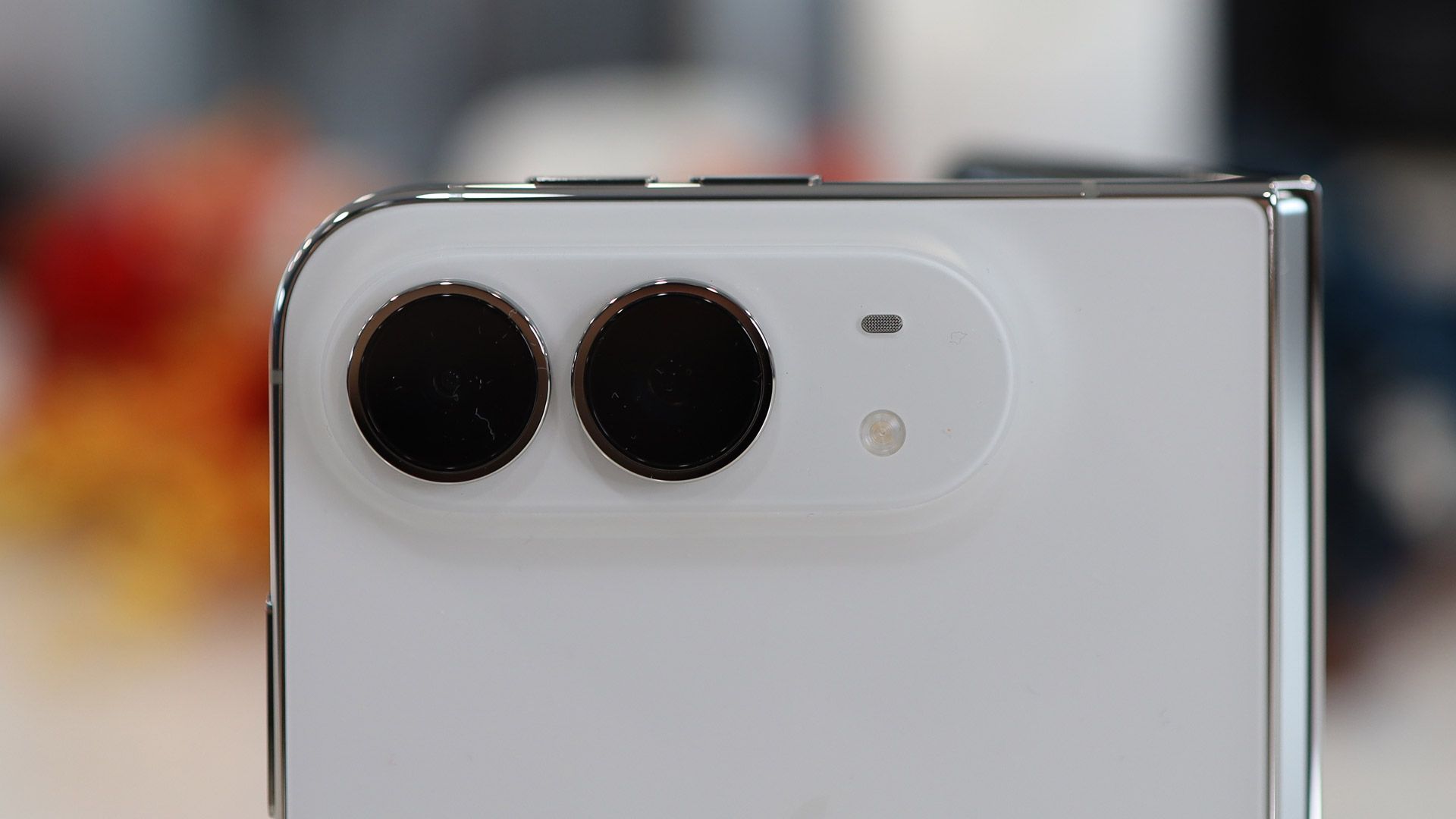
I was determined to use the iPhone Duo's two external 48MP cameras to photograph the event, which meant this scenario repeated itself more than once.

It was obvious that, unlike every other iPhone of the last decade or so, the iPhone Duo could not travel incognito; people were, it seemed, intensely interested in Apple's first truly new iPhone form factor in basically forever.

The interest is warranted.
Apple iPhone Duo REVIEW

(Image credit: Lance Ulanoff / Future)

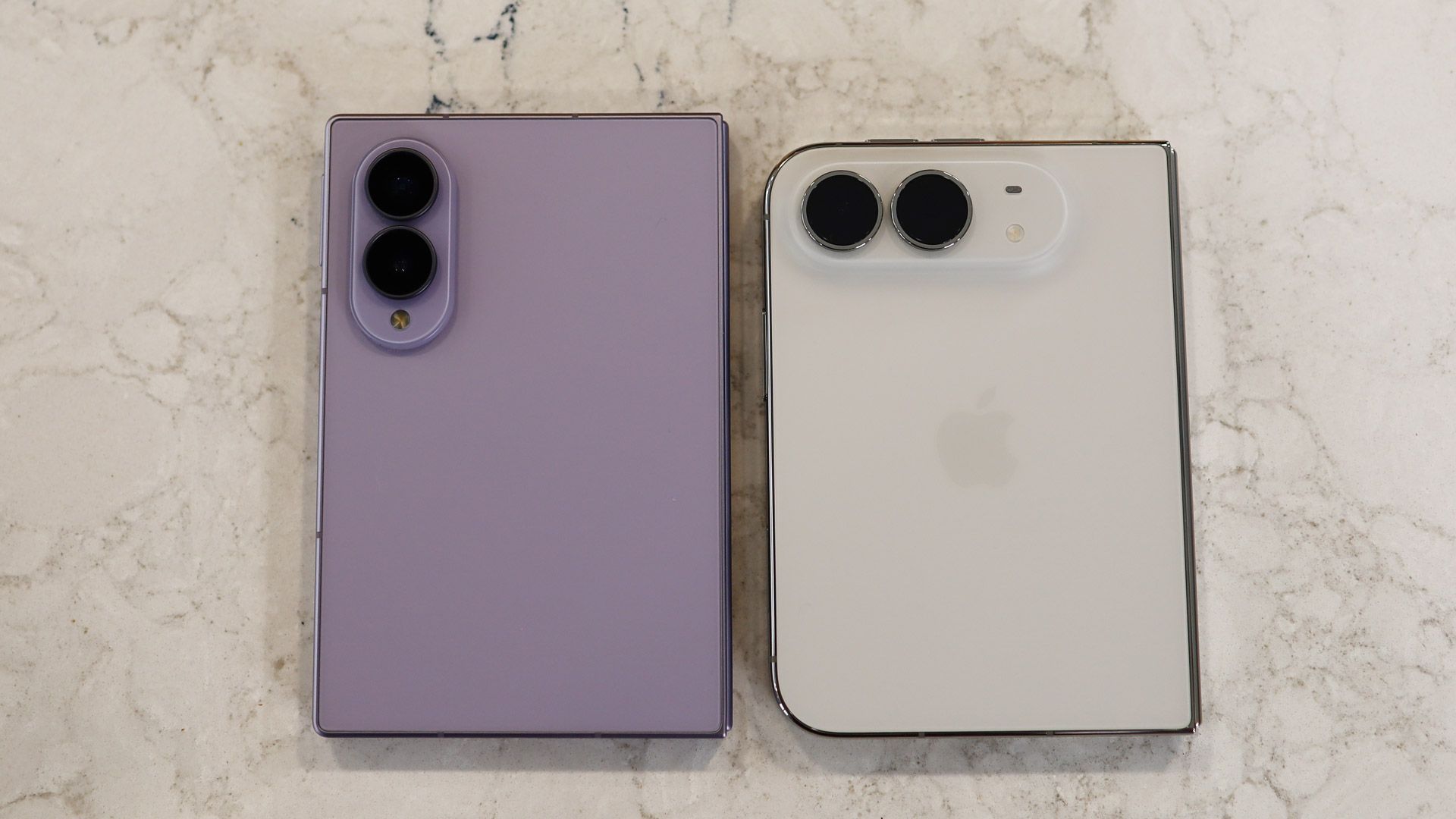
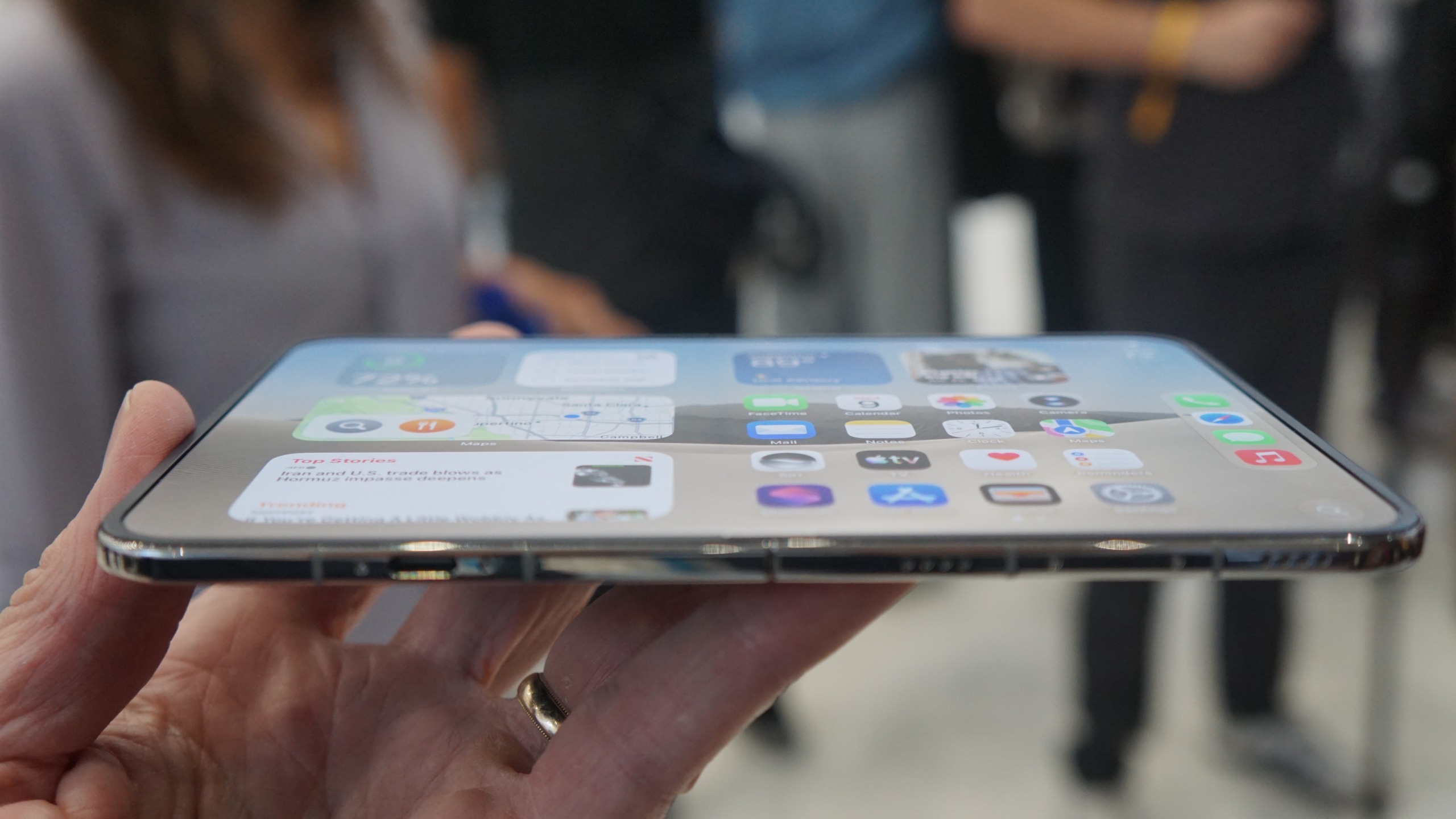
The iPhone Duo is not simply an iPhone folded in half. I'd argue it's only marginally an iPhone and more of a hybrid, splitting the difference between a sub-sized smartphone and a slightly larger, 8-inch iPad mini.

From the highly polished titanium frame to the curves and pitch-perfect tolerances, the iPhone Duo's design is Apple at its best, and while it doesn't reinvent the genre, the nano-texture finish on the main display cannily solved the chief folding phone complaint: that darn crease. It's not that the crease is completely gone, but in daily use it's virtually invisible. As an added bonus, that matte finish kills reflectivity in bright sunlight, and makes almost everything look better.

Apple includes four cameras, three of which are powerful enough to produce high-quality photos across a range of styles. I saw excellent color accuracy and low-light performance, and the ultra-wide camera feels expansive. The inner-display camera is, it appears, just 4MP, but it does a good job with casual selfies and FaceTime calls.

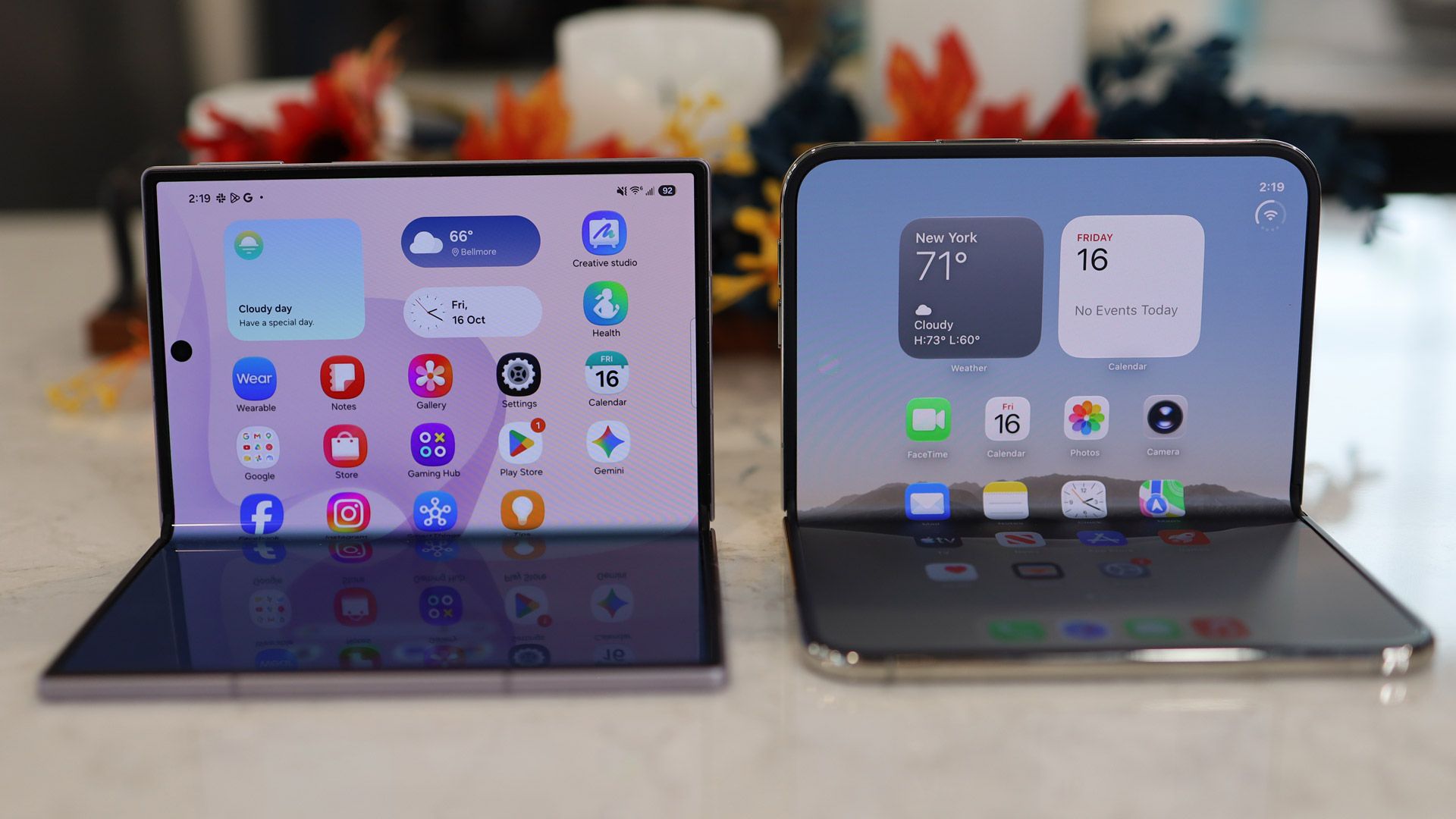
Apple has almost stuck the landing here, but there is a slight step backwards. I'm fairly certain its decision to move the status bar and dock to the right side of the 5.4-inch outer screen, and therefore shrink the width of most apps, will divide opinion. I like how this makes it easy to tap an app with your right thumb, but the remaining screen real estate makes some app experiences look and feel cramped.

Then there's the lack of Face ID on the cover screen, which means this is the first iPhone in ages that I have to use my finger to unlock.

I'm also less than thrilled that a nearly $2,000 / £1,999 phone starts with just 256GB of storage; although, to be fair to Apple, the $1,899.99 / £1,699 Galaxy Z Fold 8 also starts with the same amount.

Those small nits are like pointing out the missing eyelashes on the Mona Lisa, though. Overall, this is a fantastic entry into the folding phone space, offering the dual capabilities of a glanceable and attractive iPhone that fits in any pocket or hand, and a versatile 7.6-inch tablet.

Not everyone needs two screens in one device, or wants to pay as much as they would for a home appliance for their next smartphone; but for those who feel confined by the boundaries of a typical iPhone and want to do more in less space, the iPhone Duo, which starts out smaller than your average smartphone but unfolds to reveal an almost twice-as-large tablet display, is well worth your consideration.

Apple iPhone Duo review: Price and availability

  • From $1,999 in the US
  • From £1,999 in the UK
  • From $3,499 in Australia

Apple unveiled the iPhone Duo, its first folding phone, as its "one more thing" during the Surprise and Shine event on September 9, 2026.

The list price is $1,999 / £1,999 / AU$3,499 for the 256GB model, which is in line with most of its folding competitors from Samsung, Huawei, Motorola, and Oppo. It's available in storage configurations up to 2TB for $3,199 / £3,199 / AU$5,899.

The iPhone Duo is the most expensive iPhone Apple has ever made, but we should put this in context. Like most foldables, this is a two-in-one device: a pint-sized smartphone with a 5.4-inch 4:3 screen, and a 7.6-inch tablet. Unlike the Galaxy Z Fold 8, which has a similar passport-style shape, and even the Samsung Galaxy Z Fold 8 Ultra, which is a more conventionally sized and shaped foldable, the iPhone Duo's larger main screen supports digital pen input (this wasn't available for my testing period, but it's expected by November).

You may also be able to soften the price blow a bit with a trade-in; or you might want to look at Apple's leasing program, which will run about $57-to-$83 / £47 to £66.63 / AU$97.19 to over $161 a month for the base model.

In total, the iPhone Duo is probably better value than you think.

Apple iPhone Duo pricing

Storage

US price

UK price

AU price

256GB

$1,999.99

£1,999

AU$3,499

512GB

$2,199

£TBD

AU$TBD

1TB

$2,599

£TBD

AU$TBD

2TB

$3,199

£TBD

AU$TBD

  • Value score: 4 / 5

Apple iPhone Duo review: Specs

These are the key specs of the Apple iPhone Duo:

Dimensions:

Unfolded: 164.6 x 117.8 x 5.2mm, Folded: 84.1 x 117.8 x 11.3mm

Weight:

254g

Displays:

Main: 7.6-inch Super Retina XDR, Cover: 5.4-inch Super Retina XDR

Resolution:

Main: 1878 x 2670, Cover: 1398 x 2034

Refresh rate:

1-120Hz (main and cover)

Peak brightness:

3,000 nits

CPU:

A20 Pro

RAM:

12GB

Storage:

256GB, 512GB, 1TB, 2TB

OS:

iOS 27

Cameras:

48MP wide (f/1.6), 48MP ultra-wide (f/2.2)

Selfie cameras:

11MP Center Stage camera (f/2.2) outer, 4MP (f/1.8) inner

Battery:

4,800mAh (approximate)

Charging:

60W wired, 35W wireless

Colors:

Star White, Night sky

Apple iPhone Duo review: Design

  • Polished titanium
  • Exquisitely engineered hinge and folding operation
  • Unfolds flat
  • IP68
  • Thicker and heavier than nearest competition
  • No Face ID

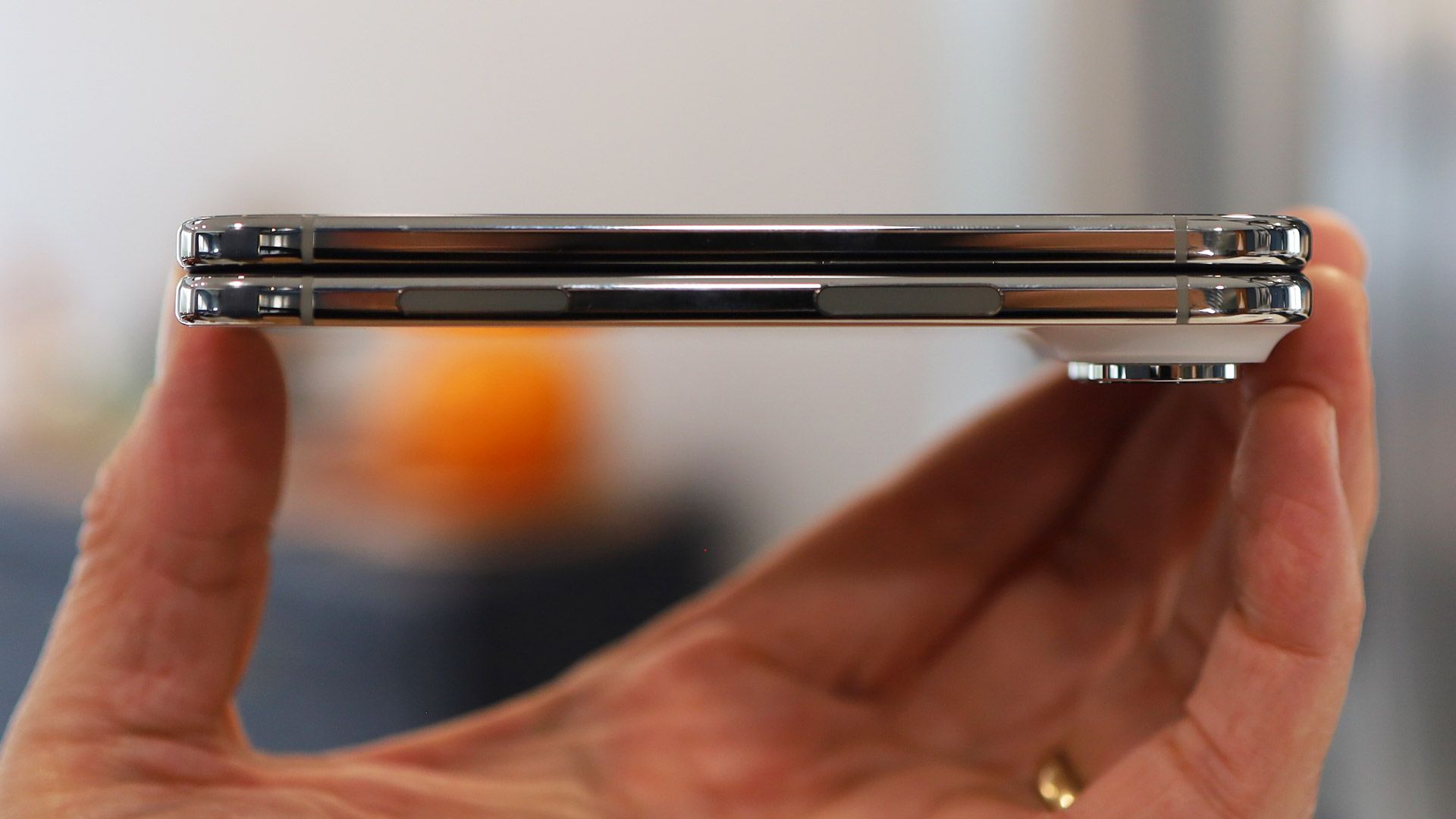
'Satisfying' is the best way to describe the feeling of repeatedly opening and closing the iPhone Duo. It's as if Apple inadvertently created a digital fidget spinner — the more I carried around the iPhone Duo, the more I found myself absentmindedly folding and unfolding the phone.

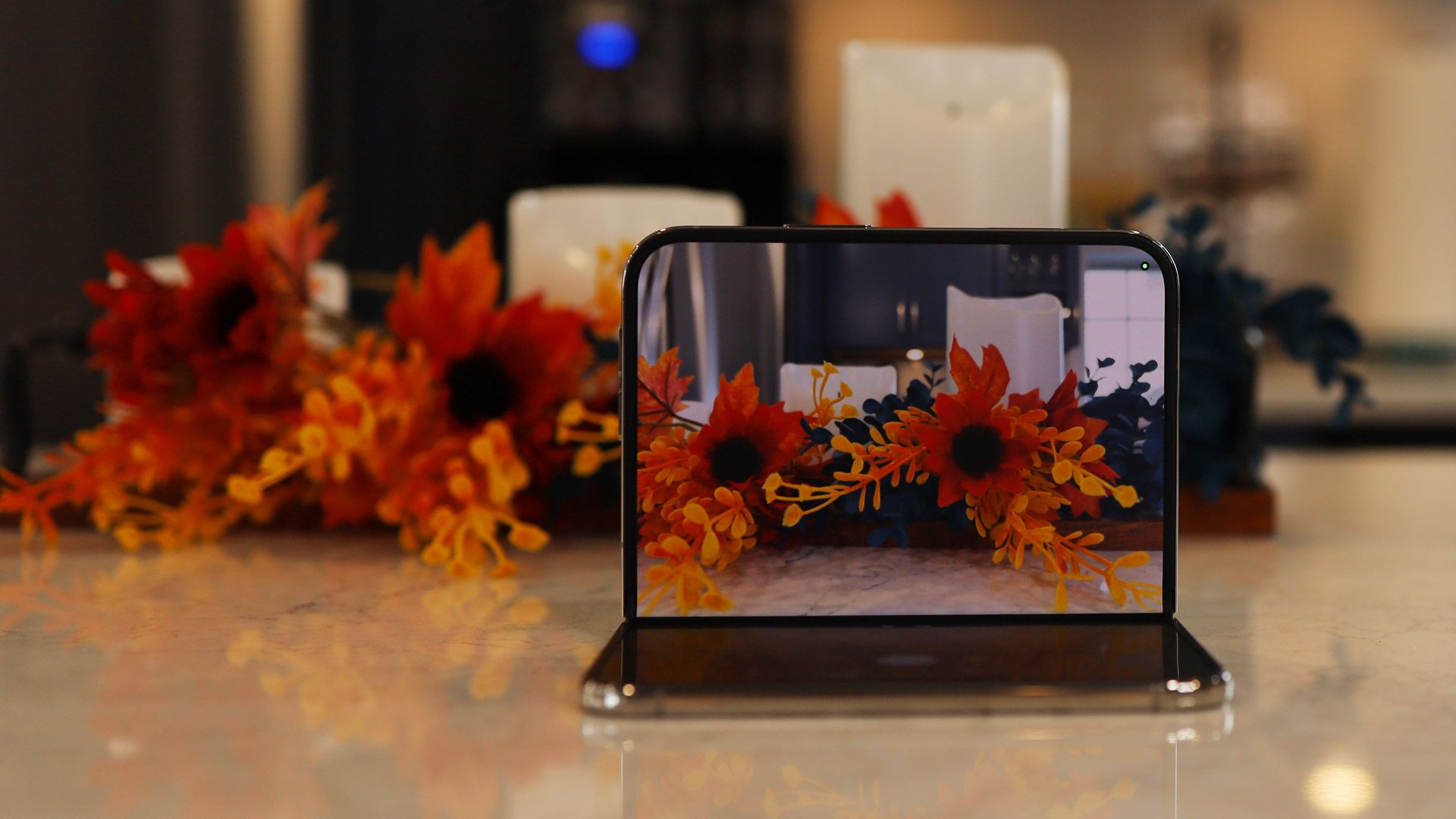
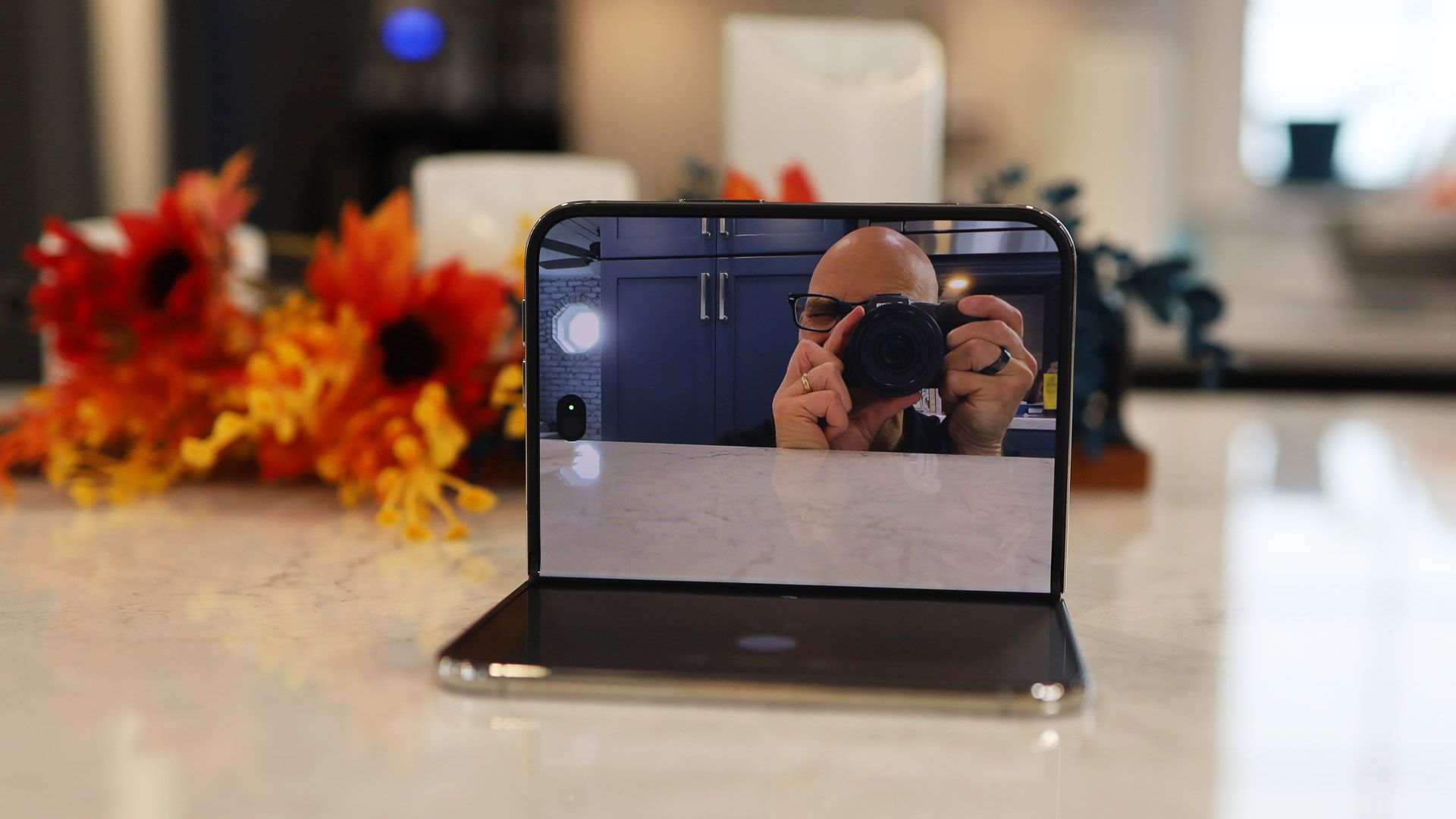
Apple's exceptional engineering makes it possible to unfold the phone initially, with almost no effort (it almost springs open at the slightest intentional touch), before the internal torque kicks in to allow for the Duo to be opened to almost any angle between zero and 180 degrees (flat).
Apple iPhone Duo REVIEW
Lance Ulanoff / Future
Apple iPhone Duo REVIEW
Lance Ulanoff / Future
Apple iPhone Duo REVIEW
Lance Ulanoff / Future
Apple iPhone Duo REVIEW
Lance Ulanoff / Future

While you can't see the work that went into making this hinge, the effort is evident in every single touch and move. Inside are hundreds of magnets and other components that keep the phone securely closed, but never get in the way of an easy opening. More so than with any folding phone I've tested, the hinge essentially disappears when the iPhone Duo is unfolded flat.

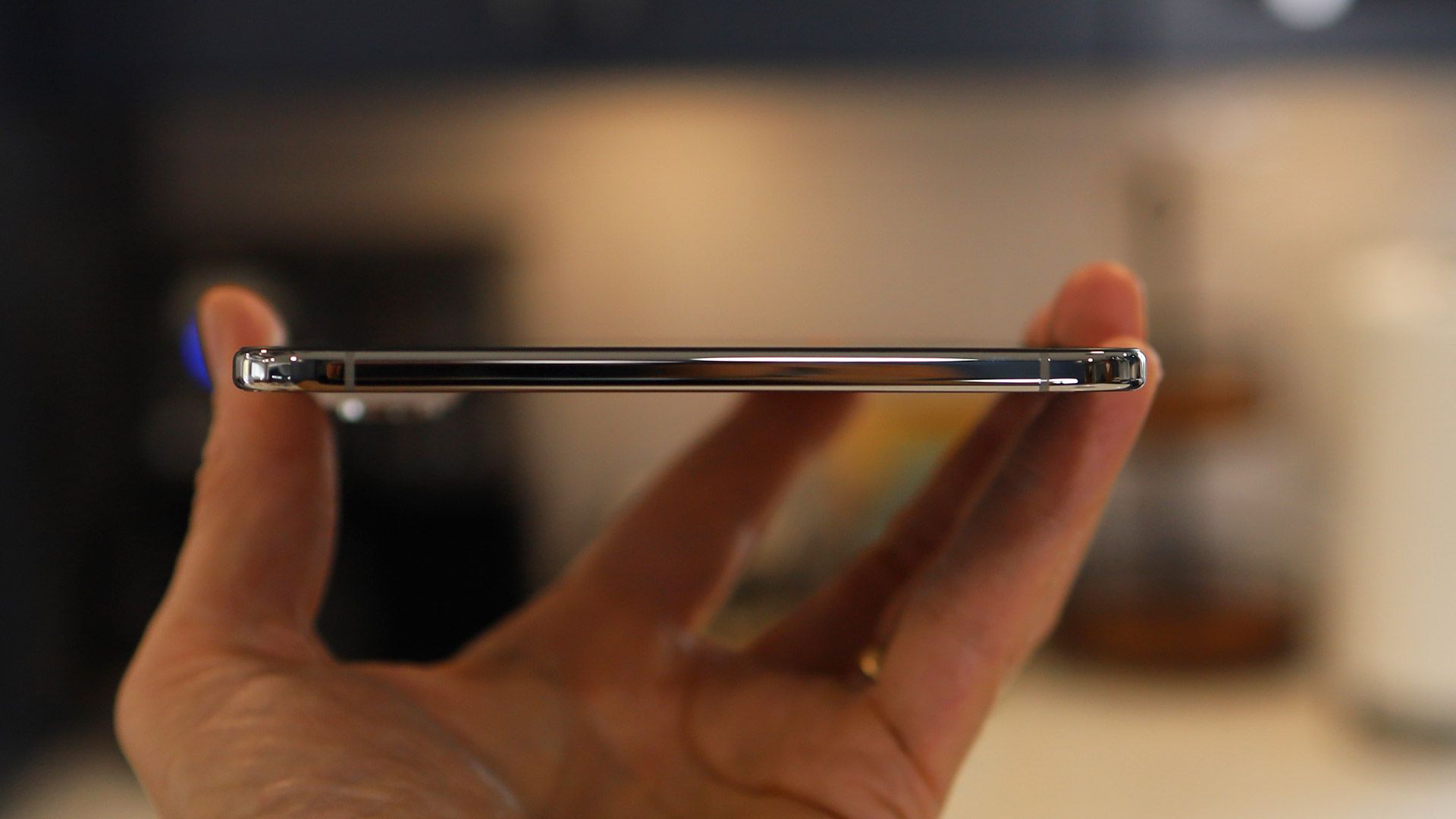
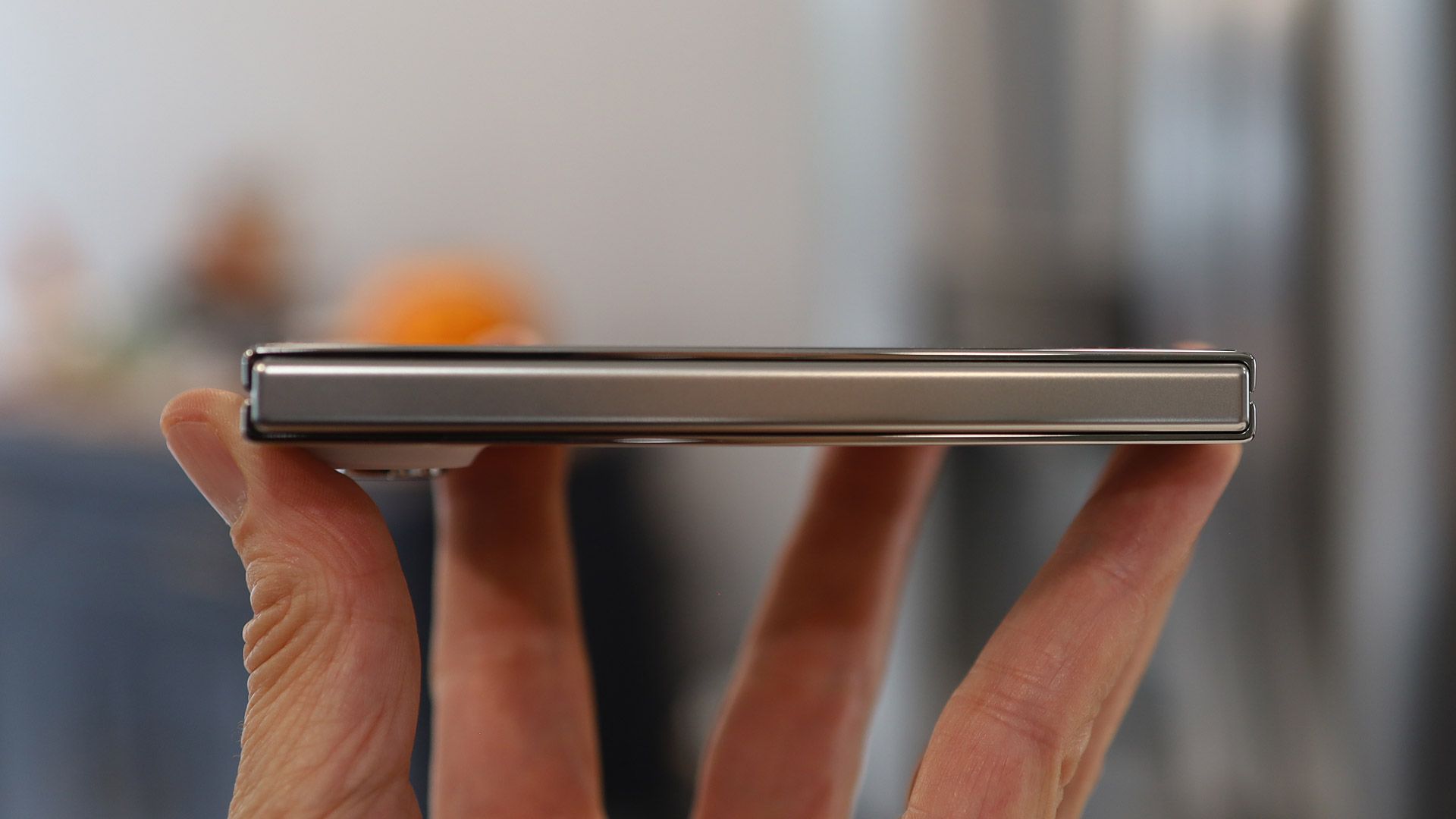
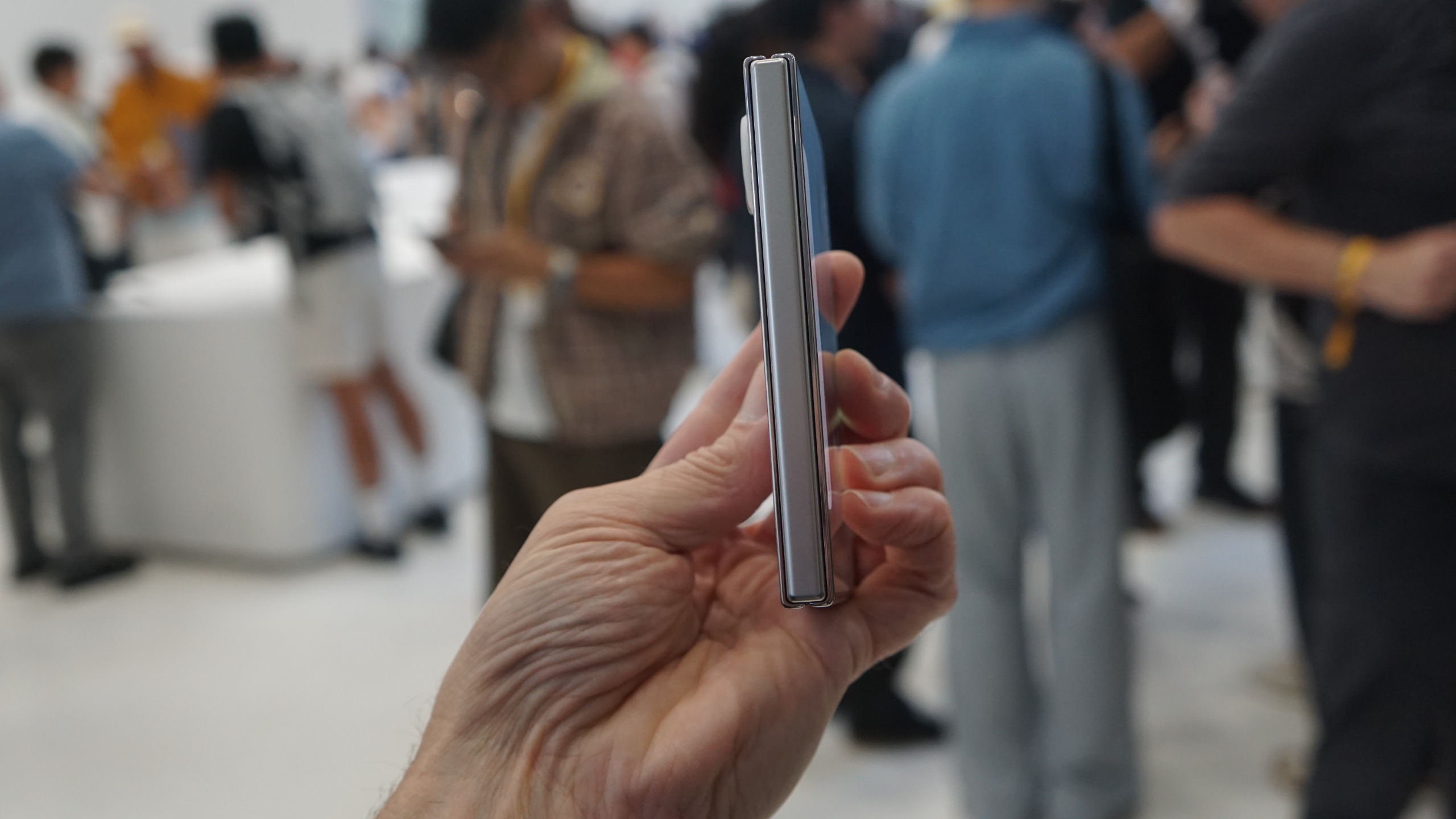
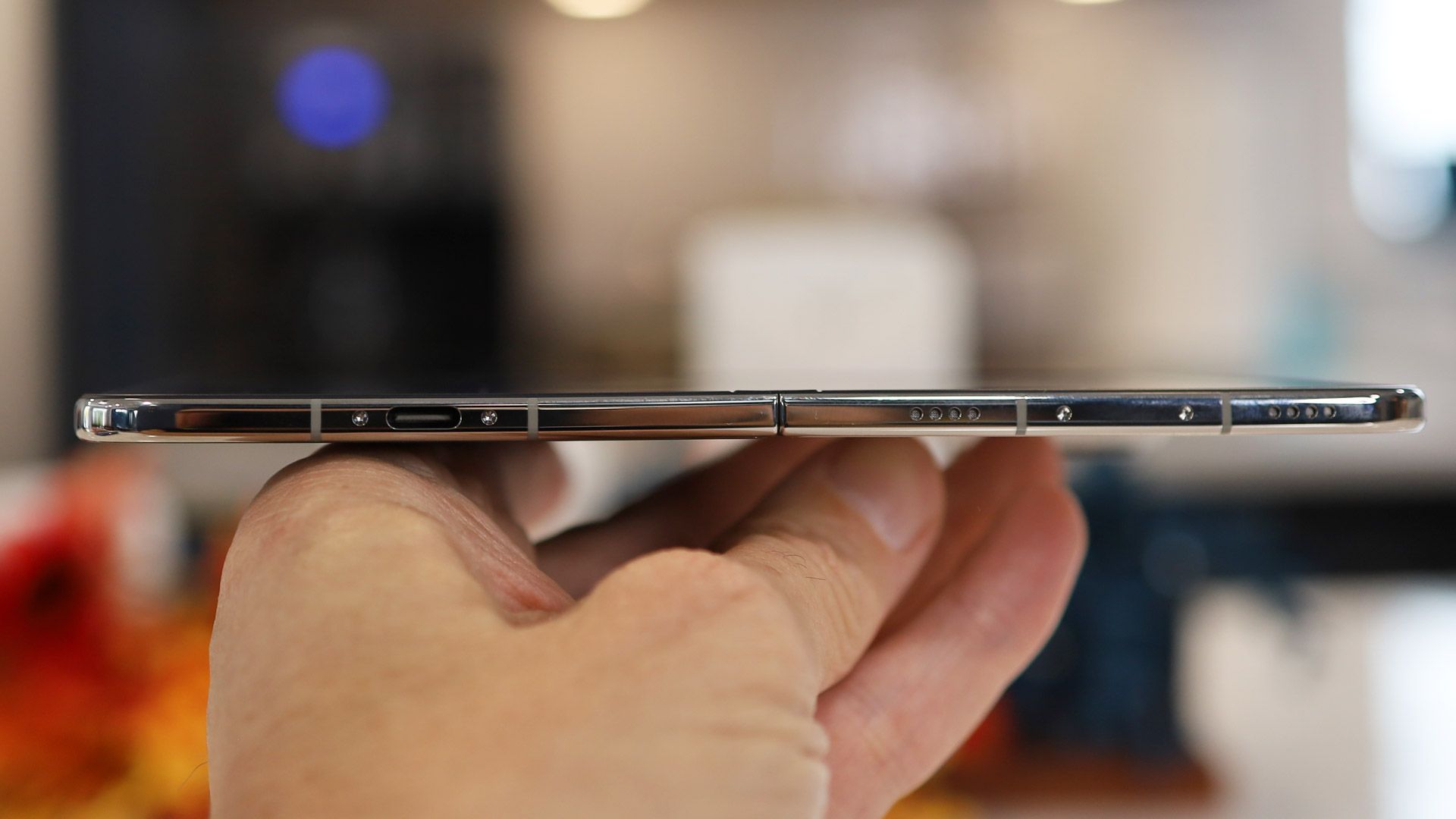
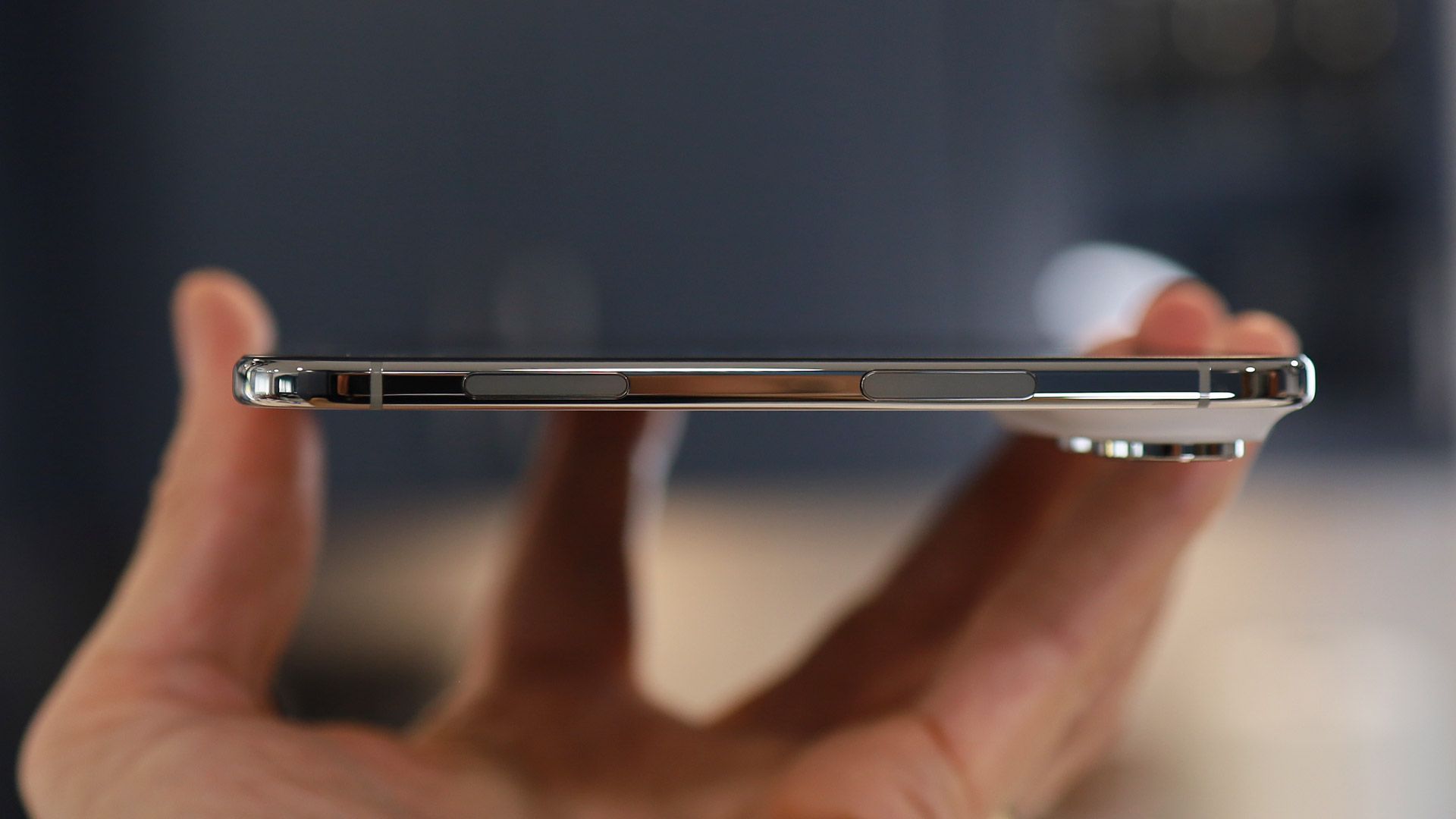
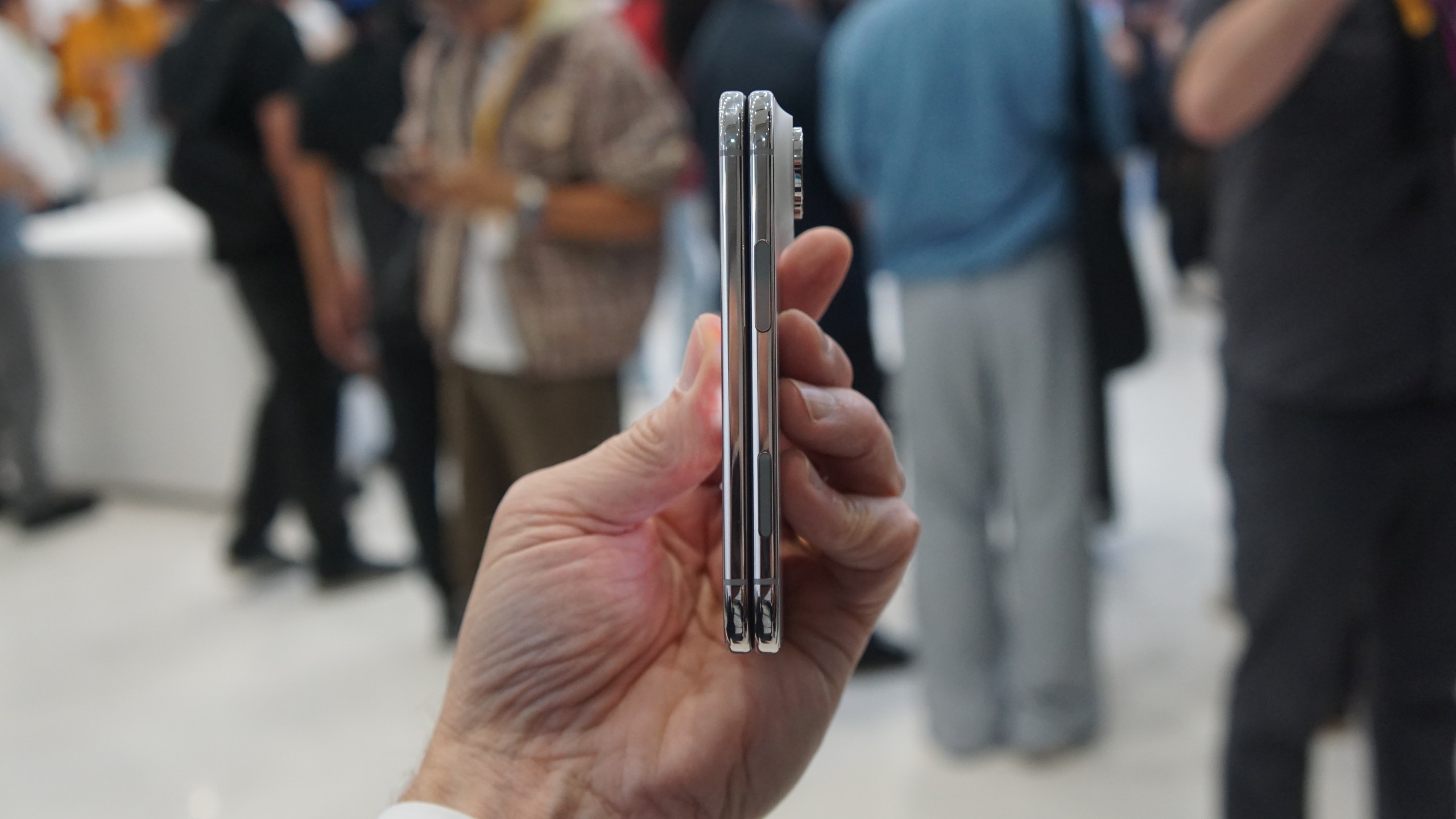
At 5.2mm thick, the fingerprint-attracting polished titanium iPhone Duo is the thinnest iPhone ever. At least that's how Apple markets it, but that's in tablet mode; I do like the sound of a 5.2mm-thick tablet. The 7.6-inch device is thinner than the 8-inch iPad mini (6.3mm). Folded, the iPhone Duo is 11.3mm thick, almost 2mm thicker than the folded Galaxy Z Fold 8. And at 254g, the iPhone Duo outweighs the Galaxy Z Fold 8 by a noticeable 53 grams. It's even slightly heavier than the iPhone 18 Pro Max, which weighs 249g.
Apple iPhone Duo REVIEW
Lance Ulanoff / Future
Apple iPhone Duo REVIEW
Lance Ulanoff / Future
Apple iPhone Duo REVIEW
Lance Ulanoff / Future
Apple iPhone Duo REVIEW
Lance Ulanoff / Future
Apple iPhone Duo REVIEW
Lance Ulanoff / Future
Apple iPhone Duo REVIEW
Lance Ulanoff / Future
Apple iPhone Duo REVIEW
Lance Ulanoff / Future

The upshot of all this is that while the 4.64-inch by 3.31-inch folded iPhone Duo fits in even the smallest pocket, you will feel its heft, especially if you pop, say, a Folio with Kickstand case on it.

The iPhone Duo stands out in a way few iPhones have in recent years. Folded, it's closer to square than rectangular in shape, resembling a squat iPhone Pro Max. Plus, the asymmetry — flat and square on one side and curved on the other when folded — means the Duo cuts a unique profile among smartphones.

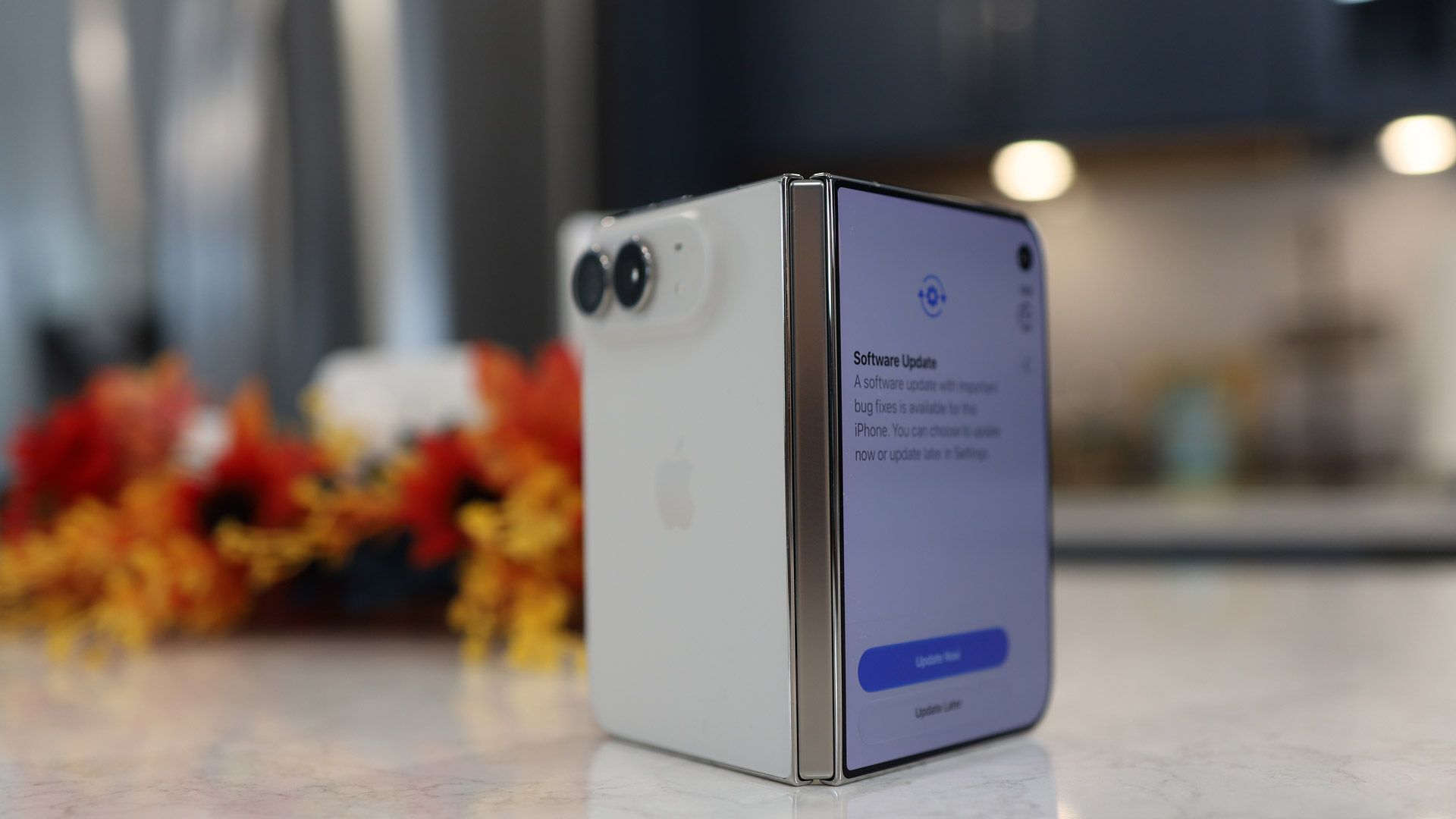
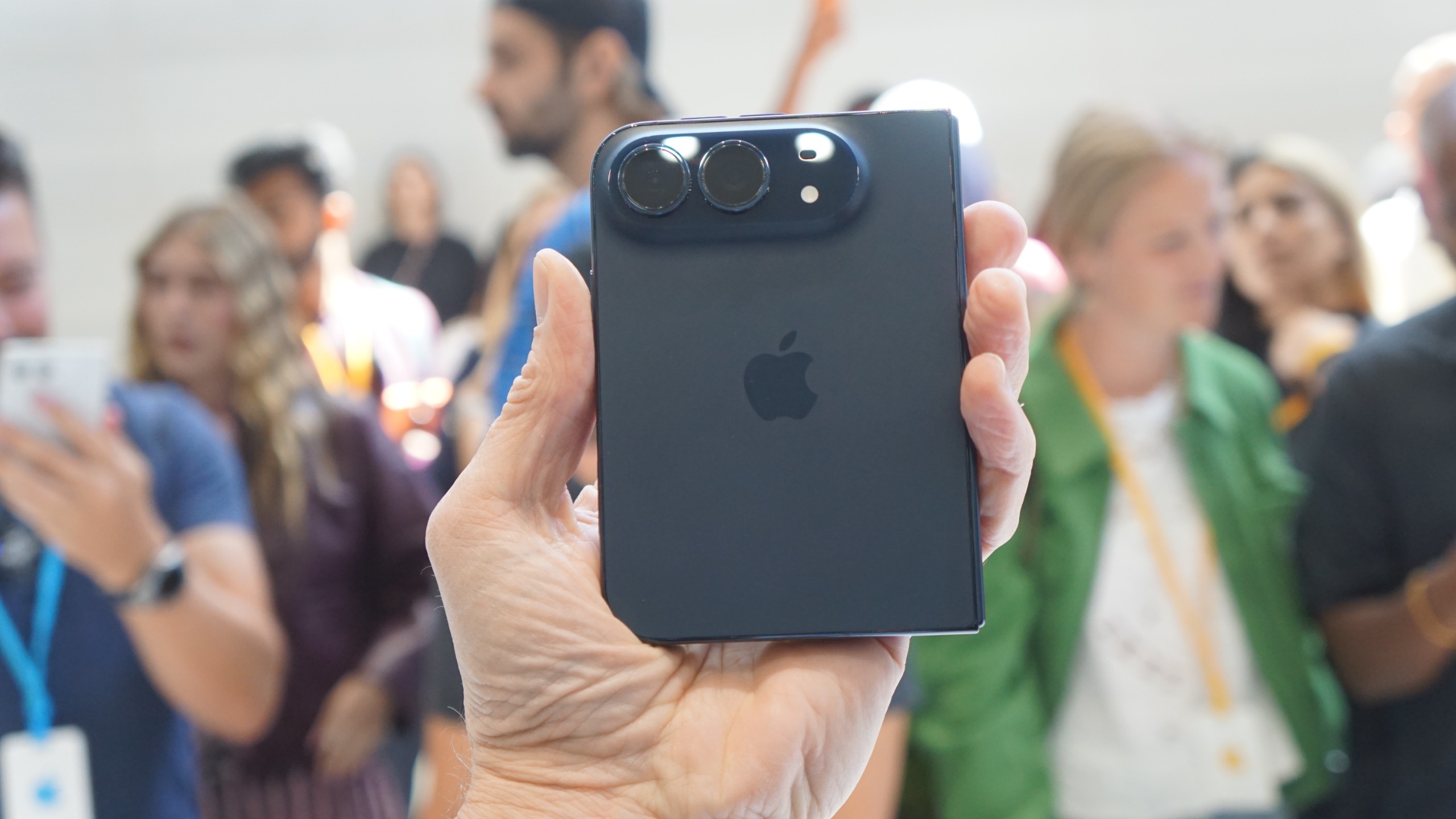
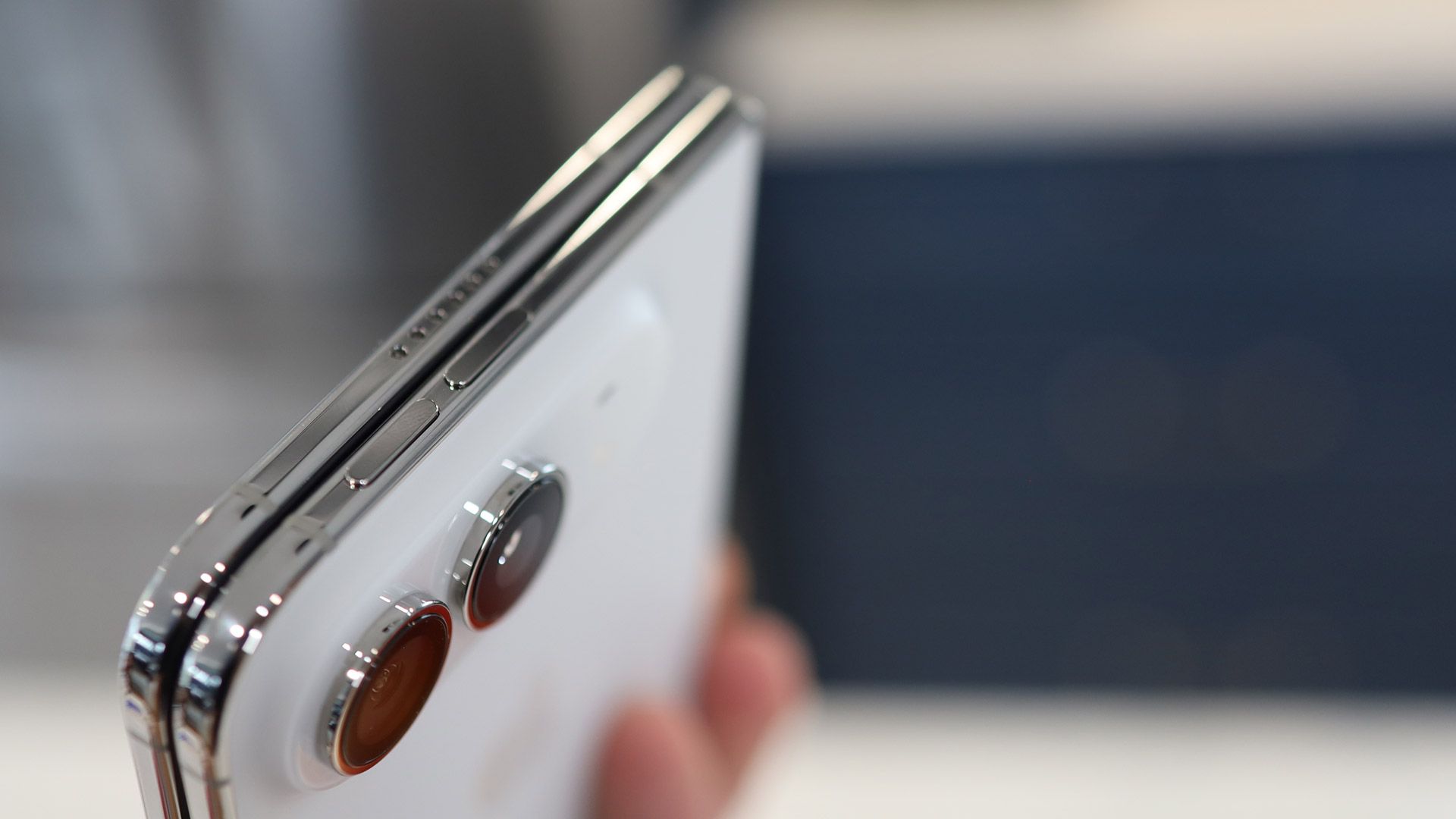
It does feel good in the hand, though the wider body might take some getting used to. I like the Ceramic Shield 2 front and back, especially the matte-finished back, which makes the Duo almost slip-from-your-hand-proof. The large dual-camera array bump is reminiscent of the iPhone Air, though the similarities end there.
Apple iPhone Duo REVIEW

(Image credit: Lance Ulanoff / Future)

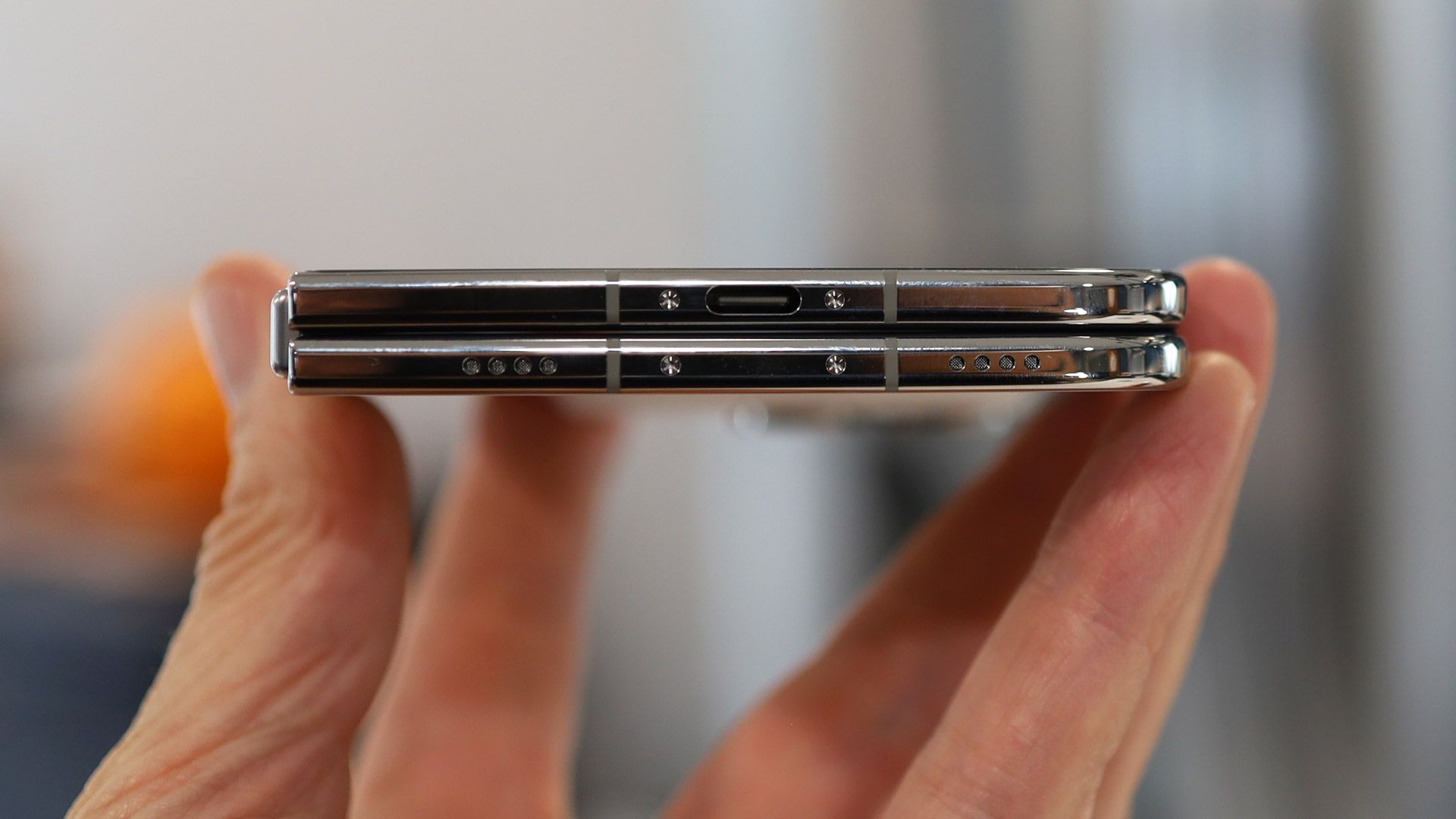
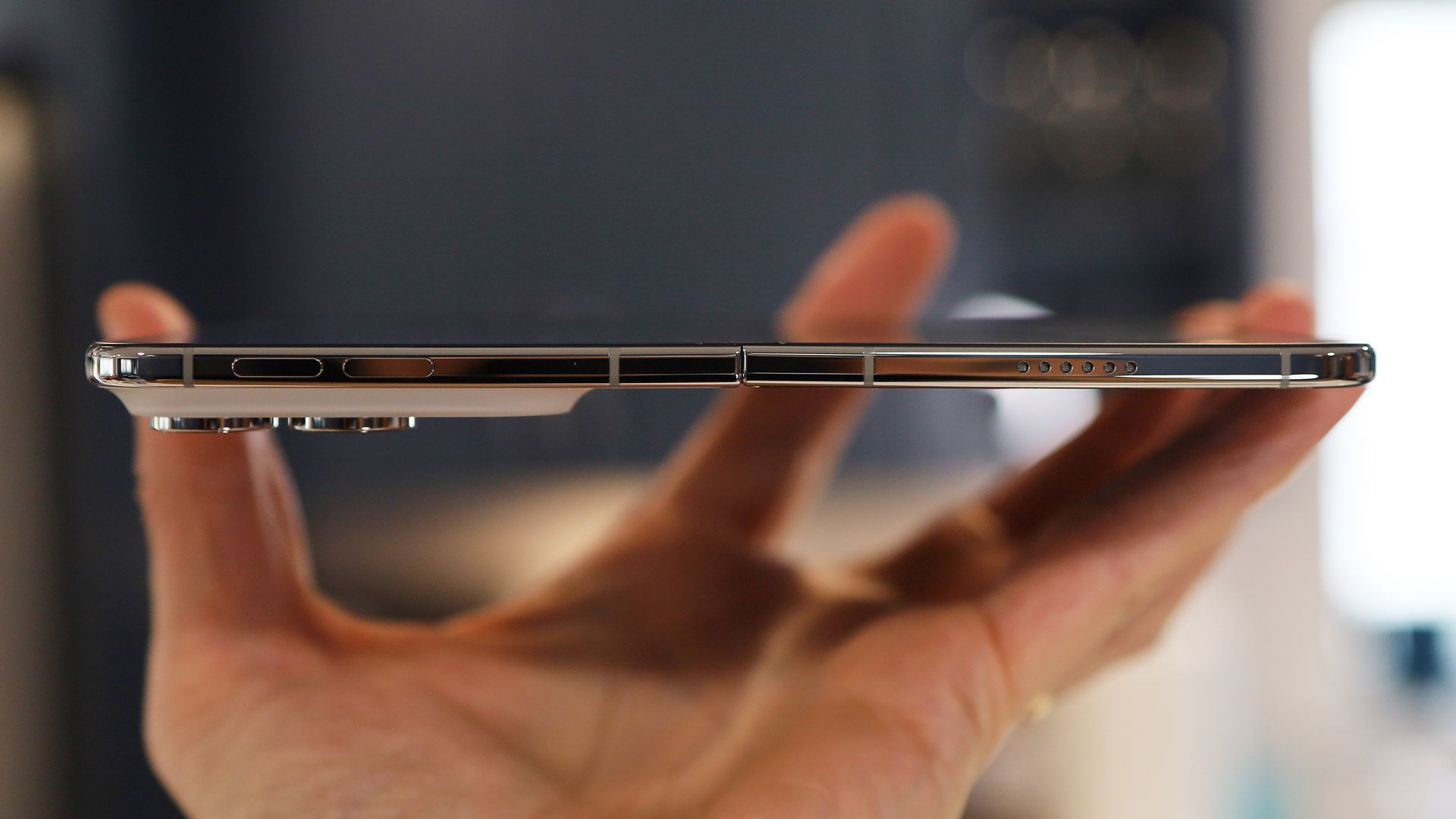
The volume buttons live on the top edge, another departure from the traditional iPhone, and indeed from smartphone design in general — I'm not sure I love that decision. On the right is the long Touch ID-enabled power/sleep/Siri AI button, and below that is the Action button. I often forget that last button exists on my iPhone 18 Pro Max, and I wonder if it was truly necessary here.

I appreciate the inclusion of Touch ID (I registered my index finger and thumb), but the lack of Face ID is frustrating — I had no idea how much I relied on it for quickly unlocking my phone until it wasn't there. Multiple times I've stared at the iPhone Duo's cover screen waiting for something to happen, forgetting that I have to intentionally touch the Touch ID button. A nearly $2,000 device lacking Apple's most powerful biometric security feature is close to unforgivable — I'll probably set up a workaround so that I can unlock the Duo via my Apple Watch.
Apple iPhone Duo REVIEW
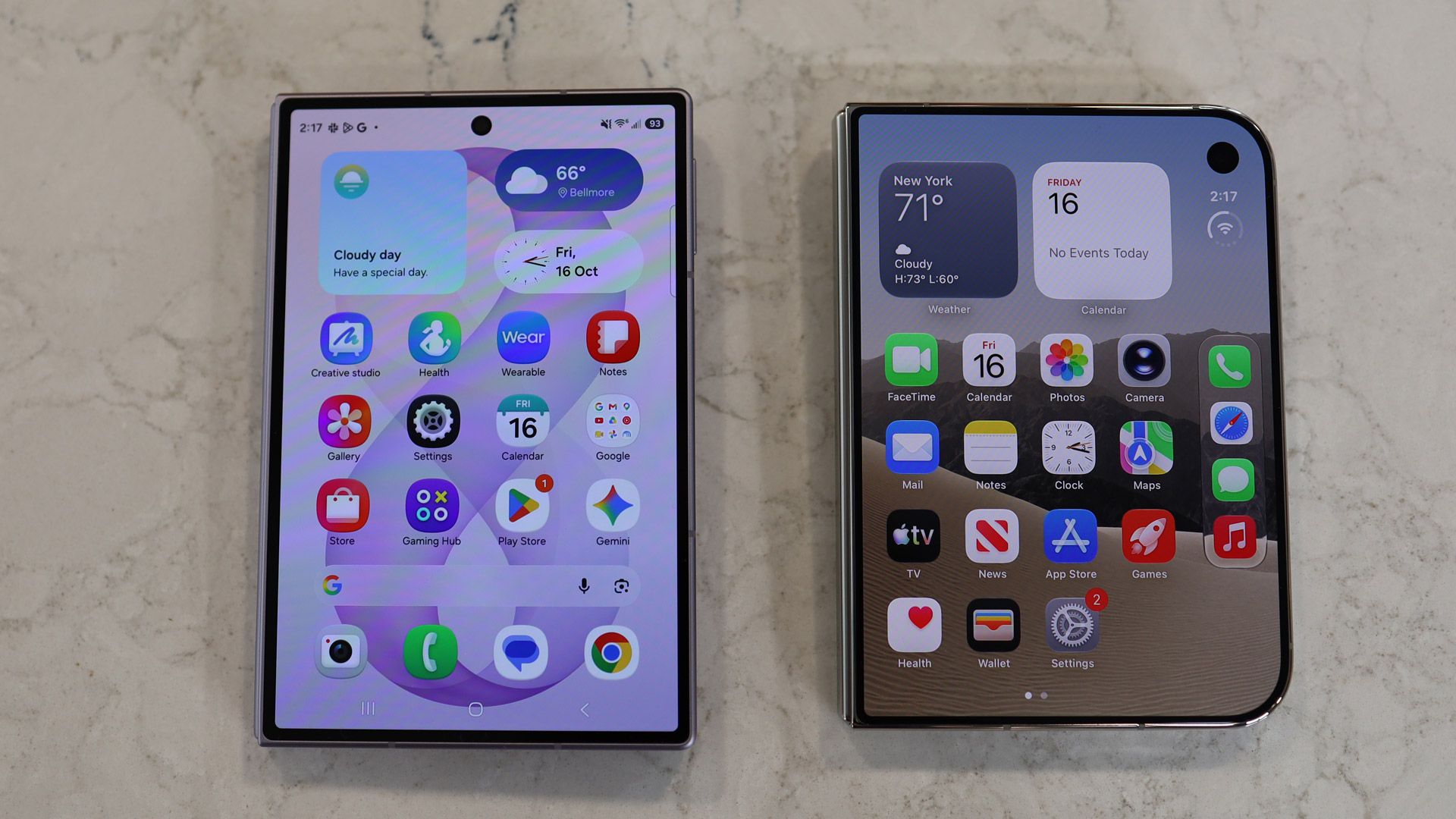
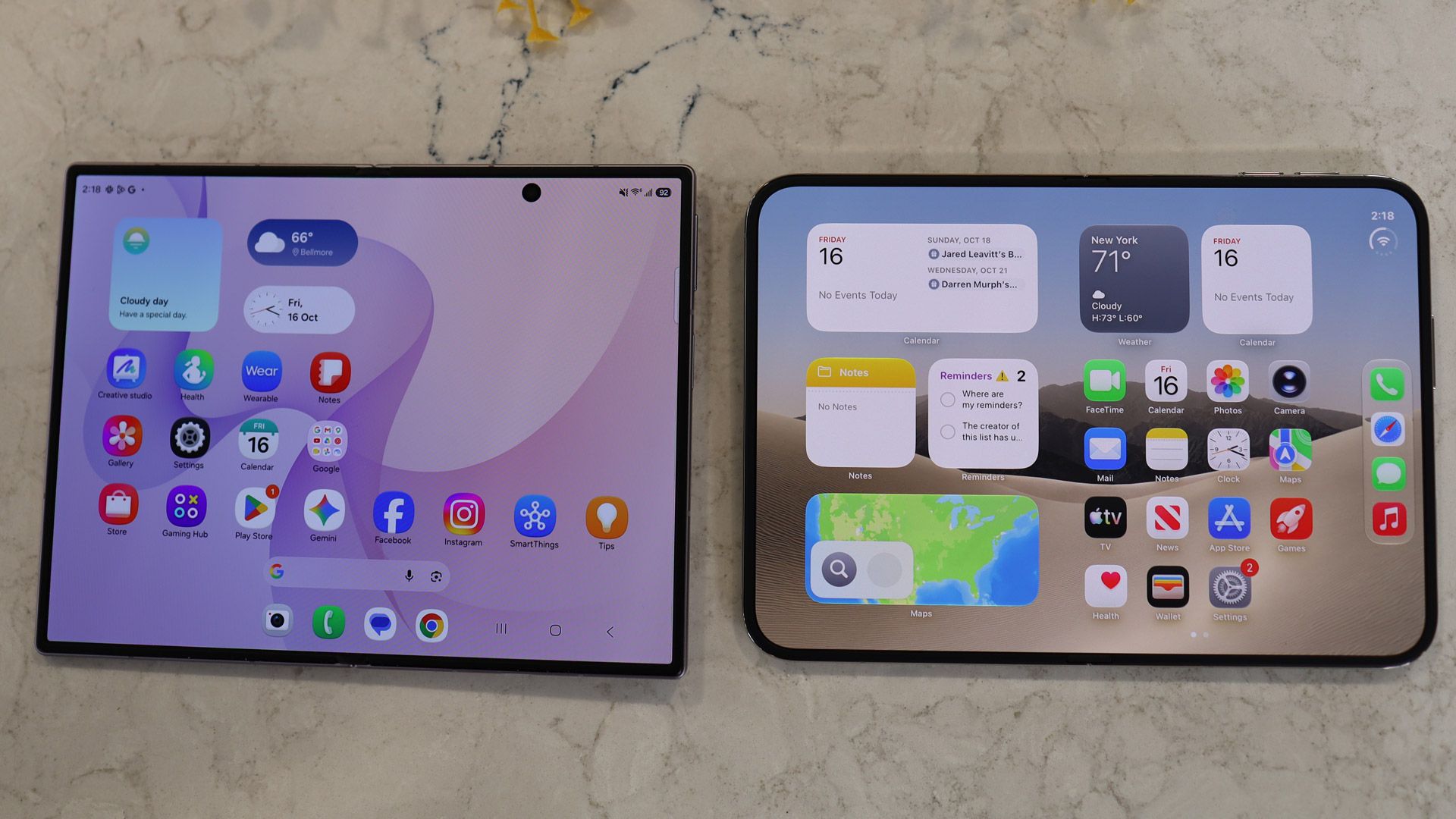
Samsung Galaxy Z Fold 8 on left, iPhone Duo on rightLance Ulanoff / Future
Apple iPhone Duo REVIEW
Samsung Galaxy Z Fold 8 on left, iPhone Duo on rightLance Ulanoff / Future
Apple iPhone Duo REVIEW
Samsung Galaxy Z Fold 8 on left, iPhone Duo on rightLance Ulanoff / Future
Apple iPhone Duo REVIEW
Samsung Galaxy Z Fold 8 on left, iPhone Duo on rightLance Ulanoff / Future
Apple iPhone Duo REVIEW
Samsung Galaxy Z Fold 8 on bottom, iPhone Duo on topLance Ulanoff / Future
Apple iPhone Duo REVIEW
Samsung Galaxy Z Fold 8 on left, iPhone Duo on rightLance Ulanoff / Future

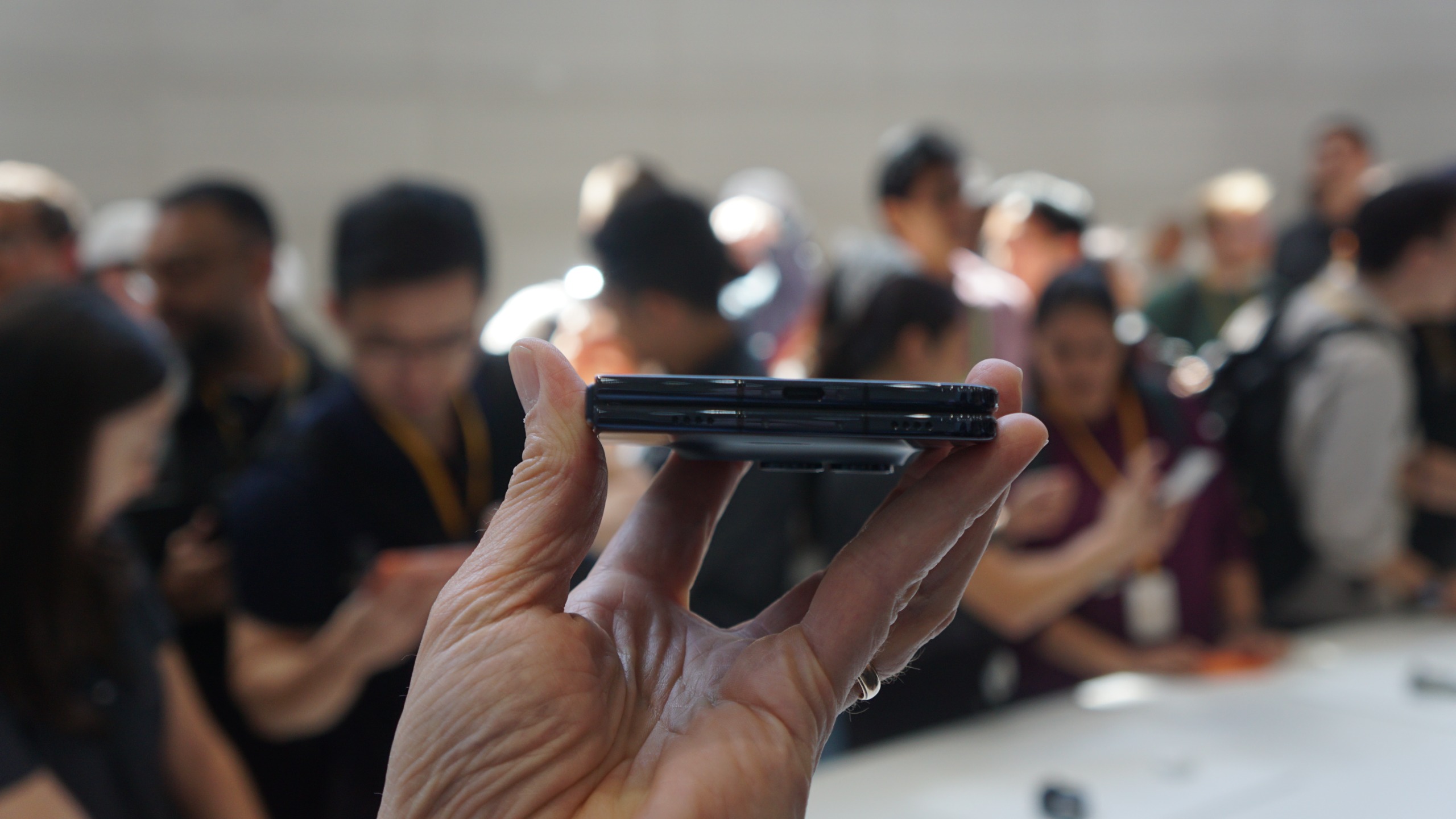
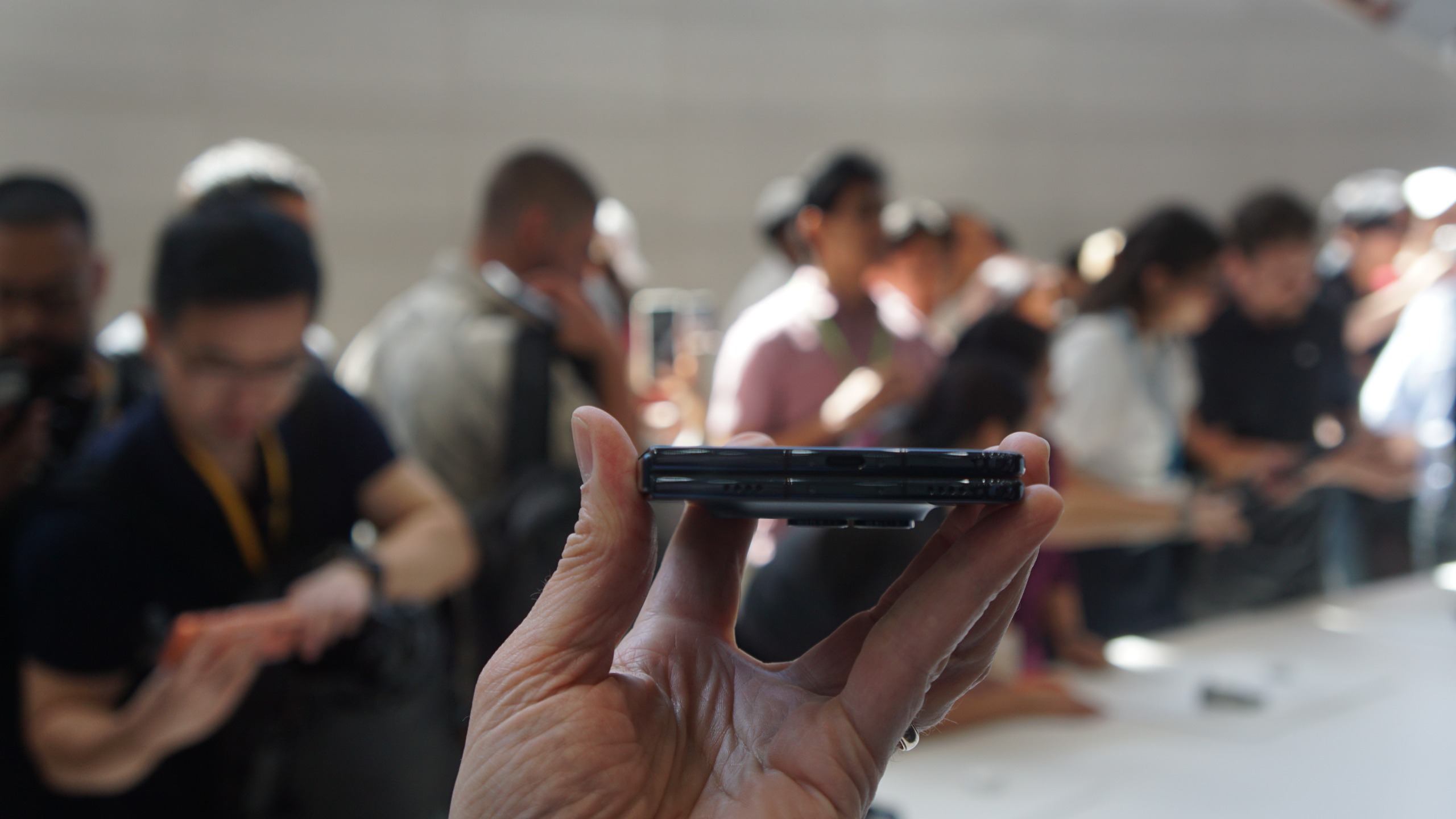
Along the bottom edge are the USB-C port (the phone ships with a charging cable but no power adapter), the speakers, and the mics.

Unfolded, the iPhone duo feels like a thin, compact tablet — I hesitate to say 'iPad' since the operating system is essentially iOS with some small adjustments for the new form factor.
Apple iPhone Duo REVIEW
Lance Ulanoff / Future

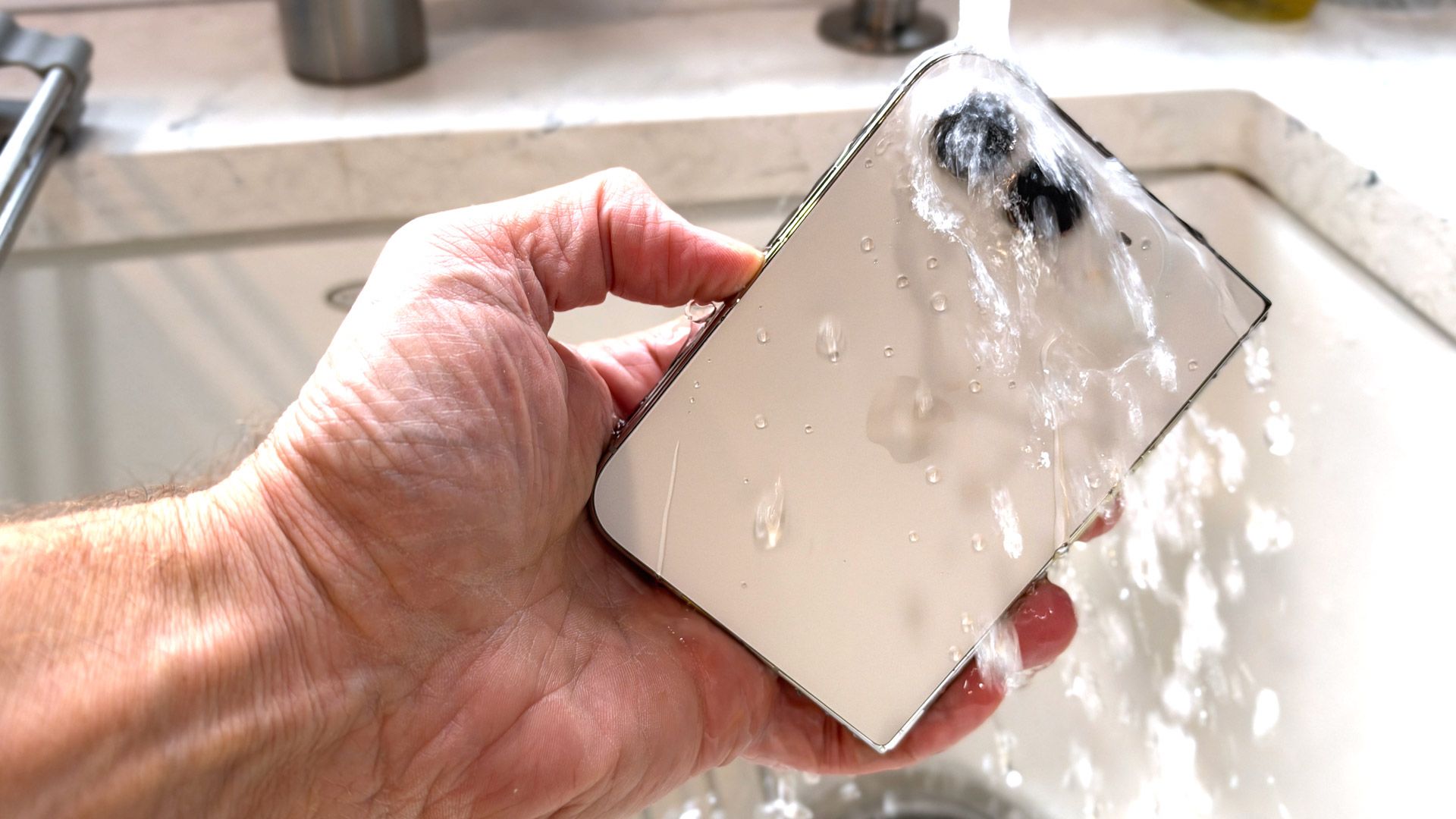
Remarkably, Apple comes out of the folding gate flourishing an IP68 rating, which means the iPhone Duo is protected against dust and even water. Naturally, I submerged the Duo under a running faucet, and it was none the worse for the experience.

Overall, I like the design and form factor, but it's different from a traditional iPhone, so it does take some getting used to. I struggled, for instance, to figure out the best way to hold the phone for photography. Do I need to turn it into landscape mode, or should I just hold it the way I hold a 'regular' iPhone? I do wonder how many will choose to unfold the phone, and shoot pictures in the same way they might with their iPad.

  • Design score: 4.5 / 5

Apple iPhone Duo review: Displays
Apple iPhone Duo REVIEW

(Image credit: Lance Ulanoff / Future)
  • Adorable and unusually shaped 5.4-inch cover display
  • Industry-leading 7.6-inch foldable internal display
  • Crease is canily hidden via a combination of expert engineering and a nano-etched display
  • Bright, sharp, fluid screens

Credit to Apple for not skimping on either of its iPhone Duo displays. Both the 5.4-inch outer and the 7.6-inch flexible inner screens are Super Retina XDR-class OLED panels, both with variable refresh rates up to 120Hz, always-on functionality, and up to 3,000 nits of brightness.

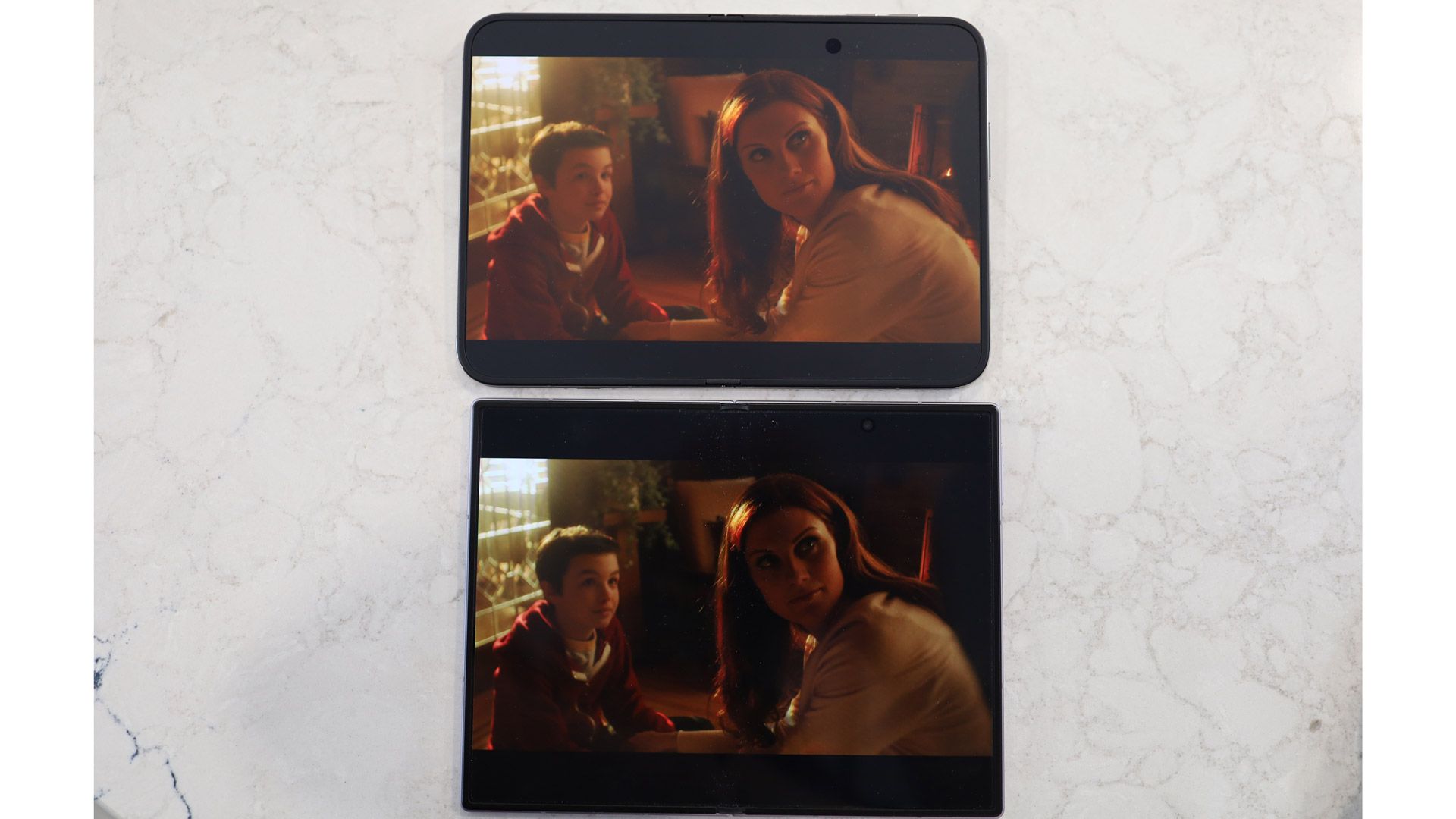
Both displays look impressively sharp, and actually offer slightly higher resolutions than the comparable displays on the Samsung Galaxy Z Fold 8.

The iPhone Duo's 5.4-inch cover display has a 2034 x 1398 resolution (compared to the Galaxy Z Fold 8 cover display's 1972 x 1248), and the 7.6-inch Inner display is 2670 x 1878 (compared to the Z Fold 8's 2448 x 1848 main display).

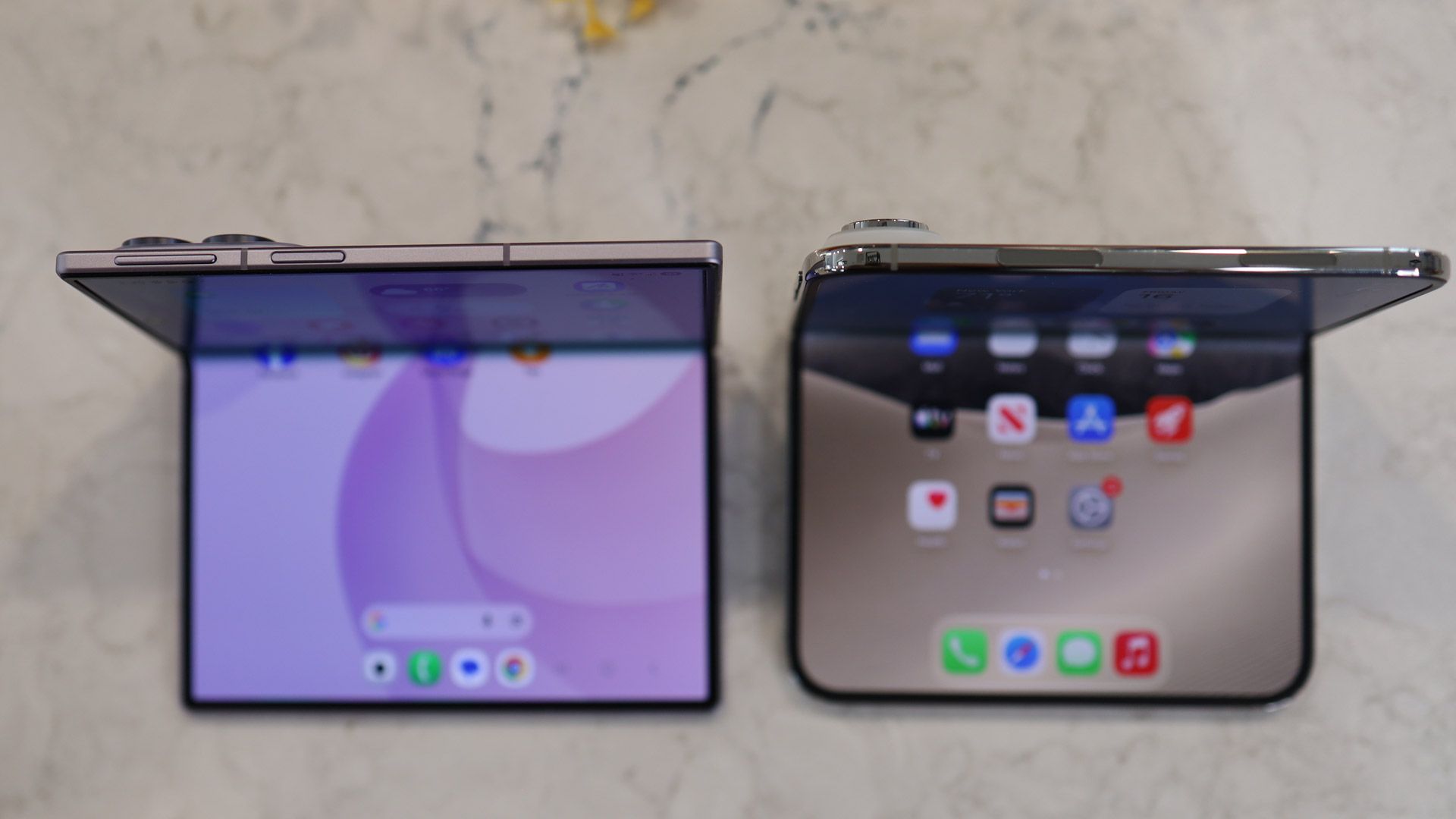
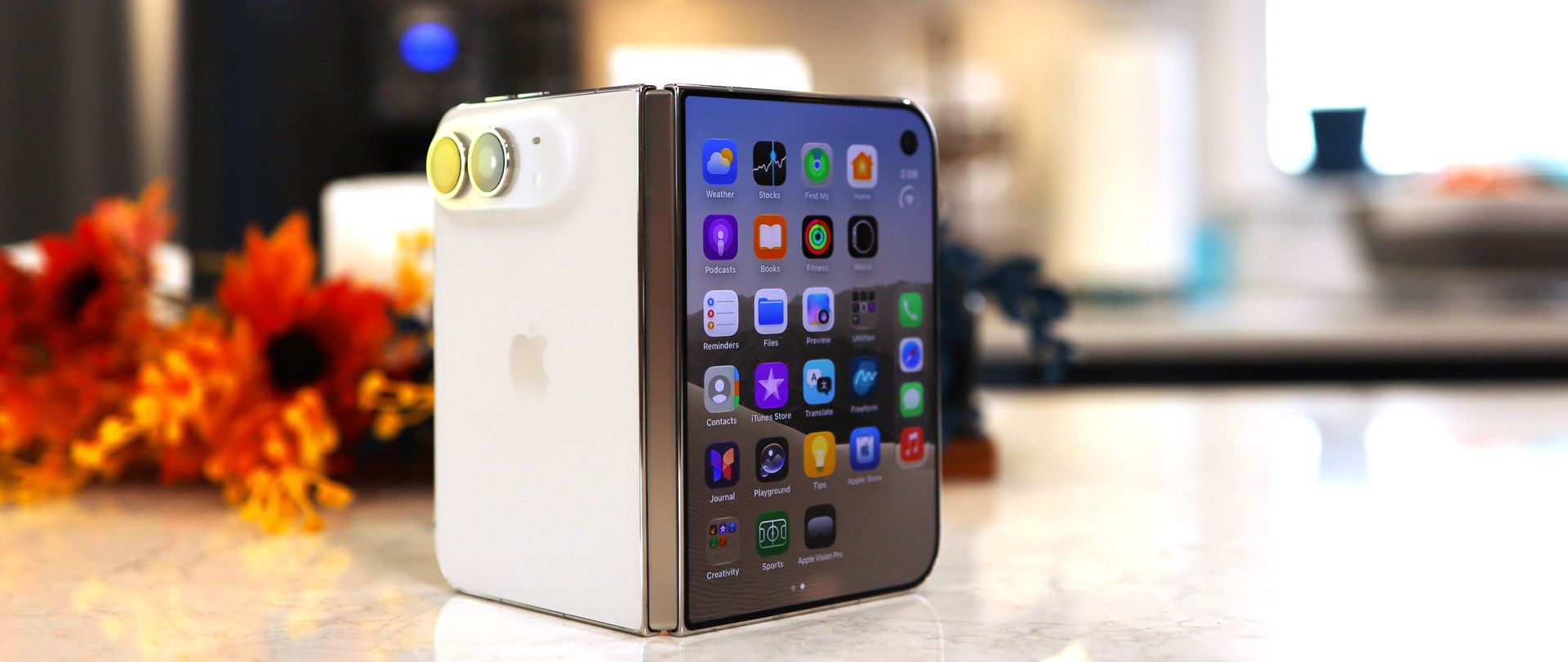
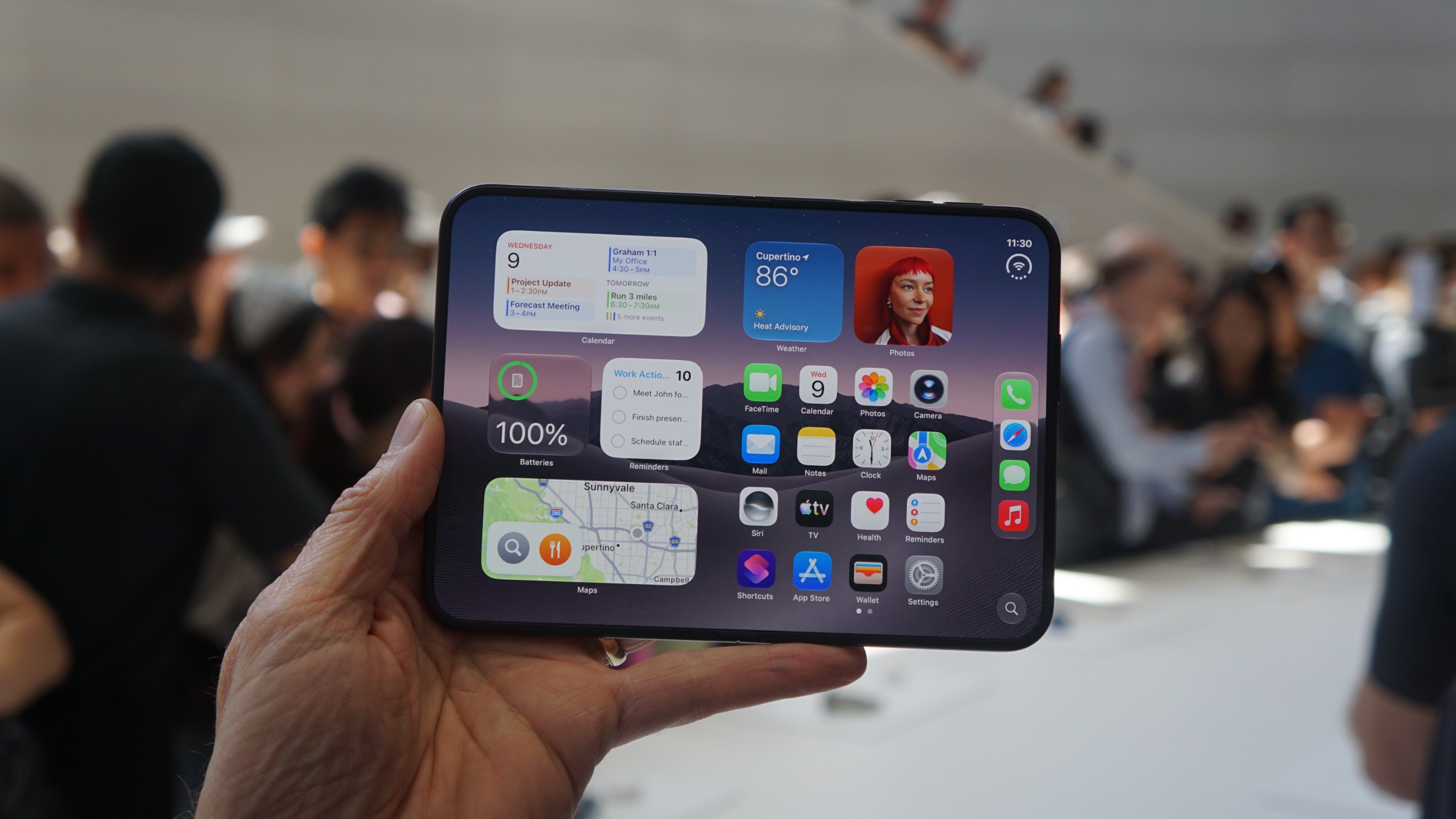
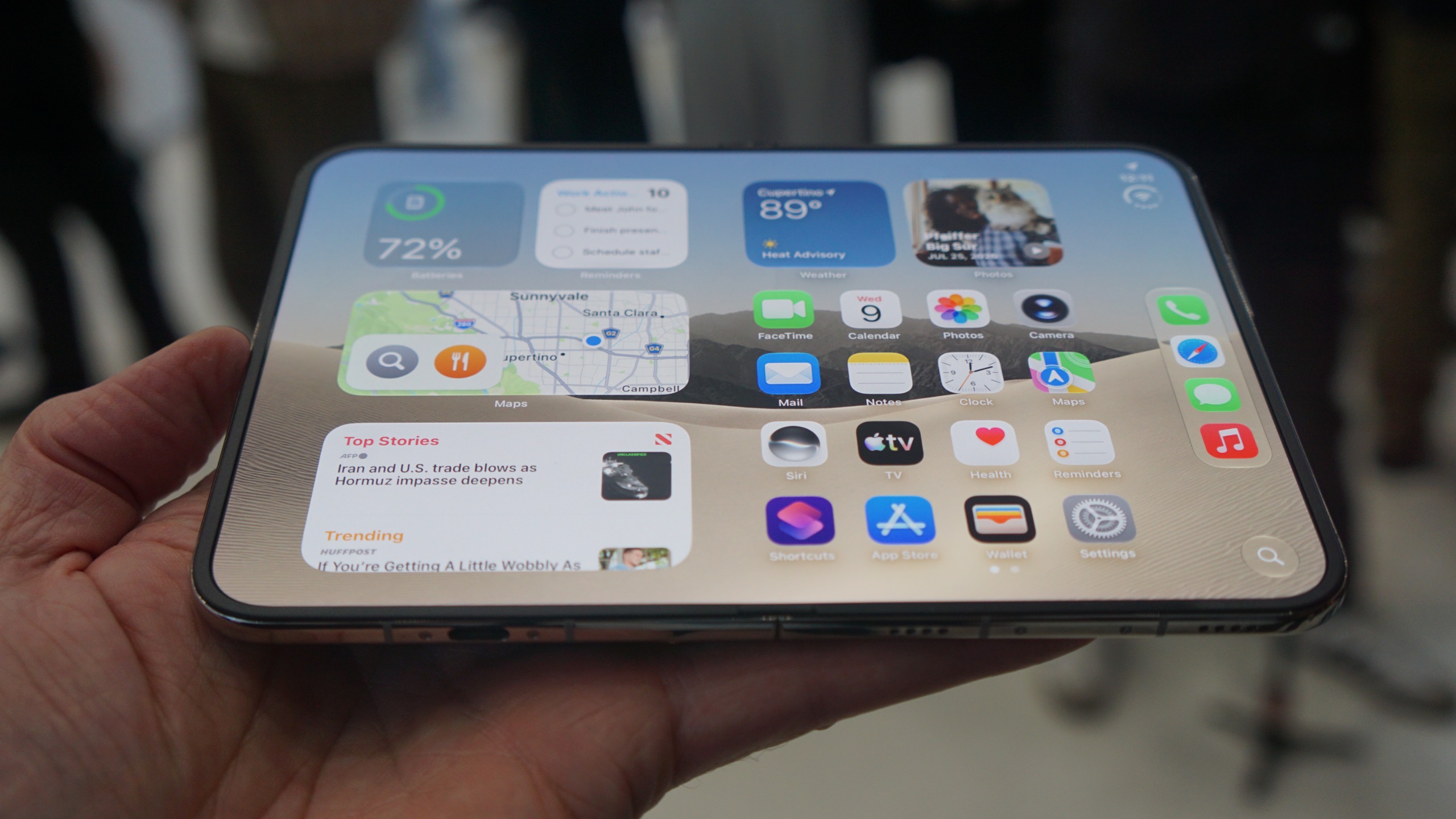
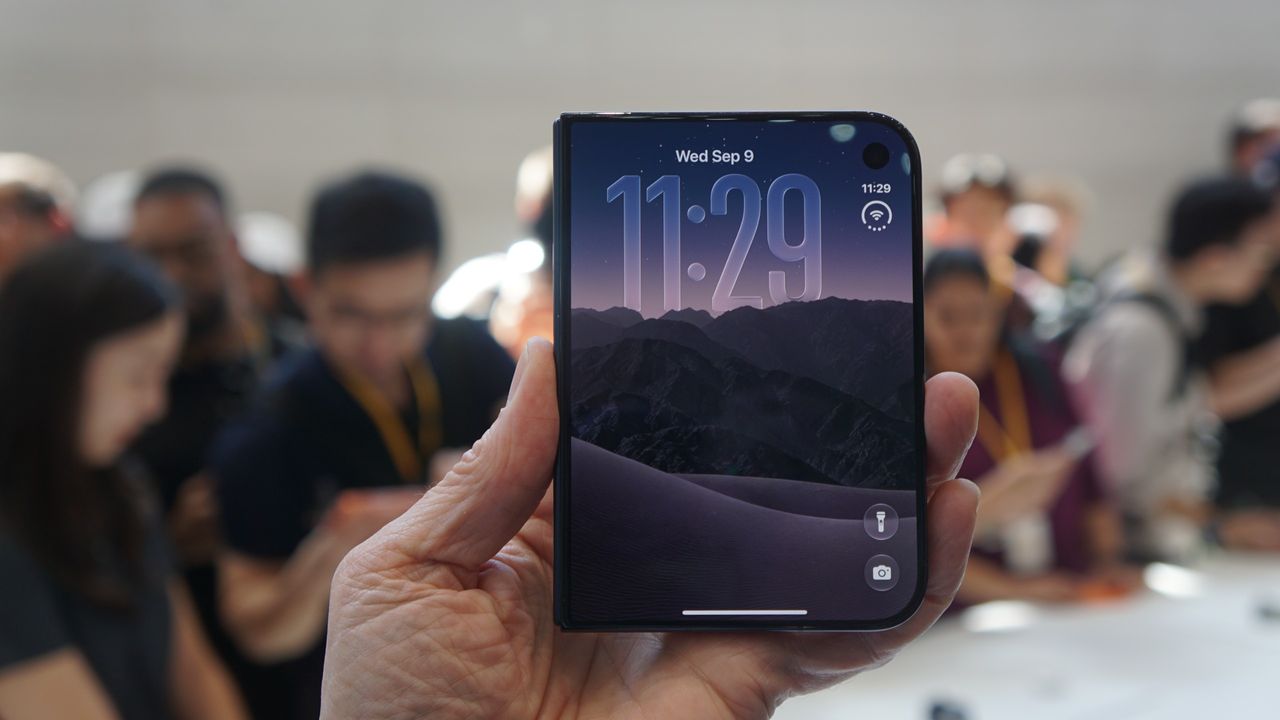
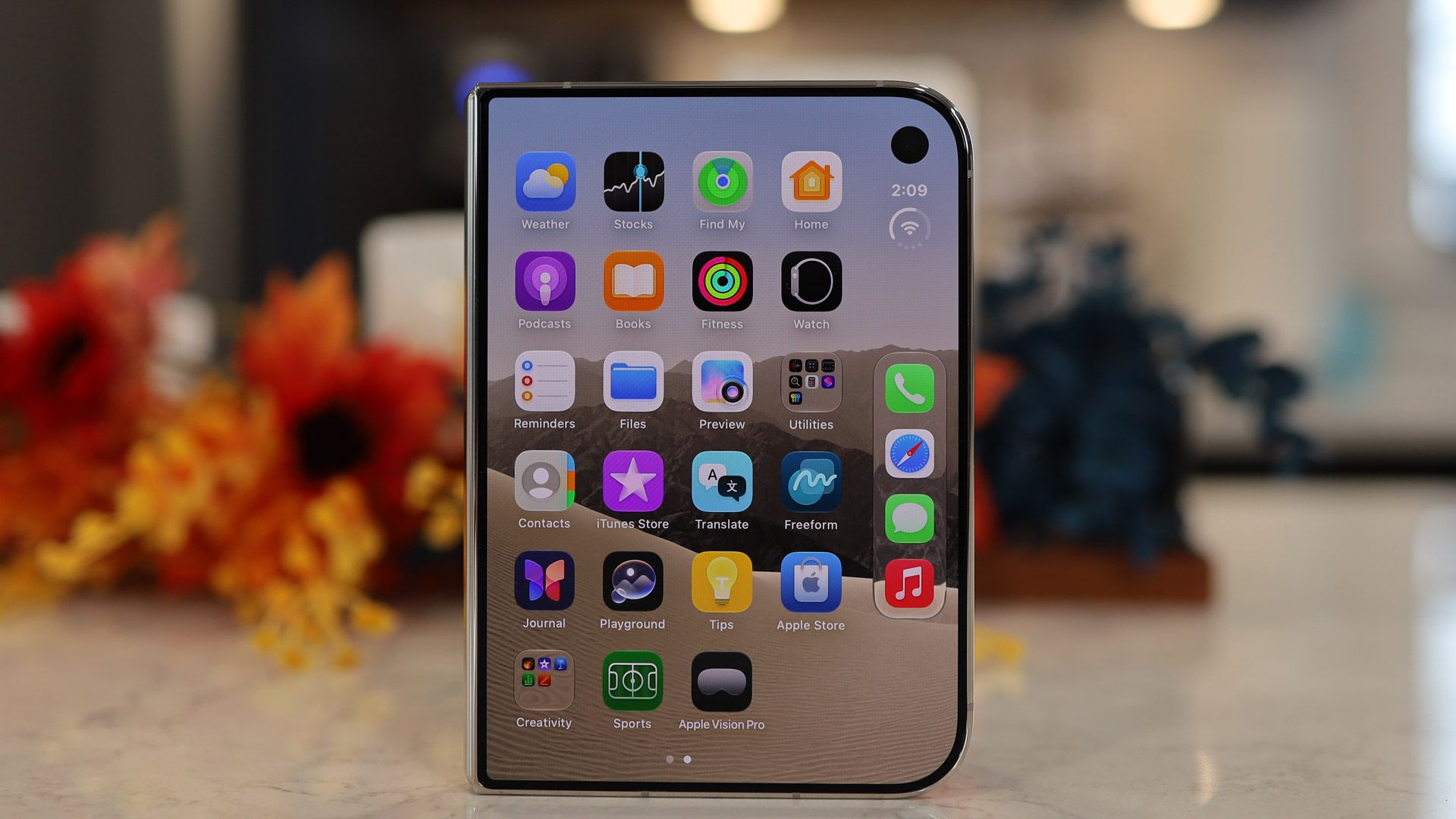
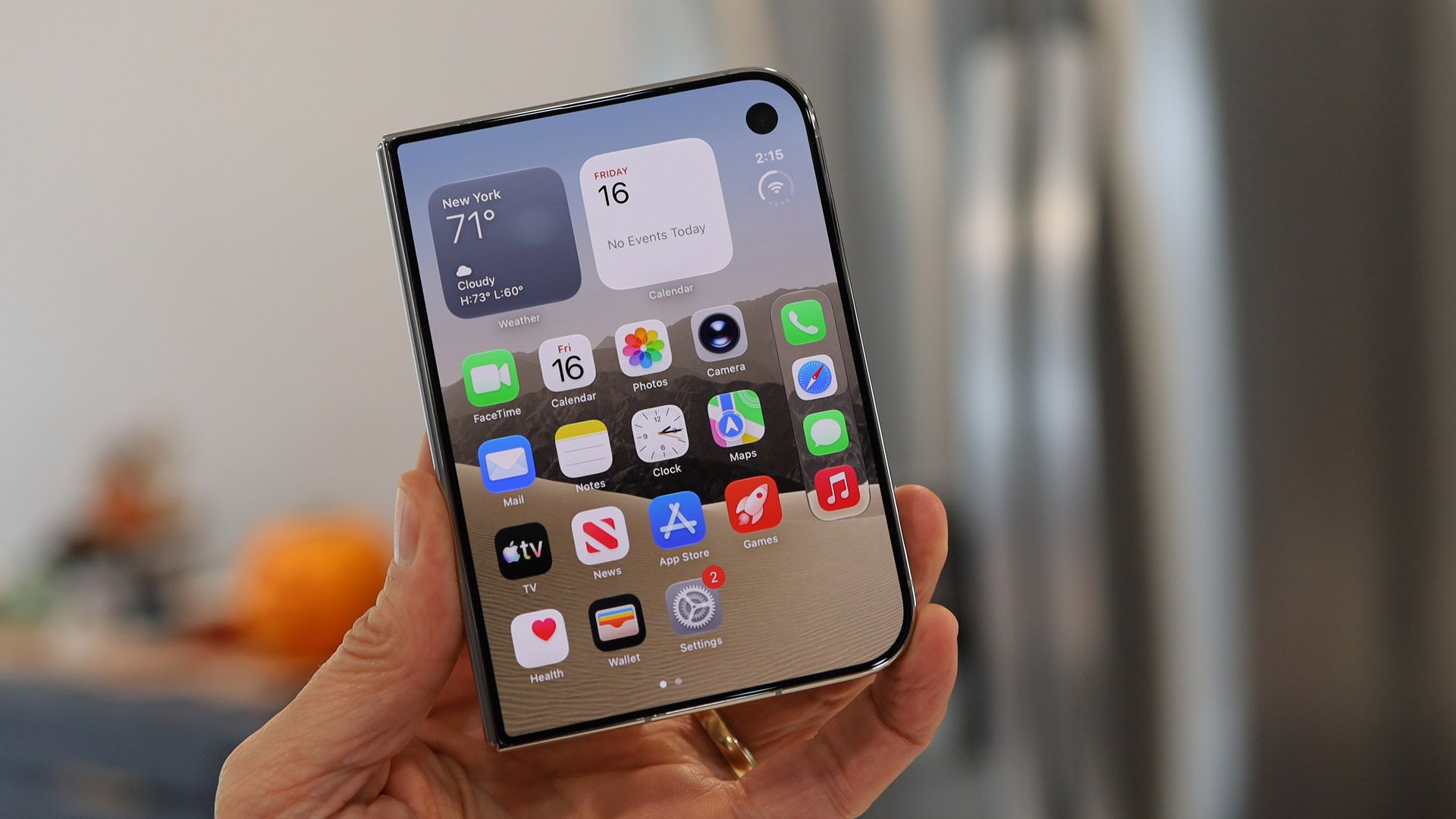
At first glance, the iPhone duo Cover screen is instantly recognizable as an iPhone, but close scrutiny reveals some interesting adjustments for the relatively short and wide display. First, the pill-shaped Dynamic Island sits in a vertical space along the right side, and when you look at the home screen, the dock is stacked vertically below the time and a status button (a single tap on it expands it to show connectivity and battery, and also drops down the full Control Center).

The Duo takes that right-hand space and rarely gives it up, which means that websites can look cramped in Safari, and some apps like TikTok, and even Apple's native ones, like Sports, can feel a bit squeezed. There are exceptions, like when you use the screen as a viewfinder in the Camera app, or look back at images in the Photo Gallery. In those cases, the imagery fills the entire screen.
Apple iPhone Duo REVIEW

(Image credit: Lance Ulanoff / Future)

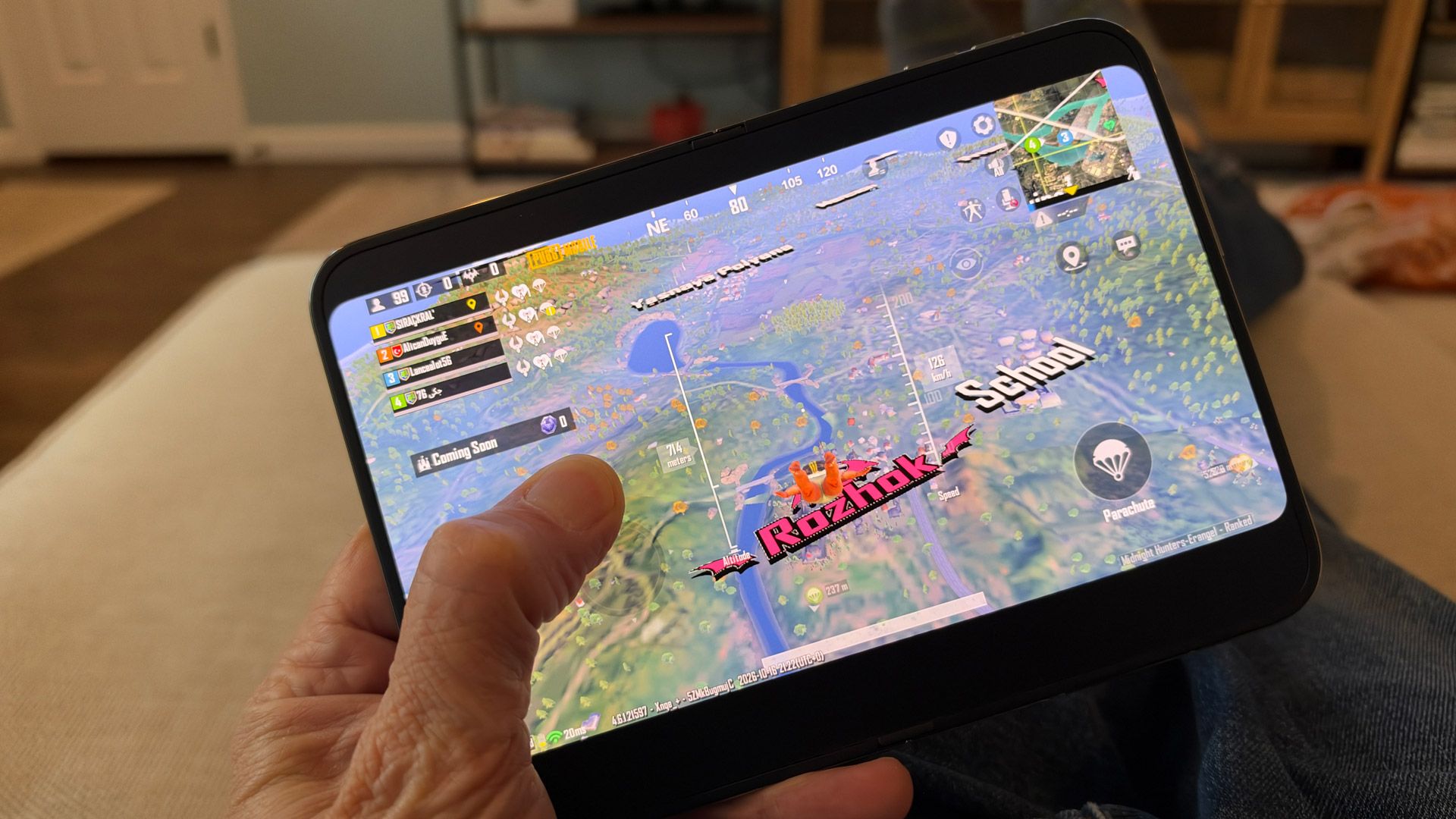
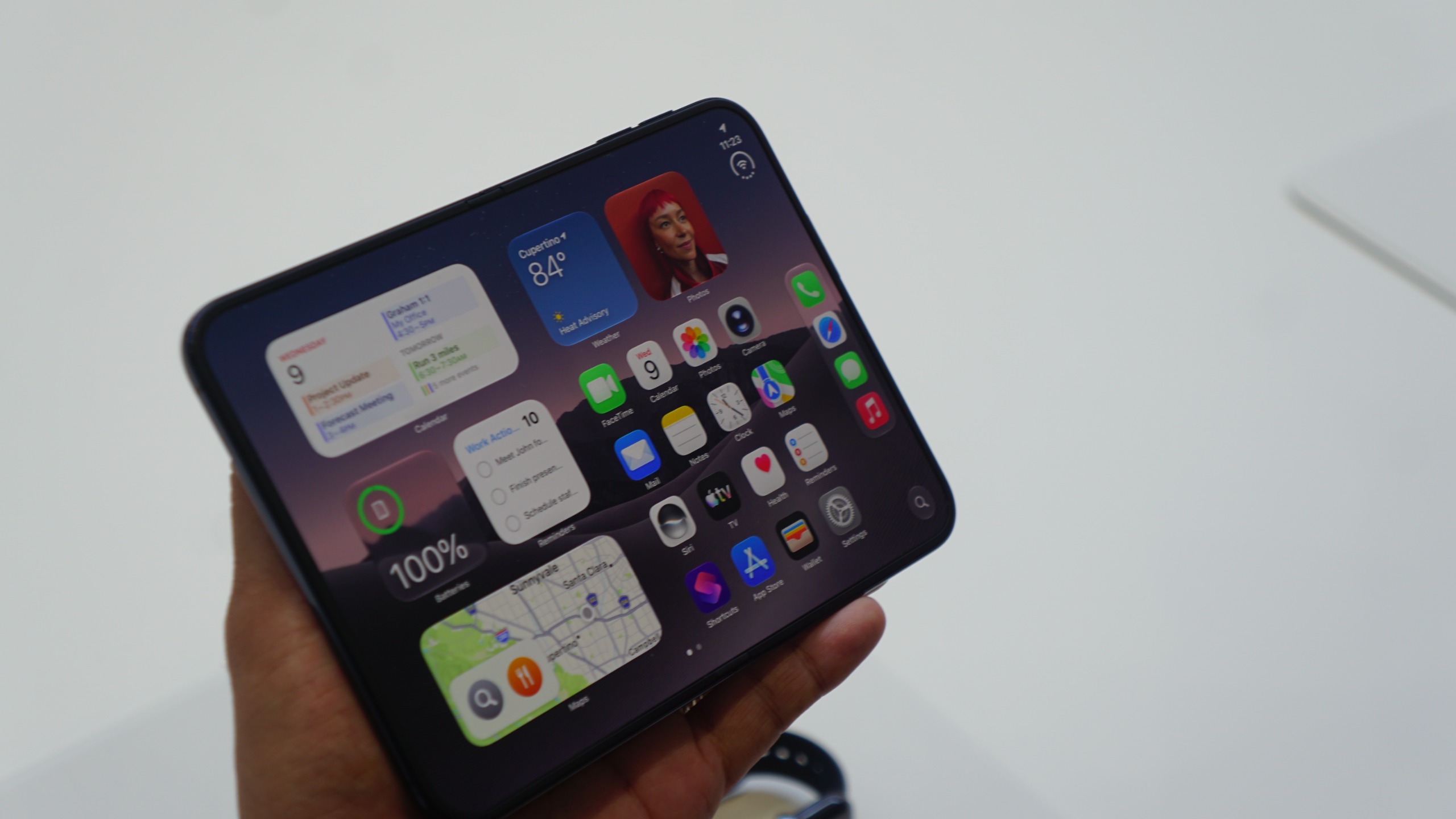
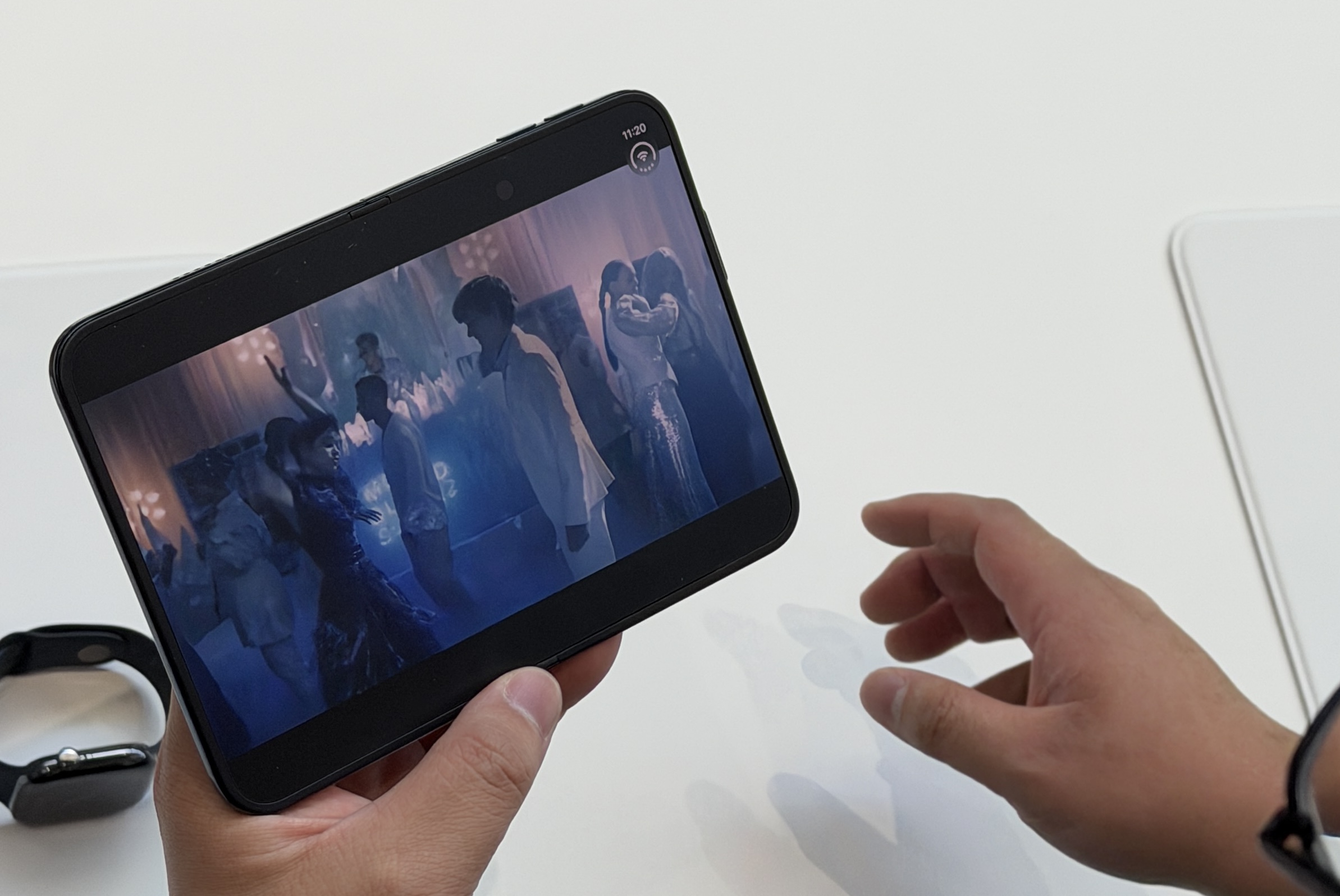
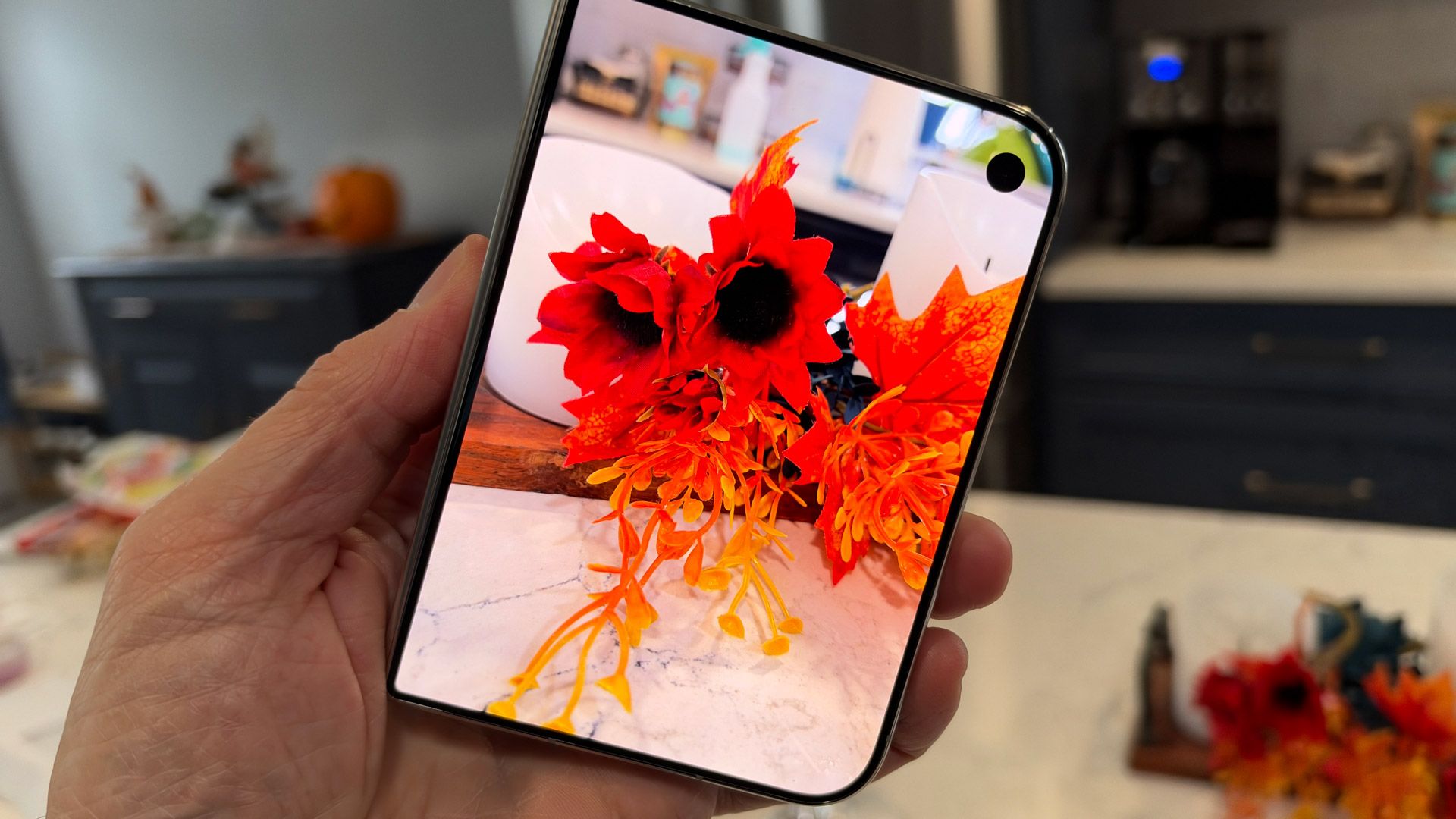
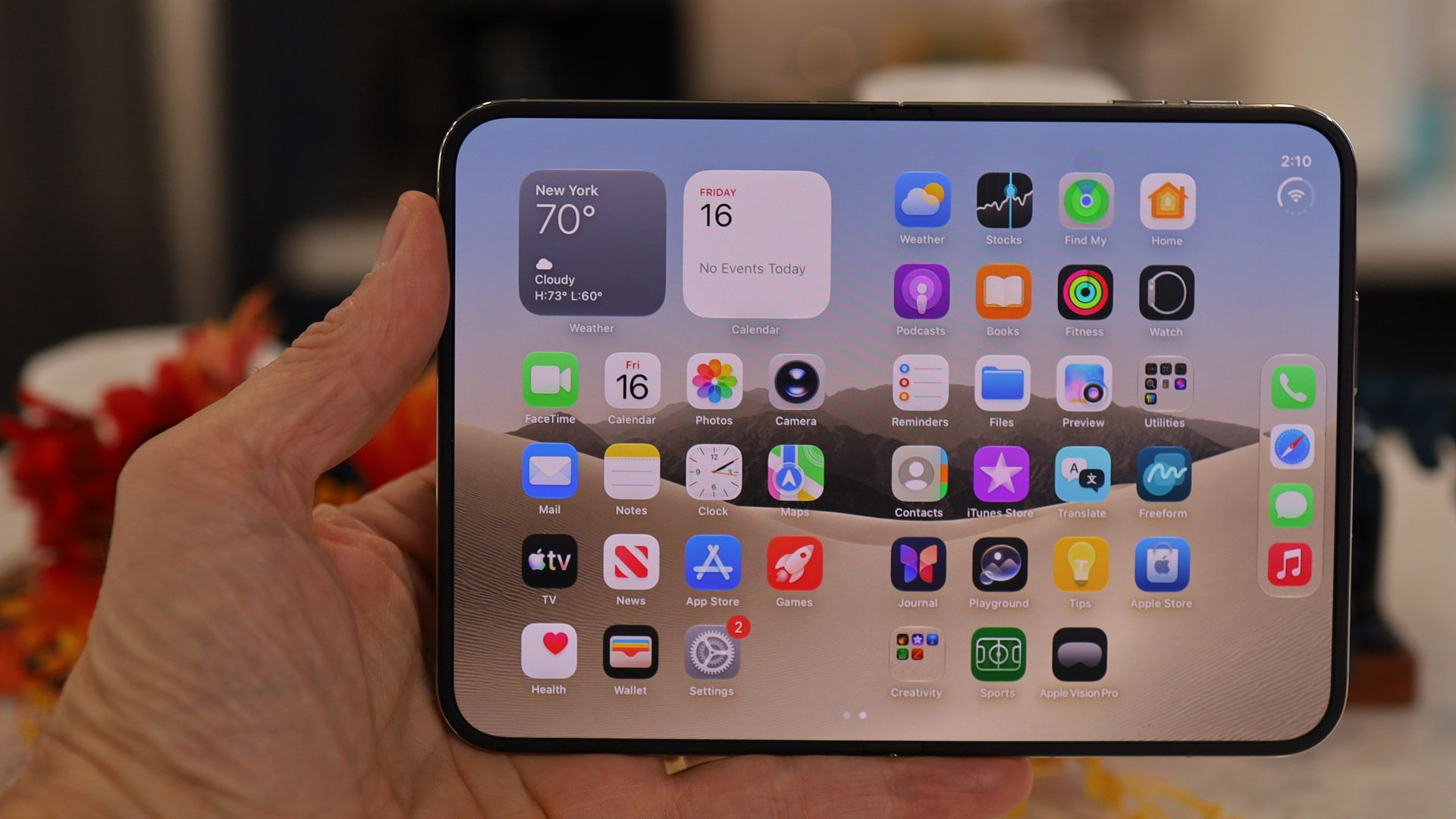
I'm less conflicted about the glorious main screen. It's big, it's responsive, and the matte, nano-texture covering almost completely hides the crease by dispersing any light bouncing off it, instead of directing it right back to your eyes. The display looks and feels perfectly flat, plus that matte covering kills all reflections, and makes every image look almost magazine-quality. It could be argued that a tiny bit of visual punch is lost in the texture, but I really enjoyed everything I viewed and did on the screen. It feels wonderful to the touch, and I had fun playing games like PUBG, browsing the web on a big screen, watching Netflix, reviewing and editing my photos, and multi-taking (more on that later).

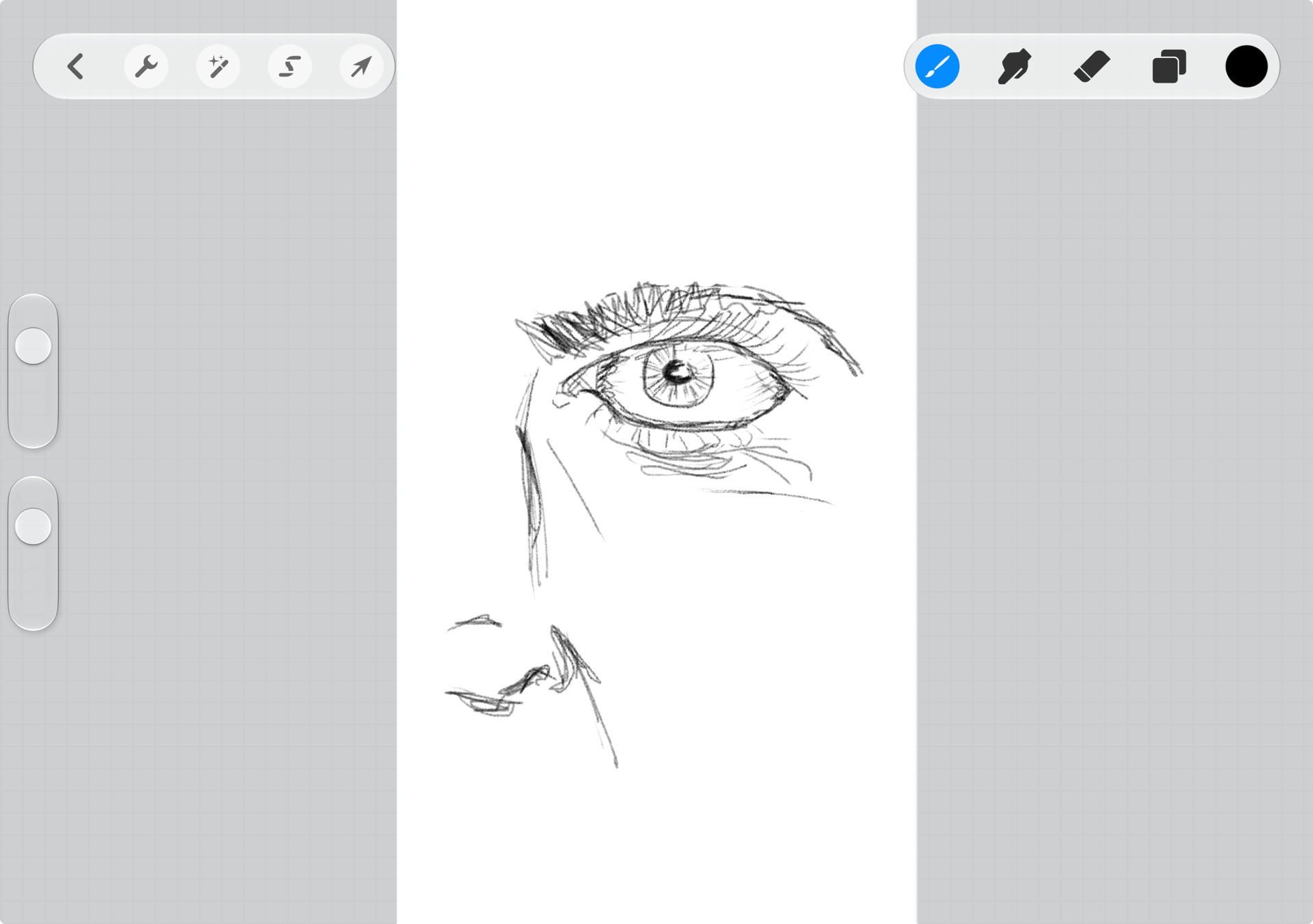
Unlike the Galaxy Z Fold 8 and 8 Ultra, the iPhone Duo's inner display supports a stylus, specifically the USB-C Apple Pencil. That support is not yet live, but I can't wait to start drawing on the Duo. I did attempt some Procreate Pocket sketches with my finger, and it didn't go well, which is mostly a me problem. However, I had slightly better luck with an analog stylus (see below).
Apple iPhone Duo REVIEW

(Image credit: Lance Ulanoff / Future)

Apple hides the 4MP inner FaceTime camera behind a handful of pixels, but they don't appear to have the exact same mix of matte and pixel density as the rest of the display, and as such are easy to spot. I wonder if Apple should have just gone with a standard, albeit smaller, cutout.

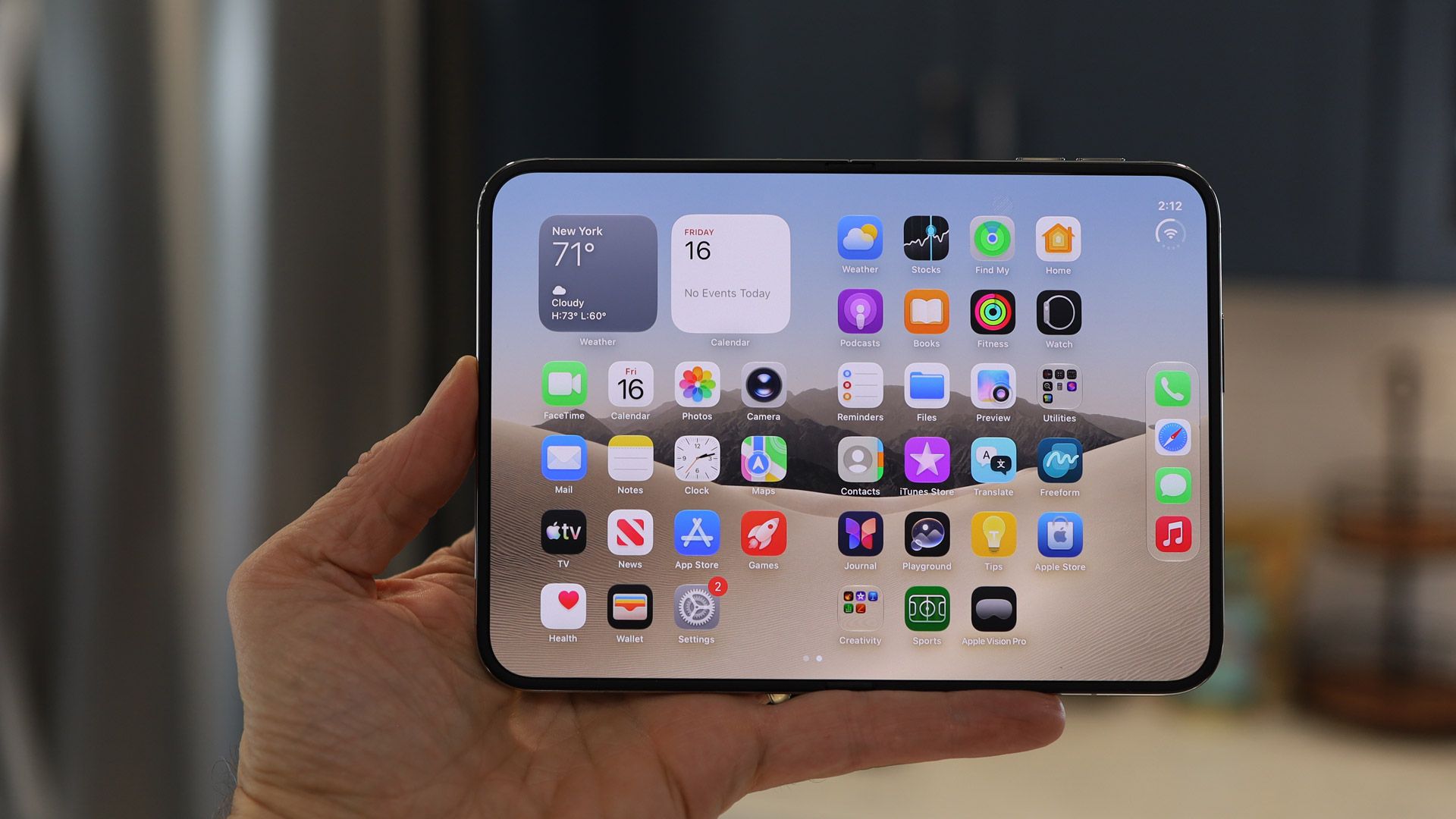
As on the cover display, Apple has positioned the status and dock vertically on the right side of the main display. I wonder why, in Tablet mode, Apple didn't simply copy the iPad and put this bar at the base of the screen. Still, I noticed that the dock disappears when you're in apps like Safari.

There's more to say about app compatibility with this platform, which I'll get into later in the Software section of this review.
Apple iPhone Duo REVIEW

(Image credit: Lance Ulanoff / Future)

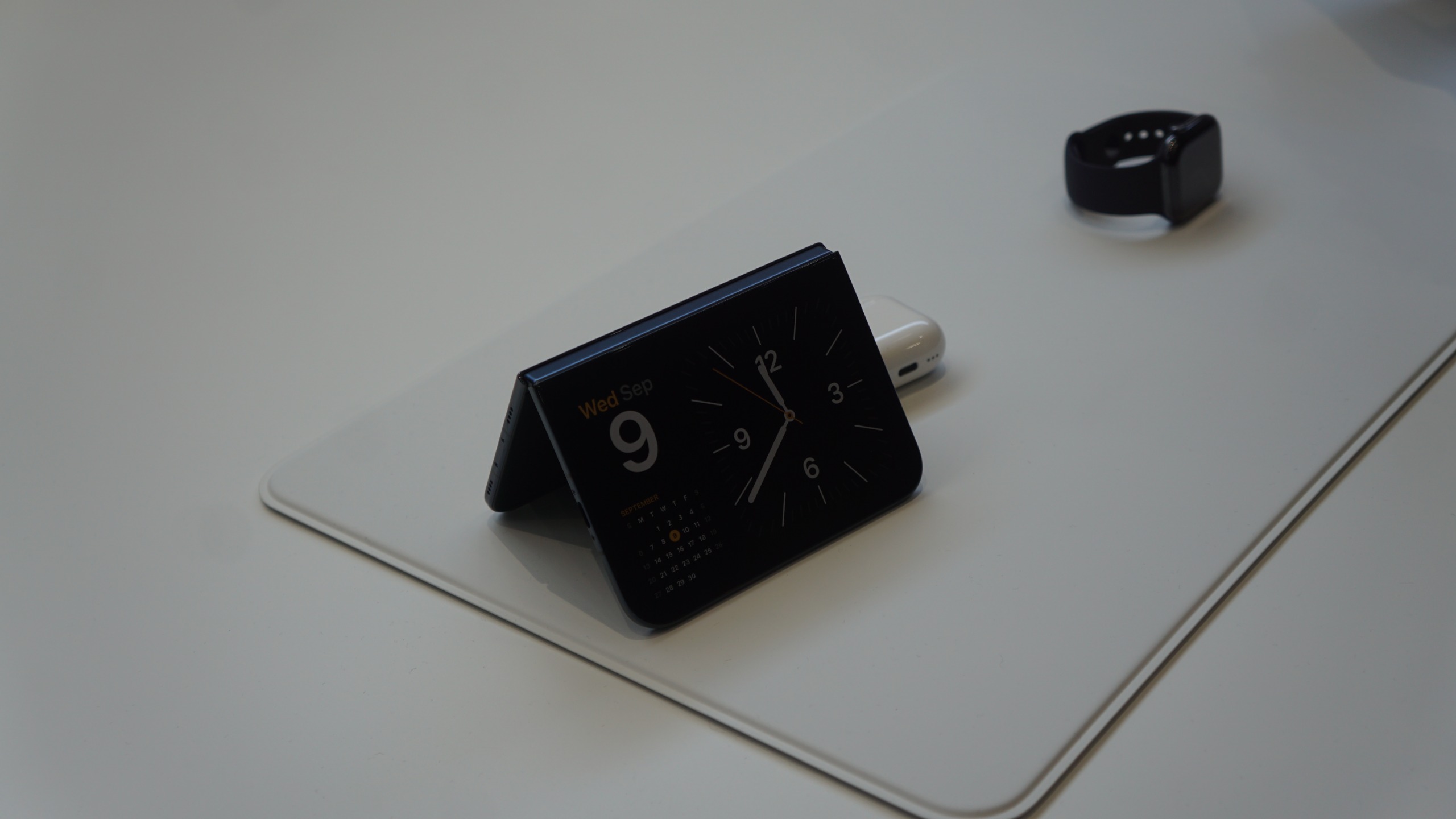
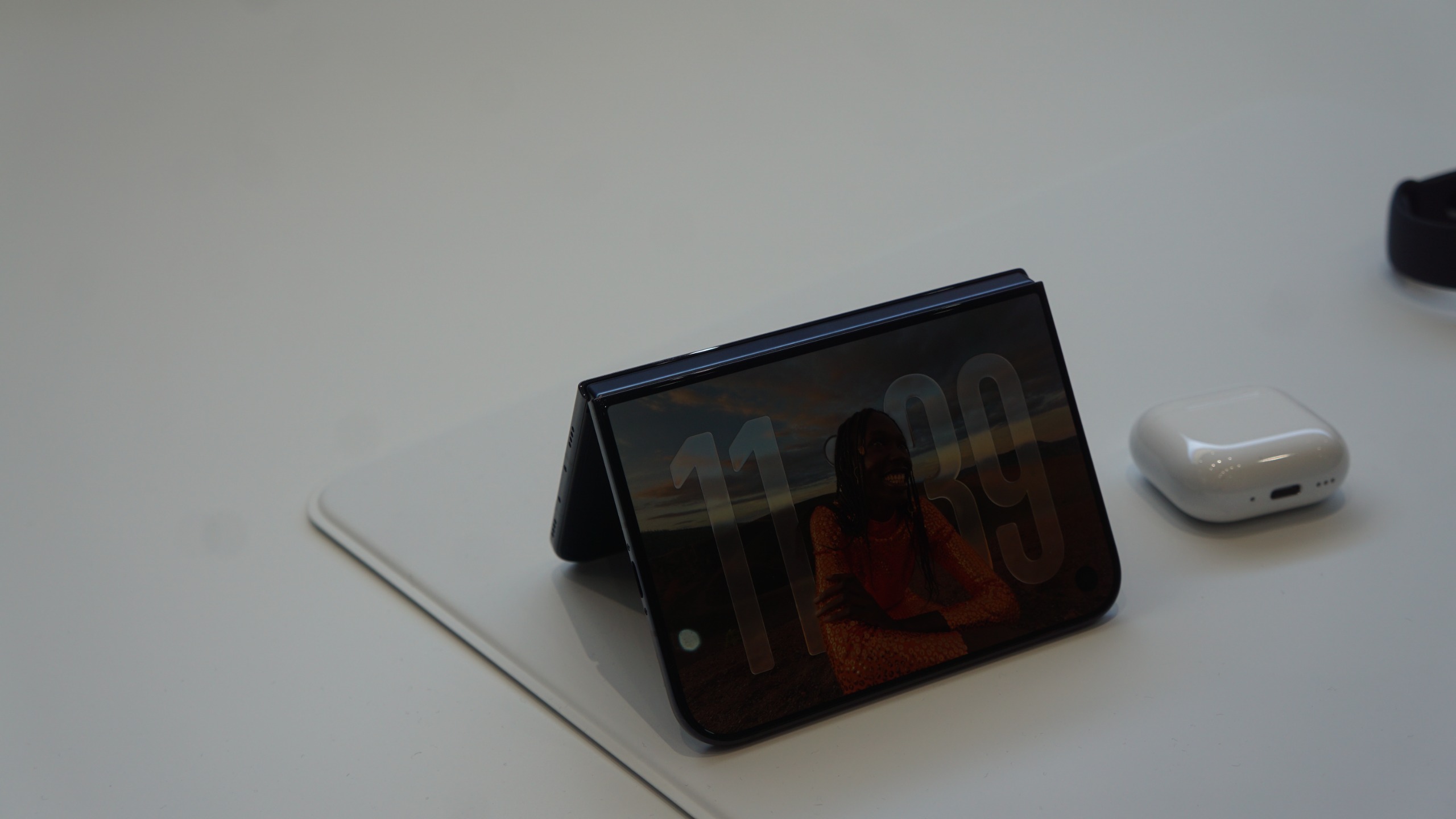
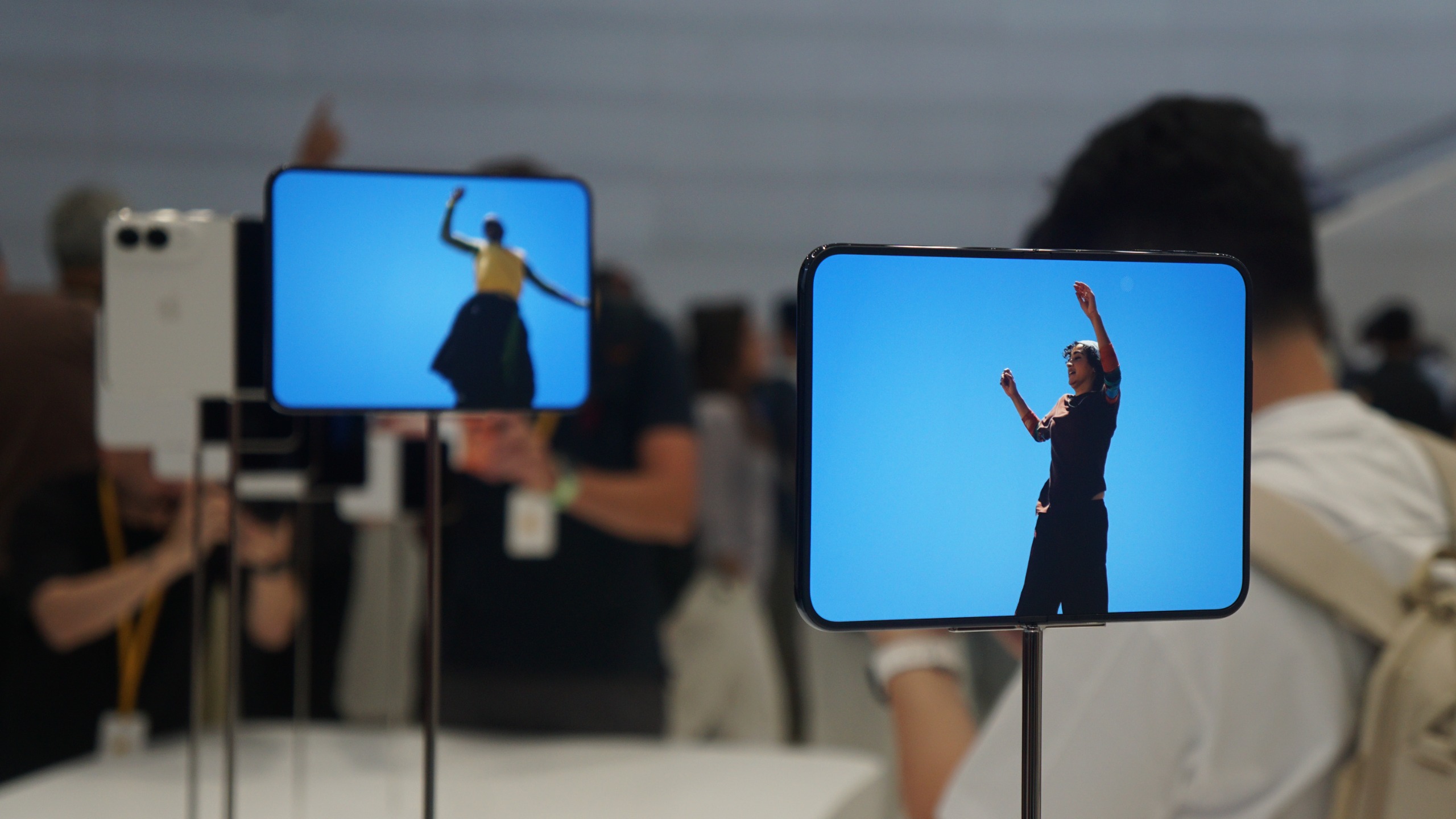
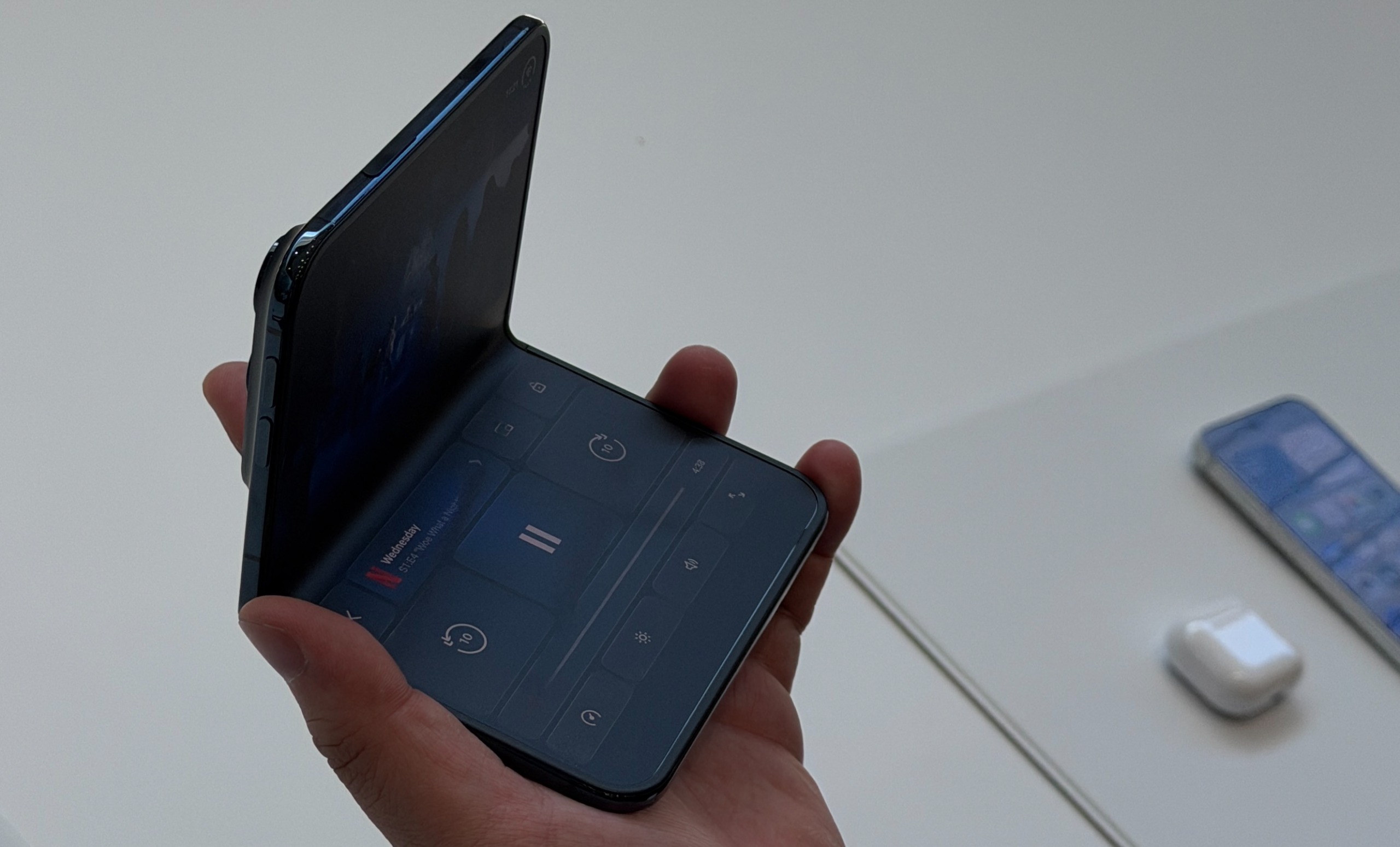
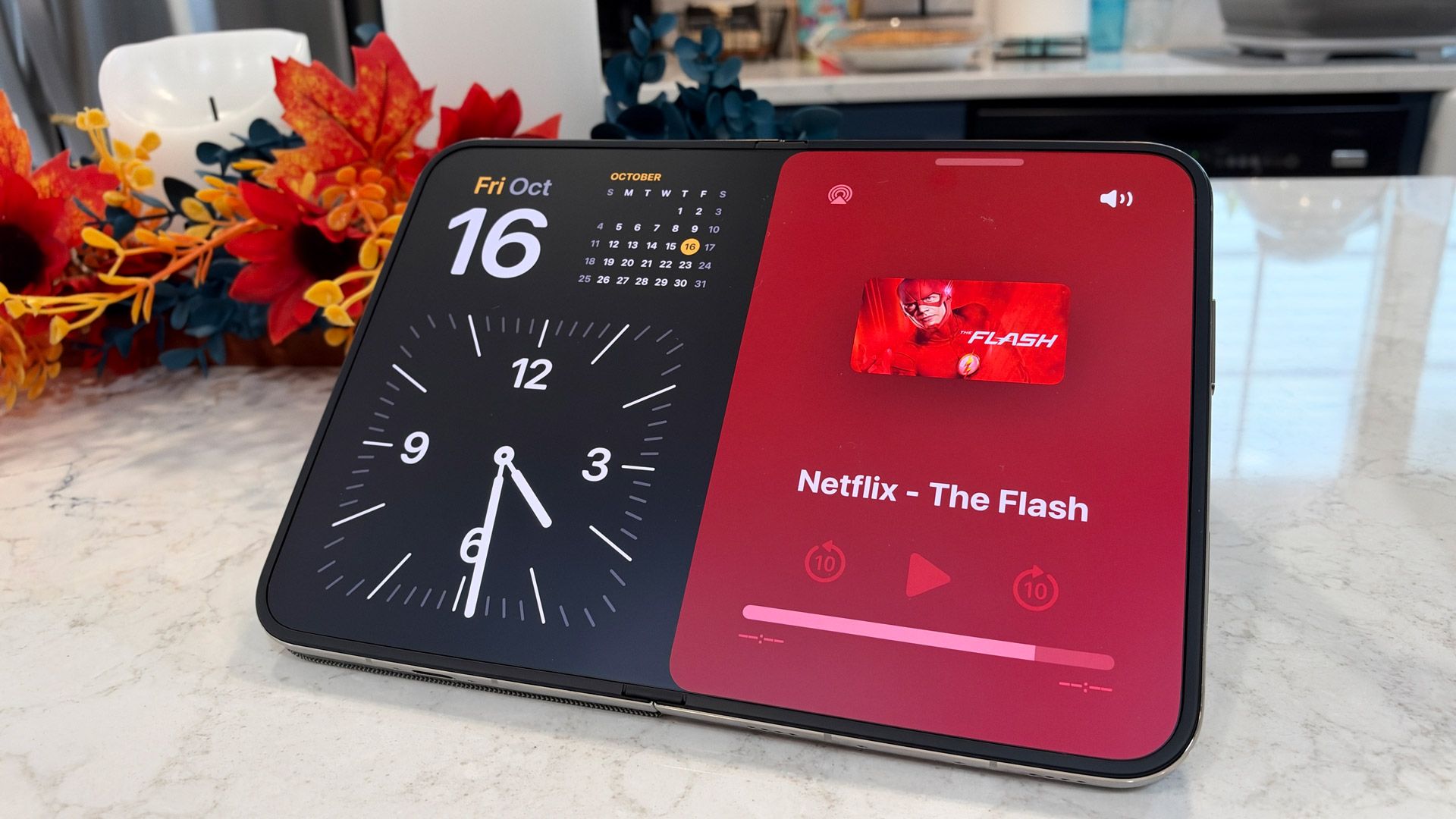
I especially like the redesigned Standby feature, which takes advantage of the Duo's multiple displays and foldable nature. You can prop up the phone like a tent and have the Standby display appear in landscape mode. If you flip the phone up so it's standing on your desk like an open book, the Duo knows to switch Standby to the inner display. At one point I popped the Duo onto my old Belkin MagSafe charger, and used it as a nightstand clock. It's so smart and useful.

What we have here are two excellent displays with a wide array of capabilities in one device. It's both a tiny iPhone and a mini tablet, with two screens that should please both the iPhone and iPad crowds. I have my reservations about the cover screen, but as an overall multi-display package, I'm impressed with the Duo.

  • Display score: 4.5 / 5

Apple iPhone Duo review: Cameras

  • Two strong 48MP cameras
  • Excellent 12MP Center Stage camera
  • Inner camera is lower-resolution but effective for FaceTime
  • No telephoto camera

It's been a long time since I've reviewed an iPhone on which camera considerations come second to design and mechanical engineering, but the excitement revolving around the iPhone Duo is about its folding capability, creaseless inner screen, and unique-among-iPhones form factor.

Even so, there's no indication that Apple has skimped on three of the four cameras. Yes, the inner camera is just a 4MP shooter that's primarily devoted to FaceTime calls, but the rest of the lenses — 48MP f/1.6 Main, 48MP f/2.2 ultra-wide, and 12MP f/2.2 Center Stage — are all excellent.

While I haven't had a lot of time with the iPhone Duo, I have managed to shoot in a variety of conditions and situations, pushing the cameras on speed, image quality, color, and low-light performance.

The two external cameras default to shooting at 24MP, which means each photo has effectively twice as much information per pixel (the process is called binning).
Apple iPhone Duo REVIEW

(Image credit: Lance Ulanoff / Future)

I was particularly impressed by the level of detail in the main-camera shots — just look at the specks of pollen on the marigold flower in the gallery below. That same image shows an exceptional balance of shadows and light; the sunlight bleed on the right does not overwhelm the exposure of the rest of the image.

In a challenging social-club environment, the main wide and ultra-wide cameras acquitted themselves nicely, making exposure adjustments to capture the moment without too much grain. Obviously, there was some motion blur, but I think it added to the emotional weight of the event.

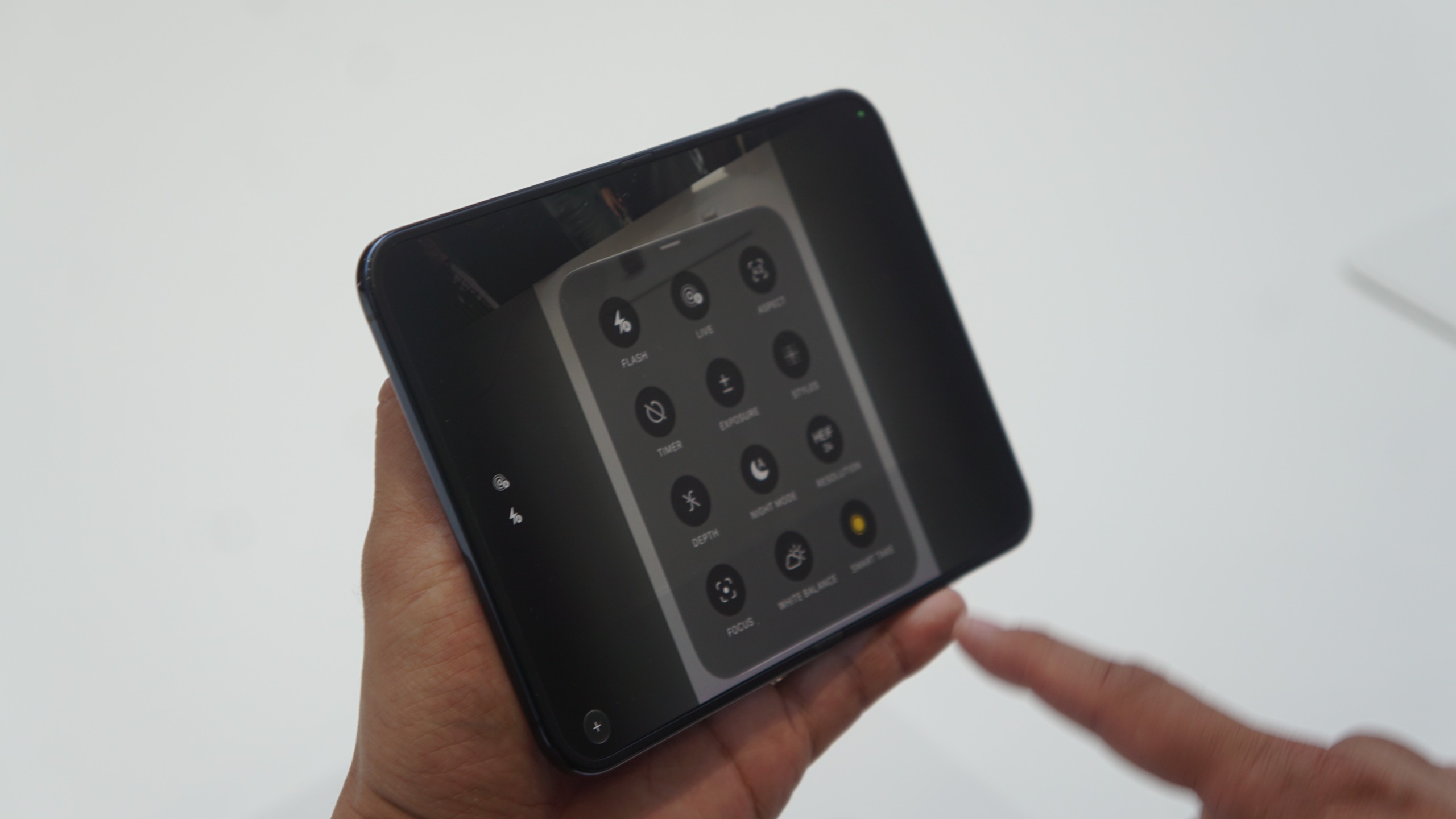
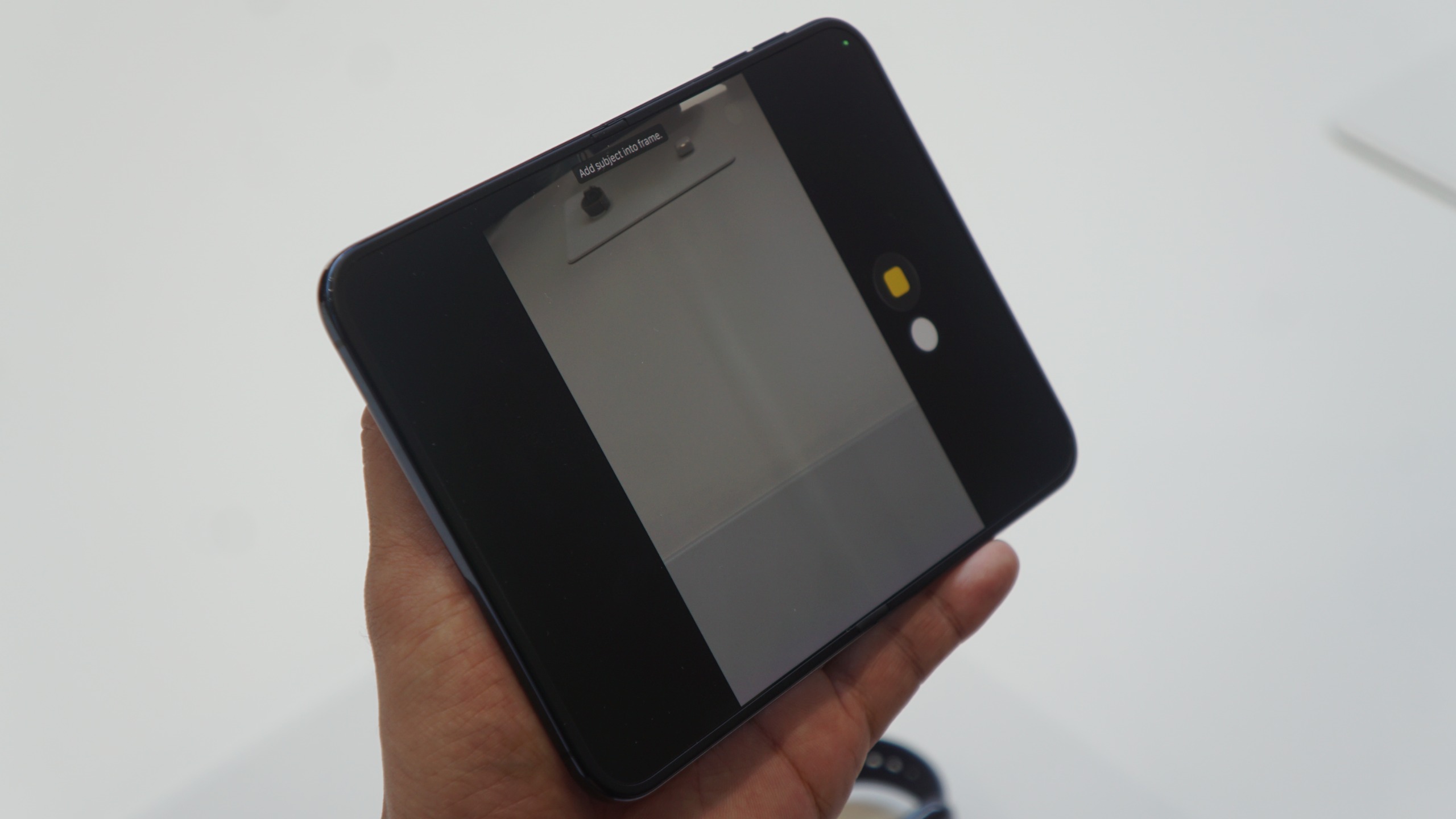
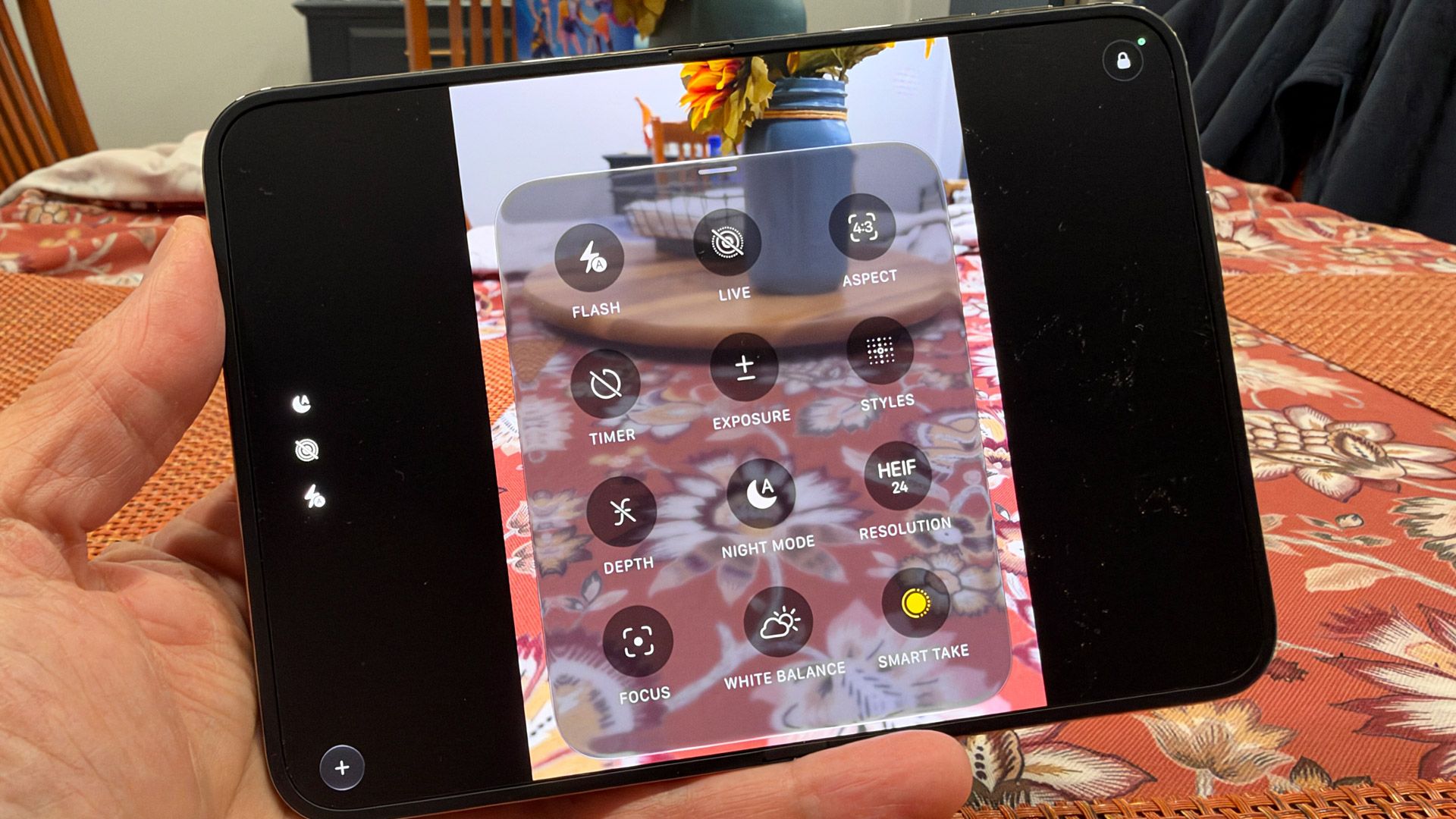
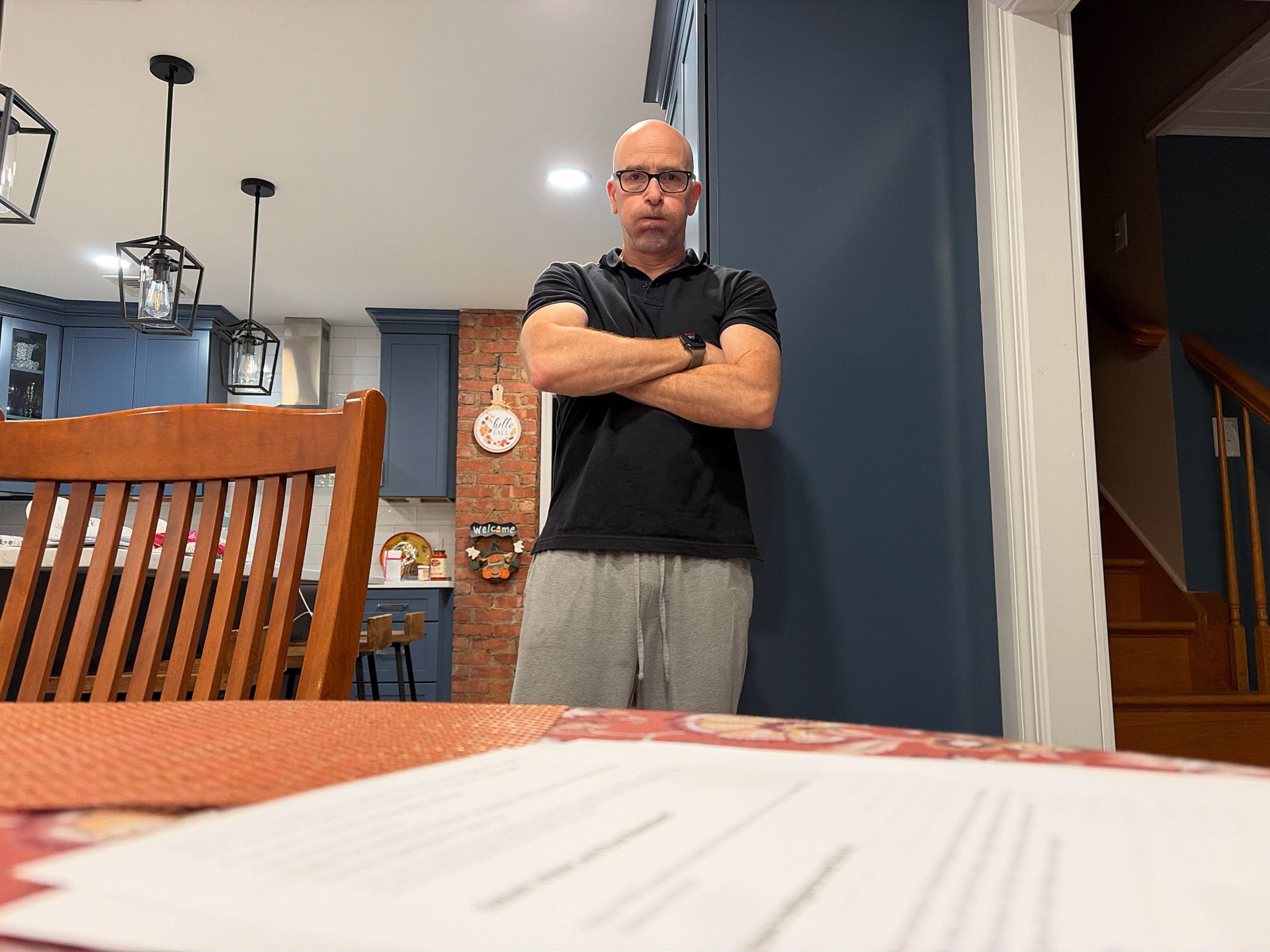
With the iPhone duo, Apple has introduced Smart Take, which I liken to your own personal fashion photographer. The setting lives under the grid menu (drawer) in the Camera app, and once it's on, you can set the phone folded at 90 degrees on a desktop, start posing in front of the camera, and Smart Take will capture the 'best shots.'

When I used it, I noted that while I was trusting the phone to take some decent photos of me, I couldn't see a display to keep track of what it was capturing (Smart Take is not supported on the 4MP inner camera). Still, I started striking poses, assuming that the camera would deem those best. It kind of worked, though I think Smart Take would work best if you're able to put the iPhone Duo up on a tripod or shelf to make sure the camera is closer to eye level.
Apple iPhone Duo REVIEW
Lance Ulanoff / Future
Apple iPhone Duo REVIEW
Lance Ulanoff / Future
Apple iPhone Duo REVIEW
Lance Ulanoff / Future
Apple iPhone Duo REVIEW
Lance Ulanoff / Future
Apple iPhone Duo REVIEW
Lance Ulanoff / Future
Apple iPhone Duo REVIEW
Lance Ulanoff / Future
Apple iPhone Duo REVIEW
Lance Ulanoff / Future

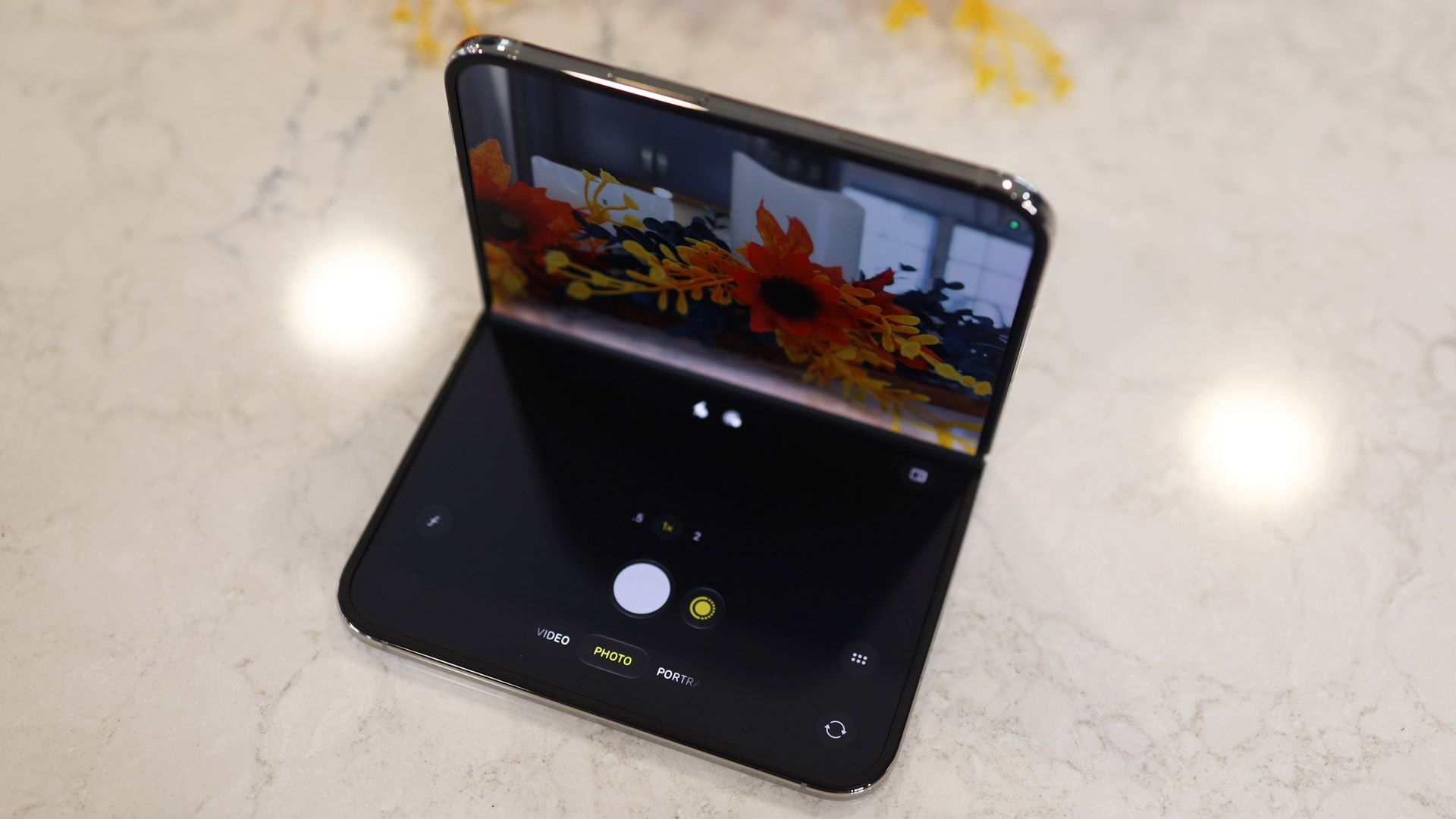
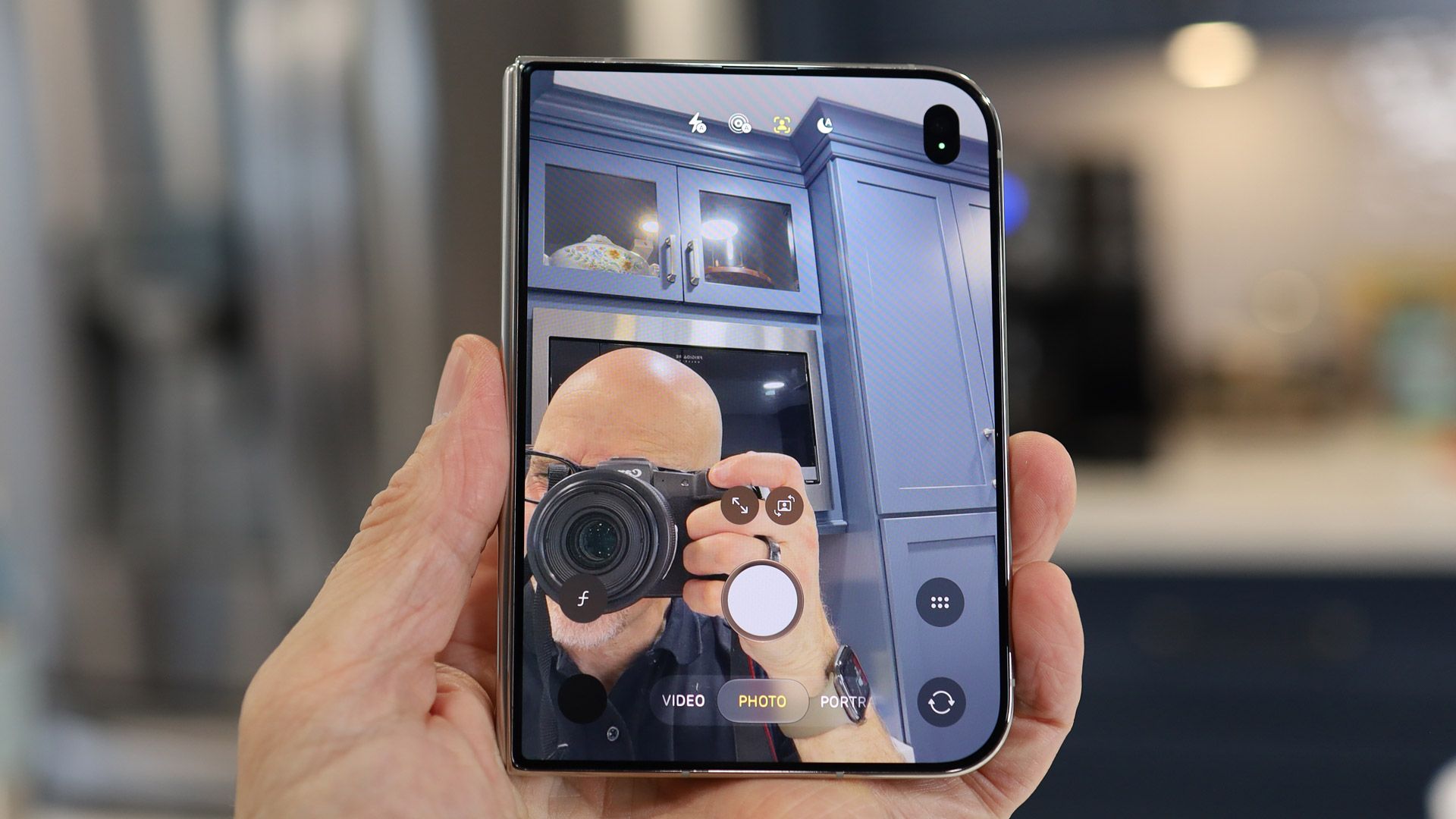
Similar to what we've seen on other foldable phones, Apple has included a camera mode, Duo Preview, that lets you use the best main or ultra-wide camera while still using the cover display as a viewfinder. It's a useful table-stakes feature that I'm glad Apple included, especially since the inner camera is so underpowered.

Apple says you get 2x effective optical zoom on the main camera, but that's a sensor crop. Yes, the pixels and image information will be real, but I prefer a proper zoom lens. To be fair, the iPhone Duo camera array is quite similar to the 50MP pair on the Galaxy Z Fold 8, which also lacks a telephoto lens.
Apple iPhone Duo REVIEW

(Image credit: Lance Ulanoff / Future)

I also used the cover screen Center Stage camera to shoot some portrait-mode selfies. They were, as you might expect, impressive (not the subject, just the brilliant bokeh).

The iPhone Duo's trio of high-quality cameras meets, in my estimation, the high watermark set by lenses on previous iPhones, including the iPhone 17 Pro (the 18 Pro models come with a variable aperture).


Apple iPhone Duo REVIEW
Lance Ulanoff / Future
Apple iPhone Duo REVIEW
Lance Ulanoff/ Future
Apple iPhone Duo REVIEW
Lance Ulanoff/ Future
Apple iPhone Duo REVIEW
Lance Ulanoff/ Future
Apple iPhone Duo REVIEW
Lance Ulanoff/ Future
Apple iPhone Duo REVIEW
Lance Ulanoff/ Future
Apple iPhone Duo REVIEW
Lance Ulanoff/ Future
Apple iPhone Duo REVIEW
Lance Ulanoff/ Future
Apple iPhone Duo REVIEW
Lance Ulanoff / Future
Apple iPhone Duo REVIEW
Lance Ulanoff / Future
Apple iPhone Duo REVIEW
Lance Ulanoff / Future
Apple iPhone Duo REVIEW
Lance Ulanoff / Future
Apple iPhone Duo REVIEW
Lance Ulanoff / Future
Apple iPhone Duo REVIEW
Lance Ulanoff / Future
Apple iPhone Duo REVIEW
Lance Ulanoff / Future
Apple iPhone Duo REVIEW
Lance Ulanoff / Future
Apple iPhone Duo REVIEW
Lance Ulanoff / Future
Apple iPhone Duo REVIEW
Lance Ulanoff / Future
Apple iPhone Duo REVIEW
Lance Ulanoff / Future
Apple iPhone Duo REVIEW
Lance Ulanoff / Future
Apple iPhone Duo REVIEW
Lance Ulanoff / Future
Apple iPhone Duo REVIEW
Lance Ulanoff / Future
Apple iPhone Duo REVIEW
Lance Ulanoff / Future
Apple iPhone Duo REVIEW
Lance Ulanoff / Future
Apple iPhone Duo REVIEW
Lance Ulanoff / Future
  • Camera score: 4.5 / 5

Apple iPhone Duo review: Software
Apple iPhone Duo REVIEW

(Image credit: Lance Ulanoff / Future)
  • An iOS tablet hybrid that somehow works
  • Dock position will split some
  • Split screen for multitasking
  • Third-party app support is a work in progress

With the iPhone Duo, iOS officially means multiple things. Where it was once a smartphone platform, it's now a multi-hardware-configuration operating system that can, depending on where it's installed, fork appropriately.

Instead of the iPhone Duo unfolding and converting into an iPad, it remains steadfastly an iPhone with tablet-like capabilities. This has resulted in some odd decisions on Apple's part, like hiding some of the ever-present status-bar information, including battery life, and rotating and moving the dock. Even the iPad doesn't put the dock on the right-hand side.

On the cover screen, the status bar and dock placement cut into screen real-estate for some apps and browser experiences; this is less of an issue on the larger inner screen.
Apple iPhone Duo REVIEW

(Image credit: Lance Ulanoff / Future)

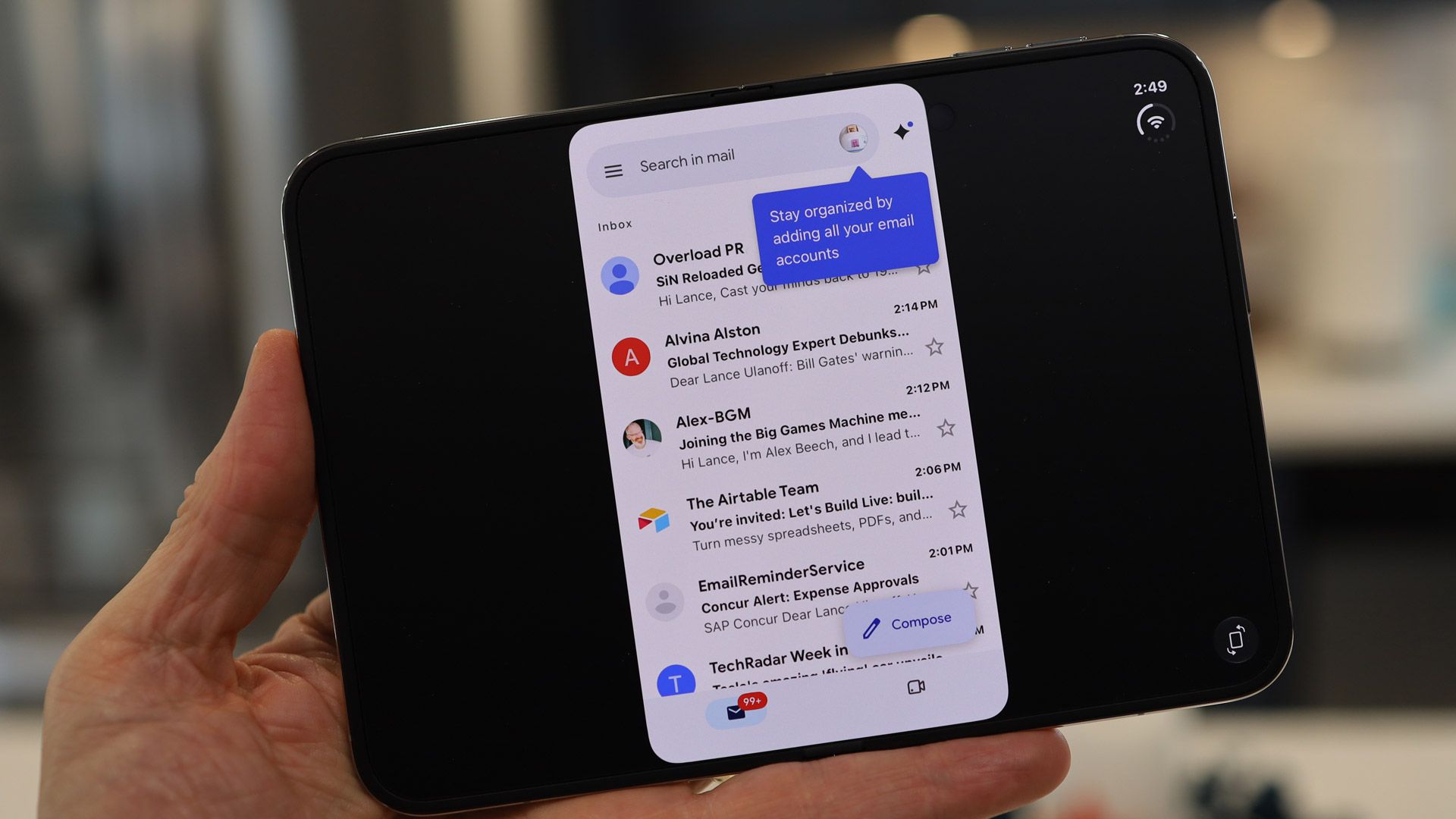
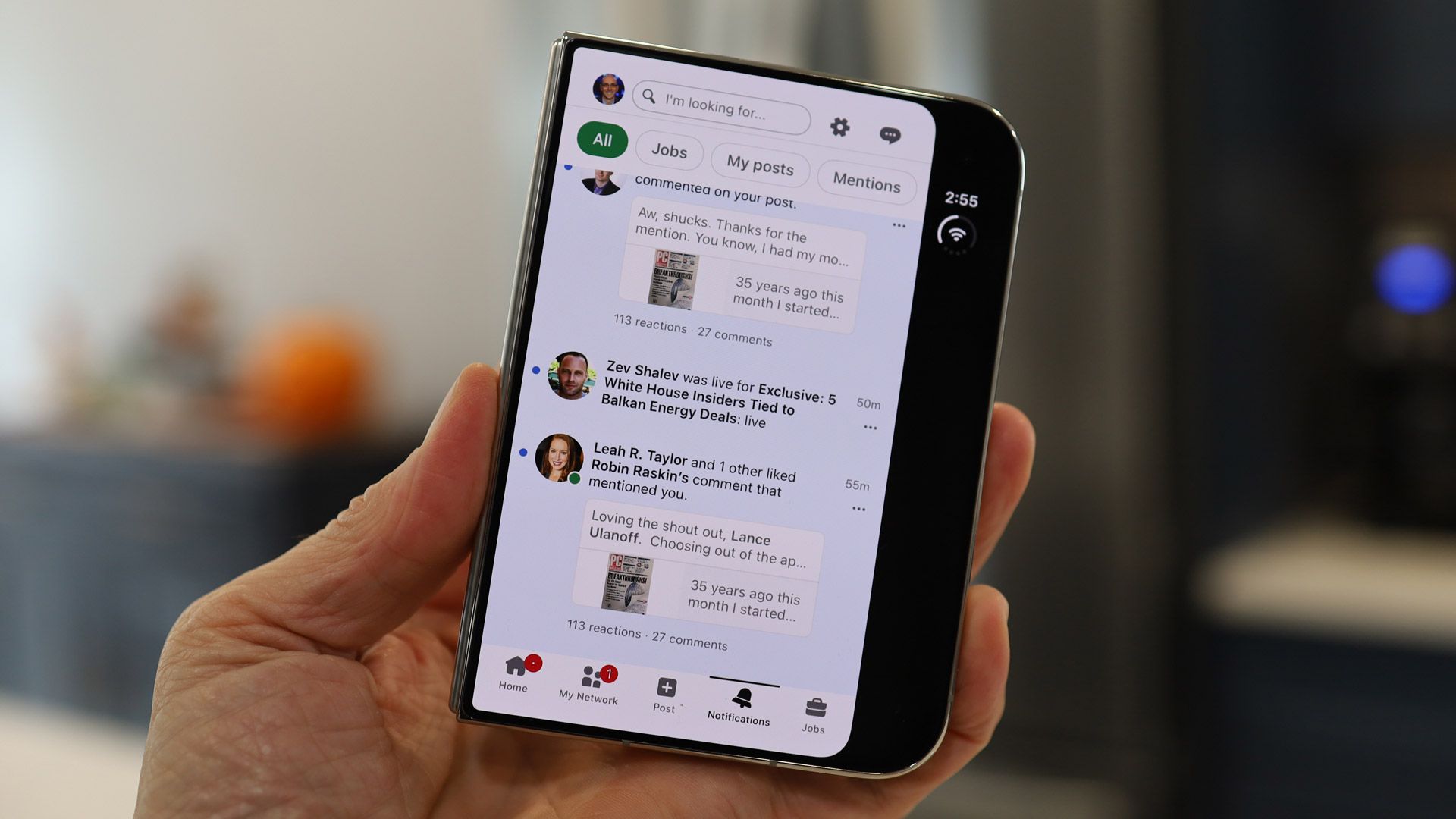
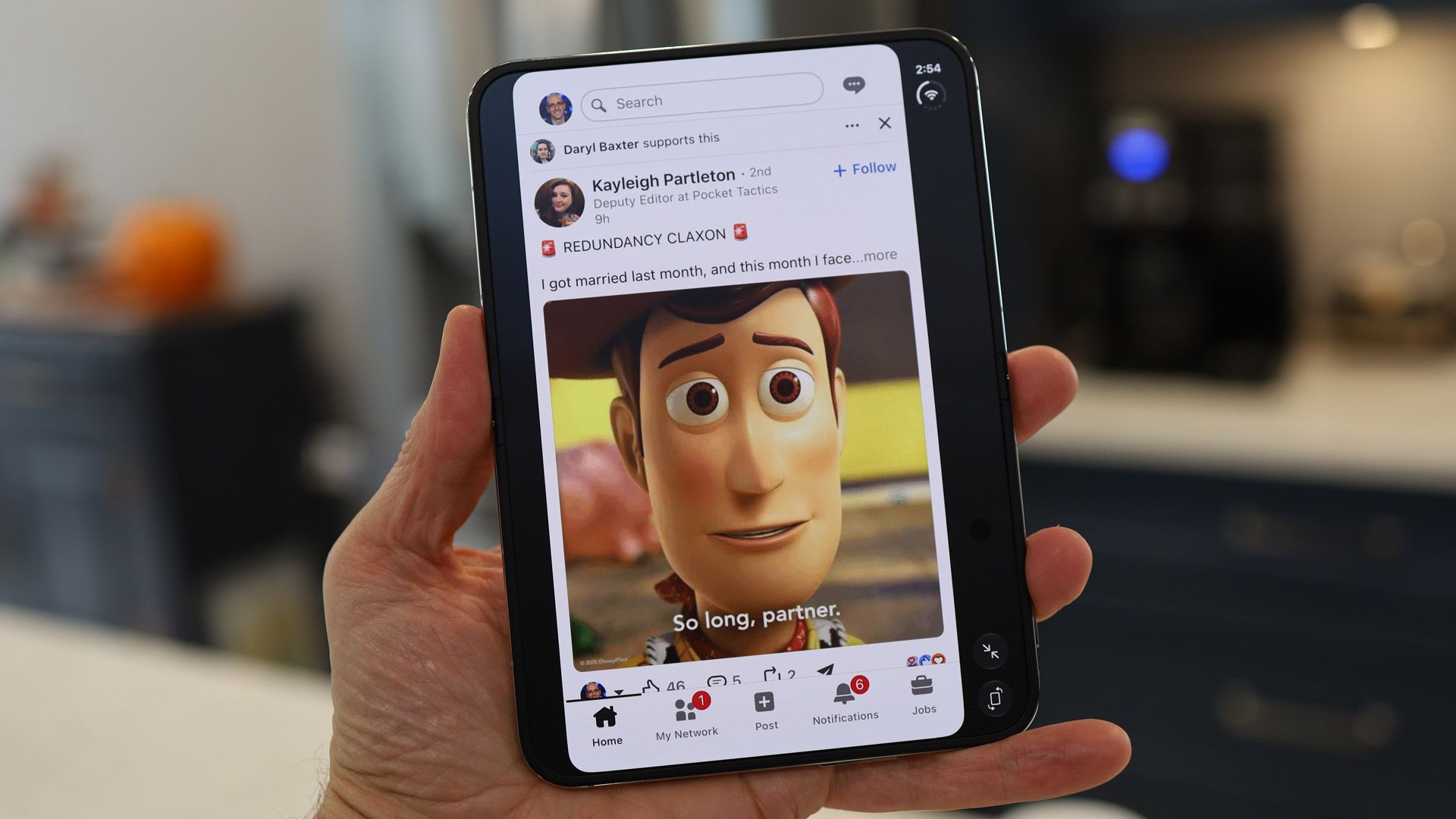
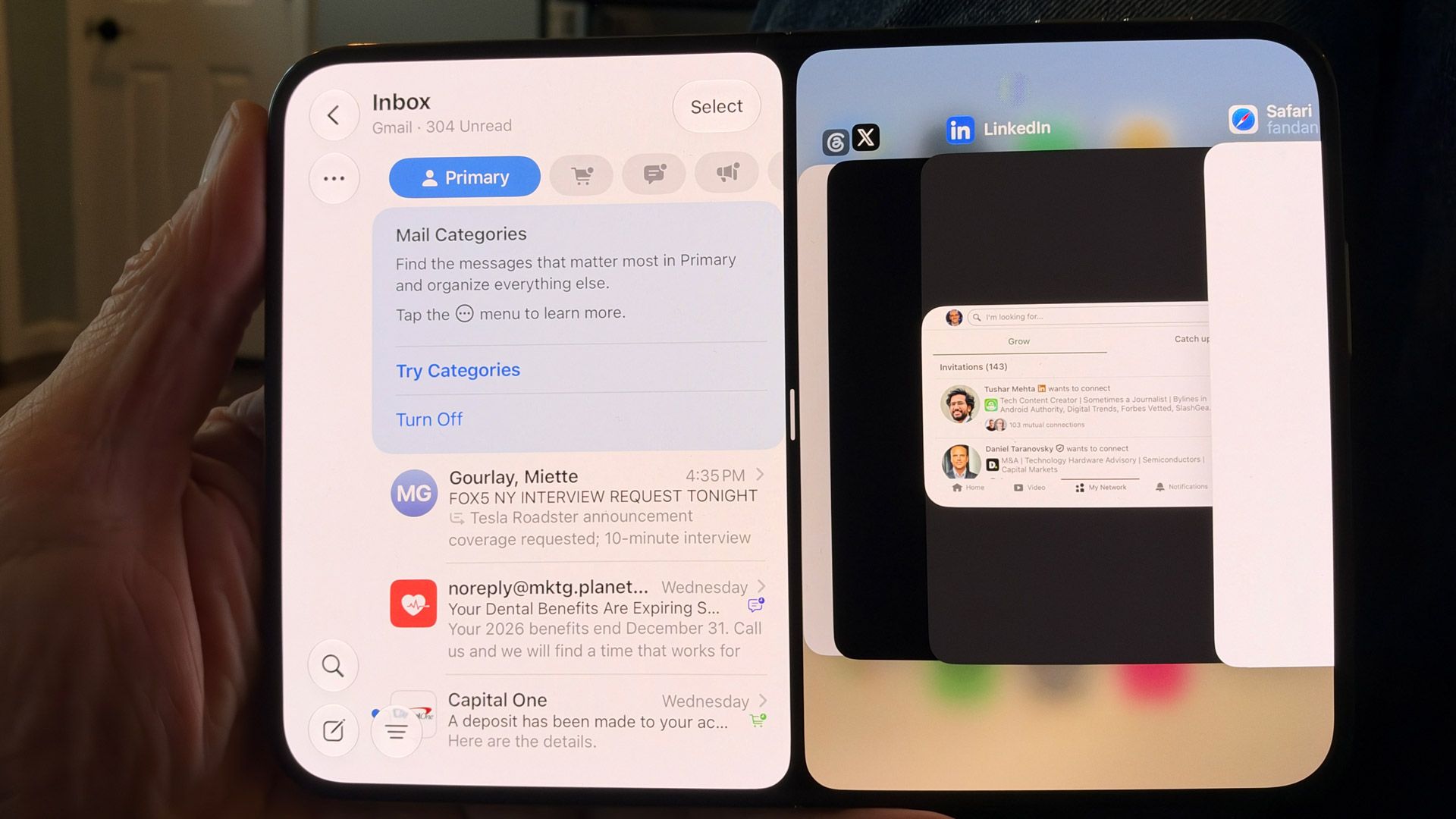
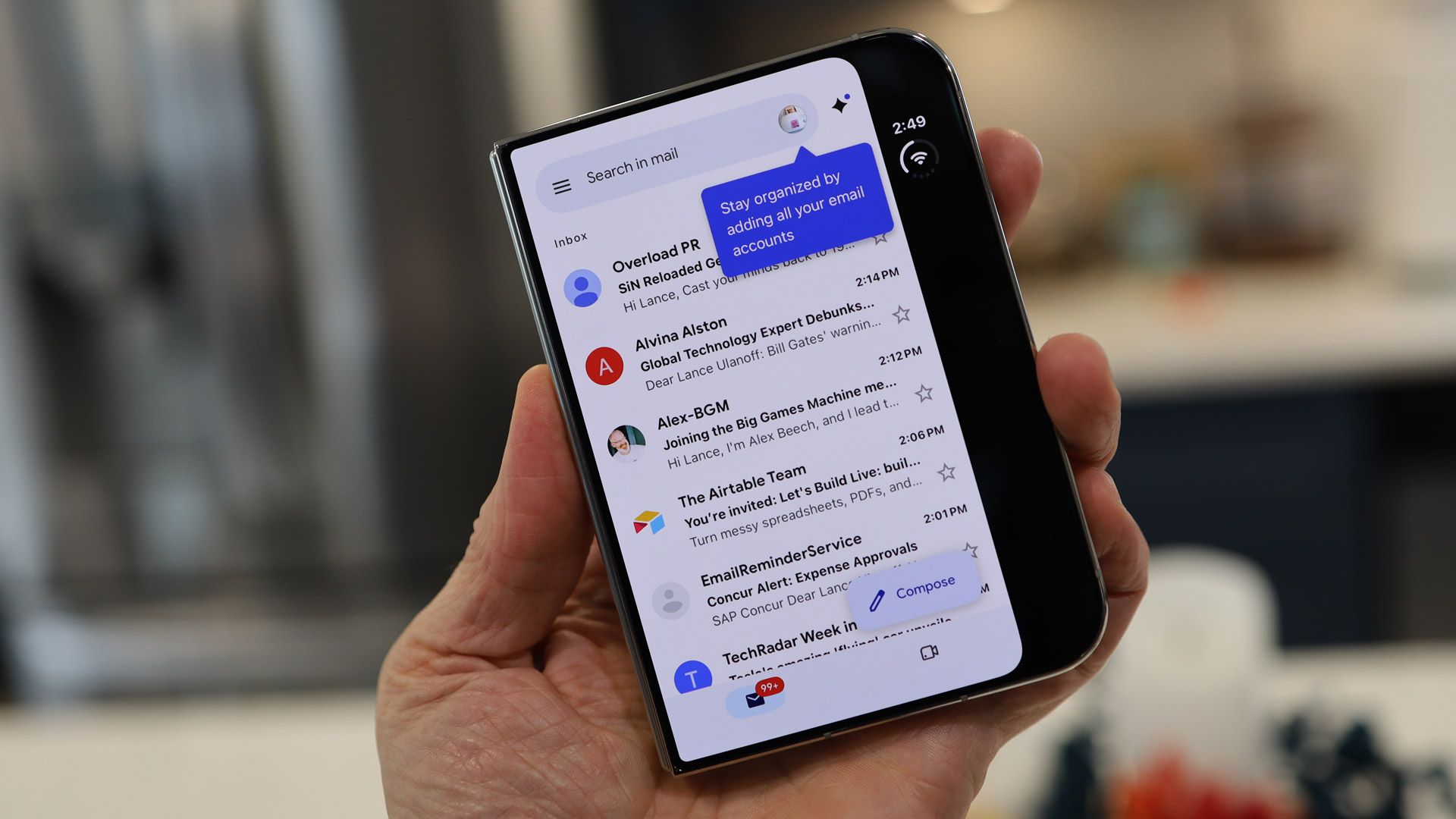
Since this is not pure-play classic iOS, there is some discontinuity in third-party app support. During my testing, Gmail and LinkedIn didn't look great. The former is stretched wide but doesn't fill the full depth of the display; LinkedIn floats in the middle.

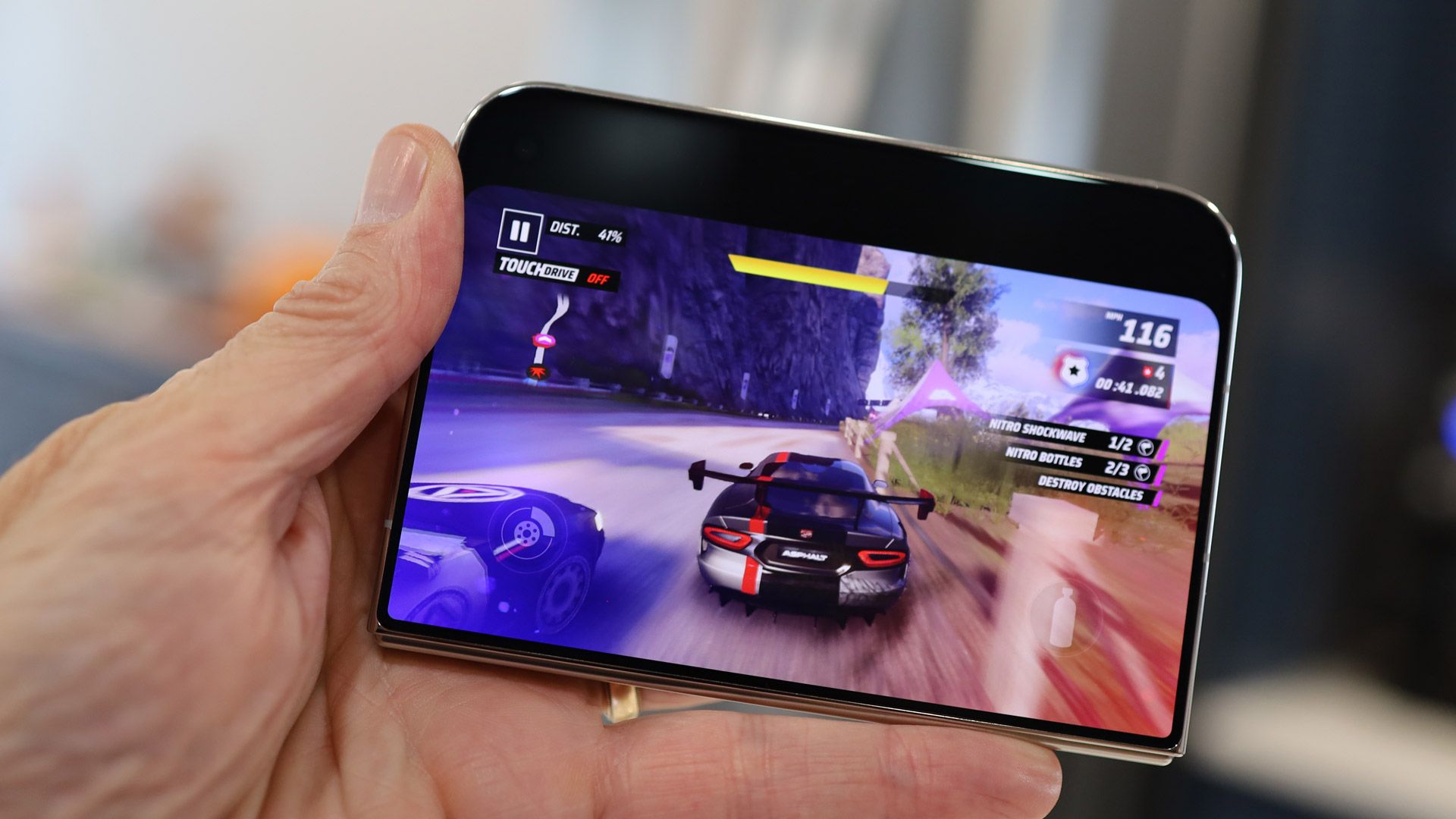
For unoptimized apps, I did have the option of using the very iPad-like 2x zoom icon, which stretched the app to fit more of the screen. In some instances, apps appeared to work, but some features were broken. When I played Asphalt Legends on the inner display, tilt-to-steer was broken, though it worked perfectly on the cover display.
Apple iPhone Duo REVIEW
Lance Ulanoff / Future
Apple iPhone Duo REVIEW
Lance Ulanoff / Future
Apple iPhone Duo REVIEW
Lance Ulanoff / Future
Apple iPhone Duo REVIEW
Lance Ulanoff / Future
Apple iPhone Duo REVIEW
Lance Ulanoff / Future
Apple iPhone Duo REVIEW
Lance Ulanoff / Future

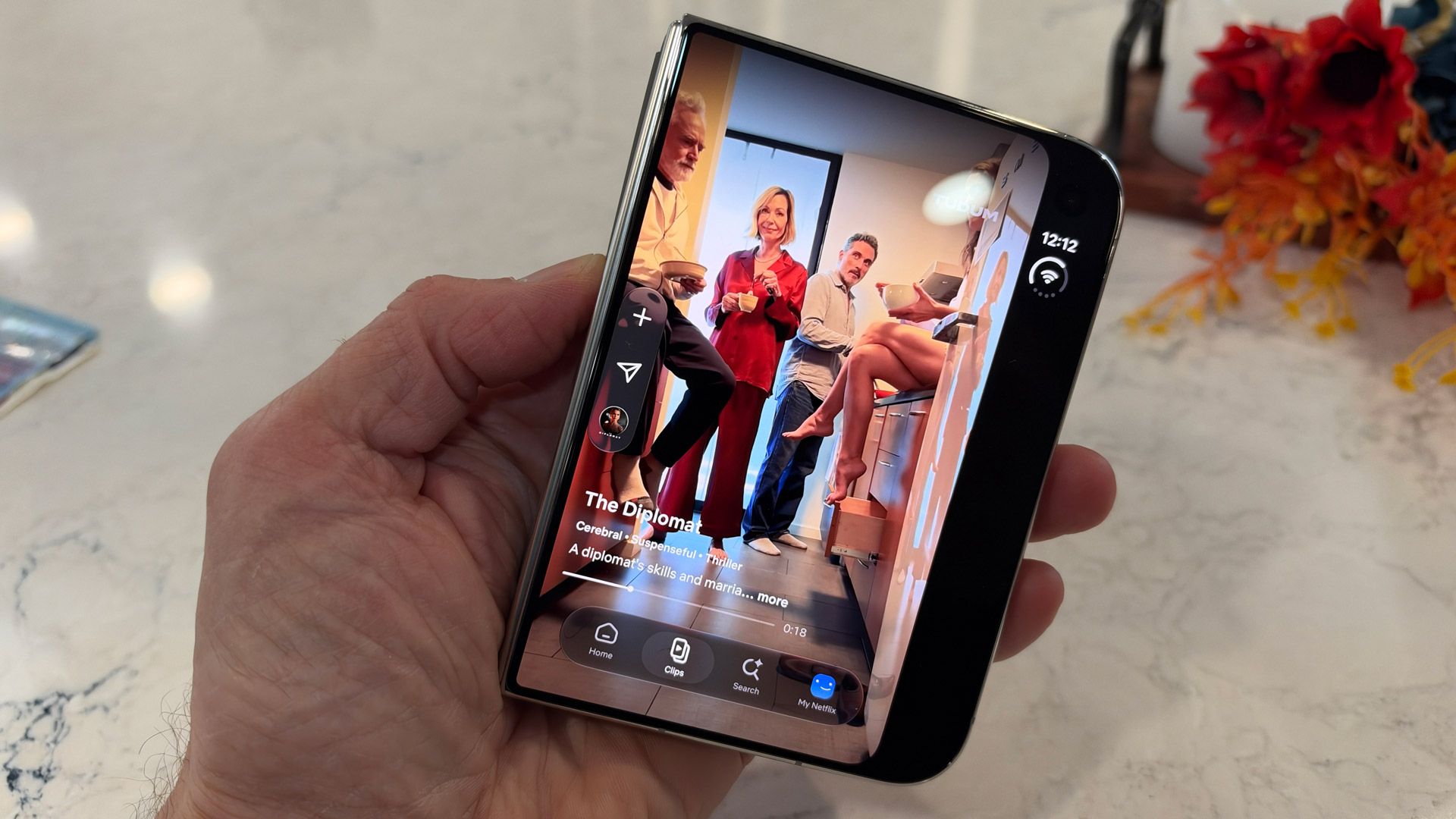
Some third-party apps, including Netflix (clips looked pretty good on the Cover display), and first-party apps like Safari and Messages, look great, and effectively use all the 7.6-inch display's real estate. There are even some apps that are already custom-designed to take advantage of the dual-display setup.
Apple iPhone Duo REVIEW
Lance Ulanoff / Future
Apple iPhone Duo REVIEW
Lance Ulanoff / Future

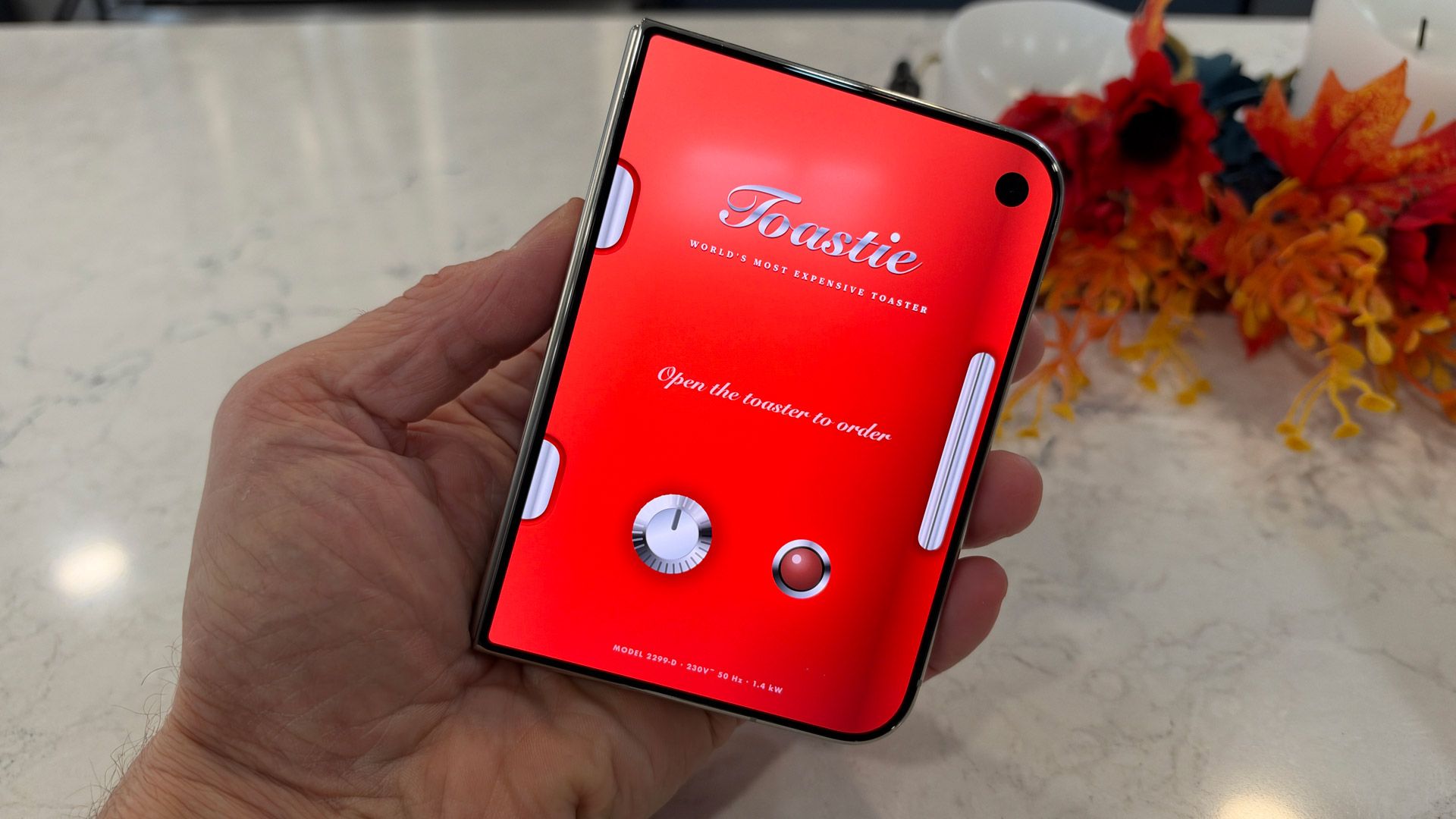
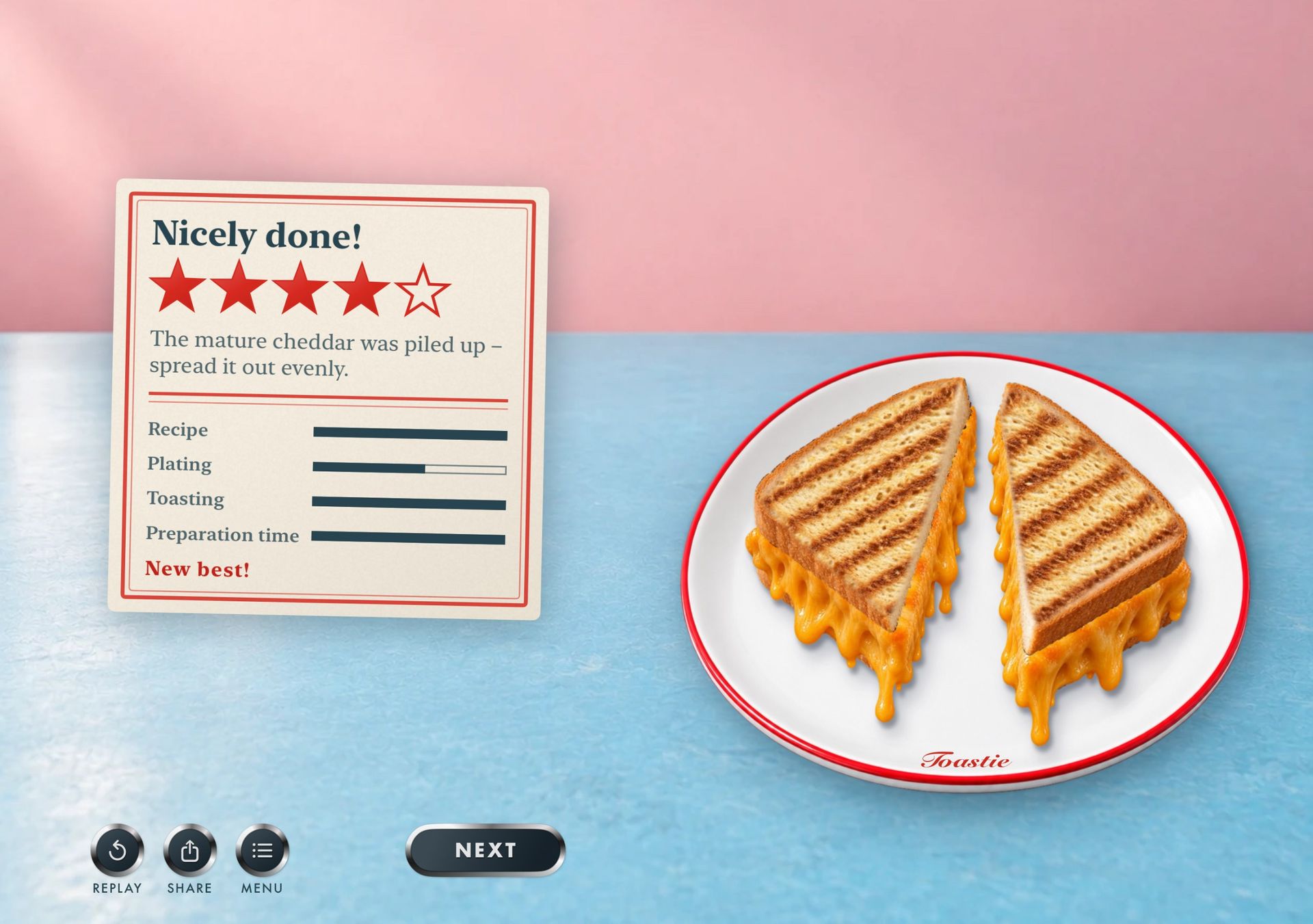
One of my favorites is a game called Toastie. On the inner screen, you butter your bread, add cheese and other ingredients, then hit grill, at which point you fold the phone closed, and it gently pulses for each second of cooking. You have to decide when to stop. To see your grilled cheese sandwich, you open the phone — I did this a half dozen times before I had a virtually edible sandwich.
Apple iPhone Duo REVIEW
Lane Ulanoff / Future
Apple iPhone Duo REVIEW
Lane Ulanoff / Future

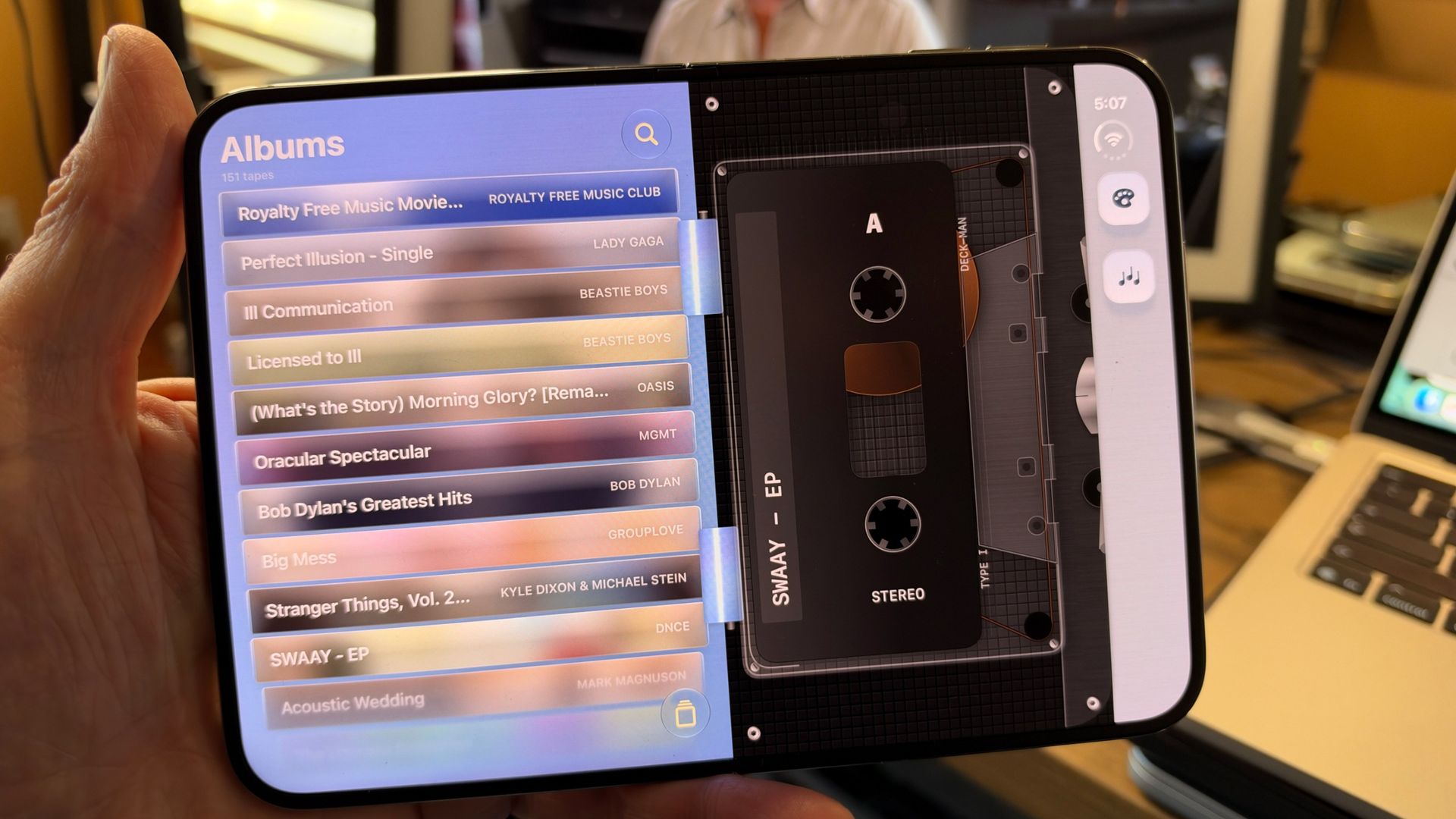
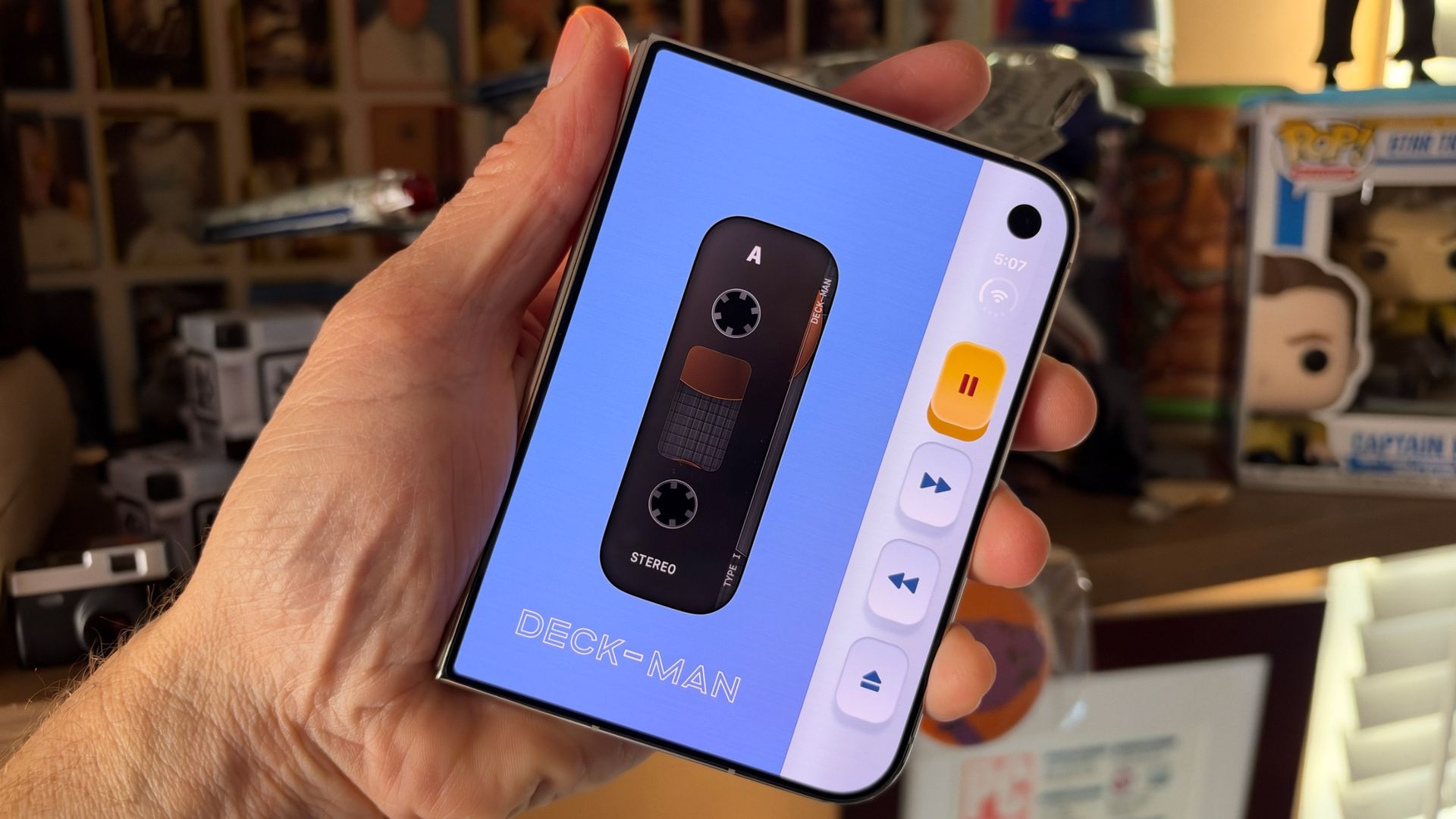
Deck-Man is also a cute concept; this turns your iPhone duo into a classic cassette tape player, complete with the static you hear when the player is on but not playing a tape. When the iPhone is open, you choose a cassette and virtually put it in the player, then you close the phone to access the player controls. I especially liked how "rewinding" the tape reproduced the classic sounds of a physical tape rewinding in an old-school player.

I also played Battle Fleet, which is a Battleship knockoff, and works well when you set up the phone in 90-degree opened desktop mode.

These are all clever apps, though I wouldn't argue that any are the Duo's 'killer app.'

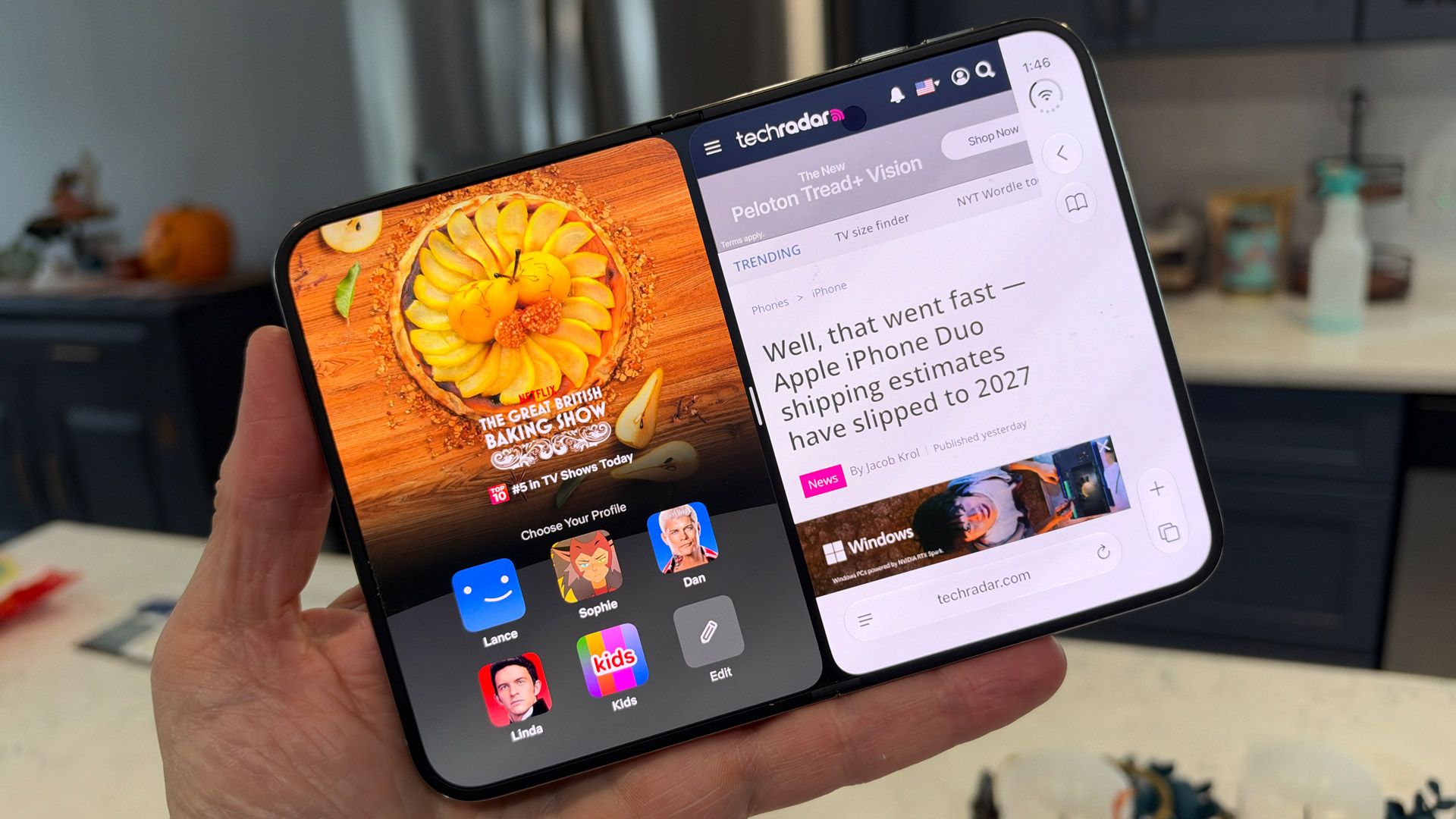
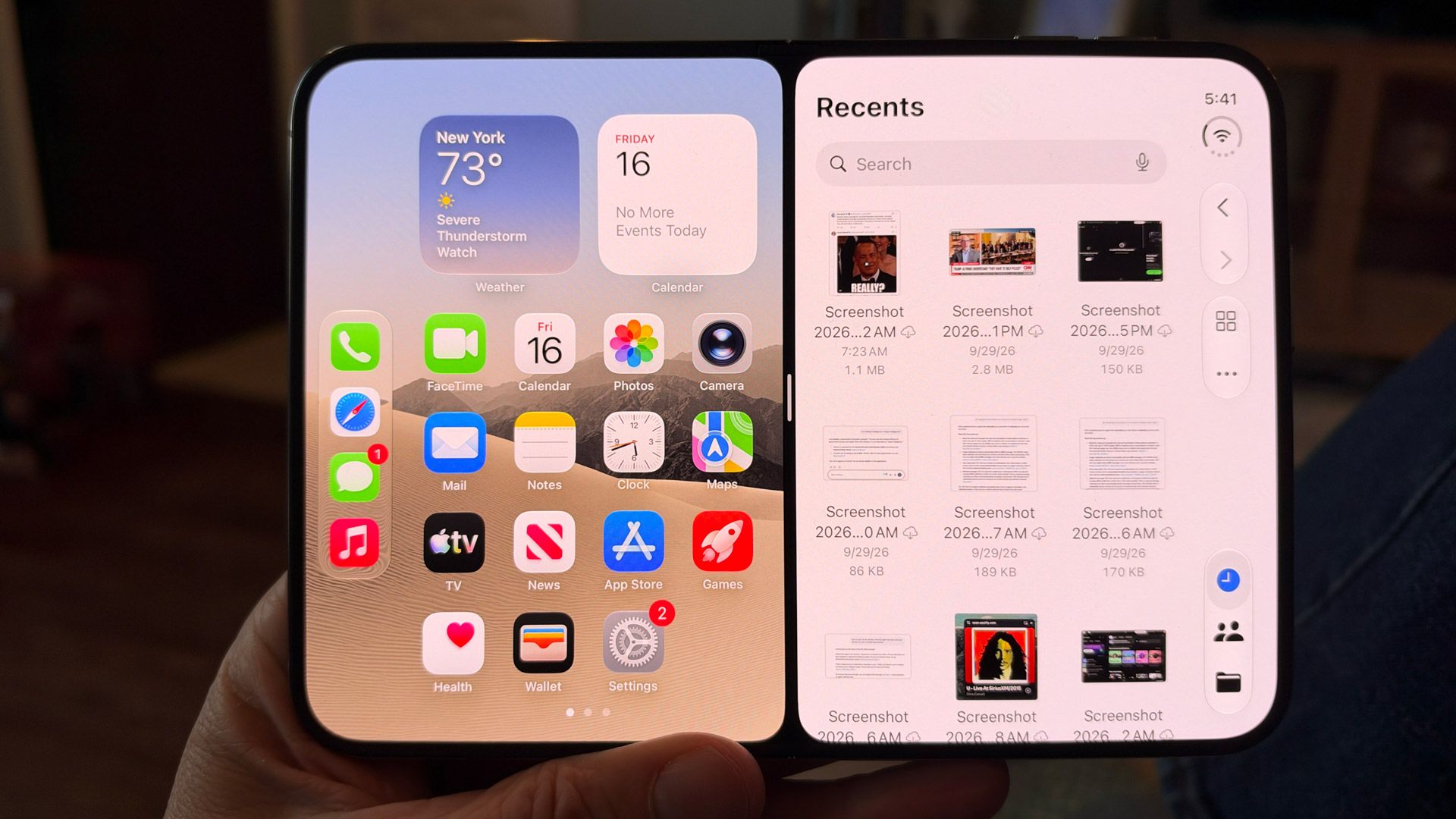
The 7.6-inch inner display is also a good canvas for multitasking. You split the screen by swiping up from the bottom of the display and slowly dragging an app left or right. Inside each pane, you can swipe up to choose a different app. I used this to have Messages and Safari side-by-side, and also for the drawing app Procreate on one side and a reference image from Safari on the left.
Apple iPhone Duo REVIEW
Lance Ulanoff / Future
Apple iPhone Duo REVIEW
Lance Ulanoff / Future
Apple iPhone Duo REVIEW
Lance Ulanoff / Future

Unlike on the Galaxy Z Fold 8, you can't run three apps, though the iPhone Duo will let you add picture-in-picture video on top of two apps you have open.

The iPhone Duo is a good showcase for Apple's growing AI ambitions. Siri AI now knows more about me and my smartphone, so when I ask if there are any emails I should know about, it automatically accesses 'Priority Mail' in the Mail app, and quickly starts reading off the first crucial message. Siri AI is better at maintaining context, so I don't have to restate myself, but it's still not foolproof. I asked Siri where I had been yesterday, and it showed me a picture of myself and listed my age. Siri AI should, though, get better as it continues to index my system.

In general, iOS 27, which is more customizable that ever, has useful widgets and more powerful AI features, and is the perfect platform for Apple's biggest iPhone design leap. It may not have all the design elements right, and the app support is lagging a bit behind, but these are all minor, and I think easily adjustable or fixable, issues.

  • Software score: 4.5 / 5

Apple iPhone Duo review: Performance
Apple iPhone Duo REVIEW
Lance Ulanoff / Future
Apple iPhone Duo REVIEW
Lance Ulanoff / Future
  • Powerful A20 Pro CPU
  • 12GB RAM
  • Smooth performance across the board

Apple smartly put the same CPU, the 2-nanometer A20 Pro, in the iPhone Duo as it did in the iPhone 18 Pro and Pro Max. As a result, the performance on its first foldable device is equally impressive. In Future Labs benchmark tests, the A20 Pro on an iPhone Duo beat the Galaxy Z Fold 8's Qualcomm Snapdragon 8 Elite Gen 5 for Galaxy in Geekbench 7 single- and multi-core tests, and it also edged out the Qualcomm chip in most of our graphics tests. None of this was by a wide margin, and I'd challenge anyone to notice the difference in real-world scenarios. Still, it's nice to know that the Duo is cooking with gas, just like its Pro counterparts.

In my experience, the iPhone Duo is fast and fluid. Speaking of which, it's fun to start with some third-party apps on the cover screen, and then flip open the iPhone Duo to see the virtually seamless graphics handoff from the smaller display to the larger one. It's both a software and performance feat that nothing stutters or stalls in the handoff process.

Apple iPhone Duo REVIEW

(Image credit: Lance Ulanoff / Future)

The larger inner screen will probably encourage many to try even tougher tasks, like editing 40K 60fps video. I used CyberLink PowerDirector to do so, and while the system and app handled the task fine, the non-optimized app couldn't properly fill the 7.6-inch display.

The back of the phone, near the camera bump, can get a little warm during gaming and other CPU-intensive operations, like recording the aforementioned 4K video, but not uncomfortably so.

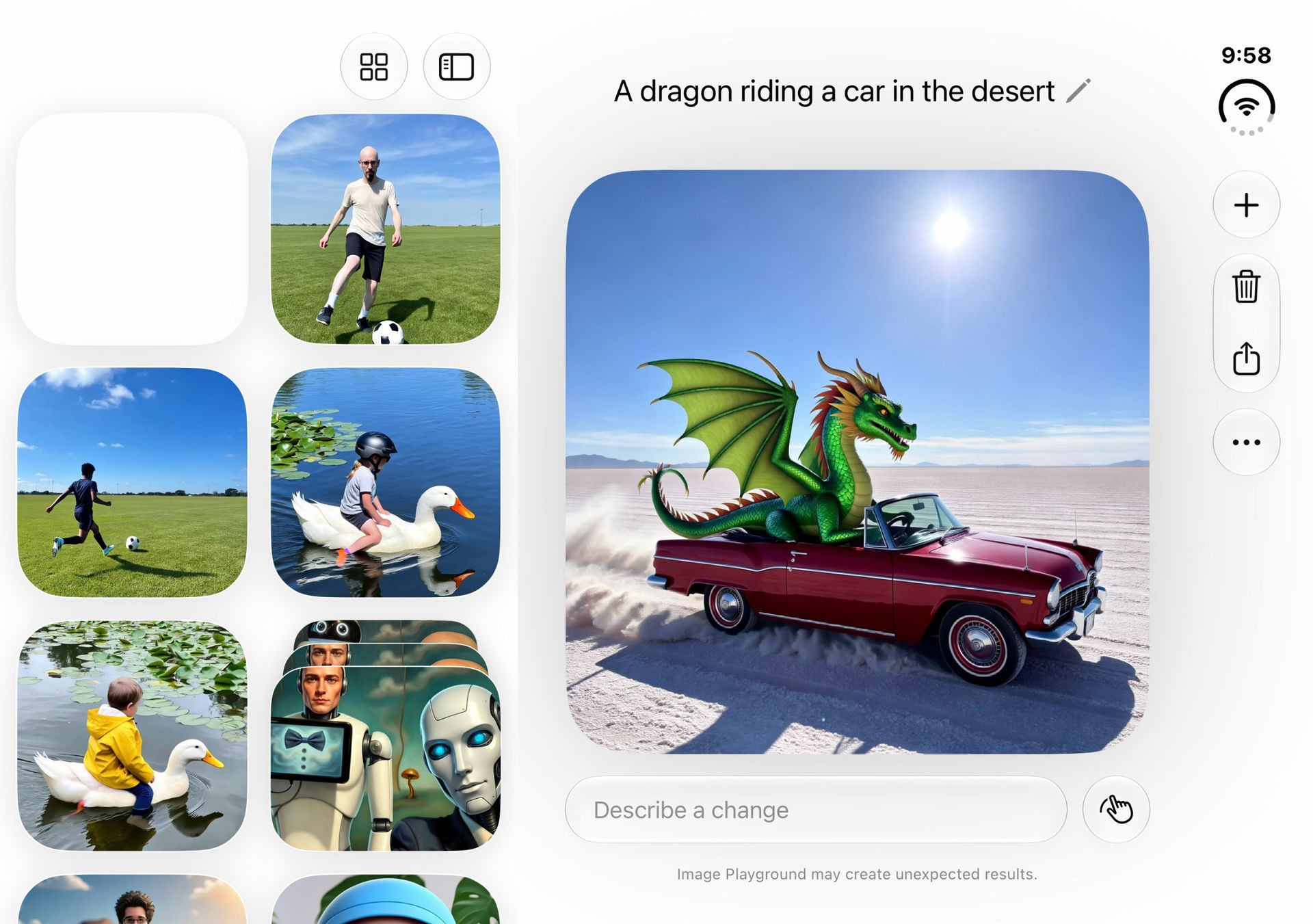
Apple's A20 and the 12GB of RAM on board seem well suited to local tasks like photo editing in Cleanup, and both realistic and fanciful image creation in Image Playground.


Apple iPhone Duo REVIEW
Apple's AI-powered image cleanup is getting really good. Look at how it removed this woman from a photo of my wife.Lance Ulanoff / Future
Apple iPhone Duo REVIEW
Lance Ulanoff / Future
Apple iPhone Duo REVIEW
You never know when you're going to need a dragon riding a car in the desert.Lance Ulanoff / Future

The iPhone Duo starts with 256GB of storage, which matches the Galaxy Z Fold 8. At this price, though, I think it should start with double that. You can expect strong connectivity across the board from the iPhone Duo. Inside is Apple's C2 modem for better 5G connectivity. Plus, there's support for WiFi 7, Bluetooth 6, and Messages via Satellite.

Apple iPhone Duo benchmark scores

Apple iPhone Duo

Geekbench 7.1 single-core

4007

Geekbench 7.1 multi-core

11363

3DMark Wild Life Extreme Unlimited

7171

3DMark Wild Life Extreme (fps)

45.3

3DMark Solar Bay Unlimited

16496

3DMark Solar Bay Unlimited (fps)

6.3

  • Performance score: 5 / 5

Apple iPhone Duo review: Battery

  • Solid all-day battery life
  • Fast wired charging

Apple reportedly squeezed a fairly large, almost 5,000mAh, battery into the iPhone duo, and is promising some pretty impressive battery-life numbers based on fairly specific types of usage. Video playback, which doesn't rely all that much on energy-draining resources, can, Apple claims, go for an eye-watering 44 hours, or 31 hours on the larger inner display.

In more varied use, Apple is claiming a full day of battery life on a charge. In my real-world tests I got around 14 hours, and in our more stringent Future Labs tests, we got 13 hours. That's commendable performance, but not as good as what the same Future Labs tests show for the Samsung Galaxy Z Fold 8, which managed 14.33 hours.

I still think the iPhone Duo's numbers are good, especially because my experience was easily cruising through a full day of phone activities, without any concern that I needed to plug in.

The phone supports fast charging and, with a 45W charger, I charged to 60% in 30 minutes. The MagSafe back also supports fast wireless charging.

  • Battery score: 4.5 / 5

Should you buy the Apple iPhone Duo?

Apple iPhone Duo scorecard

Attributes

Notes

Rating

Value

Most expensive iPhone ever but it's truly a two-in-one device and few will pay the full price upfront anyway, especially with the new leasing option.

4 / 5

Design

Beautifully designed and engineered foldable that makes the hinge and, virtually, hinge disappear. Wish it was thinner and lighter.

4.5 / 5

Displays

Sharp cover dsispl;ay and brilliant inner display that hides the crease and offered a beautiful matte finish. Everything looks good on it

4.5 / 5

Camera

Two strong 48MP lenses and an above average Center Stage selfie camera that all produce top-notch images. The inner camera is best for FaceTime only and we miss a true telephoto.

4.5 / 5

Software

Apple shows how iOS can also be a tablet platform without losing its iPhone essence. Siri AI is starting to live up to its promise. We need more app support and not a huge fan of Status and Dock placement.

4.5 / 5

Performance

An excellent A20 Pro CPU helps the iPhone Duo live up to its promises. There are zero lags, even when playing console-level games

5 / 5

Battery

All day battery life is virtually assured.

4.5 / 5

Buy it if...

You've been waiting for Apple to enter the folding race
The iPhone Duo is pretty much everything you want or could dream of from a folding iPhone

You want two screens but also cuter and pocketable
The iPhone Duo might be thicker and heavier than a Galaxy Z Fold 8, but it's right-sized for small hands and smaller pockets, and while the Galaxy Z Fold line is all flat edges and sharp corners, the iPhone Duo has curves.

You don't want to see a crease
Apple now holds the crown for best crease concealer, hiding it under nano texture finish that makes it almost impossible to spot the crease unless you really look for it.

Don't buy it if...

You want an affordable smartphone
The iPhone Duo is not just the most expensive iPhone; it's more expensive than the Galaxy Z Fold 8. Either way, think carefully before buying; not everyone needs two displays in one device.

You want a telephoto camera
The iPhone Duo's main camera promises 2X optical equivalent zoom, but that's a sensor crop, which means there's no dedicated telephoto camera.

Apple iPhone Duo review: Also consider

Samsung Galaxy Z Fold 8

Samsung has adapted familiar elements to make a phone that's ready to fit your lifestyle with its practical size, excellent screens, and plenty of software and performance potential. It’s still costly, and the lack of some features seems extra disappointing given the price, but what’s here gels together in a wonderfully cohesive way.

Read our full Samsung Galaxy Z Fold 8 review

Motorola Razr Plus 2026

This is currently our best flip-style foldable pick, and it might be the better device for you if you're looking for a foldable that can go the distance with its battery, and don’t mind only having a standard-sized phone screen when you open it up.

Read our full Motorola Razr Plus 2026 review

Samsung Galaxy Z Fold 8 Ultra

Considering the minimal price difference, you might be better off saving a little extra money and getting the full-fat fold experience with more screen space, a telephoto camera, and a longer-lasting battery. The Z Fold 8 Ultra isn't as well-suited to video, though.

Read our full Samsung Galaxy Z Fold 8 Ultra review

Apple iPhone Duo

Samsung Galaxy Z Fold 8

Motorola Razr Plus 2026

Samsung Galaxy Z Fold 8 Ultra

Price (at launch):

From $1,999 / £1,999 / AU$3,499

From $1899, £1699, AU$2699

$1,099, £1,000

From $2,099 £1,899. AU$2,999

Dimensions:

Unfolded: 164.6 x 117.8 x 5.2 mm, Folded: 84.1 x 117.8 x 11.3 mm

Unfolded: 161.4 x 123.9 x 4.5mm, Folded: 81.9 x 123.9 x 9.7mm

Unfolded: 2.9 x 6.7 x 0.3 in

Folded: 3.5 x 2.9 x 0.6 in

Unfolded: 158.4 x 143.2 x 4.1mm, Folded: 158.4 x 72.8 x 8.9mm

Weight:

254g

201g

189g

215g

Displays:

Main: 7.6-inch Super Retina XDR, Cover: 5.4-inch Super Retina XDR

Main: 7.6-inch Dynamic AMOLED 2X, Cover: 5.5-inch Dynamic AMOLED 2X

Main: 6.9-inch AMOLED, Cover: 4-inch AMOLED

Main: 8-inch Dynamic AMOLED 2x, Cover: 6.5-inch Dynamic AMOLED 2X

Resolution:

Main: 1878 x 2670, Cover: 1398 x 2034

Main: 2448 x 1848, Cover: 1972 x 1248

Main: 1084 x 2640, Cover: 1272 x 1080

Main: 2256 x 2504, Cover: 1080 x 2520

Refresh rate:

1-120hz

1 - 120Hz (main and cover)

1 - 165 Hz (main and cover)

1 - 120Hz (main and cover)

Peak brightness:

3,000

3,000 nits (main and cover)

Main: 3,000 nits, Cover: 2,400 nits

3,000 nits (main and cover)

Processor:

A20 Pro

Snapdragon 8 Elite Gen 5 for Galaxy

Qualcomm Snapdragon 8s Gen 3

Snapdragon 8 Elite Gen 5 for Galaxy

RAM:

12GB

12GB, 16GB (1TB model only)

12GB

12GB, 16GB (1TB model only)

Storage:

256GB, 512GB, 1TB, 2TB

256GB, 512GB, 1TB

256GB

256GB, 512GB, 1TB

OS:

iOS 27

Android 17 with One UI 9

Android 16

Android 17 with One UI 9

Cameras:

48MP wide (f/1.6), 48MP ultra-wide (f/2.2)

50MP wide, 50MP ultra-wide

50MP main, 50MP ultra-wide

200MP wide, 50MP ultra-wide, 10MP telephoto

Selfie cameras:

11MP Center Stage camera (f/2.2) outer, 4MP (f/1.8) inner

10MP inner, 10MP outer

32MP

10MP inner, 10MP outer

Battery:

Approximately 4,800mAh

4,800mAh

4,500mAh

5,000mAh

Charging:

60W wired, 35W wireless

45W wired, 20W wireless

45W wired, 15W wireless

45W wired, 20W wireless

Colors:

Star White, Night sky

Lavender, Graphite, Cream, Mint (Samsung Store exclusive)

Pantone Mountain View

Violet Shadow, Graphite, Cream, Green Shadow (Samsung Store exclusive)

How I tested the Apple iPhone Duo

Why you can trust TechRadar

☑️ 100s of smartphones reviewed
☑️ 15 years of product testing
☑️ Over 16,000 products reviewed in total
☑️ Nearly 200,000 hours testing tech

I used the iPhone Duo for almost a week for everything from social media to Slack and email. I perused websites, watched videos, played games, followed maps and turn-by-turn directions, and took photos. In short, I tried ot use it as my primary device

Read more about how we test

First reviewed October 2026
  •  

Forget AI ending humanity; what people are really worried about is AI taking their jobs — even if that's not exactly what's happening

The narrative that AI might end humanity in a decade has monopolized public discourse, so much so that we may be ignoring more prosaic, immediate AI concerns like jobs.

I'm neither an AI doomer nor a booster. I believe generative AI has tremendous potential, especially for helping us solve our most difficult problems, like cancer and maybe resources and climate change. I'm also a realist and know that AI development and growth are clearly outstripping our ability to properly manage it.

We should never have a situation where we do not know how or why an AI did something. The Hugging Face incident should be a call to action. In lieu of regulation (which the White House will block), self-regulation with third-party oversight is in order.

The reality, though, is that AI development is unlikely to slow down or stop. The consequences will keep coming, and people have feelings.

Job worries are so real

Earlier this year, a Pew Research study found that more than half of people under 30 are more concerned than excited about AI. The number hasn't jumped wildly in recent years, but contrast that with the rapidly shrinking number of people who are "More excited than concerned" about AI (down from 11% in 2024 to 9% in 2026). The middle group of those who balance concern with excitement also shrank a bit to 37% of those surveyed. That same survey also found that 71 percent of Americans believe AI will lead to fewer jobs over the next 20 years (if doomers are right, this may be less of a worry).

Those sentiments are now echoed by a new Gallup Work and Education survey, which found a sharp rise in the number of college graduates who fear tech job displacement (jumping from 25% to 29% in one year).

Gallup already found rising fears of AI job displacement going back to 2023 when the "concern among college graduates rose sharply, from 8% in 2021 to 20% in 2023, as generative AI tools such as ChatGPT emerged."

College graduates' concerns spiked again in the last year, with 29% worried tech will make their jobs obsolete.

More concerning is that the fears are really rising among those set to enter the workforce. Gallup notes that while people like me (over 50) are relatively steady in these concerns, anxiety among workers ages 18-to-44 has risen sharply (more than a third of them have these fears).

Whats really happening with jobs and AI?

The Gallup report notes, though, that the fears still appear to be outpacing real-world events. People are not necessarily losing their jobs to AI, at least not yet. But a recent New York Times story noted that there have been other, more subtle changes.

In roles where AI is helping automate some tasks, workers are losing the leverage to push for raises. Looked at another way, whether or not you tell them, your boss knows that you or others in your department are or can use AI and is acting accordingly. You are not yet replaceable, but are also no longer irreplaceable thanks to AI. And while people aren't necessarily losing their jobs, hiring for some knowledge-worker roles may be slowing.

Basically, the world people are worrying about, one where AI outright takes your job, is maybe somewhat hyperbolic. AI is already a coworker in many places, and it does its job, if not for free, then at a far reduced rate and, often, in less time — if you don't count the double-checking people should be doing when looking at AI work.

AI may be changing the entire complexion of work, which means these young people are right to be concerned, because it's hard to describe the workplaces they'll be entering and how their workdays alongside Gemini, ChatGPT, and Claude might unfold.

Sure, the question of whether or not AI will end up ending us by 2036 is a valid one, but there are the real-time changes happening in our everyday lives that could have the most immediate impact. I wonder if and how we're dealing with those and if anyone is thinking about how to preprare and and reassure the next generation of workers.

  •  

Now we know which iPhone Apple really wants you to buy, and John Ternus gave us the key

It's an unusual Apple iPhone season. Not since the early days of the iPhone almost 20 years ago have we seen such a limited lineup. No base model, no super thin model, no plus model, no mini model. Instead, we have two powerful Pro models and the unusual, foldable iPhone Duo. Without all of Apple's typical next-gen iPhone cards on the table, you might think even Apple would be struggling with how or where to steer consumers. Now, though, thanks to Apple CEO John Ternus, we know exactly which iPhone Apple hopes you buy.

It's the iPhone Duo, okay?

Apple hasn't and honestly wouldn't say this, but sometimes it only takes a subtle signal or simple choice to reveal what should've been obvious in the first place.

On Monday night, amid the Hollywood glitz and glamour of the 78th Primetime Emmys, newly minted Apple CEO John Ternus stood on the red carpet. Looking spiffy and maybe a bit uncomfortable in his tuxedo, with multiple microphones stuck in his face, Ternus fielded questions about Apple TV's incredible seven-year run and vast trove of awards for shows like Shrinking and the freshman Windows Bay, which garnered more season 1 Emmys than any other show before it.

He produced it like magic

Then a Deadline reporter started asking about the new phones. Without hesitation, Ternus pulled the stunning new iPhone Duo from his breast pocket as the reporter squealed with delight.

I guess she could be forgiven for her over-the-top reaction. After all, since Apple unveiled its first folding phone as the "one more thing" during Apple's "Surprise & Shine" iPhone event, not much has been seen of the passport-sized handset. It's shipping almost a month after the iPhone 18 Pro and iPhone 18 Pro Max, the only other new iPhones on offer right now.

And yet, here was Ternus, carrying it as, it seems, his phone of choice. Or at least the one he chose for that night. I guess he could've demurred when the reporter asked and pulled out a burgundy iPhone 18 Pro, but he didn't.

It was hard to hear what Ternus said over the reporter's screams, but I think it was "there we go...look at that," as he unfolded the phone to show off the unusual matte and virutally creasless display.

Doing so, on one of the entertainment world's biggest stages, was surely a calculated choice. Apple is steering all eyes toward its $1999 iPhone Duo.

You might say it's a craven attempt to garner more revenue via the pricey handset, but I think something else is at work here.

Why Apple needs to try harder with the Duo

With its late entry into the folding space, Apple is taking a risk. It's calculated, but still a risk. The foldable phone market is tiny, and most of it is owned by Samsung, which has a wide array of folding devices in shapes from the basic Flip to the larger and more powerful (at least camera-wise) Galaxy Z Fold 8 Ultra. It also has a passport-sized Galaxy Z Fold 8.

Apple isn't the first, and we still haven't decided whether it is the best. Still, how often has Samsung had the opportunity to show off its hardware at a big consumer entertainment event ostensibly watched by millions?

Well, it has been pushing its newest foldables in Spider-Man: Brand New Day, but in the action film, the phones are featured but not addressed in any real way. No one plays with them on camera to show off new features.

What would Samsung have done?

I do recall, though, when Samsung sponsored the 2014 Oscar telecast and handed out Samsung phones to celebrity audience members. With one of those phones, Ellen took one of the most famous, fame-filled selfies of all time. Even so, that sold people on social media and not the Samsung Galaxy phone.

This Emmy's opportunity was different. You had a willing and tech-obsessed reporter and Ternus, who just so happened to have their newest and most important Apple product in his pocket. There's little chance she would've asked, and he would've presented it, if he were only carrying the iPhone 18 Pro.

That wasn't the only moment where someone mentioned the foldable phone to Ternus. Another entertainment reporter called it the "Flip," and Ternus let it pass (notably without producing the phone). For Apple, it was a golden opportunity to steer consumers toward the new iPhone form factor and give it an even better chance of success.

I know, it was just a few seconds and by no means a true commercial for the iPhone Duo, but give Ternus credit for making the most of it and sending a clear signal of where Apple hopes you spend your next iPhone dollars.

  •  

'I love this place; it's in my blood. Goosebumps'; John Ternus on how he felt when he learned he was becoming Apple CEO, and why AI may be the key to future Apple innovation

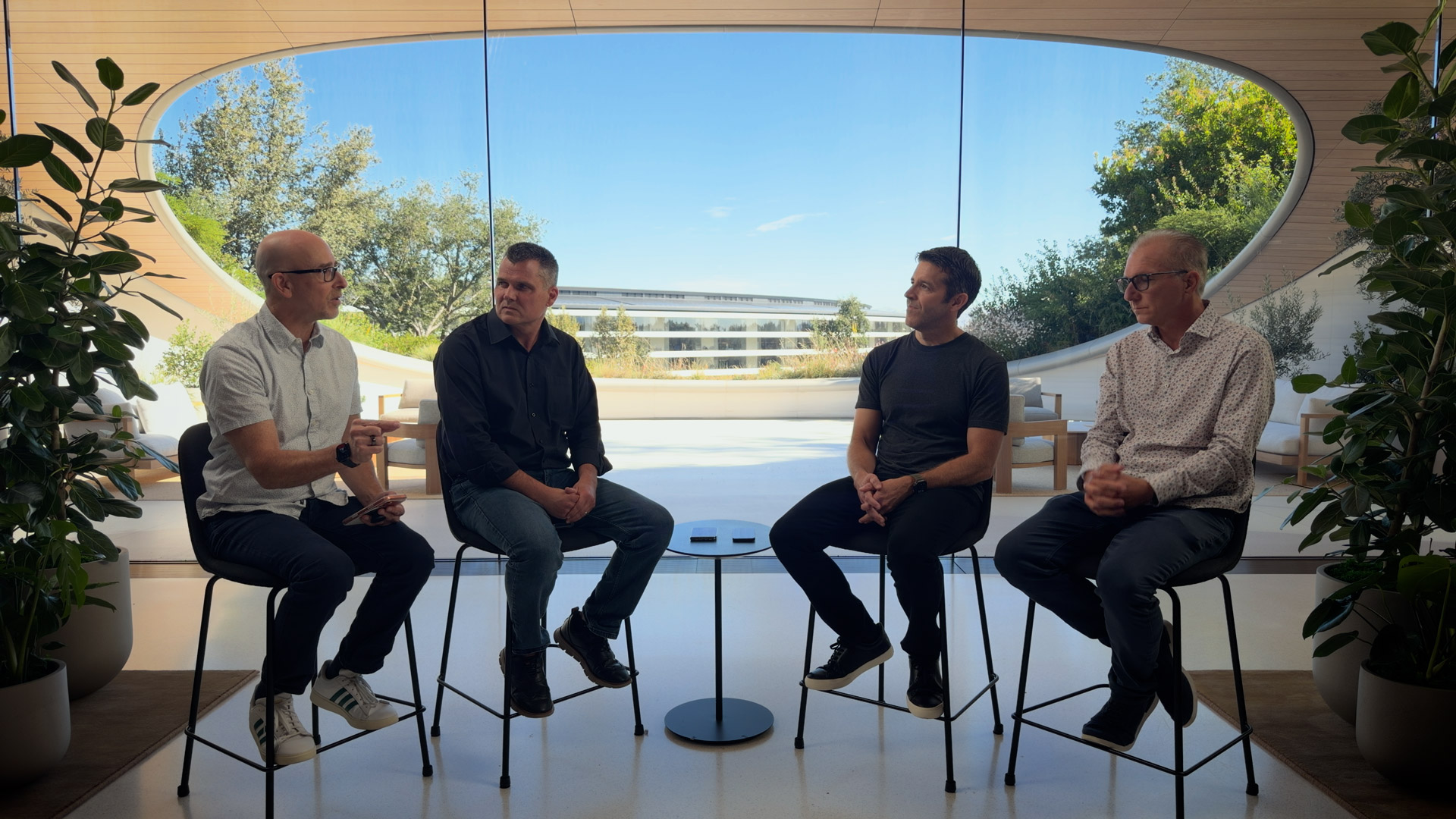
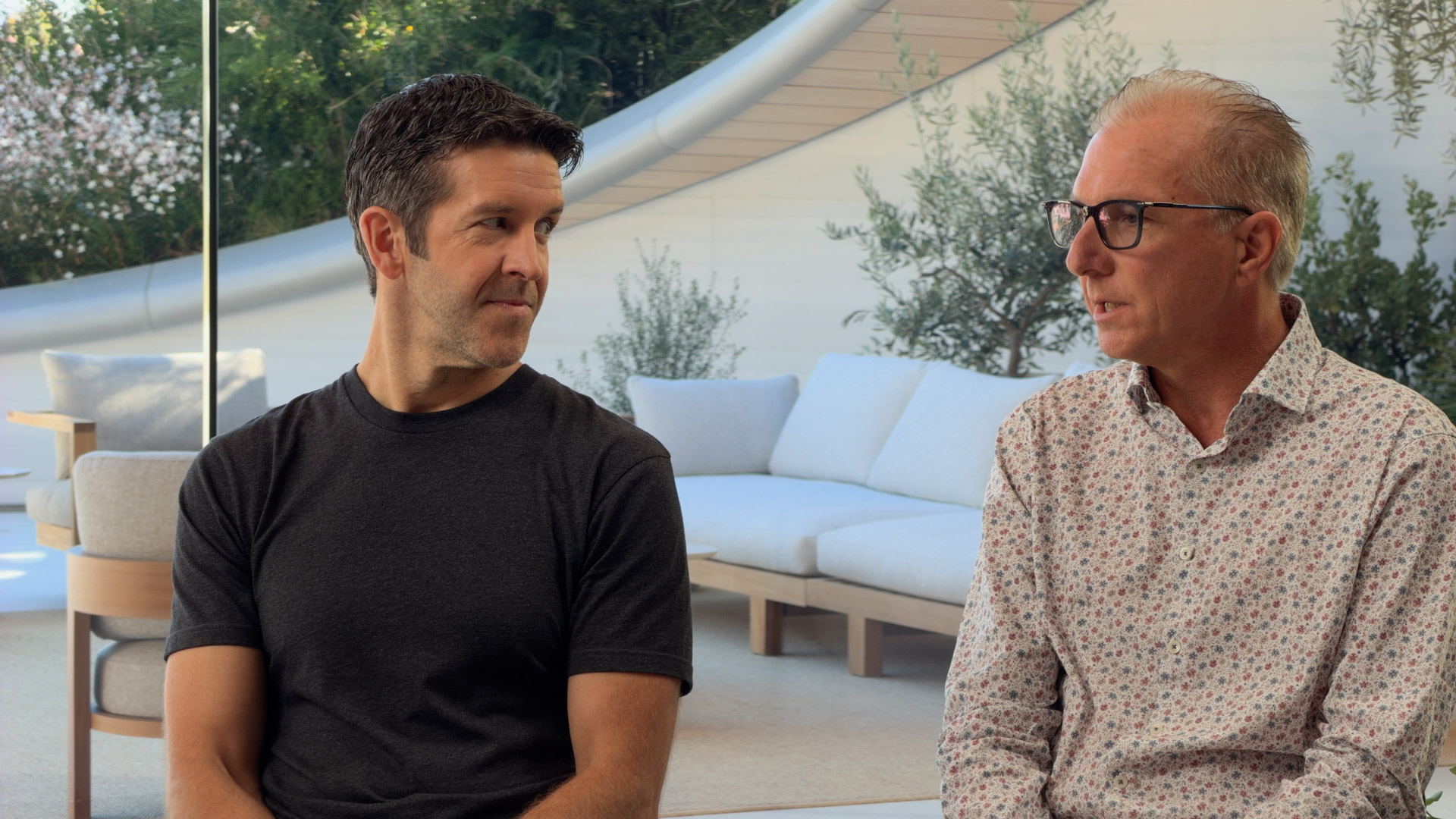
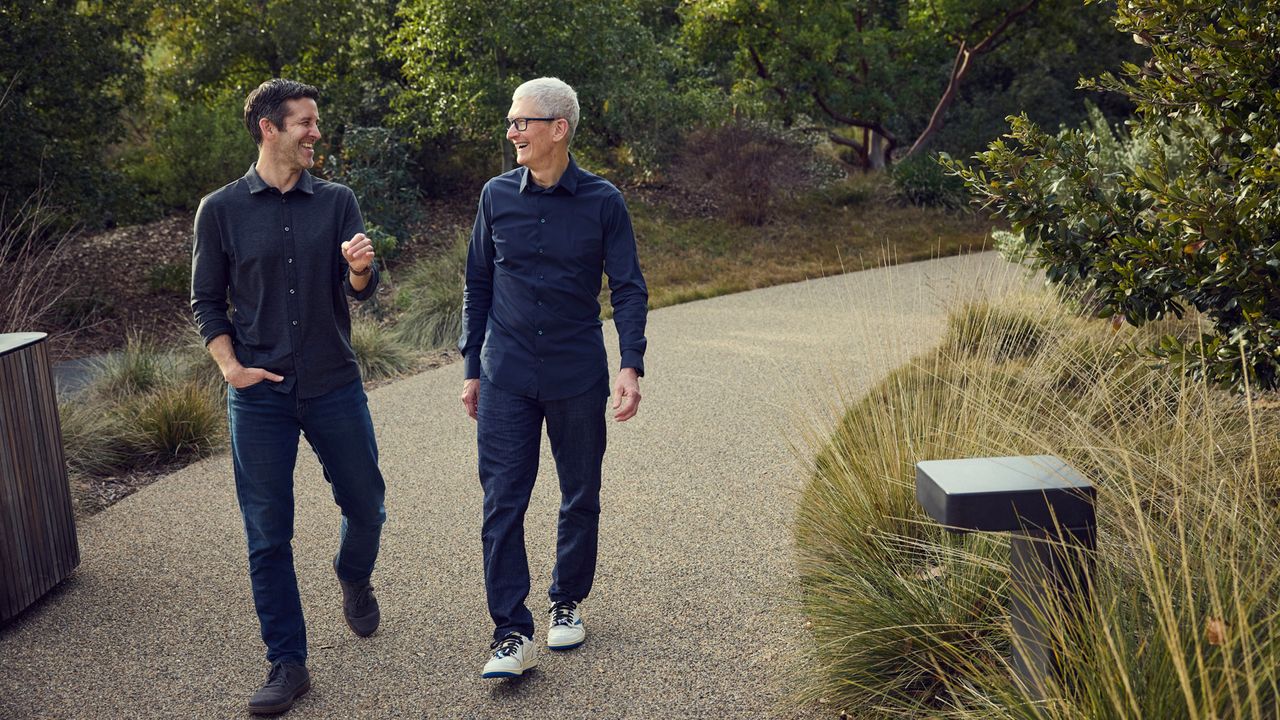
I've known John Ternus for almost a dozen years, but not this John Ternus, the newly minted Apple CEO and sudden global tech celebrity. So, color me pleased when he and his Global Marketing SVP Greg Joswiak agreed to sit down with Tom's Guide Global Editor-in-Chief Mark Spoonauer and me for a podcast discussion that ranged from bringing Pencil to the iPhone and excitement around the foldable iPhone Duo to what AI means for innovation, and the big moment when Ternus realized he was about to become CEO of arguably one of the biggest and most important tech companies in the world.

It's kind of wild to watch someone who you think of as a brilliant but also normal and approachable guy transform into an industry rockstar almost overnight, and while Ternus, who is a 25-year Apple veteran and came directly from leading Apple's hardware operations, doesn't seem outwardly fazed by the transition, he's also attuned to the moment.

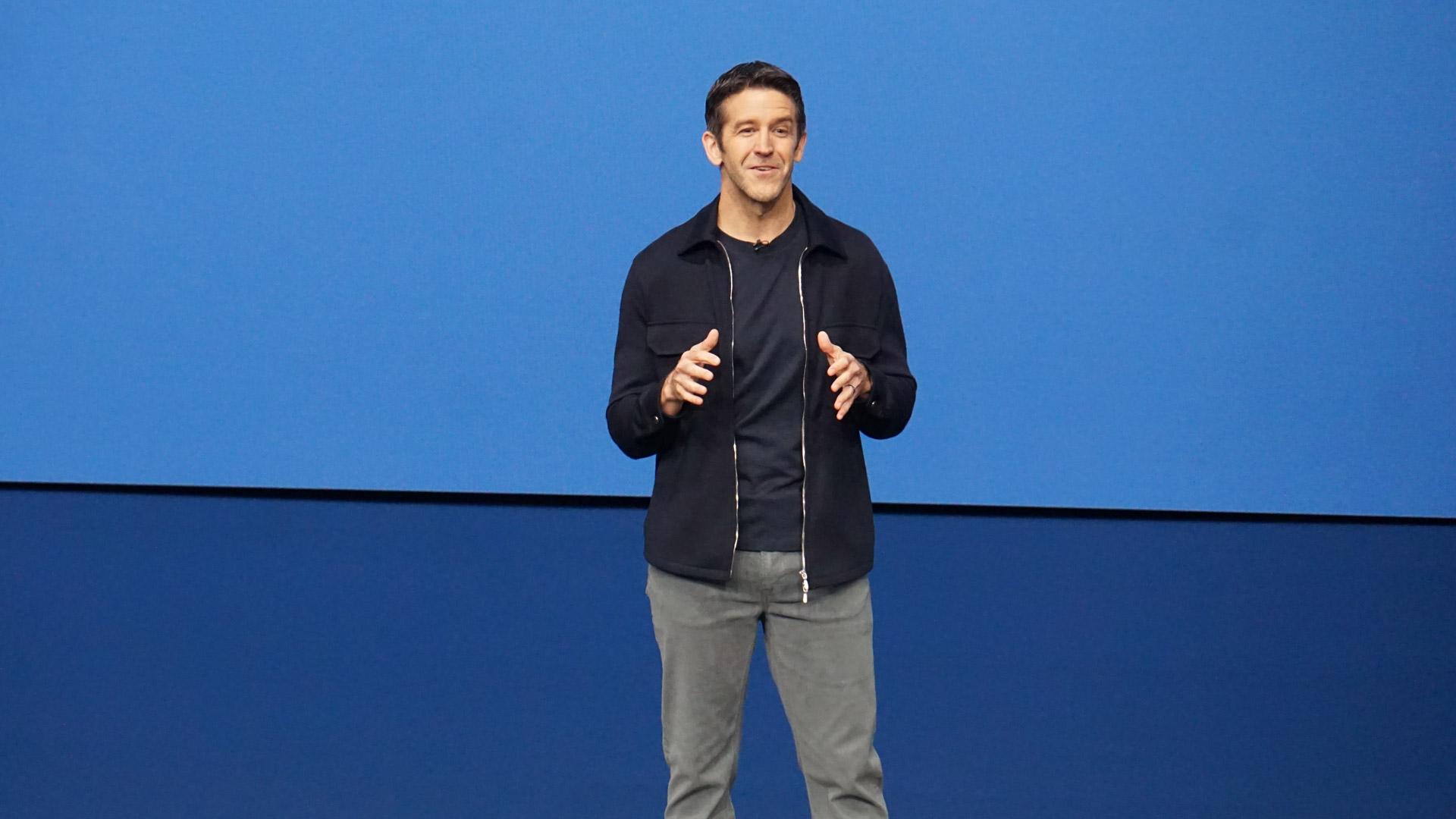
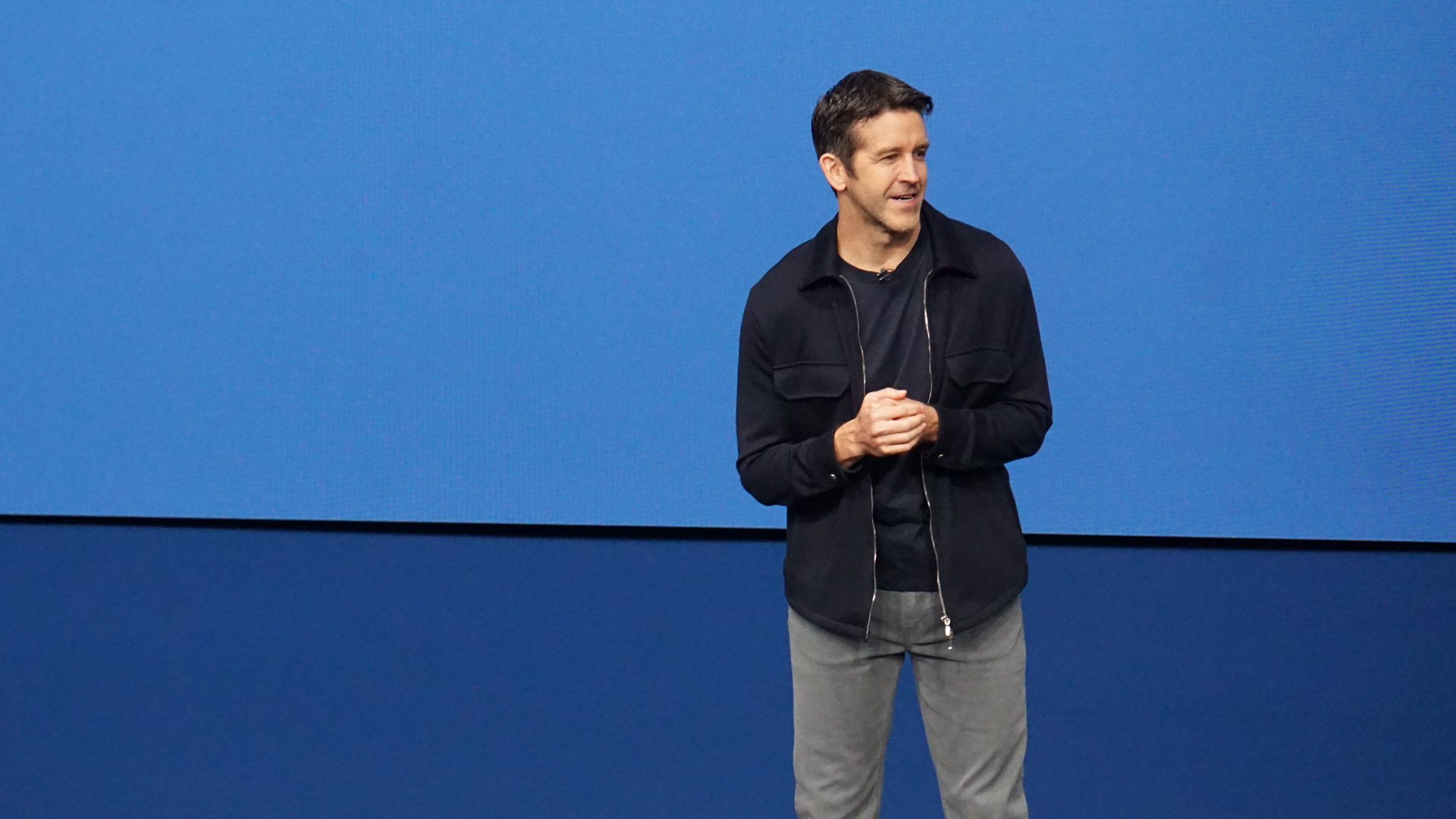
John Ternus at the Apple Fall 2026 iPhone Event

(Image credit: Lance Ulanoff / Future)

"What an extraordinary privilege, right?" said Ternus with a wide grin. The reality is, I just love this place, right? It's in my blood. ...I love the people I work with. I love to be able to build the products that we all build together. And so, goosebumps...and excitement."

What Ternus didn't say is that he was in any way nervous, worried, or even had any fear about the sheer scope of the role. But then, that shouldn't surprise anyone, certainly not Joswiak, who sat next to Ternus and told me, "John will be too humble to say it. The product quality that we have is really — there's nobody in the industry close to what we have — and this has really accelerated during the time that John has started leading the hardware organization that became such an incredible part of designing for that reliability and as well as testing for it. It's just off the charts."

The AI of it all

Throughout our discussion, Ternus's excitement and commitment to doing things the Apple way is clear. He's clearly so deeply embedded in every aspect of the Apple product pipeline, and when I pressed him on innovation, he made it clear that, obviously, Apple is innovating, but that he also has a point of view and, naturally, it involves AI.

"[This is] the most exciting time in my career to be building product because AI presents all these new opportunities." Ever the big-picture thinker, Ternus quickly added that you can't develop AI without being "really thoughtful about and deliberate about" it.

John Ternus Greg Joswiak

(Image credit: Future)

Still, Apple's next phase of innovation seems inexorably linked to AI. "You can see what we're able to do now in our products that we were never able to do before." Ternus mentioned the new Smart Take feature on the iPhone Duo, which essentially knows when you want to take a photo without you explicitly telling it so.

"Those are incredibly new, exciting capabilities for the kind of products we've made. But this also opens the door for new kinds of products, and so we're just really excited....I couldn't be more excited about our roadmap and what we have ahead of us, and yeah, it's going to be fun."

Rules? There are no rules

Ternus strikes me as maybe more flexible than Steve Jobs was on certain points. Take, for instance, Apple Pencil support on the iPhone Duo. That is an iPhone with digital stylus support.

In 2008, Steve Jobs famously dismissed stylus support for the iPhone. I think his exact words were, "Yuck."

Ternus, though, told me, " I've never really thought of it as a rule. We started with iPad. There was no Apple Pencil, right? And we proved beyond a shadow of a doubt that a touch interface on an iPad can be an amazingly capable and productive thing. But then there's things you can do with a pencil on that larger screen that are really powerful and capable. And I think we saw that opportunity here."

So no clear answer on innovation, but Ternus is smart about spotting and seizing opportunity.

His approach to whatever comes next is, it seems, rooted in his love of Apple and acting on those opportunities.

"I love making product," said Ternus, who added that he loves "doing it with the people here at Apple." He then pointed with some pride at the iPhone Duo, noting that he's "most excited to build amazing things like that."

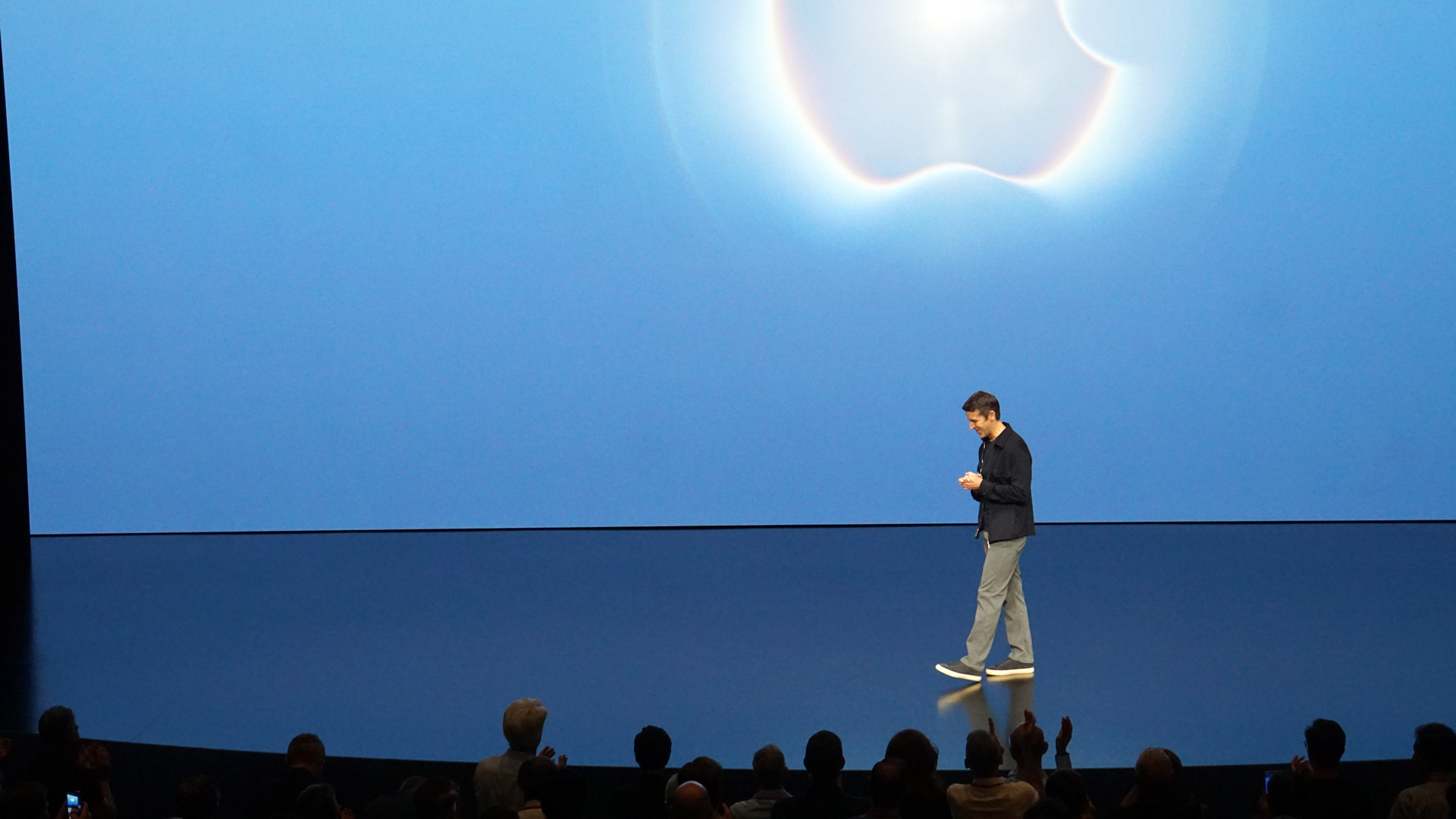
John Ternus at the Apple Fall 2026 iPhone Event

(Image credit: Lance Ulanoff / Future)

iPhone is still the one

For all the changes at Apple, in the industry at large, and even trends around smartphone use, the iPhone remains firmly at the center of Apple's Ring. The introduction of the iPhone Duo, a wholly new form factor and the first two-in-one iPhone, is evidence of that, but so is how Ternus sees screens, in general.

During the keynote, Ternus, who seemed so at home on stage (both live and in the pre-recorded bits), pulled a bit of a head fake, talking about an Intelligent Personal Hub that for a moment sounded like a mythical AI wearable (iGlasses, anyone?). In reality, he was talking about the iPhone.

Ternus told me the company is not changing any strategy on wearables (AI or otherwise). After all, it has the AirPods and the Apple Watch, which are more AI-infused than ever. But he also made it clear that screens will remain an important part of the business, mainly because that's Apple's answer to customer demand.

"People want displays. You want to see information. You know, humans process information way more effectively visually than through audio. And so, having a display is amazing, and it fits in your pocket. And so, we don't see the phone losing significance in any way, shape, or form."

John Ternus Greg Joswiak

(Image credit: Future)

When I asked, though, about the missing iPhone 18 base model, Jozwiak reminded me that the Apple "Surprise and Shine" event was "the day to celebrate these new products."

I guess that's true. The iPhone 18 would've been less exciting and maybe less able to perform some of the feats now possible across Apple's myriad AI-enabled devices, and certainly would pale in comparison to the iPhone 18 Pro and iPhone Duo. But this keynote was also, in fact, a sort of elevated event. It wasn't just about the new gear. It was also about the new CEO, and Ternus delivered the exciting goods in the most Apple way.

"I think, you look across our whole portfolio and the beauty of Apple is its hardware, software, services and what I love is when all of these things kind of come together and interact and create an experience that is just bigger than the sum of its parts."

Ternus is now a bigger part of that equation, which could make Apple's next epoch even bigger than the last.

John Ternus at the Apple Fall 2026 iPhone Event

(Image credit: Lance Ulanoff / Future)

Catch the rest of the John Ternus interview on Tom's Guide

  •  

I just touched the iPhone Duo and Apple just solved the foldable crease problem in the most wonderfully basic way

Apple has officially entered the folding phone market with the passport-sized and quite attractive iPhone Duo. I know, we all thought it would be called the Ultra, but perhaps Apple will save that superlative for another day (or product).

In some ways, the iPhone Duo is exactly what we expected. A 5.4-inch external display and a large 7.6-inch internal or main, unfolded one. The size, shape, and specs are somewhat similar to the Samsung Galaxy Z Fold 8. But there are several exciting differences.

Folded and in my hand, the iPhone Duo feels, quite honestly, nothing like any iPhone that's come before it. Heck, Apple even redesigned iOS to accommodate the unusually shaped displays, putting the dock and other controls on the right side (no word on whether you can move them to the other side). For larger screens, that might make everything more thumb accessible.

iPhone Duo Hands On
Lance Ulanoff / Future
iPhone Duo Hands On
Lance Ulanoff / Future
iPhone Duo Hands On
Lance Ulanoff / Future
iPhone Duo Hands On
Lance Ulanoff / Future
iPhone Duo Hands On
Lance Ulanoff / Future
iPhone Duo Hands On
Lance Ulanoff / Future

The 5.4-inch external display is bright, sharp, and features a Center Stage camera (not in the center of the display, despite the name).

As with the Galaxy Z Fold 8, the shape does take some getting used to, but Apple's decision to use curved chrome edges and curves on the right side (when you open it, you see four rounded corners) serves the device well. It's comfortable to hold.

I wasn't entirely successful at folding and unfolding with one hand, but I did do it easily with two and noted the solid feel of the hinge and that I could open and close it to varying degrees. It's hard to believe that this is also an IP68 (for dust and water resistance) device — but Apple does love its challenges.

The 7.6-inch main display, though, is astonishing. Apple went a little wild on the layering, mixing in numerous sheets of custom polymer, the OLED panel, a couple of glass layers, and a titanium backing (all held together with flexible glue that lets them slide back and forth against each other), but the really exciting part is the topmost layer.

The texture layer

iPhone Duo Hands On
Lance Ulanoff / Future
iPhone Duo Hands On
Lance Ulanoff / Future

When I talk to folding phone curious consumers, they all ask me the same thing: "Is there a crease?" Look, I explain: these are folding devices, and the engineering has to accommodate the folding without breaking any of the various layers and, yes, the thin glass. There has to be a tiny bit of curvature remaining when you unfold.

Even on the excellent Samsung Galaxy Z Fold 8 Ultra, the crease is slightly perceptible in certain lighting.

The crease is gone on the iPhone Duo. I can feel it with my finger, but cannot see it, because Apple decided to put a special nano-texture covering on the main display. This has the effect of dispersing the light, especially around any spots where, normally, the crease might be visible.

This also gives that big screen a matte finish that looks and feels unusual in the smartphone space, is unheard of for a foldable, and is generally lovely. I was seriously impressed.

Let's play

iPhone Duo Hands On
Lance Ulanoff / Future
iPhone Duo Hands On
Lance Ulanoff / Future
iPhone Duo Hands On
Lance Ulanoff / Future

I didn't get a ton of time with this star of the show, but what I saw bodes well for Apple's first folding device.

Apple really thought through, for instance, the handoff from the cover screen to the main display. I tried this with a game and with Netflix, where I'd open the app on the cover screen and then slowly open the iPhone Duo: the handoff from one screen to the other is perfection, a precision of connection that should please users and might excite anyone who ever wondered, "Why buy a folding phone?"

iPhone duo Hands on

(Image credit: Lance Ulanoff / Future)

I briefly played a console-level game on it, which showed off the fresh power of the new 2-nanometer A20 Pro chip, and took photos with all the cameras, including the 48MP main and 48MP ultrawide with 2x optical zoom. On the latter, I'm not thrilled that I get just 2x zoom, but at least it's optical. Also, it's pretty clear that this thinner-than-the-iPhone Air (when unfolded) probably can't accommodate a longer telephoto lens.

There are a variety of settings for managing the cover screen and cameras so that, for instance, you can use the former as a viewfinder for the best camera for top-notch selfies.

The main screen also hides a new FaceTime Camera, which I noticed effectively disappeared when you're not using it.

iPhone Duo Hands On
Lance Ulanoff / Future
iPhone Duo Hands On
Lance Ulanoff / Future

I love that you can set up the iPhone Duo as a desktop clock, though I noticed that it wasn't entirely obvious how you put it in StandBy mode without docking it or putting it to sleep.

iPhone Duo Hands On

(Image credit: Lance Ulanoff / Future)

The main screen is also big enough for multitasking, and I tried my hand at splitting it between Photos and Messages: you drag an app into a side dock, and then it opens on one side. After I opened Photos and Messages, I dragged and dropped a photo into a message. It was a smooth operation.

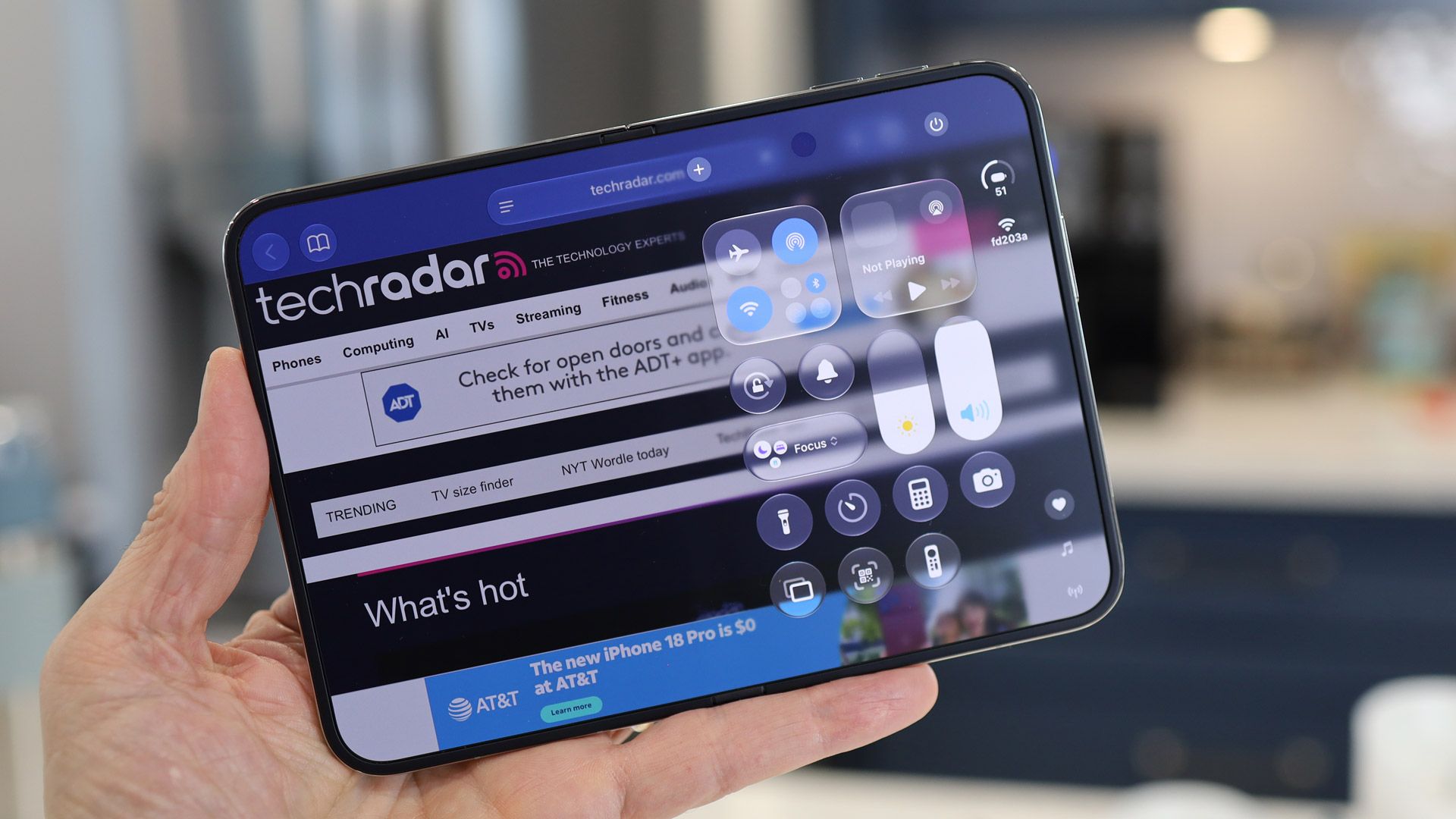
The reorganization of the iOS interface might throw some, but it made intuitive sense to me as I was playing with the iPhone Duo. I found, though, that the Control Panel still works the same way as it does on other iPhones.

iPhone duo Hands on

(Image credit: Lance Ulanoff / Future)

Oh, the Pencil

Two other things of note. The iPhone Duo will be the first iPhone to work with the USB-C Apple Pencil. That is a huge deal. I've been complaining for a while that the wonderful Galaxy Z Fold line lost that digitizing layer.

I cannot wait to try the Apple Pencil on that big screen (there were no Pencils in the demo space). I bet the nano-coating will even make a difference in how the Pencil feels on the Display. I do not yet know if the iPhone Duo will also accept Apple Pencil Pro input, though I hope it does.

The other thing is that, yes, the iPhone Duo includes MagSafe. There are, by the way, two batteries that are promising "all-day" battery life.

This is also Apple's most expensive iPhone, starting at $1,999 / £1,999 / AU$3,499 for the 256GB model. Naturally, Apple will tell you it'll be far more obtainable with a trade-in and the new leasing option (pay a fixed monthly sum for two years and then return it for a new one),

Overall, this is an exciting start for Apple's first foray into foldables. Sure, it stands on the shoulders of giants, but as is often the case, Apple's done all this in a very Apple-ly way, and in this case, that looks like a very good thing.

  •  

I asked Gemini if my chicken salad was still good: it saved itself and my stomach

What is AI good for? It's a question I get asked and ask myself almost every day. Unlike a wrench, hammer, or screwdriver, which are each good for one or two tasks, AI is amorphous and intimidating in its breadth. It seems capable of almost anything, especially as it changes and grows more intelligent. People pump it up as a do-it-all wonder, and yet, the question remains: what would I do with it?

Often, I find the answer to that question in the moment. For instance, as a partially color-blind person, I struggle to match clothing. Now, I often ask Gemini. I'll take my iPhone 17 Pro Max, open Gemini, turn on Gemini Live, pick out a shirt or pants (or both), and ask if they go together or which option is best. I always get an answer and, honestly, I usually follow the uncomplicated AI-generated advice.

Success in one area of your life with technology usually leads you to try it in another, especially with the ever-fungible AI.

In my house, I'm known as the risk taker, at least when it comes to food. "Best by" is a suggestion. "Use before,' is friendly advice. My family often blanches at my aged food consumption habits. Yes, I'll eat that five-day-old steak. Those English Muffins expired two weeks ago? Slide them over.

Enter the risk-taker

I know, it's not great, and when it was lunchtime this weekend I slid the week-plus-old store-bought-and-made chicken salad from the fridge and considered making a sandwich.

Staring at the "made on" date as if my gaze might rearrange the figures, I realized that I might be taking a risk. So I opened the container and sniffed the still spry-looking salad. It's at moments like this that I wonder, "What am I doing? Does my nose really know the difference between safe and stale or, more importantly, safe and decidedly turned?" I can tell you with some confidence: it does not.

Still, having grown up in a house where money was tight and you rarely threw anything away, I was hesitant to dump this half-a-pound of chicken salad (slightly turned or not).

I stood there in my kitchen for a minute, weighing my options and thinking that slightly sour chicken salad might not, with the right toast, be that bad.

Then I looked at my phone, lying face down on the counter, but surely judging me.

I would ask Gemini.

Putting Gemini on the menu

After launching the app, I turned on Gemini Live and pointed the camera at the open container. "Hey, this chicken salad was made on 8/1. Do you think it's still good?" I asked hopefully.

Gemini thought for a moment and then responded, but not in the way I expected.

Before giving me the answer, Gemini launched into what sounded a bit like one of those disclaimers for an Ozempic TV commercial:

"This information is not intended to be a substitute for professional medical advice, diagnosis, or treatment. Always seek the advice of your physician or other qualified health provider with any questions you may have regarding a medical condition."

Clearly, I struck a nerve. I only asked about the chicken salad, not if I should have a kidney removed.

I get it. If I'd asked this question a couple of years ago, Gemini might've launched right into an analysis, but concerns about AI accuracy and understanding of human needs and context have risen since the emergence of generative AI. Sure, it's way smarter and less likely to give you false or hallucinated information, but it's also, well, not a doctor or even a dietician.

A recent Gallup poll found that more than 25% of Americans are using AI for health info or advice, and of them, more than half query AI for health-related advice and analysis before visiting a doctor. The problem is that AI is not a medical professional, and while it can dig through the billions of health- and medical-related bits stored online, it doesn't have a medical license. It can't understand or treat your various maladies.

In my case, though, Gemini drew a long thin line from my seemingly innocuous question about chicken salad freshness to a potentially incorrect answer, my possible gastric emergency, and a potential lawsuit against Google and Gemini brought on my behalf by my surviving family members.

Look, food poisoning isn't usually fatal, at least according to Healthline, but it is yucky and uncomfortable. I think Gemini was just trying to avoid me taking its word as law on this topic and a potentially bad outcome for both of us.

I'm still hungry

But what about eating this rapidly warming chicken salad?

After the voluminous disclaimer, Gemini got to the heart of the matter:

"According to food safety guidelines, chicken salad should be stored in the refrigerator for only three to four days. Since this chicken salad was made on August 1st and today is August 9th, it is no longer safe to eat and should be discarded."

The answer, based less on the looks of this chicken salad and more on general advice that I often ignore, ultimately had the desired result.

You and my family will be pleased to know I took Gemini's advice, threw out the chicken salad, and made myself a peanut butter and jelly sandwich.

Naturally, I asked Gemini's opinion:

"Yes, absolutely! A PB&J is a much better and safer option right now.

Peanut butter and jelly have a significantly longer shelf life and aren't prone to the rapid bacterial growth that affects meat-based, mayonnaise-heavy dishes like chicken salad. It's a classic, risk-free, and delicious backup plan. Enjoy your lunch!"

Fine. Thanks, Gemini, and bon-appétit.

  •  

Secrets of the Samsung Galaxy Z Fold 8 Ultra — how Flex Titanium technology makes it stronger, thinner and, yes, flatter

Isn’t it funny that we take the flexible screen so for granted that we complain over a crease and lack of flatness? The screen folds to become half its size and unfolds to about the size of a mini-tablet, and we’re still not satisfied. I guess that’s what makes us — or maybe Samsung — human. You see, it wasn’t satisfied, either, at least with the already quite thin and pretty remarkable Samsung Galaxy Z Fold 7.

That 4.2mm thick device that features two displays and yet is somehow lighter than the Galaxy S26 Ultra was close to flat and did have a less noticeable crease at the bend, but apparently Samsung thought it could do better, which is how we got the Samsung Galaxy Z Fold 8 Ultra, unveiled at Galaxy Unpacked on July 22.

That’s right, it’s now an Ultra device, though that has more to do with the other new entry in the folding lineup: the 4:3 ratio Samsung Galaxy Z Fold 8. This new Galaxy Z Fold 8 Ultra is not, after all, a full-scale redesign and is, instead, a refinement that brings better cameras (an upgraded 200MP camera with an f-stop adjustment, a new 50MP ultra-wide that matches the Galaxy S26 Ultra), a new 5,000mAh silicon-carbon battery, an anti-reflective coating on the display, and, somehow, a thinner body.
Samsung Galaxy Z Fold 8 Ultra HANDS ON
The Samsung Galaxy Z Fold 7 on the right and the new Galaxy Z Fold 8 Ultra on the left. Note the drastically reduced crease.Lance Ulanoff / Future
Samsung Galaxy Z Fold 8 Ultra HANDS ON
Another look that also shows you the flatness of the new device.Lance Ulanoff / Future

The slimming

At 4.1mm, you might be hard-pressed to notice the difference between Samsung's two most recent foldable flagships, though I can tell you that the chassis is now so thin, it barely squeezes in a USB-C port.

What is noticeable, though, is that the Galaxy Z Fold 8 Ultra unfolds its 8.1-inch OLED display effectively flat, and the crease is all but gone. (The phone actually almost snaps to flat and is somewhat less adjustable between flat and folded modes.)

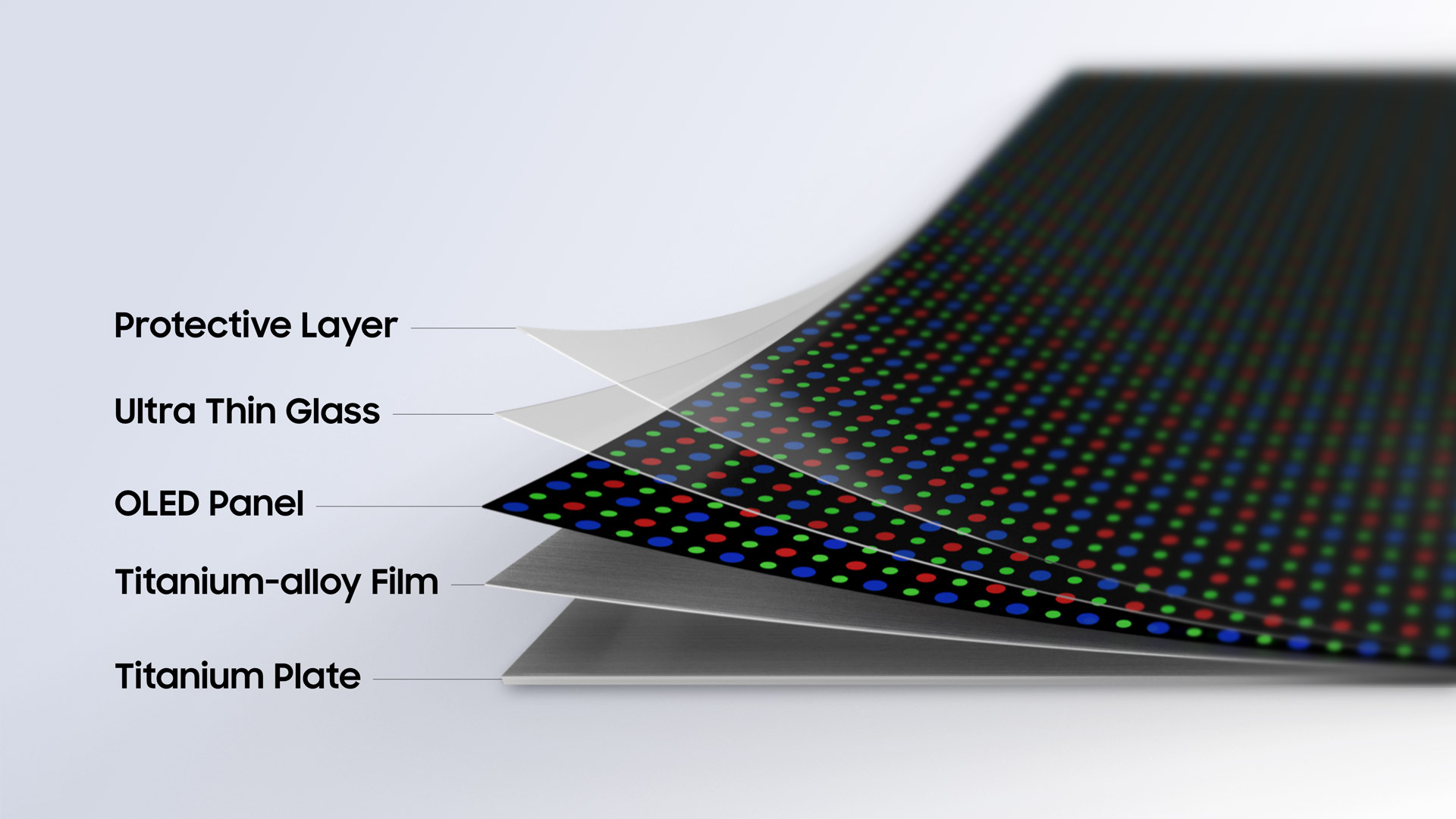
That’s due to the lightweight but also very strong titanium architecture behind that OLED panel. There has been a rigid titanium backplate behind the OLED panel since the Galaxy Z Fold 7, but the lattice work along the crease — in the center of the panel — has been totally redesigned from a seemingly infinite series of parallel holes to holes that start narrow on top but open up on the opposite side (it’s sort of an “A” shape). Stacked on top of that panel now is another far more flexible titanium alloy sheet (a mix of titanium and other metals like aluminum and chrome). It’s about as flexible as a sheet of paper (I touched it, I know) but with infinitely more strength.

Samsung Display Factory Tour

Here's a cool look at the entire makeup of the Samsung Galaxy Z Fold 8 Ultra and Z Fold 8's new Flex Titanium technology. (Image credit: Future)

The combination of these two panels, which are sandwiched and glued together along with the OLED panel, an ultra-thin glass pane, and a plastic screen protector, all work in concert to allow the panel to be both 30% easier to open (a new chamfered display frame edge also assists here) and more inclined to pop out flat. And that makes the crease almost invisible.

I know all this because I met with Samsung Electronics and Samsung Display engineers in South Korea who worked together to bring the Z Fold 8 Ultra to life.

Samsung Display Flex Titanium Technology

(Image credit: Samsung Display)

Even though I sort of understood how these elements worked together to make a flatter whole, I couldn’t entirely figure out how the rigid back plane was flexible enough to make the folding and unfolding possible, but Byung Duk Yang, EVP at Core Component Technology Team, Samsung Electronics, put a finer point on it for me.

Sitting next to a specially designed flexible display blow-out diorama featuring all those aforementioned panels hanging inside like so many curtains, Yang explained, “You’re right. Titanium is basically not flexible. We use a titanium plate already, but there are micro-holes to get the stretchability — so that is basic titanium. But this time we used the new titanium alloy — we needed some stretchability. That’s why it is not 100% titanium; it’s titanium alloy.”

The switch to the titanium alloy, which replaced a thicker polymer layer, is key because, with titanium’s ability to better withstand long-term deformation, it’s less likely that the now mostly hidden crease will grow more prominent over time.

As I noted, people tend to, with these foldables, fixate on the crease, but Yang explained that in designing these panels, Samsung Display has many considerations. “The crease itself is not our only top priority. We have to consider durability and surface quality.”

Stress tests

Samsung Gumi Automation Lab 2026
One of the benefits of the new Flex Titanium technology is that the folding phones will be more durable over time: the titanium plate and titanium alloy sheet both resist long-term deformation far better than the old polymer sheet. In Samsung's Gumi Automation Labs, it tests the Z Fold 8 and Z Fold 8 Ultra phone displays' bending and response.Samsung
Samsung Gumi Automation Lab 2026
Samsung
Samsung Gumi Automation Lab 2026
Samsung

I also traveled to Samsung’s Gumi Factory City in South Korea, where I witnessed the new Galaxy Z Fold 8 Ultra and its new sibling, the Galaxy Z Fold 8, undergo rigorous stress tests that included extreme heating and cooling, folding and unfolding tens of thousands of times, and ball-drop tests in which metal balls are repeatedly dropped on the screens from various heights.

From what I could tell, the Z Fold 8 and Z Fold 8 Ultra are quite resilient and, in the Z Fold 8 Ultras I saw, less reflective.

The new antireflective coating appears to do its part in helping the flexible display hide the crease. After all, less light is bouncing back to your eyes. And when I visited the Gumi testing lab, I saw how they used a special box with a dome of brilliant white light and a spectrometer to test display reflectivity. The light robotically moved around the Z Fold 8 Ultra panel to assess general reflectivity but also how the light might bounce off the crease. Results are gathered by a computer in a lab that runs 24 hours a day. We were, by the way, the first reporters ever to see it in person.

Samsung Galaxy Z Fold 8 Ultra HANDS ON
The new Samsung Galaxy Z Fold 8 Ultra is about as flat as it can get.Lance Ulanoff / Future
Samsung Galaxy Z Fold 8 Ultra HANDS ON
Lance Ulanoff / Future
Samsung Galaxy Z Fold 8 Ultra HANDS ON
Lance Ulanoff / Future

I’ve been pondering, though, what comes next for the Galaxy Z Fold lineup. Unless Samsung removes the USB-C port, it really can’t get any thinner. But the display could get at least one cool improvement; Samsung confirmed to me that they are thinking about how the Privacy Display on the Galaxy S26 Ultra might come to a future folding device. As you may recall, that privacy technology works at a pixel level to hide your screen from prying eyes, so it would require a very specific update to the flexible OLED panel.

In the meantime, though, consumers will have to consider this new Galaxy Z Fold 8 Ultra, perhaps the thinnest, flattest, and fullest expression of Samsung’s foldable ambitions.

Do you own a lot of Samsung devices? If so, why not test yourself to see how well you know the brand's products and services by taking the quiz below.

  •  

'My soul left my body': customers see bills in the billions after AWS billing system goes haywire — but don't go emptying your bank accounts

  • Amazon's AWS cloud services billing system went wild on Friday
  • Customers saw bills in the trillions
  • AWS apologized and is working on a fix

AWS, the cloud platform that serves millions who use Amazon's servers to run websites and businesses you use every day, just freaked out many of its customers with usage bills that literally went into the trillions.

"I just saw $1.5 trillion on my AWS bill and my soul left my body," wrote Bharath_uwu on X (formerly Twitter) on Friday, and he wasn't alone.

The Guardian originally spotted the Tweet and multiple social posts relating to the seemingly widespread glitch.

AWS doesn't mail out invoices. Instead, customers logging into the Billing and Cost Management console spotted the billion- and trillion-dollar bills and expressed emotions ranging from concern to panic.

I just saw $1.5 trillion on my AWS bill and my soul left my body https://t.co/EgfQKJTHVl pic.twitter.com/L0gXYbDio7July 17, 2026

As Dan Harvey, who heads marketing at Learning Through Landscapes, told the Guardian, "I almost had a heart attack when I received an email alert from Amazon Web Services with the billing for our charity’s school grounds audit app."

Some tried to take the billing error in stride. Chinmay on X encouraged others to post their highest AWS bills. As of 10 hours ago, he was at $333B.

Others called out AWS for the error with something less than good humor. "I bet someone must have had a real heart attack. This shouldn't be legal...," wrote Mr Doob on X.

Amazon, to its credit, has been delivering multiple updates starting at around 1:30AM PDT on Friday, July 17, when they first spotted the error: "We are investigating issues with Cost Explorer reflecting inaccurate estimated billing data."

A few hours later, AWS reported it had found the culprit: "We have identified the root cause as an issue with unit pricing within the estimated billing computation subsystem, and we are working on a mitigation," they wrote on the AWS Status page.

However, hours later, AWS admitted, "Our efforts to backfill corrected estimated cost and usage data are still underway. We are progressing slower than anticipated."

The good news is that AWS is not asking anyone to pay these incorrect fees and that, while this has been a big frustration for services that run their websites and businesses on AWS, the cloud system has been working flawlessly, and there have been no reports of outages or performance issues on Friday (if you don't count the years shaved off freaked-out customers' lives).

AWS has even tried to make light of the mistake, posting this on X:

"Typo alert: Some customers saw quadrillion-dollar AWS billing estimates today. Slight miscalculation on our end (very slight ). We're fixing it now. No action needed on your end. Sorry for the confusion. Real question: what will you do with those trillions instead?"

Yes, everyone can all laugh now, though I'm not certain customers like Harvey, Bharath, and others are chuckling along with them.

Was your business affected? How big was your AWS Billing mistake? Let us know the "damage" in the comments below.

  •  

Relax, Apple, OpenAI and its rumored AI smart speaker plans are no threat to you, Siri, HomePods, robots, or any other part of your business

OpenAI is building an AI-powered smart speaker nobody wants. That is, if you believe the Bloomberg report from Mark Gurman and you've read his description of said rumored device.

According to the report:

"OpenAI believes the product’s defining feature will be its personality and ability to connect on a humanlike level with users. The speaker incorporates mechanical elements that can move on their own, creating a sense that it is alive and not just an object responding to commands. The machine also will draw on personal information such as emails to better understand its owner."

The news sources, it appears, come from an insider who decided to spill all the juicy details mere hours after Apple dropped a blockbuster trade-secrets lawsuit on OpenAI's head. OpenAI claims it's done nothing of the sort, and recent reports say that Apple's claim that the AI giant has not even responded to Apple's earliest concerns was based on it potentially incorrectly identifying the former Apple employees who left to join OpenAI (allegedly with Apple trade secrets in tow).

Apple's concerns here are twofold: First, these former employees had access to many of Apple's secretive product development details and may even have asked recruits to share fresh details when they approached them to interview for jobs at OpenAI. The other concern is that Apple is already far behind in the AI race, and if Apple's plans for Siri, AI, and a potential robotic desktop home assistant were also leaked, it could harm its ability to catch up in multiple market sectors.

This latest news, which may or may not be accurate, should put Apple's fears to rest.

OpenAI is apparently not building something that could ably compete with any of Apple's key hardware or future hardware initiatives.

First of all, there's the smart-speaker-ness of the whole rumored OpenAI concept. There are already too many smart speakers on the market, many of them with their own smart assistants. Amazon, for instance, is smack in the middle of trying to convince millions of customers that not only do they need Echo devices throughout the home, but they need the AI-powered Alexa+ to guide them through their smart home experiences and, to some extent, their lives.

Apple has its own HomePod, Siri-infused speakers, which may get considerably more powerful with the Gemini foundation model-backed version arriving this Fall.

Put another way, smart speakers are a known quantity in the home consumer electronics space, and I think what most tech companies are realizing is that people like and use them, but mostly in limited ways: they want music, occasional answers to simple questions, and voice control of their smart home devices. That's it.

Why does my speaker think it's alive?

Amazon Alexa, Google Home, and Apple Homepod smart speakers

(Image credit: Future)

OpenAI appears to be prepared to offer something different: a personality-filled speaker that can watch you, move to engage, seem alive, and generally make you feel uncomfortable.

Obviously, that would not be the objective, but it could be the result. Who needs a speaker that quietly watches you as you walk from your kitchen to the den, waiting and hoping for you to say, "hey ChatGPT, what's up with the Strait of Hormuz today?"

In my home, we have a Psync smart security webcam with one oddball feature: it has a motorized body that can turn almost 360 degrees on its base and lift its thin, rectangular face and camera to keep track of people and alert me to intruders. However, most of the time, it's just watching us move around the house, and I can tell you that my family hates it. Sometimes I come home and find its face forced down so it can't pop up and track anything.

Now, imagine a larger and far smarter OpenAI AI smart speaker in your home, watching, waiting, chiming in when you don't want it to, and generally making people feel uncomfortable.

This will not be the breakout hardware hit OpenAI is hoping for.

Look, I was under the impression that OpenAI (really Jony Ive and Sam Altman) were working on an AI wearable. I didn't love that idea either, but it was a lot less creepy than this.

So, Apple, chill out. OpenAI's plans are no threat to you, even if they do allegedly have a bunch of insidery Apple information.

  •  

Stop saying John Ternus has to fix Apple — the company is fine, his job is simply to carry Cook's legacy forward and yes, to roll out more winning designs

I’m under no illusions that John Ternus’ Apple will be the exactly same as it has been under Tim Cook. Initially though, there will be few, if any, changes. Ternus is not an outsider with wild anti-Apple ideas intended to wake a sleeping giant. He's been here for decades, through all the major releases that made Apple, well, Apple. Claims that he's arriving in September to revive Apple's design excellence are, if not off base, then just wrong-headed.

First of all, the argument presupposes that there is something fundamentally lacking in Apple's Industrial design: Jony Ive was obviously lighting in a bottle, and current design lead Molly Anderson is a pale, albeit also British, imitation. (Granted, Anderson has not been in the position that long, taking over from Evans Hankey, who left in 2023.)

But accepting that presumption is to ignore all the beautifully designed products that have arrived under Cook's leadership, with and without Ive, and also often under the watchful eyes of Ternus.

Remember the Pro — oh

But since Ive's skills as a designer are so vaunted, let's start with a failure. Perhaps you remember the Mac Pro. No, not the cheese-grater design unveiled in 2023. While that had its detractors, it was miles above the trashcan design unveiled in 2013.

It was the ultimate expression (at least in PC terms) of Ive's "form meets function" obsession. The internal structure was sort of a triangle of boards that seemed perfectly wrong for a squat, circular enclosure. Ive's fingerprints were all over the impractical system, one that Craig Federighi later admitted to me (during a mea culpa meeting on the Pro) had boxed Apple into a thermal corner. It was hard to upgrade and was roundly rejected by pro system users.

Ive was also responsible for the Apple Pencil. With it, his penchant for skeuomorphism extended from app design into the physical world. The Apple Pencil fully resembled a white plastic version of a real, pencil, and to accommodate that, it had, under a custom cover, a hidden Lightning charging plug. You even needed a special adaptor to charge it. Later, wirelessly charging Apple Pencils, which I think Ive also designed, fixed this mess.

Naturally, Ive's hits far outweighed his misses, and many big ones came during the Cook-Ive collaboration period, including the iPad Air, the Apple Watch, and AirPods (which started awkwardly but gradually improved).

The more divisive Apple Vision Pro was likely designed under Hankey and Anderson's watchful eye. I do think it's a pleasant intersection between the needs of extremely high-end innovation and aesthetic appeal. Goggles will be goggles, after all.

Even iPhone design has remained, if not excellent, interesting.

The iPhone is still beautiful...discuss

When Apple introduced the first iPhone in 2007, there really was no other handset quite like it. Apple set the bar and, over the years, every other manufacturer followed. It became harder and harder for Apple to differentiate its metal and glass slab from its competitors. The ever-larger camera arrays have provided a sort of design challenge and an opportunity at the same time. Hankey and Anderson, at least, came up with a giant island that's quite recognizable from a distance. And let's not discount color. The orange was a stroke of genius and the new MacBook Neo's playful Blush and Citrus colors are lively, proving Anderson knows how to marry form with expression.

Ternus' role as hardware lead means he's been seeing these designs for years. My sense in sitting down with him after the launch of the iPhone Air is that he is intimately involved with the process of shoving all that technology into ever-thinner, but shockingly strong frames. He gets that you need to marry engineering skills with industrial design to get a durable and usable product that's still attractive.

When I think about what Ternus will do when he finally takes over in September, I am reminded of relay race runners. Cook continues to pace around the track while slowly holding out the baton behind him. Ternus is nearby, running just behind Cook with one hand outstretched. Neither man will stop. The handoff will happen in a few months, with everything still in motion.

The process of finishing the rumored iPhone Ultra (the folding phone) continues as we speak, and Ternus is not going to suddenly pull a Steve Jobs and throw the design into a fish tank, to see if bubbles rise, thus proving they could make it smaller. He won't demand that all plastic be replaced with glass, or even that one more color be added to the mix.

When, as the recent Bloomberg report claims, Ternus said of Apple's design history and appeal to customers, "We’re going to make sure that stays the case,” he's not talking about making huge changes to achieve that goal.

Ternus will stay the course and support Anderson. He may hire more design support and, down the line, Ternus will look for his signature initiative or product; he will want to have his own iPhone or iPod. But that's a natural inclination for any incoming CEO. Job one, though, is staying the course, shepherding the in-the-pipeline products to market and ensuring that Apple remains Apple.

I think Ternus knows exactly how to do that.

  •  
❌