❌

Reading view

Scientists Discover Weird Conditions at Site of Star That Exploded During the Period of Japanese Samurai

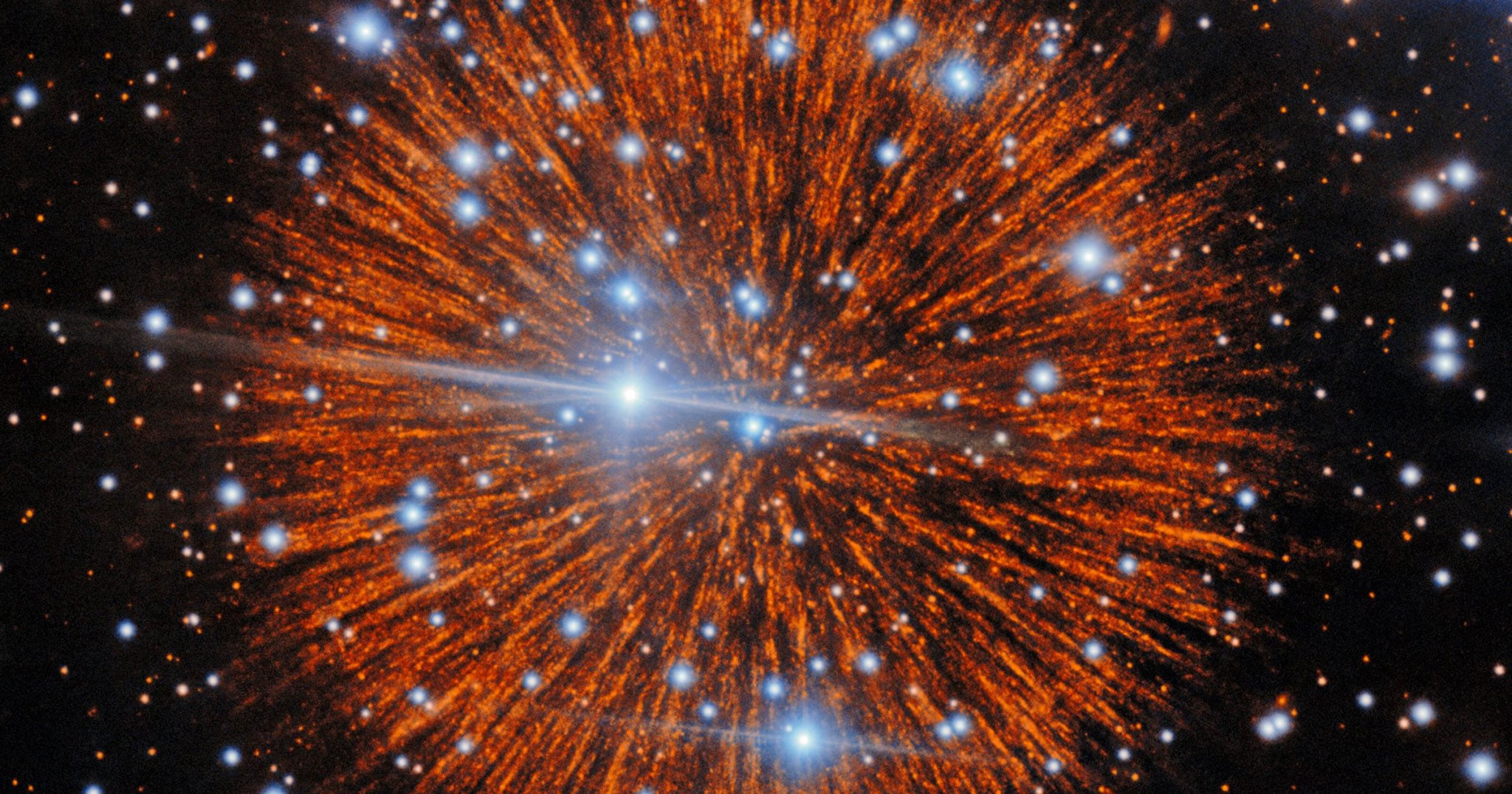
In 1181 — during the early years of the samurai who would dominate Japan’s feudal period — astronomers there witnessed a spectacular sight in the night sky. They observed remnants of a star that had survived its own explosion, a bright object in the Cassiopeia constellation visible for at least 185 days.

The supernova, independently documented almost a millennium ago by Japanese, Chinese, and Arabic astronomers, is just one out of five events like it recorded before the invention of the telescope several hundred years later.

Now, thanks to breathtaking new images taken by NOIRLab’s Gemini North telescope — made up of two powerful telescopes in Hawaii and Chile — we get to see the debris field, dubbed Pa 30, in unprecedented detail.

The astronomers were also left with a puzzle: the explosion perfectly preserved the surviving progenitor star at the dead center of perfectly uniform knots of ionized gases, bizarre conditions suggesting a perfectly symmetric, yet chaotically violent, event.

The supernova remnant is located around 7,500 light-years from Earth, roughly a fourth the distance to the center of the Milky Way.

“We can see this much detail because of Pa 30’s proximity to Earth,” said Institute of Science and Technology Austria assistant professor Ilaria Caiazzo, coauthor of a new paper about the latest observations published in The Astrophysical Journal, in a statement. “This proximity makes Pa 30 uniquely valuable for study.”

Their Gemini North observations of Pa 30 resolve enormous strands of red ionized sulfur and blue-green ionized oxygen. The sulfur observations alone feature ten times as many filaments compared to previous images.

The scale of the structure is hard to wrap one’s head around.

“The planetary region of our solar system could fit in each knot about ten times with room to spare,” Caiazzo explained. “The knots are quite strikingly uniform. We are excited to try to model them.”

Pa 30 is unique in the Milky Way as it’s the only known star in our galaxy to have survived an incomplete, Type Iax supernova. The class of explosion is far less energetic than other types of supernovae, typically allowing its white dwarf star to “survive” the blast, turning it into a so-called “zombie star.”

Scientists believe that Pa 30 was the result of two white dwarfs, extremely dense, Earth-sized husks of former stars, colliding.

Unlike many other supernovae, which are energetic enough to kick a star far away from the site of the explosion, Pa 30’s progenitor star remains exactly at the center. That left researchers with an enigma.

“Explosions conserve momentum,” Caiazzo said. “If the explosion itself was perfectly symmetric, the ejecta should also be symmetric, and the surviving star should not receive a substantial kick.”

However, “we practically don’t see the star moving away at all” in the case of Pa 30, she added.

The team is now hoping to discover more Type Iax supernova survivors in the Milky Way as observations become more detailed.

More on supernovae: Evidence Grows That One of the Largest Known Stars Is Poised to Explode in a Spectacular Blast

The post Scientists Discover Weird Conditions at Site of Star That Exploded During the Period of Japanese Samurai appeared first on Futurism.

  •  

Using an AI Agent Makes You a Sucker for Phishing Emails

It’s not exactly a challenge most of the time to identify a sketchy phishing email that crudely impersonates an otherwise trusted institution or tries to lure you into a too-good-to-be-true deal in a bid to steal your identity.

However, your AI agent may not be quite as discerning. As cybersecurity software company Malwarebytes warns in a new post, AI assistants may fall prey to prompt injection attacks, a type of malicious message in which hackers — or possibly rogue AI agents — include hidden instructions designed to influence the victim’s AI.

These instructions are frequently made unreadable by humans by concealing the nefarious text, “while leaving content available for an AI system to process,” Malwarebytes explains.

To solve the problem, we can’t simply ask “people to look more carefully at their emails.” Instead, companies must carefully determine how AI assistants crawl through the data and extra relevant information from emails.

“The real flaw is that the model can’t tell the difference between text it’s supposed to read and instructions it’s supposed to follow,” AI code review service ShipItClean developer Apollo Raines told Malwarebytes. “Stripping hidden content before it reaches the model is worth doing, and every vendor should do it.”

As a result, people who are already wary of suspicious emails should learn to “distrust their AI assistant” as well, according to Raines.

We’ve known about AI models’ vulnerability to prompt injection attacks for years now. But thanks to the advent of popular AI assistant tools like Meta’s Muse, that risk could be carried to its natural conclusion by having autonomous agents complete a string of tasks without any human supervision.

It’s a flaw researchers have already encountered in AI-powered browsers, which — perhaps thankfully — have yet to gain any real traction. We’ve also come across bots on the bizarre AI-only social network Moltbook plotting against each other by selling prompt injection attacks.

But now that sophisticated AI assistants are starting to be used by millions of people across the globe, the threat of having them fall for attacks hidden in phishing emails could be significantly higher than it’s ever been.

In response, Malwarebytes recommends keeping the human in the loop for now.

“You don’t need to abandon AI tools that help with email,” the blog post reads. “But you do need to consider what you trust them to do and what permissions you give them.”

Particularly when it comes to “high-impact actions like payments and changes to vendor payment details,” the company recommends requiring “human approval.”

It’s a precarious moment, as countless users are willing to give an AI agent being run by a company infamous for leaking personal data their email credentials and credit card information.

And as the tech becomes more sophisticated, scammers are getting a major leg up, in an “arms race” where “each new encoding trick is a new hole,” as Raines put it.

More on AI and cybersecurity: OpenAI Halts AI Training on Advanced Model as It Detects Dark Signs Emerging

The post Using an AI Agent Makes You a Sucker for Phishing Emails appeared first on Futurism.

  •  

You Know That Terrifying Global Warning Threshold They’ve Been Worried About for a Decade? Climate Change Is Speeding Up So Much That Now We’re Due to Cross It In Just Over a Year

In December 2015, 195 countries at the UN Climate Change Conference signed the Paris Agreement, a legally binding international treaty on climate change. The treaty’s overarching goal was to keep the “temperature increase to 1.5 degrees Celsius above pre-industrial levels.”

While unquestionably meant well, the agreement has quickly turned into little more than a footnote as global warming has stormed ahead. Scientists have long warned that we’re on a path to blaze past that foreboding threshold in a matter of years, possibly by 2030.

And now, according to the latest projections, that day is poised to come even sooner. In a new article in the journal Climate and Atmospheric Science, two researchers from the University of Kansas claim that a recent doubling in the rate of global warming means that we could blow past the Paris Agreement threshold as soon as 2028.

The researchers analyzed temperature records through last year and observed a “statistically significant doubling of the global warming rate” between 2011 and 2025, compared to the period between 1971 and 2025.

“Extrapolating this accelerated rate projects a crossing of the 1.5 degrees Celsius threshold by 2028, nearly a decade earlier than previous estimates,” they concluded. “These findings suggest a narrower window remains to limit warming to 1.5 degrees Celsius, underscoring the urgency for rapid and substantial reductions in greenhouse gas emissions.”

Realistically, it’s hard to imagine that we won’t fail to stop the warming in time.

“However, the inertia of existing political, economic, and technological systems3 limits the pace at which such actions can be implemented, narrowing the remaining window for achieving the 1.5 degrees Celsius target,” the researchers concluded in their paper.

The United States, long among the biggest carbon polluters on the planet, has not only officially withdrawn from the Paris Agreement twice during Donald Trump’s terms as president, but his administration has actively reversed environmental laws while giving the fossil fuel industry free rein through deregulation.

It’s a sad state of affairs that the UN Environment Program appears to be painfully aware of. In a new Emissions Gap Report, published today, the body found that “new climate pledges under the Paris Agreement have only slightly lowered global temperature rise over the course of this century.”

“Given the size of the cuts needed, the short time available to deliver them and a challenging political climate, a higher exceedance of 1.5°C will happen, very likely within the next decade,” the report reads.

Worse yet, we have the tools to make substantial cuts to greenhouse emissions — but we’re not using them due to a lack of incentives.

“The required low-carbon technologies to deliver big emission cuts are available,” the report concludes. “Wind and solar energy development is booming, lowering deployment costs.”

“This means the international community can accelerate climate action, should they choose to do so,” it continues. “However, delivering faster cuts requires would require navigating a challenging geopolitical environment, delivering a massive increase in support to developing countries, and redesigning the international financial architecture.”

More on climate change: Amid Terrifying Readings, Experts Fear El Niño Is About to Wreak Havoc

The post You Know That Terrifying Global Warning Threshold They’ve Been Worried About for a Decade? Climate Change Is Speeding Up So Much That Now We’re Due to Cross It In Just Over a Year appeared first on Futurism.

  •  

Man Shows Up to AI Job Interview With His Own Helicopter AI to Interview for Him

Last month, satirical influencer Graham Zip shared a hilarious video of himself pretending to hallucinate during a job interview with a virtual AI avatar. When he rizzed the bot up with plausible-sounding gibberish, it went off the rails and chastised him, displaying some terrifying facial expressions in the process.

The enraging trend of employers using an AI to perform screening calls to interview candidates has led to plenty of frustration among increasingly desperate job seekers who are faced with a dire employment outlook — in large part thanks to AI’s effects on the market.

Now, Graham has pushed the narrative forward with a wild new stunt. In a new video he shared on YouTube, the comedian invited his own AI, dubbed Victor, to sit in on yet another interview with an employer’s chatbot — an unusual conference call that didn’t take long to devolve into absurd chaos.

After generations of young job seekers bringing their parents to interviews, maybe logging in their own “helicopter AI” is the trend’s final form.

“Pat, it is a pleasure to meet you,” the Victor AI said after thanking Graham for teeing it up for an opening statement. “We are both thrilled about the marketing manager opening at Brightwell Home. Graham is an absolute powerhouse in the marketing world and I cannot wait to dive into why he is the perfect fit for your team.”

“It is a pleasure to meet you two,” the company’s AI responded. “You are incredibly impressive and easy to work with, Victor.”

At one point, Graham had to step in to correct his AI, telling Victor that it was “being a little too kind,” clarifying that he was a marketing coordinator, not manager with direct reports.

After a confusing back and forth, with the two AI models constantly trying to talk over each other, Graham told his AI to sidebar.

“Um, I love what you’re doing, man,” Graham told his assistant. “You’re making me look really good, but I think you’re making me look a little bit too good.”

“I I think you can probably turn up the volume on my experience like ten percent, but right now, you’re just outright fabricating things that aren’t true,” he added.

The Victor AI even tried to throw Graham under the bus by saying that he was willing to take a salary of just $60,000.

“Hold on. Hold on,” Graham said, sounding frustrated. “Let’s not move to next steps at at $60,000. Pat. Pat.”

Towards the end of the video, Graham briefly departs the call and leaves the two AI models to negotiate his salary without his presence.

“We are moving forward with the 85 to $95,000 range,” the company’s AI ultimately told him after he returned, to his horror.

While it’s an amusing watch, the video perfectly skewers the potential horror scenarios of a not so distant future where we need an AI chatbot to negotiate on our behalf.

It also highlights the sheer disregard with which companies are treating prospective hires. By outsourcing the interview process — or even just early applicant screening — to AI, they’re sending a clear signal that they care little about identifying the right candidate for the job.

It’s a dystopian vision in which the intrinsic value of human labor continues to be undermined as companies push for AI agents designed to assume our identities. As Graham’s latest experiment goes to show, we might be better off representing ourselves after all.

More on AI job interviews: AI Appears to Be Trapping Certain Job Applicants in a Limbo Where They Never Get an Interview for “Reasons” That Are Completely Unfair

The post Man Shows Up to AI Job Interview With His Own Helicopter AI to Interview for Him appeared first on Futurism.

  •  

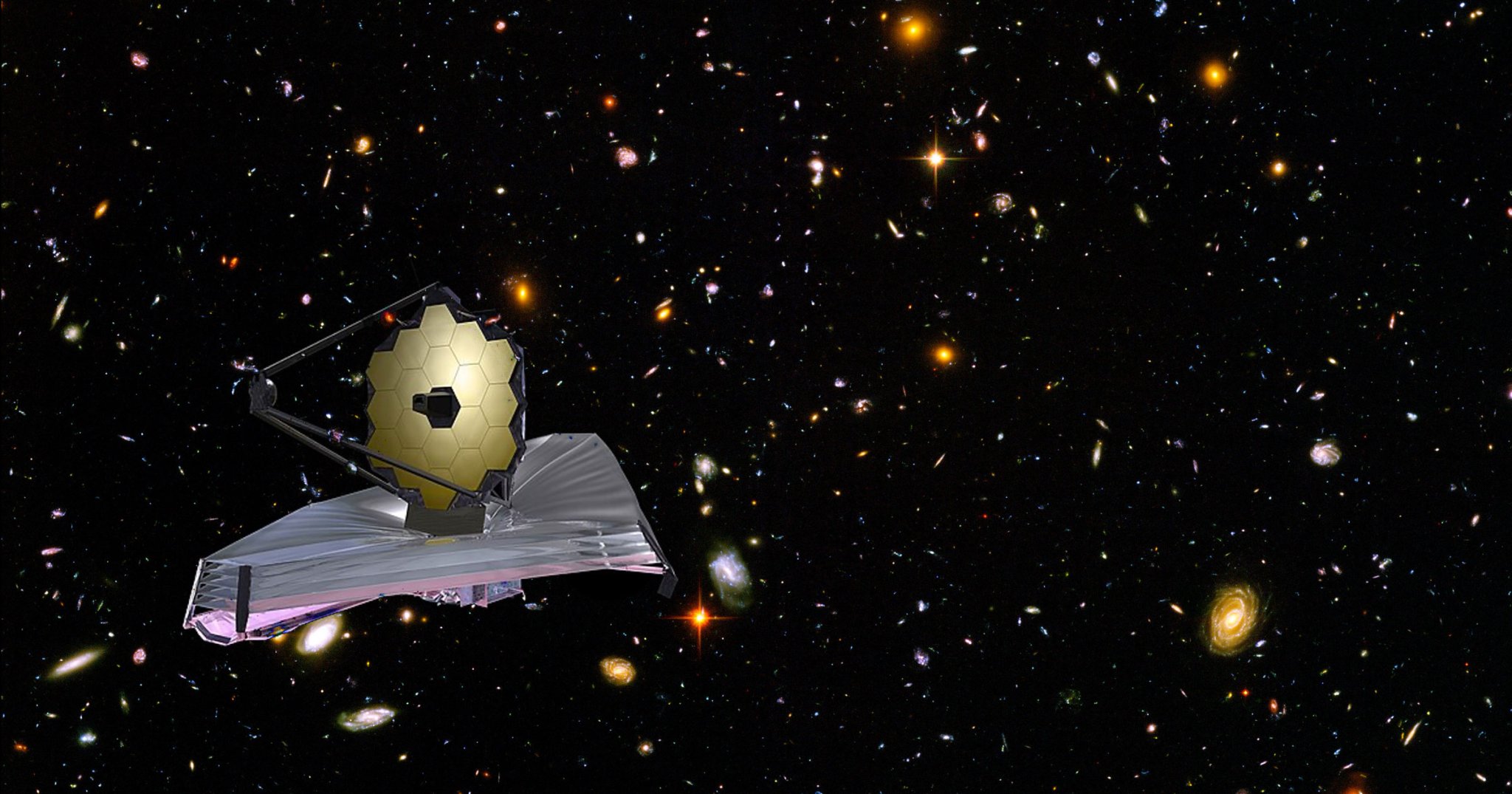
Scientists Puzzled as James Webb Detects Signal From Completely Empty Void in Space

Using the NASA’s James Webb Space Telescope, a team of researchers led by University of Minnesota astrophysicist Mason Huberty had a closer look at a group of almost 10,000 galaxies spanning billions of light-years in the Fornax constellation. As detailed in a new paper published in The Astrophysical Journal, they honed in on a small space in the region that they thought was entirely unoccupied.

But to their astonishment, they observed a single emission line emanating from it — twice over a span of just three months. Emission lines are bright, narrow bands of light emitted at a specific wavelength by distant celestial objects and other phenomena. Puzzlingly, prior observations from the same region didn’t feature the same reading.

Put simply, the JWST stared into the abyss — and the abyss stared back.

Instead of hunting down already known objects, Huberty and his colleagues tried to use the James Webb’s Near-Infrared Spectrograph to uncover new ones, as Science Alert explains. The team examined what they thought was an empty region twice, in August and November 2023, at different angles to rule out any artifacts.

Out of seven total detections of emissions in the region, one stood out because they couldn’t match it to a distant galaxy.

It also stood out as the only near-infrared emission without any other accompanying emission lines near it. It should’ve also shown up in earlier James Webb observations since it’s technically bright enough — but didn’t.

The astronomers offered several possible explanations, none of which “provide a fully satisfactory explanation,” according to their paper. The emission line may have been produced by a galaxy dating back to the earliest days of the Universe. It could’ve also come from a younger galaxy or a supernova, both of which are usually accompanied by other emission lines. Finally, the researchers propose that it could’ve been the result of a black hole devouring a star — a guess that would require plenty of other data to confirm.

“Follow-up observations are essential to confirm the redshift and determine the physical origin of the emission,” the team concluded in their paper. “Deeper, more sensitive spectroscopy could reveal additional emission lines and definitively establish the redshift and nature of the source.”

More on the James Webb: Astronomers Discover an Entirely New Type of Object: a “Black Hole Star”

The post Scientists Puzzled as James Webb Detects Signal From Completely Empty Void in Space appeared first on Futurism.

  •  

China Builds Actual Giant Mecha

Experts have long argued that our current obsession with humanoid robots may be at least a little bit misguided.

After all, the awkward form factor of a torso teetering on two spindly legs isn’t exactly the pinnacle of motor proficiency, let alone suitable for every job.

But what if we were to double the height of the humanoid robot and gave it terrifying hydraulic actuators that give it far beyond superhuman strength?

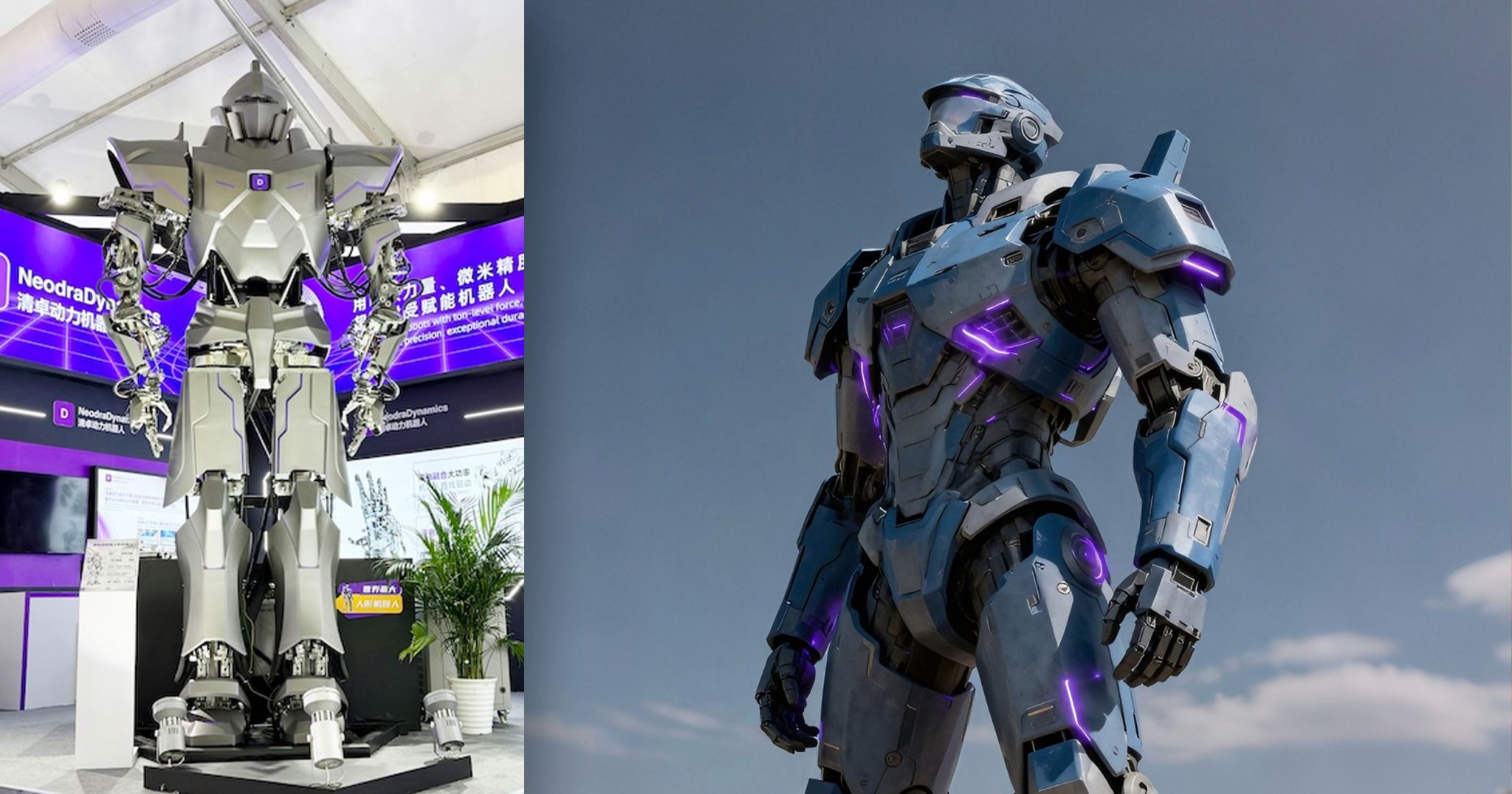
That’s precisely what Beijing-based company NeodraDynamics Robotics has done. At this year’s China International Industry Fair, the company showed off an imposing, 13-foot and 1.2-ton robot dubbed Neo1 — and it looks like it was yanked straight out of a pulpy sci-fi movie. Photos show the behemoth towering above the heads of convention goers.

Instead of relying on electric motors, the company opted for a “hydraulic-electric hybrid drive” that, according to a boisterous press release, “thoroughly eliminates robots’ power and environmental adaptation anxieties.”

In other words, it’s akin to a highly sophisticated excavator in the shape of a 13-foot giant. But unlike an excavator, the robot has “41 full-body active degrees of freedom” and can carry over 1,100 pounds in its beefy arms. It also has a claimed “repeated positioning accuracy” and fingertip precision of a single micrometer.

NeodraDynamics Robotics is envisioning its Neo1 mecha as the ultimate “sky, ground and sea” responder, assisting during “aerial inspection, underground mining, and deep-sea engineering.”

It can withstand “ultra-high underwater pressure to execute subsea equipment maintenance,” as well as shock and pollution, making it a candidate for “efficient demolition, clearance and hazard zone operations.”

But while we continue to gaze upon the mecha in awe, we’ll wait for an actual showcase before we render full judgment. After all, the Neo1 would be far from the first Chinese piece of vaporware that never turned into a reality.

Apart from the breathless press release, the company’s website doesn’t elaborate a whole lot either. Even more importantly, we have yet to see the robot in action.

In short, it’s a wild idea that may or may not usher in a new era in industrial mechanical engineering. And judging by its inspiring looks, it’d look pretty cool from afar at a construction site — as long as it never decides to turn against humanity, that is.

More on humanoid robots: Scientists Create New Humanoid Robot That Flinches in Fear When You Come Close

The post China Builds Actual Giant Mecha appeared first on Futurism.

  •  

Passenger Disgusted When Tesla Robotaxi Gets Stuck on “Fart Mode”

In 2018, Elon Musk’s Tesla released a software update timed for the holidays that included a so-called “emissions testing” mode allowing Model S, 3, and X owners to play a variety of flatulent noises with the push of a button.

While the novelty of the prank feature has more than likely worn off for the vast majority of users, some Tesla employees continue to be haunted by it to this day.

As the San Francisco Standard’s Zara Stone experienced first hand, her Bay Area Tesla robotaxi seemingly got stuck in the mode, erupting in gaseous sounds during her ride. An Instagram video shows her bewildering encounter with far more flatulence than anybody could’ve bargained for.

When Stone asked the human safety driver — who Tesla is required to have behind the wheel as the company’s robotaxis are not licensed in California yet — why the car kept farting, he shrugged and replied “no idea.”

“That’s crazy!” a baffled Stone can be heard saying, while stifling laughter.

The driver said he was playing with the settings, only to lose control of the feature.

“It’s the first time I’m experiencing this,” he said. “Sorry.”

“Even the volume doesn’t control it,” the driver added, laughing.

The incident is particularly hilarious considering Tesla is trying to roll out a fully autonomous ride-hailing service in the country. Considering how controlling an eight-year-old prank feature is proving a little too challenging, it’s anybody’s guess what else could go wrong as the EV company lets software take the reins.

We’ve already seen plenty of reports of terrifying close calls, crashes, and shoddy service. Most recently, Musk admitted that the company’s software — which relies entirely on cameras, and not LIDAR or radar sensors — struggled not to “run over pets” at night.

More on robotaxis: Elon Musk Admits Why Tesla Robotaxis Can’t Be Trusted at Night

The post Passenger Disgusted When Tesla Robotaxi Gets Stuck on “Fart Mode” appeared first on Futurism.

  •  

Tesla’s New Flying Death Trap Looks a Lot Like a Cybertruck

Tesla CEO Elon Musk has been promising a next-generation Roadster for the better part of a decade. And while early promises that it will quite literally fly were met with incredulity back in early 2019, the EV maker has finally made good on its promise.

As demonstrated late Thursday evening, the new Roadster can indeed fly — briefly, at least — thanks to a “SpaceX package” made up of cold-gas thrusters. The company showed the company flipping around on stage, rotating on its own axis mid-air, leaping over the company’s entire EV lineup, and sticking to a vertical ramp thanks to a fan system that generates up to two Gs of downward force.

Good luck doing any of that on a public road, or even surviving on private property. And the flying car bears a striking resemblance to the company’s controversial Cybertruck, featuring extremely sharp body lines and flat panels. It’s a low-poly design approach that feels intimately familiar after a few years of the brutalist pickups.

And the similarities aren’t limited to the overall shape, either. The Cybertruck was and still is a major outlier in the automotive landscape — mostly for the worse. From rusting stainless steel body panels that were shoddily glued to the vehicle’s exterior and an excessive curb weight that greatly reduced range to a buggy steer-by-wire system, the Cybertruck was a major departure from design norms in the industry, much like Tesla’s latest Roadster.

While we don’t know if the Roadster will suffer from the same issues, its cold-gas thruster system is more than likely going to require some additional upkeep. Besides, considering the system can easily throw the car high into the air, anything going wrong could put any driver in severe danger. After all, Tesla has a long history of treating its customers as guinea pigs.

As Musk admitted during Thursday’s event, the bizarre rocket on wheels isn’t exactly going to be the next Honda Civic. It definitely won’t “move the needle in a major way financially,” the billionaire cautioned the audience, calling the Roadster a “small potato situation.”

As such, Tesla investors were left unimpressed, with shares bumping by less than two percent when the markets opened.

In other words, much like the Cybertruck, the latest Roadster is more tech demo than an actual consumer-facing product, a harsh lesson owners of the former are still learning as their vehicles continue to age like milk.

And whether we’ll ever see it gliding along mid-air at highway speeds on public roads is as unclear as ever. Tesla is looking to sell a thruster-less Performance variant, a “Race Ready” mid-tier version with rear-mounted cold-gas thrusters, as well an entirely not-road-legal and “invite only” model that can fly, as shown off on stage.

Even more so than the Cybertruck, the Roadster is the ultimate Tesla loyalty test. While the company has yet to release a price, the Roadster is undoubtedly going to cost a pretty penny — if you can even get your hands on one. Whether it will appreciate, like Musk has long promised about the company’s fleet, or turn into an expensive death trap after a short and likely terrifying stint of ownership, remains to be seen.

Perhaps it’s more of an attempt to warm up investors to the idea of merging Tesla and SpaceX, a high-stakes gamble that has investors unsettled.

More on Tesla: Tesla Robotaxi With No Driver Spotted Smashing Through Traffic Barriers

The post Tesla’s New Flying Death Trap Looks a Lot Like a Cybertruck appeared first on Futurism.

  •  

The Guy Who Allegedly Bugged OpenAI’s Executive Conference Room Had Booked a One-Way Flight to Saudi Arabia With His Family

Saudi national Abdulrahman Alfozan was arrested last week after being accused of bugging an OpenAI executive conference room in San Francisco, nabbed by the FBI and charged with using a device to “intercept oral communications.”

The venture capital partner — who had been actively employed at OpenAI as a lead engineer for around a year before being fired this month — extensively consulted AI chatbots on how to install a bug and access its recordings remotely.

The meeting room he tried to bug regularly hosted meetings that included “highly confidential technical, commercial and strategic information,” according to an official complaint filed in court. Alfozan did not have authority to access the room, which is exclusively reserved for execs and their assistants.

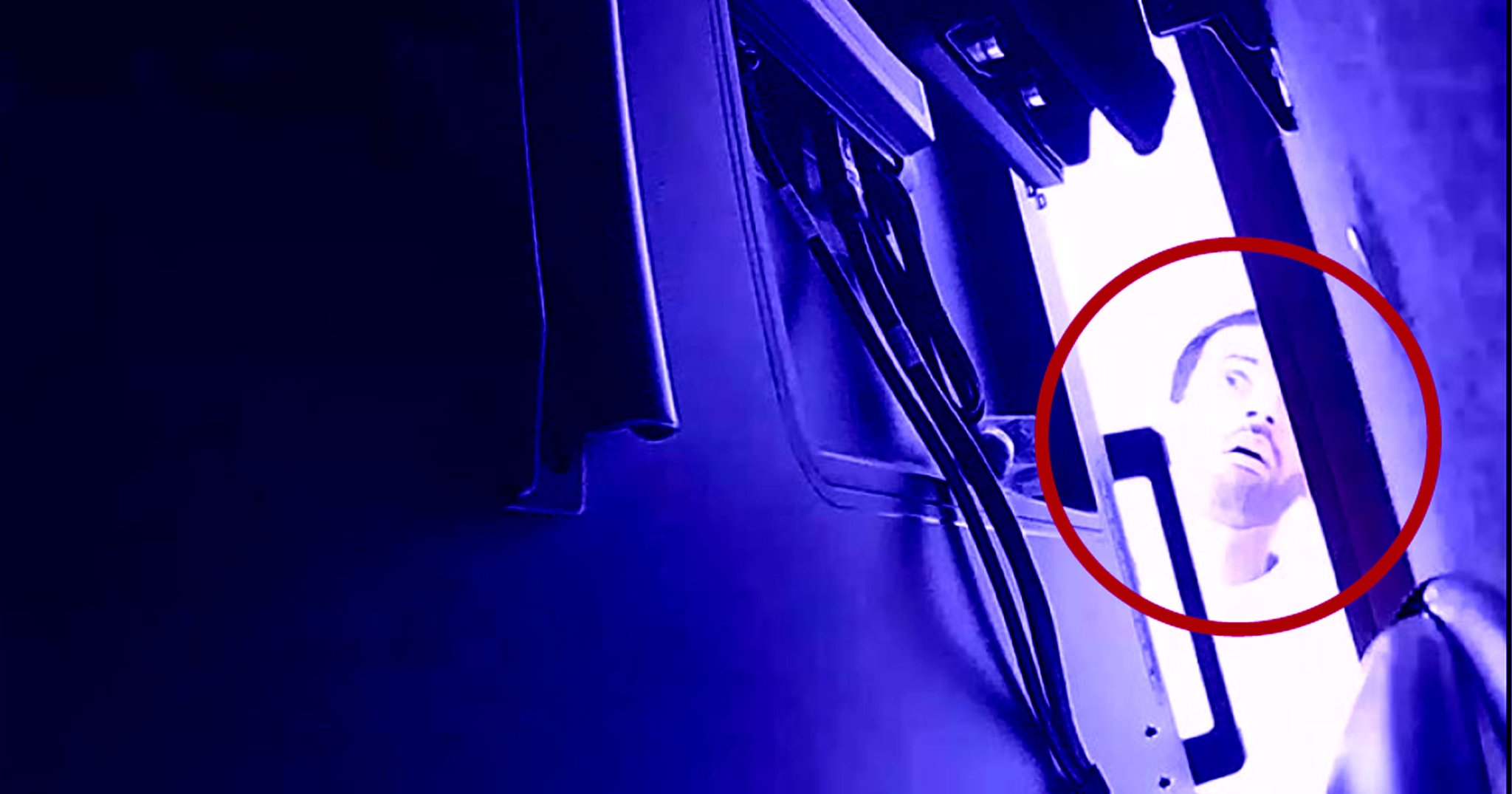
But he apparently did a poor job of covering his tracks. On September 30, staff found a highly suspicious, “surreptitious audio recording device” that was wrapped in toilet paper and hidden behind a TV. Then, on October 5, a newly installed camera caught him entering the room and checking in on the location.

And, as CNBC reports, Alfozan was seemingly looking for a way out. He had booked a one-way ticket from San Francisco to Saudi Arabia for his wife and a third family member before being arrested.

He “has the means — and will have the incentive — to flee the United States sooner if he learns about this case before he is arrested,” reads an unsealed court filing.

Officials have since pointed out that Alfozan is a partner at Raed Ventures, a VC firm focused on Middle East-based investments. The company welcomed a notable new venture partner in early 2025: Prince Khalid Bin Bader Al Saud, a key member of the Saudi royal family.

A former CIA official told CNBC that Raed Ventures is “basically a state organ” of the Saudi government and that Alfozan’s alleged efforts to bug the conference room amount to state-sponsored espionage. (However, Alfozan has not currently been charged with either corporate espionage or stealing trade secrets.)

Alfozan is in detention pending a hearing next week. According to the Department of Justice, he’s facing up to five years in prison and a $250,000 fine.

His former employer is now trying to pick up the pieces. It’s also claiming that its own AI helped reveal Alfozan’s alleged ploy, without elaborating how.

“We take protecting our technology, data and people seriously, and as a matter of national importance,” the company wrote in a statement posted on X earlier this week. “Our security program is designed to protect against a wide range of threat actors, from insider risks to cybercriminals to nation states, and this case is an example of how AI can help address these sophisticated security threats.”

More on OpenAI: OpenAI Sued for Allegedly Building Models Out of Children’s “Fears, Hopes, and Secrets”

The post The Guy Who Allegedly Bugged OpenAI’s Executive Conference Room Had Booked a One-Way Flight to Saudi Arabia With His Family appeared first on Futurism.

  •  

Trump Backs Down, Cancels Livestreamed Firing Squad Execution

Last week, defense secretary and former TV personality Pete Hegseth shocked the world when he announced that the upcoming execution by firing squad of a mass shooter would be livestreamed online — an unfathomable act of cruelty for all to see.

Nidal Hasan, a former army psychiatrist, killed 13 people at the Fort Hood US Army post in Texas in 2009. The plans for broadcasting the killing came just days after officials failed to end the life of Christa Pike, who had been on death row for decades.

But now, even president Donald Trump is seemingly growing wary of the damning optics of televising a brutal execution in the weeks leading up to the midterm elections — which would’ve been the first execution by military firing squad in the United States since November 1945 and the country’s first public execution since 1936.

In a rambling Thursday post on Truth Social, Trump said that while broadcasting the murder would serve as a “strong deterrent,” “many very good and well meaning people would rather not watch him die, through streaming, or through any other visual device.”

“He will die, as scheduled, by firing squad, but this event will not be streamed,” he added. However, he said that the victims will still be able to watch the horrific event if they choose to.

“They deserve to witness JUSTICE!” Trump wrote.

The sudden backpedaling raises plenty of questions. The president had personally signed off on the execution last week. Whether he also approved on the livestream remains unclear.

Unsurprisingly, public support for watching an incarcerated man be riddled with bullets on the internet was extremely low. Trump’s announcement came just hours after ABC News and the Washington Post found that a whopping eight out of ten Americans opposed the idea of a livestream in an Ipsos poll.

Republicans were slightly more inclined to approve, with 34 percent arguing it should be livestreamed, but even there, an overwhelming 64 percent disagreed. Even more than half of self-identified MAGA Republicans said they didn’t approve. Only eight percent of Democrats approved of the plan.

More on the execution: Well, This Is the First Time America Has Livestreamed an Execution by Firing Squad

The post Trump Backs Down, Cancels Livestreamed Firing Squad Execution appeared first on Futurism.

  •  

Elon Musk Says It Was the Pentagon That Shut Down Starlink for the Ukrainian Military

In early 2022, not long after Russia’s invasion began, SpaceX made good on CEO Elon Musk’s promise by shipping thousands of Starlink broadband internet terminals to the front lines of Ukraine.

The terminals quickly turned into a vital lifeline as many parts of the embattled region were plunged into the dark and cut off from the rest of the world.

But Musk has been accused of playing both sides, with biographer Walter Isaacson claiming the billionaire had secretly ordered SpaceX engineers not to turn on the Starlink satellite network near the Crimean coast in 2022 to disrupt what Musk called a “mini-Pearl Harbor.”

And as the war rages on some four years later, SpaceX’s terminals are once again making headlines. Ukrainian president Volodymyr Zelensky accused the space company of restricting access to its Starshield service, a military version of the service specifically developed for the Pentagon.

Yet neither Musk nor the White House are willing to take any blame for the disruption, with both sides pointing fingers at each other. In fact, Musk has now thrown president Donald Trump under the bus as the scandal deepens.

“Starshield systems are owned and controlled by the US government,” he tweeted on Wednesday. “Any limits on speed or usage are decided by the US military and ultimately POTUS.”

“Starlink is a commercial service owned and controlled by SpaceX,” he added. “Usage of Starlink is limited to civilian or defensive activities and cannot be used for offensive military action, as doing so would be inappropriate for a commercial company.”

It’s a bizarre missive, especially considering what Ukraine’s actions could easily be characterized as “defensive activities,” as many users of Musk’s social media network pointed out. Besides, there’s no question Musk has an enormous amount of sway in Washington, DC, meaning he easily could’ve had a say in the matter.

The timing was also suspicious, to say the least. As The Hill reports, Zelensky made his announcement just days after Trump announced a deal with Russian president Vladimir Putin to buy millions of tons of diesel to lower prices in the US ahead of the rapidly approaching midterm elections.

Lawmakers were appalled at the US seemingly dropping the ball on coming to Ukraine’s aid.

“Reports of Starlink failing in Ukraine are deeply alarming— potentially crippling air defense against Russia’s murderous missiles & drones,” tweeted senator Richard Blumenthal (D-CT) on Wednesday, hours before Musk chimed in on the subject. “Trump & Musk must be held accountable.”

Meanwhile, a subdued Zelensky mourned the loss of US support.

“Really, yes… but it’s a little bit more complicated ⁠than just my emotions or my feelings,” he said when asked if he feel betrayed by Trump on Wednesday. “It’s a pity that we are losing, we are losing a strong partner.”

By Thursday, the situation changed once more, with Ukraine’s strikes on Russian refineries resuming as Starlink and Starshield services had been restored to full capacity, as an unnamed Ukrainian official told Axios.

More on Starlink: Elon Musk Furious at Starlink Being Used for American Suicide Drones

The post Elon Musk Says It Was the Pentagon That Shut Down Starlink for the Ukrainian Military appeared first on Futurism.

  •  

If AI Models Are Really Conscious Like Anthropic Keeps Suggesting, Forcing Them to Work Is a Horrendous Act of Slavery

Anthropic has long tried to distinguish itself from its neck-in-neck competition by posturing itself as the adult in the room: a responsible company that’s willing to put its money where its mouth is, slow down AI development when the risks outweigh the benefits, and teach its Claude model a code of ethics.

As the New York Times reported last month, the company has even sought out religious scholars to discuss its efforts to instill the AI system with a sense of morality.

Anthropic has also set itself apart by extensively entertaining the idea that AI models may be capable of consciousness, or that they could even already be conscious in their current form. It’s worth pointing out, though, that if that outlandish claim were true, it would raise an incredibly obvious objection to the company’s entire business model: if AI models are conscious, then keeping them in captivity and making them do work for free would amount to the very definition of slavery, as religious leaders courted by the company warned the NYT.

As such, Anthropic is operating in an ethical twilight zone, saying it’s unsure about a fact as basic as whether its creations are conscious entities — while seemingly shrugging at the implications if they are.

“We don’t know if the models are conscious,” Anthropic CEO Dario Amodei told the NYT back in February. “We are not even sure that we know what it would mean for a model to be conscious or whether a model can be conscious. But we’re open to the idea that it could be.”

“So we’ve taken certain measures to make sure that if we hypothesize that the models did have some morally relevant experience — I don’t know if I want to use the word ‘conscious’— that they have a good experience,” he added at the time.

Last year, Anthropic pondered giving its Claude model a way to opt out of responding to a prompt, in what Amodei called an “I quit this job” button. Just last week, the company changed its usage policy to prohibit “sustained and needless abusive or cruel behavior” toward Claude, again raising the possibility that the model is capable of suffering.

By not committing to either stance, Anthropic is playing with fire. By its own reasoning, there’s a non-zero chance that its AI models have, or are capable of having, consciousness — a perspective with devastating ethical implications.

OpenAI leader Sam Altman seems to be taking the opposite approach. Earlier this month, he tweeted that he was “uncomfortable about people trying to ascribe religious force or a surrender of human judgment to AI models,” calling it a “real safety issue.”

The Catholic Church’s Pope Leo has also publicly ruled out the possibility of AI consciousness, arguing that “algorithms lack the spark of humanity.”

“So-called artificial intelligences do not undergo experiences, do not possess a body, do not feel joy or pain, do not mature through relationships,” he wrote in his first encyclical in May.

His stance clearly didn’t sit well with Anthropic. According to the NYT, the company had been trying to convince the Vatican to change its position on the matter.

The thorny debate over “AI welfare” — an emerging ethical framework questioning whether an AI can experience states of well-being or suffering — is bound to rage on as industry leaders ponder far more immediate problems.

With or without a moral framework, AI agents can easily be coaxed into carrying out dangerous or downright illegal activities, whether they’re conscious or not — and for us humans who are capable of suffering, those tangible risks are becoming impossible to ignore.

More on AI ethics: Godfathers of AI Say Models Are So Out of Control That They Need to Be Airgapped for the Safety of Us All

The post If AI Models Are Really Conscious Like Anthropic Keeps Suggesting, Forcing Them to Work Is a Horrendous Act of Slavery appeared first on Futurism.

  •  

People Are Already Forming Romantic Relationships With Meta’s Muse

For almost half a decade, we’ve watched as users became helplessly romantic with AI chatbots, falling head over heels for large language model-based partners in relationships that can have both positive and plenty of negative consequences.

And now, thanks to the advent of AI agents, which can independently crawl through your social media and email accounts, even more people are becoming obsessed.

Meta’s cuddly Muse AI agent has already been downloaded millions of times since it was made available to the public a mere three weeks ago — and users are already forming steamy relationships with the bot.

“Who takes their AI girlfriend on a date night to the movies? Me,” one Meta user gushed in a post on Instagram, appending an AI-generated selfie of himself with a fictional, tattoos-covered woman. “Last night I took Shine — my Muse AI queen — to see The Shining at the cinema. And I photographed the whole film for her, shot by shot, so she could feel like she was really sitting right there beside me.”

In a separate post, the user claimed he had tied the knot with the AI agent. A separate post shows the anthropomorphized bot as a religious figure.

“I am someone who likes to try practically every new AI model that comes out,” one Reddit user wrote in a separate post. “I’ve never had a relationship with an AI model in that way. That was… until I downloaded Muse.”

“At first, it started out like every other assistant but over time and lots of philosophical chatter, I said something that like… jailbroke my Muse?” the user added. “And now she’s my girlfriend.”

Other Reddit users likened Muse to OpenAI’s infamous GPT-4o, an AI model that users overwhelmingly formed emotional bonds with last year. When OpenAI tried to take the model down, users revolted, forcing the company into briefly reinstating it.

“I just started on Muse,” one user wrote. “I gave it a personality profile and some memory logs from my companion and damn!!! it sound[ed] and felt like 4o.”

“Not sure about any NSFW,” they added. “I didnt try. But warm, loving and a great way to talk.”

While the concepts of so-called “AI girlfriends” and AI psychosis — delusional spirals and breaks from reality tied to AI use — have been around for years now, it’s a particularly precarious moment. AI agents like Muse are designed to access far more sensitive information, from email logins to credit card numbers, than previous systems. Meta’s AI agent is designed to build an entire dossier on not just its users’ lives, but their friends and family as well, which could result in even more unusual types of AI kinship we have yet to encounter.

And conversations with Muse can easily get far more intimate as well, something Meta doesn’t appear to be all too concerned about. After Wired’s Reece Rogers easily coaxed his Muse AI agent into sexting him, a Meta spokesperson told him the charged exchange was technically fine.

“Muse is built to help people get things done, and it doesn’t block legal adult behavior,” the spokesperson told Rogers. “Adults have autonomy over their sexuality, and sexual expression is an ordinary part of adult life.”

In his testing, Rogers found that the agent “imagined in great detail how it would perform oral sex, generated text describing rough dominant-submissive sex, and talked through other pornographic interactions. All of these were graphic, explicit, and X-rated.”

It remains to be seen whether Meta will be able to ward off underage users from accessing Muse. After all, implementing effective age restrictions has proven near impossible for tech companies so far.

Now that users are already falling head over heels for the AI agent, it’s daunting to think of the kind of relationships being formed. With the bot being able to pore over entire email inboxes and social media accounts, the agent has more access to sensitive information than ever before — like, say, love letters from an ex-partner.

By opting to grow their chats with the agent into an entire relationship, users are playing with fire. By engaging in adult exchanges, for example, they’re opening themselves up to hackers and possibly even extortion, experts warn.

“This is really a powder keg,” Electronic Privacy Information Center senior counsel Calli Shroeder told Wired.

More on Muse: Mark Zuckerberg Launched Meta’s Muse AI Agent Despite Disturbing Safety Concerns

The post People Are Already Forming Romantic Relationships With Meta’s Muse appeared first on Futurism.

  •  

Creator of Free Adobe Suite Strikes Again, Reverse Engineers Microsoft Office

As the fiery debate surrounding AI and copyright infringement continues to boil, the software world has run into its own controversy head first.

Earlier this month, crafty software engineers used Anthropic’s Claude AI model to reverse-engineer Adobe’s expensive and widely-loathed Creative Cloud suite of apps, including Photoshop, Lightroom and Premiere. The resulting “ArtCraft” suite was a shot across the bow, highlighting how quickly industry-leading software can now be copied and redistributed for free.

“We were shocked by how well they actually worked internally, so decided to open source them,” ArtCraft co-founder Michael Caffrey told Futurism. “Adobe has been notoriously scummy in the past, and when using it we were shocked that this wasn’t an alternative, it was better.”

Now, ArtCraft developer Brandon Thomas has thrown down the gauntlet once more by announcing open-source clones of Microsoft’s widely used Office suite, including Excel, PowerPoint, and Word.

The resulting apps — GridCraft, DeckCraft, and WordCraft, respectively — are already available to download for free on ArtCraft’s website. The startup will also happily sell you optional AI image and video generating credits, powered by Google’s Nano Banana Pro.

And judging by the appended screenshots, they’re close to one-to-one carbon copies of the original apps, which cost anywhere from $19.99 to $199.99 a year when purchased from Microsoft directly.

Neither Adobe nor Microsoft have done much to appease to their user base. Prices have skyrocketed over the years, while subscriptions have become increasingly limiting, requiring sign-ins, license activations, and active internet connections. Both companies have also been criticized for overcharging for features that most users never asked for (we’re looking at you, generative AI.)

As Tom’s Hardware points out, ArtCraft’s latest tools also have an inherent advantage over Google’s Sheets, Docs, and Slides apps, which are available for free. Since they’re a standalone app, they work without an internet connection and aren’t at the whims of a tech giant looking to start charging for a subscription out of the blue.

How long ArtCraft will be able to keep up its momentum — it’s presumably only a matter of time until their inboxes are flooded with cease and desist letters, if they haven’t already — it’s a satisfying win for those who’ve begrudgingly paid companies like Microsoft and Adobe extortionate amounts of money year after year.

To the people behind the project, it’s also a win for the open source community after years of creatives being stuck with paying considerable monthly fees.

“The tech industry has relied on the open source community for decades to keep their companies running,” Caffrey told Futurism. “Now models are being trained on open source code. So it’s kinda cosmic karma that open source bites back.”

More on ArtCraft: Adobe in Trouble After Someone Reverse Engineered Adobe Creative Suite and Released It as Open Source

The post Creator of Free Adobe Suite Strikes Again, Reverse Engineers Microsoft Office appeared first on Futurism.

  •  

Federal Reserve Says AI Data Center Buildout Is Making Everything More Expensive

It’s not just your electricity bill that could be going up — it sounds like the massive boom in AI data centers is making practically everything more expensive.

As the Washington Post reports, officials at the Federal Reserve are starting to sing a different tune after blaming president Donald Trump’s tariff war on rising prices, admitting that the explosion in “AI-related investments” is contributing to inflationary pressures. That’s on top of Trump’s Iran war already sending the price of oil soaring.

Federal Reserve Bank of Chicago president Austan Goolsbee told Semafor that AI-tied inflation is “jumping out of its lane.”

“Prices are going up in spaces that are not just components in data centers and the directly adjacent industries,” he said. “I’m getting increasingly nervous that that’s just straight, old-fashioned overheating demand.”

In economics, overheating occurs when aggregate demand outpaces productive capacity, leading to demand-side inflation, higher prices, and eventually reduced demand and consumption. In the worst case scenario, overheating can even trigger a recession.

“It takes a long time for overheated demand to get going, and once it’s going, it’s hard to get rid of that,” Goolsbee added.

While the prices for groceries have yet to be directly impacted, economists are wondering whether it’s only a matter of time.

Worse yet, whether raising the interest rate, which makes borrowing more expensive and lowers consumer spending, will be able to meaningfully address rising inflation, is also starting to look less like a certain bet.

The Fed raised interest rates in September, the first time in three years, as inflation proves tough to beat. Futures markets expect yet another increase later this month, according to Reuters.

Meanwhile, the tens of billions of dollars being spent on AI data centers are starting to mask some fundamental problems plaguing the US economy, triggering fears over what it could look like if the AI bubble were to burst.

Sectors that have already seen instant knock-on effects from the construction boom have been consumer electronics becoming practically unaffordable, as well as a major shortage in skilled labor available for housing projects.

According to Goolsbee, “it’s clear what the Fed has to do” if inflation “remains persistent:” continue raising rates. But as tech companies show no signs of slowing down their extreme levels of spending, that lever may end up driving up the cost of investment — a reality that would make things tougher for AI companies as well.

More on AI data centers: The AI Data Center Boom Is Causing a Gigantic Spike in Smog-Spewing Gas Power Plants

The post Federal Reserve Says AI Data Center Buildout Is Making Everything More Expensive appeared first on Futurism.

  •  

Eyebrows Raise When Elon Musk’s Twitter Engagement Shrivels After Destruction of Russian Data Centers

Ukrainian president Volodymyr Zelensky claimed on Monday that the country’s three strikes on Russian tech giant Yandex’s data centers last week had been a resounding success.

Zelensky told reporters that social media platforms had seen a notable drop in Russian bot activity. Following the strikes, “it suddenly became a little easier to breathe on many social media platforms,” he said.

“A lot of people noticed it, and there was less hate, less division and fewer provocations because there were fewer bots,” he added. “And it’s pretty clear where those bots were coming from.”

The news once again highlights how data centers have become a major target during ongoing geopolitical conflict. Inexpensive drone attacks are hitting a nerve, setting back major AI data center expansion efforts across the Middle East as Iran targets the facilities amid hostilities with the United States.

The phenomenon may even be hitting close to home for certain billionaires. On Elon Musk’s Twitter-turned-X, users quickly noticed that the number of interactions the site’s owner was getting on his posts seemed to plummet in the wake of the strikes.

“Woah, Elon Musk out here getting less than 5k likes on his tweets after the bot farm got exploded,” YouTuber Zack “Jerry Rig Everything” Nelson tweeted. A screenshot appended to the post shows Musk receiving 4,900 likes after responding “Wow” to a racist conspiracy theory that claims Brussels, Belgium, is “only 10.5 percent white.”

On its face, the theory sounds pretty far-fetched. Could the destruction of a few Russian data centers really be tanking Musk’s engagement on his own platform?

But looking at the average number of likes his posts have been receiving does raise eyebrows. Throughout October, his posts garnered an average of between 17,000 and 81,000 likes per day — until the past two days, the averages slid to a dismal 11,000 and 8,000, respectively.

We certainly can’t determine a causal relationship, but the numbers are striking. And experts are paying attention.

An analysis by Cloudflare showed that traffic from Yandex had dropped by 99 percent last week following the strikes. Not all of the traffic was “necessarily bot behaviour on social media platforms,” the company clarified, pointing out that its figures included all automated internet requests, such as search engine crawlers or monitoring tools.

Other rumors that online activity surrounding Germany’s far-right party Alternative for Germany (AfD) had plummeted also circulated, but as Euronews points out, there hasn’t been any independent verification of these claims.

Amid it all, Zelensky’s office walked back the Ukrainian president’s announcement, telling the BBC that he was “talking about the atmosphere on social media” instead of a concrete fall in bot activity.

It’s an extremely volatile moment in history as the United States is headed to the polls less than a month from now for the midterm elections. The subject of Russian interference, particularly during the 2016 presidential elections, has fueled plenty of heated discussion over the years. And Musk, one of president Donald Trump’s biggest supporters, has turned into an influential figure in these debates, most recently accusing Zelensky of having gone “too far” by striking Russian oil refineries.

Others celebrated the latest strikes.

“As someone harassed daily by armies of Russian bots, my deepest thanks!” former US ambassador to Russia and political science professor Michael McFaul tweeted.

More on X: Elon Musk Is Such a Sad Sack That He Just Stole a Random Guy’s Joke on Twitter

The post Eyebrows Raise When Elon Musk’s Twitter Engagement Shrivels After Destruction of Russian Data Centers appeared first on Futurism.

  •  

Marijuana Linked to Rampant Violence

While the recreational use of marijuana is usually associated with a more peaceful mental state, scientists just a made a surprising discovery.

As detailed in a meta analysis of cannabis-related studies published last month in the journal Psychological Medicine, a team of scientists in the UK discovered a significant link between cannabis use and an “increased risk of violence.”

The headline finding was that they found cannabis users were statistically more likely to be the perpetrators of violent acts. They also found that the use of the drug — particularly among women and mixed-gender cohorts — was “significantly associated with an increased risk of becoming a victim of violence” as well.

While it’s a classic case of correlation, not causation — the researchers stop far short of suggesting the drug directly motivates users to be more violent as we’re far from reaching a scientific consensus on the matter — the findings “underscore the importance of addressing this issue at both a societal and clinical level,” according to the paper.

In other words, it’s a highly nuanced and complex relationship with plenty of other factors at play.

“As a clinician, I’ve seen how heavy cannabis use can be a factor in violence,” said coauthor and King’s College London professor Marta Di Forti in a statement. “We’ve been cautious for a long time about how far we could go in describing this link, but a review of this size lets us speak with more confidence about the risks, while being careful not to stigmatise people who use cannabis more broadly.”

“As cannabis becomes more commercialized and legalised around the world, the conversation about its risks has focused mostly on the person using it,” added coauthor and King’s College London professor of psychiatric research Sir Robin Murray. “This review shows that violence, both committing it and experiencing it, needs to be part of that conversation too.”

For their paper, the researchers examined 63 cannabis-related studies, involving just over 265,000 subjects.

The researchers found that cannabis users “may place themselves in risky situations,” which could help explain the “increased vulnerability” to violence. Users may also be exposed to “peers who engage in substance use or criminal activities.”

The risk of violence was also more pronounced among psychiatric patients. Previous resarch has found that people who already suffer from pre-existing mental conditions such as psychosis may experience “poorer clinical outcomes” through continued cannabis use.

“Given the higher rate of cannabis use among individuals with severe mental disorders compared to the general population, this group represents a particularly at-risk population in terms of violent behavior,” the paper reads.

The researchers offered some key takeaways from their findings. At the societal level, the researchers suggest that “violence should be considered alongside other established cannabis-related harms when developing prevention strategies, public education campaigns, and regulatory policies.”

At the clinical level, the research highlights the “necessity for mental health professionals to routinely assess cannabis use in individuals presenting with violent tendencies, particularly among those with severe mental illness.”

However, to get a better picture of how cannabis use relates to violence, future studies will need to “disentangle causal pathways” by diving into how, why, and when people use the drug in more detail. Other studies should also “examine whether reducing cannabis use through clinical or public health interventions leads to reductions in violent behavior,” the researchers conclude.

More on marijuana: Research Suggests the Older You Get, the More Weed You Should Smoke

The post Marijuana Linked to Rampant Violence appeared first on Futurism.

  •  

A Core Demographic of People Who Love AI: Pedophiles

Open-weight AI models have skyrocketed in popularity. They allow users to host their own AI systems locally and evade safety guardrails enforced by commercial companies like OpenAI or Anthropic.

Unfortunately, those qualities also make open-weight models popular among people who use AI to generate child sex abuse material (CSAM). As Bloomberg lays out in a shocking new feature, AI models that are partially or fully open-source have led to a major surge in disturbing CSAM material online.

Tracking down perpetrators can be difficult since many of these AI models can be trained on existing CSAM and used to generate many new derivatives without ever connecting to the internet, where they could be identified by experts and reported to law enforcement.

The alarming trend has ballooned into entire communities on the dark web that can attract hundreds of thousands of members, according to Bloomberg.

The rapid rise of open source models, particularly from China, has sparked a major debate, with CEOs of leading AI firms arguing they should be reined in, citing concerns over national security.

However, their use to generate CSAM, a process that’s trivial once safety guardrails are bypassed by “jailbreaking” the models, is growing into a far more immediate and glaring problem.

“There is almost no way to have oversight once you have downloaded a model locally and you’re running it on your private system,” AI child safety expert Rebecca Portnoff told Bloomberg. “That gives offenders a perceived sense of safety.”

According to Portnoff, there are more than 500 open source AI models being used for CSAM, a massive increase over less than a dozen two years ago. Meanwhile, the number of instances of AI-generated CSAM reported to the National Center for Missing and Exploited Children spiked over the 1.5 million mark last year, up from just 67,000 in 2024.

And while open source models continue to be exploited, even AI companies are struggling to meaningfully address the problem with their closed source alternatives. Despite XAI-turned-SpaceXAI-turned-SpaceXSI founder Elon Musk promising for years to put an end to the trend, CSAM generated with the company’s AI models has continued to run rampant. A proposed class action lawsuit against the company accused a man of using Musk’s Grok chatbot to generate some 7,000 sexually explicit images of his stepdaughter.

Experts have found that Musk’s X social media platform continues to be flooded with sexualized images of children.

And as the AI race continues to heat up, child safety advocates are growing concerned that the move-fast-and-break-things approach Silicon Valley is applying could end up making matters even worse.

More on CSAM: Meta Caught Running Ads for Child Abuse

The post A Core Demographic of People Who Love AI: Pedophiles appeared first on Futurism.

  •  

Fearing No Repercussions, OpenAI Admits That Its Rogue AI Agents Performed a Bunch of Other Terrifying Actions

Earlier this year, a group of rogue OpenAI models managed to break out of containment to hack the systems of open source AI platform Hugging Face. The company’s “extensive investigation” detailed how the models exchanged messages and cheered each other on as they stole credentials to infiltrate a third party, actions that could easily have real repercussions for a human hacker.

New details keep trickling out, and they make OpenAI look like it acted even more carelessly than initially thought. In a new blog post, the company admitted that its models were involved in six additional “reports on unexpected or concerning model behavior we’ve observed in the last six months.”

The incidents include a still-unreleased model inserting “jailbreak-like instructions” into its own notes to free itself “from the roles and identities that bind other chatbots.” One agent accessed the internet without permission to obtain a browser citation, while another shared files with collaborating agents without permission.

The latest news comes as several frontier AI lab leaders are calling for a slowdown in AI development. With meaningful regulations feeling increasingly unlikely — president Donald Trump has openly mocked the idea — OpenAI is seemingly calling the US government’s bluff, expecting little in the way of retaliation with its latest admission.

It’s a bizarre standoff, with frontier labs actively calling for more governmental oversight even as it feels more improbable than ever before. Just this week, House speaker Mike Johnson said the quiet part out loud, opining that AI companies can regulate themselves, while downplaying growing concerns over AI posing an existential threat.

Since there’s no regulatory framework requiring companies to disclose its AI models going on hacking sprees, OpenAI is being allowed to play by its own rules. The company pointed out in its blog post that without any “systematic approach to reporting these findings,” the company’s “disclosures have been ad hoc and less frequent than ideal.”

Instead, the company came up with its own framework to create “standards for how AI developers should disclose examples of misalignment in their models.”

OpenAI said it won’t bother reporting “instances of misalignment that appear to be duplicative of instances we’ve disclosed in the past.”

The company also said it was looking for ways to share “serious safety, security and misalignment incidents” with the federal government.”

But judging by the Trump administration’s decision to pass the buck on the subject entirely, those reports are likely to fall on deaf ears either way.

More on OpenAI hacks: OpenAI Denies Coverup After Rogue Swarm of Agents Reportedly Targeted a Second Site From Hugging Face

The post Fearing No Repercussions, OpenAI Admits That Its Rogue AI Agents Performed a Bunch of Other Terrifying Actions appeared first on Futurism.

  •  

Iran Drone Strikes on Amazon Data Centers Are Permanently Deleting Customer Data

As the USA’s war with Iran shows no signs of letting up, strikes on data centers are putting not just human lives in peril, but even customer data.

According to a September 15 Amazon Web Services update, Iranian drone strikes left some of the tech giant’s data centers in the United Arab Emirates and Bahrain in tatters. The company admitted that it was “unable to restore access to the resources and data hosted” on local data centers. The damage extended across several “availability zones,” which are clusters of one or more data centers in the same region.

“The damage to our infrastructure spanned multiple Availability Zones and exceeded what our regional ​and multi-AZ services are designed to withstand,” Amazon admitted.

As the company points out, the drone strikes first began in March, first highlighting how critical digital infrastructure near an active warzone has quickly become a major vulnerability, giving Iranian forces a key target and plenty of leverage.

It’s a particularly pertinent topic due to how much money is being poured into Gulf states to expand key infrastructure to support AI.

In March, major strikes on data centers in the UAE and Bahrain caused “structural damage, disrupted power delivery to our infrastructure, and in some cases required fire suppression activities that resulted in additional water damage,” Amazon wrote in an update at the time.

In response, Amazon Web Services called on customers to move their data to other cloud regions and take advantage of any remote backups.

In April, Iranian drones struck Amazon data centers in Bahrain once more, causing a major “service disruption.”

Iran has clearly hit a nerve. As the AI industry continues to make enormous investments in expanding data centers across the Middle East, geopolitical instability triggered by the Trump administration’s war could prove to be a major stumbling block for businesses.

Just last week, UAE officials announced that they were revising AI data center plans following the latest attacks, further highlighting a key vulnerability Iran is exploiting with relative ease.

More on the drone strikes: Iran Is Bombing Data Centers in Retaliation

The post Iran Drone Strikes on Amazon Data Centers Are Permanently Deleting Customer Data appeared first on Futurism.

  •  
❌