❌

Reading view

Bees may survive a swim by heading for the dark [COMIC]

Bees may be best known for buzzing through the air. But they are surprisingly good swimmers, too. The insects can paddle through the water using the bottoms of their wings. And a new study shows that waterborne bees prefer to swim toward dark areas. This strategy might save them from drowning.

Zach Huang and others studied this behavior in honeybees and mason bees. Huang is a bee researcher at Michigan State University in East Lansing. The team shared its findings February 10 in Communications Biology.

illustrated text reads "Wild Things: A graphic tale" with animals drawn around the letters
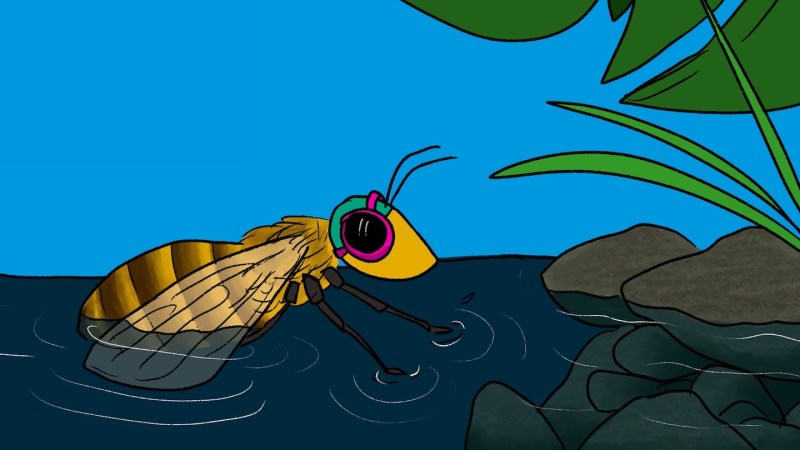
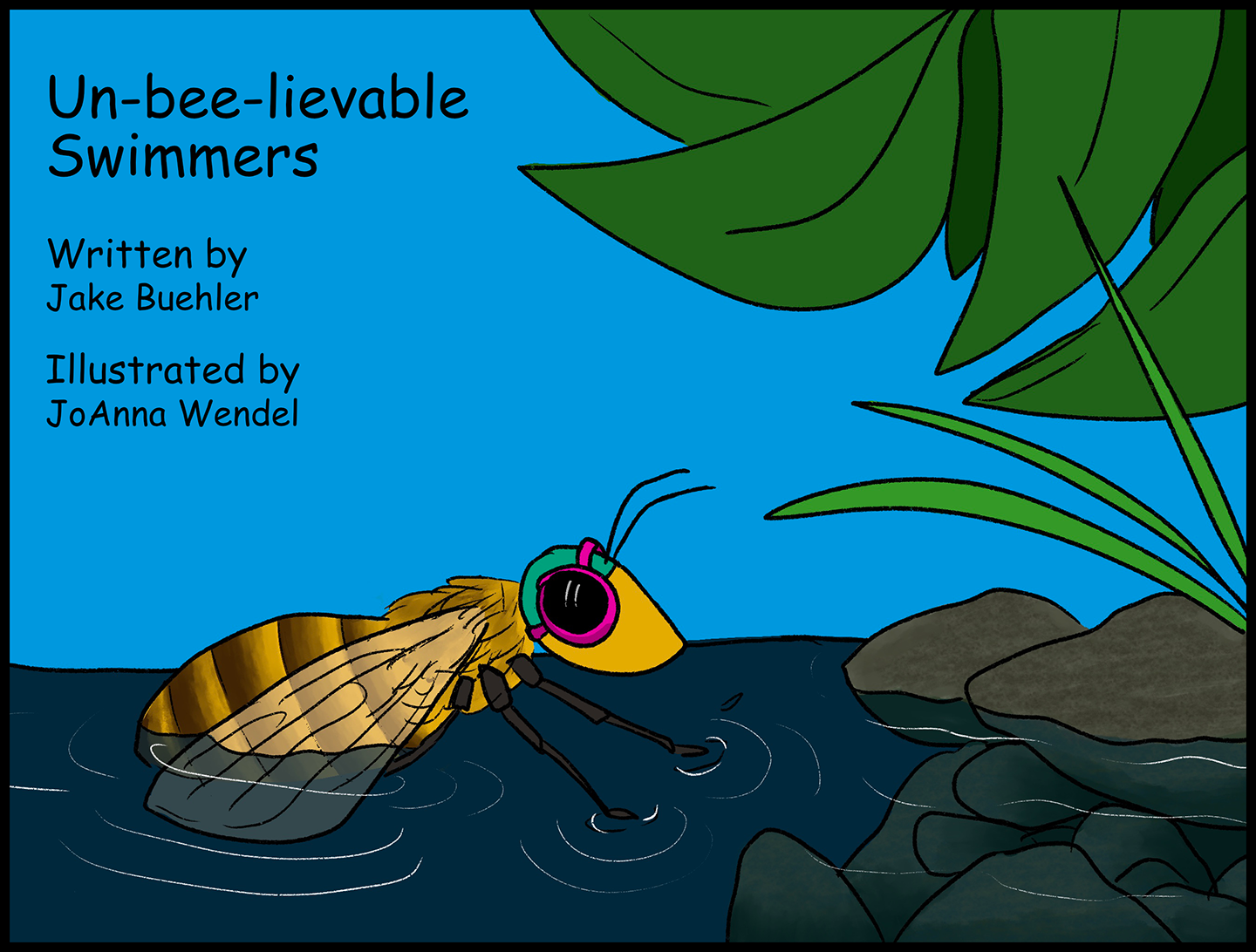
Text (above image): Un-bee-lievable Swimmers. Written by Jake Buehler. Illustrated by JoAnna Wendel. Image: a bee wearing pink goggles swims across a shallow pool toward a rocky shore.
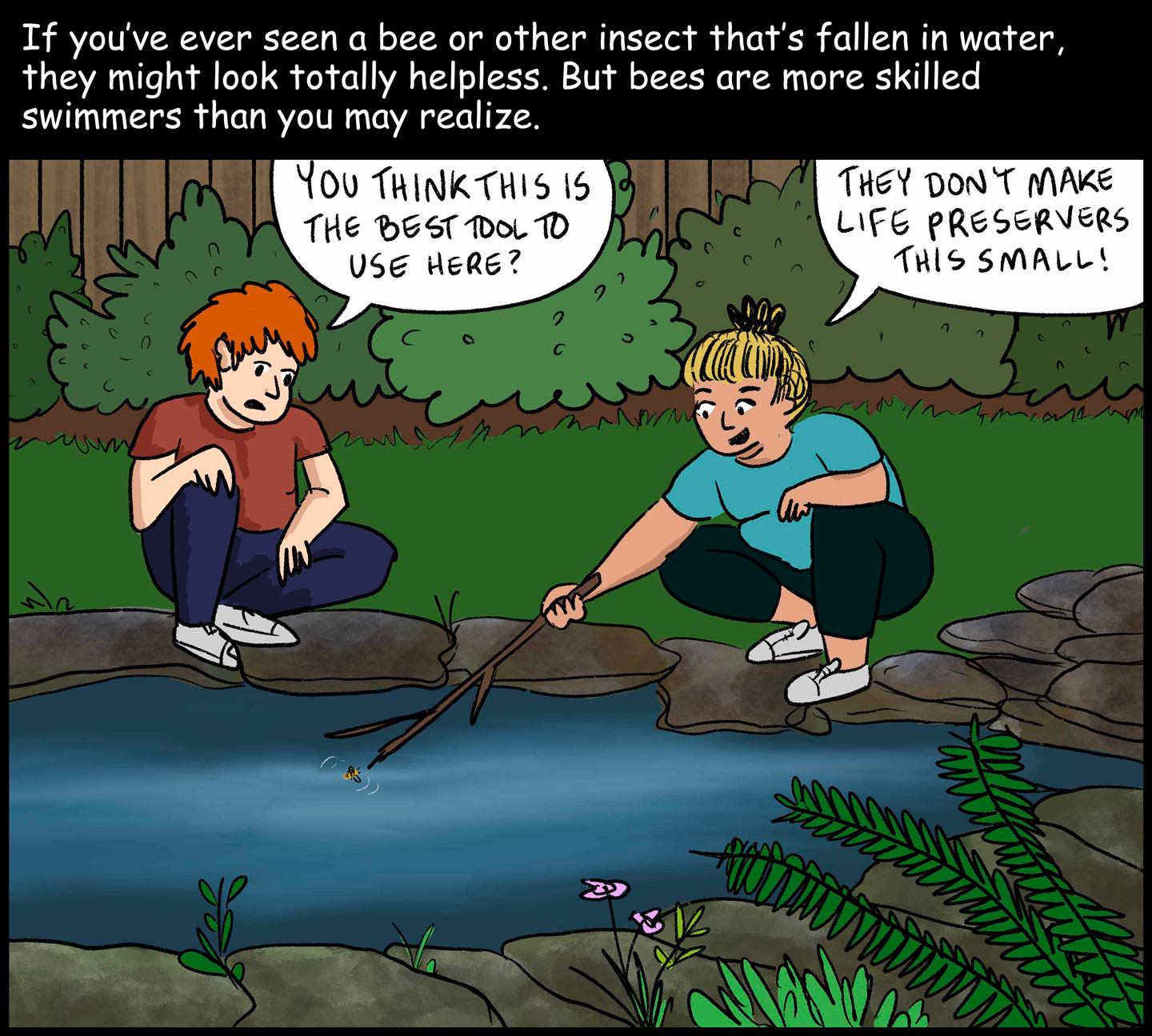
Text (above image): If you’ve ever seen a bee or other insect that’s fallen in water, they might look totally helpless. But bees are more skilled swimmers than you may realize. Image: Two children sit at the edge of a pond. One child holds out a stick toward an insect that has fallen in the water. The one not holding a stick says: “You think this is the best tool to use here?” The one holding the stick says: “They don’t make life preservers this small!”
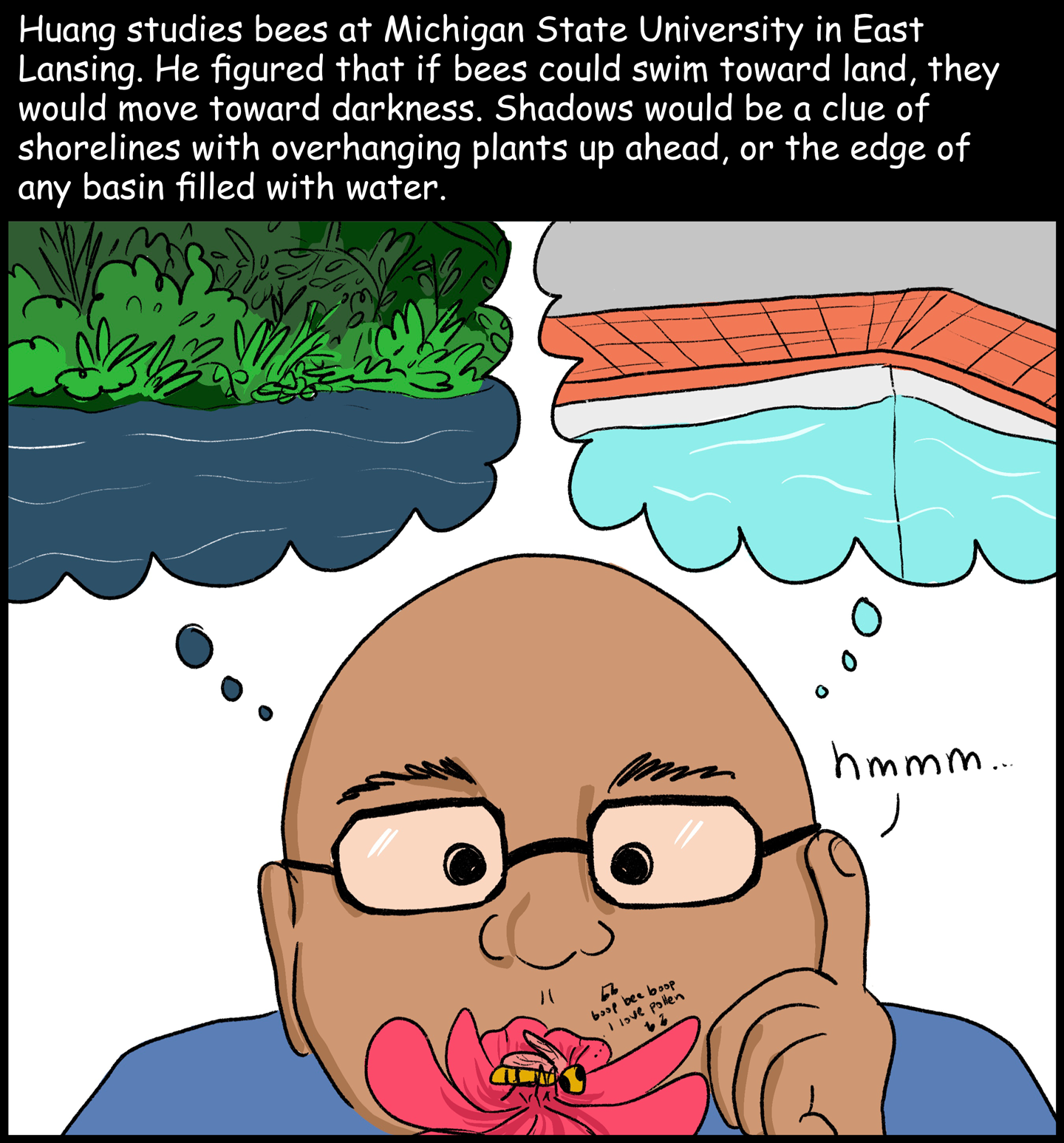
Text (above image): Huang studies bees at Michigan State University in East Lansing. He figured that if bees could swim toward land, they would move toward darkness. Shadows would be a clue of shorelines with overhanging plants up ahead, or the edge of any basin filled with water. Image: A bald man with glasses looks at a bee perched on a flower. The man is picturing the plants at the edge of a pond, or the lip at the edge of a pool. The bee is singing quietly: “Beep, boop, I love pollen!”
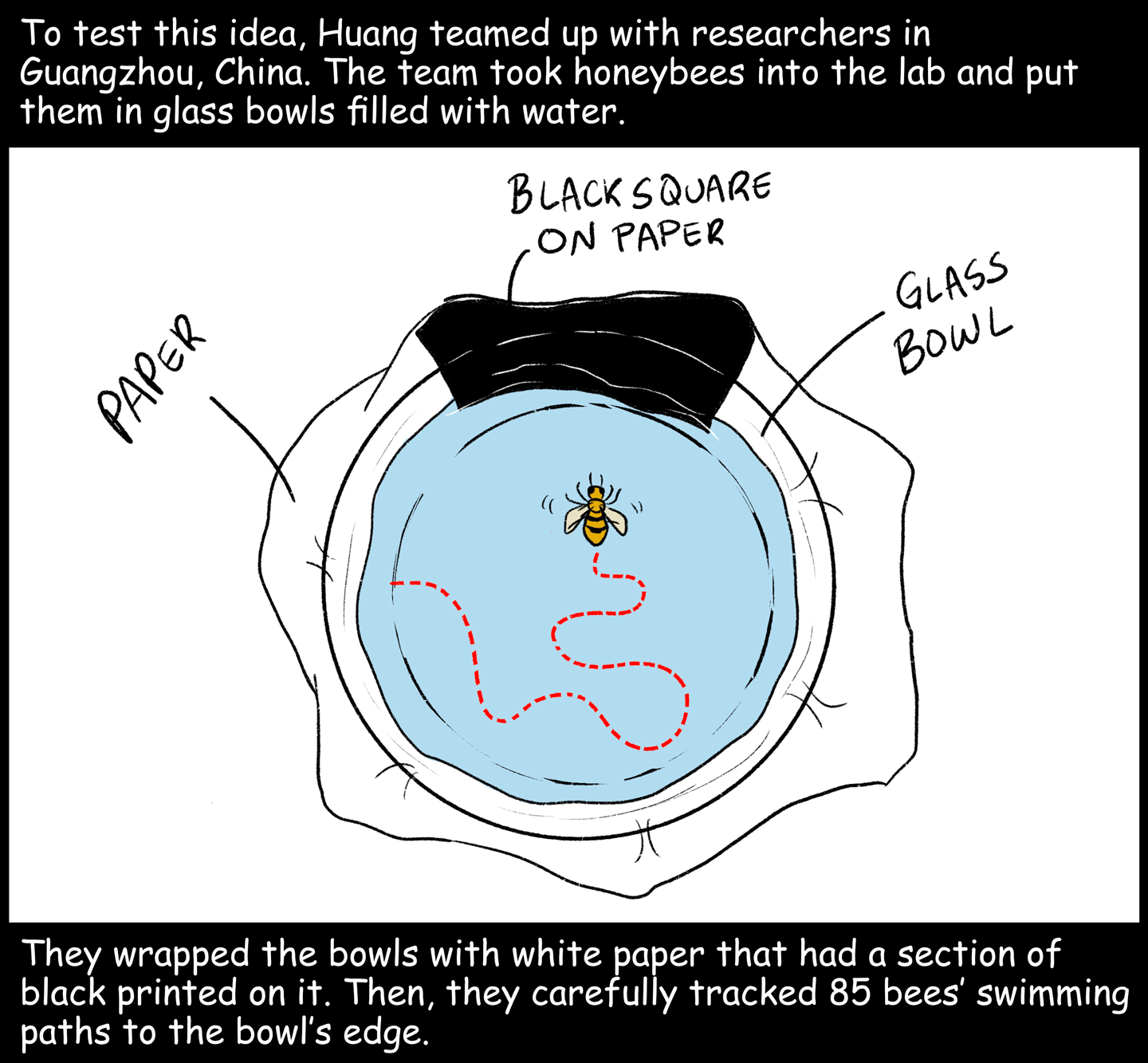
Text (above image): To test this idea, Huang teamed up with researchers in Guangzhou, China. The team took honeybees into the lab and put them in glass bowls filled with water. Image: Top view of a glass bowl filled with water. Around the bowl is a piece of white paper. One patch of the white paper is colored black. A bee swims in the water bowl toward the black patch. Text (below image): They wrapped the bowls with white paper that had a section of black printed on it. Then, they carefully tracked 85 bees’ swimming paths to the bowl’s edge.
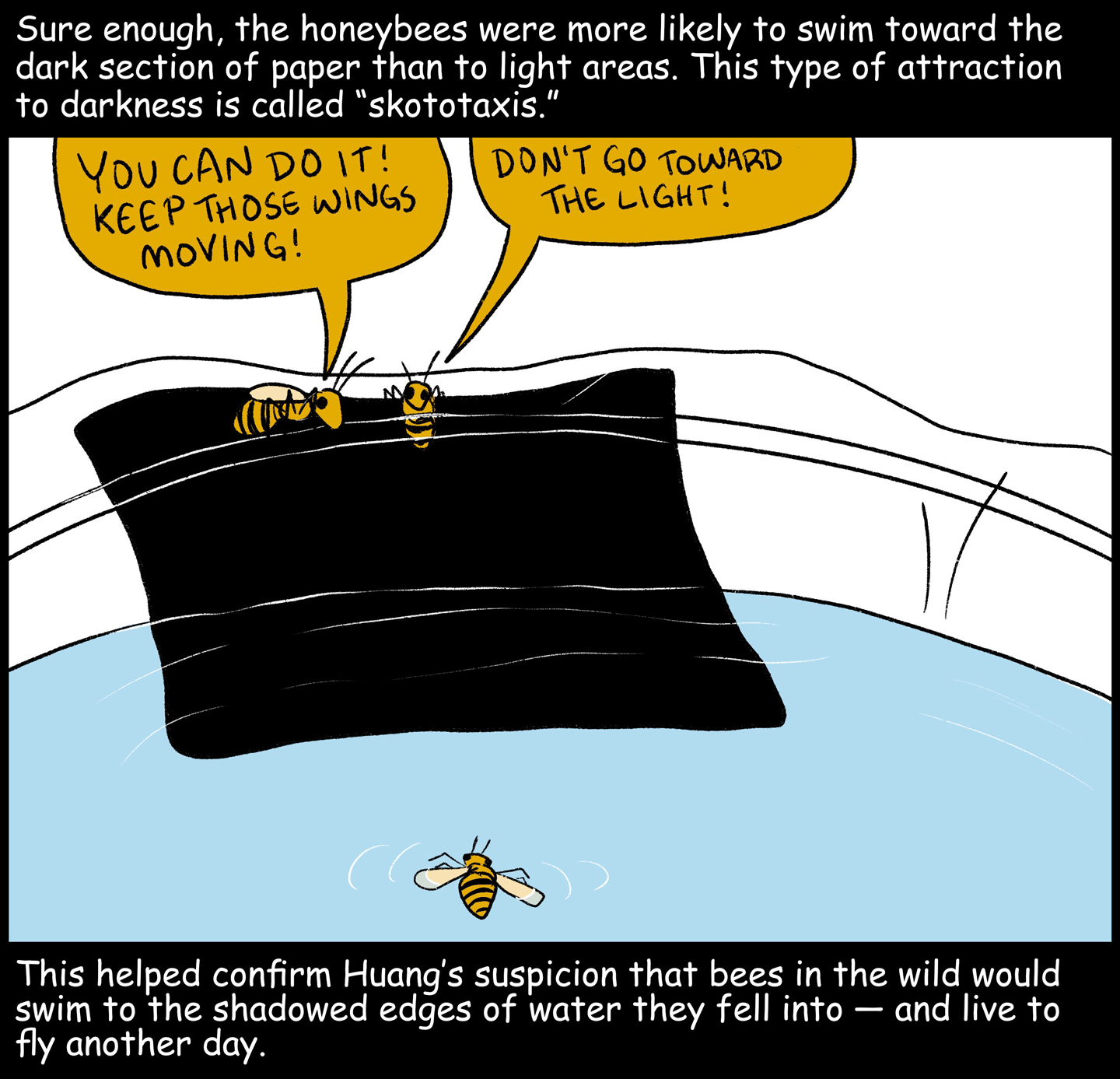
Text (above image): Sure enough, the honeybees were more likely to swim toward the dark section of paper than to light areas. This type of attraction to darkness is called “skototaxis.” Image: Two bees sit on the edge of the bowl while another swims toward the black patch of paper. One of the watching bees yells: “You can do it! Keep those wings moving!” The other watching bee yells: “Don’t go toward the light!” Text (below image): This helped confirm Huang’s suspicion that bees in the wild would swim to the shadowed edges of water they fell into — and live to fly another day.
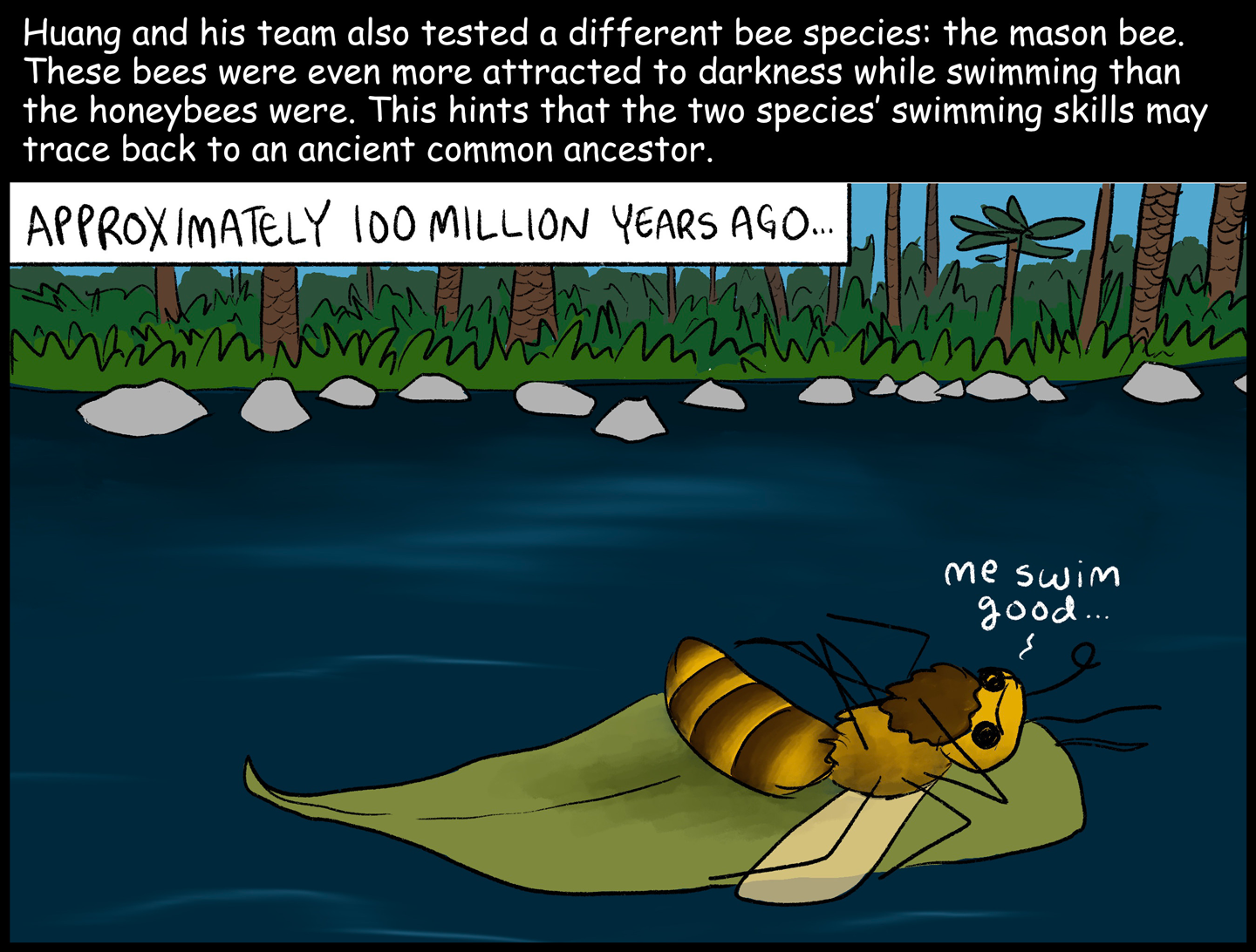
Text (above image): Huang and his team also tested a different bee species: the mason bee. These bees were even more attracted to darkness while swimming than the honeybees were. This hints that the two species’ swimming skills may trace back to an ancient common ancestor. A box with the text “Approximately 100 million years ago…” appears at the top of an image. Image: A cave-bee with a long beard floats on his back on a leaf, thinking: “Me swim good…”
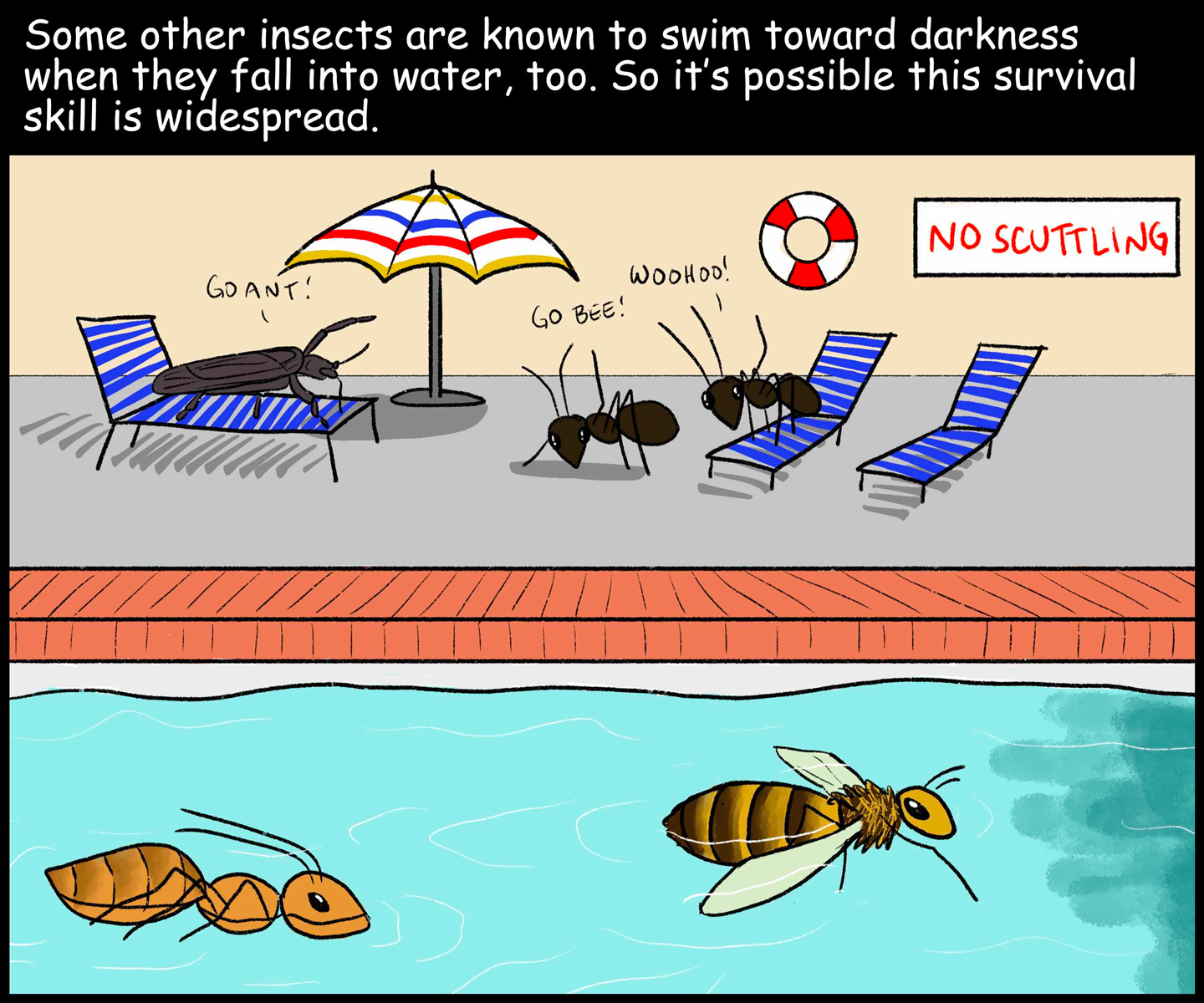
Text (above image): Some other insects are known to swim toward darkness when they fall into water, too. So it’s possible this survival skill is widespread. Image: Several insects mill about a tiny pool. On the pool deck, a few insects sit in lounge chairs. In the water, a bee races against an ant. A beetle from the sidelines yells: “Go ant!” An ant on the sidelines yells: “Go bee!” Another yells “Woohoo!”
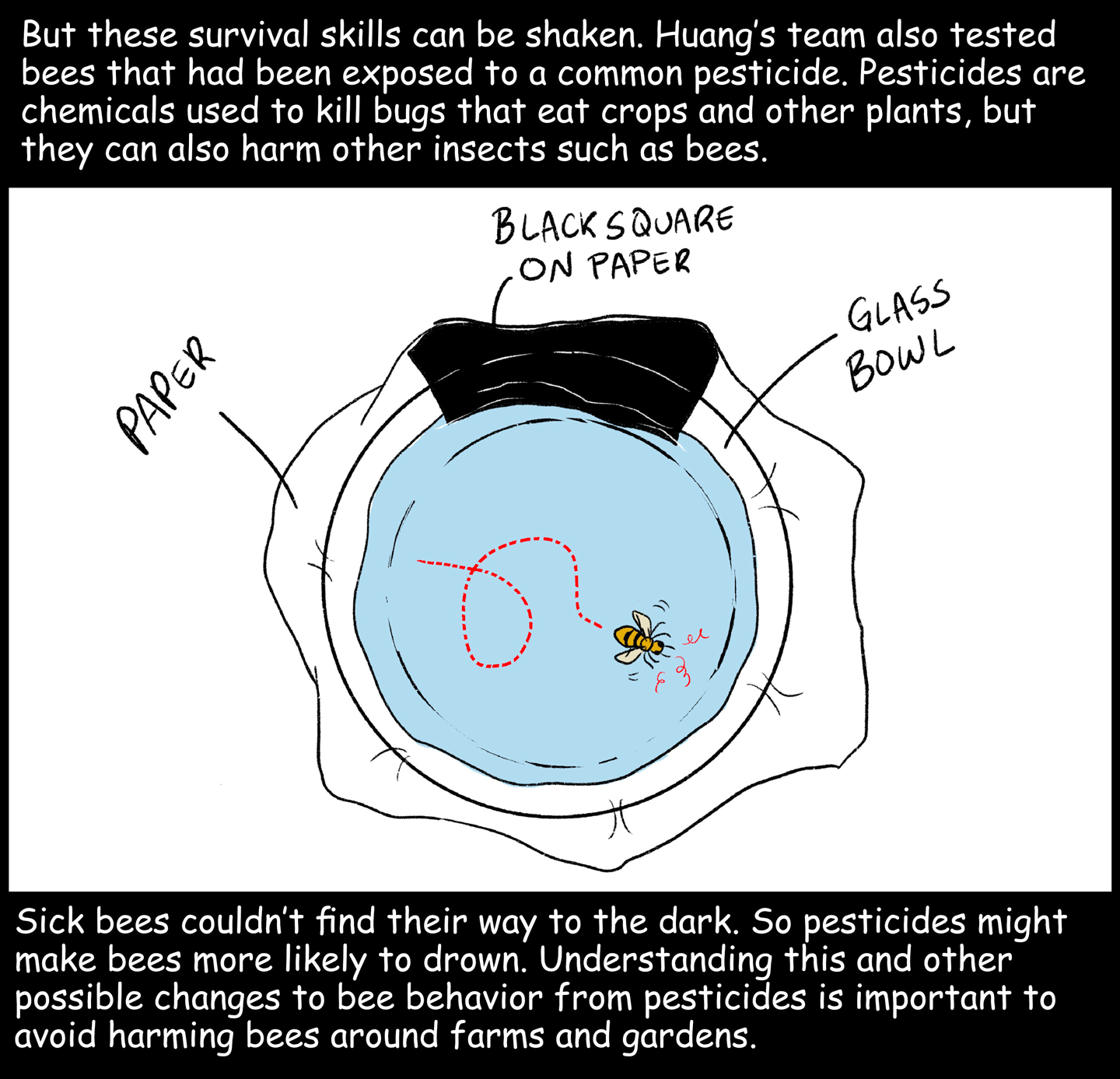
Text (above image): But these survival skills can be shaken. Huang’s team also tested bees that had been exposed to a common pesticide. Pesticides are chemicals used to kill bugs that eat crops and other plants, but they can also harm other insects such as bees. Image: Top view of glass bowl with white paper and a black patch. A bee in the water swims around in confusion. Text (below image): Sick bees couldn’t find their way to the dark. So pesticides might make bees more likely to drown. Understanding this and other possible changes to bee behavior from pesticides is important to avoid harming bees around farms and gardens.
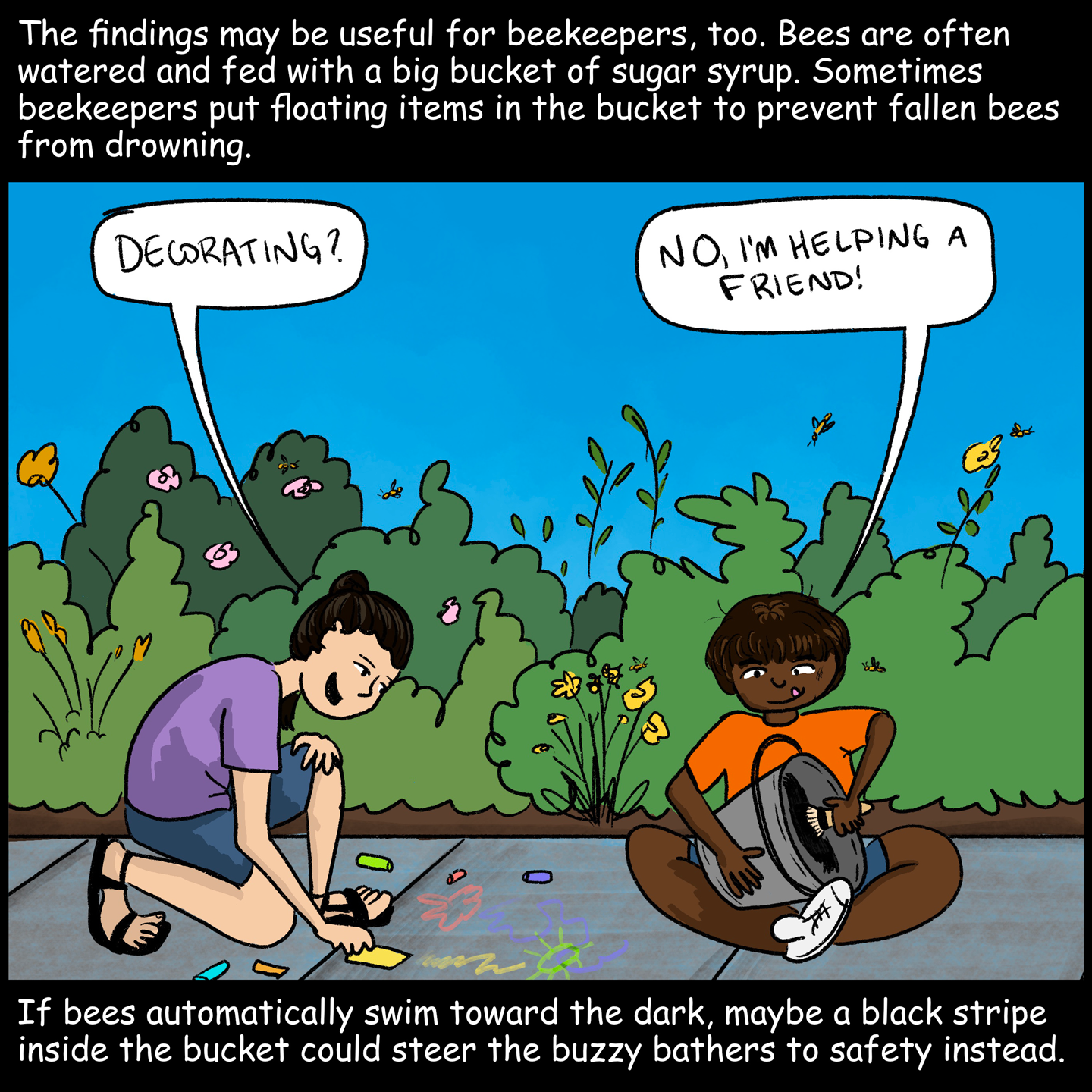
Text (above image): The findings may be useful for beekeepers, too. Bees are often watered and fed with a big bucket of sugar syrup. Sometimes beekeepers put floating items in the bucket to prevent fallen bees from downing. Image: Two kids sit on a sidewalk. One is drawing on the sidewalk with chalk. The other is painting a black patch onto a bucket. The one coloring the sidewalk asks: “Decorating?” The one painting the bucket says, “No, I’m helping a friend!” Text (below image): If bees automatically swim toward the dark, maybe a black stripe inside the bucket could steer the buzzy bathers to safety instead.

  •  

King cobras may be riding trains across India [COMIC]

Dikansh S. Parmar rescued a snake for the first time in middle school. It happened at his karate class in Surat, India. Someone spotted a baby cobra among a nearby pile of construction materials and wanted to kill it. But Parmar stopped them. His dad had rescued snakes, and he had a rough idea what to do. He took a rod from the construction site and used it to coax the baby snake inside a water bottle.

Parmar was lucky. The snake didn’t harm him. And people without proper training shouldn’t approach snakes. But this encounter inspired him to become a trained snake rescuer as a teen. Parmar is now also a herpetologist who studies snakes. He works at the Leibniz Institute for the Analysis of Biodiversity Change in Bonn, Germany. Recently, Parmar combined his snake rescue and science knowledge to discover something curious about his favorite snakes: king cobras.

Western Ghats King Cobras (Ophiophagus kaalinga), his team found, might ride trains across the Indian state of Goa. Parmar and his colleagues shared their evidence for this January 26 in Biotropica.

illustrated text reads "Wild Things: A graphic tale" with animals drawn around the letters
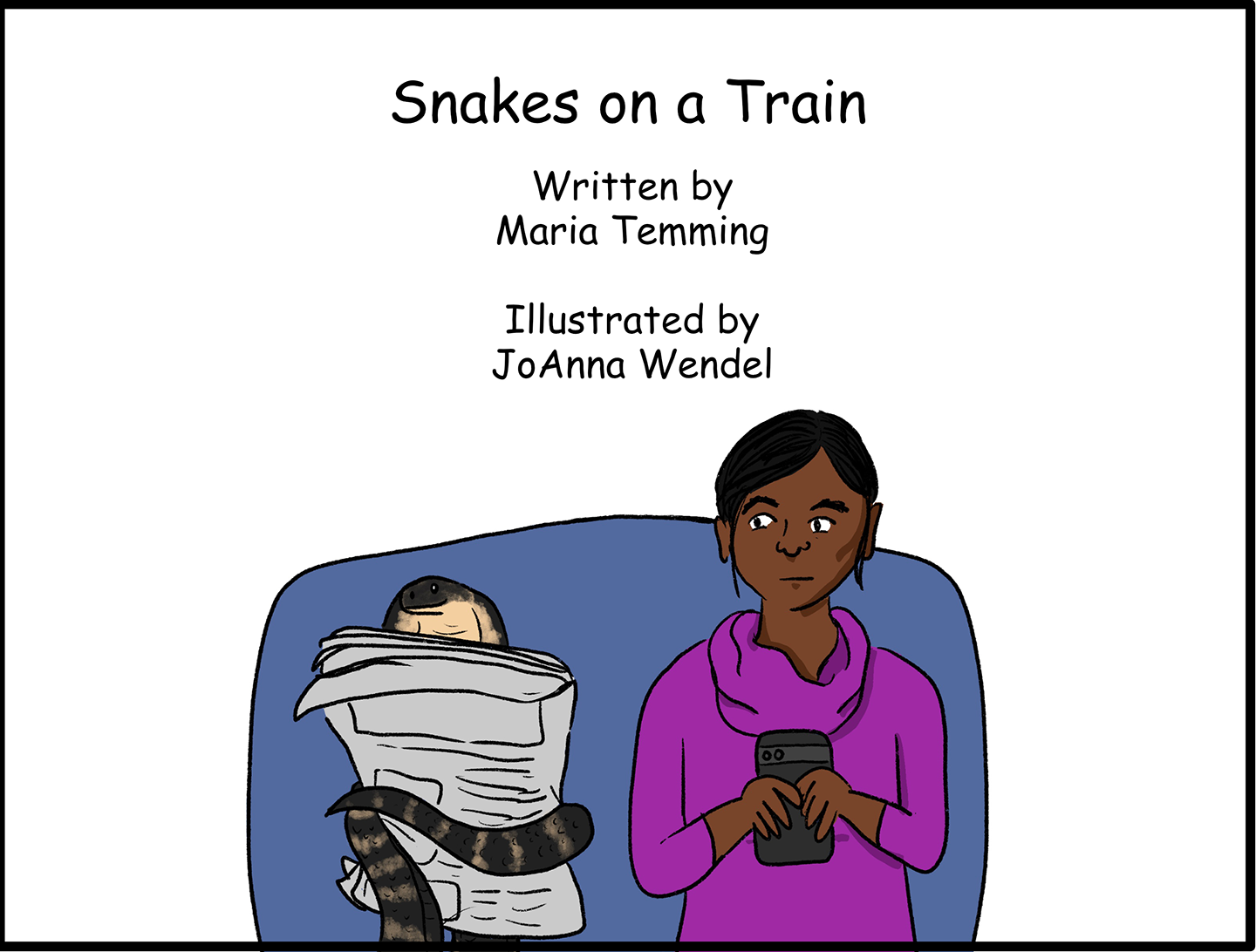
Text: Snakes on a Train. Written by Maria Temming. Illustrated by JoAnna Wendel. Image: A woman sitting on a train looks up from her phone to side-eye the passenger sitting beside her — a snake that is reading a newspaper.
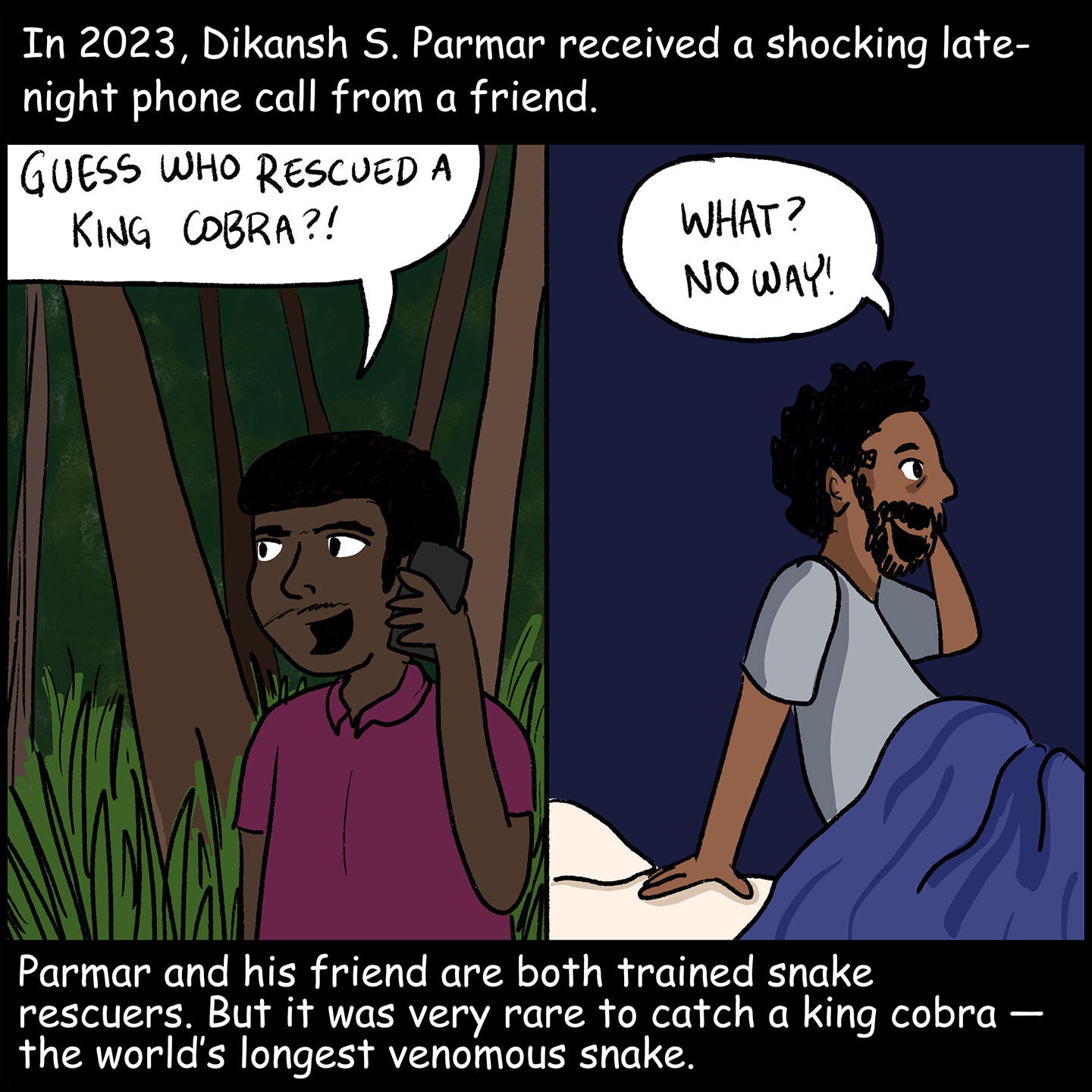
Text (above images): In 2023, Dikansh S. Parmar received a shocking late-night phone call from a friend. Image (left): A man in a forested area is on the phone. He says, “Guess who rescued a king cobra?!” Image (right): A man sits up in bed, holding a phone to his ear. He says, “What? No way!” Text (below images): Parmar and his friend are both trained snake rescuers. But it was very rare to catch a king cobra — the world’s longest venomous snake.
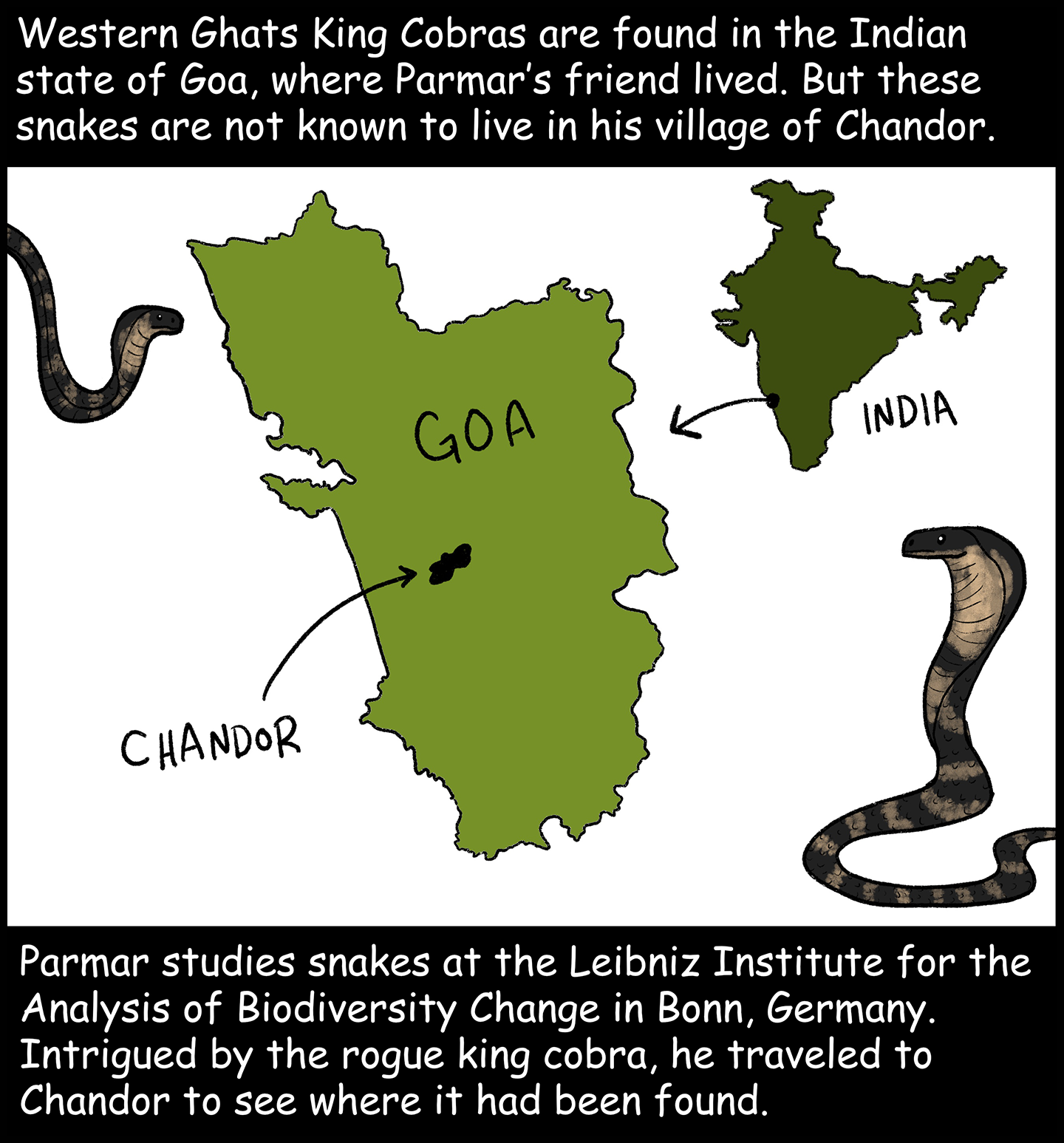
Text (above image): Western Ghats King Cobras are found in the Indian state of Goa, where Parmar’s friend lived. But these snakes are not known to live in his village of Chandor. Image: A map of India shows the state of Goa on the western coast. A map of Goa shows the village of Chandor slightly left to the center of the state. Text (below image): Parmar studies snakes at the Leibniz Institute for the Analysis of Biodiversity Change in Bonn, Germany. Intrigued by the rogue king cobra, he traveled to Chandor to see where it had been found.
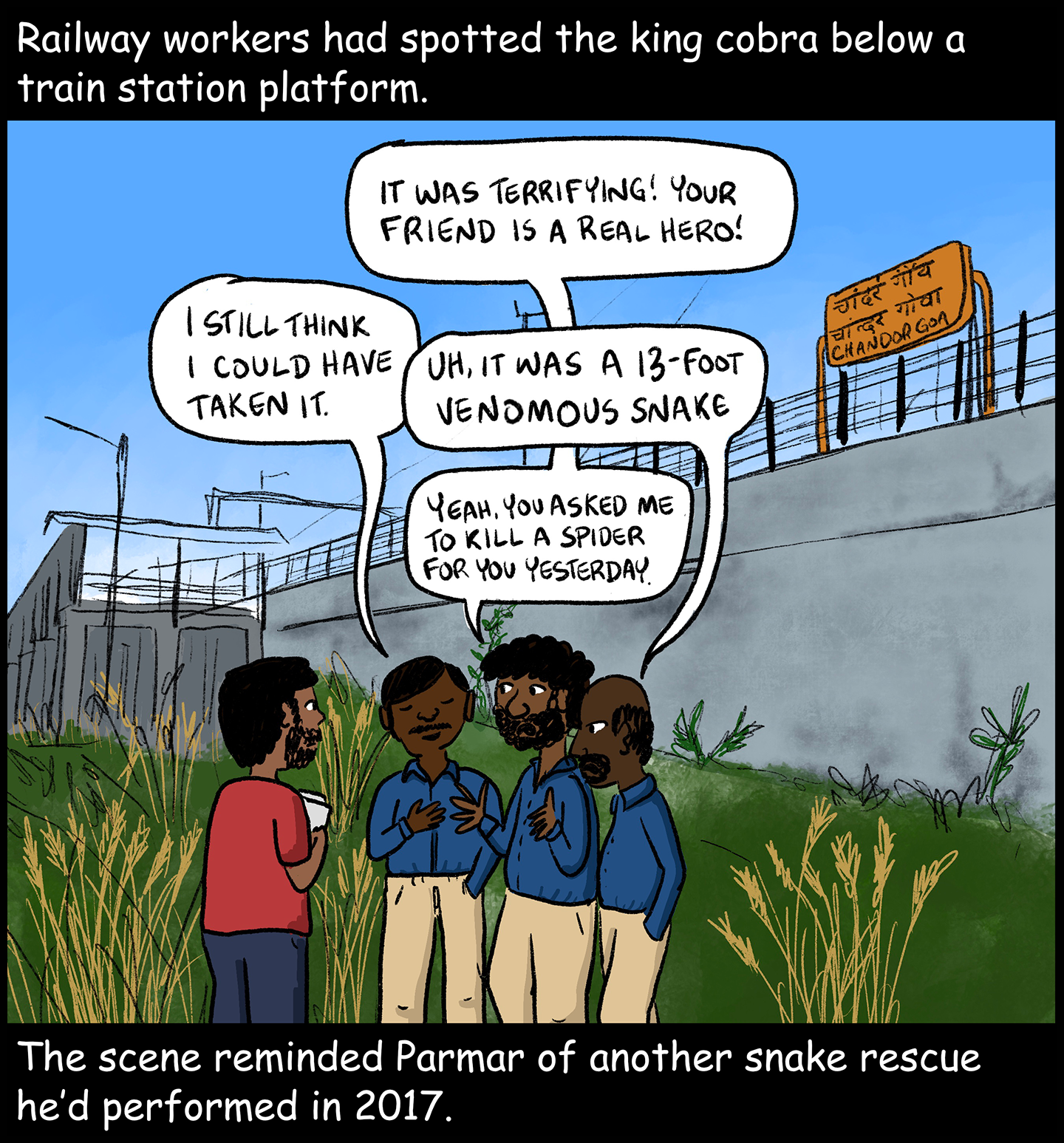
Text (above image): Railway workers had spotted the king cobra below a train station platform. Image: Parmar stands with a notebook and pen with a group of railway workers. The group are standing in a grassy area below a train station platform. A sign beside the platform reads, “Chandor, Goa.” Railway Worker 1 says to Parmar: “It was terrifying! Your friend is a real hero!” Railway Worker 2 says: “I still think I could have taken it.” Railway Worker 3 says: “Uh, it was a 13-foot venomous snake.” Railway Worker 1 says: “Yeah, you asked me to kill a spider for you yesterday.” Text (below image): The scene reminded Parmar of another snake rescue he’d performed in 2017.
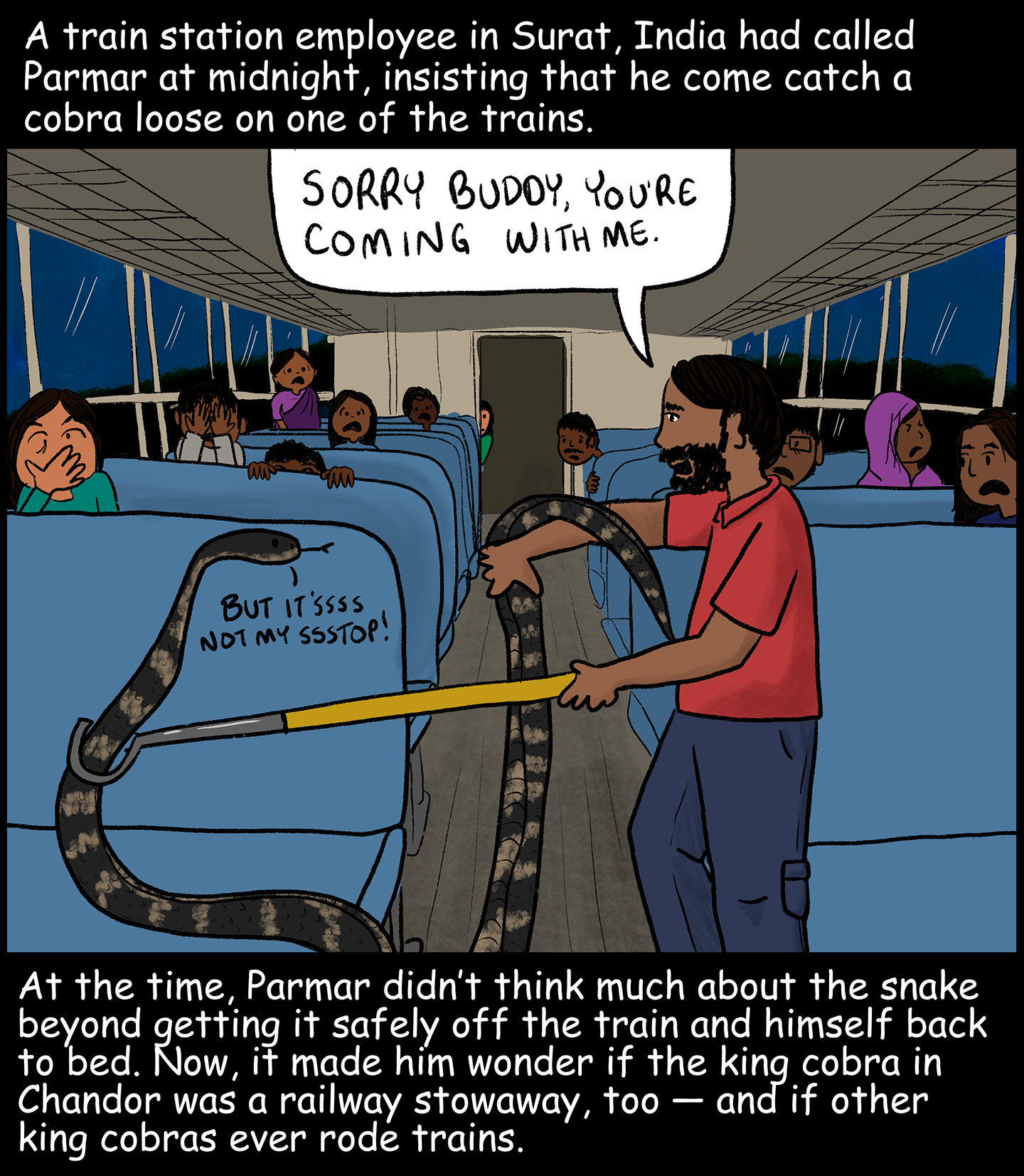
Text (above image): A train station employee in Surat, India, had called Parmar at midnight, insisting that he come catch a cobra loose on one of the trains. Image: Parmar grabs the tail of a snake sitting on the seat of a crowded train car. Parmar says: “Sorry buddy, you’re coming with me.” The snake says: “But it’s not my stop!” Text (below image): At the time, Parmar didn’t think much about the snake beyond getting it safely off the train and himself back to bed. Now, it made him wonder if the king cobra in Chandor was a railway stowaway, too — and if other king cobras ever rode trains.
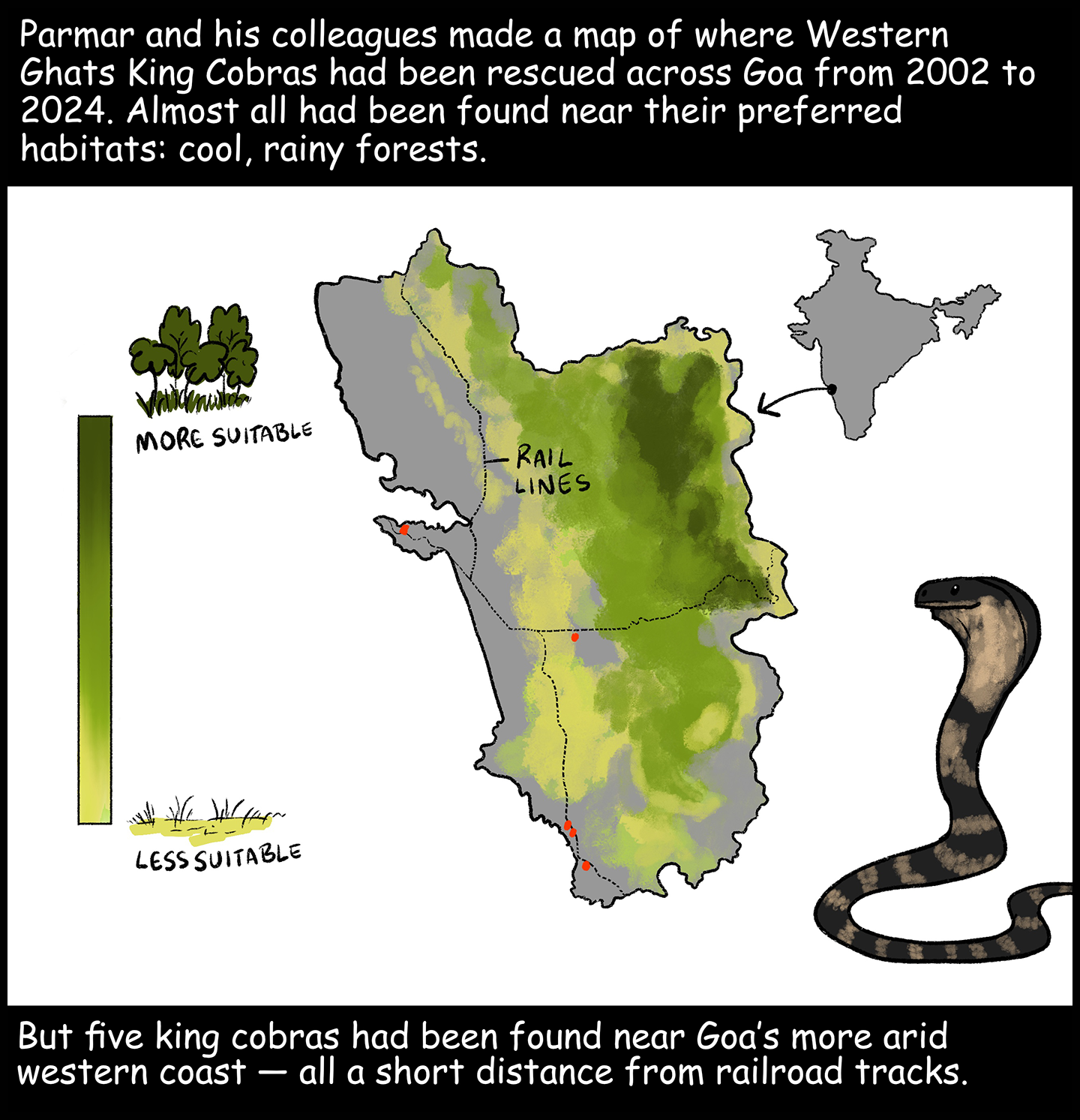
Text (above image): Parmar and his colleagues made a map of where Western Ghats King Cobras had been rescued across Goa from 2002 to 2024. Almost all had been found near their preferred habitats: cool, rainy forests. Image: A map of Goa shows where the most suitable king cobra habitats exist in the state. The eastern half of the state contains more suitable habitats than the western half. Black lines show where rail lines cut across the state, and red dots near some of those lines show where king cobras have been rescued. Text (below image): But five king cobras had been found near Goa’s more arid western coast — all a short distance from railroad tracks.
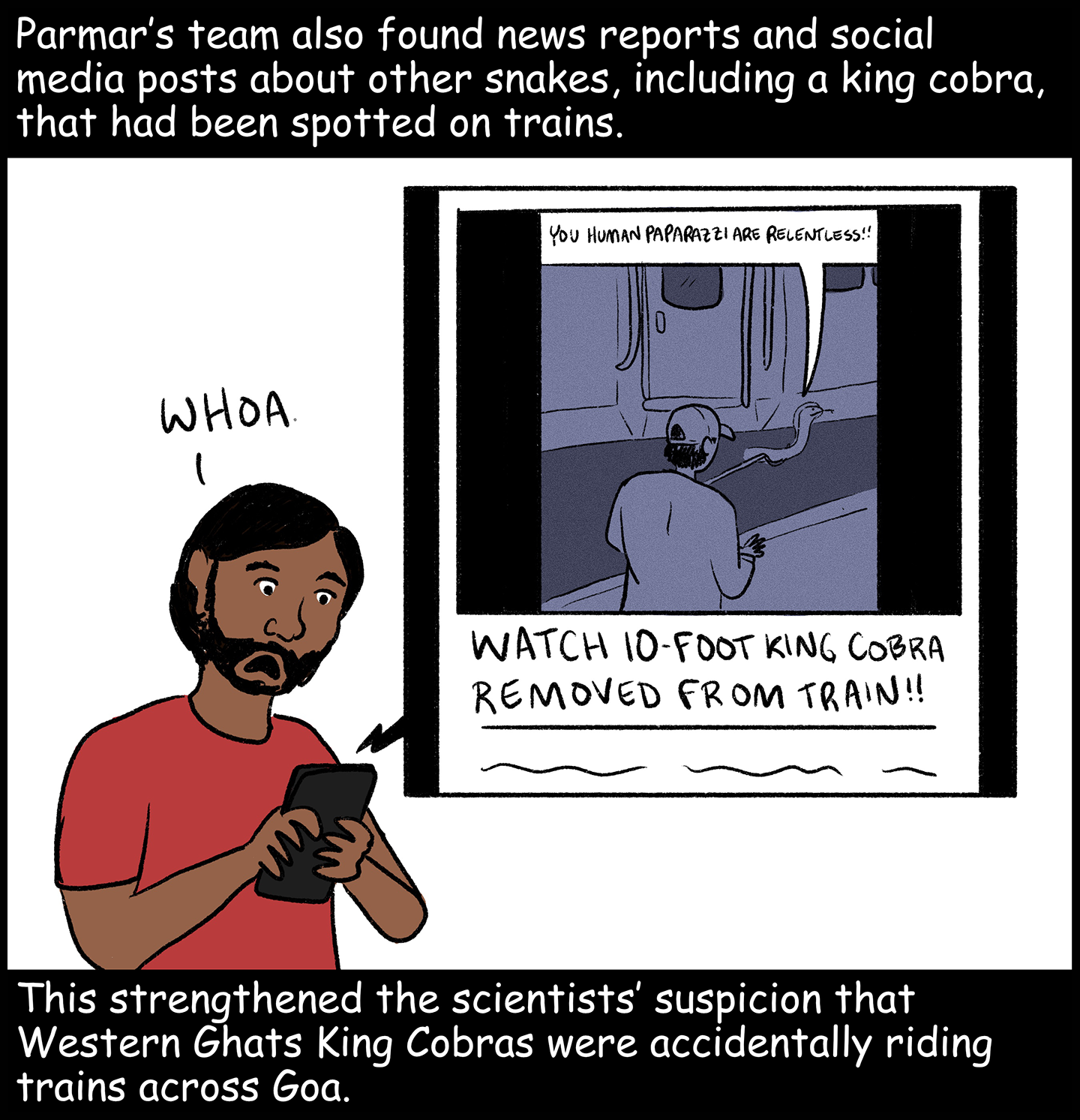
Text (above image): Parmar’s team also found news reports and social media posts about other snakes, including a king cobra, that had been spotted on trains. Image: Parmar looks down at his phone and says, “Whoa.” A news report with a video is on the phone’s screen. The news headline reads: “Watch a 10-foot king cobra removed from a train!” A video accompanying the report shows a railway worker trying to take a snake off a train car. The snake says, “You human paparazzi are relentless!” Text (below image): This strengthened the scientists’ suspicion that Western Ghats King Cobras were accidentally riding trains across Goa.
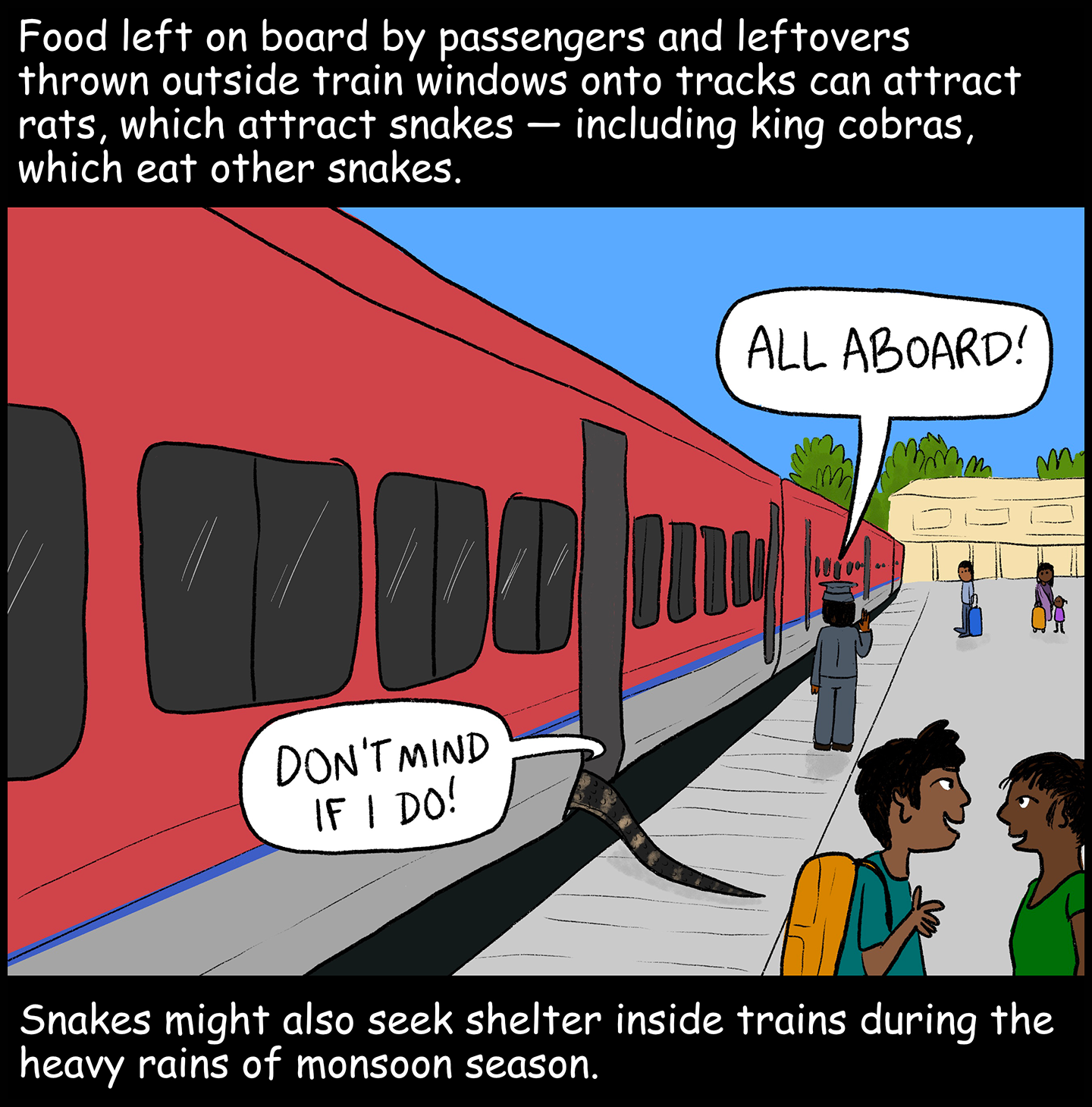
Text (above image): Food left on board by passengers and leftovers thrown outside train windows onto tracks can attract rats, which attract snakes — including king cobras, which eat other snakes. Image: A train platform bustles with people. A railway worker yells, “All aboard!” Meanwhile, a snake slithers onto one of the cars of the train parked at the platform. The snake says, “Don’t mind if I do!” Text (below image): Snakes might also seek shelter inside trains during the heavy rains of monsoon season.
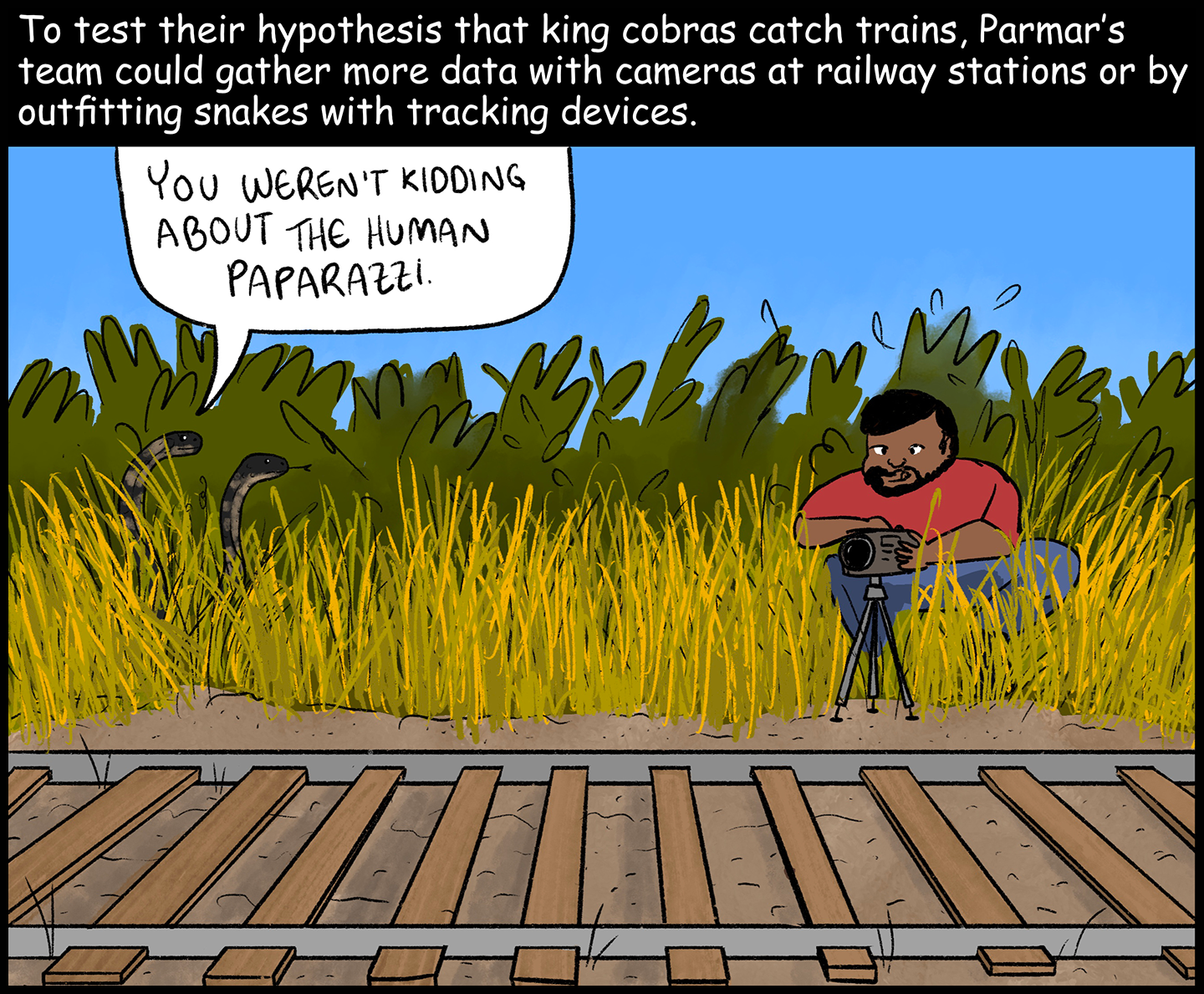
Text (above image): To test their hypothesis that king cobras catch trains, Parmar’s team could gather more data with cameras at railway stations or by outfitting snakes with tracking devices. Image: Parmar sets up a camera near railroad tracks. Two snakes are hiding in the grass nearby, watching. One snake says to the other, “You weren’t kidding about the human paparazzi.”
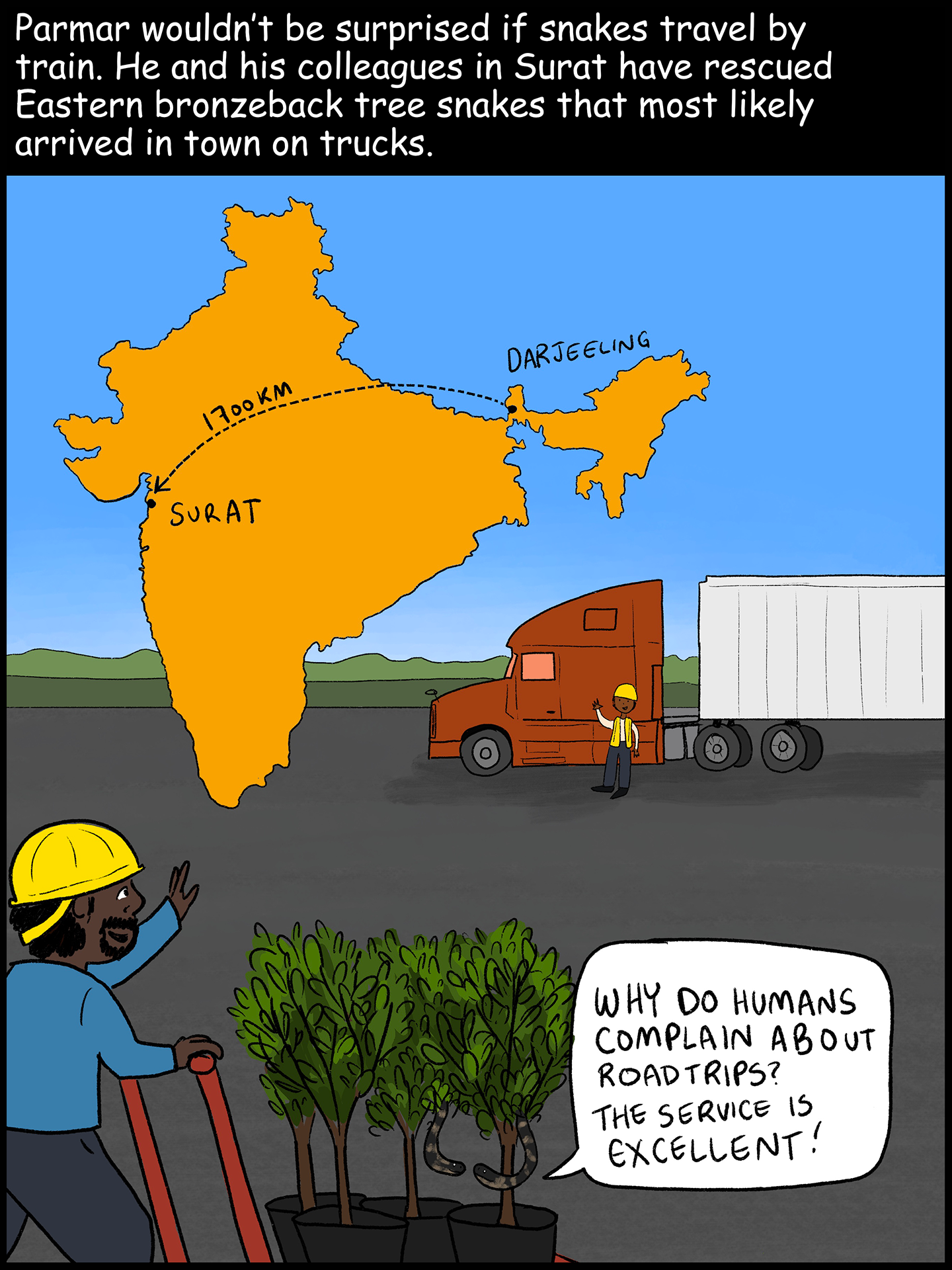
Text (above image): Parmar wouldn’t be surprised if snakes travel by train. He and his colleagues in Surat have rescued Eastern bronzeback tree snakes that most likely arrived in town on trucks. Image: A map of India shows a path from Darjeeling to Surat that spans 1,700 kilometers. Below the map, a truck driver waves to a man pushing a cart of sapling trees. Two snakes are hiding in the leaves of those trees. One snake says to the other, “Why do humans complain about roadtrips? This service is excellent!”
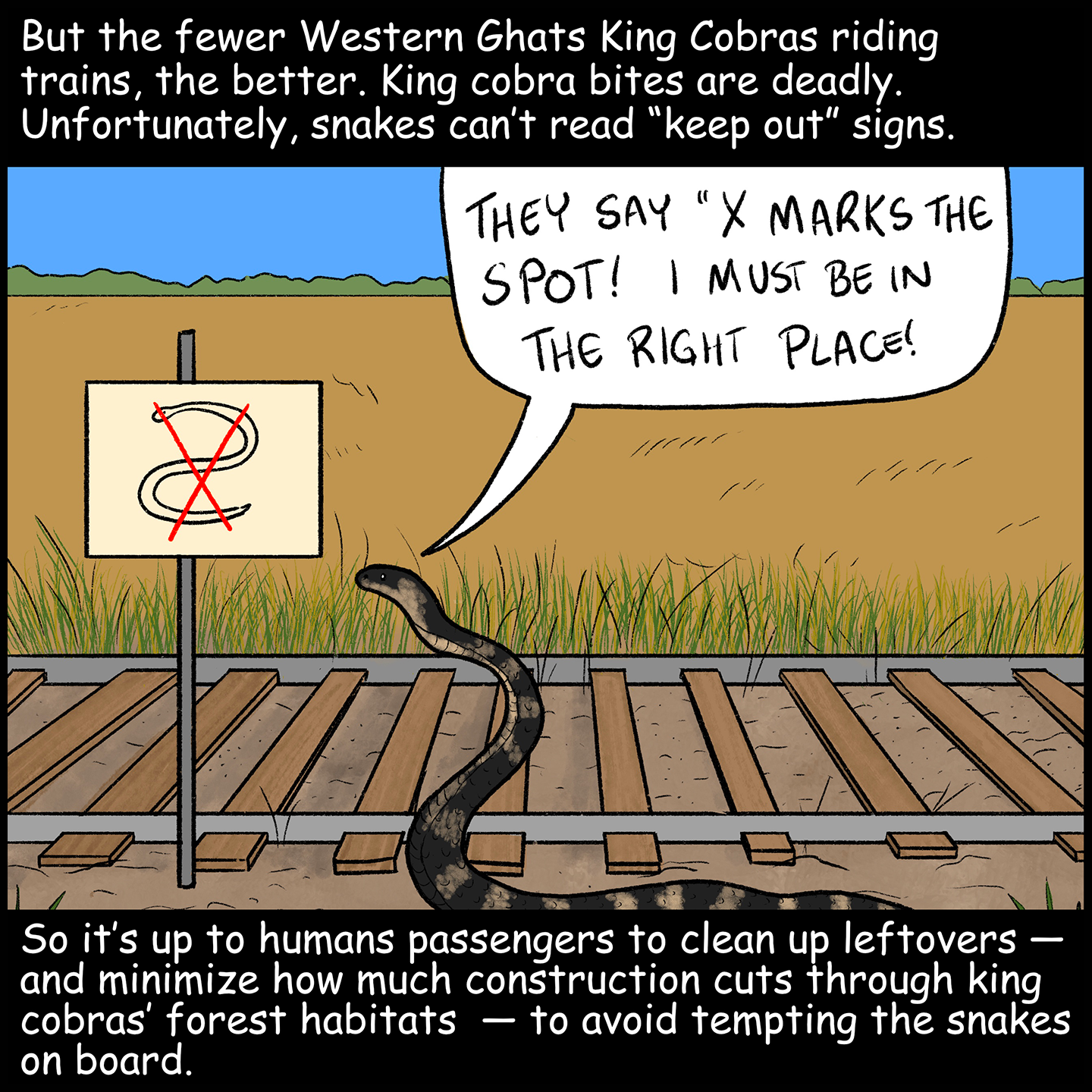
Text (above image): But the fewer Western Ghats King Cobras riding trains, the better. King cobra bites are deadly. Unfortunately, snakes can’t read ‘keep out’ signs. Image: A snake slithers up to railroad tracks. Beside the tracks is a sign. On the sign is a snake with a big red X through it. The snake says, “They say ‘X marks the spot!’ I must be in the right place!” Text (below image): So it’s up to human passengers to clean up leftovers — and minimize how much construction cuts through king cobras’ forest habitats — to avoid tempting the snakes on board.
All: J. Wendel

  •  
❌