❌

Reading view

  •  

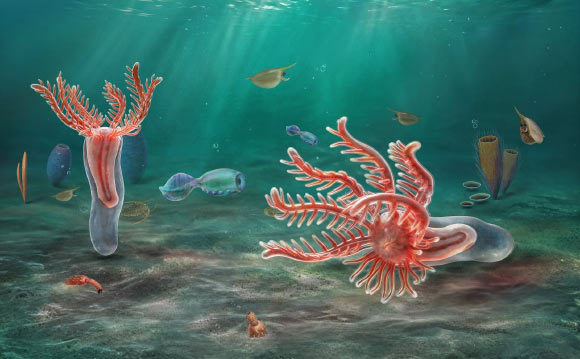
Early Cambrian Fossil Rewrites Starfish Family Tree

An artist’s impression of Yujingia glutenotunica. Image credit: He et al., doi: 10.1016/j.cub.2026.08.053.

A 518-million-year-old ambulacrarian fossil from China suggests that the common ancestor of starfish and their relatives was not a burrowing worm; it was probably a tentacled animal that fed from the water around it.

The post Early Cambrian Fossil Rewrites Starfish Family Tree appeared first on Sci.News: Breaking Science News.
  •  
  •  

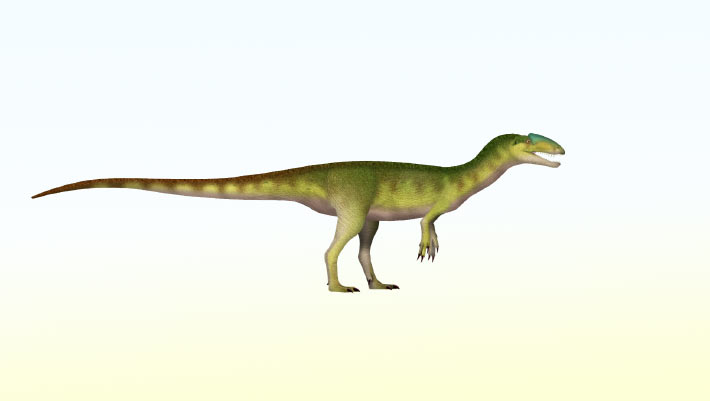
Single Vertebra Hints at Oldest Known Iberian Dinosaur

An artist’s impression of Sarcosaurus. Image credit: TotalDino / CC BY 4.0.

A fossil theropod vertebra about the length of a thumb, found in the Algarve region in southern Portugal, may be the oldest dinosaur remains ever discovered on the Iberian Peninsula.

The post Single Vertebra Hints at Oldest Known Iberian Dinosaur appeared first on Sci.News: Breaking Science News.

  •  

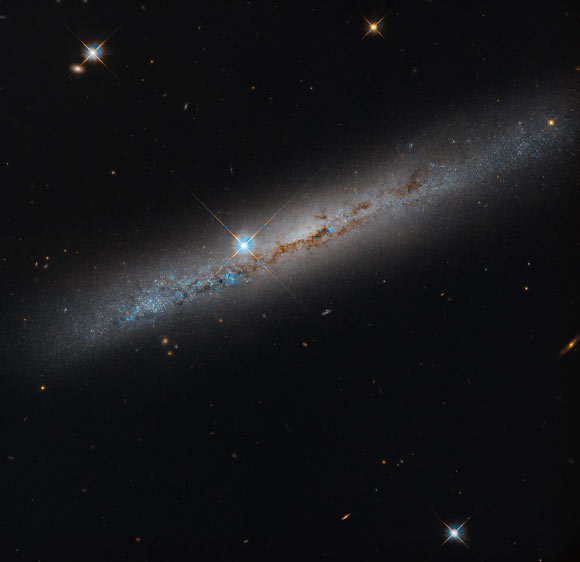
Hubble Space Telescope Spots Dusty Spiral Galaxy: NGC 1827

This Hubble image shows the edge-on, intermediate spiral galaxy NGC 1827. Image credit: NASA / ESA / Michael Jones, California Institute of Technology / Gladys Kober, NASA / Catholic University of America.

Astronomers using the NASA/ESA Hubble Space Telescope have captured a new view of NGC 1827, an intermediate spiral galaxy seen edge-on in the constellation Columba.

The post Hubble Space Telescope Spots Dusty Spiral Galaxy: NGC 1827 appeared first on Sci.News: Breaking Science News.
  •  

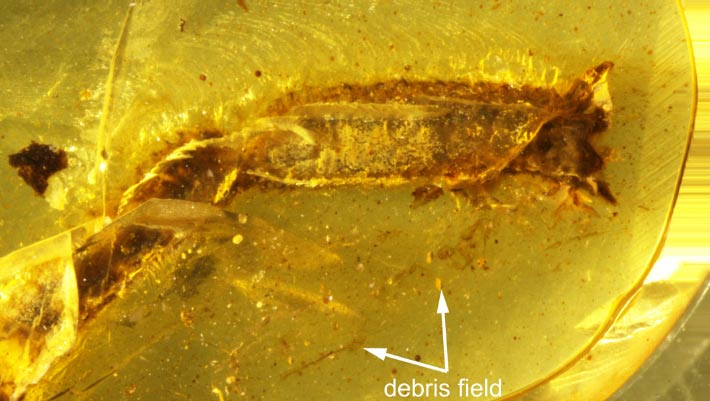
Lizard Dropped Its Tail 99 Million Years Ago, Amber Preserved Evidence

General view of the amber piece from Myanmar, arrows highlighting the debris stuck to the initial resin flow at the level of the ventral surface of the tail. Image credit: Fabrikant et al., doi: 10.26879/1706.

A tiny piece of amber from Myanmar has captured a defensive maneuver that lizards still use today: shedding part of their tail to escape a predator.

The post Lizard Dropped Its Tail 99 Million Years Ago, Amber Preserved Evidence appeared first on Sci.News: Breaking Science News.
  •  

White Dwarfs Really are White, But Few are Green, Pink or Vivid Blue

The cool white dwarf WD J1330+6435 has accreted sodium-rich rocky material from its planetary system into its atmosphere; the immense atmospheric density causes the sodium to absorb light over broad range of yellow, orange, and red wavelengths, giving the WD J1330+6435 a ghostly green appearance. Image credit: Mark A. Garlick / University of Warwick.

A team of astronomers led by University of Warwick’s Dr. Mark Hollands has converted white dwarf spectra into the colors a human eye would perceive.

The post White Dwarfs Really are White, But Few are Green, Pink or Vivid Blue appeared first on Sci.News: Breaking Science News.
  •  
  •  

New Species of Predatory Dinosaur Identified in UK

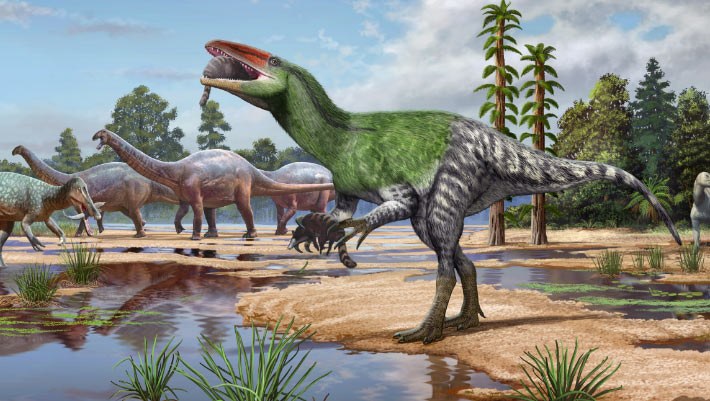
Artists’ rendition of Invictibellatrix amberina with contemporary fauna in the lower part of the Wessex Formation. Image credit: Sergey Krasovskiy / Pedro Salas.

A fossilized braincase that sat in in the collection of the Natural History Museum in London for a century has been identified as Europe’s first megaraptoran dinosaur, a lineage once thought to have flourished mainly in the southern hemisphere.

The post New Species of Predatory Dinosaur Identified in UK appeared first on Sci.News: Breaking Science News.

  •  

Small Raptors Likely Feasted on Fallen Tyrannosaur, Fossil Bite Marks Suggest

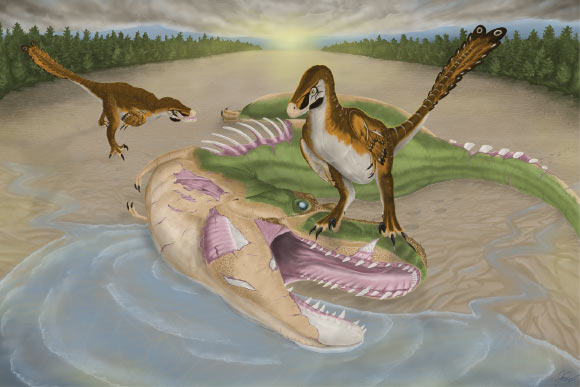
Atrociraptor scavenge the carcass of Albertosaurus along the edge of a river floodplain. Image credit: Joshua Adam Doyon.

Tyrannosaurs sit at the top of the food chain in the popular imagination, but a newly described fossil from Alberta, Canada, suggests that a much smaller predator may have fed on the carcass of Albertosaurus sarcophagus, a tyrannosaur relative.

The post Small Raptors Likely Feasted on Fallen Tyrannosaur, Fossil Bite Marks Suggest appeared first on Sci.News: Breaking Science News.
  •  

Fossil Evidence Suggests Early Homo Had Abandoned Tree-Climbing by 1.8 Million Years Ago

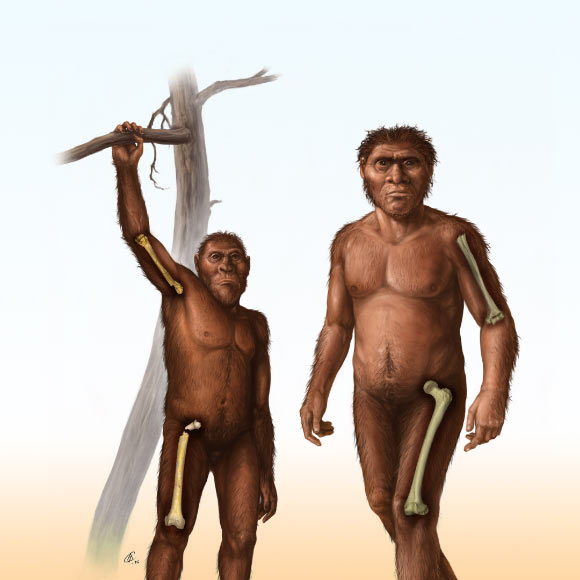
A depiction of an early Homo (right) characterized by relatively greater bone strength of the femur in the thigh compared to the humerus in the arm, and a depiction of an older human ancestor, Australopithecus (left), characterized by more equivalent strength in the bones of the arm and thigh. Image credit: Cullen Townsend.

New research led by University of the Witwatersrand and University of Southern California paleoanthropologists sheds more light on one of the most debated transitions in human evolution: when our ancestors stopped regularly climbing trees and committed fully to walking on two legs.

The post Fossil Evidence Suggests Early Homo Had Abandoned Tree-Climbing by 1.8 Million Years Ago appeared first on Sci.News: Breaking Science News.
  •  

CERN Physicists Find Evidence of One of Higgs Boson’s Rarest Decays

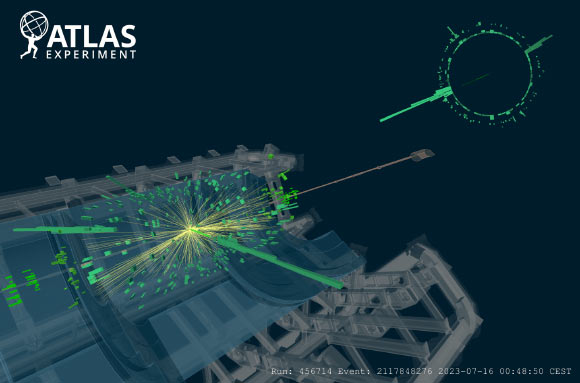
Event display of a candidate Higgs boson decay to a photon and a lepton pair, from proton-proton collisions recorded with the ATLAS detector in 2022. Image credit: ATLAS Collaboration / CERN.

Physicists from the ATLAS Collaboration at CERN’s Large Hadron Collider (LHC) have found evidence of the Higgs boson decaying into a β€˜virtual’ photon and a real photon, which in turn produces a pair of leptons.

The post CERN Physicists Find Evidence of One of Higgs Boson’s Rarest Decays appeared first on Sci.News: Breaking Science News.
  •  

Spanish Amber Deposit Offers Rare Window into Cretaceous Life

Life reconstruction of Hallucinochrysa diogenesi. Image credit: J.A. PeΓ±as.

El Soplao, a fossil site tucked into the hills of Cantabria in northern Spain, stands out for yielding amber pieces with a blue-violet hue and abundant bioinclusions, according to a new review paper.

The post Spanish Amber Deposit Offers Rare Window into Cretaceous Life appeared first on Sci.News: Breaking Science News.
  •  
  •  

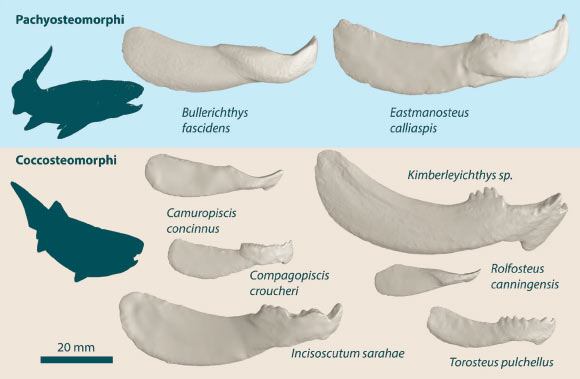
Devonian Armored Fish Show Multiple Ways to Crush Hard-Shelled Prey

Devonian placoderm inferognathal jaw bones used display ranging size and morphology reflecting their evolutionary and ecological diversity. Image credit: Mitchell et al., doi: 10.1038/s41598-026-57261-3.

Long before sharks or reptiles ruled the seas, armor-plated fish called placoderms were already experimenting with different jaw designs to crush hard-shelled prey.

The post Devonian Armored Fish Show Multiple Ways to Crush Hard-Shelled Prey appeared first on Sci.News: Breaking Science News.
  •  

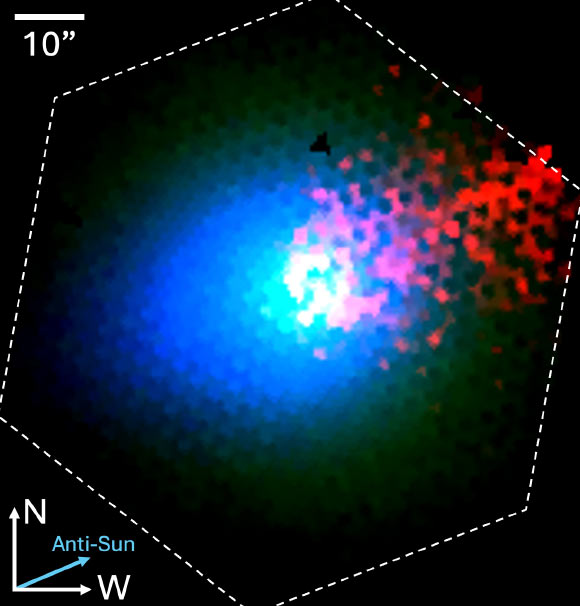
Study: Interstellar Comet 3I/ATLAS Formed in Cold, Nitrogen-Rich Environment

The distribution of dust (blue), gas (green) and ions (red) in the interstellar comet 3I/ATLAS. Image credit: Lea Ferellec.

Astronomers have found new evidence that 3I/ATLAS, only the third confirmed interstellar object ever detected entering the Solar System from beyond, formed in an extremely cold environment far from any star.

The post Study: Interstellar Comet 3I/ATLAS Formed in Cold, Nitrogen-Rich Environment appeared first on Sci.News: Breaking Science News.
  •  

Ichthyosaurs Had Surprisingly Dense Ribs, New Study Finds

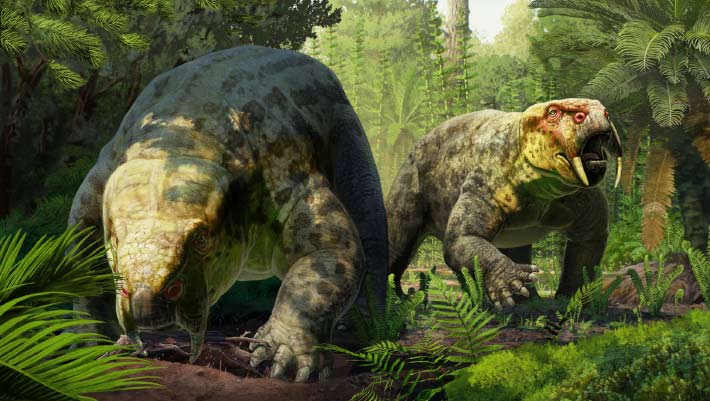
Cryopterygius kristiansenae, a species of ophthalmosaurid ichthyosaur from the Jurassic of Svalbard. Image credit: Esther van Hulsen.

New research from the Natural History Museum at the University of Oslo suggests ichthyosaurs’ rib cages may have done a job modern whale ribs don’t: acting as ballast to help them dive.

The post Ichthyosaurs Had Surprisingly Dense Ribs, New Study Finds appeared first on Sci.News: Breaking Science News.
  •  
❌