One day in June 2023, the many unblinking, electronic eyes of the LUX-ZEPLIN detector — LZ for short — may have glimpsed something remarkable. They may have made the first direct detection of dark matter.
Scientists think dark matter is everywhere in space, but no one has ever actually seen it. But they may have finally detected it. #darkmatter#physics Emily Conover Matthew Kapust/Sanford Underground Research Laboratory
Dark matter is the invisible stuff thought to make up most of the matter in the cosmos. Scientists can sense its gravity tugging on stars and other objects in space. But no one knows what it is. No one has ever directly observed it either, despite decades of searching.
Now, an LZ experiment might have found a single particle interaction that fits the bill. The LZ team shared its findings September 1 at the TeV Particle Astrophysics meeting in Tendo, Japan.
One event is not conclusive. Without more data, scientists can’t be sure that dark matter caused the signal they spotted.
Still, the unexpected particle event has physicists buzzing.
“It’s the most interesting thing that’s come up in recent times,” says Wick Haxton, who did not take part in the research. A theoretical physicist, he works at the University of California, Berkeley. “I definitely think that there’ll be a flood of people looking at this event,” he says.
Watching for WIMPs
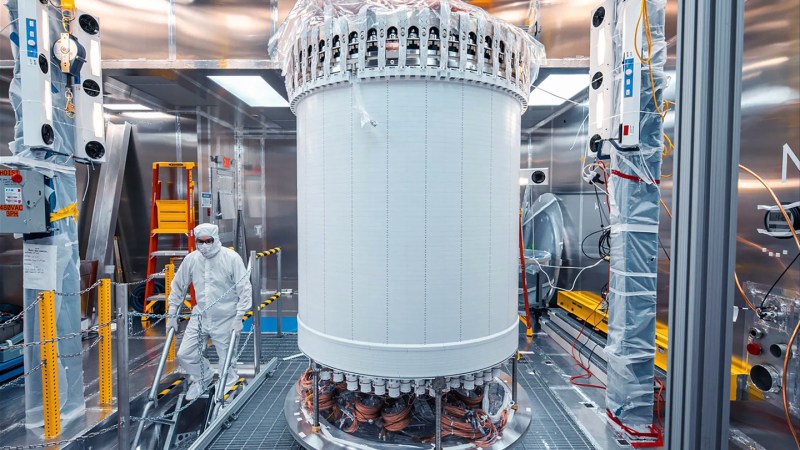
LZ is housed at the Sanford Underground Research Facility in Lead, S.D. There, it searches for weakly interacting massive particles, or WIMPs. Scientists have proposed that such particles might make up dark matter.
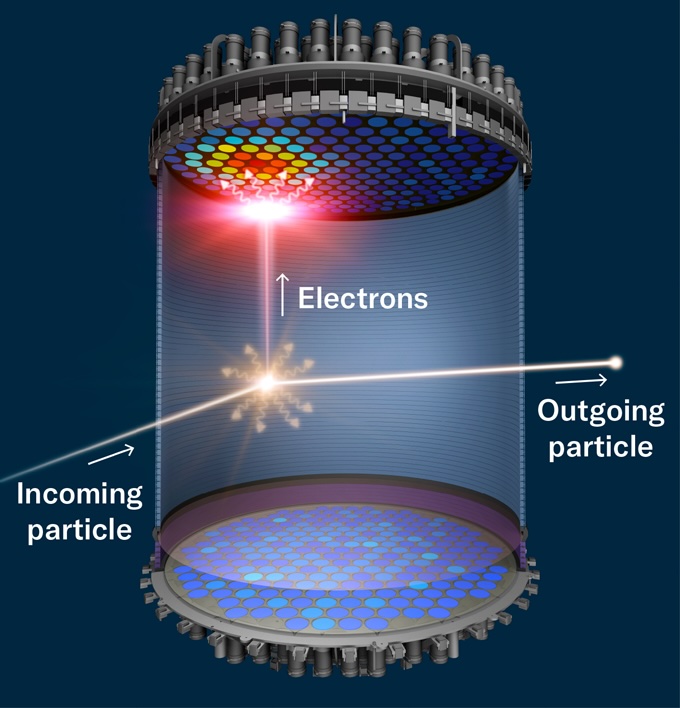
If they exist, WIMPs might crash into the nuclei of atoms in LZ’s tank of liquid xenon. Such a collision would send a xenon nucleus zinging away. In the process, it would give off a small flash of light and electrons. LZ’s sensors could spot such debris.
Dual signals
The LZ detector is designed to spot two signals when a dark-matter particle inside it interacts with an atomic nucleus. As the nucleus recoils, it creates a flash of light. That glint is detected immediately by arrays of light sensors (circles at top and bottom). The event also releases electrons (red). These particles drift through the detector due to an electric field. When the electrons reach the top, they make another flash of light.
Greg Stewart/SLAC National Accelerator Laboratory
The new study looked for a proposed version of WIMPs that fling xenon nuclei away at high energies. The team combed through 220 days’ worth of data.
In the end, “we got left with one event, which is fascinating. Absolutely fascinating,” says Rick Gaitskell. This physicist works at Brown University in Providence, R.I. He’s also a spokesperson for LZ.
There’s only about a 1 in 100 chance that known, non-WIMP particles could cause such an event, the LZ team estimates. Physicists convey such odds in terms of a figure called sigma. In this case, their certainty that a WIMP caused the event is 2.6 sigma. Physicists usually need a sigma of 3 to claim they have evidence for something. They need 5 sigma to say they’ve detected it for sure.
Not so wimpy WIMPs
A past study had combed through the same data looking for xenon nuclei zooming away from WIMP smashups at low energies. That’s typically what scientists would expect from WIMP interactions. And that search came up empty.
This hints that dark matter might interact in a way that makes atomic nuclei recoil with a lot of oomph.
WIMPs could have different energy states, much as atoms do. Such a WIMP might interact only if there’s enough energy to bump it up to its next energy level. This would put a lower limit on the energy of the atomic nucleus it kicks away.
For that type of interaction, dark-matter events are expected to occur more in the summer. That’s when Earth is plowing through the dark matter in our galaxy more head-on. This creates more higher-energy collisions.
It also makes the June 2023 event particularly notable, says Neal Weiner. Though not part of the LZ team, he’s a theoretical physicist at New York University in New York City.
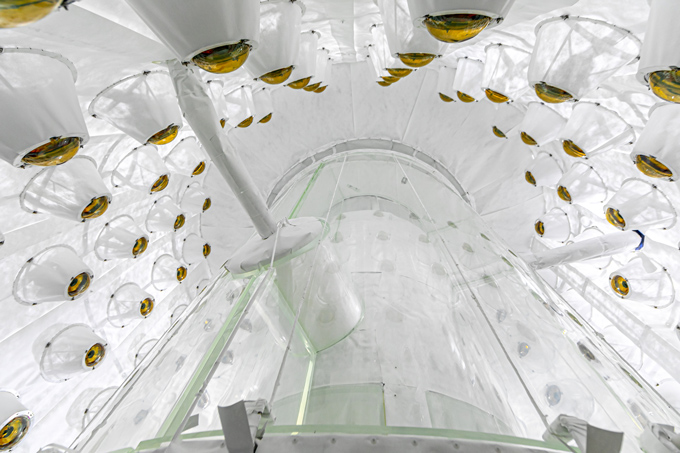
Sensors called photomultiplier tubes (gold) detect light in the LZ detector. Part of the detector’s veto system, they help eliminate signals due to things other than dark matter.Matthew Kapust/Sanford Underground Research Laboratory
What comes next
Dark-matter experiments have a history of getting scientists’ hopes up — and then dashing them.
In 2020, for instance, the XENON1T experiment in Italy saw a hint of new particles that seemed like they could be dark matter. A later version of that experiment showed this was not the case.
Even if the newfound event was not caused by dark matter, the study proves the value of LZ and similar detectors. “We have these incredible machines,” Weiner says. It’s been unclear if they could be used to search for particles that don’t match the original predictions for WIMPs. “One really exciting top-line result is, yes, they can.”
Meanwhile, LZ has collected more data. In fact, it’s gathered at least three times as much data as researchers have analyzed. If dark matter really is behind the 2023 event, there are likely others waiting to be found.
“People have looked for [dark matter] for such a long time, and with growing frustration that it hasn’t been found,” Haxton says. “It would be very nice if this event is followed by a few more.”
For decades, researchers wondered if the Navier-Stokes equations, which describe fluid flow, break down. OpenAI put thousands of agents on the question.
Shadowy dark matter has eluded scientists for decades. The LZ experiment may have spotted one particle, called a WIMP, but more data is needed to check.
For the first time, scientists have used an atomic nucleus as a clock.
Clocks need to keep a steady rhythm. (Think of the swinging pendulum in a grandfather clock.) The new clocks are based on how light interacts with an atomic nucleus — the collection of protons and neutrons at the center of an atom. This technique could allow scientists to make clocks that tick more precisely than any before.
The world’s most precise timepieces are already made using atoms. Existing atomic clocks rely on their electrons. Clocks based on atomic nuclei might perform even better. Now, two teams of scientists have finally made the first nuclear clocks.
This tech is still at an early stage. So nuclear clocks don’t yet tick more precisely than atomic clocks. But these new clocks can already test physics in novel ways.
A research team used one of these clocks to search for dark matter. That’s an unidentified substance that makes up much of the universe. The team describes its new clock — and the search — in a paper submitted June 3 to arXiv.org. This nuclear clock didn’t find any dark matter. But it seems to be more sensitive to some types than atomic clocks. In that search, “we’re already outperforming all of the atomic clocks,” reports Thorsten Schumm. He’s a physicist on the project at Vienna University of Technology in Austria.
“This is an outstanding result,” says Victor Flambaum, who did not take part in the work. A theoretical physicist, he works at the University of New South Wales in Sydney, Australia. The new feat should spur more progress, he says. “This is only the first step. [The] race for building super-accurate nuclear clocks just started.”
Nuclear clocks have the potential to weigh in on other weird physics, too. That’s why they’re “one of the most actively pursued frontiers,” says Shiqian Ding. He’s a physicist at Tsinghua University in Beijing, China. Ding’s team made a nuclear clock based on a technology similar to Schumm’s. They described this second clock in a paper submitted June 7 to arXiv.org. (Neither paper has been peer reviewed.)
Both clocks contain crystals of calcium fluoride. Embedded in those crystals are atoms of thorium-229, a radioactive isotope. That thorium is key. In the entire periodic table, it’s the only element whose atomic nucleus can be used to make a clock.
Scientists hit that thorium-229 with a laser. The wiggling electromagnetic waves of laser light acted like a clock’s swinging pendulum. Thorium’s role was to make sure that the frequency of those waves didn’t change. This kept the “ticking” of these clocks from slowing or speeding up.
The way this works is based on quantum physics, the branch of science that describes atoms and similarly tiny stuff. According to quantum physics, a nucleus can hold only certain amounts of energy. That gives each nucleus a set of energy levels. A jump between two particular energy levels of a given atom always takes the same amount of energy.
So the laser’s frequency was locked to a jump between energy levels in the thorium nucleus. Only the right frequency of light will make that jump take place. Scientists used the jump to readjust the laser. They did this over and over to keep the ticks steady.
Thorium-229 is the only atomic nucleus that has an energy jump of a size that will be initiated by a laser. So it’s the only one that can be used to make a clock.
Although scientists have previously gotten close to making nuclear clocks, this readjustment step had never been done before.
“This was the final missing step before calling it an actual clock,” says Lars von der Wense, who also was not involved with the research. A physicist, he works at Johannes Gutenberg University Mainz in Germany. With improvements to lasers and crystals on the horizon, he says, nuclear-clock technology is expected to advance rapidly.
Improving on atomic clocks
Nuclear clocks have been hotly anticipated. Compared with atomic clocks, they’re less sensitive to stray electromagnetic fields that can throw them off. And they can be made out of solid materials. The atoms in atomic clocks must be suspended in a cumbersome vacuum chamber. These traits have scientists hoping for more portable, robust clocks.
And atomic nuclei respond to different forces than electrons. Electrons mainly are subject to electromagnetic forces. In contrast, the strong nuclear force holds protons and neutrons together. That opens up new possibilities for study.
Numbers called fundamental constants determine the relative strength of those forces. Comparisons of an atomic clock to a nuclear one could be used to check if those numbers really stay constant over time.
It’s been a long wait — almost a quarter century — since scientists first dreamt of a thorium nuclear clock. But “I have always been optimistic about the success of this project,” says Ekkehard Peik. He’s a physicist at the National Metrology Institute in Braunschweig, Germany. Peik is one of the scientists who proposed the idea for such a clock and was a coauthor with Schumm on a paper describing the new clocks.
After initially slow progress, researchers have made rapid advances in recent years. Now, Peik says, “a great deal of interesting research … is only just beginning.”
Steel rusts over time. Copper turns green. But gold stays shiny, seemingly forever. Scientists have now discovered a property that explains why gold stays spotless.
Oxidation is a type of chemical reaction that can cause a metal to rust or tarnish when it meets oxygen. Atoms on gold’s surface, new data show, rearrange into a geometry that hinders that oxidation. If they didn’t, gold would begin to oxidize in seconds.
Santu Biswas and Matthew Montemore shared their new finding May 21 in Physical Review Letters. These researchers work at Tulane University in New Orleans, La.
In air, oxygen is bundled into molecules, each consisting of two oxygen atoms. For a metal to oxidize, it first has to split those oxygen pairings. Then the single oxygen atoms can form compounds that stick to the surface of a metal. The researchers calculated how well gold’s surfaces could split oxygen. They found that it depends on what happens on gold’s surface.
Imagine cutting a piece of gold in two. That would create a new surface that was once in the center of the gold hunk. Atoms on the newly exposed surface then shift from their original locations in the metal.
There are a few different possible arrangements those atoms can take. The researchers studied two common ones. In both, atoms that had been laid out in squares rearranged into hexagons.
The researchers did calculations to understand the effect of such shapeshifting. The hexagonal arrangement, they found, was much worse at splitting oxygen than the square one. To split oxygen, the hexagonal structure would first need to distort back into the original square shape. That’s a hurdle that stalls oxidation. (A third common surface structure of gold was already known to be bad at oxidizing. It’s hexagonal from the start.)
But there’s more to the story. Under certain conditions, gold can react with oxygen. When it does, it forms gold oxide. That’s unstable. So even if gold were able to split oxygen, the material would form only a thin layer of oxide, notes Montemore, a chemical engineer. His team’s new findings, he says, could help scientists understand how to design better catalysts. Those are materials that speed up chemical reactions.
Just how much slower the rearranged gold atoms oxidize was “definitely a surprise,” Montemore says. The tiny position shifts made a huge difference. “It’s something like a billion to a trillion times slower oxidation once you rearrange.”
Swapping materials in its Majorana 2 chip boosted the effectiveness of quantum bits that rely on the math of topology to reduce errors, Microsoft says.
Physicist Richard Feynman turned a lunch dilemma into a math problem. Researchers finally cracked his notes and found people approximate his solution on their own.
 Login



Emily Conover
Matthew Kapust/Sanford Underground Research Laboratory