❌

Reading view

A Pulsar in a Rare Triple System

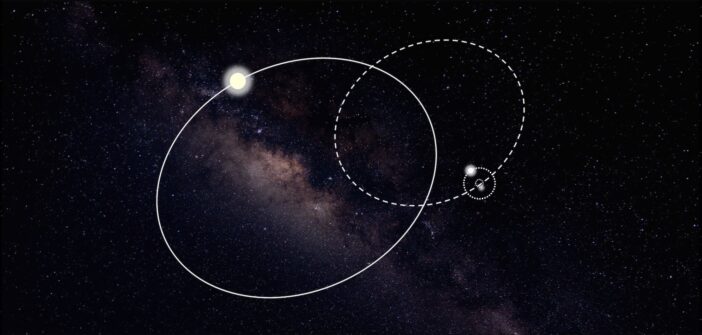
triple-star system containing the pulsar PSR J0435+3233

Follow-up observations show that a recently discovered pulsar has two stellar companions, making it one of just a handful of millisecond pulsars known to be in triple-star systems.

An Unusual New Pulsar

Earlier this year, researchers reported the discovery of a pulsar with the Five-hundred-meter Aperture Spherical radio Telescope (FAST). The newfound pulsar, PSR J0435+3233, is a millisecond pulsar, rotating once every 3.2 milliseconds. What’s unique about this pulsar is how quickly it’s spinning down: its spin rate is decreasing roughly 100 times faster than other millisecond pulsars in our galaxy, suggesting an unusually strong magnetic field and the possibility of an exotic formation pathway.

The FAST observations also showed that the pulsar is not alone: it appears to be on an 8-day orbit with a white dwarf. Now, follow-up observations have revealed the pulsar’s membership in an intriguing stellar system.

From Radio to Gamma Rays

Zonglin Yang (National Astronomical Observatories, Chinese Academy of Sciences) and coauthors followed up on the discovery of PSR J0435+3233 using multiwavelength data from FAST, multiple optical and infrared observatories, and the Fermi Gamma-Ray Space Telescope.
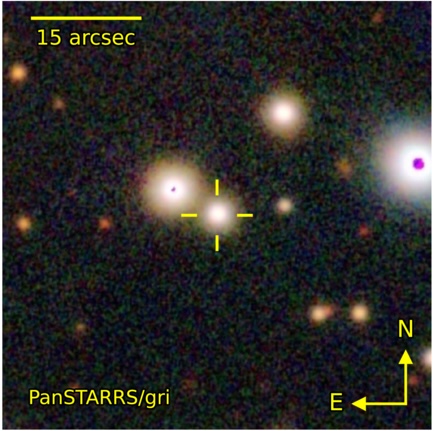
optical image of the subgiant companion to PSR J0435+3233

Visible-light image from PanSTARRS of the outer subgiant companion. [Adapted from Yang et al. 2026]

With this broad dataset, the team confirmed the identity of the pulsar’s white-dwarf companion, detected gamma-ray emission from the pulsar, and identified a second previously unknown companion, a subgiant star roughly as massive as the Sun. These three stars are arranged in a hierarchical triple: the pulsar and white dwarf orbit one another tightly, and the subgiant is a more distant companion, orbiting in decades rather than days. Current observations show that the orbits of the inner binary and the outer star are tilted relative to one another, either nearly perpendicularly or at about 54 degrees. While a triple system of three closely intertwined stars invites chaos, this configuration is stable long term.

Insights into Stellar Evolution

While it’s common to find millisecond pulsars in binary systems β€” in fact, many millisecond pulsars are thought to spin up to their incredible speeds via accretion from a stellar companion β€” it’s rare to discover them in triple systems. Because this system is isolated out in the field rather than crowded together with other stars in a dense cluster, Yang and collaborators suspect that the three stars have been together since birth, as opposed to being assembled dynamically later on.
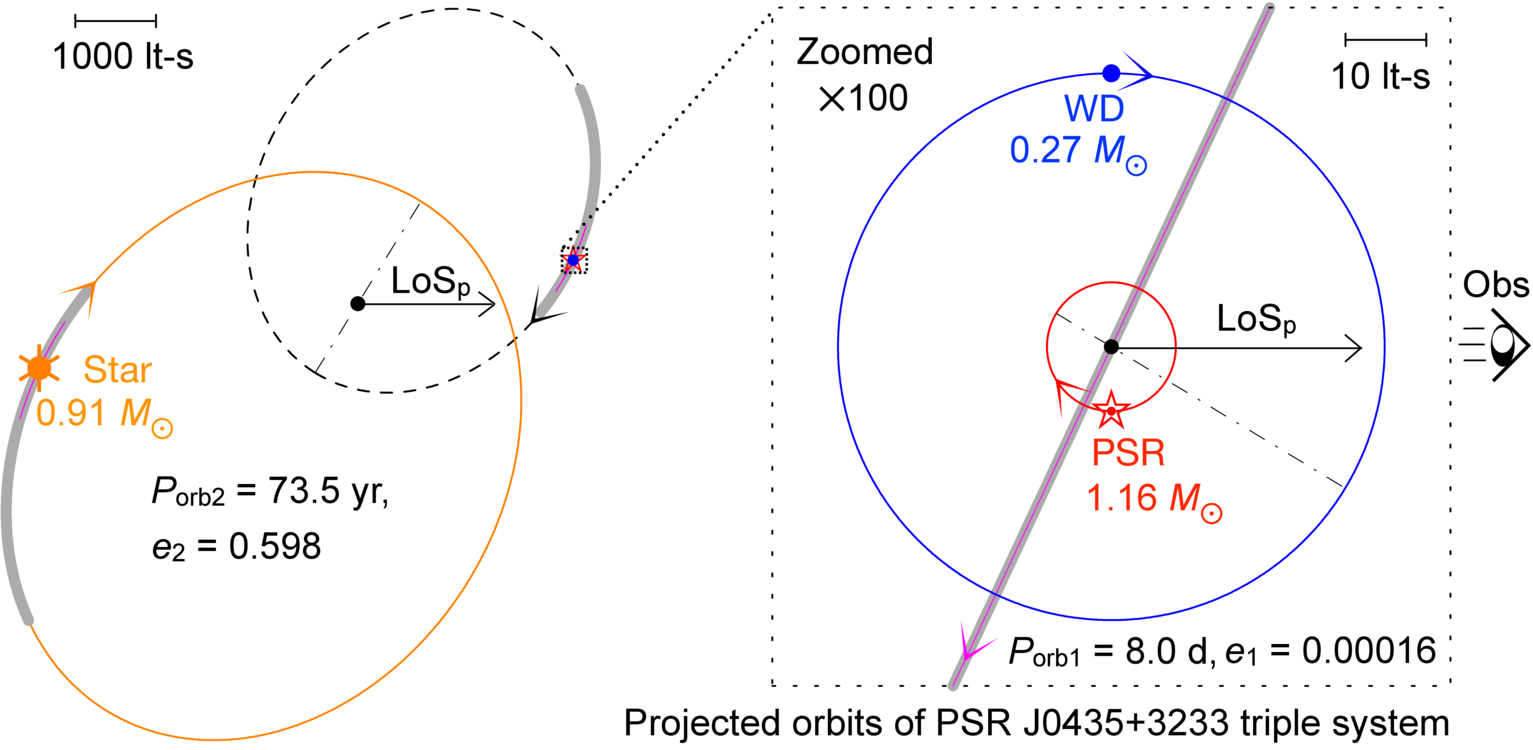
projected orbits of PSR J0435+3233 and its two stellar companions

Projected orbits of the three stars in the system. Click to enlarge. [Yang et al. 2026]

The most massive star in the trio would have hurried through its main-sequence lifetime in less than 10 million years, culminating in a supernova. The remaining two members of the system would have had to withstand this explosion, which the team found is possible but not especially likely; the likelihood of the system coming unglued due to a star going supernova depends on how much of a β€œkick” the explosion gives the newborn pulsar, and even in a zero-kick scenario, the likelihood of the system remaining bound is only 35%. The future evolution of the system will be less dramatic. The outer star will eventually evolve into a white dwarf, undergoing a gentle transition that poses no threat to the stability of the system.

Triple-star systems are common among massive stars, but how this configuration affects stellar evolution is still being explored. This discovery offers a valuable opportunity to study dynamics and stellar evolution in a rare triple system.

Citation

β€œThe PSR J0435+3233 Triple System,” Z. L. Yang et al 2026 ApJL 1010 L9. doi:10.3847/2041-8213/aeaa29

The post A Pulsar in a Rare Triple System appeared first on AAS Nova.

  •  

How a Black Hole Collision Could Explain the Milky Way’s S-Stars

Milky Way center

New research shows that a past collision between the Milky Way’s central black hole and a smaller black hole could explain the dynamics of the S-stars, a group of stars that orbit precariously close to our galaxy’s supermassive black hole.

Journey to the Center of the Milky Way

The center of the Milky Way harbors a supermassive black hole (Sagittarius A* or Sgr A*) with a mass of 4 million Suns. The nearest neighbors of this behemoth are a compact disk of massive young stars and a collection of stars called the S-stars, which inhabit the innermost 48 light-days of our galaxy.

While the stars in the disk are orderly, arranged on orbits with moderate eccentricities and low inclinations, the S-stars orbit Sgr A* every which way, careening around the black hole with a wide range of eccentricities and inclinations. So far, the cause of this unusual distribution of stars is unknown.

When Black Holes Collide

Past research has struggled to explain the S-stars’ orbits. A successful theory of S-star origins must account for the stars’ eccentric orbits (e = 0.61, on average) and high orbital inclinations (i = 79ΒΊ, on average), and it must produce these characteristics within the 15-million-year lifetime of the stars.

diagram showing the proposed formation pathway for the Milky Way's S-stars

Schematic showing the proposed formation pathway for the Milky Way’s S-star population. Click to enlarge. [Akiba et al. 2025]

In a recent research article, a team led by Tatsuya Akiba (University of Colorado Boulder) offered a new hypothesis to explain these traits: Sgr A* absorbed a smaller black hole in the not-so-distant past, and the aftermath of the merger created the distribution of stars seen today.

The premise is not far-fetched: at the ripe old age of nearly 14 billion years, the Milky Way has likely gulped down neighboring dwarf galaxies and globular clusters multiple times. When a black hole embedded within one of these meals of stars and gas merges with the Milky Way’s central black hole, the collision causes Sgr A* to recoil β€” potentially rearranging the stars in its vicinity in the process.

Radical Reorganization

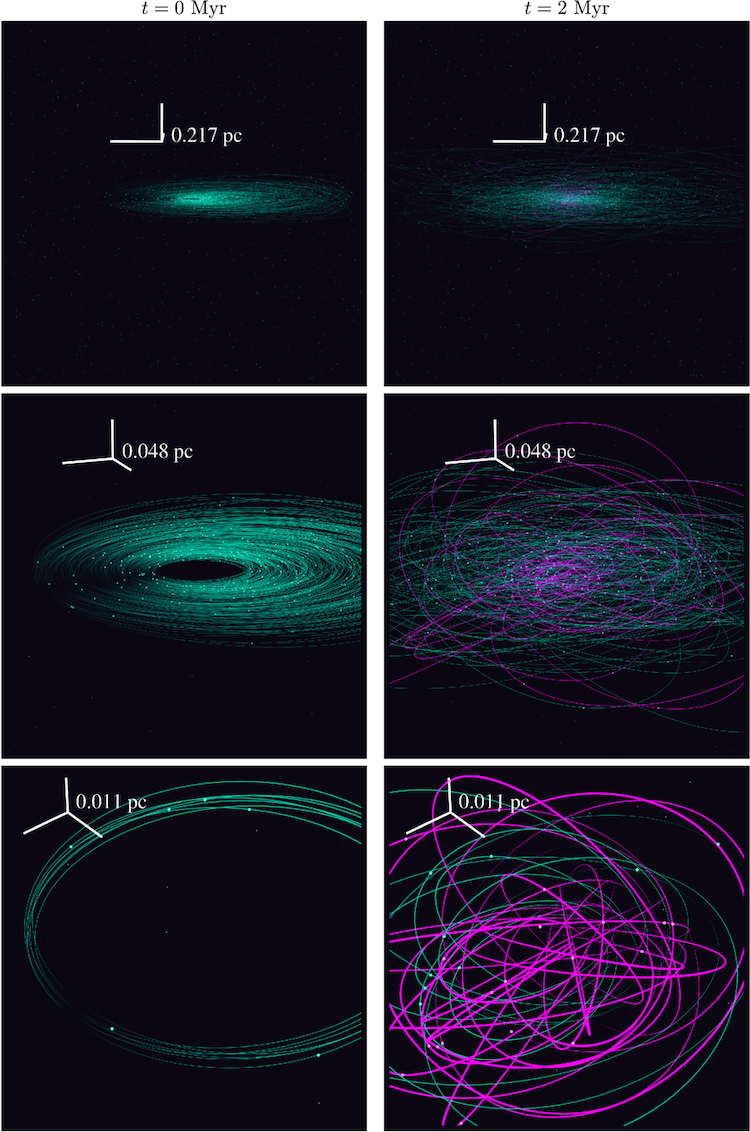
Akiba and collaborators usedΒ N-body simulations to explore the outcomes of such a collision. In their simulations, Sgr A* is situated within an axisymmetric disk of stars or gas. A smaller black hole falls toward Sgr A*, spirals inward, and merges with the larger black hole. The asymmetric emission of gravitational waves causes Sgr A* to recoil, warping the surrounding collection of stars and gas into an eccentric disk. For the eccentricity of the disk to match what is seen in the disk of stars surrounding Sgr A* today, the incoming black hole must have a mass of roughly 200,000 solar masses.

simulation results

Simulation snapshots taken at the simulation onset (left column) and after 2 million years (right column). Orbits with inclination greater than 30 degrees are shown in magenta. Note the difference in scale between the rows. [Akiba et al. 2025]

After the merger, the stars orbiting farther out torqued the inclinations and eccentricities of the innermost stars up to high values through what’s called the eccentric Kozai–Lidov mechanism. After 2 million years of simulation time, this interaction produced a stellar distribution similar to what is seen today: a disk of moderate eccentricity surrounding β€œS-stars” with eccentric and highly inclined orbits.

While the properties of the modeled S-stars don’t exactly match the properties of the real deal β€” the simulated stars have, on average, lower inclinations and eccentricities β€” the authors noted that this work represents a first foray into their hypothesis. Modeling that explores a broader range of parameter space is needed to fully understand the origins of the stars at the center of the Milky Way.

Citation

β€œOn the Formation of S Stars from a Recent Massive Black Hole Merger in the Galactic Center,” Tatsuya Akiba et al 2025 ApJL 987 L27. doi:10.3847/2041-8213/addc5d

The post How a Black Hole Collision Could Explain the Milky Way’s S-Stars appeared first on AAS Nova.

  •  
❌