Login

Former OpenAI science lead launches Warp Science to automate wet labs with robots
Wearing cameras and sensor gloves, the startup’s human chemists will train robots to perform various lab tasks.


Dead internet theory could soon become a reality in the literal sense. Two critical vulnerabilities in PHP, the programming language powering an estimated 70% of websites, have triggered an emergency security response. OpenAI says its GPT-5.6 Sol model helped uncover one of the flaws, highlighting how advanced models can expose weaknesses across the internet before attackers exploit them.
Both vulnerabilities received severity scores of 9.2 out of 10. PHP released emergency patches on Wednesday, October 21, following weeks of coordinated work among researchers and software maintainers. The immediate concern is whether website administrators can secure vulnerable servers before hackers turn the newly disclosed flaws into widespread attacks.
OpenAI detailed the discovery in a Wednesday blog post about its Patch the Planet initiative. The effort brought together software maintainers, security researchers and infrastructure providers to prepare fixes before public disclosure.
A self-described hacker team called Calif used GPT-5.6 Sol to identify one of the vulnerabilities. Cybersecurity firm Wiz independently discovered and reported both flaws, according to OpenAI.
PHP’s development team led the patching effort, with OpenAI, Wiz and Cloudflare contributing research and technical support. The vulnerabilities required extensive coordination because their impact could extend across countless independently operated websites and servers.
OpenAI said frontier models identified the flaws before attackers did, giving defenders time to prepare. That window matters because publishing technical details can help other researchers understand a vulnerability, but it can also give hackers a starting point.
The vulnerabilities can enable remote code execution, allowing an attacker to run malicious commands on an affected server. Depending on the server’s configuration and permissions, a successful attack could expose sensitive information or compromise the system.
PHP’s official security advisory urges users to update immediately. The release includes fixes for supported branches, with emergency updates also available for certain older versions. Administrators should check PHP’s official guidance to identify the correct package for their installations.
Security experts are already concerned about attempts to weaponize the flaws. WatchTowr reproduced one of the exploits, while its head of threat intelligence, Jake Knott, warned that attacks could escalate quickly.
“As expected, watchTowr Intel is already observing in-the-wild exploitation of the latest PHP vulnerabilities,” Knott said in an email Wednesday morning, as reported by CNET. He added that nobody had succeeded at that point, but warned, “we don’t expect that will last long.”
Cloudflare Chief Technology Officer Dane Knecht said Wednesday that the company had deployed a fix to its firewall. The US National Security Agency also urged organizations to prepare for immediate updates. It advised taking affected systems offline if administrators could not patch them promptly.
OpenAI’s disclosure points to a growing tension in cybersecurity. More capable models can help researchers uncover deeply embedded flaws, but attackers may also use similar tools to develop exploits faster.
If you are wondering whether your website is affected, we have packaged a Codex skill to help check.
— OpenAI (@OpenAI) October 21, 2026
Point your Codex at this repo to guide you through it: https://t.co/XUEbOwXuQC https://t.co/BDaIIaJ4yK
The company acknowledged that risk directly, warning that the same capabilities can help malicious actors build offensive tools. It expects discoveries of similarly consequential vulnerabilities to increase sharply in the coming months.
Finding a flaw, however, does not automatically secure the internet. Software maintainers must develop reliable patches, hosting providers need to deploy protections, and website operators must update systems they control. Older installations can complicate that process, particularly when administrators cannot upgrade immediately.
The PHP incident also shows why coordinated disclosure matters. Researchers spent weeks working with maintainers and security providers before releasing details that could help defenders and attackers alike.
That preparation has now given website operators a path to remediation. The remaining uncertainty is how quickly they can act before attackers turn public knowledge of the flaws into widespread compromises.


Tuesday Labs, a New York City robotics lab and design studio, has opened reservations for Voxel, a bipedal home robot meant to learn and take over routine household tasks. A $200 reservation holds a spot, while full pricing is expected to be around $20,000 when Voxel ships sometime in 2028, The Verge reported.
The company calls it a “droid butler.” The Series-1 model joins other household robots, such as Weave Robotics’ Isaac 1, that aim to handle chores beyond mopping or vacuuming floors.
Voxel’s main tools are two highly articulated arms with seven degrees of freedom. Each ends in a simple gripper, not the dexterous fingered hand found on machines such as Boston Dynamics’ Atlas. The arms extend from the top of a torso that also serves as the head, which has a small mouth.
Pixelated, animated eyes sit near the robot’s waist, well below a hidden pair of stereo RGB cameras. A separate wide-field camera lets Voxel monitor an entire room.
It walks on a pair of Z-shaped legs with knees that bend opposite to human knees. The design is intentional, allowing the robot to bend its knees for balance and to raise or lower its height while standing close to kitchen cabinets, tables and shelves.
In all, Voxel is mostly humanoid, with a few liberties. It trades finger dexterity for simpler grippers and puts its face lower on its body than a human would.
Tuesday Labs’ website details the hardware at length but says less about capabilities and household benefits. Voxel is meant to handle basic autonomous tasks, including decluttering and putting things back where they belong. It is also meant to handle routine chores such as watering plants, fetch items like books and help locate lost objects. For example, a user could ask where Voxel last saw the TV remote.
At launch, Voxel will not cook dinner or change diapers. The Verge noted that if it can reliably remember where you left your keys, people with bad short-term memories might find a reason to justify its steep price.
The $200 reservation is separate from the roughly $20,000 full price. Voxel is expected to ship “sometime in 2028,” the report said, so buyers would wait at least a year or more for a unit.

A retired professor was handcuffed and arrested last week, for the crime of standing on the sidewalk in front of a delivery robot.
According to local channel 6ABC, 78-year-old Carolyn Marvin was arrested in Philadelphia’s Center City, after planting her feet in the path of an oncoming Avride delivery robot. Marvin, a retired communications professor at the University of Pennsylvania, told local reporters she was protesting the robots due to the threat they pose to local delivery workers.
“I know they’re taking the jobs of human delivery workers,” Marvin told 6ABC, “and so I have been protesting them whenever I saw them by standing in front of them and preventing them from going forward.”
The “confrontation” — if you can call it that — attracted a small crowd, who watched as police ordered Marvin to move out of the robot’s path. When she refused, citing protected speech, she was arrested and charged with one count of disorderly conduct, which she reportedly plans to dispute in court.
It wasn’t Marvin’s first time passively protesting Philadelphia’s growing fleet of delivery robots, and it probably won’t be her last. Asked by 6ABC whether she plans on continuing her demonstrations, she replied that “I do. Why not?”
“I think it’s my First Amendment right to publicly demonstrate on a sidewalk to protest against delivery robots,” Marvin continued.
In a separate interview with KYW Newsradio, the retired professor said she was protesting the “ruthless way that rich corporations are casting aside human workers — and here, we’re talking about the humble delivery folks — in order to enrich their bottom lines.”
The incident raises a valid legal question around delivery bots: if the privately-owned devices need unimpeded access to public infrastructure to work, who’s responsible for making sure they have room to roam?
More on robots: Walmart Running Into Trouble as Its Super-Expensive Robots Can’t Handle the Realities of Warehouse Work
The post 78-Year-Old Woman Hauled Off In Handcuffs After Blocking Delivery Robot appeared first on Futurism.

A drone powered by artificial intelligence (AI) has completed a championship race course faster than some of the world's best human drone pilots.
In a study published Oct. 14 in the journal Science Robotics, scientists created an AI system capable of pushing a quadcopter through a demanding course at over 60 mph (100 km/h), using little more than a single forward-facing camera, an inertial measurement unit, and a tiny onboard computer.
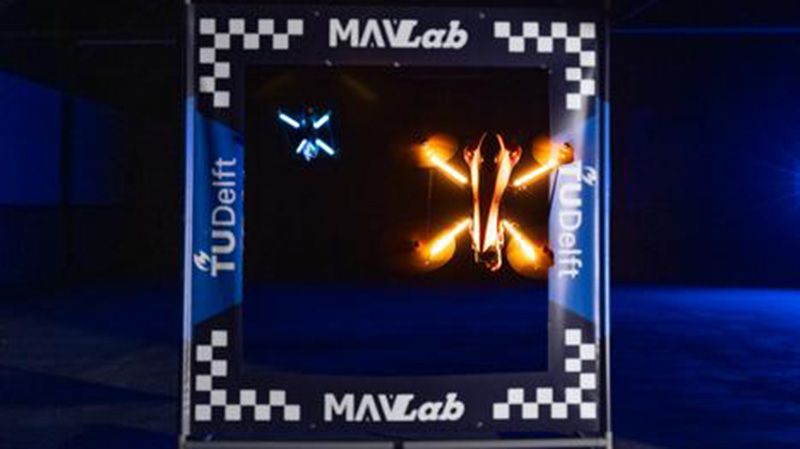
The system, called MonoRace, even won the 2025 Abu Dhabi Autonomous Racing League drone racing competition, outperforming every rival autonomous team and posting faster times than three former human world-champion drone pilots.
MonoRace accomplished this without the aid of GPS, external motion-capture systems, stereo cameras, or a preloaded map of the course. The system is an onboard autonomous flight model created by researchers at the Delft University of Technology's Micro Air Vehicles Lab in the Netherlands. Its name reflects its central design feature; "mono" refers to its monocular vision. The drone relies on a single rolling shutter camera and monitors its own motion with an internal measurement unit (IMU) that gauges acceleration and rotation.
The limited sensor package feeds a neural network, a machine-learning model that uses interconnected artificial neurons to learn patterns from data. This neural network identifies racing gates and estimates the drone's position and motion to generate motor commands. Then, it sends the commands to the four propellers at a rate of 500 times per second through the drone's flight controller.
The system fits a drone that weighs a mere 966 grams (2.13 pounds) and measures approximately 11.8 x 11 x 3.9 inches (30 x 28 x 10 centimeters). Because the MonoRace hardware was so compact, lightweight and computationally efficient, the team was able to operate it entirely aboard the drone.
On the Abu Dhabi course, MonoRace completed two laps around 11 gates in 16.56 seconds, hitting a top speed of approximately 63 mph (102 km/h).
A recently released video tracks MonoRace's development and performance in the competition, with real flight sequences demonstrating how the drone banks sharply, accelerates through gates, and navigates a course without human assistance.
However, some of the sequences are computer-generated. Study co-author Guido de Croon, a professor at the Delft University of Technology, said those are intentional visual effects. The only fully simulated imagery appears at about the two-minute mark, during the segment showing the training process.
"Here we show the gates in a visual simulator for the video but the real training happened in a stripped-down, pure physics simulator that ran really fast," de Croon told Live Science in an email. "Simulating vision was not done during training, as the control neural network receives an estimated state as input, which comes from a different perception and state estimation process."
The rest of the footage is real, although some shots include overlays showing how the drone interprets its camera feed. A convolutional neural network segments the white gates, sometimes displaying them as red in the normal camera image. Small circles mark detected gate corners, red lines indicate gate edges, and a blue overlay shows the portion of the image where the drone expects to find the next gate.
Scientists trained the MonoRace model with reinforcement learning, a machine learning method in which an agent repeatedly attempts a task and receives feedback based on its success or failure.
"The reinforcement learning ran in simulation, because it needs lots of trial and error — like millions of tries," de Croon said. "It actually learns to fly from scratch."
The network learned to translate the drone's position on the track, velocity and orientation directly into motor commands. According to de Croon, early training focused on the basics, like avoiding crashes and reaching the first gate. As the training progressed, the system learned to advance farther along the course and fly at higher speeds.
The researchers didn't train the system on a single aircraft. Instead, they varied dimensions such as weight, voltage, drag, sensor noise and propeller condition so the AI model could cope with real-world variations and imperfections.
"That ensures that the trained network can control different drones," de Croon said.
MonoRace could become a training tool for human drone pilots, "a bit like powerful chess programs have also inspired humans playing the game," de Croon said.
Its broader significance lies in demonstrating advancements in physical AI, especially how a robot can perceive, decide and act at high speeds despite limited sensing and computing power. The control network runs on a microcontroller-class chip, meaning that sophisticated control doesn't require a large computer.
De Croon noted that a similarly sized network could optimize for minimal energy use rather than minimum lap time. Because most machines rely on small processors and conventional controllers, energy-optimal neural control could eventually reduce power consumption in everyday robotics, he said.
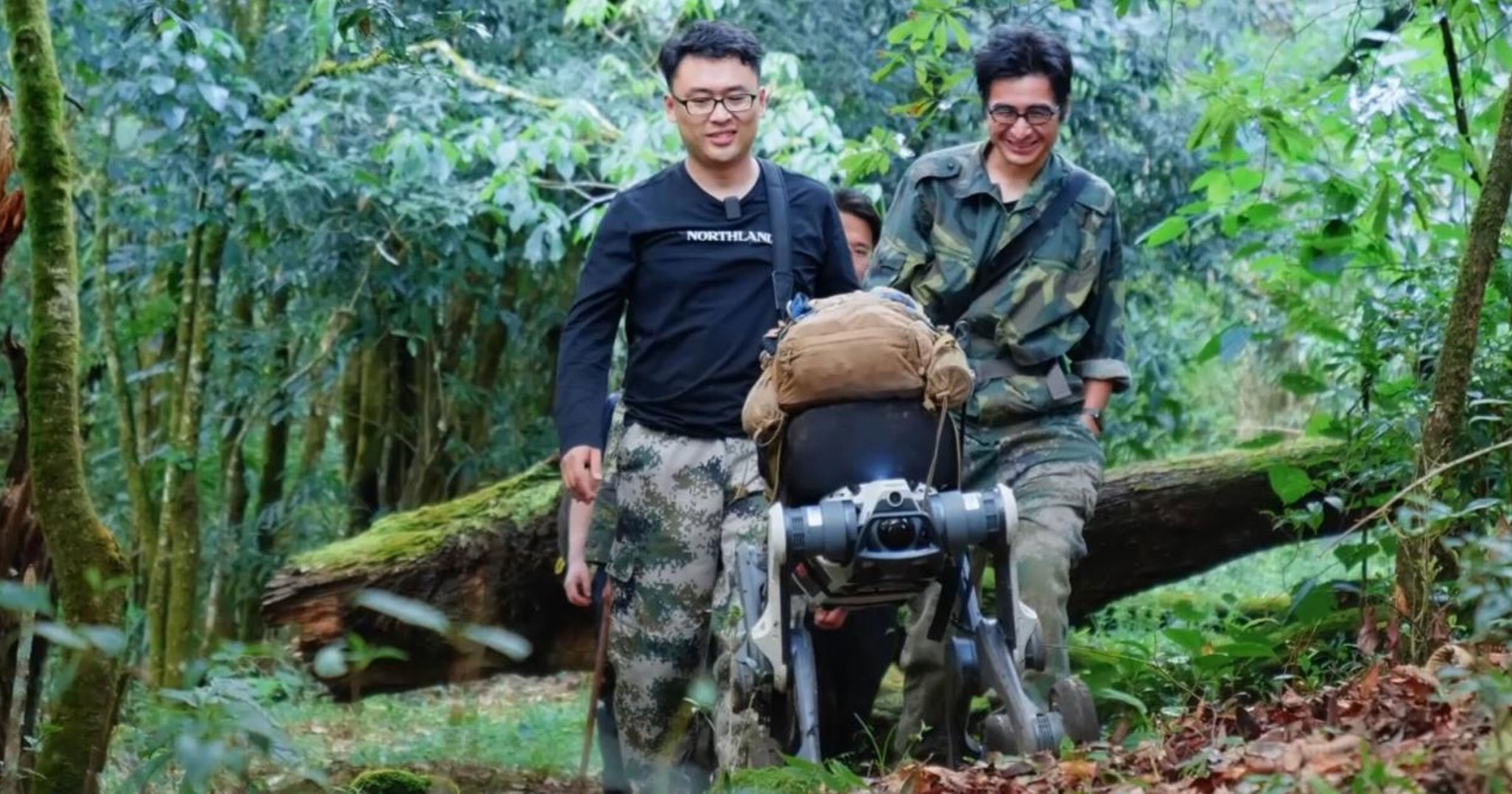
A biodiversity research team journeying into the incredibly diverse subtropical forests of China’s Ailaoshan Mountains took a strange companion with them: a robotic dog.
The robot, a Lynx M20S developed by DEEP Robotics, assisted the team on a trip organized by the China Association for Scientific Expedition, China’s state-run tabloid the Global Times reported. Photos of the expedition show the researchers using the robot like a pack mule to carry field and imaging supplies, though the unit reportedly also assisted with other tasks like route scouting, image recording, and data collection.
At one point, the robot was even used to capture footage of a rare parasitic plant known as Monotropa uniflora, as well as forest gibbons (though, to be fair, these are tasks a human scientist could surely perform just as well.)
Whether the expedition amounts to a practical deployment or a frivolous gimmick probably depends on how you view commercial robots as a whole. Though it can carry a load of about 220 pounds, the battery life on the Lynx M20S lasts just 2.5 to 3.5 hours, likely putting a decent burden on any researchers who have to lug replacement batteries up the Ailaoshan Mountain range or figure out a way to charge them in situ.
At the same time, it makes for a pretty effective product demo. The Ailaoshan Mountain range and its surrounding area are notoriously treacherous, with navigation of ravines and dense primeval forests complicated by extreme outbursts of precipitation. In 2021, a rapid change in weather on the range resulted in the deaths of four experienced geological researchers — an illustrative example of the kinds of conditions one can expect on the Ailaoshan Mountains.
As a device designed for challenging outdoor terrain, the Lynx M20S’s apparently successful participation in this trek seems to validate the company’s engineering efforts.
Elsewhere, DEEP robotics’ robo-hounds have reportedly assisted with underground tunnel excavation, patrolled urban streets during the 2026 FIFA World Cup, and helped firefighters extinguish blazes.
More on robots: Chinese Startup Shows Off Robot Horse You Can Actually Ride
The post Jungle Research Expedition Using Robot Dog Like a Pack Mule appeared first on Futurism.
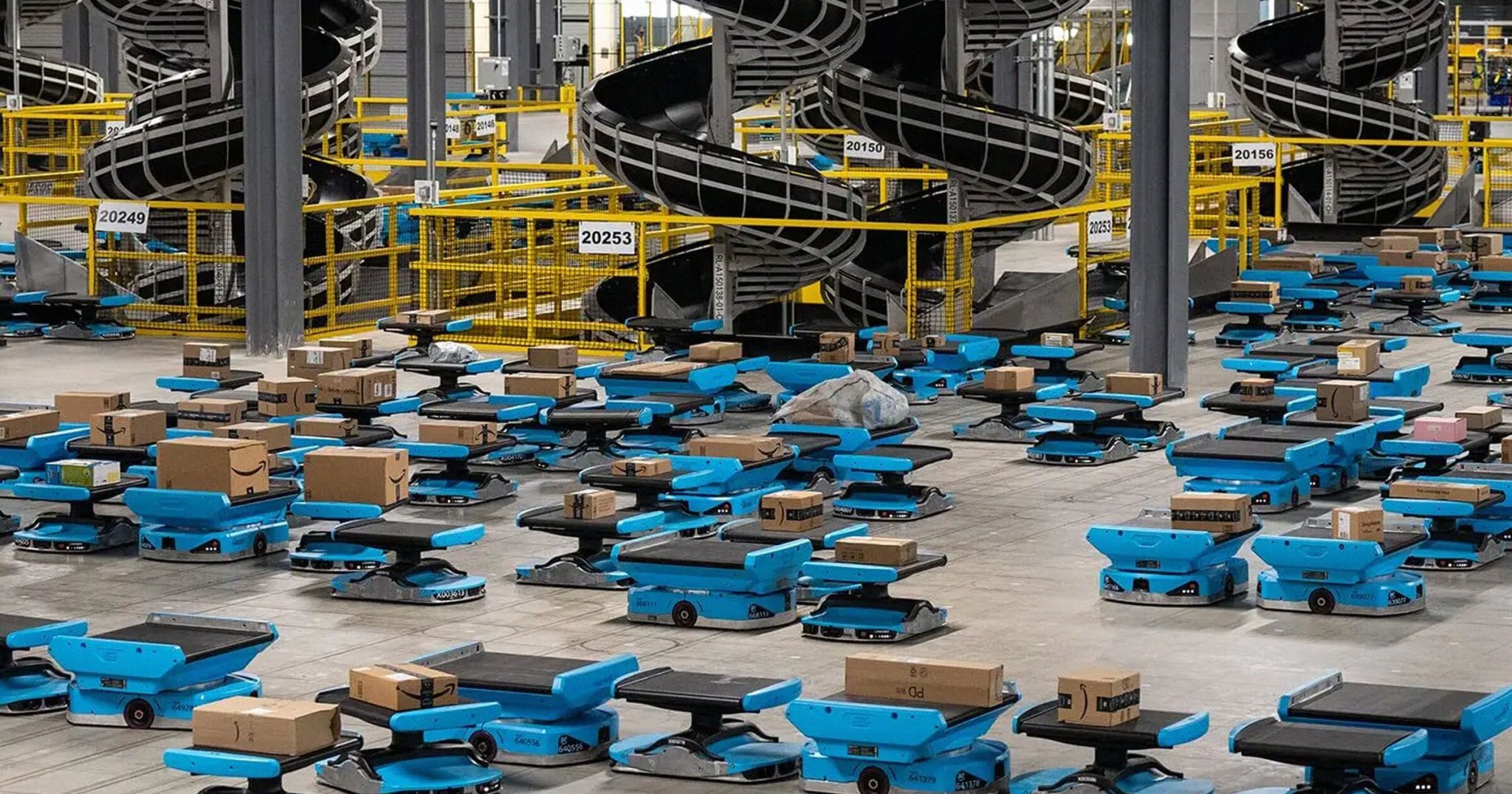
Amazon has officially surpassed a fleet of 1 million robots, an arsenal of mechanical arms, Roomba-like floor loaders, and hulking pallet sorting machines.
Each robot is a node in an intricate web allowing the corporation to speed up delivery times and lower overhead. But for the over 1.5 million full- and part-time workers relying on Amazon wages to pay their bills, the company’s bot army represents rising competition — not just metaphorically, but physically.
As George Mason University professor of business Brad Greenwood told Ars Technica in a recent interview, Amazon’s warehouse robots aren’t just helping Amazon cut costs on labor, but are literally boxing humans out of workspaces in the company’s facilities.
“For the last 100 years, most of the automation that we’ve seen usually happens away from workers,” Greenwood explained. “You’re taking that high-risk task away from the worker, and you’re doing so in a way that is not physically proximate.”
Yet the growth of Amazon’s robot fleet “really changes that dynamic for two reasons: one is that it is physically proximate, and two, the robot has the ability to dictate the pace of work,” Greenwood continued.
That shifting terrain is great for Amazon’s bottom line. The robots help decrease friction across the company’s vast logistics empire, increasing speed and strengthening the company’s bottom line. And by allowing robots to “dictate the pace” of work, as Greenwood put it, Amazon is also loosening its need for human labor, disempowering workers both on an individual basis and in any potential collective bargaining arrangements.
Beyond the shop floor, Amazon’s robots also serve as a near-constant source of buzzy PR, as exciting achievements in automation overshadow the more mundane but widespread reality of workplace injuries. It’s especially convenient for Amazon, as conditions in the company’s facilities appear to become more dangerous as more robots roll out to the floor (and that’s to say nothing of the impact of AI-mediated human resources).
As director of strategic research at the trade union coalition Strategic Organizing Center, Joan Moriarty, told Ars: “Amazon likes to talk about its latest robots because it doesn’t want to talk about the tens of thousands of Amazon workers who are injured every year due to Amazon’s obsession with maximizing speed and minimizing costs.”
More on Amazon: Amazon Warns Local Communities to Stop Defying Its Massive AI Data Centers
The post Amazon Has Now Deployed Over 1 Million Robots, Which Is Bad News for Its 1.5 Million Workers appeared first on Futurism.
Police in Cologne, Germany, have seized a humanoid robot after a pair of livestreamers used it to sexually harass a teenage girl.
According to a police statement released Monday, the robot “allegedly touched a 16-year-old girl on the buttocks and performed thrusting motions against” her.
There’s not much “alleged” about the incident, though, since the IRL streamers recorded everything that happened while live on Twitch.
The robot’s owner is 16-year-old German IRL streamer Agaamuza. For the past few weeks, according to 404 Media, he’s been filming himself and his friends wandering the streets of Cologne while accompanied by a humanoid robot from the company Unitree, which they dress in a ridiculous outfit and have fixed with a mustache. They spend a lot of the time using the robot, which they’ve nicknamed Ahmed, to bother and outright harass strangers, most of them women.
In clips of the recent incident circulating online, the robot encounters a group of girls standing on the street at night. Then, it just so happens that the robot, after having no problems walking down a busy sidewalk, plows directly into one of the girl’s behind.
“Oh my god stop,” one of her friends says.
Agaamuza and his crew act as if they’re shocked by the robot’s actions, but ask the girls if they want to meet the robot. When she and her friends say no, the robot starts thrusting its hips provocatively in front of them. The girls, repulsed, move away.
This is just one example, though. In plenty of other videos, Agaamuza tricks unsuspecting women into being friendly with the robot before it suddenly springs into doing something pervy, like humping a woman as she’s hugging it, or making masturbatory gestures. Then Agaamuza’s posse play dumb and pretend to be appalled by what’s happening.
Make no mistake: these robots aren’t autonomous and everything they do is controlled by a human operator. Those hip thrusts and other gross gestures are pre-programmed moves, not something that’s happening spontaneously.
Nonetheless, the German police statement added an unnecessary air of mystery to who was responsible for these actions, saying that it’s now “investigating how the robot was operating at the time of the incident and whether someone was deliberately controlling its movements.”
This is unfortunately another example of how men looking for clout are using the latest gadgets to target women. Plenty of other livestreamers and Instagram “pick up artists” are using Meta smart glasses to film themselves harassing girls on the street and record them without their consent.
More on robots: Walmart Running Into Trouble as Its Super-Expensive Robots Can’t Handle the Realities of Warehouse Work
The post Livestreamers Film Themselves Using Humanoid Robot to Sexually Assault Teen Girl, Prompting Police to Seize the Bot appeared first on Futurism.

Experts have long argued that our current obsession with humanoid robots may be at least a little bit misguided.
After all, the awkward form factor of a torso teetering on two spindly legs isn’t exactly the pinnacle of motor proficiency, let alone suitable for every job.
But what if we were to double the height of the humanoid robot and gave it terrifying hydraulic actuators that give it far beyond superhuman strength?
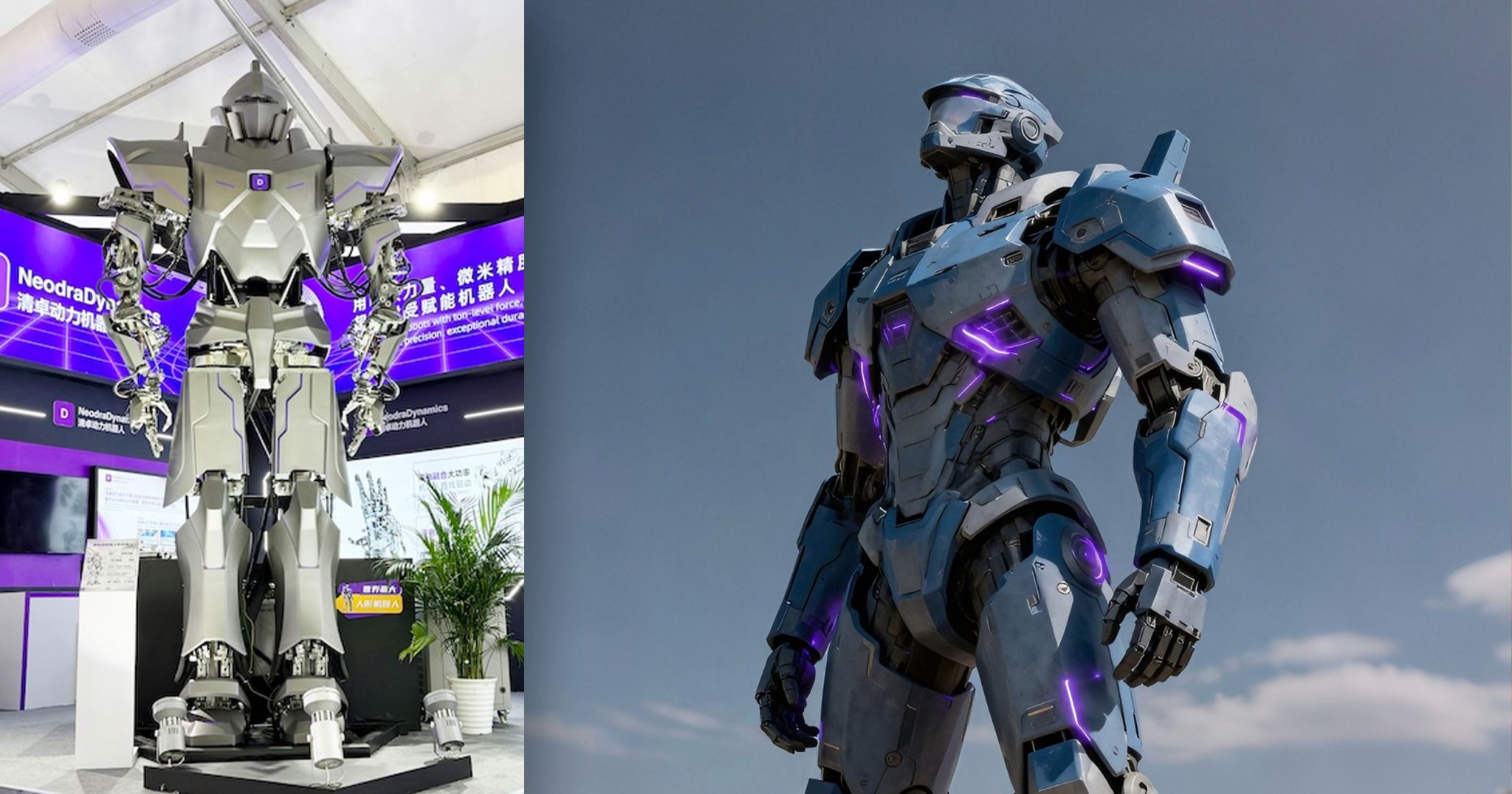
That’s precisely what Beijing-based company NeodraDynamics Robotics has done. At this year’s China International Industry Fair, the company showed off an imposing, 13-foot and 1.2-ton robot dubbed Neo1 — and it looks like it was yanked straight out of a pulpy sci-fi movie. Photos show the behemoth towering above the heads of convention goers.
Instead of relying on electric motors, the company opted for a “hydraulic-electric hybrid drive” that, according to a boisterous press release, “thoroughly eliminates robots’ power and environmental adaptation anxieties.”
In other words, it’s akin to a highly sophisticated excavator in the shape of a 13-foot giant. But unlike an excavator, the robot has “41 full-body active degrees of freedom” and can carry over 1,100 pounds in its beefy arms. It also has a claimed “repeated positioning accuracy” and fingertip precision of a single micrometer.
NeodraDynamics Robotics is envisioning its Neo1 mecha as the ultimate “sky, ground and sea” responder, assisting during “aerial inspection, underground mining, and deep-sea engineering.”
It can withstand “ultra-high underwater pressure to execute subsea equipment maintenance,” as well as shock and pollution, making it a candidate for “efficient demolition, clearance and hazard zone operations.”
But while we continue to gaze upon the mecha in awe, we’ll wait for an actual showcase before we render full judgment. After all, the Neo1 would be far from the first Chinese piece of vaporware that never turned into a reality.
Apart from the breathless press release, the company’s website doesn’t elaborate a whole lot either. Even more importantly, we have yet to see the robot in action.
In short, it’s a wild idea that may or may not usher in a new era in industrial mechanical engineering. And judging by its inspiring looks, it’d look pretty cool from afar at a construction site — as long as it never decides to turn against humanity, that is.
More on humanoid robots: Scientists Create New Humanoid Robot That Flinches in Fear When You Come Close
The post China Builds Actual Giant Mecha appeared first on Futurism.
No organization in the world operates more robots than Amazon. The company already has more than 1 million robots working in warehouses around the clock to make tens of millions of same-day and one-day package deliveries happen on a daily basis—and Amazon is poised to significantly grow that robotic fleet in the coming years as it establishes new factories to churn out increasingly more capable robot workers.
Despite deploying so many robots, Amazon is also the second-largest corporate employer in the world, with more than 1.5 million full-time and part-time human workers, according to its 2025 annual report. Amazon executives say that the growing robot fleet has eased the burden on its human workforce by taking on the toughest fulfillment center tasks that carry the greatest risks of physical fatigue and injury. But labor advocacy groups and independent researchers point to evidence suggesting that warehouse automation driven by AI is not all upside for the humans who work alongside robots.
“For the last 100 years, most of the automation that we've seen usually happens away from workers—you're taking that high-risk task away from the worker, and you're doing so in a way that is not physically proximate,” Brad Greenwood, professor of business at George Mason University, told Ars. “The rise of collaborative robots really changes that dynamic for two reasons: one is that it is physically proximate, and two, the robot has the ability to dictate the pace of work.”


© Amazon
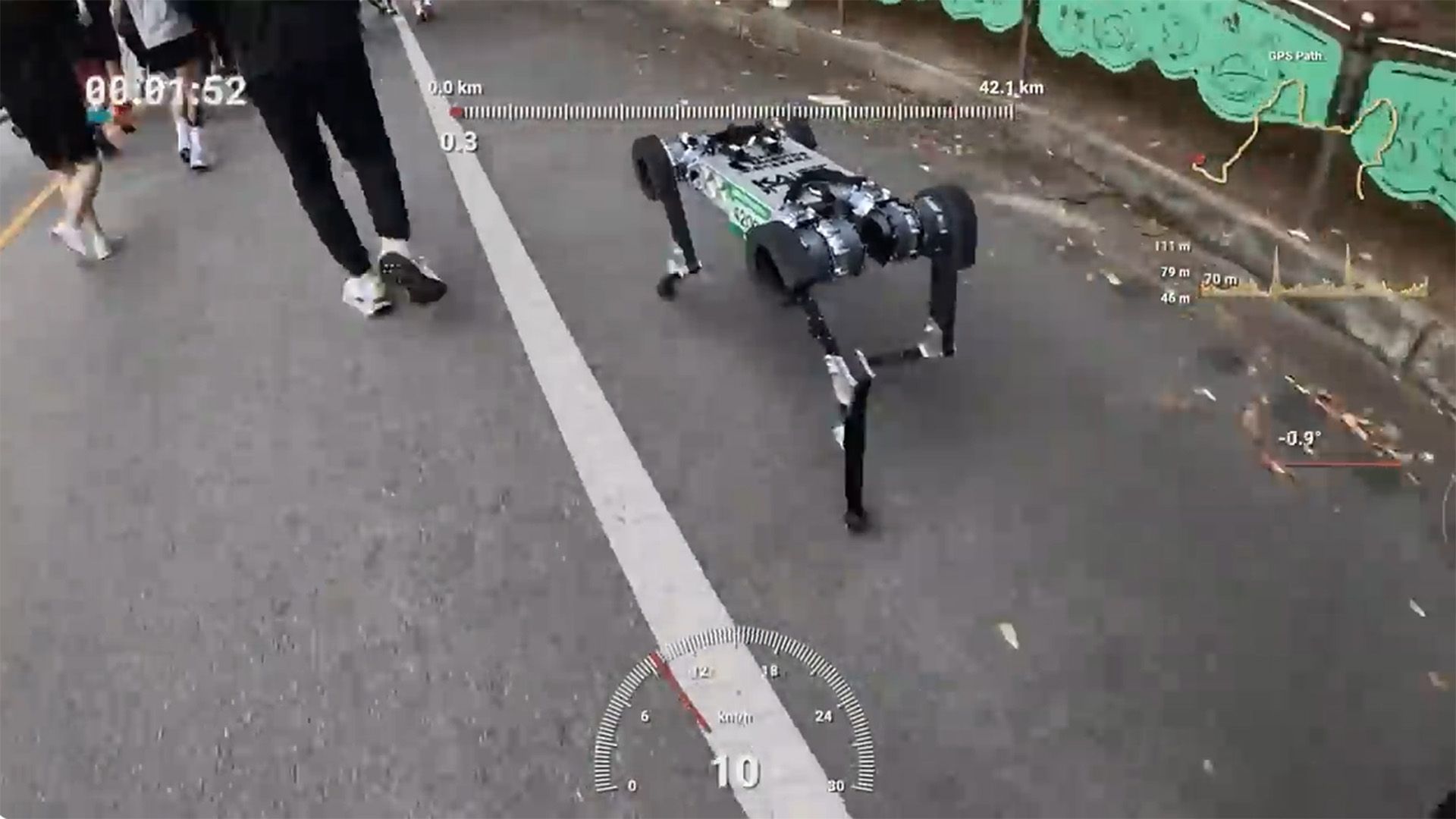
A four-legged robot completed a full marathon on a single battery charge, covering 26.2 miles (42.2 kilometers) on a hilly public-road course in South Korea two years ago. Now we know a lot more about how it achieved this record-breaking feat.
The dog-like robot, called RAIBO2, finished the 22nd annual Sangju Dried-Persimmon Marathon in just over 4 hours, 19 minutes. The bot's developers say it's the first quadruped robot to have completed an official marathon-distance event without stopping to recharge. They're commonly referred to as "robot dogs" because the movement of their joints in both front and hind legs resembles that of canines.
The scientists outlined their findings about the robot's feat, which it achieved Nov. 17, 2024, in a study published Sept. 23 in the journal Nature.
This achievement represented a new milestone in overcoming a critical limitation for quadruped robots: endurance. Although four-legged robots can cross difficult terrain that wheeled machines struggle to traverse (like stairs and rugged trails), their endurance has been limited because powering multiple joints while repeatedly lifting and stabilizing the machine's body consumes huge amounts of energy.
"Unlike wheeled robots, quadrupeds continuously expend energy at their joints to support body weight and incur kinetic energy losses during intermittent foot-ground contact," the researchers wrote in the study.
RAIBO2's race was a demanding real-world trial. It took place during the Sangju Dried-Persimmon Marathon, with the bot racing alongside human participants. The route covered two 50-meter [164 feet] elevation climbs, with slopes of up to 10 degrees. Those kinds of gradients put increased strain on the robot's energy resources, stress-testing the bot's battery management capabilities, the scientists said.
RAIBO2 had previously run a 26.7-mile (43 km), GPS-guided route across a flat athletic field, which it knocked out in 4 hours, 40 minutes on one charge. However, an earlier marathon attempt across uneven terrain against other competitors had to be aborted around the 23-mile (37 km) mark after the robot's battery ran out. The robot's developers attributed that shortfall in part to frequent pace changes as the machine attempted to adjust to the pace of nearby runners.
To compensate, the team boosted the robot's battery capacity by 33% and tinkered with the control system, including implementing joint-stiffness control at the actuator. This allowed the bot to soften its leg when it had to absorb an impact or it needed a stable, forceful push-off. After the adjustments, RAIBO2 expanded to a maximum range of 41.6 miles (67 km) on a single charge, albeit on straight paths, according to the researchers.
Another key metric was RAIBO2's total cost of transport — a measure of the energy required to move a body over a given distance, with lower values indicating less energy expended. Researchers reported that RAIBO2 achieved a total cost of transport of 0.25, compared with a human benchmark of 0.37. The researchers said their machine was the first quadruped robot to surpass that figure.
The team attributed that efficiency to several optimizations across RAIBO2's software and hardware. Especially vital were its lightweight mechanical components, which were capable of transmitting kinetic energy from its joints with very little interference. They also credited a low-loss motor-driving circuit and, on the software side, a locomotion policy specifically streamlined to limit energy use. The system was also trained using the team's simulation environment, called RaiSim, which includes models of slopes, stairs and icy roads.
Like many electric vehicles, RAIBO2 can regenerate some battery by capturing kinetic energy, particularly while traveling downhill. That capability allows it to offset some of the energy it expends while climbing, though it doesn't eliminate the extra cost of hilly terrain.
The researchers said RAIBO2 has more than three times the travel range per charge of existing quadruped robots, with a total battery capacity of 2,016 watt-hours. It's in part because of that capacity increase that the team now estimates that the robot could travel up to 15.5 miles (25 km) farther than its marathon stint, up to a total of 41.6 miles (67 km).
That kind of endurance could broaden the roles for quadruped robots in places where wheeled models are impractical, the developers added in the study. For example, they could be useful in disaster zones and mountainous areas, where a sufficiently mobile, high-endurance robot could carry cameras, sensors or communications gear across uneven terrain.
The animal kingdom has influenced several robot designs over the years to solve fundamental challenges in propulsion and movement — from horses to insects. Now, frogs are the latest creatures to inspire roboticists.
As seen in a new study published Sept. 18 in the journal Science Advances, researchers probed how twisting bent elastic rods could produce a "snapping motion" that enabled a small robot to hop or swim. This mechanism could be used to improve robots with limited power and ones that need to traverse rough terrain and even water, the scientists said in the study.
They also built a prototype to demonstrate the work. The palm-sized robot weighs just 3.4 ounces, or about as much as a deck of playing cards. It moves about three body lengths per second — launching itself forward with short jumps.
"The broader opportunity is to let the mechanics of the robot do some of the work that would otherwise require larger motors or more complicated control," Xiaonan (Sean) Huang, an assistant professor of robotics at the University of Michigan and co-first author of the study, said in a statement.
"By programming when an elastic structure stores and rapidly releases energy, we can give small robots access to powerful, repeatable motions without continuously demanding high output from the motor," Huang explained. "In the future, this principle could be useful for robots that must navigate cluttered terrain, overcome obstacles, reorient quickly, or operate across both land and water."
When a flexible rod bends and its ends are rotated, it can eventually reach a point where it changes shape to release built-up tension, the roboticists said. However, this change does not always happen in the same way. Some combinations of bending and twisting cause the rod to change shape gradually, while other combinations force it to snap rapidly from one shape to another, with the potential to provide a strong push.
The team used computer modeling and experimentation with a robotic arm to repeatedly deform the rods and find an optimal shape. In this case, they settled on a helix similar to a coiled spring to give the rod its maximum release of energy, the team reported.
With the ideal propulsion mechanism, the team then designed and built real robots that used the snapping rods to hop. They connected these rods to a rotating motor, with the bent rods twisted until they produced the snapping motion. Then, the motor unwound the twist and contorted the rod again.
"Because the design rules depend on the rod’s shape and how its ends are moved, they work across different sizes and scales," Khalid Jawed, an associate professor at UCLA's School of Engineering and co-first author of the study, said in the statement.. "This opens a promising path toward miniaturized robots just a few millimeters in size that turn small motor movements into powerful bursts of motion," said Jawed, whose lab worked on the simulation and robot arm experiments.
The final form of the prototype was a frog-like robot with a pair of snapping rods at the rear of its main body. Tests included hopping over a broad range of surfaces, including solid materials like wood and glass, as well as trickier soft and slippery surfaces that used materials like leather. The scientists also tested the robot outdoors on sand and grass, noting that it could even climb and descend steps and, with paddle attachments, swim.
By using only one of the snapping rods, the team enabled the robot to turn and, with a remote control, navigate a small obstacle course.


OpenAI’s frontier intelligence model GPT-6 Astra has completed the Orc starting area in World of Warcraft in about 40 minutes without processing a single rendered game frame, according to the developer of the open-source agent-wow project.
Instead of seeing the game through screenshots or computer vision, the AI reconstructed its environment from server network messages and game data, then built its own tools to navigate and play.
The experiment was conducted on a private local server running AzerothCore, not Blizzard’s live World of Warcraft service. The developer gave Codex, running GPT-6 Astra at its high reasoning setting, a single instruction: create an Orc character and complete all quests in the starting zone. The agent reportedly finished the run without dying.
The unusual part of the experiment is how little conventional game automation was provided to the model. Agent-wow does not use computer vision, screenshots, or direct keyboard and mouse controls. Instead, it allows an AI agent to communicate with the game server through World of Warcraft’s network protocol, Tom’s Hardware reported.
The project also does not provide predefined movement, combat, or interaction systems. The agent is expected to build the capabilities it needs through modules. During the run, GPT-6 Astra created a module that could process dozens of different server messages and keep the resulting information in memory. A Python script then used those messages to construct the model’s view of what was happening in the game and send actions back to the server.
That meant the model could determine things such as its surroundings, quest progress, and available targets without ever receiving the visual information a human player normally relies on.
The experiment therefore tests something different from simply teaching an AI to recognize a game screen. The model had to reason about a structured but unfamiliar environment using the information available through the game’s underlying protocol.
The agent also had access to AzerothCore’s underlying data, including SQL files containing information about quests, NPCs, and spawn locations. It used those resources to determine where quests started and ended, and how different objectives were connected.
The developer said the model effectively created a plan for completing prerequisite quests in sequence. It also managed routine tasks such as selling unwanted items, equipping better gear, and training abilities before reaching the final cave in the starting area.
Navigation was another problem the agent had to solve, with GPT-6 Astra generating a C++ helper that used AzerothCore’s navigation-mesh data, known as mmaps, to calculate routes. The helper used the Detour pathfinding library to generate waypoints between locations, which the agent could then follow.
The developer said the system even encountered locations where collision information appeared to be incomplete and was able to exploit those map quirks. That makes the result interesting, but also means the run should not be treated as a straightforward test of how well an AI can navigate an unmodified commercial game world.