Doom is much more than a classic, bloodsoaked first-person shooter known for its chaotic action, over-the-top weapons, and challenging boss fights. For some odd (but very enjoyable) reason, it’s served as a benchmark for testing basic computing capabilities for well over 30 years. Name a device——calculators, ATMs, digitally enabled tractors, and even biochips built with E. coli bacteria—and someone has likely coded it to run Doom.
The latest entry in the ever-growing list of Doom compatible contraptions is a double-dose of DIY ingenuity, however. The Linux software engineer known as Miss Molerat recently began tinkering with a pocket-sized medical gadget made specifically to keep track of her menstrual cycle. But unlike many similar commercial products, “Clotty” keeps all personal data strictly on the device itself. It never connects to an external cloud or offloads sensitive information to a company’s servers, thereby preventing any unwanted data harvesting. And it does all this on a custom, uterus-shaped minicomputer running on a Raspberry Pi microcontroller.
Clotty includes a Tamagotchi-like sprite players must maintain and keep happy. Credit: Miss Molerat
“I have one thing that has been bothering me for as long as I’ve been menstruating: despite my cycle being very regular, I somehow manage to get surprised by PMS each and every month anew,” Clotty’s inventor wrote on her website’s blog.
Clotty “does the boring stuff” for her by tracking her period via a Tamagotchi-like digital pet that requires attention and maintenance throughout each month. The pixelated creature’s mood shifts depending on the cycle phase, but it also can go on little quests and offer various minigames in the meantime.
“[It’s] basically some sort of adorably shaped mirror version of my own moods that serves as a reminder that I, too, am just some sort of creature that tries to stay alive and happy,” explained Clotty’s creator.
But why stop there? Clotty is powerful enough to run Doom on its itty-bitty LCD screen, which is thematically perfect given the project’s overarching, bloody motif. This means that, when not keeping up with personal health, a user can also blast through wave after wave of space demons using small onboard sensors.
The inventor admitted that Clotty is still in its “fetal stage,” but she plans to add more features like a menstrual cycle history archive, more games, and even some reproductive health trivia. It’s also a completely open-source project, so anyone can follow her online tutorials and download files for Clotty (and Doom).
The concept of a corporate psychopath is eerily recognizable, depending on your work history. It’s also notoriously misunderstood. The archetype of the manipulative, self-serving manager has regularly resurfaced in popular culture for decades, but concrete evidence supporting the wider concept is debatable. For example, a research study went viral in 2016 after estimating upwards of 1-in-5 business employees fit the “psychopath” bill, only to be retracted two years later. Additionally, psychiatrists widely agree that only about 1 percent of the general population truly can be considered clinically psychopathic.
That said, many of the people determined to claw their way to the top of the company ladder display at least some of the trademark psychopathic behaviors. Many theorists have convincingly argued this has a lot to do with corporate capitalism’s foundational principles, which leave it easily exploited by the most ruthless and manipulative among us.
Clive Boddy, one of the world’s foremost investigators of corporate psychopathy, recently took this idea to its logical historical conclusion. In a study recently published in the Asian Journal of Business Ethics, Boddy reviewed one of toxic corporate leadership’s earliest documented examples—and he makes today’s nightmare coworkers sound tame in comparison.
Who was Jeronimus Cornelisz?
Meet Jeronimus Cornelisz, an all-time contender for World’s Worst Boss. According to archival accounts, the 17th century Dutchman Cornelisz embodied every core corporate psychopath characteristic over 400 years ago while working for the conglomerate that started it all: the Dutch East India Company.
Established in Amsterdam in 1602, the Dutch East India Company is arguably the world’s first multinational, shareholder-owned company. It quickly amassed enough funds and power to rival most sovereign countries through the import and export of spices, tea, luxury items, coffee, wine, and enslaved populations. The Dutch East India Company eventually exerted enough influence to wage its own wars, mint its own currency, form colonies, as well as arrest and execute convicts.
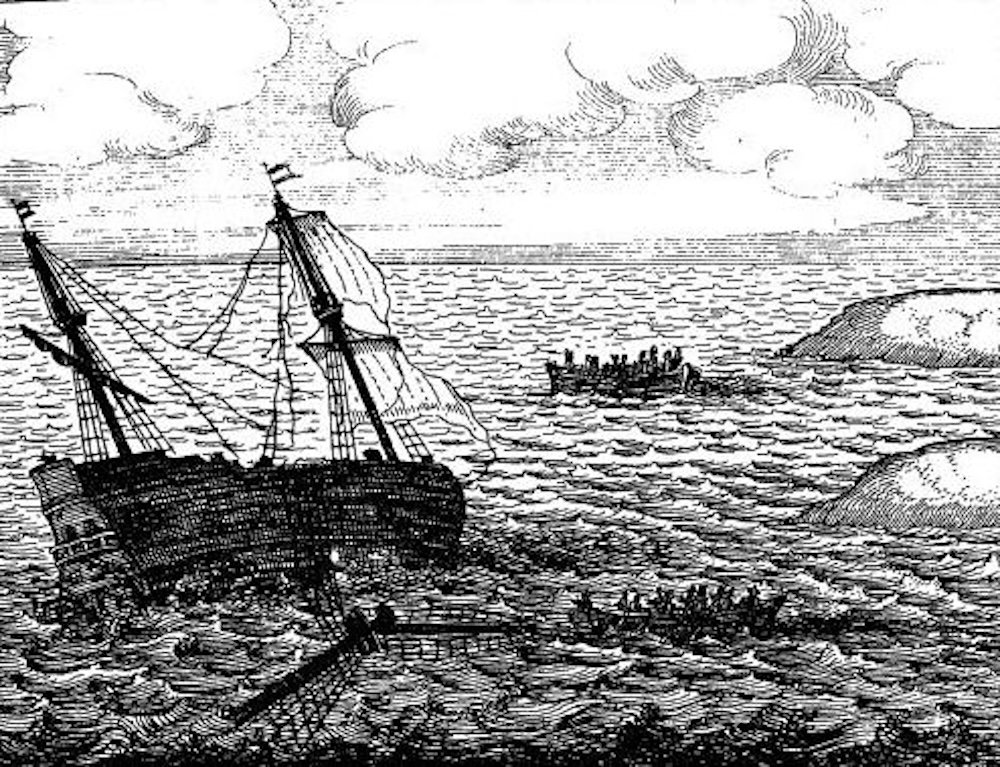
All of this was made possible through a vast fleet of ships,but even the best outfitted vessels sometimes fell afoul of nature. In June 1629, a Dutch East India Company’s flagship called Batavia collided with a reef off the Western Australian coast. Nearly 300 survivors made it to the nearby island shores, but their remote location ensured they wouldn’t survive without help. The ship’s senior officers soon set off in an open longboat on a 1,900-mile journey to present-day Jakarta, then the Dutch East Indies’ capital. Before leaving, they appointed under-merchant Jeronimus Cornelisz to the top corporate position in their absence.
An illustration from 1647 depicting survivors being transferred from the wrecked Batavia to nearby islands in the ship’s boats. Credit: Wikimedia Commons
Mutiny, murder, and malignant narcissism
Unbeknownst to Batavia’s departing senior crew, Cornelisz had already spent weeks scheming on ways to incite a mutiny. The plan was to take control of the vessel then steer its copious stores of gold and silver to a new life. Cornelisz apparently viewed getting marooned as an inconvenient detour, and quickly got to work on his hostile takeover.
According to firsthand accounts, Cornelisz immediately consolidated power by swapping fellow council members with loyalists and requiring them to pledge an oath of allegiance to him. Next, he tricked suspected opponents under the direction of a soldier named Wiebbe Hayes to search a nearby island for supplies, then left them to die.
Although his revised plan required any impending rescue ship, Cornelisz’s ultimate goal remained the same—get as far away as possible, then start his own kingdom using riches plundered from Batavia. Over the ensuing months, Cornelisz directed his gang to kill more than 100 of the shipwrecked men, women, and children. Cornelisz often justified the murders under the pretense of conserving food and water, when in actuality he was continuing to eliminate perceived threats. Meanwhile, some of the surviving women were subjected to sexual abuse.
However, Cornelisz underestimated his abandoned compatriots. As the operatically psychopathic Cornelisz terrorized his group of survivors and scrounged for supplies, Hayes’ team reportedly discovered freshwater wells and hunted local wallabies, seals, and fish. The two sides subsequently squared off on multiple occasions after learning of each others’ continued existence until a rescue ship finally arrived in October 1629. After nearly three months, only about a third of Batavia’s original passengers and crew were left.
Management ultimately decided Cornelisz wasn’t internal promotion material, even by Dutch East India Company standards. Nearly everyone involved in his reign of terror was executed. As for Cornelisz and his closest loyalists, authorities eventually hanged them, but not before cutting off their hands.
The tragedy of the Batavia is an admittedly extreme case study, but Boddy argued that it illustrates how corporate structures have facilitated and encouraged psychopathic behaviors since the invention of the corporation itself.
“The same playbook we see in toxic workplaces today appears in this case from 1629,” he said. “He removed opponents, rewarded loyalists, created fear, manipulated followers and pursued power at any cost.”
A corporate (psychopath) case study
In recent years, some historians have expressed doubts about details in the Batavia saga after reviewing available evidence and recontextualizing cultural dynamics. Instead of focusing on the machinations of a single ruthless corporate psychopath, they contend Batavia is more accurately a case study in group desperation. But even when viewed under this lens, the chilling event is still a cautionary tale about corporate capitalism’s darker underpinnings.
“Perhaps the most striking finding is that another leader facing the same circumstances achieved completely different outcomes,” Boddy said. “This was effectively a natural experiment in leadership. One group prospered while the other descended into murder and abuse.”
Medical researchers in Washington state are tracking an unusual spike in H1N1 flu cases, aided and abetted by a new mutation that protects the virus against some preexisting antibodies.
An apparent leak prompted Merck and Moderna to release the full trial results ahead of schedule, but investors puzzlingly greeted the good news by sending the companies’ stock prices down.
Microsoft’s new AI diagnostic system beat generalist doctors on hard cases, according to a study in Science. But most of the improvement seems to come from the AI models underneath, not from Microsoft’s system itself.
Dr. Nick Medford’s patient had plenty of reasons to be terrified of a simple blood test.
His body had shrunk down to a fraction of its size, or so he believed, and the physicians looming over him were enormous. Then there was the needle about to pierce his vein: to the patient’s eye, it was larger than his entire arm.
It might sound like something out of Alice in Wonderland. But this patient’s story belonged to a different genre entirely. Horror, namely. As far as the patient was concerned, there was no point in taking his blood. It was no longer human. Neither was he.
Medford’s patient was suffering from clinical lycanthropy, defined as the delusional belief that one is turning into a werewolf. And unlike the flesh-tearing beasts of folklore, who terrorize the unsuspecting by the light of the full moon, patients like Medford’s are often the ones haunted, trapped inside a body-horror nightmare.
According to Medford, his patient knew something was wrong, but was as confused about his condition as anyone. “Not only did he think he was a werewolf, but he would also talk about things like wanting to realign the cosmos and wanting to kill God,” says Medford, a neuropsychiatrist with the South London and Maudsley NHS Foundation Trust.
“And then you would say, ‘Do you believe in God? Are you religious?’ And he’d say, ‘No.’ His ideas didn’t really make sense even to him, which was a part of his distress.”
So, what causes this rare condition? And why does it take the form of one of Halloween’s classic monsters?
Rarer than movie werewolves
If you’ve never heard of clinical lycanthropy before, there’s a good reason: Hollywood’s werewolves easily outnumber the real-life cases of this condition. Only about 25 instances have been reported in the medical literature.
Because there are so few cases, Medford says it is difficult to identify a common cause or predictable disease course. However, he says that typically it is seen in patients already experiencing mental illness.
“In around 40 percent of published cases, it occurs in the context of schizophrenia,” Medford says. “There are also reports of it occurring in the context of bipolar disorder or psychotic depression. So, in the context of severe mental illness, basically.”
Experts debate whether German artist Lucas Cranach the Elder depicts a werewolf or a cannibal in this woodcut print from the 16th century. Image: Public Domain
Medford’s own patient had been diagnosed with Huntington’s disease, an inherited, fatal brain disease that causes psychiatric symptoms and uncontrolled body movements. The case, which Medford documented in a 2023 report, was the only published instance of clinical lycanthropy associated with Huntington’s. Although Medford says it is uncertain what then led his patient to believe he was a werewolf, he says the physical changes associated with Huntington’s may have fed this idea.
“There may be some change in the person’s body or in their perception or their experience of their body,” Medford says. “That might be, if you like, the seed from which this idea can develop.”
This seems possible in the case of Medford’s patient, who exhibited involuntary writhing movements and other strange physical sensations.
“He did not seem to be aware that he was having these abnormal movements, but he was aware of some weird sensations,” he says. “He described freezing sensations and electric-shock-like sensations. He had some sense that something strange was happening in his body.”
Why wolves?
But physical changes alone don’t explain why the patient imagined he was turning into a werewolf. Which raises the question: Why do these delusions so often focus on lupine metamorphoses?
They don’t always, Medford notes. There’s a broader term—therianthropy—for the delusion that one has turned into any animal. But most of these cases involve canines, he acknowledges.
“Most of them are wolves or dogs or something of that type,” he says. “And then there’s a whole range of other strange things. There’s a report of someone who thought they’d turned into a bee.” That would make for an underwhelming horror movie, to be sure.
So, is it a coincidence that many of these patients report delusions ripped straight from a creature feature?
Probably not. In their case report, Medford and his co-author, neuroscientist Natasha Sigala, note that “delusions are influenced by culture,” and few cultural images of human/animal shapeshifting are as deeply embedded as the werewolf.
“The werewolf folklore and werewolf mythology goes right back to antiquity,” Medford says. “And it’s kind of interesting that the werewolf or something like it seems to pop up in a lot of different cultures and different times and places.”
American actor Henry Hull poses for a publicity portrait for his 1935 film Werewolf of London. Image: Getty Images / Stringer / Archive Photos
Why is the werewolf legend so potent and enduring? Medford suspects it may tap into something primal.
“The werewolf symbolizes something about the human condition,” he says. “We live in civilized societies, and we adhere to social norms, but there’s a sort of animal part of us that perhaps chafes against that.”
That internal conflict may explain some of the patient’s other fixations. He described urges to strangle his wife and to defecate in a church. Medford notes that Huntington’s may also have impaired his sense of disgust, which can happen as the disease progresses.
Yet the patient also fought against his own impulses. At times, he lunged at staff, only to pull back and apologize.
“You could see the conflict in that moment,” Medford says. In that sense, the patient wasn’t so far from the werewolves of fiction. Like a movie werewolf beholding his mirror image in horror, he looked at his reflection and saw himself changing in ways he couldn’t control.
The werewolf fades
For Medford’s patient, that dreaded blood test ultimately was part of a turning point in his treatment. The bloodwork allowed Medford to keep the patient on clozapine, a potent antipsychotic. As Medford increased the dose, the patient’s delusional beliefs dwindled, and although the underlying Huntington’s disease remained, the werewolf soon was gone.
Medford hopes patients like his will be treated with compassion rather than sensationalism. “These cases, they’re rare, but when they do happen, they tend to arise in the context of serious psychiatric or neurological disturbance,” Medford says. “They are people meriting sympathy and treatment, rather than romancing about it.”
In Ask Us Anything, Popular Science answers your most outlandish, mind-burning questions, from the everyday things you’ve always wondered to the bizarre things you never thought to ask. Have something you’ve always wanted to know? Ask us.
Women surveyed about their treatment for hyperemesis gravidarum, a severe form of nausea and vomiting during pregnancy, reported delayed or missed diagnoses, inadequate clinician knowledge of treatment guidelines, denied or discontinued medicines, and structural barriers restricting access to appropriate care. The qualitative study of 189 women, published in the Journal of Pharmacy Practice and Research, found that these experiences accompanied enduring emotional and psychological effects, including anxiety and post-traumatic stress syndrome. Associate Professor Luke Grzeskowiak, who led the research team at Flinders University, said the condition affects almost 4% of pregnancies.
The survey identified several issues affecting how hyperemesis gravidarum is recognised and treated. Participants described clinicians who lacked suitable training to diagnose the condition and who were either unaware of clinical management guidelines or did not follow them. Some women said they were not diagnosed with hyperemesis gravidarum when they should have been, while others reported receiving a diagnosis only late in the course of their illness. Other participants said health professionals denied prescribing or dispensing medications. The researchers also identified educational and financial status as possible influences on treatment outcomes, together with systemic barriers within Australia’s healthcare system.
Misinformation about medicine safety further disrupted care for some participants. Some women said they stopped taking medication after reading reported safety concerns that the researchers said were not aligned with current research and management guidelines. Participants also described poor management of medication side effects, including constipation and mood disorders. Current treatment focuses on supportive care and on medicines, including antiemetics, that address nausea and vomiting. Nevertheless, women reported that their symptoms were often not taken seriously and that clinicians in several professions commonly lacked appropriate education and training to recognise and manage hyperemesis gravidarum.
The study documented emotional and psychological effects during and after the illness. Participants cited impaired quality of life, anxiety and post-traumatic stress syndrome. The researchers said some women reported that hyperemesis gravidarum influenced their decision to terminate an otherwise wanted pregnancy, while others said the trauma of a previous episode left them afraid to consider another pregnancy. Collectively, the researchers proposed improving experiences and outcomes through better education for health practitioners, greater public awareness, clearer clinical practice guidelines, expanded outpatient care, investment in specialist hyperemesis gravidarum clinics and services, changes to the Pharmaceutical Benefits Scheme, and strategies to improve medicine availability and affordability. Because the research was a qualitative survey based on reported experiences and perceptions, it does not quantify how frequently these barriers occur among all pregnancies affected by the condition.
Subject of Research: Women’s experiences of pharmacological care for hyperemesis gravidarum
Article Title: Greater access to help needed for women with nausea during pregnancy
Article References: Greater access to help needed for women with nausea during pregnancy. Original publication (Bibliographic details unavailable.)
Despite repeated warnings that wildfire-scarred mountains could unleash catastrophic flooding, officials in Ruidoso, New Mexico, prioritized tourism and racetrack investments over flood protections.
Climate Central analysis shows how temperatures boosted by human-caused climate change contributed to the number of gun violence incidents from 2021–2025 in 100 U.S. cities.

 Login











 “People who had more exposure to clinical obesity over decades had worse brain health.”